A thesis presented to the Department of Psychology, University of Canterbury
In partial filment of the requirements for the degree of
Master of Arts in Psychology
by
Helen Chambers
ACKNOWLEDGEMENTS
The author wishes to thank all those who were involved in this thesis, with thanks to Colin Burnett for writing the computer program that implemented the experiment; Ian Douthwaite for constructing the word lists and collecting data for
Experiment 2; Stuart McKenzie for constructing some of the programs used in the data analysis and spec 1 gratitude to my supervisor, Paul Russell, for his support and guidance.
1. would also like to thank Mr H.R. Unger and Dr J.A. Begg for their kind permission to carry out research at Sunnys Hospital and Sharon Branford and Graeme Clark for helping in obtaining subjects.
Finally, I would like to thank my husband, Michael, wi,thout who I s financial and moral assistance thi.s undertaking
An investigation of associative and direct priming effects of l7 schizophrenics and 17 non-hospitalized normal controls, was carr out using a reading latency task.
Assessment of capacity of short-term memory using activation spread was also. investigated. Subjects were presented with word
ons and with two kinds of lists in a variety of lag condi
fillers, (i.e. words and digits). Results showed that
CHAPTER PAGE
I Introduction and Literature Reviews 1
I I Experiments 1 and 2 and Results 17
I I I General Discussion 33
References 37
CHAPTER I
NETWORK THEORY AND LITERATURE REVIEW
Contemporary accounts of the mode of representation of information in long-term memory make use of network theory (see Anderson, 1980 for a good overview). Every idea or concept is said to be represented by a node. Wickelgren (1981) states:
"For every idea (feature, segment, word, image, concept, proposition, etc) that we can represent in our minds, there is assumed to be a particular set of
elements that represent (encodes, stands for) the idea . . . Psychologically, a node means nothing more than 'what ever represents an idea'. There must be at least one node representing any idea we have encoded in our minds, or else, by definition, we could not think about that idea." (p. 24)
In much the same way as a cortical neuron is said to have its level of activation raised by a particular set of sensory stimulation, so a node is said to have its level of activation raised by a particular set of sensory events. This is direct activation.
Some events occur together in everyday life. For
example bread and butter frequently occur together, as do salt and pepper; brother and sister, etc. In network theory, this kind of associational information is preserved in the links
joining the nodes. These links are said to vary in strength as a function of previously experienced frequency of occurrence of the event. The links provide a medium by which activation may spread from node to node. For example, on seeing bread, or on hearing the word bread, activation spreads from this directly activated node to the butter node, so that the node is acti~ated
and speeq of activation spread is said to be a function of the frequency with which bread and butter have occurred in close continguity in a person's previous experiences. Thus corrunon everyday occurrences in a person's life have the highest associational value.
Bower (1981) states:
"A relevant analogy is an elec 1 network in which terminals correspond to concepts or event nodes (units), connecting wires
correspond to associative relations with more or less resistance, and electrical energy corresponds to activation that is injec into one or more nodes (units) in the network. Activation of a node can be accomplished either by presentation of the corresponding stimulus pattern or by prior activation of an associated thought."
(p. 134).
Activation spread can be measured experimentally by means of priming tasks. For example, using a naming latency
task, the latency in reading the word "butter" is reduced if i t is ceded by a strongly associated word, e.g. "bread " , but not if preceded by a word having no corrunon association with it, e.g. IIdoctorll
• 1 dec ion and stroop tasks are corrunonly used
to demonstrate s effect. Typically in a lexical decision task subjects are presented with two letter strings and have to decide if they are words or nonwords. Meyer and Schvaneveldt
(1971). i Fisher 977)i and sher and Goodman (l978) carried out typical experiments. In each task, RT's for pairs of words is measured as a function of the assoc tive relation between two words. Results show that positive responses are faster when the
target word is presented as a visual stimulus, the time to name the ink colour of the target word increases in proportion to the forward associa strength of prime to target, (Warren, 1972).
Activation spread is the means by which knowledge is encapsulated in network theory. Seeing the nose, head and
whiskers of a ti r appearing out of the jungle, results in the activation spreading to nodes representing hindlegs, tail, etc.
Comprehension, forming a representation in memory of events is said to involve constructing new elements onto an
existing network by forming new links between nodes. Only nodes currently in an active state can be linked. (Anderson, 1980).
In network theory, short-term memory is those nodes in an active state. Nodes can only be linked when active. If activation decays too rapidly i t would not be possible, .for
example, to relate an early part of a sentence to a latter part. This is the same for the area of language production, if the activation decays too quickly continuity in thought and speech could be lost. A person would not be able to make associative connec ons between ideas and events in their environment and cognitive confusion would~result.
There have been a large number of studies carried out investigating capacity of short-term memory but very few from a decay of activation perspective. Utilizing an indirect activation paradigm to investigate decay of activation, Loftus
(l974), required subjects to retrieve from memory well learned information about categories such as fruit. Subjects retrieved instances of a category, i.e. IIFruit beginning with pll. It took an ave of 1.53 seconds to perform this task. Then at
lib". Lag was manipul
categories between
by inserting tests on other unrelated two tests. With 0, 1 and 2 intervening itemsl retrieval ,time increased with the number of items inter-polated as follows: 1.2~ seconds, 1.28 seconds and 1.33 seconds respectively for
o
to 3. Thus two items can intervenebefore the activation has almost completely returned to its resting level.
Warren (1972), designed a stroop ta to investigate associative priming. The associated words included category items, e.g. "relatives" and examples of test items belonging to that category, e.g. "aunt". The category items were presented auditorily in lags of 0, ~ and 2. A lag of 0 consists of having a prime word llowed by its common associate. In a lag of 1, the prime and common associate will have one word interpolated between them and in a lag of 2, two wo interpolated between them. There were four phases to experiment: a) words
presented auditorily, b) presentation words in coloured ink, c) subject a to name colours as rapidly as possible and attempt to ignore base word, d) subjects asked to recall the spoken word. In stroop tasks activation is measured by the degree interference vLa of namLng the colour of ink of the word. Results for this experiment showed that
activa on lasted for two intervening words. As with the Loftus
(~974) experiment there were not quite enough lag conditions to
cover total decay of ac tiona
Wickelgren, Corbett and Dosher (l980) investigated associative priming, using a speed accuracy trade-off task. Subjects saw 16 consonants with .7 seconds blank in between; a test consonant was then presented which subjects judged to be
accuracy trade-off method was employed in which subjects ssed both It yes" and "nol! keys every .4 seconds, beginning during the
blank interval. Both. keys were pressed simultaneously at first In this method, but as soon as possible the chosen response had to the other, by a time interval that reflected the
confidence of the decision. Results showed memory strength in storage lined over the 6 second interval containing the 12 items and only the last item differed from others in its speed-accuracy trade-off function. It was stated that under these conditions only the last item in memory was active. This conflicts with the results of both Loftus (1974) and Warren
(1972), who found two items active, and may well ref t the experimental paradigm employed in this latter work.
The persistence of activation in directly activated nodes can be investigated by tasks in which a word is presented as the prime and later same word is used in a lag condition. Although the direct-indirect activation is drawn by network
theorists, (Anderson, 1980), there appear no relevant published studies of the persistence of activation in directly activated nodes.
Others have purported to measure short-term memory capacity, using serial rec 1 and running recognition tasks
(e.g. See Murdock, 1974). These are not direct measures of activation decay, as they involve retrieval processes and
results can confounded by serial reca ,primacy, recency and other ef ts.
processing modes under which priming can occur. There are two distinct components of attention, 1) Automatic process, which is, a) fast acting, b) occurs without intention or conscious awareness and c) does not effect retrieval from unrelated nodes that have not been activated and, 2) Limited-capacity conscious attention mechanism, which is said to , a) slow acting, b) cannot operate without intention and conscious awareness and c) inhibits retrieval of information stored in unrelated nodes, which i t is not focused on. Posner and Snyder's theory accounts for the semantic facilitation, where the response to "nurse" would be faster following "doctor", than following "bread" because of the automatic priming effect.
Neely U977), ,investigated semantic priming by varying the time available to subjects between the priming event and the target array. Results suggest that at 250 msecs, activation has fully occurred. Fisher and Goodman (1978), carried out an
associative activation experiment, varying the time available between the priming event and the targets array. Their findings showed that at 40 msecs prime has just begun to influence the test word processing, when the critical point was passed, after which activation would no longer produce reductions in test processing time. Suggestions were, that if people were conscious of the associations between the prime and its paired associate, they could bring conscious strategies to bear,
affecting the reading latency. sher (1977), used a lexical task and explicitly instructed subjects to try and take
advantage of the presence of associations in letter strings. No effect on the size of fac itation resulted from these
different mean1ng, e.g. "palm:::: tree"; "palm:::; handll
) , pattern
masked one of his experimental lists of words, which meant subjects were allowed semantic access but were prevented from having conscious awareness of the actual words. His results showed subjects evidenced a priming effect even though they were not conscious of the initial prime. These results are all said to g confirmation for Posner and Snyder's of a two component mechanism of attention.
Several other researchers postulated theories to account for litation t, which conflict with those put forward by Posner and Snyder. Smith C1979)_, demonstrated that whether facilitation occurred depended on the manner in which the prime was processed. Subjects in an associated word task, where i t necessitated analysing both the prime and target words for a letter search, produced no litation between target and prime reaction times. Becker Cl~80), suggested subjects create an "expectancy setl1, in carrying out a word association task and can produce a litation t by using strategies, which do not necessitate reading the whole word before a processing
ision is made. Antos (197~), stated that facilitation is due to several factors working together, discriminability, teria bias and response bias.
In this thesis a reading latency task 1S employed as i t a simple task for schizophrenics and would produce a useful amount of data in a short experimental session. There has been a cost to experimental design as a result of this, in the area of loss of control over the
cue-build-up of the priming e t. That is,
duration, and the
INVESTIGATIONS INTO SCHIZOPHRENIA
Schizophrenia is undoubtedly a disorder of cognition. Over a period of thirty to forty years a large body of
terature has been produced investigating aspects of thought disorder. At Worcester State Hospital in the 1930's, pioneering research demonstrated the cognitive deficits in schizophrenic patients, (Huston, Shakow and Rigg, 1937; Rodick and Shakow, 1940). Other researchers followed, Payne and Hewleth (1960), Yates (1966). McGhie (1970) and Chapman (1956a, 1956b) carried out experiments which assumed that schizophrenics had a
defective mechanism for filtering information, or were over-inclusive in their thinking. These theories were based on
Broadbent's (1958) model of selective attention, which was found incapable of accommod ng later findings.
Kahneman (1953), postulated a "limited capacity" model or a circumscribed quantity or pool of capacity, effort or attention. This effort is allocated to simultaneous activi
which compete for supply and when more effort is expended in one direction, there is less available for other activities.
Chapman and Chapman (1965) and Chapman, Chapman and Miller (19641, hypothesized that schizophrenics have a response bias, constraining them to attend only to dominant meanings of words. They stated, schizophrenics tend to rely on the word's strongest denotive meaning, to the relative exclusion of other weaker meanings, which might have been more correct in the
context of the sentences they were being presented with. It was
equated with "concreteness of thought", associated with
smaller, that is if activ on does not persist as .long, subjects will effectively forego the priming effects of context and we would expect the strongest link, (i.e. therefore the most cornmon associate), to be available to the subject. However, consistent with this interpretation are
Willerman (1980), who tested
findings of Naficy and
zophrenics with sentences with double meanings, one of which was the normally preferred choice. Results showed that schizophr s y Ided excessively to normal biases in their choices.
There are no theories of thought disorder in
schizophrenia rooted' i.n modern network theory. The present study is therefore not directly reI to past work. Never-the-less a large body of studies investigated memory in schizophrenia. The early work in this area constructed a two part paradigm looking at recall and tion memory. Bauman and Murray (19681, constructed tasks using paired associate
1 and paired associate recognition ta s, with word lists. Schizophrenic subjects performed normally on the recognition
, in that more complex encoding and search procedures, which involve associative connections, are required recall.
In network terms, recall involves the of ac from directly-activated nodes (i.e. nodes
corresponding to retrieval cues1, through the network to target nodes, to-be-remembered items), (Bower, 1981;
(1980) . In word-lists learning tasks, the list context and task instructions usually provide the retrieval cues. For ac on to spread from these to the target words, some links must
been estab
target words at elaboration,
tween the potential retrieval cue and time of presentation. This linking, or
encoding. We would expect schizophrenics to display a recall
deficit if either the processes of activation spread do not function normally, and/or if nodes representing information
likely to serve as retrieval cues are not linked to target nodes
at the time of presentation. We would not, according to network theory, expect potential cue-target word links to be formed if activation did not persist for long enough, (i.e. short-term memory deficit), for such links to be formed.
A similar argument can be applied to the encoding of semantic relationships. Frequently word lists have been
constructed by drawing words from clearly defined categories. Although words are presented in random order, the categorical
structure of the lists facilitates recall in normals. However, since i t seems likely that such encoding requires "keeping in mindlt
that certain categories have previously occurred in the list, a deficit in short-term memory (i.e. activation
persistence), is likely to result in a failure to link words to category labels in the episodic trace of the word list, and thus category cues and the inherent list organization would not
assist schizophrenics.
Bauman (197~1 i Koh, Kay ton and Berry G973) i Russell and Beekhuis (l976); Russell, Bannatyne and Smith {1975}, all
reported results of recall impairment, which has been explained by assuming that schizophrenics are lacking in ability for
mnemonic organization.
Koh and Peterson (1978>-; Koh, Kay ton and Peterson (1976);
Larsen and Fromholdt (1976), have shown however that when the
Koh, Kay ton and Peterson (l976) had subjects view word lists
which they rated for pleasantness-unpleasantness and later had
them freely recall the lists. Schizophrenics and normals both
demonstrated the "Pollyanna tendency" to recall pleasant words more frequently than unpleasant words, evidencing that encoding was normal in schizophrenics.
Koh and Peterson (~978) exercised control via an
experimenter-imposed coding task on schizophrenic subjects and
they were required to make yes/no judgements as to whether a probe word, al contained letters, b) rhymed with a word, cl
belonged to a conceptual category, or, d} fitted into a sentence. Schizophrenics and normals recalled semantically processed words. Koh noted at the conclusion of this research, IIthat the mnemonic processing in schizophrenics is perhaps intact in tasks that are more or less automatic and natural but impaired in tasks that
require conscious effort on the part of the subjects". These resul ts can be viewed vi.a network theory and in particular Posner and Snyders' (1975a, 1975bl, theory of two components of
attention, 1) Automatic and occurring without conscious I awareness and
21
Limited-capacity and needing conscious attention. possible deductions could be made equating Kohls automatic processing with Posner and Snyder's, and conclusions be drawn that where no conscious awareness is neededschizophrenics process words as normals; where they become conscious of their own thoughts and decision-making processes, they show a decrament in performance.
Theorists investigating storage and structure in
similarity and relatedness. Matusarz and Koh (1980),
investigated schizophrenics utilization of categorical cues, via a free-recall task; finding retrieval strategies adopted by
schizophrenics comparable with those of normals. Taupman, Berzofsky and Kesselman (l9761, discovered that release from proactive interference was evidenced by both schizophrenics and normals. Proactive interference occurs in word trials, when items share the same category membership and earlier, items in the list, interfere with the recall of following items and recall probabi ty decreases. Subjects can be released from
this interference by changing the category of the f0llowing words and the high probability of recall returns. ndings of the
above research can be interpreted in network terms as supporting the claim that activation spreads normally in schizophrenics.
As far as I am aware, there have been no studies of the persistence of activation in schizophrenics. Short-term memory capacity has be.en investigated by other more traditional methods. Bauman and Kolisnyk (1976}, investigated the capacity of short-term memory in schizophrenics via a recall task. Lists of digits were presented to subjects and items in the different serial
positions were probed randomly, in seven recall trials for each list. Input interference resulted from interpolation of items between presentation and recall of the probed item, and was the same for schizophrenics and normals. Output interference
resulted from interpolation of responses between presentation and recall and was greater for SChizophrenics than for normals.
These results show that input schizophrenics, i.e. capacity, was normal. The fact that they could recognise the items suggest
Traditionally one of the fundamental characteristics of
schizophrenia, (Bleuler, 1950), has been loosening of
associations. Very early studies were felt to support the view that schizophrenics made ideosyncratic associations. (Kent and
Rosanoff, 1910). Subjects were given a word and asked to report the first word they thought of. This task does not actually
demand the most commonly used associate. Griffith, Mednick, Schulsinger and Diderichsen (1980), used a word and continuous association test on children at high and low risk for
schizophrenia. Results showed that although the high risk group did exhibit more deviant associations, i t was not seen as
predictive of outcome to develop schizophrenia, and premorbid associative disturbance was not a characteristic of those who later became schizophrenic. Again, these results point to normality of mechanisms of association spread in relation to schizophrenia.
The present study by using priming based measures of memory is considered an advance on previous work with
schizophrenics because i t attempts to measure directly processes of activation spread and persistence which are thought to be basic to memory, perception, language comprehension and
production, etc. In particular, a combined priming-and-lag study using reading latency should provide a more direct
assessment of short-term memory functioning that has hither-to been available.
normal priming effects. Reading latencies (i.e. time between the appearance of a word and the beginning of its vocalization),
was recorded. When a target word was preceded by a prime, that
is a word that was strongly associated with it, e.g.
"mother-father", the reading latencies of the target word was less than when preceded by a non-associated word, e.g. "dog-father". The facilitatory effect of associated words was equal for
schizophrenics and normals over a range of conditions involving
associates, category labels, synonyms and antonyms.
Second, in previous work by Loftus (1974) and Warren (19721, associative activation lasted for two intervening words, between the prime control word and its common associate. I t is intended to investigate whether this phenomena can be repli.cated by schizophrenics and normal subjects in this experiment.
In this thesis the following pattern of results is
expected from normal subjects. Firstly, for all lists of lag 0, reading latencies for experimental words should be less than for control words. Words in the control condition are used to give a baseline reading latency for the word as i t appears in the list without semantically associated words in close proximity. Words appearing in the experimental condition are the same words that appeared in the control condition, used again, only this time they, ( i .e. for associated condi tion), are preceded by a prime word, which will spread activation to thi.s experimental word, facilitating its processingi thus making its reading
latency shorter. Secondly, this facilitation effect should decrease with lag. Lag conditions are where other semantically unrelated words or digits, (i.e. fillers), are interpolated between the prime word, which will start the spread of
proces ng facilitated by being preceded by this prime. At 0, I s ~re interpolated between the prime and the
experimental word; at lag l/ one filler will be interpolated; at lag 2, two llers interpolated. It is expected that the rate of decrease ilitation may be greater for associated than direct lists and differ, with the kind of filler, (i.e. word or digit). The general pattern of normal results, ignoring the differences between lists,
solid line.
given in Figure 1 denoted by the
control condition schizophrenics
ReactiJ Time
- - - - - ----:::;=-.==
=-===
===
".- Experimental condi tion
Facilitatio Due To Priming
Figure I
/ '
/ '
/ '
~ schizophrenics
Lag
Control condition I
norma s xperimental condition normals
The pattern of results exhibited by schi.zophrenics may differ in a number of ways. FirstlY, their response may be slower overall. Secondly, they may exhibit a reduced
facilitation effect or none at all. If activation spread in schizophrenics does not operate as i t does in normals, they may show no facilitation with an associative prime. Thirdly, if
CHAPTER II
EXPERIMENT 1
METHOD
SUBJECTS
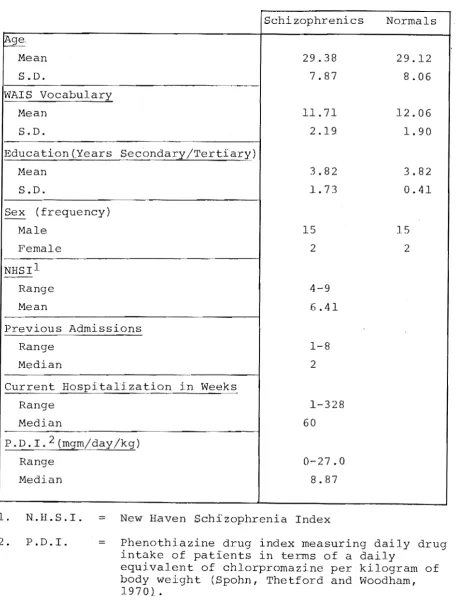
The demographic characte.ristics of the subject groups are given in Table 1.
(i
1
Schi.zophrenic SampleThe sample of seventeen patients tested was drawn from one rehabilitation and one long-stay ward at Sunnyside Hospital, Christchurch, in August 1983. They were selected on the basis of psychiatrist's diagnosis, case histories and clinical
psychologist's observations. The diagnosis of schizophrenia was confirmed using the criteria specified by Astrachan, Harrow, Adler, Bauer, Schwartz, Schwartz and Tucker (1972), in the New Haven Schizophrenia Index.
Patients included in this group were a) aged between 21 years and 48 years of age, b) were devoid of symptoms thought to be the result of brain damage, c) had no history of use of
halucinogenic drugs, d) no history of heavy chronic alcohol consumption, el were not receiving electroconvulsive therapy, f) did not suffer epileptic seisures, and, g) were capable of reading the size of letters used on the computer screen.
An attempt was made to express the current level of medication being received by patients in equivalent terms by
TABLE ~
Subject Demographic Data
Schizophrenics Normals
~.
Mean 29.38 29.12
S.D. 7.87 8.06
WAIS Vocabulary
Mean 11.71 12.06
S. D. 2.19 1. 90
Education (Years Secondary/Tertiary)
Mean 3.82 3.82
S.D. l.73 0.41
Sex (frequency)
-Male 15 15
Female 2 2
NHSII
-Range 4-9
Mean 6.41
Previous Admissions
Range 1-8
Median 2
Current Hospitalization in Weeks
Range l-328
Median 60
P.D.I. 2 (mgm/day/kg)
Range 0-27.0
Median 8.87
~. N.H.S.I.
=
New Haven Sch~zophrenia Index2. P.D.I.
=
Phenothiazine drug index measuring daily drug intake of patients in terms of a daily [image:22.595.78.537.133.746.2]Hollister (1970). The PDI gives a measure of daily equivalent
milligrams of chlorproma ne per kilogram of body weight. A shortened form of the Wechsler Adult Intelligence Scale vocabulary subtest (Jastak and Jastak, 1964), was used as a measure of verbal intelligence.
(ii} Control Sample
A sample of seve.nteen, psychiatric
non-institutiona zed subjects was drawn from the general population and were as far as possible individually matched to the
schLzophrenic subjects for sex, age, verbal Lntelligence and educational status.
APPARATUS
An Apple rI+ computer was used to present the word lists and store the readLng latencLes. The words themselves were
displayed one at a time, in lower case letters 6mm high, in the centre of a viewLng screen. At a viewing distance of about .Sm they cast a horizontal (vertical) visual angle of 4.5 (.68) degrees. Words were removed from the screen as soon as the
sub ct spoke into a mLcrophone. The microphone was connected to a cassette tape-recorder which fed a signal to the computer's "cassette in" jack. An assembly language routine converted this signal into the appropr te screen clear command. Reading
latencies were measured to the nearest milliseconds using soft-ware timing routines modelled after Price (l979), and
incorporating a modLfication of the computer hardware which
STIMULUS MATE~IAL
Four lists of words, of high frequency usuage, were
compiled from the Ku~era and Francis (1967), list. High
frequency words have been shown to have shorter reading
latencies. (Forester and Chambers, 1973; Scarborough, Cortese and Scarborough, 1977). Words were three to nine letters long and mainly one or two syllables. Ericksen, Pollard and Montague
(1970) and Klapp Cl97J., J.974) , have shown that encoding and preparation for vocalLzation of three syllable words takes
longer than for one and two syllable words.
The main experiment lists consist of two Direct lists and two Associated lists. In the Direct lists the same word appeared Ln both cue or prime and experimental condition. In list DW (Direct-Wordt, words were used as fLllers separating the first and second presentatLons of the target word, as follows:
LAG 0 LAG 2 LAGS ETC.
tree apart plane
tree ideal brown
desk. mouth.
apart tease
alert truth plane
In lLst DD (DLrect-DLgit), two dLgLt numbers (presented in digit forml served as fi.llers. In both lists lags of 0, 2, 5, 7 and 9 were used.
For each Direct list 8 di.fferent words were used at each lag condition to give a total of 5 x 8
=
40 stimulus sets.They were constructed as follows. The first word in a set of words was the prime or cue. This was followed by 0, 1, 3 or 5 ller items, and then the associate of the prime, as
follows:
LAG 0 LAG 1 LAG 3 ETC.
table bread light
chair low ample
butter food
, barn dark
To see if the prime affected the reading latency of the target word, the target had to appear elsewhere in the list in a
control condition. This was achieved by constructing groups consisting of only target words. These were interspersed at random throughout the lists.
List AW used words as fi.l s while i.n list AD, digits were used. Seven different target words were used at each lag condition.
Approximately 2l words forming examples of the kinds of word sets encountered in the lists proper were placed at the beginning of each list, but their latencies were not recorded.
The target words and primes for all four experimental , lists are presented in an Appendix.
DESIGN
Stimulus material was presented in four stimulus lists; AW, AD and DW, DD. Each list had words in four or five lag conditions. These small sets of lag conditions, were randomly ar,ranged through the list. Different words were used in each
A pilot study carried out with Univer ty students showed that i t was advantageous to have breaks between sets, when subjects could cough to clear the throats. It was
anticipated that the schi.zophrenic subjects on high doses of medication would have greater difficulty concentrating and sitting still and would require frequent breaks between sets. The final design allowed -for breaks of this nature between each set if subjects requested it.
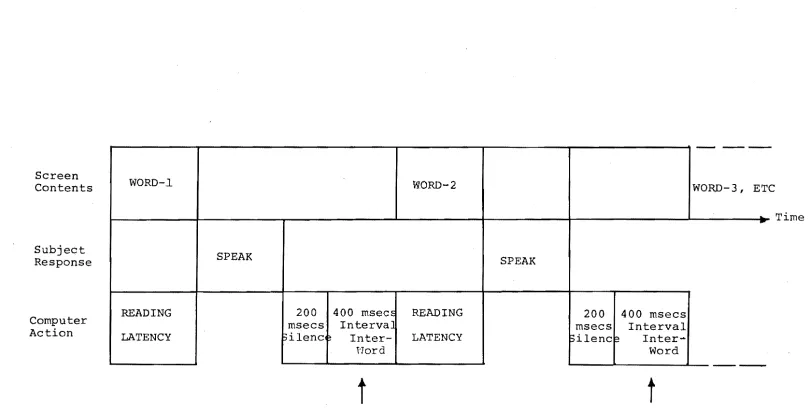
At the begi.nning of each set the first stimulus word appeared on the screen and disappeared as soon as the subject started to vocalize. Subjects were deemed to have completed articulating a word when a continuous riod of silence of 200 msec duration occurred. A 400 msec interword interval began immediately the 200 msec silence criterion was met. The temporal relationships between the screen display; subjects
vocal response; and computer activity are displayed in Figure 2. Four lists were presented in random order to the
subject.
PI\OCEDURE
Subjects were run individually a single one hour session. Each subject was given a t of instructions to stating tha t the task was concerned with reading latenc
Subjects were to expect 4 word lists, each divided into smaller groups for presentation. The expe;r:-imenter stated "ready" at the beginning of each set and pressed a button on the computer to bring up the first word in each set. Subjects were instructed to start, saying the word that appeared in the centre of the screen, as quickly as they could after i t was displayed.
Screen Contents
Subject Response
Computer Action
WORD-l
READING LATENCY
SPEAK
200 msecs Silenc
WORD-2
SPEAK
400 mseCE READING IntervaJ
Inter- LATENCY l'Jord
t
Figure 2. The lists were presented in random order to the subjects
200 400 msecs msecs Interval
I;ilenc~ Inter ....
Word
t
WORD-3, ET
...
-C
Time
N
[image:27.841.30.842.59.474.2]the presentation they could expect in the main lists. Subjects
were informed that the main lists were the important ones.
RESULTS
Since the interest in this thesis is in the latencies to
words in their control and experimental presentations, RT's to fillers and practice words were not recorded.
Occasionally extraneous noises, or inadvertent vocali.zations by the subject occurred at the time a word
appeared, or very shortly afterwards. These resulted in very short RT1,s. In an attempt to remove these from the data, all RT1s of less than 100 ·msecs were rejected. This resulted in 3.5% of responses by schizophrenics and ~% of responses by normals being rejected. Occasionally subjects did not speak loudly enough to trigger voice activated apparatus and hence the word remained i.n view and very long reaction times were
registered. In an attempt to remove these data and those which may have resulted from attentional lapses, all latencies greater th.an .10.00 msecs were rejected. By this criteria 3.4% of the responses of schizophreni.cs and 0.6% of those of normals were rejected.
The median of the remaining RT I. S in each condi tion was found for each subject, to give 8 medians per subject for each of the Associated lists and 10 for each Direct list.
Analyses were. performed on these subject median RT's using Lane's (Lane, 198~l, general analysis of variance program
(modified to run on an Apple II+). This incorporates Huynh's (Huynh, 1978), slightly conservative procedure to protect
effect of reducing the degrees of freedom used in assessing
significance. The reduced degrees of freedom are reported
throughout.
Because lag conditions differed in the Direct and
Associated conditions, groups x lag x type of filler x target word condition ANOVA's with repeated measures on all but the
group factor, were performed on the Direct and Associated data separately.
Associated Lists
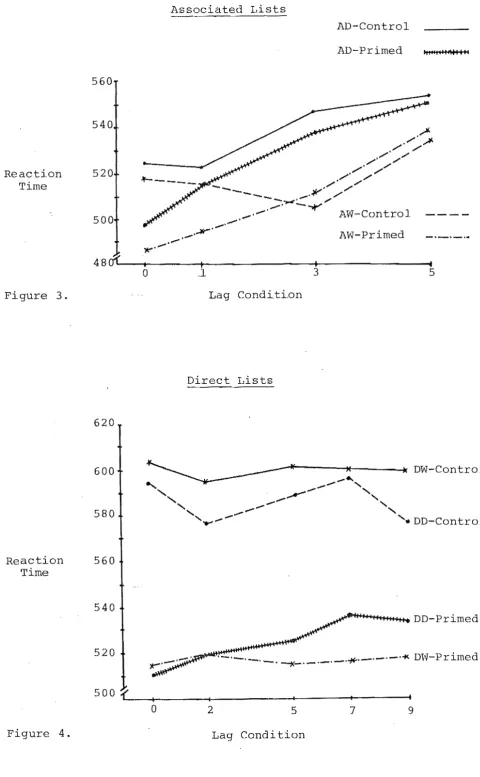
Neither the graphs effect, nor any interaction involving groups approached significance. Mean latencies, pooled over groups are presented in Figure 3. Examination of the figure suggests that a facilitation effect occurred at lag 0 but had disappeared by lag 3 for both kinds of fillers. This conclusion is supported by the significant lag X target
condition interaction FO, 96}
=
8.32, p<.OOl. Othersignificant effects were i the type of filler, F (l, 32)
=
10.04,p<.O~, where latencies with digit fillers were greateri an
over-all lag effect, F(3, 96)
=
8.32, P<.OOli
the type of filler x lag effect, F(3, 83)=
3.51, p<.025i a target condition effect, F(l, 29}=
15.62,P<.OOli
and the interaction of filler x target condition, Fll, 32)=
7.77, p<.Ol.Direct List
Neither the groups effect, nor any interaction involving groups approach si.gnificance. Mean reactions pooled over groups are seen in Figure 4. The target word condition effect was
significant, F(l, 32}
=
79.47, p<.OOl. Other significantReaction Time
Figure 3.
560
540
520
500
'K'-Associated Lists
.-'
,..r'-
.-AD-Control
AD-Primed 11111111'1'\+1+11
/,."x.. / , ' ,,;;.
.
/ ' ./' ,,// . /,
. / / ' , / / ' ./' / , '-_
""'--..,.._.r /
",
.-.'-"-
..._.- AW-Control
-AW-Primed 48d<--~1---1~---~1~---~.
o
~ 3 5Lag Conditi.on
Direct Lists
620
600 DW-Control
580
,
--
--~,"-',....
.-....-
"
...
,,--
--
"
"-' ... - - ' . DD-Control
Reaction 560 Time
540
rr"""'1-"+f+i+Ho ... D D-Primed
520
'-'_._.
~._._.-'oJ( DW-Primed- . --;<_._._._.-rr
500 ~L _ _ ~I ______ ~ _ _ - -_ _ --~ _ _ - -_ _ -+---~
o
2 5 7 9 [image:30.595.61.542.44.822.2]demonstrating the fact that the facilitation was greater where words were used as fi erSj lag x target condition, F{3, 111) ~
3.02, p<.025, which shows a small tendency for facilitation to decrease with lag but unexpectedly the effect was sti
at lag 9.
sizeable
Separate ANOVAS were carried out at lag 9 on the word filler and digit filler data separately. Both were significant. For digits as fillers the control word effect was, F(l, 32) = 23.71, p<.OOl and for digits as fillers, F(l, 32)
=
52.91, p<.OOl.DISCUSSION
A weakness in the design of Experiment 1 arises because different prime-target pairs were used at each lag condition and those appearing in the various conditions were the same for all subjects. For example in the associative condition, the finding of a priming effect on latency at lag 0 but not at lag 5 could have arisen because the particular prime-target pairs used at lag
a
produced priming whereas those used in lag 5 did not. Lag ef t is confounded with list composition. Similarly, anydifferences between lists with word or digit fillers and absolute lag effects could be ascribed to confoundings due to list
constructions. However the fact that digit and word filled lists behaved in a similar manner with respect to lag lessen this
likelihood. Nevertheless, as a check that results were not a function of the specific list, items used, a second experiment using different prime-target pairs was run and is reported in Experiment 2 below.
words was employed in Experiment 2.
In the Direct li'st the first word in the list was always used as the control and the same word appeared again at the end of the list as the experimental item. It was felt that a
subject could learn this pattern of presentation and selectively retain the first item ln active memory by means of rehearsal or some other strategy. Also, the shorter latency to the second presentation (experimental condition) of a word may have arisen, not because of any priming effect, but because latency to the first word was long by virtue of being first in the list. Experiment 2 sought also to clarify this issue.
EXPERIMENT 2
SUBJECTS
Eight University students and two Unlversity technical staff in the age range of 19-34 years served as suBjects.
Direct Lists
The Direct lists consisted of 363 presentations grouped into 33 sub-lists of II presentations each. The first 3 sub-lists were practice sub-lists only.
E.g. Lag Lis.t
0 X X X XX X X X X P T 2 X X X X X X X P X X T
5 X X X X P X X X X X T 7 X X P X X X X X X X T
9 P X X X X X X X X X T
P Priming word; T
=
Target word; X=
Filler.There were 5 different lags: 0, 2, 5, 7 and 9 and there were 6 sub-lists for each lag (making a total of 30). Words used as targets (and also as primesl were drawn randomly without replacement from a pool used in Experiment l (Direct list, DW). Filler words were drawn randomly without replacement from a disjoint pool of words, some used previously in Experiment l as fillers, and others generated by a "stream of conscious"
technique.
Associated Lists
The lists wi.th fillers: consi.sted of 252
---~--~---presentations, comprising 59 sub-lists of varying length, the first of which were practice sub-lists.
Target pairs consisted of a target word and an
associated prime. Each. target word appeared in two sub-lists (of equal length): one preceded by its associated prime
Lag EXEerimental List Control List
0 P T X T
1 P X T X X T
3 P X X X T X X X T
5 P X X X X X T X X X X X T
P
=
Prime word; T=
Target word; X := FillerFour different lag conditions were used: 0, 1, 3 and 5. There were seven pairs in each lag condition and two sub-lists
(experimental and controll for each pair: thus there were 4 x 7 x 2 = 56 sub-lists.
Target pairs were taken from a pool used i.n Experiment 1 (Associated list, ADt and were assigned randomly to lag
condi tions. Fi.ller words w.ere drawn randomly, wi thout replacement, from the same pool as the direct condition.
Associated lists with digits as fillers: were identical to the associated list wi.th words as fillers, except that the target pairs were from Experiment l (Associated list, AW) pool and filler items were random two-digit numbers.
RESULTS Associated Lists
Mean latencies are presented in Figure 5. Median
reaction times of all latencies between 200 and 1000 msecs were found for each subject in each condition. A lag x type of
filler x target ANOVA was carried out and essentially confirmed the results from Experiment l . The lag x target condition
F(2, l8}
=
4.58, p<.025 was significant, demonstrating that the experimental - control difference is greater at lag 0 and l than at lags 3 and 5. Other significant effects are lag, F(2, 20) ==.16.1, p<.OD.l; filler x lag effect, FC3, 24) ==. 7.69, p<.OOl where
Reaction Time
Figure 5
Reaction Time
Figure 6
500 490 480 470 460 450
440
,.
0. 570. 560 550 540 530 520 510 500 490 480
470
...
"
460450
o
EXPERIMENT 2 Associated Lists
[image:35.595.53.551.59.797.2]."
...
.
'
".,;
-
.""
...
---"
...
...
"
."
--"
...-""
...
--"
""""...
" , , ".-.-'
• .",.".,. ... fIIIIIIIIII".
-'-Word Filler - Control Word Filler - Exp
Digi.t Filler ____ _
l 3
Lag Condi.ti.on
Direct Li.sts
- Control
Digit Filler
...
_._.-- EXP
5
Fillers
Jill
/ / ~P
/
,
/,
---'
......
_-/,
,
..
\2 5 7 9.
Direct List
Mean latencies are presented in Figure 6. A lag x type of filler x target condition ANOVA showed a significant lag effect, F(3, 26).
=
12.5, p<.OOl; also significant was whether the word was in the control or experimental condition, F (l, 9)=
65.32, P ~OOl, and lag x experimental or control condition F(3, 24)
=
12.88, p<.OOl was significant.DISCUSSION
Results from the Associated lists are similar to those of Experiment 1 (compare Figures 3 and 5). The results from the Associated lists Experiment 1 are therefore not specific to the particular prime - target pairs used. Also, the grouping of control words in bunches does not seem to have biased estimates of the size of facilitation effects.
Resul ts of the magni.tude of priming effects from the Direct list demonstrated that results of the Direct list in Experiment 1 were merely an artifact of the control word always being the first word in the list. This was confirmed, when the control lag 9 condition tfirst word in the list) in Experiment 2 showed approximately the same elevated latency relative to words In associated lists, as all control words in Experiment 1.
The results from the Direct condition in Experiment 2 show very little facilitation at any stage in the list. In priming and activation terms this is difficult to account for and no explanation is offered as to why, on the second
presentation of the same word, virtually no facilitation at all is evidenced. Common sense would require some activation but because of the unsa tis factory res.ul ts from Experiment l , tliere will be no further discussion In this thesis on the Direct
CHAPTER III
GENERAL DISCUSSION
Because the same overall pattern of results was obtained for associated lists with word and digit fillers and both experiments, i t is assumed that results in Experiment 1 are not an artifact of the specific prime-target pairs used, nor the grouping of words in the control condition in Experiment 1.
With respect to the schizophrenic/normal comparison, this discussion is con ned to the Associative lists.
The major finding of· this study was that there was no significant difference between the performance of schizophrenic and normal groups. The hypothesized performance decrament,
where thought disordered schizophrenics would mani st a smaller facilitation effect from the prime, and that activation would decay more rapidly for this group, did not occur.
The necessary and expected effect of whether a word was in an experimental or control position in the 1ist,_ was obtained for both schizophrenics and normals. The significant overall lag effect verified the expected decrease in facilitation from lag 0 to 3, with the tendency for the latencies of
experimental words to increase diverging from lag O. This was true for lists with both kinds of fillers. Thus digits create no more interference than words when interpolated between
control and experimental target words.
Thus, the present experiment, using naming latency have confirmed the results of priming and lag experiments using
,
naming latency (Warren, 19721, and other tasks. (Meyer and Schvaneve1dt, 1971); Fisher, 1977; Fisher and Goodman, 1978).
Associative priming effects, i.e. where the reading latency of a word is facilitated when preceded oy a high
associate, occurred in the same manner and to the same degree in the schizophrenics and normals used. As noted in the
introductory chapter, Rus 1 (unpublishedl, found similar results.
Sperber, Ragain and McCauley (~9701, demonstrated a semantic priming effect using a category knowledge task with retarded individuals. The above discoveries suggest that if subjects have a normal priming effect and activation spread, while evidencing cognitive and intellectual deficits, the genes for the defic must occur in some other aspect of information processing.
Capacity of short-term memory as·investigated oy
activation spread from associative priming, appears to be normal for schizophrenics. Activation remains for up to three items to intervene between the prime and its common associate. These findings closely follow Loftus's (l9741 results, establishing the capacity of short-term memory· as approximately two words. Deficits in retrieval from memory for schizophrenics therefore do not appear to be due to a lack persistence of the
activation.
Bauman and Kolisnyk Cl976) presented schizophrenics and normals with 1 of digits and randomly probed items in serial positions via a recall task. Lists of digits were presented to subjects and items in the different al positions were probed randomly in seven recall trials for each list. Input
interference resulted from interpolation of items Between
interpolation of responses between presentation and recall and was grea ter for schizophrenics than for normals. These results are indicative of equal memory capacity for both sChizophrenics and normals and are consistent with the findings in this study.
Regarding the areas of priming and whether subjects can bring conscious strategies to bear. This study was formulated to replicate the Posner and Snyder (1975a, 1975b), concept of automatic priming, carried out without the conscious awareness of the subject. The experiments were constructed to ensure that subjects were constrained by the experimental demands. Subjects were instructed to start speaking as soon as the word appeared on the screen and rehearsal was made difficult by the rapidity with which filler words appeared .between the control and target words. Priming and facilitation evidenced from these tas'ks were resultant from processes carried out by the subject at automatic levels. This is supported by findings of Koh, Kay ton and
Peterson (1976)_, who demonstrated, by experimentally
constraining the encoding of schizophrenics and normals by
requiring subjects to rate words as pleasant or unpleasant, that on recall schizophrenics and normals would display the same
response bias in recalling pleasant words more frequently. On the other hand, Larsen and Fromholdt(l976), looked at word-storage structure Cmnemonics), and used a self-paced task wi.th subjects sorting words into self-determined categories, and discovered schizophrenics required more trials to complete the sorting task than the normals. However, Koh and Peterson (1978)
ha~e drawn conclusions from this, that mnemonic processes used
in recall, function normally if the tasks occur as an automatic process. It could be concluded that if processing occurs at
deficits and if tasks become conscious then deficits appear.
Future research in this area of deficits in schizophrenic processing could therefore, centre on this question of what
occurs when consciousness enters processing and the actual features of conscious decision making that go wrong and create the deficits evidenced in schizophrenic processing.
Another are.a of interest arising from this study, are the peculiar results received in Experiment 2, in the Direct
Association condition. These results are an anomoly in the terms of network theory. Common-sense dictates that i.n the visual
world, if for example a cat is seen, that this results in an activation of the links and nodes pertaining to the cat in
REFERENCES
ANDERSON, J.R. Cognitive Psychology and Its Implications. San Francisco: W.H. Freedman and Company, 1980.
ANTOS, S.J. Processing facilitation in a lexical decision task. Journal of Experimental Psychology, 1979, Vol. 5, No.3, 527-545.
ASTRACHAN, B.M., HARROW, SCHWARTZ, C., and of schizophrenia. 121, 529-541.
M., ADLER, D., BAUER, A., SCHWARTZ, A., TUCKER, G. A check st for diagnosis
British Journal of Psychiatry, 1972,
BAUMAN, E. Schizophrenic short-term memory: A deficit in
subjective organisation. Canadian Journal of Behavioural Sciences, 1971, 3, 56-65.
BAUMAN, E., and KOLISNYK, E. Interference effects in
schizophrenic short-term memory. Journal of Abnormal Psychology, 1976, Vol. 85, No.3, 303-308.
BAUMAN, E., and MURRAY, D.J. Recognition versus rec 1 in
schizophrenia. Canadian Journal of P , 1968, 22, 18-25.
BECKER, C.A. Semantic context effects in visual word
recognition: An analysis of semantic strategies. Memory and Cognition, 1980, Vol. 8(6}, 493-512.
BLEULER, E. Dementia praecox on the group of schizophrenics. New York: International Universities Press, 1950.
(Original, 1911).
BOWER, G.H. Mood and Memory. American Psychologist, 1981, Vol. 36, No.2, 129-148.
BROADBENT, D.E. Perception and Communication. London: Academic Press, 1958.
CAVANAGH, P., and AUSTIN, S.M. Visual psychophysics on the Behaviour Research Methods App II: getting star
and Instrumentation, 1980,
CHAPMAN, L.T. Distractability in the conceptual performances of schizophrenics. Journal of Abnormal and Social
Psychology, 1956(a), 53, 286-291.
CHAPMAN, L.T. The role of type distractors in the "concrete" conceptual performance of schizophrenics. Journal of personality, 1956(b) r 25, 130-141.
CHAPMAN, L.T., and CHAPMAN, J.P. Interpretations of words in schizophrenia. Journal of Personality and Social
CHAPMAN, L.T., CHAPMAN, J.P., and MILLER, G.A.A. A theory of verbal behaviour in schizophrenia. In B.A. Maher (Ed), Progress in experimental personality research. New York: Academic Press, 1964.
ERICKSEN, C.W., POLLARD, M.D., and MONTAGUE, W.E. Implicit speech mechanisms in perceptual encoding. Journal of Experimental Psychology, 1970, Vol. 54, No.3, 502-507. FISHER, I. Associative facilitation without expectancy in a
lexical decision task. Journal of Experimental
Psychology: Human Perception and Performance, 1977, Vol. 3, No.1, 18-26.
FISHER, I., and GOODMAN, G.O. Latency of assoc tive activation in memory. Journal of Experimental Psychology: Human Perception and Performance, 1978, Vol. 4, No.3, 455-470. FORRESTER, K.I., and CHAMBERS, S.M. Lexical access and naming
time. Journal of Verbal Learning and Verbal Behaviour, 1973, 12, 627-635.
FREDRICKSEN, R.J., and KROLL, J.F. Spelling and sound: Approaches to the internal lexicon. Journal of Experimental Psychology: Human Perception and Performance, 1976, Vol. 2, No.3, 361-379. GRIFFITH, J.J., MEDNICK, S.A., SCHULSINGER, F., and
DIDERICHSEN, B. Verbal associative disturbances in children at high risk for schizophrenia. Journal of Abnormal Psychology, 1980, Vol. 89, No.2, 125-131. HOLLISTER, L.E. Choice of .. anti-psychotic drugs. American
Journ:al nf Psychiatry,' 1970, 127, 186-190.
HUSTON, P.E., SHAKOW, D., and RIGG, L.A. Studies of motor
functions in schizophrenia: II. Reaction time. Journal of General Psychology, 1937, 16, 39-82.
HUYNH, H. Same approximate test for repeated measures designs. Psychometrika, 1978, 43, 161-175.
JASTAK, J.F., and JASTAK, S.R. Short forms of the WAIS and WISC vocabulary subtests. Journal of Clinical psychology, 1964, 20, 167-199. (Monograph).
KAHNEMAN, D. Attention and Effort. New Jersey: Prentice Hall, 1973.
KENT, G.H., and ROSANOFF, A.J. A study of association in
insanity. American Journal of Insanity, 1910, 67, July and October, 37-96.
KLAPP, S.T. Implicit speech inferred from response latencies in same different decisions. Journal of Experimental
KLAPP, S.T. Syllable-dependent pronunciations latencies in
number naming. Journal of Experimental Psychology, 1974, Vol. 102, No.6, 1138-1140.
KOH, S.D., KAY TON , L., and BERRY, R. Mnemonic organisation in young non-psychotic schizophrenics. Journal of Abnormal Psychology, 1973, 81, 299-310.
KOH, S.D., KAY TON , L., and SCHWARTZ, C. The structure of word storage in the permanent memory of non-psychotic
schizophrenics. Journal of Consulting and Clinical Psychology, 1974, 42, 879-887.
KOH, S.D., and PETERSON, R.A. Encoding orientation and the remembering of schizophrenic young adult. Journal of Abnormal Psychology, 1978, Vol. 87, No.3, 303-313. v
KUCERA, H., and FRANCIS, N. Computational Analysis of Present-Day American English. Providence, Rhode Island: Brown University Press, 1967.
LANE, D.M. A general analysis of variance program for micro computers. Behaviour Research Methods and
Instrumentation, 1981, Vol. 13(5), 694. LARSEN, S.F., and FROMHOLDT, P.
recall in schizophrenia. 1976, 85, 61-65.
Mnemonic organisation and free Journal of Abnormal Psychology,
LOFTUS, E.F. Activation of semantic memory. American Journal of Psychology, 1974, 86, 331-337.
MARCEL, T. Conscious and preconscious recognition of poly-semous words: Locating the selective effects of prior verbal context. Attention and Performance VIII.
Hillsdale, N.J.: Lawrence Erlbaum Associates, 1980. MATUSARZ, T.Z., and KOH, S.D. Contextual effects of the
short-term memory retrieval of schizophrenic young adults. Journal of Abnormal psychology, 1980, Vol. 89, No.6, 683-696.
MCGHIE, A. Attention and perception in schizophrenia. In B.A. Maher (Ed). Progress in Experimental Personality
Research, Vol. 5. New York: Academic Press, 1970. MEYER, D.E., and SCHVANEVELDT, R.W. Facilitation in
recognising pairs of words: Evidence of a dependence between retrieval operations. Journal of Experimental Psychology, 1971, Vol. 90, No.2, 227-234.
MURDOCK, B.B. Human Memory: Theory and Data. Potomac, Maryland. Erlbaum and Associates, 1974.
NAFICY, A., and WILLERMAN, L. Excessive yielding to normal biases is not a distinctive sign of schizophrenia. Journal of Abnormal Psychology, 1980, Vol. 89, No.8,
697-703.
THE LIBRARY UNIVERSITY OF CANTERBURY
NEELY, J.H. Semantic priming and retrieval from lexical memory: Roles of inhibitionless spreading activation and limited-capacity attention. Journal of Experimental Psychology: General, 1977, Vol. 106, No.3, 226-254.
PAYNE, R.W., and HEWLETH, J.H.G. Thought disorder in psychotic patients. In H.J. Eysenck (Ed). Experiments in
Personality, Vol. 2. London: Routledge and Kegan Paul, 1960, 3-104.
POSNER, M.I., and SNYDER, C.R.R. Attention and cognitive
control. In R.L. Solso (Ed). Information processing and cognition: The Layola Symposium. Hillsdale, N.J.:
Erlbaum, 1975(a).
POSNER, M.I. and SNYDER, C.R.R. Facilitation in inhibition in the processing of signals. In P.M.A. Rabbitt and S. Dornic (Eds). Attention and Performance V. New York: Academic Press, 1975(b).
PRICE: J.M. Software timing for 6500 series microcomputers. Behaviour Research Methods and Instrumentation, 1979, 11,
568-571.
RODICK, E.H. and SHAKOW, D. Set in the schizophrenic as
measured by a composite reaction time index. American Journal of Psychiatry, 1940, 97, 214-225.
RUSSELL, P.N., BANNATYNE, P.A., and SMITH, J.F. Associative strength as a mode of organization in recall and re-cognition: A comparison of schizophrenics and normals. Journal of Abnormal Psychology, 1975, 84, 122-128.
RUSSELL, P.N., and BEEKHUIS, M.E. Organization in Memory: A comparison of psychotics and normals. Journal of
Abnormal psychology, 1976, Vol. 85, No.6, 527-534.
SCARBOROUGH, D.L., CORTESE, C., and SCARBOROUGH, H.S. Frequency and repetition effects in lexical memory. Journal of Experimental Psychology: Human Perception and
Performance, 1977, Vol. 3, No. I, 1-17.
SMITH, M.C. Contextual facilitation in a letter search task depends on how the. prime is processed. Journal of Experimental Psychology: Human Perception and Performance, 1979, Vol. 5, No.2, 239-251.
SPOHN, H. E., THETFORD, P. E., and WOODHAM, E. L. Span of
apprehension and arousal in schizophrenia. Journal of Abnormal Psychology, 1970, 75, 113-124.
SPERBER, R.D., RAGAIN, R.D., and MCCAULEY, C. Reassessment of category knowledge in retarded individuals. American Journal of Mental Deficiency, 1976, Vol. 81, No.3,
227-234.
TAUPMAN, K.L., BERZOFSKY, M., and KESSELMAN, M. Encoding of taxonomic word categories by schizophrenics. Journal of Abnormal Psychology, 1976, Vol. 85, No.4, 35
-WARREN, R.E. Stimulus encoding and memo~y. Journal
Experimental Psychology, 1972, Vol. 94, No.1, 90-100. WICKELGREN, W.A. Human learning and memory. Annual Review of
Psychology, 1981, 32, 21-52.
WICKELGREN, W.A., CORBETT, A.T., DOSHER, B.A. Priming and retrieval from short term memory: A speed accuracy trade-off analysis. Journal of Verbal Learning and Verbal Behaviour, 1980, 19, 387-404.
APPENDIX
ASSOCIATED LIST AW ASSOCIATED LIST AD
CONTROL EXPERIMENTAL CONTROL EXPERIMENTAL
LAG 0 day night LAG 0 enemy friend
table chair fruit apple
boy girl cat dog
doctor nurse eagle bird
black white lion tiger
brother sister day night
pepper salt weak strong
LAG 1 uncle aunt LAG 1 long short
bread butter soldier army
high low love hate
man woman sickness health
mother father giant dwarf
early late devil angel
king queen heaven hell
LAG 3 odd even LAG 3 happy· sad
light dark near far
bitter sweet lost found
bottom top float sink
hot cold hard soft
good bad front back
stop go buy sell
LAG 5 cow calf LAG 5 stern flower
cat kittens large small
square round needle thread
hard soft scissors cut
stomach food live die
large small quick slow
DIRECT LIST DW SAME WORD CONTROL AND
EXPERIMENTAL
LAG 0 track pedal tree build bring beach fixed grand
LAG 2 room apart train grain dream· state thrill joke
LAG 5 three plane green night brick point drove teach
LAG 7 brush storm eight dance beard wrote grill bloom
LAG 9 design error guest hair hero stage spring value
DIRECT LIST DD SAME WORD CONTROL AND
EXPERIMENTAL
LAG 0 trade crowd play road pipe dark knee adopt
LAG 2 line dirt study unity hope leave work rubber
LAG 5 glass trade well wild daily today bath mate
LAG 7 what bank jail twist join when judge type