AND ANXIETY LEVEL DURING STRESS
A thesis
submitted in partial fulfilment of the requirements for the Degree
of
Master of Science in Psychology in the
University of Canterbury
by
A.O. Whitley ?
CONTENTS
Page
LIST OF TABLES . • • • • • < • • iv
LIST OF FIGURES
.
. .
. . .
.
ivABSTRACT
.
. . . .
. .
viiChapter
1. INTRODUCTION
.
. .
1SOURCE AND HISTORY •
.
.
. .
.
. .
1Pharmacological Properties • • 5
Performance Effects 10
Mood Effects • • • • •
.
.
. .
.
. . . .
132. REVIEW OF THE LITERATURE
. . .
.
.
.
17Chemistry of Caffeine 17
PHARMACOLOGICAL PROPERTIES AND PHYSIOLOGICAL
EFFECTS OF CAFFEINE 18
Adrenal Medullary Activity.
Respiratory and Cardiovascular Effects • Central Nervous System • •
Smooth Muscle Skeletal Muscle Gastric Secretion
Metabolism
.
.
.
.
.
.
.
. . .
. .
.
Toxicology •. . .
.
. .
Mutagenic Effects
. .
.
.
. . .
. .
Other IllnessesCAFFEINE EFFECTS ON PERFORMANCE
19 23
27
30
30
32
34
35
36
38
40
Chapter
2. CAFFEINISM • • • • • • •
.
.
. .
. .
.
.
. . .
Anxiety Manifestations.
.
.
.
.
.
.
.
.
Depression
.
.
Tolerance
. . .
.
.
.
. .
. .
Caffeine Withdrawal SymptomsRestless Legs Syndrome • • •
PROBLEMS INVOLVED WITH RESEARCH INTO THE EFFECTS OF CAFFEINE • • • " • • •
.
.
.
Page 49 49 51 53 54 57 593. THE EXPERIMENT 62
4 •
INTRODUCTION . •
NATURE AND SCOPE OF THE EXPERIMENT Aims of the Experiment •
62 68 68 Rationale and Hypotheses of the Experiment. 69 PROCEDURE
Subjects • • • Apparatus
Physiological measurements • • • • Performance measurements • • • • • • • • • Subjective reports • • • • • • • • • • Trait Anxiety Inventory • • • • • • • Drugs
Method • •
Criterion for assignment to High and Low
71 71 71 71 72 72 73 73 73
Anxiety groups • • • • • • • • 74
RESULTS • • • • •
Calculations
.
.
..
.
PREDRUG DATA •
Physiological Measures • Subjective Measures
ANOVA's ON THREE DIFFERENCE SCORES. Physiological Measures • • •
Subjective Report Measures •
4. PERFORMANCE MEASURES .
. .
103Total attempted 103
Percentage correct . 104
5. DISCUSSION
. .
.
. . . .
107PHYSIOLOGICAL MEASURES 107
Blood Pressure • 107
Heart Rate . . • . I I I
SUBJECTIVE REPORTS . 112
Alertness
. . .
.
.
112Tension 114
PERFORMANCE IN THE. MENTAL ARITHMETIC TEST 115
SUMMARY OF CAFFEINE EFFECTS 117
SUGGESTIONS FOR FUTURE RESEARCH 118
ACKNOWLEDGEMENTS . • . • • • . . . • . . . • . 122
REFERENCES . . • . . • • . . . • • • • ~ . . • . • 123
APPENDICES
1. Self-Evaluation Questionnaire • . 2. Tension and Alertness Scales
3. Predrug ANOVA Tables • • . . . • .
4. ANOVA Tables on Three Difference Scores for the Physiological Measurements and Subjective
127 128 129
Self Reports . • . . . • • • • • . • • . . • . 132 5. ANOVA Tables for Total Attempted and Percentage
Correct Scored by Subjects in Mental Arithmetic
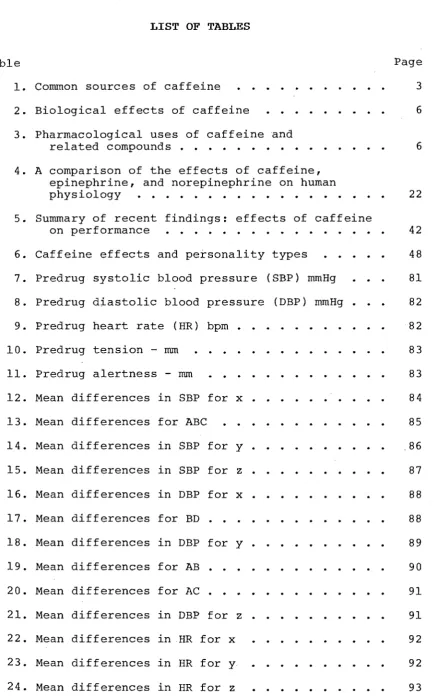
LIST OF TABLES
Table
1. Common sources of caffeine 2. Biological effects of caffeine
3. Pharmacological uses of caffeine and related compounds • • • • • • . 4. A comparison of the effects of caffeine,
epinephrine, and norepinephrine on human physiology • • • • • • • • • • • • • 5. Summary of recent findings: effects of caffeine
Page 3
6
6
22
on performance • • • • • • • • • • • . • • • • 42 6. Caffeine effects and personality types
· · ·
48 7. Predrug systolic blood pressure (SBP) mmHg· ·
·
81 8. Predrug diastolic blood pressure (DBP) mmHg·
829. Predrug heart rate (HR) bpm
·
· · ·
· · ·
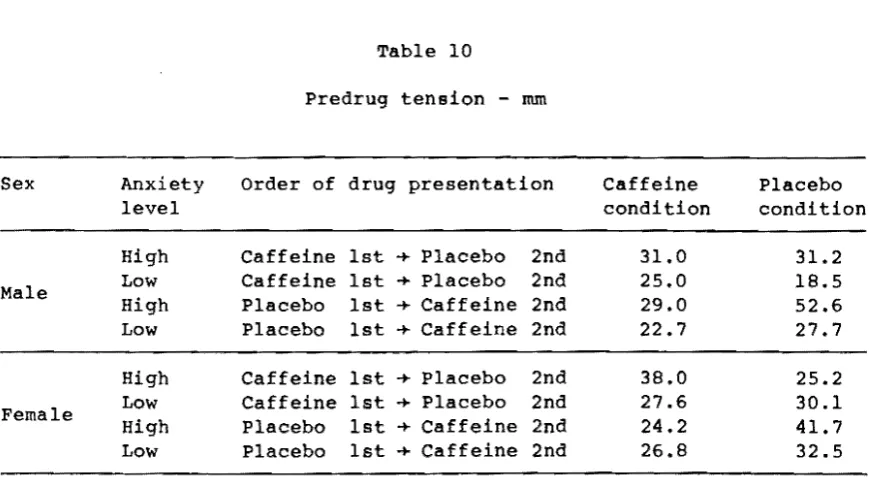
82 10. Predrug tension-
mm·
· · ·
· · ·
·
83 11. Predrug alertness-
mm·
·
· · ·
· · · ·
· · · ·
8312. Mean differences in SBP for x
·
· · ·
8413. Mean differences for ABC
· · ·
8514. Mean differences in SBP for y
·
·
· · · ·
8615. Mean differences in SBP for z
· ·
· · ·
8716. Mean differences in DBP for x
· · · · ·
· ·
·
8817. Mean differences for BD
·
· · ·
· · ·
· · · ·
88 18. Mean differences in DBP for y· · · · ·
· · ·
89 19. Mean differences for AB·
· ·
·
· · ·
·
9020. Mean differences for AC 91
21. Mean differences in DBP for z 91
22. Mean differences in HR for x 92
23. Mean differences in HR for y 92
[image:5.595.96.531.78.779.2]Table Page
25. Mean differences for BC
·
·
·
· ·
9426. Mean differences in tension for x
·
· ·
·
9427. Mean differences for BC
·
·
· ·
· ·
·
·
'.
·
·
· ·
9628. Mean differences for CD.
·
·
·
·
· ·
·
9629. Mean differences in tension for y
·
·
· ·
· ·
9630. Mean differences for CD
·
·
· ·
·
·
· ·
·
· ·
9731. Mean differences in tension for z
·
· ·
· ·
· ·
·
9832. Mean differences for AC
· ·
·
·
· · ·
·
· ·
·
9933. Mean differences in alertness for x
· ·
·
· ·
·
·
9934. Mean differences in alertness for y
· ·
·
·
10035. Mean differences for BCD
·
· ·
· · ·
10136. Mean differences in alertness for z
·
·
· · ·
10137. Mean differences for ACD
· · ·
·
·
·
· ·
· ·
10238. Mean number of total attempted
· ·
· · ·
·
10339. Mean values for BCD
· ·
· ·
·
· ·
· · ·
10440. Mean number of percentage correct
·
·
· ·
1044l. Mean values for ABC
·
· · ·
·
· ·
·
106Figure 1.
LIST OF FIGURES
Physiological changes in men whose jobs were terminated . . • • . • • • . • .
2. Effect of caffeine on blood pressure at rest and during psychological stress • . • • • .
Page
64
ABSTRACT
An experiment was conducted to examine the potential interaction of caffeine and psychological stress in human subjects. More specifically, subjects comprised of those who showed 'high' and 'low' trait anxiety levels as determined by administration of the Spielberger Trait - Anxiety Inventory. Each student consumed caffeine on a regular basis (2 or more cups of coffee and/or tea per day).
Subjects were run in a single-blind, randomized cross-over design with caffeine (400mg) and placebo. Each subject participated in two, one and a half hour experimental sessions held one week apart.
The cardiovascular effects of a high (400mg) dose of caffeine, equivalent to 4 or 5 cups of coffee, were measured during periods of rest and psychological stress. The stressor involved the administration of a mental arithmetic task (serial subtraction) with a set time limit. Subjects were challenging required to perform as well as they could
conditions. In addition, subjects "alertness" and "tension" after each part
under reported
of each
subjective session, using lOcm visual analogue scales representing each of these two dimensions.
pressure, alertness, tension, and performance, but there has been no experimental work comparing the response of high and low trait anxiety subjects with respect to these variables.
Since caffeine is a central nervous system stimulant i t is reasonable to suggest that the drug could be used as a means for low anxiety people to reach an optimal level of arousal, and hence perform optimally in a stressful situation (eg. exams or public speaking). Likewise, i t is equally reasonable to suggest that caffeine usage may well be avoided by those people who have high anxiety levels if they are to perform well.
consumption was found to have no effect on performance in a mental arithmetic task, in both high and low anxiety groups.
It is concluded from the results that caffeine administration (400mg) cannot be used as a means for a low anxiety person to reach an optimal drive or stress level to perform optimally during a stressful situation. Likewise, there was no evidence to suggest that those who have high anxiety levels should avoid caffeine consumption to achieve
INTRODUCTION
SOURCE AND HISTORY
Nonmedically, caffeine is the most widely used central nervous system stimulant. Found in a number of plants i t is contained in beverages and/or flavourings being popular in the form of coffee, tea, cocoa and "cola" drinks.
Caffeine is found in various prescription medications and over-the-counter preparations.
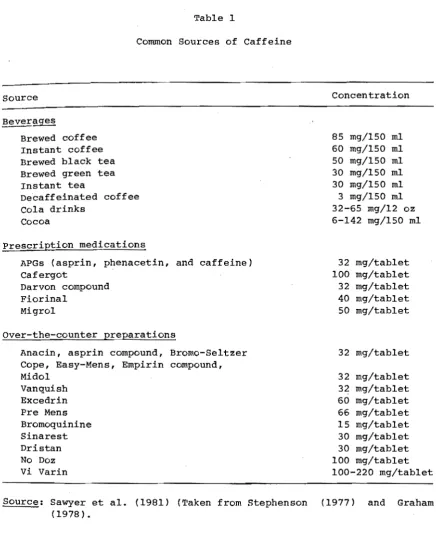
Table I illustrates the common sources of caffeine and its approximate concentrations.
Caffeine is also found in certain noncola softdrinks, such as Mellow Yellow, Mountain Dew, and Sunkist Orange, as well as in teas containing mate', guarena, and youpon.
Man discovered caffeine in many forms:
Coffee was found in Arabia and Turkey; after spreading to these and other near Eastern and African regions from Ethiopia.
~ was found in China.
The kola nut was found in common use in west Africa, and was later introduced into cola drinks as a source of caffeine.
The cocoa tree was discovered in Mexico, the West Indies, and much of central and sou.th Africa. Chocolate from this tree was the favourite beverage of the Emperor Montezuma; it was said that 50 pitcherfuls a day were prepared for his use. Throughout the world this drink soon became popular.
The ilex plant, source of the caffeine drink known as mate' or Paraguayan tea, was found in Brazil and elsewhere in the American tropics. In the United States this tea is still drunk as yerba mate', and i t rivals coffee and tea in popularity in parts of South America.
Cassina - also known as youpon, the Christmas berry tree, and the North American tea plant, was found in common use as the source of a caffeine beverage among Indians from Virginia to Florida and west along the Gulf coast to the Rio Grande. Cheney (1925), reported at the time that "none of the Indians but their great Exploits of War and Noble Actions, are admitted to the use of this noble beveridge."
White settlers in these regions prepared a tea known as the "Black Drink", "Black Drought", or dohoon, from the same plant.
Table 1
Common Sources of Caffeine
Source
~ages
Brewed coffee Instant coffee Brewed black tea Brewed green tea Instant tea
Decaffeinated coffee Cola drinks
Cocoa
Prescription medications
APGs (asprin, phenacetin, and caffeine) Cafergot
Darvon compound Fiorinal
Migrol
Over-the-counter preparations
Anacin, asprin compound, Bromo-Seltzer Cope, Easy-Mens, Empirin compound, Midol
Vanquish Excedrin Pre Mens Bromoquinine Sinarest Dristan No Doz Vi Varin
Concentration
85 mg/ISO ml 60 mg/ISO ml 50 mg/ISO ml 30 mg/ISO ml 30 mg/ISO ml 3 mg/ISO ml 32-65 mg/12 oz 6-142 mg/ISO ml
32 mg/tablet 100 mg/tablet 32 mg/tablet 40 mg/tablet 50 mg/tablet
32 mg/tablet
32 mg/tablet 32 mg/tablet 60 mg/tablet 66 mg/tablet 15 mg/tablet 30 mg/tablet 30 mg/tablet 100 mg/tablet 100-220 mg/tablet
[image:13.595.72.519.68.623.2]When newly introduced, coffee was considered to be an intoxicating brew, dangerous to health. However, coffee became a welcome and socially acceptable drink despite medical warnings and efforts to suppress i t (Stephenson, 1977).
The controversey over the health aspects of coffee continues. Increasing+y the debate has focused on caffeine. Heavy users of caffeine containing beverages report tolerance (including cross-tolerance among the Xanthine (Theophylline, Caffeine, and Theobromine) beverages), physical dependence with withdrawal symptons and craving (Brecher et al., 1972).
The basis for the popularity of all the caffeine containing
beverages elevated
beverages has been the ancient belief that these had stimulant and anti soporific actions that mood, decreased fatigue, and increased capacity for work (Roll, 1980).
For example, legend credits the discovery of coffee to a prior of an Arabian convent. Shepherds reported that goats that had eaten the berries of the coffee plant gamboled and frisked about all through the night instead of sleeping. Mindful of the long nights of prayer that he had to endure, the prior instructed the shepherds to pick the berries so that he might make a beverage from them.
Pharmacological Properties
Caffeine pharmacologically impacts most physiological systems. With regard to the central nervous system (CNS), caffeine is a power stimulant. Such stimulation undoubtedly accounts for the popularity of caffeinatedbeverages. It is claimed (Ritchie, 1975; Graham, 1978), that coffee and tea promote rapid, clear thinking, improved intellectual effort, enhanced mental activity, and decreased drowsiness, fatigue, and reaction time - all valued commodities in an achievement oriented society. Most of these stimulating actions are accounted for by the fact that caffeine affects all parts of the cortex. Caffeine also affects the respiratory, vasomotor, and vagal centres of the medulla, as well as all parts of the spinal cord at high doses.
Caffeine's action on the cardiovascular system can be detected in systemic, coronary, and cerebral circulation patterns. The coronary arteries and
general systemic vessels become dilated
the pulmonary and following caffeine ingestion. Heart rate and force of contraction also increase. Many of these peripheral effects cannot be observed directly, however, because they tend to be masked by central stimulating effects upon the medulla. Therefore, at moderate doses a person may notice no change in heart rate, no tachycardia (rapid beating), or even a slight bradycardia
(slow beating).
The commonly experienced "coffee diuresis" is a result of caffeine's effect on the renal system.
Finally, caffeine relaxes smooth muscles (especially of the bronchi), strengthens the contraction of skeletal muscles, and increases basal metabolic rate an average of 10 per cent among regular coffee drinkers (Brecher at al., 1972).
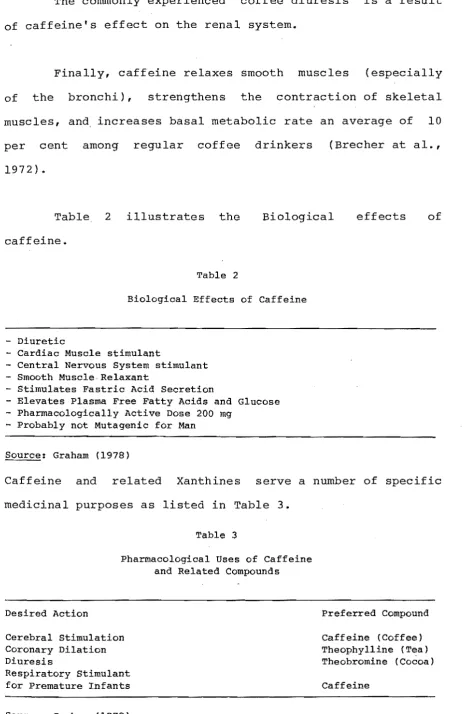
Table. 2 illustrates the Biological effects of caffeine.
Table 2
Biological Effects of Caffeine
- Diuretic
- Cardiac Muscle stimulant
- Central Nervous System stimulant - Smooth Muscle Relaxant
- Stimulates Fastric Acid Secretion
- Elevates Plasma Free Fatty Acids and Glucose - Pharmacologically Active Dose 200 mg
- Probably not Mutagenic for Man
Source: Graham (1978)
Caffeine and related Xanthines serve a number of specific medicinal purposes as listed in Table 3.
Table 3
Pharmacological Uses of Caffeine and Related Compounds
Desired Action
Cerebral stimulation Coronary Dilation Diuresis
Respiratory Stimulant for Premature Infants
Source: Graham (1978)
Preferred Compound
Caffeine (Coffee) Theophylline (Tea) Theobromine (Cocoa)
[image:16.595.64.529.74.789.2]Note that caffeine is preferred as a stimulant, theophylline from tea is preferred as a coronary dilator, and theobromine from cocoa is preferred as a diuretic (Krontz, 1954).
The annual world consumption of coffee exceeds four million tons (Robertson et al., 1978). In some countries this amount translates into a per capita ingestion of lOOg of pure caff eine each year. ,
Dosage is a relevant consideration in the study of caffeine pharmacology. Fifty to 200mg of caffeine is typically
actions
required to (Greden, 1974).
produce expected pharmacological Truitt (1971) refers to doses of over 250mg as being "large".
Of clinical significance, this dosage is frequently exceeded in everyday life. As indicated in Table 1, caffeine is widely available in a mUltiplicity of beverages and medications. When cumulatively considered, an individual can ingest doses much higher than 250mg often without being aware of it. For example, three cups of coffee, two over-the-counter headache tablets, and o~e cola drink consumed in one morning approximates an intake of 500mg caffeine.
It is easy to drinkers dosages would amounts.
Definitive tests have shown that caffeine is not adaptive, ie. regular consumption does not diminish its stimulant effects. However, caffeine-withdrawal headache is well documented.
The consumption of high levels of caffeine clearly becomes a toxic condition. The LD50 of orally administered caffeine for the mouse, rat, guinea pig, rabbit, cat, dog and hamster has ranged from 100 to 1050mg per kg (Graham, 1978).
Within recent years, the chronic effects of caffeine have been of much interest~ No growth retardation, reproductive impairment, nor any other pathological problems have been found at levels of 35 to 60mg per kg of body weight daily for 26 weeks administered to rats in drinking water. No adverse effects on fertility or mortality of rats were produced after daily injection with 100mg caffeine per kilo-gram of body weight for four generations.
However, higher levels of caffeine near the LD
50, ie. 150mg per kilogram, produced a variety of pathological effects over periods of 100 days; the effects included loss of hair, dermotitis, thymic atrophy and congestion of many organs (Select Committee on GRAS Substances, 1976).
have failed to establish a clear-cut cause and effect relationship between caffeine ingestion and induction or
~.----/
exacerbation of peptic ulcer (Select Committee on GRAS substance, 1976).
Several studies have indicated that caffeine may exhibit genetic activity in vitro, but in vivo investigations failed to demonstrate mutagenic effects of caffeine (Kreybig and van Czok, 1975; Furmanova, 1976; Weathersbee et a1., 1977; Timson, 1977).
The transfer of caffeine across the placental barrier occurs readily and the developing foetus as well as the gonads are subject to the same levels of caffeine present in body water of other tissues. In a variety of studies teratogenic effects have been shown with laboratory animals when caffeine was administered other than by the oral route ..
However, teratogenic effects were generally absent at oral doses of 50mg per kilogram of body weight and lower (Graham, 1978).
Major interest has recently been focused on the cardiovascular ects of caffeine after the suggestion that coffee drinking might be associated with an increased risk of myocardial infarction; caffeine ingestion has long been known to predispose to extrasysto1es.
pharmacology remain. For example, i t has been reported to increase respiration slightly at high doses (Scott and Chem, 1944), but has variably been said both to raise (Salla Torre et al, 1952), and to lower, (Cotton et al., 1968), the heart rate, both to increase (Grollman et al., 1930), and to decrease (Starr et al., 1937), the arteriovenous oxygen difference, to raise blood pressure and cardiac output (Stepp et al., 1938; Ritchie, 1975; Robertson et al., 1978; Lane, 1983),
1944).
and to Thus
elevate oxygen contradictions
consumption exist in
(Haldi et al., the literature concerning the hemodynamic and humoral effects of the drug in man.
Questions have been raised recently about the possible role of caffeine as a cause of cancer. Japanese newspaper reports mentioned recent studies indicating that caffeine may cause endocrine tumors in female rats (Food Chemicals, 1977). Graham (1978) reports that no published scientific studies have been found on the influence of caffeine per se on carcinogenesis. Studies of coffee drinking in humans and feeding of coffee solids to rats show no causal relationship between caffeine and cancer (Select Committee on GRAS Substances, 1976).
Performance Effects
As Regina, Smith, Keiper and McKelvy (1974) have indicated, there is a conspicuous lack of contemporary literature concerning the drug.
Graham (1978) characterized caffeine as a 'cortical stimulant which relieves fatigue, increases awareness, decreases appetite, and often becomes moderately addictive'.
Caffeine has stimulant in that and produces few
been described as an almost ideal i t enhances cognition and motor activity or no side ects for most people (Thompson, 1975). Grollman (1951) pointed out that although ideas become clearer, thought flows more freely, and fatigue and drowsiness disappear, caffeine ingestion often leads to inhibition of logical, connected thought, and much effort is required to focus attention on a single object~
Behavioural effects are partially dependent upon the tolerance level of the user, which is increased by chronic usage. Doses that increase tolerance result in indigestion, nervousness, and insomnia (Leukel, 1972), and these disturbances
pathologies.
often
Caffeine has
are
been
antecedents for more serious
This variability in outcomes suggests that caffeine effects may be highly 'task-specific' and raises the question of the circumstances under which caffeine produces a facilitatory effect.
The consumption of caffeine in large amounts, is a common practice used to overcome drowsiness and forestall sleep. Ritchie (1975) has contended that dosages of lOOOmg of caffeine are capable of
referrable in large part to
producing the central Restlessness and excitement which may delerium with sensory disturbances are said
responses.
untoward reactions nervous system. progress to mild to entail such
In a 1936 case report McManny and Schube describe a 'caffeine-induced psychotic state'. Greden (1974) directed attention to caffeine as an etiologic factor in certain anxiety states.
Even small amounts may lead to sufficient sensory and motor disturbances to prove dangerous in situations such as
long-distance driving.
Indeed, such e ects of caffeine on behaviour and performance merit closer attention.
Mood Effects
The perspective gained from previous literature regarding the effects of caffeine on anxiety and mood is not a clear one. Reports concerning caffeine are mostly based on clinical impression. In two of the correlational studies (Greden et al., 1978; Winstead, 1976) a positive relationship was found between the consumption of caffeine and anxiety. However, in two other correlational stUdies (Hire, 1978; Lynn, 1973) the relationship was negative.
Two experimental studies (De Freitas and Schwartz, 1979; Goldstein et al., 1965) did not control for usual consumption and body weight.
Furthermore, there is evidence to suggest that the effect of caffeine in psychiatric patients could be an i'ndirect one through the interference with antipsychotic drug effect (Kulhanek et a1., 1979).
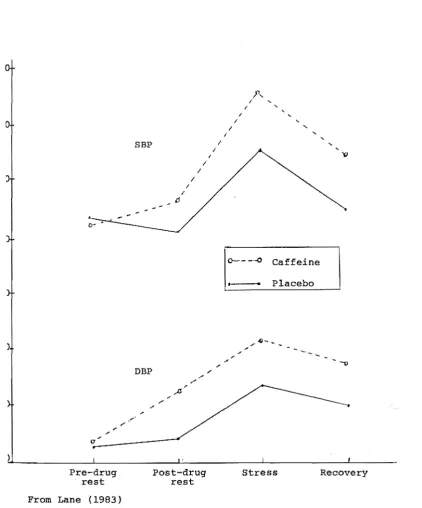
Examining the potential interaction of caffeine and psychologic stress in human subjects, Lane (1983) found that moderate doses of caffeine (two or three cups of coffee), elevated blood pressure in healthy young males during periods of rest and stress. Blood pressure during stress was also significantly higher after caffeine had been consumed. More importantly, the author concludes that the elevation blood pressure due to caffeine adds to that elicited by stress.
Recently a study by Ve1eber and Templer (1984) using normal subjects, involved a double blind procedure and controlled for body weight and usual consumption. They found that consumption of moderate (250mg) doses of caffeine increased anxiety, depression, and hostility.
Although all the studies mentioned do provide us with some insight into possible relationships between caffeine consumption and mood e ects they have also served to lay a foundation upon which future research should be built.
The general public has been reluctant to classify caffeine as a drug, even though
produces dependence, This reflects the
tolerance, and
heavy use of caffeine withdrawal symptoms. drug's "domestication", that is,
There is little doubt that the popularity of caffeine containing beverages depends on their stimulant action, although most people are unaware of any stimulation. The degree to which an individual is stimulated by a given amount of caffeine varies. For example, some persons boast of their ability to drink several cups of coffee in the evening and yet "sleep like a log". On the other hand, there are rare persons who are so sensitive to caffeine that even a single cup of coffee will cause a response bordering on toxic.
Very little is known about the effects of caffeine in the general population. Is there a normal pattern of usage? Are the effects of caffeine consistent in a given population or do they vary? Research indicates that there are individual differences in tolerance to caffeine and that there are interactive effects between caffeine and other drugs (Robertson et al., 1978; Jung et al., 1981; Childs, 1978; Gilliland, 1980; Keisler and McLaughlin, 1972; Revelle et al., 1976, 1980).
Some of the differences in response to caffeine may be due to individual differences in the metabolic half-life of caffeine (Horning et al., 1977) and differing rates of absorption (Robertson et al., 1978).
centuries as opposed to groups for whom i t is a relatively new substance.
Individual differences in response to caff ne may well be further understood with information of this kind.
There is no doubt that a certain degree of tolerance (Cotton et al., 1968) and of psychic dependence (ie. habituation) develops to caffeine containing beverages.
REVIEW OF THE LITERATURE
Chemistry of Caffeine
Caffeine is an alkaloid structurally identied as 1,3, 7-trimethylxanthine. It is one of several xanthine derivatives which occur naturally in coffee beans, tea leaves, kola nuts and cocoa beans. Theophylline (1,3-dimethylxanthine) and theobromine (3,7-dimethylxanthine) are also well known. There is close similarity chemically between these alkaloids and metabolically important compounds such as the purines, xanthine and uric acid.
Coffee (Coffee arabica) , Tea (Thea sinensis), Chocolate (Theobroma cocoa) and kola (Cola nitidia), are the most common plants in which caffeine occurs. It is readily extracted from these plants and is very soluble in boiling water, from which i t crystallizes as a monohydrate with one molecule of water; from organic solvents i t crystallizes as an anhydrous material, melting at 235 to 237oC; it sublimes at l760C at atmospheric pressure without decomposition.
Pure caffeine is adourless, has a distinctly bitter taste and is
concentrations (Graham, i978).
stable normally
at temperature, pH and salt
encountered in food processing
PHARMACOLOGICAL PROPERTIES AND PHYSIOLOGICAL EFFECTS OF CAFFEINE
Caffeine is characterized as a central nervous system
stimulant. Furthermore, i t affects metabolic and
cardiovascu functions. Caffeine also stimulates the adrenal medulla to secrete hormones which themselves are known to affect these just mentioned variables and which are also closely associated with emotion, stress, and arousal.
Caffeine acts on the kidney to produce diuresis, stimulates cardiac muscle, and relaxes smooth muscle, notably bronchial muscle.
To follow is a brief review of the literature of studies concerning caffeine and:
a) Adrenal Medullary Activity
b) Respiratory and Cardiovascular effects c) Central Nervous System
d) Smooth Muscle e) Skeletal Muscle f) Gastric Secretion g) Metabolism
h) Toxicology
Adrenal Medullary Activity
The consumption of caffeine leads to increases in the amount of epinephrine and norepinephrine secreted by the adrenal medulla (Levi, 1967; Bellet et al., 1969; Lentinietat, 1974). Robertson et al. (1978) recorded increases in plasma epinehrine (207%), plasma norepinephrine (75%), urinary metanephrine (100%), and urinary normetane-phrine (52%) in nine healthy non-coffee drinkers who had fasted overnight and abstained from any caffeine consumption in the previous week, one hour after ingesting 250mg of caffeine.
While such increases were substantial and significant, Tepperman (1965) pointed out that the adrenal medulla is capable of producing increases of up to 1000% during the full-blown panic reaction known as the "flight or fight" response.
A number of effects throughout the body occur as a result of increases in catecholamine levels. Being a neuro-transmitter, norepinephrine increases activity at peripheral autonomic synapses. It is also found at high concentrations in brain structures that have their influence primarily on the autonomic nervous system and in some of those involved in the motivational and emotional aspects of behaviour
(Thompson, 1975).
has also been associated with emotion. Schacter and Singer (1962) found that subjects injected with an epinephrine s~lution explained their resulting physiological arousal on the basis of cognitive and soc 1 determinants. In the presence of someone acting euphorically, subjects interpreted their own arousal as euphoria; in the presence of someone acting out anger, they interpreted their own arousal as anger. Therefore, if the consumption of caffeine increases epinephrine levels sufficiently, these increases may aggravate whatever the emotional tone of the individual is at the time.
The pattern of epinephrine and norepinephrine levels that occur with regular daily ingestion of caffeine also needs to be determined. Jung et al. (1981), found that among regular coffee drinkers only 3 of 22 subjects after oral caffeine ingestion, and in 3 of 14 subjects following intravenous caffeine, recorded catecholamine increases of the magnitude found in the Robertson et al. (1978) study.
Increases in epinephrine and norepinephrine would be expected to have both physical and emotional consequences in the form of increased stress and anxiety. A number of the effects of caffeine in humans are consistent with the effects of increased levels of epinephrine and/or norepinephrine.
Caffeine may act as a sympathomimetic drug in some people (Sawyer et al., 1981). Sympathomimetic drugs are those which cause changes in the body usually associated with sympathetic arousal. Through the release of norepinephrine, many sympathomimetic drugs act indirectly on the sympathetic nervous system. Innes and Nickerson (1975) regarded the release of epinephrine from the adrenal glands, as the prototype of the sympathomimetic agents.
Caffeine causes increases in both of these hormones and on this basis, Sawyer et al. (1981) hypothesized that i t is a sympathomimetic agent in some, if not all, individuals. Further complications exist as, like caffeine, epinephrine is also a central nerous system stimulant.
Sawyer et al. (198l) argued that a differentiation of the effects of caffeine from those of norepinephrine and epinephrine as well as determining the manner in which they may interact is necessary we are to understand the real effects of caffeine.
Table 4 summarizes the similarities and differences I
Table 4
A Comparison of the Effects of Caffeine, Epinephrine, and Norepinephrine on Human Physiology
Effects reported for:
Physciological variable Caffeine Epinephrine Norepinephrine
Ritchie (1975 )
Innes and
Nickerson (1975)
Innes and
Nickerson (1975)
Respiration
Respiratory rate
o consumption
c6
2 consumptionCardiovascular effects Heart function
Rate
Cardiac output
Force of contractions Cardiac rhythm
Compensatory vagal activity
Circulation Coronary Pulmonary
Skeletal muscle Hepatic
Cutaneous Renal Cerebral
Peripheral resistance Blood pressure
CNS stimulation Anxiety reaction
Anxiety Restlessness
Periods of depression Tremors
Flushing Diuresis Insomnia
Sensory distrubances Skeletal muscle
Neuromuscular transmission
Power of contractions Fatigue
From Sawyer et al., 1981.
+ + + +,-+,-,0 Present +,-+ + + + + + + + + + Facil-itated + + + + + + ? +,-,0
May be
+ + + + + + + + + ? + ? ? ? present Facilitated + ? ? ? 0,-? +,-,0 Present + ? 0,-+ + 0 + + ? + ? ? ? ? ? ?
[image:32.595.90.515.129.687.2]Sawyer et al. (1981) question whether c feine is a sympathomimetic agent, in which case some of its effects would be due to increases in catecholamines and not to the direct action of caffeine itself.
Respiratory and Cardiovascular Effects
Consumption of caffeine leads to increases in respiratory rate, oxygen consumption, and carbon dioxide elimination as a result of stimulation of the medullary respiratory centre (Table 4).
In a study by Robertson et al. (1978), the respiratory rate was determined during a 10 minute interval of quiet breathing, of nine healthy non-coffee drinkers following the ingestion of 250mg caffeine. Where as the respiratory rate 60 minutes after placebo averaged 13.4 1.6 (mean ±S.D), the comparable value ter caffeine was 16.1 2.3 per minute (mean ±S.D). This value was significant at P(0.05 by a paired t-test. The degree of respiratory acceleration appeared to correlate with plasma caffeine levels over the range observed in their subjects (r=0.73, P(O.02).
The effect is masked because the drug also stimulates the medullary vagal nuclei, which in turn, decrease heart iate. The result of these two opposing actions may be bradycardia, tachycardia,
Stephenson, 1977).
or no change (Truitt, 1971;
There also may be variations over time. Caffeine has an antagonistic action on the circulation of the blood (Table 4). Caffeine dilates the coronary, pulmonary, and general systemic blood vessels by causing a relaxation of the smooth muscle in the vessel walls, i t may also constrict blood vessels by stimulating the medullary vasomotor centre. No compensatory activity on the part of the medulla takes place in the brain itself, where caffeine causes a constriction of the blood vessels with a decrease in cerebral blood flow
(Truitt, 1971; Ritchie, 1975).
The response of blood pressure to caffeine is thought to depend on the balance between central vasomotor and myocardial stimulation, which tends to increase it, and central vagal stimulation and peripheral blood vessel dilation,
Significant
which tend elevations
to decrease i t (Ritchie, 1975). in blood pressure were found in Robertson's et al. (1978) study, 30 minutes after nine healthy male subjects ingested 250mg caffine (Table 4).
effect was found by Studlar (1973), particularly in insulin-dependent diabetic
ihat blood glucose
patients. dropped
Naismith et ale (1970), noted slightly when caffeine was withdrawn and did not return to pretest levels. The work of Sandberg and Bellet (1969) did not support the hyperglycerine action of c eine; in their studies, normal subjects had lower glucose levels when receiving glucose and caffeine than when receiving glucose alone.
higher blood sugar levels were
However, in diabetic patients, found at 30, 60, and 90 minutes than when receiving glucose alone.
Free fatty acids may rise after a dose of caffeine (Lentini et al., 1974; Naismith et al., 1970; Wachman et al., 1970). Because they can also fluctuate in response to emotional changes, caution is suggested in attaching significance to this finding (Naismith et al., 1970).
Heart rate, blood pressure levels, glucose and fatty acid blood concentrations were observed by Handel et ale (1977) in six men and six women aged 20-42 years, before and within 360 minutes after oral administration of coca cola with caffeine (22.5, 35 and 150mg) but without sugar. Clinically significant ts (an increase in mean blood pressure level, glucose and free fatty acid levels and urinary catecholamine excretion) were induced only by 150mg of caffeine.
elevation. Williamson (1978) has criticized this conclusion and enumerated the methodological errors. He has pointed out for example, that the authors took the half-life period as 12 hours though it had not in fact been determined.
Much interest has developed concerning a possible deleterious effect of caffeine in the etiology of acute myocardial infarction. An association between myocardial infarction and coffee usage has been shown in a
u.s.
surveillance study, and some of these patients are now restricted as to caffeine use (Bowan and Rand, 1980). Jick and coworkers (1973) reported that individuals drinking more than 5 to 6 cups of coffee per day are about twice as liable to suffer myocrdia1 infarction. However, in an equally careful study K1atsky and associates (1973) found no association between coffee drinking and a independentsubsequent rst myocardial infarction: they suggested that the discrepancy in the findings of the two groups may be related to factors such as cigarette smoking or the selection of control subjects~ Further studies have confirmed that coffee drinking is associated with little, if any, increased incidence of coronary heart disease (Dowber et a1., 1974; Hennekens et a1., 1976).
coffee intake lowered the effective and functional refractory period of the a/v node, the effect probably being mediated by datecholamine release (Gould et al., 1979).
Multiple measurements of multiple variables should be included in the study of c feine and its effects on the circulatory system and the medullary centres. As Ritchie (1975) stated, "The observation of a single function, for example, blood pressure, is deceiving because the drug may act on a variety of circulatory factors in such a way that blood pressure may remain essentially unchanged." Sawyer et al. (1981) added that although caffeine has not been associated with an increased frequency of respiratory, cardiac, circulatory, or hypertensive disorders (except for myocardial infarction (Bowan and Rand, 1980), neither have the effects of caffeine on these abnormal populations been studied in an experimental setting. Until this is done, the assumption that caffeine is not contraindicated for these populations will remain an open question.
Central Nervous System
Caffeine can stimulate all parts of the central nervous system when high enough concentrations are attained (Table 4). It is not only the vagal centres in the medulla which are affected, but also the cortex and the spinal cord.
to 500mg may produce headache, tremors, nervousness, and irritability. Hypersethesia, pleasant or unpleasant, may occur after excessive coffee intake (Ritchie, 1970; Truitt, 1971).
In the course of a series of studies on c eine's psychotropic effects Goldstein et ale (1965, 1969) found that the drug had no demonstrable effect on objectively measured performance, although it made the subjects feel more alert and physically active. In some subjects, caffeine caused a feeling of "nervousness" rather than alertness.
There were both qualitative and quantitative differences in responses to caffeine that were related to the degree of habitual caffeine consumption. Heavy users became less jittery and nervous and had fewer headaches with increasing doses of caffeine. In the abstainers, caffeine produced jitteryness, nervousness, and gastrointestinal complaints (Goldstein, 1969).
The effectiveness of caffeine in preventing attention lapses was studied in a visual monitoring test analogous to night driving. Caffeine was effective in preventing attention lapses after the first hour, and the effect persisted over the remaining 2 to 3 hours of the experiment
(Mitchell et al., 1974).
"Caffeine results in a more rapid and clearer flow of thought, and allaying of drowsiness and fatigue. After taking caffeine one is capable of a greater sustained intellectual effort and a more perfect association of ideas. There is also a keener appreciation of sensory stimuli, and reaction time is appreciably diminished. In addition, motor activity is increased: typists, for example, work faster and with few errors. II
Recent studies show large variations in these effects depending on such variables as dosage of caffeine and personality type. For example, Revelle et al. (1976) found that under 200mg of caffeine and time stress, accuracy of extraverts increased while accuracy of introverts decreased in a verbal ability test.
A number of EEG studies concerning caffeine's stimulating effect on the cortex show inconsistencies.
For example, contingent negative variation is a slow surface-negative electrical potential of the human brain, and its amplitude is related to attention and arousal. Both increases (Ashton et al., 1974) and decreases (Jenssen et al., 1978) in contingent negative variation amplitudes have been reported at comparable time periods (about 30 minutes) after the ingestion of 300mg caffeine.
Looking at other aspects of EEG activity, Klein and Salzman (1975), reported reductions in auditory event-related potentials, 2 hours following the ingestion of 300mg caffeine. Walpow and Penny (1978), found that the decreases in temporal N
following caffeine. Thus these results indicate both increases and decreases in functions.
Only after massive doses (probably between 2 and 5gms) is the spinal cord stimulated by caffeine (Julien, 1981). Increased excitability of spinal reflexes might be observed and, at even higher doses, convulsions and death may ensue (Ritchie, 1975). The convulsive dose, however, is so high (over 10gms, the equivalent of 100 cups of coffee) that death from caffeine is highly unlikely. Very few people would consume such high amounts of caffeine in the space of a day even if they were regular heavy consumers.
Smooth Muscle
Caffeine blood vessels. their ability
relaxes various muscles other than those of The most important action in this respect is to relax the smooth muscles of the bronchi, especially if the bronchi have been constricted either experimentally by histamine or clinically in asthma (Roll, 1980).
Skeletal Muscle
output during the second work period when compared to control injections.
Huidibro and Arnenbar (1945), found that doses of 3.5mg/kg caffeine increases twitch tension of the indirectly stimulated quadriceps muscle of cats.
Caffeine causes marked increases in tension of frequencies slightly below those producing tetanus and is accompanied by fusion of individual contractions, perhaps owing to a prolonged contraction time (Goffart and Ritchie, 1952).
Such observations may be explained in part by the ability of caffeine to increase the release of acetylcholine, as judged by augmentation of the amplitude and rate of rise of end-plate potentials in curarized rat diaphragm (Goldberg and Singer, 1969). Caffeine can also increase the resting tension of denervated muscle (Huidibro, 1945).
The site of action of caffeine in the excitation-contraction coupling process in skeletal muscle has been a controversial subject for some time. Axelsson and Thesleff
(1958) did not observe contraction when caffeine was injected intracellularly and they therefore suggested that caffeine acted on the plasma membrane. Caldwell and Walstar (1963) found,
elicit
suggested by Luttgow and Oetliker (1968), and by Thorpe and Seeman (1971), caffeine nevertheless could exert its effect by displacing calcium from the plasma membrane and its invaginations, the T tubules.
Thorpe and Seeman's (1971) results indicated that caffeine acts at only one site in the excitation-contraction coupling system, the sarcoplasmic reticulum. Caffeine did not displace calcium from the sarcolemma, but it did release a significant portion of the calcium bound to sarcoplasmic reticulum. As reported previously (Weber and Herz, 1968) this effect on the reticulum was inhibited by procaine.
Gast~ic Secretion
The ability of caffeine to stimulate gastric secretion in man is well documented (Roth et al., 1944; Czok, G. 1972; Volkheimer et al., 1972; Meiderer et al., 1973; Cohen and Booth, 1975).
Man is relatively sensitive, and moderate oral or parental doses of caffeine cause secretion of both acid and pepsin (Debas et al., 1971). Patients with active ulcer disease can be identified by a sustained elevation of acid secretion in response to high doses of caffeine. Normal patients show only a transitory rise (Roth et al., 1944).
peptic ulcer in the ulcer-prone individual and renders the management of the condition more difficult.
The primary effect probably results from stimulation of the gastric myenteric and submucous nerve networks by caffeine. A secondary effect is believed to come from the central nervous system stimulation via the cholinergic nerve fibres. Caffeine has been shown to cause an increase in cyclic 3',5' adenosine monophosphate, which appears to be involved in the stimulation of hydrogen ion secretion by the gastric mucosa (Harris et al., 1965, 1969).
It has long been known that beverages made from roasted grain containing no caffeine stimulate acid secretion in man as much as does coffee (Cohnell and Berg, 1931). Similarly, Cohen and Booth (1975) demonstrated that both decaffeinated coffee and coffee were equally potent in stimulating gastric acid secretion. Their results indicated that coffee in either form may contain stimulants for acid secretion other than caffeine, or possibly a compound which potentiates the action of caffeine or a secretagogue which acts independently. Czok (1972) attributed these effects to caffeine and "Ie sostanze di torrefazione del caffe," the compounds resulting from roasting and brewing of coffee.
Metabolism
After ingestion caffeine is rapidly and essentially completely absorbed from the gastrointestinal tract. It passes quickly into the central nervous system and into various tissues in approximate proportion to their water content; tissue response is proportional to caffeine content
(Axelrod and Reichenthal, 1953).
Caffeine reaches maximum levels in the blood between 30 and 120 minutes after ingestion, the mean time being 60 minutes (Robertson et al., 1978). Among different
individuals, the metabolic half-life of caffeine varies between 4 and 10 hours (Horning et al., 1977) ie. 4 hours after ingesting one cup of brewed coffee (85mg caffeine), a person with a rapid rate of biotransformation will still have a minimum of 42.5mg of caffeine in his/her system. Ingesting two more cups of coffee at this time would add l70mg caffeine, for a total of 2l2.5mg a figure above the pharmacologically active dose given by Graham (1978) as 200mg and by Truitt (1971) as between 50 and 200mg. Individuals with lower rates of biotransformation would have higher levels and would accumulate caffeine more rapidly. This difference in turnover rate may be helpful in explaining individual differences in response to caffeine.
reported that 48 hours are needed to clear 66 per cent of 100mg caffeine dose, Axelrod and Reichenthal stated that there was no day-to-day accumulation of the drug after a 500mg dose. The drug is fatal at doses of 3,000 to 10,000mg, if taken in a brief time span (Dimaio and Garriott, 1974).
Cellular metabolic effects of caffeine include increases of muscle lactic acid, stimulation of oxygen consumption, and muscle twitches and contractures in high concentrations (Ritchie, 1970; Truitt, 1971). Miller et ala
(1974) investigated the ability of caffeine to potentiate normal thermic responses and found that it caused a marked increase in oxygen consumption. These authors suggested that caffeine, by virtue of its negligible energy values and thermogenic properties, could be of value in weight-reducing regimes.
Sutherland et ala (1968) provided a biochemical explanation for some of the metabolic and physiologic effects of the methylxanthines. The enzyme, phosphodiesterase, is necessary to convert cyclic 3' ,5' adenosine monophosphate to 5' adenosine monophospate. Methylxanthines inhibit phosphodresterase breakdown of cyclic 3',5' adenosine monophosphate, which then prolongs its metabolic stimulating action in the cells.
Toxicology
occurred. A five-year-01d girl died after ingesting 5,000mg caffeine alkaloid from her mother's bottle of
over-the-counter diuretic. In other cases, patients have
unintentionally been given caffeine rather than their correct medications with fatal results (Dimaio and Garriott, 1974). Suicide has been reported due to caffeine ingestion. The individual intending to misuse i t , however, is usually thwarted by another of its pharmoco1ogic properties, that of potent gastric irritation, which causes vomiting (A1sott et a1., 1973).
The concentration of caffeine in postmortem blood has ranged from 80 g/m1 to over 1mg/m1. Untoward reaction, however, may be observed following the ingestion of 19 (15mg/ kg) or more of caffeine, leading to plasma concentrations above 30 ~g/m1. These are mainly referable to the CNS and circulatory systems. Insomnia, restlessness, and excitement are the early symptoms, which may progress to mild de1erium. Sensory disturbances such as ringing in the ears and flashes of light are common. The muscles become tense and tremulous. Tachycardia and extrasysto1es are frequent, and respiration is quickened (Dimaio and Garriott, 1974).
Mutagenic Effects
processes. The doses required to induce such inhibition, however, are significantly higher than those usually consumed by humans. Furthermore, available evidence suggests that caffeine is neither mutagenic by itself nor in combination with known mutagens in mammals.
At very high doses, caffeine appears to have some teratogenic activity in mammals. One retrospective study (Weathersbee et al., 1977) indicated that pregnant women who ingest more than 600mg of caffeine per day in beverages may have an increased incidence of spontaneous abortion, still birth, or premature delivery.
Kreybig and von Czok (1975) have analyzed other authors' data and the results of their own study of mutagenic and teratogenic effects of caffeine and soluble coffee in pregnant rats. Such effects were indeed observed after administration of high doses of caffeine - 240mg/kg (intra-peritoneally) and 264mg/kg (orally) in rats, and 304 and 4l0kg/mg respectively in mice. These doses greatly exceeded those usually taken by man, even in cases of coffee dependence. Taking this into account, normal coffee intake by pregnant women may be considered harmless unless it is proved injurous on other grounds.
In the light of these data, the depressive action of caffeine on the division of cells requires further fnvestigation (Furmanova et al., 1976).
other Illnes
Caffeine in combination with aspirin, is widely employed in
an analgesic, the ordinary
.such types
as of headache. There are few data to substantiate this use. Caffeine is also used in combination with an ergot alkaloid in the treatment of migraine. The ability of caffeine to produce constriction of cerebral blood vessels may improve the therapeutic response (RaIl, 1980).
Because caffeine stimulates brain motor centres, i t may be contraindicated for some epileptic patients. However, in some cases, the patient learns that drinking coffee relieves attacks. As an adjunct to diphenylhydantion, caffeine may be used to allay the drowsiness induced by the former; children and adults may be directed to drink a prescribed number of cups of coffee. Caffeine and herbs were the only treatment for narcolepsy until ephedrine sulphate was introduced in 1930 and amphetamine in 1935 (Lennox et al., 1960).
al., 1978). However, these studies involved the use of single doses of caffeine unadjusted for body weight.
A number of studies concerning caffeine, coffee, and cancer were reviewed in the British Medical Journal (1976). In animals, laboratory tests of caffeine for carcinogenicity gave essentially negative results.
Caffeine, ascorbic acid, and sodium salicylate increase circulating serum levels of interferon in response to viral infection. Caffeine was the least active in elevating interferon levels (Geber et al., 1975).
Caffeine has been withheld from patients with gout, due to the possibility that i t could be converted into additional uric acid. Since the development of the uricase method of determining uric acid, all reported studies have indicated there is no increase in true uric acid secretion
(Cornish and Christman, 1957).
CAFFEINE EFFECTS ON PERFORMANCE
The belief that caffeine enhances mental and physical performance is widespread and deeply embedded in our folklore, but experimental support for this belief is neither extensive nor unequivocal.
One of the most comprehensive literature reviews of performance effects of caffeine was carried out by Weiss and Laties (1962). These investigators reviewed numerous early studies which had reorted performance enhancement with caffeine. Among them were improved ergonomic output on a bicycling task (Foltz, Ivy and Barborka, 1942), decreased reaction time (Cheney, 1935, 1936: Horst and Jenkins, 1935), increased tapping rate (Hollingworth, 1912: Lehman and Csank, 1957), more accurate compensatory tracking (Seashore and Ivy, 1953), greater galvanic skin response conditioned amplitudes
(Switzer, 1935), and a slight increase in typing speed (Hollingworth, 19l2). However, caffeine has been found to disrupt or to produce no effect upon many of these variables (Adler, Burkhardt, Ivy and Arkinson, 1950: Hawk, 1929: Hollingworth, 1912: Hull, 1935).
Thus, specific effects of the Weiss and Laties (1962) indicated some
drug are not known. general conclusions without the benefit of analyses of treatment interactions: 1. caffeine has little or no effect on reaction time
2. caffeine impairs hand steadiness
3. caffeine produces equivocal effects on motor co-ordination 4. caffeine is capable of counteracting motor performance
Fleishman and Bartlett (1969), who reviewed research on the effects of drugs on human performance, pointed out the need
tor experimental studies evaluating the effects of specific drugs and dosage on specific classes of human performance.
Caffeine has mixed effects with those in the workplace. Stimulation, increasing arousal, and anxiety do not necessarily result in improved performance. A summary of work in this area compiled by Truitt in 1971 includes:
1. a prolonged and slightly increased ability to perform exhausting work,
2. an unpredictable effect on simple and complex tasks involving choice and descrimination,
3. tremor interference with hand steadiness,
4. possible influences on eye-hand co-ordination, and
5. improved mental activity in simple arithmetic, typing and uncoding.
More recently caffeine has been shown to affect such variables as vigilance, accuracy, and reaction time. Sawyer et al. (1981) produced a summary of recent findings on caffeine and performance. This is illustrated in Table 5. Some endurance components are also included in Table 4 to compare caffeine's effects to those of epinephrine and norepinephrine on muscular contraction.
Table 5
Summary of Recent Findings: Effects of Caffeine on Performance
Performance Variable
Physical endurance Bicycle ergometer
Fixed load
Progressive load Motor Skills
Rapidity and accuracy Eye-hand co-ordinate Vigilance
Visual
Night-driving analogue Target scanning
Low coffee users High coffee users Auditory
Auditory Extroverts Introverts Reaction Time
Regular reaction time Choice reaction time
Decision time Motor time Verbal tests
GRE practice test Speed and accuracy Extroverts
Introverts
Verbal test, time stress Accuracy
Extroverts Introverts Verbal test
Accuracy
Low impulsives High impulsives
From Sawyer et al., 1981.
Effect of Caffeine
+ (Costill et al., 1978)
o
(Perkins and Williams, 1975)- higher doses(paroli 1972)
+ lower doses '
- (Putz-Anderson et al., 1981)
+ (Baker and Theologus, 1972)
o
(Childs, 1978)+,0 (Clubley et al., 1974)
+
o
(Keister and McLaughlin,1972)
- (Paroli, 1972)
+ (Smith et al.,
1977)
+ with increasing dosage
First +, then -, with increasing dosage (Gilliland, 1977)
+ (Revelle et al.,
1976)
+, AM: AM:
- PM
+ PM (Revelle et al., 1980)
of caffeine are the results of direct stimulation, action through epinephrine, or indeed both, remains an unanswered question.
Vigilance, Reaction Time, and Motor Skills
The results of early investigations on caffeine effects on performance are conflicting. Payne and Hauty (1954) found the onset of fatigue slower after caffeine 20mg in a vigilance test. As early as 1912 Hollingworth reported that caffeine 300mg reduced reaction times.
Gilliland and Nelson (1939) also found reaction times were reduced after one to two cups of coffee. Later in more controlled studies, Knowles (1963) and Franks et al. (1975) recorded reaction times after c feine 250 and 300mg/70kg, which were shortened but not significantly different from placebo.
Clubley et al. (1978) obtained significant decrements in reaction time after caffeine 75-300mg but the observed decrement after caffeine 100mg did not differ significantly from that following the placebo.
there are interactive effects with personality variables. Changes which make work easier or more difficult may interact with arousal and anxiety levels to reduce or increase stress levels on the job.
Caffeine has been reported to increase the capacity for muscular work (Ritchie, 1975). It has been argued that this is due to central nervous system stimulation, although peripheral effects cannot be discounted. Evidence for this effect comes from measurements and studies with the bicycle ergograph.
However, both significant effects (Coste11 et a1., 1978) at a fixed workload, and non significant effects
(Perkins and Williams, 1975) using a progressive workload, in muscular work capacity have been reported. Factors such as the use of constant versus increasing workloads and/or the degree of physical fitness of subjects may be helpful in explaining the differing results of these two studies.
Increased tapping rates after 324mg caffeine have been reported by Gilliland and Nelson (1939) Holck and Smith (l939), Lehman and Csonk (1957), but Flory and Gilbert (1943) found no effect after the same dose. Clubley et al. (1978) found tapping rates to be increased by caffeine doses of 150 and 300mg, but not 75 or 100mg. Tapping requires muscular work and since caffeine is known to strengthen and prolong the concentration of isolated skeletal muscle (Huidibro, 1945; Goffart and Ritchie, 1952) its effects on tapping may be due to a peripheral action. However, since these effects occur with doses also producing subjective arousal, peripheral effects and central stimulation cannot be separated.
Subjective arousal after caffeine (150-300mg) has been reported (Barmack, 1940; Goldstein et al., 1965) although Knowles (1963) claimed no subjective effects occurred after 250mg caffeine.
Regina et al. (1974) required subjects to drive an automobile for 90 minutes after consuming either 200mg of caffeine or a placebo. Following the initial drive, subjects ingested a supplemental dose (200mg) of either caffeine or placebo and continued the driving task for an additional 90 minutes. Caffeine ingestion significantly decreased response times for acceleration, decelerations, and high beam signals.
In an earlier study on a task analogous to night driving, Baker and Theologus (1972) found that, 1 hour after ingesting 200-400mg caffeine, alertness increased, ie. there were significantly fewer attention lapses.
Lake and Meliska (1984) tested the effect of caffeine on a simple visual vigilance task under conditions designed to produce boredom and fatigue. Contrary to expectation, no improvement was found in vigilance as a result of caffeine ingestion compared to control. Thus, caffeine did not reverse a progressively deteriorating performance relative to control.
The regularity of caffeine consumption may also effect performance. Childs (1978) reported that 'high coffee users' responded significantly faster and more accurately in a visual scanning task than 'lower coffee users' when they ingested 400mg caffeine, but not when placebo or 200mg caffeine was ingested.
Mental Tasks and Personality Variables
Caffeine has been reported to show improvements in simple arithmetic and uncoding (Truitt, 1971), faster solving of maths problems (Paro1i, 1972), and adverse effects on the recall of a series of nonsense syllables (Hull, 1935).
Studies involving more complicated mental tasks have shown an association between caffeine's effects and personality types. Eysenck's (1962) extraversion-intraversion model, predicted that the effects of a stimulant drug would be in an intraverting direction. In contrast, extraversion was associated with increased speed and decreased accuracy. Subjects in the caffeine studies have been divided into personality groups on the basis of Eysenck's theories.
Table 6 shows some findings of studies involving caffeine effects and personality types.
Task
Recording of digits
GRE practice test
Verbal ability test under stress
Caffeine Effects and Personality Types
Condition (mg Caffeine)
o
mg 200 mgIncreasing dosages
200mg caffeine plus time stress
Personality Group Performance
Extroverts
Decrease
No decline
Increase
Increase
Introverts
No change
NO decline
Increase the