Department of Physics and Astronomy University of Canterbury, Private Bag 4800
Christchurch, New Zealand
PHYS 690 MSc Thesis
submitted in partial fulfilment of the requirements for
The Degree of Master of Science in
Physics
Average cosmic evolution
in a lumpy universe
by
James A.G.
Duley
Supervisor:
Assoc. Prof. David L.
Wiltshire
Assistant Supervisor:
Dr Teppo
Mattsson
To my parents, who without their help and encouragement I would not
Contents
Acknowledgements vii
Abstract ix
Conventions xi
1 Introduction 1
1.1 Inhomogeneous cosmology . . . 1
1.2 Thesis outline . . . 4
2 Newtonian cosmology 7 2.1 Introduction . . . 7
2.2 Governing equations . . . 7
2.3 Averaging of the Newtonian cosmology . . . 15
3 Congruences and the splitting of spacetime 21 3.1 A kinematical description of spacetime . . . 21
3.2 The 3+1 split of spacetime . . . 25
3.3 Hypersurfaces . . . 30
3.4 The ADM gauge . . . 31
4 Coarse-graining in general relativity 37
vi Contents
4.1 Introduction to coarse-graining tensors . . . 37
4.2 Korzy´nski’s method . . . 37
4.3 The coarse-graining boundary . . . 42
4.4 Isometric embedding in E3 . . . 43
4.5 Korzy´nski’s coarse-graining . . . 46
4.6 Coarse-graining example: Bianchi I universe . . . 49
4.7 Evolution for the irrotational case . . . 53
4.8 Evolution example: The Lemaˆıtre-Tolman-Bondi model . . . 57
4.9 Discussion . . . 61
5 Wiltshire’s timescape model 63 5.1 Introduction . . . 63
5.2 The Buchert averaging formalism . . . 65
5.3 Buchert equations of the timescape model . . . 67
5.4 Solution and observables . . . 71
5.5 Data fitting . . . 74
5.6 Estimation of the effects of radiation . . . 78
5.7 Adding radiation to the timescape model . . . 80
5.8 Beyond the surface of last scattering . . . 83
5.9 Discussion . . . 89
6 Summary 91 6.1 Chapter 2: Newtonian cosmology . . . 91
6.2 Chapter 3: Congruences and the splitting of spacetime . . . . 92
6.3 Chapter 4: Coarse-graining in general relativity . . . 92
6.4 Chapter 5: Wiltshire’s timescape model . . . 93
6.5 Proposed coarse-graining procedure . . . 95
Acknowledgements
Firstly, I would like to acknowledge my supervisor, David Wiltshire, for his help and guidance of this thesis. Secondly, I would like to acknowledge the following people for their proofreading efforts; Teppo Mattsson, Josephine Faulkner, Alice Balme, Ahsan Nazer and Michael Pitman.
Abstract
The procedure of averaging and coarse-graining of the gravita-tional field equations with sources are investigated in both Newto-nian gravity and in general relativity. In particular the schemes of Buchert and Korzy´nski are examined and compared in both situa-tions. In Newtonian gravity it is shown how to calculate the tidal tensor given boundary conditions for it and how to average it given those boundary conditions. It is also shown that one can always choose boundary conditions to make the average tidal tensor vanish or take any value.
The problems of coarse-graining tensors in general relativity are critically examined, and a set of relevant conditions for such a pro-cedure are enumerated. Korzy´nski’s covariant coarse-graining pro-cedure is reviewed and applied to a particular case. For the case of the Lemaˆıtre-Tolman-Bondi model it is shown that the backreaction was always zero for a centred spherical coarse-graining domain.
Wiltshire’s timescape model, which applies a particular obser-vational interpretation to Buchert’s averaging scheme, is reviewed. The dust timescape model of Wiltshire is extended by the addition of a homogeneous radiation source. This model is solved numerically and it is shown not to vary significantly from the dust model since the redshift z ≈ 30, which is when the backreaction and radiation density are equal. The model is integrated back in time from the sur-face of last scattering with results indicating a breakdown in aspects of the model at early times.
Conventions
Unless otherwise noted, the following conventions will be used. Units will be used such that c = 1. In reference to spacetime, Greek indices will be taken to be 0,1,2,3 and Latin indices will be taken to be 1,2,3; the first half (a to g) will be used to denote Euclidean space and the middle letters (i to p) to denote the spatial indices of a 3+1 split of spacetime. In reference to coarse-graining on an arbitrary dimensional manifold, Greek indices will indicate a coordinate basis and Latin indices will indicate a non-coordinate basis. Einstein summation convention shall be assumed. Tensor signs will follow that of Misner, Thorne and Wheeler [1], i.e.,
M etric signature: ηµν = diag(−1,+1,+1,+1) (1)
Riemann tensor: Rµναβ =∂αΓµνβ−∂βΓµνα+ ΓµσαΓσνβ −ΓµσβΓσνα (2)
Einstein tensor : Gµν ≡Rµν− 12gµνR= 8πGTµν (3)
A comma shall denote a partial derivative, whereas a semicolon will denote a covariant derivative, i.e., Xβ,α ≡ ∂αXβ and Xβ;α ≡ ∇αXβ. Parentheses
around indices shall denote symmetrization on those indices, i.e.,
A···(α1···αp)···≡
1
p!
X
σ∈Sp
A···(ασ(1)···ασ(p))···, (4)
xii Conventions
for permutations σ. Square brackets around indices shall denote antisym-metrization on those indices, i.e.,
A···[α1···αp]···≡
1
p!
X
σ∈Sp
sgn(σ)A···[ασ(1)···ασ(p)]···, (5)
where sgn(σ) is the sign of the permutation σ. The Levi-Civita symbol is defined as
α1α2···αn =
+1 ifα1α2· · ·αn is an even permutation of the index range
−1 ifα1α2· · ·αn is an odd permutation of the index range
0 otherwise
(6) and the Levi-Civita pseudotensor as
ηµνσρ =
q
−det(gµν)µνσρ. (7)
Also, we will define the following tensor derived from the metric,
CHAPTER
1
Introduction
1.1
Inhomogeneous cosmology
The assumption that the universe is homogeneous and isotropic was cer-tainly very accurate at the time of last scattering, evident from the near perfectly smooth cosmic microwave background (CMB). During the inter-vening aeons formation of large scale structures has led to a universe that is no longer near to homogeneous, but rather dominated by voids with galaxy clusters in filaments and walls threading and surrounding these voids. This is seen in sky surveys such as the Sloan Digital Sky Survey (SDSS) [2], 2dF Galaxy Redshift Survey and others. These surveys show that voids with a characteristic mean effective radii of order (15 ±3)h−1 Mpc1 and a typical density contrast of δρ/ρ = −0.94±0.02, where ρ is the average density of the observed volume, compose 40% of the volume of the nearby universe [3, 4]. A study [5] of the Sloan Digital Data Release 7 [6] found the median effective radius of voids in the survey volume of 17h−1 Mpc and 62% of the volume is occupied by voids with mean effective radii between 10h−1 Mpc and 30h−1 Mpc. Along with voids of this size there an abun-dant amount of smaller voids occupying the universe [7] meaning overall
1Due to the ellipticity some voids exhibit, the mean effective radius is defined as the
radius of a sphere occupying the same volume.
2 Introduction
the current universe is dominated by voids.
The non-linear nature of the Einstein equations makes trying to solve them for the full inhomogeneous geometry of the universe extremely difficult to do analytically with today’s current mathematical knowledge, or even numerically with today’s computing power. The difficulties in numerical relativity go beyond the simple limits imposed by hardware limitations. To solve Einstein’s equations requires a splitting of spacetime into space and time in order to construct evolution equations. Such a splitting involves intrinsic ambiguities. Further problems arise when structures form and geodesics cross. Any numerical scheme has to deal with smoothing over singularities. In cosmology, in view of the complex hierarchy of observed structure, we have the additional problems of coarse-graining over these structures to define average symmetries of the global spacetime background.
The simplifying assumptions most cosmologists make is that, firstly, the
universe is on average homogeneous and isotropic and, secondly, on
aver-age it evolves like an exactly homogeneous isotropic Friedmann-Lemaˆıtre-Robertson-Walker (FLRW) model. The first assumption seems to be valid on scales of over 100h−1Mpc, although there is some debate as what exactly this scale is [8, 9]. The second assumption concerning average evolution, however, has no direct physical justification. A further third assumption that is also often made is that our own measurements yield parameters which exactly coincide with those that describe the average cosmic evo-lution (which means those of a FLRW model if we also make the second assumption).
1.1. Inhomogeneous cosmology 3
then match the geometry of the Milky Way to that of the local group, and so on until we have matched geometries up to the scale which describes the average cosmic evolution and propagation of light. There are several possible relevant steps of coarse-graining in this hierarchical process, with qualitatively new physical questions entering when we make a transition from dealing with bound systems to regions of expanding cosmic fluid [12]. If we ignore the fitting problem and make the standard assumptions con-cerning homogeneity and isotropy then current cosmological observations indicate that the expansion rate of the universe appears to have begun accelerating in the relatively recent past, at redshifts z <1. Given the in-trinsically attractive nature of gravity, an acceleration of cosmic expansion is not possible if the universe contains only sources of mass–energy which obey the strong energy or “timelike convergence” condition, which for per-fect fluids is characterized by an equation of state for which p >−1
3ρ. The strong energy condition must be satisfied in order for matter to focus light rays, and it is satisfied for all forms of matter which have been directly observed.
A form of matter which violates the strong energy condition is therefore required, and observationally the equation of state of such a fluid which best fits cosmological observations is found to be extremely close to the lowest possible bound, p=−ρ, allowed by the dominant energy condition2. The p=−ρbound is realised by a cosmological constant, which represents a pure vacuum energy. Generically any form of matter which violates the strong energy condition will not clump as a result of gravitational collapse, and is therefore called dark energy. Dark energy is, as of yet, not directly observed and its only manifestation is to change the expansion history of the universe to allow for cosmic acceleration.
Since the determination of the average expansion history of the universe is intimately related to the assumptions of homogeneity and isotropy in the
2Physically, the dominant energy condition, |p| ≤ ρ, may be understood as saying
4 Introduction
standard ΛCDM model, it is possible that the expansion history has been misinterpreted as a result of incorrect assumptions in a complex geometrical problem. This thesis will investigate what happens if we do not make such assumptions.
To perform such a task we need to first decide what is meant by an average. The concept of an average in general relativity is not a trivial one. We will present and analyse two methods that define the concept of an average, those of Korzy´nski [13] and of Buchert [14, 15]. These show that the Einstein equations of the average geometry and the average of the Einstein equations of the full geometry are not the same; the difference leads to abackreaction term. We will then generalise Wiltshire’s timescape model [16] to include radiation. The timescape model drops the second and third assumption above and, after a particular physical interpretation of our own measurements relative to both cosmic averages and cosmic variance, fits observed data well without dark energy.
1.2
Thesis outline
Before beginning our discussions on averaging in general relativity, we will look at the simpler case of averaging in Newtonian cosmology first. This is presented in Chapter 2 where we start by reviewing the existing formulation of Newtonian gravity and proceed to averaging while deriving some new results along the way.
In Chapter 3 we review the kinematical description of spacetime and compare that with Newtonian gravity. We then review the 3+1 split of spacetime and some useful coordinate systems. This is followed by a review of hypersurfaces and then the Arnowitt-Deser-Misner (ADM) gauge [17, 18, 19].
1.2. Thesis outline 5
the velocity gradient and apply it to the Bianchi I universe. Following Korzy´nski, we then develop the evolution equation for the coarse-grained velocity gradient and then apply the procedure to the Lemaˆıtre-Tolman-Bondi model.
In Chapter 5 we begin by reviewing the Buchert averaging formalism for dust. We then describe the timescape model and apply the Buchert aver-aging formalism and then describe how observables are related to variables of the timescape equations. Following this we proceed by adding homoge-neous radiation to the model and analysing the results. Next we attempt to solve the model beyond the surface of last scattering and discuss the prob-lems of doing so. This is followed by a discussion on the initial conditions and the merits of combining the timescape model without radiation with a homogeneous model with radiation at an earlier time.
CHAPTER
2
Newtonian cosmology
2.1
Introduction
The approach we will adopt in this chapter predominantly follows the inves-tigations of Buchert and Ehlers in 1997 [14] and by Korzy´nski in 2010 [13], supplemented by that of Zalaletdinov who wrote a rigorous series of papers on the subject in 2002 [20, 21, 22]. The work of Buchert and Ehlers was the first published work on the subject of averaging Newtonian cosmology and led to Buchert’s extension of the scheme to general relativity [15, 23]. Whereas Buchert and Ehlers looked at differences relative to a homoge-neous and isotropic cosmology, Korzy´nski generalised it to looking at the differences relative to just a homogeneous cosmology. This is preparation for Korzy´nski’s method of coarse-graining in general relativity, which is the main subject of the same paper [13].
2.2
Governing equations
Consider a pressureless fluid, henceforth referred to by the term dust, in Euclidean space E3, interacting under the influence of Newtonian gravity. This system is described in Cartesian coordinates, xa, by the local
den-sity function ρ(xa, t), velocity field va xb, t and the Newtonian potential
8 Newtonian cosmology
φ(xa, t). The evolution of this system is governed by the following system
of PDEs known as theEuler-Poisson equations,
∂va
∂t +v
b∂va
∂xb =−δ ab ∂φ
∂xb (2.1)
∂ρ ∂t +v
b ∂ρ
∂xb =−ρ
∂va
∂xa (2.2)
δab ∂
2φ
∂xa∂xb = 4πGρ. (2.3)
Following Buchert and Ehlers [14], we can define the gravitational acceler-ation by
ga =−δab∂φ
∂xb (2.4)
and rewrite equations (2.1)-(2.3) in terms ofg. Rewriting the LHS of (2.3) as the negative divergence of the gravitational acceleration, −∇ ·g, with the addition of a fourth equation requiring the gravitational acceleration be a conservative field,∇ ×g= 0, yields the desired result. We will, however, leave the equations in terms of the gravitational potential.
The position of a dust particle can be given in Eulerian coordinates by xa = fa Xb, t, where Xb denotes the Lagrangian coordinate of the
dust particle which is constant with respect to any given dust particle. We define the total time derivative, d
dt, as the time derivative with respect to a
dust particle, i.e., at fixed Xa, d
dt ≡ (. . .)˙ = ∂
∂t in Lagrangian coordinates.
The velocity field is then va = dxa
dt = ∂
∂tfa and the total time derivative
in Eulerian coordinates is ddt ≡ (. . .)˙ = ∂t∂ +vb ∂
∂xb. The left-hand side of
equations (2.1) and (2.2) can then be realised to be ˙va and ˙ρ respectively.
Equations (2.1)-(2.3) are invariant under the kinematical group of trans-formations,
xa→xa0 =Aabxb +Da(t) t →t0 =t+b (2.5)
whereAa
b is a constant real-valued orthogonal matrix and Da(t) is an
arbi-trary function of time. Under this change of coordinates, the gravitational potential, φ(xa, t), undergoes the following transformation,
φ→φ0 =φ−δab
d2Da(t)
dt2 x
2.2. Governing equations 9
Zalaletinov [21] gives this group of transformations but erroneously scales
t by a constant factor a and does not require Aa
b to be orthogonal. The
consequence of the invariance under this group of transformations is that inertial observers cannot be defined as the lack of invariance of the inertial and gravitational acceleration, dva
dt and g
a respectively, means that it is
impossible to distinguish between the two. We cannot say if the inertial acceleration, ddvta, is zero which is what defines an inertial observer.
The reason for the undefined inertial frames is a result of the ill-posedness of equations (2.1)-(2.3) when only supplemented with initial conditions and
not boundary conditions. Poisson’s equation (2.3) does not have a unique
solution unless we can place boundary conditions on φ, which in
study-ing the infinite Newtonian cosmology we generally cannot. It is only when
boundary conditions are placed on φ that it becomes uniquely defined and
d2Da
dt2 must be zero. This results in the kinematical group of transformations
reducing to the Galilean group of transformations,
xa→xa0 =Aabxb +Bat+Ca t→t0 =t+b, (2.7)
where Aa
b is a constant real-valued orthogonal matrix and Ba and Ca are
constants also. An example of such a case [21] is when we have an isolated fluid, and we demand the global boundary condition of vanishing potential at infinity,
φ(xa, t)→0 as (xaxa) 1
2 → ∞. (2.8)
The ill-posedness is more evident with a more useful form of (2.1), ob-tained by taking a spatial partial derivative, so that (2.1)-(2.3) become
(va,b)˙ =−va,cvc,b−φ,a,b (2.9)
˙
ρ=−ρva,a (2.10)
φ,a,a = 4πGρ. (2.11)
10 Newtonian cosmology
σab, and the antisymmetric part or vorticity tensor,ωab,
va,b= 13θδab+σab+ωab, (2.12)
where
θ =va,a =∇ ·v, (2.13)
σab =v(a,b)− 13θδab, (2.14)
and
ωab =v[a,b] =δ[acδb]dvc,d = 12eabecdvc,d =−12eabζe, (2.15)
letting ζ = ∇ ×v be the curl of the velocity field. We can also perform a similar decomposition onφ,ab,
Θ =φ,a,a = ∆φ (2.16)
Eab =φ,ab− 13Θδab, (2.17)
whereEab is referred to as the tidal tensor.
With the use of (2.13)-(2.17), equations (2.9)-(2.11) give, through some derivation, the transport equations,
˙
θ =−1 3θ
2−σ2+ω2−Θ (2.18)
˙
σab =−23θσab−σacσcb −ωacωcb+13δab σ 2
−ω2−Eab (2.19)
˙
ωab =−23θωab−σacωcb−ωacσcb or ζ˙ =−23θζ+ ¯σζ (2.20) ˙
ρ=ρθ (2.21)
Θ = 4πGρ, (2.22)
where the scalar shear and vorticity are, σ2 = σ
abσab and ω2 = ωabωab
respectively, and ¯σ denotes the matrix composed of the elements σab. We
see that we have a system of ODEs governing the evolution of all of the above variables except the tidal tensor, Eab. This can only be determined
through boundary conditions placed on φ, as opposed to the trace, which
2.2. Governing equations 11
We note the following integrability conditions on account of θ, σab, ωab
and Eab being derivatives,
1
3δa[bθ,c]+σa[b,c]+ωa[b,c]= 0, (2.23)
Ea ,bb = 8πG
3 ρ,a (2.24)
and
Ea[b,c] =− 4πG
3 δa[bρ,c]. (2.25)
We can place boundary conditions on Eab by specifying Eab on the
boundary, ∂Gt, of some domain Gt. These boundary conditions are not
completely arbitrarily specifiable, however, one must ensure they satisfy the integrability conditions (2.24) and (2.25) on ∂Gt, as well as obviously
being traceless and symmetric. Then one can solve forEab overGtby using
equations (2.24) and (2.25). This is performed using Helmholtz’s theorem, treating Eab as three separate vector fields labelled by a, Ea. Equations
(2.24) and (2.25) are then effectively the divergence and curl of Ea
respec-tively. Helmholtz’s theorem combined with
Z
Gt ∂A ∂xa d
3x=Z
∂Gt
A nadσ, (2.26)
which is a form of Stokes’ theorem, then leads to
Eab(xe, t) =Ba,b(xe, t) +bcdAac,d(xe, t), (2.27)
where
Ba(xe, t) =
1 4π
Z
∂Gt E g
a (x0f, t)− 8πG3 ρ(x0
f, t)δ g a
p
(xe−x0e)(x
e−x0e)
ng(x0f, t) dσ0 (2.28)
and
Aac(xe, t) = 1 4π
Z
∂Gt
hcg Eah(x
0f, t) + 4πG
3 ρ(x0f, t)δah
p
(xe−x0e)(x
e−x0e)
ng(x0f, t) dσ0. (2.29)
Here na is the outward pointing unit normal on ∂Gt. We can combine
12 Newtonian cosmology
integrals. However, the form does not become any more transparent, so we will not do so here.
The system will then have a unique solution up to the kinematical group of transformations (2.5) on theGt. An example of such a case is the general
Heckmann-Sch¨ucking boundary condition [24, 25],
Eab(xa, t)→E˚ab(t) as (xaxa) 1
2 → ∞, (2.30)
where ˚Eab(t) is some arbitrary function of t. By virtue of the integrability
conditions, (2.24) and (2.25), this boundary condition is only valid if
ρ(xa, t)→˚ρ(t) as (xaxa) 1
2 → ∞, (2.31)
where ˚ρ(t) is some function of t.
Alternatively, one could give an evolution equation for Eab which must
propagate the integrability conditions. This would then indirectly give
boundary conditions for Eab. An example of such an equation is given
by Bertschinger and Hamilton [26], the local tidal approximation,
˙
Eab =−θEab−δabσcdEcd+ 3σc(aEb)c+ωc(aEb)c−Θσab. (2.32)
At this stage, it is unclear to me whether (2.32) preserves the integrability conditions.
Solving the system
To solve the system we will assume that an evolution equation for Eab
has been specified, otherwise if boundary conditions are given explicitly equation (2.27) will couple all the equations making the following solution not just involve ODEs. Begin by solving the ODEs (2.18)-(2.22) and an evolution equation forEab from initial conditions
θ(Xa, t0) =θ0(Xa) ωab(Xc, t0) = ωab0(Xc) σab(Xc, t0) = σab0(Xc)
2.2. Governing equations 13
to give
va,b(Xc, t) (2.34)
by equation (2.12). Compared to solving (2.1)-(2.3), where one can give a completely arbitrary initial velocity profile, va(xb, t
0), and density
pro-file, ρ(xa, t
0), one must make sure (2.33) satisfy the integrability conditions
(2.23)-(2.25). If one derives (2.33) from an arbitrary initial velocity profile and density profile, the integrability conditions are, of course, trivially sat-isfied. Because (2.33) are given in Lagrangian coordinates, one would need to use the inverse of the Eulerian-Lagrangian transformation (fa
0 below) to check this, alternatively one could give (2.33) in Eulerian coordinates and change to Lagrangian coordinates to do the solving. One can then show that
∂ ∂t
∂fa
∂Xb
=va,c ∂f
c
∂Xb, (2.35)
which is a system of ODEs that one can solve for ∂X∂fab(Xc, t) given the initial
condition ∂X∂fab(X
c, t
0) = ∂f
a
∂Xb0(X
c). That initial condition is a derivative of
the initial Lagrangian coordinates,fa(Xb, t
0) =f0a(Xb). Usually one would let fa
0(Xb) = Xa so that the Lagrangian coordinates coincide with the Eulerian coordinates at t0. Once ∂f
a
∂Xb(t, Xc) is obtained, one may solve the
ODEs for fa(Xb, t) given an initial condition
fa( ˚Xb(t), t) = ˚fa(t), (2.36)
where ˚Xb(t) and ˚f(t) are some arbitrary functions of t. Usually one will
take ˚Xb(t) = ˚fa(t) = 0 so that a particle at the origin stays at the origin in
Eulerian coordinates. It is this freedom that gives rise to the kinematical group of transformations.
The homogeneous case
14 Newtonian cosmology
density constant in space,
ρ(xa, t) = d(t). (2.37)
We also expect that the relative velocity of any two dust particles to be the same as any other two dust particles displaced by the same amount, which means va is linear in xa. Setting va(0, t) = 0, to keep the particle at the
origin at the origin, we have
va(xb, t) =Qab(t)xb. (2.38)
Using equation (2.37) in (2.3) and solving we obtain
φ(xa, t) = 12Φab(t)xaxb+ua(t)xa+c(t). (2.39)
By substituting (2.38) and (2.39) into equation (2.1) and evaluating at the origin we findua(t) = 0. So arbitrarily setting c(t) = 0 we have,
φ(xa, t) = 1
2Φab(t)x
axb. (2.40)
Note the antisymmetric part of Φabdoes not play any part in the solution so
is set to zero. The traceless part of Φab, which equates to the tidal tensor,
can be specified arbitrarily as a function of time.
Applying the equations of motion to these solutions, we obtain the fol-lowing non-linear system of ODEs,
˙
Qab =−QacQcb −Φab (2.41)
˙
d=−dQaa (2.42)
Φaa= 4πGd. (2.43)
We may create a homogeneous and isotropic solution by setting Qab =
H(t)δab or, alternatively, setting θ = 3H(t), σab = 0 and ωab = 0 as well
as the tidal tensor vanishing, i.e., Φab = 4πG3 dδab. This then gives the
spe-cial case of the Friedmann-Lemaˆıtre-Robertson-Walker (FLRW) solutions, equations; (2.18)-(2.22) and (2.41)-(2.43) then yield,
2.3. Averaging of the Newtonian cosmology 15
˙
d=−3Hd. (2.45)
Defining the scale factor, a, by H = aa˙, equation (2.44) gives the second Friedmann equation (the acceleration equation) for a dust cosmology,
3a¨
a =−4πGd, (2.46)
and equation (2.45) gives
˙
d =−3a˙
ad. (2.47)
Equation (2.47) can be solved and substituted into (2.46) to obtain
3a¨
a =−4πG M
a3, (2.48)
where M = da3 is a constant, which represents the conserved mass inside
the volume a3.
2.3
Averaging of the Newtonian cosmology
We would like to construct an average or coarse-grained value of quanti-ties on spatial surfaces. First, let us define a spatial domain, Gt ∈ E3,
whose boundary is dragged by the dust particles. The volume average of a quantity, A, on that domain, is then defined by
hAiGt = 1
VGt
Z
Gt
Ad3x, (2.49)
where VGt is the volume of the domain. The quantity Amay be a scalar or
components of a Cartesian tensor. Now we would like to know how these averaged quantities evolve, but for that we need to know how the evolution of an average quantity relates to the average evolution of the quantity.
One approach is via the Lagrangian description of Buchert and Ehlers. The volume element in Lagrangian coordinates is related to the volume element in Eulerian coordinates by d3x = Jd3X where J(Xa, t) = ∂f
∂X
16 Newtonian cosmology
determinant can be computed via Jacobi’s formula,
˙
J = d dt ∂ f ∂X = ∂X∂f
tr ∂X∂f
−1 ∂f˙
∂X
!
=Jtr
∂x ∂X
−1∂v
∂X
=Jtr
∂v ∂x
=J∇ ·v=Jθ. (2.50)
The derivative of volume of the comoving domain can then be shown to be
˙
VGt =
d dt
Z
G(t)
d3x=
Z
G
˙
Jd3X =
Z
G(t)
θd3x, (2.51)
or
hθiGt = V˙Gt VGt
. (2.52)
We may then derive the important commutation rule [14],
hAi˙ = d dt
1
VGt
Z
Gt Ad3x
=−V˙Gt VGt
hAi+ 1
VGt
Z
Gt
˙
AJ +AJ˙d3X (2.53) or
hAi˙− hA˙i=hAθi − hAihθi. (2.54) Note the subscripts denoting the averaging region have been left off for simplicity and we will continue to do so.
Alternatively, one may start with Reynolds’ transport theorem,
d dt
Z
Gt
Ad3x=
Z
Gt ∂A
∂t d
3x+
Z
∂Gt
Av·ndσ, (2.55)
where ∂Gt denotes the boundary of the domain Gt and n is the outward
pointing surface normal on ∂Gt. Although, Reynolds transport theorem
usually requires a Lagrangian description to be proved.
It is then a fairly simple task to apply the commutation rule to equations (2.21), (2.18) and (2.20), giving
hθi˙ = 2 3hθ
2
i − hθi2− hσ2i+hω2i −4πGhρi (2.56)
hσabi˙ = 13hθσabi − hθihσabi − hσacσcbi − hωacωcbi+13δab hσ 2
i − hω2i− hEabi
2.3. Averaging of the Newtonian cosmology 17
hωabi˙ = 13hθωabi−hθihωabi−hσacωcbi−hωacσcbi or hζi˙ = 13hζθi−hζihθi+hσ¯ζi (2.58)
hρi˙ =hρihθi, (2.59)
where we have substituted (2.22) into (2.18). Buchert and Ehlers derive equations (2.56) and (2.59) along with a slightly different version of the
right side of (2.58). We may then average Eab in terms of its boundary
conditions by applying (2.49) to (2.27) and using (2.26) we find that it takes the form of a double surface integral over ∂Gt,
hEabi(t) =
1 4πV Z ∂Gt Z ∂Gt
δbd
Eag(x0e, t)− 8πG 3 ρ(x
0e, t)δ g a
+ 2δ[bhδd]g
Eah(x0e, t) +
4πG
3 ρ(x 0e, t)δ
ah
× n
d(xe, t)n
g(x0e, t) dσ0dσ
q
(xf −x0f)(x
f −x0f)
. (2.60)
One can show that if the boundary conditions are changed byEab(xe, t)|∂Gt → Eab(xe, t)|∂Gt +Aab(t), which will still satisfy the integrability conditions,
then
hEabi(t)→ hEabi(t) +Aab(t)
1 4πV Z ∂Gt Z ∂Gt
nd(xe, t)n
d(x0e, t) dσ0dσ
q
(xf −x0f)(x
f −x0f)
.
(2.61) Thus, it is always possible to choose boundary conditions so that hEabi
takes a specific value at any time.
Korzy´nski assigns coarse-grained quantities on Gby the following aver-ages,
¯
Qab =hva,bi (2.62)
¯
Φab =hφ,abi (2.63)
¯
d=hρi. (2.64)
As a consequence of (2.26), the averages (2.62) and (2.63) are effectively surface integrals,
¯
Qab = 1
VGt
Z
∂Gt
18 Newtonian cosmology
¯ Φab =
1
VGt
Z
∂Gt
φ,anbdσ, (2.66)
which means they only depend on va and φ,
a respectively at the boundary
of the coarse-graining domain. Now we can decompose the velocity, density and potential into their coarse-grained part and their deviations from such by
va= ¯Qabxb+δva (2.67)
φ= 12Φ¯abxaxb+δφ (2.68)
ρ= ¯d+δρ. (2.69)
Substituting these definitions into the integrals (2.62)-(2.63), it follows that
hδva,bi= 0 (2.70)
hδφ,abi= 0 (2.71)
hδρi= 0. (2.72)
This leads us now to calculate the evolution equations for these coarse-grained quantities. Substituting the above into equations (2.1), (2.2) and (2.3), averaging and applying the commutation relation, (2.54), gives
˙¯
Qab =−Q¯acQ¯cb −Φ¯ab+Bab (2.73) ˙¯
d=−d¯Q¯aa (2.74)
¯ Φa
a = 4πGd,¯ (2.75)
whereBa
b =hδva,bδvc,c−δva,cδvc,bi. We see that these are the same
evolu-tion equaevolu-tions as the homogeneous case, (2.41), (2.42) and (2.43), with the addition of a back-reaction term, Bab, that describes the influence of the
inhomogeneities on the system. One can show that Ba
b only depends on
δva and its derivatives at the boundary by way of a surface integral,
Bab =hδva,bδvc,c−δva,cδvc,bi, (2.76)
=hδva,bδvc,c+δva,bcδvc−δva,bcδvc−δva,cδvc,bi,
=h δva,bδvc
,c− δv a
,cδvc
,bi
= 1
V
Z
∂Gt
2.3. Averaging of the Newtonian cosmology 19
Buchert and Ehlers derived a similar equation to (2.73) and (2.77) but they were looking at inhomogeneity relative to a homogeneousand isotropic cosmology, which is obtained by setting
3 ¯H(t) =hva,ai= V˙Gt VGt
(2.78)
and then
va= 3 ¯Hxa+δva, (2.79)
which gives
hδva,ai= 0. (2.80)
Then in the same fashion to (2.73), we obtain [14]
3 ˙¯H =−3 ¯H2 −4πGd¯+ 1
VGt
Z
∂Gt
(δv∇ ·δv−(δv· ∇)δv)·ndσ, (2.81)
which is (2.56) in a different form. Also equation (2.74) now takes the form
˙¯
d =−3 ¯Hd.¯ (2.82)
These are the same equations as the homogeneous and isotropic case, (2.44) and (2.45), with the addition of a backreaction term. Similarly, we can define a scale factor by ¯a =VGt
1/3 and we find ¯H = a˙¯ ¯
a and [14]
3¨¯a ¯
a =−4πG
¯
M
¯
a3 + 1
VGt
Z
∂Gt
(δv∇ ·δv−(δv· ∇)δv)·ndσ, (2.83)
where ¯M = ¯d¯a3 is the mass in G
t, which is conserved. This equation is the
same as (2.48), with the addition of the backreaction term.
Equation (2.77) allows us to put bounds on the back-reaction if we can place bounds on the velocity inhomogeneities and their derivatives.
Consider a spherical averaging domain with radius R, the volume divides
the backreaction by O(R3) but the surface integral multiplies it by O(R2). Thus, we can place the bound on the back-reaction
|Bab|< C
20 Newtonian cosmology
where C is some finite positive constant. This means the backreaction will tend to zero if a large enough volume is considered
Equation (2.77) may appear to involve derivatives in all directions, how-ever, it only involves derivatives tangential to the surface because of the an-tisymmetrization inb andc. A spatial derivative can be split into a normal and tangential part with respect to a surface normal, na,
u,a =nbu,bna+u||a, (2.85)
where the double vertical slash denotes a derivative tangential to the surface defined by the above equation. Therefore, (2.77) becomes
Bab = 1
V
Z
∂G(t)
ndδva,dnbδvcnc−ndδva,dncδvcnb +δva||bδvcnc−δva||cδvcnbdσ,
(2.86)
= 1
V
Z
∂G(t)
δva
||bδvcnc−δva||cδvcnbdσ (2.87)
CHAPTER
3
Congruences and the splitting
of spacetime
3.1
A kinematical description of spacetime
Consider a timelike congruence on a Lorentzian manifold generated from some timelike unit vector field uµ, which is usually (but not necessarily)
the four-velocity of some fluid. We shall let an overdot denote the covariant derivative along uµ, which is given by D
dτ ≡u ρ∇
ρ ≡ ∇u, where τ is proper
time if uµ is a four-velocity. The acceleration of the congruence is denoted
byaµ= ˙uµand is zero if it is geodesic. We define the transverse projection
tensor,
hµν =δµν+uµuν, (3.1)
This has all the same properties as the hypersurface projection tensor in
§3.3, e.g., orthogonality and idempotentness. It projects tensors on to a hyperplane orthogonal to uµ at that point, the result being the transverse
parts of the original tensors. We let
Zµν =uµ;ν, (3.2)
22 Congruences and the splitting of spacetime
which is known as the velocity gradient when uµ is a fluid velocity, and
calculate the transverse part which can be shown to be
Zµν⊥ =hσ
µhρνZσρ =Zµν+aµuν =θµν+ωµν, (3.3)
where
θµν =hσµhρνZ(σρ) =Z(⊥µν) (3.4)
and
ωµν =hσµhρνZ[σρ]=Z[⊥µν] (3.5)
are the expansion tensor and vorticity tensor respectively. The expansion tensor is decomposed into a trace, the expansion scalar,
θ=θµ
µ (3.6)
and the shear tensor which is defined to be the traceless part of (3.4),
σµν =θµν −13θhµν, (3.7)
so that
θµν = 13θhµν +σµν. (3.8)
The projected tensors are effectively 3-dimensional objects living locally in a hyperplane orthogonal touµ, that is,
Zµν⊥uµ=Z⊥
νµuµ = 0. (3.9)
We have
Zµν = 13θµν+σµν+ωµν−aµuν (3.10)
and by use of the Ricci identity we can show that
˙
3.1. A kinematical description of spacetime 23
Dust transport equations
We will now assumeuµis the four-velocity of dust, so the energy-momentum
tensor is
Tµν =ρuµuν, (3.12)
where ρis the dust density. One may use the conservation law Tµν
;ν = 0 to
show
uµTµν;ν = 0 ⇐⇒ ρ˙=−ρθ (3.13)
and
hσµTµν;ν = 0 ⇐⇒ aσ = 0, (3.14)
which gives us an evolution equation for the density and shows that the acceleration is zero for dust and hence Z⊥
µν = Zµν. This is the general
relativistic analogy of the Newtonian cosmology in §2, where Zµν is
effec-tively a 3-dimensional tensor analogous to va,b, with an analogous evolution
equation to equation (2.9),
˙
Zµν =−ZµσZσν −Rµσνρuσuρ. (3.15)
We can decompose the evolution equation for Zµν = 13θµν+σµν+ωµν in a
similar way,
˙
θ =−1 3θ
2
−σ2+ω2−Θ (3.16)
˙
σµν =−23θσµν −σµσσσν −ωµσωσν+ 13hµν σ 2
−ω2−Eµν (3.17)
˙
ωµν =−23θωµν−σµσωσν −ωµσσσν, (3.18)
where the scalar shear and vorticity are, σ2 = σ
µνσµν and ω2 = ωµνωµν
respectively and we have used the following decomposition,
Θ =Rµσµρuσuρ=Rσρuσuρ (3.19)
Eµν =Rµσνρuσuρ− 13Θhµν. (3.20)
One may then calculate the Ricci tensor via the Einstein equation (3) using (3.12),
Rµν = 8πGρ uµuν +12gµν
24 Congruences and the splitting of spacetime
This gives
Θ = 4πGρ. (3.22)
Now, using the definition of the Weyl tensor,
Cµσνρ ≡Rµσνρ−12 gµσνλRλρ+gµσλρRλν
+ 16gµσνρR, (3.23)
and equations (3.21) and (3.20), one may show that
Eµν =Cµσνρuσuρ, (3.24)
which is also known as the electric part of the Weyl tensor. One may also define the magnetic part [28],
Hµν = 12ηµσλκCλκνρuσuρ. (3.25)
The electric and magnetic parts are both traceless symmetric tensors con-taining 5 independent components each, which together define the 10 inde-pendent components of the Weyl tensor by [28]
Cµσνρ = (gµσαγgνρβδ−ηµσαγηνρβδ)uαuβEγδ+(ηµσαγgνρβδ−gµσαγηνρβδ)uαuβHγδ.
(3.26) Together with the 10 additional independent components of the Ricci ten-sor, the 20 independent components of the Riemann tensor are given by (3.23). The Ricci tensor is given algebraically by the local matter content via the Einstein equation. The Weyl tensor, however, and hence its electric and magnetic parts, are only given differentially by the Bianchi identity. It has been shown [28, 29] that
˙
Eµν =−hσ(µην)κλρuκ∇λHσρ−θEµν−hµνσσρEσρ
+ 3Eσ(µσν)σ−Eσ(µων)σ −4πGρ σµν (3.27)
˙
Hµν =hσ(µην)κλρuκ∇λEσρ−θHµν −hµνσσρHσρ
3.2. The 3+1 split of spacetime 25
hµσhνρ∇νEσρ+ηµνσρuνσσκHκρ+32η
νκσρu
κωσρHµν =
8πG
3 h
µν
∇µρ (3.29)
hµσhνρ∇νHσρ−ηµνσρuνσσκEκρ− 32η
νκσρu
κωσρEµν = 8πGρ ηµνσρuνωσρ.
(3.30) These are two evolution equations and two constraint equations for the Weyl tensor. Equation (3.29) is analogous to the Newtonian equation (2.24) and (3.28) is analogous to (2.25).
Equations (3.16), (3.17), (3.18), (3.13), (3.22) (3.27) and (3.28) consti-tute the transport equations for a dust filled space-time in general relativ-ity that are analogous to the Newtonian cosmology equations (2.18)-(2.22). These transport equations, however, present a well-posed Cauchy problem due to the evolution equation for the tidal tensor. The initial conditions given on a Cauchy surface must satisfy the integrability conditions (3.29) and (3.30) and a few more derived from the Ricci identities onuµ analogous
to (2.23) (see reference [28] for such conditions). The are further differences from Newtonian gravity on account of the finite propagation velocity, c. This is due to the presence of Hµν, which enters the evolution equation of
Eµν as a spatial gradient and vice versa. This leads to other phenomena,
for example gravitation waves which are not possible in the Newtonian case due to the infinite propagation velocity.
3.2
The 3+1 split of spacetime
Comoving coordinates
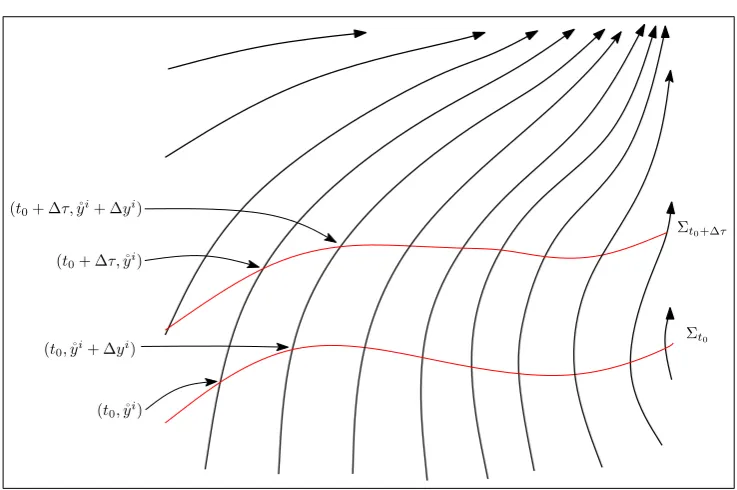
We will work in a comoving coordinate system yµ = (t, yi), one in which
uµ = (1,0,0,0). Such a coordinate system can be constructed from a general
coordinate system xµin the following way (see Figure 3.1). Take a spacelike
hypersurface Σt0 that crosses all the trajectories of fluid under consideration,
be it a small part of the manifold or the whole thing, and place coordinates
yi on the hypersurface. The fluid trajectories can then be given by xµ =
fµ(τ, yi), where yi is the coordinate on Σ
26 Congruences and the splitting of spacetime
Σt0
Σt0+∆τ
(t0+ ∆τ,˚yi)
(t0,˚yi)
(t0,˚yi+ ∆yi)
[image:38.595.134.503.120.365.2](t0+ ∆τ,˚yi+ ∆yi)
Figure 3.1: An illustration showing how one can construct a comoving coordinate system given the fluid trajectories parameterised by proper time,
τ, and then choosing an arbitrary initial foliation Σt0 with coordinates y i.
proper time along the trajectory relative to the crossing of Σt0 at t = t0.
Therefore, we can recognise yi as Lagrangian coordinates. Provided there
are no trajectory crossings, letting t = τ +t0, the inverse of fµ gives the comoving coordinates yµ in terms of the original coordinates xµ.
Such a method gives constant time slices Σt that are dependent on the
choice of the initial constant time slice, Σt0. We can, however, in certain
situations define a unique constant time slicing as one will see in the next sections.
Given that gµνuµuν = −1, we have g00 = −1, so the metric takes the form
ds2 =−dt2+ 2g
3.2. The 3+1 split of spacetime 27
Orthogonal coordinates
When the flow is irrotational, we have the following three equivalent con-ditions [28]:
ωµν = 0, (3.32)
which is the definition of irrotational flow,
u[µ∇γuν]= 0, (3.33)
which is the condition that says uµ is hypersurface orthogonal, or
equiva-lently
uµ=A ∂µB (3.34)
for some functions A and B of xµ. The level surfaces B =constant define the hypersurfaces orthogonal to uµ and A = ±(−gµν∂
µB∂νB)−
1
2 ensures
uµu
µ=−1, where the sign is chosen to make A ∂µB future pointed.
If we take B(yµ) = t, so that the hypersurfaces are those of constant
time (but not necessarily proper time), then
uµ= (A,0,0,0), (3.35)
where A=−(−g00)−12. Hence,
uµ = (g00u0, g0iu0) (3.36)
= (−1
A, C
i), (3.37)
where Ci = −g0i(−g00)−12 are functions that will depend on how spatial coordinates are placed on the hypersurfaces. Given that Ci = dyi
dτ, where
τ is the fluid proper time, if we define the spatial coordinates such that the fluid stays at constant spatial coordinates, then Ci = 0. This is an
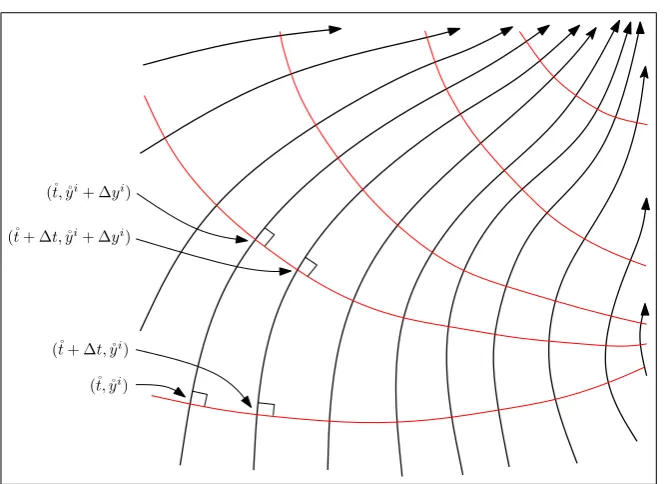
orthogonal coordinate system (see Figure 3.2). We note yi need not be
orthogonal to each other but just with the time coordinate, i.e., g0i = 0.
In this coordinate system the metric is block diagonal, g0i = g
0i = 0,
g00g
00 = 1, gijgik =δik and
ds2 =g
28 Congruences and the splitting of spacetime
(˚t,˚yi)
(˚t+ ∆t,˚yi)
(˚t,˚yi+ ∆yi)
[image:40.595.154.487.122.364.2](˚t+ ∆t,˚yi+ ∆yi)
Figure 3.2: An illustration showing how one can construct an orthogonal coordinate system given the fluid trajectories that are irrotational. We note that in 1+1 dimensions, as depicted, fluid flow is always irrotational.
Comoving orthogonal coordinates
When working with orthogonal coordinates, if dt
dτ =−
1
A = 1 then the time
coordinate t is equal to the fluid proper time and the coordinate system is also comoving. Such a choice is not possible in general, but can be made
when aµ = 0 in addition to ω
µν = 0, as we will now demonstrate. In an
orthogonal coordinate system,
aµ=uν∇νuµ =−A−1∇0uµ (3.39)
=−A−1∂0 −A−1
+ Γ000 −A−1,Γi00 −A−1 . (3.40) One can show
Γ000= 12g00∂0g00 = 21(−A−2)∂0(−A2) = 1
A∂0A (3.41)
and
Γi
00=−12g
ij∂
3.2. The 3+1 split of spacetime 29
(˚t,˚yi)
(˚t+ ∆τ,˚yi)
(˚t,˚yi+ ∆yi)
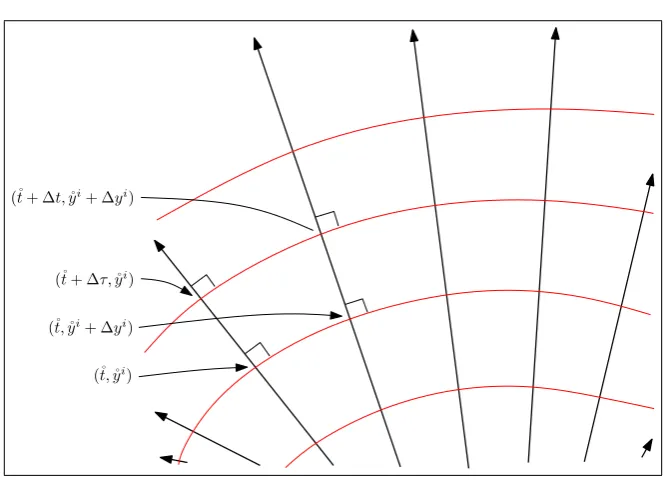
[image:41.595.109.443.118.358.2](˚t+ ∆t,˚yi+ ∆yi)
Figure 3.3: An illustration showing how one can construct a comoving or-thogonal coordinate system given the fluid trajectories that are irrotational and geodesic. We note that in 1+1 dimensions, as depicted, fluid flow is always irrotational.
so that
aµ= (0, 1 Ag
ij∂
jA). (3.43)
So, if aµ= 0, then
∂iA= 0 (3.44)
which implies Ais constant with respect to the spatial coordinates, yi. We
are free to define A(t) as we want as it is just a corresponds to a variable scaling of the time coordinate, t. Setting A =−1 we find that ddτt = 1 and
we have a comovingand orthogonal coordinate system, orGaussian normal
coordinates (see Figure 3.3). The metric takes the form
ds2 =−dt2+g
30 Congruences and the splitting of spacetime
3.3
Hypersurfaces
Consider an n-dimensional manifold, M, coordinates xµ, with metric g µν,
and a (n−1)-dimensional submanifold, a hypersurface N with coordinates
yα. The hypersurface can be given inM, either implicitly by the points at
which a function, F(xµ), takes a constant value, or explicitly parametrized
by the coordinates on N,xµ=ψµ(yα). The unit normal to the surface, η µ,
is then given by
ηµ=±
πµ
|gσρπ σπρ|
1 2
, (3.46)
where
πµ=∂µF or πµ=µν1ν2···νn−1ψ ν1
,1ψν2,2· · ·ψ
νn−1
,n−1. (3.47)
One may then define the hypersurface projection tensor orfirst fundamental form,
Pµν =δµν−σηµην, (3.48)
where σ =ηµη
µ denotes whether the normal is timelike or spacelike. It is
so called because its operation on tensors, denoted by a hat,
b
Aµν···ρσ··· =PµλPνκ· · ·PτσPυρ· · ·Aλκ···τ υ···· · · , (3.49)
can be shown to be orthogonal to the normal vector on every contraction,
b
Aµν···ρσ···ηµ=Abµν···ρσ···ην =Abµν···ρσ···ησ =Abµν···ρσ···ηρ =· · ·= 0. (3.50) It can be shown to act as the metric for vectors tangent to the hypersurface,
PµνVµWν =gµνVµWν (3.51)
where Vµ and Wν are tangent to the hypersurface. It also can be shown
that it is idempotent,
PµνPνλ =Pµλ, (3.52)
3.4. The ADM gauge 31
If we have a family of hypersurfaces, as one would for the level sets of a function F(xµ), we have a vector field of hypersurface normals. We can
then define the extrinsic curvature or second fundamental form, Kµν. It
describes how the projection tensor changes as we move along the integral curves of the normal vector field and is defined by
Kµν =−12LηPµν. (3.53)
One can then show this is equivalent to
Kµν =−PσµPρν∇(σηρ). (3.54)
Given coordinates on the hypersurface N, yα, such that xµ = ψµ(yα)
defines the hypersurface, we can restrict or pullback any tensor in M to N
by
n−1A
αβ··· =ψµ,αψν,β· · ·nAµν···, (3.55) where the n−1 pre-superscript denotes the pulled-back tensor in N of the tensor in M denoted by the n pre-superscript.
3.4
The ADM gauge
We will henceforth work in the ADM gauge for a Lorentzian manifold, M,
which is given in coordinates xµ= (t, yi). The hypersurfaces, Σ
t, are those
of constant t, and the coordinates on the hypersurfaces are yi. The unit
normal,mµ, which is timelike, is chosen to be future pointing. It is therefore
given by
mµ = −
∂µt
(−gσρ∂ σt∂ρt)
1 2
= (−N,0,0,0), (3.56)
where N ≡ √1
−g00 is known as the lapse function and
mµ=gµνmν =
1
N(1,−N
32 Congruences and the splitting of spacetime
where Ni ≡ g0iN2 is the shift vector. One can then define the projection tensor,
pµν =δµν +mµmν, (3.58)
=
"
0 0
Ni δi j
#
, (3.59)
which projects tensors on to Σt and acts as the metric for tensors in the
hypersurface. One can show by raising an index on equation (3.58) and rearranging with the use of equation (3.57) that
gµν =
"
− 1
N2 N
j
N2 Ni
N2 pij− N
iNj
N2
#
. (3.60)
It is then possible, using the fact thatgµνg
νλ =δµλ, to show that
gµν =
"
−N2+NkN k Nj
Ni pij
#
(3.61)
and
pijpjk =δik, (3.62)
whereNi =pijNj.
The pullback fromM to Σtis given in terms of∂x
µ
∂yi =δ
µ
i. Thus, equation
(3.55) gives
3A
ij··· =4Aij···. (3.63)
We can use3A
ij···and 4Aij···interchangeably but we cannot, however, inter-change tensors when some or all of the indices are raised, e.g.,
3Ai
j···=3gik3Akj···6=4Aij···=giµAµj···, (3.64) in general. The equality only holds for tensors that are tangent to Σt, the
hypersurface projection tensor for example. When a tensor is only given with Latin indices without a pre-superscript we will henceforth assume that it is the component of the 3-tensor. We have the 3-metric on Σt,
3g
3.4. The ADM gauge 33
Its inverse 3gij satisfies 3gij3g
jk = δik, so using equations (3.65) and (3.62)
we have
3gij =4pij =4gij + NiNj
N2 . (3.66)
We will therefore usepij andpij to denote the 3-metric on Σthenceforth. We
define the 3-covariant derivative,Di ≡3∇i, on Σtas the covariant derivative
given by the 3-Christoffel symbols, 3Γi
jk, e.g., DiXj =∂iXj+3ΓkijXj etc.
The 3-Christoffel symbols are given in terms of the 3-metric, pij,
3Γk
ij = 12p
kl(∂
ipjl+∂jpil−∂lpij). (3.67)
We also have the extrinsic curvature of Σt given by
Kµν =−pσµpρν∇(σmρ). (3.68)
One may show with the use of equations (3.56) and (3.59) that
Kµν =
"
−N NkNlΓ0
kl −N NkΓ0ik
−N NkΓ0
kj −NΓ0ij
#
(3.69)
Evaluating Γ0
ij, we can show
Kij =4Kij =
1
2N (DiNj +DjNi−∂tpij). (3.70)
Evaluating the rest of the Christoffel symbols we obtain all the independent ones,
4Γ0
ij =−
1
NKij (3.71)
4Γk
ij =3Γkij +
Nk
N Kij (3.72)
4Γ0 00=
1
N ∂tN +N
iD
iN −NiNjKij
(3.73)
4Γk
00=pki∂tNi+N DkN −NiDkNi
− N1 Nk∂tN +NkNiDiN
+N
iNjNk
N2 (2DiNj −N Kij) (3.74) 4Γ0
i0 = 1
N DiN −N
jK ij
(3.75)
4Γk i0 =−
Nk
N DiN +DiN
k+NkNj
N Kij −N K
k
34 Congruences and the splitting of spacetime
We now also note the scalar Gauss equation [30],
4R+ 24R
µνmµmν =3R+K2−KijKij, (3.77)
where 4R and 3R are the Ricci scalars of g
µν and pij respectively and K =
Ki i.
Comoving coordinates in the ADM gauge
Now if the coordinates are comoving with a fluid, we haveuµ = (1,0,0,0)
as the fluid 4-velocity andg00 =−N2+NkNk =−1. Using equation (3.61),
we then have
uµ=gµνuν = (−1, Ni), (3.78)
hµν =δµν +uµuν =
"
0 Nj
0 δi j
#
, (3.79)
Zµν =∇νuµ= Γµν0 (3.80)
and
aµ≡uν∇νuµ =Zµνuν = Γ µ
00. (3.81)
Also, one can show
Zij =4Zij =∇jui =DjNi−N Kij =D[jNi]+12∂tpij. (3.82)
So ifaµ = 0, as is the case for a geodesic dust fluid, then Γ0
00 and Γk00 are zero. Also equation (3.3) gives
Zµν⊥ =Zµν. (3.83)
and thus,
θij =4θij =D(jNi)−N Kij = 12∂tpij (3.84)
and
3.4. The ADM gauge 35
Comoving orthogonal coordinates in the ADM gauge
Now, if we have an irrotational geodesic fluid we can work in comoving orthogonal coordinates as is shown in §3.2. In this case the fluid 4-velocity is the hypersurface normal,
mµ=uµ= (1,0,0,0) andmµ=uµ= (−1,0,0,0). (3.86)
This implies N = 1, Ni = 0 and that the transverse projection tensor (3.1)
and hypersurface projection tensor (3.58) coincide,
pµν =hµν =
"
0 0
0 δi j
#
. (3.87)
Equations (3.71) to (3.76) then give
Γ0ij =−Kij, 4Γkij =3Γkij, Γk0i =−Kki, Γ000= Γ0i0 = Γk00 = 0, (3.88) and equation (3.82) gives
Zij =−Kij = 12∂tpij. (3.89)
We can then show the rest of the components of Zµν are zero, as well as
θ≡θµµ =θii = 12pij∂tpij (3.90)
and
σ2 ≡σµνσµν =σijσij = 14pijpkl∂tpik∂tpjl− 121 pij∂tpij
2
. (3.91)
Using (3.88) and (3.89), the covariant derivative along uµ can be shown to
be
˙
Zij ≡uµ∇µZij =∂tZij −2ZikZkj. (3.92)
From equation (3.15) we see that
˙
Zij =−ZiρZρj−Riρjσuρuσ (3.93)
36 Congruences and the splitting of spacetime
and, therefore,
∂tZij =ZikZkj−Ri0j0. (3.95)
Using the Ricci tensor for dust (3.21) we can show that the scalar Gauss
equation (3.77), in these coordinates, becomes the energy constraint for
dust,
16πGρ=3R+ 2 3θ
2
CHAPTER
4
Coarse-graining in general
relativity
4.1
Introduction to coarse-graining tensors
Thus far there exists no natural method for coarse-graining tensors (above rank zero) in a covariant manner. Efforts have been made by Zalaletdinov [31, 32] and others [33], but these generally require the addition of much mathematical structure over and above that provided by general relativ-ity. For a critical review of these approaches see, e.g., reviews of van den Hoogen [34], Ellis [35] and Wiltshire [12]. These methods also are not what we define as coarse-grainingper se; they are methods forsmoothing tensors. Smoothing defines a tensor field over the domain that is some continuous average of the original field, whereas coarse-graining defines a single aver-aged value of the original field. One could, however, choose the smoothed value at some single point as a coarse-grained value of the field.
4.2
Korzy´
nski’s method
Korzy´nski pushes the Newtonian cosmology analogy further by
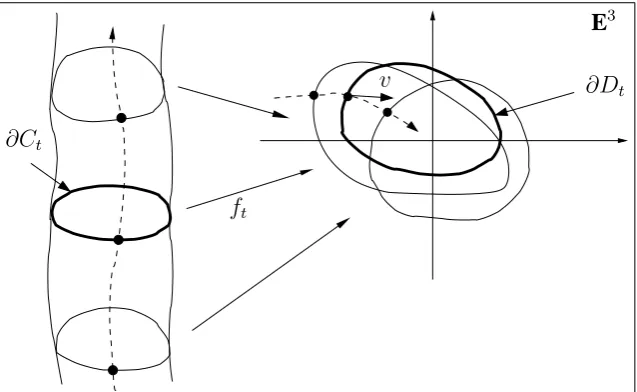
coarse-graining Zµν as was performed to va,b Chapter 2. Consider a finite fluid
38 Coarse-graining in general relativity
C
hZµνi
uα
∂Ct
Ct
∂C
[image:50.595.212.426.123.374.2]t =const
Figure 4.1: A four-dimensional cylinder C, generated by the collective tra-jectories of a finite volume of fluid, and its boundary ∂Ct are foliated by
constant time slices. Image courtesy of Korzy´nski [13].
element travelling through spacetime (see Figure 4.1). The fluid element
defines a four-dimensional cylinder C in spacetime and its boundary ∂C
defines a three-dimensional tube. It can be foliated by suitably chosen constant time slices which will give three-dimensional spatial slices of the cylinderCtbounded by a two-dimensional spatial boundary ∂Ct. One may
then attempt to assign a coarse-grained value of Zµν for the domainCt. A
time evolution equation for the coarse-grained value of Zµν could then be
derived and it should have a similar form to (3.15) with additional terms derived from inhomogeneities in the metric and 4-velocity field. The addi-tional terms referred to as backreaction should reduce to zero for the FLRW solution as they did in the Newtonian case (2.73).
There are possibly unlimited ways in which one might assign a coarse-grained value toZµν on a domain, but some conditions should be placed to
4.2. Korzy´nski’s method 39
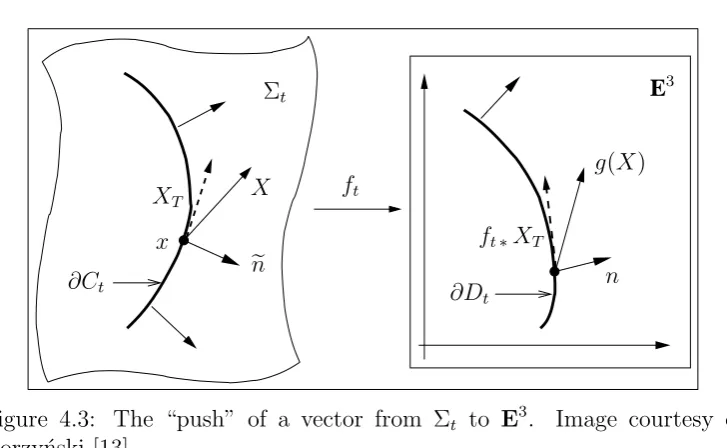
coarse-graining procedure should adhere to. The first condition states that if the volume of the fluid element is shrunk towards zero the coarse-grained velocity gradient should tend to the local one. The second condition states that such a procedure should be covariant in the sense that, apart from the choice of the fluid element itself and the 3+1 splitting of spacetime, the
result should not depend on any externally introduced structure, including
the coordinate system.
Korzy´nski does not explicitly state any further conditions. However, we will specify further natural conditions a coarse-graining procedure should
satisfy. When we coarse-grain a n-tensor we coarse grain over some n
-dimensional domain D on a n-dimensional (pseudo-)Riemannian manifold
M. When applied to cosmology, this manifold will usually be some spatial hypersurface as illustrated in Figure 4.1 with n = 3. The conditions are as follows:
1. When one wants to describe a coarse-grained tensor they must give the components of the tensor with respect to some basis or alternatively in some abstract tangent space. This also defines a metric that one can use to raise and lower indices, ¯g say. This basis or tangent space may or may not be related to some basis or tangent space on the manifold M.
If the coarse-grained tensor basis is not related to any basis on the manifold it should naturally have an orthogonal basis. This would mean hTiab···
cd··· should be unique up to orthogonal transformations,
hTiab···cd··· = Λaa0Λbb0· · ·Λ−1c 0
cΛ−
1d0
d· · · hTi a0b0
···
c0d0···, (4.1)
where
ηabΛaa0Λbb0 =ηa0b0. (4.2)
When averaging over a spatial constant time slice the canonical metric is ηab = diag(1,1,1) and Λaa0 ∈O(3).
40 Coarse-graining in general relativity
given that basis on the manifold. However one generally has the free-dom of choosing bases on a manifold so the coarse-grained tensor components generally will not be completely unique.
Either way, scalars which do not depend on a basis should be unique. Thus, scalars formed from grained tensors and the coarse-graining of scalars, e.g., hTiab···
ab···, hTiab···cd···hSicd···ab···,hUi, should be unique and not depend on the coarse-grained tensor basis.
The procedure should be covariant in the sense that the value of the coarse-grained tensor should not depend on coordinates placed on
M. The coordinates might give the basis and the components of the
coarse-grained tensor with respect to that basis. However, when one chooses different coordinates giving a different basis and components of the coarse-grained tensor, they should both be transformed the same way from the previous ones.
2. In the limit of the volume of the domain shrinking to zero around a point p the coarse-grained value should tend to the local value. In general, the coarse-grained tensor, hTiab···
cd···, and the local tensor,
Tαβ···γδ···, on the manifold will be given in different bases, so more formally there exists some matrixBa
α ∈GLn such that
hTiab···
cd···→BaαBbβ· · ·B−
1γ
cB−1δd· · ·T αβ···
γδ···|p (4.3)
as the coarse-graining volume is shrunk to zero around p. Moreover, ifTαβ···γδ···is given in an orthonormal basis atpandhTiab···
cd···is given in an orthonormal basis, Ba
α should be orthogonal i.e., satisfy (4.2).
4.2. Korzy´nski’s method 41
4. When coarse-graining a scalar the procedure should just be a plain volume-average over the domain. The 3-dimensional case being the Buchert average defined in §5.2.
5. The procedure should be linear, that is,
haT +bSiab···
ab··· =ahTiab···ab···+bhSiab···ab··· (4.4) should be true for any tensors T and S and constant scalarsa and b.
The last three conditions we will not demand a coarse-graining procedure satisfy, but they are true in the flat case so one could demand them to possibly narrow down a number of coarse-graing methods that satisfy 1-4.
6. The coarse-grained metric, hgiab, should be the metric given by the
basis for the coarse-grained tensors, ¯gab.
7. The coarse-graining procedure should commute with contraction. That is, the following should hold,
hTiab···ad···=hTαβ···αδ···eˆβ· · ·ωˆδ· · ·ib···d···, (4.5)
where ˆeα and ˆωα are the basis vectors and dual vectors respectively
for T onM.
8. When coarse-graining over a domainD, composed of sub-domainsDi,
the coarse-grained tensor overDshould be some volume weighted sum of the coarse-grained tensor over the sub-domains Di. That is,
DhTi ab···
cd··· =
V1
V D1hTi ab···
cd··· ⊕
V2
V D2hTi ab···
cd··· ⊕ · · · , (4.6)
where V is the volume of D and Vi is the volume of Di such that
V = PiVi. The summing operator ⊕ should reduce to the usual +