Correction: COCAINE CARDIOMYOPATHY — A CASE REPORT
(2014, Vol 9, issue 3, p. 233–237.)
Georgiev Antonio
,
1Zhivadinovik Julija
2 1PHO Cardiology – Prima, MIT University, R. Macedonia
2
Institute of Anatomy, Medical Faculty, Skopje, University “Ss. Cyril and Metodius”, R. Macedonia
In Sanamed Medical Journal, vol. 9, issue 3, in the text titled‘COCAINE CARDIOMYOPATHY — A CASE REPORT’ authors made a mistake by inadequately citing parts of scientific paper, in sections Intro-duction and Discussion. The mistake was discovered by Center for Evaluation in Education and Science (CEON). Authors were informed from the Editorial Board of Medical Journal‘Sanamed’ and the stated parts of paper were timely corrected.
Primljen/Received 01. 09. 2016. god. Prihva}en/Accepted 01. 10. 2016. god.
Abstract:The second most commonly used drug in the world is cocaine. Its use is the most common cau-se of death among drug ucau-sers. The ucau-se of cocaine is as-sociated with acute and chronic complications. Mostly affected system in the human body’s cardiovascular system. Cocaine cardiomyopathy may result from the use of cocaine.
This article presents a first case in Republic of Ma-cedonia of 24-year-old male with reversible cocaine-re-lated cardiomyopathy. Clinical presentation, laboratory, X-ray, ultrasound findings and treatment are reviewed.
Key words: cocaine, reversible cocaine cardiomyo-pathy, diagnosis, treatment.
INTRODUCTION
Cocaine is an alkaloid extract obtained from the leaves of the plant Erythroxylon coca. This plant usu-ally grows in South America and has a data on its use before 5000 years. This drug and its complications are a worldwide problem. Cocaine is the most frequent ca-use of drug related deaths. Very ca-useful data are obtai-ned from a European retrospective study done on 479 ACS patients. The current study included subjects younger than 50 years admitted to a critical care unit from 2001 to 2008. From the total number of partici-pants involved, 24 patients (5%) had admitted to recent cocaine abuse or tested positive on urine drug screen-ing (1). In 2005 registered 2.4 million persons were ac-tively using cocaine. Verified that the most frequent us-ers of cocaine as a drug are young people aged 18 to 25
years and it is estimated that 11% of the population has used it at some point (2). The ratio of men to women is 2 : 1. The 2008 National Survey on Drug Use and He-alth reported that approximately 36.8 million Ameri-cans aged 12 years and older (14.7% of AmeriAmeri-cans in that age group) had tried cocaine at least once (3). The trade with this illicit drug in Republic of Macedonia is prosecuted by law. Yet there are people who use this drug and have complications from it.
Cocaine may be used by smoking, intravenous, ga-strointestinal and nasal inhalation. It causes physiologi-cal changes highlighted, psychologiphysiologi-cal effects but also addictive. Mechanism of action of cocaine is not com-pletely understood. It is assumed that its detrimental ef-fect is due to its direct toxicity. But also because of his mighty sympathomimetic action which is the main char-acteristic of cocaine. With sympathetic acting cocaine increases level of norepinephrine, dopamine and catec-holamines, with the suitable effect on the systems in the body, particularly the cardiovascular system (tachycar-dia, arrhythmia, hypertension...). Cocaine also acts on muscarinic receptors blocking the reuptake of dopamine and serotonin which contributes to the appearance of “positive psychological effects”. Cocaine carried block-ing sodium ion channels on myocytes and contributblock-ing to the occurrence of cardiac arrhythmias (1, 4, 5).
Symptomatology in cocaine intoxication is associa-ted with adrenergic redundancy that causes cocaine. The occurrence of hypertension is one of the most common symptoms. Impaired mental condition of the users on this drug manifested by the appearance of acute delirium or
2016; 11(3): 255–259 ID: 227801612
mania (2). Very often cocaine users admitted to hospital with already manifested complications. Complications of cocaine can be acute or chronic. Cocaine related compli-cations can affect any system: cardiac (coronary artery spasm, myocardial infarction, hypertension, cocaine car-diomyopathy, myocarditis, arrhythmia, possible occur-rence of endocarditis, acceleration of atherosclerosis); vascular (aortic dissection and rupture, vasculitis, super-ficial and deep venous thrombosis, thrombophlebitis); neurological (cerebral infarction or hemorrhage, transient ischemic attack, seizures, migraine); gastrointestinal (ul-cer disease, mesenteric thrombosis, perforation); pulmo-nary (pneumonia, pulmopulmo-nary oedema, occurrence of hae-moptysis); obstetric (abruptio placentae, spontaneous abortion, prematurity, growth retardation) (2-7)...
CASE REPORT
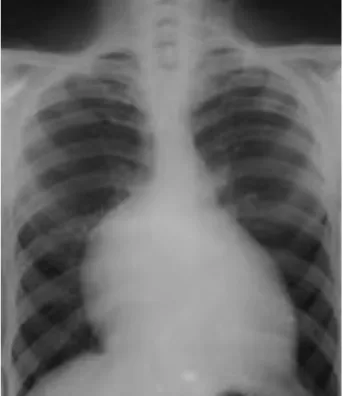
We present a case of a twenty four years old male, with a history of inhaling vaporized cocaine, and mari-huana for two years. The main complaints of patient we-re fatigue, labowe-red we-respiration, especially et night, dyspnea, anxiety, increased heart rate and lost of appeti-te during last 2-3 months. The patient was conscious, anxious, oriented to time, space and persons. Heart so-unds were clear with systolic murmur. The ECG showed sinus tachycardia (HR > 100/min) (Figure 1) and about 0,5 mm upsloping ST segment depression in lateral le-ads. Blood pressure was elevated (150/105 mmHg). La-boratory analysis showed elevation of blood Urea (10.6 mmol/L), Creatinine (154 mmol/L), Na (149 mEq/L), K (4.2 mEq/L) and iron-deficiency anemia with Fe (7.1 mcg/dl). X-ray findings obtained enlarged heart silhou-ette (Figure 2). Echocardiographic evaluation showed left chamber dilatation with reduced global systolic fun-ction and ejefun-ction frafun-ction (EF) 38%, designated mitral cusps with posterior cusp prolapsed, thin regurgitated flow and intraatrial septum tissue changes.
Preceding therapy Carvedilol and Aspirin was chan-ged to heart failure – guideline-based heart failure ther-apy: Carvedilol, nonselective alfa/beta – adrenergic bloc-ker (2 x 6, 25 mg per day), Perindopril, ACE inhibitor (4 mg per day), Spironolactone, mineral corticoid receptor antagonist, MRA (25 mg per day), Thiazide diuretic (25 mg per day) and Aspirin, acetylsalicylic acid (100 mg per
day). Therapy for correction of anemic syndrome was re-commended. Cocaine cessation was obligated.
Two months later, after cocaine cessation and tre-atment in specialized hospital, the patient didn’t fill the symptoms from the first examination, but he was at bad physical condition. Laboratory findings were normali-zed: Urea 7.6 mmol/L; Creatinin 108 mmol/L; Na 139 mEq/L; K 4.2 mEq/L and Fe 16.2 mcg/dl. EKG sho-wed sinus rhythm with HR 65/min. Blood pressure was 120/80 mm Hg. Dimensions of left ventricle were in referent values. Left ventricle function was slightly re-duced with EF 49%, mitral cusps were designated with posterior cusp prolapsed and intraatrial septum tissue changes. The patient continued with the same therapy.
The patient abstained from cocaine use and five months later he didn’t fill any of the symptoms from the first examination, and he was et good physical con-dition. Laboratory findings were in the ranges of refer-ent values. Left and right vrefer-entricles function and di-mensions were preserved. Left ventricle EF was 62%. The patient continued with medications: Nebivolol, cardioselective â1– receptor blocker (2,5 mg per day) and Aspirin (100 mg per day).
DISCUSSION
This is the first case of cocaine reversible cardi-omyopathy registered at the Clinic for Cardiology in Macedonia. Patients who are addicted to drugs are dif-ficult for cooperation. This medical case demanded great personal and professional effort.
Figure 1.ECG findings
Among cocaine users certainly dominated symp-toms of the cardiovascular system. Sympsymp-toms result-ing from hypertension, angina pectoris, also these pati-ents can be hospitalized with symptoms of myocardial infarction or dissection of the aorta. Other symptoms from the vascular origin may occur in cerebral ische-mia or hemorrhage. Cocaine leads to damage of ac myocytes, leading to the emergence of cardi-omyopathy. Often these patients are with signs of con-gestive heart failure. So, the first clinical symptoms in these patients may arise as a result of acute cardiac de-compensation with or without pulmonary edema. Hypotension and shock make investigations and treat-ment in these patients very demanding. It is not uncom-mon for these patients their first hospitalization to fin-ish lethal. Cocaine is the most common cause of sud-den death caused by drugs (1, 4, 7, 8, 9).
In our case, which is very rare in the literature, we refer for the 24 year old boy who at first medical exami-nation was with signs of congestive heart failure, hyper-tension, iron-deficiency anemia and elevated electrolyte and degradation products. First echocardiography eval-uation showed reduced global systolic function with EF 38%. After five months of using the appropriate therapy and complete renunciation of the use of cocaine, on con-trol echocardiography evaluation showed completely normalization of cardiac left ventricular function with 62% EF and the full normalization of the general condi-tion and laboratory analysis. This represents the classi-cal case of reversible cocaine-related cardiomyopathy.
In the absence of prospective randomized studies the literature data obtained mainly from case reports or from autopsy studies. Saurabh K. Chokshi et al. in their case report also refer for reversible cocaine-related car-diomyopathy. In their case it is a woman, 35 years old, which is also completely withdrawn clinical signs of cardiac decompensation, with normalization of the fin-dings of all investigations. In this case endomyocardial biopsy was done and it was not found any fibrosis, nec-rosis or inflammatory infiltrate (10).
Virmani et al. in their study included autopsies of 40 patients, 31 of whom died cocaine-related deaths and 9 of whom were homicide victims with detectable blood cocaine levels. In this study, in 20% of respon-dents has been established the existence of a myocardi-tis proven with toxicology screen laboratory tests (11). In another autopsy study, Tazelaar et all., refers for fin-ding of myocardial necrosis very similar to the finfin-dings in pheochromocytoma (12).
Robledo-Carmona at all. in their case report refers for severe cardiomyopathy associated to cocaine abu-se. Histological findings, in this case, of the left ventri-cular myocardium indicate the presence of mononucle-ar infiltrates, degenerative changes, present necrotic
changes on myocytes and also distinctly marked and severe form of fibrosis in interstitial space (13).
While most cases of cocaine-related cardi-omyopathy have proved to be reversible, others have re-sulted in permanent cardiac dysfunction or death. Any patient with the data that used cocaine and clinical signs of congestive heart failure should make us suspicious and induce as on cocaine-related cardiomyopathy etio-logical basis. This especially refers to a younger patient, a smoker with signs of adrenergic excess (5, 10).
If there is doubt about cocaine cardiomyopathy first need to make laboratory investigations: urine toxi-cology screen for cocaine and its metabolites, also might expect electrolytes abnormalities (Na, K), ane-mic syndrome and a rise of renal degradation products (blood urea nitrogen and creatinine), blood tests for possible infection.
Radiographic analysis mostly shows a picture of cardiomegaly and congestive heart failure. But for most cocaine addicts radiographic analysis is often normal.
Echocardiography evaluation shows reduced glo-bal systolic function with chamber dilatation. In cocai-ne addicts who had myocardial infarction we can ex-pect echocardiographic finding of impaired (hypo/aki-nesia) regional mobility on the wall of the chamber.
Cocaine addicts often have angina symptoms and they are indicated to make angiography. Coronary an-giography is usually with normal finding on coronary arteries or with insignificant changes.
In cases of cocaine cardiomyopathy mostly have no specific ECG changes. In these patients are also possible nonspecific ST-T wave changes, ECG signs of left ventricular hypertrophy and the occurrence of arrhythmias. Unpredictable possible ECG changes es-pecially malignant arrhythmias suggest a need for con-stant monitoring of these patients.
Management
conversion of arrhythmias. These patients requires con-tinuous monitoring and in case of apnea to perform en-dotracheal intubation by connecting the respirator (mec-hanical ventilation). In cases where angina symptoms are accompanied by ST segment changes on ECG, besi-des the right drug treatment (beta-blockers, nitrates, cal-cium channel blocking medicaments), coronary angio-graphy should be performed. It is not uncommon for these patients to survive the myocardial infarction (1, 4, 14, 15). For the purposes of this, these patients need to know and to be familiar with the medical practice of car-diac magnetic resonance as a method that is quite useful for predictions of reversibility of cocaine-induced ven-tricular dysfunction (16).
John McMurray et al. ESC Guidelines for the di-agnosis and treatment of acute and chronic heart failure 2012 (17) recommend the following therapy:
The combination of beta blockers with ACE inhi-bitors used in the treatment of patients with cardi-omyopathy and left ventricular EF < 40%. This combi-nation of drugs is used to reduce the risk of heart failure hospitalization and the risk of premature death. An MRA is recommended for all patients with left ventric-ular EF < 35% and persisting symptoms despite medi-cament treatment. It is good to mention that analysis of B-type natriuretic peptide (BNP) level can help moni-tor the presence of congestive heart failure. Also BNP is very helpful to monitor response to treatment (17).
Most of reported cases with cocaine cardiomy-opathy showed that treatment of these patients depends on stopping of drug use. Patients who stopped using drugs have registered significant improvements of the condition of cocaine-related cardiomyopathy. There are cases, as in our patient in this case report, when we have a full reversibility of cocaine cardiomyopathy and the establishment of completely normal cardiac function. But if these patients start using drugs again, the possibil-ity reoccurrence of cocaine-related cardiomyopathy is
confirmed most of the cases described in the literature (4).
Physicians usually don’t consider the possibility of cocaine use of their patients. It is therefore necessary to inform and educate them. Abstinence from cocaine use and long time follow up is mandatory in these pati-ents. The regular echocardiographic controls are nec-essary. The patient needs to take care of the other risk factors such as hypertension, smoking and others. In planning the treatment of these patients of great impor-tance is ambulatory treatment of addiction. Also there is a need for hospitalization centers when it is neces-sary for their detoxification.
CONCLUSION
This is the first publication of cocaine-related car-diomyopathy in our country. Recognition of cocaine cardiomyopathy is crucial for optimal treatment. It re-quires a structured education of drug users about the consequences, risks of using cocaine and “Life bene-fit”. It requires a multidisciplinary approach in treating these individuals and it should include the family, but also a psychiatrist, psychologist, sociologist, cardiolo-gist and other professional disciplines.
Abbreviations
ACE— Angiotensin converting enzyme BNP— Natriuretic peptide
BUN— Blood urea nitrogen ECG— Electrocardiography EF— Ejection fraction
ESC— European Society of Cardiology HR— Heart rate
MI— Myocardial infarction
MRA— Mineral corticoid receptor antagonist ST— ECG between the end of the S wave (the J point) and the beginning of the T wave
Sa`etak
KOKAINSKA KARDIOMIOPATIJA — PRIKAZ SLU^AJA
Georgiev Antonio,1Zhivadinovik Julija21
PZO Kardiologija — Prima, MIT Univerzitet, Skoplje, R Makedonija
2
Institut za anatomiju, Univerzitet “Sv. ]irilo i Metodije”, Medicinski fakultet, Skoplje, R Makedonija
Kokain je druga naj~e{}e kori{}ena droga u sve-tu. Upotreba ove droge je naj~e{}i uzrok smrti kod ko-risnika droge. Upotreba kokaina daje akutne i hro-ni~ne komplikacije. Naj~e{}e afektirani sistem u }o-vekovom organizmu je kardiovaskularni sistem. Ko-kainska kardiomiopatija mo`e biti izazvana konzumi-ranjem kokaina.
Ovaj ~lanak predstavlja slu~aj dvadeset~etvorogodi-{njeg mu{karca s reverzibilnom kokainskom kardiomiopa-tijom, {to predstavlja prvi takav u Republici Makedoniji. Nalazi klini~kog pregleda, laboratorijskih analiza, rendgen-grafije srca i plu}a, ultrazvuka srca i tretman su prikazani.
REFERENCES
1. Finkel JB, Marhefka GD. Rethinking cocaine-associa-ted chest pain and acute coronary syndromes. Mayo Clin Proc. 2011; 86(12): 1198–207.
2. Egred M, Davis GK. Cocaine and the heart. Postgrad Med J. 2005; 81(959): 568–71.
3. SAMHSA - Substance abuse and mental health service administration. Sharp decline also continues for methamphet-amine use. US Department of Health and Human Services (DHS); Office of Applied Studies Results from the 2008 Na-tional Survey on Drug Use and Health: NaNa-tional Findings. http://oas.samhsa.gov/nsduh/2k8nsduh/2k8Results.cfm. 2009.
4. Schwartz BG, Rezkalla S, Kloner RA. Cardiovascular effects of cocaine. Circulation. 2010; 122(24): 2558–69.
5. Howell LL, Kimmel HL. Monoamine transporters and psy-chostimulant addiction. Biochem Pharmacol. 2008; 75(1): 196–217. 6. Phillips K, Luk A, Soor GS, Abraham JR, Leong S, Butany J. Cocaine cardiotoxicity: a review of the pathophysiology, pathology, and treatment options. Am J Cardiovasc Drugs. 2009; 9(3): 177–96.
7. Awtry EH, Philippides GJ. Alcoholic and cocaine-associ-ated cardiomyopathies. Prog Cardiovasc Dis. 2010; 52(4): 289–99. 8. Bhargava S, Arora RR. Cocaine and cardiovascular complications. Am J Ther. 2011; 18(4): e95-e100.
9. Velasquez EM, Anand RC, Newman WP 3rd, Richard SS, Glancy DL. Cardiovascular complications associated with cocaine use. J La State Med Soc. 2004; 156(6): 302–10.
10. Chokshi SK, Moore R, Pandian NG, Isner JM. Revers-ible cardiomyopathy associated with cocaine intoxication. Ann Intern Med. 1989; 111(12): 1039–40.
11. Virmani R, Robinowitz M, Smialek JE, Smyth DF. Cardiovascular effects of cocaine: an autopsy study of 40 pa-tients. Am Heart J. 1988; 115(5): 1068–76.
12. Tazelaar HD, Karch SB, Stephens BG, Billingham ME. Cocaine and the heart. Hum Pathol. 1987; 18(2): 195–9.
13. Robledo-Carmona J, Ortega-Jimenez MV, Gar-cia-Pinilla JM, Cabra B, de Teresa E. Severe cardiomyopathy associated to cocaine abuse. Int J Cardiol. 2006; 112(1): 130-1. 14. Rangel C, Shu RG, Lazar LD, Vittinghoff E, Hsue PY, Marcus GM. Beta-blockers for chest pain associated with recent cocaine use. Arch Intern Med. 2010; 170(10): 874–9.
15. Littmann L, Narveson SY, Fesel MN, Marconi SL. Be-ta blocker treatment of heart failure patients with ongoing co-caine use. Int J Cardiol. 2013; 168 (3): 2919–20.
16. Smedema JP. Cardiac magnetic resonance predicts re-versibility of cocaine-induced ventricular dysfunction. Cardiovasc J Afr. 2009; 20(3): 198–9.
17. McMurray JJ, Adamopoulos S, Anker SD, et al. ESC Guidelines for the diagnosis and treatment of acute and chronic heart failure 2012: The Task Force for the Diagnosis and Treat-ment of Acute and Chronic Heart Failure 2012 of the European Society of Cardiology. Developed in collaboration with the He-art Failure Association (HFA) of the ESC. Eur HeHe-art J. 2012; 33(14): 1787–847.
Correspondence to /Autor za korespondenciju Georgiev Antonio
University Clinic for Cardiology Vodnjanska bb