T
HEI
NFLUENCE OFP
ARTISANC
ONFLICT ONP
OLICYA
TTITUDESMary Layton Atkinson
A dissertation submitted to the faculty of the University of North Carolina at Chapel Hill in partial fulfillment of the requirements for the degree of Doctor of Philosophy in the Department of Political Science.
Chapel Hill 2013
Approved by:
Frank R. Baumgartner
James A. Stimson
Michael B. MacKuen
Jason M. Roberts
c 2013
ABSTRACT
MARY LAYTON ATKINSON: The Influence of Partisan Conflict on Policy Attitudes. (Under the direction of Frank R. Baumgartner)
The central question the project asks is to what degree are policy attitudes shaped by
aversion to partisan conflict versus the substance of proposed legislation? I argue that the
tenor of elite debate—which is often highlighted by the news media and characterized by them as combative—acts as a powerful signal that shapes public policy opinion in
pre-dictable ways. The news media’s focus on heated partisan debate can erode public support
for policies associated with it because many Americans view such conflict as a sign of
dysfunction in the government. Each of the articles that comprise the dissertation uses
a different methodological approach to test this hypothesis: a natural experiment, a
con-trolled experiment, and an aggregate level examination of the relationship between policy
debate in the news and policy-specific mood over time. I find that approximately two-thirds
of policy-focused news reports employ a “conflict frame” that highlights precisely the el-ements of the lawmaking process that many Americans dislike. Further, I find that the
public responds more negatively to policies associated with partisan conflict, even when
controlling for factors related to the substance of the bill and to individual’s underlying
policy preferences. These findings are of importance for lawmakers and scholars of public
opinion alike. They suggest that to fully understand patterns of public policy opinion we
ACKNOWLEDGMENTS
I have been incredibly fortunate to have the support and guidance of several mentors,
friends, and family members, without which I could not have completed this project. I
would like to thank the American Politics Research Group (APRG), the George Rabinowitz
Seminar, and the Thomas M. Uhlman Graduate Fund at UNC-Chapel Hill. APRG and the
Uhlman Fund provided summer research stipends and travel awards that helped to support this research. The George Rabinowitz Seminar graciously provided numerous
opportuni-ties to present early drafts of the dissertation chapters. The seminar’s participants—and its
namesake in particular—offered feedback that has dramatically improved the quality of the
project.
I have had the pleasure of working with several research assistants who dedicated hours
and hours of their lives to coding theNew York Timesdata described here. I appreciate the
hard work and attention to detail provided by Anna Dietrich, Lindsay Tello, Linden Wait,
and Jazmine Walker.
Chris Reynolds and Shannon Eubanks provided administrative support and invaluable
assistance in compiling job packets. I am grateful for their patience and kindness.
My classmates at UNC-Chapel Hill and American University have been wonderful
sources of advice, commiseration, and comradery. In particular, I am grateful for the
friendship and support offered by Kevin Banda, Elizabeth Coggins, Sarah Baurle
Danz-man, Amanda Girth, and Jason Windett.
I wish to extend wholehearted thanks to Brian Schaffner, who has been a steadfast source of feedback, encouragement, and guidance throughout my years of graduate study.
Furthermore, I owe Brian many thanks for offering a terrific political behavior seminar.
If ever there was a dissertation committee dream team, surely my committee is it. I
have been truly privileged to work under the direction of Frank Baumgartner, Jim Stimson,
Mike MacKuen, Jason Roberts, and Justin Gross. All five share a passion for research
that is palpable and contagious—making them a pleasure to work with. All five are also
lovely, generous people who have taught me as much about how one ought to treat others
as about political science. I appreciate the thoughtful feedback, the encouragement, and the kindness each one of them has offered me over the past five years.
I owe Frank Baumgartner and Jim Stimson special thanks for inviting me to join their
NSF-fundedMoodproject (along with Elizabeth Coggins) as a research assistant in 2010.
Working on that team project was one of the absolute highlights of my time in graduate
school. For an hour each week during the grant period, I had the privilege of sitting around
with these two giants of our profession and talking about research. Few young scholars
have the opportunity for this type of intensive apprenticeship and I am truly grateful for the experience. I learned a tremendous amount and also had a lot of fun in the process.
I also wish to thank Frank Baumgartner for going far above and beyond as an advisor.
To say that Frank is generous with his time and resources is a gross understatement. He
is tireless in his devotion to his students and his commitment to their success. Over the
past five years, he has read and offered detailed comments on an obscene number of paper
drafts. He has provided opportunities for collaboration on several projects—from which I
have learned so, so much. He has shared his many secrets of file management, which have saved me from certain disaster on numerous occasions. He has offered support, guidance,
and encouragement. Put simply, he has been a phenomenal mentor. I owe a huge debt of
gratitude to Frank, without whom I could not have completed this project.
Finally, I want to thank my family. My fantastic in-laws—Sue Wood, Greg Paulson,
and Jane Pugliese—have encouraged me with the same love and enthusiasm that they show
or night) when I need a pep talk or a sounding board. I am thankful for her friendship and
support. My parents, Linda and Jim Strong, and Jerry and Robin Atkinson have always
believed I could accomplish anything I put my mind to. Through 23 years of school, they
have offered unwavering support. They have never missed a school play, a flute recital, a
choir concert, or an awards ceremony. I am thankful for their love and guidance, without
which I could not have completed this journey. And finally my amazing husband, Tim Paulson, is a source of endless optimism, encouragement, and tech support. I am truly
fortunate to have a partner who is so dedicated to my success and happiness. I could not
TABLE OF CONTENTS
1 INTRODUCTION . . . 1
2 “BROKEN POLITICS” AND INDIVIDUAL LEVEL POLICY ATTITUDES . . . 6
2.1 Conflict in the News . . . 8
2.2 Cognition and Attitude Formation . . . 10
2.2.1 Cues and Heuristics . . . 13
2.3 How Conflict Influences Policy Attitudes . . . 14
2.4 Design . . . 18
2.5 Analysis and Findings . . . 22
2.5.1 Summary of Findings . . . 28
2.6 Conclusion . . . 29
3 STATE LEVEL CONFLICT AND SUPPORT FOR THE FMA . . . 31
3.1 Partisan Conflict and Political Attitudes . . . 32
3.2 Cognition and Attitude Formation . . . 33
3.2.1 Updating Attitudes . . . 35
3.3 Hypotheses . . . 37
3.3.1 Alternative Explanations . . . 38
3.4 The Same-Sex Marriage Case Study . . . 39
3.4.1 Research Design. . . 42
3.5 Analysis and Findings . . . 44
3.5.1 Testing Sub-Hypotheses . . . 47
3.6 Conclusion . . . 55
4 THE NEWS MEDIA AND THE THERMOSTATIC RESPONSE . . . 56
4.1 Conventional Wisdom: The Thermostatic Response . . . 59
4.1.1 The News Industry as an Institution . . . 61
4.1.2 The Effects of the Conflict Frame on Public Opinion . . . 64
4.2 Theory and Hypotheses . . . 65
4.3 Research Design . . . 69
4.3.1 Content Analysis . . . 71
4.4 Content Analysis Results . . . 75
4.5 Policy Focused Articles and Public Opinion . . . 82
4.6 Conclusion . . . 89
5 CONCLUSION . . . 90
A AN APPENDIX: EXPERIMENTAL TREATMENTS . . . 93
A.1 Heated Debate, Spending . . . 93
A.2 Civil Debate, Spending . . . 93
A.3 Heated Debate, Efficacy . . . 94
A.4 Civil Debate, Efficacy . . . 94
A.5 Heated Debate, Tactics . . . 95
A.6 Civil Debate, Tactics . . . 96
B AN APPENDIX: SUPPLEMENTAL MATERIALS FOR CHAPTER THREE . . . 97
B.1 Support for the FMA, Excluding Massachusetts . . . 97
B.2 Cross Tab of Marriage Attitudes and Support for the FMA . . . 98
B.3 Question Wording, Support for Gay Marriage . . . 99
B.4 Alternative Model Specification, Support for FMA . . . 100
C AN APPENDIX: CODEBOOK . . . 101
C.2 General guidelines for the application of the policy-focus code . . . 101
C.3 General guidelines for the application of the problem-focus code . . . 102
C.4 Topic Specific Codes . . . 103
C.4.1 Health . . . 103
C.4.2 Welfare . . . 104
C.4.3 Preschool through grade 12 education . . . 105
C.5 Conflict Codes . . . 107
C.5.1 Heated Conflict . . . 107
C.5.2 Generic Conflict Frame . . . 108
C.5.3 Substantive Debate . . . 109
C.5.4 Political Calculus . . . 110
C.5.5 Parliamentary Tactics . . . 111
C.6 Spending, Deficit and Macroeconomic Codes . . . 112
C.6.1 Spending and Deficit Estimates . . . 112
C.6.2 Tax Increases . . . 113
C.6.3 Tax Decreases. . . 113
C.6.4 Macroeconomics . . . 113
C.6.5 Economic Focus . . . 113
C.7 Substance Focus . . . 113
C.8 Human Interest. . . 115
LIST OF TABLES
2.1 Description of Experimental Treatments . . . 20
2.2 Proportion of Respondents Who Agree that the Policymaking Process is Broken, by Treatment Group . . . 22
2.3 Likelihood of Believing the Process is Broken . . . 24
2.4 Average Ideological Placement of Bill on a Seven Point Scale . . . 24
2.5 Absolute Value of Distance Between Ideological Self-Placement and Place-ment of Bill . . . 25
2.6 Proportion of Respondents who Support the Bill . . . 26
2.7 Likelihood of Supporting the Bill . . . 28
2.8 Predicted Probability of Support for Education Bill . . . 28
3.1 Summary of Hypotheses . . . 39
3.2 Number of news articles mentioning “same-sex marriage” or “gay marriage” between January 1, 2004 and April 30, 2005 . . . 41
3.3 Model A—Likelihood of Support for the FMA by Year and Residence in a Ballot Measure State . . . 47
3.4 Models B & C—Likelihood of Support for the FMA in Ballot Measure States 50 3.5 Model D—Likelihood of Support for the Legalization of Gay Marriage . . . 54
4.1 Content of Health-Focused News Articles . . . 76
4.2 Content of Education-Focused News Articles . . . 77
4.3 Content of Welfare-Focused News Articles . . . 77
4.4 Summary Statistics for News and Mood Variables . . . 83
4.5 Important Laws, 1980-2009 . . . 86
4.6 Estimating Health Mood, 1980-2009 . . . 87
4.7 Estimating Education Mood, 1980-2009 . . . 87
B.1 Likelihood of Support for the FMA, Excluding Residents of Massachusetts . . 97
B.2 Comparison of Attitudes Toward Same-Sex Marriage with Support for the FMA . . . 98
LIST OF FIGURES
2.1 Concepts Associated With the Affordable Care Act . . . 16
2.2 Direct and Indirect Influence of Conflict on Policy Attitudes . . . 19
3.1 Levels of Support for the Federal Marriage Amendment Between 2004 and 2005 in Ballot Measure and Non-Ballot Measure States . . . 45
3.2 Predicted Probability of Support for a Federal Marriage Amendment. . . 48
3.3 Predicted Probability of Support for FMA Within Ballot Measure States . . . 51
4.1 Health Policy Mood and Number of Health Policy News Articles . . . 84
4.2 Education Policy Mood and Number of Education Policy News Articles . . . 84
1 INTRODUCTION
News reports about policymaking are often filled with colorful descriptions of partisan
debates, battles, and brawls on The Hill. Reporters seize on these “more dramatic and
con-troversial aspects of politics” to increase the entertainment value of public affairs reports, to
craft a running story line that can be updated regularly, and to conform to norms regarding
what constitutes “balanced coverage” (Patterson 1993, 60, also see: Bennett 1996; Graber
1984; Iyengar, Norpoth, Hanh 2004; Jamieson 1992; Zaller 1999). Yet, prior research demonstrates that many Americans dislike partisan conflict and view nearly all policy
de-bate as politically motivated “bickering” that stands in the way of real problem-solving
(Hibbing and Theiss-Morse 2002). Many Americans believe there is a “best way” to
cor-rect the problems we face as a nation and think that a properly functioning government
should “just fix it” without wasting time on needless debate (Hibbing and Theiss-Morse
2002).
When policy disputes become heated and protracted—as with the 2009 debate over
health care, the budget negotiations of 2011, or the sequestration debate of 2013—the pub-lic grows increasingly cynical. For instance, nearly three quarters of respondents surveyed
at the height of the 2009 health care debate stated the debate demonstrated that “our
pol-icymaking process is broken,” rather than working as intended (Kaiser 2010). Similarly,
when survey takers were asked to describe in their own words the state of political debate at
the height of the 2011 budget negotiations, the most common responses were “ridiculous,”
“disgusting,” and “stupid” (Pew 2011).
partisan debate, studies of the effects of exposure to political conflict have become an
im-portant area of research. Scholars have investigated topics such as the link between
ex-posure to political conflict and trust in government, approval of the government and the
institutions that comprise it, and support for the political system (e.g. Durr, Gilmour and
Wolbrecht 1997; Cappella and Jamieson 1996; Forgette and Morris 2006; Hibbing and
Theiss-Morse 2002). Collectively, these works demonstrate that heightened periods of po-litical debate lead to more negative public assessments of the government, Congress, and
the political system. I build on these prior studies, investigating the role exposure to
par-tisan debate plays in shaping attitudes toward specific policies. I examine the degree to
which policy attitudes are shaped by aversion to the process of policymaking versus the
substance of proposed legislation.
The bodies of literature on cognition, attitude formation, and issue framing provide the
undergirding of the theory I test (e.g. Lodge and Stroh 1993; Lodge, McGraw, and Stroh 1989; Nelson, Clawson and Oxley 1996; Zaller 1992; Zaller and Feldman 1992). What
these schools of thought share is an assumption that political attitudes are formed through
an aggregation process that draws on the mix of information an individual associates with a
given target (such as a person, a policy, or a bill). Further, each of these schools of thought
argues that the more salient the information associated with a particular target, the more
that information will contribute to an individual’s overall attitude toward the target.
Building on this work, I argue that information about the process of lawmaking—which is highlighted by the news media and characterized by them as combative—becomes
as-sociated with and shapes attitudes toward the policies under consideration by lawmakers.
Thus, individuals who are disgusted by the tenor and tactics of the debate may turn against
the policy proposal itself. Among individuals who have a negative response to political
debate, exposure to partisan conflict should both: 1) Lead to the sentiment that the
controversies. This reaction is most likely among those with weak prior attitudes on the
policy in question and should be minimal among those with strong preexisting attitudes.
I test this theory using three methodological approaches: a controlled experiment, a
natural experiment, and an aggregate level examination of the relationship between policy
debate in the news and aggregate level policy opinion over time. While the chapters are
written in the style of articles that can each stand on their own, they also work together to provide answers to the project’s central question. The controlled experiment allows
me to manipulate descriptions of the policymaking process and issolate their influence on
policy opinions. Its participants were randomly assigned to one of six treatment groups and
asked to read a short vignette describing a fictional education policy. All of the treatments
open with a lead paragraph that describes the education bill as one “designed to reform K
through 12 education by providing vastly more resources for schools and teachers.” The six
treatments differ in that they vary both the tone of debate (heated or civil) and the substance of the article. This allows for a comparison of support for the bill among participants who
view a “heated debate” treatment versus a “civil debate” treatment.
While the results of the controlled experiment are promising—they show that bills
asso-ciated with high levels of conflict receive significantly less support than do those assoasso-ciated
with lower levels of conflict—the test leaves questions about generalizability and external
validity unresolved. To address these questions, the natural experiment and aggregate level
study provide evidence from the “real word” that bolster the lab findings. The controlled experiment examines attitudes toward the Federal Marriage Amendment (a proposed gay
marriage ban) during 2004 and 2005. During that period, 14 states considered ballot
mea-sures on constitutional amendments banning same-sex marriage, creating a high conflict
environment in those states. The remaining states experienced demonstrably less debate
during this period, allowing for a comparison of attitudes toward the FMA among states
FMA decreased by 12 percentage points among residents of high conflict states during this
period, while support remained unchanged among residents of other states.
Together, the two micro-level tests show that considerations about the policymaking
process can have a substantive, negative effect on policy opinions. Put simply, policies
that are associated with partisan debate garner less public support than do policies not
associated with such debate. This creates perverse incentives for lawmakers in the minority party. Those who want to stymie the majority party’s legislative agenda have an incentive
to gin up nasty brawls over the majority’s proposals—even when (and perhaps especially
when) the substance of the legislation is publically popular. Doing so will generate media
attention focused on the conflict, and exposure to that media coverage will dampen public
support for the bills and actors associated with it.
As a result of this dynamic between the majority party and the minority party, a cyclical
pattern of public opinion emerges. Individuals want more government services and more federal spending in areas like health care, education, and social welfare until proposals are
put forward that would provide them. Once a reform plan is introduced, the debate begins
and is quickly picked up by the press. As the rhetoric becomes increasingly heated, public
opposition to the controversial plan mounts and public demand for increased spending and
services decreases. Eventually, the pendulum of public opinion swings firmly toward the
minority party, and it seizes power. Using the election as a mandate for smaller government,
the new majority party proposes plans to reduce government spending and cut government services. Yet these proposals ultimately suffer the same fate as the liberal policies that came
before them, and public demand for increased spending and services again begins to swell.
The cyclical pattern of public opinion described above has long been observed and
studied. Traditionally, it has been seen as evidence that the public is rational and
respon-sive to the substance of new legislation—demanding less government when more spending
is provided (e.g. Alesina and and Rosenthal 1989; Erikson, MacKuen and Stimson 2002;
Wlezien 1995). In the fourth chapter, I argue that aggregate level public opinion is
respon-sive to policy-focused news reports rather than government action per se. I create new
full-text databases of policy-focused news reports and use content analysis to demonstrate
that information about the policymaking process is more plentiful and prominent than is
information about the substance of new laws. I then model aggregate level policy opinion as a function of policy-focused news coverage, change in government spending, and the
passage of major legislation. I find that the public is more responsive to news reports about
lawmaking than to objective measures of government activity. In fact, public opinion can
shift in response to a salient policy debate even when policy change does not occur and the
status quo remains in place.
This project offers insights that are of importance for lawmakers and scholars of public
opinion alike. Policy opinions are influenced by news coverage that highlights the non-substantive elements of the policymaking process, such as the tone of elite debate and the
tactics used by lawmakers to advance their preferred policies. Even when the public wants
to see policy reform, and even when the provisions of the legislation being drafted are
pub-licly popular, policies associated with heated debate can suffer a public backlash. People
simply do not like to see the sausage being made, and when they inevitably do, it turns their
stomachs. We should not, therefore, automatically assume that policy opposition reflects
attitudes toward the substance of the legislation under debate. To fully understand patterns of public policy opinion we must examine attitudes toward the substance of policies and
2 “BROKEN POLITICS” AND INDIVIDUAL LEVEL POLICY ATTITUDES
At the beginning of 2009, most Americans either viewed the health reform taking shape
in Washington favorably or had yet to form an opinion. An online Harris poll showed that
in February of 2009, the fledgling plan had 50% approval and 20% disapproval, with the
balance of Americans undecided (Harris 2009).
The key provisions of the reform package that was developed over the course of the next
13 months garnered broad public support. Polls revealed that 82% of respondents strongly or somewhat favored expanding Medicaid and SCHIP (a health care program for
impov-erished children) (Kaiser 2010). Eighty percent strongly or somewhat favored requiring
health insurance companies to cover everyone who applies for insurance, regardless of
pre-existing conditions (Kaiser 2010). Sixty eight percent of respondents answered that they
strongly or somewhat favored requiring all Americans to have medical insurance if those
who could not afford it were given financial help (Kaiser 2010). Nearly 60% supported
requiring companies not providing their employees with health coverage to pay into a
gov-ernment health care fund (Pew 2009a). And 58% supported raising taxes on families with high incomes as a means of paying for reforms (Pew 2009a).
Despite the popularity of the bill’s provisions, opposition to the plan increased
through-out 2009, climbing above 50% by the end of the year (e.g. ABC News/Washington Post
2009; CNN 2009; The Economist/YouGov 2009). Why did the tide of public opinion
change so rapidly for the Affordable Care Act and how could a plan with such popular
provisions become so broadlyunpopular? Rather than being extraordinary, I argue that the
policy attitudes are not solely a function of the substantive elements of bills and policy
debates. The tenor of debate—which is often highlighted by the news media and
charac-terized by them as combative—is also a powerful signal that shapes public policy opinion
in two distinct ways. First, the association of a given bill with partisan conflict has a direct,
negative impact on public policy support among individuals who view such debate as a sign
of dysfunction in government. Second, ideologically-minded individuals use the presence (or absence) of partisan debate as a cue about the ideological content of legislation. Among
these individuals, exposure to partisan debate shapes policy attitudes indirectly by altering
the perceived location of the bill on the left/right ideological spectrum. In the aggregate,
policies associated with partisan conflict receive less public support than do identical bills
that do not generate such controversy.
These findings have important implications for the broader work on public policy
atti-tudes at both the micro and macro levels. They indicate that policy attiatti-tudes are sensitive to non-substantive information about the process by which policies are made—and the ways
in which that process is characterized by the news media. This creates perverse incentives
for lawmakers in the opposition party to attack, battle, and brawl over the legislation put
forward by the majority party—even when (and perhaps especially when) the substance of
that legislation is publically popular. I further discuss these implications in the concluding
section of the paper. In the following section, I review prior studies documenting the
per-vasive use of the “conflict frame” in news reports on public affairs, which I argue focuses public attention on the partisan aspects of lawmaking that many Americans dislike. I then
build on established theories in political psychology to make the case that the association
of a bill with partisan conflict in the news has predictable and significant effects on policy
2.1 Conflict in the News
The factual information citizens receive from news reports about the content of
pro-posed laws is often packaged with descriptions of the political conflicts surrounding the
bills. Colorful references to poisonous partisan debate, brass knuckles politics, battles,
attacks, and stalemate on the Hill are frequent elements of reports on policymaking.
Pub-lic affairs journalists and editors have incentives to focus on the confPub-licts inherent in the
process of lawmaking. Doing so increases the entertainment value of the articles (Iyen-gar, Norpoth, Hanh 2004; Zaller 1999), provides a running story line that can be updated
regularly (Patterson 1993), and conforms to journalistic norms regarding what constitutes
“hard news” and “balanced coverage” (Patterson 2007). As a result, partisan rhetoric on
the Hill is amplified by the news media, who track the successes and setbacks of each party,
presenting political elites as “polarized forces” (Newman, Just and Crigler 1992).
Viewed through this lens, the actions of politicians seem petty and self-interested. The
legitimacy of differences of opinion over the best course of action for the country are lost in the cacophony of partisan “bickering” trumpeted by the press. The news media seldom
highlight lawmakers’ efforts at compromise or their dedication to constituent’s needs. Little
attention is given to the underlying problems at issue, their causes, and the needs of the
groups most affected. The details of the bills generating such debate are also frequently
subordinated to descriptions of the partisan conflict.
The proclivity of journalists to focus on the political conflict when reporting on
pub-lic affairs has been documented in a number of studies (e.g. Jamieson 1992; Morris and Clawson 2005; Patterson 1993; Pew 2010a; Rozell 1996). In particular, a Pew Research
Center study analyzed news coverage of the recent health care debate. Rather than
focus-ing on the substantive elements of the debate, the study found that more than 40% of the
coverage focused on politics—the strategies and tactics of, and the horse race between the
various reform plans comprised the second largest category of articles, accounting for 23%
of all coverage. Some articles in this category provided substantive analyses of those
provi-sions, however, “many others, while outlining the elements of the proposals, also focused
on the political calculus for passage” (Pew 2010a, 8). Descriptions of partisan conflict
were, therefore, pervasive elements of the coverage of health care reform. Just 9% of the
coverage focused on the underlying issue—“the health care system itself, what works, what doesn’t, what needs to be fixed and what is all right” (Pew 2010a, 7).
Public opinion polls reveal that Americans were largely unsatisfied with the media’s
coverage of the health care debate (Pew 2009b; Pew 2010b). In August of 2009, 70% of
the individuals surveyed responded that news organizations had done either a poor or only a
fair job of “of explaining the effect the proposals would have on people like [themselves]”
(Pew 2009b). When asked for their impressions of the debate itself, respondents were
similarly negative in their views. Nearly three quarters of respondents surveyed at the height of the debate stated that it demonstrated that “our policymaking process is broken,”
rather than working as intended (Kaiser 2010). When asked to give a one-word impression
of Congress in the days just prior to the House vote on the sweeping reform package that
was ultimately enacted, the most frequent responses were “dysfunctional,” “corrupt,”
“self-serving,” and “inept” (Pew 2010c).
In focusing on strategy, conflict, and the horse race, the news media are highlighting
precisely the elements of the legislative process that many members of the public dislike and view as a sign of dysfunction in government. Many Americans believe there is a “best
way” to correct our collective problems and think that a properly functioning government
would “just fix it” without wasting time on what they perceive to be needless debate
(Hib-bing and Theiss-Morse 2002; Hird and Reese 1999).
This aversion to political debate and conflict among Americans has been shown to
for instance, find that “conflict-laden television coverage decreases public evaluations of
political institutions, trust in leadership, and overall support for political parties and the
system as a whole” (447). Durr, Gilmour and Wolbrecht (1997) demonstrate that periods
of heightened conflict in Congress and the reflection of that conflict in the news have a
negative impact on Congressional approval. Hibbing and Theiss-Morse (2002) show that
for Americans without strong policy preferences, disapproval of the conflictual process of policymaking played a larger role in shaping attitudes toward the government than did
disapproval of government policies. Exposure to negativity and incivility in campaign
advertisements has been shown to decrease turnout (Kahn and Kenney 1999), decrease
political trust (Lau et al. 2007; Mutz and Reeves 2005), and decrease feelings of political
efficacy (Ansolabehere and Iyengar 1995; Lau et al. 2007).1
This project builds on these prior studies by investigating the role exposure to partisan
conflict plays in shaping attitudes toward specific policies. I investigate the degree to which public policy attitudes are shaped by conceptions of the process of lawmaking as compared
with the substance of the proposals. Put differently, I ask how Americans respond to bills
that they believe are the product of a “broken,” “dysfunctional” lawmaking process. I turn
to the literature on cognition and attitude formation for insight into the processes by which
impressions of lawmaking come to influence attitudes toward specific policies.
2.2 Cognition and Attitude Formation
The specific processes by which individuals form political attitudes and the degree to which those attitudes are stable over time has been a topic of research and debate in
polit-ical science for nearly 50 years (e.g. Converse 1964; Achen 1975; Zaller 1992; Zaller and
Feldman 1992; Lodge McGraw and Stroh 1989; Taber and Lodge 2006). My goal is not to
1But note that in the context of campaign ads, negativity has also been found to have some positive effects,
generate a new, competing theory, but instead is to highlight some important
commonali-ties among the established schools of thought—particularly between the accessibility-based
models developed by Zaller (1992) and Zaller and Feldman (1992) and the online
process-ing model developed by Lodge and his colleagues (e.g. Kim, Taber and Lodge 2010; Lodge
and Stroh 1993; Lodge and Taber 2000; Lodge and Taber 2005). I draw on these
common-alities to demonstrate that attitudes toward the political process of lawmaking naturally spill over onto and shape attitudes toward the policies associated with political controversy.
The Zaller and Feldman (1992) model and the online processing model both assume
that political judgments are generated through an aggregation process that draws on the
range of considerations an individual associates with a given target (such as a candidate
or policy). Zaller and Feldman (1992) argue that individuals arrange the information they
encounter into “schema,” a term from cognitive psychology that refers to the mental
frame-work used to organize ideas and make sense of new information by associating it with similar, familiar concepts. According to this school of thought, attitudes are formed by
sampling from and averaging across associated information accessible in memory.
The online processing literature also draws on concepts from cognitive psychology. It
describes the organization of associated concepts in an individual’s mind as a series of
“nodes” and “links.” For a specific policy proposal, for instance, some of the many nodes
that might be linked with it include information about the bill’s provisions, information
about the groups and individuals who endorse and oppose it, the party affiliation associated with it, and more abstract concepts like “expensive” or “conservative” (Lodge and Taber
2000). Each of these associations will be charged with a positive, negative, or neutral
feeling. Summing the charges on each of the associated nodes generates global affect (e.g.
Kim, Taber and Lodge 2010; Lodge and Taber 2000; Lodge and Taber 2005).
While the two schools of thought differ in the roles they believe memory and emotion
result of individuals linking up and aggregating across associated concepts in their minds.
Axiom 1: Political attitudes are formed through an aggregation process that draws on the
mix of information an individual associates with a given target.
Both models also assume that the recency of exposure to information and the degree to which the information is salient will affect how it is factored in to the individual’s overall
attitude (e.g. Kim et al. 2010; Lodge and Taber 2000; Lodge et al. 1989; Zaller 1992;
Zaller and Feldman 1992). Salient, recently encountered information will be more heavily
weighted in the global tally according to the online processing model. Similarly, Zaller and
Feldman (1992) argue that only information that is salient at the time the attitude is called
for will be averaged across in forming an attitude on the spot. Both schools of thought,
therefore, acknowledge the importance of priming and framing effects in the formation of political attitudes. Factors that are focused on by the news media and political elites (or
made salient via other means, such as an exogenous event or by the question order on a
sur-vey) are made readily available for consideration and, thus, play an important role in
shap-ing political attitudes. This assumption of the two models has been confirmed by numerous
studies that demonstrate the influence of priming and framing effects on both individual
and aggregate level attitudes (e.g. Baumgartner, DeBouf and Boydstun 2008; Chong and
Druckman 2007a; Chong and Druckman 2007b; Iyengar 1991; Iyengar and Kinder 1987; Kellstedt 2003; Krosnick and Kinder 1990; Nelson, Clawson and Oxley 1997).
Axiom 2: The more salient the information associated with a particular target, the more it
will contribute to an individual’s global attitude.
considerations.
Finally, both models hold that the political novice and the political sophisticate will
pro-cess information differently. Political sophisticates will have a larger body of knowledge to
draw from in forming their opinions, leading to attitude stability. Further, sophisticates are
expected to filter new information as it is received, accepting information that supports their preexisting attitudes and discounting information that challenges them (e.g. Fischle 2000;
Kim, Taber and Lodge 2010; Lebo and Cassino 2007; Redlawsk 2002; Taber and Lodge
2006; Zaller and Feldman 1992). The political novice, however, does not hold stable,
pre-formed attitudes. Instead, the attitudes such individuals reveal are heavily dependent upon
the mix of information that is currently salient to them—in the words of Zaller and
Feld-man, the information “at the top of the head.” As the mix of salient considerations about a
given topic changes, so will the attitude expressed (although according to Zaller and Feld-man, an individual’s attitude will vary around a central tendency).
Axiom 4: Individuals with strong prior attitudes filter new information, accepting
informa-tion that confirms their prior beliefs and discounting informainforma-tion that challenges them.
2.2.1 Cues and Heuristics
An additional branch of the literature on attitude formation focuses on the use of heuris-tics by individuals to aid them in decision-making (e.g. Brady and Sniderman 1985;
Boudreau 2009; McKelvey and Ordshook 1984, 1985; Sniderman, Brody and Tetlock
1991). “Heuristics are judgmental shortcuts, efficient ways to organize and simplify
po-litical choices ...” (Sniderman et al. 1991, 19). Lau and Redlawsk (2001) outline five such
identification, ideological cues, endorsements, candidate viability, and candidate
“likeabil-ity.” Perhaps the most often used heuristic among these is the party cue. Voters familiar
with the platforms of the major parties save time figuring out where a particular candidate
stands on the issues by assuming the views of the candidate align with the views of the
candidate’s party (e.g. Aldrich 1995; Rahn 1993; Schaffner and Streb 2002). Heuristics
are also used when individuals are asked to make judgments about policies. For instance, Lupia (1994) found that voters used heuristics to guide their attitudes toward an arcane
California ballot measure related to insurance reform. Voters were able to decide whether
to vote for or against the measure just by knowing the insurance industry’s position on it.
Level of political knowledge influences both the heuristics individuals use and the
de-gree to which they do so effectively. Political sophisticates, who view political decisions
through an ideological lens, are more likely to use party cues, ideological cues, and
en-dorsements to aid them in determining the degree to which the views of a candidate or the contents of a bill aligns with their underlying ideological preferences (Law and Redlawsk
2001). These individuals are often able to use heuristics effectively. Individuals with low
levels of political knowledge are likely to use heuristics ineffectively and to draw
incor-rect conclusions from them (e.g. Kuklinski and Hurley 1994; Kuklinski and Quirk 2000;
Kuklinski, Quirk, Schweider, and Rich 1998). Such individuals are more likely to use cues
such as candidate likeability and candidate viability than are individuals with higher levels
of knowledge (Lau and Redlawsk 2001).
2.3 How Conflict Influences Policy Attitudes
The association of a bill with conflict can influence policy attitudes both directly and
indirectly. Based on the four axioms above, the direct process by which conceptions of the
lawmaking process influence policy attitudes is straightforward. When individuals
the mix of information that is aggregated in forming an attitude toward the policy.
Individ-uals who are not ideologically-minded and who have lower levels of political knowledge
are particularly apt to view such controversy as a sign of dysfunction. Among individuals
who have a negative response to the tenor of the debate, attitudes toward the policy itself
will sour through this associative process. The more salient the conflict is—which can be
influenced by media coverage of partisan “bickering”—the more heavily conceptions of the lawmaking process will weigh in to the individual’s overall assessment of the policy.
Some individuals are less likely to be swayed by the tenor of the debate than are others,
however. Those with high levels of political knowledge and strong prior attitudes are less
likely to be influenced directly by exposure to policy debate because their preferences tend
to be stable over time, they tend to discount information that challenges their prior beliefs,
and they are less inclined to view debate in a negative light. In the aggregate, a policy that
is the center of a heated, partisan policy debate will receive less public support than will a policy that does not generate heated debate.
H1: The greater the amount of conflict associated with a policy, the less public support it
will receive.
H2: The policy attitudes of individuals with weak prior attitudes will be the most directly
affected by exposure to conflict.
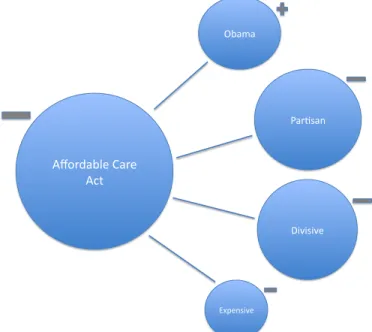
Figure 2.1 summarizes this associative process. Here, the “target” is the Affordable
Care Act. The concepts linked with the policy in the individual’s mind include President
Obama (which is a positive association for this individual), and “partisan,” “divisive,” and
“expensive” (all negative associations). Notice that some of the nodes are larger than
most heavily covered in the news—those characterizing the lawmaking process—are most
salient here. To form an attitude toward the policy, the individual calculates a weighted sum
of the charges on each of the associated nodes and arrives at an overall negative impression
of the Affordable Care Act.
!"#$%&'()*+&$)* !,-*
.'&/&*
0&$12&3*
4565256)*
789)3256)*
Figure 2.1: Concepts Associated With the Affordable Care Act
The innovation here is not that associated concepts form the bases of political attitudes.
We’ve long know that, just as we’ve long know that framing effects can have a powerful
influence on attitudes. What runs counter to conventional wisdom is the idea that
non-substantiveconsiderations are part of these associative maps and, due to their heightened
salience, can overwhelm the influence of substantive considerations in the formation of
policy attitudes.
Partisan conflict also has the potential to influence policy attitudes in an indirect way, by acting as a cue about the ideological content of the bill’s provisions. Individuals with
high levels of political knowledge and strong policy preferences generally view policy
the left/right ideological spectrum (while the political novice, who does not have preformed
preferences and strong ideological leanings, is less inclined to do so). By figuring out how
closely the bill’s provisions align with their own policy preferences, these individuals can
decide how much they like or dislike the bill. To help accomplish that task, these
individ-uals might use the presence (or absence) of partisan debate as a shortcut, just as they use
party identification as a shortcut that helps them determine where politicians stand on var-ious issues. When a piece of legislation generates bipartisan support, this might be viewed
as a cue that the bill’s content is fairly moderate; after all, bipartisan legislation ought to
reflect compromise and compromise leads to moderation. Conversely, when a bill
gener-ates partisan debate, ideologically-minded citizens might take this as a sign that the bill’s
content is ideologically extreme. In this way, the presence or absence of partisan debate
could influence public policy attitudes indirectly, by altering the perceived location of the
bill on the left/right ideological spectrum.
H3: When a bill generates heated debate, ideologically-minded individuals will perceive
its content as more ideologically extreme than if the bill generates bipartisan support.
Note that this hypothesis leads to an expectation that is somewhat counter-intuitive. If
the presence of conflict is used as an ideological cue, conflict should have the ability to
in-creasesupport for legislation among some members of the public. For instance, suppose a
Democratic bill is introduced in Congress that would increase public school funding. If the
bill generated partisan conflict, strong liberals would place it closer to themselves (at the far
left of the ideological spectrum) because the controversy would suggest to them that the bill
is extremely liberal. Due to the perceived congruence between their own preferences and
the content of the bill, strong liberals would be more inclined to support the bill under such
the other hand, would be less likely to support the bill if it generated controversy than they
would if it were to receive bi-partisan support. This is because the heated debate would
similarly suggest to them the extremely liberal nature of the bill. Ultimately, the closer an
ideologically-minded individual places a bill to him or herself on the ideological spectrum,
the more likely he or she will be to support it.
H4: Strong liberals will place Democratic bills closer to themselves on the ideological
spectrum when such bills generate partisan debate, while moderates and conservatives will
place them further away. Conversely, strong liberals and moderates will place Republican
bills further from themselves on the ideological spectrum when such bills generate partisan
debate, while strong conservatives will place them closer to themselves.
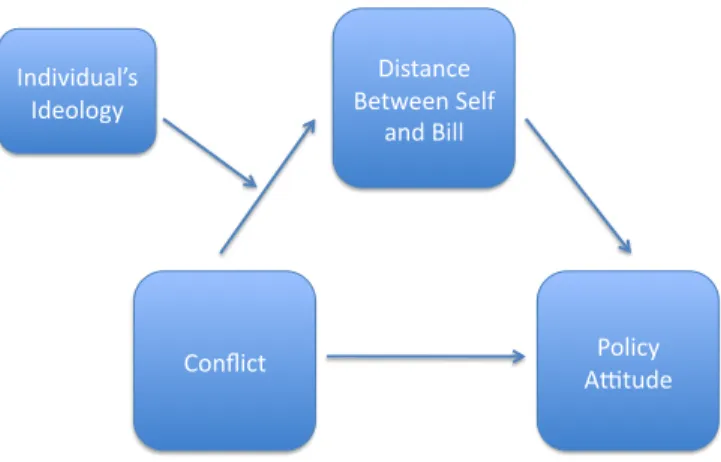
The basic causal structure outlined in this section is summarized by Figure 2.2. Conflict can affect policy attitudes directly, through the associative process described, or indirectly,
by altering the perceived distance between the individual and the bill on the ideological
spectrum. Whether the association of a bill with partisan debate causes an individual to
place the bill closer to him or herself or further away depends upon the individual’s
ideo-logical self-placement. But note that in the aggregate, the signal that a bill is ideoideo-logically
extreme will be a negative for most Americans (because a minority of Americans place
themselves at either extreme of the ideological spectrum).
2.4 Design
I use an experimental design to assess the influence of heated, partisan debate on policy
attitudes.2 The experiment was administered online to 367 UNC-Chapel Hill
undergrad-uate students using the Qualtrics platform during the fall of 2011. Subjects, who were
required to participate in the university subject pool or complete an alternative assignment,
!"#$%&'(
)%*'+#&,( -,'.,,#(/,01(
+#2(-%00(
3"0%&4( 56'72,( 8#2%9%27+0:*(
82,"0";4(
Figure 2.2: Direct and Indirect Influence of Conflict on Policy Attitudes
were first asked to complete a questionnaire that gathered demographic information as well
as information on party identification, political ideology, political knowledge, and interest
in politics.3 Participants were then randomly assigned to one of six treatment groups and
asked to read a short vignette (approximately 250 words long) about an education policy.
Education was chosen because it was not a topic of national debate while the experiment
was in the field, thereby minimizing the influence of real world policy debate on the ex-perimental findings. All of the vignettes were modeled after realNew York Timesarticles
about the Obama health care plan (where education was substituted for health care), using
as many verbatim statements from the articles as possible. While the real articles attribute
3The use of a student subject pool poses some limitations for the project. First, levels of knowledge about
quotes to named party leaders (like Nancy Pelosi), no actual members of Congress were
referenced by name in the treatments. (The treatments reference speakers with titles, such
as “Committee Chairman,” or use made up names.) This was done to prevent attitudes
toward specific political figures from influencing participant responses. The vignettes were
also designed by a graphic artist to look like articles downloaded from theNew York Times.4
All of the treatments open with a lead paragraph that describes the education bill as one “designed to reform K through 12 education by providing vastly more resources for
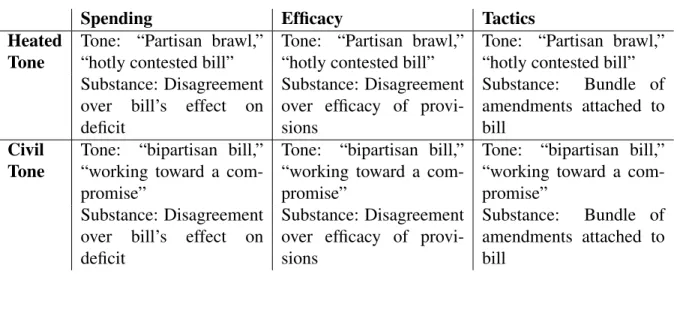
schools and teachers.” The six treatments—summarized in Table 2.1—differ in that they
vary both the tone of debate (heated or civil) as well as the substance of the article. The
treatments that highlight partisan conflict use the headline, “Partisan battle on education
heats up.” The articles themselves describe the bill as “hotly contested,” note that “the
debate has deteriorated into a partisan brawl,” and state that “Democrats will have to close
ranks and vote as a bloc to pass the bill without Republican support.” All of the treatments that employ a civil tone describe the bill as a bipartisan one, note that the bill is gaining
momentum in the Senate, and describe lawmakers as working to reach a compromise.
Table 2.1: Description of Experimental Treatments
Spending Efficacy Tactics
Heated Tone
Tone: “Partisan brawl,” “hotly contested bill”
Tone: “Partisan brawl,” “hotly contested bill”
Tone: “Partisan brawl,” “hotly contested bill” Substance: Disagreement
over bill’s effect on deficit
Substance: Disagreement over efficacy of provi-sions
Substance: Bundle of amendments attached to bill
Civil Tone
Tone: “bipartisan bill,” “working toward a com-promise”
Tone: “bipartisan bill,” “working toward a com-promise”
Tone: “bipartisan bill,” “working toward a com-promise”
Substance: Disagreement over bill’s effect on deficit
Substance: Disagreement over efficacy of provi-sions
Substance: Bundle of amendments attached to bill
The three different substantive treatments each focus on a distinct facet of real-world
policy debate, as reported by the news media. Those facets are the parliamentary tactics
being employed by the respective parties, the program’s cost, and the efficacy of the plan’s
provisions. The tactics and procedures treatments provide minimal substantive information
about the bill being considered (they note the party affiliation of the bill and provide the
de-scription of the bill that is common to all of the articles regarding “vastly more spending”). The article is focused on the attachment of a bundle of amendments to the bill, which are
described by the Democrats as “delay tactics” in the heated conflict version of the article,
and described as a method of insuring bipartisan support in the civil debate version of the
article. The tactics treatments are, therefore, designed to show the impact of partisan debate
on policy attitudes in an instance where very little substantive information is available.
The spending and efficacy treatments provide a more moderate level of substantive
information about the bill. These treatments give arguments for and against the passage of the legislation, describing the particular elements of the bill about which the parties
disagree. In the two “spending” treatments, Republicans reject Democrat’s claims that the
proposal will decrease the deficit. In the two “efficacy” treatments, Republicans assert
that some of the bill’s provisions might do more harm than good because they are “risky”
and “untested,” while Democrats state the plan will increase test scores. All four of these
treatments, therefore, describe the substance of the policy debate. The civil and heated
versions of the treatments manipulate the tone of that debate.
After reading the article to which they were assigned, all participants were asked to
respond to several questions (the order of which was randomized). To assess perceptions
of the policymaking process, respondents were asked: “Do you think the education reform
process shows more that our policymaking process is working as intended, or more that
our policymaking process is broken?” Respondents were also asked whether they support
scale.
2.5 Analysis and Findings
One of the key assumptions on which the primary hypothesis is built is that many
Amer-icans view partisan conflict as a sign of dysfunction in the lawmaking process. I examine
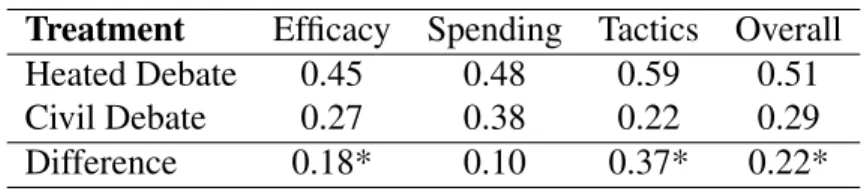
the veracity of this assumption by comparing the proportion of respondents that stated the
policymaking process is broken in the heated debate groups with that of participants in the civil debate groups. Table 2.2 shows the results of t-tests measuring differences in
propor-tions between paired treatment groups—meaning differences between the Efficacy/Heated
group and the Efficacy/Civil group were analyzed, differences between Spending/Heated
and Spending/Civil were analyzed, and so on. Asterisks indicate statistically significant
differences in proportions between these paired groups.
Table 2.2: Proportion of Respondents Who Agree that the Policymaking Process is Broken, by Treatment Group
Treatment Efficacy Spending Tactics Overall
Heated Debate 0.45 0.48 0.59 0.51
Civil Debate 0.27 0.38 0.22 0.29
Difference 0.18* 0.10 0.37* 0.22*
* Indicates 95% confidence
Notice that in all cases, participants who received one of the heated debate treatments
were more likely to view the policymaking process as broken than were participants who
received one of the civil debate treatments. With the exception of the spending treatments,
all of these differences are statistically significant. Overall, individuals who received one of the heated debate treatments were 22 percentage points more likely to view the
poli-cymaking process as broken than were individuals who received one of the civil debate
treatments.
I further explore the factors that affect attitudes toward the policymaking process by
and of opposition to the education bill. By including both of these variables in the model,
I can test the degree to which attitudes toward the policymaking process are a function of
the amount of conflict inherent in the process as compared with approval/disapproval of the
legislation produced by the process. The results of the model are shown in Table 2.3. They
indicate that exposure to conflict is a statistically significant predictor of the belief that the
policymaking process is broken, while opposition to the proposed bill is not. These findings provide strong evidence that heated, partisan debate is interpreted by many members of the
public as a sign of dysfunction in government, which leads to more negative evaluations of
the policymaking process.
Recall that H3 expects conflict to influence conceptions of the ideological content of
the bill, causing individuals to view the bill’s provisions as more ideologically extreme. To
test this hypothesis, Table 2.4 compares the average ideological placement of the bill by
respondents on a seven-point scale, across treatment group (where lower values indicate a more liberal placement of the bill and higher values indicate a more conservative placement
of the bill). Paired t-tests are again used to assess statistical significance. This analysis
provides evidence in support of the cue-taking hypothesis. The t-tests show that across all
the substantive treatments, respondents who were exposed to conflict evaluated the bill as
more liberal than did respondents who received the corresponding civil debate treatment.
On average, individuals who received a heated debate treatment assessed the bill as being
.5 points more liberal (on a seven-point scale) as compared with other respondents. Further, the influence of heated debate was strongest among respondents who received the “tactics”
treatments, indicating that the presence of heated partisan debate is a particularly strong
cue in instances where individuals have very low levels of substantive information about
the bill under consideration.
Hypothesis four states that for some individuals, the association of a bill with partisan
Table 2.3: Likelihood of Believing the Process is Broken
Variable Coefficient Standard Error
Heated Debate Treatment 0.98* 0.22
Opposes the Bill -0.50 0.33
Constant -0.85* 0.17
N=367; Pseudo R2=0.04
* Indicates 95% confidence Results are from a logit model.
Table 2.4: Average Ideological Placement of Bill on a Seven Point Scale
Treatment Efficacy Spending Tactics Overall
Heated Debate 2.9 2.7 2.9 2.8
Civil Debate 3.2 3.2 3.5 3.3
Difference - 0.3* - 0.5* - 0.6* - 0.5*
* Indicates 95% confidence
Lower values indicate a more liberal assessment of the bill’s ideology, higher values indicate a more conservative assessment of the bill’s ide-ology.
In the case of the education bill, strong liberals exposed to the heated debate treatment should place the bill closer to themselves, as the presence of debate should signal the
ex-treme (very liberal) nature of the bill. Both moderates and strong conservatives should
place the bill further from themselves on the ideological spectrum when it is associated
with heated debate. To test this hypothesis, I first generate a variable that measures the
ab-solute value of the distance between the individual’s placement of the bill on a seven-point
ideological scale and the individual’s placement of him or herself on the same scale (which
was assessed with the pre-treatment questionnaire). The variable has a mean of 1.6 and
ranges from zero to five with a standard deviation of 1.2. I then model this distance as a function of exposure to heated debate, the individual’s ideology, and a set of variables that
interact these indicators. Ideology is measured with two dummy variables—one that
iden-tifies strong liberals (respondents who placed themselves at one or two on the seven-point
scale), and one that identifies strong conservatives (respondents who placed themselves at
dummy variable that indicates whether the respondent received one of the three heated
de-bate treatments. The ideology variables are multiplied with the conflict variable to create
interaction terms.
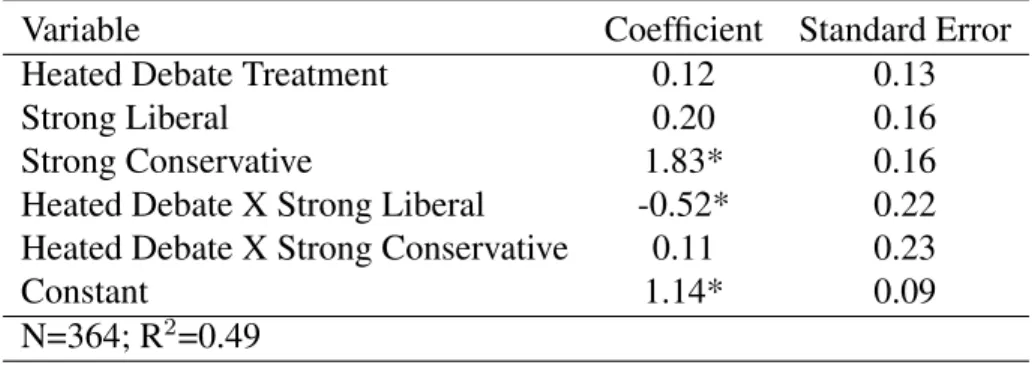
Table 2.5 displays the results of this model. They indicate that strong liberals who were
exposed to partisan conflict placed the bill closer to themselves than did strong liberals
who were not exposed to heated debate (as indicated by the negative, statistically signif-icant coefficient of the interaction term “Heated Debate X Strong Liberal”). The sign of
the coefficient on the interaction term, “Heated Debate X Strong Conservative” is positive,
indicating that strong conservatives who were exposed to heated debate placed the bill
fur-ther from themselves than did strong conservatives who received one of the “civil debate”’
treatments. This interaction term is not statistically significant, however.5 These findings
provide moderate support for hypothesis four. Strong liberals do, in fact, view controversial
Democratic bills as being closer to themselves on the ideological spectrum, as compared with bills that receive bipartisan support.
Table 2.5: Absolute Value of Distance Between Ideological Self-Placement and Self-Placement of Bill
Variable Coefficient Standard Error
Heated Debate Treatment 0.12 0.13
Strong Liberal 0.20 0.16
Strong Conservative 1.83* 0.16
Heated Debate X Strong Liberal -0.52* 0.22
Heated Debate X Strong Conservative 0.11 0.23
Constant 1.14* 0.09
N=364; R2=0.49
* Indicates 95% confidence Results are from an OLS model.
5The failure of the “Heated Debate X Strong Conservative” to attain statistical significance is likely related
The ultimate goal of this project is to assess the impact of exposure to heated partisan
debate on policy attitudes. Toward that end, Table 2.6 compares the proportion of
respon-dents who stated support for the education bill across treatment groups. Paired t-tests are
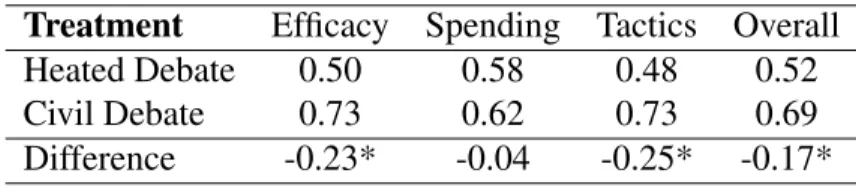
again used to assess statistical significance. Overall, 69% of respondents given a civil
de-bate treatment supported the bill as compared with just 52% of respondents given a heated
debate treatment—a difference of 17 percentage points. This finding provides support for the first hypothesis, which states that the association of a policy with heightened debate
re-sults in decreased support for it. Looking at the paired, substantive treatment groups, 73%
of the respondents in the efficacy/civil debate group supported the bill, and the same
per-centage of respondents supported the bill in the tactics/civil debate group. Support among
respondents who received the heated debate version of those treatments fell to 50% and
48% respectively.
The difference in support between the heated and civil versions of the spending treat-ment is not statistically significant, although the difference is in the expected direction.
Interestingly, support for the bill is highest among those who received the spending/heated
debate treatment as compared with any of the other heated debate treatments. It seems that
partisan conflict over spending and the deficit is less likely to tamp down support for
legis-lation than is debate on other topics. This suggests that debate over government spending
may be seen as more legitimate than are other substantive topics of debate.
Table 2.6: Proportion of Respondents who Support the Bill
Treatment Efficacy Spending Tactics Overall
Heated Debate 0.50 0.58 0.48 0.52
Civil Debate 0.73 0.62 0.73 0.69
Difference -0.23* -0.04 -0.25* -0.17*
* Indicates 95% confidence
Thus far, we have seen evidence in support of the hypothesis that exposure to conflict
indirectly (by causing citizens to alter their placement of the bill on the ideological
spec-trum). As a means of testing these hypotheses against one another, I model the likelihood
of support for the education bill as a function of exposure to conflict and the distance
be-tween the ideological placement of the bill and the individual’s ideological self-placement.
If conflict has a direct effect on policy attitudes, the coefficient on the conflict variable
should be negative and statistically significant. If exposure to conflict affects policy atti-tudes indirectly, the coefficient on the ideology variable should be negative and statistically
significant. If conflict affects policy attitudes both directly and indirectly, we should see
the coefficients for both variables attain statistical significance.6
Table 2.7 displays the results of the model. The coefficient on the conflict variable is
negative and statistically significant, indicating that the association of a bill with heated
conflict lowers support for it. The coefficient on the ideology variable is also negative and
statistically significant, indicating that individuals who place the ideology of the bill further from their own ideological preferences are less likely to support the bill.
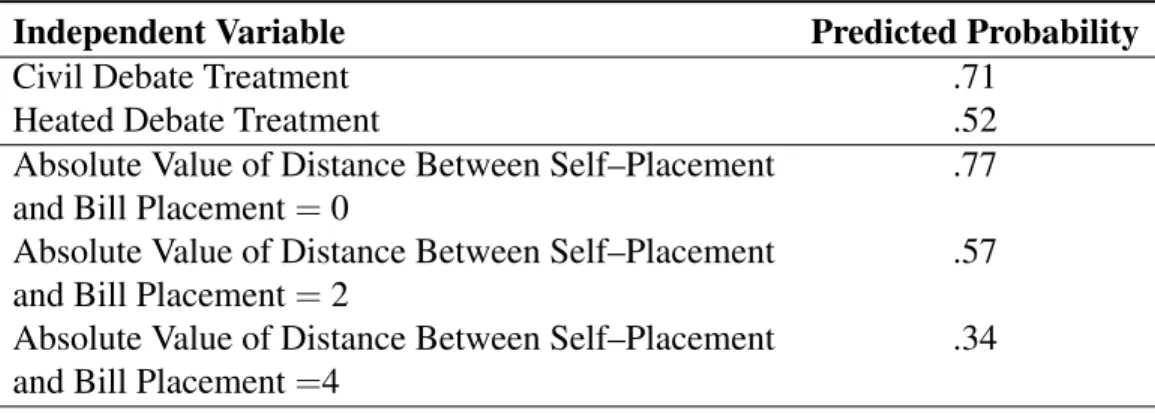
Table 2.8 shows the predicted probability of support for the education bill for the two
categories of the conflict variable and for various levels of the ideological distance measure.
The probability of support for the education bill was 19 percentage points lower among
in-dividuals who were exposed to heated debate (holding the distance variable at its mean).
This finding provides strong evidence that exposure to partisan conflict has a direct,
nega-tive, substantively meaningful impact on policy attitudes. The probability of support for an individual who perceives no difference between the ideology of the bill and his or her own
ideology is 77%, as compared with 57% for an individual who places the bill two points
away from him or herself—a difference of 20 percentage points. The predicted
probabili-ties, therefore, indicate that conflict has both a direct and indirect effect on policy attitudes
and that both of these effects are substantively significant.
6Note that the level of correlation between the conflict variable and the ideology variable is just 0.007, so
Table 2.7: Likelihood of Supporting the Bill
Variable Coefficient Standard Error
Heated Debate Treatment -0.79* 0.23
Absolute Value of Distance Between Respondent -0.47* 0.10 Ideology and Perceived Bill Ideology
Constant 1.75* 0.25
N=364; Pseudo R2=0.07
* Indicates 95% confidence Results are from a logit model.
Table 2.8: Predicted Probability of Support for Education Bill
Independent Variable Predicted Probability
Civil Debate Treatment .71
Heated Debate Treatment .52
Absolute Value of Distance Between Self–Placement .77 and Bill Placement=0
Absolute Value of Distance Between Self–Placement .57 and Bill Placement=2
Absolute Value of Distance Between Self–Placement .34 and Bill Placement=4
Predicted probabilities were generated holding all other variables at the mean or modal value.
2.5.1 Summary of Findings
The results from the logit model estimating the likelihood of support for the bill show that respondents exposed to heated debate were less likely to support the bill even when
accounting for the absolute value of the distance between their ideological self-placement
and their placement of the bill on the same scale. This finding provides strong support
for the primary hypothesis. The mere association of a policy with heated, partisan debate
results in decreased support for the associated policy. Exposure to debate also increases the
likelihood that individuals will view the policymaking process as broken, which is further
more ideologically extreme. The further an individual places the bill from him or herself
on the ideological spectrum, the lower his or her predicted level of support for it—meaning
conflict can indirectly influence policy attitudes. This cue-taking effect is perhaps most
likely to influence policy attitudes in instances where very low levels of substantive
infor-mation about the bill are available, as indicated by the strong influence of conflict among
individuals who received the “tactics” treatment.
2.6 Conclusion
Journalists make choices about how to cover lawmaking, and these choices are guided
by the norms of their profession and the need to attract attention. Health care reform, for
instance, is a multifaceted issue that could have been covered from a variety of angles,
in-cluding a focus on the political aspects of the debate, the substance of the proposals, the
effect of the economic downturn on health coverage, and the workings (and failures) of the
health care system itself (Pew 2010a). In choosing to focus on politics, partisanship, and the horse race, journalists framed the issue in a way that was consequential for public policy
attitudes. Such coverage highlighted the aspects of lawmaking that many Americans view
as a sign of dysfunction. Further, those negative conceptions of the process of
lawmak-ing became part of the mix of information that was aggregated when individuals formed
opinions about the Affordable Care Act. As a result, a law with many popular provisions
became widely unpopular.
Due to the incentives that lead journalists to focus on conflict and the widespread aver-sion to partisan debate that exists among members of the public, we should find that bills
with popular provisions fail to attain public support time and again. The longer a partisan
debate drags on, the more heated the rhetoric becomes, and the greater the media focus on
the conflict, the more public opposition should be generated.
This implication is somewhat troubling from a normative perspective. The process of