Karl E. Germeck. On the Road Again: Planning the Transfer of an Academic Transportation Research Library’s Archival Collection to University Archives.A
Master’s paper for the M.S. in L.S degree. December, 2016.54pages.Advisor: Rebecca Vargha
So much of project planning is circumstantial. Even after the approval of a formal project proposal or plan, an unsuspecting shift in environmental factors can often alter or redirect a project’s original objectives, goals, and purpose. In the face of such change it is not uncommon for members of a project team to find themselves, in a sense, “on the road again,” re-evaluating and perhaps even re-envisioning the course and direction of a project. Project planning practiced in this way—as a continuous process as opposed to a single, linear stage completed prior to a project’s launch—provided the small, one-person transportation research library at the University of North Carolina Highway Safety
Research Center (HSRC) with a manageable way to plan and keep project documentation during a three-year period, from 2013 to 2016, that saw tremendous change to the library and its larger role at HSRC. This report documents the process of composing a project plan for transferring HSRC Library’s archival collection of original research manuscripts, publications, and ephemera to UNC-CH University Archives and illustrates one way a project planner might create and keep project plan documentation within small and single-librarian environments.
Headings:
Libraries
Archives
Project management
Project planning
Small libraries
ON THE ROAD AGAIN: PLANNING THE TRANSFER OF AN ACADEMIC TRANSPORTATION RESEARCH LIBRARY’S ARCHIVAL COLLECTION TO
UNIVERSITY ARCHIVES
by Karl E. Germeck
A Master’s paper submitted to the faculty of the School of Information and Library Science of the University of North Carolina at Chapel Hill
in partial fulfillment of the requirements for the degree of Master of Science in
Library Science.
Chapel Hill, North Carolina
December, 2016
Approved by
_______________________________________
Table of Contents
List of Figures ... 2
Epigraph………...3
Introduction: Project Planning as a Continuous Process ... 4
Literature Review: Project Planning Methods and Practices in Libraries ... 9
Reflection: Facilitating a Culture of Documentation at HSRC Library ... 23
Notes ... 29
Bibliography ... 30
List of Figures
Figure 1. PMBOK PM Processes and Project Planning Process Group. ... 11
Figure 2. PRINCE2 PM Processes and Project Planning Process Group. ... 11
Figure 3. L. German’s (2009) Project Charter Template. ... 19
Figure 4. OTRA Project Plan Environmental Factors Decision Chart. ... 25
We're the best of friends, insisting that the world be runnin' our way.
And our way is on the road again.
1Introduction: Project Planning as a Continuous Process
So much of project planning is circumstantial. Even after the approval of a formal
project proposal or plan, an unsuspecting shift in internal or external environmental
factors—such as changes in the fiscal or project budgets, personnel, the organizational
structure of the larger institution, project partners, and/or leadership roles of project team
members, etc.—can often alter or redirect a project’s original objectives, goals, and
purpose. In the face of such change it is not uncommon for members of a project team to
find themselves, in a sense, “on the road again,” evaluating and perhaps even
re-envisioning the course and direction of a project. As a way to adapt to and consistently
document unanticipated circumstances, Carpenter (2011) has suggested periodically
revisiting and revising project plan documentation throughout the life of a project. “An
effective project plan,” she has written, “should become a working document, kept under
review and updated in response to change” (Carpenter, 2011, p. 23). Project planning
practiced in this way becomes a continuous process, as opposed to a single, linear stage
completed prior to a project’s launch. This recursive approach to project planning, in
particular, provided the small, one-person transportation research library at the University
of North Carolina Highway Safety Research Center (HSRC) with an incremental and
manageable way to plan and keep project documentation during a three-year period, from
Established in 1965 by the North Carolina Legislature and located on the
University of North Carolina at Chapel Hill campus, HSRC is home to an
interdisciplinary team of more than forty transportation safety researchers and staff
whose mission is to “improve the safety, sustainability, and efficiency of all surface
transportation modes”.2
The HSRC Library, since its inception in 1971 as a repository for
HSRC’s research publications, has operated under the direction of a full-time,
professionally trained solo-librarian and has often employed a part-time assistant or
Graduate Student Assistant from UNC-CH’s School of Information and Library Science.
It is a member of the National Transportation Library’s Eastern Transportation
Knowledge Network and provides in-house library services to HSRC’s staff, including
access to the library’s transportation research collection, reference and research
assistance, instruction, interlibrary loan, and document delivery.
A Library in Transition
In 2013, after conducting an initial user-needs survey and focus group with its
researchers and staff, HSRC began the process of better adapting its library services to
the current needs of its researchers by shifting the main responsibilities of the Librarian
position from traditional collection management and reference activities to an immerging
emphasis on embedded research support and electronic resource/data management.
HSRC and the HSRC Library took two strategies to achieve this goal:
A. Shrink the physical footprint of the library collection, (thereby reducing the amount of time spent on traditional collection management activities and freeing up physical room for a potential collaborative space such as a Makerspace or reading room), and
Following an additional assessment of the library collection in the summer and fall of
2014, the HSRC Library conceived two projects that aimed to reduce the library’s
physical space by at least 85%: 1) the consolidation and transfer of its circulating
materials to UNC-CH’s University Libraries, and 2) the transfer of its archival materials,
consisting of original research manuscripts, HSRC publications, and ephemera, to
UNC-CH University Archives. The first of these two projects, The Library Consolidation (LC)
project, was launched in September of 2014 and involved a collaborative effort with
UNC-CH University Libraries to aggressively weed HSRC Library’s 10,000-volume
circulating collection and then transfer the remaining materials not selected for weeding
to off-site storage at Triangle Research Library Network’s (TRLN) Library Service
Center. 3 Planning for the second project, the On the Road Again (OTRA) project, to transfer HSRC Library’s archival collection to UNC-CH University Archives began a
year later in the fall of 2015.
Though, by that time, the library work environment had shifted unexpectedly into
a transitional state. The HSRC Librarian position became vacant, and the search for the
new Embedded Research Librarian position began. A temporary, one-year Project
Librarian position was approved to carry out a reduced set of daily library operations,
manage the completion of the LC project, and plan the OTRA project. In addition, a
Graduate Student position to assist with the completion of the LC project was approved
for a six-month, non-renewable term. The conclusion of the LC project and the one-year,
temporary Project Librarian position, in which the author of this paper served, coincided
with the start-date of HSRC’s new Embedded Research Librarian position in May of
on the actual hire date. However, because the Project Librarian position held a fixed
end-date, there was the possibility that there would be no overlap but, instead, a gap between
when the Project position ended and the new Embedded Research position began. The
opportunity to pass off and/or discuss the completed OTRA project plan and its context
with the new librarian could very well not occur.
Under these tenuous circumstances, consistent and concise project documentation,
or a lack there of, would have a significant impact on the eventual launch and execution
of the OTRA project as well as on the success of the forthcoming transition in HSRC
Library leadership. Allan (2004) has written that creating and maintaining up-to-date
project documentation serves as a mechanism of accountability between project
stakeholders and the project team as well as a day-to-day project management tool (p.
57). Yet, for the solo-librarian managing a major project and also responsible for
overseeing daily library operations, the thought of writing and keeping formal project
documentation may seem overwhelming, if not impractical. As Carty (2014) wrote, in an
article appearing in a special project management issue of Catalogue and Index: It can be all too appealing to skip the [project] documentation stage. Especially when you start doing some research and see examples such as the “Project Initiation Document” in the Jisc Project Management Infokit, which includes 33 headings and is 11 pages long just as a template. (p. 18)
Selecting and adapting a project plan template appropriate to the reasons for creating the
plan, the size of the project team, and the scale of the project (i.e., the number project
stages, milestones, or deliverables) increases the likelihood that the process of
documenting the project plan and, once launched, the progress of the project will be
manageable. This report documents the process of composing a project plan for
publications, and ephemera to UNC-CH University Archives and illustrates one way a
project planner might create and keep project plan documentation within small and
single-librarian environments. The literature review provides a discussion on current
project planning methods and practices within libraries, followed by a brief reflection of
the process of creating the OTRA project plan. Appendix A contains a complete copy of
Literature Review: Project Planning Methods and Practices in
Libraries
There a number of previous reviews of the literature on project management
practices within libraries. Early reviews by Winston and Hoffman (2005) and Kinkus
(2007) have provided background information about project management as a discipline
and, in general, investigated literature about the skills and training needed to become a
successful project manager. Winston and Hoffman (2005) observed that much of the
early library literature concerning project management relates to managing large-scale
implementations of digital library, web-based, and information-systems projects (p. 55).
More recently, Feeney and Sult (2011) and Horwath (2012) categorized the increasing
body of library literature about project management into the following three areas of
study:
A. Project management skills and training/education for ILS professionals B. Project management tools and techniques, and
C. Project management methods and best practices for specific types of library projects
Horwath (2012), in her review, also confirmed that most of the literature tends to address
the project management processes of large-scale, multi-team projects at large academic
libraries (p. 3). “Little,” she wrote, “is written about [project management] methodologies
used at smaller libraries or the appropriate PM tools to use for small library projects”
(Horwath, 2012, p. 29). In addition to her own study, which investigated project
that future investigations could more directly explore the practices of specific project
management processes within libraries, such as monitoring and controlling a project (p.
30). This literature review, in taking Horwath’s suggestion to focus on one specific
project management process, first provides a short comparison of the two predominant
project management methodological frameworks often applied to library projects and
then examines specific processes and documentation libraries commonly use to plan
projects discussed within the literature.
Project Management Methodological Frameworks
The two predominant project management methodological frameworks discussed
in the library literature are the U.S. based Project Management Institute’s Project Management Body of Knowledge (PMBOK) and Great Britain Office of Government Commerce’s PRojects IN Controlled Environments (PRINCE2). Horwath (2012) has provided an excellent review of past library projects and studies making use of either
PMBOK or PRINCE2. Black (1996), Winston and Hoffman (2005), Riggs (2006),
Kinkus (2007), Cervone (2007), Marill and Lesher (2007), and Revels (2010) have
provided introductions to PMBOK, while Dickson et al. (2003), Allan (2004), and
Carpenter (2011) have discussed PRINCE2. Although these articles provide background
information about either PMBOK or PRINCE2, none discuss the details of each method
together. It is worthwhile, then, to provide a short synopsis of both frameworks as they
relate to the project planning process and the creation of project planning documentation.
PMBOK consists of five project management process groups: Initiation, Planning,
Execution, Monitoring/Controlling, and Closing (Cervone, 2007; Greene, 2010; Riggs,
amongst these five process groups, and twenty of these sub-processes, as shown in fig. 1,
are dedicated to the project planning process. The Planning process group is defined in
the PMBOK guide as “those processes required to establish the scope of the project,
refine the objectives, and define the course of action required to attain the objectives that
the project was undertaken to achieve”; together, these twenty planning processes
produce “the project management plan and the project documents that will be used to
carry out the project” (Project Management Institute, p. 39, 46 ). The PRINCE2
PMBOK – Project Management Processes 1. Initiation 2. Planning 3. Execution 4. Monitoring/Controlling 5. Closing
PMBOK – Project Planning Process Group [Subprocesses]
1. Develop Project Management Plan
2. Collect Requirements
3. Define Scope
4. Create Work Breakdown Structure (WBS)
5. Define Activities
6. Sequence Activities
7. Estimate Activity Resources
8. Estimate Activity Duration
9. Develop Schedule
10. Estimate Costs 11. Determine Budget 12. Plan Quality
13. Develop Human Resources Plan 14. Plan Communications
15. Plan Risk Management 16. Identify Risks
17. Perform Qualitative Risk Analysis 18. Perform Quantitative Risk Analysis 19. Plan Risk Responses
20. Plan Procurements
Figure 1. PMBOK PM Processes and Project Planning Process Group.
PRINCE2 – Project Management Processes
1. Directing a Project
2. Starting up a Project
3. Initiating a Project
4. Controlling a Project Stage
5. Managing Product Delivery
6. Managing Project Stage Boundaries
7. Closing a Project
8. Planning
PRINCE2 – Project Planning Process Group [Subprocesses]
1. Designing a Plan
2. Defining and Analyzing Products
3. Identifying Activities and
Dependencies
4. Estimating
5. Scheduling
6. Analysing Risks
7. Completing a Plan
framework, more so than PMBOK, places importance on the products produced by a
project. As Dickson et al. (2003) have written: “PRINCE2 is end-product-based, which
means the project process focuses on the delivery of results – not simply on planning
when the various activities in the project will be completed” (p. 71). PRINCE2 consists
of eight project management processes and seven planning sub-processes, as shown in
fig. 2 (Bentley, 2006, p. 3-7). Cervone (2007) and Bentley (2006) both advise that any
methodology used should be adapted to the project’s environment and goals.
Project Planning Processes
Horwath’s (2012) observation that formal project management methodologies are
adapted and practiced informally within libraries is echoed in the projects discussed by
Greene (2010) and by Mair and Shrauger (2014). Although Greene (2010) stated that the
initiation and establishment of an institutional repository at the University College Dublin
Libraries was not explicitly planned using a standard methodology, he did demonstrate
how the five PMBOK process groups “were at work [during the project], even if
implicitly" (p. 103). Mair and Shrauger (2014), in developing a plan for their project at
the University of Florida, relied primarily on the use of project management tools to
consider the project’s internal/external environment, goals, staffing, cost, and
implementation logistics (p. 6). For example, they discussed the results of a user needs
assessment, stakeholder analysis, scalability action plan, and Gnatt chart. They did not,
however, mention creating a formal project plan document. Similarly, Weaver and
Stanning (2007) described using techniques and tools such as creating a business case, a
project definition matrix, and conducting a stakeholder analysis in planning a large-scale,
great detail, project plans for each of the project groups were created prior to the
implementation of the project (Weaver & Stanning, 2007, p. 65).
Barba and Perrin (2010) emphasized the importance of communication during the
development and implementation of a project. “The most important part of project
planning,” they wrote, “is the people” (Barba & Perrin, 2010, p. 19). They have identified
the project sponsor, project manager, and stakeholders as primary facilitators of the
project planning process. The project sponsor is a “super customer” who acts as the
champion for a project and “is guardian of expectations and defines the parameters of
[project] success or failure” (Barba & Perrin, 2010, p. 19). The project manager, on the
other hand, is responsible for realizing and executing the purpose and goals of a project—
as envisioned by the sponsor. The project planning processes starts by assigning a project
sponsor and project manager; a project team is formed and communication occurs
between the sponsor and the project manager about the purpose and goals of the project.
An initial project team meeting is then held in which the project team begins the process
of developing three official planning documents: a) a definition document containing a description of project goals, completion criteria, limitations, and deliverables/outcomes,
b) an estimation of work or timeline outlining tasks and specific task-responsibilities held by each project team member, and c) a risk management plan establishing a strategy for minimizing project risks (Barba & Perrin, 2010, p. 19).
Feeney and Sult (2011) discussed the University of Arizona (UA) Libraries’
adoption of the PMBOK framework and appropriation of Brigham Young University’s
(BYU) Project Management Process Guide as a model for implementing system-wide
and Perrin (2010), UA Libraries begin the planning process by assigning a project
sponsor who appoints a project manager. The project manager forms a project team and,
together, the team creates a definition document addressing the project’s objectives,
deliverables, and constraints relating to scope, schedule, and resources (Feeney & Sult,
2011, p. 752). Once the definition document is completed, the team holds an open
meeting with project stakeholders to discuss and refine the project deliverables. The team
then creates a Work Breakdown Structure (WBS), “[identifying] the specific tasks that
need to be accomplished to complete each of the project’s deliverable” (Feeney & Sult,
2011, p. 753). Feeney and Sult reported that the WBS can be created by writing out a
simple list; through UA’s own experience, though, they found project management
software (e.g., Microsoft Project) very helpful in creating the WBS (p. 753). A list form
of these same steps is as follows (Feeney & Sult, 2011, p. 756):
1. Validate the project’s scope and approach
2. Create a work breakdown structure for the expected outputs that were given to the team in the project charge
3. Create a preliminary resource schedule
4. Create an implementation plan (with timelines and deliverables embedded in the work breakdown structure)
5. Create a risk management plan
6. Hand the implementation plan off to an implementation team
Kass (2003) applied an Agile approach to the project planning process, in which
the project plan is developed by the project team over numerous project planning
sessions. Kass’s (2003) suggestions for project planning are specific to IT contract
situations, where an organization hires a third-party consulting team to plan and
implement a project. Kass (2003) has outlined four steps in planning a project (p. 52):
1. Understand the requirements 2. Define the project
Instead of beginning the process by forming a project team, Kass (2003) has
recommended creating a Statement of Requirements document; this involves
communicating with the management, business, technical units within the organization to
come to a formal agreement with the contracting firm on the goals and end-product of the
project (p. 53). Kass (2003) argued that creating this document allows the contracting
firm to better understand how adjustments in time, cost, and scope impacts the proposed
requirements. He wrote: “Increase any one [of these factors—time, cost, or scope] and
you probably have to decrease another” (Kass, 2003, p. 53). It is in the second, define the project, stage that Kass (2003) has suggested assigning a project manager and
establishing a project team. The plan the highlevel step involves holding project planning sessions and composing a project plan, which consists of major milestones (i.e., project
start/end dates, project deliverable specifications). A copy of the project plan is then sent
to all the project stakeholders. In the last step of planning, plan the detail level, the
project plan is extended to include the step-by-step milestones for project implementation
and risks related to the project are considered. A final planning session is held in which
task responsibility is assigned. Lastly, a detailed estimate of the project’s cost is
produced, a cost summary is sent to stakeholders, and project resources are purchased
(Kass, 2003, p. 53).
Project Planning Documentation
Allan (2004) in Project Management: Tools and Techniques for Today’s ILS
multi-page document often used for large projects “involving different units, departments or
organizations” and may include the following twenty-one headings (Allan, 2004, p. 56):
● Introduction
● Purpose
● Background
● Goals and objectives
● Strategy
● Description of main activities
● Project schedule
● Resources
● Finance
● List of staff and their involvement
● Connections to other activities
● Transitional arrangements
● Communication strategy
● Management structure
● Reporting schedule
● Risks
● Quality standards, processes and procedures
● Intellectual property, patents and licenses
● Insurance
● Distribution list
● Formal approval (signature, name, date)
For smaller projects, Allan (2004) has recommended a one- to two-page simple project
plan consisting of a project brief, which serves as a project proposal during the project
initiation stage, and the following additional headings (p. 33-34):
● Project brief - Title of project
- Aim of project
- Main project outcomes
- Rationale of project
- Project stakeholders and how they will benefit from project
- The scale of the project: time period, number of staff, resource requirements
- Project milestones (key stages in the project process)
● Project brief, continued - Potential risks and how they
may be managed
- Proposed project team
- Relationship between this project and other projects
● Action plan
● Details of staffing implications
● Financial requirements
● Risk analysis
Black (1996) and Webb (2001) provided a comparable, but slightly smaller list of
● Definition document with names, aims, objectives and scope
● Lists of tasks descriptions and deliverables
● Project schedule – one or all of Gantt chart, CPA network diagram, Pert Chart
● Critical path of tasks showing duration of individual tasks and the entire project List of staff to be involved in the project work and the amount of input they have
● Other resources such as equipment
● Cogent financial estimates
● Management structure
● Reporting schedule
In this case, the first heading, “project definition document,” functions very similar to
Allan’s (2004) project brief.
Atkins and Kruger (2005) reported in a book-length, Association of Research
Libraries (ARL) SPEC Kit on the results of a survey that investigated project
management processes and activities of large, system-wide projects undertaken at
ARL-member libraries. 73 % of the survey’s respondents (thirty-six of fifty-five ARL-ARL-member
organizations) claimed to have created and documented formal project plans/proposals,
which commonly included the following sections (Atkins & Kruger, 2005, p. 10):
● project definition and scope ● goals and objectives
● resources ● project timeline
● project budget ● expected outcomes ● necessary tasks
● implementation strategy
In addition to the survey results, the SPEC Kit also includes samples of official project
documentation (i.e., planning, implementation, and assessment reports) submitted by the
respondents as well a very helpful appendices, which includes a bibliography and helpful
online resource related to project management within libraries (Atkins & Kruger, 2005).
Thomas et al. (2000) presented their project proposal for the development of a
pilot electronic reserve services program at Virginia Commonwealth University.
the proposal, they did include the following headings within their proposal: a)
background, b) objectives, c) scope, d) and budget (Thomas et al., 2000). Thomas et al.
(2000) also added a few project-specific headings and sub-headings within their proposal:
a section covering intellectual property management and a “royalties” sub-section under
the budget heading.
German (2009) has provided general PMBOK guidelines for developing a project
plan and breaks the process of creating the plan into two steps: 1) conceptualizing the
project, and 2) composing the project charter. But, before beginning this process, she has
first suggested considering how closely aligned the proposed project is to the larger
organization’s mission statement/strategic plan and how the priority level of the proposed
project compares to the level of priority of current and other possible projects (German,
2009, p. 7). German (2009) stated that during the conceptualization phase one formulates
the project’s purpose and recommended asking why-based questions. “It is in this phase,”
she wrote, “that you examine what you are trying to achieve or what problem you are
trying to solve. Is there a new service you want to implement? Why?” (German, 2009, p.
8). The next step is to compose the project plan, which German (2009) has referred to as
the “project charter.” She has defined the charter as a document that “details the
definition, scope, and resources needed to carry out the project” (German, 2009, p. 8).
German (2009) has also suggested, like Allan (2004), that a project charter for a small
project may not need to exceed more than a page or two, while charters for large projects
are often longer, multipage documents. And like Cervone (2012a), German (2009) has
German (2009) provided a list of major components of a project charter, as shown in fig.
3, which include the following: purpose, overview, scope, specific statements of work,
communication plan, project deliverables, project schedule, project budget, and project
risks (p. 8).
Cervone (2012a; 2012b; 2012c), in a series of three articles, has provided the
most comprehensive discussion about the components of a project plan. He has
maintained that regardless of the project management methodological framework one
German’s Project Charter
Purpose: A high-level definition of the project.
Overview: The rationale for the project, the project's goals, and a high-level description of project objectives.
Scope: Additional details about specific goals and objectives and a definition of what is out of scope for the project.
Specific Statements of Work: What needs to be done when and by whom.
Communication Plan: The mechanism for updating people on project progress (i.e. who needs to be updated and how).
Project Deliverables: The key milestones of the project and key delivered products that confirm achievement of those milestones.
Project Schedule: A timeline of the overall project, including dependencies.
Project Budget: How much the project will cost and when the costs will be incurred.
Project Risks: Constraints or risks that may affect project completion.
chooses to use during implementation, a project plan should at the minimum contain the
following five primary headings (Cervone, 2012a):
1. Purpose, goals, and objectives 2. Scope and risk assessment
3. Project products and deliverables 4. Assumptions and constraints
5. Project methodology and management
Cervone (2012a) pointed out, though, that specific project management methodologies
may impact the level of detail for each section of the project plan (p. 76).
The purpose, goals, and objectives section functions as the project plan’s introduction and explains the motivations for initiating the project, articulates the
project’s aims and objectives (Cervone, 2012a). The goals and objectives of the project
should be written so that they complement those expressed within the larger
organization’s strategic plan. “Making this connection,” wrote Cervone (2012a), “is a
critical component in selling the plan to the institution as a whole because if this
connection cannot be made, it makes it difficult to justify the institutional investment in
the project” (p. 76). Cervone (2012a) has also recommended that the purpose, goals, and objectives section begin with background information addressing the environmental changes within the organization that have influenced project initiation and of any prior or
current initiatives related to the proposed project. “By including these elements,” he has
written, “the project plan may more effectively explain the rational and reasoning for
engaging in the project, especially to constituencies that are not as intimately familiar
with these issues as the project team and sponsor may be” (Cervone, 2012a, p. 76).
activities that fall “out of scope” and thus excluded from the project (Cervone, 2012a).
Cervone (2012a) wrote, “defining the work to be done during the project is the main
focus of the scope statement. In some cases, it may make sense for the scope definition to
define what is not included in the project” (p. 77). This section also often includes an
estimated cost of the project (i.e., materials, staffing hours) as well as a risk assessment
statement. The project products and deliverables section includes descriptions of
products produced during the project. These items may either take the form of a tangible
object or intangible result, and should be the direct end result of a project’s goals and
objectives (Cervone, 2012b). “Making this connection [between a project’s
goals/objectives and a project deliverable],” wrote Cervone (2012b), “is a critical
component because if this connection cannot be made, it is difficult to justify institutional
investment in the project” (p. 126). In addition, each deliverable described in a project
plan should have a corresponding milestone date attached to it. Cervone (2012b) has
defined milestones as “checkpoints for measuring the progression of a project as they are
the points in a project where a significant product or result can be demonstrated” (p. 126).
Milestones are also helpful in tracking project cost estimates and project completion
(Cervone, 2012b).
The assumptions and constraints section addresses the contextual factors (i.e., internal and external work environment) that shape the parameters of a project’s purpose,
scope, deliverables, and outcomes (Cervone, 2012b). Cervone (2012b) has recommended
considering how such factors and assumptive decisions impact the development of work
schedules and deliverable timelines, project funding, resource availability in relation to
plan, methodology and management, provides context to any methodological frameworks or tools being used to monitor quality assurance (Cervone, 2012c). Cervone (2012c) has
encouraged the creation of a schedule for reviewing project progression, endorsed the use
of such traditional project management tools as a Work Breakdown Structure (WBS) to
help ensure quality assurance, and suggested assigning quality management roles and
outlining the inclusion of performance/quality standards and necessary staff training (p.
177-78).
Carty (2014), in one of the very few articles from the library literature addressing
documentation for small projects, provided an example template for a one-page project
summary document. She has asserted that limiting the document to one page “offers an
opportunity to really think about the purpose of the project” (Carty, 2014, p. 19). Carty
wrote:
The process of distilling down the essence of the project into a simple, short (ideally one-sentence) objective statement is incredibly helpful. By removing the local shorthand and jargon, this statement can become a powerful tool in
communicating to management or colleagues about what you are trying to achieve. (p. 19)
Carty’s (2014) template—based on an excellent slideshare presentation presented at the
2011 Digital Library Federation Forum by Tito Sierra4—includes six headings: a) project name, b) project objective, c) project deliverables, d) scope, e) milestones, and f) team (p.
Reflection: Facilitating a Culture of Documentation at HSRC
Library
As a young librarian, the opportunity to plan a future project while at the same
time manage the completion of a current project reinforced, for me, the circular nature of
project management and project planning processes. Specifically, the process of
designing and composing a project plan template for the On the Road Again (OTRA)
project greatly influenced how I chose to keep and update the existing project
documentation for the HSRC Library Consolidation (LC) project. Over the course of
planning the OTRA project and completing the LC project, the LC project document
underwent numerous revisions and updates in response to progress in reaching project
milestones, time constraints, and changes to members of the project team, project
partners, and requirements for completing specific milestones. By the time the LC project
was completed and the OTRA project plan approved in May of 2016, the LC project’s
original, one-page project brief had expanded into an eleven-page, hyper-linked
document, its organizational structure corresponding to that of the OTRA project plan.
Together, both project documents serve as one potential model for organizing and
keeping future documentation at HSRC Library.
The Planning Process
The OTRA project plan was composed and compiled over a four-month period,
members: the HSRC Embedded Research Librarian, as the project manager, and a
part-time Graduate Student Assistant as the primary executioner of the project; the team also
includes two internal HSRC project sponsors and one project coordinator from UNC
University Archives. Consultations with both the project sponsors and UNC-CH
University Archives occurred prior to composing the plan. After the plan was reviewed
by UNC University Archives in April of 2016, the plan underwent a second revision
process followed by its preliminary approval by the HSRC OTRA project sponsors in
May of 2016. Initially, the plan had one primary function: as a traditional project
document, outlining and detailing the steps necessary to meet the project’s purpose,
complete its milestones, and ensure quality insurance of project deliverables. As the
project plan developed and took shape, it also became a place (mainly in the form of
footnotes and hyperlinks) for documenting the recent institutional memory of the library
and the major transition the library and the librarian-role were undergoing. In preparation
for drafting the plan, I first weighed and considered the following series of questions
related to a) the plan’s methodology and template design, b) work plans and
project-tracking tools, and c) project- and milestone-specific documentation, and then, in
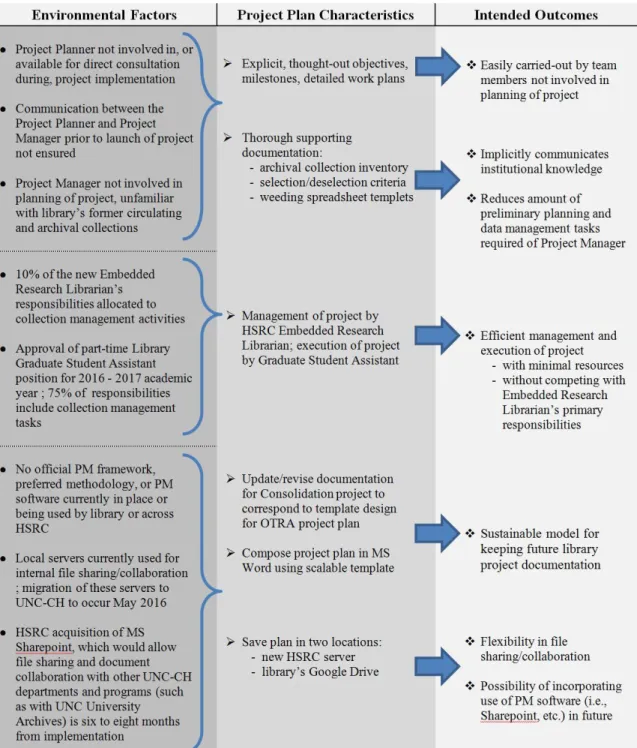
considering each, I created an Environmental Factors Decision Chart (as seen in fig. 4) to
guide the design of the plan:
Template Design
- How closely should the plan correspond (in methodology and template design) to the project plan for the Consolidation project?
- Are there project plan templates specifically suited for small projects?
Work Plans, Project Communication, and Project-tracking Tools - Should I consider using Project Management software?
- How will project communication occur within the project team? With project partners (i.e., with UNC University Archives Transfer Coordinator)?
- Should I include a formal Gantt chart, Work Breakdown Structure (WBS), workflow diagrams, and/or other organization, team management, and project-tracking tools?
- How extensive and detailed should the work plans be? Should they be described How detailed should the descriptive steps for each major milestone be—at a very basic, high level or described at a low level?
Project- and Milestone-specific Documentation
- Are there parts of the project (such as spreadsheet templates,
selection/weeding criteria) that I can complete and include within a set of appendices as a part of the plan?
Planning Methodology, Design, & Template
While the planning of the OTRA project did not follow a formal methodological
framework, the environmental factors outlined in fig. 4 heavily influenced the shape of
the project and the components of the project plan. For comparison, because the planning
of the LC project took place within a relatively stable work environment, the LC project
team adopted an informal, plan-as-you-go method for managing the project. 5 In contrast, due to the shifting priorities and practices of the HSRC Library at the time of planning
the OTRA project, the temporary nature of the Interim Librarian position, and the project
management resources available, all of the components of the OTRA project plan were
completed prior to the project’s proposed approval date and compiled together into a
single document. Project milestones are clearly defined and work plans for completing
each milestone are detailed and descriptive.
The nineteen-page OTRA project plan consists of two main sections: A) a
descriptive steps required to complete the project’s three major milestones and related
deliverables (e.g., a Work Breakdown Structure), ii.) a preliminary inventory of HSRC
Library’s archival collection, and iii.) a set of three descriptive and detailed work plans
for completing each of the project’s three milestones. The project brief, modeled after
Carty’s (2014) adaption of Sierra’s (2011) “project one-pager,” includes twelve headings,
as shown in fig. 5. 6 The Background and Assumptions sections were helpful in providing contextual information related the project’s partnership with UNC University Archives,
its relationship to the LC project, and the larger transition occurring with the HSRC
Library. The Out of Scope section aided in preventing “scope creep” and also became an appropriate place to list tertiary activities that could potentially be small, one-off projects
in the future. Lastly, as a way to provide managerial space for tracking the progress of the
OTRA Project Brief Template
1. Project Name*
Unique name describing the project
2. Objectives*
One-sentence description of the project’s aim(s)
3. Background
Multi-sentence, contextual description of the rationale of the project
4. Assumptions
List of the contextual factors that shape the parameters of the project’s purpose, scope, deliverables, and outcomes
5. Requirements* [Milestones]
High-level outline of the steps required to complete the project
6. Out of Scope*
List of items the project will explicitly not achieve
7. Materials
Items and resources (not allocated as part everyday operations) that are required to complete the project
8. Project launch
The Proposed start date of the project
9. Team*
List of the project team members and the role each member fulfills
10.Schedule* [Project Deliverables]
Timeline of proposed deadlines for completing each project milestone, with fields for proposed start date, proposed end date, and duration
11.Project Tracking Sheet
List of the steps required to complete each of the project’s milestones, with fields for tracking the status, start date, end date, and duration of each step
12.Project Plan Appendices
Hyperlinked list of supporting documentation compiled with the plan but not included as a part of the two-page project brief
project and making revisions to the plan, I left a number of the headings less detailed than
Notes
1
From “On the Road Again” by Nelson, W. (1980). On Honeysuckle Rose: Music from the Original Soundtrack. Columbia.
2 See HSRC’s website at http://www.hsrc.unc.edu/ to learn more about its mission, programs, and research. 3 The HSRC Library Consolidation (LC) project was launched in September of 2014 and completed in May
of 2016. The two primary members of the LC project team consisted of the HSRC Librarian (as the project manager) and a part-time Graduate Student Assistant; the team also included two internal HSRC project sponsors and four external project coordinators from UNC-CH University Libraries. From September 2014 to May 2015, the author served on the LC project team as the part-time Graduate Student Assistant; then, as HSRC’s Project Librarian, the author managed the LC project from June 2015 to its completion in May of 2016.
4 See Sierra (2011).
5 The original, one-page (front-to-back) Library Consolidation project brief contained five headings: a
multi-sentence project Objective, a list of Requirements, items identified as Out of Scope for the project, a list of Team members, and a Schedule of project deadlines. Project milestones were loosely defined; descriptive work plans and workflow/decision diagrams were drafted just prior to the launch of each milestone.
6
Bibliography
Allan, B. (2004). Project management: Tools and techniques for today’s ILS professional. London: Facet.
Atkins, S., & Kruger, B. (2005). Managing large projects. Washington, D.C.: Association of Research Libraries, Office of Leadership and Management Services.
Barba, S., & Perrin, J. (2010). Great expectations: How digital project planning fosters collaboration between academic libraries and external entities. The Unabashed Librarian, (155), 18–22.
Bentley, C. (2005). PRINCE2 revealed: Including how to use PRINCE2 for small projects. Oxford: Burlington, MA: Elsevier.
Black, K. (1996). Project management for library and information service professionals. London: Aslib.
Carpenter, J. (2011). Project management in libraries, archives and museums: Working with government and other external partners. Oxford: Chandos Publishing. Carty, C. (2014). Lessons learned from managing projects: Tips for success and sanity.
Catalogue & Index, (176), 18–21.
Cervone, H. F. (2007). Standard methodology in digital library project management.
OCLC Systems and Services, 23(1), 30–34.
- - -. (2012a). Understanding the elements of a digital library project plan: Part 1. OCLC Systems & Services: International Digital Library Perspectives, 28(2), 75–78. - - -. (2012b). Understanding the elements of a digital library project plan: Part 2. OCLC
Systems & Services: International Digital Library Perspectives, 28(3), 126–129. - - -. (2012c). Understanding the elements of a digital library project plan: Part 3. OCLC
Systems & Services, 28(4), 176–179.
Feeney, M., & Sult, L. (2011). Project management in practice: Implementing a process to Ensure Accountability and Success. Journal of Library Administration, 51(7/8), 744–763.
German, L. (2009). No one plans to fail, they fail to plan: The importance of structured project planning. Technicalities, 29(3), 1–9.
Greene, J. (2010). Project management and institutional repositories: A case study at University College Dublin Library. New Review of Academic Librarianship, 16, 98–115.
Horwath, J. A. (2012). How do we manage? Project management in libraries: An investigation. Partnership: The Canadian Journal of Library & Information Practice & Research, 7(1), 1–34.
Kass, S. (2003). Turning the Queen Mary, part 2. AIIM E-DOC, 17(3), 52–54.
Kinkus, J. (2007). Project management skills: A literature review and content analysis of librarian position announcements. College & Research Libraries, 68(4), 352–363. Mair, K. R., & Shrauger, K. J. (2014). UCF library express: Planning a faculty delivery
service. Journal of Interlibrary Loan, Document Delivery & Electronic Reserve,
24(1-2), 5–22.
Marill, J. L., & Lesher, M. (2007). Mile high to ground level: Getting projects organized and completed. Serials Librarian, 52(3-4), 317–322.
Project Management Institute. (2008). A guide to the project management body of knowledge (PMBOK® Guide). (4th ed.). Newtown Square, Pa.: Project Management Institute.
Revels, I. (2010). Managing digital projects. American Libraries, 41(4), 48–50.
Riggs, C. (2006). 2006 LITA national forum: Conference report. Library Hi Tech News,
23(10), 15–17.
Sierra, T. (2011). The project one-pager: A simple tool for collaboratively defining project scope. Presented at the Project Manager’s Group Meeting, Digital Library Federation Forum 2011. Retrieved from http://www.slideshare.net/tsierra/the-projectonepager
Weaver, M., & Stanning, M. (2007). Reclassification project at St Martin’s College: a case study. Library Review, 56(1), 61–72.
Webb, S. P. (2001). Project management in library and information services. Information Management Report, 16–19.
Appendix A: On the Road Again Project Plan
O T R A | 34
On the Road Again:
The Transfer of HSRC Library’s Archival
Collection to UNC-CH University Archive
s
Project Documentation
May 20, 2016
Prepared by:
Karl Germeck, Project Librarian
Contents
On the Road Again Project Brief ... 35
Appendix A – Milestones & Work Requirements ... 38
Appendix B – HSRC Library Archival Holdings Inventory ... 39
Appendix C – Milestone 1: Decision Tree Diagram & Selection/De-Selection Criteria ... 44
Appendix D – Milestone 2: Manuscripts & Publications Series Weeding Workflow ... 48
O T R A | 35
On the Road Again Project Brief
Objectives
The transfer of HSRC Library’s archival collection (HSRC research publications, annual reports, scrapbooks) to UNC-CH University Archives aims to ensure the collection’s long-term preservation and will improve the awareness of and access to HSRC’s scholarly legacy in highway safety research.
Background
The motivation for initiating the transfer of HSRC Library’s archival collection to UNC-CH University Archives originated during the recently completed Library Consolidation Project, which has resulted in a 97% reduction of the library’s physical footprint. The archival collection was marked out of scope for the Consolidation Project. However, transferring the archival collection to an appropriate UNC-affiliated repository for long-term care and access remains a high-priority.
Assumptions
a) A records management liaison relationship between HSRC library and University Archives has been recently established.
b) There is a current and accurate folder- and box-level inventory of the archival
collection’s three principal sub-collections (publications, annual reports, scrapbooks). c) The collection has been appraised and pre-approved for transfer by the UNC-CH
University Archives Records Services Archivist.
d) UNC-CH University Archives has an access policy and procedures in place for retrieving and accessing items (which includes services such as making and requesting copies of an item).
e) No formal library policy outlining the criteria and procedures for transferring research publications to, or retrieving/accessing HSRC material from, University Archives currently exists.
Requirements
1. Develop a decision tree (informed by selection criteria) that guides weeding and location decisions for all items in collection.
2. Weed the HSRC Manuscripts & Publications series and assign future location of
each item (either to be transferred to UNC-CH University Archives, included with the consolidated items sent to LSC, or retained and kept within HSRC’s future reading room).
3. Properly prepare HSRC Library’s Archival collection for transfer to UNC-CH
O T R A | 36
Out of Scope
Weeding and transferring HSRC’s photographic collection
Appraising and weeding HSRC Library’s media materials (35mm film, CDs, VHS)
Revising and updating citations to the HSRC Research Bibliography
Creating an official policy for transferring future HSRC publications to UNC-CH University Archives
Materials
Banker’s Boxes, 12″ x 15″ x 10″ (Staples Item # 825695)
(Non-hanging) file folders
Project Launch: TBA
Team
Member Position E-Mail Project Role
HSRC Head of Communications Project Sponsor
HSRC Director Project Sponsor
HSRC Embedded Research Librarian Project Manager
HSRC Library Graduate Assistant Project Assistant
UNC-CH University Archives
Records Services Archivist Transfer Coordinator
Schedule
Milestone # Milestone Prop. Start Date Prop. End Date Duration
Milestone 1 Create Decision Tree Diagram Milestone 2 Weed Publications series Milestone 3 Prepare collection for transfer
Project Tracking Sheet
Milestone # Milestone Step # Step Name Step Satus Start Date End Date Duration
1.1 Create a list of selection/deselection criteria Completed 6/1/2015 6/8/2015 1 week 1.2 Create a decision tree digram
2.1 Create Excel workbook for tracking weeding process Completed 10/2/2015 10/7/2015 1 week 2.2 Deselect items that do not qualify as HSRC publications
2.3 Consider deselected items for bibliography collection 2.4 Discard remaining deselected items
3.1 Record archive inventory on University Archives transfer sheet 3.2 Weed copies of items that have 3 or more duplicates 3.3 Re-folder, box, and label collection with apprpriate series titles
On The Road Again Project Tracking Sheet
Milestone 3 Prepare Collection for Transfer
Milestone 1 Create Decision Tree Diagram
O T R A | 37
Project Plan Appendices
Appendix A – Milestones & Work Requirements
Appendix B – HSRC Library Archival Collection Inventory
Appendix C – Milestone 1: Decision Tree Diagram & Selection/De-Selection Criteria Appendix D – Milestone 2: Manuscripts & Publications Series Weeding Workflow Appendix E – Milestone 3: Transferring HSRC Library’s Archival Collection to UNC-CH
O T R A | 38
Appendix A – Milestones & Work Requirements
Milestone 1. Create Decision Tree Diagram
Step 1. Create a list of criteria for selecting items for transfer.
Step 2. Create a decision tree diagram that illustrates the step-by-step process for weeding the publication collection.
Milestone 2. Weed HSRC Manuscripts & Publications Series
Step 1. Create a master Excel workbook containing two spreadsheets for tracking the selection, de-selection, and final location decisions of items identified as a) HSRC publications and b) publications authored by current or previous HSRC researchers.
Step 2. Using the recommended HSRC Publication Selection/De-selection Criteria in Appendix C, separate out those items that do not qualify as HSRC publications from the hanging folders and the un-inventoried items.
Step 3. If the deselected items qualify as HSRC researcher publications, consider adding them to the HSRC Research Bibliography collection.
Step 4. Discard items that do not meet either selection criteria as an HSRC publication or as an HSRC researcher publication.
Milestone 3. Prepare HSRC Library’s Archival Collection for Transfer to UNC-CH University Archives
Step 1. Record the inventories of each of the three series within HSRC Library’s archival collection on UNC-CH University Archives transfer sheet.
Step 2. Weed contents of more than two duplicates of each item.
Step 3. Re-folder and box collection according University Archives transfer guidelines.
O T R A | 39
Appendix B – HSRC Library
Archival Holdings Inventory
1The HSRC Library’s archival holdings consist of three distinct series2:
Series I. Re-print and final copies of HSRC and HSRC researcher publications, 1966 – present.
Series II. Publication copies of center-published newsletters, annual reports and ephemera (i.e. press-kit items such as phamplets, posters, bumper stickers).
Series III. 12 scrapbooks (mid-1970s – mid-1980s) containing newspaper clippings and articles related to HSRC history, research activities, and public initiatives.
The manuscript/publications and newsletter collections are located in HSRC’s library room and are housed within the hanging file system installed along the room’s back wall. The scrapbook collection is housed within oversize, archival boxes, which are shelved next to the hanging files. Three Excel spreadsheets inventory the contents of each of the collection’s sub-series.
Series I. HSRC Manuscripts & Publications – Shelf-Level Inventory
12 Rows of vertical hanging files located against the back wall on the right-side of the library room. (Columns 1 and 2 each contain five rows of hanging files; column 3 contains two rows of hanging files). Files arranged alphabetically by title.
A. Hanging Folders (Row-Level Inventory) - 707 Total hanging folders3
- 3 folders are empty/missing content
The hanging folders contain pre-prints, reprints, photocopies and, at times, final publication copies of HSRC and HSRC researcher publications dating from 1966 to the mid-1990s.
1 This inventory was created in October of 2014 by Karl Germeck. It was last updated in October of 2015.
The Google Sheets version of the inventory is located here. The Excel series-level spreadsheets that record the inventory of HSRC Library’s archival collection are also located on HSRC common drive M:\Library And Archives\Current Library Documentation\Archival Processes.
2
There is an additional series of archival material containing photographic items, which document past HSRC research projects and public relations events; it is located in a single five-drawer filing cabinet in the lobby of office suite 208 on the second the floor of HSRC’s office building. Because this series originated from HSRC’s Communications Department and was not included in the original archival inventory, it has been identified as out of scope for the proposed project to transfer the library’s archival material to UNC-CH University Archives.
3
O T R A | 40
The pre-prints: printed on normal copy paper and typically belong to publications sponsored by government agencies; content tends to be the same but in some cases that is not always the case.
The reprints: usually printed on glossy, publication-quality paper and mounted (individual sheet by individual sheet) with scotch taped onto an 8.5 x 11 sheet of printer/copier paper. These reprints are bulky and have been housed inside of a box, which then is held within the hanging file.
Photocopies: belong mostly to publications that appeared within a larger work, such as an edited collection.
Bound, publication copies: a copy (or sometimes even 2 or 3 copies) of the actual bound publication is found within a hanging file. Some of these copies have been previously cataloged and were a part of the HSRC library collection and other copies appear to have never been cataloged at all.
(C)olumn #, (R)ow # Range ("first title" to "last title") # of Folders # of empty Folders Tittles of Empty Folders
C1, R1 “Accident – 94/6/3” to “An Assessment – 90/4/2” 62 1 “An Assessment – 1994”
C1, R2 “An Assessment – 1990” to “Comparison of – 84/10/6” 61 0
C1, R3 “Manual For Rapid -78/2/1” to “Driver Improvem – 76/2/1” 62 1 “Manual For Rapid – 78/2/1” C1, R4 “Driver License – 1975” to “Estimation of T – 85/8/2” 59 0
C1, R5 “Evaluating The – 87/8/9” to “An Exposure Su – 81/10/2” 49 0 C2, R1 “A Fact Book: A Su – 76/5/1” to “HSRC AudioVisua – 90/7/1” 54 0 C2, R2 “Identification – 80/10/1” to “Large Truck Safe – 89/1/2” 58 0
C2, R3 “Large Truck Safe – 84/2/1” to “Operation Dry R – 95/4/2” 66 1 "The National Bic - 94/6/1 C2, R4 “The Operation O – 86/7/2” to “The Relationship – 86/6/3” 67 0
C2, R5 “The Relationship – 87/6/1” to “Single Variable – 75/6/5” 72 0 C3, R1 “Single Variable – 77/6/3” to “Truck Driver – 86/10/2” 63 0 C3, R2 “Truck Driver – 79/12/6” to “Youthful Driver – 70/9/1” 34 0
Total # of Hanging Folders 707 Total # of Empty Folders 3
HSRC Hanging Folders_Manuscript Publications (Row-level Inventory)_October 2, 2014
B. Un-Foldered HSRC/HSRC Researcher Publications4
i. Inventoried items
These are the items which were identified as HSRC publications during the HSRC Library Consolidation Project and which have already gone through the HSRC publications selection/weeding process. These items are located on a library shelf directly across from the HSRC publications Hanging Folder collection labeled with a sign which reads: “Inventoried HSRC Publications.”
ii. Un-inventoried items
These items, which include approximately 140 items, were originally set aside by HSRC’s previous Librarian, Mary Ellen Tucker, and were labeled as HSRC/HSRC researcher publications that had yet to be incorporated within the HSRC Publication Hanging Folders Collection. These items have not gone through the HSRC publications selection/weeding process and are located together on the shelf directly below the HSRC Publication Hanging
4
Recommendations for compiling all of the information about the inventoried HSRC publications into a single spreadsheet and instructions for incorporating the un-inventoried items within the workflow for selecting/weeding items as HSRC publications from the HSRC publication hanging folders is included in
O T R A | 41
Folders Collection labeled with a sign which reads: “Un-inventoried HSRC/HSRC Research Publications.”
C. Digitized HSRC Publications
- HSRC Common Drive Location: P:\ProjectsSwitchAvol (V)\HSRCWEB\www_new\PDFs
- Folder Size: 697 MB
- # of digital files: 376
- # of estimated digitized publications: 294
Digital surrogates of items from the HSRC Library’s Manuscripts/Publication hanging files are located on the HSRC network common drive P. The file-naming scheme for the digitized publications is the first word (or in some cases, the first two words) appearing in the title of the publication + a 2-digit or 4-digit year. For example: Analysis1978.pdf or Community84.pdf. Most of the time, each individual file corresponds to one single publication. But, in some cases, larger publications (especially those appearing within a series) have been given their own sub-folders and the publication has been split into multiple pdf documents.
Series II. HSRC Newsletters/Ephemera - Folder-Level Inventory
Two Rows of unlabeled vertical hanging files located on the left-center side of the back wall in the library room.
(R)ow #, (F)older # Contents
R1, F1 The Accident Reporter (Nov.1980-Jan.1981); Better Driving (Jan. 1975- June 1975); Highway Safety Highlights (Aug. 1970-Dec. 1975)
R1, F2 Highway Safety Highlights (mid 1970s-mid-1980s)
R1, F3 Highway Safety Highlights with 3 copies of publication index (mid-1970s-1979) R1, F4 The Accident Reporter (1970s)
R1, F5 The University of North Carolina Highway Safety Research Center Bulletin (late 1960s-early 1970s) R1, F6 Highway Safety Directions (fall 1987-spring 2002)
R1, F7 Highway Safety Directions (late 1980s-2000) R1, F8 Tot Line, published copy and photocopy (1980s) R1, F9 Better Driving (Jan. 1974- Dec. 1974)
R1, F10 North Carolina Symposium on Highway Safety, volume two, six, and ten (1972) R2, F1 The Accident Reporter (1970s-1980s)
R2, F2 Highway Safety Highlights with one copy of index (Aug. 1970-Dec. 1975) R2, F3 Highway Safety Research Center Annual Reports (1970s, 80s, 90s) R2, F4 Highway Safety Research Center Annual Reports (1970s and 1980s) R2, F5 Highway Safety Research Center Annual Reports (1990s)
R2, F6 Three-ring binder containing information about the history, purpose, activities, and procedures of the center. Includes employee biographies and their publication bibliographies, descriptive inventories of center holdings, and memorandums. (late 1970s--employee manual/handbook?)
R2, F7 Public relations kits, pamphlets, and publications; conference programs; memorandums about HSRC library collection development activities. (1970s)
O T R A | 42
Series III. HSRC Scrapbooks - Box-Level Inventory
12 oversize archival boxes, inventoried from the top box (b1) to the bottom box (B12).
Box # Box Label Contents Notes
1 “February 1973 - September 1974” Highway-safety-related newspaper articles (clippings and photocopies).
Contents pasted on individual scrapbook mounting leaves. The mounting leaves are not contained within any binding and are loose within the box. Twenty-three leaves contain material and some of the individual articles have lost their adhesive and come loose from the mounting-leaves. Some contents contain handwritten citations (i.e. which newspaper it was published in or what pages have significance to HSRC)
2 “September 1980 - September 1982” A beige-colored, three-ring binder of highway-safety-related newspaper articles (clippings and photocopies).
Contents are housed on two-sided, photo album mounting sheets and are bound within a three-ring binder. Some contents contain handwritten citations (i.e. which newspaper it was published in or what pages have significance to HSRC).
3 “15th Anniversary Celebration - Photos-Letters-Remarks”
A blue-colored photo album containing photos, correspondence, event programs, RSVP invitations to, and clippings about, the center’s “Open House” celebration of its 15th-year anniversary--November 11, 1980.
Contents are housed on two-sided, photo-album mounting sheets and are bound within the photo album. Some contents are loose.
4 “October 1969 - September 1972” A turquoise-colored scrapbook documenting the 1969 North Carolina Symposium on Highway Safety. The album contains photographs, cut-out clippings from symposia programs, and individual publications by the
symposium.
Many items within the scrapbook have lost their adhesive.
5 “April 1972 - November 1978” A blue-colored photo album of newspaper clippings and University of North Carolina press releases related to highway safety and/or the HSRC.
At the front of the album is a HSRC envelope marked “Misc. Magazine Articles, 1975,” which contains a single article torn out of the september 1975 issue of Woman’s Day(?)
6 “September 1980 - May 1983” A blue-colored University of North Carolina photo album containing HSRC-related newspaper clippings
Some of the sheets within the photo album have come loose; also contained loose within the middle of the album is a single UNC press release.