“I AM NOT GOING BACK-LAH”
AN ECONOMETRIC ANALYSIS OF POST-STUDY INCLINATIONS AMONG MALAYSIAN STUDENTS IN THE UNITED STATES
By
Yi Rong Hoo
Honors Thesis Department of Economics
University of North Carolina at Chapel Hill
April 25th 2014
Approved:
______________________
Abstract
Acknowledgements
I cannot express enough thanks to my advisor Dr. Clement Joubert for his continued
support, guidance and encouragement to push me beyond my limits. I offer my sincere
appreciation for the learning opportunities that I have experienced through this senior honors
thesis project under his tutelage. Also, the completion of this project could not have been
accomplished without the support of the Summer Undergraduate Research Fellowship (SURF)
Program. I would also like to extend my appreciation to my friend, Nicole Tze Yeen who has
been so helpful in sharing her research experiences with me. Congratulations on your admissions
to University of Oxford! You deserve it! To my parents – thank you for your patience and
support in accompanying me through the completion of this project. The countless reminders
both of you gave to keep my feet on the ground will not be forgotten. Last but not least, to the
“Superwoman” of the Economics Department, Dr. Geetha Vaidyanathan: my deepest gratitude.
Your patience in guiding not only me but also the rest of the class is supernatural. We’re so
indebted to you for all of your efforts in making this year’s group of honors students, a very
4
Contents
Abstract ... 2
Acknowledgements ... 3
Introduction ... 5
Literature Review... 8
Data Collection and Variables of Interests ... 15
Empirical Analysis ... 19
Conclusion ... 33
References ... 35
5
Introduction
Brain drain is the emigration of high skilled individuals aged 25 or above with an
academic or professional degree beyond high school. (World Bank, 2011; Docquier and
Rapoport, 2004, 2011). One major cause of brain drain happens when students from developing
countries studying in developed countries decide to remain in their host countries after
completing their studies (Baruch, Budhwar and Khatri, 2007). Malaysia is one of these
developing countries that have been experiencing this phenomenon.
The research in this paper investigates the inclination of Malaysian students to remain in
the United States after completing their desired level of education at the tertiary level. In 2010,
the total number of Malaysian students studying abroad was 79,524 out of which 6,100 were
studying in the United States. By 2012, that number increased to 6,743 (IIE, 2012). Since there
are no official estimates of the number of Malaysian students who decide to remain in the United
States after completing their studies, studying students’ inclinations to remain is important to
understand the potential brain drain that will occur among these students. Additionally, it is
important to study this group of students because when these students graduate with a tertiary
degree and decide to remain in the United States, they will fit the World Bank’s definition of
brain drain.
Studying the patterns and trends of brain drain is important especially in the context of a
developing country such as Malaysia. Brain drain will usually result in the loss of human capital
that is vital for economic growth. The brain drain phenomenon is a serious and pressing issue for
6
estimates that one in every ten skilled Malaysians born in Malaysia elects to leave the country,
which is double the current world average of brain drain (World Bank, 2011).
The cost of brain drain is relative to the human capital base a country possesses. At any
given level of brain drain, the impact of brain drain will be higher the narrower the human capital
base. This is precisely the case pertaining to Malaysia. In the period of 1990 to 2000 for
example, other countries within the Asian region experienced higher rates of diaspora than
Malaysia (World Bank, 2011). Yet, despite Malaysia’s lower emigration rate compared to those
countries, Malaysia’s brain drain intensity relative to its domestic human capital base is actually
higher. This highlights that Malaysia’s stock of human capital has not grown as rapidly as in
other Asian countries.
Another issue worth mentioning here is that Malaysia is experiencing a net loss of human
capital. This is because while Malaysia is experiencing a large outflow of human capital which
mainly consists of skilled migrants, Malaysia is only able to attract low-skilled foreign labor. It is
estimated that 2.4 million foreign workers are currently working in Malaysia, both legally and
illegally and that these workers are largely low-skilled workers holding jobs mainly in
agriculture, manufacturing and construction (Junaimah and Yusliza, 2011).
The economic impact of brain drain in Malaysia is also well documented. Using the
endogenous growth model, Harnoss (2011) found that emigration of skilled Malaysians since
1980 has cost an estimated 1.2 percent to 2.2 percent of per capita income in 2000 and 0.7
percent to 1.6 percent of per capita income in 2010. According to Harnoss, this reduction of the
impact of the emigration of skilled Malaysians on per capita income from 2000 to 2010 shows
7
Similar to that of Baruch, Budhwar and Khatri (2007), the research in this paper focuses
on brain drain at the individual level. Specifically, this research investigates the factors that
affect Malaysian students’ inclinations to remain in the United States after completing their
studies. To do so, the research in this paper estimates a multinomial logistic regression to
identify those factors which influence students’ inclinations to stay. After estimating the
multinomial logistic regression, the research in this paper proceeds to analyze potential
endogeneity that exists in the model.
The research in this paper also estimates a number of simple logistic regression models to
identify the characteristics of students who are most likely to change their mind or inclinations
given different hypothetical scenarios. For example, in one simulation, students were asked if
they would be more inclined to remain in the United States permanently if granted permanent
residence.
The research in this paper incorporates the push-and-pull model used by Baruch,
Budhwar and Khatri (2007) to estimate a student’s inclination to remain in the host country. By
adding wage expectations as in Janger and Nowotny (2013), this research will also be able to
estimate whether monetary factors influence the students’ inclinations to stay in the U.S. In this
perspective, this research will also contribute to the general literature on the push-and-pull model
by incorporating monetary factors.
In the context of policy making, this research will have important policy implications. By
studying students’ inclinations to remain in the US as well as the underlying factors which
contribute to those inclinations, policies can be designed to anticipate potential brain drain
8
might be possible to identify policies that can be designed to counter the brain drain phenomenon
in Malaysia as well as to foresee brain drain trends in different scenarios. Thus, the research in
this paper can be considered to be a “forward-looking” approach.
Literature Review
The push-and-pull model (Baruch, 1995) lays the theoretical foundations of this research.
Baruch found that the model can help explain migration movements across borders.
Additionally, Mazarol and Soutar (2002) found that the model can also explain students’
international migration behavior. The push-and-pull model defined by Baruch is based on
Lewin’s (1951) field theory in which individuals experience opposing forces in making a
decision regarding whether or not to move to a different country. In simple terms, it means that
there are some factors that push an individual to move away from a country and there are some
factors that pull an individual towards one.
The push-and-pull concept can also be viewed strictly in the economic or monetary sense.
Two existing models can be used to explain this. One is the Roy model (Roy, 1951) used by
Borjas (1992) to study migration. Using the conceptual framework of the Roy model, Borjas
provided an empirical analysis of internal migration flows using data from the National
Longitudinal Survey of Youth. The empirical study highlighted that regional differences in the
returns to skills to be a major determinant of both the size and skill composition of internal
migration flows. Individuals whose skills are mismatched with the reward structure offered in
their home state of residence are most likely to migrate, and these individuals often migrate to
states which offer higher rewards. If viewed from the push-and-pull model perspective, lower
9
The second model which also explains migration from a monetary perspective is the
Harris-Todaro model which was first defined in Todaro (1969). In its conventional form, the
model assumes that migration decisions of individuals between rural and urban areas are based
on expected income differentials. If applied to the context of migration across countries, this
model predicts that migration will occur from countries with lower expected wages to countries
with higher expected wages. Similar to the Roy model discussed above, the differentials in
expected wages in the Harris-Todaro model can also be viewed from a push-and-pull model
perspective strictly in a monetary sense.
The empirical studies related to this research can be divided into two different categories.
One category focuses on foreign students’ immigration to a host country while the other category
focuses on the foreign student emigration out of the home country. In the former category,
Huang (1988), by using pooled data for 25 countries from 1962 to 1973, analyzed foreign
students’ decisions to return home or remain in the US after completing their studies in the US.
However, unlike the research in this paper, Huang performed his analysis at the macro-level
using economic explanatory variables such as income differentials as well as socio-political
variables. Huang’s model also incorporated constraints imposed by U.S immigration policies and
concluded that his model is capable of explaining the pattern of non-return by foreign students
from different countries of origin over time.
While Agarwal and Winkler (1984, 1986), and Agarwal and Huang (1987) estimated
their models by incorporating US immigration policy constraints such as labor certification and
financial sponsorship policies, Huang (1988) extended the model further by incorporating
non-pecuniary factors. The logic behind Huang’s approach was that an individual’s economic
socio-10
psychological factors although non-pecuniary can also be viewed broadly as economic
considerations. By including non-pecuniary factors into the model, Huang found that income
differentials did not play a predominant role in determining student brain drain. Huang also
found that political and social considerations play no less significant roles than economic
variables in motivating the stay of foreign students. In short, Huang found that poor standards of
living, low levels of income, surplus labor, the lack of political stability and freedom and high
fertility rates are all statistically significant “push” factors for student’s emigration. Huang’s
findings were consistent with Glaser (1978) who reported that income and the quality and
quantity of jobs are associated with non-return decisions among students as well as with Kao
(1971) who found that income satisfaction and the satisfaction of the American way of life are
strong reasons to stay among Taiwanese students.
Similar to Huang (1988), Bratsberg (1995) used student visa adjustments of individuals
from 69 source countries to proxy the non-return rate for foreign students in the US. Bratsberg
estimated the non-return rate for students by looking at F-1 visa issued from 1970-1975 and their
adjustment to permanent residency by 1986. Interestingly, the non-return rate was found to be
14.13 percent for Malaysian students. Bratsberg also found that variation in non-return rates
across source countries is explained by the differences in economic and political conditions in
the source country. Furthermore, Bratsberg found that scholarships and financial aid from home
country to be a significant deterrent of continued stay and this finding was consistent with Huang
(1988) and Myers (1972).
The research in this paper derives most similarities with Baruch, Budwar and Khatri
(2007). Unlike most of the above studies, Baruch, Budwar and Khatri revolved their analyses
11
studied in the United Kingdom and the United States. A questionnaire was administered in 2003
to Master’s students enrolled in business management programs in five universities – three in the
United Kingdom and two in the United States. The reason why Master’s students were chosen
was because they were nearing the completion of their education and may be looking forward to
starting their career. Interestingly, 16 Malaysian students were also sampled in the process.
Baruch, Budhwar and Khatri found that four variables were statistically significant in affecting a
student’s inclination to stay. These were 1) perception of job market opportunities 2) the
adjustment process of the student in the host country 3) the strength of family ties of the student
in the host country and 4) the social support. Their study also found that students who perceived
the cultural differences between the US and their home countries to be too large and significant
are more inclined to return home. For example, Indian students were the least inclined to return
to India.
The research by Baruch, Budhwar and Khatri (2007) also differs from previous studies in
another aspect. Unlike the studies discussed earlier, Baruch, Budhwar and Khatri have studied a
student’s inclination to remain in the host country (before migration) rather than using data on
students who have already made their decisions to remain in their respective host countries. The
research in this paper is thus similar to Baruch, Budhwar and Khatri in this aspect as well as it
examines the “forward-looking” inclinations rather than “backward looking” decisions. The
results of this analysis have important policy implications. Identifying the underlying factors that
affect a student’s inclination to remain in the host country can be useful for designing policies to
12
Malaysia which has through its Talent Corporation invested heavily on policies and attempts to
attract Malaysian talent to return back to contribute to its development.1
Still, there are more potential extensions to the model presented in Baruch, Budhwar and
Khatri (2007). For example, their model does not incorporate wage differentials to estimate the
monetary tradeoffs and opportunity costs that are involved in a student’s decision whether to stay
or return to his or her home country. However, in such a micro-level analysis wage differentials
are difficult to compute unless if a survey is performed to ask students about their expected wage
earnings or the minimum wage they are willing to work both in the home and host country. My
study will thus extend Baruch, Budhwar and Khatri’s approach by incorporating expected wage
variables to estimate the monetary influences when a student makes his or her decision.
While the above studies revolve around the foreign brain drain into the United States, it is
also necessary to review studies which have analyzed the brain drain trends out of Malaysia.
Junaimah (2009) examined the factors that drive the brain drain in Malaysia. However, the study
was conducted on a small sample of 150 accounting students and professional accountants.
Nonetheless, it is noteworthy to mention that the study found that higher salary and benefits
programs and international exposure positively related to brain drain.
Foo (2011) presented an estimate of the stocks and flows of Malaysian born migrants in
the world and also studied the different key determinants of high-skilled migration specific to
Malaysia. By using four key datasets: the University of Sussex Migration Development Research
Centre (MDRC) bilateral migration dataset of 226 countries, the World Bank data used in
Parsons et al. (2007), the Docquier et al. (2010) dataset based on 25+ year old highly-skilled
1
13
migrants with gender data and the OECD study by Dumont et al. (2010) on migrants to 89
countries, Foo estimated the stock of Malaysian born migrants in the world. Similar to the
estimates of the World Bank (2011), Foo found the stock of Malaysian migrants in key
destinations to be close to 900,000 (World Bank estimated it to be 1 million). Foo also found that
there is a clear upward trend of overall Malaysian migrant stock and high skilled migrants and
that Singapore was the destination for one out of every three high-skilled migrant who decided to
leave Malaysia. Foo opined that this upward trend is in line with expectations since Malaysia has
become increasingly open to the global economy and more residents will seek opportunities
outside of Malaysia. Also, the fact that Singapore accounts as destination for one third of the
high skilled Malaysian migrants should not come as a surprise due to the historical and
geographical links that both countries share.
Using country level data from different sources, Foo (2011) also investigated the
determinants of migration of skilled Malaysians living abroad. In his model, he included
variables such as the stock of highly-skilled Malaysian-born migrants in destination country, the
weighted distance from Malaysia to destination country, as well as the quality of living index of
a country. Foo (2011) found that the GDP per capita of destination country and the quality of
living index are positively correlated to the rate of migration for high-skilled migrants born in
Malaysia. Foo’s study however, does not attempt to establish causalities of the migration patterns
out of Malaysia but rather just an explanatory effort to study the relevant effects of proposed
determinants of skilled emigration from Malaysia.
In addition to the above findings, Foo (2011) also administered a survey and collected
about 194 responses over a period of three weeks. From the survey, Foo found that the top three
14
social injustice and 3) more attractive salary/benefits overseas. Interestingly also, Foo found that
almost half of the Malaysians based overseas who responded to the survey felt a strong sense of
attachment to Malaysia. This is a good indicator, according to Foo (2011) that Malaysians have
not given up on returning to Malaysia at some point in their lives.
Unlike Foo (2011) and Junaimah (2009), Tyson et al. (2011) attempted to link economic
and educational policies to the current brain drain phenomenon in Malaysia. Tyson et al. argued
that the structure of the Malaysian education system and political economy contribute to the
country’s brain drain. Specifically, Tyson et al. emphasized that the New Economic Policy is a
major contributing factor to the current brain drain trends in Malaysia. The NEP policy is an
affirmative action policy which offers preferential treatment to Bumiputera Malaysians in areas
such as public employment, business opportunities and education. The argument here is that due
to preferential policies, non-Bumiputera Malaysians have felt socially discriminated at and thus
are more inclined to leave the country for better pastures overseas.
Tyson et al.’s arguments are also supported by the World Bank (2011). By 2010 for
example, the share of ethnic Chinese Malaysian migrants in Singapore had risen to almost 90
percent of all Malaysian migrants in Singapore, with the share of ethnic Indians remaining flat at
5 percent. Similarly, based on the US census 2000 data in IPUMS, the World Bank has found
that only 10 percent of the Malaysians migrants in the US reported Malay as their mother tongue
while over 60 percent reported one of the Chinese languages and another 6 percent reported one
of the Indian languages to be their mother tongue. In the context of the push-and-pull model, the
NEP policies and the negative externalities it produced is considered to be a push factor when it
15
Data Collection and Variables of Interests
The data used for research in this paper was obtained by surveying two groups of
students. One group of students consisted of Malaysian students currently studying in a tertiary
institution in the United States while the other group consisted of US-bound Malaysian students.
The latter was defined as Malaysian students who were yet to begin studying in a tertiary
institution in the United States but were certain to further their studies in the United States. These
students were either enrolled in various academic programs in Malaysia such as the American
Degree Transfer Program, the International Baccalaureate (IB) or even the A-levels. Some of
these students are also sponsored by institutions in Malaysia whose scholarships require them to
further their studies in the United States at the tertiary level. 2 In order to collect data from the
two interest groups, a questionnaire survey was administered. The survey is provided in the
appendix.
The survey was administered in two ways: a paper version and an online version. The
survey began on 26th of May, 2013 and ended on 1st of November, 2013. 588 responses were
collected. Respondents were primarily identified through a Facebook group called the
“US-bound Malaysian Students” which consists of more than 2000 Malaysian students. Members of
the Facebook group were encouraged to share and distribute the survey voluntarily.
Of the 588 responses, 100 responses were collected from the paper version of the survey.
Of these 100 paper responses, 26 were collected from a group of US-bound Malaysian students
sponsored by the Public Service Department of Malaysia (JPA) who are currently studying at
16
Universiti Tenaga Nasional (UNITEN).3 These students were mainly engineering majors. The
paper questionnaire was administered to these students in June, 2013.
Another 46 of these 100 responses were collected from a group of students comprised of
of students sponsored by various institutions. These students were studying at Universiti
Teknologi Mara’s (UiTM) INTEC.4
The paper survey for this group of student was administered
in July 2013.
Figure 1 shows the theoretical model as well as the different categories of variables
which are potential push and pull factors used in research in this paper. The following is a
thorough explanation of each category of variables that are included in the model.
Adjustment process to living in the United States: was measured by two variables which
were combined into one variable through factor analysis. Factor analysis is usually used for two
reasons. One reason for using factor analysis is to create a smaller set of variables from a large
set of variables that are preferably uncorrelated with each other. A second reason for using factor
analysis is to create indexes of variables that measure conceptually similar things (Kim and
Mueller, 1978). The two variables that were combined in this research were the students’
perceived level of English proficiency and their level of adjustment to living in the United States.
Both variables were measured on a (1) to (5) scale. Table 11 presents the results from the factor
analysis process described here.
Family ties: consists of two dummy variables. The first dummy variable indicates if the
student has relatives or siblings currently studying or living in the United States. The second
3
A private university in Malaysia. See http://www.uniten.edu.my/newhome/content_list.asp?ContentTypeid=99
17
dummy variable indicates if most of the student’s immediate family members are still living in
Malaysia.
Demographics:consists of 4 different dummy variables. One dummy variable designates
if the student is a Bumiputera. Another denotes if the student is a sponsored scholar. The other
two dummy variables indicate if the student is a male and if the student comes from a rural area
in Malaysia respectively.
Academic demographics: consists of 3 dummy variables. One dummy variable indicates
if the respondent did not attend a public national school in Malaysia. This includes students who
come from vernacular schools, private schools, international schools as well as home-schooled
students. Another dummy variable indicates if the student is pursuing a Science related academic
field. This includes students who are pursuing applied as well as pure sciences. The third
dummy variable indicates if the student’s desired level of education to complete is beyond a
bachelor’s degree.
Perceptions on living conditions in the United States and Malaysia: were measured in
nine different areas which include, economic conditions, political conditions, quality of
education, job prospect, easiness to raise a family, culture, inter-racial relations, gender equality
and lastly, sexuality justice. Each perception on a specific condition was measured on the scale
of (1) to (10). Most of these variables are suggested factors that may have contributed to the
Malaysian brain drain by World Bank (2011). These variables were then combined into groups
through factor analysis. By performing factor analysis on the list of variables for Malaysia and
the U.S, three factors were created. One factor measures the general perception on Malaysia
18
economic conditions in United States. Last but not least, the third factor measures perceptions on
social conditions in the United States which were primarily students’ perception on gender
equality and sexuality justice in Malaysia. Tables 12 and 13 present the factor analysis process
for the students’ perceptions on living conditions in Malaysia and the United States respectively.
Two monetary variables were also created. One isthe minimum annual income at which
students are willing to work for in Malaysia. Students were asked to respond in the Malaysian
currency, Ringgit. PPP conversions were then made to US dollars. This minimum income will
be useful to approximate a student’s reservation wage to work in Malaysia. Another monetary
variable is the expected wage differential between the United States and Malaysia. Students were
asked about their expected income in both countries in each country’s respective currency. Those
responses were then adjusted to purchasing power parity dollars.
Attachment towards Malaysia: was represented by an individual’s perceived moral duty
to return to Malaysia. A dummy variable was created to represent if the respondent considers
himself or herself to have the moral duty to return to Malaysia. This moral duty can be in the
form of duty to fulfill contractual obligations especially among scholars or duty to care for their
respective families in Malaysia.
Job market experiences: were represented by two dummy variables. One dummy variable
denotes if the student had an internship experience in Malaysia. The other dummy variable
indicates if the student had an internship experience in the United States.
Last but not least, a categorical variable was created to define each student’s post-study
inclinations. This categorical variable measures four different post-study inclinations. It
19
temporarily for less than five years, inclined to remain in the United States temporarily for more
than five years and remain in the United States permanently. This variable will be used as the
dependent variable in the multinomial logistic regression. Alternatively, another dichotomous
dependent variable is created to designate students who are inclined to remain in the United
States both temporarily and permanently.
Empirical Analysis
Descriptive Statistics
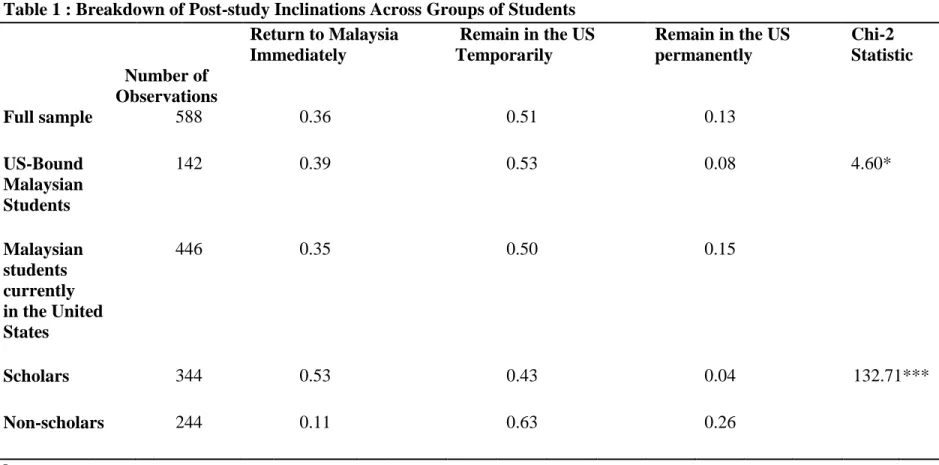
Table 1 shows the breakdown of post-study inclinations among students across various
categories. In the full sample of students, it is found that 51 percent are inclined to remain in the
United States temporarily while 13 percent are inclined to remain in the United States
permanently. Similar trends are seen in the sub-sample of Malaysian students who are currently
studying in the United States. In this sub-sample, 50 percent of the students are inclined to
remain in the United States temporarily while 15 percent of the students are inclined to remain in
the United States permanently. Both the 13 percent as well as the 15 percent figures can be
interpreted as the respective potential brain drain rate in each sample.
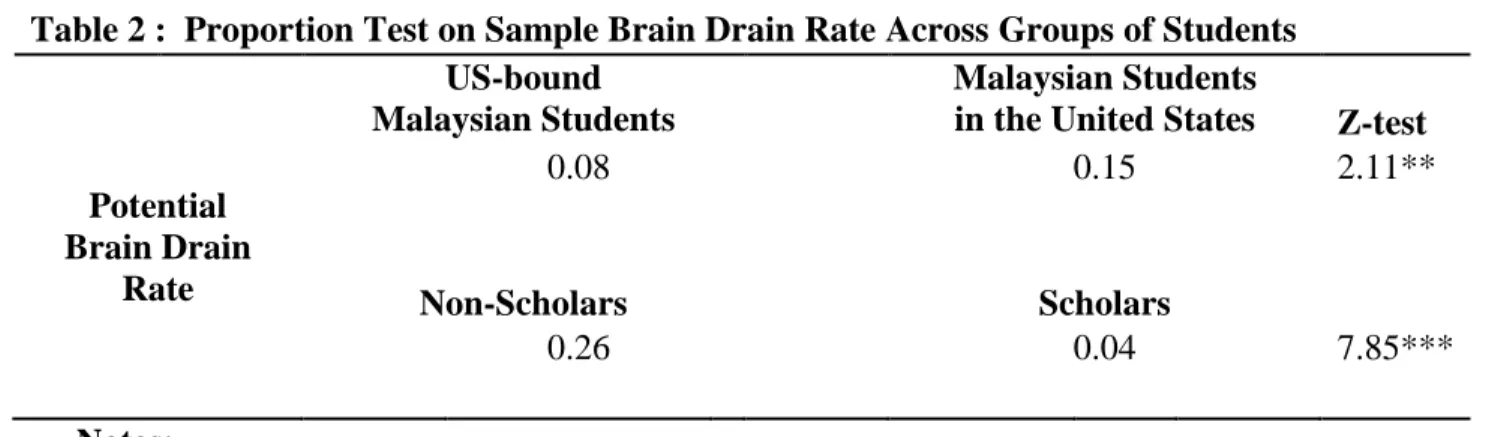
It is also interesting to see if there is a systematic difference in inclinations to remain in
the United States permanently between Malaysian students currently studying in the United
States and US-bound Malaysian students. The results in Table 2 show this. Using a proportion
test, it is found that there is a significantly higher proportion of students who are inclined to
remain in the United States permanently among Malaysian students currently studying in the
United States compared to the US-bound Malaysian students. This difference is significant at the
20
Table 1 also includes the potential brain drain rate among scholars and non-scholars. In
this case, non-scholars are more inclined to remain in the United States permanently than
scholars. The proportion of non-scholars who are inclined to remain in the United States
permanently for example is 26 percent while the proportion of scholars who are inclined to
remain in the United States permanently 4 percent. The proportion test in Table 2 also shows that
this difference is significant at the 1 percent level for both the one-tailed and two-tailed tests. The
pattern of the potential brain drain rate among scholars shown here is consistent with the fact that
most these scholars are usually required to return to the country to serve their respective sponsors
after completing their education since their scholarships are binding ones. Not all scholarships
though are binding. This is perhaps why we see that a small portion of scholars are actually
inclined to remain in the United States permanently.
Multinomial Logistic Regression
To model the students’ study inclinations, P is defined as the set of possible
post-study inclinations; . These inclinations include 1) returning to Malaysia
immediately 2) remain in the US temporarily for less than 5 years 3) remain in the US
temporarily for more than 5 years and 4) remain in the US permanently. By denoting Uik as the
utility specific to post-study inclination k, a student will choose decision k if and only if:
Assuming that utility is linear in the observed attributes of post-study inclinations, a
representative utility function can be defined as follows:
21
where is the unobserved portion of the total utility. Additionally, if it is assumed that this
disturbance is random, independent and identically distributed, it is possible to estimate the
probability of a student’s inclination by using a multinomial logistic model.
( ) (
)
∑ ( )
where Yik = 1 if the student chooses post-study decision k and zero otherwise. The Xi’s are the
list of independent variables that are included in the model.
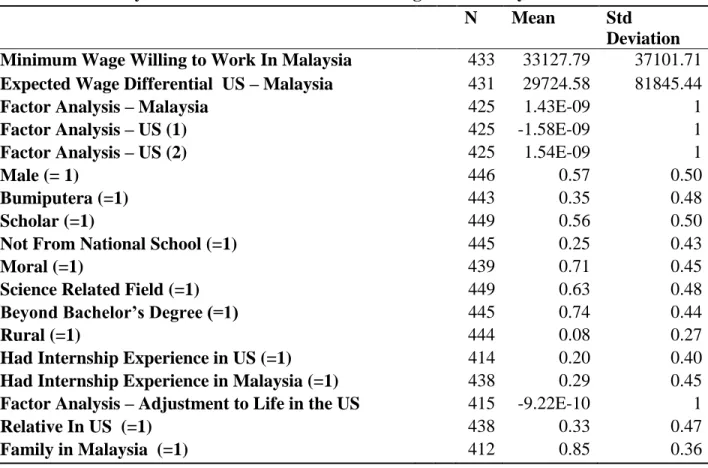
Table 3 shows the summary statistics of the variables used in the multinomial regression
analysis while Table 4 shows the results from the regression. After performing the multinomial
regression analysis, a number of factors with significant explanatory power emerged from the
analysis.
After controlling for other variables the following results emerged.
(1) The higher the student’s reservation wage to work in Malaysia the more
inclined the respondent will be to remain in the United States.
(2) Scholarships are associated with lower inclinations to remain in the United
States.
(3) Students who did not attend a public national school in Malaysia are more
inclined to remain in the United States
(4) The higher the level of a student’s perception on conditions in Malaysia the
more inclined the respondent is to return to Malaysia
(5) The higher the level of a student’s perception on conditions in the United
22
(6) Bumiputera students do not exhibit a significant difference in terms of
inclination to return to Malaysia compared to non-Bumiputera students.
Furthermore, the model provides some additional partial explanatory power across a
number of variables:5
(1) Students who desire to pursue an education beyond a Bachelor’s degree are
more inclined to remain in the United States temporarily but not permanently
(2) Students who are pursuing a science related academic field are more inclined
to remain in the United States permanently but not temporarily
(3) Students who have internship experience in Malaysia are less inclined to
remain in the United States temporarily for more than 5 years as well as
permanently
(4) Students who are inclined to remain in the United States permanently also
take in account their perception on the social conditions (sexuality justice and
gender equality) in the country
(5) Students who are inclined to remain in the United States also take in account
their level of adjustment (measured by English proficiency and perceived
level of adjustment) in the country.
The reservation wage proxy used in the model can be understood as the minimum wage
at which a respondent would be willing to work in Malaysia. This is in line with the theory that
reservation wage is interpreted as a measure of the willingness of a person to work (Holzer,
1986). Prior to searching for a job, an individual decides on the minimum acceptable wage that
5 “Partial” because that it does not exhibit significance across all dependent
23
the individual will work for. The theory of reservation wage also implies that a high reservation
wage makes it less likely that a person will work (Borjas, 2005). In the context of the research in
this paper, the reservation wage will be considered to be a measure of willingness to work in
Malaysia. An individual’s reservation wage to work in Malaysia can be determined by a number
of factors. One is the opportunity cost to work in Malaysia that each respondent values
monetarily. Higher perceived opportunity cost is thought to increase reservation wage (Van
Ophem, Hartog and Berkhout, 2011). The opportunity cost to work in Malaysia in this two
country case is the opportunity to work in the United States. In making a decision to work in
Malaysia, the respondent will need to forgo his or her opportunity cost to work in the United
States. The higher each respondent values the opportunity cost to work in Malaysia the higher it
is each respondent’s reservation wage to work in Malaysia. Other factors that would also
influence an individual’s reservation wage are race, age, education level as well as gender.
Klasen and Woolard (2000) as well as Walker (2003) discovered that these factors have
significant effects on an individual’s reservation wage.
To examine the factors contributing to a student’s reservation wage, a simple OLS
regression with robust estimators is estimated by using the reservation wage as the dependent
variable. Table 6 presents the results of this regression. From this regression, it is found that the
strongest predictors for reservation wage among the sampled students are 1) gender, 2) desired
level of the education and 3) scholarships. Students who desire to pursue an education level
beyond a Bachelor’s degree for example have a higher reservation wage compared to their
counterparts who do not desire to pursue a similar education level after controlling for other
variables in this model. If it is interpreted that reservation wage is a monetary measure of
24
work in Malaysia to be higher than students who desire only to pursue an education at the
Bachelor’s degree level.
There is also evidence that contractual scholarships are viable tools for Malaysia to retain
talent. Students who are sponsored by Malaysian institutions to pursue their study in the United
States are less inclined to remain in the United States. The findings here may not support the
claim of one minister in Malaysia who argued that scholarship programs may have contributed to
the brain drain problem in Malaysia. 6 Still, one weakness in this interpretation is that the model
here does not capture the fact that these students actually applied to be sponsored by a
scholarship program in Malaysia having already the plan to return to Malaysia in the first place.
In other words, the scholarship variable may potentially be endogenous to student’s inclination to
return to Malaysia.
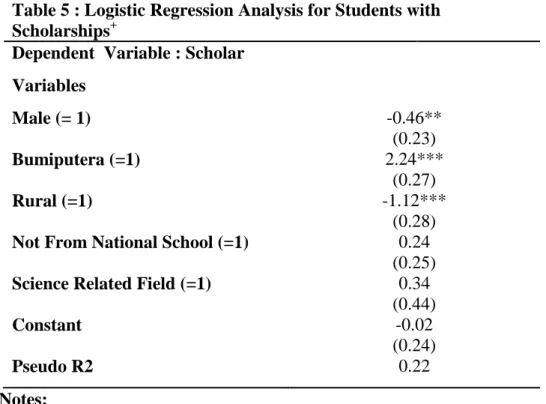
It is also useful to understand the underlying characteristics of scholars within the
sampled studied. Using a logistic regression analysis, the dichotomous dependent scholarship
variable is regressed on a series of students’ characteristics. Table 5 shows the results of this
regression. The results indicate that Bumiputera students’ are more likely to be scholars
compared to non-Bumiputera students while students who did not attend a public national school
in Malaysia are less likely to be scholars. It will thus be interesting for future studies to
investigate if contractual scholarships are effective tools to retain talent among students who did
not attend a public national school since they (as discussed later in this section) are more found
to be significantly more inclined to remain in the United States.
6
25
That affirmative action policies in Malaysia have resulted in non-Bumiputera emigration
out of Malaysia is also strongly contested by the findings in this study. At each category of
post-study inclination, given everything else equal, there is no significant difference between
Bumiputera and non-Bumiputera students’ inclinations to remain in the United States.
However, this research also shed an interesting finding related to how the political
economy in Malaysia may have affected the brain drain trends among Malaysians. That the
research in this paper found that students who did not attend a public national school in Malaysia
are significantly more inclined to remain in the United States controlling for other variables is an
important finding. Different schooling experiences in these schools seem to have an impact on a
student’s inclination to return to Malaysia or remain in the United States. The research in this
paper would suggest future studies to investigate this further.
It is also found that the better the conditions in Malaysia are, the more inclined are
students to return to Malaysia after completing their education in the United States. Likewise, the
better the conditions in United States are, the more inclined are students to remain in the United
States. In the context of the push-and-pull model, better conditions in a country can be a pull
factor towards moving into the country. It is also interesting to note that students who are
inclined to remain in the United States permanently also take into account social conditions such
as gender equality and sexuality justice. In other words, they do take into account such aspects
when considering living in the country in the long run.
Additionally, it is also found that students who desire to obtain a level of education
beyond a Bachelor’s degree are more inclined to remain in the United States. While this can be
26
States and achieve their career goals before returning to Malaysia, this finding also indicates that
the Malaysian economy does not have enough jobs for returning high skilled labor. The World
Bank (2011) has indicated that while the share of individuals with tertiary education level
increased from 16 percent in 2001 to 22 percent in 2008, the percentage of individuals employed
in higher skill occupations only changed marginally from 18.4 percent to 19.9 percent during the
same period. The World Bank has thus concluded that the share of high skilled occupation has
not matched the growth of education. This implies that the growth of domestic employment
demand is insufficient to sustain the supply of individuals with higher education.
Interestingly also, it seems plausible that internship experiences in a country may have an
impact on a student’s inclination to remain in the country. Based on the results from the
regression analysis, internships in Malaysia seem to be a deterrent for students to be more
inclined to remain in the United States (for more than 5 years and permanently). One possible
explanation for this is that visits to Malaysia through internships by these individuals may have
somehow increased their inclination to return to Malaysia perhaps by discovering better job
prospects in Malaysia than in the United States. Still, similar to the scholarship variable, that a
student had an internship experience in Malaysia can be potentially endogenous to his or her
inclination to return to Malaysia. In other words, these students actually pursue an internship in
Malaysia because they have actually intended to return to Malaysia once they have completed
their education.
Logistic Regression Analysis
A separate logistic regression is estimated where the dependent variable is a binary
27
temporarily or permanently. Table 7 shows the results from this regression as well as the average
marginal effects of each variable.
It is found that scholarships are the strongest deterrents for students to remain in the
United States. The inclination to remain in the United States is reduced by 23 percent for
students who are scholars compared to students who are not. In the context of the push-and-pull
model, scholarships are a strong pull factor for these students to return to Malaysia. On the other
hand, being a student who did attend a public national school in Malaysia increases the student’s
inclination to remain in the United States by 23 percent also. Additionally, being a student who
desires to pursue an education beyond the degree level increases the student’s inclination to
remain in the United States by 13 percent. The marginal effect of having an internship
experience in Malaysia on the other hand is negative but insignificant.
Accounting for Endogeneity of the Scholarship and Internship Variables
To account for the potential endogeneity for both the scholarship and internship
variables, a bivariate probit simultaneous-equations model is estimated. The purpose of
estimating such a model is to identify if the unobserved disturbances of some explanatory
variables in the model defined earlier is potentially correlated to the unobserved disturbances of a
student’s post-study inclination. If the covariance between both disturbances is significant, it can
be concluded that both the explanatory and the dependent variables are endogenous in the model
thus weakening the interpretation discussed earlier.
Thus in order to identify potential endogeneity in the multinomial logistic regression model,
the following bivariate probit model is specified:
28
where each equation is an individual probit function in which the unobserved disturbances have
an expected value of zero and a variance of one. The covariance between the two disturbances is
defined as, :
[ | [ |
[ | [ |
[ |
in each equation are the list of explanatory variables used in the earlier estimations. In
addition to that, the inclusion of the internship variable in the right-hand side of the first equation
makes this model a recursive, simultaneous-equations model (Greene, 2003). Two sets of
bivariate probit regression are estimated. The first set examines the potential endogeneity
between a student’s inclination to remain in the United States and his or her having an internship
experience in Malaysia before. The second set examines the potential endogeneity between a
student’s inclination to remain in the United States and his or her being a scholar.
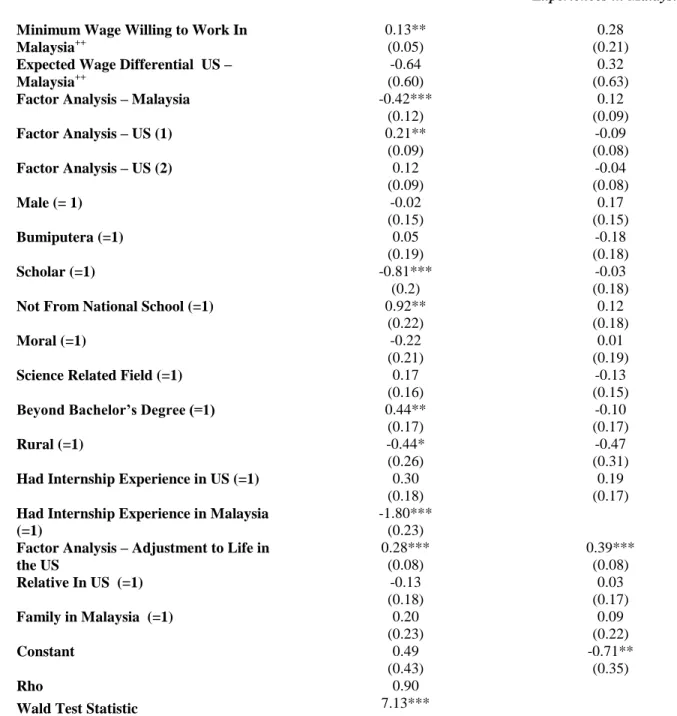
Table 8 shows the results from the bivariate probit simultaneous-equations model used to
study the potential endogeneity of the internship variable. The model exhibits a significant
correlation coefficient of 0.90. In other words, the unobservable disturbance of one pursuing an
internship position in Malaysia is positively correlated with his or her inclination to remain in the
United States. The probability of a student who had an internship in Malaysia is also endogenous
to his or her inclination to remain in the United States. However, similar to the results in the
29
likely to remain in the United States either temporarily or permanently compared to students who
had no internship experience in Malaysia. This implies that an internship experience in Malaysia
may in fact potentially motivate or encourage a student to return to Malaysia. Similar ideas have
been expressed elsewhere. Minoian and Freinkman (2006), in the context of the Armenian brain
drain, suggested that that return visits to home country by Armenian individuals abroad may
change their attitudes and motivate them to become more involved with the local Armenian
economy.
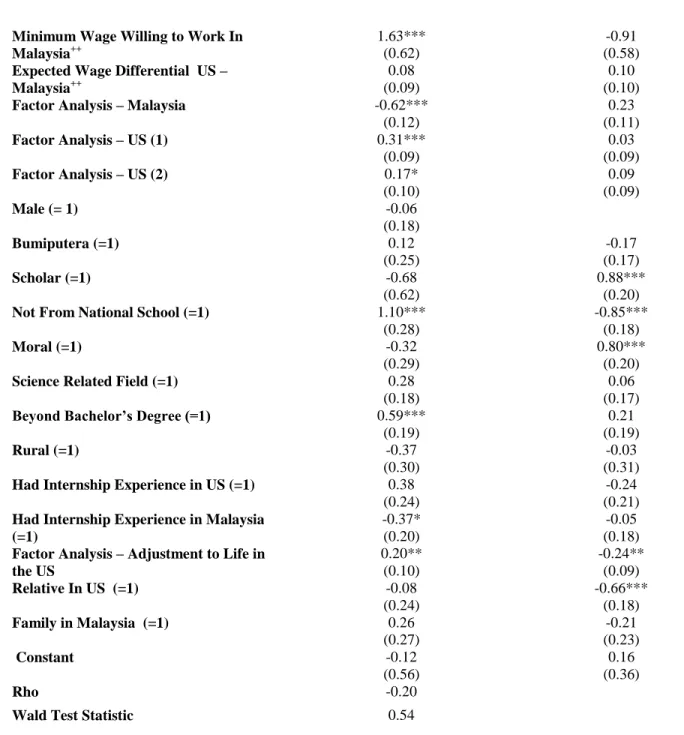
Table 9 shows the result from the set of bivariate probit simultaneous-equations to study
the potential endogeneity between student’s inclination to remain in the United States and the
probability of a student being a scholar. Unlike the earlier set of simultaneous equations, the
Wald statistic for the hypothesis that the correlation coefficient equals to zero is insignificant. In
other words, both variables are not endogenous to each other and need not to be estimated
simultaneously.
To conclude this section, the inclination of a student to remain in the United States is not
endogenous to the student being a scholar. However, the inclination of a student to remain in the
United States is in fact endogenous to the student’s having an internship experience in Malaysia
before. By addressing this endogeneity using the bivariate probit simultaneous equation, it is still
found that students who had an internship experience in Malaysia are less inclined to remain in
the United States.
Hypothetical Scenarios
It is also interesting to study how students’ post-study inclination can be affected given
30
the students will be 1) more inclined to remain in the United States permanently if granted
permanent residence 2) more inclined to return to Malaysia if the economic situation in Malaysia
improves and 3) more inclined to return to Malaysia if the political situation in Malaysia
improves. These questions were asked on a scale of 1 to 5 to capture the degree of agreeability of
each respondent to each question. 1 for example, denotes “strongly disagree” while 5 denotes
“strongly agree”. Students whose inclination to either remain in the United States or return to
Malaysia changed in each scenario were identified to tabulate a new potential brain drain rate for
each separate scenario. In doing this, two bounds are created. The lower bound includes only
students who answered “strongly agree” while the upper bound also includes students who
answered “agree”.
If students are granted permanent residence in the United States, the potential sample
brain drain rate more than doubled from 15 percent in the base scenario to 36 percent at the
lower bound and 59 percent at the upper bound. Both new potential brain drain rates are
statistically significant at the 1 percent level. The new potential brain drain rate as a result of the
hypothetical scenario is also significantly higher than the brain drain rate that World Bank (2011)
has estimated. Drawing from these findings here, it seems that foreign immigration policies can
be a threat to the current Malaysian brain drain predicament. Skill-selective immigration policies
are usually given to highly skilled foreign individuals to combat what most developed countries
refer to as “reverse brain drain” to retain foreign talent in the country. In the context of the
push-and-pull model, awarding these individuals permanent residence can be a strong pull factor for
them to migrate into the country. Proponents of such a policy often championed the
“internationalists” (Johnson, 1968) approach which argues that movement of skilled individuals
31
of such policies however are known to have the “nationalists” (Patinkin, 1968) approach which
argues that developed countries are accumulating these human capitals for their own benefit at
the expense of poorer and developing countries. In any case, awarding these students permanent
residence by the United States will be a huge threat to Malaysia’s brain drain phenomenon.
On the other hand, an improvement of economic and political situation independently
may result in a statistically significant reduced potential brain drain rate. In the former scenario,
the lower bound of the new potential sample brain drain rate is reduced to 12 percent albeit not
statistically significant, while the upper bound is reduced to 5 percent which is statistically
significant at the 1 percent level. It is also the same for the latter case in which its upper bound
potential sample brain drain rate is reduced to 8 percent. One conclusion that can be derived here
is that economic improvements will seem to be a stronger pull factor compared to political
improvements in Malaysia, at least according to the students surveyed here. This may seem to be
a positive outlook that Malaysia should anticipate with the country currently embarking
numerous economic restructuring programs through the Economic Transformation Program
(ETP) which seeks to shape Malaysia into a high income country by the year 2020. 7 The
findings here can also draw similarity with Harnoss (2011) which discovered that GDP growth
rates as forecasted under the ETP program will reduce the emigration rate out of Malaysia.
A separate set of logistic regression analyses is estimated to identify students’
characteristics that make a student more likely to change their mind if given a particular
simulation. Again, in the same spirit of creating upper and lower bounds, two separate
regressions are estimated for each scenario. In the permanent residence scenario, the first
7 Details on the ETP can be found here: Pemandu. (2012), ETP Annual Report 2012 .Kuala Lumpur: National
32
identifies only students who became more inclined to remain in the United States permanently
having initially answered that they are inclined to remain in the United States temporarily. The
second logistic regression on the other hand also includes students who are initially more
inclined to return to Malaysia immediately after completing their studies. In the other two
scenarios where Malaysia’s economic and political situation improves respectively, the first
logistic regression identifies only students who became more inclined to return to Malaysia
having initially answered that they are more inclined to remain in the United States temporarily.
The second logistic regression also includes students who are initially more inclined to remain in
the United States permanently.
It is thus found in all three separate scenarios that, students who desire to complete an
education beyond a Bachelor’s degree are more likely to change their mind. Again, in the context
of the awarding permanent residence simulation by the US government, it can be further asserted
here again that Malaysia’s labor mismatch are likely push factors for these individuals. Even if
these individuals may have been more inclined to return to Malaysia initially, awarding the
permanent residence can drastically change their inclinations to be more inclined to remain in the
US permanently. However, the findings from the latter simulations suggest that by improving
both the political and economic situation in Malaysia, these highly skilled individuals who desire
to complete their education beyond a Bachelor’s degree can still be re-attracted into the country
33
Conclusion
The research in this paper has investigated the post-study inclinations of Malaysian
students currently studying in the United States after they complete their desired level of
education in the US by estimating a multinomial logistic regression. Students are asked if they
are inclined to return to Malaysia, remain in the United States temporarily or remain in the
United States permanently after completing their desired level of education in the United States.
The potential brain drain rate that is between 13 percent figure in the full sample and the 15
percent in sub-sample of Malaysian students in the United States are in line with World Bank’s
estimate that one out of ten skilled Malaysians will elect to leave the country. Potential brain
drain rate among non-scholars is also significantly higher than scholars.
Through the multinomial logistic regression analysis, a number of significant findings are
discovered: (1) the higher the respondent’s reservation wage to work in Malaysia the more
inclined the respondent will be to remain in the United States (2) scholarships have a negative
impact on student’s inclination to remain in the United States (3) Students who did not attend a
public national school in Malaysia are more inclined to remain in the United States (4) the higher
the level of a respondent’s perception on conditions in Malaysia the more inclined the respondent
is to return to Malaysia (5) and the higher the level of a respondent’s perception on conditions in
the United States the more inclined the respondent is to remain in the United States (6)
Bumiputera students do not exhibit a significant difference in terms of inclination to return to
Malaysia compared to non-Bumiputera students.
The estimates of marginal effects of each variable indicate that scholarships are the
34
hand, being a student who did attend a public national in Malaysia increases the student’s
inclination to remain in the United States.
To account for the potential endogeneity in the scholarship and the internship variables,
two separate sets bivariate probit simultaneous equations are estimated. It is found that even after
controlling for endogeneity, students who had an internship experience in Malaysia are less
likely to remain in the United States. In addition to that, it is found that the scholarship variable
is not endogenous to a student’s inclination to remain in the United States.
In addition, it is identified that students who desire to pursue an education level beyond a
bachelor’s degree to be the group of students most likely to change their mind if given a
particular scenario. Furthermore, it is found that the relaxation of foreign immigration policies
such as the awarding of permanent residence to Malaysian students abroad to be a genuine threat
to the brain drain predicament in Malaysia. On the other hand, improvement in economic and
35
References
Agarwal, V. B., & Winkler, D. R. (1984). Migration of Professional Manpower to The United States. Southern Economic Journal, 50, 814–830.
Agarwal, V. B., & Winkler, D. R. (1985). United States Immigration Policy and Indirect Immigration of Professionals. Economics of Education Review,4, 1–16.
Azjen, I., & Fishbein, M. (1980). Understanding Atittudes and Predicting Social Behavior. NJ: Englewood Cliffs.
Baruch, Y. (1995). “Business globalization—the human resource management aspect,” Human System Management, vol.14, 313-326.
Baruch, Y., Budhwar, P., & Khatri, N. (2007). Brain Drain : Inclination to Stay Abroad After Studies. Journal of World Business, 42, 99–112.
Bratsberg, B. (1995). The Incidence of Non-return Among Foreign Students in the United States. Economics of Education Review , 14(4), 373–38
Borjas, G. J. (1987) Self-selection and the Earnings of Immigrants. American Economics
Review, 77, 531-553
Borjas, G. J., Bronars, S. G. & Trejo S. J. (1992) Self Selection and Internal Migration in the United States, National Bureau of Economic Research Working Paper No.4002.
Borjas, G. J.(2005). Labor Economics. Boston: McGraw Hill / Irwin.
Dreher, A., & Poutvaara, P. (2011). Foreign Students and Migration to the United States. World
Development , 39(8), 1294–1307.
Docquier, F., Lohest, O., & Marfouk, A. (2007). A Panel Data Analysis of the Brain Gain. The World Bank Economic Review,21(2), 193–218.
Docquier, F., & Rapoport, H. (2004). Skilled Migration : The Perspective of Development Countries. World Bank Policy Research Working Paper No. 3382. Washington, D.C: The World Bank
Docquier, F., & Rapoport, H. (2011). Globalization, Brain Drain and Development. Centre for Research and Analysis of Migration ( CReAM) Discussion Paper Series No. 1108. London : University College London.
36
Fishbein, M., & Azjen, I. (1975). Belief, Attitude, Intention and Behavior: An Introduction
to Theory and Research. Reading,MA: Addison-Wesley.
Foo, G. (2011). Quantifying the Malaysian brian drain and an investigation of its key determinants. Malaysian Journal of Economic Studies, 48(2), 93–116.
Glaser, W. (1978). The Brain Drain : Emigration and Return. New York: Pergamon Press.
Hatton, T. J. (2003). Emigration from the UK, 1870-1913 and 1950-1998. (Discussion Paper No. 830), Institute for the Study of Labor (IZA).
Harnoss, J. D. (2011). Economic Costs of the Malaysian Brain Drain : Implications from an Endogenous Growth Model .Malaysian Journal of Economic Studies , 48(2), 117 130.
Huang, W. C. (1987). A Pooled Cross-section and Time-series Study of Professional
Indirect Immigration to The United States. Southern Economic Journal, 54, 95 109. Huang, W. C (1988). An Empirical Analysis of Foreign Student Brain Drain to the United
States. Economics of Education Review, 7(2), 231–243.
Holzer, H. J. (1986). Wages and Their Labor Market Effects for Black and White Male Youth. The Journal of Human Resources, 21(2), 157–177.
Junaimah J., & Yusliza M.Y. (2011). Brain Drain: Propensity to Leave by Malaysian Professionals. International Journal of Innovation, Management and
Technology, 2(2), 119–122.
Junaimah, J., Yusliza, M. Y., & Ying, K. M. (2009). Factors that Drive Brain Drain of Accountants in Malaysia. Proceedings of the 6th International Conference on
Intellectual Capital, Knowledge Managemnent & Organizational Learning, School of Information Studies, McGill University, 1-2 October, Montreal, Canada.
IIE. (2011). Malaysian Students Overseas. Retrieved from http://www.iie.org/Services/Project Atlas/Malaysia/Malaysias-StudentsOverseas
Kao, C. H. (1971). Brain Drain : A Case Study of China. Taipei: Mei Ya Publications Inc.
Kim, J., & Mueller, C. W. (1978). Factor Analysis: Statistical Methods and Practical Issues. SAGE.
Lewin, K. (1951). Field Theory in Social Science. New York : Harper & Row.
Lucas, R. (1976). The supply-of-immigrants Function and Taxation of Immigrants’ Income J. Bhagwati (Ed.), The Brain Drain and Taxation (pp. 63–82). Amsterdam: North Holland.
Magnussen, O. (1978). Migration from Norway to The USA, 1866-1914.Scandinavian
37
Mazzarol, T. & Soutar, G. (2002). Push-pull Factors Influencing International Student
Destination Choice. The International Journal of Education Management, 16(2), 82–90.
Minoian, V., & Freinkman, L. (2006). Diaspora’s Contribution to Armenia’s Economic Development: What drives the First Movers and how their efforts could be scaled up? Retrieved from
http://info.worldbank.org/etools/docs/library/152388/victoriaminoian.pdf
NEAC. (2010). New Economic Model for Malaysia: Part 1 - Strategic Policy Directions. Putrajaya: National Economic Advisory Council.
Psacharopoulos, G. (1975). Estimating Some Key Parameters in The Brain Drain Taxation Model. Journal of Development Economics, 2, 309–318.
Roy, A. D. (1951) Some thoughts on the Distribution of Earnings. Oxford Economic Papers 3(2), 135-146
Todaro, P. M. (1969) A Model of Labor Migration and Urban Unemployment in Less Developed Countries. The American Economic Review, 59 (1),138-148
Tyson, A. D., Jeram, D., Sivapragasam, V., & Hani, N. A. (2011). Ethnicity, Education and the Economics of Brain Drain in Malaysia : Youth Perspectives.Malaysian Journal of
Economic Studies, 48(2), 175–184
van Ophem, H., Hartog, J., & Berkhout, P. (20011). Reservation Wages and Starting
Wages. Retrieved from http://ftp.iza.org/dp5435.pdf
Walker, R. (2003). Reservation Wages - Measurement and Determinants: Evidence from the
Khayelitsha/Mitchell’s Plain (KMP) Survey. Retrieved from
file:///D:/brain%20drain/wp38.pdf
Wilkinson, M. (1970). European Migration to the United States . Review of Economics Statistics, 52, 272–279.
World Bank. (2011). Malaysia Economic Monitor: Brain Drain. Bangkok: The World Bank.
38
Appendix
Figure 1: Theoretical Model Adjustment process
to living in the United States
Family ties
Demography
Living conditions in Malaysia and United
States Academic Demography
Monetary Factors
Post-study Inclinations
Job Market Experience
39
Table 1 : Breakdown of Post-study Inclinations Across Groups of Students Return to Malaysia
Immediately
Remain in the US Temporarily
Remain in the US permanently
Chi-2 Statistic Number of
Observations
Full sample 588 0.36 0.51 0.13
US-Bound Malaysian Students
142 0.39 0.53 0.08 4.60*
Malaysian students currently
446 0.35 0.50 0.15
in the United States
Scholars 344 0.53 0.43 0.04 132.71***
Non-scholars 244 0.11 0.63 0.26
Notes:
40
Table 2 : Proportion Test on Sample Brain Drain Rate Across Groups of Students US-bound
Malaysian Students
Malaysian Students in the United States
Potential Brain Drain
Rate
Z-test
0.08 0.15 2.11**
Non-Scholars Scholars
0.26 0.04 7.85***
Notes:
41
Table 3: Summary Statistics for Variables Used In Regression Analysis
N Mean Std
Deviation Minimum Wage Willing to Work In Malaysia 433 33127.79 37101.71
Expected Wage Differential US – Malaysia 431 29724.58 81845.44
Factor Analysis – Malaysia 425 1.43E-09 1
Factor Analysis – US (1) 425 -1.58E-09 1
Factor Analysis – US (2) 425 1.54E-09 1
Male (= 1) 446 0.57 0.50
Bumiputera (=1) 443 0.35 0.48
Scholar (=1) 449 0.56 0.50
Not From National School (=1) 445 0.25 0.43
Moral (=1) 439 0.71 0.45
Science Related Field (=1) 449 0.63 0.48
Beyond Bachelor’s Degree (=1) 445 0.74 0.44
Rural (=1) 444 0.08 0.27
Had Internship Experience in US (=1) 414 0.20 0.40
Had Internship Experience in Malaysia (=1) 438 0.29 0.45
Factor Analysis – Adjustment to Life in the US 415 -9.22E-10 1
Relative In US (=1) 438 0.33 0.47