i
PLANNING FOR RACIALLY EQUITABLE (RE)DEVELOPMENT:
LEVERAGING THE POWER OF NEIGHBORHOOD SOCIAL & COMMERCIAL CENTERS IN URBAN COMMUNITIES OF COLOR
By
CARA WITTEKIND
A paper submitted to the faculty of The University of North Carolina at Chapel Hill In partial fulfillment of the requirements of the degree
Master of City and Regional Planning
April 10, 2015
This paper represents work done by a UNC-Chapel Hill Master of City and Regional Planning Student. It is not a formal report of the Department of City and Regional Planning, nor is it the
work of the department’s faculty.
Approved by:
____________________________ ____________________________
ADVISOR READER (optional)
____________________________ ____________________________
ii Abstract
This project explores the potential for planners to leverage neighborhood social and commercial centers to create racially equitable economic change. It first calls on planning literature to establish racial economic inequity as a planning issue, both because of the inherently spatial and racial dimensions of urban poverty and because of clear linkages between planning history and racially disparate outcomes. Recognizing that person-centered policies have not been effective in addressing poverty in urban communities of color and that market-driven reinvestment in urban centers tends to result in gentrification and push-out rather than inclusive benefit, this project seeks alternative solutions. This is accomplished through a best practices analysis of equitable development concepts and the application of a package of planning analyses toward maximizing the impact of selected development tools.
Key contributions of this project include a conceptual model of economic well-being, a logic model that captures the nested nature of equitable development tools, the concept and model of a triple-lens mechanism for impactful resource targeting, a GIS tool to predict reinvestment
iii
Acknowledgements
I would first like to thank the Economic Development specialization faculty of the Department of City and Regional Planning: Nichola Lowe, Meenu Tewari and the adviser on this project, Bill Lester. Additionally, professors who have influenced and inspired this work include Emil Malizia, Danielle Spurlock, and especially Mai Nguyen, who graciously served as the second reader on this project and encouraged me in my decision to pursue a racial equity lens.
Thanks also to Micah Kordsmeier and Dan Levine of Self-Help Credit Union for serving as the client to this project. I appreciate your patience and openness to these ideas and your willingness to discuss and brainstorm solutions with me.
I could not have completed this project without the unwavering support of my wife Jen
Isherwood. I thank her for delivering countless morning coffees, participating in brainstorming sessions, and listening to me rave about the City of Cincinnati, albeit with varying degrees of enthusiasm.
Thank you to my parents, Rachel and John Wittekind, for their support and trust in my decision to return to school once again, despite having only a tenuous idea of what city planning is and what employment opportunities might or might not exist in the field.
iv
Table of Contents
Goals and Questions Driving this Project ...1
Framing the Problem: Background and Logic Model ...3
The Problem of Racial Economic Disparities in Cities ...3
Typical Solutions to Economic Inequality ...6
A Short History of Systemic Racial Oppression in Planning ...8
Zoning ...8
Racial segregation ...8
Exclusionary zoning...9
“White Flight” and the ghettoization of urban neighborhoods ...9
Unintended consequences of Civil Rights era legislation ...10
Uneven effects of economic restructuring ...10
Race and Neighborhood Centers Today ...11
Lack of access to basic goods and services ...12
Missed opportunities for job growth and labor market access ...12
The downside of “re-urbanization”: business gentrification ...13
An Alternate Path: Equitable Development ...15
Neighborhood Social & Commercial Centers: A Working Definition ...17
Scholarly literature toward a full definition ...17
Practitioners working in neighborhood centers ...17
West Humboldt Park Development Council, Chicago, IL ...17
Invest in Neighborhoods, San Francisco, CA ...18
Plan Cincinnati, Cincinnati, OH ...19
The Equitable Development Potential of NSCCs ...21
Methods ...23
Findings: Best Practices ...25
Equitable Development Broadly Defined: “Helping neighborhoods hold their own” ...25
The contents of an equitable development toolkit ...25
v
Targeted business assistance ...31
Community-initiated real estate development ...32
Triple lens for impactful focusing of resources ...33
Challenges ...34
Findings: Quantitative Supports for Impactful Resource Focusing ...36
The Durham Context...36
East Durham’s neighborhood center ...37
Applying the Triple-Lens Focusing Tool to East Durham ...38
Places ...38
People ...42
Industries ...48
SBO data ...48
NETS data ...51
Summary of Recommendations for East Durham’s NSCC ...55
Conclusion ...57
vi List of Tables
Table 1: Elements of a Commercial Stabilization Plan ...27 Table 2: Weighting for Scoring of Likelihood to Redevelop Index ...40 Table 3: Person- and Household-level Census Variables ...43
List of Figures
Figure 1: Conceptual Model of Economic Well-being and Economic Development
Metrics and Techniques ...5 Figure 2: Logic Model of Possible Futures for Re-urbanizing Neighborhood Social &
Commercial Centers...16 Figure 3: Commercial Stabilization Logic Model ...29 Figure 4: Nested Toolkits of Equitable Development Strategies...30 Figure 5: Triple lens for Impactful Focusing of Business Assistance and Community Real Estate Development ...34 Figure 6: Conceptual Model of Likelihood to Redevelop Index ...40 Figure 7: Likelihood to Redevelop Index applied to East Durham Neighborhood Center ...41 Figure 8: Dot-Density Representation of Race in Central Durham by Block Group (2013),
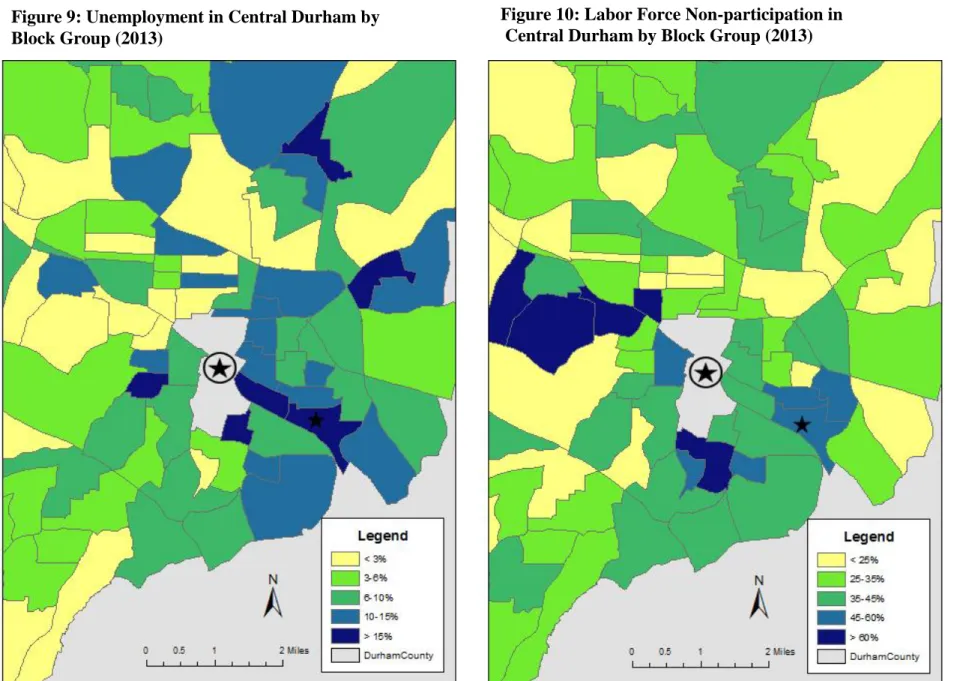
with East Durham Inset ...45 Figure 9: Unemployment in Central Durham by Block Group (2013) ...46 Figure 10: Labor Force Non-participation in Central Durham by Block Group (2013) ...46 Figure 11: Black Median Household Income as a Percentage of Overall MHI by
Block Group (2013) ...47 Figure 12: Black-owned Firms vs. All Durham Firms by NAICS 2-digit Industry ...51 Figure 13: Distribution of Minority-Owned Firms across High-level NAICS Sectors in
Durham County, 2012 ...52 Figure 14: Employment in Minority Business Enterprises (MBEs) by High-level NAICS Industry with Average Employees per Firm ...53 Figure 15: Kernel Density of Minority-Owned Business with Durham
1
Goals and Questions Driving this Project
Though history and planning textbooks tell us that the times of legally enforced racial segregation and Urban Renewal are over, urban communities of color face more challenges than ever before. Policymakers, academics, and community leaders have been vexed for decades about how to solve the problems of disinvested urban neighborhoods. Most approaches have been aimed at helping those who live in these neighborhoods in person-based approaches such as transfer payments, job training, and education efforts. Place-based strategies have been weak, short-lived, or under-funded. Many urban neighborhoods of color are persistently poor, their business centers largely vacant and disinvested.
Recent renewed interest in urban centers and neighborhoods from wealthy and middle-class individuals and entrepreneurs is bringing an inflow of capital and attention to investment-ready neighborhoods. While not inherently bad – in fact, outside investment is vital to sparking the transformation of these neighborhoods – it becomes devastating when the effect is the pushing out of long-time residents being pushed out of their homes, businesses, and social spaces.
Residents of urban neighborhoods are now caught between chronic underinvestment that supports persistent concentrated poverty, and gentrification, which leads to loss of space,
identity, and social networks. Further, many residents who are pushed out of central cities by gentrification are now ending up in older, inner-ring suburbs, where despite being in
environments of less concentrated poverty, they are often disconnected from transit, services, and job opportunities in central cities (Sink & Ceh, 2011; Ray, 2014).
2
The broad research question asked here is: How can neighborhood social and commercial centers (NSCCs) be best leveraged to induce redevelopment in urban
neighborhoods that improves local racial economic equity and minimizes gentrification of the business district?
Self-Help Credit Union in Durham, North Carolina is a client to the project. Through many conversations with representatives of this community-centered credit union, the work took on an iterative process of seeking solutions, finding more questions, and seeking to answer those questions. Thus, in an effort to answer the main question above, several others arose and are answered in turn in the following sections:
Why should planners be concerned with racial economic disparities in cities?
What do planners need to understand about how the racial economic disparities came to be? Specifically, what has been the field of planning’s role in creating and perpetuating racial economic inequity?
What is the evidence that neighborhood centers are might be leveraged toward racially equitable planning outcomes?
What tools within the broad concept of equitable development planning are most
appropriate to use on the scale of NSCCs and by the type of organizations that the client on this project represents?
How might planners provide additional valuable information to organizations looking to employ equitable development tools? What kinds of questions and research should planners contribute to equitable development efforts?
3
Framing the Problem: Background and Logic Model
This chapter frames the problem of racial economic disparities and centers it within the urban planning literature as having spatial dimensions within the urban landscape and historical links to planning actions. This project builds upon the premise that planners should be concerned with the racial dimensions of economic inequity because 1) though race and poverty in the United States are correlated, a “race-blind” look at poverty misses the degree and nuance of racial economic inequity, thereby providing incomplete or inadequate solutions; and 2) racial disparities have been exacerbated by past planning and public policy interventions. Thus, the first section of this chapter is a call for race-conscious planning. It looks at the typical person-based solutions to economic inequality to argue that transformative progress in this area requires an understanding of planning history and the impact on racial inequity.
This history and the current state of racial inequity in urban neighborhoods are the focus of the next two sections. The final section of this chapter posits that more effective inroads to equitable economic development are achievable through the leveraging of assets within neighborhood social and commercial centers (NSCCs) in disinvested neighborhoods that are home to many communities of color. Many of these neighborhoods are currently experiencing a trend of “re-urbanization” and reinvestment that often leads to gentrification and business push-out. The chapter concludes with an original logic model that frames the research in the remainder of the project by demonstrating the need for planning interventions in neighborhood centers home to communities of color.
The Problem of Racial Economic Disparities in Cities
It should come as no surprise that to talk about economic inequality planners must also talk about race. Any casual observer or novice user of statistics can see that black and Latino Americans1 are worse off financially than white Americans, yet race is often ignored, or
mentioned merely as an aside in discussions of the economic disparities facing the U.S. generally and its cities in particular. An exception to this is in discussions of the “underclass” theory, which places the responsibility for racial disparities on black families, who are said to be
4
perpetuators of social pathologies that result in their continued poverty (Model, 1993; Trotter, 1993). Such arguments ignore the reality that white-dominated policies have created and
continually reinforce these problems, and that a history and present state of systemic oppression outweighs the personal decisions or efforts of many people of color.
It is vital that planners not fall into either of two less egregious, but still damaging, race-related pitfalls. First, it is a mistake to attempt to steer clear of politically or personally difficult conversations by ignoring race altogether.2 The health disparities literature provides highly instructive evidence of the ineffective and incomplete policy and practice that arise from such a “color-blind” approach. David and Collins (1997) in a longitudinal study of infant mortality in the U.S. found that black mothers with college educations have worse infant mortality rates than white mothers who dropped out of high school. In contrast to the race-aggregated data, which suggests that higher income and education lead to better health outcomes across the board, this finding shows the importance of race to Americans’ quality of life and points to a role for race in planners’ research and practice toward improving quality of life.
Secondly, planners and other practitioners seeking to act in the public interest should not make the mistake of conflating race with income by simply lumping together “poor and black residents,” for example, or alternately arguing that the problems of cities are not really about race but are solely about poverty, again seeking to apply a colorless lens to a racial problem. While it should not be ignored that generally, black and brown people in America are significantly worse off financially than white people; if that were not so, there would be no reason to continue researching solutions to racial inequity. The danger again comes from ignoring the historic and continuing role of race in determining an individual’s life chances. A report from the Urban Institute found that the income gap between white people and black or Hispanic people in the U.S. remained about the same between 1983 and 2010 (with whites earning about $1.80 for every dollar that blacks or Hispanics earned), and the wealth gap grew. In 1983, the average white family was five times wealthier than the average black or brown family; by 2010 whites were about six times wealthier (Urban Institute, 2014).
Note that “economic disparities” reach far beyond income inequality. While earned income is certainly important to an individual or family’s economic well-being, it is vital to
5
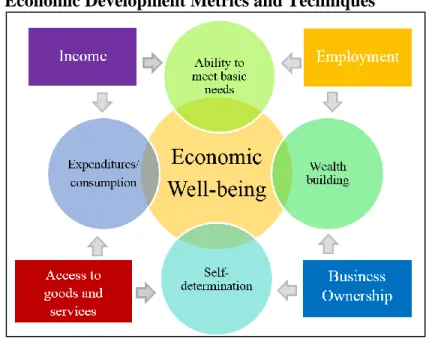
round out the understanding of the breadth and depth of economic health in order to understand the full range of disparities that communities of color disproportionately face. In addition to the wealth gap mentioned above, a 2013 report from the Pew Research Center also raises the issues of expenditure or consumption inequality, referring to a lack of disposable income; other measures of true economic equality should include unemployment disparities and business ownership rate disparities (Desilver, 2013; Fairlie & Robb, 2008; Manjarrez, 2014). Figure 1 distills these various components of economic well-being into four key areas – the ability to meet basic needs, the option to consume a range of goods and services, the opportunity to build
wealth, and the power of determining one’s own life3 through small and large choices – and shows the economic development policy or planning concepts that may be used to measure or address each.
Figure 1: Conceptual Model of Economic Well-being and Economic Development Metrics and Techniques
Thus, the rest of this report and the research it informs attempts to walk the line between an understanding of the financially disadvantaged position of the average black citizen of America with the knowledge that race and class are separate, though related, issues. Since most urban policy is made in a “color-blind” way that focuses on income as a more measureable
6
criterion for participation, many of the policies discussed are focused on class, but impact people of color disproportionately. Above all, the analysis presented here seeks to recognize the role of race and the responsibility of planners to suggest racially aware solutions to the problems of inequitable economic development.
Typical Solutions to Economic Inequality
While planners increasingly see equity as a primary goal of economic development practice, rather than an afterthought or secondary goal (See American Planning Association supported articles by Salkin; Sanchez; Krumholz; and Talen), the most common ways that equity is addressed by up until this point are person-based, often paternalistic, and underfunded
interventions. Popular solutions for addressing economic inequality aim to either supplement income, reduce the cost of basic necessities, or move unemployed workers to where jobs are located. This section provides a concise overview of the person-based vs. place-based
intervention literature and argues that adding a place-based approach focus by building on the assets of NSCCs would be more effective at addressing economic inequity in urban
neighborhoods of color.
Spencer (2005) defines person-based vs. place-based policies through the lens of the labor market. Person-based interventions aim to improve supply-side issues, namely improving potential workers’ skills and getting them physically to the workplaces where labor is needed through improved transportation. Chapple’s (2006) analysis uses a jobs-housing “mismatch” framework, and adds to the list of person-based programs income supports such as SNAP/Food Stamps and TANF/welfare, poverty dispersion through Section 8 housing vouchers and HOPE VI programs, and social network interventions that aim to build supportive linkages between impoverished people, employers, and supportive networks.
7
become employed or housed, and likewise, that person-based programs inherently have
geographic implications, as people exist in space. The main thrust of his research, cited here, is that the EITC should be considered a neighborhood improvement strategy, since the money follows poverty and poverty is concentrated (Spencer, 2005). Even so, the person- vs. place-based dichotomy, imperfect as any conceptual model is, is still useful for understanding the typical responses to urban neighborhood poverty, and for envisioning more impactful interventions.
While person-based programs provide needed short-term assistance and quality of life improvements, and may lead to increased employment in urban neighborhoods of color, they present some major challenges. First, their availability is subject to the whims of the funding governmental agency or legislative body, and since most require a steady stream of funding (to pay for housing subsidies or reduced-cost bus fares, for example), are shaky on financial stability. Moving workers to jobs also requires that a region have jobs for those workers to access, and which match up with their skills and education levels. This approach also requires that employers are willing to hire even qualified newcomers. Chapple points out that in many cases, it is not location, but racial bias, which prevents residents from finding employment. Even if these obstacles are all overcome, moving workers to jobs means that residents must travel, sometimes long distances, and moving them out of the neighborhood entirely results in a loss of social capital that is hard to regain (Chapple, 2006).
Because of these challenges, place-based initiatives may be better suited to creating long-term, stable employment opportunities in underinvested urban neighborhoods. When new jobs are created near unemployed workers, transportation and relocation become a non-issue. However, issues of sustained cooperation, job quality, and fair hiring still loom on the horizon. In order to fully address racial economic inequity in urban neighborhoods, this project argues that place-based programming is not enough. As demonstrated by the Federal Enterprise Zone program, underfunding, local political barriers, and lack of sustained support and oversight are some of the many barriers that may arise and challenge the most well-intentioned place-based efforts (Gittell, Newman, & Pierre-Louis, 2001).
More thoughtful research into the causes and effects of economic inequity and an
8
economic inequality, it is important to review the history of race and planning practice. Examining the role of planners in bringing about the current inequitable situation is crucial to understanding the responsibility planners have to urban neighborhoods of color, to motivating action that will benefit these neighborhoods and their residents, and to understanding what has been withheld or taken from these neighborhoods, so that it can be returned through planning’s inherently place-based work.
A Short History of Systemic Racial Oppression in Planning
Despite the clear historical influence of race on planning decisions, race is often left out of planning discussions altogether, obscured by conflation with socioeconomic status, or included in a long list of secondary variables to any problem or solution, rather than a main consideration. This section enumerates several of the most prominent examples the history of racial discrimination in planning in the U.S. in an effort to explain the current state of economic inequality between white Americans and black and brown Americans.
Zoning. Of the tools in a planner’s toolbox, zoning is perhaps the most used and potentially also the most maligned. Ross & Green Leigh (2000) go so far as to call zoning “planning’s misappropriated tool” for the way it has been abused to achieve classist and racist objectives in the guise of working for the public good.
Conventional planning wisdom holds that zoning was first applied to address public health concerns, namely mandating the separation of industrial and agricultural uses from residential areas. Scholars of the specific history of zoning, however, point out that these
incompatible land uses had long been regulated via nuisance laws (Erickson, 2012). In actuality, zoning arose as much to protect narrow economic interests and maintain race and class divisions as it did to protect the public health.
Racial segregation. One of the first zoning ordinances was an 1885 San Francisco ban on
laundries in areas of the city that was aimed at shuttering Chinese-owned businesses (Fischel, 2004). Early zoning elsewhere was used to separate neighborhoods based on race, with most ordinances keeping black people out of white neighborhoods (Dubin, 1993). Fischel
9
segregation, it does not remedy the long lasting negative effects of the practice on communities and individuals of color.
Exclusionary zoning. The practices of exclusionary zoning from the 1970s onward do
not focus exclusively on race (Fischel describes zoning as moving from specific to general exclusions), but still have racially differential effects. Suburban homeowners sought to protect the value of their homes against undesirable land uses nearby, and thus used social and political power to get land uses that may reduce land values excluded by law from their subdivisions. Two key points bear mentioning in relation to exclusionary zoning: the impenetrability of suburban neighborhoods to affordable housing, and the siting of nuisance, noxious, or otherwise undesirable land uses.
Because exclusionary zoning is used to protect home values, a use does not have to be dangerous to exclude it, it must only threaten the assessed value of the homes in the
neighborhood. Unfortunately, affordable multi-family housing has the effect of lowering home values for single-family homeowners, and is thus banned from suburban neighborhoods by some ordinances (Fischel, 2004). The effect of this is that the best neighborhoods remain permanently out of reach for lower-income residents, including many people of color.
In the face of exclusionary zoning regulations, a party looking to build an undesirable land use (such as a factory or waste transfer site) will choose to locate near a community that has not been protected by exclusionary zoning, or which is in an older urban center with more open zoning policies generally. Both of these scenarios are more likely to be in or near black
neighborhoods than white ones. A second possibility is that the owners of the would-be
undesirable use will ask for a parcel of land to be upzoned to an industrial or other use “heavier” or more intense than residential. Poor and/or oppressed communities of color are less well-equipped to fight these zoning changes, and frequently end up stuck with undesirable, unhealthy land uses in their backyards (Fischel, 2004; Ross & Green Leigh, 2000).
“White Flight” and the ghettoization of urban neighborhoods. To understand why black communities often exist in isolation in urban centers, it is necessary to understand the forces that led to “white flight” from U.S. urban centers in the 1940s through 1980s. The Federal Housing Authority, which was created in 1934 in part to ensure safe and adequate mortgages for citizens, adopted redlining policies. Redlining, instituted first by the Home Owners Loan
10
determined by their black populations, and demarcated on lending maps by thick red lines. As a result, a staggering 98% of the loans the FHA issued in its first 28 years were to white borrowers. Due to these same practices, black veterans of WWII were nearly always barred from the home loan benefits of the GI bill, since racial covenants prevented them from buying homes in non-redlined areas (Hannah-Jones, 2012).
These phenomena coalesced to produce even more segregated and deteriorating inner cities while white residents moved en masse to the newer, cleaner, racially segregated suburbs. Black urban residents were left isolated and stranded in “ghettoes” with fewer and fewer opportunities to improve their situations as jobs and public investment dollars followed whites out of the inner city (Wilson, Hutson, & Mujahid, 2008).
Unintended consequences of Civil Rights era legislation. Suggs (1995) lays out a convincing argument for an unlikely downward turning point in black entrepreneurial businesses specifically: the Civil Rights era of the 1960s. He argues that with the advent of civil rights for blacks in the U.S. three things changed that destroyed the previously strong black businesses in many cities.
First, desegregation orders meant that for the first time, black people were allowed to shop at all white-owned businesses. Previous to this, because most white businesses, whether independent shops or national chains, did not allow black customers to enter stores, black-owned businesses had a “protected market” of guaranteed customers. Following desegregation, black-owned businesses that were “undercapitalized, inconveniently located, and higher priced” compared to national chains suffered from the new competition and lost customer base rapidly. The 1968 Fair Housing act allowed many middle- and upper class black families to leave
segregated inner-city neighborhoods for the more affluent and desirable suburbs. After Title VII of the 1964 Civil Rights Act made employment discrimination illegal, many black employees chose to move to better jobs, which were also largely located in suburban settings. Black neighborhood businesses were thus deprived of their most dependable and profitable customers and employees and began to fall into states of disinvestment, vacancy, and deterioration (Suggs, 1995).
11
both what and how the U.S. economy produced. The “what” component generally refers to a shift away from goods manufacturing and wholesale distribution and toward “advanced services.” The “how” changes refer to an increase in the centralization of corporations and the addition of many service-type activities, such as advertising and investing, done in-house in major companies (Noyelle, 2007).
Noyelle argues that this restructuring was driven by several major changes in the demography and economy of the U.S. as a whole post-World War II, including an increase in market size with rising populations, changes in technology and transportation improvements, increasing influence of the government and nonprofit sectors, and the rise of large corporations and accompanying offshoring of manufacturing jobs. The geographic result was that all but a few “advanced service center” cities, which were already equipped with the human, financial, and transportation capital to meet the demands of the changes, were left behind (Noyelle, 2007). Sassen (1990) adds to this an analysis of the sociological effects of the shift, and ties the labor market changes to increasing inequality both within and across racial groups.
Sassen’s analysis of economic restructuring focuses on the effect of sectoral changes on the spatial organization of individual urban centers. Specifically, she ties the loss urban blue-collar manufacturing and distribution jobs to the depression of inner-city housing markets and concentrated urban poverty and racial segregation. Further adding to the racial analysis pertinent to this project, she contends that while some blue-collar employers survived the shift, they overwhelmingly moved to suburban areas and were thus out of reach to black and brown workers who were trapped in ghettoized inner cities by housing policy, poverty, and lack of education.4
Race and Neighborhood Centers Today
The effects of racially-biased zoning, white flight, unintended economic consequences of civil rights legislation and the uneven ramifications of economic restructuring are easily
observed in urban communities of color today. This section discusses two key economic
12
problems that arise from disinvested urban neighborhoods and then explores the unintended negative consequences of what seems like a positive trend for urban neighborhoods: a movement of middle-class people, businesses, and capital back into urban neighborhoods. Upon this
foundation, a conception of an alternative economic development strategy, one that holds racial economic equity as a primary goal, is introduced.
Lack of access to basic goods and services. Helling & Sawicki (2003) found that primarily black census tracts are
“…less accessible than their predominantly white matches to grocery stores of all types, restaurants other than fast food franchises, small banks, liquor stores, and movie theaters. They are more accessible to fast food restaurants, laundries, drug stores, and large banks, despite their having the same median and per capita incomes as their matched [primarily white] tracts and despite evidence that affluent blacks and whites have comparable expenditure patterns” (p. 96).
They note that though some of the disparity comes from real or perceived differences in income, the problem is worsened by developers’ and investors’ inaccurate information about black neighborhoods’ preferences and true spending power as well as “racially biased business decisions,” overt and implicit racism, and lingering effects of exclusionary zoning in the form of undesirable land uses in black neighborhoods that discourage significant investment (Helling & Sawicki, 2003).
One possible avenue for change arises from current popular concern with “food deserts,” neighborhoods with little or no access to fresh food. There may be potential for planners to work into this conversation disparities in access to other goods and services as well. Some promising avenues for exploration include the increasing willingness of national retailers such as Wal-Mart to move into urban neighborhood markets and public inducements, such as the Food Retail Expansion to Support Health (FRESH Food) program in New York City, which incentivizes food retailers to move into underserved areas (NYC Planning, 2014).
13
a neighborhood not only raises family incomes, it is also tied to increased levels of social capital, particularly what Putnam (2000) calls “bridging” capital that builds networks across lines of geography, class, and race and ultimately provides stepping stones toward increasing power in a community.
The lack of business investment in these areas is a missed opportunity specifically to promote minority-owned businesses, which in turn create a jobs multiplier within the
community. The Atlanta metro area is a stronghold of black-owned businesses in the U.S., and as such makes for a useful laboratory for studying the behavior of black business. Boston & Ross (1997) find that black-owned firms in Atlanta are eight times more likely to hire black workers than white-owned firms, are more likely to locate in and remain in lower-income neighborhoods, and hire workers from within surrounding urban neighborhoods. Bates (1993) presents similar findings and advocates increasing black business ownership as a way to increase black
employment, income, and ultimately wealth.
According to Porter’s (1995) work on the competitive advantage of inner cities, the economic underutilization of urban neighborhoods and residents is also limiting to enterprises that would benefit from accessing loyal blue-collar workers often found in central city
neighborhoods as well as the spatial linkages between urban neighborhoods, central cities, and transportation corridors. He further also points out the unmet demand for goods and services in inner-city neighborhoods, and contends that urban neighborhoods are missed opportunities for both local-serving and export producing private firms (Porter, 1995).
14
It follows that this metro-level re-urbanization trend plays out in the neighborhoods on a micro scale. Just as cities are becoming desirable for their mix of uses, accessibility, and historic qualities, so are early 20th century neighborhoods desirable for their affordable and historic housing stock (often seen as investment-ready property by developers and individuals alike), accessibility to reinvigorating downtowns, and the potential for neighborhood centers to provide a healthy mix of uses convenient to home.
As Kennedy & Leonard (2001) elucidate, the term “gentrification” traditionally refers to housing displacement, and specifically the pushing out effect that an influx of higher-income people have on lower-income people in an area. Additionally, the literature contains an understanding of “neighborhood gentrification” that also encompasses business changes that mirror these push-out trends.
Over time, an influx of relatively wealthy newcomers to a neighborhood commercial center will likely result in a transfer of ownership, wealth, and control of neighborhood identity away from poorer long-time residents and toward richer newcomers. Lester and Hartley (2014) in their analysis of the labor market changes that accompany gentrification find that
gentrification of neighborhoods in 20 large cities was associated with a shift away from
manufacturing and wholesaling jobs toward retail and restaurant sector jobs. Though the precise process that leads to this change is not confirmed, Lester and Hartley speculate that the real estate market, namely conversion of industrial properties to residential and commercial as property values rise, is a key factor.
Up until this point, this report has discussed gentrification strictly in terms of financial disparities between neighborhood newcomers and old timers. Though this is the strict definition of gentrification, the reality in the United States is that gentrification is also perceived in terms of race (Burnstein & Gallagher, 2014). To see the full picture, it is necessary to bring into the frame an understanding of the racial dynamics that accompany these trends.
15
was true even when controlling for population level and income, indicating that investment in black and brown neighborhoods lagged for reasons outside the traditional drivers of commercial investment, and pointing toward racial bias in hiring, entrepreneurship support, and business lending (Immergluck, 1999).
An Alternate Path: Equitable Development
As the preferred alternative to gentrification of neighborhood business centers, this project adopts Kennedy & Leonard’s term equitable development, “the creation and maintenance of economically and socially diverse communities that are stable over the long term, through means that generate a minimum of transition costs that fall unfairly on lower income residents.” Equitable development is a useful concept in that it both captures the residential and commercial side of redevelopment and can be extended beyond the simple financial definition of
gentrification to include racial considerations.
16
17
Neighborhood Social & Commercial Centers: A Working Definition
The research that follows this framing chapter focuses on a specific small geography, which this project calls “neighborhood social and commercial centers” or more simply neighborhood centers (NSCCs). This section presents scholarly and practitioner-produced literature that were used to work toward a definition of the specific geography of interest.
Scholarly literature toward a full definition. Leinberger & Lynch (2014) present a typology of “walkable urban places,” or “walkUPs,” that informs an understanding of neighborhood commercial and social centers. WalkUPs may be located in either urban or suburban environments, and are characterized by a set of criteria which includes high density development or redevelopment; a mix of real estate types (by which they mean land uses); connectivity to multiple transit options; and high walkability. WalkUPs are then further divided into four categories, including “urban commercial,” which are local-serving neighborhood shopping streets which are being redeveloped as mixed-use centers. These are distinct from the central business district and from suburban centers, lying in between the two on a spectrum. Often, they are the main streets of early 20th century streetcar suburbs, which later became neighborhood centers within the anchor city.
Malizia (2013) in his conception of “vibrant centers” adds a social element to the definition. Not only must a vibrant place be “compact, mixed-use, and walkable” and provide employment opportunities; it must also provide opportunities for people to interact with one another, to be active and to rest, and to build local meaning and identity. In short, Malizia’s work adds the “social” to “neighborhood commercial and social centers”: neighborhood centers are not simply places of commerce. One need not buy or sell something to have a place in a
neighborhood center.
Practitioners working in neighborhood centers. There is also evidence within planning practice of an emerging trend of valuing the assets and opportunities in neighborhood centers. This section presents three examples of NSCC-focused planning efforts from Chicago, IL, San Francisco, CA, and Cincinnati, OH. While a full review and analysis of these cases is beyond the scope of this project, this section is intended to highlight the range of strategies that can develop out of a neighborhood center focused planning and economic development initiative.
West Humboldt Park Development Council, Chicago, IL. The first example is the most
18
primarily black and Puerto Rican neighborhood on the west side of Chicago which fell into deep decline following the loss of manufacturing jobs in the 1970s and 1980s (Schmidt, 2012). A nonprofit community organization called West Humboldt Park Development Council (WHPCD), spearheaded a neighborhood center-focused transformation of the neighborhood that began in the mid-1990s and continues today (West Humboldt Park Development Council, 2015).
Originally founded in 1992 in response to high crime rates in the neighborhood, within two years of its inception, WHPDC turned its focus to commercial stabilization of the area with a focus on job creation for the majority unemployed residents. Concentrating on the main
commercial corridor, WHPCD sought and received funding from the U.S. Department of Health & Human Services to redevelop several vacant and dilapidated properties into a shopping center. Through partnership with a local developer, the project was completed and brought 22
businesses, over 70 jobs, and vital goods and services including a City office to the area. Since that time, WHPCD has partnered with the City of Chicago and other area nonprofit organizations to implement streetscaping improvements, build connections between the community and the larger business community, launch a neighborhood news and public relations website, provide business assistance to new and relocating firms, and coordinate Tax Increment Financing for locally beneficial development projects (West Humboldt Park Development Council, 2015).
This case serves to demonstrate the dramatic benefits that can be derived from investment in a well-situated commercial corridor. The transformation of the Humboldt Park NSCC is even more remarkable given its beginnings as a small anti-crime community group that grew to attract federal funding and City partnerships. Planners should keep the extraordinary nature of this case in mind. While a proactive citizenry can – and should – spark local governments to action, planners and other public officials can – and should – act on their own to leverage NSCCs toward greater quality of life in urban neighborhoods.
Invest in Neighborhoods, San Francisco, CA. The San Francisco neighborhood social
and commercial centers initiative, “Invest in Neighborhoods,” is an example of the effects of strong elected leadership toward the goals of NSCC reinvestment. The initiative was
19
new programs, including a vacant storefront tracker to help entrepreneurs find space in NSCCs, “Biz Fit SF,” a highly targeted business assistance program, and “Healthy Retail SF,” which combines food access and entrepreneurship goals to bring fresh foods to more neighborhood centers (InvestSF, 2014).
With input from planners, the mayor, and community members, the City’s Office of Economic and Workforce Development (OEWD) identified 25 focus neighborhood commercial centers throughout the city, prioritizing those “demonstrating economic need, potential for economic growth, and/or existing social capital.” With direction from the Office of the Mayor, OEWD and the Planning Department have conducted in-depth economic, population, and social capital analyses of each neighborhood center to better tailor services to the context of each (SF OEWD, 2015).
One of the San Francisco neighborhoods that has seen transformative change through these programs is the Tenderloin, also known as Central Market. An economic development planning process was already underway in the Tenderloin when Invest in Neighborhoods launched, and the addition of new funding and services accelerated development in the area. A 2015 progress report says that since 2012, the neighborhood center has gained 18 tech
companies, two venture capital firms, and more than 11,000 new jobs. The area’s cultural facilities are also strengthening with the opening of 15 new arts venues, and the storefront vacancy rate has fallen from 30% in 2010 to 16% in 2015 (InvestSF, 2015).
Again, the Invest in Neighborhoods story is an inspiring one, but many cities would find it difficult to replicate as it depends on a strong mayor or other political leader to champion the cause and a municipal budget strong enough to support focused spending. Still, the case provides lessons on the importance of coordinating across departments and across policy issues to
increase impact in NSCCs and their surrounding residential areas.
Plan Cincinnati, Cincinnati, OH. The final case demonstrates NSCC-focused planning
20
The plan is built on five overarching goals that capture the typical range of
comprehensive plan components captured in an active way: Compete (economic development and resident attraction); Connect (transportation); Live (housing and community development); Sustain (environmental goals); and Collaborate (leverage partnerships to meet City goals). These are put into motion via a set of geographic principles, the first of which is, “focus revitalization on existing centers of activity,” defined as the centers of the City’s 40 neighborhoods (Plan Cincinnati, 2013).
Plan Cincinnati overtly recognizes the assets within its neighborhood social & commercial centers, and structures the plan around leveraging the power of NSCCs, as evidenced by this goal statement from the Plan Cincinnati document:
“Cities throughout the United States are trying to design communities around pedestrian-scale main streets surrounded by residential neighborhoods. In Cincinnati, we already have this, and it is one of our greatest assets. Although most of these centers surround our Neighborhood Business Districts, they are more than simply commercial areas.” (pg. 86) The plan identifies the location of all of the NSCCs then assigns each a priority status according to its current situation and degree of change desired. Well-preserved, active, and walkable neighborhoods are designated “Maintain.” NSCCs that need to revitalize somewhat and improve walkability and community spaces are designated “Evolve.” Neighborhood centers where vacancy is highest, infrastructure is badly lacking, public spaces are nonexistent or
dilapidated, and walkability is low are designated “Transform.” This codification guides the City in focusing resources including transportation investment, infrastructure, planning, and business assistance to “Transform” neighborhoods (Plan Cincinnati, 2013).
In addition to guiding impactful use of City resources, the neighborhood center focus has generated a wealth of data and improved the tracking of neighborhood economic health. This improved data also helps the Economic Development Department direct interested private investors and entrepreneurs toward neighborhoods with compatible real estate, transportation, and workforce resources (Bill Fischer, Director of the Cincinnati Economic Development Department, personal correspondence, September 19, 2014).
21
the City has established a Neighborhood Business District Support Fund, which in fiscal year 2015 allocates up to $4,800 in funding to each business district for physical improvements or organizational development within the community. The City has also increased its micro-loan and small business loan programs with the support of the Plan’s principles (City of Cincinnati, 2015).
These three short cases demonstrate that the concept of the neighborhood center is not simply helpful to framing the history of planning, race, and urban poverty; it also comes with a value proposition that leveraging the assets found in NSCCs stands to become – and indeed, is becoming – a real and impactful community and economic development strategy.
The Equitable Development Potential of Neighborhood Social & Commercial Centers This final section presents a working definition of neighborhood social and commercial centers. Drawing on academic literature and documentation of planning practice, this project defines NSCCs by the following parameters:
neighborhood – The geography of interest is a non-residential district, usually one “shopping street,” crossroads, or square within a residential urban neighborhood. This is distinct from the central business district and suburban shopping centers, and can be conceptualized as the close-in neighborhoods around the CBD. A planned unit
development (PUD) outside a central city may feature something similar, but this paper focuses on those neighborhood centers that grew up organically, often as early suburbs that were later subsumed into the city as neighborhoods.
social – These areas serve as places where neighborhood residents can meet one another,
socialize, and build social capital. They provide public space in the form of sidewalks, small parks, and seating areas, in addition to interior spaces of restaurants, shops, courtyards, and organizational offices.
commercial – They are centers of economic activity, primarily providing services for the
22
centers – The areas are at the center of the neighborhood, often geographically, but certainly socially, politically, and economically. They could be called the “heart” of the neighborhood, or potentially the “spine;” they are important to neighborhood residents not only because they provide needed goods and services, but also identity, pride, and a sense of place.
As the above definition indicates, neighborhood social and commercial centers have the potential to spark transformative change in urban neighborhoods rendered blighted and
disinvested by racially charged policies of the past. For this to happen, however, redevelopment must be guided by thoughtful planning and a commitment from various stakeholders to protect neighborhood ownership and identity. This means that redevelopment must occur with an eye to keeping existing entrepreneurs in place, cultivating new entrepreneurs from the surrounding community, hiring from the neighborhood, and providing goods and services demanded by neighborhood residents.
23 Methods
This project employs a mixed methods approach. The first is a review of best practices and the various tools that can be used toward equitable development goals. Rather than a review of cases where equitable development practice has been employed, this study examines various toolboxes and guides to build a better understanding of the multi-layered concepts within equitable development. This best practices review was used to develop an original logic model that illustrates the nested concepts, goals, and tools that comprise equitable development.
This logic model also helps draw out the two strategies that this study examines in greater depth, chosen because they fit both the client on this project and the context of the city in which the client and other potential end users operate. The two strategies, targeted business assistance and community-initiated real estate development, are described with an eye toward the particular features that make them unique in the broader fields of economic development and planning and to the actors involved and potential challenges in implementation.
A second original product that developed through analysis of the two key tools identified is the resource-focusing Venn diagram. This visualization emerged from the realization that in order to have maximum impact on the motivating problem behind this study, namely the racial economic equity gap, the strategies described must focus their resources using a mechanism that goes beyond the traditional dichotomy of people-based versus place-based. Note the intentional language that this study chooses to use: rather than “targeting” resources at a problem population or area in hopes of fixing or eradicating a bad, the tool developed uses the word “focusing” to describe the funneling of resources toward people, places, and industries to activate assets
toward building a good. The Venn diagram is a simple but effective way to show the overlapping focusing strategies – person-based, place-based, and industry-based – that the best practices and literature review in this report suggest will lead to the most impactful resource focusing
strategies.
24
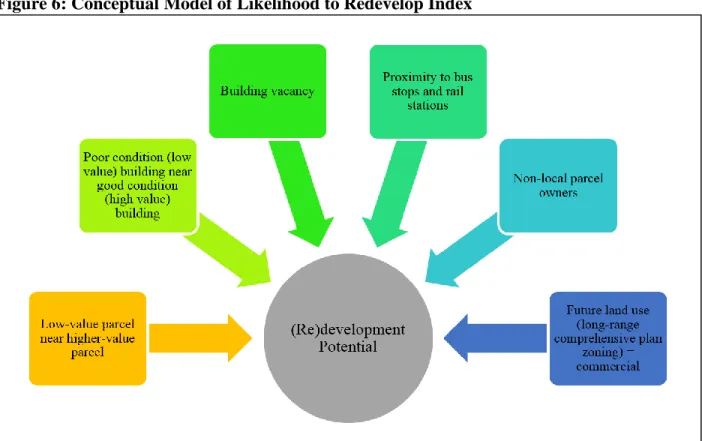
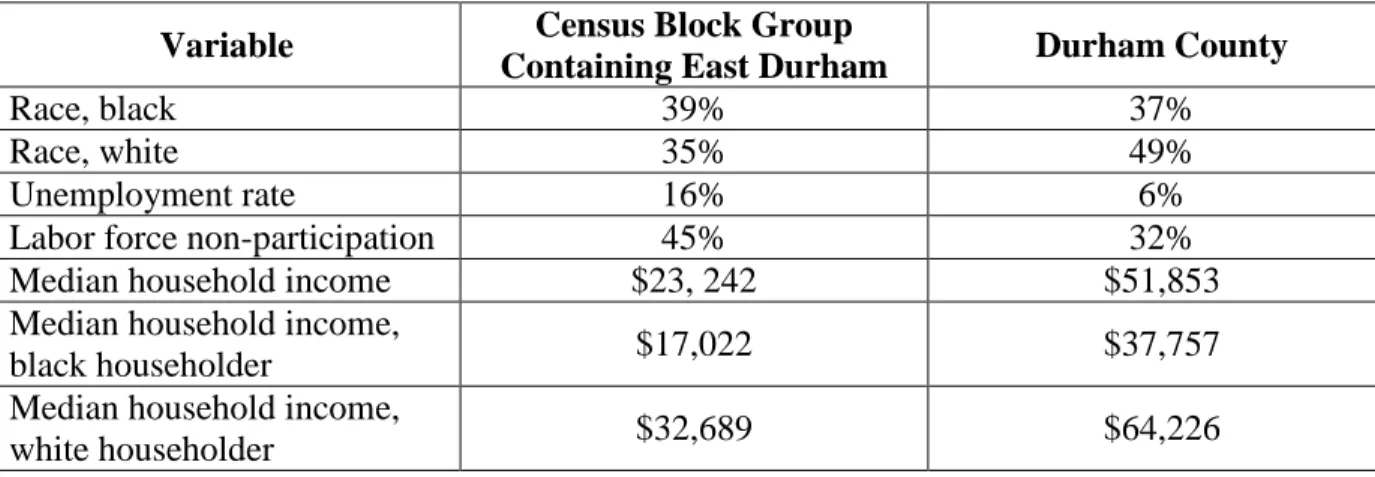
To guide impactful place-based focusing, this study presents an original GIS mapping tool that combines property values, vacancy rates, and other trends in historic neighborhood centers to help predict a context that will be supportive of redevelopment or gentrification and thus will be an impactful focus area. Next, person-level and household-level data from the American Community Survey are presented in both tabular and GIS map form toward
confirming that target neighborhood centers will indeed serve focus populations including people of color and those experiencing economic inequity. Finally, this study uses National
Establishment Time Series (NETS) and Small Business Owners (SBO) data to produce
25
Findings: Best Practices
This section begins with an outline of the broad literature on equitable development concepts and best practices, then draws out two tools for commercial stabilization of
neighborhood centers: targeted business assistance and community-initiated commercial real estate development. A key finding of this section is that equitable development practice builds on these traditional economic development tools to shift toward more just outcomes via highly intentional targeting, or focusing, of resources. The final part of this section presents an original conception of this targeting, which this project terms a triple lens for impactful focusing.
Defining the lenses within this mechanism is the subject of the next chapter.
Equitable Development Broadly Defined: “Helping neighborhoods hold their own” In the most general terms, equitable development is an economic development practice that sees economic ventures as a means to achieving some improvement in equality across groups of residents, rather than an end in itself (as in typical private-sector development). The goal is often stated as quality of life for all, but honors and privileges existing neighborhood residents of focus areas, namely low-income, black, or brown residents.
Planning literature provides the term “equitable development” as a response to
re-urbanization that threatens gentrification of historic neighborhoods. Kennedy & Leonard (2001) provide an academic definition of equitable development by the actions that are taken: “the creation and maintenance of economically and socially diverse communities that are stable over the long term, through means that generate a minimum of transition costs that fall unfairly on lower income residents.” Corridors of Opportunity, a place-based initiative in the Minneapolis-St Paul metro area that seeks to employ equitable development around transit stations and corridors, defines equitable development by its outcomes: “Equitable development creates healthy vibrant communities of opportunity where low income people, people of color, new immigrants and people with disabilities participate in and benefit from systems, decisions, and activities that shape their neighborhoods.” Some of the tactics that Corridors of Opportunity and their partners use to work toward these goals include living wage jobs, entrepreneurship supports, housing and transportation accessibility, walkable streets, public spaces, and food access.
26
development. The most clear and comprehensive identified through this research is from
PolicyLink, an Oakland, CA-based “research and action institute” that publishes information for those working toward economic and social justice. PolicyLink defines equitable development by both the process and its outcomes:
“Equitable development is an approach to creating healthy, vibrant, communities of opportunity. Equitable outcomes come about when smart, intentional strategies are put in place to ensure that everyone can participate in and benefit from decisions that shape their neighborhoods and regions. The toolkit…includes tools to reverse patterns of segregation and disinvestment, prevent displacement, and promote equitable revitalization.”
This definition explicitly mentions the goals of improving quality of life in a place-based manner, being cognizant of both the existing situations of segregation and disinvestment and the risk of displacement from gentrification. It also contains clearly defined and usable methods for achieving these goals, which are organized as tools within an Equitable Development Toolkit (EDTK). The EDTK is actually a set of 27 nested toolkits, organized into four broad categories: Economic Opportunity, Affordable Housing, Health Equity and Place, and Land Use and Environment. The Economic Development tools include Living Wage Campaigns, Resident-Owned CDFIs and Worker Cooperatives, Minority Contracting, Transit-Oriented Development, and Commercial Stabilization.
Commercial stabilization. The Commercial Stabilization toolkit was chosen as the further focus of this project because its particular mix of goals, processes, and players most fits the problems and opportunities that define the project, as laid out in the framing chapter of this report. The driving goal behind the concept of Commercial Stabilization tools is to “help communities build the economic strength of their neighborhood commercial district so that it is better equipped to both serve neighborhood residents’ needs and withstand gentrification pressures” (PolicyLink, 2002). This goal identifies the specific geography of the neighborhood center and frames the problem as: How can neighborhood centers improve in the provision of goods, services, and jobs without gentrifying?
Commercial Stabilization works on the understanding that “it is the abandoned
27
economic niche, made up of businesses that provide employment and ownership opportunities, preserve the character and culture of residents and their spaces, and fill the void – both
physically in terms of building vacancy and economically as a missed market opportunity – that attracts gentrifying forces. PolicyLink states the goal of commercial stabilization as “helping neighborhoods hold their own” by building up established, resilient, and local-serving
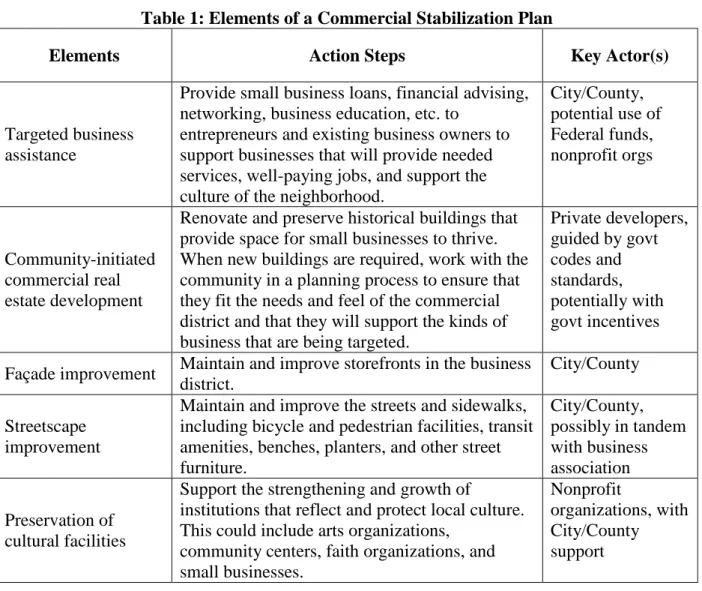
neighborhood centers. The key elements of a commercial stabilization plan are laid out in Table 1.
Table 1: Elements of a Commercial Stabilization Plan
Elements Action Steps Key Actor(s)
Targeted business assistance
Provide small business loans, financial advising, networking, business education, etc. to
entrepreneurs and existing business owners to support businesses that will provide needed services, well-paying jobs, and support the culture of the neighborhood.
City/County, potential use of Federal funds, nonprofit orgs
Community-initiated commercial real estate development
Renovate and preserve historical buildings that provide space for small businesses to thrive. When new buildings are required, work with the community in a planning process to ensure that they fit the needs and feel of the commercial district and that they will support the kinds of business that are being targeted.
Private developers, guided by govt codes and standards, potentially with govt incentives Façade improvement Maintain and improve storefronts in the business
district.
City/County
Streetscape improvement
Maintain and improve the streets and sidewalks, including bicycle and pedestrian facilities, transit amenities, benches, planters, and other street furniture.
City/County, possibly in tandem with business association Preservation of
cultural facilities
Support the strengthening and growth of
institutions that reflect and protect local culture. This could include arts organizations,
community centers, faith organizations, and small businesses.
Nonprofit
organizations, with City/County support
28
WalkUP report (2014) affirms that aesthetics and design are important factors in re-activating a neighborhood center. Cultural facilities and institutions, including community centers, faith organizations, neighborhood leadership groups, and cultural arts organizations, serve as a vital anchor for the history, culture, and population of the historic neighborhood. Existing small businesses, particularly those that have been open for decades and whose owners serve as community leaders (whether official or ad hoc) also qualify as cultural facilities. The
30 Living Wage Campaigns Affordable Housing CDCs w/ Resident Shareholders CBAs / Exactions Commercial Stabilization Zoning Changes Cooperative Ownership EQUITABLE DEVELOPMENT TOOLBOX Strengthen Cultural Facilities Façades & Streetscapes Targeted Business Assistance Community-initiated Commercial Real Estate Dev’t.
COMMERCIAL STABILIZATION TOOLBOX
TARGETED BUSINESS ASSISTANCE:
COMMUNITY-INITIATED COMMERCIAL REAL ESTATE DEVELOPMENT:
Provide typical business assistance to targeted businesses that:
Stand to succeed in the market
Will provide locally-needed products
Are likely to create higher-wage jobs
Will locate IN THE NEIGHBORHOOD
CENTER OF INTEREST
Examples of business assistance to provide:
Loans and other financial products
Networking support and linkages
Business counseling and education
Make physical investments in spaces (new or rehabilitated) that are needed to push the neighborhood vision forward.
Development should be community-driven, seek to preserve resources wherever possible, and add to the cultural identity of the area.
These two processes should be linked to the extent that it is
31
Targeted business assistance. Business assistance is the provision of loans, financial
advising, mentorship, networking opportunities, technical assistance, or other supports to businesses (Suggs, 1995). Typical business assistance programs may involve targeting businesses owned by women or people of color, or they may involve providing assistance to entrepreneurs within a particular industry, such as technology startups. Targeted business assistance within the concept of commercial stabilization uniquely combines these two criteria and adds a third, place-based, layer, the geographic targeting of one or several neighborhood centers as defined in the framing chapter of this report. Funding and other supports are funneled toward businesses either already in existence in the NSCC of focus, starting up in the NC, or moving to the NSCC (PolicyLink, 2002).
This assistance, which may be provided by local government units, nonprofit
organizations, or even occasionally private business associations, is first targeted, or focused toward, businesses which are owned by neighborhood residents or neighborhood entrepreneurs. In many cases, though, the community will also need to draw in businesses, entrepreneurs, and capital from the outside. In this case, the targeting scheme must be even more careful to bring in businesses that will meet local needs and add to the culture of the neighborhood and its center rather than paving the way for gentrification by catering services and retail offerings toward wealthier patrons.
The most challenging part of providing targeted business assistance may be the
32
The next section describes the second strategy, community-initiated real estate
development, and describes a similar need for thoughtful focusing of resources. Following that section is the introduction of an original visualization for what this report has termed the “triple lens for impactful focusing of resources” via either strategy discussed here.
Community-initiated real estate development. Much like targeted business assistance,
using real estate development toward economic development of an area is, on its face, not a new concept to most planners or community groups. Again, the uniqueness of the tool in this instance comes from its steering by the needs and desires of the local neighborhood community rather than solely by the profit motivation of a traditional private developer.
Community-initiated real estate development aims to combine a community planning process for neighborhood center redevelopment with real estate investment in the center. In order for the community planning process to authentically hold the power in visioning the NC’s
redevelopment, it must take place well before any real estate decisions are made or any deals are on the table.
The planning process should seek to answer two main types of questions. First, questions about what types of businesses the NSCC needs additional or improved space for will help planners and developers translate these needs into real estate projects:
What goods and services do we need and want access to in the NC?
What existing businesses is it important to support for continued presence in the NC? What kinds of businesses will we patronize and otherwise support?
What entrepreneurs or would-be business owners do we know of who need space? Equally important, the community process should seek to answer questions of aesthetics and design:
What features make our neighborhood center unique? What do we want our neighborhood center to look like?
What existing buildings or other structures or spaces (including open space) is it important to preserve?
Do we agree on what our physical assets are? How can we build on existing assets? What new spaces are needed? What kind of businesses might fit in the space that is
33
Are there “problem spots” that need to be addressed, such as empty lots, buildings that house dangerous activity, etc.?).
This plan should be used to guide intentional reinvestment, both in renovating and preserving historical buildings and in new construction if necessary to support unmet needs. The community’s understanding of a neighborhood center’s past and vision its future takes priority during this process and sets the stage for sustainable economic change that builds on
neighborhood assets to meet neighborhood needs.
Such thoughtful application of a traditionally solely market-driven activity requires partner organizations with capital and a community-centric mission. Mission-driven credit unions and development finance initiatives fit the bill well, but will still face ongoing challenges of land acquisition, particularly in newly desirable neighborhoods where absentee owners may be more reticent to sell if they sense a favorable market change in the near future. A second challenge is maintaining the community-driven nature of the NSCC vision after the completion of the initial planning process. To do this, PolicyLink reiterates the importance of forging strong partnerships with existing business leaders, established and emergent community leaders, and cultural facilities in and around the NSCC to increase long-term commitment and accountability from both community participants and partner organizations. These partnerships may also open up opportunities to combine community-initiated real estate development with targeted business assistance for even greater impact. For example, if arts-based industries emerge as a primary business target, real estate development should take into account the need for small, sub-dividable spaces for studios and galleries. Or, perhaps a well-funded (or highly fundable) neighborhood cultural facility is looking to redevelop a vacant space into a business incubator and wants to both find an appropriate space and connect with local entrepreneurs in high-impact industries. Both targeted business assistance and community-driven real estate development would benefit from occurring simultaneously.
Triple lens for impactful focusing of resources. A key tool that emerged from this study
34
The idea for a triple-lens visualization evolved out of the understanding of what differentiates the type of intervention that
commercial stabilization requires from traditional business assistance programs and real estate development. The use of business assistance and real estate development to leverage reinvestment in neighborhoods is not new; these are two of the most common efforts toward revitalizing cities and the neighborhoods. The way that these practices are undertaken as part of a commercial
stabilization process, however, is unique, primarily because they bring a highly intentional focusing mechanism into the process.
This triple-layered focusing, as diagrammed in Figure 5, serves to funnel scarce resources toward projects which:
Build wealth in neighborhoods of color (via ownership by people of color and likely hiring of more black and brown employees per trends cited in previous chapters)
Will be or host financially sustainable businesses which will continue to provide jobs and services to the neighborhood for many years
Will contribute to the stabilization of the NSCC through presence in the center, while preventing push-out by occupying space, both physical and market space
Challenges.As mentioned in the targeted business assistance section above, such specific targeting criteria, while useful in directing limited funds and other resources, does demand a more rigorous screening and recruitment process, which may present a barrier to the
organizations providing assistance. Again, partnership with community groups, other organizations, and planners, or devoting only a portion of operations or funding to highly intentional focused work may help reduce the difficulty.
A second challenge, particularly when working closely with neighborhood groups, is that this this focusing process may be or become somewhat political. It is important to be clear with stakeholders and participants on two points: First, be transparent about what criteria for funding or other supports are and what process will guide resource distribution. Second, communicate
Neighborhood Center location
(place-based criteria)
Person of color ownership (person-based
criteria) Likely to
succeed (industry-based
criteria)
35
that the targeting process is not intended to leave businesses or entrepreneurs out, but rather to guide the use of resources toward those ventures that are most likely to have impact at the
particular time and in the particular location of focus. The goal of clear communication should be to help community members understand the process and the goals, and to build long-term
support for the program as a whole.