Christine F Mayo. The Location of the Citation: Practice vs. Recommendations in Data Citation. A Master’s Paper for the M.S. in L.S degree. November, 2014. 32 pages. Advisor: Todd Vision
Over the last decade, citation of archived scientific data have been the focus of intense debate. However, much of the work on data citation has centered around proposing specific formats for references. In the meantime, scientists have been creating and citing archived data sets, and we thus far lack a deep body of evidence to map the emerging best practices onto actual usage of data references.
This study sketches out some of those connections by examining references to data from the Dryad Digital Repository as appearing in articles collected in PMC Europe. I
collected examples of references that appear in works cited lists and intratextually, and analyzed the occurrence of references over time, both by themselves and in conjunction with several other factors. This paper offers preliminary insights into current data citation practices, which hopefully can be used to help inform the discussion surrounding data citation.
Headings:
Digital libraries -- Evaluation
THE LOCATION OF THE CITATION: PRACTICE VS. RECOMMENDATIONS IN DATA CITATION
by
Christine F Mayo
A Master’s paper submitted to the faculty of the School of Information and Library Science of the University of North Carolina at Chapel Hill
in partial fulfillment of the requirements for the degree of Master of Science in
Library Science.
Chapel Hill, North Carolina November 2014
Approved By
Table of Contents
Acknowledgements: 2
Introduction: 3
Literature Review: 7
Methodology: 13
Results: 16
Discussion: 22
Conclusion: 26
Acknowledgements
Introduction
The citation of scientific data is a largely new phenomenon, driven by an increased desire
by scientists for their research data to be viewed as an output on par with peer-reviewed
literature. This desire stems in large part from the introduction over the last decade of
requirements that grant applications to major funding institutions such as the NIH and
NSF include a plan for the long term management and sharing of any scientific data
produced by grant-funded research. While many scientists support the idea of data
sharing in principle, fewer report having shared or archived their own data, due primarily
to concerns about misinterpretation, being scooped, or not receiving proper credit for
their work (Roche, 2014). Data citation is the scientific community’s response to the
lattermost of these problems.
As more and more data is deposited to public repositories, individual researchers as well
as large task forces have attempted to define the format that a data citation should take.
For this paper, I located and considered four different recommended formats of data
citations, from Altman and King’s 2007 article, the Dryad Digital Repository
(datadryad.org), the Joint Data Citation Principles, and the CODATA-ICSTI Task Group.
While there is considerable overlap between the definitions provided by each source,
researchers have only recently begun to directly study data citation, and to compare these
to discover the relative frequency of citations to data appearing in the Works Cited list of
an article versus intratextually, in the body of article.
Many of the bodies that have attempted to provide guidance on data citation, including
Force 11, the CODATA-ICSTI Task Group on Data Citation Standards and Practices,
and Dryad itself, have encouraged authors to place formal citations in their Works Cited
lists. However, this runs against a long-standing tradition in fields such as genetics to
place less formal references, primarily accession numbers of archived data (e.g., gene
sequences stored in GenBank), within the text of an article.
The purpose of this study is to assess references to data deposited with the Dryad Digital
Repository (henceforth Dryad) as recorded in the literature. I searched within Europe
PubMed Central to collect and analyze examples of references to Dryad data which
appeared both intratextually and in works cited lists. I operationally defined a citation to
Dryad data as the presence of Dryad’s unique DOI prefix, 10.5061, because the presence
of a unique identifier such as a handle or DOI is one of the factors of a data citation that
appeared in all four definitions I considered.
I examined the presence of data citations in various parts of the articles together with
other factors, including journal in which the article appeared, whether that journal
required authors to share or archive their own data, and whether the authors of the article
in question had archived their own data, either previously or in conjunction with the
publication of that article. I deemed these factors important because by examining
relationships between journal policy and the number and types of citations that appeared
in the journals that contained the highest numbers of references to Dryad data. I looked at
authors’ archival practices because I wanted to test my assumption that authors who had
archived their own data would be accordingly invested in the data ecosystem, and
therefore more likely to include references to data in their articles.
There are two main limitations to this study. The data collected here only represent
incidence of data citations. One of the primary recommended functions of data citation is
to give credit when data are reused by authors other than the creators, but little evidence
has yet been gathered to demonstrate the use of data citations in this role. I was interested
in studying reuse of data as evidenced by citation, but I was unable to find an efficient
means of automating that search. When I searched references appearing in papers
published in 2014 by hand for my analysis of author’s experience with data archiving, I
discovered so few instances of reuse that I felt it would be more fruitful to focus my
analyses on all of the citations I discovered, instead of limiting the dataset to the few
instances of reuse citations.
The other limitation is that in examining incidences of data citation as a proxy for author
behavior and reuse, we can only see authors who are actually citing data in their
publications. There is no easy way at present to track the number of authors who deposit
data or reuse archived data and fail to cite it, and so there is no way of knowing what
proportion of data reusers actually cite their reuse. The easiest current assessment would
been downloaded from a repository, but download counts are notoriously noisy (Zuccala,
2008).
The value in this study lies in discovering how authors who currently engage in data
citation format and situate their citations, as a measure of how deeply current best
practice recommendations for data citation have penetrated into the actual research and
publication practices of the scientific community. Knowing the effects of current
recommendations can help shape future guidance, and knowing what types of authors and
journals tend to feature references to data will help future efforts to expand the practice of
Literature Review
In spite of the fact that citation analysis is a field with decades of history, little analysis
has yet been carried out on data citations, presumably because the idea of publishing
research data (at least in the hard sciences) is so new. There is, in fact, considerable
debate in the scientific community over best practices for data publication and citation.
When determining how to define a data citation for the purposes of this study, I looked at
definitions and recommendation from four different sources: one article by a pair of
researchers, two best practice guides published by large task forces, and the sample data
citations provided on every data package page at Dryad.
Writing in 2007, Altman and King proposed a minimum citation for “numerical data”
that was comprised of six elements. They required author, date, title, a unique persistent
identifier such as a handle or DOI, a Universal Numeric Fingerprint (UNF), and a
“bridge” URL that formats the unique identifier as a URL that will resolve when cut and
pasted directly into a web browser. The authors note, however, that a truly minimal
citation could consist of a unique identifier and nothing more, as that would still allow a
user to locate the cited item without ambiguity. Note that this latter practice of providing
only an accession number or DOI is much the same as the convention for the intratextual
The Joint Declaration of Data Citation Principles does not outline in its text proscribed
elements for a data citation, preferring to focus on the purposes that a data citation should
fulfill in the literature. However, we can infer desired fields from the examples offered.
An intratextual reference is shown as consisting of author names and the year of
publication, with an optional definition of a subset of the data where appropriate. This
intratextual information is explicitly designed to point to a full entry in the works cited or
reference list, consisting of names, date, dataset title, repository name, versioning
information where appropriate, and a unique persistent identifier. This set of guidelines
differ interestingly in that they do not recommend the use of a unique identifier in an
intratextual reference, but again, the explicit assumption is that an intratextual reference
will never appear in the absence of a works cited reference.
The CODATA-ICSTI Task Group offered a lengthier list of elements that should make
up a data citation in its 2013 report, including author, title, publisher (the repository in
which the data is archived), date, resource type, edition, version, ISO feature name and
URI, verifier (checksum), unique persistent identifier, and location (a resolvable,
persistent URL or UNF). There is no discussion of which of these elements should be
considered mandatory versus optional, but the report includes sample formats for data
citation from various style manuals that do not contain every field. The report also notes
that the areas where current citation formats tend to fall short are granularity (i.e.,
specifically identifying subsets of a published dataset), version control, and attributing
Dryad has never published guidelines on data citation, but the repository encourages data
citation by posting a pre-formatted citation on the main landing page for each individual
data package, and requesting that authors who make use of the data include a reference to
it in their work. The segments that make up these citations are name, year, title,
repository name, and unique persistent identifier (in this case, DOI).
There is considerable overlap between these four standards, but what I found most
striking is that in spite of Altman and King’s admission that a unique persistent identifier
can constitute by itself the minimum required information for a citation, all four primarily
offer examples that are formatted as full works cited references. Even the intratextual
reference outlined by JDCP is meant specifically to point to a full works cited reference.
This emphasis suggests a strong disconnect between theory and practice, as Fenner’s
2014 work on references to Dryad data in PLoS ONE has suggested that the vast
majority, up to 97%, of data DOIs occur intratextually, rather than in the works cited list
of an article. There is even suggestion that some journal editors have encouraged authors
not to place references to datasets in their works cited list, due to internal confusion over
data citation policy (Bruna, 2014).
It is possible that the haphazard adoption of best practices in data citation is related to the
still extensive ambivalence within the scientific community about data archiving in
general. When Costello et. al. studied attitudes towards data archiving, they noted that
scientists react much more positively to the idea of making data publicly available when
the process is referred to as “publication” rather than “sharing”, pointing out that the
Piwowar and Vision have addressed this issue in numerous articles, both separately and
collaboratively, demonstrating among other things that articles with related datasets
published in the Gene Expression Omnibus average more citations over their lifetime
than those without (Piwowar, 2011). These are, however, citations accrued by the article,
not the associated data set.
While many articles have been published about the value of data archiving to scientists,
there has been a certain amount of pushback, as well. Costello et. al. make no attempt to
hide their belief that current data repositories do not fully meet the needs of the scientific
community because they have limited or no capacity to allow for peer review of archived
data prior to its publication (Costello 2009). A recent survey of life science researchers
found that over 50% of those surveyed considered data sharing (including archiving) to
be the norm in their field. However, the same study also found that institutional
requirements had little impact on data archiving behaviors, that fully a third of grant
reviewers place little or no importance on the presence of a data sharing plan in a grant
proposal, and that researchers who reported ignoring data sharing requirements also
reported facing very little in the way of formal sanctions (Pham-Kanter, 2014).
Granting agencies are not the only institutions bringing pressure to bear on researchers to
archive or otherwise share their data. In late 2013, the PLoS consortium of journals
announced that public accessibility of the underlying data would become a requirement
for all articles published in PLoS journals as of March 2014. PLoS is not the only
publisher that has begun mandating open access to research data, and it is likely that such
archiving in the field of animal behavior suggests that as yet, however, journal data
policies are the exception rather than the norm (Caetano, 2014). Another study suggests
that while a strong journal data sharing policy has a significant positive impact on
authors’ tendencies to archive data, so few journals have had such policies in the past that
the phylogenetic data for roughly 60% of a sample of studies published in the last 13
years has already been lost (Magee, 2014). Knowing that journal policies can have such a
strong impact on author behavior, it is all the more surprising that even journals which
require data sharing or archiving rarely make public statements about citation of archived
data, or take steps to make it easier for authors to include references to archived data in
their publications.
There are numerous reasons for authors to archive and cite data, including the potential
career benefits and journal and funder mandates mentioned thus far. Arguably more
important, however, are the peer review, assessment, and reuse of data made possible
through archival access. Part of the integral mission of Dryad and other data repositories
is to encourage the strengthening of the scientific process via the reuse of deposited data
sets.
Several methods for tracking access to data are already in place. Every data package
deposited on Dryad tracks the number of pageviews and downloads each file receives,
but these numbers can only be seen as a broad indicator of interest in each dataset, not
necessarily reuse, and especially not reuse in a new peer-reviewed publication. As early
as 2008, Zuccala called for clearer measures of data reuse from digital repositories, but
should be measuring reuse of data as the clearest possible assessment measure and called
for the use of references to deposited data sets as a proxy for reuse (Luzi, 2012).
Distinguishing citations that represent actual reuse is difficult, however. Most of the
references observed in this study were linkage references meant to tie an article in the
literature to its underlying data. Other types of references that would not indicate reuse
include references to a previously archived data set in a future article by the same lab or
set of authors, and references to a dataset that was used to provide reference values for
constants, but in which the data was not reanalyzed. Currently, these latter types of
non-reuse references must be assessed and weeded from a dataset by hand, a lengthy and
time-consuming process which I did not undertake for this study.
If authors used a more formal and standardized format for data citations, verification of
reuse citations for assessment purposes would be somewhat easier, although still not a
simple process. This study and others have demonstrated that references to data can be
located and collected for assessment regardless of their format and location within an
article, as long as they contain a unique persistent identifier. The lesson that remains,
then, is that best practice recommendations for data citation should focus not only on
format and minimum required fields, but should also take into consideration what
suggested practices will lead to the most widespread use of references to data in the
literature. This would ensure that the incentive for archiving data publicly remains high,
Methodology
I searched for references to datasets archived in Dryad that are contained in scholarly
articles published between 2010 and 2014, whose full text is indexed in PMC Europe.
This covers a total of 1,142,734 articles. I did not specifically choose the date range;
searches of PMC Europe simply did not reveal any references to Dryad data in articles
dating from before 2010.
I used the advanced search function at http://europepmc.org/ to craft queries and export
bibliographic data about the articles returned by the search. In each case, I defined the
presence of a citation to Dryad data, in whatever part of the article I was seeking it, as the
presence of the “10.5061” string, Dryad’s unique DOI prefix. Searching for mentions of
“Dryad” by name tended to result in unacceptable amounts of noise, due to the
namespace overlap with Microsoft’s Dryad parallel-processing computing initiative.
I searched for references in the works cited list by searching for occurrence of the Dryad
DOI prefix in the reference section of articles, and limiting the results to full text articles
known to contain data DOIs. There were only 169 articles that contained Dryad DOIs in
the works cited list as of October 17, 2014, out of the 1.1 million full text articles indexed
To locate intratextual references, I used the full text search to look for the Dryad DOI
prefix embedded anywhere in an article. As of October 28th, 2014, this full text search
returned 1341 items. I compared the PubMed IDs of these articles with the IDs of the
articles containing works cited reference to establish the extent to which the two sets
overlapped.
I also conducted an API search for intratextual references in PMC Europe by using the
Rebi API package to search for articles containing the Dryad DOI prefix in the full text. I
determined how many of these articles also contained works cited references by grepping
their works cited lists as downloaded through the API for the Dryad DOI prefix. This
method returned only 1279 articles, seven of which also included works cited references.
These data were not included in the sets used to generate the charts.
I analyzed the data for the relative prevalence of each citation type over time by tracking
the number of references that appeared in each year and normalizing the results against
the number of full text articles indexed in PMC Europe for that year. I also examined
more closely the data for journals that contained more than 20 references to Dryad data
over the study period (15 journals in total), by tracking the number of each type of
reference by journal and normalizing those numbers against the total number of full text
articles in PMC Europe for that journal during the study period. For each of these
journals, I visited the journal websites and examined their submission rules to see if their
and what that information consisted of. I did not look for editorial advice on data
citations, or the proper formatting thereof.
Finally, for each article published in 2014 (88 in the works cited dataset, and 367 in the
intratextual dataset), I searched in Dryad itself at datadryad.org, to see if the authors of
the citing articles had ever deposited data with Dryad, in order to determine whether
archiving data makes an author more likely to reference data. I considered the results
positive even when the data deposited was the dataset associated with the article in
question, because data are typically deposited early enough in the editorial process for
edits still to be made, as evidenced by the fact that many articles reference their own data.
I selected only articles published in 2014 in order to limit the amount of manual
Results
The two main datasets consist of 1341 items with intratextual references to Dryad, and
169 items with references in the works cited lists. 100% of the articles in the works cited
dataset were also represented in the intratextual dataset. This means that 12% of authors
who refer to data do so both intratextually and in their works cited list, while the
remainder make solely intratextual references. API results for a functionally equivalent
full text query searching for intratextual references consisted of only 1279 articles, only
seven of which (.5%) contained both intratextual and works cited references. I did not
include the API data in the charts for deeper analysis because I only acquired data for
intratextual references via the API, and I could not compare the sets without API data for
works cited references. The differing results suggest that there are differences in the API
Figure 1: Articles with Intratextual and Works Cited references by year, as a percentage of total
articles available in PMC Europe
Figure 1 shows of the number of intratextual vs. works cited references by year, as a
proportion of the total number of articles indexed for that year in PMC Europe. As a
percentage of total articles, the number of articles containing intratextual references
levels off in 2014 after having steadily risen between 2010 and 2013. The percentage of
articles containing works cited references has been rising since 2012, but at a much
slower rate than intratextual references. Overall, articles containing references to data of
In terms of non-normalized numbers, while the number of works cited references is
rising, the number of intratextual references is falling, and in fact, the increase in works
cited references is not making up for the decrease in intratextual references. Currently,
the numbers for 2014 stand at 88 works cited citations and 367 intratextual references.
Extrapolating, I project 117 works cited references and 489 intratextual references or 606
references total for 2014. The 367 articles containing data citations in 2014 represent
0.2% of the 168,448 full text articles available in Europe PMC that year.
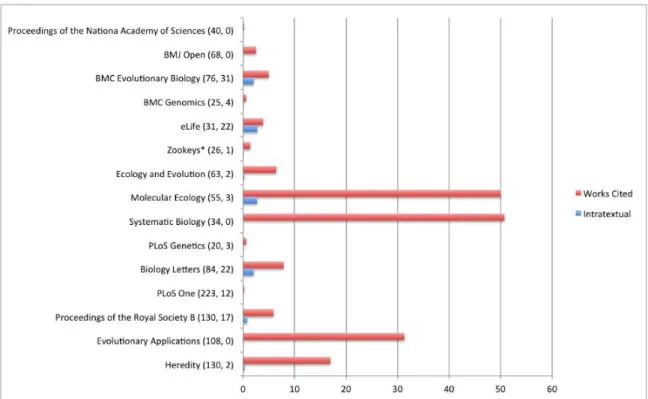
Figure 2: Articles with Works Cited and Intratextual references by journal, and as a percentage of
the total number of full-text articles for that journal indexed by PMC Europe over the period
Figure 2 presents the overall rates of each citation type for the 14 journals represented in
the datasets that had 20 or more references to Dryad data over the 2010-2014 period. The
numbers in parentheses by the journal names are the exact numbers of intratextual and
works cited references, respectively. Note that four journals contained no works cited
references. The journals are also clustered by data policy type: all journals above
Zookeys ‘encourage’ data sharing, while all journals below Zookeys feature a mandatory
rule that data must be archived in a public repository. Zookeys is marked with an asterisk
because it features a hybrid data policy, in which only certain types of sequence data are
required to be publically archived. In each case, the numbers of citations are normalized
against the number of full-text articles from that journal in that period that are available
in PMC Europe. In some cases, such as with Systematic Biology and Molecular Ecology,
limiting the count to full-text only articles severely decreased the number of articles from
the total number published and indexed.
Only four of the 15 journals contain data references in more than 10% of their articles,
and these journals represent those with the highest number of references to data in my
dataset, at 20 or more references each.
The data show that the top seven journals in terms of percentage of articles with data
citations (Molecular Ecology, Systematic Biology, Evolutionary Applications, Heredity,
Biology Letters, Ecology and Evolution, and Proceedings of the Royal Society B), all
have mandatory data archiving requirements. However, the two journals with the least
Evolutionary Biology) both only encourage authors to make their data available for
sharing. All nine of the journals that I have singled out in those two categories are
integrated with Dryad, meaning that they offer authors the opportunity to deposit their
data with Dryad as part of the manuscript submission workflow. These data are not
concrete enough to offer substantial analysis by themselves, but they show that the
relationships between journal policy, article workflow, and data citation practices are
complicated, and require further, specific study to demonstrate whether journal data
policies and repository partnerships have an effect on an author’s likelihood to cite data.
Data Archiving Experience No Data Archiving Experience
Intratextual 366 1
Works Cited 87 1
Table 1: Observed data references for 2014, divided by whether the authors had ever archived
data of their own.
Table 1 shows the relationship between data citation behaviors and data archiving
behaviors, by searching through Dryad based on each data citation-bearing article from
2014 in the datasets and determining whether the authors had previously or concurrently
submitted data to Dryad. Concurrent submissions for the data associated with the article
in question were counted because data submissions nearly always take place before the
text of an article is finalized, and authors who are able to add references to their own data
after it is archived would also have time to add a reference to any other data that they
might have used. Nearly every article searched had an associated dataset in Dryad; I had
than on general incidence of data citation, but I strongly suspect that if I had my dataset
would have been too small to analyze meaningfully.
I theorized that depositing data of their own would make authors more likely to reference
data in their works, because it would indicate a stronger commitment to and closer
relationship with the research data infrastructure. With only a single article whose authors
had not previously or concurrently archived data, it was impossible to test these results
significantly. Nevertheless, the proportional differences between authors who had or had
Discussion
My results differed both from those discovered in previous research, and within
themselves depending on the search methods used. In results from the web search, I
found intratextual references to be nearly eight times more common than works cited
references, with 88% of references to data to be located intratextually. Also, 100% of the
works cited references gathered via the web search were contained in articles that also
used intratextual references. Strikingly, they never occurred independently.
For comparison, in his 2014 work on PLoS ONE articles, Fenner found that 97% of
references to data were intratextual, as opposed to the 88% I found in PMC Europe. His
work was both broader and narrower in scope than this study, as he was examining
references appearing only in PLoS ONE articles, but that cited data in more repositories
than just Dryad. It is difficult to say how the numbers compare.
A more direct comparison can be drawn between my results obtained using different
search methods. Using an API to access PMC Europe returned only 1279 articles with
intratextual references to Dryad data, as opposed to the 1341 returned by the web search.
Also, of those 1279 articles with intratextual references, only seven (or roughly .5%)
contained works cited references as determined by the API, as opposed to the 169
two different searches access PMC Europe’s index, and while this is deserving of further
investigation, it is beyond the scope of this study.
Breaking down the data, a number of interesting trends became evident. Figure 1 showed
that as a proportion of all articles, the number of articles containing works cited
references to data has been rising since 2012, and the rate of the rise is accelerating.
Articles with intratextual references have been on the rise since first appearing in 2010,
but thus far, the percentage for 2014 has remained equal with that from 2013. Note that
indexing in PMC Europe can have a delay of up to 6 months after an article appears,
however, meaning that my data were more reflective of early-to-mid 2014 than late 2014,
when they were collected. Once articles published later in the year can be considered, the
proportion may rise. These caveats also apply to the data for works cited references, and
mean that the observed rise in works cited references may become steeper, if the upward
trend continues.
I am uncertain why the growth in intratextual citations has effectively halted, especially
as the growth in works cited citations has not increased proportionally. It is possible that
authors are getting the message that intratextual references are not considered formal
enough, without receiving the follow-up understanding of how to format a works cited
data reference. Journal editors and repository managers should be made aware of these
trends, so that they can offer more clear advice and support to authors who wish to cite
What is clear, however, is that at less than .25% of articles indexed in PMC Europe,
articles containing references to data are still rare. It will be important to repeat this study
in a few years’ time to determine whether incidence of intratextual references is really
leveling off. Future data will also be able to determine if the .21% cap reflects some sort
of overall limit on the proportion of papers referencing archived data, or if those numbers
will be exceeded by a continuing rise in the number of works cited references, or renewed
growth in intratextual references.
I do not anticipate that papers containing references to data will be limited to less than
.25% of the literature, primarily because of my findings when I grouped references by
journals. I selected the 15 journals that contained 20 or more references to Dryad data
over the study period, and found that in four of them, articles containing data references
comprised greater than 10% of the articles from that journal available in PMC Europe.
When all 15 journals are considered, the average percentage of articles with intratextual
references is 12%. This is strongly affected by the two 50% outliers, and the median is
approximately 6%.
I believe that these numbers are more reflective of practice in journals that have an active
culture of data archiving, as 13 of the 15 journals are currently integrated with Dryad. It
is difficult to draw direct links between journal integration and data citation, however,
because of the differing lengths of time that the journals have been integrated, both in
It was also difficult to draw links between a journal’s data policy and the instances of
references to data within that journal’s articles. I consider it striking that all four journals
with a data reference incidence of above 10% require mandatory deposition of
accompanying data in a public repository, but there was not sufficient data to link the two
directly.
The final link that I attempted to draw was between data citation behaviors and data
deposition behaviors. Having only found a single article from 2014 that did not have
either an associated data package in Dryad or a previous data package from one or more
of the same authors, I was unable to statistically test the relationship. This result did
suggest to me that the people who typically cite data are those who have a stake in the
scholarly citation of data; i.e., those who have archived their data in the past. It also
showed that the vast majority of references to data that currently exist are not citing data
reused by the authors of the study in question, but rather consist of the references tying
together a given article with its own underlying data. I fully expect that as more and more
journals implement mandatory data archiving requirements, this type of data citation will
continue to rise. I do not know whether references to reused data will ever comprise a
significant proportion of data citations in the literature, but they do not yet, and it may be
Conclusion
I have provided a baseline sample of data citation practices as they are currently being
employed in the scientific literature, using papers in the PMC Europe corpus that cite
data in the Dryad Digital Repository intratextually and in their works cited list. I have
shown that intratextual references make up the vast majority of references to data in
recent years, but growth in these references has leveled off in the last year. Works cited
references to published datasets are on the rise, but do not occur in the absence of
intratextual references. I have also shown that the highest frequency of data references
tend to occur in journals that have mandatory data archiving policies. Nearly all authors
who cite Dryad data have published data with Dryad, and most data references refer to
the data associated with the article in question, rather than to re-used data compiled and
published by a different set of authors.
This study provides a limited view of data citation practices in the literature, counting
only full text articles available in PMC Europe that cite data deposited in Dryad. For
broader scientific applicability, this study or a similar one should be repeated for other
major data repositories, such as FigShare and GenBank.
This study is also a valuable demonstration of the utility of data citation for repository
assessment, as I have been able to demonstrate that citations to Dryad data have been
the current year. Dryad submission rates have been growing at a slower pace since the
fourth quarter of 2013, but they are still growing, and I do not think that slowdown is
related to stalling of intratextual reference growth.
Several proposed best practice documents for data citation have been published over the
last decade. In 2007, Altman and King proposed a standard that contained many of the
elements of a traditional, full works cited reference, but provided no guidance as to where
the reference should be located in a work. Dryad itself requests that authors who use
Dryad data should cite it in a similarly formal fashion, but also do not proscribe a
location for the reference. The Joint Data Citation Principles offer example formats for
both intratextual and works cited references, although the formatting for the intratextual
reference includes the assumption that it should guide the reader to a fuller reference
within the works cited list. The 2013 CODATA-ICSTI Task Group report is one of the
only documents that explicitly defines a data citation as “the full bibliographic reference
information for the object” (CIDCR 12). The range of information contained in such an
item is implied in all of the other format guidelines, but the use of the term bibliographic
places an emphasis on the idea of the data citation as a more formal object.
The repeated publication of data citation guidelines that encourage full, formal references
that are generally too large to locate intratextually would seem to predict a decline in
intratextual references, assuming that authors read and attempt to follow best practice
documents. This somewhat matches the data observed, except that the growth in works
cited references did not increase enough to account for the slowdown in intratextual
recommendations and the actions that authors and editors are taking in actual
publications.
Best practice recommendations should be informed by current practice, in order to meet
in the middle between the ideal and the feasible. Authors referencing data seem to be
influenced by best practice recommendations, but the current changes in citation practice
are actually slowing the growth of articles containing references to data as a proportion of
the literature. More data is needed, as current practice seems to be in flux, but these
findings highlight the need for bodies issuing best practice recommendations to be aware
References
Altman, M., King, G. (2007). A proposed standard for the scholarly citation of
quantitative data. D-Lib Magazine 13(3/4). doi:10.1045/march2007-altman
Bruna, E. M. (@BrunaLab) “You can get credit for your #OpenScience! Unless you
don’t. cc: @ESA_org @datadryad @ElDon78 http://wp.me/p32RIy-E8”. 17
October 2014, 10:30 a.m. Tweet.
Caetano, D. S., Aisenberg, A. (2014). Forgotten treasures: the fate of data in animal
behaviour studies. Animal Behavior 98: 1-5. doi:10.1016/j.anbehav.2014.09.025
CODATA-ICSTI Task Group on Data Citation. (2013). Out of cite, out of mind: the
current state of practice, policy, and technology for the citation of data. Data
Science Journal 12. doi:10.2481/dsj.OSOM13-043
Costello, M. J. (2009). Motivating online publication of data. BioScience 59(5):
418-427. doi:10.1525/bio.2009.59.5.9
Fenner, M. (2014) Overview.md. GitHub. https://github.com/articlemetrics/data-
analysis/blob/master/datacite/overview.md. Accessed 20 October, 2014.
Joint Declaration of Data Citation Principles. (2014).
https://www.force11.org/datacitation. Accessed October 10, 2014.
Luzi, D., Di Cesare, R., Ricci, M., & Ruggieri, R. (2012). Enhancing diffusion of
scientific contents: Open data in repositories. The Grey Journal, 8(2), 71-8.
Magee, A. F., May, M. R., Moore, B. R. (2014). The dawn of open access to
phylogenetic data. PLOS ONE 9(10): e110268. doi:10.1371/journal.pone.0110268
Pham-Kanter, G., Zinner, D. E., Campbell, E. G. (2014). Codifying collegiality: recent
developments in data sharing policy in the life sciences. PLOS ONE 9(9):
Piwowar, H. A., Vision, T. J., Whitlock, M. C. (2011). Data archiving is a good
investment. Nature 473(7347): 285. doi:10.1038/473285a
Roche, D. G., Lanfear, R., Binning, S. A., Haff, T. M., Schwanz, L. E., Cain, C. E., Kokko, H., Jennions, M. D., Kruuk, L. E. B. (2014). Troubleshooting public data
archiving: suggestions to increase participation. PLOS Biology 12(1): e1001779.
doi:10.1371/journal.pbio.1001779
Zuccala, A., Oppenheim, C., & Dhiensa, R. (2008). Managing and evaluating digital