Enhancement of Educational Games based on
Personality Type Indicators
Negar Shabihi
Electrical and Computer Engineering department University of Tehran
Tehran, Iran [email protected]
Fattaneh Taghiyareh (Corresponding Author)
Electrical and Computer Engineering department University of Tehran
Tehran, Iran [email protected]
Mohammad Hossein Abdoli
Electrical and Computer Engineering department University of Tehran
Tehran, Iran [email protected]
Received: March 11, 2017 - Accepted: August 19, 2017
Abstract— Previous studies indicate that the use of adaptive learning and game techniques enhances learning process; nevertheless, the adaptation based on learner’s personality has not been well researched in serious-game’s literature. There are plenty of game-elements which can be used in an educational game, but the effect of them may vary due to differences in personality types of learners. The purpose of this paper is to investigate the impact of various game-elements on learning outcomes. With the aim of improving learning process we have focused on designing a game-based learning where the game-elements have been personalized based on learner’s personality types. The developed game contains a non-adaptive mode and also an in-game adaptive mode that assigns game-elements due to learner’s personality type. The results represented significant difference between engagement levels of two modes; in addition, learning outcomes were better for the adaptive mode. Besides, in this paper the sensitivity analysis of various personality dimensions relative to the game-elements has been determined and presented in a corresponding table. The results of this paper indicates that a well-designed game environment can improve the learning process. This paper presents the prominent and influential elements for each of personality types. Results of this paper can be used to improve effect of using game-elements in designing learning environments.
Keywords- Game-based learning; Game design; Game-element; Adaptive learning; Personalization; MBTI; Personality
I. INTRODUCTION
The acceptance of potential benefits of educational games has increased widely over the past few years. Adaptive educational games can be used to connect contents to specific skills and friendly environment where the learner is able to play, make mistakes, discover, and learn. [1] Adapting learning environments to be in correspondence with users' needs assure that each user will see contents and features of system which are suitable for his/her characteristics.
Games have basic requirements of an adaptive learning environment [2] and studies show the positivity of game environments impact on promoting learning outcomes [3]. Game-based learning (GBL) is field of taking advantage of game environments’ main features like effectiveness, motivation, engagement, enjoyment to achieve learning goals, enhance knowledge gain and improve skill acquisition. GBL is newly emerging medium that takes serious learning and interactive entertainment together [4].
Pedagogical principles alone cannot make games enough enjoying for learners to attract them. Every game has “elements” or features that keep users engaged [5]and some games have many while others have only a few of them. Game-elements (e.g. Conflict, cooperation and competition, strategy and chance, story, score, badge, levels, rewards and leaderboard) have an important impact on making games engaging. To have well-designed learning games which are able to motivate learners and promote their knowledge acquisition using both game-elements and pedagogical principles is required [5].
A. Educational Games
Research showed that using educational games improves knowledge acquisition and content understanding. Also they change users’ behavior and lead to increased users’ motivation. Educational games should not be so challenging to cause anxiety and not so easy to cause boringness. They should have enough challenge and fun to engage user and made him/her interested in the learning medium [6]. Entertainment and amusement are the main goal of users in using games however we can make them a suitable context for pedagogical goals by using these environments appropriately [7]. Adapting due to user’s characteristics is a good solution to enhance educational games. B. Game-element adaption as a key part of GBL
environment
In adaptation process, the first consideration is to identify which components of the learning experience are going to be adapted.[6] Game-elements are one of the most important parts of GBL environments and using them appropriately will have positive impact on learning process. As [5] mentioned designing mechanisms and contents of game in a manner which can support using game-elements is an important task. Also choosing best matching game-elements and arranging them together to maximize learners’ outcomes is necessary for developing educational games. The way we arrange game-elements together could adapt learning environment to our pedagogical goals. Another consideration in adaption process is that there are many different parameters for deciding how to adapt the system, such as learner’s knowledge level, different learning objectives, user preferences and learning styles[6]. Users’ personality type is one of the most important learners’ specifications that game-elements in an adaptive learning system can be arranged based on it.
C. Myers-Briggs Type Indicator
The Myers-Briggs Type Indicator (MBTI) is one of the most known type indicators to indicate personality type. [7] This model describes each individual’s personality type in terms of four-letter code which obtains from four different bi-polar scales of opposite preferences giving an indication of how people interpret and interact with the world. [8]
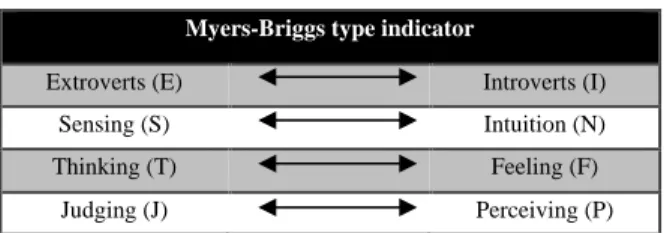
These four dichotomous dimensions classify individuals either as extraverted (E) or introverted (I), sensing (S) or intuitive (N), thinking (T) or feeling (F), and judging (J) or perceiving (P) as listed in Figure 1. . Different combinations of the four dimensions of personality specify sixteen different personality types.
In literature MBTI is an accepted indicator for personality type that its relationship with learning style has been studied before [11]. In TABLE II. some of important characteristics of each personality dimension were mentioned which can be used to recognize each person’s sentiment to different game-elements in learning environment.
D. Keirsey Temperament Sorter
Keirsey [9] showed that individuals learning style is highly relevant to the following four personality types
Myers-Briggs type indicator
Extroverts (E) Introverts (I)
Sensing (S) Intuition (N)
Thinking (T) Feeling (F)
Judging (J) Perceiving (P)
Figure 1. The four bi-polar scales of Myers-Briggs Type Indicator
Keirsey Temperament Sorter
Guardians (SJ)
Artisan (SP)
Idealist (NF)
Rational (NT) Figure 2. Keirsey Temperament Sorter Personality Types
as shown in Figure 2. : The Rational type (NT), the Idealist type (NF), the Artisan type (SP) and the Guardian type (SJ). These personality types reflect the learner’s preferences for taking in information and making decisions, which may be defined by one individual’s learning style [10]. Keirsey theory is closely linked to and is somehow an extension of MBTI. Each personality group of Keirsey have some individual characteristics. For example, the Guardian and Artisan groups are concrete in communicating. These two groups focus on facts and are realistic because of the sensing part of their personality type.
In our study based on Keirsey’s temperament theory we focused on personalization of game-elements as one of key parts of learning environments.
This paper is organized as described here. In section II we presented our first experiment research hypothesizes. In sections III first we mentioned the experiment method then explained the results and discussed about them. With support of our results for each personality group we partitioned game-elements based on interest rate of users to game-elements. In section IV we described the second experiment. In second experiment we used results of first experiment to make learning environment adapted to users’ personality type. Then we discussed and explained results of experiment and concluded from them. II. RESEARCH HYPOTHESIS:RELATIONSHIP BETWEEN
MBTI DIMENSIONS AND GAME-ELEMENTS Previous sections imply that both GBL environment and adaptive learning have a considerable impact on learner’s motivation and learning outcomes. Besides, there are plenty of game-elements that can be used in an educational game, but the effects of them may vary due to differences in personality types of learners.
As Ryan and Deci [11] mentioned interest and motivation have casualty relationship and if someone get interested in something this can produce intrinsic
motivation. So interesting game-elements might motivate learners’ in GBL environments and if we adapt the learning environments to users’ interest rate in game-elements it may increase users’ motivation and improve their engagement level.
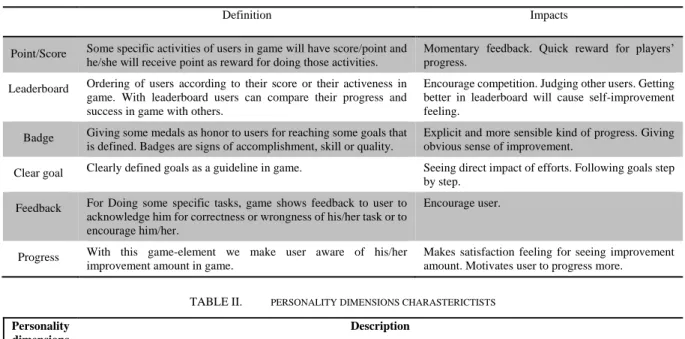
In this research a number of game-elements are taken into consideration, as mentioned in TABLE I. game-elements have different effects on users and
could create a variety of feelings. Besides different personality dimensions have different characteristics and receive a variety of impacts from outer world as mentioned in TABLE II. so in our research we tried to find relationship between user’s personality dimensions and impact of game-elements on them. List of our research hypothesizes which we claimed according to TABLE I. and TABLE II. is presented inTABLE IV.
TABLE I. GAME-ELEMENTS CHARACTERISTICS
Definition Impacts
Point/Score Some specific activities of users in game will have score/point and he/she will receive point as reward for doing those activities.
Momentary feedback. Quick reward for players’ progress.
Leaderboard Ordering of users according to their score or their activeness in game. With leaderboard users can compare their progress and success in game with others.
Encourage competition. Judging other users. Getting better in leaderboard will cause self-improvement feeling.
Badge Giving some medals as honor to users for reaching some goals that is defined. Badges are signs of accomplishment, skill or quality.
Explicit and more sensible kind of progress. Giving obvious sense of improvement.
Clear goal Clearly defined goals as a guideline in game. Seeing direct impact of efforts. Following goals step by step.
Feedback For Doing some specific tasks, game shows feedback to user to acknowledge him for correctness or wrongness of his/her task or to encourage him/her.
Encourage user.
Progress With this game-element we make user aware of his/her improvement amount in game.
Makes satisfaction feeling for seeing improvement amount. Motivates user to progress more.
TABLE II. PERSONALITY DIMENSIONS CHARASTERICTISTS
Personality dimensions
Description
I/E This dimension indicates that individual focuses energy towards inner or outer world. Introverts (I) focus their energy
towards inner world and prefer time alone. Extroverts (E) focus their energy towards outer world and are action oriented often.
S/N Shows how individuals take information from the world. Intuitive (N) types believe in the open mind and novelty and prefer
to rely on ideas, possibilities and their ideas. Sensing (S) individuals focus on actual world and things happening around them. They use their five senses and observe facts to understand events.
F/T This dimension shows how an individual make decisions. Feeling (F) group decisions are more dependent on their feelings
and their values are more subjective. Thinking (T) group use logic and reason to make decisions and tend to be objective.
P/J Indicates how individuals react to external word and how they adapt themselves to it. Judging (J) individuals are concerned
with decision-making, planning and organizing while Perceiving (P) individuals prefer to gather more information and postpone making decisions.
TABLE III. RESEARCH HYPOTHESES
Hypothesis Description
H1a I/E dimension have significant effect on preferring point to badge by users.
H1b I/E dimension have significant effect on average interest rate of users to get badges for learning skills in game. H1c I/E dimension have significant effect on no importance of seeing user’s progress in game by other users.
H1d I/E dimension have significant effect on average interest rate to leaderboard by users. H1e I/E dimension have significant effect on average interest rate to clear goals by users. H2a S/N dimension have significant effect on average interest rate of users to get Feedback.
H2b S/N dimension have significant effect on average interest rate of users to get more points in game. H2c S/N dimension have significant effect on average interest rate of users to get more badges in game. H3a F/T dimension have significant effect on average interest rate of getting Feedback by users.
H3b F/T dimension have significant effect on no importance of seeing user’s progress in game by other users.
H3c F/T dimension have significant effect on average interest rate of users to get more badges in game.
H3d F/T dimension have significant effect on average interest rate of users to get badges for learning skills in game. H3e F/T dimension have significant effect on average interest rate of users to Clear goals in game.
H4a J/P dimension have significant effect on average interest rate users to seeing their progress in game. H4b J/P dimension have significant effect on average interest rate of to get more points/scores in game.
H4c J/P dimension have significant effect on no importance of seeing user’s progress in game by other users.
III. EXPERIMENT 1
Experiment I was intended to determine the impact of different personality dimension on individual’s interest in game-elements. Moreover, game-elements were sorted based on interest level of each personality dimension.
A. Method 1) Participants
A total of 320 participants (214 men and 106 women) aged 17-25 years (M = 20.87, SD = 2.1) took part in this study. They were recruited from two universities of Iran, and they were all undergraduate.
2) Procedure and materials
The students that participated in the survey were asked to fill out a questionnaire. The questionnaire consisted of two parts which were in Persian; The first part was a collection of personality questions, aiming to detect user’s personality type and the second part contained nine questions that were designed on a five-point Likert-type scales ranging from 1 to 5 which higher scores reflect more positive agreement.
The first part of the questionnaire was prepared by the Psychology Faculty of Tehran University. Reliability of this test is higher than 80 percent which has been proven with rerun procedure. Also all of the test phrases have positive correlation with total test, and clinical assessment and psychological observation has confirmed the validity of this test. For the second part of the questionnaire validity and reliability is achieved through experts’ approval.
B. Results and discussion 1) data source
Participants who did not complete all the questions of questionnaire were eliminated from the analysis. Also participants with outlier values for their personality types eliminated due to box plot chart. There was no significant different among personality types in the number of eliminated participants. Totally 295 participants remained (195 men, 100 women) which all analyses reported in the result section refer to this subset of the participants.
2) Results of Research Hypotheses
In our study personality type detection was based on MBTI which for each individual learner simplifies detection of learning style [9]. Specifically, [10] claimed that knowing learner’s personality types could lead to provide adaptive learning environments which improve learner’s satisfaction. Findings of this section helps learning environment designers so that if one individual is unwilling to learn using an educational game, in the condition that his/her personality dimension is sensible to some specific game-elements, it is more probable that we can make him/her more interested in learning environment by adding proper game-elements for his/her personality type.
a)Results related to I-E dimensions of MBTI Pertaining to hypotheses (H1a) related to preferring point to badge, the hypothesis was supported.
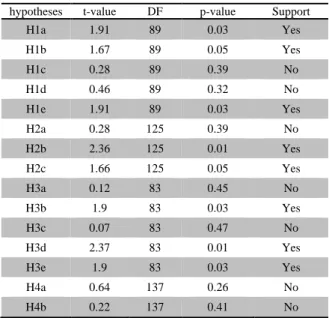
Moreover, two another hypotheses (H1b) which is related to measuring interest in winning badges for learning, and (H1e) which is related to measuring interest in clear goals, both for I-E dimension of personality was significantly supported. Since introverts’ general attitude towards the world is oriented internally and the extroverts’ are externally oriented[8], these findings are predictable. As expected, since the point is more interior game-element than badge, introverts are more interested in it. Also, introverts in comparison to extroverts are more interested in learning badges and clear goals; these findings corroborate the claim that introverts compared to extroverts are more interested in game-elements that related to inner world. Contrary to expectations the two other expressed hypotheses for I-E dimension in section II (H1c, H1d) which refer to interest in leaderboard and caring about point and progress being seen by opponents, had no significant difference in participants’ interest level. Since the I-E dimension does not pertain to shyness versus gregariousness [8], the rejection of these two hypotheses is explainable. According to these results personalized games for introverts have to be more goal-oriented and also badges have to be more contiguous (joint) to milestones.
b)Results related to N-S dimensions of MBTI Pertaining to hypotheses related to N-S dimensions, results indicated that sensing participants were significantly more interested on earning badges than intuitive participants (H2b), and also they were more interested on winning badges in comparison to intuitive participants (H2c), but in the case of preferring feedback there was no significant difference in N-S dimension.
c)Results related to T-F dimensions of MBTI Results demonstrated that feeling participants were more interested than thinking participants in earning points compared to getting badges (In the case of F-T dimension feeling individuals significantly preferred point to badge in comparison to thinking individuals which is in contrary with our assumptions.) (H3b). On the other hand, thinking participants were more interested than feeling participants in winning badge for learning (H3d) and taking clear goals (H3e) which is explicable with knowing that thinking individuals involves logical reasoning and decision process while feeling individuals take interpersonal approaches.
d)Results related to P-J dimensions of MBTI In the case of last personality dimension results proved the significant difference between perceiving and judging participants’ interest in leaderboards (H4c). As expected, judging participants cared more for being ranked among others and disliked to be judged. [8] Unexpectedly, in J-P dimension preferring point to badge (H4b) and interest in progress (H4a) were not significantly different.
The results of research hypotheses depicted in TABLE IV.
3) Most effective game-elements for each personality dimension
Through the results of 295 filled questionnaire and based on the average score of each game-element which were scored based on participants’ interest, the game-elements have been clustered for each MBTI personality dimension. At least, the most effective game-elements for each personality dimension have been recognized. The procedure of putting game-elements in clusters, as was explained here: first of all, for each personality dimension the game-elements were sorted based on their average approval rate. If the approval rating of two adjacent game-elements in the sorted list had a significant difference, they have been categorized in different clusters otherwise they have been categorized in the same cluster. The order of clusters indicates the order of favorite game-elements of the related personality dimensions. For each personality dimension 0TABLE V. demonstrates the sorted game-elements and statistical inference analyses of every two neighbor pair of them. Eventually TABLE VI. shows the clusters of game-elements for each personality type.
TABLE IV. HYPOTHESES CONFIRMATION
hypotheses t-value DF p-value Support
H1a 1.91 89 0.03 Yes
H1b 1.67 89 0.05 Yes
H1c 0.28 89 0.39 No
H1d 0.46 89 0.32 No
H1e 1.91 89 0.03 Yes
H2a 0.28 125 0.39 No
H2b 2.36 125 0.01 Yes
H2c 1.66 125 0.05 Yes
H3a 0.12 83 0.45 No
H3b 1.9 83 0.03 Yes
H3c 0.07 83 0.47 No
H3d 2.37 83 0.01 Yes
H3e 1.9 83 0.03 Yes
H4a 0.64 137 0.26 No
H4b 0.22 137 0.41 No
H4c 1.76 137 0.04 Yes
For the majority of personality types point and progress were determined as the most desired game-elements. Also, this has been realized that the individual’s interest level in game-elements vary for different personality types. Due to the various personality types and also the different impact of game-elements on individuals the different interest of them in game-elements were predictable however this had not been studied before.
4) Experimant I Conclusion
To enhance the educational games and to achieve our prior question which was “How personality type of different individuals influences on their interest level in game-elements of educational games?” a questionnaire has been designed. From participants’ answers the most interesting game-elements for each personality group of Keirsey temperament have been found. We sorted game-elements for each personality group into four clusters which was based on significant difference between interest rate of participants to game-elements. The obtained result as shown in TABLE VI. showed that point and progress are the two most interested game-elements. Since almost all personality groups have point and progress in their first cluster, these game-elements are not good determinants to adapt educational games according to personality type. With the aim of enhancing educational games due to the results of this paper it is recommended to use other game-elements like feedback, badge and leaderboard to adapt the environment.
The results of this experiment both directly and indirectly can be used in an educational setting. The direct usage is possible in integrated learning systems where it is possible to fill out a questionnaire; otherwise according to the obtained relations between personality types and behavior of learners, the results can be used by tracking the learner’s behavior.
TABLE V. SORTED GAME-ELEMENTS FOR EACH PERSONALITY TYPE
Personality dimension
1st game-element (μ, SD) p*
2nd game-element (μ, SD) p* 3rd game-element (μ, SD) p*
4th game-element (μ, SD) p*
5th game-element (μ, SD) p*
6th game-element (μ, SD) E Progress (4.55, 0.69) 0.03
Point (4.3,
1.03) 0.17
Feedback (4.18,
1.06) 0.05
Leaderboard (4, 0.72) 0.2
Badge
(3.88, 1.19) 0.01
Clear goal (3.6, 1.2)
I
Progress (4.47, 0.72) 0.44
Point (4.41,
0.83) 0.003
Badge (4.19,
0.98) 0.14
Feedback (4.11, 88) 0.02
Leaderboard (3.94, 1.02) 0.35
Clear goal (3.89, 1.09)
N (4.4, 0.81) Progress 0.05
Point (4.26,
1.05) 0.16
Feedback (4.15,
0.95) 0.16
Leaderboard (4.04, 1) 0.23
Badge
(3.95, 1.13) 0.03
Clear goal (3.77, 1.26) S Progress (4.57, 0.64) 0.46
Point (4.47,
0.75) 0.002
Badge (4.28,
0.87) 0.09
Leaderboard (4.12, 1.01) 0.02
Feedback (3.02, 1.03) 0.05
Clear goal (3.89, 1.08) F Progress (4.52, 0.62) 0.29
Point (4.46,
0.88) 0.007
Badge (4.21,1) 0.2
Feedback (4.12, 1.07) 0.12
Leaderboard (3.93, 1.06) 0.02
Clear goal (3.62, 1.17)
T (4.4, 0.7) Progress 0.18 Point 0.006 (4.2, 0.87) Badge 0.22 (4.14, 0.95) Feedback 0.03 Leaderboard (3.95,1) 0.25 Clear goal (3.91,0.9)
(4.35, 0.8)
J
Progress (4.41, 0.78) 0.28
Point (4.37,
0.7) 0.02
Feedback (4.16,
0.93) 0.23
Badge
(4.08, 0.93) 0.03
Clear goal (3.91, 1.01) 0.43
Leaderbo ard (3.89, 1.17)
P Progress (4.6, 0.6) 0.17
Point (4.38,
0.8) 0.01
Badge (4.2, 0.91) 0.07
Leaderboard (4.05,1.01) 0.28
Feedback (3.9, 0.89) 0.003
Clear goal (3.77, 1.14)
TABLE VI. SORTED GAME-ELEMENT CLUSTERS FOR EACCH PERSONALITY DIMENSION
Personalit y dimension
game-element clusters
First cluster Second cluster Third cluster Forth cluster
E Progress Point – Feedback Leaderboard - Badge Clear goal
I Progress - Point Badge – Feedback Leaderboard -Clear goal N Progress Point - Feedback - Leaderboard –
Badge
Clear goal
S Progress, Point Badge – Leaderboard Feedback Cleargoal
F Progress - Point Badge - Feedback - Leaderboard Clear goal T Progress - Point Badge - Feedback Leaderboard – Clear
goal
J Progress - point Feedback - Badge Clear goal -
Leaderboard P Progress - Point Feedback - Leaderboard - Badge Clear goal
IV.EXPERIMENT II: APPLYING PERSONALITY DIFFERENCES EFFECTS TO E-LEARNING SYSTEM DESIGN
Experiment II was intended to use the results of experiment I in an educational adaptive environment and reveal the impact of personalizing game-elements due to user personality type in an e-learning environment.
A. Rememry Game
Rememry is a vocabulary learning game which provides an environment for users to learn 504 essential English words. This game is designed in the form of memory card matching table. This design of game allows users to learn English by matching English words with their corresponding pictures or by matching them with their Persian meanings. The game has a questionnaire at the beginning, which determines the learner’s personality type. Therefore, by knowing the learner’s personality type and based on the results of experiment I the proper game-elements are assigned to each participant. Several types of game-elements were designed for this game. This game-elements include point, progress, badge, leaderboard, feedback, and notifications.
1) Game design
Game design is the process of applying design and aesthetics to create an entertaining environment for a usual game or a serious game with the educational purpose or medical and experimental usage. Game design also can be used in gamification. Game design defines the rules, goals, and challenging features of a game. This is clear that the challenging and goal orientation nature of games is cause of their usefulness for serious applications. For example, in the field of
game-based learning, through the use of serious games users can learn much better in contrary to the use of other e-learning environments. Design of a game as the most important part of a game environment can be implemented in different game design models. In the following section the design model of Rememry game has been represented. At first, the level structure of game and after that design of game-elements have been explained.
a)Levels structure
Rememry contains more than forty levels that each level pertains to teaching of three to seven words. Each seven continuous levels of the game relate to one lesson of 504 essential words book. The probability of word’s appearance in each level depends on their previous appearance count; In this way the words’ appearance frequencies are kept approximately equal.
b)game-elements
As previously mentioned, using game-elements are the mechanism of providing an entertaining environment. Game-elements which were used in this game have been discussed below.
POINT
Based on the results of experiment I point was one of the most popular elements. Also, this game-element have been used widely on different games. The point has been selected as one of the permanent game-elements for both control and experiment groups. Since, Rememry is a memory game for matching cards, the amount of time that player spend for ending a level and also the number of moves that he/she takes are important factors. Therefore, to define a formula for score level time and number of moves are considered as
variables of score. Equation (1) calculates the score where the FS is the amount of feedback score that has been earned through the game level-calculation of feedback has been explained in the following sections. LTime in equation (1) is the amount of time taken for completion of game level and BTime is the best time of finishing the game regardless of the performance of the player. Moves is the remaining moves of player which referring to the number of extra moves that if had been taken by the player, he/she would be losing the game. LevelCoeficient is the factor of each level which has greater amount for higher levels. At least, α and β are constant factors. Since the higher amount of remaining moves represents the better performance of player, the Moves variable is considered as part of nominator in equation (1). On the other hand, about elapsing time the much lower amount is better; therefore, the ratio of the user time to the best time of finishing game is considered as part of denominator. Score of each level are calculated at the end of each level and the total score is available at the top-left corner of the game board Figure 3.
𝑆𝑐𝑜𝑟𝑒 = [
𝐹𝑆 + 𝛼
√𝐿𝑇𝑖𝑚𝑒 𝐵𝑇𝑖𝑚𝑒
∗ 𝑙𝑜𝑔2(𝑚𝑜𝑣𝑒𝑠∗𝛽) ]
∗ 𝐿𝐶 (1)
PROGRESS
Based on the results of Experiment I the second popular game-element was Progress. Progress shows the amount of player’s improvement through the time. Progress as well as point has been assigned to both control and experiment groups. User’s progress increase is dependent on level completions, beating a previous time or score of a level, finishing an exam, and lesson completions.
FEEDBACK
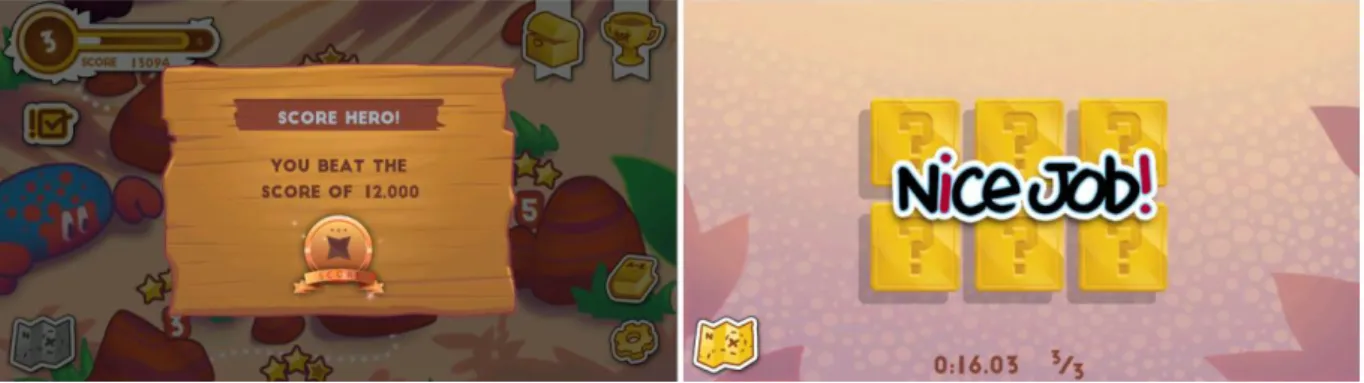
Feedbacks are messages or pictures that are shown to the user for doing some specific tasks to acknowledge him/her for correctness or wrongness of his/her tasks or to encourage him/her. In Rememry game feedbacks are given to the user based on his/her speed of playing and rate of correct selections per time during the matching game. The more sequential matched cards will bring more positive feedbacks.
Like the Point, feedback has a formula. Equation (2) shows the formula of feedback calculation, where the Seq is the length of sequential true matched cards and totalSeqSeen is the number of matching efforts. Screenshots of two feedback type has been represented in Figure 4.
TABLE VII. DESCRIPTIVE STATISTICS FOR ENGAGEMENT AND LEARNING OUTCOMES
engagement Learning outcomes
Group N Mean SD df p-value t-value Mean SD df p-value t-value
Experimental 15 13.28 2.56 14 0.04 1.88 8.42 5.58 14 0.32 0.47
Control 14 8.92 1.87 7.13 6.92
Figure 3. Rememry screenshots (Point, Progress and game levels)
Figure 4. Rememry screenshots (feedback)
Figure 5. Rememry screenshots - badge room (left hand picture) and leaderboard room (right hand picture)
𝐹𝐵𝑆𝑐𝑜𝑟𝑒 = 𝛼 ∗ 2
𝑆𝑒𝑞
√𝑡𝑜𝑡𝑎𝑙𝑆𝑒𝑞𝑆𝑒𝑒𝑛 (2) LEADERBOARD
The ordering of users according to their score or their activeness in games is named as leaderboard. With leaderboards users can compare their progress and success rate in game with other users. In Rememry three different type of leaderboards have been implemented. The first one is named as topInProgress which shows the names of top competitors who are in the same progress level as the player. The second leaderboard is named topPlayers which shows the names of top players of the game regardless of their progress levels. Last leader board is named league which shows the name of top players in the last league of the game. Leagues are events that continue for a couple of days and the players compete during these days. At the end of the league winners receive extra points and awards. Figure 5. Shows a representation of leaderboards in Rememry game.
BADGES
Badges are medals that are given to players as honor of reaching some predefined goals or achievements. Four type of badges are defined in Rememry game; these four category is as follows: first one is score badges which are given to players for reaching specific scores. Second badge category is learning badges which represents the number of learnt words by user. Third category of badges is league badges which are given to users based on being top on league leaderboard. The last badge category is day streak badges which are given for the numbers of sequential days of login in the game. Figure 5. Shows a schema of badge room in Rememry game.
2) repetition spacing interval
Repetition spacing interval which is a memorizing technic has an important role in Rememry game. The game has a section which lets users to review previously learned words. In this review section the game automatically adjusts the repetition spacing interval based on spaced repetition methods. This method’s usage is in enhancing memorization process. In memorizing items, most of the new items will eventually be forgotten after a short period of time, so in order for these items to be remembered and also to reduce the rate of knowledge forgetfulness, reviewing is regularly needed [14]. Spaced repetition is a method that specifies proper increasing interval of time between
these regular reviews. This method has been implemented in the Rememry game.
B. Procedure of Experiment II
All participants asked to fill out a questionnaire at the beginning of the game. Based on user’s personality type by knowing the appropriate game-elements for each personality type the following rules used to assign game-elements to participants: 1. since the point and progress were the most popular game-elements among entire personality dimensions, they were assigned equally to both control and experimental group. 2. In the case of control group, third game-element was randomly chosen from all of the remaining game-elements. But, in the case of experimental group, third game-elements were chosen randomly from TABLE VIII. TABLE VIII. shows a set of game-elements assigned to each Keirsey’s personality type. Game-elements for each Keirsey’s personality type in TABLE VIII. were obtained from intersection of second clusters of two rows from TABLE VI. so that these two rows have been selected based on the two personality dimension of MBTI theory that construct one personality type in Keirsey’s theory. 0TABLE VIII. represents the second cluster of game-elements for each of the Keirsey’s personality types that were obtained from the TABLE VI. The game-elements of NT group were obtained from intersection of game-elements in second clusters of N and T dimensions from TABLE VI. For NP group, N and P dimensions, for the SJ group, S and J dimensions, and finally for SP group, S and P dimensions’ have been used.
As formerly expressed first game-element cluster of all of Keirsey’s personality types was assumed to be progress and point, consequently point have been removed from second clusters if needed. Finally, three game-elements assigned to each participant and as point and progress were joint between all participants only the third game-element varied between the experimental and control group.
TABLE VIII. THIRD GAME-ELEMENT BASED ON KEIRSEY PERSONALITY TYPE
Keirsey method’s Personalities
Intersection of Second clusters (0)
NT Badge – Feedback
NF Feedback - Badge - Leaderboard
SJ Badge
SP Badge – Leaderboard 1) Results and discussion
This experiment shows that personalization based on the first experiment’s results will impress learning outcomes and engagement level. 0shows the results of experiment II. For each user, number of correct and wrong answers to all of words held. For each word, if number of sequential correct answers of user reached a specific threshold the word is assumed to has been learned by the player; therefore the phrase “Learning outcome” in TABLE VII. refers to the number of words that have been learned by player. Furthermore the user’s engagement level have been measured by the number of times that he/she has played levels of the game which the phrase “engagement” in TABLE VII. refers to this. Between experimental and control group there was a significant difference in engagement level of participants. This finding corroborates the previous studies of engagement in game-based learning. For example [8] found that fictional elements and game mechanics increase learner’s engagement; [15] represented that game design elements can increase motivation and engagement. In the case of learning outcomes, although the mean of the experimental group was higher, but there was no significant difference between experimental and control group. However, the positive impact of adaptive learning on learning outcomes has been determined in previous research. For example, [8], [16] showed that adaptive learning improves the learning outcomes; [17] indicated that adaptive learning systems can contribute positively to students’ learning outcomes; furthermore, [18] showed that engagement has a positive impact on learning outcomes. In this study the lack of significant difference in learning outcomes of experimental and control groups may be because of the low number of participants and short duration the experiment.
V. CONCLUSION AND FUTUR WORK
In this study, we investigated the interest rate of different personality types on game-elements. In previous research the impact of game-elements to increase motivation and engagement level of learners have been proven; moreover, previous researches imply the positive impact of adaptive learning and use of adaptive game-elements. In this study the results demonstrated that some personality dimensions have a significant effect on the user’s interest amount in game-elements. Furthermore, most effective game-elements for each personality dimension determined and categorized into clusters. In addition, the study demonstrated that proper game-elements in a learning game can effectively increase learning outcomes and learner’s engagement level. We presented a corresponding table between personality type and game-elements which can be used for choosing an appropriate game-elements in designing learning environments.
Limitation and future study: in the case of the experiment I because of unequal distribution of MBTI personality types, number of participants in some personality types were insufficient so analyzing all of the 16 personality types of MBTI was impossible. Furthermore, extensive researches on “Rememry” game with more users can lead to more precise results in various aspects such as learning outcomes, time of
using a system, predicting personality by user’s behavior, etc.
VI. REFRENCES
[1] A. All, E. P. Nuñez Castellar, and J. Van Looy, “Towards a conceptual framework for assessing the effectiveness of digital game-based learning,” Comput. Educ., vol. 88, pp. 29–37, Apr. 2015.
[2] K. Kiili, “Digital game-based learning: Towards an experiential gaming model,” Internet High. Educ., vol. 8, no. 1, pp. 13–24, 2005.
[3] R. Van Eck, “Digital Game-Based Learning : It ’ s Not Just the Digital Natives Who Are Restless ….,” Educ. Rev., vol. 41, no. 2, pp. 1–16, 2006.
[4] M. Prensky, Digital Game-Based learning. McGraw-Hill Education, 2001.
[5] M.-C. Li and C.-C. Tsai, “Game-Based Learning in Science Education: A Review of Relevant Research,” J. Sci. Educ. Technol., vol. 22, no. 6, pp. 877–898, 2013.
[6] F. Ke, K. Xie, and Y. Xie, “data-driven exploration,” 2016. [7] T. Hainey, T. M. Connolly, E. A. Boyle, and A. Wilson,
“Computers & Education A systematic literature review of games-based learning empirical evidence in primary education,” Comput. Educ., vol. 102, no. January 2004, pp. 202–223, 2016.
[8] P. Moreno-ger, D. Burgos, and J. Torrente, “Digital Games in eLearning Environments,” Simul. Gaming, vol. 40, pp. 669– 687, 2009.
[9] M. Carlyn, “An assessment of the Myers-Briggs Type Indicator,” Joumal Personal. Assess., vol. 41, pp. 461–473, 1977.
[10] G. J. Boyle, “Myers-Briggs Type Indicator ( MBTI ): Some psychometric limitations,” Aust. Psychol., vol. 30, pp. 71–74, 1995.
[11] J. Kim, A. Lee, and H. Ryu, “Personality and its effects on learning performance : Design guidelines for an adaptive e-learning system based on a user model,” Int. J. Ind. Ergon., vol. 43, no. 5, pp. 450–461, 2013.
[12] R. C. Wicklein and J. W. Rojewski, “The Relationship Between Psychological Type and Professional Orientation Among Technology Education Teachers,” vol. 7, no. 1, pp. 57– 74, 1995.
[13] A. Krapp, “Interest, motivation and learning: An educational-psychological perspective,” Eur. J. Psychol. Educ., vol. 14, no. 1, pp. 23–40, 1999.
[14] X.-L. Pham, G.-D. Chen, T.-H. Nguyen, and W.-Y. Hwang, “Card-based design combined with spaced repetition: A new interface for displaying learning elements and improving active recall,” Comput. Educ., vol. 98, pp. 142–156, Jul. 2016. [15] M. Qian and K. R. Clark, “Computers in Human Behavior
Game-based Learning and 21st century skills : A review of recent research,” Comput. Human Behav., vol. 63, pp. 50–58, 2016.
[16] M. Soflano, T. M. Connolly, and T. Hainey, “Learning style analysis in adaptive GBL application to teach SQL,” Comput. Educ., vol. 86, pp. 105–119, Aug. 2015.
[17] C. Dreyer and C. Nel, “Teaching reading strategies and reading comprehension within a technology-enhanced learning environment,” System, vol. 31, no. 3, pp. 349–365, 2003. [18] J. Hamari, D. J. Shernoff, E. Rowe, B. Coller, J. Asbell-Clarke,
and T. Edwards, “Challenging games help students learn: An empirical study on engagement, flow and immersion in game-based learning,” Comput. Human Behav., vol. 54, pp. 170–179, Jan. 2016.
Negar Shabihi received her B.Sc. degree from University of Tabriz in Information Technology engineering and her M.Sc. in the Department of Computer Engineering, Information Technology Group, at the University of Tehran. She is interested in e-learning systems, gamification, game-based learning and Human-Computer Interaction topics. Also, she has experiences in game design systems, level design and implementation of learning and serious games with focuses on mobile platform.
Fattaneh Taghiyareh is an
Assistant Professor of Computer Engineering -Software & Information Technology- at the University of Tehran, where she has served since 2001. She received a Ph.D. in Computer Engineering- Parallel Algorithm Processing- from the Tokyo Institute of Technology in 2000. Her research interests include Human-Centered Computing applied to Leaming Management Systems and based on Multi-Agent Systems. She is currently working on "Group Collaborative Leaming" as well as "Educational Data Mining (EDM)" with a pedagogical approach. In addition, Web Services are also another concern of her research to solve the composition problem from an ontology-based perspective.
Mohammad Hossein Abdoli got his B.Sc. from University of Tehran in software engineering. He is M.Sc. student in software engineering in university of Tehran. He is interested (and conducting research) in gamification, game-based learning and more specifically, personalization of serious games. Saeed intends to continue his career in similar fields. He also has experience in designing and programming mobile games and has published an educational game on online markets