ORIGINAL ARTICLE
Does the Rise of Housing Prices Impede Labor Supply? -Evidence
from CGSS Data
Guang Yang1, Jinhua Li2
1,2 Nankai University, Tianjin, China
Abstract: Firstly, inspired by the theoretical mechanism of housing prices on consumption and savings, this paper summarizes three kinds of mechanisms of housing prices on labor supply in China: the wealth effect, the mortgage slave effect and the home mortgage effect and then empirically analyzes the influence and heterogeneity of housing prices on the quantity and quality of labor supply using Chinese General Social Survey (CGSS). Finally, to observe the difference of the influences of housing prices on labor supply of different groups, it distinguishes between households with and without houses, young and old groups.
Keywords: labor supply; housing prices; wealth effect; mortgage slave effect; home mortgage effect
1. Introduction
On December 9, 2015, the World Bank released the report titled “The Life of a Longer Life: An Aging Population in East Asia and the Pacific.” The report indicates that as the aging population accelerates, Chinese labor force is facing an unprecedented pressure to shrink and will reduce by 90 million people of working age until 2040.Many scholars start with individual characteristics and study the impact of human capital such as health and education on labor supply. In developed countries, the decline in the health status of workers can significantly inhibit workers’ willingness to enter the labor market and reduce their working time and income[1]. In a developing country like Indonesia, we have found that
worsening health conditions reduce the local residents' labor participation probability and income level [2]. Similarly,
scholars in China have used the China Health and Nutrition Examination Survey (CHNS) data to test the impact of health as an exogenous variable on the labor supply of residents. It was found that the health status of the lagging period was significantly positively correlated with the current labor supply and the labor participation probability of healthy individuals is higher[3] as well as the income level [4]. Therefore, from the perspective of human capital, the
improve-ment of health conditions does promote the supply of labor.
However, while the health status of Chinese labor suppliers are getting better and better, the supply of labor is de-creasing. This shows that there are reasons other than health factor to explain the changes in labor supply of China. This article believes that the current high housing prices in China have a significant impact on labor supply. On the one hand, the wealth gains caused by the rising housing prices to real estate owners are likely to prompt them to enjoy their spare time instead of working, thus reducing the labor supply; on the other hand, in terms of the consumption and investment attributes of real estate, rising housing prices will cause people without house and their families to increase labor supply in order to guarantee other purchases while buying a house[5]. At the same time, all households may increase their labor
Copyright © 2018 Yang Guang et al. doi: 10.18686/fm.v3i2.1116
This is an open-access article distributed under the terms of the Creative Commons Attribution Unported License
(http://creativecommons.org/licenses/by-nc/4.0/), which permits unrestricted use, distribution, and reproduction in any medium, provided the original work is properly cited.
supply to invest in real estate as housing prices continue to rise, regardless of ownership. Because of the large amount of real estate investment, it is difficult for the average family to pay the full amount. Therefore, borrowings derived from this will increase the household's debt level, thus forcing families to participate more in labor market and extending working hours to repay debts[6]. Then, whether the current rising housing prices have exerted an inhibitory or
promo-tional effect on China's labor supply? This article hopes to study the net effect of increasing housing prices on China's labor supply and provide a new idea for explaining the changes in China's labor supply. At present, there are not many studies on the impact of housing prices on labor supply, and the existing researches mainly conducted by foreign schol-ars. From the perspective of the research objects, most of the studies focus on married women and the elderly[7];as to the
research content, the existing papers focus on the impact of housing price on labor participation probability[6], while
there is little research on the impact of housing price on working hours and wage levels[8]. Therefore, this paper will
study the influence of housing prices on labor participation probability, working hours and wage level of all labor sup-pliers from both the quantity and quality perspectives of labor supply.
The rest of the paper will be organized as follow: part II summarizes the mechanisms of housing prices on labor supply; part III descripts data source and sets model; part IV empirically analyzes the net effect and heterogeneity of housing prices on labor supply, and the net effect of housing prices on labor supply of different groups; part V con-cludes.
2. Mechanisms of Housing Prices on Labor Supply
With regard to the mechanisms of housing prices on labor supply, this article is mainly inspired by the mechanisms of housing prices on consumption and savings. Housing prices mainly affect consumption and savings through three channels.
For families with real estate, they can sell and rent out their excess real estate[9]. The increase in housing
pric-es bring about an increase in their net wealth, which will lead to an increase in their consumption expenditure. The is the wealth effect caused by the rise in housing prices[10].The home mortgage effect means that the credit market enables
homeowners to use their existing properties to obtain loans, thereby increasing the affordability of housing wealth[11].The rise in real estate prices, on the one hand, is likely to squeeze the consumption of those who are planning
to purchase houses for the first time. On the other hand, some consumers who already have houses may also squeeze other consumption in order to join the ranks of speculative house purchasing[10]. It is the mortgage slave
ef-fect brought by rise in housing prices.
Leisure is a kind of consumption and is usually regarded as a normal product. Therefore, the mechanisms of the impact of housing price on consumption can be extended to the study of housing prices on labor supply. By summariz-ing, there are three theoretical mechanisms for the impact of housing prices on China's labor supply. The first mecha-nism is the wealth effect. Rising housing prices will increase the net wealth of labor suppliers who own real estate. Ris-ing housRis-ing prices, whether through the form of refinancRis-ing or rentRis-ing out real estate to deliver on capital gains, will facilitate labor suppliers' consumption of leisure [10] and reduce their labor supply. The second channel is the mortgage
slave effect. All along, the Chinese people's "house-based" ideology is very deep, and the idea of "no house, no mar-riage" has long been entrenched. Real estate as a consuming product, when its price rises, due to the existence of ratchet effect and the rigid demand for life necessities, people without house will inevitably squeeze other expenses in order to buy a house, and increase labor supply [5]. The continuous rise in housing prices is also likely to force the parents and
even grandparents to increase their labor supply to support their children's house purchasing plan[7]. Real estate is also
an investment product [12]. Regardless of whether own real estate, continuous rising housing prices will encourage more
labor force enter into labor market for the purpose of housing investment. The third channel is the home mortgage ef-fect[13] which is mainly for house owners. Families with real estate can purchase more houses through mortgage loans
and be burdened with higher debt, thus pushing up the family's labor supply[7].
In conclusion, the wealth effect will have a negative effect on the labor supply, while the mortgage slave and home mortgage effect will positively promote labor supply.
Finance and Market Volume 3 Issue 2| 2018|3
3. Data Description and Model Setting
3.1 Data Description and Variables
The data used in this paper are mainly from the Chinese General Social Survey (CGSS) in 2010, 2012, 2013 and 2015. The data of housing prices are from the Wind database. Since the research object of this study is exactly the pop-ulation in working age, this study selected males aging from 16 to 64 and females aging from 16 to 55.
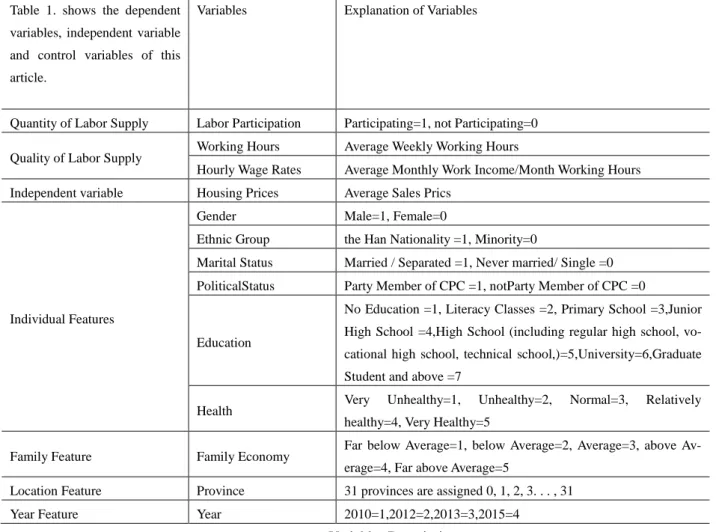
Table 1. shows the dependent variables, independent variable and control variables of this article.
Variables Explanation of Variables
Quantity of Labor Supply Labor Participation Participating=1, not Participating=0 Quality of Labor Supply Working Hours Average Weekly Working Hours
Hourly Wage Rates Average Monthly Work Income/Month Working Hours Independent variable Housing Prices Average Sales Prics
Individual Features
Gender Male=1, Female=0
Ethnic Group the Han Nationality =1, Minority=0
Marital Status Married / Separated =1, Never married/ Single =0 PoliticalStatus Party Member of CPC =1, notParty Member of CPC =0
Education
No Education =1, Literacy Classes =2, Primary School =3,Junior High School =4,High School (including regular high school, vo-cational high school, technical school,)=5,University=6,Graduate Student and above =7
Health Very Unhealthy=1, Unhealthy=2, Normal=3, Relatively healthy=4, Very Healthy=5
Family Feature Family Economy Far below Average=1, below Average=2, Average=3, above Av-erage=4, Far above Average=5
Location Feature Province 31 provinces are assigned 0, 1, 2, 3. . . , 31
Year Feature Year 2010=1,2012=2,2013=3,2015=4
Table 1. Variables Description
3.2 Model Setting
In order to figure out the impact of housing prices on the quantity and quality of labor supply, the following models are constructed separately:
Pr(work = k) = ∅(α + β ln (hp) + γ𝑋1+ 𝜏𝑋2+ 𝜑𝑋3+ 𝜔𝑋4) (1)
job − quality = α + β ln(hp) + γ𝑋1+ 𝜏𝑋2+ 𝜑𝑋3+ 𝜔𝑋4+ 𝜀 (2)
In model (1), the dummy variable work represents labor participation and reflects the quantity of labor supply. In model (2), job-quality represents the quality of labor supply, measured by the average weekly working time and the natural logarithm of hourly wage rates. Ln(hp) represents the natural logarithm of housing prices, and X1, X2, X3, and X4 represent personal features, family feature, location feature, and year feature, respectively.
4. The Empirical Analysis of the Impact of Housing prices on Labor Supply
4.1 The Net Effect of Housing Prices on Labor Supply
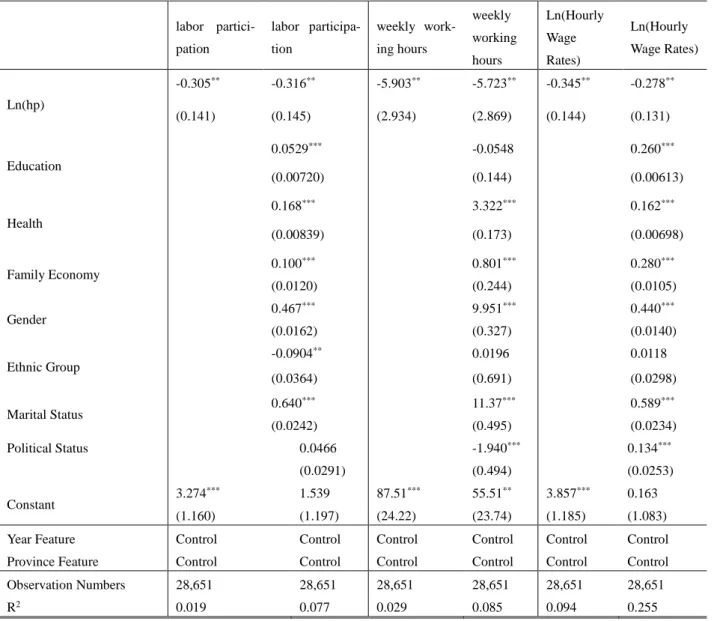
Table 2 shows the marginal impact of housing prices on labor participation, working hours, and hourly wage rates. Without any control variables, the marginal effect of housing prices on labor participation, working hours, and hourly wage rates are negative and significant at the 5% level, indicating that housing prices have a net negative effect on labor supply. After adding control variables,
the impact coefficients of housing prices on labor participation, working hours, and hourly wage rates are -0.316, -5.723, and -0.278, respectively, and remain significant at the 5% level, indicating that under control of other factors, ong percentage point increase in housing prices will result in a drop in labor participation rate of approximately 0.32%, a reduction of 0.057 hours in working hours per week, and a decrease of 0.28 yuan/hour of hourly wage rate. Thus, it can be seen that the wealth effect exceeds the sum of the mortgage slave effect and the mortgage effect. The increase in housing prices does suppress the supply of labor and reduce the labor participation rate, weekly working hours and hourly wage rate of the entire society.
labor partici-pation
labor participa-tion
weekly work-ing hours
weekly working hours
Ln(Hourly Wage Rates)
Ln(Hourly Wage Rates)
Ln(hp)
-0.305** -0.316** -5.903** -5.723** -0.345** -0.278**
(0.141) (0.145) (2.934) (2.869) (0.144) (0.131)
Education
0.0529*** -0.0548 0.260***
(0.00720) (0.144) (0.00613)
Health
0.168*** 3.322*** 0.162***
(0.00839) (0.173) (0.00698)
Family Economy 0.100
*** 0.801*** 0.280***
(0.0120) (0.244) (0.0105)
Gender 0.467
*** 9.951*** 0.440***
(0.0162) (0.327) (0.0140)
Ethnic Group
-0.0904** 0.0196 0.0118
(0.0364) (0.691) (0.0298)
Marital Status 0.640
*** 11.37*** 0.589***
(0.0242) (0.495) (0.0234)
Political Status 0.0466 -1.940*** 0.134***
(0.0291) (0.494) (0.0253)
Constant 3.274
*** 1.539 87.51*** 55.51** 3.857*** 0.163
(1.160) (1.197) (24.22) (23.74) (1.185) (1.083)
Year Feature Control Control Control Control Control Control
Province Feature Control Control Control Control Control Control
Observation Numbers 28,651 28,651 28,651 28,651 28,651 28,651
R2 0.019 0.077 0.029 0.085 0.094 0.255
Note: The marginal effect is reported in the table, and the robust standard error is in the brackets. ***, **, and * represent significant at the 1%, 5%, and 10% levels, respectively. The notes of other regression forms in this article are the same as this and are omitted.
Table 2. Impact of Housing prices on Labor Supply
4.2 The Heterogeneity of Housing prices on Labor Supply
In table 3, the marginal coefficients of the interactions of housing prices and education are significantly posi-tive at the level of 1%, which indicates that the negaposi-tive impact of housing prices on labor participation, weekly working hours, and hourly wage rate decreases with the increase of education level of labor suppliers. In general, the average wage level of highly educated workers is also relatively high, and their salary level is also growing relatively faster[14]. As a result of the wealth effect, rising housing prices will have a negative impact on labor sup-ply, however, those with higher incomes will have relatively lower levels of risk aversion. Therefore, the increase
Finance and Market Volume 3 Issue 2| 2018|5
in housing prices will have a smaller wealth effect on the highly educated labor suppliers. In addition, as the level of income increases, the level of consumption of labor suppliers will gradually escalate. Real estate is a kind of high-end consuming goods. When housing prices rise, highly educated workers will work harder and require higher wage levels to maintain and even increase their own consumption levels. Therefore, the increase in the ed-ucation level of labor suppliers will weaken the negative impact of rising housing prices on labor supply.
labor partici-pation
labor partici-pation
weekly working hours
weekly working hours
Ln(Hourly Wage Rates)
Ln(Hourly Wage Rates)
Ln(hp) -1.134
*** -1.337*** -14.82*** -17.91*** -1.133*** -1.193***
(0.154) (0.160) (3.180) (3.121) (0.145) (0.139)
Ln(hp)*Education 0.207
*** 0.256*** 2.240*** 3.057*** 0.198*** 0.230***
(0.0150) (0.0160) (0.292) (0.293) (0.0146) (0.0143)
Education -1.710
*** -2.134*** -19.15*** -26.14*** -1.386*** -1.700***
(0.128) (0.136) (2.497) (2.504) (0.124) (0.121)
Other Variables Control Control Control Control Control Control
Control Control Control Control Control Control
Year Feature Control Control Control Control Control Control
Province Feature Control Control Control Control Control Control
Observation numbers 28,651 28,651 28,651 28,651 28,651 28,651
R2 0.027 0.085 0.030 0.089 0.174 0.264
Table 3. Heterogeneity of Housing Prices on Labor Supply (Education)
In table 4, the marginal coefficients of the interactions between housing prices and health are significantly positive, indicating that the negative effect of housing prices on labor supply will gradually decrease with the improvement of workers’ health conditions. Health is a prerequisite for participation in labor. The mortgage slave effect brought by ris-ing housris-ing prices will encourage healthy labor suppliers to participate more in labor, extend workris-ing hours, and pursue higher labor remuneration to meet their home purchase needs. In addition, the continuous rise in housing prices has made real estate a popular investment product, thus healthy individuals will invest more in labor to meet the investment needs of real estate. Therefore, the healthier labor suppliers will not reduce their labor supply when housing prices rise.
labor partici-pation
labor partici-pation
weekly working hours
weekly working hours
Ln(Hourly Wage Rates)
Ln(Hourly Wage Rates)
Ln(hp) -0.504
*** -0.661*** -8.645*** -10.86*** -0.439*** -0.601***
(0.153) (0.157) (3.154) (3.114) (0.151) (0.141)
Ln(hp)* Health 0.0675
*** 0.105*** 0.975*** 1.517*** 0.0420** 0.0955***
(0.0172) (0.0179) (0.336) (0.338) (0.0183) (0.0172)
Health -0.421
*** -0.726*** -5.425* 0.824*** -0.109 -0.654***
(0.147) (0.153) (2.894) (0.244) (0.155) (0.146)
Other Variables Control Control Control Control Control Control
Control Control Control Control Control Control
Year Feature Control Control Control Control Control Control
Province Feature Control Control Control Control Control Control
Observation numbers 28,651 28,651 28,651 28,651 28,651 28,651
R2 0.031 0.078 0.039 0.086 0.129 0.256
In table 5, the marginal coefficients of the interactions of housing prices and family economy are significantly positive at the 1% level, indicating that the negative effect of housing prices on labor supply will gradually decrease with the improvement of the family economy of labors. Relatively high levels of risk aversion are found in family with poorer economy [15]. By contrast, the wealth
pre-mium brought by rising housing prices has a greater marginal utility to family with poor economic conditions. Relatively speaking, families with better economy are less likely to use leisure to replace jobs just due to the increase in wealth. Therefore, the better the family economy, the lower the housing prices will have a negative impact on labor supply.
labor partici-pation
labor partici-pation
weekly working hours
weekly working hours
Ln(Hourly Wage Rates)
Ln(Hourly Wage Rates)
Ln(hp) -0.381** -0.517*** -7.442** -9.310*** -0.405*** -0.540***
(0.151) (0.156) (3.152) (3.088) (0.149) (0.140)
Ln(hp)* Family Economy
0.0486** 0.0834*** 0.822* 1.477*** 0.0751*** 0.108*** (0.0226) (0.0235) (0.452) (0.450) (0.0240) (0.0230)
Family Economy -0.262 -0.618*** -5.477 -11.89*** -0.223 -0.647***
(0.194) (0.202) (3.909) (3.888) (0.204) (0.195)
Other Variables Control Control Control Control Control Control
Control Control Control Control Control Control
Year Feature Control Control Control Control Control Control
Province Feature Control Control Control Control Control Control
Observation numbers 28,651 28,651 28,651 28,651 28,651 28,651
R2 0.025 0.077 0.030 0.086 0.143 0.256
Table 5. Heterogeneity of Housing prices on Labor Supply (Family Economy)
4.3 The Effect of Housing Prices on Labor Supply of Different Groups
So far, this paper has studied the effects of rising housing prices on the quantity and quality of labor supply, and assumes that all labor suppliers are regarded as the same group. In fact, the labor supply of different groups has different sensitivity to housing prices. From the previous analysis of the three effects of housing prices on labor supply, we can see that for labor supplier with houses and without houses, the impacts of rising housing prices on labor supply are not exactly the same. Theoretically, for labor supplier with houses, high housing prices have a negative wealth effect on their labor supply and a positive mortgage slave effect and housing mortgage effect. However, for labor supplier with-out houses, housing prices mainly have a positive mortgage slave effect on their labor supply. Therefore, this paper hopes to differentiate between those who have houses and don not have houses and compare the impact of housing prices on their labor supply.
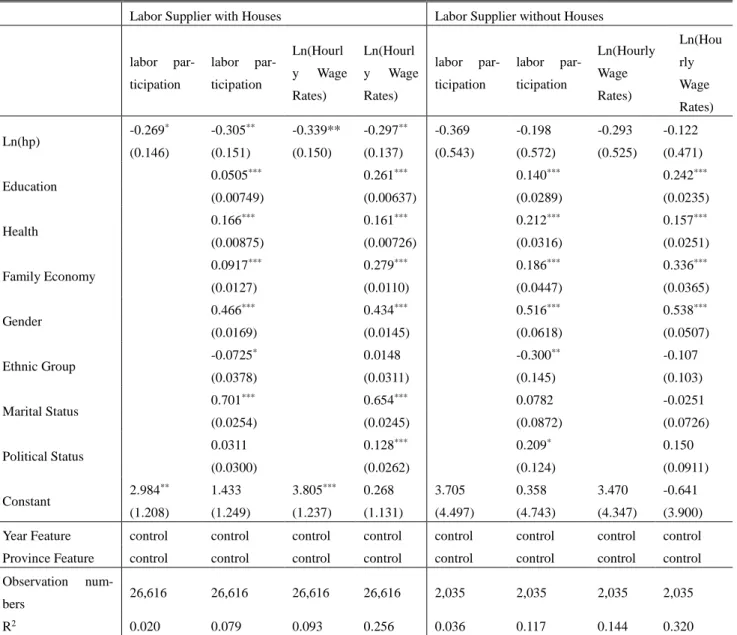
Table 6 shows the impact of housing prices on the labor supply of labor supplier with houses and without houses. We find that the marginal effect of housing prices on the labor supply of labor supplier with houses is significantly negative, while the marginal effect on the labor supply of labor supplier without houses is negative but not significant, which is not in line with the mortgage slaves ef-fect. This result shows that for labor supplier with houses, the negative wealth effect of rising housing prices exceeds the sum of the positive mortgage slaves and home mortgage effect, so we can conclude that the wealth increment brought by the increasing housing prices strongly substitutes the gaining from labor participation. However, for those who do not have any house, the increase in hous-ing prices does not significantly contribute to their increase in labor supply through the mortgage slave effect. This is mainly because current housing prices in China are too high and the growth rate is too fast, which makes it difficult to form effective incentives for labor supplier without houses. Even if they want to rely on their parents and even grandparents, they do not have enough capital to support high housing prices. In China, the most common situation for us is that parents help young people pay down payment, and the remaining part needs the children to bear their own. In addition to the high housing prices, the young people's thinking about house purchasing is becoming more and more progressive. Many young people, especially those who born in the 1990s, would rather rent a house than buy a house at the cost of reducing their living standards. Therefore, we can see that the effects of high housing
Finance and Market Volume 3 Issue 2| 2018|7
prices on labor supply are quite different for the young and the old groups. Next, this article continues to classify the sample of labor suppliers into a young group (below 45 years old) and an old group (45 years old and above) to observe the changes in the labor sup-ply of people in different ages when facing rising housing prices.
Labor Supplier with Houses Labor Supplier without Houses
labor par-ticipation
labor par-ticipation
Ln(Hourl y Wage Rates)
Ln(Hourl y Wage Rates)
labor par-ticipation
labor par-ticipation
Ln(Hourly Wage Rates)
Ln(Hou rly Wage Rates)
Ln(hp) -0.269
* -0.305** -0.339** -0.297** -0.369 -0.198 -0.293 -0.122
(0.146) (0.151) (0.150) (0.137) (0.543) (0.572) (0.525) (0.471)
Education 0.0505
*** 0.261*** 0.140*** 0.242***
(0.00749) (0.00637) (0.0289) (0.0235)
Health 0.166
*** 0.161*** 0.212*** 0.157***
(0.00875) (0.00726) (0.0316) (0.0251)
Family Economy 0.0917
*** 0.279*** 0.186*** 0.336***
(0.0127) (0.0110) (0.0447) (0.0365)
Gender 0.466
*** 0.434*** 0.516*** 0.538***
(0.0169) (0.0145) (0.0618) (0.0507)
Ethnic Group -0.0725
* 0.0148 -0.300** -0.107
(0.0378) (0.0311) (0.145) (0.103)
Marital Status 0.701
*** 0.654*** 0.0782 -0.0251
(0.0254) (0.0245) (0.0872) (0.0726)
Political Status 0.0311 0.128
*** 0.209* 0.150
(0.0300) (0.0262) (0.124) (0.0911)
Constant 2.984
** 1.433 3.805*** 0.268 3.705 0.358 3.470 -0.641
(1.208) (1.249) (1.237) (1.131) (4.497) (4.743) (4.347) (3.900) Year Feature control control control control control control control control Province Feature control control control control control control control control Observation
num-bers 26,616 26,616 26,616 26,616 2,035 2,035 2,035 2,035
R2 0.020 0.079 0.093 0.256 0.036 0.117 0.144 0.320
Table 6. The Effect of Housing Prices on Labor Supply for Labor Supplier with Houses and without Houses According to Table7, we find that the increase in housing prices has no significant effect on the labor supply of young people, but the impact on the elderly group is significantly negative at the 1% level. The reason why rising ing prices have no significant effect on young people's labor supply is that the proportion of young people having hous-es is quite lower than the elderly, so the wealth effect and home mortgage effect are relatively small for them. And it is difficult to encourage them to become house slaves due to the high housing prices and fast housing price growth rate. Young people without real estate would choose to take advantages of renting instead of house purchasing. Owing to the existence of suitable alternatives for house purchasing, young people's labor supply becomes less sensitive to the rise of housing prices. However, for the elderly group, rising housing prices will reduce their probability of labor participation and reduce the length of working time. Compared with young people, the proportion of older people owing real estate is quite high, and the wealth effect will reduce the mortgage effect they face. The reason that the elderly become house slaves and apply for a home mortgage loan is largely for their children than for themselves. On the one hand, they hope to ease the pressure on their children's home purchase by participating in labor market and extending working hours; on the other hand, the legacy motive of the elderly is very strong. Therefore, when housing prices increase their wealth,
they do not have to participate more in labor market and even rejoin the labor market. Young Group
(below 45 years old)
Elderly Group
(45 years old and above) Ln(Hourly Wage
Rates)
Ln(Hourly Wage
Rates) Ln(Hourly Wage Rates)
Ln(Hourly Wage Rates)
Ln(hp) 0.143 0.187 -0.623
*** -0.533***
(0.187) (0.165) (0.209) (0.193)
Education 0.233
*** 0.216***
(0.00857) (0.00890)
Health 0.0466
*** 0.195***
(0.0100) (0.00972)
Family Economy 0.296
*** 0.255***
(0.0142) (0.0146)
Gender 0.680
*** 0.293***
(0.0178) (0.0214)
Ethnic Group 0.0918
** -0.0880*
(0.0375) (0.0471)
Marital Status 0.845
*** 0.112
(0.0247) (0.0735)
Political Status 0.376
*** 0.0651*
(0.0307) (0.0359)
Constant -0.110 -3.557
*** 6.084*** 3.022*
(1.538) (1.364) (1.722) (1.597)
Year Feature control control control control
Province Feature control control control control
Observation numbers 16,057 16,057 12,594 12,594
R2 0.025 0.148 0.064 0.209
Table 7. The Effect of Housing prices on Labor Supply for the Young and the Elderly
5. Conclusion
Rising housing prices significantly reduce the labor supplier's probability of labor participation, working hours and wage levels. The impacts of housing prices on the labor supply of individuals with different education, health conditions, and family economy are heterogeneous. The improvement of education, health conditions, and family economy inhibits the negative impact of housing prices on labor participation probability, working hours, and wage levels. For different labor supply groups, the increase in housing prices has suppressed the quantity and quality of labor supply for labor supplier with houses and the elderly, while the marginal effect of housing prices on labor supply for labor supplier without houses and young people is not significant.
References
1. Pelkowski JM. and Berger MC. The impact of health on employment, wages and hours worked over the life cy-cle[J]. The Quarterly Review of Economics and Finance 2004; 44(1): 102-121.
2. Thomas D, Frankenberg E, Friedman J. Causal effect of health on labor market outcomes: experimental evi-dence[J]. Working Paper Series 2006.
3. Liu SL, Li J. Health, labor participation and elderly poverty in rural China[J]. Chinese Rural Economy 2012(1). 4. Yuan HN. Health and income of peasant workers in cities: evidence from Peasant Worker Survey in Beijing[J].
Management World 2009(5).
5. Glaeser EL, Nathanson CG. An extrapolative model of housing price dynamics[J]. NBER Working Paper 2015. 6. Wu WP, Zhang Y, Liu NQ. Housing prices and women's decision-making of labor participation - evidence from
Finance and Market Volume 3 Issue 2| 2018|9
7. Disney RF, Gathergood J. House prices, wealth effects and labor supply[J]. Institute for Fiscal Studies, Working Paper 2014.
8. Farnhan M, Sevak P. Housing wealth and retirement timing[J]. CESifo Economics Studies 2016; 62(1): 26-46. 9. Zhang CY, Zhang YY, Wu Y. Does house price fluctuation have income distribution effects? - the perspective of a
family asset structure [J]. Financial Research 2014; (12).
10. Ludwing A, Torsten S. The impact of changes in stock prices and housing prices on consumption 11. in OECD countries [J]. IMF Working Paper 2002.
12. Deng Jian, Zhang Yuxin. The impact of house price fluctuations on residents' consumption [J]. Management World 2011(4).
13. Wu XY, Wang M, Li LX. Did high housing price discourage entrepreneurship in China Economic Research Jour-nal 2014.
14. Iacoviello M, Neri S. Housing market spillovers: evidence from an estimated DSGE Model. American Economic Journal: Macroeconomics 2010; 2(2): 125-164.
15. Luo CL. Urban residents' return on education and its distribution characteristics[J]. Economic Research Journal 2007.
16. Haurin DR, Rosenthal SS. The impact of housing price appreciation on portfolio consumption and savings[J]. Economic Development Publications from U.S. Department of Housing and Urban Development, 2004.