And Disparities in Pediatric Pyogenic Arthritis
By
Joshua N. Freedman
A Master's Paper submitted to the faculty of
The University of North Carolina at Chapel Hill
in partial fulfillment of the requirements for
the degree of Master of Public Health in
the Public Health Leadership Program
Chapel Hill
National Trends in Health Care Utilization and Disparities in Pediatric
Pyogenic Arthritis
Abstract
OBJECTNE: To detennine the national trends in health care utilization and
disparities in pediatric pyogenic arthritis over a thirteen-year period.
METHODS: We determined the trends in length of hospital stay, disposition, and
total cost for pediatric patients hospitalized with pyogenic arthritis from 1988 to 2000.
Patients were selected using International Classification of Diseases, Ninth Revision,
Clinical Modification (ICD-9, CM) codes in the Nationwide Inpatient Sample (NIS).
The NIS is part of the Healthcare Cost and Utilization Project (HCUP), sponsored by
the Agency for Healthcare Research and Quality (AHRQ). There were 12,925 cases
analyzed by age, prematurity, joint location, socioeconomic status, and race.
RESULTS: The average length of stay (LOS) decreased from 10 days in 1988 to
5 days in 2000, with whites having a shorter LOS than non-whites. LOS decreased for
both whites and non-whites but the difference in length of stay between the two
remained constant. LOS was also shorter for patients with a higher socioeconomic
status but differences in LOS between socioeconomic classes decreased from 1988 to
2000. The percentage of patients being discharged to home health care increased from
1988 to 2000. Both whites and non-whites had an increase in percentage of patients
discharged to home health care but the increase was much greater for whites than
non-whites. Inflation adjusted total cost increased over time.
1
b
CONCLUSIONS: There was a trend toward decreased health care utilization but
no decrease in cost due to pediatric pyogenic arthritis from 1988 to 2000. Disparities
between whites and non-whites exist and have not improved over time.
Keywords: length of stay I utilization I arthritis, infectious I costs and cost analysis I
patient discharge I pediatrics
i
Introduction
The United States spends more money, both in actual dollars and as a percentage
of the Gross Domestic Product (GDP), on health care than any other country in the
world1 This rate has been increased substantially over the last decades2, with hospital
spending being the key driver in this trend.2•3 Although hospitalizations due to
infectious diseases are responsible for a large percentage of this increase 4•5, few studies
have evaluated this upward trend.
This upward trend in health spending provides the impetus to find ways to
decrease health care utilization and the associated cost. Because of the impact of
hospital spending on total health care expenditures, reduction in the delivery of
inpatient services has been one of the main strategies to reduce health care costs.6 One
way to reduce the use of inpatient services is to reduce the length of stay of a given
hospitalization. In the case of septic arthritis, which has traditionally required a two to
four week length of stay to finish a complete course of parenteral antibiotics, 7•8·9
research has been aimed at finding treatments to reduce the length of time required for
intravenous antibiotics. 10·11 This research has the potential to reduce the length of stay
associated with pyogenic arthritis. A reduced length of hospital stay, either through a
shortened course of parenteral antibiotics or through outpatient antibiotic therapy, can
lead to a decrease in health care utilization due to pyogenic arthritis. 12 In this paper, we
have attempted to assess whether the length of hospital stay has declined for patients
with pyogenic arthritis and whether this resulted in decreased medical costs.
Along with rising health care costs, the unequal treatment of racial and ethnic
goals of the Healthy People 2010 initiative being to eliminate racial and ethnic
disparities in six key health areas. Studies have shown higher mortality rates for
minorities with stroke, diabetes, cancer, heart disease, acquired immunodeficiency
syndrome (AIDS), and lung disease. Infection was second only to cardiovascular
disease in terms of major categories of disease contributing to disparities in mortality. 14
Due to the contribution of infectious disease to the problem in health disparities, we
attempted to assess whether disparities also exist for pediatric pyogenic arthritis. In this
paper, we also attempted to discover if the efforts being made to reduce the length of
stay associated with pyogenic arthritis10•11, would have an impact on any racial
Methods:
Study Population
Patients with ICD-9, CM (International Classification of Diseases, Ninth
Revision, Clinical Modification) diagnostic codes for pyogenic arthritis were selected
from the Nationwide Inpatient Sample (NIS) (Appendix-A). Patients over the age of 21
were excluded.
The NIS databases provide demographic data, admission and discharge dates,
I
inpatient stay records including clinical and resource use information typically available
from discharge abstracts, as well as discharge status. The procedure and diagnostic
p
codes are classified according to the ICD-9, CM. The NIS is part of the Health careCost and Utilization Project (HCUP), sponsored by the Agency for Healthcare Research
and Quality (AHRQ), and contains 5 to 8 million hospital stays from about 1000
hospitals to approximate a 20% stratified sample of the U.S. community hospitals.
Sampling strata were employed for the creation of the NIS based on five hospital
characteristics to ensure maximal representativeness of the US population (geographic
region, ownership, location, teaching status, bedsize). The NIS contains data over a
13-year time period, from 1988 to 2000, allowing for analysis of trends over time.
The NIS was validated by reviewing the univariate statistics for all numeric data
elements, checking range against norms, frequency distributions for all categorical and
between related data elements. 15 The NIS also performed well for many estimates
when validated against the National Hospital Discharge Survey (NHDS). 16
Outcomes
Length of stay (LOS): LOS, measured in days, was defined as the difference between
date of admission and date of discharge of the patient. Length of stay was coded as 0 for
patients discharged within 23 hours from admission.
Disposition: Patient disposition was dichotomized into those receiving home health
care and those that did not.
Total charges: Total charges were the charges of a patient's hospitalization, not
including professional fees and non-covered charges. Values were adjusted for inflation
to represent year 2000 dollars17 and rounded to the nearest dollar. Zero and negative
values were set to missing.
Co variates
Patients ( <21 years old) were categorized into neonates ( <90 days old), children (90
days old- 13 years old) and adolescents (13-21 years old). Neonates were considered
premature if they had a birth weight of 1000-2499 grams and/or gestation of 28-37
grams and/or a gestation of less than 28 completed weeks (Appendix B). Joint location
was coded as pelvic region and thigh, lower leg (lower leg, ankle, and foot) and other
(unspecified site, shoulder region, upper arm, forearm, hand, other specified sites, and
multiple sites). Race was categorized as whites, blacks, and others. Socio-economic
status (SES) was categorized using the median household income for the patient's ZIP
code. It was divided into four categories: $1-$24,999 (lower), $25,000-$34,999
(lower-middle), $35,000-$44,999 (upper-(lower-middle), and $45,000 and above (upper).
Statistical Methods
The NIS database is a stratified probability sample and calculations
were adjusted for survey sampling characteristics (probability weights, cluster
sampling, and stratification). All statistical analyses were performed using Stata
version 8.0 (Stata Corporation, Intercooled Stata 8.0 for Unix).
L L
~-Results
The databases contain information about 12,925 inpatient encounters for treatment of
pyogenic arthritis.
Baseline Characteristics
In the total patient population, the majority of the cases (69.6%) were children, male
(63.8%), and predominantly white (37.5%). Among the adolescents, over two thirds
(71.8%) of the patients were male. Patients were evenly distributed across the four
income categories with no group being represented by less than 17%. Overall, the most
common site of infection was the lower leg (38.6% ). This is in contrast with neonates,
where the pelvis or thigh region was more common (33.0%) than the lower leg (31.9%).
For adolescents the pelvis or thigh region was less common (9.3%) than the lower leg
(39.1 %). (Table 1)
LOS
The average length of stay was 25.3 days for a neonate, 9.5 days for a child, and 8.0
days for an adolescent. Of the 373 neonates with pyogenic arthritis, 42 patients (11.3%)
had an ICD-9 code for prematurity, and 24 (6.4%) had a code for extreme prematurity.
infants ( 44.55 days). Both groups had a longer LOS than those without a prematurity
code (18.90 days). LOS was longer for those with a pelvis or thigh infection (10.57
days) than those with a lower leg or other infection (8.84 days). The average length of
stay declined steadily across the thirteen years of the study (figure 1).
In 1988, LOS was longer for patients with a lower socio-economic status compared to
patients with a higher socio-economic status. The difference in LOS between different
socio-economic groups was significantly reduced by the year 2000 (figure 2). Overall
there was a trend towards a shorter LOS over time but the difference in LOS for whites
versus blacks and others did not change significantly over the thirteen years (figure 3).
Disposition
There were 20 in-hospital deaths among the 12, 925 patients (0.2% ), with no preference
for neonates (11373, 0.3%), children (15/8997, 0.2%), or adolescents (4/3555, 0.1 %).
Adolescents were more likely to receive home health care (13.2%) than neonates
(11.5%) or children (11.7% ). There was a trend over the thirteen years to send more
people home to complete their care (figure 4). This increase was more prominent for
patients from households with higher incomes (figure 5). The trend over the thirteen
years was for patients of all races to receive home health care but the gap between
whites and non-whites widened (figure 6).
f---r
L
~---Total charges
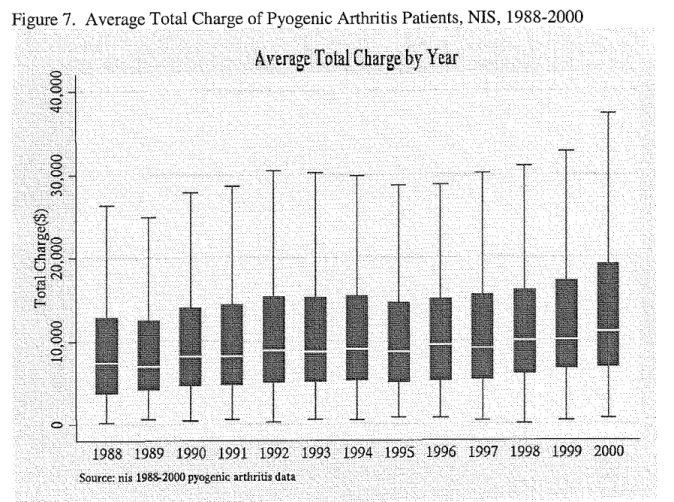
There was a trend toward an increase in total charges across the thirteen years (figure
7). Outliers were excluded.
f--_;___
Discussion
In 1988, patients with a higher SES had a shorter LOS compared to patients with
a lower SES. Similarly, whites had a shorter LOS compared to non-whites. However,
by the year 2000, SES was much less likely to predict LOS, while non-whites continued
to have a longer LOS than whites. For all patients, regardless of race or SES, LOS has
decreased from 1988 to 2000. Unfortunately the associated costs have actually
increased.
To the best of our knowledge, this is the first attempt to demonstrate that the
efforts to shorten the course of parenteral antibiotics required to treat patients with
pyogenic arthritis 10·11 have actually resulted in a reduced length of hospital stay. Other
studies have demonstrated that changes in treatment practices can reduce the LOS for a
other conditions. Treating methicillin-resistant Staphlococcus aureus infections with
Linezolid (available both intravenously and orally) as opposed to vancomycin (only
available intravenously) facilitates earlier discharge from the hospital.18 Despite
assertions that decreasing the LOS by promoting earlier hospital discharge will
significantly reduce the overall costs, in this case no evidence that costs were actually
reduced was provided.18 In some situations alternative treatments for a given disease
have been shown to reduce both LOS and cost. Treating pyogenic liver abscesses with
sequential intravenous/oral antibiotics as opposed to treating them with continuous
intravenous antibiotics reduced both LOS and cost. 19 Treatment of gram-positive
infections with intravenous linezolid followed by oral administration was found to
reduce the length of stay and the associated cost of treatment when compared with
I
r
L
intravenous or intramuscular teicoplanin. 20 Our study found that while efforts to reduce
the LOS associated with pyogenic arthritis have been successful, these efforts have not
resulted in decreased costs.
While there has been a trend towards a reduced length of stay for all patients, the
disparities between whites and non-whites has remained. Whites consistently have a
shorter length of stay than non-whites across all thirteen years of the study. Other
studies have shown similar differences by race for LOS. In 1995, white patients with
systemic sclerosis had an average LOS 10% shorter than non-whites. 21 Additionally,
from 1993 to 1997 the mean LOS for HIV-related admissions was found to be shorter
for whites than non-whites. The mean LOS decreased over this time but the difference
between races remained. 22 This may be an access to care issue. Patients that seek care
later in the course of the illness will more than likely require a longer length of stay
compared to patients with easier access to care that can begin treatment while the
infection is still localized to one joint. The longer length of stay for non-whites may be
due reduced access to care.
Non-whites have less access to care than whites as they are less likely to have
health insurance, have more difficulty getting healthcare, and have less choice in their
healthcare. 13 In addition, non-whites are less likely than whites to visit a primary care
physician or have a usually source of care. 13• 23· 24 Disparities between whites and
non-whites have also been found to exist for specific health care services, including
rehabilitative and long-term services.25 Whites tend to use home health care more often
than non-whites.26· 27 However, to the best of our knowledge, this is the first study that
has specifically looked at trends in racial disparities in home health care. From 1988 to
L
~
I
r
+-2000, there was an increase in the difference between the percentage of whites receiving
home health care for pyogenic arthritis compared to non-whites.
This study has several limitations. First the NIS database does not provide
information regarding the timing of the diagnosis or when appropriate treatment was
begun once the diagnosis was made. Second, there is no way to determine the severity
of the infection or if the severity of infection was different for whites or non-whites, or
different for people from different socio-economic classes. Additionally, a patient's
race was missing for 36.3% of the cases. Third, it was not possible to determine if
patients being discharged from the hospital were requiring readmission. A reduced
length of stay would not indicate less health care utilization if patients were consistently
of the United States' population, trends in incidence of pyogenic arthritis could not be
I
having to be readmitted. While the database was designed to be a 20% stratified sampledetermined due the variation in the number of hospitals sampled and the dynamic
population of the country.
Our study shows a decrease in health care utilization due to pyogenic arthritis
over time but no associated decrease in cost. Disparities between whites and
non-whites exist and have not improved over time. Future studies should examine
geographic and insurance coverage differences to determine their effect on disparities.
Also, a study should be performed to determine the clinical significance of an earlier
hospital discharge. Readmission rates and the development of complications in patients
discharged earlier need to be compared to patients with a longer LOS. Total health care
utilization due to pyogenic arthritis and total cost can only be measured if patients with
References
1. http://www.newsbatch.com/healthcare.htm. Health Care Policy Issues.
2. http://cms.hhs.gov/media/press/release.aso?Counter=693. Report Details National Health Care Spending
Increases in 2001, January 8, 2003.
3. Health Aff (Millwood). Tracking health care costs: growth accelerates again in 2001. 2002;Supp Web
Exclusives: W299-310.
4. Simonsen L. Conn LA. Pinner RW. Teutsch S. Trends in infectious disease hospitalizations in the United
States, 1980-1994. Archives of Internal Medicine. 158(17):1923-8, 1998 Sep 28.
5. Martin GS. Mannino DM. Eaton S. Moss M. The epidemiology of sepsis in the United States from 1979
through 2000. New England Journal of Medicine. 348(16):1546-54, 2003 Apr 17.
6. Rosenheck R. Fontana A. Impact of efforts to reduce inpatient costs on clinical effectiveness: treatment
of posttraumatic stress disorder in the Department of Veterans Affairs. Medical Care. 39(2):168-80, 2001
i
'Feb.
7. Dagan R. Management of acute hematogenous osteomyosteomyelitis and septic arthritis in the pediatric
patient. Pediatr !'!feet Dis J 1993; 12:88-93.
8. Nelson JD. The bacterial etiology and antibiotic management of septic arthritis in infants and children.
Pediatrics 1972;50:437-40.
9. Welkon CJ, Long SS, Fisher MC, Alburger PD. Pyogenic arthritis in infants and children: a review of 95
cases. Pediatr Infect Dis 1986;5:669-76.
10. Jaberi P.M. eta!. Short-term Intravenous Antibiotic Treatment of Acute Bone and Joint Infection in
Children: A Prospective Randontized Trial. Journal of Pediatric Orthopaedics. 22:317-320, 2002
May-June
11. Kim HKW eta!. A shortened Course of Parenteral Antiniotic Therapy int eh Management of Acute
Septic Arthritis of the Hip. Journal of Pediatric Orthopaedics. 2000;20:44-47
12. Kind AC, Williams DN, Gibson J. Outpatient intravenous antibiotic therapy. Ten years' experience.
13. Smedley BrianD, Stith Adrienne Y, Nelson Alan R. Unequal Treatment. Washington D.C.: The
National Academic Press, 2003.
14. Wong MD, Shapiro MF, Boscardin WJ, Ettner SL. Contribution of major diseases to disparities in
mortality. N Engl J Med2002;347:1585-92
15. HCUP quality control procedures. Agency for Healthcare Research and Quality, Rockville, MD.
http://www.ahrg.gov/data/hcup/sasddocu/techsupp2.pdf
16. Comparative Analysis of HCUP and NHDS Inpatient Discharge Data. Technical Supplement 13, NIS
Release 5. Agency for Health Care Policy and Research, Rockville, MD.
http://www.ahrq.gov/data/hcup/niscomp.htm
17. Columbia Journalism Review Dollar Conversion Calculator created using data provided by Professor
Robert Sahr of the Oregon State University of Political Science Department found at
www.cir.org/resources/inflater.asp.
18. Nathwani D. Impact of methicillin-resistant Staphylococcus aureus infections on key health economic
outcomes: does reducing the length of hospital stay matter? J Antimicrob Chemother. 2003 May;51
Suppl2:ii37-44.
19. Ng PH, Wong WM, Wong BC, Kng C, Wong SY, Lai KC, Cheng CS, Yuen WC, Lam SK, Lai CL.
Sequential intravenous/oral antibiotic vs. continuous intravenous antibiotic in the treatment of pyogenic
liver abscess. Aliment Pharmacal Ther. 2002 Jun;16(6):1083-90.
20. Lopez H, Li JZ, Balan DA, Willke RJ, Rittenhouse BE, Mozaffari E, Vidal G, Zitto T, Tang T. Hospital
resource use and cost of treatment with linezolid versus teicoplanin for treatment of serious gram-positive
bacterial infections among hospitalized patients from South America and Mexico: results from a
multicenter trial. Clin Ther. 2003 Jun;25(6):1846-71.
21. Nietert PJ, Silverstein MD, Silver RM. Hospital admissions, length of stay, charges, and in-hospital death
among patients with systemic sclerosis. J Rheumatol. 2001 Sep;28(9):2031-7.
22. Fleishman JA, Hellinger FJ. Trends in HIV-related inpatient admissions from 1993 to 1997: a seven-state
study. J Acquir Immune Defic Syndr. 200! Sep 1;28(1):73-80.
23. Cornelius LJ. Ethnic minorities and access to medical care: where do they stand? J Assoc Acad Minor
Phys. 1993;4(1):16-25. Erratum in: J Assoc Acad Minor Phys 1993;4(2):66.
~--L_
I
r
4--24. Weinick RM, Zuvekas SH, Cohen JW. Racial and ethnic differences in access to and use of health care
services, 1977 to 1996. Med Care Res Rev. 2000;57 Suppl1:36-54.
25. Mayberry RM, Mili F, Ofili E. Racial and ethnic differences in access to medical care. Med Care Res
Rev. 2000;57 Suppl1:108-45. Review.
26. Haupt BJ. An overview of home health and hospice care patients: 1996 National Home and Hospice Care
Survey. Adv Data. 1998 Apr 16;(297):1-35.
27. Haupt BJ, Jones A. The National Home and Hospice Care Survey: 1996 summary. Vital Health Stat 13.
1999 Oct;(141):1-238.
~-I
r
Figure 1. Average Length of Stay of Pyogenic Arthritis Patients, NIS, 1988-2000
.J\yetage:Length.ofStay
_da:ta-Figure 2. Average Length of Stay of Pyogenic Arthritis by Socioeconomic Status, NIS, 1988-2000
Average
Length of Stay by Socioeconomic Status
.
00-' '
1985 1990 1995 2000
Calendar year
111 LowerSES
---
Fitted values Ill Lower Middle SES - · - · - Fitted valuesx Upper Middle SES
-·-·-·-
Fitted valuesFigure 3. Average Length of Stay of Pyogenic Arthritis by Race, NIS, 1988-2000
--1985
Average Length. oF Stay
by
Race
Ill
~---~---"
.
--
.
--a.._
.
----
---~
.
----X
--• 411 -oi'-.Jill
--
a1990
e White Ill Black
x Other
--1995 Calendatyear
- - - Fitted values
- · - . . Fitted values -·-·-·- Fitted values
-·
Figure 4. Percentage of Pyogenic Arthritis Patients Discharged to Home Health, NIS, 1988-2000
Percentage of Home Health
I
•
"--r
Figure 5. Percentage of Pyogenic Arthritis Patients Discharged to Home Health by Socioeconomic Status, NIS, 1988-2000
19&5
Pertentag~
ofHomeHealtb
b;ySocioewnollli.cSfatus
Hl90
· ..
411 Lower SES
Ill Lower Middle SES · .. x Upper Middle SES
o
UpperSESC!lendaryear .
Figure 6. Percentage of Pyogenic Arthritis Patients Discharged to Home Health by Race, NIS, 1988-2000
0
1985
Percentage ofHollle
Healfh
by
Race
1990
...
. .
.41 White · .. 111 Black
· x Other
1995 Calendar year
.· ·
..
- - - Fitted values
- · - · - · - Fitted values
Fitted values
·.·
..
s-ource:,nis_1988-2000 pybgehiq~.rthritis
data-
Figure 7. Average Total Charge of Pyogenic Arthritis Patients, NIS, 1988-2000
AverageTo!alChargebyYear
0
Appendix A. ICD-9, CM codes for Pyogenic Arthritis Patients.
Arthropathy associated with infections Pyogenic Arthritis
Arthropathy associated with other bacterial diseases Arthropathy associated with other viral diseases Arthropathy associated with mycoses
Arthropathy associated with other infectious and parasitic diseases
Unspecified infective arthritis
The following fifth-digit subclassification is for use with category 711:
site unspecified shoulder region upper arm forearm hand
pelvic region and thigh lower leg
ankle and foot other specified sites multiple sites Gonococcal arthritis Arthritis due to rubella
Appendix B. ICD-9, CM codes for Prematurity.
Disorders relating to short gestation and
711 711.0 711.5 711.8 0 l 2 3 4 5 6 7 8 9 098.50 056.71
unspecified low birth weight 765
Extreme immaturity (Usually implies a birthweight of less than 1000 grams and/or a gestation
of less than 28 completed weeks) 765.0
Other preterm infants (Usually implies a birthweight of 1000-2499 grams and/or a gestation of
28-37 completed weeks) 765.1
711.4
711.6