Screening and Prevention of Tuberculosis in IllV-Infected Patients: Utilizing Nurses in Sub-Saharan Africa
By
Anna Freeman, RN
A paper presented to the faculty of The University of North Carolina at
Chapel Hill in partial fulfillment of the requirements for the degree of Master of Public Health in the Department of Maternal and Child Health.
Chapel Hill, N.C.
28 March 2011
Abstract
Table of Contents
Introduction ... .4
Background ... 5
Task-Shifting ... 6
Incorporating TB Care into Nurse-Driven HIV Clinics ... .10
Special Populations ... 14
Implementation ... 15
Conclusion ... 17
References ... 18
Introduction
Sub-Saharan Africa bears the largest burden of the HIV / AIDS epidemic and in
2009 was home to nearly 70% of all cases world-widel. Complicating the HIV epidemic
in this region is tuberculosis (TB). An ancient ailment that was once thought to be
disappearing, TB has resurged since the start of the HIV epidemic2• As with HIV,
sub-Saharan Africa bears one of the highest burdens ofTB, and in 2009 claimed 30% of all
cases3.
Critical healthcare worker shortages in sub-Saharan Africa complicate the
delivery of effective HIV care and treatment4 Both the number and quality of health care
workers are positively associated with health outcomes for HIV-infected patients5• Not
surprisingly, in 2005 countries with the smallest health workforces had the poorest
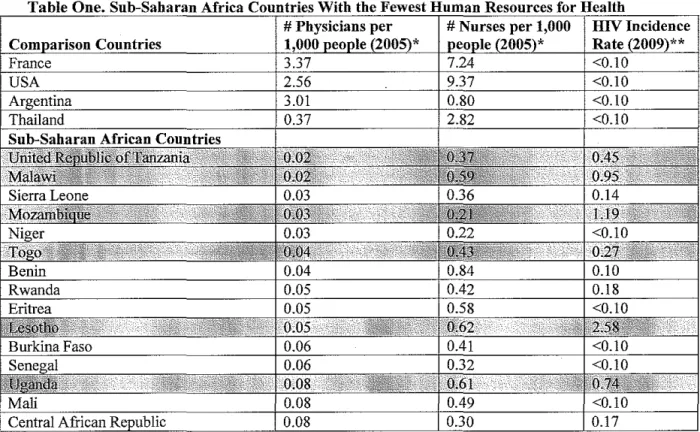
provision of treatment for HIV6. For more information on the healthcare shortages in
sub-Saharan Africa, please see the Appendix.
One proposed solution for the shortage of health care workers (with subsequent
implications for delivery of HIV care and treatment) is shifting the clinical responsibility
for HIV management to mid-level healthcare workers, such as nurses. In some areas,
nurses have already assumed the care and treatment of HI V-infected patients7.12.
This report and proposal is prompted by the urgency of the coinciding HIV and
TB epidemics and the recent release of the World Health Organization's Guidelinesfor
Intensified Tuberculosis Case-Finding and Isoniazid Preventive Therapy for People
Living with HIV in Resource-Constrained Settings13 In it, the feasibility of incorporating
these guidelines into nurse-driven HIV care and treatment facilities in sub-Saharan Africa
Background
Acquired Immune Deficiency Syndrome (AIDS) was first described in 198114,
and by 1983, scientists had isolated the human immunodeficiency virus (HIV), the virus
that leads to AIDS 15-16. HIV is now recognized as a virus that is spread through blood,
semen, vaginal fluid, and breast milk; it infects and weakens the immune system of its
host, leading to the host's inability to fight infection. This weakened immune system
allows the development of opportunistic infections - diseases that are otherwise
uncommon, but attack when one's body cannot defend itself17. It is these opportunistic
infections that lead to death among individuals who are infected with HIV. Now the vast
majority of new and existing HIV infections occur in sub-Saharan Africa; sixty percent of
the infections in this region are among heterosexual women I.
Recent initiatives by the World Health Organization, national health programs,
and non-governmental organizations, as well as increased funding by the Gates
Foundation, the Global Fund to Fight AIDS, Tuberculosis, and Malaria, and the
President's Emergency Plan For AIDS Relief (among others) have facilitated treatment
scale-up in sub-Saharan Africal8. These efforts have led to a decrease in incident
infections and AIDS-related deaths in recent years1• In 33 highly-affected countries there
was a 25% decrease in new infections from 2001 to 20091. In spite of this progress, there
were still 2.6 million new infections around the world in 2009 and 33.3 million people
living with HWI.
Tuberculosis is a communicable disease that is spread through particles in the air3.
Over one in three people in the world are have latent TB, and only 5-10% of those who
HIV, as HIV enables quicker development of active disease3. In sub-Saharan Africa,
where the HIV epidemic is rampant, TB rates are rising19. HIV is now the biggest risk
factor for development of active TB20. Up to 34% of all smear-positive cases ofTB are
directly attributable to HIV2, and reduction of the TB epidemic in sub-Saharan Africa
will depend on control of the HIV epidemic21.
In short, HIV accelerates the progression of TB, and TB accelerates the
progression ofHIV22, even when TB is treated23. Further, TB is the most common
opportunistic infection that affects HIV -infected individuals;22 unlike other infections, it
can develop throughout the progression ofHIV24, even when a person's immune system
is still relatively strong. TB is also the most common cause of death ofHIV-infected
individuals22.25. Despite these sobering facts, there is evidence that treatment of TB in
HIV-infected individuals can have a positive impact on CD4 count, one measure of HI V . 26
progressIOn .
Task-Shifting
Critical shortages in human resources for health in sub-Saharan Africa complicate
delivery of HIV prevention, screening, and treatment services. Worldwide, there is a
shortage of 4.3 million health workers, including physicians, nurses, midwives, and
ancillary workers5. Sub-Saharan Africa, which is home to 11 % of the world's
population, has only 3% of its health workforce5. These shortages are due to inadequate
emollment in nursing and medical schools, insufficient job opportunities for all cadres of
health professionals, poor compensation, uneven urban-rural distribution of workers, and
of the fifty-seven countries (63%) with healthcare worker shortages are in sub-Saharan
Africa29, and the magnitude of the HIV epidemic in this region puts additional pressure
on a health workforce that is already stressed3o. The healthcare worker shortage in this
region is considered a significant impediment to widespread expansion of HIV
treatment3].
Task-shifting, or the delegation of certain clinical responsibilities from
higher-trained cadres of health professionals to lower-higher-trained cadres (e.g., doctors to nurses and
nurses to nurse's aids or community health workers), is one proposed solution for the
healthcare worker shortage. While task-shifting alone will not address all of the
problems with health systems in sub-Saharan Africa, it should be considered part of a
holistic approach to improving provision of HIV care and treatment.
In many resource-rich countries, task-shifting has long been used as an effective
way to address shortages in service deliverl2, particularly in the areas of primary care
and management of chronic diseases33. In sub-Saharan Africa, nurse-driven, stand-alone
TB programs are an accepted and widely-used form oftask-shifting34-36.
There are documented logistical, financial, and clinical advantages to task-shifting
HIV care and treatment to nurses. Regarding logistical benefit of HIV clinics, authors
have reported both lower wait times in nurse-driven HIV clinics7 and increases in
program efficiencl7.
Financial benefits of task shifting affect both the clinics and health education
systems. Task-shifting to nurses or other mid-level cadres of health workers can either
reduce clinic costs or increase the number of patients seen for the same cost38. A report
follow-up care to nurses and pharmacists could save the Ugandan Ministry pfHealth 0.5
to 11 million dollars each year32. The same article examined the cost of training new
clinicians, and estimated that nurse education in east Africa costs $730-$2,500 per
individual, compared to $11,600 per new physician trained32. It is reasonable to assume
other countries that shift HIV care and treatment to nurses would see similar savings,
although perhaps to varying degrees.
Other recent reports have described the clinical outcomes from nurse-driven HIV
clinics in sub-Saharan Africa. Benefits of using nurses to run these clinics include
increased access to counseling and testing7.37 and improved coverage of care, leading to
improved population-level outcomes39. Nurse-driven HIV programs report shorter
patient wait times37 and reduced loss to follow_up,8.37 compared to hospital based,
physician-driven programs. By replacing physicians with nurses, physicians are able to
focus more on non-HIV tasks27,37 such as management of complex medical or surgical
cases and supervision of other health workers. One study estimates that this
re-designation of responsibilities could allow for a 4.1-14.8% increase in physician time for
other tasks32.
Studies report that nurses are able to provide high-quality clinical care for
HIV-infected individuals that is comparable to that ofphysicians7.11,31,37. Specifically, nurses
have demonstrated that they are able to effectively assess HIV -infected patients, perfonn
I· · I . 31 dh 'd I' fi ART .. 9·1031
C Imca stagmg , a ere to treatment gUl e mes or provISIOn', manage
opportunistic infections, oversee drug supply, and supervise ancillary stafe. Patients
d . I . 7 . I f: '1 .. f:'1 8 d' d h 810 an vlra suppressIOn ,vlfa ill ure, tOXICIty ill ure ,an tlme-to- eat outcomes'
comparable to those seen in physician-run centers.
Task-shifting to nurses for HIV management does have limitations and should not
be considered a simple solution that requires merely handing nurses additional
responsibilities. Task-shifting requires an investment in nursing - in nurse education,
on-the-job trainings, and continuing education opportunities. There are noted discrepancies
between nursing schools in different regions, which can affect the capacity of some
nurses to provide adequate HIV care31. Effective task-shifting requires initial in-depth
training (both didactic and practical) to reduce errors7,9-10,23,27. Continuing education
should be provided, in the form of targeted training to address deficiencies9-1O• Nurses
who manage the care of HI V-infected patients should be provided with standardized
protocols4o, checklists, diagnostic algorithms, and flowcharts for ART initiation to
facilitate high-quality care9-10. Finally, ongoing supervision is an important component
f k h·ft· . 710-1241 o tas -s I mg to morutor care' ' .
There is concern, as well, for the acceptability of nurse-driven HIV progrmns by
patients. This can depend on cultural and societal factors, as well as the age, experience,
and training of the nurses42. Effective, attentive care may be one way to address this
concern. There is also concern for co-worker acceptability as nurses assume more
responsibility for HIV care and treatment37. Clearly defined clinical roles are essential to
preventing or addressing this tension28. One study found that while shifting roles caused
initial discomfort for other healthcare workers, with time this tension subsided7•
In order for task-shifting to serve as an effective component of HI V management,
expanded and improved, as there is a significant nursing shortage in sub-Saharan Africa
(although not nearly as dire as the physician shortage
i.
As nurses assume moreresponsibility for assessment, diagnostics and prescription, traditional nursing roles (such
as phlebotomy, administrative tasks, and support group management) must also be
shifted to aids, community health workers, or expert-patientsll. This must be periodically
re-evaluated to assure that nurses are not over-burdened by their new responsibilities. As
one study that examined the workload of community health workers in an HIV clinic
noted, there was a decline in quality of care with the addition of extra tasks 43.
In summary, task-shifting for HIV programs appears to be working already in
many parts of sub-Saharan Africa, particularly those that incorporate the strategies for
success that are described above. By bolstering nurse education and providing initial and
follow-up training and supervision, programs are already seeing that this is an effective
approach to HN care and treatment. These programs should be expanded in sub-Saharan
Africa and should also incorporate the new World Health Organization recommendations
for adult and adolescent TB screening and prevention into the care provided by nurses.
These guidelines and justification for their use in nurse-driven HN clinics are detailed
below.
Incorporating TB Care into Nurse-Driven HIV Clinics
There is a recognized need to improve identification and management ofTB in all
HIV clinics in sub-Saharan Africa2,9,44. Nurses have demonstrated their capacity to
properly recognize TB in HIV -infected patients31, and one nurse-driven HIV clinic in
WHO's recently published guidelines provide a comprehensive set ofrecommendations
for identification ofTB in HIV-infected adults, adolescents, and children13• Detailed
below is each adult and adolescent recommendation and support for its use in
nurse-driven programs.
Recommendation One: Adults and adolescents living with H1V should be screened for TB with a clinical algorithm and those who do not report anyone of the symptoms of current cough, fever, weight loss or night sweats are unlikely to have active TB and should be offered 1PT [isoniazid preventive therapy}.
Recommendation Two: Adults and adolescents living with H1V and screened with a clinical algorithm for TB, and who report anyone of the symptoms of current cough, fever, weight loss or night sweats may have active TB and should be evaluatedfor TB and
other diseases.
Source: World Health Organization, 2011. Guidelinesfor intensified tuberculosis case.jinding and isoniazid preventive therapy for people living with HIV in resource-constrained settings.
These first recommendations specifically advise the use of clinical algorithms in
screening and preventing TB. Several studies have reported that nurses are able to
manage HIV care effectively by utilizing clinical algorithms9•1o. Using the same
technique for intensified TB case finding would be easily incorporated in nurse-driven
HIV clinics. Additionally, nurses have already been shown to accurately identify TB in
HIV-infected patients31 and will thus be able to properly identify patients with or without
the symptoms outlined in these recommendations.
Adult and adolescent dosing ofIPT is standardized and thus much more simple
than initiation and management of ART, which nurses have demonstrated the capacity to
administer7,9.31. This straightforward component ofthese guidelines would be quite
evaluating patients for "other diseases", as Recommendation Two states, would be
manageable. The compatibility of these recommendations with existing standards of
nursing practice favors their successful implementation.
Recommendation Three: Adults and adolescents living with H1V who have an unknown or positive TST [tuberculin skin test] status and are unlikely to have active TB should receive at least six months of 1PT as part of a comprehensive package of H1V care. 1PT should be given to such individuals irrespective of the degree of immunosuppression, and also to those on ART, those who have previously been treated for TB and pregnant
women.
Recommendation Four: Adults and adolescents living with HIV who have an unknown or positive TST status and who are unlikely to have active TB should receive at least 36
months of 1PT 1PT should be given to such individuals irrespective of the degree of immunosuppression, and also to those on ART, those who have previously been treated for TB and pregnant women.
Source: World Health Organization, 2011. Guidelines for intensified tuberculosis casejinding and isoniazid preventive therapy for people living with HIV in resource-constrained settings.
Nursing practice already includes the initiation and interpretation ofTST; iftests
are available, nurses managing HIV care and treatment can easily provide this service.
As discussed above, IPT for adults and adolescents is not complex - it requires no
weight-based dosing and no clinical judgment to determine who should receive it. As the
recommendation outlines, all patients qualify, regardless of history or clinical condition,
and high-technology laboratory testing is not needed to exclude those with different
levels of immunosuppression. Recommendation Four allows for longer use ofIPT in
HIV-infected persons, which may provide further benefit. As nurse-driven HIV
programs have similar or better rates ofloss-to-follow-up compared to physician-driven
unreasonable. Nurses managing HIV care and treatment should be able to readily
incorporate these recommendations into their practice, as they are based on existing
nursing tasks.
Recommendation Five: TST is not a requirement for initiating 1PT in people living withHIV.
Recommendation Six: People living with HIV who have a positive TST benefit more from 1PT; TST can be used where feasible to identifY such individuals.
Source: World Health Organization, 2011. Guidelines/or intensified tuberculosis casefinding and
isoniazid preventive therapy for people living with HIV in resource-constrained settings.
There are simply not enough HIV clinics in many sub-Saharan African countries,
and inaccessibility due to long travel times is a known barrier to receiving care45. As
TST requires two visits, a TST-positive approach to TB case-finding is impractical in
traditional physician-driven, hospital-based HIV clinics, many of which exist only in
urban settings. Nurse-driven clinics can be implemented in rural areas and thus be
located very near their patients. As such, providing TST is feasible, but as the
recommendation states, is not necessary for initiation of IPT. Therefore, nurses working
Recommendation Seven: Providing 1PT to people living with H1V does not increase the risk of developing isoniazid (INH}-resistant TE. Therefore, concerns regarding the development of 1NH resistance should not be a barrier to providing 1PT
Source: World Health Organization, 20 II. Guidelines for intensified tuberculosis case-jinding and isoniazid preventive therapy for people living with HIV in resource-constrained settings.
Drug-resistant TB is a real problem and a valid concern. Despite this, the WHO
recommendations acknowledge that prevention with isoniazid is still appropriate. There
may be considerable needs for healthcare worker education on this topic, including
nurses. As stated before, nurses can easily incorporate near-universal IPT prescription
into HN care and management programs, and this recommendation simplifies TB
prevention, making it an ideal area of care for task -shifting.
Special Populations
The management of adult HIV care and ART provision are fairly straight forward
and therefore lend themselves to protocols and clinical algorithms. This also makes this
treatment ideal for task-shifting. However, as adults develop more advanced disease,
their care becomes more challenging. Similarly, HIV -infected children have complex
disease even initially, as their weak immune systems cannot stave off the opportnnistic
infections and there is less evidence to guide their care. Adults with advanced disease
and children are special populations that, while challenging, are still good candidates for
nurse-based HIV care. These populations are discussed further below.
As HIV progresses in adult patients, and as adults develop resistance to first-line
ART, their care becomes complicated. Patients are often managed on a case-by-case
complex HIV, and care of these patients is currently managed by physicians. However,
as nurses gain experience in managing HIV, their programs should start to assume more
responsibility for these complex patients. Many of the recommendations that are outlined
above for nurse-driven clinics (particularly continuing education, supervision and
ongoing quality control) must be considered as nurses adopt this extra responsibility.
Children with HIV, even those without advanced disease, require careful
monitoring and refined clinical judgment to navigate treatment. Pediatric HIV progresses
more quickly than in adults, and this progression has been found to be even more rapid in
sub-Saharan African settings due to poor nutrition and higher exposure to opportunistic
infections46• One study, conducted in Rwanda, found that nurses were capable of
managing care for HIV -infected pediatric patients 11, but there is little other evidence
regarding the use of task-shifting for the management of HI V-infected children.
However, nurses have demonstrated that they are capable of providing excellent adult
care, and have adopted responsibility for this care in health systems that often offer very
little support, which suggests they also may be capable of providing care for
HIV-infected children. Further, as nurses adopt the care of HI V-HIV-infected adults, a disparity in
available care will appear, as adults find themselves with more options for treatment and
children do not. Anticipating this disparity, and utilizing the available resources (such as
nursing) to address it are crucial.
Implementation
In order for countries to fully implement a shift from physician-based HIV care
have to be addressed. As is illustrated in the Appendix, many countries in sub-Saharan
Africa have nursing shortages in addition to physician shortages. These shortages will
need to be addressed through increased capacity and enrollment at nursing schools, as
well as improved didactic and clinical training on management of HIV, before nurses can
assume responsibility for HIV care and treatment.
Some countries in this region are home to nurses who have been adequately
trained but who are unable to find employment due to lack of available jobs47• Increased
governmental investment in nurse-driven programs will lead to the creation of more jobs
for local nurses who are ready to assume this responsibility.
Another important consideration for the transition from physician- to nurse-driven
HIV care and treatment is reimbursement. As nurses who take on the added
responsibility of managing HN-infected patients, they will have to be compensated
accordingly. While this would be an added expenditure by already struggling health
systems, it is an investment that will have high return as more HIV -infected patients are
treated, and can thus contribute to the country's economy. Further, compensating nurses
adequately for this work will be less expensive than hiring extra physicians to do the
same work, making it a cost -effective alternative.
Finally, the cultural shift that will accompany this transition to nurse-driven care
should be considered. Nurses will have to be accepted as primary care givers for patients
with HN by their colleagues in the healthcare system and the larger community. Tactics
for ensuring a smooth transition among healthcare workers to nurse-driven HN care are
care will facilitate a cultural shift at the community level to accepting nurses as they take
on the responsibility of HIV care and treatment.
Conclusion
Nurse-driven HIV clinics in sub-Saharan Africa are recognized as viable options
for addressing the HIV epidemic. The incorporation of TB screening and prevention, as
outlined by the WHO's Guidelinesfor Intensified Tuberculosis Case-Finding and
Isoniazid Preventive Therapy for People Living With HIV in Resource-Constrained
Settings13, is feasible and highly promising in light of the concurrent epidemics and
synergy between HIV and TB. By utilizing comprehensive training and supervision, as
well as clinical algorithms and protocols, nurses can easily manage the care of HI
V-infected adults and adolescents while also screening for and preventing TB.
Task-shifting alone will not address all of the barriers to HIV care and treatment
in sub-Saharan Africa. Without efforts to recruit and retain healthcare workers, as well as
those to improve or reinforce laboratory capacity, drug and supply availability, and
infrastructure, health systems will remain unable to address the HIV epidemic. However,
many studies have shown that nurses are competent to take on this responsibility and
References
1. UNAIDS Global Report on the Global AIDS Epidemic [Internet] 2010 [Updated 2010 Dec 01; cited 2011 Jan 27]. Available from: www.unaids.org/en/
2. Harries, AD, Zachariah, R, Corbett, EL, Lawn, SD, Santos-Filho, ET, Chimzizi, R, Harrington, M, Maher, D, Williams, BG, De Cock, KM. The IllY -associated tuberculosis epidemic- when will we act? The Lancet. 2010; 375: 1757-1758.
3. World Health Organization Tuberculosis Factsheet [Internet] 2010 [Updated 2010 Nov; cited 2011 Jan 27]. Available from: http://www.who.intlmediacentre/factsheets/fs104/en/index.htrnl
4. Philips, M, Zachariah, R, Venis, S. Task shifting for antiretroviral treatment delivery in sub-Saharan Africa: not a panacea. The Lancet. 2008; 371: 682-684.
5. World Health Organization Working Together for Health [lnternet] 2006 [Updated 2006; cited 2011 Mar 01] Available from: http://www.who.intlwhr/2006/en
6. WHO & UNAIDS: Progress on Global Access to HIV Antiretroviral Therapy: A Report on '3 by 5' and Beyond. [Internet] 2006 [Updated 2006; cited 2011 Jan 29] Available from:
http://www.who.intlhiv/pub/2006progressreport/en/
7. Bedelu, M, Ford, N, Hilderbrand, K, Reuter, H. Implementing antiretroviral therapy in rural communities: the Lusikisiki model of decentralized IllY IAIDS care. Journal of Infectious Diseases. 2007; 196: S464-8.
8. Sanne, I, Orrell, C, Fox, MP, Conradie, F, Ive, P, Zeinecker, J, Cornell, M, Heiberg, C, Ingram, C, Panchia, R, Rassool, M, Gonin, R, Stevens, W, Truter, H, Dehlinger, M, van der Horst, C, Mclntyre, J, Wood, R. Nurse versus doctor management ofHIV-infected patients receiving antiretroviral therapy (CIPRA-SA): a randomized non-inferiority trial. The Lancet. 2010; 376; 33-40.
9. Cohen, R, Lynch, S, Bygarve, H, Eggers, E, Vlahakis, N, Hilderbrand, K, Knight, L, Pillay, P, Saranchuk, P, Goemaere, E, Makakole, L, Ford, N. Antiretroviral treatment outcomes from a nurse-driven, community-supported IllY I AIDS treatment programme in rural Lesotho: observational cohort assessment at two years. Journal of the International AIDS Society. 2009;
12(1):23.
10. Shumbusho, F, van Griensven, J, Lowrance, D, Turate, I, Weaver. MA, Price, J, Binagwaho, A. Task shifting for scale-up ofHIV care: evaluation of nurse-centered antiretroviral treatment at rural health centers in Rwanda. PLoS Medicine. 2009; 6: 10.
I I. Van Griensven, J, De Naeyer, L, Uwera, J, Asiimwe, A, Gazille, C, and Reid, T. Success with antiretroviral treatment for children in Kigali, Rwanda: Experience with health center/nurse-based care. BMC Pediatrics. 2008; 8:39.
13. World Health Organization Guidelines for Intensified Tuberculosis Case-Finding and Isoniazid Preventive Therapy for People Living With HIV in Resource-Constrained Settings. [Internet] 2011 [updated 2011; cited 2011 Mar 01] Available from:
http://whqlibdoc.who.intipublications/2011/9789241500708 eng.pdf.
14. Centers for Disease Control. "Pneumocystis pneumonia - Los Angeles." MMWR Morbidity and Mortality Weekly Report. 1981; 30 (21): 250-252.
15. Gallo, RC, Sarin, PS, Gelmann, EP, Robert-Guroff, M, Richardson, E, Kalyanaraman, VS, Mann, D, Sidhu, GH, Stahl, RE, Zolla-Pazner, S, Leibowitch, J, Popovic, M. Isolation of human T-cell leukemia virus in acquired immune deficiency syndrome (AIDS). Science. 1983; 220 (4599): 865-867.
16. Barre-Sinoussi, F, Chennann, JC, Rey, F, Nugeyre, MT, Chamaret, S, Gurest, J, Dauguet, C, Axler-Blin, C, Vezinet-Brun, F, Rouzioux, C, Rozenbaum, W, and Montagnier, L. Isolation of a T-Iymphotropic retrovirus from a patient at risk for acquired-immune deficiency syndrome (AIDS). Science. 1983; 220 (4599): 868-871.
17. World Health Organization HlV/AIDS. [Internet] 2011 [updated 2011; cited 2011 Jan 30] Available from: http://www.who.intitopicsihivaids/enlindex.html.
18. Hanefeld, J. The impact of Global Health Initiatives at national and sub-national level- a policy analysis of their role in implementation processes of antiretroviral treatment (ART) roll-out in Zambia and Sroll-outh Africa. AIDS Care. 2010; 22(1): 93-102.
19. Chaisson, RE and Martinson, NA. Tuberculosis in Africa - combating an HlV-driven crisis. New England Journal of Medicine. 2008; 358(11): 1089-1092.
20. Rieder HL, Gauthen, GM, Comstock, GM, Snider, DE. Epidemiology of tuberculosis in the United States. Epidemiological Review. 1989; II: 79-98.
21. Elzinga, G and Nunn, P. TB and HIV: joint problems, joint solutions? Bulletin of the World Health Organization. 2002; 80 (6): 469-470.
22. World Health Organization Global Tuberculosis Control. [Internet] 2010 [updated 2010; cited 2011 Jan 27] Available from:
http://whqlibdoc.who.intipublications/201 0/9789241564069 eng. pdf.
23. Morris, L, Martin, DJ, Bredell, H, Nyoka, SN, Sacks, L, Pendle, S, Page-Shipp, L, Karp, CL, Sterling, TR, Quinn, TC, Chaisson, RE. Human immunodeficiency virus-I RNA levels and CD4 lymphocyte counts, during treatment for active tuberculosis, in South African patients. The Journal of Infectious Diseases. 2003; 187: 1967-1971.
24. Kizza, HM, Rodriquez, B, Quinones-Mateu, M, Mirza, M, Aung, H, Yen-Liebennan, B, Starkey, C, Horter, L, Peters, P, Baseke, J, Johnson, JL, Toossi, Z. Persistent replication of human immunodeficiency virus type I despite treatment of pulmonary tuberculosis in dually infected subjects. Clinical and Diagnostic Laboratory Immunology. 2005;11: 1298-1304.
26. Martin, OJ, Sim, JG, Sole, GJ, Rymer, L, Shalekoff, S, van Niekerk, AB, Becker, P,
Weilbach, CN, Iwanik, J, Keddy, K, Miller, GB, Ozbay, B, Ryan, A, Viscovic, T, and Woolf, M. CD4+ lymphocyte count in African patients co-infected with HIV and tuberculosis. Journal of Acquired Immune Deficiency Syndrome and Human Retrovirology. 1995; 8: 386-391.
27. Price, J, Binagwaho, A. From medical rationing to rationalizing the use of human resources for AIDS care and treatment in Africa: a case for task shifting. Developing World Bioethics. 2010; 10:2,99-103.
28. Tantchou Yakam, JCY, Gruenais, ME. Involving new actors to achieve ART scaling-up: difficulties in an HIV I AIDS counseling and testing centres in Cameroon. International Nursing Review. 2009; 56(1): 50-57.
29. World Health Organization, UNAIDS & PEPFARTask Shifting: Global Recommendations and Guidelines. [Internet] 2008 [updated 2008; cited 2011 Jan 29]. Available from:
htlp:llwww.who.intihealthsystems/taskshifting/enlindex.html.
30. Van Damme, W, Kober, K, Laga, M. The real challenges for scaling up ART in sub-Saharan Africa. AIDS. 2006; 20: 653-656.
31. Vasan, A, Kenya-Mugisha, N, Seung, KJ, Achieng, M, Banura, P, Lule, F, Beems, M, Todd, J, Madraa, E. Agreement between physicians and non-physician clinicians starting antiretroviral therapy in rural Uganda. Human Resourcesfor Health. 2009; 7:75.
32. Babigumira, JB, Castelnuovo, B, Lamorde, M, Kambugu, A, Stergachis, A, Easterbrook, P, and Garrison, LP. Potential impact of task-shifting on costs of antiretroviral therapy and physician supply in Uganda. BMC Health Services Research. 2009; 9: 192.
33. Fairman, JA, Rowe, JW, Hassmiller, S, Shalala, DE. Broadening the scope of nursing practice. The New England Journal of Medicine. 2011; 364:3, 193-197.
34. Awofeso, N, Schelokova, I, Dalhatu, A. Training of front-line health workers for tuberculosis control: lessons from Nigeria and Kyrgyzstan. Human Resources for Health. 2008; 6:20, 1-9.
35. Robinson, JJA. Tuberculosis: nurses' work continues. International Nursing Review. 2006; 53:4,241.
36. Fairall, LR, Zwarenstein, M, Bateman, ED, Bachmann, M, Lombard, C, Majara, BP, Joubert, G, English, RG, Bheekie, A, van Rensburg, 0, Mayers, P, Peters, AC, Chapman, RD. Effect of educational outreach to nurses on tuberculosis case detection and primary care of respiratory illness: pragmatic cluster randomized control trial. British Medical Journal. 2005; 331(7519): 750-754.
37. Callaghan, M, Ford, N, Schneider, H. A systematic review of task-shifting for HIV treatment and care in Africa. Human Resourcesfor Health. 2010; 8:8.
39. Miles, K, Clutterbuck, DJ, Seitio, 0, Sebego, M, Riley, A. Antiretroviral treatment roll-out in a resource-constrained setting: capitalizing on nursing resources in Botswana. Bulletin of the World Health-Organization. 2007; 85: 555-560.
40. Assefa, Y, VanDamme, W, and Hermann, K. Human resource aspects of antiretroviral treatment delivery models: current practices and recommendations. Current Opinions in HIVand AIDS. 2010; 5:78-82.
41. Labhardt, N, Manga, E, Bischoff, A, Stoll, B. Implementation of a programme to prevent Mother-To-Child Transmission ofHIV in rural Cameroon - a survey in 70 health care facilities. Tropical Medicine and International Health. 2008; 14:288-293.
42. Buchan, J, O'May, F., Determining skill mix: practical guidelines for managers and health professionals. Human Resources Development. 2000; 4(2): 111-118.
43. Rowe, SY, Kelly, JM, Olewe, MA, Kleinbaum, DG., McGowan Jr, JE, McFarland, DA, Rochat, R, Deming, MS. Effect of multiple interventions on community health workers' adherence to clinical guidelines in Siaya district, Kenya. Transactions of the Royal Society of Tropical Medicine and Hygiene. 2007; 101: 188-202.
44. Maher, D, Harries, A, Getahun, H. Tuberculosis and HIV interaction in sub-Saharan Africa: impact on patients and programmes; implications for policies. Tropical Medicine and
International Health. 2005;10: 734-742.
45. Finnie, RKC, Base Khoza, L, van den Borne, B, Mabunda, T, Abotchie, P, Mullen, PD. Factors associated with patient and health care system delay in diagnosis and treatment for TB in sub-Saharan African countries with high burdens ofTB and HIV. Tropical Medicine and International Health. 2011; 16(4): 394-411.
46. De Baets, AJ, Ramet, J, Msellati, P, Lepage, P. The unique features of pediatric HIV-I in sub-Saharan Africa. Current HIV Research. 2008; 6: 351-362.
Appendix. Table One.
Countries