Volume III (2014), Page 47- 66
RESIDENTIAL SATISFACTION - CONCEPT, THEORIES AND EMPIRICAL STUDIES
Mohammad Abdul Mohit1 and Adel Mahfoud Mubarak
Al-KhanbashiRaja2
1&2
Kulliyyah of Architecture and Environmental Design
INTERNATIONAL ISLAMIC UNIVERSITY MALAYSIA
Abstract
Residential satisfaction, defined as the feeling of contentment when one has or achieves what one needs or desires in a house, is an important indicator and planners, architects, developers and policy makers use it in a number of ways. There are three theories – housing needs theory, housing deficit theory and psychological construct theory, and most empirical studies have used these theories or a combination of these theories in their research design. A number of variables representing housing and neighbourhood characteristics, individuals‘ socio-demographic attributes as well as their perceptions of housing and neighbourhood conditions have been analysed in most empirical studies what stand to indicate that further studies are required until a general theory of residential satisfaction/ dissatisfaction emerges. Also, a host of variables belonging to housing and its environment including the socio-demographic attributes of residents exert significant influences on the level of residential satisfaction/ dissatisfaction which is however, culture and value specific indicating that further studies on residential satisfaction/ dissatisfaction can be undertaken on case specific context to guide public policies on housing.
Keyword: Residential satisfaction, housing needs theory, housing deficit theory, psychological constructs theory, neighbourhood characteristics
1
Professor at Department of Urban and Regional Planning. Email: [email protected] / [email protected]
2
INTRODUCTION
Since the post-war housing boom of the 1950s and early 1960s and the concomitant growth of suburban developments in western countries, two phenomena – new residential development and living patterns and the central city rebuilding through slum clearance programmes, have played a catalytic role in fostering much of the research on residential satisfaction (Campbell et al, 1976). Meanwhile, the developing world is experiencing rapid urban growth (urbanization) which is due to rapid industrialization and economic growth since 1970s. Thus, the governments in these countries have been providing/ facilitating different types of houses for different income groups. Residential satisfaction studies in these countries are focussed on ascertaining the extent to which houses produced and provided by both public and private sectors satisfy the aspirations of the citizens.
OBJECTIVES
The aim of the paper is to provide an overview of the theoretical and empirical perspective of residential satisfaction with the following objectives:
a) To explore the concept of residential satisfaction;
b) To investigate the various theories of residential satisfaction;
c) To examine the empirical studies on residential satisfaction at cross-cultural level; and
d) To assess the need and importance of residential satisfaction as a policy tool to guide future housing development.
METHODOLOGY
In order to fulfil the stated objectives of the paper, methodology adopted is based on the gathering and analysis of secondary data and information. Desktop research was carried out for about six months to search for the theories and studies of residential satisfaction at cross-cultural levels which included both developed and developing countries. A review of the theories and empirical studies on residential satisfaction was carried out to arrive at a meaningful conclusion leading to the need for further studies on residential satisfaction, based on country or culture specific situations.
LITERATURE REVIEW
Definition of Residential Satisfaction
In order to understand, the concept of residential satisfaction or housing satisfaction as some researchers usually use it, we should, firstly, take the term apart as Housing and Satisfaction and define them separately and secondly, we should define the concept of residential satisfaction or housing satisfaction together.
Satisfaction is a process of evaluation between what was received and what was expected (Parker and Mathews, 2001). Satisfaction can be precisely defined as the perceived discrepancy between aspiration and achievement, ranging from the perception of fulfilment to that of deprivation (Campbell et al., 1976). Williamson (1981) found that satisfaction was not only conditioned by physical aspects but also by the ability to form social networks. Finally, Satisfaction is a subjective response to an objective environment (Potter and Cantarero, 2006).
Residential satisfaction involves an extensive range of experts and professionals; some of them try to define the term from one dimension while others try to define it from multi-dimensional perspectives. For instance, Onibokun (1974), defined the residential satisfaction as a spatial aspect - ―Housing satisfaction encompasses satisfaction with dwelling unit and satisfaction with the neighbourhood and the area‖. Conversely, Satsangi and Kearns (1992), defined residential satisfaction as psychological aspect – ―Housing satisfaction is a complex attitude‖. In addition, Lu (1999) has defined residential satisfaction as a complex cognitive construct. Besides that, Ogu (2002) reported that ―the concept of housing or residential satisfaction is often employed to evaluate residents‘ perceptions of and feelings for their housing units and the environment‖. On the other hand, Galster (1985) has defined residential satisfaction as social aspect - ―The concept of residential satisfaction has become the preeminent social indicator employed by housing developers, analysts and policymakers alike during the last decade‖. Also, McCray and Day (1977) refer to housing satisfaction as ―the degree of contentment experienced by an individual or a family member with regard to the current housing situation‖.
Theories of Residential Satisfaction
Residential satisfaction, defined as the feeling of contentment when one has or achieves what one needs or desires in a house, is an important indicator and planners, architects, developers and policy makers use it in a number of ways. Indeed, theories of residential satisfaction all hinge upon the notion that residential satisfaction measures the differences between household actual and desired (or aspired to) housing and neighbourhood situations (Galster and Hesser, 1981). There are three main theories upon which most of the empirical studies are based. These are housing needs theory, housing deficit theory and psychological construct theory.
Housing Needs Theory
Rossi (1955) introduced the notion of ―housing needs‖ to conceptualize residential satisfaction / dissatisfaction. In his theory, Rossi posited that changing housing needs and aspirations as households‘ progress through different life cycle stages often place households out of conformity with their housing and neighbourhood situations. The ―lack of fit‖ between their current and desired housing needs creates stress or dissatisfaction with their current residence. Households respond to such stress or dissatisfaction through migration, which brings a family‘s housing into adjustment with its housing needs. Life cycle changes may generate different space requirements, which are considered the most important aspect of the needs. Thus, households are likely to feel dissatisfied if their housing and neighbourhood do not meet their residential needs and aspirations.
Housing Deficit Theory
Morris and Winter (1978) introduced the notion of ―housing deficit‖ to conceptualize residential satisfaction / dissatisfaction. In their housing adjustment model of residential mobility, they theorize that individuals judge their housing conditions according to normatively defined norms, including both cultural norms, which are dictated by societal standards or rules for life conditions, and family/personal norms, which amount to households‘ own standards for housing.
incongruity or by improving their housing conditions through remodelling. They may also move to another place and bring their housing into conformity with their needs.
Psychological Construct Theory
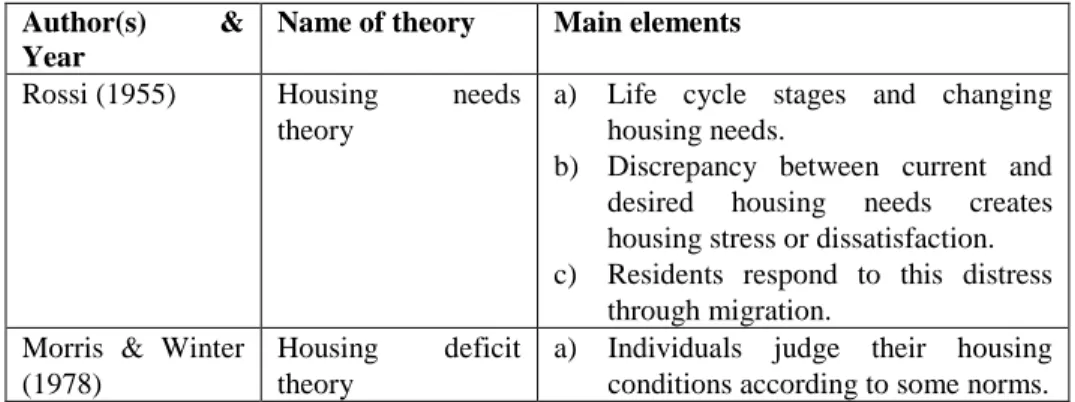
Galster (1985) introduced the notion of ―psychological construct‖ of residential satisfaction and theorized that individuals may be seen as cognitively constructing a ―reference‖ condition for each particular facet of their residential situation. The quantity or quality of the given facet implied by the reference point will depend on the individual‘s self-assessed needs and aspirations. If the current situation is perceived to be in proximate congruence with (or superior to) the reference situation, a psychological state of ‗satisfaction‘ should be manifested. If, on the other hand, the current situation falls short of the reference situation by more than a ‗threshold deficiency‘, two alternatives are possible. One may attempt to reconcile the incongruence by ‗adaptation‘, through redefining needs, reducing aspirations and/or altering the evaluation of the current situation, thereby producing a modicum of satisfaction. The other alternative is that one cannot somehow adapt to the current residential context, in which case ‗dissatisfaction‘ should be manifested. Such individuals, over time, would likely attempt to reduce their dissatisfaction by altering conditions of the present dwelling unit or by moving to another more congruent residential situation (Foote et al., 1960). Of course, these options may be relatively limited, e.g., by lack of purchasing power for lower income households and discrimination against minority households. The main elements of the three theories are summarised in Table 1.
Table 1: Summary of residential satisfaction theories with their major elements
Author(s) &
Year
Name of theory Main elements
Rossi (1955) Housing needs theory
a) Life cycle stages and changing housing needs.
b) Discrepancy between current and desired housing needs creates housing stress or dissatisfaction. c) Residents respond to this distress
through migration. Morris & Winter
(1978)
Housing deficit theory
b) Incongruity between actual and familial housing norms results in housing deficit.
c) Housing deficit is mitigated through some form of housing adjustments. Galster (1985) Psychological
construct theory
a) Individuals cognitively construct a ―reference‖ condition of their residential situation.
b) Satisfaction prevails when current housing is proximately congruent with the reference situation.
c) Incongruence will lead to either adaptation or dissatisfaction/ modification.
Source: Literature review, 2014.
Most empirical studies on residential satisfaction/ dissatisfaction have used either one or a combination of the three theories discussed above. A host of variables representing housing and neighbourhood characteristics, individuals‘ socio-demographic attributes as well as their perceptions of housing and neighbourhood conditions have been analysed in most housing studies (Lu, 1999). However, some empirical studies have demonstrated that housing deficit is a useful theory in explaining residential satisfaction and mobility behaviour (Bruin and Cook, 1997; Husna and Nurijan, 1987).
EMPIRICAL STUDIES
Socio-Demographic Characteristics of Residents
Empirical studies have identified a number of important factors belonging to residents‘ characteristics, such as age, income, duration of residence, and ownership of house (Lu, 1999; Spear, 1974). According to a number of authors (Baum et al., 2010; Chapman & Lombard, 2006; Lu, 1999; Osward et al., 2003; Pinquart & Burmedi, 2004) age exerts a positive effect on residential satisfaction. Older people tend to be more satisfied with their dwelling than do younger people. Weidemann et al., (1989) reported, in general, that the levels of housing satisfaction of elderly residents are likely to be higher than those of younger residents. Galster (1987) also argued that empirical findings of housing satisfaction should be segregated by household type (e.g., family and elderly). A study by Mohit et al., (2010), however, argued that age of the household is negatively related to housing satisfaction.
Yearns (1972) and Tucker (1969) found a significant relationship between income and housing satisfaction. Previous works by Adriaanse (2007) and Lu (1999) indicated that higher income households are generally satisfied with their housing. Frank and Enkawa (2009) contended that higher income enables households to move to a suitable house in an attractive neighbourhood, which may result in a relatively higher level of satisfaction.
Halimah and Lau (1998) compared the perceived concept of home aspired between Malay and Chinese housewives in Low-cost housing in Selangor and found that there were significant differences between the Malays‘ and Chinese perception of home and housing satisfaction.
Vera-Toscano and Ateca-Amestoy (2008) pointed out that, the higher the education level of the heads of the household; the more satisfied they are with their housing compared to household heads with lower educational attainment. Indeed, a positive relationship has been found between housing satisfaction and age, income, education and job status (Campbell et al., 1976; Pruitt, 1977). However, Lu (1999) found that education appears to have insignificant effects on housing satisfaction.
owner-occupiers tend to be more satisfied than renters possibly because homeownership gives a sense of ‗self-gratification‘ to owner-occupiers and makes them psychologically proud and satisfied with their dwelling units (Kaitilla,1993). Barcus (2004) found that tenure shift from renters to owners is the only significant variable in predicting residential satisfaction of American urban-rural migrants; individual migrant characteristics and their motivations offered little explanation for the variation in residential satisfaction. In addition, Whiteford and Morris (1986) also examined the impacts of both households‘ age and tenure type on households‘ housing satisfaction. They found that older renters are as satisfied as owners, whereas younger renters are significantly less satisfied than all other groups.
Housing Characteristics
According to Lane and Kinsey (1980) housing characteristics were more crucial determinants than demographic characteristics of housing occupants. Thus, empirical studies show that building features such as number of bedrooms, size and location of kitchen and quality of housing units, are strongly related to residential satisfaction (Noriza et al., 2010). Morris et al., (1976) found a positive relationship between number of rooms and housing satisfaction. Speare and Stewar (1974) and McCown (1977) also found a negative relationship between person-per-room ratio and housing satisfaction. As the number of persons-per-room increases, creating a higher density living environment, housing satisfaction decreases. Oh (2000) in her study on housing satisfaction of middle income households in Bandar Baru Bangi Malaysia, revealed that while the residents were highly satisfied with the space and price of the house owned, they were not satisfied with the size of kitchen, plumbing and public facilities such as recreational area, playground, taxi and bus services in the housing area.
Pruitt (1977) analyzed the housing characteristics related to housing satisfaction and found that tenure, age of dwelling, and structural quality were related to housing satisfaction. Home ownership and high structural quality were also indicators of higher perceived housing satisfaction. A negative relationship was found between age of dwelling and housing satisfaction. Those persons in older units were less satisfied.
and length of residency significantly influence housing satisfaction among the residents of Penang Development Corporation‘s project. Also, Ukoha and Beamish (1997) observed that while the residents of public housing in Abuja, Nigeria, were satisfied with neighbourhood facilities, they were dissatisfied with structure types, building features, housing conditions and management.
According to Baum, et. al. (2005); Hipp (2010) and Parkes et al., (2002), structural attributes of housing is a significant factor affecting housing satisfaction. These attributes include objective physical characteristics of housing such as kitchen space, laundry and washing areas, size of living area and dining area, morphological configuration of residence hall, number and level of sockets, number of bedrooms and bathroom, other aspects of housing such as housing quality, privacy (social densities), and housing services provided by developers such as garbage disposal, safety, brightness and ventilation of the house (cited in Tan, 2011).
Neighbourhood Characteristics
Morris et al., (1976) pointed out that, a family evaluates a neighbourhood based on the following normative criteria: 1) Area should be predominately residential. 2) Accessible to quality schools. 3) Quality of streets and roads. 4) Homogeneity regarding social class, race, and ethic group. Thus, Lu (1999) contended that neighbourhood satisfaction has been shown to be an important predictor of dwelling satisfaction.
Few studies, however, have examined the relationship between safety from physical accidents (e.g., fire, demolition, traffic accidents, etc.), which might also be very important in housing environments. Anderson et al., (1983) and Francescato, et al., (1979) are among those who have considered the issue of safety from accidents as a predictor of housing satisfaction. Lawton, et. al. (1984), however, found that safety from crime (e.g., rated risk of crime) was not found to be related to any of the other indices of well-being except for residents‘ housing satisfaction.
Yancy (1971) concluded, in a study of Pruitt-Igo, St. Louis, that one of the reasons for the failure of Pruitt-Igo was the lack of neighbourhood cohesion and social order associated with dissatisfaction with neighbours. Djebuarni and Al-Abed (2000) observed that the residents of public low-income housing in Sana‘a, Yemen, attach great importance to the level of satisfaction with their neighbourhood, particularly, with privacy which reflects the cultural background of Yemeni society.
Therefore, it can be deduced that residential satisfaction does not only rely on the dwelling units itself; neighbourhood plays an important role in residential satisfaction (Noriza et al., 2010) and (Salleh, 2009).
Behavioural Characteristics of Residents
Behavioural characteristics of residents or ―Housing adjustment and adaptation‖ as conceptualized by Morris and Winter (1978) are the family‘s efforts to redress the discrepancies between the housing it has and the housing it and others feel they should have when such deficits appear. In fact, housing adjustment is a process that may occur when a family experiences a normative housing deficit that causes a significant reduction in housing satisfaction. Housing adjustment takes place through residential mobility and residential modification (e.g., alterations, additions, etc.) (Morris and Winter, 1978).
Morris and Winter (1978) pointed out that, residential alterations and additions consist of two main phenomena - a) increases in the amount of space or number of rooms in the dwelling, and b) improvements in the quality of the dwelling. Thus, residential alterations and additions are typically undertaken to correct normative housing deficits in space or quality.
satisfaction and planning future alterations may be the curvilinear relationship between satisfaction and alterations. As in residential mobility, people who are dissatisfied with their dwelling tend to make home improvements. Such alterations are undertaken partly to overcome deficit and partly to improve the resale value of properties. People who are highly satisfied with their dwelling and neighbourhood may love the dwelling so much that they want to continue improving it (Morris and Winter, 1978).
Using only satisfaction with space and neighbourhood, Yockey (1976) developed a typology of satisfaction. She classified people according to high and low space satisfaction and high and low neighbourhood satisfaction. She further classified families according to whether or not they planned to move. People with low space satisfaction and high neighbourhood satisfaction who planned to move were most likely to make residential alterations. The second highest proportion planning alterations occurred in the group with the highest satisfaction levels and no expectation of moving. Morris and Winter (1978), pointed out that, the key determinant of the propensity to move and, in turn, actual mobility, is dissatisfaction with dwelling. In addition, neighbourhood satisfaction affects housing satisfaction and mobility.
Table 2: Summary of main findings from residential satisfaction studies
Residential satisfaction with
Main findings
Socio-demographic characteristics of residents
a) Residents‘ characteristics such as age, income, duration of residence, house ownership, household types, impact residential satisfaction variously, positively or negatively across different countries/ cultures.
b) The findings between residential satisfaction and residents‘ characteristics is not conclusive
Housing characteristics
a) Housing characteristics such as number of bed rooms and toilets, size and location of kitchen, living room, quality of housing unit, affect residential satisfaction differently at cross-cultural levels.
b) The findings between residential satisfaction and housing characteristics are, however, not conclusive.
Neighbourhood characteristics
a) According to some authors, neighbourhood satisfaction is an important predictor of residential satisfaction.
b) Neighbourhood dissatisfaction occurs due to higher distances travelled for school, work, shopping, medical centres.
c) Safety from crimes and accidents is positively associated with residential satisfaction.
Behavioural characteristics of residents
a) Behavioural characteristics of residents reflect their feeling about their residential satisfaction/ dissatisfaction. b) Residents‘ react differently with their housing
dissatisfaction. It can be adaptive or it may lead to migration depending on the degree of dissatisfaction or the ability of relocation.
Source: Literature review, 2014.
Indicator Framework of Residential Satisfaction
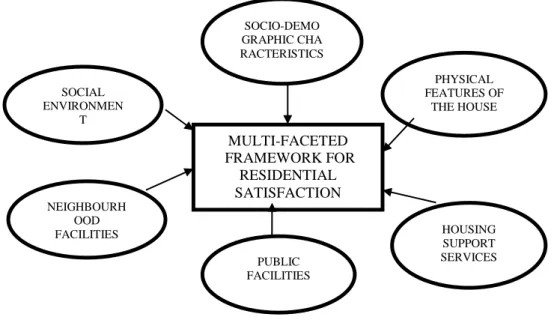
Based on the review of theories and empirical studies pertaining to residential satisfaction, a multi-faceted indicator framework of residential satisfaction can be developed and this will help further research in this area. The framework is community based and it provides the architecture for framing to capture and evaluate community issues of importance. The framework is a composition of several components with each component being represented through a number of indicators or variables (Figure 1).
Figure 1: Multi-Faceted Framework for Study of Residential Satisfaction SOCIO-DEMO
GRAPHIC CHA RACTERISTICS
PHYSICAL FEATURES OF
THE HOUSE SOCIAL
ENVIRONMEN T
MULTI-FACETED FRAMEWORK FOR
RESIDENTIAL SATISFACTION NEIGHBOURH
OOD
FACILITIES HOUSING
SUPPORT SERVICES PUBLIC
MEASUREMENT OF RESIDENTIAL SATISFACTION
To understand residential satisfaction, it must be adequately measured (Gifford, 1997). However, adequate measurements of residential satisfaction depend on studying the type of variables that are related to the different processes: cognitive, affective and behavioural which take place in the dynamic interaction between the individual and his/her residential environment. Thus, Francescato, et. al. (1986) defined satisfaction as an attitude and stated that affective, cognitive and behavioural variables affect satisfaction.
Cognitive Process
The cognitive process refers to negative or positive perceptual attitudes and feelings occupants have while perceiving the ―meaningfulness‖ or ―meaninglessness‖ of their housing environment (Ajzen and Fishbein, 1981). In addition, it refers to perception and beliefs (e.g., about the physical environment, other residents) (Potter and Cantarero, 2006). Gifford (1997) pointed out that, there are two cognitive processes related to measurement of residential satisfaction namely, purposive evaluation and comparative evaluation.
Purposive evaluation has several aspects such as level factor (e.g., to evaluate a single part or a large portion of residence), quality factor (e.g., to evaluate the quality of residence such as beauty, lighting, or spaciousness) and focus factor which depends on the quality (e.g., to evaluate the ability of a particular lamp to light a study desk, or is it broader, such as lighting in the home as a whole). Therefore, the concept of residential satisfaction is often employed to evaluate residents‘ perceptions of and feelings for their housing units and environment (Ogu, 2002).
Affective Process
The affective process refers to the positive or negative feeling that the occupants have where they live in. In other words, it is people‘s satisfied or dissatisfied attitudes towards their socio-physical housing environment (Ajzen and Fishbein, 1981). Also, it is both emotional and evaluation and is composed of multiple reactions that form a ―global representation of the affective responses of people to the social-physical environment in which they live‖ (Weidemann and Anderson, 1985). In fact, there are three affective processes related to measurement of residential satisfaction namely, subjective attributes, objective attributes and personal characteristics (Amerigo and Aragones, 1997).
It has been found that the overall quality of life or life satisfaction is influenced by a variety of social and physical domains (e.g., family job, religious affiliation, residence, neighbourhood, community, etc.) (Campbell et al., 1976). Thus, Potter and Cantarero (2006) pointed out that the process of evaluating a domain begins with the objective attributes. While we all live in an objective world, we make decisions based on our subjective assessments of a situation. Therefore, our assessments of a domain are influenced by personal characteristics (e.g., experience, social standing, aspirations, reference group and so forth) which in turn affect our level of satisfaction with that domain. Thus, Potter and Cantarero (2006) also, defined residential satisfaction as a subjective response to an objective environment.
Behavioural Process
CONCLUSION
Residential satisfaction is a complex construct for three reasons. Firstly, it involves terminologically two complex terms - housing and satisfaction. Secondly, it involves three different processes - cognitive, affective and behavioural which lead to the third reason. It needs different measurements based on those processes such as objective attributes, subjective attributes, and personal characteristics. In addition, even though, residential satisfaction has three main theories viz., housing needs, housing deficit, physiological construct, most empirical studies on residential satisfaction/ dissatisfaction use one or a combination of theories what stand to indicate that further studies are required until a general theory of residential satisfaction/ dissatisfaction emerges. The empirical studies discussed indicate that a host of variables belonging to housing and its environment including the socio-demographic attributes of residents exert significant influences on the level of residential satisfaction/ dissatisfaction which is however, culture and value specific indicating that further studies on residential satisfaction/ dissatisfaction can be undertaken on case specific context to guide public policies on housing.
ACKNOWLEDGEMENT
We gratefully acknowledge the two unannonimous reviewers whose comments have contributed to improve the quality of our paper.
REFERENCES
Amerigo,M. and Aragones.J (1997). A Theoretical and Methodological
Approach to the Study of Residential Satisfaction. Journal of
Environmental Psychology .Vol.17.pp.47 -57.
Abdul Ghani Salleh and Norini Yusof . (2006). Residential satisfaction in low – cost Housing in Malaysia. Report of research funded by University Sains Malaysia USM.
Abdul Ghani Salleh (n.d). Residential and Neighborhood satisfaction in Private low- cost Housing: Case study of Penang, Malaysia. Housing Symposium. University of Sians Malaysia.
Berke, Philip. Godschalk, D (2009), Searching for the Good Plan a
Meta-Analysis of Plan Quality Studies, Journal of Planning Literature, 23(3),
227-240
Campbell, A.et.al (1976). The quality of American life. perceptions, evaluation
and satisfaction. Russell Sage foundation. .U.S.A.
Chandler,R. et.al (2005). Building type basics for Housing. John Wiley and Sons. Toronto - Canada.
Erdogan,N.et. al . (2006). Comparison of Urban Housing Satisfaction in
Modern and Traditional Neighbourhoods in Edirne, Turkey . Journal of
Social Indicators Research. Vol.81. pp.127- 148.
Fang, Y. (2005). Residential satisfaction conceptual framework revisited – a case study on redeveloped neighbourhoods in inner city Beijing. Unpublished PhD thesis. University of Colorado, U.S.A.
Fourier, S. and Mick, D. (1999). Rediscovering satisfaction. Journal of
marketing.Vol.63.No(4).
Galester, G. (1985). Evaluating indicators for housing policy: Residential
satisfaction VS marginal improvement priorities. Social Indicator
Research. Vol.16. pp.415- 448.
Galester, G and Hesser, G. (1981). Residential satisfaction compositional and
contextual correlates. Journal of Environment and Behaviour, Vol.13.
No (6).pp. 735- 758.
Gilderbloom, J. et.al.(2005). Hope VI: A study of housing and neighbourhood satisfaction. report .university of Louisville –U.S.A.2005.
Gruber, K and Shelton. G. (1997). Assessment of neighbourhood satisfaction by residents of three housing types. Social indicator research. Vol. 19.pp 303 – 315.
Gifford, R. (1997). Environmental psychology principles and practice. 2nd
edition. A Vicom company .U.S.A.
Hawley, A and Rock. V.(1975). Metropolitan America in contemporary
perspective. John Wiley and Sons. Toronto, Canada.
Hai, T. and Sendut, H. (1980). Public and private housing in Malaysia.
Heinemann educational books. Kuala Lumpur, Malaysia.
Hassana Sulaiman and Nurizan Yahaya. (1987). Housing provision and
satisfaction of low – income households in Kuala Lumpur. Habitat
International. Vol.11. No(4).pp 27- 38.
Hong, T. (2011). Housing satisfaction in Medium – and High – Cost Housing :
the case of Grater Kuala Lumpur , Habitat International.Vol.1.No.(9) .
Jiboye, A. (2009). Evaluating tenants‘ satisfaction with public housing in
Lagos, Nigeria. Journal of town planning and architecture. Vol.33.
No.(4). Pp. 239- 247.
Kaitlla, S. (1993). Satisfaction with public housing in Papua New Guinea - the
Lu, M. (1999). Determinants of residential satisfaction: ordered logit vs .
regression models. Journal of growth and change .Vol.30.pp 264- 287.
Mohit, M.A.and Elsawahli Hannan, M.H..(2012). A Study of Crime Potentials in Taman Melati Terrace Housing in Kuala Lumpur: Issues and
Challenges. Procedia- Social and Behavioural Sciences, 42 (2012)
271-183.
Mohit, M.A.and Nurul Nazyddh (2011). Social housing program of Selangor Zakat board of Malaysia and housing satisfaction. Journal of Housing and the Built Environment .Vol.26, pp.143-64.
Mohit, M.A. et al (2010). Assessment of residential satisfaction in newly
designed public low- cost housing in Kuala Lumpur, Malaysia, Habitat
International, Vol.34. pp.18 -27.
Michelson, W. (1977). Environmental choice, human behaviour, and residential
satisfaction .Oxford University Press. U.K.
Mccrea,R. et .al.(2005). Testing a moderated model of satisfaction with urban living using data for Brisbane – South East Queensland, Australia. Social Indicators Research.vol.72. pp.121- 152.
Nurizan Yahaya. (1989). Housing in Malaysia: 1955- 1990. Habitat
International. Vol.13.No(4).pp 63- 69.
Omar, et. al. (2010). Adapting by altering: Spatial modifications of terraced
house in the Klang Valley area, Asian Journal of Environment–
Behaviour Studies. Vol.1 No (3).
Potter, J. and Cantarro,B. (2006). How does increasing population and diversity
affect resident satisfaction?, Journal of Environment and Behaviour
.Vol. 9. No (7). pp 514 – 545.
Peck,C. (1978).Relationship between satisfaction with housing and quality of life. . Unpublished Masters thesis. University of Oklahoma, USA. Parkes,A. et.al. (2002).What makes people dissatisfied with their
neighbourhoods? Journal of urban studies. Vol.39. No.(13). pp . 2413- 2438.
Raja Noriza Ariffin, et ,a.l (2010). Residential satisfaction in private low – cost housing in the urban area: A case study of the Klang Valley, Malaysia.
International Housing Research Conference. Istanbul, Turkey, 4 -7 July 2010.
Scanlon,E. (1998). Homeownership, housing quality and neighbourhood conditions: A study of African- American residential and life satisfaction. Unpublished PhD thesis. University of Washington, U.S.A. Savasdisara, et. al. (1989). Residential satisfaction in private estates in Bangkok - comparison of low–cost housing estates and determinant factors.
Habitat International. Vol.13. No (1).pp 65- 73.
Ukoh.O and Beamish. J. (1997). Assessment of residents‘ satisfaction with
public housing in Abuja, Nigeria. Habitat International.
Vol.21.No(4).pp.445- 460.
Winter, M. (1978). Housing and society. John Wiley and Sons. Toronto,
Canada.
Yangkyo, C. (1990). Resident housing satisfaction in multifamily housing environments in Korea. Unpublished PhD thesis, University of Illinois, U.S.A.