research sponsored by
The School Governance Study
Maria Balarin | Steve Brammer | Chris James | Mark McCormack
Governing our Schools
Foreword
3
Executive Summary
4
Chapter 1. Introduction
7
Chapter 2. History and background
10
Chapter 3. Governing bodies
15
Chapter 4. What does published research say about school governing
25
Chapter 5. Governance and governing in other settings
37
Chapter 6. Methods
42
Chapter 7. Findings: The effectiveness of governing bodies
45
Chapter 8. Findings: The function of governing bodies
51
Chapter 9. Findings: Structure and process in school governing
53
Chapter 10. Findings: School governing and the business community
58
Chapter 11. Main messages and recommendations
61
Chapter 12. Models of school governing
70
Chapter 13. Concluding comments
74
Foreword by
Schools are crucially important institutions in our society. It is essential that their work is of the highest quality, that they are well led, and very significantly, that they are well governed. School governors in England have an
important responsibility for helping to ensure that their schools are performing well and are continually seeking to improve.
Despite the importance of school governing, it has become clear of late that the work of school governors has not received sufficient attention in the past and that the attention it has received has not always been helpful. It is also becoming increasingly clear that ensuring ‘good governance’ is not particularly straightforward and that recent changes in our expectations of schools are likely to make school governing yet more complicated. Or as this report puts it, at present school governing is overloaded, overcomplicated and overlooked.
As a governor of a secondary school myself, I am acutely aware of the challenges of managing and governing schools. Schools are complex places with a multiplicity of tasks, purposes and responsibilities.
It is timely therefore to turn our attention to school governing and the part school governing bodies play in ensuring high quality education for all our young people to ascertain how school governing can be improved.
In my view, before any change to school governing is proposed, agreed and
implemented, it is essential that we find out about the current situation. Any change must be underpinned by a secure knowledge of: the history of and background to school governing; the existing arrangements; and the issues of concern. In addition, those considering any change should be ready to learn from good practice in other contexts.
That is why I am delighted that we have been able to sponsor this School Governance Study, which has been commissioned by BITC Education and undertaken by the University of Bath. It has achieved those aims. I believe that this is a detailed and comprehensive analysis, provides the kind of platform on which sensible changes can be built.
I am particularly pleased that the Study makes clear that school governors already make a substantial and high quality contribution to the work of schools. Any changes therefore will be built on extensive existing good practice. I hope that this report will help to engender constructive debate about school governing so that worthwhile changes will be implemented. Those changes must help to ensure that our schools are of the highest quality and enable them to continually improve. That is what all our young people deserve.
Barry O’Brien
Partner, Freshfields Bruckhaus Deringer LLP Member of the Business in the Community Education Leadership Team
School Governor at Haggerston School for Girls
Since the mid-1980s governing bodies have had a significant role in the governance of education in England. Currently, they are responsible for the conduct of all maintained schools. There are about 350,000 school governors and they are all volunteers. During the last 20 years, the English school system has changed substantially and the work of schools has become more complicated and demanding. These changes have had important implications for school governing and are likely to further complicate it in the future. A study of school governing is therefore timely and appropriate.
The School Governance Study took place between April and September 2008. Its aims were: to review the arrangements for school governance and propose improvements; review the business contribution of governors; and to analyse what can be learned from the business and human/public service sectors about governance and how those insights might enhance school governance. It was commissioned by the Business in the Community Education Team and was funded by Freshfields Bruckhaus Deringer LLP.
The Study analysed the policy and research literature relevant to school governing. It carried out 43 in-depth interviews with key stakeholders, undertook a large scale random on-line survey of over 5000 school governors and elicited the views of 42 headteachers.
The main messages from the Study
1. School governing is important and it is generally working well thanks to the efforts of all those involved. However, it could be improved and it will need to change if it is to respond to the ways schools are changing. 2. At present, school governing is:
• overloaded - governing bodies are responsible for too much
• overcomplicated - their work is unnecessarily complex, difficult and demanding
• overlooked - what governing bodies are responsible for and how they should function has not received enough of the right kind of attention and the work of governing bodies goes largely unnoticed.
A summary of the findings
1. School governing is important. Governing bodies can add value to the organisation and performance of schools and can help to legitimise schools as institutions.
2. Generally, school governing is working well but there is scope for improvement. About 85% of the governors in our survey reported that their governing bodies were effective. A slightly smaller proportion of the headteachers we surveyed agreed with that assessment. The governors’ and headteachers’ assessments are therefore broadly comparable with Ofsted judgements of school governing over a number of years. Ofsted reports that governing is less effective more often in schools in disadvantaged settings. So, although school governing appears to be working well generally, there is room for improvement in the governing of a minority of schools and especially in the governing of schools in disadvantaged settings. We conclude that a number of relatively straightforward changes to governing processes could substantially improve school governing. Effective governing bodies contribute positively in a range of ways but ineffective governing bodies tend not to challenge the headteacher, monitor plans and targets, undertake a scrutiny role and ensure the accountability of the governing body. The non-education (business) community makes a considerable contribution to the effectiveness of school governing. There are significant benefits from participation in school governing. Minority groups tend to be under-represented on governing bodies. Governing bodies may not engage in discussions about ‘the kind of school we want’ and are not required to undertake any formal reporting on their work.
3. Schools are changing and school
governing will need to change. Increasingly, schools are: more diverse; collaborating - and benefiting as a result; providing an extended range of services for their communities; undertaking a broader range of responsibilities and tasks; and are changing as a result of workforce re-modelling. Headteachers and senior staff are better trained. However, even with all these changes, ‘the school’ as a thriving, self-managing and well governed institution remains important.
4. School governing is overloaded. Governing bodies are responsible for the conduct of the school and must comply with numerous regulations which generally apply to all schools regardless of their size. Many of their responsibilities could be assigned directly to the headteacher. Governing bodies have a high workload and strategic management, scrutiny and other responsibilities. Governing bodies’ extensive responsibilities may prevent them discussing ‘the kind of school we want’. In non-education settings, governing primarily entails scrutiny.
5. School governing is overcomplicated. The role of governing bodies is described ambiguously in policies and regulations. Governing bodies have to manage a number of conflicting roles: support and challenge, the representational role of members and their skills, the operational and the strategic; and management and scrutiny. They have to decide which of their responsibilities to delegate to the headteacher. Governing bodies are part of a complex and intensive accountability system. Schools and therefore governing bodies have a complicated yet important relationship with local authorities. 6. The overloaded and overcomplicated
nature of school governing is likely to make recruitment challenging, training complicated, and retaining governors difficult.
7. School governing does not have a sufficiently high profile. It is not widely publicised, understandings of it are not widespread and its contribution is hidden.
8. New arrangements for school governing. New models of school governing are being implemented by some individual schools and groups. Some models have the potential to transform school governing and the governance of the English school system.
A summary of the recommendations
1. The range of governing body responsibilities should be reduced.
2. The role of governing bodies should be simplified.
3. The status of governing bodies should be enhanced, their contribution more widely recognised, and greater publicity given to school governing in all sectors of society especially the business community.
Together, these recommendations are likely to: • enhance the quality and effectiveness of
school governing
• improve recruitment to governing bodies • reduce the workload of governors and
governing bodies
• enhance governor motivation
• lead to improvements in governor training and increase participation.
Specific recommendations are as follows.
1. Governing body responsibilities that can be assigned to the headteacher should be specified as such in the regulations. The headteacher should be responsible for strategy, policy matters and the operation of the school and should be accountable to the governing body. The headteacher should delegate responsibilities to colleagues as appropriate. The governing body’s responsibilities should be: to scrutinise and agree relevant aspects of the management of the school and to provide a forum for discussion of strategy and policy matters. Their responsibilities should be described simply, clearly and unambiguously.
2. The accountability relationships in which governing bodies are involved should be clarified by making reporting responsibilities more straightforward. 3. Governing bodies should continue
to be responsible for appointing and managing the performance, setting the remuneration and if necessary the dismissal of the headteacher. The local authority should be routinely involved in the headteacher appointments. Schools should be the employers of the staff and should take responsibility for all employment matters.
. The status of the clerk to the governing body should be raised and the clerk should not work in the school in a different capacity to reduce the potential for conflicts of interest. . The public profile of school governing
should be raised. Companies and all ‘nonschool’ work organisations should be encouraged to play a part in recruitment. Where schools or groups of schools have a business and higher education partner, the partners could be represented on the governing body.
. Efforts should be made to recruit members of groups currently under-represented on school governing bodies. The beneficial outcomes for those involved in school governing should be made more widely known. 7. All schools should maintain very
high quality relationships with their communities because it is on these relationships that governor recruitment will be built.
8. Training for new governors, chairs and clerks should be compulsory. There should be a quality assurance system for school governor training programmes. Consideration should be given to establishing a Virtual College for Governor Training.
9. The inspection of school governing bodies should be strengthened.
Evaluation criteria for the performance of school governing bodies as recorded in the school self evaluation form should be enhanced. The involvement of the governing body in inspections should be mandatory.
10. New models of school governing should be evaluated.
Introduction
School governing bodies have an important role in ensuring that schools in England perform as well as they can and continually seek to improve what they do. School governing is perhaps the largest collective voluntary endeavour in the country. Every school has a governing body, and school governors number over 350,000.
Recently, it has become apparent that school governing has not received sufficient attention. Moreover, such changes as there have been have not helped the already difficult task of governing. There is a growing realisation that, perhaps as a result of recent changes, ensuring ‘good governance’ is increasingly demanding. Moreover, there is a very good case for arguing that the ways in which schools are governed needs to change because schools are changing substantially following recent policy developments. These reforms, many of which are significant include: extending the work of schools; changing and remodelling the school workforce; bringing in different kinds of schools such as academies; and changing the ways in which schools as institutions are managed, for example, as federations and clusters. All these educational reforms have implications for the ways in which schools are governed and have been implemented since the last major piece of legislation in which school governance featured substantively. Furthermore, it is also now widely recognised that governing schools in areas of significant socio-economic disadvantage can be especially challenging.
Along with the lack of ‘policy attention’, published research into the work of schools governors has not been extensive. One of the problems with even the relatively small amount of research that has been undertaken is that it has been largely normative – it has been extensively conditioned by current practice in education. Research has not been substantially informed by practice elsewhere in the public/human service sector. Moreover, it has not been significantly informed by governance practice in the business sector. That school governance has not been informed by practice in other sectors is all the more
significant because of the numerous laws and voluntary codes that have been implemented recently on corporate governance in the UK and elsewhere.
The intention of this report is to summarise the outcomes of a project undertaken by the University of Bath into school governance, entitled the School Governance Study, on behalf of Business in the Community.
The Research Project
The School Governance Study had three principle aims and within those general aims a number of research questions were important and guided the work.
Aim 1. To review the arrangements for school governance and to propose improvements.
1. Is the organisation and structure of governing bodies appropriate for their purpose, and if not, what would be appropriate organisational models and structures?
2. What is the relationship between their representative and functional responsibilities and how might those responsibilities be undertaken?
3. What is the ideal size of a governing body in relation to its various responsibilities? 4. How can governing bodies best support
headteachers in the leadership and management of their school?
5. What are the skills and expertise that schools should have access to and how might such skills be provided?
6. Is governor training appropriate and who should be involved (see below)?
Aim 2. To review the business contribution of governors.
1. What are the obstacles in the governor recruitment process?
2. How can schools be made aware of the benefits of employee governors and how best to access them?
3. What characterises an effective employee governor programme in a company and why should companies seek to develop them?
4. What discourages business governors from volunteering as school governors and how might the extent of volunteering be improved?
5. How can business governorships link most effectively with other elements of the education-business partnership to maximise the benefits to both the school and the company?
6. How might governance in the business sector and in the human/public services sector can inform the ways in which school might be governed in the future the development of schools?
7. Should companies be involved in governor training?
Aim 3. To analyse what can be learned from the business and human/public service sectors about governance and how those insights might enhance school governance
1. What is the nature of equivalent structures and the organisation, composition, responsibilities and
accountabilities of such structures in the business sector?
2. What is the nature of equivalent structures and the organisation, composition, responsibilities and
accountabilities of such structures in the human/public sector?
3. What lessons can be learned from the principles and codes of governance in other sectors and countries that may be applicable to school governance in the UK?
The research team
The Study was undertaken by:
Professor Chris James, who is Professor of Educational Leadership and Management in the Department of Education at the University of Bath (Project Director)
Dr Maria Balarin, who is Lecturer in Education in the Department of Education at the University of Bath
Dr Steve Brammer, who is the Director of the Centre for Business Organisations and Society in the School of Management at the University of Bath
Mark McCormack, from the Department of Education at the University of Bath who was the Project Research Assistant.
There were three project consultants as follows.
Professor Michael Connolly, who is a visiting professor in the Department of Education and is Emeritus Professor of Public Management at the University of Glamorgan
Professor Ian Jamieson, who is Pro-Vice Chancellor of Learning and Teaching at the University and a Professor of Education Professor Andrew Pettigrew, who is the Dean of the School of Management
The project report
Following this introduction chapter, subsequent chapters address the following issues.
Chapter 2 explores the history and background to school governing. It sets out the historical and policy context for school governing with the purpose of providing a reminder of the relationship between governance and the wider context of education in England. Chapter 3 provides a summary of the regulatory and legislative context of school governing.
Chapter 4 analyses the findings of published research on school governing. It draws on a range of academic publications, reports, surveys and summaries of inspection findings. Chapter 5 explores theories of governance and models of governance in other settings.
Chapter 6 explains the research and the rationale for the data collection and analysis. Chapter 7 explores our findings on the effectiveness of governing bodies.
Chapter 8 summarises the findings on the function of governing bodies.
Chapter 9 considers the findings on the structure and process of school governing bodies.
Chapter 10 focuses on school governing and the business community. In this chapter, we highlight the contributions to school governing bodies being made by employees of businesses and set those in the context of the wider contributions to schools made by businesses in areas other than governance.
Chapter 11 summarises the main messages from the study and sets out the argument that develops from our analyses of the policy and research literature and the empirical data. On the basis of that argument we make a number of recommendations.
Chapter 12 outlines and evaluates different models of school governing.
Chapter 13 gives some concluding comments. This report is an extensive document, and arguably rightly so, given the scope and complexity of the issues researched. The executive summary gives a brief resume of the main findings and the recommendations we are making on the basis of the research and analysis. At the end of each chapter, we summarise the main findings. We suggest that readers go to Chapter 11 for a detailed exposition of the main findings, the case that we have built on the basis of those findings, and our recommendations.
A note about governance and
governing and leadership and
management
The governing of schools appears to be unnecessarily complicated by the use of a number of terms in a rather confusing and often contradictory way. Thus ‘leadership’ and ‘management’ are often used interchangeably and to cover the whole range and full scope of the work of governors and headteachers and others with management responsibility in schools. The terms ‘governance’ and ‘governing’ are also used interchangeably. In the report, we have attempted to use the term ‘governance’ to refer to the patterns of rule in a system which are concerned with regulation, direction and procedure. Contemporary governance of the school system involves the interrelationship of a wide range of parties - central and local government, teachers, unions, headteachers, parents and, of course, governors. We use the term governing to refer to what governors do. It is not possible
to adequately deliberate on what governors do without considering governance more generally, which is what we have done in the project and in this report. Our main focus within our consideration of governance has however been the work of governors. Also in the report, we used named roles in schools such as ‘headteacher’ to delineate roles with an assigned responsibilities, and used the terms ‘school leadership’ and ‘school management’ to refer to the practices of leading and managing in schools rather than using those terms to denote individuals.
Acknowledgements
We would like to acknowledge the
commissioners of the research, Business in the Community and the funders of the Study, Freshfields Bruckhaus and Deringer LLP. We would also like to express out considerable appreciation to those who very willingly and generously gave their time and expertise to the work of the Study by taking part in interviews and completing questionnaires. Our special thanks also go to colleagues from Business in the Community, Nick Chambers, for the energetic, creative and astute way he handled the Study’s work, and Christopher Joubert for the wise, thoughtful and thorough way he has helped the research. They have been excellent to work with.
The members of the Business in the Community Educational Leadership Team, especially the Chair, Bob Wigley, have been particularly helpful.
A number of organisations have helped the Study and have willingly devoted time and other resources to the Study’s research. These include: the School Governors’ One- Stop Shop; the National Governors’ Association; and the National College for School Leadership. Finally, we would like to express our
appreciation to the 350,000 school governors, all of whom are volunteers. It was obvious from the research that their work makes a significant contribution to the education system, carries a high level of responsibility and can be extremely complicated. What they do on behalf of society should be more widely acknowledged.
Introduction
The intention of this chapter is to summarise the history and background to school governing. Following this introduction, we briefly discuss school governance, which is the broader context within which school governing is located. Next, we summarise the relevant developments in education with particular reference to school governing, in order to provide a context for understanding the present position. In the final section, we summarise the key messages and make some concluding comments.
The notion of governance
Governance in a general sense refers to the ‘patterns of rule’ which are concerned with regulation, direction and procedure. Schools are important places in society and a large number of varied groups have a considerable interest in them. So, in practice, present-day governance of the school system involves a highly complex and very broad set of inter-relationships between inter-dependent groups and individuals. This broad range of interest and involvement complicates school governance and the pattern of rule. Those involved in school governance include teachers, politicians, unions, government departments, government agencies, headteachers, local authorities, public
companies, voluntary organisations, members of the wider community and of course, school governors. Indeed, the 350,000 or so school governors have a very important role in the governance of the school system in England.
Developments in the last 60 years
In the last 60 years, the school system in England and the way it is governed have changed substantially.
Mid 190s – mid-1970s
During the period from the end of the Second World War till the mid-1970s, control over schools was largely in the hands of local education authorities (LEAs). Central government had limited direct involvement and the teaching profession had a major influence
on teaching methods, curriculum content and examinations. Central and local government and the profession in its broadest sense controlled both policy and provision. Governing bodies comprised mainly local politicians or church representatives.
During this period, society changed substantially. Consumerism developed, standards of living improved and the bases of post-war public service provision were challenged by new expectations of choice and flexibility.
Mid-1970s – late 1990s
By the mid-1970s, concern was growing about the level of public expenditure and service quality in education and other public services. In 1976, the then Prime Minister, James Callaghan, questioned the value for money of the education system and whether it was meeting society’s needs. From then onwards, the education system, curriculum content and particular approaches to teaching were widely and openly criticised. This critique formed the basis of the 1988 Education Reform Act, the main elements of which were:
• a National Curriculum and national testing • local management of schools (LMS)
whereby the majority of funding was devolved directly to schools rather than LEAs
• the devolution of the power to appoint and dismiss staff from the LEA to governing bodies
• the enabling of schools to opt out completely from LEA control and become Grant Maintained
• the Assisted Places Scheme to enable maintained school pupils to take up places at fee-paying schools.
• changes to pupil admission practices to take greater account of parental preference.
The reforms were founded on the idea that parents could and would choose to send their children to the best school and that all schools would therefore strive to be the best in order to attract the best pupils. The changes were intended to separate ‘government’ from ‘provision’, to reduce the bureaucratic
involvement of government and to expose schools to the pressures of ‘the market’. The power of the LEAs was reduced, ‘monolithic’ state provision was broken up, schools were given increased autonomy and opened up to competition, and a wider number of agencies and groups began to get involved in the education system. The 1980 Education Act and 1986 Education (No 2) Act had between them required governing bodies to include parents and local community and business representatives. Following the 1988 Education Reform Act, governing bodies became
central to school administration, especially in relation to schools’ strategic planning and accountability. The Office for Standards in Education (Ofsted) was established in 1992 with a remit to inspect schools. All these changes complicated the governance of schools.
From 2000 onwards
During the late 1990s, research evidence indicated that market-based policies were not in fact giving better opportunities for everyone. The middle-classes were better positioned to benefit from open enrolment and from the assisted places scheme. The increased diversity of provision expected from opting out was not widespread and the changes were not resulting in ‘less government’ as had been hoped.
During this period, there was a shift from education markets to partnerships and performance management as ways of raising standards. Policies sought to overcome divisions between ‘the public’ and ‘the private’ and to enable partnerships in which both would cooperate in service delivery. A sophisticated system was put in place to measure performance largely in national tests and examinations. Setting and meeting performance targets became important. At the same time, policies continued to enhance choice, diversity and competition with, for example, specialist schools, academies and trusts.
• Specialist schools, which were introduced in 2003, are maintained secondary schools that teach the full National Curriculum but give particular attention to their specialist discipline. Currently there are about 3000 specialist schools, which is around 80% of all secondary schools
• Academies are all-ability, state-funded schools established and managed by sponsors from a wide range of backgrounds, including high performing schools and colleges, universities, individual philanthropists, businesses, the voluntary sector, and the faith communities. The first academy projects were announced in September 2000. There are currently 83 academies in 49 local authorities, with a further 50 expected to open in each of the next three years
• Trust schools which were established in 2006, are state funded foundation schools supported by charitable trusts that are made up of the schools and partners working together. Trust schools manage their own assets, employ their own staff, and set their own admissions arrangements. They are not exempt from the local authority admissions code however and their funding is the same as community schools, as is their relationship with the local authority
Despite this diversity, strong, autonomous and well-led institutions continued to be the foundation of the education system, and that remains so. But there were changes. The education service was opened to new and different providers and modes of delivery. The full-service extended schools initiative encouraged schools to offer a wider range of services and activities over and above the normal curriculum, often beyond the school day and including weekends and school holidays, in order to meet the needs of children and their families. During this period, although the standards agenda was pursued, schools became more diverse and began to offer a wider range of services.
In 2000, the National College for School Leadership (NCSL) was opened with the main aim of providing a single national focus for school leadership and development, research and innovation. In the last eight years, the College has had a substantial impact on the leadership and management of schools. It has designed and developed numerous leadership development programmes for all categories of school leaders, including leadership teams. The College has also developed a substantial virtual learning environment and been a major sponsor of school leadership research. Interestingly, when the College was established it had no remit for the development of,
or research into, school governors or the governing of schools.
The current era
Schools in England have changed substantially in the last few years. A different kind of school service is emerging and the changes are beginning to have profound implications for school governance. Some of the pressures for change are as follows:
• A concern that ‘the standards agenda’ (the government’s central policy interest in pupils meeting centrally-defined standards of attainment) might be disadvantaging certain pupils
• A realisation of the importance of schools including all learners and responding to their individual learning needs, for example through personalised learning, rather than schools simply reaching a particular benchmark for a specific group of students • A greater awareness of the wider
influences on pupil learning and
attainment, such as the effects of pupils’ feelings, relational concerns, and out-of-school social issues
• A realisation that, despite considerable endeavour, the gap in attainment between pupils who experience high levels of socio-economic disadvantage and those who do not has not narrowed substantially. • A concern about the high level of
‘school disenchantment’ amongst some youngsters and their families
• The substantial effect on young people of rapid changes in society, including the development of new technologies
• A frustration about the continuing and very apparent links between poor health, disadvantage and low educational outcomes
• The requirements that changes to the 14 – 19 curriculum are beginning to have on the ways schools work as single institutions and together with others • The remodelling of the school workforce
so that a wider range of staff are now more extensively involved in teaching as teaching assistants and in organising schools as administrative staff
• Increasing ethnic diversity in the school student population and the implication for the work of schools and the ways schools are led and managed
• Very importantly, tragedies, such as those reported in the Victoria Climbie inquiry in January 2003 indicated the failure of the public services to coordinate their activities to ensure the safety of vulnerable children.
Taken together, these developments and concerns initiated a major review of education system’s purpose and role. One of the
outcomes was the Every Child Matters Green Paper and the legislation that followed, the 2004 Children Act, which began the reconstitution of the education service and social care services into an integrated children’s service. The education, health and social services were to provide a new framework for the education and care for young people. The outcomes would be that every child would:
• be healthy • stay safe
• enjoy and achieve
• make a positive contribution • achieve economic wellbeing.
The 2004 Children Act required changes in the responsibilities of local authorities. In particular, it required local authorities to appoint directors of children’s services to coordinate integrated service provision for children which would encompass education, social and other services. Local authorities have taken over the responsibilities of the Learning and Skills Councils for 14 – 19 provision, which in education has shifted them into a commissioning role as they
work in partnership with others as required by the Children Act. Their role can be similarly described in other aspects of their responsibilities such as children’s mental health.
To ensure the delivery of these outcomes, a new form of community governance is beginning to emerge that emphasises the integration of services for young people, families and communities. In some local authorities, especially shire counties, area boards are being established and will have a central role in this new form of governance. The implications for schools are that they are now part of an integrated service in which partners are required to cooperate, and they have a much broader focus now than the achievement of attainment standards. Partly in response to the changes wrought by the Children Act 2004 but also as a result of other pressures, partnership working between schools has grown. It is taking various forms such as federations, learning partnerships and networked learning communities. Only some types of federation have implications for governing, as we discuss in Chapter 3. School governing remains unchanged in the other forms of partnership.
Joint working has a number of benefits. It can: • add value to the efforts of individual
schools and teachers
• enhance professional development • provide access to additional resources • through the sharing of resources can make
resource use more economical.
Importantly, collaboration between schools can locate the unit of school organisation – for example a federation – in a particular community. So, a federation in a town or an area of a large city would be responsible for the broad range of provision required by the Children Act 2004 for that particular community. Further, with the moves towards greater collaboration, there is a shift away from an atomised system of autonomous, self-sufficient, self-managing schools to a much more integrated system where schools, still as individual and self-managing institutions, collaborate and work together for the good of the community.
With school autonomy, increased diversity in the types of school, the requirements of integrated local service delivery and the demands of 14 – 19 curriculum provision, the relationship between schools and local authorities has become increasingly complicated. Local authorities can intervene in the management and governance of schools, but the general rule is that the level of intervention is in inverse proportion to the level of school performance. They typically use performance data and other information provided by a ‘link adviser’ to monitor schools, although data from the latter source is likely to be limited. Local authorities also usually have systems in place whereby they review the schools and their performance regularly and frequently – at least annually or more typically once a term. School Improvement Partners (SIPs – see Chapter 3) are appointed by local authorities and should improve the flow of information between schools and their local authority. This on-going monitoring by local authorities is important. It enables a continuous watch to be kept on schools and it can minimise the risk that schools can begin a decline in their performance, which may, if other monitoring systems fail, go un-noticed. The NCSL continues to provide a wide range of development programmes in leadership and management for leaders and managers at all levels in schools. Recently its remit has narrowed and is now more focussed on the development and management of core programmes such as the National Professional Qualification for Headship. Ascertaining the impact of headteacher training on the overall quality of headteacher practice is of course difficult. However, it is highly likely that the investment in headteacher training and development will have improved practice and that headteachers are more capable of running their schools than in the past. The days when the headteacher was simply that, ‘the leading teacher,’ and had only limited leadership and management capability is long past. Of late, the College has become increasingly involved in the development of governor training.
Summary and concluding comments
There are a number of messages in the analysis in this chapter.
1. During the last 20 years or so, since schools have existed as self-managing institutions, school governing bodies have had an increasingly important role in the governance of schools.
2. Schools are changing in a range of ways and are set to change yet further. All the changes have implications for the governing of schools.
3. Individual schools, albeit in a multiplicity of forms, remain the bedrock of the education system but at the same time schools are collaborating in a range of ways and deriving considerable benefit as a result.
4. Local authorities have a complex yet important relationship with schools. In line with the way they are discharging their responsibilities they are increasingly taking on a commissioning role with schools as they work in partnership with them. They also have an important role keeping a watching brief on schools and being ready to intervene should the need arise.
5. There has been a considerable investment in developing the leadership and
management capacity of headteachers and other senior staff in schools, which will have enhanced ‘in-school’ leadership and management expertise.
Introduction
School governing bodies function within a regulatory framework. The intention of this chapter is to discuss and analyse aspects of that framework and to explore particular features of it such as the governing body responsibilities, the constitution of governing bodies and the role of governing bodies in the appointment and performance management of headteachers.
The chapter begins with an analysis of the responsibilities of governing bodies. Sections on the role of the school improvement partner, the clerk to the governing body, the current arrangements for school governor training and the involvement of the business community in school governing then follow.
The responsibilities of governing
bodies
The current view of the responsibilities of governing bodies was shaped in the 1980s. The 1988 Education Reform Act assigned the responsibility for schools’ strategic planning and accountability to governing bodies. The 1998 Standards and Framework Act subsequently confirmed governing bodies’ ‘overarching responsibility for the conduct of schools’ with the specific duties of: setting strategic directions; supporting or challenging schools and acting as ‘critical friends’ by monitoring and evaluating schools’ progress. Section 21 of the 2002 Education Act also confirmed that:
‘the conduct of a maintained school shall be under the direction of the school’s governing body’ (and that) ‘the governing body shall conduct the school with a view to promoting high standards of educational achievement at the school’.
The Act also confirmed that the local authority employs the teachers in community schools, voluntary controlled schools, community special schools, and maintained nursery schools, whereas the governing body employs the staff of foundation schools, voluntary aided schools, and foundation special schools. In summary then, school governing bodies
have a legal responsibility to conduct the school with a view to promoting high standards of educational achievement. Specifically, governing bodies:
• set the school’s vision and strategic aims • monitor and evaluate performance • approve the school’s budget
• ensure the school is accountable to those it serves
• appoint the headteacher
• act as a critical friend by providing support and challenge.
Statutory Instrument 2000 No. 2122 The Education (School Government) (Terms of Reference) (England) Regulations which was published in 2000 specifies the strategic responsibility of the governing body and contrasts this aspect of their responsibilities with those of the headteacher as follows.
‘The governing body shall exercise their functions with a view to fulfilling a largely strategic role in the running of the school. (2) The governing body shall establish a
strategic framework for the school by (a) setting aims and objectives for the
school;
(b) setting policies for achieving those aims and objectives;
(c) setting targets for achieving those aims and objectives.
The governing body shall monitor and evaluate progress in the school towards achievement of the aims and objectives set and regularly review the strategic framework for the school in the light of that progress.
The governing body shall consider any advice given by the head teacher. The governing body shall act as ‘critical friend’ to the head teacher, that is to say, they shall support the head teacher in the performance of his functions and give him constructive criticism.
The head teacher shall be responsible for the internal organisation, management and control of the school, and the
implementation of the strategic framework established by the governing body.
The head teacher shall advise the governing body in relation to the establishment and review of the strategic framework, and in particular the head teacher shall
(a) formulate aims and objectives for the school, for adoption, with or without modification, or rejection by the governing body;
(b) formulate policies for the school for achieving those aims and objectives, for adoption, with or without modification, or rejection by the governing body; and (c) formulate targets for the achievement of
those aims and objectives for adoption, with or without modification, or rejection by the governing body.
The head teacher shall report at least once every school year to the governing body on the progress made towards achieving the aims and objectives set and in particular towards meeting specific targets set’. A number of points are of interest in the configuration of the governing body’s strategic role.
1. The school’s strategy is set by the governing body. The headteacher advises on it and must implement it. There is a good case for arguing that governing bodies carry too much strategic responsibility and that the responsibility for the strategy could lie more with the headteacher. Such an arrangement could shift the governing body into a more strategy-scrutinising role rather than a strategy-setting role. Moreover, given the notorious difficulty of distinguishing between operational and strategic matters, such a change could help to prevent the governing body becoming overly involved in operational management matters.
2. The governors are given the role of ‘being critical’, albeit a role to be undertaken in a friendly and constructive way, which may not be helpful. Scrutiny does not necessarily entail criticism but, amongst other things, asks searching questions, checks on the appropriateness of
systems and procedures and considers appropriateness in relation to wider concerns.
3. To specify the important role of governing metaphorically (as a ‘critical friend’) may not be help in the performance of the role. Such terms are open to wide interpretation.
4. The requirement on headteachers to report to their governing bodies only once a year (although in practice it may be more frequent) would seem to be rather infrequent for such an important activity.
In 2002, Ofsted sought to clarify the central responsibilities as strategic direction, critical friendship and accountability (Ofsted 2002). Governing the School of the Future (DfES, 2004) states in paragraph 13 that:
‘The overall purpose of governing bodies is to help the schools they lead (our emphasis) provide the best possible education for pupils. This involves, in particular:
1. Setting the school’s vision and strategic aims and agreeing plans and policies; and making ‘creative’ use of resources
2. Monitoring and evaluating performance; and acting as a ‘critical friend’ to the headteacher to support and challenge them in managing the school
3. Ensuring the school is accountable to the children and parents it serves and to its local community and to those who fund and maintain it, as well as the staff it employs’.
Paragraph 12 states that governing bodies should establish ‘a strategic framework for leadership development’ and champion ‘continuous professional development for all school staff’. These functions together with ‘making creative use of resources’ could arguably be the responsibility of the headteacher as indeed could the leadership of the school.
Towards the turn of the millennium, concern about the complex nature of the role of governing bodies was growing. Further, there was a concern that amidst their increasingly burdensome role, they had lost sight of the priority of appointing, monitoring and supporting the performance of an effective headteacher. The 2002 Education Act
had begun to tackle the overburdening of governors but A New Relationship with Schools, which was published by Ofsted and the DfES in 2004, pledged to go further. Following the 2005 Education Act, the reporting responsibilities of school governing bodies were scaled down.
Prior to the 2005 Education Act governing bodies had been required to prepare annual reports and hold annual meetings with parents. Following its implementation, legally, governing bodies of maintained schools, except maintained nursery schools, were required to complete a school profile every year. Following this change in reporting procedures, governing bodies are not required to undertake any formal reporting. Given their role in being responsible for the conduct of the school, this lack of formal reporting is perhaps surprising. The legal responsibilities of school governing bodies are set out in A Guide to the Law for School Governors 2007, which is published by the Department for Children, Schools and Families (DCSF) and made available through GovernorNet (DCSF 2007). The Guide’s intention is to explain to governors their legal responsibilities and how these fit in with the responsibilities of the headteacher, the local authority and the Secretary of State. The guide itself suggests that it should be read alongside the Law and Guidance sections listed at the end of each chapter, and any information on governance provided by the local authority. The Guide is a comprehensive and impressive resource. It runs to 236 pages and has 25 chapters and two annexes and a glossary, which has over a 100 items. Evidence of compliance with this legislation is an important feature of Ofsted inspections. A number of aspects of this document and its contents are worthy of comment.
1. The scope of governing body responsibilities is considerable. 2. Many – if not all - the responsibilities
are complicated. Very few are straightforward.
3. Although the guide makes clear that ‘A good governing body will delegate enough powers to allow the headteacher to perform his or her management duties as effectively as possible’ (Ch. 3, Section 22), all the responsibilities are clearly the governing body’s.
4. The guidance occasionally draws the governing body into an operational role. For example, the regulations ‘require governing bodies . . . . to establish and, together with the headteacher, implement a performance management policy for their teachers’ (Ch. 8, para. 24). 5. The regulations appear to apply to all
schools – and their governing bodies – regardless of size.
Section 10 of A Guide to the Law for School Governors 2007 makes clear the responsibility of a school’s governing body for the appointment of the headteacher and also stresses that ‘the headteacher is the key figure in the school’. Significant features of the process are that it is the governing body’s responsibility, that local authorities can veto appointments but that veto is not binding, and that the local authority or a local authority representative has a right to attend relevant meetings of the selection panel to offer professional advice, but only governors on the selection panel can vote. In voluntary aided schools the governing body may accord the local authority and the diocese such ‘advisory rights’ but is not bound to do so. The local authority must appoint a candidate recommended by the governing body, unless the candidate does not meet the staff qualification requirements. Given the importance of headteachers’ role (and arguably that of other senior staff) and the responsibilities they carry, the nature of the governing body (willing volunteers who may not have experience in senior staff appointment matters), it is perhaps surprising that the involvement of the local authority, especially given the professional expertise of its staff and its responsibility in the system, is somewhat distant. Governing the School of the Future does not explicitly state that the governing body is responsible for appointing the headteacher and senior staff.
The constitution of governing bodies
The 2002 Education Act introduced a deregulated and flexible system for the constitution of governing bodies. The new system ensured enhanced accountability and democratic participation and was widely supported. The 2003 publication, School Governance Constitution (DfES 2003), enabled the inclusion of: parents, staff, LEA, community, foundation, partnership,
sponsor and associate governors. The regulations replaced a series of options for the composition of the governing body with a more flexible series of principles to underpin the make-up of the governing body. The new arrangements:
• reduced the proportion of local authority-nominated governors
• increased the proportion of parent governors
• renamed co-opted governors as community governors
• merged the separate categories of headteacher, elected teacher governor and elected (support) staff governor into a separate category of staff governor. Currently, there are various categories of governors, which are summarised as follows.
Parent Governors – parents or carers of a registered pupil at the school (Mostly elected. In Academies, Voluntary Aided and Trust schools they can be appointed).
Staff Governors – teaching and support staff paid to work at the school (Elected).
Community governors – to represent community interests (Appointed by the governing body).
LA governors – any eligible person can be appointed (Appointed by the LA).
Foundation Governors – from the school’s founding body, church or other organisation named in the school’s instrument of
government (Appointed by the founding body).
Partnership Governors – who replace foundation governors in a Foundation school if that school does not have a foundation (Appointed by the governing body).
Sponsor governors – are individuals or representatives of businesses who give
substantial assistance to the school (Appointed by the governing body – they can substantiate a link between a particular business and a school)
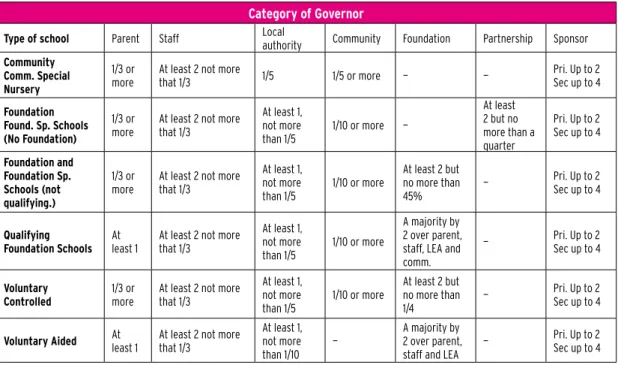
Associate members – are widely defined and can include providers of other services (Not formally members of the governing body). Governors of all categories are volunteers. The School Governance (Constitution) (England Regulations (2007) (DFES 2007) allows schools to specify the size and membership of its governing body within limits. The size is must be between 9 and 20 governors. The constitution of governing bodies for various kinds of schools is set out in Table 3.1.
Table 3.1. The regulations for the constitution of governing bodies for various kinds of schools. Category of Governor
Type of school Parent Staff Local authority Community Foundation Partnership Sponsor Community
Comm. Special Nursery
1/3 or more
At least 2 not more
that 1/3 1/5 1/5 or more — — Pri. Up to 2 Sec up to 4 Foundation Found. Sp. Schools (No Foundation) 1/3 or more
At least 2 not more that 1/3 At least 1, not more than 1/5 1/10 or more — At least 2 but no more than a quarter Pri. Up to 2 Sec up to 4 Foundation and Foundation Sp. Schools (not qualifying.) 1/3 or more
At least 2 not more that 1/3 At least 1, not more than 1/5 1/10 or more At least 2 but no more than 45% — Pri. Up to 2 Sec up to 4 Qualifying Foundation Schools At least 1
At least 2 not more that 1/3 At least 1, not more than 1/5 1/10 or more A majority by 2 over parent, staff, LEA and comm. — Pri. Up to 2 Sec up to 4 Voluntary Controlled 1/3 or more
At least 2 not more that 1/3 At least 1, not more than 1/5 1/10 or more At least 2 but no more than 1/4 — Pri. Up to 2 Sec up to 4 Voluntary Aided At least 1 At least 2 not more that 1/3 At least 1, not more
than 1/10
— A majority by 2 over parent, staff and LEA
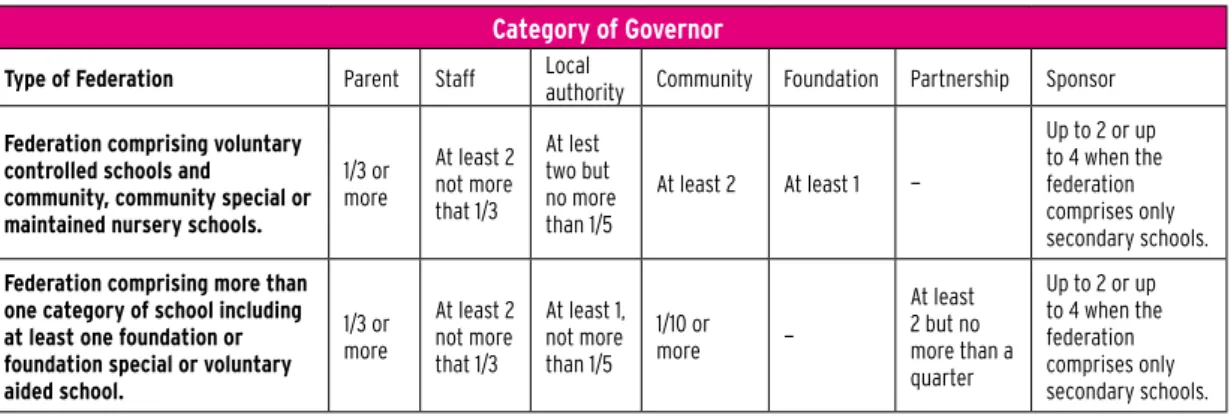
The governing of federations can take two forms: hard and soft. In ‘hard governance’ federations, there is a single governing body shared by all the schools in the federation. For a ‘soft governance’ federation, each school has its own governing body but the federation has a joint governance/strategic committee with delegated powers. It is the same arrangement for ‘soft’ federations but the joint governance/strategic committee does not have delegated powers. When the schools in a hard governance federation are all in the same category as the schools listed in Table 3.1, the federation governing body has the same composition. The composition of federation governing body when the federation comprises different schools is shown in Table 3.2.
A Trust school governing body must have 11 members and include:
• an elected parent • two members of staff
• a local authority representative
• a community representative appointed by the trust
• six other governors appointed by the trust (including three parents).
Schools can decide if they want to appoint a minority or majority of governors. A third of the membership of a trust school governing body must be parents.
Academies have considerable freedom to decide on the size and constitution of their governing bodies. The governing bodies should have at least three members and an average sized secondary academy governing body should have about 10 members. Academies are encouraged to include community and staff members on their governing bodies. They can also recruit associate members to provide advice on specific issues. The governing body and the headteacher have responsibility for managing the academy. In order to determine
the ethos and leadership of the academy, and ensure clear responsibility and accountability, the private sector or charitable sponsor always appoints the majority of the governors. This arrangement applies even when a local authority is acting as a co-sponsor for wider purposes.
Governing the School of the Future supports the representative stakeholder model of governance, but it also stresses the importance of schools recruiting governors from other agencies, and schools in general recruiting governors from a variety of backgrounds to ensure a wide-range of skills and representation of the local community. This community involvement is considered to contribute to community cohesion.
The role of the school improvement
partner
Under the 2006 Education and Inspections Act, a local education authority in England must appoint a school improvement partner (SIP) to each maintained school to provide advice to the governing body and headteacher with a view to improving standards. Since September 2006, all secondary schools in England have had SIPs and since March 2008, so have all primaries. SIPs:
• provide expert support for schools in raising standards and improving the education of all pupils
• act as a communications conduit between central government, the local authority and schools
• help schools to set targets and priorities and identify any additional support needed • are also required to advise school
governing bodies on headteacher performance management. This
responsibility does not apply to Academy governing bodies.
Category of Governor
Type of Federation Parent Staff Local authority Community Foundation Partnership Sponsor Federation comprising voluntary
controlled schools and
community, community special or maintained nursery schools.
1/3 or more At least 2 not more that 1/3 At lest two but no more than 1/5 At least 2 At least 1 — Up to 2 or up to 4 when the federation comprises only secondary schools. Federation comprising more than
one category of school including at least one foundation or foundation special or voluntary aided school. 1/3 or more At least 2 not more that 1/3 At least 1, not more than 1/5 1/10 or more — At least 2 but no more than a quarter Up to 2 or up to 4 when the federation comprises only secondary schools. Table 3.2. The composition of a federation governing body when the federation comprises different schools.
The SIP helps a school to:
• use the outcomes of the school self-evaluation and benchmarking data and inspection evidence
• understand local and national priorities • help formulate the school’s development
plan and targets
• use networks and support for school improvement.
The SIP’s work involves:
• moderating the school’s self-evaluation • agreeing priorities and targets for future
improvement
• identifying any external support needed SIPs will increasingly influence the workings of school governing bodies.
The clerk to the governing body
The 2002 Education Act makes provision for the appointment of a clerk to the governing body of a maintained school. The governing body must appoint a clerk and the clerk may not be a governor, associate member or the headteacher of the school. In the clerk’s absence, a governor but not the headteacher may act as clerk for that meeting. The Governors Guide to the Law makes clear that the clerk needs to work effectively with the governing body and the headteacher to support the governing body and be able to advise the governing body on constitutional and procedural matters, duties and powers. The clerk is accountable to the governing body. Specifically, the clerk is responsible for
• convening meetings of the governing body • attending meetings of the governing body
and ensure minutes are taken
• maintaining a register of members of the governing body and report vacancies to the governing body
• maintaining a register of attendance and report this to the governing body
• giving and receiving notices in accordance with relevant regulations
• performing such other functions as may be determined by the governing body from time to time.
A full job description and person specification for governing body clerks can be found in the training and recruitment section of GovernorNet website. It runs to four pages and sets out a series of very high
level requirements. Clerks clearly have very important responsibilities and are important in ensuring the proper functioning of the governing body.
School governor training and
development – current arrangements
Governing the School of the Future discusses governor training and highlights the role played by the National Coordinators of Governor Services (NCOGS) and the National College for School Leadership (NCSL) in providing training and support, and encourages the formation of partnerships with other providers of training. It encourages governing bodies to carry out skills audits to identify their specific training needs, and it urges schools to consider seriously governors’ support and training when allocating their budget. Governing the School of the Future also outlines a programme for training new chairs of governing bodies called ‘Taking the Chair’. The document acknowledges the role played by the School Governors’ One- Stop Shop (SGOSS) in recruiting volunteers with transferable management skills. It emphasises the importance of raising the profile of governors, both within the community and among employers. Governing the School of the Future also stresses the need for employers to provide suitable arrangements for governors to be able to comply with the time demands of their volunteering role, which employers are required to do under Section 50 of the Employment Rights Act 1996.
Training for school governors is not compulsory, but it is strongly recommended. Governing the School of the Future makes clear that good governor training and support are central to ensuring governing body effectiveness and that a wide range of organisations and institutions have a role in supporting governing bodies. These include: the National Governors’ Association and NCOGS. The NCSL has also had a role in advising on the development of programmes and identifying development needs. Governing the School of the Future sets out the development needs that have been identified as follows.
• Opportunities to develop and practise the skills of effective governance (including communication skills, organisational skills, team working, strategic and analytical skills; effectively challenging as well as supporting the school leadership team)
• Enjoying opportunities to build effective relationships with school leaders through joint training so that, as school governors, they can take their rightful place as partners in school leadership and as community leaders
• Understanding what knowledge,
experience, skills and attributes contribute to effective leadership so that governors are able to draw on this knowledge when appointing headteachers and other members of the school’s leadership team • Understanding the Government’s agenda
for education in schools (including leadership, an explicit focus on learning and teaching, remodelling the school workforce, transformational partnerships and specialisms and collaboration) • Where governors wish, having their
commitment, learning and development recognised by the provision of accredited training opportunities
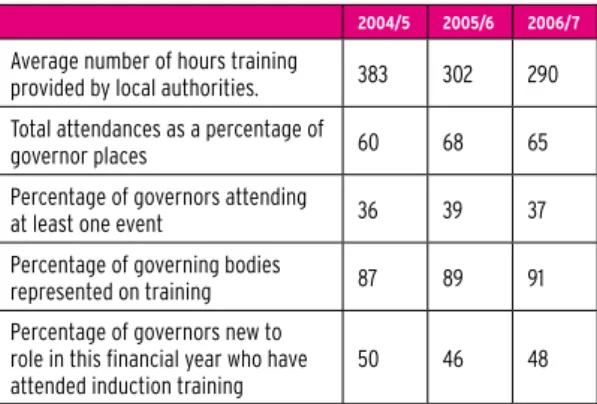
Governing bodies are required to pay for their own training and support needs from their Standards Fund Grant allocation. Some local authorities offer buy back subscription packages for governor training, as well as individually priced courses, and others also offer clerking services or regular briefing updates to independently appointed clerks. Some local authorities use link governors to ensure that governors are made aware of training opportunities. Link governors can play a useful role in developing governing body expertise by ensuring that there are sufficient numbers of trained governors. They can also provide useful feedback to the local authority on the suitability of courses being provided as well as help to identify training needs.
At the national level, the following key training programmes are currently available.
Taking the Chair, which aims to explore the skills required to lead and manage the work of a school governing body. For: prospective and new chairs and vice-chairs of governing bodies of committees and experienced chairs who wish to review their effectiveness.
Leading Together, a school-based programme which aims to explore and improve the team-work of the governing body, the headteacher and the school leadership team to achieve a school improvement priority. For: governing bodies, headteachers and school leadership teams.
Safer Recruitment, an on-line training programme that provides information on a safer school culture and advice and guidance to strengthen safeguards against employing unsuitable people in schools. For: all headteachers and governors in state and independent schools and appropriate staff from each local authority.
National Training Programme for New Governors, which supports governor trainers in local authorities and Diocesan Boards to help them to ensure that new governors have the information they need to become effective school governors. For: governor trainers.
National Training Programme for Clerks to Governing Bodies, which supports both new and experienced clerks in their roles as administrator, information manager and adviser. For: clerks to governing bodies.
BTEC Advanced Certificate in School Governance, which enables school governors to build a portfolio of evidence demonstrating the effective part they play in governing their school and to achieve a nationally recognised qualification. For: school governors.
NCSL (2008) reports that whilst there is some daytime provision, most local authority training for school governors seems to be offered during evenings or at weekends, with courses ranging from two hours to a whole day in length and some being offered in several units, thus requiring a commitment to several sessions. A small number of local authorities are introducing on-line training for school governors but the majority of provision is still face-to-face, either at external venues, which is typical, or as bespoke courses at the governors own school, which sometimes incurs additional costs. Provision varies between local authorities but tends to be either commissioned out and run by private companies or provided by ‘in-house’ trainers. NCSL also reports that the preparation of headteachers to enable them to work effectively with governors and the governing body will be enhanced by the development of new learning materials for the redesigned National Professional Qualification for Headship (launched from September 2008). There will be two key sections aimed at addressing the relationship.