Auditing for Distributed Storage Systems
Anh Le,
Member, IEEE
Athina Markopoulou,
Senior Member, IEEE
and Alexandros G. Dimakis,
Member, IEEE
Abstract
Distributed storage codes have recently received a lot of attention in the community. Independently, another body of work has proposed integrity checking schemes for cloud storage, none of which, however, is customized for coding-based storage or can efficiently support repair. In this work, we bridge the gap between these two currently disconnected bodies of work. We propose NC-Audit, a novel cryptography-based remote data integrity checking scheme, designed specifically for network coding-based distributed storage systems. NC-Auditcombines, for the first time, the following desired properties: (i) efficient checking of data integrity, (ii) efficient support for repairing failed nodes, and (iii) protection against information leakage when checking is performed by a third party. The key ingredient of the design ofNC-Auditis a novel combination ofSpaceMac, a homomorphic message authentication code (MAC) scheme for network coding, and NCrypt, a novel chosen-plaintext attack (CPA) secure encryption scheme that preserves the correctness ofSpaceMac. Our evaluation of NC-Audit based on a real Java implementation shows that the proposed scheme has significantly lower overhead compared to the state-of-the-art schemes for both auditing and repairing of failed nodes.
Index Terms
Network Coding, Distributed Storage, Auditing, Integrity, Encryption, Security.
I. INTRODUCTION
Traditional distributed storage architectures provide reliability through block replication, whose major disadvantage is the large storage overhead. As the amount of stored data is growing faster than hardware infrastructure, this becomes a major cost bottleneck. In contrast, coding techniques achieve higher data reliability with considerably smaller storage overhead [1]. For that reason,
A. Le and A. Markopoulou are with UC Irvine. Emails:{anh.le, athina}@uci.edu A. G. Dimakis is with UT Austin. Email: [email protected]
Node 1
b1
b2
Node 2 b3
b4
+
Node 3
b1+b3
b2+b4
Node 4 b2+b3
b1+b2+b4
b1
b3+b4
b2+b4
b2+b3
b1+b2+b4
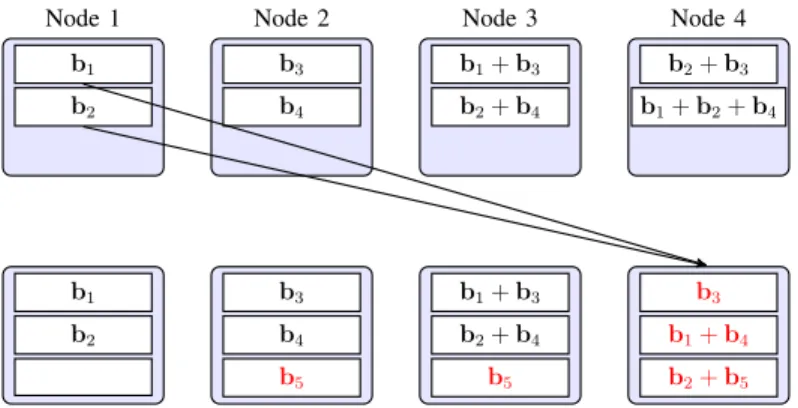
Fig. 1. Repairing a failed node [6]: The original data consists of four blocks:b1,b2,b3 andb4. A(4,2)MDS code is used such that any 2 nodes can be used to restore the original data. Note that the repair involves combining blocksb3 and b4 and the repair bandwidth consists of 3 blocks instead of 4, where 4 is the amount of blocks needed to reconstruct the whole data.
coding techniques are under investigation for different distributed storage systems. Specifically, novel storage codes are currently being deployed in production cloud storage systems, such as Windows Azure [2], analytics clusters (e.g., Facebook Analytics Hadoop clusters [3]), archival storage systems, and peer-to-peer storage systems like Cleversafe and Wuala [4], [5].
Distributed storage codes operate by splitting files into blocks and creating additional parity blocks that provide fault tolerance. If the original file consists ofK blocks, an(N, K)maximum distance separable (MDS) code is typically used to produce N blocks to be stored individually on N storage nodes, thus tolerating up to (N −K) node failures. A well-known problem of classical erasure codes, like Reed-Solomon, is the so-called repair problem: when a single node fails, typically one block is lost from the file; however, the reconstruction of that single block requires reading and transferring K blocks from other nodes.
Novel storage codes that use network coding (NC) were recently developed to reduce this
repair bandwidth. These distributed storage codes require significantly less than K blocks to repair a single node failure and rely on network coding to perform in-network processing [6], [7]. Key ingredients of NC-based distributed storage codes include (i) storing coded blocks, i.e., linear combinations of original blocks that form the original data, and (ii) block mixing when repairing. An example is shown in Fig. 1. The repair bandwidth, however, is only one aspect of cloud storage.
Another practical aspect of cloud storage, besides the repair bandwidth, is data integrity checking. Integrity checking is extremely important for distributed storage systems, especially
when data is stored with untrusted cloud providers. Data can be lost or corrupted for various reasons while users may remain completely unaware of for long periods of time. For example, storage errors, such as torn writes [8] and latent errors [9], may damage data in a way that remains undetected. Cloud storage providers may also have incentives to misbehave, e.g., misreport data loss incidents in order to maintain their reputation [10]–[12]. This problem is further exacerbated in systems that use coding because corrupted data can propagate to multiple nodes during repair re-encoding [13]. Therefore, it is important for the user to be able to audit the integrity of the data stored on the cloud.
Another complication is that frequent integrity checking of large data sets may be out of the ability or budget of users with limited resources [12], [14]. As a result, users often resort to a third party to perform audits on their behalf [10], [12], [15], [16]. In this latter case, it is important that the auditing protocols are privacy-preserving, i.e., do not leak information to the third party [12], [17]. Indeed, users can leverage data encryption to protect their data before outsourcing it [16]. However, data encryption should be complementary and orthogonal to integrity checking protocols. In other words, the auditing protocol should not introduce new vulnerabilities of unauthorized data leakage. Furthermore, the users may want to outsource unencrypted instead of encrypted data to support more efficient and complex computations.
As a result, auditing for distributed systems that use modern NC-based storage codes is an important emerging problem. Despite the rich literature on auditing protocols for general distributed and cloud storage [10]–[12], [15]–[20], [22]–[25], there have been very few auditing protocols for NC-based distributed storage systems [13], [26]. These protocols, however, are generic in the sense that they do not specifically exploit coding properties for efficient integrity checking [13]. Moreover, they do not prevent data leakage [13], [26]. Most importantly, they do not efficiently support repair, which is the main advantage of NC-based storage systems when compared to other storage systems.
In this work, we propose a symmetric key-based cryptographic protocol, called NC-Audit, to check for the integrity of data stored on an NC-based distributed storage system. To the best of our knowledge, this is the first scheme proposed for NC-based systems that possesses all the following desired properties:
(i) Efficient Integrity Checking: The integrity check incurs a small bandwidth and
the storage provider passes the integrity check if and only if it possesses the data. The proposed protocol also supports unlimited number of checks.
(ii) Efficient Support for Repair: The repair of failed nodes require negligible bandwidth (no
data download) as well as computation for maintaining the metadata used by the integrity checking.
(iii) Efficient Privacy Protection: A third party auditor cannot learn any information about the user data through the checking protocol (except for the metadata used by the integrity checking). This privacy preserving property incurs a small bandwidth (< 1%) and compu-tational overhead (on the order of milliseconds).
We would like to emphasize that, independently of (iii), properties (i) and (ii) together are already useful to users who could and prefer to audit the data themselves. NC-Audit is the first protocol that possesses (i) and (ii) at the same time. NC-Audit achieves these properties by fully exploiting network coding in its design. The main novelty of NC-Audit come from a careful combination of SpaceMac – a homomorphic message authentication code (MAC) that was previously specifically designed for network coding [27], [28], andNCrypt– a novel chosen-plaintext attack (CPA) secure encryption scheme that we custom designed, in this work, to operate in synergy with and preserve the correctness of SpaceMac.
We implemented NC-Audit in Java, utilizing our previous implementation of SpaceMac [28]. Our evaluation of NC-Audit shows that it has very low computational overhead. In particular, when performing an audit, both the storage node and the auditor only need to spend a few milliseconds. Furthermore, the auditor’s overhead is much less than that of the state-of-the-art approach for NC-based storage systems [13], which is on the order of seconds.
The rest of the paper is organized as follows. In Section II, we discuss related work. In Section III, we formulate the problem and describe the threat model. In Section IV, we describe the auditing framework and the key building blocks of NC-Audit, namely SpaceMac and NCrypt, before presenting NC-Audit itself. In Section V, we show how NC-Audit efficiently supports repair. In Section VI, we analyze the security of NC-Audit. In Section VII, we evaluate its storage, bandwidth, and computational efficiency. In Section VIII, we conclude the paper.
II. RELATEDWORK
A. Integrity Checking for Remote Data
There has been a rich body of work on integrity checking for remote data [10]–[12], [15]–[19], [22]–[25], commonly known as Proof of Retrievability and Proof of Data Possession.
Proof of Retrievability (POR). In [16], Juels and Kaliski introduced the notion of POR, where
a POR enables a client (verifier) to determine that the server (prover) possesses a file or data object. Furthermore, a successful execution of POR would allow a verifier to extract the file from the proof. The main POR scheme presented there uses sentinels, i.e., small check blocks, that are inserted into the outsourced data to guard against large file corruption. At the same time, it also utilizes error correcting codes to protect against small file corruption. This scheme can only handle a limited number of queries, which has to be fixed a priori. In contrast, NC-Audit does not use sentinels and supports unlimited number of queries.
In [15], Shacham and Waters proposed two POR schemes with full proofs of security and extract-ability. The first one, built on Boneh-Lynn-Shacham (BLS) signatures, provides public verifiability. The second one, built on pseudorandom functions (PRFs), provides private verifia-bility. Recently, Bowers et al. [20] proposed HAIL, an improvement of existing POR schemes that allows for performing data integrity checking with multiple servers against stronger, mobile adversaries.
These schemes [15], [20] exploit homomorphic properties to aggregate authenticator values to improve the audit efficiency. NC-Audit also exploits homomorphic properties (of SpaceMac) and provides private verifiability. In terms of extract-ability, NC-Audit is different from existing approaches, e.g., [15], in that NC-Audit exploits the inherent embedded coding coefficients in the stored blocks to perform the extraction. Meanwhile, [15] relies on additional erasure codes (pre-applied to the data) for the extraction.
Proof of Data Possession (PDP). The notion of PDP was introduced by Ateniese et al. [10].
The PDP scheme in [10] uses homomorphic RSA signatures to generate verification tags. The data possession guarantee provided by this scheme is under the RSA and KEA1 assumptions in the random oracle model. Earlier in [29], Schwarz and Miller proposed using a combination of both erasure-correcting coding and algebraic signatures (homomorphic hashes) to perform
integrity checking for remote data. As discussed in [15], the notion of PDP is considered to be weaker than POR. This is because in POR, a successful audit guarantees that all the data can be extracted while in PDP, only a certain percentage of the data (e.g., 90%) is guaranteed to be available. Integrity checking for groups with efficient user revocation was recently introduced in [21]. We will show that NC-Audit provides the stronger data possession checking with data extraction as in POR (Section VI-A).
Data Modification. In [18], Ateniese et al.proposed a symmetric-key based checking scheme
that supports data modification. This scheme is built on regular PRFs, hash functions, and encryptions. It provides private verifiability and supports a limited number of queries. In [22], Erwayet al.proposed an auditing scheme built on rank-based authenticated skip lists and requires the storage server to maintain the lists for verification. In [23], Wang et al. proposed a public auditing scheme that uses a combination of the BLS-based scheme in [15] and Merkle Hash Tree (MHT).
In practice, most current deployments of distributed storage codes [2], [3] initially set all files to replication mode. When certain files become cold (i.e., rarely accessed and modified) the replicated blocks are deleted and corresponding parity blocks are created. This dynamic switching of files from replication to coding allows distributed storage systems to benefit from the high performance of replication forhot files and the storage benefits of coding forcold files. Interestingly, in most analytics clusters and cloud storage systems, the vast majority of data seem to be cold [2], [3]. Therefore, we do not expect data modification to be a critical operation for encoded data.NC-Auditprovides some preliminary support for data modification, and the details can be found in the Appendix.
Privacy Preserving. In [11], Shah et al.proposed an auditing protocol that is privacy
preserv-ing. This protocol first encrypts the data and then sends a number of message authentication code (MAC) tags of the encrypted data to the auditor. The auditor verifies both the outsourced data and the outsourced encryption key. This approach only works on encrypted files. It also requires the auditor to maintain states and supports only limited number of audits. In [17], Wang et al. proposed a privacy preserving auditing protocol that has public verifiability. This protocol can be considered an extension of the BLS-based protocol in [15]. In this approach, the aggregated (proving) block sent by the storage server is masked with a random element to protect
the privacy of the block. NC-Audit is explicitly designed to provide privacy preserving-auditing (Section IV-E and VI-B). Different from [17], NC-Audit relies on symmetric-key cryptographic primitives instead of public-key ones, and thus it provides private instead of public auditing.
Finally, we stress that none of the schemes described above was customized for NC-based storage. In particular, they do not provide efficient support for node repair.NC-Auditwas designed to achieve all the above properties: providing proof of retrievability and privacy-preserving auditing while efficiently supporting node repair.
B. Integrity Checking for NC-based Storage Systems
NC-based Storage Systems. The benefits of network coding for distributed storage were first
formalized by the work of Dimakis et al. [7]. In particular, in [7], the authors proposed the notion of regenerating codes and show that they can significantly reduce the repair bandwidth. This work showed the fundamental tradeoff between node storage and repair bandwidth and proposed regenerating codes that can achieve any point on the optimal tradeoff curve. A survey on recent advances in NC-based storage system can be found at [6]. A wiki on NC-based storage cloud is maintained at [31]. NC-Audit is designed to fully support regenerating codes.
An NC-based distributed file system (NCFS) is proposed in [32]. One of the first imple-mentations of NC-based storage cloud is NCCloud by Hu et al. [33]. In particular, NCCloud is a proxy-based system for multiple-cloud storage. It utilizes a functional minimum-storage regenerating code to provide cost-effective repair for a permanent single-cloud failure. This efficient repair is achieved without the cost of storage or redundancy level. NCCloud prototype was deployed on top of Windows Azure Storage.
Integrity Checking Schemes for NC-Based Storage Systems. There have been only a few
number of work that provide remote data checking for NC-based storage. In [26], Dikialotis et al. proposed an integrity checking scheme that utilizes the error-correction capabilities of the storage system. This scheme aims to detect errors with a very small amount of bandwidth. The key technique for reducing the bandwidth is to project data blocks onto a small random vector. This checking scheme is inherently different from NC-Audit as it relies on the communication between the auditor and multiple nodes to perform a single check while NC-Audit does not. Moreover, this scheme is information-theory based while NC-Audit leverages cryptographic
primitives to provide the checking.
A more recent integrity checking scheme for NC-based storage was proposed in [13]. In this work, Chen et al. adopted the symmetric-key based scheme that Shacham and Waters proposed for regular cloud storage [15] with minor modification. In particular, based on the symmetric-key based scheme in [15], the scheme in [13] proposed to encrypt the coding coefficients of the outsourced encoded blocks to prevent replay attacks, where a malicious storage node may store old (incorrect) encoded blocks instead of the new (correct) encoded blocks as required by the repair [13]. NC-Audit overcomes this attack by requiring the user/auditor to store the coding coefficients, which is also needed for the repair process and only occupies a negligible amount of storage (see Section VII-A).
What really sets NC-Audit apart from [13] is that NC-Audit fully exploits network coding for integrity checking. In particular, the scheme proposed in [13] relies on two independent logical representation of file blocks for two different purposes: data possession checking and network coding operation. Because of this, during the repair process, the user has to download blocks from the remaining healthy nodes to compute the integrity checking data for the new coded blocks (to be stored at the recovery node). This approach puts heavy bandwidth and computational overhead on the user. In contrast, NC-Audit uses a singlerepresentation for both purposes and thereby achieving integrity checking while eliminating the heavy user’s bandwidth and computational overhead. Details of how NC-Audit support efficient repair are provided in Section V. Furthermore, the scheme in [13] does not support privacy-preserving auditing while NC-Audit does. We provide detailed performance comparison between NC-Audit and [13] in Section VII.
Finally, a recent work by Cao et al. [34] proposed an LT codes-based storage system with an integrity checking and an exact repair schemes; however, it neither supports functional repair [7] (discussed in Section V) nor privacy-preserving auditing.
Other Security Issues. Other security problems for NC-based storage include protecting the
privacy and integrity of the blocks while repairing. The work in [42] and [43] prevents eaves-droppers from accessing/decoding all the data. In [42], Pawar et al. provide an explicit code construction that achieves the secrecy capacity for the bandwidth-limited regime of the storage systems under repair dynamics. [43] analyzes the effects of interaction between the storage nodes
USER THIRD PARTY AUDITOR
NC-BASED DISTRIBUTED STORAGE
Storage node
Step 1 (Set up) • Encoded blocks • MAC tags • Enc. key
Step 2 (Set up) • MAC key
Step 3 (Audit) • Coefficients
Step 4 (Audit) • Encrypted block • MAC tag
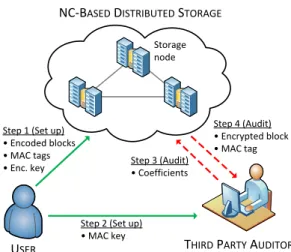
Fig. 2. Parties and Steps Involved inNC-Audit.
on the amount of data revealed to the eavesdroppers. The work in [44] provides upper bounds on the maximum amount of information that can be stored safely when there are malicious nodes. In [44] and [45], the authors provide protection against pollution attacks during the repair. In [45], Buttyan et al. provide a lightweight, pollution-resilient decoding algorithm that is capable of finding adversarial blocks. The scheme in [13] also protects the repair phase against pollution attacks, i.e., preventing remaining nodes from sending corrupted data to the new (recovering) node. Dealing with pollution attacks is out of the scope of this work. We refer the reader to the rich literature, including our previous work, that deal with pollution attacks [35]–[41].
C. This Work in Perspective
A preliminary version of this work has appeared in NetCod 2012 [46]. In this paper, we provide the following revisions and extensions of the previous version: We revise and provide complete proofs of all lemmas and theorems; we described in detail a repair process; we discuss and compare our storage overhead to prior work [13], [17], [23]; finally, we provide a comprehensive discussion of related literature.
III. PROBLEMFORMULATION
A. System Model and Operations
Fig. 2 illustrates an overview of NC-Audit. We consider a cloud storage service that involves three entities: a user, NC-based storage nodes, which make up the storage cloud, and a third
party auditor (TPA). The user distributes his/her data on the storage nodes. The user resorts to a TPA to check for the integrity of the data stored at each node; at the same time, he/she does not want the TPA to learn about the outsourced data. We assume that the user is responsible for repairing of a failed node. The user here acts as a proxy that manages the storage nodes as in the case of NCCloud [33]. Our work is also applicable to scenarios where there is a cloud service provider, who is independent from the user and acts as the proxy.
The user follows the following basic steps to store his/her data on the storage cloud. We adopt the notation used in [40]. Denote the original file by F. The user first dividesF into m blocks,
ˆ
b1,· · · ,bˆm. Each block is a vector in an n-dimensional linear spaceFnq, whereF is a finite field
of size q. To facilitate the decoding, the user then augments each block bˆi with its m global
coding coefficients. The resulting blocks, bi, have the following form:
bi = ( n z }| {
—bˆi—,
m
z }| {
0,· · · ,0,1
| {z }
i
,0,· · · ,0) ∈Fn+m
q .
We call bi source blocks and the space spanned by them source space, denoted by Π. We use
aug(bi) to denote the coefficients of bi. Typically, n m, and this presentation is also called
an n-extended version of a storage code [26].
The user then creates a number of encoded blocks using an appropriate linear coding scheme for the desired reliability,e.g., an array MDS Evenodd code is used in Fig. 1. Each encoded block is a linear combination of the source blocks. Note that if an encoded block eequals Pm
i=1αibi,
then the last m coordinates of e are exactly the coding coefficients αi’s. These encoded blocks
are then distributed across the N storage nodes of the storage cloud. Let M be the number of encoded blocks stored at a storage node, P be the number of healthy nodes that need to send the (encoded) repair blocks, and Q be the number of repair blocks each healthy node needs to send to the new node. In the example given in Fig. 1, m = 4, N = 4, M = 2, P = 3, and
Q= 1.
B. Threat Model
We adopt the threat model considered in [17] and [24]. In particular, we consider semi-trusted storage nodes that behave properly and do not deviate from the prescribed auditing protocol. However, for their own benefits, they may deliberately delete rarely accessed, archival user’s
data to reduce operational cost; they may also decide to hide data corruptions, caused by either internal or external factors to maintain reputation. For clarity, we focus our discussion on a single storage node except when discussing the repair process.
We assume that the TPA, who is in the business of auditing, is reliable and independent. We assume that the TPA does not colludewith the storage node during the auditing process to hide data corruption. This is a standard assumption when relying on a TPA for integrity checking [17], [21], [23]. The TPA, however, must not be able to learn any information about the user’s data through the auditing process, aside from the metadata needed for the auditing, as in [17]. In order words, the auditing protocol should not introduce a data leakage vulnerability. Similar to standard applications of cryptographic protocols, we assume that both the node and the TPA are fully aware of all the cryptographic constructions and protocols used; however, their runtime is polynomial in the security parameter.
IV. AUDITING SCHEME
A. Definitions and Auditing Framework
We follow the literature of integrity checking of remote data [10], [15]–[17], [19] and adapt the proposed framework to our privacy-preserving auditing system. In particular, we consider an auditing scheme which consists of four algorithms:
• KeyGen(1λ)→(kv, ke) is a key generation algorithm that is run by the user to setup the
scheme. It takes a security parameter λ as input and outputs two different private keys: kv
used to generate verification metadata, and ke used to encrypt the possession proof.
• TagGen(e, kv)→t is an algorithm run by the user to generate the verification metadata.
It takes as input a coded block, e, a private key, kv, and outputs a verification tag of e, t.
• GenProof(ke,(e1,· · · ,eM),(te1,· · · , teM),chal) →V is run by the storage node to
gen-erate a proof of possession. It takes as input a private key, ke; coded blocks stored at the
node, e1,· · ·,eM; their corresponding verification metadata, te1,· · · , teM; and a challenge,
chal, which includes block indices and coding coefficients. It outputs a proof of possession,
V, for the coded blocks determined by chal.
• VerifyProof(kv,chal, V) → {1,0} is run by the TPA in order to validate a proof of
V. It returns 1 (success) if V is the correct proof of possession for the blocks determined by chal and 0 (failure) otherwise.
An auditing system can be constructed from the above algorithms and consists of two phases:
• Setup: The user initializes the security parameters of the system by running KeyGen. The
encoded blocks are prepared as previously described in Section III-A. The user then runs TagGen to generate verification metadata for each encoded block. Afterwards, both the encoded blocks and verification metadata are uploaded to the storage node. The encoded blocks are then deleted from the user’s local storage. Finally, the user sends metadata needed to perform the audit to the TPA.
• Audit: The TPA issues an audit message, i.e., a chal, to the storage node to make sure that
the node correctly stores its assigned coded blocks. The node generates a proof of possession for the blocks specified inchal by runningGenProof, and it sends the possession proof back to the TPA. Finally, the TPA runs VerifyProof to verify the possession proof it receives.
B. Basic Scheme and Key Techniques
Here we describe the most basic scheme that supports remote data checking and show that it does not provide the desired properties. This basic scheme is also described in [10]. Afterwards, we describe how we improve this basic scheme to arrive at our proposed scheme.
The Basic Scheme. During the Setup phase, the user precomputes a Message Authentication
Code (MAC) tag, ti, for each coded block, ei, using a secret key, kv, and a standard MAC
scheme, e.g., HMAC. The user then uploads both the tags and the coded blocks to the storage node and sendskv to the TPA. During theAuditphase, to verify that the node stores ei correctly,
the TPA issues a request for ei. The node then sends ei and its tag ti to the TPA. The TPA can
use kv and ti to check for the integrity of ei. Although providing the possession checking, this
scheme suffers from many drawbacks:
• It is inefficient in both computation and communication since the computation and
band-width overhead increases linearly in the number of checked blocks.
• It does not efficiently support node repair [6], [7]: It requires the user to download all
the blocks necessary to compute the new (recovering) blocks. The user then computes verification tags for all the new blocks, essentially re-setting up the storage node.
• It violates privacy because the TPA learns about the blocks. A straightforward way to
provide privacy is to encrypt the response block using a standard encryption scheme, e.g., AES. However, in this case, the TPA will not be able to verify the integrity of the original block because the provided tag is not computed on the encrypted block but on the original block.
Key Techniques. We improve the basic scheme to arrive at our proposed scheme by leveraging
a novel combination of (i) a homomorphic MAC scheme and (ii) a novel encryption scheme that exploits properties of linear network coding.
In detail, we adopt SpaceMac, a homomorphic MAC scheme that we previously designed specifically for network coding [27], [41]. We use SpaceMac to generate verification tags. With SpaceMac, the integrity of multiple blocks can be verified with the computation and communication cost of a single block verification, thanks to the ability to combine blocks and tags. SpaceMac also facilitates repair as verification metadata at a newly constructed node can be computed efficiently from existing metadata at healthy nodes.
We custom design a novel encryption scheme, called NCrypt, to protect the privacy of the response blocks. NCrypt is constructed in a way that preserves the correctness of SpaceMac: A response block, even when encrypted, can be used by the TPA for the integrity check. We stress that it is not possible to use other standard encryption schemes, such as AES, in place of NCrypt, because they will break the SpaceMac integrity verification. The reason is that in general, a MAC tag computed on a data block can only be used to verify the integrity of the block upon the reception of the tag and the data block, but it cannot be used when the encrypted data block is received instead of the original block.
Formally, let (Enc,Dec) denote a symmetric-key encryption scheme and (Mac,Verify)denote a MAC scheme. Let e be an (encoded) data block, and ke and kv be the keys for the encryption
and MAC schemes. Let c=Enc(ke,e) and t=Mac(kv,e). The encryption and MAC schemes
are compatible with each other when Verify(kv,c, t) outputs 1 if and only if c=Enc(ke,e) and
outputs 0 otherwise.
The main novelty of NCrypt lies in its compatibility with SpaceMac: It is carefully designed to maintains both the correctness ofSpaceMac (Theorem 3) as well as the security ofSpaceMac (Theorem 4). NCrypt employs the random linear combination technique of network coding and
is semantically secure under a chosen-plaintext attack (CPA-secure). Next, we describe how we use SpaceMac and NCrypt in detail.
C. The Homomorphic MAC: SpaceMac
In prior work, we originally designed SpaceMac and used it to combat pollution attacks in network coding [27], [28], [40], [41].SpaceMac was inspired by and an improvement of another homomorphic MAC scheme, HomMac, proposed by Agrawal and Boneh [36]. The novelty of SpaceMacand a detailed comparison between the two schemes can be found in [27], [41]. Here, we adopt SpaceMac to support the aggregation of file blocks and tags to allow for efficient auditing (similar to [15], [20]). Furthermore, as we show in Section V,SpaceMacalso facilitates efficient node repairs.
Definition.A (q, n, m) homomorphic MAC scheme is defined by three probabilistic,
polynomial-time algorithms:Mac,Combine, andVerify. TheMacalgorithm generates a tag for a given block; the Combine algorithm computes a tag for a linear combination of some given blocks; and the Verify algorithm verifies whether a tag is a valid tag of a given block.
• Mac(k,id,e):
– Input: A secret key, k, the identifier, id, of the file, and a source block or encoded block, e∈Fn+m
q .
– Output: Tag t for e.
• Combine((e1, t1, α1),· · · ,(e`, t`, α`)):
– Input: ` blocks, e1,· · · ,e`, their tags, t1,· · · , t`, under key k, and their coefficients,
α1,· · · , α` ∈Fq.
– Output: Tag t for block edef=P`
i=1αiei.
• Verify(k,id,e, t):
– Input: A secret key, k, the identifier, id, of the file, a block, e∈Fn+m
q , and its tag, t.
– Output: 0 (reject) or 1 (accept).
Also, the scheme must satisfy the following correctness requirement: Let t =Combine((e1, t1, α1),· · · ,(e`, t`, α`)), thenVerify
k,id,P`
i=1αiei, t
= 1.
Note that the homomorphic property of the MAC scheme, or the existence of Combine, which does not exist in regular MAC schemes, such as HMAC, ensures that multiple blocks can be
audit at the bandwidth and verification computation cost of a single block.
Construction. SpaceMac consists of a triplet of algorithms: Mac, Combine, and Verify. The
construction ofSpaceMacuses a pseudo-random function (PRF)F1 :K1×(I ×[1, n+m])→Fq,
where K1 is the PRF key domain and I is the file identifier domain.
• Mac(k,id,e) → t: The MAC tag t ∈ Fq of a source block or encoded block, denoted by
e∈Fn+m
q , under key k, can be computed by the following steps:
– r ←(F1(k,id,1),· · · , F1(k,id, n+m)) .
– t ←e·r∈Fq .
• Combine((e1, t1, α1),· · · ,(e`, t`, α`)) → t: The tag t ∈ Fq of e def= P`i=1αiei ∈ Fnq+m is
computed as follows: – t ←P`
i=1αiti ∈Fq .
• Verify(k,id,e, t)→ {0,1}: To verify iftis a valid tag ofeunder keyk, we do the following:
– r ←(F1(k,id,1),· · · , F1(k,id, n+m)) .
– t0 ←e·r .
– If t0 =t, output 1 (accept); otherwise, output 0 (reject).
Lemma 1(Theorem 1 in [27]). Assume thatF1 is a secure PRF. For any fixedq,n,m,SpaceMac
is a secure (q, n, m) homomorphic MAC scheme.
We refer the reader to [27] for the security game and proof of SpaceMac. We provide security proof ofSpaceMac when used inNC-Auditin Section VI-A. If the user computes the verification tags for the source blocks using the Mac algorithm of SpaceMac, then the storage node can compute a valid MAC tag for any encoded block using the Combine algorithm. The security of SpaceMac guarantees that if a block, e0, is not a linear combination of the source blocks, then the storage node can only forge a valid MAC tag for e0 with probability 1q. The security when using ` tags is improved to q1`. For clarity, we focus on a single file F and thus omit the file
identifier id used by the above three algorithms in our subsequent discussion.
D. The Random Linear Encryption: NCrypt
To protect the privacy of the response file block, we need to encrypt it. The encryption, however, needs to still allow for the verification of the block. To this end, we design a novel
encryption scheme that is compatible with SpaceMac, called NCrypt. In particular, NCrypt will protectn−2elements of the response block while still allowingSpaceMacintegrity checking. The remaining 2 elements are random padded elements. These 2 elements are needed to guarantee the security of the schemes, as we will show in the construction and proofs of NCrypt and SpaceMac1.
Let x¯ denote the vector formed by the firstn−2 elements of a vectorx. The construction of NCryptuses two PRFs:F2 :K2×([1, n−1]×[1, n−2]) →FqandF3 :K2×({0,1}λ×[1, n−1])→
Fq, where K2 is a PRF key domain. NCrypt consists of three probabilistic, polynomial time
algorithms:
• Setup(k,¯r) → (p1,· · · , pn−1): This algorithm is run by the user to setup the encryption
scheme. It takes as input a secret key k and a vector ¯r 6= 0,¯r ∈ Fn−2
q . It outputs n−1
elements in Fq, which are called auxiliary elements and are used by the encryption. The details are as follows:
– Compute pi¯ ←(F2(k, i,1),· · ·, F2(k, i, n−2)) ∈Fnq−2, for i∈[1, n−1].
– Compute pi ←¯r·p¯i ∈Fq, for i∈[1, n−1].
• Enc(k,¯e,(p1,· · · , pn−1))→ h¯c,(r, p)i: This algorithm is run by the storage node to encrypt
the n −2 first elements of the aggregated response block. It takes as input a secret key,
k, vector formed by the first n −2 elements of the response block, ¯e, and the auxiliary elements, p1,· · · , pn−1. It computes the encryption, h¯c,(r, p)i, of ¯e as follows:
– Compute p¯i, i∈[1, n−1], using key k as in Setup.
– Choose r uniformly at random: r ← {R 0,1}λ.
– Compute the masking coefficients: βi ←F3(k, r, i)∈Fq,for i∈[1, n−1].
– Compute the masking vector: m¯ ←Pn−1
i=1 βip¯i ∈F n−2
q .
– Compute ¯c←¯e+ ¯m∈Fn−2 q .
– Compute p←Pn−1
i=1 βipi ∈Fq.
In essence, the data is masked with a randomly chosen vector m¯ ∈span(p¯1,· · · ,p¯n−1).
• Dec(k,h¯c,(r, p)i) → ¯e: This algorithm takes as input a secret key, k, and the cipher text,
1
In particular, the 2 random padded elements is to control the number of equations in the system of equationsΠ1 andΠ2 described in the proofs of Theorems 2 and 4, respectively. Intuitively, these 2 random elements are needed to compensate for the extra information learned by the adversary inNCrypt(the elementpas part of the ciphertext) and inSpaceMac(the equations related to¯r).
h¯c,(r, p)i. The decryption is done as follows:
– Compute pi¯ , i∈[1, n−1], using key k as in Setup. – Compute βi ←F3(k, r, i)∈Fq, for i∈[1, n−1].
– Compute m¯ ←Pn−1
i=1 βip¯i ∈Fnq−2.
– Compute e¯←c¯−m¯ ∈Fn−2 q .
Theorem 2. Assume that F2 and F3 are secure PRFs, then NCrypt is a fixed-length private-key
encryption scheme for messages of length (n−2)×log2q that has indistinguishable encryptions under a chosen-plaintext attack.
Proof: Intuitively, the security of NCrypt holds because m¯ looks completely random to an adversary who observes a ciphertext h¯c,(r, p)i since it is computationally difficult for the adversary to compute βi’s without knowing the secret key k.
The proof follows a textbook technique used to prove the security of Construction 3.24 in [47]. We follow the notation in [47]. Denote the CPA security experiment of an encryption scheme
Π = (Setup,Enc,Dec) and an adversary A by PrivKcpaA,Π. The game is as follows:
• A key k is chosen uniformly at random from {0,1}λ.
• The adversary A is given ¯r, p1,· · ·, pn−1, and oracle access to Enck. A outputs a pair of
messages ¯e0 and ¯e1, both are in Fnq−2.
• A random bit b ← {0,1} is chosen, and then a ciphertextc←Enc(k,e¯b,(p1,· · · , pn−1))is
computed and given to A. We call c the challenge ciphertext.
• The adversary A continues to have oracle access to Enck, and outputs a bit b0.
• The output of the experiment is defined to be 1 ifb0 =b, and 0 otherwise. In casePrivKcpaA,Π=
1, we say that A succeeded.
Let Π1 be an encryption scheme that is exactly the same as Π except that a truly random
function f2 is used in place of F2. Let Adv[B, F2] be the probability of an adversary B with
similar runtime to A winning the PRF security game (can tell a pseudo-random function F2
from a truly random function f2). By the security of PRF, we have that Adv[B, F2] is negligible
in λ and it can be shown that (details are provided in the proof of Construction 3.24 in [47]) Adv[B, F2] =|Pr[PrivKcpaA,Π= 1]−Pr[PrivK
cpa
A,Π1 = 1]|. (1)
random function f3 is used in place of F3. Let Adv[C, F3] be the probability of an adversary C
with similar runtime toA winning the PRF security game. Similar to the above, by the security of PRF, we have that Adv[B, F3] is negligible in λ and
Adv[C, F3] =|Pr[PrivKcpaA,Π1 = 1]−Pr[PrivK
cpa
A,Π2 = 1]|. (2)
We claim that for every adversaryA that makes at most g(λ)queries to its encryption oracle, where g is a polynomial function, we have
PrPrivKcpaA,Π 2 = 1
≤ 1
2 + g(λ)
2λ . (3)
Let rc denote the random string used when generating the challenge ciphertext, which is of
the form h¯c,(rc, p)i (by encrypting ¯eb). There are two cases:
(a)rc is never used by the oracle in the encryption algorithm to produce ciphertext to answer
any ofA’s queries:In the following, we will show that each element ofanyplaintext¯eis masked with a uniformly random value, thus the adversary will not be able to tell which message (¯e0
or ¯e1) was encrypted, as in the case of one-time pad.
Parse ¯e as (e(1),· · · , e(n−2)), m¯ as (m(1),· · · , m(n−2)), and p¯ i as (p
(1)
i ,· · · , p (n−2)
i ). From a
ciphertext returned from an oracle query of ¯e, the adversary can construct the following system of equations Π1 by subtracting the query plaintext from the ciphertext:
(Π1)
β1p (1)
1 +· · ·+βn−1p (1)
n−1 =m(1) · · ·
β1p (n−2)
1 +· · ·+βn−1p (n−2)
n−1 =m(n
−2)
β1p1+· · ·+βn−1pn−1 =p
.
Note that p(ij) are not all zeros w.h.p. since they are chosen uniformly at random from Fq by
f2. Let βi be unknowns,i∈[1, n−1]. The above system of n−1linear equations is consistent
regardless of the values ofm(j)’s since the rank of the coefficient matrix is at mostn−1, which is
the number of unknowns. Lets be the rank of the coefficient matrix. Now for anyw∈[1, n−2], assume that all m(j), j 6=w, j ∈ [1, n−2], are fixed. Then m(w) still can take any value in
Fq
equally likely because (i) for any value of m(w), there is the same number of solutions, which is qn−1−s, and (ii) β
j are chosen uniformly at random from Fq (as a truly random function f3
random value, m(w), independent of other masking elementsmj=6 w, j ∈[1, n−2]. Therefore, the
probability that A outputs b0 =b is exactly 1/2, as in the case of the one-time pad.
(b) rc is used by the oracle to answer at least one ofA’s queries:In this case, A may easily
determine which of its messages was encrypted. This is because whenever the oracle returns a ciphertext, h¯c,(r, p)i, it learns the masking vector m¯ associated with r as m¯ = ¯c−¯e. Thus, by leveraging the corresponding m¯ of rc, the adversary can tell if ¯e0 or ¯e1 was encrypted by
actually decrypting the challenge response. SinceA makes at mostg(λ)queries, andr is chosen uniformly at random, the probability of this event is at most g(λ)/2λ.
Equation (3) follows from (a) and (b). Equations (1), (2), and (3) show that PrPrivKcpaA,Π= 1≤ 1
2 + g(λ)
2λ +(λ),
where is a cryptographically negligible function in λ. This completes the proof.
E. The Privacy-Preserving Auditing Scheme: NC-Audit
Now we are ready to describe our symmetric-key based auditing protocol, called NC-Audit. In particular, NC-Audit is built from a novel combination of SpaceMac and NCrypt as follows:
Setup phase:
• The user divides the file intomblocks of sizen−2instead ofn and pads to each block two
random elements in Fq. This is necessary asNCrypt encrypts only the first n−2 elements. We still denote each padded block with its coding coefficients by bi, i∈[1, m].
• The user runs KeyGen to generate MAC verification key, kv, and encryption key, ke:
– KeyGen(1λ)→(ke, kv): ke R
← {0,1}λ, k v
R
← {0,1}λ.
• The user then setups the encryption scheme by computing the auxiliary elements,p1,· · · , pn−1:
– ¯r ←(F1(kv,1),· · · , F1(kv, n−2)).
– (p1,· · · , pn−1)←Setup(ke,¯r).
• Afterward, the user computes a tag for each source block bi using the Mac algorithm of
SpaceMac:
– tbi =Mac(kv,bi).
• The user computes MAC tags of encoded blocks using theCombinealgorithm ofSpaceMac.
Assume e=Pm
i=1αibi, then its tag is computed as follows:
• Finally, the user sends the encoded blocks,e1,· · · ,eM, their tags,te1,· · · , teM, the auxiliary
elements, p1,· · · , pn−1, and the encryption key,ke, to the storage node. The user also sends
the coding coefficients,aug(e1),· · · ,aug(eM), and the MAC key,kv, to the TPA. We assume
that the user uses private and authentic channels to send kv and ke2. The user then keeps
the coding coefficients and the keys but delete all other data.
Note that maintaining coding coefficients is necessary for the repair process and is an inherent characteristic of NC storage systems. The overhead of storing the coefficients is negligible compared to the outsource data and could be constant for practical purposes (see Section VII-A). If the user outsources the management of the nodes to a third party, such as a proxy as in NCCloud [33], then he/she does not need to store the coding coefficients. However, in this case, the proxy must be trusted.
Audit phase:
• The TPA chooses a set of indexes of blocks to be audited, I ⊆ [1, M], and chooses the
coefficients for these blocks uniformly at random: αi R
←Fq, i∈ I. The challenge includes the indexes of the blocks and their corresponding coefficients:
– Prepare chal ={(i, αi)|i∈ I}.
• GenProof run by the storage node to generate the proof of storage, V, is implemented as
follows:
– Compute the aggregated block: ˆe=P
i∈Iαiˆei. Parse eˆ as (¯e, e(n−1), e(n)).
– Compute the aggregated tag: t =P
i=∈Iαitei.
– Encrypt the response block: h¯c,(r, p)i ←Enc(ke,¯e,(p1,· · ·, pn−1)).
The node then sends V = (h¯c,(r, p)i, e(n−1), e(n), t) back to the TPA.
• VerifyProof run by the TPA to verify the proof V is implemented as follows:
– Compute coefficients of ˆe: aug(e) =P
i∈Iαiaug(ei).
– Let c= (¯c|e(n−1)|e(n)|aug(e)), where “|” denotes augmentation. Return result of Verify(kv,c, t+p).
2
Exchanging secret keys, in particular, and establishing secure and authentic channels, in general, could be done with the support of a public key infrastructure (PKI). This is an important, well studied problem in the cryptography community and is orthogonal to this work.
Correctness.The correctness ofNC-Audit,i.e., if the file is correct then the algorithm will accept the proof, is guaranteed by the following Lemma 3. And its security, i.e., if there is corruption then the algorithm will reject the proof, is proved in Section VI.
Lemma 3. If the storage node follows NC-Audit and computes the aggregated response block
using uncorrupted blocks, then the TPA will accept the proof. Proof: Let r = (F1(kv,1),· · · , F1(kv, n+m)). Note that
c= (¯c|e(n−1)|e(n)|aug(e))
= ((¯e+ ¯m)|e(n−1)|e(n)|aug(e)) =e+ ( ¯m|0,· · · ,0).
Thus, in the Verify,
t0 =c·r=e·r+ ¯m·¯r =t+
n−1 X
i=1
βipi¯ ·¯r=t+ n−1 X
i=1
βipi =t+p .
Therefore, Verify returns 1. Hence, the TPA accepts the proof.
V. SUPPORT FORNODE REPAIR
When there is a node failure, the user creates a new node to replace this node. Based on the coding coefficients of the coded blocks at the remaining healthy nodes, the user instructs the healthy nodes to send appropriate coded blocks to the new node. The new node then linearly combines them, according to the user instruction, to construct its own coded blocks. This new node may construct the same coded blocks that the failed node had (exact repair), or completely different coded blocks that still preserve the same level of reliability (functional repair) [6]. In the example given in Fig. 1, the user instructs the first three storage nodes to send coded blocks to exactly repair the fourth node.
Formally, for each healthy node,Ni, i= 1,· · · , P, recall that it needs to sendQencoded repair
blocks to the new node. Let (ei,1,· · · ,ei,M) be the encoded blocks currently stored on Ni. For
j = 1,· · · , Q, the user sends a set of repair coding coefficients (γi,j,1,· · · , γi,j,M) to Ni. This
node then uses these coefficients to compute the repair blocks,gi,j = PM
k=1γi,j,kei,k, to send to
them to reconstruct the encoded blocks, h1,· · · ,hM, that it needs to store. For k = 1,· · · , M,
the user sends a set of P ×Q reconstruction coding coefficients, (θi,j,k,· · ·θP,Q,k), to the new
node to instruct its reconstruction. The new node then reconstructs hk = PP
i=1 PQ
j=1θi,j,kgi,j.
Note that the coding coefficients γ’s and θ’s are dependent on the repairing scheme.
Using NC-Audit, the verification tags of the newly constructed blocks, hk, at the new node
do not need to be computed by the user. In particular, the healthy nodes can send along the verification tags of the repair blocks, gi,j, that they send to the new node, where the tags of gi,j
can be computed using the Combine algorithm of SpaceMac on the tags of ei,k. The new node then can also use Combine on the tags of gi,j to generate tags of hk. Finally, the user sends the
coding coefficients of the coded blocks at the newly constructed node, aug(hk) (dependent on
the repair scheme), to the TPA so that it can audit this new node.
Consequently, withNC-Audit, there is negligible cost to the user when repairing a failed node, in terms of both bandwidth and computation of verification metadata. In particular, the user does not need to download data, i.e., ei,k, and the user also does not need to compute the tags, i.e., runs Mac on hk. This stands in stark contrast with the prior integrity checking scheme for
NC-based storage [13], which requires the user to download many data blocks (equal to the repair bandwidth) and compute security metadata for the newly coded blocks him/herself.
Last but not least, since the TPA audits the new node based on the new set of coefficients, a malicious node cannot carry out a replay attack [13] (discussed in Section II-B); otherwise, it will not pass the audit because theSpaceMactags are computed on both the data and coefficients. Here we assume that the healthy remaining nodes send valid data and tags to the new node. If there is a malicious node that sends corrupted data or tags, the storage systems is considered polluted. Dealing with pollution attacks is out of the scope of this paper; we refer the reader to previous work, including our own, which explicitly combats pollution attacks [28], [35]–[38], [40], [41], [45], [48].
VI. SECURITYANALYSIS
A. Data Possession Guarantee
When using SpaceMac in NC-Audit, some information about the vector r in the SpaceMac construction is available to the adversary. In particular, the storage node knows the following
n−1equations are exposed,SpaceMac is still a secure homomorphic MAC, i.e., any corruption will be detected w.h.p.
Theorem 4. Assume that F1 is a secure PRF. For any fixedq, n, m, assume that a probabilistic
polynomial time adversary A knows any n − 1 linearly independent vectors, p¯1,· · · ,pn¯ −1,
and any n − 1 constants, p1,· · · , pn−1, such that p¯i ·¯r = pi, where r is used in the
con-struction of SpaceMac. The probability that A wins the SpaceMac security game, denoted by
Adv[A,SpaceMac], is at most
PRF-Adv[B, F1] + 1 q ,
where PRF-Adv[B, F1] is the probability of an adversary B with similar runtime to A winning
the PRF security game.
Proof: The security game, called the Attack Game 1, of SpaceMac involves a challenger C
and an adversary A, and is as follows:
• Setup. C generates a random key k ← KR
• Queries. A adaptively queries C, where each query is of the form (id,y). For each query,
C replies to A with the corresponding tag t←Mac(k,id,y).
• Output. A eventually outputs a tuple (id∗,y∗, t∗).
Up to the time A outputs, it has queried C multiple times. Let l denote the number of times A
queriedC using id∗ and get tags for l vectors, y∗1,· · · ,y∗l, of these queries. We consider that the adversary wins the security game if and only if
• (y∗(n+1),· · ·, y∗(n+m))6=0 (trivial forge otherwise), • Verify(k,id∗,y∗, t∗) = 1, and
• y∗ ∈/ span(y1∗,· · · ,yl∗).
Here, we prove Theorem 4 with respect to a slightly different security game, called Attack Game 2. This Attack Game 2 is similar to Attack Game 1, except that in the Queries phase, for each distinct id, the space spanned by the vectors used in the queries has dimension at most
m. This Attack Game 2 is stricter but better fits the reality: since the dimension of the source space Π is only m, the adversary must only learn tags of vectors in spaces having dimensions at most m.
Now the proof is done by using a sequence of games denoted Game 0 and Game 1. Let W0
and W1 denote the events that A wins the homomorphic MAC security in Game 0 and Game
1, respectively. Game 0 is identical to Attack Game 2 applied to the scheme SpaceMac. Hence, Pr[W0] =Adv[A,SpaceMac] (4)
Game 1 is identical to Game 0 except that the challengerC computesr←(r1,· · · , rn+m), where
ri is chosen uniformly at random from Fq: ri
R
←Fq instead of ri ←F(k,id, i), and everything
else remains the same. Then, there exists a PRF adversary B such that
|Pr[W0]−Pr[W1]|=PRF-Adv[B, F] (5)
The complete challenger in Game 1 works as follows:
Queries. A adaptively queries C, where each query is of the form (id,y). If id is already used in m previous query, C discards the query. Otherwise, C replies to query i of A as follows:
if id is never used in any of the previous queries:
ri := (r1i,· · · , rin+m), where rji
R
←Fq, j ∈[1, n+m]
else:
ri := the one used in the previous response send t :=yi·ri to A
Output. A eventually outputs a tuple(id∗,y∗, t∗). When y∗ does not equal 0, to determine if A
wins the game, we compute
if id∗ =idi (for some i) then // case (i)
set r∗ :=ri
else // case (ii)
set r∗ := (r∗1,· · · , r∗n+m), where r∗i ←R Fq, i∈[1, n+m]
Let l denote the number of times A queried C using id∗ and get tags for l vectors, y1∗,· · · ,y∗l, of these queries. The adversary wins the game, i.e., event W1 happens, if and only if
t∗ =y∗ ·r∗, and (6)
y∗ ∈/span(y∗1,· · · ,y∗l). (7) Subsequently, we will show that Pr[W1] = 1q. Let T be the event that A outputs a tuple with
• When T happens,i.e., in case (ii), since r∗i ’s are indistinguishable from random values and
(y∗(n+1),· · · , y∗(n+m)) 6=0, the right hand side of equation (6) is a completely random value in Fq. Thus,
Pr[W1∧T] = 1
qPr[T]. (8)
•When T does not happen,i.e., in case (i):r∗ of equation (6) equalsri for some i, andr∗ has
been used to generate tags for vectors y1∗,· · · ,y∗l. In this case, we proceed by showing that for a fixed y∗, t∗ looks indistinguishable from a random value in Fq. The given prior knowledge,
the queries, and the output form the following system of linear equations Π2:
(Π2) ¯
p1·¯r∗ =p1 · · ·
¯
pn−1·¯r∗ =pn−1 y∗1·r∗ =ty∗
1
· · ·
y∗l ·r∗ =ty∗
l
y∗·r∗ =t∗
.
Let the elements r∗i, i ∈[1, n+m], of r∗ be the unknowns of the system. The above system is consistent regardless of the value oft∗ because the coefficient matrix has rank at most n+m, which equals the number of unknowns. Let d be the rank of the coefficient matrix, d≤n+m. For a fixed y∗, its valid tag t∗ could be any value inFq equally likely because (i) for any value
t∗, the solution space always has the same size qn+m−d, and (ii) r∗
i’s are chosen uniformly at
random fromFq. As a result, the probability that the adversary chooses a correctt∗ is1/q. Thus,
Pr[W1∧ ¬T] = 1
qPr[¬T]. (9)
• From equations (8) and (9), we have
Pr[W1] =Pr[W1∧T] +Pr[W1∧ ¬T] = 1
q. (10)
Equations (4), (5), and (10) together prove the theorem.
Lemma 5. With probability at least 1− 2
q, the storage node can pass a check if and only if it
possesses the blocks specified in the challenge of the check.
Proof:Lemma 3 shows that if the storage node possesses the data then it can pass the check. It remains to show that if the node passes the check then it possesses the corresponding blocks w.h.p. Let us prove the converse, i.e., if there are corrupted or missing blocks, the node will fail the check w.h.p. For simplicity, we assume that when responding to a challenge involving a block that no longer exists in the storage, the node replaces it with a block chosen uniformly at random in Fnq+m.
Case (a) - The storage node is able to compute a correct response block even when some blocks are missing or corrupted: Denote the correct, unencrypted aggregated block by e, i.e.,
e = P
i∈Iαiei. Denote the data of the response block actually computed by the storage node
byaˆ and denote(ˆa|aug(e))by a. If there is at least one error in the data of one of the block or there is at least one missing block, then Prob[ˆa=ˆe]≤ 1
q because α’s are chosen uniformly at
random fromFq. Note that eis in the source space: e∈Π, thus if ˆa6= ˆe thena∈/ Π. Therefore, Prob[a∈Π] =Prob[a=e]≤ 1
q.
Case (b) - The storage node responds with an incorrect block:The security ofSpaceMacfrom Theorem 4 guarantees that the node can provide a valid tag of a∈/ Π with probability at most
1
q. Without loss of generality, we can ignore the encryption because if the node already knows
a valid tag ofa, it can provide the correct encryption to pass the check. Meanwhile, if the node does not know a valid tag of a, its chance of forging a valid tag for the cipher text c is still bounded by the security guarantee of SpaceMac, which is at most 1q.
As a result, from cases (a) and (b), the probability of passing the check when there is error or missing block is at most 2q.
Not only does NC-Audit provide detection in the presence of corrupted or missing blocks, it also ensures that the user can extract the data stored on the storage node just by collecting responses of the node from the checking protocol. This is also known as the retrievability
property. We provide the proof of retrievability based on the theoretical framework of [19], which is derived from [15] and [16].
Lemma 6. Assume that the storage node responds correctly to a fraction,1−, of the challenges
by performing γ challenge-response interactions with the storage node with high probability (depending on γ, , and q).
Proof: Lemma 5 implies that if a node responds correctly to a fraction of challenge, then with probability at least 1−2
q, the response block is a correct linear combination of the blocks
stored at the node. For a challenge coefficient vector (α1,· · · , αM), the user can challenge the
node using a number of constant-multiples of the vector,e.g., (c α1,· · · , c αM)for some constant
c, to learn the responses (including incorrect responses), and then use majority decoding to learn the correct equation PM
i=1αiei =d, where d is some constant vector. By collecting M linearly
independent equations of this form, the user can solve fore1,· · · ,eM using Gaussian elimination.
Note that for a fixed < 12, the probability of learning one correct equation depends on both
q and the number of queries made using the multiples of the corresponding coefficient vector. For a fixed q, this probability can be made arbitrarily high by increasing the number of queries.
B. Privacy-Preserving Guarantee
NCryptprovides the privacy guarantee ofNC-Audit, which we stated in the following lemma.
Lemma 7. From the responses of the storage node, the TPA does not learn any information
about the outsourced data, except for the information that could be derived from the MAC tag. Proof: The claim is a direct consequence of Theorem 2 and the fact that the padding elements are chosen randomly.
VII. PERFORMANCEEVALUATION
A. Client Storage Overhead
NC-Auditrequires the user and the TPA to store the coding coefficients, which is inO(mM N)
space. The user needs the coefficients to carry out repairs while the TPA needs the coefficients to carry out audits. In any case, the overhead of O(mM N) is orders of magnitude less than the outsourced data, which is in O((n+m)M N) space; this is because n m for NC-based storage systems. In fact, in a practical NC storage cloud, the space necessary for storing the coding coefficients could be kept less than 160 B (i.e., constant storage) while being able to
support arbitrary file size (by increasing the block size n, see Section 5.1 of NCCloud [33]). Table I compares client storage overhead of NC-Audit and other state-of-the-art schemes [13], [17], [23].
B. Bandwidth Overhead
Integrity Checking. For each audit round, the major communication cost is the cost of sending
the proof of possession from the storage node to the TPA, which is dominated by the size of the (encrypted) data bock. Thanks to homormophic property of SpaceMac, blocks in the challenge can be aggregated. We achieve similar bandwidth overhead compared to prior schemes for integrity checking of cloud data [13], [15], [17], [23]. In particular, the proof of possession for multiple blocks contains only a single block (of size varying from 4 KB [10] to 1.6 MB [13]).
Repairing. As discussed in Section V, when using NC-Audit, the user does not need to
download any data block to repair a failed node. This stands in stark contrast with the state-of-the-art scheme for NC storage systems [13], where the user needs to download an amount of data equal to the repair bandwidth to setup integrity metadata for the new coded blocks him/herself.
Encryption. The amount of additional bandwidth to support encryption is small. In particular,
NCrypt requires the storage node to send with the encrypted block, ¯c; the random value, r, of sizeλ(typically 80 bits [10]); the auxiliary tag, p, and the random padding elements,e(n−1), e(n),
which are of size log2q. These are negligible compared to the block size: nlog2q, e.g., 0.3% for q = 28, n= 4×210 (4 KB block).
The bandwidth overhead of NC-Audit when compared to other schemes [13], [17], [23] are summarized in Table I.
C. Computational Overhead
We first analyze the cost of each operation inNC-Auditby the number of finite field multipli-cations involved, which is the dominating cost factor. We then present the cost of each operation from our real implementation in Java. We omit the cost of computing PRF values that do not take as input random seeds since they can be precomputed.
Wang 2009 [23] Wang 2010 [17] Chen 2010 [13] NC-Audit
Features
Public-Key Audit Public-Key Audit Private-Key Audit Private-Key Audit
NoNC Repair NoNC Repair NC Repair EfficientNC Repair
NoAudit Privacy Audit Privacy NoAudit Privacy Audit Privacy
Client Storage Audit Overhead O(1) O(1) O(1) O(mM N)
Repair Overhead N/A N/A O(mM N) O(mM N)
Bandwidth
Audit Overhead 1 block 1 block 1 block 1 block Repair Overhead N/A N/A repair bandwidth 0*
Enc. Overhead N/A 0* N/A 0*
Computation
Security 80-bit
Parameters 300 blocks per challenge, 4 KB block size
Testbed Config. 1.86 Ghz CPU, 2GB RAM 2.8 Ghz CPU, 32 GB RAM Server Overhead 270 ms 273 ms 3.19 ms 4.69 ms Auditor Overhead 491 ms 493 ms 2.76 s 0.73 ms
TABLE I
COMPARISON OF DIFFERENT REMOTE DATA INTEGRITY CHECKING SCHEMES. 0*INDICATES NO DATA BLOCK NEEDS TO BE DOWNLOADED BY THE USER TO SUPPORT THE FEATURE. N/AMEANS NOT APPLICABLE DUE TO THE LACK OF SUPPORT.
Integrity Checking with Encryption:
1. Storage Node Overhead:In NC-Audit, the cost to compute a proof of possession includes the cost to compute (i) the aggregated response block, ¯e, (ii) the response tag, t, (iii) the masking vector, m¯, and the auxiliary element, p. The total cost is dominated by the cost to compute ¯e
and m¯. m¯ can be precomputed in advance as it is independent of the challenge. Let C be the average number of blocks specified in a challenge. The average cost to compute a response per challenge is C×n multiplications with a precomputation of m¯ and C×n+ (n−2)×(n−1)
without.
2. TPA Overhead: In NC-Audit, verifying a proof of possession can be done very efficiently. In particular, the cost to verify include the time to (i) compute the coefficients of the response block and (ii) run the Verify of SpaceMac. Let ` be the number of tags used (to increase the security to 1/q`). The total cost is C×m+`×(n+m) multiplications.
Repairing:
user side to maintain the security metadata of the auditing.
Implementation:
We implementNC-Audit in Java to compare its performance with the state-of-the-art schemes [13], [17], [23]. For a fair of comparison with [17], [23], we use q= 28 and ` = 10 to provide 80-bit security, and we also set block size to 4 KB (n = 4×210), m = 500, and the number of blocks indicated by a challenge to C= 300. We stress that the choice of parameters may be different in a practical NC storage system, e.g., in [33], a block size could be as big as 4 MB while the storage space taken by the coefficients could be kept below 160 B. We implement finite field multiplications in F28 by table look-ups and additions using XORs. We also precomputed values that do not depend on the challenges.
Table I compares the computational overhead of different remote data integrity checking schemes. The reported numbers for [23] and [17] are taken from [17]. (The overhead of the scheme in [23] is similar to the public-key based scheme in [15].) We refer the reader to [17] for the detailed setup. We implement the checking scheme in [13] ourselves. For this scheme, we use AES with CBC mode from the Java crypto library to decrypt coding coefficients. We refer the reader to Appendix A in [13] for the detailed description of this scheme. The number reported for NC-Audit and the scheme in [13] are the average of 100 runs on a computer with 2.8 Ghz CPU and 32 GB RAM. We note that among the three schemes under comparison [13], [17], [23], the scheme in [13] is the only one specifically designed for NC storage systems and thus supports NC repair.
Table I shows that NC-Audit manages to achieve very modest computational overhead. The computational overhead ofNC-Audit is orders of magnitude smaller than those of [23] and [17]. This is due to the fact that NC-Audit is symmetric-key based while the schemes in [17] and [23] are public-key based and make heavily use of expensive bilinear mapping operations3. The scheme in [13] achieves similar storage node’s computational overhead toNC-Audit as it is also symmetric-key based. However, due to the cost of executing C ×m = 150,000 numbers of decryption for the coefficients, the computational overhead of the TPA of [13] is much larger
3Due to the fundamental difference: the use of expensive bilinear mapping operations in [17], [23], we expect a similar gap
(in order of magnitude) between the computational overhead of [17], [23] and that ofNC-Auditwhen we run them on the same hardware.
than that of NC-Audit, in the order of seconds as opposed to milliseconds.
VIII. CONCLUSION
In this work, we propose NC-Audit, a cryptography-based remote data integrity checking scheme for NC-based storage systems. NC-Audit is based on a novel combination of an existing MAC scheme custom made for network coding, SpaceMac, and a novel CPA-secure encryption scheme, NCrypt, which we carefully design in this work to work in synergy withSpaceMac. To the best of our knowledge,NC-Auditis the first scheme that efficiently supports auditing for NC storage systems.NC-Auditalso provides protection against leakage of the outsourced data when the audit is done by a third party. Our evaluation results based on a real implementation in Java demonstrate that NC-Audit is significantly more efficient than the state-of-the-art schemes.
REFERENCES
[1] D. For, F. Labelle, F.I. Popovici, M. Stokely, V.A. Truong, L. Barroso, C. Grimes, and S. Quinlan, “Availability in globally distributed storage systems,” inUSENIX Symposium on Operating Systems Design and Implementation (OSDI), Oct. 2010. [2] C. Huang, H. Simitci, Y. Xu, A. Ogus, B. Calder, P. Gopalan, J. Li, and S. Yekhanin, “Erasure coding in windows azure
storage,” inUSENIX Annual Technical Conference (USENIX ATC) (Best Paper Award), Boston, Jun. 2012.
[3] M. Sathiamoorthy, M. Asteris, D. Papailiopoulos, A. G. Dimakis, R. Vadali, S. Chen, “XORing Elephants: Novel Erasure Codes for Big Data,” (to appear) in Very Large Data Bases (VLDB), Riva del Garda, Trento, Aug. 2013.
[4] Cleversafe, “Limitless Data Storage,” http://www.cleversafe.com/ [5] Wuala, “Secure Cloud Storage,” http://www.wuala.com/
[6] A. G. Dimakis, K. Ramchandran, Y. Wu, and C. Suh, “A Survey on Network Codes for Distributed Storage,”Proceedings of the IEEE, vol. 99, no. 3, pp. 476–489, Mar. 2011.
[7] A. Dimakis, B. Godfrey, Y. Wu, M. Wainwright, and K. Ramchandran, “Network coding for distributed storage systems,”
IEEE Transactions on Information Theory, vol. 56, no. 9, pp. 4539–4551, Sep. 2010.
[8] A. Krioukov, L. N. Bairavasundaram, G. R. Goodson, K. Srinivasan, R. Thelen, A. C. dusseau, and R. H. Arpaci-dusseau, “Parity Lost and Parity Regained,” inUSENIX FAST, San Jose, CA, Feb. 2008, pp. 127–141.
[9] B. Schroeder, S. Damouras, and P. Gill, “Understanding latent sector errors and how to protect against them,” inUSENIX Conference on File and Storage Technologies (FAST), San Jose, CA, Sep. 2010, pp. 1–23.
[10] G. Ateniese, R. Burns, R. Curtmola, J. Herring, L. Kissner, Z. Peterson, and D. Song, “Provable data possession at untrusted stores,” inACM Conference on Computer and Communication Security (CCS), Alexandria, VA, Oct. 2007, pp. 598–609. [11] M. A. Shah, R. Swaminathan, and M. Baker, “Privacy-Preserving Audit and Extraction of Digital Contents,” inCryptology
ePrint Archive, Report 2008/186, 2008. [Online]. Available: http://eprint.iacr.org/2008/186.pdf
[12] C. Wang, Q. Wang, K. Ren, and W. Lou, “Ensuring Data Storage Security in Cloud Computing,” inQuality of Service, Charleston, SC, Jul. 2009, pp. 1–9.
[13] B. Chen, R. Curtmola, G. Ateniese, and R. Burns, “Remote Data Checking for Network Coding-based Distributed Storage Systems,” inACM Workshop on Cloud Computing Security (CCSW), Chicago, IL, Oct. 2010, pp. 31–42.
![Fig. 1. Repairing a failed node [6]: The original data consists of four blocks: b 1 , b 2 , b 3 and b 4](https://thumb-us.123doks.com/thumbv2/123dok_us/8523576.2289516/2.918.287.637.109.315/fig-repairing-failed-node-original-data-consists-blocks.webp)