Available online throug
ISSN 2229 – 5046
INFLUENCE OF AN INCLINED MAGNETIC FIELD ON THE MIXED CONVECTIVE
FLOW OF A SECOND GRADE FLUID IN A VERTICAL CHANNEL WITH PERMEABLE WALLS
K. MADHUSUDHANA*
a, K. RAMAKRISHNA PRASAD
ba
Research Scholar, Department of Mathematics, S. V. University, Tirupati-517502, (A.P.), India.
b
Department of Mathematics, S. V. University, Tirupati-517 502, (A.P.), India.
(Received On: 31-08-17; Revised & Accepted On: 26-09-17)
ABSTRACT
I
n this paper, the effect of an inclined magnetic field on the fully developed mixed convection flow of a second grade fluid in a vertical channel with permeable walls is investigated. The governing non – linear equations are solved for the velocity field and temperature field using the traditional perturbation technique. The effects of various emerging parameters on the velocity field and temperature field are discussed in detail through graphs.Keywords: Second grade fluid, Inclined magnetic field, mixed convection.
1. INTRODUCTION
The approach of heat transfer through convection has received considerable attention as of its applications in wide areas of thermal engineering field. Convection is the approach of heat transfer between a solid surface and the moving fluid in contact with it. The faster the fluid motion, greater the convective heat transfer. Convective heat transfer is three type’s viz., forced convection if the fluid is forced to flow over the surface, natural or free convection if the fluid motion is caused by buoyancy forces that are induced by density differences due to variation of temperature in the fluid. The third type is known as the mixed convection heat transfer which takes place when forced and natural convection act together in a system. Under this process both pressure forces and buoyant forces act together. Joye et al.
[8] analyzed the mixed convection heat transfer in nuclear reactors and some aspects of electronic cooling. Boulama and Galanis [4] have investigated the fully developed mixed convection between parallel vertical plates with heat and mass transfer. Barletta et al. [3] have studied the Dual mixed convection flows in a vertical channel.
Over the past few decades, interest in the flow and heat transfer of non-Newtonian fluids has increased significantly due to the occurrence of these fluids in industrial processes. The equations of motion of non-Newtonian fluids are highly non-linear and one order higher than the Navier Stokes equations. The extension of the theory of Newtonian fluid mechanics to non-Newtonian fluids has proven not to be so straightforward. That is, the shear dependent viscosity and/or the elasticity of such fluids can make the theory quite complicated. Due to the complexity of the governing equations, for non-Newtonian fluids, finding accurate solutions is not easy. Ariel [1] has studied the laminar forced convection of a second – grade fluid through two parallel porous walls. Hayat and Abbas [6] have investigated the boundary layer flow of a Maxwell fluid in a channel with chemical reaction, the walls of two channels being permeable. Sajid et al. [12] have studied analytical solution for the problem of fully developed mixed convention flow of viscoleastic fluid between two permeable parallel vertical walls.
Corresponding Author: K. Madhusudhana*
a,
The general MHD flow problems are studied considering the imposed magnetic field in a direction perpendicular to the direction of the flow. But here we are interested to investigate the nature of a problem of electrically conducting fluid past between two vertical plates in the presence of a magnetic field placed at different angles
θ
(whereθ
varies from 0 toπ
/ 2
) to the motion of the fluid. MHD Poiseuille flow between two infinite parallel porous plates in an inclined magnetic field was analyzed by Manyonge et al. [10]. Sandeep and Sugunamma [13] have studied the effect of an inclined magnetic field on unsteady free convection flow of a dusty viscous fluid between two infinite flat plates filled by a porous medium. Joseph et al. [7] have investigated the unsteady MHD couette flow between two infinite parallel porous plates in an inclined magnetic field with Heat Transfer. Olanrewaju and Abbas [11] studied the convection heat and mass transfer in a hydromagnetic flow of a second grade fluid in the presence of thermal radiation and thermal diffusion.In view of these, the effect of an inclined magnetic field on the fully developed mixed convection flow of a second grade fluid in a vertical channel with permeable walls is investigated. The governing non – linear equations are solved for the velocity field and temperature field using the traditional perturbation technique. The effects of various emerging parameters on the velocity field and temperature field are discussed in detail through graphs.
2. MATHEMATICAL FORMULATION
We consider the fully developed laminar mixed convection flow of a second grade fluid in a vertical permeable
channel, the space between the plates being
h
, as illustrated in Fig. 1. A uniform magnetic fieldB
0 acts at an angleα
0
2
π
α
≤ ≤
, to theY
-axis. It is assumed that the rate of injection at one wall is equal to the rate of suction at theother wall. A rectangular coordinate system
( )
x y
,
is chosen such that thex
- axis is parallel to the gravitational acceleration vectorg
, but with opposite direction and they
- axis is transverse to the channel walls. The left wall (i.e,at
y
=
0
) is maintained at constant temperatureT
1 and the right wall (i.e, aty
=
h
) is maintained at constant temperatureT
2, whereT
1>
T
2. The flow assumed steady and fully developed, i.e. the transverse velocity is zero. Then, the continuity equation drops to∂ ∂ =
u
/
x
0
.Figure-1: The physical model
Viscoelastic fluids can be modeled by Rivlin – Ericksen constitutive equation
2 1 1 2 2 1
S
= − Ι + Α + Α + Α
p
µ
α
α
(2.1)where
S
is the Cauchy stress tensor,p
is the scalar pressure,µ α
,
1 andα
2 are the material constants, customarilyknown as the coefficients of viscosity, elasticity and cross - viscosity, respectively. These material constants can be
determined from viscometric flows for any real fluid.
Α
1 andΑ
2 are Rivlin-Ericksen tensors and they denote,respectively, the rate of strain and acceleration.
Α
1 andΑ
2 are defined by( )
1
V
V
T
and 2
d
1 1( ) ( )
V
V
T 1dt
Α
Α =
+ Α ∇
+ ∇
Α
(2.3)where
d dt
/
is the material time derivative and∇
gradient operator and( )
T transpose operator. The viscoelastic fluids when modeled by Rivlin-Ericksen constitutive equation are termed as second-grade fluids. A detailed account of the characteristics of second - grade fluids is well documented by Dunn and Rajagopal [5]. From the thermodynamics consideration they assumed0
µ
≥
,α
1>
0,
α α
1+
2=
0
(2.4)The basic equations of momentum and energy governing such a flow, subject to the Boussinesq approximation, are
(
)
(
)
2 3
2 2
0 2 1 0 3 0
cos
0du
dp
d u
d u
v
v
B
u
g
T
T
dy
dx
dy
dy
ρ
= −
+
µ
+
α
−
σ
α
+
ρ β
−
(2.5)2
0 2
dT
d T
v
dy
=
α
dy
(2.6)where
p
is the pressure,ρ
is the density,µ
is the dynamic viscosity of the fluid,g
acceleration due to gravity ,β
coefficient of thermal expansion,α
1is the viscoelastic parameter,σ
is the electrical conductivity andv
0is the transpiration cross flow velocity . Further, heredp dx
/
is a constant.The boundary conditions are given by
( )
0
( )
0
u
=
u h
=
,T
( )
0
=
T
1,T h
( )
=
T
2 (2.7)Introducing the following non-dimensional variables
y
y
h
=
,u
u
U
=
, 02 0
T
T
T
T
θ
=
−
−
into the equations (2.5) and (2.6), we obtain
(
)
3 2
2 2
3 2
cos
0
Re
d u
d u
du
Gr
kR
R
M
u
A
dy
+
dy
−
dy
−
α
+
θ
+ =
(2.8)2
2
Pr
0
d
d
R
dy
dy
θ
−
θ
=
(2.9)
where 1
2
k
h
α
ρ
=
is the viscoelastic parameter,M
hB
0σ
µ
=
is the Hartmann number,R
ρ
v h
0µ
=
is the crossflow Reynolds number,
(
)
3 2 1
2
g
T
T h
Gr
β
ν
−
=
is the Grashof number,Re
ρ
U h
0µ
=
is the Reynolds number,Pr
ν
α
=
is the Prandtl number, 1 02 0 T
T
T
r
T
T
−
=
−
is the wall temperature parameter and 02U
dp
A
dx
h
ν
= −
is the constant pressure gradient.The corresponding dimensionless boundary conditions are given by
( )
0
( )
1
0
u
=
u
=
,θ
( )
0
=
r
T,θ
( )
1
=
1
(2.10)3. PERTURBATION SOLUTION
We write
0 1
u
=
u
+
ku
(3.1)and
θ θ
=
0+
k
θ
1 (3.2)Substituting Eqs. (3.1) and (3.2) into the Eqs. (2.8) and (2.9) and boundary conditions (2.10) and then equating the like
powers of
k
, we obtain3.1 Zeroth-order system
( )
k
0(
)
2 2 2 0 0 0 0 2cos
Re
d u
du
Gr
R
M
u
A
dy
−
dy
−
α
= −
θ
−
(3.3)2
0 0
2
Pr
0
d
d
R
dy
dy
θ
θ
−
=
(3.4)Together with boundary conditions
u
0( )
0
=
u
0( )
1
=
0
,θ
0( )
0
=
r
T ,θ
0( )
1
=
1
(3.5)3.2 First-order system
( )
k
1(
)
32
2 2 0
1 1
1 1
2
cos
3Re
d u
d u
du
Gr
R
M
u
R
dy
−
dy
−
α
= −
dy
−
θ
(3.6)2
1 1
2
Pr
0
d
d
R
dy
dy
θ
−
θ
=
(3.7)
Together with boundary conditions
u
1( )
0
=
u
1( )
1
=
0
,θ
1( )
0
=
0
,θ
1( )
1
=
0
(3.8)3.3 Zeroth-order solution
Solving equations (3.3) and (3.4) using the boundary conditions (3.5), we get
(
)
(
)
(
)
Pr Pr 0 Pr1
1
1
R R y
T T
R
r e
r
e
e
θ
=
−
+
−
−
(3.9)(
Pr)
0 1 2 3 4 2 2
Re
cos
ay by
Gr
R yA
u
c e
c e
c
c e
M
α
=
+
+
−
+
(3.10)where
2 2 2
4
cos
2
R
R
M
a
=
+
+
α
,2 2 2
4
cos
2
R
R
M
b
=
−
+
α
,(
)
(
)
Pr
3 Pr 2 2
1
1
cos
R T Rr e
c
e
M
α
−
=
−
,(
)
(
)(
)
4 Pr 2 2 2 2 2
1
1
Pr
Pr
cos
T R
r
c
e
R
R
M
α
−
=
−
−
−
, 5(
3 4)
2 2Re
cos
Gr
A
c
c
c
M
α
=
−
+
,(
Pr)
6 3 4 2 2
Re
cos
R
Gr
A
c
c
c e
M
α
=
−
+
, 1 6 5b
b a
c
c e
c
e
e
−
=
−
and 2 5 6a
b a
c e
c
c
e
e
−
=
−
.3.4 First-order solution (or Solution for a second - grade fluid) Solving Eq. (3.7) with corresponding boundary conditions, we obtain
1
0
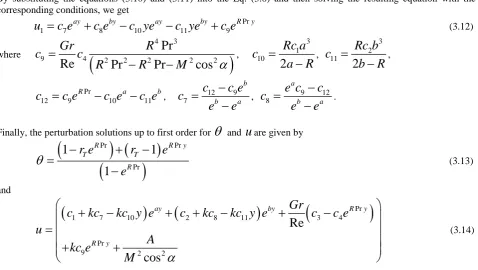
By substituting the equations (3.10) and (3.11) into the Eq. (3.6) and then solving the resulting equation with the corresponding conditions, we get
Pr
1 7 8 10 11 9
ay by ay by R y
u
=
c e
+
c e
−
c ye
−
c ye
+
c e
(3.12)where
(
)
4 3
9 4 2 2 2 2 2
Pr
Re
Pr
Pr
cos
Gr
R
c
c
R
R
M
α
=
−
−
, 3 1 102
Rc a
c
a
R
=
−
, 3 2 112
Rc b
c
b
R
=
−
, Pr12 9 10 11
R a b
c
=
c e
−
c e
−
c e
, 7 12 9 bb a
c
c e
c
e
e
−
=
−
, 9 12 8 a b ae c
c
c
e
e
−
=
−
.Finally, the perturbation solutions up to first order for
θ
andu
are given by(
)
(
)
(
)
Pr Pr Pr1
1
1
R R y
T T
R
r e
r
e
e
θ
=
−
+
−
−
(3.13)and
(
)
(
)
(
Pr)
1 7 10 2 8 11 3 4
Pr
9 2 2
Re
cos
ay by R y
R y
Gr
c
kc
kc y e
c
kc
kc y e
c
c e
u
A
kc e
M
α
+
−
+
+
−
+
−
=
+
+
(3.14)The rate of heat transfer coefficient in terms of Nusselt number
Nu
at the platey
=
0
of the channel is given by(
)
(
Pr)
0
1
Pr
1
T R yr
R
Nu
y
e
θ
=−
∂
=
=
∂
−
(3.15)Note that when
α
→
0
our results reduces to those given by Kavitha et al. (2012) and whenk
=
0
,0,
0
R
=
α
→
andM
→
0
our results reduces to those given by Aung and Worku (1986).4. DISCUSSION OF THE RESULTS
In order to see the effects of
M k R
, , , Pr,
Gr
, Re
andr
T on the velocityu
, we have plotted Figs. 2-12.Fig. 2 illustrates the effect of viscoelastic parameter
k
onu
forM
=
1,
r
T=
0.2,
,
6
π
α
=
R
=
2,
A
=
1
,1, Pr
0.71
Gr
=
=
andRe 1
=
. It is found that, the velocityu
decreases with an increase ink
. The point where the maximum velocity occurs is shifted away from the upper wall as the value of the viscoelastic parameter isincreased. Further it is observed that, the velocity is more for Newtonian fluid (
k
→
0
) than that of second grade fluid.The effect of Hartmann number
M
onu
for0.2,
0.01,
,
6
Tr
=
k
=
α
=
π
R
=
2,
A
=
1
,Gr
=
1, Pr
=
0.71
and
Re 1
=
is depicted in Fig. 3. It is observed that, the velocityu
is decreases with increasingM
. Further, it is found that, the velocity is more for non-conducting (magnetic) (i.e.,M
→
0
) second grade fluid than that of conducting second grade fluid.Effect of
α
onu
forr
T=
0.2,
k
=
0.01,
R
=
2,
A
=
1
,Gr
=
1, Pr
=
0.71
andRe 1
=
is depicted in Fig. 4. It is observed that the velocityu
increases on increasingα
.Fig. 5 shows the Effect of cross flow Reynolds number
R
onu
for0.2,
0.01,
,
6
Tr
=
k
=
α
=
π
A
=
1
,1,
Effect of Prandtl number
Pr
onu
for0.2,
0.01,
,
6
Tr
=
k
=
α
=
π
R
=
2,
A
=
1
,Gr
=
1
andRe 1
=
isshown in Fig. 6. It is found that, the velocity
u
decreases on increasing Prandtl numberPr
.Fig. 7 illustrates the effect of Grashof number
Gr
onu
forr
T=
0.2,
k
=
0.01,
,
6
π
α
=
R
=
2,
A
=
1
,Pr
=
0.71
andRe 1
=
. It is observed that, the velocityu
increases with increasing Grashof numberGr
.Effect of Reynolds number
Re
onu
for0.2,
0.01,
,
6
Tr
=
k
=
α
=
π
R
=
2,
A
=
1
,Gr
=
1
andPr
=
0.71
is shown in Fig. 8. It is noted that, the velocityu
decreases with increasing Reynolds numberRe
.Fig. 9 shows the effect of wall temperature parameter
r
T onu
forr
T=
0.2,
k
=
0.01,
,
6
π
α
=
R
=
2,
1
A
=
,Gr
=
1
andPr
=
0.71
. It is observed that, the velocityu
increases with increasingr
T.The effect of cross flow Reynolds number
R
on the temperatureθ
forr
T=
0.2
andPr
=
0.71
is presented in Fig. 10. It is noted that, the temperatureθ
decreases with increasingR
.Fig. 11 illustrates the effect of Prandtl number
Pr
on the temperatureθ
forr
T=
0.2
andR
=
2
. It is found that, the temperatureθ
is decreases with increasing Prandtl numberPr
.The influence of
r
T on temperatureθ
forR
=
2
andPr
=
0.71
is shown in Fig. 12. It is noticed that, the temperatureθ
increases with an increase inr
T .Table-1 shows the effect of
R
on Nusselt numberNu
forr
T=
0.2
andPr
=
0.71
. It is found that, theNu
decreases with increasingR
.The effect of
Pr
on Nusselt numberNu
forr
T=
0.2
andR
=
2
is depicted in Table-2. It is observed that, theNu
decreases with increasingPr .
Table-3 shows the effect of
r
T on Nusselt numberNu
forR
=
2
andPr
=
0.71
. It is noted that, theNu
decreases with increasingr
T.5. CONCLUSIONS
In this paper, the influence of an inclined magnetic field on mixed convective flow of a second grade fluid in a vertical channel with permeable walls is studied. The governing non – linear equations are solved for the velocity field and temperature field using the traditional perturbation technique. It is found that, the velocity
u
decreases with increasing,
, , Re
Figure-2: Effect of viscoelastic parameter
k
onu
for 0.2, 1, , 6 Tr = M =
α
=π
R
=
2,
A
=
1
,Gr
=
1, Pr
=
0.71
and Re 1= .
Figure-3: Effect of Hartmann number
M
onu
for 0.2, 0.01, , 6 Tr = k =
α
=π
R
=
2,
A=1,Gr
=
1, Pr
=
0.71
andRe 1
=
.Figure-5: Effect of
R
onu
for0.2,
0.01,
,
6
T
r
=
k
=
α
=
π
A
=
1
,Gr
=
1,
Pr
=
0.71
andRe 1
=
.Figure-6: Effect of Prandtl number
Pr
onu
for0.2,
0.01,
,
6
Tr
=
k
=
α
=
π
R
=
2,
A
=
1
,Gr
=
1
andRe 1
=
.
Figure-7: Effect of Grashof number
Gr
onu
for 0.2, 0.01, , 6T
Figure-8: Effect of Reynolds number
Re
onu
for 0.2, 0.01, , 6T
r = k= α=π
R
=
2,
A
=
1
,Gr
=
1
andPr
=
0.71
.Figure-9: Effect of wall temperature parameter
r
T onu
forr
T=
0.2,
k
=
0.01,
,
6
π
α
=
R
=
2,
A
=
1
,1
Gr
=
andPr
=
0.71
.Figure-11: Effect of
Pr
onθ
forr
T=
0.2
andR
=
2
.Figure-11: Effect of
r
T onθ
forR
=
2
andPr
=
0.71
.Table-1: Effect of
R
on Nusselt numberNu
forr
T=
0.2
andPr
=
0.71
.R
Nu
1 0.5493
2 0.3621
5 0.0840
Table-2: Effect of
Pr
on Nusselt numberNu
forr
T=
0.2
andR
=
2
.Pr
Nu
0.71 0.3621
1 0.2504
2 0.0597
Table-3: Effect of
r
T on Nusselt numberNu
forR
=
2
andPr
=
0.71
. Tr
Nu
0 0.4526
0.2 0.3621
REFERENCES
1. P.D. Ariel, On exact solutions of flow problems of a second grade fluid through two parallel porous walls, Internat. J. Engrg. Sci., 40 (2002), 913-941.
2. W. Aung and G. Worku, Theory of fully developed, combined convection including flow reversal, J. Heat transfer, 108(2), 485-488.
3. A. Barletta, E. Magyari, B. Keller, Dual mixed convection flows in a vertical channel, Int. J. Heat Mass Transfer, 48(2005), 4835-4845.
4. K. Boulama, N. Galanis, Analytical solution for fully developed mixed convection between parallel vertical plates with heat and mass transfer, J. Heat Transfer, 126(2004), 381-388
5. J.E. Dunn and K.R. Rajagopal, Fluids of differential type: critical review and thermodynamic analysis, Int. J. Engng. Sci., 33(1995), 689-729.
6. T. Hayat, Z. Abbas, Channel flow of a Maxwell fluid with chemical reaction, J. Appl. Math. Phys. (ZAMP), 59(2008), 124-144.
7. K.M. Joseph, S. Daniel and G.M. Joseph, Unsteady MHD couette flow between two infinite parallel porous plates in an inclined magnetic field with heat transfer, International Journal of Mathematics and Statistics Invention, 2(3)(2014), 103-110.
8. D.
vertical tube, Ind. Eng. Chem. Res., 28 (12)( 1989), 1899 - 1903.
9. K. Kavitha,K. Ramakrishna Prasad. K, B. Aruna Kumari. A. Mahesh Babu and P. Shantan Kumar, Effects of Magnetic Field on the Mixed Convective Flow of a Second Grade Fluid in a Vertical channel with Permeable Walls, International Journal of Fluids Engineering, 4(2), (2012), PP.91-104.
10. W.A. Manyonge, D.W. Kiema and C.C.W. Iyaya, Steady MHD Poiseuille Flow between two infinite parallel porous plates in an inclined magnetic field, Inter. Journal of Pure and Applied Maths., 76(5) (2012), 661-668. 11. P.O. Olanrewaju, and Z. Abbas. “Corrigendum to Convection Heat and Mass Transfer in a Hydromagnetic Flow of a Second Grade fluid in the Presence of Thermal Radiation and Thermal Diffusion”. Int. J. Heat Mass Transf. 38(3)(2014), 377–382.
12. M. Sajid, I. Pop, T. Hayat, Fully developed mixed convection flow of a viscoelastic fluid between permeable parallel vertical plates,Computers and Mathematics with Applications, 59 (2010), 493-498
13. N. Sandeep and V. Sugunamma, Effect of an inclined magnetic field on unsteady free convection flow of a dusty viscous fluid between two infinite flat plates filled by a porous medium. Int. Journal of Appl. Maths. Modelling, 1 (1) (2013), 16 – 33.
Source of support: Nil, Conflict of interest: None Declared.