International Journals of Advanced Research in Computer Science and Software Engineering
ISSN: 2277-128X (Volume-7, Issue-6)
Research Article
June
2017
ANN Based Recommendation Algorithm for the Product of
E-commerce
Aditya Parashar, Eshan Gupta
Dept. of Computer Science Engineering, Amity University, Gwalior, Madhya Pradesh, India
DOI: 10.23956/ijarcsse/V7I6/0134
Abstract— E-commerce websites have millions of product and billions of the reviews given by users on the products. The reviews are given by authentic and fake reviewers. If the customer read some reviews among them to check the quality of the product, he/she may get confuse. If customer gets bad quality product it get hearted and the image of the E-commerce site degrades. Another problem here is that the reviews are huge in numbers for a single product. To process these reviews E-commerce requires a big quality analysis team, which will be costly for the stakeholders. This paper gives the solution of this problem by doing some automation using artificial neural network. Proposed work is divided into two modules in first half neural net gives its output and in second half all the output is taken and calculate its mean, this mean makes able to the rank the product, that by how much percent it is saleable. Ultimately believe of the customer will maintain and it will not think for other option.
Keywords— Ecommerce, User reviews, Product rank, Artificial Neural Network, Back Propagation
I. INTRODUCTION
commerce is the platform of buying and selling of product, today‟s era everybody wants to do shopping on E-commerce because of it gives comfort, cost effective items, variety etc. Seeking this type of facility people do shopping on E-commerce platform. Apart from that today everybody talks about quality of service, everyone needs good product after paying some amount from its precious income. Today E-commerce is a huge platform to fulfil the customer demands, E-commerce persons should also maintains the quality of its products and they have very good team of quality check and assurance team but there are millions of product launches on their platform which are worldwide favourite brands but the quality of these brands may be good or it may not be good according to the customer‟s expectations, after all customer is the end user of the particular product so it gives its reviews about that particular product on the site so t he other customer may easily seek the information about that particular product. Some of the customer does not purchase the item if it has not good reviews given by the user, this kind of products which do not have good reviews may harms the image of the E-commerce site in front of its customer and customer may deviate to the other option and this will not be good for that organization.
Artificial neural network is the better solution for that problem where some decision has to be made or problem requires some solution or classification. This problem will help to solve the problem of the E-commerce person to know the product quality which launches on their platform. If the product quality is not good according to its customer reviews, the action can be taken by E-commerce persons by removing the product form its site or by intimating the concerning product related company to maintain its product quality. These customer reviews are processed by the neural network and it will give some solution about the product. Instead of keeps a particular team for reviewing the comments of the user, neural network is the good option which will help to reduce the time and expanse of the stakeholders over that particular quality analysis team. Another aspect of this problem is that there is the chance of human error or it impossible to compete with machine. A neural network can give fast result as far as a team is concerned.
Application of artificial neural network for this problem is so easy and straightforward. There are number of neural network models but the multilayer perceptron is the best one among them using back propagation. Back propagation is a revolutionary algorithm in the ANN world and gives very good result. In here the inputs are taken as the user comments and these comments are digitizing as input to the network. The learning process of network is done on bases of change in waits again and again and minimizes the error at last the network produces minimize error and actual output will be approximately equal to the desired output and the neural network will ready for its training data.
II. LITERATURE REVIEW
Excellent research has been done in the area of E-commerce in the field of web personalization collaborative filtering, online word of mouth, artificial neural network, fuzzy logic etc. there is no work has been done in the area of artificial neural network for the user reviews here the related work according to this problem are discussed below.
Ranking algorithm has an important role to develop the E-commerce field. An Item-to-Item collaborative filtering system [1] is the application of it. Recommendation is very important to keep the interest of the customer by viewing the product of its choice. Gerg Linden has taken three approaches and compares it with the proposed algorithm. The algorithm produces real-time recommendations was able to scale massive data set.
ISSN: 2277-128X (Volume-7, Issue-6)
preference level of the customers. The work was totally around the filtering of the product in front of the customer so that the customer can see the product of its interest.
Personalization technique is old technique and it evolving day by day, there are number of companies in the world and all are using different-different techniques of personalization here the customer knowledge is used in personalization by filling questionnaires [3]. To ensure the customer‟s navigational behaviour a neural network is used which is pre trained. There were two methods being used to know the accuracy rate to finding the customer‟s product knowledge by filling a questionnaire. There are two methods to know the customers knowledge level assessment system (KLAS) and Hybrid KLAS but sometimes KLAS is not accepted by some users in that case Hybrid KLAS is used.
Bo Xiao et. al [4] proposed that consumer interest is very important recommendation agent (RA) lights either implicitly or explicitly, the interest of the particular consumer for the product on the E-commerce and it makes recommendations accordingly. RA helps to make and improve the quality of decision. It reduce the burden of the information which is heavily deployed with the product menace reduces the complexity of the online search. Here some specific features of RA is discussed like process of RA, RA inputs and output design characteristic. This affects the consumer evaluations. Proposed approach is derived twenty eight propositions from five theoretical perspectives. Proposed approach is helps to answer the two research questions such as what is the RA characteristic and its use and consumer decision making process and outcome. Second, other factors influence the user‟s evaluation of RAs.
The survey has been done on online word of mouth and other related factors by Alanah Davis and Deepak Khazanchi. Online word of mouth is use as decision changer tools it impacts the customer mentality [5]. The survey is on empirical study of online WOM with other related factors like promotions, product view and category. It proposed excellent impact on sales of the products on E-commerce site.
E-commerce offers very wide area for research soft computing techniques for product filtering in E-commerce personalization [6]. Mr. Wong compared two techniques of soft computing that is fuzzy logic and artificial neural network. E-commerce site having huge amount of data, due to the huge data the valuable customer may lose its concentration from its goal due to irrelevant or scatter information. The product filtering technique is used to make the information valuable. To make it valuable artificial neural network and fuzzy logic is used as comparative study.
Electronic commerce is getting an important research area of electronic commerce. Multi attributive utility theory and decision analysis becomes a pillar for the electronic negotiation [7]. The artificial neural network and case based reasoning are the two kinds of approaches of AI that use correlation in a comprehensive way. CBR and ANN both have neutral link. So it is called forward model of negotiation rely on ANN and CBR. That‟s why it made negotiation to achieve very good result.
An article wrote by Mr. Yong Soo Kim which was on, a novel and fast recommender system for websites based on user click pattern and product taxonomy [8]. It consist four steps first, purchase statuses, basket placement, and a product preference matrix customer is evaluated by a linear combination of click. Second, compute the ratio of number of clicks and the basket placement and the total product purchase. Third, cluster analysis by genre performance matrix, and neighbourhood formation process using performance matrix. Fourth, hence data generated for the prediction. It greatly reduces the computational burden.
In the competitive market, it is a challenging to make that kind of electronic system and interactions which holds customers as well as increase the sales. An exploratory study has done by Marios Koufaris to observe the consumer behaviour in web based commerce [9]. The study reviles about international purchase of products online and the study of customer experience and coming back to the site. Observation finds that enjoyment in shopping may increase the probability to coming new web customer. A way that is value-added search pattern is used here to increase the customer‟s shopping enjoyment.
Many types of recommender systems are there for E-commerce such as electronic negotiation, web personalization, collaborative filtering etc. Among these type of recommended system most weighted recommended system is introduced by Mohammad Daoud that is depends upon reviews of the customer and advanced multi criteria search engine [10]. E-commerce site user wishes to judge a product using reviews of its consumer, so the same problem arises of huge number of comments but proposed approach gives the solution of the text mining.
The approach of ANN based ranking algorithm for products on E-commerce website [11] was given by Aditya parashar and Eshan gupta, this approach is similar to the proposed solution. It was a theoretical description of the current problem. In this approach the discussion was about what is the problem, how it can be implemented, what should be the input to network, how it works, what will be the flow, what should be the result etc.
III. PROPOSED ALGORITHM
The proposed solution consists of two modules. In first module an ANN based automation system implemented which generates in percentage about how much a product ia buyable on basis of rating of a single comment. This module will run for all comments over the product. Second module will calculate average percentage value of the previously calculated percentage values. The first module is based on Back propagation algorithm. Here the input scale is between the ranges of {0-9} these inputs will be provided to the network according to the comments very good comment will get the higher rating and very bad comments will get the lower rating in the scale from the input scale.
A. Module 1
First of all neural network in first module is implemented in three following steps:-
ISSN: 2277-128X (Volume-7, Issue-6)
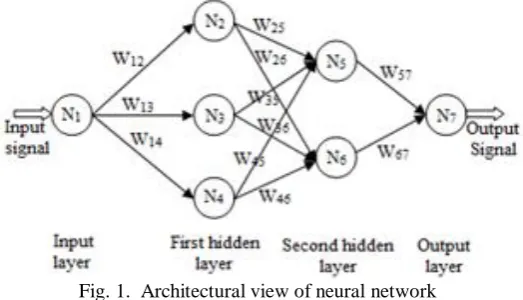
neural network is consisting of one neuron in input layer and one neuron in the output layer. It is designed with the help of two hidden layers, first hidden layer consists of three neurons, second hidden layer consist of two neurons.
Every neuron have input with some randomly initialised weight.
Fig. 1. Architectural view of neural network
Suppose x represents the range of numerical value of comments according to the given solution – X= {0, 1, 2….9}
Weights are represented as-
W= {W12, W13………. W11}
Where W is initialized as-
W= {0, 1}
2. Training: The network gives some result, this actual result is compared with the desired output and according to the desired output difference is estimated. The main aim of the network is to reduce the error, the error is propagate in backward direction and the weights on neurons in hidden layers and the input layer are adjusted, flow of input signal in forward direction and flow of error in backward direction this complete cycle is called one epoch and to train the network there are several epochs are required to achieve the objective.
Here the main equation which keeps most of the potential of the network is- €j(n)= 𝐷𝑗(n) - 𝑥𝑗(n)
Where 𝐷𝑗(n) is the desired response and 𝑥𝑗(n) is the produced response by the neural network. The instantaneous error
energy of neuron j can be defined as-
𝐸𝑗(n) =
1 2 €𝑗
2(n)
Summation of error energy of all the neurons consisting by the output layer can be defined by- E(n) = 𝑐 𝐸
𝑗 =1 j(n)
E(n) = 1 2 €𝑗
2 𝑐
𝑗 =1 (n)
Where c=1 is the total number of output neuron. With training sample consisting of N number of example, the average error energy over the training sample is given by-
𝐸𝑎𝑣(N) = 1
2 N €𝑗
2 𝑐 𝑗 =1 𝑁
𝑛 =1 (n)
The induced local field Ƒ𝑗(n) of the network is producing at the jth neuron before activation function θ is defined by-
Ƒ𝑗(n) = 𝑚 𝑤
𝑖=0 ji(n) xi(n)
Where neuron j getting the input signal m. where the output of neuron j is the output of activation function of neuron j represent by 𝑥𝑗(n) -
𝑥𝑗(n) = θ (Ƒ𝑗(n))
The correction in weight is proportional to partial derivative of -
𝜕𝐸 (𝑛)
𝜕 𝑤𝑗𝑖(𝑛)∝ Δ 𝑤𝑗𝑖(n) 𝜕𝐸 (𝑛)
𝜕 𝑤𝑗𝑖(𝑛) = 𝜕𝐸 (𝑛) 𝜕€𝑗(𝑛)×
𝜕€𝑗(𝑛) 𝜕 𝑥𝑗(𝑛)×
𝜕 𝑥𝑗(𝑛) 𝜕Ƒ𝑗(𝑛)×
𝜕Ƒ𝑗(𝑛) 𝜕𝑤𝑗𝑖(𝑛) By differentiate the above equation in terms of €j (n) -
𝜕𝐸 (𝑛)
𝜕€𝑗(𝑛) =€𝑗(n) By differentiate the above equation in terms of 𝑥𝑖(n) -
ISSN: 2277-128X (Volume-7, Issue-6) 𝜕 𝑥𝑗(𝑛)
𝜕Ƒ𝑗(𝑛) = θ Ꞌ
(Ƒ𝑗(n))
By differentiate the above equation in terms of 𝑤𝑗𝑖(n) - 𝜕Ƒ𝑗(𝑛)
𝜕 𝑤𝑗𝑖(𝑛) = 𝑥𝑖(n) By concluding all the derivatives again the equation became like this -
𝜕𝐸 (𝑛)
𝜕𝑤𝑗𝑖(𝑛) = - €𝑗(n)θ Ꞌ
(Ƒ𝑗(n))𝑥𝑖(n)
So it is defined by delta rule and Correction in weight is Δ𝑤𝑗𝑖(n) - Δ𝑤𝑗𝑖(n) = -ρ 𝜕𝑤𝜕𝐸 (𝑛)
𝑗𝑖(𝑛)
Where ρ is the learning parameter of back propagation algorithm, the use of negative sign (-) here account for the gradient descent in weight.
Let‟s take - €𝑗(n)θꞋ(Ƒ𝑗(n)) as 𝜓𝑗(n), and it is said to be local gradient, then equation becomes 𝜓𝑗(n) = - €j(n) θꞋ(Ƒ𝑗(n))
so local gradient can be defined as-
𝜓𝑗(n) = 𝜕𝜕𝐸 (𝑛)Ƒ 𝑗(𝑛) Now the delta rule can be defined as
𝜕𝐸 (𝑛)
𝜕𝑤𝑗𝑖(𝑛) = ρ 𝜓𝑗(n) 𝑥𝑖(n) Δ𝑤𝑗𝑖(n) = ρ 𝜓𝑗(n) 𝑥𝑖(n)
The key factor is involved here in the calculation of Δ𝑤𝑗𝑖(n) is the error €𝑗(n) at the output of neuron j. In this context it
may identified as the two distinct cases depending upon where the neuron j is located in the network.
Case 1: The neuron j is an output node. This case is so simple to handle because output neuron of the network is supplied with a desired response of its own, making it a straight forward matter to calculate error signal.
Case 2: The neuron j is a hidden layer neuron even though hidden layer neurons are not directly accessible, they share responsibility for any error made at the output of the network.
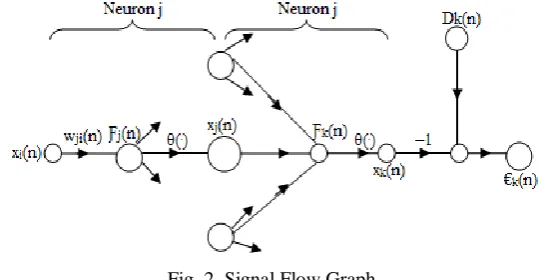
The question is to know how to panellize the hidden neuron for the share of responsibilities, so the problem is called as credit assignment problem. When neuron j is in hidden layer of the network, so there is no specified desired response for that neurons accordingly, the error signal for a hidden neuron have to be determined recursively and working in backward direction in terms of error signals of all the neurons to which that hidden neuron is directly connected in the network.
Fig. 2. Signal Flow Graph
Consider j as hidden layer neuron and k as output layer neuron. Compute 𝜓𝑗(n) and jth neuron is in the hidden layer. 𝜓𝑗(n) = – 𝜕𝜕E(n)Ƒj(n)
𝜓𝑗(n) = - 𝜕𝜕𝐸 (𝑛)Ƒ 𝑗(𝑛) θ
Ꞌ
(Ƒ𝑗(n))
Calculate again Summation of error energy of the neuron in the output layer
E(n) =1
2 𝑘 ∈𝐶€j2(n)
Again perform the chain rule of partial derivative of ∂€k(n)/∂xj(n).
∂E(n)
∂xj(n) = 𝑘€𝑘(𝑛)
∂€k(n) ∂Ƒk(n)
∂Ƒk(n) ∂xj(n) Calculate the error by subtracting actual output from desired response
ISSN: 2277-128X (Volume-7, Issue-6) €𝑘(n) = 𝐷𝑘(n) – 𝜃𝑘(Ƒ𝑘(n))
Because k is an output node neuron
𝜕€𝑘(𝑛) 𝜕Ƒ𝑗(𝑛) = – 𝜃𝑘
ˊ(Ƒ
𝑘(n))
Now induced local field for neuron k can be defined as
Ƒ𝑘(n) = 𝑚𝑗 =0𝑤𝑘𝑗(n) 𝑥𝑗(n)
Here „m‟ is the number of inputs in the hidden layer provided to the neuron k.
𝜕Ƒ𝑘(𝑛)
𝜕 𝑥𝑗(𝑛) = 𝑤𝑘𝑗(n) By using previous equations, the equation can be re written as -
∂E(n)
∂xj(n) = – 𝑘€k(n) θꞋ (Ƒ𝑘(n)) 𝑤𝑘𝑗(n) 𝜕𝐸 (𝑛)
𝜕𝑥𝑗(𝑛)= – 𝜓𝑘(n) 𝑤𝑘𝑗(n)
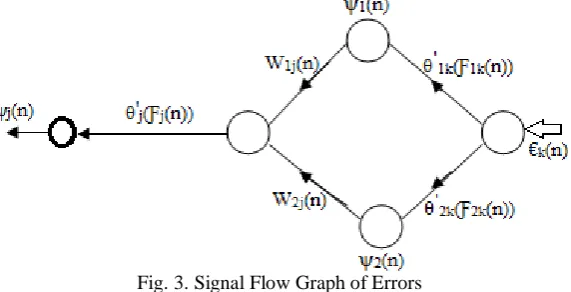
By using previous equations the back propagation equations for the local gradient ψj(n) can be written as 𝜓𝑗(n) = 𝜃𝑗ʹ(n) (Ƒ𝑗(n)) 𝜓𝑘 𝑘(n) 𝑤𝑘𝑗(n)
Where ψj(n) is belongs to the hidden layer neuron and 𝜓𝑘(n) belongs to the output layer neuron. Where neuron j is
hidden layer neuron and the neuron k is output layer neuron.
Fig. 3. Signal Flow Graph of Errors
Signal €𝑘(n) where entire neurons existed in the layer which is immediate right to the hidden layer neuron j, these
connection consist 𝑤𝑘𝑗(n) which is synaptic weight. Now correction in weight can be defined as-
𝑤𝑗𝑖(n) = ρ × 𝜓𝑗(n) × 𝑥𝑖(n)
Where, 𝑤𝑗𝑖(n) is correction in weight, ρ is learning parameter, 𝜓𝑗(n) is the local gradient and xi(n) is input signal for j. 3. Testing: In this step testing data is applied on trained neural network and result stored in a table. The testing data is also similar to training data. It also provides comments in range of {0-9}.
B. Module 2
Second module takes all the values generated by neural network in first module and takes average of them. This final value in percentage will represent how much a particular product is buyable on the E-commerce website.
IV. EXPERIMENTAL RESULT
Proposed work is divided into two modules first module gives its results to the second module. In first module it talks about the working of neural network, it talks about how the inputs are being treated. It talks about the output of neural network. Proposed figure consist one neuron in input layer and one neuron in output layer it menace it can treat only one input signal and it is able to give single output at a time but the training data is not fixed in number one set consist fift y inputs and other set consist two thousand input signal to process one by one. So it is essential to hold the entire output signal in a storing element. That‟s why second module comes into play. In second module the output {xk(0), xk(1),…….
xk(n-1)} given by the neural network is storing in an array and the calculating the mean. By calculating the mean it is
easy to calculate the rank.
ISSN: 2277-128X (Volume-7, Issue-6)
Second module consist the output given by the first module stored in an array. This result of network is used to calculate the mean to rate the product that how much it able to sale the product to the customer. The network consist only single neuron in input layer it menace is able to take only the single input and output layer consist only the single neuron it menace it able to produce only the single output. The training data set is not fixed training data consist six batch of training data set. Batch one consist fifty output it menace there would have been fifty input signals, same thing with second batch which consist hundred outputs. With the help of these output batches the mean is calculated for the ranking of the product.
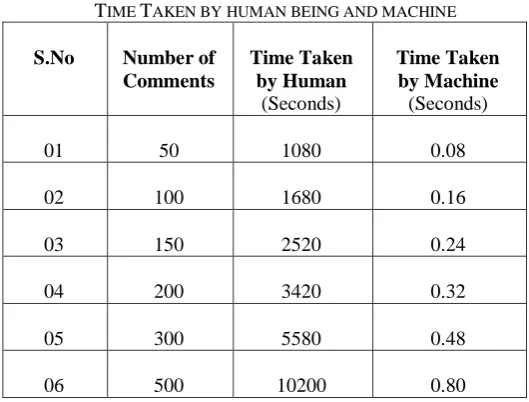
As far as the difference between machine and human being is concerned machine is always the winner in terms of efficiency, speed, accuracy etc. limitation of machine is that it cannot think like human being. Today the machines are also having some intelligence but at some extent. Proposed results are showing exciting result in which the time take by the human being and time taken by the machine is shown in the table.
TABLEI
TIME TAKEN BY HUMAN BEING AND MACHINE
S.No Number of Comments
Time Taken by Human
(Seconds)
Time Taken by Machine
(Seconds)
01 50 1080 0.08
02 100 1680 0.16
03 150 2520 0.24
04 200 3420 0.32
05 300 5580 0.48
06 500 10200 0.80
The time taken by machine and human being is shown in the table the time taken here for the human being is generalised time. The time taken to read the comment by human being is calculated with the help of 10 different persons then calculate the average time.
With the help of neural network the comments processing has been done in superfast speed while it is impossible to achieve this kind of speed, even human being is not able to reach nearby. The difference between human being and machine is shown with the help of graph.
Fig. 4. Difference in the time taken by human and machine
Figure consist a huge difference between human and machine. Time taken to process a single comment by human being is more than time taken to process all the comments by the network.
V. CONCLUSION
ISSN: 2277-128X (Volume-7, Issue-6)
VI. FUTURE WORK
This research work consist very good results, the neural network is highly efficient as compare to the human being. A person read a single comment in mean time neural network is able to process all the comments. Proposed work consisting the quantize value of the comments. It has wide range of possibilities in future. It can able to process the language of the comments directly with the help of other techniques of artificial intelligence.
REFERENCES
[1] Greg linden, Brent Smith and Jeremy York “Amazon.com Recommendations Item-to-Item Recommendation System” IEE Computer Society February 2003.
[2] Yong Soo Kim, Bong-Jin Yum, Junehwa Song, Su Myeon Kim- “Development of a recommended system based on navigational and behavioural pattern of customer in E-commerce sites” Elsevier, Expert system with Application, vol-28 February 2005.
[3] Shuchih Ernest chang, S.Wesley Changchien, Ru-Hui Huang- “Personalization in Electronic commerce” Elsevier, Expert systems with Application vol-30,pp 682-693, May 2006.
[4] Bo Xiao, Izak Benbasat, “E-commerce product recommendation agents: use characteristic and impact” ACM Digital Library, Volume 31 Issue 1 March 2007.
[5] Alanah Davis, Deepak Khazanchi- “An empirical study of online word of mouthas a predictor of multi-product category as E-commerce sales” Taylor& Francis, Electronic market vol-18, 20 may 2008.
[6] Kok Wai Wong1, Chun Che Fung1 and Halit Eren2 “Soft Computing Techniques for Product Filtering in E-commerce Personalisation: A Comparison Study” IEEE International Conference on Digital Ecosystems and Technologies 2009.
[7] Shaobin Dong and Mr.Aihua Li “Negotiation Model Based on artificial intelligence in the E commerce” IEE, IEE Computer Society 2010.
[8] Yong Soo Kim “Recommender system based on product taxonomy in E-commerce site” Journal of information science and engineering 29,63-78(2013).
[9] Marios Koufaris, Ajit kambil, Priscilla Ann Labarbera, “Consumer behaviour in web based commerce: An empirical study” Taylor & Francis, International journal of electronic commerce, Vol-6 pp115-138 December 2014.
[10] Mohammad Daoud, S.K.Naqvi, Asad Ahmad “Opinion Observer: Recommendation System on E-Commerce Website” International Journal of Computer Applications (0975-8887) vol-105 November 2014.