ISSN-L: 2501 - 1235 Available on-line at: www.oapub.org/edu
doi: 10.5281/zenodo.2003269 Volume 5 │ Issue 2 │ 2018
SIMULTANEOUS IMPROVEMENT OF GIFTED YOUTHS
IN BIOLOGY AND PHYSICAL FITNESS FACTORS FOLLOWING
TRADITIONAL AND INTEGRATIVE TEACHING
Iryna Skrypchenko¹, Amir Vazini Taher², Ratko Pavlović³i,
Marko Joksimović³
1Water Sports department,
Prydniprovska State Academy of Physical Culture and Sports, Dnipro, Ukraine
2Motor Behavior,
Physical Education Teacher, Hamedan, Iran
3Faculty of Physical Education and Sport,
University of East Sarajevo, Bosnia and Herzegovina
Abstract:
The major aim of this study was to compare the effects of two different teaching methods (traditional and integrative) on learning biology, as well as development of selected factors of physical fitness (agility, flexibility, speed and balance). Participants were gifted students who finished first grade of junior high schools at the end of academic year 2014-2015. From 1190 students who took the IQ test, 52 persons who had highest IQ scores were chosen and assigned randomly to two groups of traditional (26) and integrated (26) classes. The traditional group was taught biology three sessions and physical education one session per week for twelve weeks. The integrated group were taught biology composed with physical education activities four sessions per week (each session lasted 75 minutes). The results revealed that the mean scores of four physical fitness factors in both groups differed significantly from baseline to post teaching examinations (p<0.01). We found that integrated teaching of physical education with other fields (such as biology) in comparison with traditional method, not only leads to better learning, but also encourages students to be more active in learning process.
Keywords: traditional teaching, integrated teaching, learning, physical fitness, biology
1. Introduction
In the global dynamic environment with high level competitions and interactions, educational communities are responsible to develop a flourishing future for societies. Being successful in this difficult task depends on applying suitable methods for effective teaching of all humanistic factors in different aspects (e.g. spiritual, physical, moral, social, etc.) and also developing the creative thinking in learners (Maleki, 1994; Ahmadi, 2001). Many studies have been done to evaluate effectiveness of educational systems regarding different teaching methods. Some of the studies that dealt with examining the effectiveness of traditional or common teaching methods (separate teaching of different courses) came to the conclusion that traditional methods have many limitations (Maleki, 2003; Placek, & Sullivan, 1997). Disability to make a connection between scientific concepts and learning them separately are most common problem of this method (Eggebrecht, 1996; Fahiminejhad, Mozafari, & Sabaghiyanrad, 2012; Findley, 2000).
There are several studies presenting other effective teaching methods without limitations of traditional methods. Integrative teaching can be one of the interesting alternative methods in this area in order to remove the illogical boundaries and strengthen the connection between different scientific concepts. Therefore, it has been claimed that integrative teaching may be crucial to achieve unity and integrity in learning various concepts and skills in students with different abilities and interests (Maleki, 2003). The results of numerous studies indicated that integrative teaching is more interesting, stimulating and useful for students in comparison to traditional method (Fahiminejad, et al. 2012; Findley, 2000; Weilbacher, 2000; Zemelman, Daniels, & Hyde, 2005), because this strategy fosters creativity and thinking in students (Mirascieva, 2010).
Recently integrative method of teaching, especially integrative physical education have been paid attention in schools and developed education systems (especially elementary and guidance schools) (Sharifi, 2003; Gribacheva, & Kruglyihin, 2009; Cherkasov, 2013; Hasanshina, & Shatunov, 2015). Therefore, many studies have been done about combination of physical education with other courses, showing the capacity of physical education to be integrated with almost all courses (Placek, 1996; Mozafari, 2001; Zagrebina, 2008).
elementary and guidance schools are necessary for development of society, still a few studies are in doubt about the positive effect of integrative teaching on learning (Katlin, 1992) and a difference in effectiveness of traditional and integrative methods of teaching. Another challenging subject is about the effect of both traditional and integrative physical education on development of physical fitness factors (Fahiminejhad, et al. 2009). Hence, it is necessary to do a semi-experimental research about effectiveness of two different teaching methods of traditional and integrative physical education on learning biology and development of selected physical fitness factors of male junior high students. The findings of such a research can make variety in school programs, make learning atmosphere more attractive and increase learning motivation. Moreover, it causes a high flexibility in designing and implementing integrative courses which help teachers to consider the interest and ability of students by using all the valuable facilities. Another important point is that integrative teaching is not only limited to education and it can lead to creativity and development of social skills of learners.
The main purpose of this study was to evaluate the advantages of integrative teaching method by using theoretical information and implementing them.
2. Materials and method
This was a semi-experimental study and the population consisted of students who finished first grade of junior high school at the end of academic year 2014-2015. To increase the rate of participation, both students and their parents were provided with some useful services such as knowing their IQ scores, attending extracurricular courses in summer and the opportunity of participating in physical activities and competitions. Finally, among 1190 students who confirmed the agreement to take part in study, fifty two students who had highest IQ scores were chosen and divided into traditional (26) and integrated (26) groups randomly.
After obtaining the informed consent from parents along with verifying form of the participants’ health, selected physical fitness factors were tested. To control the intervening variables, such as teacher’s method of teaching, teacher’s motivation and their teaching experiments, two same physical education and biology teachers were selected for both groups. During 12 weeks of experiment, the odd days selected for traditional group and the even days were appointed to integrative group. The traditional group was taught biology three sessions of seventy five min and physical education one session of seventy five min per week during twelve weeks while the lessons taught separately. Also, integrated group were taught biology lesson composed with physical activities during twelve weeks and "biology - physical education" four sessions a week, each session seventy five min.
Wels modified sit and reach test, 40 yard and shuttle run were used to evaluate balance, flexibility, speed and agility and also a 20-question written teacher made test to evaluate the learning of biology concepts. To determine the validity of the teacher - made test, the opinions of specialized teachers in the area of integrated and biology were used.
To analyze the data of selected physical fitness factors, both dependent and independent t-test were used while the interval scores of biology were changed to four ordinal scales—“very good”, “good”, “acceptable”, and “requiring more practice”— and were analyzed by using Wilcoxon sign-ranked test and Mann-Whitney U test.
3. Results
Table 1: IQ of participants and mean differences in traditional and integrative groups
(independent t-test)
Teaching Method N Mean ± Std. Dev Lower Upper t df **Sig (2-tailed) Traditional 26 118,47±2,45 113 121 0.549 50 0.575
Integrative 26 118,54±2,56 113 121
Sig.**p<0.05
The participants were selected from students with high IQ score and randomly were divided into two groups of traditional and integrated methods. According to the data shown in table 1, independent t-test results showed that there was no significant difference between the two groups in the level of IQ.
Table 2: Mean differences of Ranks in traditional and integrative teaching methods
on learning biology (Mann-Whitney U test)
Teaching Method Mean Z *Sig (1-tailed)
Traditional 2,12
-3,423 0.001*
Integrative 3,45
Sig.*p<0.05
Considering the data in table 2 and the calculated z-score, the mean of the integrative group were significantly higher than the traditional group at p<0.05. In other words, learning biology occurred more effectively in integrative group than traditional group.
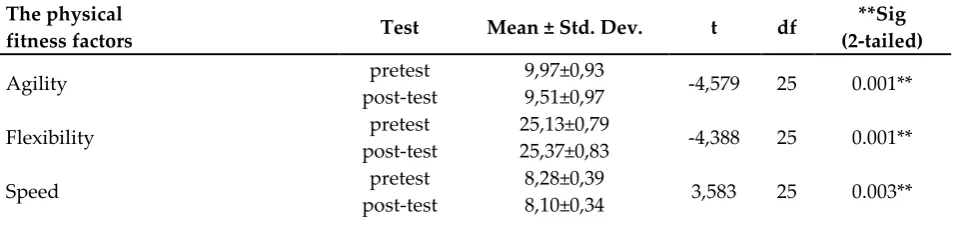
Table 3: Mean differences of the pretest and post-test in traditional teaching methods
on the selected physical fitness factors(dependent t-test)
The physical
fitness factors Test Mean ± Std. Dev. t df
**Sig (2-tailed)
Agility pretest 9,97±0,93 -4,579 25 0.001**
post-test 9,51±0,97
Flexibility pretest 25,13±0,79 -4,388 25 0.001**
post-test 25,37±0,83
Speed pretest 8,28±0,39 3,583 25 0.003**
Balance pretest 28,77±2,19 -2,972 25 0.010** post-test 29,03±2,37
Sig. **p<0.01
According to the table 3, the level of correlated t for comparing the pretest and post-test mean of the traditional group in physical fitness factors was significant at p< 0.01. In other words, the mean of the selected physical fitness factors in post test of traditional group were significantly higher than the mean of these factors in pretest of traditional group. Therefore, the null hypothesis about the lack of significant difference between the mean of pretest and post-test of traditional group in selected physical fitness factors is rejected.
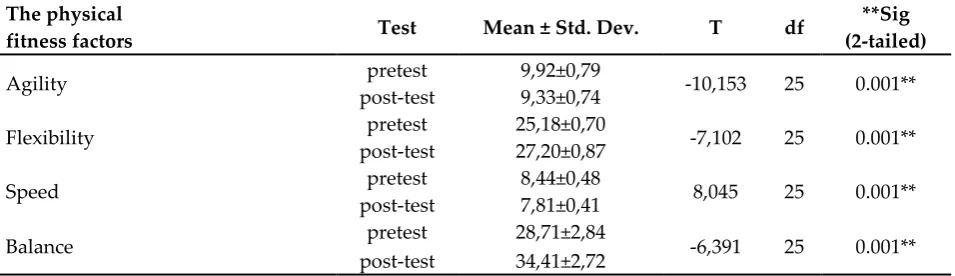
Table 4: Mean differences of the pretest and post-test in integrative teaching method
on the selected physical fitness factors(dependent t-test)
The physical
fitness factors Test Mean ± Std. Dev. T df
**Sig (2-tailed)
Agility pretest 9,92±0,79 -10,153 25 0.001**
post-test 9,33±0,74
Flexibility pretest 25,18±0,70 -7,102 25 0.001**
post-test 27,20±0,87
Speed pretest 8,44±0,48 8,045 25 0.001**
post-test 7,81±0,41
Balance pretest 28,71±2,84 -6,391 25 0.001**
post-test 34,41±2,72 Sig. **p <0.01
Considering table 4, the level of correlated t for comparing the pretest and post-test mean of the integrative group in selected physical fitness factors was significant at α< 0.01. In other words, the mean of the four physical fitness factors in post test of integrative group were significantly higher than the mean of these factors in pretest of integrative group. Hence, the null hypothesis about the lack of significant difference between the mean of pretest and post-test of integrative group in selected physical fitness factors is rejected.
Table 5: Mean differences of the four physical fitness factors in the traditional and
integrative teaching methods on the selected physical fitness factors in Final test
The physical
fitness factors Test Mean ± Std. Dev. t df
**Sig (2-tailed)
Agility traditional 9,51±0,91
-3,498 50 0.001** integrative 9,33±0,74
Flexibility traditional 25,37±0,78 -4,693 50 0.001**
integrative 27,20±0,86
Speed traditional 8,10±0,31 3,982 50 0.001**
integrative 7,81±0,41
Balance traditional 29,03±3,42 -3,121 50 0.029**
Considering table 5, the level of correlated t for comparing the mean of the traditional and integrative group in physical fitness factors was significant at p< 0.01. In other words, the mean of the four physical fitness factors in post test of integrative group were significantly higher than the mean of these factors in post test of traditional group. So the null hypothesis is rejected and it means that the mean of final score of four physical fitness factors in integrated method were significantly higher than traditional method.
4. Discussion and Conclusion
Although in Iran’s educational system same as the majority of educational communities in all level of education such as guidance period, the concepts of different fields are usually organized within separate course books, in the face of a real life and multi-dimensional situations, the traditional method is not capable of solving problems. So the integrative teaching method as an alternative can lead to a meaningful learning and transfer necessary knowledge and skills of living to students for more active, effective and rational living.
The results show that in the traditional group (Table 3), significant differences were observed between the pretest (8,28±0,39) and post-test (8,10±0,34) score of speed, between the pretest (9,97±0,93) and post-test (9,51±0,97) score of agility, between the pretest (28,77±2,19) and post-test (29,03±2,37) score of balance, and between the pretest (25,13±0,79) and post-test (25,37±0,83) score of flexibility. These findings emphasize the effectiveness of traditional teaching of physical education in development of selected physical fitness factors.
Also in the integrative group (Table 4), significant differences were observed between the pretest (8,44±0,48) and post-test (7,81±0,41) score of speed, between the pretest (9,92±0,79) and post-test (9,33±0,74) score of agility, between the pretest (28,71±2,84) and post-test (34,41±2,72) score of balance, and between the pretest (25,18±0,70) and post-test (27,20±0,87) score of flexibility. These differences illustrate the effectiveness of the integrative method for physical fitness factors.
Finally comparing the final scores of the two groups of traditional and integrative revealed (Table 5) that there are significant differences between the mean speed score of the traditional group (8,10±0,74) and the integrative group (7,81±0,41), between the mean agility score of the traditional group (9,51±0,91) and the integrative group (9,33±0,74), between the mean balance score of the traditional group (29,03±3,42) and the integrative group (34,41±5,29), and between the mean flexibility score of the traditional group (25,37±0,78) and the integrative group (27,20±0,86).
The main purpose of this study was to evaluate the advantages of integrative teaching method by using theoretical information and implementing them. So this study compared the effectiveness of traditional and the integrative teaching method in terms of learning biology and physical fitness in male junior high students.
By examining the effects of integrative physical education teaching method on learning biology, the results show that the mean scores of integrative group were significantly higher than traditional group.
The concepts of biology in guidance level are the basic grounds of other fields such as physics and chemistry in higher level of education. So it is one of the important fields and the suitable teaching method of biology can lead to more interest and motivation in learners and result in professional future of them, but the inactive environment and over expectation in traditional method of teaching put the learners in difficulty such as inadequate motivation and interest. In such an environment, applying the physical activities and integrating them with different concepts of biology, make an opportunity for students to learn concepts in different ways through playing (Mirascieva, 2010; Placek, & Sullivan, 1997) which lead to meaningful learning in happy and attractive environment.
It seems that according to the findings of this study and also previous ones, applying the integrative physical education in junior high schools lead to more effective learning in biology than traditional method (Findley, 2000; Weilbacher, 2000; Zemelman et.al. 2005). Also findings of this study show that integrated teaching of biology concepts with physical activities, prepares the suitable ground and satisfying environment for learning (Mirascieva, 2010) as well as development of physical fitness factors in students. Therefore to compare the effectiveness of traditional and integrative method of teaching in development of physical fitness factors (agility, flexibility, speed, and balance), these factors were taken as pre and post test in both traditional and integrative groups.
References
Ahmadi, P. (2001) Design of an integrative syllabus and its comparison with the existing syllabi at the elementary level. Doctorate Dissertation, Tarbiat Modares University, Tehran.
Bodnar, I. (2014) Integraty`vnefizy`chnevy`xovannya shkolyarivrizny`xmedy`chny`x grup: monografiya. L.: LDUFK, 2014. 300 р.
Brayan, J.A. & Fennell, B.D. (2009) A Lesson Illustrating the Integrated of Mathematics, Science and Technology through Multiple Representations. Department of Physics and Astronomy. Ball State University. USA.
Cherkasov, V. V. (2013) Integrativnoe obuchenie po predmetu «fizicheskaya kultura». Sovremennyie problemyi nauki i obrazovaniya. (3), 201-201. URL: http://www.science-education.ru/ru/article/view?id=9233
Eggebrecht, J. (1996) Reconnecting with the Society. Educational Leadership. 53(8).
Erwin, H.E., Abel, M.G., Beighle, A. and Beets, W.M. (2009) Promoting Children's Health through Physically Active Math Classes: A Pilot Study. Pub: Health Promotion Practice.
Fahiminejhad, A., Mozafari, S.A.A., & Sabaghiyanrad, L.(2012) The effect of traditional & integrated methods of teaching on the amount of learning Math, Farsi & Physical Education of first grade of elementary students. European Journal of Experimental Biology,2(5),1646-1653.
Findley, N.J. (2000) Making Connections: A Case Study of Fifth-Grade Learning from Two Different Organizations of Curriculum Integrated. Dissertation, Bell & Howell Information and Learning Company.
Gribacheva, M., & Kruglyihin, V. (2009). Programma integrativnogo kursa fizicheskogo vospitaniya. Dlya uchas chihsyanachalnoy shkolyina osnove futbola. Litres. 250р.
Hasanshina, L.I., & Shatunov, D.A. (2015). Integratsionnyie uroki v sisteme fizicheskogo vospitaniya shkolnikov. Sovremennoe sostoyanie psihologi I ipedagogiki. рр. 291-292.
Housner, L.D. (2009) Integrated Physical Education: A Guide for the Elementary Classroom Teacher. West Virginia University (2ndED.).
Jafari, H., Ghorbani, N. (2008) The effect of integrating the content of four main chapters of Basic Science course book on the academic progress and social growth of female first grade junior high school students. Journal of Educational Innovations, No. 28
Katlin, R. & at el. (1992) Integrated from the Student Perspective: Constructing Meaning. Center of the Learning and Teaching of Elementary Subjects.
Maleki, H. (2003) An integrative approach to syllabi. Parents and Coaches Association Press, Tehran.
Marx, A.C. (2009) An Interdisciplinary Approach to Physical Education & Sport: an in Class Activity (teaching tips). Journal of Physical Education, Recreation & Dance, 80, (4), 12-13
Mirascieva, S. (2010) The Integrated Access in the Preparation and Planning of the Teaching Process at the Primary Schools in Republic of Macedonia. Procedia Social and Behavioral Sciences, Vol: 2, 5059- 5065.
Mozafari, A.A. (2001) Integrated of physical education into different courses. Danshevar Journal, 338:65-70.
Placek, J.H. & Sullivan, O.M. (1997) The Many Face of Integrated Physical Education.
Journal of Physical Education, Recreation & Dance. 68, (1), 20-24.
Placek, J.H. (1995). Annotated Bibliography grades K-3. In E.S. Bressan (Ed), Basic Stuff in Action Grades K-3. Reston, VA: American Alliance for Health, Physical Education, Recreation and Dance, pp. 121-123.
Placek, J.H. (1996) Annotated Bibliography grades K-3. In L. T. Lambert & R. T. Trimble (Eds), Basic Stuff in Action Grades 4-8. Reston, VA: American Alliance for Health, Physical Education, Recreation and Dance, pp. 180-183.
Rauschenbach, J. (1996) Tying It All Together Integrating Physical Education & other Subject Areas. Journal of Physical Education, Recreation & Dance. 67, (2), 49-51. Sharifi, H.P. (2003) Personality Evaluation (Psychology).6th Edition, Payame Noor
University, Tehran.
Soleimani, T. (2008) The role of integrated in the curriculum of first grade elementary schools: A model for formulating the syllabi based on the integrative approach. Doctorate Dissertation, Tehran Science and Research Branch, Islamic Azad University.
Timofeeva, A.A., & Shestakova, G.V. (2016) Mezh predmetnoe v zaimodeystviena urokah fizicheskoy kulturyi v mladshih klassah obsche obrazovatelnoy shkolyi.
Mezhdunarodnyiy zhurnal ekonomiki i obrazovaniya. 2, (2), 70-76.
Vars, G.F. (1991) Integrated Curriculum in Historical Perspective. Educational Leadership, 49, (2), 14-15.
Weilbacher, G.A. (2000) Why Teachers Decide to use, Then not Use, Curriculum Integrated as Their Curriculum Planning Philosophy. University of Wisconsin-Madison
Zagrebina, I.V. (2008). Integrativnoe obuchenie kak sredstvo telostnogo razvitiya lichnosti mladshego shkolnika. Inostrannyie yazyiki v shkole. рр. 32-33.URL:
http://naukarus.com/integrativnoe-obuchenie-kak-sredstvo-tselostnogo-razvitiya-lichnoai-mladshego-shkolnika
Creative Commons licensing terms
Authors will retain the copyright of their published articles agreeing that a Creative Commons Attribution 4.0 International License (CC BY 4.0) terms will be applied to their work. Under the terms of this license, no permission is required from the author(s) or publisher for members of the community to copy, distribute, transmit or adapt the article content, providing a proper, prominent and unambiguous attribution to the authors in a manner that makes clear that the materials are being reused under permission of a Creative Commons License. Views, opinions and conclusions expressed in this research article are views, opinions and conclusions of the author(s). Open Access Publishing Group and European Journal of Physical Education and Sport Science shall not be responsible or answerable for any loss, damage or liability caused in relation to/arising out of conflict of interests, copyright violations and inappropriate or inaccurate use of any kind content related or integrated on the research work. All the published works are meeting the Open Access Publishing requirements and can be freely accessed, shared, modified, distributed and used in educational, commercial and