
Abstract
Appendicitis is one of the common surgeries all over the world, and its diagnosis is difficult and based on clinical examinations or its symptoms. Moreover, after the surgery is accomplished, it is probable that the patient is faced with certain problems and complications. In this regard, the present study was carried out in order to review the infections caused after appendicitis surgery. The databases like PubMed, Google Scholar, and Science Direct and relevant articles were collected, in which keywords like appendicitis surgery, perforation, laparoscopy, and infection had been used. A total number of 6,000 articles were retrieved, out of which, 74 relevant articles were examined. The results of the present study indicated that perforated appendix can be the biggest cause of infection and abscess after intra-abdominal surgery. An increase in the level of C-reactive protein and leukocytes is accompanied with the risk of postoperative complications including infection and abscess. Numerous studies have reported that formation of infection and abscess after laparoscopic appendectomy is a little more than open appendectomy. It is not necessary to consume antibiotics after a non-perforated appendectomy. It is sufficient to consume antibiotics for 3 to 5 days after a perforated appendectomy to prevent infection and abscess. With the above results now it is evident that the appendicitis and its complications are still a common problem
among people all over the world. There is still much to discuss among the surgeons with regards to appendicitis and its complications .
Keywords: Appendectomy, Infection, Laparoscopic, Perforating
Appendectomized Patient and
Infections after Surgery
Mohammad Reza Asgary
*and Hosein Hemmati
Department of Surgery, Faculty of Medicine, Guilan University of Sciences, Rasht, Iran; [email protected]
1. Introduction
According to the Center for Disease Control and Prevention, an annual number of about 325,000 appendectomy cases happen in the USA1. In most of these cases, after patients wake up in the recovery room, they refer to their pain relief2. And after they are examined and followed by the surgeon, it is known that they return to their daily lives with a marginal effect on their life quality3. All in all, the problems caused after appendectomy occurs in 5-20% of patients. These problems include bowel obstruction, infection, pneumonia, and death4. Extensive studies have been carried out on appendicitis. A simple search on PubMed website using appendicitis as the keyword indicated that about 6000 articles were carried out over 2003-2016, i.e. about 1.17 articles of appendicitis
every day. The present review study was carried out in order to examine and identify the predicting and predisposing factors for intra-abdominal infections after appendectomy, whose rate varies between 1 and 10%5. Moreover, different topics that are related to infection after appendectomy, including perforated appendectomy, in comparison to non-perforated appendectomy, including age and obesity, were taken into account.
2. Perforated and Non-Perforated
Appendicitis
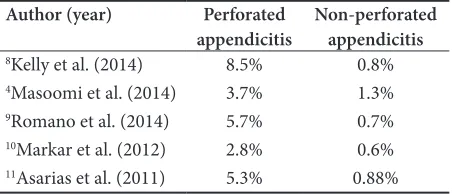
Program (NSQIP), the rate of perforated appendicitis was reported 17%2. Likewise, the results of a study carried out on 9.048 adults in Washington’s Surgical Care region indicated that patients who had undergone perforated appendectomy were about 16%5. In children, the most rate of perforation in teenage is similar to adults; however, a significant increase on perforation in ages below 5 years (60%) and ages below 3 years (86-100%) was reported6,7. Among all postsurgical factors, perforation condition is the biggest risk factor causing infection and abscess after appendicitis surgery. Based on following research result (Table 1), it is clear as to what amount of infection has been resulted in perforated surgery compared to the non-perforated surgery.
Table 1. Postsurgical infection rate in perforated surgery compared to non-perforated surgery
Author (year) Perforated
appendicitis Non-perforated appendicitis
8Kelly et al. (2014) 8.5% 0.8%
4Masoomi et al. (2014) 3.7% 1.3%
9Romano et al. (2014) 5.7% 0.7%
10Markar et al. (2012) 2.8% 0.6%
11Asarias et al. (2011) 5.3% 0.88%
According to Table 1, it seems reasonable that the risk rate of infection in non-perforated and perforated appendicitis is about 1 [4, 8, 11] and 5% [8, 9, 11]. respectively. By taking into account the number of appendicitis surgeries carried out every year, it can be concluded as to what percent of patients need treatment of intra-abdominal infection and abscess after appendicitis surgery. As a result, it can be understood what level of tendency exists to identify and solve infection risk factors.
3. Childhood and Adulthood as
Clinical Factors
It is an important challenge to diagnose what clinical factor can be the predicting and potential factor in internal infection of the organs after appendectomy, and there are numerous contradictory results for this issue in the literature. By reviewing the NSQIP database, Fleming et al.12 studied 39,950 appendicitis patients and found various clinical variables related to infection after appendectomy. Those variables included masculinity, date and level of
tobacco consumption, systemic inflammatory response syndrome, mean and number of WBC before surgery, emergency method, higher level of injury, and surgery period of longer than 60 minutes, all of which are related with prevalence of infection in internal organs. On the contrary, mean age, BMI, diabetes history, and bleeding disorder history are not correlated with prevalence of infection in internal organs in appendectomy12.
A similar study was carried out on 5,097 two-eighteen-year-old children who had undergone appendectomy. It was concluded that there was a correlation between infection of internal organs and complex appendectomy (perforation and abscess infection), high level injuries, putrefaction, and surgery time of over 60 minutes. As opposed to adults; however, it does not seem that an increase in the level of infection in internal organs is related with genders or emergency operations8.
4. Predisposing Factors
for Complications after
Appendectomy
The data indicate that the population of appendectomy patients is changing. The number of patients with obesity, multiple diseases, and age of over 65 is increasing. By reviewing the literature, it can be perceived that with over 1.5 million appendectomy patients in the USA from 2003 to 2011, there has been an increase in various problems and complexities among men, aging over 52 years old, inexperienced hospitals, rural regions, insurance system of individuals over 65, and African American race13.
4.1 Racial Disparities
4.2 Obesity
Because perforation is the biggest factor predisposing infection of internal organs, it can be predicted that any situation that causes high risk in perforation can result in postsurgical infection. Obesity is a factor that can lead to perforated appendicitis. However, it cannot be concluded that obesity is absolutely the cause of infections in internal organs after appendectomy14,15. Although there are disagreements, other researchers have referred to the risk of infection in internal organs among obese children to be 35%16; however, further research should be carried out on this certain population.
4.3 Young Ages
As discussed before, children under 5 years are more prone to perforated appendectomy6,17. However, one cannot conclude more infection after appendectomy from the high rate of perforation. Bansal et al.6 observed that the rate of infection in organs among children under 5 years is 3.2%. Nevertheless, the rate of perforation among children below 1 year, 1-2 years, and 2-3 years is 86%, 74%, and 60% respectively; however, none of those children had an infection after appendectomy. Henry et al.18 reported that diarrhea is a predicting factor for development of infection in internal organs after appendectomy6. Moreover, Henry
et al. concluded that painful period, type and time of
consuming antibiotics, the presence of infection at the time of surgery, and surgical techniques are not predictive factors for postsurgical infection and abscess18.
4.4 Old Ages
On the other end, patients aging over 65 are more predisposed to perforation19. This is an important factor for infection risk in internal organs after appendectomy.
4.5 Prediction Laboratory Data of Infection
of Internal Organs
Published articles have identified different laboratory markers, including WBC, CRP, and bilirubin that are correlated with perforated appendicitis20. However, the examined data use this value as a predicting factor for postsurgical infection of internal organs. Thereaux et al.21 examined 141 appendectomies in which appendicular peritonitis had been carried out (presence of intra-abdominal purulent fluid) and concluded that the number of leukocytes before surgery of more than 17,000 and the
CRP concentration of over 200 mg/l were correlated with an increase in infection after appendectomy. Age, gender, cycle of symptoms, fever lower than 38°, cystectomy, and presence or absence of fluid leakage are not correlated with infection of internal organs after appendectomy. Other studies indicated that WBC value as the predicting factor for postsurgical infection of internal organs is not convincing8,12,22.
4.6 D elay in Taking the Person to the
Operating Room
As was stated before, it is assumed that any scenario leading to the formation of perforation will result in postsurgical infection. One of the assumptions referred to in the literature is a delay in conducting appendectomy surgery. The results of a review study have recently confirmed that a delay of more than 12 hours can lead to increased perforation and infection of internal organs after appendicitis surgery23. Some studies have referred to the opposite of this issue. When the course of antibiotics starts, delay in surgery does not enhance the rate of perforation24,25. The results of a meta-analysis carried out in 2014 indicated that a delay of 12-24 hours had no effect on the formation of postsurgical infection26.
5. Laparoscopic Surgical
Techniques vs. Open Surgery
Many scholars have tried to remove appendicitis in a way that no infection occurs after the surgery. After McBurney27 proposed his method in appendectomy in 1894, it was employed as a technique to remove appendicitis for a century. In 1981, Semm28 implemented laparoscopic method for the first time. With the knowledge of infection after appendectomy, numerous studies have been carried out in order to figure out better methods.difference was not significant29. Almost a decade later, the results of another meta-analysis focusing on 1995-2006 indicated that infection of internal organs during laparoscopic surgery was 3% while 1.6% in open surgery30.
6. Consuming Antibiotics in
Appendectomy
6.1 Consuming Antibiotics during
Non-Perforated Appendicitis
In a review, Anderson et al.31 examined 45 studies consisting of 9,000 children and adults. They reported that consuming antibiotics caused a decrease in postsurgical infection. Consuming antibiotics is aimed at minimizing postsurgical infection, and researchers have tried to achieve this goal. Regarding non-perforated appendicitis among 700 patients, it was determined that continuous consumption of antibiotics after surgery may be seriously dangerous and increase the level of
Clostridium difficile, urinary tract infection, and its
survival time32. Surgical Infection Society has proposed guidelines against microbes. These guidelines postulate that antibiotics should be consumed before surgery, but not after it. Antibiotic selection should be in a decreasing and instant way. Conventional treatments include two-generation cephalosporin and long-term spectrum penicillin33. Moreover, it has been recommended that antibiotics are not consumed after surgery in adults with non-perforated appendicitis. Daskalakiset al.34 carried out a review and concluded that individuals with non-perforated appendicitis need a single and extensive dose of antibiotics before surgery.
6.2 Consuming Antibiotics during
Perforated Appendicitis
In perforated appendicitis cases, antibiotic consumption duration is discussable. Surgical Infection Society has suggested that children with perforated appendicitis consume an extensive range of antibiotics until clinical symptoms recover (24 hours without fever, normal WBC, and disappearance of symptoms)33. According to the recommendations by the Surgical Infection Society, adults should not consume antibiotics more than 7 days unless the patient reaches his natural state. Samples of single-use antibiotics include cefoxitin, ertapenem, and piperacillin-tazobactam35.
There have been numerous attempts to identify the duration of antibiotic consumption. Daskalakiset al.34 concluded that injecting intravenous antibiotics for at least 3-5 days is recommended until clinical recovery is obtained. Symptoms of clinical recovery includes decrease in fever, CRP, and leukocytosis.
A study carried out in 2014 focused on the difference between consuming antibiotics for 3 and 5 days. The results indicated that there was no significant difference between these two states. All patients were treated with two-generation cephalosporin and metronidazole before and after the surgery35.
7. Diagnosis and Treatment
There are not many discussions on diagnosing infection of internal organs after appendectomy. In most cases, there is an increase in fever, stomachache, and leukocytosis. When there is clinical doubt, CT scan seems to be a preferable method. If an infection is identified, antibiotics should be prescribed in a large amount and infection should be extracted through penetrating into the skin of that part36.
8. Discussion and Conclusion
individuals are more prone to infection of internal organs after appendectomy16; however, there are contradictory results in this regard14,15. Further studies should be carried out in order to understand such discrepancies better and determine the role of age, gender, and insurance in the rate of infection after an appendectomy. In addition to these variables, researchers should identify laboratory variables that may expose the patients to risk. CRP level of higher than 200 mg/l and the number of leukocytosis over 17,000 are considered as predictors of infection after appendicitis surgery21. When patients who are exposed to risk are identified, this can be used to identify useful approaches to decrease the level of infection after appendicitis surgery. For instance, in non-perforated appendicitis, patients only need to consume antibiotics before surgery and they need not take antibiotics after surgery. It seems that patients with perforated-appendicitis need to use antimicrobial coatings for 3-5 days. In all cases, the patient’s clinical condition should be controlled to make sure about improvement in symptoms, decrease in fever, normal state of WBC and CRP34.
Numerous studies have focused on whether open surgery or minimally invasive surgery is more effective in decreasing infection after appendectomy. Despite of contradictory results, most meta-analyses have indicated that minimally invasive surgery causes more infection after appendectomy. Despite of this, due to its advantages, laparoscopic surgery is preferred to open surgery by most surgeons. During the recovery period after appendectomy, recurrence or worsening of abdominal pain, fever, and increase in level of WBC and CRP can be a proposed factor for infection. Confirmation with CT scan is the commonest diagnostic method and data that are required for guidance and treatment. In general, appendicitis and its complications are still a problem shared by all people throughout the world. There is still a lot to discuss regarding appendicitis and its complications in the field of surgery.
9. References
1. Hall MJ, DeFrances CJ, Williams SN, Golosinskiy A, Schwartzman A. National hospital discharge survey: 2007 summary. Natl Health Stat Report. 2010; 29(29):1–20. 2. Ingraham AM, Cohen ME, Bilimoria KY, Pritts TA, Ko
CY, Esposito TJ. Comparison of outcomes after laparo-scopic versus open appendectomy for acute appendicitis at 222 ACS NSQIP hospitals. Surgery. 2010; 148(4):625–37.
Available from: file:///C:/Users/Wafa/Downloads/Telegram Desktop/video_2016-09-28_01-17-31.mov
3. Kapischke M, Friedrich F, Hedderich J, Schulz T, Caliebe A. Laparoscopic versus open appendectomy—quality of life 7 years after surgery. Langenbeck’s Archives of Surgery. 2011; 396(1):69–75.
4. Masoomi H, Nguyen NT, Dolich MO, Mills S, Carmichael JC, Stamos MJ. Laparoscopic appendectomy trends and outcomes in the United States: data from the Nationwide Inpatient Sample (NIS), 2004‐2011. The American Sur-geon. 2014; 80(10):1074–7.
5. Wilson DG, Bond AK, Ladwa N, Sajid MS, Baig MK, Sains P. Intra-abdominal collections following laparoscopic ver-sus open appendicectomy: an experience of 516 consecu-tive cases at a district general hospital. Surgical Endoscopy. 2013; 27(7):2351–6.
6. Bansal S, Banever GT, Karrer FM, Partrick DA. Appendici-tis in children less than 5 years old: influence of age on pre-sentation and outcome. The American Journal of Surgery. 2012; 204(6):1031–5.
7. Alloo J, Gerstle T, Shilyansky J, Ein SH. Appendicitis in children less than 3 years of age: a 28-year review. Pediatric Surgery International. 2004; 19(12):777–9.
8. Kelly KN, Fleming FJ, Aquina CT, Probst CP, Noyes K, Pegoli W, et al. Disease severity, not operative approach, drives organ space infection after pediatric appendectomy. Annals of Surgery. 2014; 260(3):466–73.
9. Romano A, Parikh P, Byers P, Namias N. Simple acute ap-pendicitis versus non-perforated gangrenous apap-pendicitis: is there a difference in the rate of post-operative infectious complications? Surgical Infections. 2014; 15(5):517–20. 10. Markar SR, Blackburn S, Cobb R, Karthikesalingam A,
Evans J, Kinross J, et al. Laparoscopic versus open appen-dectomy for complicated and uncomplicated appendici-tis in children. Journal of Gastrointestinal Surgery. 2012; 16(10):1993–2004.
11. Asarias JR, Schlussel AT, Cafasso DE, Carlson TL, Kas-prenski MC, Washington EN, et al. Incidence of postoper-ative intraabdominal abscesses in open versus laparoscopic appendectomies. Surgical Endoscopy. 2011; 25(8):2678–83. 12. Fleming FJ, Kim MJ, Messing S, Gunzler D, Salloum R,
Monson JR. Balancing the risk of postoperative surgical in-fections: a multivariate analysis of factors associated with laparoscopic appendectomy from the NSQIP database. An-nals of Surgery. 2010; 252(6):895–900.
13. Bliss LA, Yang CJ, Kent TS, Ng SC, Critchlow JF, Tseng JF. Appendicitis in the modern era: universal problem and variable treatment. Surgical Endoscopy. 2015; 29(7):1897– 902.
14. Blanco FC, Sandler AD, Nadler EP. Increased incidence of perforated appendicitis in children with obesity. Clinical Pediatrics. 2012; 51(10):928–32.
16. Garey CL, Laituri CA, Little DC, Ostlie DJ, Peter SDS. Out-comes of perforated appendicitis in obese and nonobese children. Journal of Pediatric Surgery. 2011; 46(12):2346–8. 17. Bratton SL, Haberkern CM, Waldhausen JH. Acute appen-dicitis risks of complications: age and Medicaid insurance. Pediatrics. 2000; 106(1):75–8.
18. Henry MC, Walker A, Silverman BL, Gollin G, Islam S, Syl-vester K, et al. Risk factors for the development of abdomi-nal abscess following operation for perforated appendicitis in children: a multicenter case-control study. Archives of Surgery. 2007; 142(3):236–41.
19. Walker A, Hatch Q, Drake T, Nelson DW, Fitzpatrick E, Bingham J, et al. Predictors of appendiceal perforation in an equal access system. Journal of Surgical Research. 2014; 190(1):87–92.
20. Panagiotopoulou I, Parashar D, Lin R, Antonowicz S, Wells A, Bajwa F, et al. The diagnostic value of white cell count, C-reactive protein and bilirubin in acute appendicitis and its complications. The Annals of the Royal College of Sur-geons of England. 2013; 95(3):215–21.
21. Thereaux J, Veyrie N, Corigliano N, Servajean S, Czernich-ow S, Bouillot J-L. Is laparoscopy a safe approach for diffuse appendicular peritonitis? Feasibility and determination of risk factors for post-operative intra-abdominal abscess. Surgical Endoscopy. 2014; 28(6):1908–13.
22. Brenner DJ, Hall EJ. Computed tomography—an increas-ing source of radiation exposure. N Engl J Med. 2007; 357:2277–84.
23. 23. Papandria D, Goldstein SD, Rhee D, Salazar JH, Arlikar J, Gorgy A, et al. Risk of perforation increases with delay in recognition and surgery for acute appendicitis. Journal of Surgical Research. 2013; 184(2):723–9.
24. Teixeira PG, Sivrikoz E, Inaba K, Talving P, Lam L, Deme-triades D. Appendectomy timing: waiting until the next morning increases the risk of surgical site infections. An-nals of Surgery. 2012; 256(3):538–43.
25. Drake FT, Mottey NE, Farrokhi ET, Florence MG, John-son MG, Mock C, et al. Time to appendectomy and risk of perforation in acute appendicitis. JAMA Surgery. 2014; 149(8):837–44.
26. Bhangu A. United Kingdom National Surgical Research Collaborative. Safety of short, in-hospital delays before surgery for acute appendicitis: multicentre cohort study, systematic review, and meta-analysis. Ann Surg. 2014; 259(5):894–903.
27. McBurney C. The incision made in the abdominal wall in cases of appendicitis, with a description of a new method of operating. Annals of Surgery. 1894; 20(1):38.
28. Semm K. Endoscopic appendectomy. Endoscopy. 1983; 15(02):59–64.
29. Golub R, Siddiqui F, Pohl D. Laparoscopic versus open ap-pendectomy: a metaanalysis. Journal of the American Col-lege of Surgeons. 1998; 186(5):545–53.
30. Bennett J, Boddy A, Rhodes M. Choice of approach for ap-pendicectomy: a meta-analysis of open versus laparoscop-ic appendlaparoscop-icectomy. Surglaparoscop-ical Laparoscopy Endoscopy and Percutaneous Techniques. 2007; 17(4):245–55.
31. Andersen BR, Kallehave FL, Andersen HK. Antibiotics ver-sus placebo for prevention of postoperative infection after appendicectomy. Cochrane Database Syst Rev. 2005; 3. 32. Coakley BA, Sussman ES, Wolfson TS, Bhagavath AS, Choi
JJ, Ranasinghe NE, et al. Postoperative antibiotics correlate with worse outcomes after appendectomy for nonperforat-ed appendicitis. Journal of the American College of Sur-geons. 2011; 213(6):778–83.
33. Nadler EP, Gaines BA. The Surgical Infection Society guide-lines on antimicrobial therapy for children with appendici-tis. Surgical Infections. 2008; 9(1):75–83.
34. Daskalakis K, Juhlin C, Påhlman L. The use of pre-or postoperative antibiotics in surgery for appendicitis: a systematic review. Scandinavian Journal of Surgery. 2014; 103(1):14–20.
35. Solomkin JS. Evaluating evidence and grading recommen-dations: the SIS/IDSA guidelines for the treatment of com-plicated intra-abdominal infections. Surgical Infections. 2010; 11(3):269–74.
36. van Rossem CC, Schreinemacher MH, Treskes K, et al. Duration of antibiotic treatment after appendicecto-my for acute complicated appendicitis. Br J Surg. 2014; 101(6):715–9.
37. Clark JJ, Johnson SM. Laparoscopic drainage of intraab-dominal abscess after appendectomy: an alternative to lap-arotomy in cases not amenable to percutaneous drainage. J Pediatr Surg. 2011; 46(7):1385–9.
![4′,4′,6′,6′ Tetrachloro 3 (4,6 dimethylpyridin 2 yl) 3,4 dihydrospiro[1,3,2 benzoxazaphosphinine 2,2′ (2λ5,4λ5,6λ5 cyclotriphosphazene)]](data:image/gif;base64,R0lGODlhAQABAIAAAP///wAAACH5BAEAAAAALAAAAAABAAEAAAICRAEAOw==)