THE PROPHETS OF INCENTIVES: THE METASTASIS OF ECONOMIC TROPES IN POLICY AND CULTURE
Robert Olen McDonald
A dissertation submitted to the faculty at the University of North Carolina at Chapel Hill in partial fulfillment of the requirements for the degree of Doctor of Philosophy in the Department
of Communication in the College of Arts & Sciences.
Chapel Hill 2016
Approved by:
©2016
ABSTRACT
Robert Olen McDonald: The Prophets of Incentives: The Metastasis of Economic Tropes in Policy and Culture
(Under the direction of Christian O. Lundberg)
This dissertation critically evaluates the discourses of “incentive-driven behavior” that have arisen in culture, politics and in economic theory. I use the framework of Lacanian
psychoanalysis to develop a critical typology of “the incentive,” and deploy rhetorical theory to account for the metastasis thereof. Fundamentally, I argue that “incentives” retroactively fills in a gap in our explanations of a chaotic social reality, and presumes that market structures (prices, preferences) organize all of human behavior. The result is that a fairly narrow set of assumptions about human behavior and social phenomena—borrowed from neoclassical economic theory— are smuggled into cultural analysis and politics. “Incentives” then work proactively to diagnose and solve social problems using market mechanisms, and retroactively to account for inequalities by presuming incentive structures operative below the phenomenal level.
incentive driven approach to all cultural, political, social and personal phenomena, and more recently through the cultural artifacts of Freakonomics and Nudge.
ACKNOWLEDGEMENTS
TABLE OF CONTENTS
LIST OF FIGURES ... ix
CHAPTER 1: The Metastatic Logic of the Incentive ... 1
Chapter Layout ... 16
The Definition and Expansion of Incentives ... 20
Reading Practices ... 24
Incentives as Retroactive Causality ... 38
CHAPTER 2: Between the Fire and the Tune, or a History of the Term “Incentive” in Economic Thought ... 53
Early Uses of the Term: From Incentivum to Incentive, and to Incentivize ... 57
Jeremy Bentham: The Pleasure/Pain Calculus ... 65
Alfred Marshall: Reducing Poetics to Positivism ... 72
Paul Samuelson: Setting the Tune, or, Incentives as Behavioral Modification ... 80
Conclusion ... 92
CHAPTER 3: Gary Becker, The Godfather of Incentives ... 95
Overview of Becker’s Economic Approach to Human Behavior ... 103
“Market Mechanisms”: The Copulating Metaphor and Ontological Commensuration .... 112
Stable Preferences, or the Metonymy of Desire ... 124
Utility Maximization: An Incipient Theory of Enjoyment ... 134
Conclusion ... 141
Neoclassical Economics and Freakonomics ... 149
The Representative Anecdote: “Humans are Incentive-Driven” ... 152
Incentives and the Retroaction of the Signifier ... 161
On Perversion(s) ... 165
Conclusion ... 175
CHAPTER 5: Approaching Gen(d)eral Equilibrium: Equal Pay Legislation and the Logic of Incentives ... 177
Overview of Laws: Lilly Ledbetter and Paycheck Fairness Act ... 185
The Lilly Ledbetter Act of 2009 ... 188
Paycheck Fairness Act ... 198
Conclusion: What Does Woman Want? ... 225
Chapter 6: The Frontiers of Incentive-Driven Politics ... 231
LIST OF FIGURES
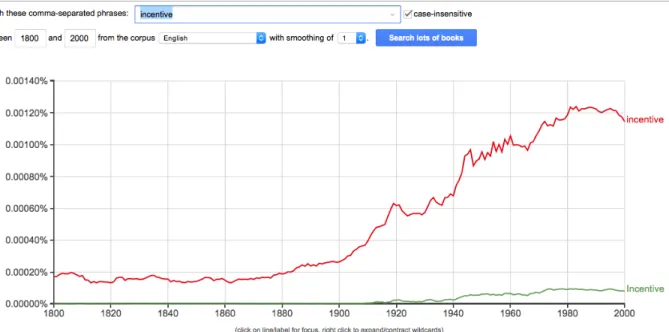
Figure 1 – Frequency of the term “incentive,” 1800-2000 ... 61
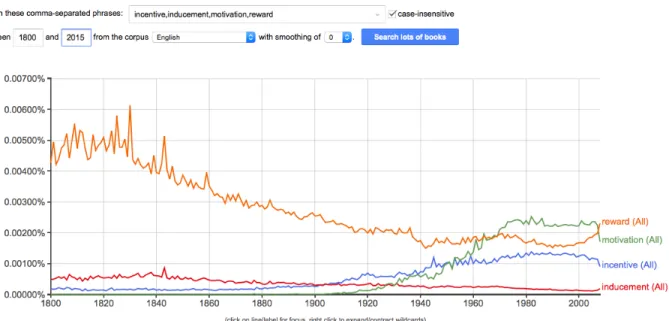
Figure 2 – Frequency of “incentive,” “inducement,” “motivation,” and “reward,” 1800-2000 ... 62
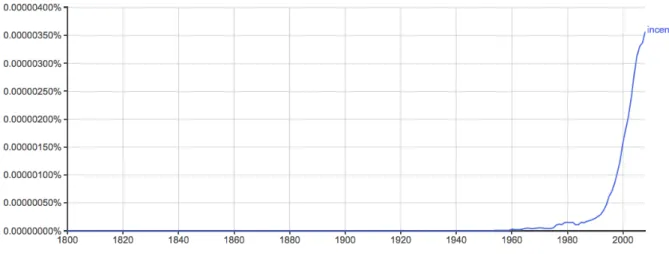
Figure 3 – Frequency of “incentivize,” 1800-2000 ... 63
Chapter 1: The Metastatic Logic of the Incentive
“Economists, the prophets of incentives, quite logically respond to their own incentives to service their various constituencies, and as they never cease to insist, life is nothing but a sequence of trade-offs. Whenever they make reference to the ‘public good’ or ‘general welfare’ in the course of their endeavors, they frequently mean nothing more than the brute fact of caveat
emptor.”—Philip Mirowski, Never Let a Serious Crisis Go to Waste1
This is a story about a seemingly innocuous concept—the “incentive”—that has become nearly ubiquitous in contemporary discourse. Journalists, politicians, economists, and people from virtually every walk of life use it as a synonym for motive, desire, and reward—it has become the modern world’s organizing metaphor for our subjective causes of action, and the name for the primary inducements in human behavior. The prophets of incentives have won Bank of Sweden prizes in economic sciences2, been appointed to presidential administrations, become widely cited federal district court judges, and have not only testified in front of, but have been elected to the United States Congress. The liberals of all parties, both Democratic and Republican, deploy such language to explain why the present looks the way it does. According to its proponents, the logic of “incentives” explains how judges rule, how businesses motivate workers, and even when people turn off the light at night to sleep. The logic of the incentive has metastasized over whole new regions of culture, politics and society—and, as I will argue in what follows, this metastasis has severe consequences for public life.
To see the implications of the expansion of incentive thinking, one has to understand the assumptions built into the rhetorical logic of the incentive. Embedded within this term is a
discrete history and politics, both of which entail a set of commitments to market-based
approaches to solving social problems, via the engineering of incentive structures. The rhetoric and logic of engineering incentives announces a presumably pragmatic way of engaging social problems, but it only gains the purchase it does by normalizing assumptions about the texture of social reality and the character of the social bond, including a commitment a specific definition of the rationality of social action, and to the consensual character of the social bond. Thus, the use of the term “incentive” harbors a struggle over the appropriate organizing metaphors for social life. As a result, the decision to approach social reality through the logics and rhetoric of the incentive is neither neutral, nor devoid of commitments to an economically determined vision of social life. Far from it: its implementation narrows our explanatory faculties, limits our
capacity to speak meaningfully about difference, and precludes questions about the non-economic determinants of social change. It is, in other words, nowhere near as innocuous as it seems, and, as I will show, “buying” into the incentive as a means of interpreting social reality requires the assumption of a whole range of doctrines about the character of the subject, its choices, and its means of relating to the world.
The social logic of the incentive aims to explain some fairly philosophically heavy issues that plague human existence: Mainly, it purports to address why it is we do the things that we do. Our behaviors could be the result of our existential angst, our habitation in language, our
repressed childhood sexual trauma, our being-with-others, or the complex articulation of multiple temporalities and logics, each of which deserve our careful attention. Not so for the prophets of incentives. As authors Steven Levitt and Stephen Dubner put it, “Incentives are the cornerstone of modern life.”3 For these authors, and for other consequential thinkers, to be
3 Steven D. Levitt and Stephen J. Dubner, Freakonomics: A Rogue Economist Explores the Hidden Side of
“incentive-driven” is the human condition: We act through a system of external rewards or penalties, and we act in accordance with our own unique desires. This slim, seemingly harmless conceptual edifice authorizes a host of presumptions and prescriptions that can have calamitous consequences for human life. Crucially, the point of incentive language is not that it founds an account, but rather, it retroactively presumes an account that supplants alternatives. When people perform any action—marry a partner, run a stop sign, join a protest movement—and the causes are unclear, it is an easy shortcut to say one was “incentivized” by it. As I demonstrate,
attributing the conditions that produced the behavior to “incentives” does not solve the problem of causality—instead, it hides it via a post hoc explanation, adherent to the precepts of
neoclassical economic thought.
Like all discursive formations, the discourse of economics functions at the level of attribution: No theoretical apparatus fully covers the social field. Rather, any such apparatus is a compromise formation that retroactively accounts for, and proactively contours, our
logic, along with its theoretical and political fellow-travelers, presents a serious challenge: Its prevalence, its utterances, its metastasis signals the serious work that must be done to overcome and overturn market-based thinking in the multiple sites where it occurs.
From its original poetic usage as a “fire” or a “tune” that sets people in motion, and through movements within the field of economic thought that reduce it strictly to financial motivation, today “incentives” have been raised to an all-encompassing account of human behavior. The “incentive-driven” approach posits an explanatory matrix that smuggles in a fairly narrow set of commitments from neoclassical economic theory onto analyses of social
phenomena. The scope of “incentive” metastasizes a neoclassical style of analysis far beyond its uptake in orthodox economic thought. For instance, Federal Circuit Court Judge Richard Posner relies upon “incentives” as part of his judicial philosophy, informed by the precepts of orthodox neoclassical economics. As Jeanne Lorraine Schroeder writes of Posner, “the ‘economist’s basic analytical tool for studying markets’ can be used to study other behavior.”4 Its avowed universal applicability ends up reducing the complexity of any given situation to fit standard assumptions from neoclassical economic thought. Its ubiquity becomes its limitation; as I demonstrate, the “incentive-driven” approach frequently ends up affirming tautologies and reaffirming the rectitude of any given status quo.
The presence of the term “incentives” clues us into a gap in the intelligibility of social reality that is filled in symbolically: As a result, alternative possibilities outside of market-based approaches are foreclosed. Used by some economists, they retroactively account for all
inequalities and irrationalities, and narrate them as freely chosen rational behaviors; used by policymakers, incentives are used to proactively assume in advance individual preferences and
4 Jeanne Lorraine Schroeder, The Triumph of Venus: The Erotics of the Market (Berkeley: University of California
socially (and economically) beneficial behaviors in order to contour social reality. Incentives are a point of investment in a particular(ly) economic interpretation of sociality itself, and the
repetition and circulation of this trope signals to me how enjoyment (jouissance) is attributed and distributed across the social field. The result is a non-falsifiable, and hermetically sealed
discourse. It is non-falsifiable because any new information or outcome can be narrated as the result of a “hidden” incentive, or a “shadow price” that we have not discovered yet; it is
hermetically sealed because only new information (as data) can be entered, not new or different analytics or problems.
social life as a metastatic vocabulary, but not as a general synonym for human behavior. Instead, financial motivation becomes the model for all of human reality, not the end in and of itself. The condensed meaning of “incentive” can metastasize over any available social context because it strictly presumes that at root, markets provide the ontological structure of reality. As I argue below, the step of “metastasis” epitomizes both condensation and figural displacement, which produces a rhetorical “perpetual motion machine” that integrates economic vocabularies onto social formations. The sentence “every action acquires an economic meaning” sums up my threefold analysis of the incentive-based approach: Metastasis is the “every,” metaphor is the “economic meaning,” and metonymy represents the “acquires.”
First, incentives exist as a metonym, or a trope of displacement, in which other terms are set up as functional equivalents for “incentive”: Rewards, desires, motives, reasons, penalties, etc., are lined up in a signifying chain that could make any one of them equivalent to substitute one another. In any given context, “incentive” can name a set of incidental connections to the other terms, the result is that we do not blink an eye when we name each of these fairly distinct concepts as equivalent to it. For instance, journalist Zaid Jilani of The Intercept asked on Twitter what “incentive” presidential candidate Hillary Clinton has to act differently when her interest group supporters in organized labor do not challenge her positions on trade. He writes, “If they are just going to pretend Clinton is good in the area when she isnt [sic] what is her incentive to do anything differently?”5 And elsewhere, a colleague of mine in Political Science described to me the difficulties of teaching online through the University of North Carolina. Because
instructors do not own the intellectual property of the course, he told me that “there’s no
incentive for grad students” to improve their existing courses. In these cases, “reason,” “benefit,” or “reward” could be easily substituted for “incentive” without much alteration to the meaning of
the sentences. Yet my gamble is that these terms do not remain “functional equivalents”—there is a (non-subjective) libidinal surplus within the deployment of the term, which brings the movement from metonymy to metaphor.
Next, the term does not just stand as equivalent to these other terms—it condenses them into itself; “incentive” becomes a metaphor for all goal-directed behavior. Within the domain of early 20th century neoclassical economics, the term becomes a metaphor, or a trope of
condensation, for commitments to a strictly neo-classically “economic” vision of society. That is, the term “sums up” investments in the story that neoclassical economics has about itself,
predicated on the axioms of utility maximization, selfish behavior, and market equilibrium. “Incentive” comes to simultaneously describe the external laws of capitalism and the financial motivations that individuals have therein. (In a following chapter, I further explicate the “double duty” that incentive accomplishes within the discourse of economics by metaphorically suturing together “desire” and “reward,” which ultimately grounds Alfred Marshall’s theory of general equilibrium.) Here, the metaphor of the “incentive” reduces (condenses) available sets of discursive resources into a single one, analogous to financial motivation and reward in the capitalist mode of production. For instance, when governments offer “tax incentives” for businesses to relocate, or when people say that television studios “have an incentive” to renew popular shows, this exemplifies the condensed meaning of “incentive” at work.
useful trope from rhetoric’s history. In his classic treatise The Garden of Eloquence, Henry Peachem defines metastasis as “a forme of speech by which we turne backe those thinges that are objected against us, to them which laid them to us… The use of this figure serveth both to repell objections, and also to reply by accusations, and all at one time.”6 In the context of an argument, metastasis is invoked to respond not through refutation, but through a counter-accusation. The original argument is displaced into a different order, or into a new place. Such an insight lines up with the Greek etymology of the term “metastasis” as another form of rhetorical “displacement,” in that something is placed (stasis) outside (meta-) of its normal context. Incentives move beyond their original stasis—that of financial motivation—and literally metastasize into new domains which were not previously governed by the trope.
What does this mean in practice? When we view the invocation of “incentive” as an exemplar of metastasis, we see how it is first metonymically linked to particular stases, so “incentives” are applied to strictly economic and financial problem-spaces. Boswell et al. write that in workplace settings, “Locke, Feren, McCaleb, Shaw, and Denny (1980) concluded, following the first meta-analytic review of the literature, that no other incentive or motivational technique compares to money in terms of its instrumental value…. Incentive compensation systems attempt to align employee interests with those of the organization by making compensation contingent on particular outcomes or behaviors.”7 But beyond that, and more importantly, “incentive” becomes an all-encompassing metaphor for human behavior writ large, so markets are not just introduced into social phenomena, but are presumed to have structured
6 Henry Peachem, The Garden of Eloquence 1577, 181-182. Accessed February 1, 2016.
http://gateway.proquest.com.www2.lib.ku.edu/openurl?ctx_ver=Z39.88-2003&xri:pqil:res_ver=0.2&res_id=xri:lion&rft_id=xri:lion:ft:pr:Z200728358:.
7 Wendy R. Boswell, Alexander J. S. Colvin, and Todd C. Darnold, “Organizational Systems and Employee
human reality all along—the style of neoclassical analysis is placed outside of its original economic context and into new ones altogether. What was previously a narrow explanation for financially motivated activity then retroactively becomes the model for human behavior as a whole.
The mode of argument for “incentive-driven” vocabularies is functionally metastatic— not only does it spread, it moves. Wherever “incentive” stands in for non-monetary social
relations, it can never catch up to them. Something fundamental about human reality is displaced when the trope of the “incentive” is invoked. One could think of the movement metonymy— metaphor—metastasis as a rhetorical form of sublation, in which the previous moment is both canceled and elevated. One does not metastasize “incentives” as a solution for all social
problems without being committed to market-based approaches to reality, and seeing all rewards, motives and desires as functionally equivalent thereto. The M—M—M circuit is a “perpetual motion machine,” since each meta-stasis involves a dis-placement of alternative interpretations of a given cultural formation. The raw material of sociality is placed elsewhere: into economic logics of supply, demand and innate preferences, the result of which is a suppression of
alternative explanatory mechanisms. Metastasis erases the rhetorical labor of the market metaphor by locating each example of an incentive in a determinate identity. We shall see how the “godfather of incentives,” Gary Becker, accomplishes this task, wherein he contends that literally all behaviors obey market principles. For Becker, there is no symbolic distance or artifice in this claim. He does not claim that families are “like” firms, or that marriages are “like” markets—he joins them at the level of identity. The metastasis shifts any of our considerations away from culture, history, and context, and places them into a new stasis altogether:
As a result, incentives instantiate a trans-contextual mode of social analysis. Incentives are presumed to govern social reality and render it calculable in the face of a generalized anxiety—call it risk society, or call it uncertainty about the future. Faced with a chaotic and unstable future, incentive-based vocabularies render the world calculable, predictable, and manipulable. We need no longer infer why people act as they do; instead, we deliver answers according to the rubric “By what were they incentivized?” The incentive here functions to discipline our chaotic contexts through a terminological reduction to techniques and retroactive explanations. Becker metastasizes the style of neoclassical economic analysis onto every conceivable cultural formation, so any synonym or differential articulation of desire, reward or motive is re-described as an “incentive.” He writes: “Indeed, I have come to the position that the economic approach is a comprehensive one that is applicable to all human behavior, be it
behavior involving money prices or imputed shadow prices, repeated or infrequent decisions, large or minor decisions, emotional or mechanical ends, rich or poor persons, men or women, adults or children, brilliant or stupid persons, patients or therapists, businessmen or politicians, teachers or students.”8 The result is that all contexts, contingencies, and contradictions of human life become factors in a utility function, calculable as an advanced version of Jeremy Bentham’s pleasure/pain calculus.9 Becker explicitly dismisses sociology, psychology, history, and religion as useful for explaining human behavior—not because they do not matter, but because they can be calculated by the “one social science” he advocates.
To be clear, his position is not unique strictly to “incentive” logics, but comes part and parcel from neoclassical economics writ large. Maurice Allais, in his lecture after winning the
8 Gary Becker, The Economic Approach to Human Behavior (Chicago: University of Chicago Press, 1976), 7-8. 9 These are: stable preferences, utility maximizing actors, and the presumption that market mechanisms structure
Bank of Sweden prize in economic sciences in 1990 stated, “I have been gradually led to a twofold conviction: human psychology remains fundamentally the same at all times and in all places; and the present is determined by the past according to invariant laws. It seems to me that, to a very large extent, the social sciences must, like the physical sciences, be based on the search for relationships and quantities invariant in time and in space.”10 Not only is the neoclassical approach trans-contextual, it is also assiduously anti-contextual. Allais’ comments unconsciously harken back to Jacques Derrida’s critique of structuralism: Structuralism must account for its inauguration outside of its own inner logic, thus any structure is the result of contingency. The only possible rejoinder is that contemporary economic relations are merely the expression of the underlying ontological structure of the universe, and the domain of contemporary academic economics is to explicate how such relationships exemplify it. Witness, too, economist Ernest Fehr’s claims: “I don’t like the argument that everything is context dependent. That view lacks any grounding. In this regard, I really like the strong theoretical emphasis of economics and our desire for unifying explanations. It distinguishes us from biologists and psychologists, and provides us with a normative anchor.”11 In Fehr’s and Allais’ views, trans-contexuality is a strength rather than a weakness of the discourse, because every single conceivable question can be answered logically through a reduction to a single one: What were the relevant incentives at play, and how can we better engineer them for the next decision?
Finally, Becker makes the argument that because we have a retroactive account for all human behavior, economists can manipulate certain social, political and economic levers to
10 Maurice Allais, “Nobel Lecture,” in Nobel Lectures, Economics 1981-1990 ed. Karl-Göran Mäler (Singapore:
World Scientific Publishing Co., 1990): 243.
11 Ernest Fehr, interview in European Economics at a Crossroads, eds. J. Barkley Rosser, Jr., Richard P.F. Holt, and
produce new equilibria to their liking. In his weekly column for BusinessWeek magazine, he deployed his “economic approach to human behavior” onto dozens of subjects, from
immigration, to trade policy, public schools, divorce law, environmental protections, and college athletics. He argues, “in this approach, behavior crucially depends on incentives… The fact that behavior responds to incentives in this way is consistent, in most situations, with common sense.”12 By applying the presumption of incentivization to social questions, Becker argued for the introduction of market relations into these matters. For instance, he advocated for a severe and violent crackdown on illegal immigration into the United States from Mexico alongside an auction system by which wealthy immigrants could purchase their way into the country legally— such a system would indicate, through the money commodity, the desire (or incentive) that migrants had, and indicates further what kinds of contributions they would be able to make as workers within this country.13 By introducing formal market relations where there previously were none, human beings’ activities become calculable, predictable, and especially manipulable toward the preferred political ends of its advocates.
In sum, metastasis as a concept incorporates the displacement of alternative explanations and the condensation of commitments to a neoclassical explanation of society. The metastasis of “incentives” covers over sets of concrete particularities with axioms of neoclassical economics: actors behave selfishly, and markets organize such behaviors. Economists, authors and
politicians then advance a unitary solution—social problems arise because markets are
inadequately produced or maintained, or we are simply inattentive to the deep underlying market logics at work in our chaotic reality. The logic of the incentive then displaces all potential
12 Gary Becker and Guity Nashat Becker, The Economics of Life: From Baseball to Affirmative Action to
Immigration, How Real-World Issues Affect our Everyday Life. (New York: McGraw-Hill, 1997), 4.
alternative explanations—historical, cultural, rhetorical, theoretical—as deficient without the discourse of economics translating these explanations into utility maximization models. In the above example of immigration, witness what must be suppressed in order for such an “incentive scheme” to function. Becker’s blind spot is that he must disavow his presumption that informal markets already exist everywhere, and in all contexts. Thus, a migrant’s willingness to risk their life crossing the Mexico/U.S. border does not register on Becker’s scale of “incentive” as a marker of desire to become a resident of this country. Becker’s public (non-academic) work is suffused with this type of oversight—he aims to force nonmonetary market relations into monetary ones, which results in a reduction of what “counts” as economic, even for him. Yet despite all this, the term’s prevalence reflects the growing prestige and importance that orthodox, neoclassical economics has in questions of social policy, and cultural formations. “Incentive” is a term that offers retroactive symbolic coherence for complex social phenomena; it is the
paradoxically indispensable surplus that stitches up reality. The social logic of the incentive attributes enjoyment to actors with the fantasy that they are “enjoying” economically in accordance with neoclassical theory.
Although this is a universalizing logic, I do not presume it to be presently hegemonic in everyday life. Thankfully, we have not yet arrived at the point where “incentive schemes” are universal or assumed to be natural. Instead, it is a specific discursive formation within what Grossberg calls “economic culture.”14 For its proponents, “incentive” becomes a point of investment—a place where quintessentially neoclassical commitments about humanity, politics and social organization are condensed into a single term. The economists, journalists and politicians that invoke this trope in cultural and political sites mark their commitment to the
14 Lawrence Grossberg, “Interview with Lawrence Grossberg, November 14, 2012,” Interview conducted by James
power of neoclassical economics to define, circumscribe, and contain potentially any context. Incentive-driven logics provide a story about how and why the various outcomes within capitalism are distributed. This is not to say that other ideological discourses are inoperative— current events remind us daily of the importance that individualism, nationalism and class consciousness play in this conjuncture. Whereas these strictly ideological discourses constitute habituated practices of enjoyment revolving around social antagonisms (the outsider, the
indolent, the parasite), “incentive-driven” logics perform a double duty of their own—they work both proactively and retroactively to provide (symbolic) coherence over an inconsistent reality.
This figural occlusion performs the duty of evading any question of structural economic inequality—according to its commitments, enjoyment is already counted as part of a system, even if it does not appear as social power, monetary wealth, etc. All outcomes are registered as having been the result of a prior incentive, so any unequal treatment or outcome is buffered by the logic that renders it sensible. Incentive-driven behavior is a figure that both names and covers over a gap in social life: Absent alternative explanations, we infer, and enjoy, the stable
explanation of why other people behave as they do—and when the Freakonomics series arrives, we see it provides a coherent account for why we ourselves do. We fill in this gap of
indeterminacy with the term “incentive”—and as Gérard Genette says, like any gap, it has a form. In the face of competing explanations for the behavior of others, “incentives” retroactively fill in this opening with the assumption that people act in accordance with their preferences, and have stable sets of motives by which they are incentivized. Incentives allow economists to figure
our desire as both contingent and learned from others. And further, the tacit acknowledgement that we do not know what we want causes anxiety and a desire for fixity. “Incentives” solve problems by joining cause and effect, and by promising any unexpected outcome is
understandable once we discover the “hidden forces” of markets that pervade our existence. The economy of enjoyment accounts for why these common tropes are repeated, and why they purport to have explanatory power. In each case, these tropes provide explanations of human behavior that fits at the level of lived reality, especially in times of economic trouble, and that there is surplus enjoyment in the deployment of these baseline assumptions about capitalism and human nature. In troublesome times, “economic” explanations for behavior become more
attractive, not less, since this vocabulary explains potentially any outcome—inequalities are managed, high salaries are justified, and we have a straightforward rubric for objectifying, for cognizing, what we desire. When people have to do more with less, I contend that we are beholden even more to orthodox understandings of ourselves, of society, and of others: We “double down” on incentive logics a means of control when an object (an economy, another person, ourselves) performs differently than we expect to. As a result, to counteract our anxiety about fundamentally unknowable things, we invest in a vocabulary that promises the underlying rule of all social reality is knowable and controllable. The result is an imagined unicity for what is inherently an unstable multiplicity of practices. As a set of publicly persuasive acts,
“incentive-driven” analysis invites subjects to identify themselves and their own desires with economic axioms of human nature. We must behave like economically rational agents, because we already do.
not every use of this term is a tacit endorsement of neoliberalism, or something similar. This signifier, like all signifiers, moves through bodies in a non-subjective manner; as Kenneth Burke once wrote, “We use words, and words use us.” My inquiry is uninterested in assigning personal responsibility to the individuals who use “incentives” in everyday conversation, or even to engage with social problems. (There may be a Utopian impulse to the discourse of “incentives”: Who would refuse a calculable and measurable means of predicting behavior and engaging with the world’s trickiest problems of unemployment, discrimination, and climate change?) Rather, the use of “incentive” as a rhetorical shortcut—especially by non-economists—signals only to me the paucity of our collective imaginations and available discursive resources to explain a chaotic reality.
If my hypothesis is correct, the unconscious signifying content of “incentive” should serve as an “incentive” for critical scholars to develop robust, critical, and careful explanations for the shape of social life as it is, away from the standard answers that neoclassical economics proffers. By critically examining the limits of this discursive formation, it paradoxes and its surpluses, we can develop a critique that actively resists the foreclosure of alternative
possibilities that neoclassical economics performs; we can begin to tell a better story about how social life is complexly articulated. What follows is a brief layout of the following chapters, after which I describe my method for reading the metastatic rhetorical logic of the incentive.
Chapter Layout
economics, influenced by Jeremy Bentham’s utilitarianism, and embodied in the work of Alfred Marshall, adopts the term strictly as a descriptor of an external, objective, measurable and especially financial motivation within competitive markets. “Incentive” shares an etymological history with both the phrase “to be incensed” and the term “incantation” (or charm); today, modern economics uses the term primarily as a set of external levers or techniques to induce outcomes. The externalization of the term “incentive,” and its decoupling from the subject, has a paradoxical consequence: Incentives become essentially the domain of reactive forces, despite the term describing motivated behavior. The discipline of economics appropriated a fairly general synonym for motivation to describe a fairly narrow band of activities, constricting the term “incentive” into a set of external, objective relations.
Chapter 3, “Gary Becker: The Godfather of Incentives,” examines the work of a
behavior. I take his threefold approach to the letter—utility maximization, stable preferences, market mechanisms—and explore how social, political and economic inequalities are
retroactively produced as rhetorical effects of “incentive-based” analyses.
Becker’s thought is the paradigm for a globalization of incentive thinking, and Chapter 4 continues that work, but with a view toward an even more “popular” set of cultural artifacts. The bestselling Freakonomics book series, written by a New York Times Magazine journalist and another Chicago School economist, took seriously Becker’s challenge to apply the incentive-based approach to human behavior to all phenomena. Over the course of three books and a collection of essays, the authors entreat us to see the outcomes of sumo wrestling matches, the fall of the Ku Klux Klan, global climate change, Zappos shoe company policy, and many other things as the results of “hidden forces,” a term borrowed from the first book’s subtitle. The “hidden force” in literally every case comes from the application of neoclassical market
principles onto social phenomena. The discourse of Freakonomics is a discourse of perversion, in which the rhetorical strategies of the books mandate that its readers take part in the “freakish” outcomes of neoclassical economics by becoming the object of market operations, rather than its active subjects. If “incentives” organize the distribution of enjoyment, Freakonomics as a
cultural artifact signals that individual, idiosyncratic subjects become the objects of market enjoyment as they behave according to the axioms laid out by neoclassical theory.
economics has intervened into questions of social policy. Those who opposed the bills smuggled in essentialist concepts of womanhood and femininity, arguing that there was such a thing as “women’s incentives”—to raise children, to perform service, care work, and domestic labor— that retroactively justifies pay inequality. That some women take low-paying jobs, rear children and leave the workforce means that any opposition to equal pay has its empirical alibi: Women demonstrate an incentive to remain unequal, because they are “incentivized” by things other than equal pay. Incentive logics metastasize traditional gender norms as “human capital factors,” thus justifying unequal treatment in the future. By and large, those who supported the bills remained locked in an “economic” frame of argument, severely attenuating the vocabulary for articulating social change. Whereas the existence of an inequality can be, and ought to be, a place where antagonisms can be pushed, analyzed, and critiqued, the incentive-based vocabulary hypostasizes social reality and closes off alternative discursive operations. This, I believe, partially explains the failure of the Paycheck Fairness Act.
Finally, I conclude with a discussion of the frontiers of social, economic and cultural life within the boundaries of an incentive-driven approach to human behavior. The Obama
administration recently announced an executive order to encourage the use of behavioral economics in policymaking; this came on the heels of one of the authors of the highly popular book Nudge: Improving Solutions in Health, Wealth and Happiness appointment to the administration to advise on social policy. Yet his is not altogether a new strategy for the
Democratic Party: Philip J. Cooper argues that presidents since Jimmy Carter have attempted to solve “regulatory problems through market mechanisms, including incentives and rewards.”15
Nudge, and behavioral economics more broadly, depends heavily on the precepts of neoclassical
15 Phillip J. Cooper, The War Against Regulation: From Jimmy Carter to George W. Bush (Lawrence: University
economics, foregrounding the role “incentives” play in any social and economic policy decision. Rather than regulations and laws governing the behavior of individuals and institutions, the “libertarian paternalist” philosophy of Nudge authors Sunstein and Thaler appears more
consonant with Jeremy Bentham’s vision of government, in which appetites cannot be created by the state, only channeled through prudent policy. Instead of the state taxing income, investments, and property in order to redistribute it via social welfare programs, the behavioral
economics/“nudge” trend aims at contorting individuals’ behaviors toward supposedly socially beneficial ends—perhaps even eliminating the need for social welfare programs altogether. “Libertarian paternalism” represents a significant shift in the aims and ends of the state, and I believe this to be the frontier of where debates about “incentives” are heading.16 This concluding chapter looks to these developments as both a summation and potential turning point for the social logic of the incentive. I use the psychoanalytic distinction between the “goal” and the “aim” of a desire to account for how economic thinkers argue against progressive/social democratic policies.
Defining and Expanding the Domain of Incentives
The Oxford Dictionary of Economics defines an “incentive” as:
Rewards or penalties designed to induce one set of economic agents to act in such as way as to produce results that another economic agent wants. As rewards for good results, incentives can include higher pay, better working conditions, better job security, better promotion prospects, or prestige. As penalties for poor results, incentives may take the form of lower pay, worse working conditions, poorer promotion prospects, demotion or sacking, or loss of reputation. Incentives may be applied in response to actual results, such as output or profits, or to management's perceptions of inputs, such as attendance and disciplinary record. Incentives cannot be based on inputs or outputs unobservable by
16 By both presuming in advance the socially beneficial goals individuals ought to have, and pushing against
management: to motivate these it is necessary to rely on self-respect or team spirit.17 This definition gets more complex as we pull on each of its threads, but is a useful starting point. Incentives are designed to induce certain behaviors. They can be both monetary and
nonmonetary—to incentivize your daughter to go run errands, you may promise a trip to a taco stand afterward. They can be material, like a corner office, and “immaterial” (like prestige, although “prestige” necessarily correlates to a material of some kind, even if it is discursive, like a title).
Perhaps at one time it would be considered revolutionary to include monetary and
nonmonetary activities as fundamentally equivalent, but today, the particular logic of “incentive” has been expanded to account for all monetary and nonmonetary interactions on a single plane. The aforementioned Judge Richard Posner, herald of the “law and economics” field of judicial decision-making, is the single most cited legal scholar in the country, and advocates a market-based approach to all matters, legal, moral and ethical. Economists, using this style of analysis, no longer need to justify entering non-monetarily motivated actions into neoclassical utility functions: Non-monetary desires and rewards (or penalties) become functionally equivalent when observing behavior.18 Take this claim from data guru Nate Silver’s FiveThirtyEight site on the “economics” of hospital choice: “Even in settings where patients have little information about providers’ efficiencies, and insurance and time pressures reduce any incentive to find out, we see that patients still find their way to better hospitals. Something in the market is able to
17 “Incentives,” Oxford Dictionary of Economics (3rd Ed.) eds. John Black, Nigar Hashimzade & Gareth Myles
(Oxford: Oxford University Press, 2009).
18 Utility functions are sets of equations into which economists enter initial “capital” or “human capital” outlays,
collect and transmit that performance information to patients or to someone who knows them.”19 “Incentive” here indicates the presumption that despite not having an incentive to perform research on a matter of life and death, “something in the market” promotes rational action. Ironically, the unnamed “market force” ought to be the explanatory innovation that economics brings to the table, but unsurprisingly, the crucial function of conveying survival rates is “black-boxed” or hand-waved as the result of a market force, and not an example of a communicative, advertising or cultural process. In the end, the rhetorical form that sutures a “good outcome” to “market force” is the “incentive.”
This distinction between monetary and nonmonetary incentive is only useful to demonstrate how the line between them is blurred, and then elided. The original logic of the incentive is thus expanded to include any context or situation, and can even be used in an intrapersonal context. In other words, it can act as a vocabulary for an individual to motivate oneself to act differently. For example, GQ and Deadspin columnist Drew Magary wrote in a 2015 column, “I have yoyo-ed when it comes to weight loss, and I have kept the tight clothes around as an incentive, simply because I can't bear the thought of disposing of them and admitting that I will never recover.”20 Incentives have not just expanded into the intrapersonal realm—incentives become synonymous with motives writ large, so instead of simply being the object of a motivated force, “incentive” is the motive itself.
Such a trajectory was set out at the outset of neoclassical economic thought. Marshall,
19 Chad Syverson, “Market Forces Appear to Apply to Hospitals, Too,” FiveThirtyEight, March 28, 2014, Accessed
January 27, 2016. http://fivethirtyeight.com/features/standard-market-forces-appear-to-apply-to-hospitals-too/. The article’s main claim is that patients go to hospitals with reputations for not killing their patients as frequently as other hospitals do. This is taken as a warrant that “market forces” work. And the relevant question worth asking— why do people go to these hospitals?—is simply hand-waved as a result of said market forces (“something in the market is able to transmit that performance information” instantaneously).
20 Drew Magary, “Russell Wilson’s Ball-Bread Is Fucking Weird,” Deadspin, February 24, 2015, accessed January
one of the most influential figures in early neoclassical economics, identifies “incentive” not as reward, but as motive, or desire, and sutures desire to satisfaction to satisfy equilibrium
requirements. And finally, the final part of the Oxford definition, regarding whether incentives must be empirically observable, frays somewhat upon its cultural metastasis. Becker, the subject of Chapter 3, posits unobservable “psychic costs” onto actors that equalize his utility functions; the inheritors of his legacy, the authors of the Freakonomics book series also assiduously seek out the reality of “hidden forces” that motivate people. In other words, taking seriously the logic of the incentive means nothing is outside of the purview of the neoclassical gaze.
But either way, this vocabulary is a unity of opposites, since it represents a commitment to a unifying explanation for all of social reality. Whether they are monetary or nonmonetary, inter- or intrapersonal, observable or unobservable, incentives function to mediate disparate orders of being. It performs the discursive work that signals how different orders of time (past, present and future), as well as disparate orders of being (social, political, economic) become fungible with one another. Crucially, term “incentive” does not do the work of commensuration, but is rather a signal that different elements of reality are being mediated on a single plane by economic analysis. To invoke the incentive as an explanatory mechanism entails the collapse of different levels of causality (material, formal, efficient) onto the “final cause” of economic causality. Overall, incentive logics obey similar formal properties across different contexts—as it metastasizes, it folds a number of discrete social and theoretical functions into an overarching logic. What this move purchases in terms of intelligibility, and in mobility, it forfeits in terms of specificity. The following section introduces my reading practices for interrogating the
Reading Practices
As mentioned, it could be that the invocation of “incentives” adds nothing to any given situation; at first glance, it appears as a synonym for motive or desire. When a journalist offhandedly mentions a political or social “incentive” to act in a certain way, it may not
necessarily guarantee that neoliberal values are being smuggled in. Consider the following claim by baseball writer Jonah Keri: “Major league hitters, like all human beings, are motivated by incentives, so when they come to the plate with runners in scoring position, they’re flooded with team incentives (a chance to put runs on the board and help produce a win), individual incentives (a chance to feel the rush of driving in a run), and financial incentives (even amid the advanced stats movement, RBIs still = $$$).”21 Yet my gamble is otherwise: The re-description of social reality as a set of economic factors is no natural or neutral act. It is the signal of the investment in this stable explanatory matrix, and this investment is a point of enjoyment, wherein a rhetorical practice takes root, repeats, and takes hold to produce meaning for publics and subjects. The act of speaking into the void, of coding all practices as some form of a neoclassical utility function, is not an act of discursively creating reality, but rather of taming and managing it. This
management is the mark of a libidinal surplus—jouissance—that represents a specific form of affective investment in stable ideological commitments.
I am concerned with a discursive cluster of terms (and commitments) that cut diagonally across the social field—my case study consists of objects that demonstrate the essential character of incentive-based vocabularies. “Incentive” is a framework for thinking about the ways in which economists, policymakers, influential thinkers and even ordinary people have attempted to deal with a financial crisis, a recession, and a predicted low-growth future, and contains within it a set
21 Jonah Keri, “The Duncan Way: How Cardinals Pitchers Continue to Dominate by Exploiting Hitter Tendencies,”
of commitments to an “economic” (neoclassical) approach to literally every social phenomenon. The commitment to “incentive-driven behavior” is a conjunctural response to a crisis, a “story” being told, and a process of articulation in and of itself. Economics as a discipline poses a serious challenge to alternative modes of articulating sociality, politics, power, and even communication itself (however fraught that term may be), so I forward a mode of critique that allows us to resist it.
As Grossberg puts it, the coding of discrete, contextual actions as “economic” demands serious criticism, and we should cast aspersions on a discipline with serious empirical
shortcomings.22 He writes of economics, “What other discipline is of such immediate concern to so many people and yet so totally obscure, even dismissive of popular curiosity? ...What other discipline claims the right to directly shape real policies, while building analytic tools that enable it to operate by abstracting models that are only weakly if at all connected to reality? What other discipline could claim to be the only true science in the human sciences, while still clinging to its founding texts…as if they were sacred… What other discipline can claim to be authoritative, even a ‘science,’ and yet have such a bad record?”23 And elsewhere, in an interview with James Hay, Grossberg contends, “I do think that there is something happening that is useful to refer to as ‘economic culture.’ Partly, I am referring to the discourses of Economics, as a discipline and as popular discourses, and partly I am referring to economic practices as discursive… The cultural presence of economy, what I would call economic culture, has changed significantly and become part of our popular culture in ways that I think it never used to be.”24 He attributes this to
22 Lawrence Grossberg, Cultural Studies in the Future Tense (Durham: Duke University Press, 2010), 148. 23 Ibid., 110.
the disappearance of our dominant commenusrating apparatuses: “as they have collapsed, disappeared, or become dysfunctional, there seems to be a tendency for them to increasingly become what Deleuze and Guattari (1977) describe as ‘paranoiac machines.’”25 My own inquiry describes the rhetorical means by which “economic culture” takes hold in political and cultural formations. In the absence, or bankruptcy, of other orienting logics (nationalism, class
consciousness, the “American Dream”) incentive logics intervene to render a chaotic reality sensible, and the “economization” of everyday life is part and parcel of what Grossberg identifies as “economic culture.”
Psychoanalysis, particularly that of French analyst Jacques Lacan, is the necessary apparatus to inquire about the discursive labor that stabilizes and habituates the neoclassical commitments to incentives. The psychoanalyst’s gambit is that the borders between text and meaning, between a subject’s interior and exterior, and even between language and reality can be organized and thought of as a process of affective investment, or enjoyment. The privileged site for Lacan, a practicing psychoanalyst his entire professional life, was speech. As he puts it, “We can let ourselves be taken in by our first initial contact with the subject …[this] brings us to the point of going beyond [meaning] and positing the term discourse. For to be sure, these patients speak to us in the same language as ourselves. Without this component, we would be in total ignorance. It’s therefore the economy of discourse, the relationship between meaning and meaning, the relationship between their discourse and the common organization of discourse, that allows us to ascertain that a certain delusion is involved.”26
25 Grossberg, Cultural Studies in the Future Tense, 167.
26 Jacques Lacan, The Ethics of Psychoanalysis, 1959-1960: The Seminar of Jacques Lacan, Book VII, ed.
Speech, for Lacan, is a way to evade the twin traps of both subjectivism and
structuralism—Lacan’s “rhetorical” artifact is not the individual(istic) discrete utterance of a knowing subject, nor is it the epiphenomenal effect of a dominant ideology. Speech is not
reducible to the body, or the subject, or ideology, but is itself a practice that is contoured by each of these. The sign moves through the body. Merleau-Ponty, discussing Ferdinand de Saussure, one of Lacan’s early influences, writes, “language is not a function of the speaking subject. Involved in the speaking community, the subject is not the proprietor of his language… For Saussure, the individual is neither the subject or the object of history but both simultaneously.”27 For a Lacanian, the movement of signs through bodies is not to deny the agency of either, but to mark that this process is habitual and inescapable.
Wherever the trope of “incentive-driven behavior” functions in cultural formations, it exemplifies the Lacanian concept of enjoyment, or jouissance; it squares the circle between and among individual subjects, and offers a cohesive version of what the social bond looks like. I deploy reading strategies that identify the loci of enjoyment in economic thought. It is not that economic actors simply “enjoy” their idiosyncratic, individual choices, but rather, economists enjoy in their place by attributing economic rationality to their actions, thus validating their simplifying mechanisms and organizing metaphors for social life. So another way of talking about jouissance is to ask: What are the precious objects, or objets a that a discourse organizes? Or as Žižek puts it, “The easiest way to detect ideological surplus-enjoyment in an ideological
27 Maurice Merleau-Ponty, Consciousness and the Acquisition of Language, trans. Hugh J. Silverman(Evanston:
Northwestern University Press, 1973), 97. I also prefer not to think of this project as involving subject-formation or subjectivization for two related reasons. The first is that to claim a discourse subjectivizes individuals removes the active process of co-constitution (not of meaning, but of the subject)—as mentioned above, the subject becomes nothing but an effect of ideology. On the other hand, I am sympathetic to Žižek’s argument that the subject is a
formation is to read it as a dream, and analyse the displacement at work in it.”28 While Žižek contends elsewhere in the quoted work that metaphor precedes metonymy (at least logically, in his interpretation of the symbolic order), in this chosen discursive formation, the process moves from displacement to condensation, then to metastasis. The result is a site at which all of social reality can be represented stably and habitually as a universally applicable logic, and one that has cultural purchase by professional policymakers and prominent thinkers.
I evoke the Lacanian concept of jouissance (enjoyment) in two related senses in the following chapters. First, as mentioned above, I note the habitual repetition of the term in sites of social importance as a logic of attribution. Economists “enjoy” the ability to attribute
economically rational (or irrational) behavior to individuals. This is a second-order enjoyment, and highly symbolic: Economists enjoy in the place of the other by pointing to where and how individuals act in accordance with their own desires. As we shall see in Chapters 3, 4 and 5, this second-order enjoyment has nothing to do with the actual behaviors of people. Policymakers and lobbyists opposed to equal pay for women are able to attribute enjoyment onto underpaid women by claiming that they enjoy (i.e. incentivized by) the nonmonetary remuneration that comes from raising children. Becker, in an argument against the American welfare system, claims that people who do not sign up are “incentivized” by dignity more than money—which gives theoretical (and calculable) cover for the system’s destruction. Lacan defines the contemporary superegoic injunction as “Enjoy!”, which I interpret as a sort of forced freedom—everything is permitted, as long as it can be retroactively narrated as the result of a stable utility function. Enjoyment is the result of metastasis: By ascribing economic meaning to all actions, be they idiosyncratic,
individual, or irrational, the economist’s tools are authorized to intervene in all social milieus.29 The next sense of jouissance is more fundamentally psychoanalytic—a first-order enjoyment. Any discursive system—the symbolic order itself, mathematics, or a more specific formation such as this—has an adequation problem with “reality.” It is both too much and too little. On the one hand, the symbolic order (for better and worse) over-codes what we think of as reality—our ideological commitments, our terministic screens, or even an ordinary conceptual system (such as Kant’s transcendental aesthetic, or Lakoff and Johnson’s orienting metaphors) produces stable and habituated explanations for an inconsistent totality, and often results in a foreclosure of alternative possibilities. What gets lost in this account are the cracks, the margins, the resistances, and the exceptions that must be reintegrated or discarded. On the other hand, the symbolic order, by necessity, must play “catch up” with reality, and bind the new to the old. This alternative sense is also inadequate to reality itself, and merely produces a retroactive ascription, or an underlying logic, that makes it stable. Reality’s inadequation to our conceptual systems, and our conceptual system’s inadequation to reality is precisely the orbit of desire that Lacan identifies as the symbolic ground of jouissance.
Like Zeno’s tortoise, the symbolic order can never catch up or equal to life as lived in some non-artificial manner. Rather, I invoke the term “artifice” advisedly: Since there is no such “thing” as adequation, all we have are elliptical orbits around the poles of “the Real” (the non-discursive, hard kernel) and “reality” (our clumsy systematization or assemblage of a discursive and non-discursive world). For these reasons, the language of trope offers a rich vocabulary for inquiring about economic discourse.
29 As Godelier points out below, the rhetorical sleight of hand that equates “rational,” “economic” and “purposive”
Lundberg writes, “for Lacan, ‘trope’ marks the idea that no connection in the life of the subject or its discourses is given in advance. Rather, such connections are the result of habituated accidental connections between signs, representations and the world…[T]he formal properties of tropes are a function of the ways that ritually repeated connections elicit the investment of the subjects who employ them.”30 Without a necessary connection between words and things, we manage this gap through signifying practices. As Gérard Genette puts it, a rhetorical figure marks this gap: “We see that here, between the letter and the meaning…there is a gap, a space, and like all space, it possesses a form. This form is called a figure, and there will be as many figures as one can find forms in the space that is created on each occasion between the line of the signifier…and that of the signified.”31 Economic tropes are figures that cover over a structural inconsistency in social life, and participate in the relationship between feigned and failed unicity that Lundberg identifies as the proper domain of rhetorical inquiry.
He writes, “Failures of unicity in speech, subject and the sign are put to work as forces that call forth our investment in the supplements, fantasies, and imagined totalities that work to cover over failed unicity: instead of becoming fatal in the life of speech and the speaking subject, failures in unicity become the driving forces that animate human existence. Thus, a provisional definition of rhetoric as a compromise formation: rhetoric is both signifying in a condition of failed unicity and a way of feigning unicity in the context of failed unicity.”32 Rickert writes, “If it is through signifiers that function not so much as representations of the world and people but as their representatives, then the relations between language and audience are mystified each time
30 Christian O. Lundberg, Lacan in Public: Psychoanalysis and the Science of Rhetoric (Tuscaloosa: University of
Alabama Press, 2012), 3-4.
we isolate the two as separate entities. The signifiers, images, and objects that circulate in socio-symbolic space, however, are never neutral in regard to our comportment toward them. Above and beyond the mechanism of identification, they are continuously penetrated or suffused with
jouissance.”33 For my case study sites, “incentive driven behavior” works as a metastatic trope that organizes investments in a particular neoclassical understanding of the social bond. The orbit between “feigned” and “failed” unicity is the locus of jouissance: “Incentive” works as an
argument to bind an inconsistent reality to a stable code. In other words, it attempts to bind “reality” to “the Real”—the very impossibility of doing so is what spurs its repetition.
As Lacan puts it, “[t]o be a psychoanalyst is simply to open your eyes to the evident fact that nothing malfunctions more than human reality.”34 Parapraxes (slips of the tongue) as well as habituated, repetitive invocation of terms are one in the same process, since both betray the fact that what is outside speaks within the individual utterance. Rickert notes, “Errors, slips of the tongue, accidents, and other such phenomena whereby more is said than intended, or where the unconscious makes itself heard, constitute a form of excess or surplus signification that returns through the symbolic.”35 I mark “incentive” as a point of investment because of its habitual repetition in cultural formations outside of mainstream economics. The habituated repetition of “incentive” is one example of this phenomenon—it takes the place of, and stands in for, any other potential description of motivation, reward, or desire. It sticks out like a sore thumb even as it partakes in the cultural cache donated from economic thought. Here, I introduce the Lacanian concept of the objet a to diagnose how the term functions in a given cluster of utterances.
33 Thomas Rickert, Acts of Enjoyment: Rhetoric, Žižek, and the Return of the Subject (Pittsburgh: University of
Pittsburgh Press, 2007), 63-64.
34 Jacques Lacan, The Seminar of Jacques Lacan, Book III: The Psychoses 1955-1956, trans. Russell Grigg (New
York: W. W. Norton & Co., 1997), 82.
Any psychoanalytic reading must pass a fairly high threshold for both intelligibility and intellectual utility, so I deploy the concept of the objet a under advisement. Lundberg, in a similar vein, denounces what passes for psychoanalytically flavored criticism in the academy today: “This tradition promises the possibility of access to the psychic economy of the author via an exegesis of the unconscious logic of signs and desires that are really writing the text. Flavors of this rendering of psychoanalysis are not unique to the Freudian tradition, and they range from utterly naïve to excruciatingly sophisticated… Instead one must read economically, that is, at the site of exchange between the two, a ‘text’ is never readable on its own terms, but must be
situated in relation to the whole field of intertextual discursive effects.”36 “Incentive” functions as the objet a for the discourse of economics not just because I identify it as a point of
investment, but more precisely because it designates the point at which “object” and “cause” of desire are sutured.
Lacan introduces the concept of the objet a in his work to designate the “object-cause” of desire in a given discursive situation. As Evans writes, “In 1957, when Lacan introduces the matheme of fantasy ($◊a), a begins to be conceived of as the object of desire.”37 For Lacan, the
objet a is not a “real” thing, but, using the example of romantic love, that which is “in you more than yourself” that generates desire. When one is in love with a partner, no single feature of the beloved can be isolated as “the thing” that generates the feeling of love, there is always
something “more” within their body. You could be asked, and would answer in the negative: Is it their eyes? Their intellect? Another isolable feature? And further, even if these objects or
36 Lundberg, Lacan in Public, 126, 128.
37 Dylan Evans, An Introductory Dictionary of Lacanian Psychoanalysis (London: Routledge, 2005), 128. Lacan’s
components were aggregated, the objet a works as the unifying feature—the “you-ness” of a “you.”38 In this formulation, the objet a is a non-empirical object that acts as an indicator of desire.
Thanks to the development of his own theoretical apparatuses, Lacan subtly sublates his definition to incorporate (the problem of) causality in the realm of human affairs. In his eleventh seminar, Evans writes that Lacan denotes the objet a as the “object which can never be attained, which is really the cause of desire rather than that towards which desire tends; this is why Lacan now calls it ‘the object-cause’ of desire. Objet petit a is any object which sets desire in
motion.”39 The objet a both causes desire—spurs, sparks, motivates, incenses, charms—and (using its first definition) represents the satisfaction of that desire. As I write in Chapter 2, Alfred Marshall sutures “desire” and “satisfaction” with the term “incentive;” as mentioned above, the standard definition of incentive means both an internal motivation and an external reward.
Ultimately, the innovation that objet a gives us is the ability to think through symbolic causality in any given discursive formation, and as Bracher argues, it is the singular contribution that Lacanian psychoanalysis gives to us: “[p]sychoanalysis…is a social link that is based on the object a.”40 Lacan ruminates on Aristotle’s “four causes” discourses from his Physics and
Metaphysics to pinpoint how the objet a functions. Aristotle explains that any result comes from an intermingling of four causes: the formal, material, efficient, and final cause. He writes, “In one sense, we say that the substance or the essence is a cause (for the why leads us back to the
38 Using a rhetorical interpretation of Lacanian psychoanalysis, this “object” is always discursive. For the example
of romantic love, typically the term that designates what makes you “you” is a beloved’s “heart” or “character,” which function as synecdoches for the entire person.
39 Evans, An Introductory Dictionary of Lacanian Psychoanalysis, 125.
40 Mark Bracher, “Introduction,” Lacanian Theory of Discourse: Subject, Structure, and Society eds. Mark Bracher,
ultimate formula, and the first why is a cause and a principle); in another, it is the matter or the underlying subject; in a third, the source which begins motion; and in a fourth, the cause opposite to the previous, namely, the final cause or the good (for this is the end of every generation and every motion).”41 Every end results from its essence or form,42 the material used to produce it, the activity that effectuates it, and the reason why it is produced. For the purposes of this section, I restrict myself to considerations of the efficient and final causes, the causes that, as Lacan writes in his essay “Science and Truth,” are closely aligned with magic and religion,
respectively.43 At first blush, these causes straightforwardly align with the dual nature of the “incentive” as simultaneously motive and reward. But instead, using Lacan’s concept of the objet a, I argue instead that “incentive” functions as a retroactive narration of the “final cause” in any given context.
Aristotle writes of the “final cause” as the reason why any action is taken: “Also, the end, and this is the final cause [that for the sake of which]; for example, walking is for the sake of health. Why does he walk? We answer, ‘In order to be healthy;’ and having spoken thus, we think that we have given the cause.”44 That is, by walking, we set out the final cause ahead of us, and by walking, we accomplish having caused the action. Aristotle’s “final cause” concept allows us to posit situations in which the effect precedes the cause. This formulation somewhat differs from Aristotle’s attempts “to find the direct and the remote efficient and material causes” of events, that is, to reconstruct the chain of events that led thereto, but this is merely a question
41 Aristotle, Aristotle’s Physics, revised by W.D. Ross (Oxford: Clarendon Press, 1955), 16. 42 For Aristotle, the eternal “idea” of a painting is part of its cause.
43 Jacques Lacan, “Science and Truth,” in Écrits, trans. Bruce Fink (New York: W. W. Norton & Co., 2006), 741. 44 Aristotle, Aristotle’s Metaphysics, trans. Hippocrates G. Apostle (Bloomington: Indiana University Press, 1966)