Transgender sexual health in China: a cross-sectional online
survey in China
Ye Zhang1,2, John Best3, Weiming Tang1,2,4, Lai Sze Tso2, Fengying Liu1, Shujie Huang1, Heping Zheng1, Bin Yang1, Chongyi Wei5, and Joseph D Tucker2,3
1Guangdong Provincial Centres for Skin Diseases and STI Control, Guangzhou, China
2Institute of Global Health and Infectious Diseases, University of North Carolina Project-China,
Guangzhou, China
3School of Medicine, University of California, San Francisco, California, USA 4University of North Carolina at Chapel Hill, Chapel Hill, North Carolina, USA
5Department of Epidemiology and Biostatistics & Global Health Sciences, University of California,
San Francisco, California, USA
Abstract
Objective—Transgender individuals are at increased risk for HIV infection around the world, yet few studies have focused on transgender individuals in China. We conducted an online cross-sectional survey of men who have sex with men (MSM) and transgender individuals to examine sociodemographics, intimate partner violence (IPV) and sexual behaviours in China.
Methods—We recruited participants (born biologically male, ≥16 years old, ever engaged in anal sex with men and agreed to provide cell phone number) from three web platforms in 2014. Data on sociodemographics, IPV and sexual behaviours were collected. Logistic regressions were performed to compare the differences between transgender individuals and non-transgender MSM.
Results—Overall, 1424 eligible participants completed our online survey. Of these participants, 61 (4.3%) were transgender individuals, including 28 (2.0%) identifying as women and 33 (2.3%) identifying as transgender. Compared with MSM, transgender individuals were more likely to have experienced IPV and sexual violence (economic abuse, physical abuse, threat to harm loved ones, threat to ‘out’, forced sex). In addition, transgender individuals were more likely to have engaged in commercial sex (21.3% vs 5.1%, aOR 4.80, 95% CI 2.43 to 9.51) and group sex (26.2% vs 9.2%, aOR 3.47, 95% CI 1.58 to 6.48) in the last 12 months.
Correspondence to: Dr Joseph D Tucker, University of North Carolina Chapel Hill Project-China, No. 2 Lujing Road, Guangzhou 510095, China; [email protected].
YZ and JB contributed equally.
Contributors YZ and JB wrote the main manuscript text; FL, WT and JB analysed the data; YZ and LST collected the data; JDT, BY,
HZ, SH and CW oversaw the whole study process. All authors reviewed the manuscript.
Competing interests None declared.
Ethics approval This study was approved by the ethics review committees in China (Guangdong Provincial Center for Skin Diseases
and STI Control, IRB board approval number: 5100477) and USA (University of North Carolina at Chapel Hill and the University of
HHS Public Access
Author manuscript
Sex Transm Infect
. Author manuscript; available in PMC 2017 October 06.Published in final edited form as:
Sex Transm Infect. 2016 November ; 92(7): 515–519. doi:10.1136/sextrans-2015-052350.
A
uthor Man
uscr
ipt
A
uthor Man
uscr
ipt
A
uthor Man
uscr
ipt
A
uthor Man
uscr
Conclusions—Our study is consistent with the emerging literature demonstrating increased sexual risk behaviours and high levels of IPV among transgender individuals. Future research should further investigate transgender individuals’ experiences of IPV and explore ways to promote disclosure of gender identity to healthcare providers. Furthermore, transgender research in China should be expanded independently of MSM research.
INTRODUCTION
Transgender (TG) individuals are defined as persons whose gender identity and gender expression differ from their biological sex assigned at birth.1 TG individuals rarely disclose their status to health providers and thus are often invisible to healthcare providers and programmes. Many studies have reported a high burden of HIV among this group, with HIV prevalence rates higher than that of men who have sex with men (MSM).23 A systematic review reported that nearly one in five transgender women globally lives with HIV.4 In response, the WHO 2014 HIV guidelines identified TG individuals as a new key population. 56
TG individuals are also at an increased risk of intimate partner violence (IPV).7 IPV is highly correlated with risky sexual behaviours, such as condom-less intercourse, often due to an inability to negotiate condom use.8 In addition, IPV is associated with other high-risk sexual behaviours such as commercial sex, increased number of partners and sex while under the influence of alcohol and drugs.12910 A systematic review found that the overall HIV prevalence rate among TG individuals engaging in commercial sex was 27.3%, twice that of TG individuals not engaged in commercial sex work.11
There is limited data on the burden of HIV and HIV-related risk behaviours among Chinese TG individuals. The only paper focused on this Chinese demographic reported elevated risk of HIV infection compared with MSM;12 however, the specific risk factors are still
unknown. Additional research is needed to characterise the demographics, behaviours and preferences on TG individuals in China. This data must be collected to aid the development of sustainable and targeted HIV prevention campaigns for TG individuals. We conducted an online multisite survey to collect and compare the sociodemographics, sexual behaviours, HIV/sexually transmitted infection (STI) testing history and IPV experience of TG individuals and non-TG MSM in China.
METHODS
We conducted an online survey of Chinese MSM and transgender people in September 2014. We recruited participants through three lesbian, gay, bisexual and transgender (LGBT) web platforms located in Northern, Eastern and Southern provinces in China. These
websites were used for LGBT-specific networking, education, news and partner-seeking, and have an estimated combined 90 000 daily users. Eligibility criteria included being born male, aged 16 years of age or older, lifetime history of anal sex with a man and willing to provide cell phone number and informed consent. Phone numbers were collected to identify duplicates as well as post-survey follow-up for a separate study for some participants embedded within the survey.
A
uthor Man
uscr
ipt
A
uthor Man
uscr
ipt
A
uthor Man
uscr
ipt
A
uthor Man
uscr
Survey development
To aid the development of the survey, we interviewed local MSM and other key stakeholders regarding survey format and content.1314 Our draft survey was reviewed by MSM who previously completed online surveys, local community-based organisation (CBO) leaders and staff, physicians and public health experts, and social media experts. Additionally, the three-partner LGBT website platforms reviewed our draft survey. We field-tested the survey with 144 MSM/TG individuals online. We followed the CHERRIES checklist to further improve the quality of our survey.15
Measures
TG individuals were defined as those whose self-reported gender was female or transgender. Due to inclusion criteria, all individuals were born biologically male. Information regarding sociodemographic characteristics (age, education level, marital status, income status, residential information, sexual orientation, etc), sexual behaviours with male and female partners in the last 3 months (gender of current sexual partner, number of sexual partners, whether they had condomless sex and engaged in commercial sex), and lifetime HIV and sexually transmitted disease testing histories were elicited from all participants. Participants were also asked about experiences with IPV with their current sexual partner, including whether they experienced financial threats, threats to hurt someone they cared, threats to reveal their sexual orientation to others, property destruction, and been hit or had objects thrown at them. They were also asked about lifetime history of forced sexual experiences. These questions have previously been validated in the study of male on male violence among MSM in Shanghai, China.16 Ethics review committees in China (Guangdong Provincial Center for Skin Diseases and STI Control) and USA (University of North Carolina at Chapel Hill) provided study approval, and all participants completed an online informed consent process.
Statistical analysis
Microsoft Excel and SAS V.9.2 (SAS Institute, Cary, North Carolina, USA) were used for data cleaning and analysis. Descriptive statistics was used to describe participants’ sociodemographics, HIV and syphilis infection history, sexual behaviours and IPV
experience. χ2 analysis was performed to compare sociodemographic characteristics of TG individuals and non-TG MSM. Bivariate and multivariate logistic regressions were
performed to compare the difference in sexual behaviours, HIV/STI testing history and IPV experience between TG individuals and non-TG MSM. Age (16–20, 12–25, 26–30, >30), marital status (single, married, divorced/widows), education level (high school or technical school, college and graduate degree), monthly income (US$<500, US$500–810, US$811– 1300, US$>1300) and location (urban, rural) were controlled in the multivariate logistic regression models.
RESULTS
Overall, 1424 participants finished our online survey from 32 provinces and 290 cities. We excluded 395 duplicates, and 1328 were ineligible individuals based on inclusion criteria. Table 1 shows sociodemographic characteristics and sexual behaviours of participants. A
A
uthor Man
uscr
ipt
A
uthor Man
uscr
ipt
A
uthor Man
uscr
ipt
A
uthor Man
uscr
total of 61 (4.3%) participants self-identified as TG individuals. Overall, most participants (80.7%) were younger than 30 years of age. Most participants were never married (83.8%), had a bachelor degree or higher (74.0%) and lived in the city (88.9%). There were no differences in demographics between participants who self-identified as MSM and transgender except that TG individuals were more likely to live in rural settings. The sociodemographics of individuals who identified as women versus transgender can be found in the online supplementary table S1. In addition, 538 (37.8%) of the participants had never discussed their sexual identity (sex with men, not transgender) with anyone (missing data are presented in the online supplementary appendix 1).
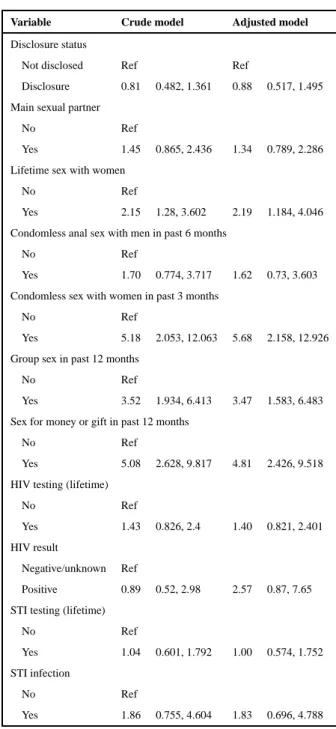
Among the study participants, 58.2% currently have a main sexual partner. We found 414 participants (29.1%) reported lifetime history of vaginal sex with women, and among these participants, about half (44.0%) reported condomless sex with women in the last 6 months. Multivariate analysis demonstrated that TG individuals were more likely to have lifetime history of vaginal sex with women (aOR 2.19, CI 1.18 to 4.05) and recent condomless sex with women (aOR 5.68, CI 2.16 to 12.93), compared with non-TG MSM (table 2).
In our study, 82 participants (5.8%) were involved in commercial sex in the last 12 months, with 21.3% among TG individuals and 5.1% among non-TG MSM. The result of
multivariate logistic regression suggested that TG individuals were more likely to be
involved in commercial sex (aOR 4.80, 95% CI 2.43 to 9.51) in the last 12 months compared with non-TG MSM. In addition, 82 participants (5.8%) participated in group sex.
Multivariate logistic regression showed that TG individuals were significantly more likely to participate in group sex (aOR 3.47, 95% CI 1.58 to 6.48) compared with the other MSM.
The self-reported HIV infection rate among participants was 4.7%, and 703 individuals (49.4%) reported lifetime HIV testing. Our multivariate logistic regression model did not find significant differences in lifetime HIV and STI testing and history between TG individuals and non-TG MSM.
Table 3 presents the differences in self-reported IPV between TG individuals and non-TG MSM. Univariate and multivariate models show that, aside from destruction of property, TG individuals experienced significantly more intimate physical violence and sexual violence from their current partner compared with non-TG MSM. Multivariate analysis suggests TG individuals were at greater risk for having an intimate partner threaten to stop financial or housing support (aOR=5.53, 95% CI 2.27 to 13.33), threaten to hurt individual or someone they cared (aOR=5.85. 95% CI 2.47 to 13.89), threaten to reveal their sexual orientation to others (aOR=3.48, 95% CI 1.40 to 8.70), hit or had objects thrown at by partner (aOR=2.35, 95% CI 1.03 to 5.35). TG individuals also experienced higher rates of lifetime sexual violence (aOR=2.10, 95% CI 1.21 to 3.62). In addition, they were significantly more likely to report sexual violence from their current sexual partner (aOR=5.53, 95% CI 2.092 to 14.706) (demographics of biologically born men who currently identify as women vs transgender are presented in the online supplementary appendix 2).
A
uthor Man
uscr
ipt
A
uthor Man
uscr
ipt
A
uthor Man
uscr
ipt
A
uthor Man
uscr
DISCUSSION
While it has been demonstrated that TG individuals across the world are at an increased risk for HIV infection,2 there is minimal literature exploring sexual health of TG individuals in China. Our study extends the literature by showing that TG individuals in China experience higher rates of IPV and engage in more high-risk sexual behaviours, especially with their female partners.
We found significantly higher rates of IPV among TG individuals compared with non-TG MSM. This is consistent with the global reports on IPV among TG individuals.1718 This includes both lifetime risk of sexual assault as well as physical, verbal and sexual violence from their current partners. IPV has been linked to increased risk of HIV acquisition.19 Those experiencing IPV often cite inequalities and fear of violence as reasons for not negotiating condom use.1920 TG individuals also experience numerous difficulties in seeking help from police after violent experiences,21 thus creating a barrier to leave current abusive partners. In addition, IPV has been shown to be associated with worse HIV outcomes and engagement.22 Of note, there are limited resources for transgendered individuals in China to seek protection or support from abusive relationships. Future studies should confirm, further describe, and investigate potential resources and interventions for this at-risk population.
This study also found that, compared with non-TG MSM, TG individuals reported higher rates of high-risk sex behaviours such as commercial sex and group sex. Commercial sex further increases risk of HIV acquisition among TG individuals.11 A number of studies have cited employment discrimination and lack of other incomes as reasons for increased commercial sex work among TG individuals.2324
TG individuals in China are especially difficult to be recruited throughout China and multiple other low and middle income countries (LMIC). Although our study did not focus exclusively on TG individuals, our online sampling method proved to be an effective way to sample a subset of this population. This study further supports online surveys as a means for sampling TG individuals in China. Future research should also investigate ways to more effectively identifying TG individuals who are not online.
Our study has a number of limitations. First, a small number of TG individuals joined our survey. Our ability to explore a number of variables and adjust for potential confounders was limited by this small sample size. Second, one eligibility criterion was lifetime history of anal sex with men, which might have excluded a number of possible participants. Third, most IPV questions only asked about the current sexual partner, but not about those in their lifetime. This excluded a number of participants from IPV analysis and underestimates total prevalence. We were also unable to estimate the rate of gender reassignment surgery among the TG participants. For those who have had vaginoplasty, the nature of and risk from condomless vaginal sex with women would be different. Finally, all health behaviours and preferences, including HIV testing history, HIV serostatus, IPV, lifetime sex with women and history of condomless sex, were self-reported, which can lead to social desirability bias. However, our survey was self-administered, anonymous and online, which should help to minimise that bias.
A
uthor Man
uscr
ipt
A
uthor Man
uscr
ipt
A
uthor Man
uscr
ipt
A
uthor Man
uscr
CONCLUSION
Our study is consistent with the emerging literature revealing the sexual risk behaviours and high levels of IPV among TG individuals. Future research should further characterise the nature of commercial and transactional sex among TG individuals in China, including types of clients and frequency of events. Support networks for victims of IPV for TG individuals should be expanded. Transgender research in China should be expanded independently from MSM research.
Supplementary Material
Refer to Web version on PubMed Central for supplementary material.
Acknowledgments
Funding This study was supported by the National Institutes of Health (NIAID 1R01AI114310-01), UNC-South
China STD Research Training Center (FIC 1D43TW009532-01) and the UJMT Fogarty Fellowship (5R25TW009340, R25TW0093).
References
1. White JC, TM. Transgender medicine: issue and definations. J Gay Lesbian Med Assoc. 1998; 2:1– 3.
2. Baral SD, Poteat T, Strömdahl S, et al. Worldwide burden of HIV in transgender women: a systematic review and meta-analysis. Lancet Infect Dis. 2013; 13:214–22. [PubMed: 23260128] 3. HIV Epidemiology Program. An epidemiologic profile of HIV and AIDS: Los Angeles County,
2004. LosAngeles County Department of Health Services; 2006.
4. Chow EP, Wilson DP, Zhang J, et al. Human immunodeficiency virus prevalence is increasing among men who have sex with men in China: findings from a review and meta-analysis. Sex Transm Dis. 2011; 38:845–57. [PubMed: 21844741]
5. World Health Organization. Consolidated guidelines on HIV prevention, diagnosis, treatment and care for key populations. 2014.
6. World Health Organization. Prevention and Treatment of HIV and Other Sexually Transmitted Infections Among Men who Have Sex with Men and Transgender People: Recommendations for a Public Health Approach. Geneva, Switzerland: World Health Organization; 2011.
7. National Coalition of Anti-Violence Programs. Lesbian, gay, bisexual, transgender, and queer domestic/intimate partner violence in the United States in 2009. 2011.
8. Buller AM, Devries KM, Howard LM, et al. Associations between intimate partner violence and health among men who have sex with men: a systematic review and meta-analysis. PLoS Med. 2014; 11:e1001609. [PubMed: 24594975]
9. Lombardi EL, Wilchins RA, Priesing D, et al. Gender violence: transgender experiences with violence and discrimination. J Homosex. 2001; 42:89–101. [PubMed: 11991568]
10. Wheeler J, Anfinson K, Valvert D, et al. Is violence associated with increased risk behavior among MSM? Evidence from a population-based survey conducted across nine cities in Central America. Glob Health Action. 2014; 7:24814. [PubMed: 25361722]
11. Operario D, Soma T, Underhill K. Sex work and HIV status among transgender women: systematic review and meta-analysis. J Acquir Immune Defic Syndr. 2008; 48:97–103. [PubMed: 18344875] 12. Best J, Tang W, Zhang Y, et al. Sexual behaviors and HIV/Syphilis testing among transgender
individuals in China: implications for expanding HIV testing services. Sex Transm Dis. 2015; 42:281–5. [PubMed: 25868142]
13. Tucker JD, Muessig KE, Cui R, et al. Organizational characteristics of HIV/syphilis testing services for men who have sex with men in South China: a social entrepreneurship analysis and
A
uthor Man
uscr
ipt
A
uthor Man
uscr
ipt
A
uthor Man
uscr
ipt
A
uthor Man
uscr
implications for creating sustainable service models. BMC Infect Dis. 2014; 14:601. [PubMed: 25422065]
14. Bien CH, Muessig KE, Lee R, et al. HIV and syphilis testing preferences among men who have sex with men in South China: a qualitative analysis to inform sexual health services. PLoS One. 2015; 10:e0124161. [PubMed: 25875336]
15. Eysenbach G. Improving the quality of Web surveys: the Checklist for Reporting Results of Internet E-Surveys (CHERRIES). J Med Internet Res. 2004; 6:e34. [PubMed: 15471760] 16. Dunkle KL, Wong FY, Nehl EJ, et al. Male-on-male intimate partner violence and sexual risk
behaviors among money boys and other men who have sex with men in Shanghai, China. Sex Transm Dis. 2013; 40:362–5. [PubMed: 23588124]
17. National Coalition of Anti-Violence Programs. Lesbian, gay, bisexual, transgender, queer, and HIV-affected intimate partner violence. 2013.
18. Partick DLMTP. The health of lesbian, gay, bisexual, and transgender (LGBT) persons in Massachusetts. Massachusetts Departments of Public Health; 2009.
19. Feldman MB, Díaz RM, Ream GL, et al. Intimate partner violence and HIV sexual risk behavior among Latino gay and bisexual men. J LGBT Health Res. 2008; 3:9–19.
20. Mittal M, Senn TE, Carey MP. Fear of violent consequences and condom use among women attending an STD clinic. Women Health. 2013; 53:795–807. [PubMed: 24215273]
21. Moran LJ, Sharpe AN. Violence, identity and policing: the case of violence against transgender people. Crim Justice. 2004; 4:395–417.
22. Schafer KR, Brant J, Gupta S, et al. Intimate partner violence: a predictor of worse HIV outcomes and engagement in care. AIDS Patient Care STDS. 2012; 26:356–65. [PubMed: 22612519] 23. Grant JM, Mottet LA, Tanis J. , et al. Injustice at every turn: a report of the national transgender
discrimination survey. Washington DC: National Center for Transgender Equality and National Gay and Lesbian Task Force; 2011.
24. Infante C, Sosa-Rubi SG, Cuadra SM. Sex work in Mexico: vulnerability of male, travesti, transgender and transsexual sex workers. Cult Health Sex. 2009; 11:125–37. [PubMed: 19140056]
A
uthor Man
uscr
ipt
A
uthor Man
uscr
ipt
A
uthor Man
uscr
ipt
A
uthor Man
uscr
Key messages
• This study reported higher rates of intimate partner violence among transgender (TG) individuals compared with non-TG MSM in China.
• TG individuals in this study reported higher rates of sexual behaviours associated with HIV transmission compared with non-TG MSM.
• Online sampling methods may be an effective way to sample a subset of TG individuals in China.
A
uthor Man
uscr
ipt
A
uthor Man
uscr
ipt
A
uthor Man
uscr
ipt
A
uthor Man
uscr
A
uthor Man
uscr
ipt
A
uthor Man
uscr
ipt
A
uthor Man
uscr
ipt
A
uthor Man
uscr
ipt
Table 1
Sociodemographic and HIV/STI-related risk behaviours of MSM and TG individuals who attended the online survey conducted in 2014, China (N=1424)
Total (%) Non-TG (%) TG (%)
Gender identity
Male 1363 (95.7)
TG 61 (4.3)
Age (years)
16–20 338 (23.7) 327 (24) 11 (18.0)
21–25 528 (37.1) 504 (37) 24 (39.4)
26–30 283 (19.9) 270 (19.8) 13 (21.3)
>30 275 (19.3) 262 (19.2) 13 (21.3)
Marital status
Single 1194 (83.8) 1147 (84.2) 47 (77.0)
Married 158 (11.1) 147 (10.8) 11 (18.0)
Divorced/widows 72 (5.1) 69 (5.1) 3 (4.9)
Education
High school and/or technical school 369 (25.9) 344 (25.2) 25 (41.0)
College 969 (68.0) 939 (68.9) 30 (49.2)
Graduate degree 86 (6.0) 80 (5.9) 6 (9.8)
Monthly income (US$)
<500 790 (55.5) 760 (55.8) 30 (49.2)
500–810 376 (26.4) 363 (26.6) 13 (21.3)
811–1300 171 (12.0) 157 (11.5) 14 (23.0)
>1300 87 (6.1) 83 (6.1) 4 (6.6)
Residency
Urban 1266 (88.9) 1215 (89.1) 51 (83.6)
Rural 158 (11.1) 148 (10.9) 10 (16.4)
Sexual orientation
Homosexual 1038 (72.9) 997 (73.1) 41 (67.2)
Bisexual 368 (25.8) 349 (25.6) 19 (31.1)
Heterosexual 18 (1.3) 17 (1.2) 1 (1.6)
Current partner’s gender
TG 19 (1.3) 13 (1.0) 6 (9.8)
Male 585 (41.1) 563 (41.3) 22 (36.1)
Female 87 (6.1) 80 (5.9) 7 (11.5)
No current partner 733 (51.5) 707 (51.9) 26 (42.6)
Sexual orientation disclosure
No 538 (37.8) 512 (37.6) 26 (42.6)
Yes 886 (62.2) 851 (62.4) 35 (57.4)
Self-reported HIV status
A
uthor Man
uscr
ipt
A
uthor Man
uscr
ipt
A
uthor Man
uscr
ipt
A
uthor Man
uscr
ipt
Total (%) Non-TG (%) TG (%)
Negative or unknown 1356 (95.2) 1300 (95.4) 56 (91.8)
Vaginal sex with women (lifetime)
Yes 414 (29.1) 386 (28.3) 28 (45.9)
No 1010 (70.9) 977 (71.7) 33 (54.1)
HIV testing (lifetime)
Yes 703 (49.4) 678 (49.7) 25 (41.0)
No or unknown 721 (50.6) 685 (50.3) 36 (59.0)
STI testing (lifetime)
Yes 456 (32.0) 436 (32.0) 20 (32.8)
No or unknown 968 (68.0) 927 (68.0) 41 (67.2)
Condomless anal sex with men (past 6 months)
Yes 421 (29.6) 398 (29.2) 23 (37.7)
No 1003 (70.4) 965 (70.8) 38 (62.3)
Condomless vaginal sex with women (past 6 months)
Yes 182 (44.0) 160 (41.5) 22 (78.6)
No 232 (56.0) 226 (58.5) 6 (21.4)
Intimate partner violence
Yes 294 (20.7) 740 (54.3) 40 (65.6)
No 1130 (79.3) 623 (45.7) 21 (34.4)
Group sex
Yes 141 (9.9) 125 (9.2) 16 (26.2)
No 1283 (90.1) 1238 (90.8) 45 (73.8)
Commercial sex
Yes 82 (5.8) 69 (5.1) 13 (21.3)
No 1342 (94.2) 1294 (94.9) 48 (78.7)
A
uthor Man
uscr
ipt
A
uthor Man
uscr
ipt
A
uthor Man
uscr
ipt
A
uthor Man
uscr
ipt
Table 2
Correlates of self-identification as female or transgender (N=1424)
Variable Crude model Adjusted model
Disclosure status
Not disclosed Ref Ref
Disclosure 0.81 0.482, 1.361 0.88 0.517, 1.495
Main sexual partner
No Ref
Yes 1.45 0.865, 2.436 1.34 0.789, 2.286
Lifetime sex with women
No Ref
Yes 2.15 1.28, 3.602 2.19 1.184, 4.046
Condomless anal sex with men in past 6 months
No Ref
Yes 1.70 0.774, 3.717 1.62 0.73, 3.603
Condomless sex with women in past 3 months
No Ref
Yes 5.18 2.053, 12.063 5.68 2.158, 12.926
Group sex in past 12 months
No Ref
Yes 3.52 1.934, 6.413 3.47 1.583, 6.483
Sex for money or gift in past 12 months
No Ref
Yes 5.08 2.628, 9.817 4.81 2.426, 9.518
HIV testing (lifetime)
No Ref
Yes 1.43 0.826, 2.4 1.40 0.821, 2.401
HIV result
Negative/unknown Ref
Positive 0.89 0.52, 2.98 2.57 0.87, 7.65
STI testing (lifetime)
No Ref
Yes 1.04 0.601, 1.792 1.00 0.574, 1.752
STI infection
No Ref
Yes 1.86 0.755, 4.604 1.83 0.696, 4.788
*
Adjusted model was adjusted for age (continuous), residency (urban, rural), income (3000<, 3000–800, >8000), education level (high school or below, college, graduated) and marital status (never married/married/divorced or widowed).
A
uthor Man
uscr
ipt
A
uthor Man
uscr
ipt
A
uthor Man
uscr
ipt
A
uthor Man
uscr
ipt
Table 3
Univariate and multivariate analysis of intimate partner violence and forced sex: TG individuals versus non-TG MSM who attended the online survey conducted in 2014, China (N=1424)
Non-TG MSM (%) TG (%) OR (95% CI) Adjusted OR (95% CI)
Threatened to stop helping with money or housing*
Yes 6.7 27.6 5.291 (2.212 to 12.658) 5.525 (2.273 to 13.333)
No 93.3 72.4
Hit or thrown objects at you*
Yes 16 31 2.353 (1.042 to 5.319) 2.353 (1.034 to 5.348)
No 84 69
Threatened to harm you or someone you care for*
Yes 7.7 31 5.405 (2.331 to 12.5) 5.848 (2.469 to 13.889)
No 92.3 69
Destroyed your property*
Yes 18.8 17.2 0.898 (0.336 to 2.404) 0.945 (0.349 to 2.558)
No 81.2 82.8
Threatened to reveal sexual identity*
Yes 8.3 24.1 3.497 (1.425 to 8.547) 3.484 (1.397 to 8.696)
No 91.7 75.9
Forced sex
Yes 20.1 34.4 2.088 (1.212 to 3.597) 2.096 (1.211 to 3.623)
No 79.9 65.6
First sexual experience, non-consensual
Yes 41.8 52.4 1.534 (0.631 to 3.731) 1.449 (0.580 to 3.623)
No 58.2 47.6
Non-consensual sex with current partner*
Yes 23.1 61.9 5.405 (2.151 to 13.699) 5.525 (2.092 to 14.706)
No 76.9 38.1
*
Refers to current sexual partner.