MEASURING RELIGIOUS IDENTITY:
HOW RELIGIOUS CENTRALITY AND IDENTITY SALIENCE RELATE TO ADOLESCENT BEHAVIOR
Sally Morris
A thesis submitted to the faculty of the University of North Carolina at Chapel Hill in partial fulfillment of the requirements for the degree of Masters in the Department of Sociology.
Chapel Hill 2013
Approved By:
Lisa Pearce
Andrew Perrin
ii ABSTRACT
SALLY MORRIS: Measuring Religious Identity: How Religious Centrality and Identity Salience Relate to Adolescent Behavior
(Under the direction of Lisa Pearce)
Sociologists of religion and adolescence often employ questions about how important
religion is to an individual (religious centrality) in order to indirectly measure the likelihood that
an individual will act on a religious identity (religious identity salience). While measures of
religious centrality are seemingly indirect measures of religious identity salience, identity
theorists have shown that as components of identity, centrality and salience are conceptually
and empirically distinct. Utilizing the National Study of Youth and Religion, I take this research in
identity theory and place it in a religious context to explore how these two components of
religious identity are empirically and substantively related, and how their relationship affects
our assessment of the association between religious identity and behavior. Findings include: 1)
measures of religious centrality are not sufficient as indirect measures of religious identity
salience; 2) religious identity salience only partially mediates the relationship between religious
centrality and behavior, contrary to popular assumption; and 3) these two components of
religious identity interact such that adolescents who have both high levels of religious centrality
and high levels of religious identity salience have significantly different likelihoods of
participating in certain behaviors than adolescents who have high levels of only one or the
iii
TABLE OF CONTENTS
LIST OF TABLES iv
Chapter
I. INTRODUCTION 1
II. LITERATURE REVIEW 5
Defining Centrality and Identity Salience 5
Centrality and Identity Salience: Interchangeable or Distinct? 6
Combinations of Centrality and Salience 9
Summary 11
Research Questions 12
III. DATA AND SAMPLE 14
Measures 15
Analytic Strategy 19
IV. RESULTS 25
V. DISCUSSION 34
VI. CONCLUSION 42
APPENDIX 45
iv LIST OF TABLES
Table
1. Crosstab of Religious Centrality and Religious Identity Salience 25
2. Logit Regression Coefficients on Behavior 27
3. Multinomial Logistic Regression Coefficients on Behavior 28
4. Statistical Tests Comparing Coefficient Sizes within Model 3 and
between M1R and Model 3 30
5. Predicted Probabilities for Likelihood of Engaging in Behavior for Respondents with Low Religious Centrality (LC) and High Religious
Centrality (HC) 31
6. Logit and Multinomial Logit Regression Coefficients on Behavior by Religious
Centrality-Religious Identity Salience Category 32
7. Predicted Probabilities for Likelihood of Engaging in Behavior by Religious
Centrality-Religious Identity Salience Category 33
8. Descriptive Statistics of Key Variables 45
I. Introduction
“I am often confronted by the necessity of standing by one of my empirical selves and
relinquishing the rest. Not that I would not, if I could, be both handsome and fat and
well-dressed, and a great athlete, and make a million a year, be a wit, a bon-vivant, and lady-killer, as
well as a philosopher…But the thing is simply impossible….So the seeker of his truest, strongest,
deepest self must review this list carefully, and pick out the one on which to stake his salvation.”
–William James, The Principles of Psychology
While being a “philosopher” may not be in the top ten of most desirable adolescent
identities (though being a “lady killer” might be), having a religious identity features prominently
in American adolescent life. In comparison to other similarly developed countries, the U.S. is
fairly religious, with 97% of adolescents aged 13 to 17 claiming they believe in God and 41% of
them reporting they attend religious services weekly or more (Smith and Denton 2005).
Sociologists of religion and adolescence have long sought to link religious belief to
adolescent behavioral outcomes. Religious identity is thought to be connected to behavior
through the moral directives provided by religion; for teens who consider religion important in
their lives, religion can act as a moral compass upon which they can rely when navigating
adolescence (Smith 2003). Much of the past work connecting religious identity to behavior has
utilized large-scale survey datasets to measure the importance of religious identity. This work
typically operationalizes the strength of religious identity through a general importance
question, for example: “How important is religion in your everyday life?” These types of
2
adolescent such that he would “stake his salvation” (look to religion when making behavioral
decisions) on it.
Approaching this work from the perspective of identity theory, general importance
questions are a measure of an identity’s psychological centrality, or how much an individual
values an identity as part of his sense of self. While seemingly an indirect measure of how likely
an individual is to act on an identity, identity theorists conceptually differentiate how much
individuals value an identity (psychological centrality) from how likely they are to act on it
(identity salience). Some scholars in religious research have made this distinction, measuring
and discussing religious identity salience using behavioral reports as suggested by identity
theorists (Stryker and Serpe 1982; Wimberly 1989). Yet various factors, including the difficulty of
asking identity salience questions in large surveys, have led to the primary use of psychological
centrality measures to assess the strength of religious identity, and consequently, the
application of identity salience rhetoric to theories of how the centrality of religious identity is
related to behavior.
A study by Stryker and Serpe (1994) compared these two measures empirically. They
showed that for some identities, centrality and identity salience measure the same underlying
conceptions associated with the strength of an identity, while for other identities these
measures have distinct relationships with behavior. Unable to draw conclusions about for what
identities centrality and identity salience are distinct measures, they caution against using one in
place of the other.
Stryker and Serpe’s (1994) caution against using only centrality or identity salience as a
measure of identity strength has not been incorporated into the realm of religious research,
even though much of the work on the relationship between religion and behavior utilizes only
3
longitudinal dataset, the National Study of Youth and Religion (NSYR), to systematically explore
the relationship between centrality and identity salience as measures of the strength of religious
identity in influencing behavior. The NSYR is unique in that it includes measures of both religious
centrality and religious identity salience; most large-scale datasets used by religious researchers
only include measures of religious centrality.
This research will enable me to answer important questions such as: 1) do we misspecify
the relationship between religious centrality and behavior in not accounting for religious
identity salience in models which only look at religious centrality in relation to behavior,and 2)
are religious centrality and religious identity salience so distinct that adolescents who have
different combinations of them have measurably different behavioral outcomes? Answers to
these and other questions will advance theoretical and empirical understanding of exactly how
religious identity is related to behavioral outcomes. In doing so, this research also will contribute
to the burgeoning work on culture and cognition, which explores how cultural elements, such as
religion, influence behavior through cognitive mechanisms like identity.
I begin this paper by reviewing the general difference between centrality and identity
salience in the identity theory tradition, giving examples of how they can be used to measure
the strength of religious identity. I then explain how scholars came to rely solely on religious
centrality to measure the strength of religious identity and why doing so is potentially
problematic. Next, I illustrate how religious centrality and religious identity salience could relate
in different ways and provide theoretical reasons for why people might have different
combinations of the two measures than might be expected. Finally, I list a series of research
questions that I will use to explore how religious centrality and religious identity salience relate
4
discussing the impact the relationship of these two concepts has on our understanding of the
II. Literature Review
Defining Centrality and Identity Salience
Identity theory portrays the self as an organized whole consisting of individual identities,
of which there can be as many as the number of distinct roles that a person holds in a network
of social relationships (Stryker 1968). For example, an individual could hold the identities of
mother, CEO, a friend, and a religious person. There are two conceptualizations of how
identities are organized hierarchically within the self. The first, a theory of psychological
centrality, is based on the importance attributed to each identity by an individual. The second, a
theory of identity salience, is based on the likelihood that an identity will be enacted in or across
various social situations, which is not necessarily dependent on how much importance the
individual attributes to an identity.
Theories of psychological centrality stem from the work of McCall and Simmons (1978)
and Rosenberg (1979). Centrality, also known in their work and other’s work as importance, is
how important an individual feels an identity is to his/her sense of self. In this conceptualization,
identities are organized based on how much an individual prizes an identity, which itself is a
function of the individual’s interests and subjective values (Ervin and Stryker 2001). Measures of
centrality are evaluative in nature, asking respondents to reflect on their feelings about their
various identities (Stryker and Serpe 1994). Thornton and Camburn (1989:644) provide a classic
example of a question that measures centrality as it pertains to a religious identity (hereafter
referred to as religious centrality): "Quite apart from attending religious services, how important
6
more important an individual sees a religious identity, the more likely that identity, and the
moral norms associated with prevailing religious beliefs, is to be associated with behavior.
In contrast, identity salience originates from the conceptualization that identities are
arranged based on their likelihood of being enacted in or across various situations. Stryker
(1968) originally defined identity salience as the readiness or propensity to act on an identity.
This propensity is a function of the individual’s commitment or strength of ties to the social
relationships from which the identity emerged (Stryker and Burke 2000). Unlike in theories of
centrality where an identity’s hierarchical location is determined by a self-judgment of
importance, identity salience is not always tied to importance, and individuals are not
necessarily aware of how salient an identity might be (Stryker and Serpe 1994). As such,
measures of identity salience are not evaluative in nature, but rather are based on “behavioral
reports” (Stryker and Serpe 1994). For example, Stryker and Serpe (1982:210) measure identity
salience in the following way: “Suppose it were a weekend and you had a choice to do the
following things (go to a religious service or activity, go on an outing with/visit your children,
catch up on work, spend time with your husband or wife, none of these). Which would you most
likely do? Next? Next?” Each behavioral option is tied to an underlying identity, and the measure
of identity salience is how highly the respondent ranks each option in comparison to the others
presented. In this question, a very salient religious identity would be indicated if the respondent
selected the religious option as their first choice.
Centrality and Identity Salience: Interchangeable or Distinct?
Historically, religion scholars utilized both measures of religious centrality (Bahr, Bartel,
and Chadwick 1971; Roof and Perkins 1975; Hoge and Zulueta 1985) and measures of religious
identity salience (Stryker and Serpe 1982; Wimberly 1989). However, those of identity salience
7
generally involve asking respondents to report behavior across a number of situations and so
require more time to implement than the single questions that are used to measure religious
centrality. Due to the amount of time and space they take up in surveys, identity salience
measures largely have disappeared from studies examining the relationships between religious
identity and behavior. Religious centrality became the standard way to measure religious
identity and account for the internalization of religious beliefs (Smith 2003). While many studies
rightly discuss religious centrality as the importance of religion to an individual, some apply the
label and rhetoric of identity salience (likelihood of acting on religious identity) to centrality
measures (Bahr et al. 1971; Gibbs, Mueller, and Wood 1973; Hoge and Zueleta 1985; Regnerus
and Smith 2005; Longest and Vaisey 2008). For example, Longest and Vaisey (2008:691) define
religious salience as the “likelihood that an adolescent uses religion in making decisions,” but
they measure it using a combination of religious centrality and religious identity salience
measures, thus conceptually and empirically confounding the two concepts.
Using religious centrality to indirectly measure the likelihood of acting in accordance
with religious identity may not seem like a significant issue, for scholars believe that one
explanation for the link between religious centrality and behavior is religious identity salience.
High religious centrality is theorized to be closely related to a high likelihood of acting on a
religious identity (see Gibbs et al. 1973; Hoge and Zueleta 1985; Wimberly 1989; Stryker and
Burke 2000). The reasoning behind this theory is relatively basic: individuals seek to minimize
cognitive dissonance, the perceived distance between what identities they hold and what
identities they enact. Distance between “self-concept and actual behavior should produce an
inherently painful situation, disrupting the Gestalt of the self” (Wimberly 1989:131), meaning
8
should have a greater likelihood of acting in accordance with prevailing religious beliefs (have
high religious identity salience) than someone who doesn’t see herself as religious.
However, Stryker and Serpe (1994) suggest otherwise in a seminal piece investigating
the relationship between centrality and identity salience with respect to time spent in certain
roles. They found that an individual’s judgment of how important an identity is (centrality)
relates to the likelihood that identity will be enacted (identity salience) for some roles, while for
other roles, the effects of centrality and identity salience on time spent in the role were quite
distinct. More importantly, Stryker and Serpe (1994:31) found that for the roles in which
centrality and identity salience were highly correlated, statistical models that incorporated only
one of the variables “are misspecified, and estimates of the effect of either [variable]…may be
quite inaccurate.” Unable to make any conclusions about for what behaviors models using only
centrality or identity salience might be misspecified, they conclude their work with a caution
against using only one measure or the other when looking at the relationship between identity
and behavior.
Stryker and Serpe’s (1994) study did not look at centrality and identity salience in
relation to religious identity. Thus, we do not know whether using religious centrality to
indirectly account for the likelihood of enacting religious identity is an issue. For some
behaviors, it could be that questions of religious centrality actually do measure religious identity
salience, the likelihood of acting on a religious identity. However, it is also possible that
measures of religious centrality and religious identity salience pick up on different parts of what
it means to hold a religious identity, meaning studies that use only religious centrality in their
9 Combinations of Centrality and Salience
As stated earlier, centrality is more a function of an individual’s interests and subjective
values, whereas identity salience is a function of an individual’s commitment to the social
relationships from which the identity emerged. Dichotomizing religious centrality and religious
identity salience into categories of HIGH and LOW can help us understand theoretically exactly
how religious centrality and religious identity salience could relate (Ervin and Stryker 2001).
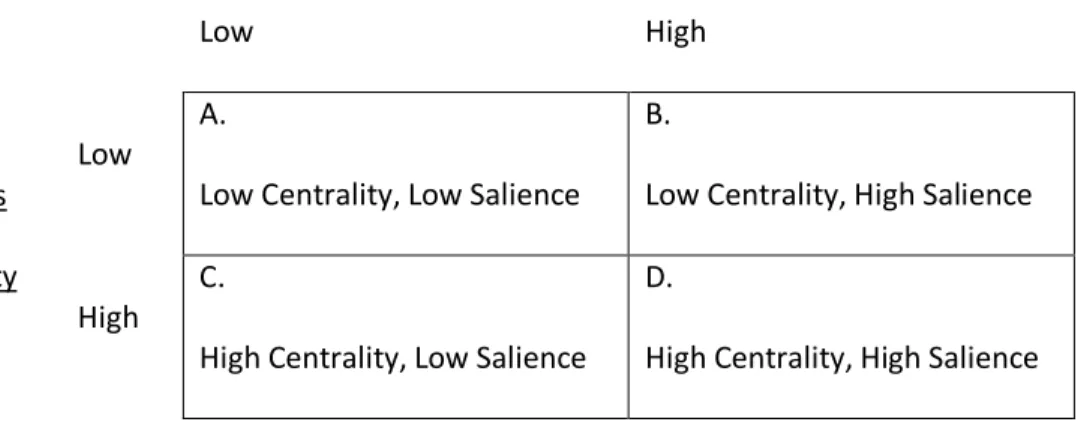
Figure 1 illustrates the categories that are produced when religious centrality and religious
identity salience are split into HIGH and LOW and compared in a table:
Graphical Illustration of the Categories Created by Crossing Religious Centrality and Religious Identity Salience
Religious Identity Salience
Low High
Religious
Centrality
Low A.
Low Centrality, Low Salience B.
Low Centrality, High Salience
High C.
High Centrality, Low Salience D.
High Centrality, High Salience
Cells A and D make logical sense in light of the current literature on religious identity
that operates as if religious centrality and religious identity salience are highly correlated. For
example, Thornton and Camburn (1989:642) have an often cited study of religious participation
and adolescent sexual behavior that clearly illustrates how scholars connect these two concepts.
They write that “individuals who…value religion in their lives are probably more likely than
others to develop sexual attitudes and behavior that are consistent with religious teachings.” In
10
is to act on it (Cell A). The more importance an individual places on her religious identity, the
more likely she is to act on it (Cell D).
Cells B and C, should they exist, are the ones that could cause issues should religious
centrality be used as a measure of religious identity salience or vice versa. Why would someone
who doesn’t value religion be very likely to act upon a religious identity (Cell B), and conversely,
why would someone who does value religion highly be not likely to act upon a religious identity
(Cell C)? While I do not attempt to answer these questions in this paper, I do posit potential
reasons why people may fall into Cells B or C to give theoretical backbone to the importance of
investigating the relationship between religious centrality and religious identity salience. What
reasons are there to think that religious centrality and religious identity salience might not be
positively correlated?
First, Ervin and Stryker (2001) discuss the structural constraints that keep people
enacting certain identities that they dislike. Remember that an identity’s salience is a function of
the commitment to the social relationships from which that identity emerges. Often people will
continue to enact a behavior consonant with an identity they do not value because of
obligations to people with whom that identity is connected. For example, one can picture an
adolescent who doesn’t value her religious identity acting “religiously” (e.g. avoiding alcohol,
practicing abstinence), because of her ties to those who support her religious identity (e.g.
parents, religious friends). This adolescent would fall into Cell B.
Alternatively, Cell C would represent an adolescent who highly values her religious
identity but is not likely to act in accordance with the moral norms associated with that identity.
One potential reason for this disconnect is that the adolescent doesn’t see religion as a primary
moral authority. Rather, the adolescent looks to other forms of moral authority that may offer
11
that source of moral authority is highly related to behavioral outcomes (Bellah et al. 1989;
Hunter 2000; Vaisey 2009) but that adolescence is a period during which teens are awash in
often competing moral frameworks (Smith 2003). As stated earlier, identity theory holds that
identities are organized hierarchically within the self. The possibility exists that a religious
identity may be seen as very important to an adolescent, but that another identity with a
competing moral framework is more important. When these two identities intersect, the
alternate identity either wins out over the religious identity, or it somehow mediates the effect
of the religious identity such that the behavioral outcome isn’t fully consonant with the
prevailing religious moral order (Read and Eagle 2011).
These reasons are just a couple of many that could explain why measuring the
behavioral influence of religious identity using only religious centrality might be problematic. Yet
in addition to statistical models that use only one or the other being misspecified, there is
another reason why examining the relationship between religious centrality and religious
identity salience is fruitful. As stated previously, religious centrality often is used as an indirect
measure of religious identity salience, because importance of religious identity logically seems
to connect to the likelihood of acting on that identity. Stated differently, it would seem that
religious identity salience mediates the relationship between religious centrality and behavior.
This oft-used theory can be tested to advance understanding of the process by which placing
high importance on an identity is associated with certain behavioral outcomes.
Summary
In this paper, I place work from identity theory on psychological centrality and identity
salience into a religious context to explore the degree to which religious centrality and religious
identity salience are empirically related and how their association affects scholars’ theoretical
12
I posit a series of five research questions designed to examine the relationship between
these two concepts across four different behaviors. Testing this relationship across a variety of
behaviors is necessary to understand how the relationship changes based upon situational
context. Identities are cognitive schemas that serve “as frameworks for interpreting
experience” and “increase sensitivity and receptivity to certain cues for behavior” (Stryker and
Burke 2000:286). Consequently, the relationship between religious centrality and religious
identity salience (and their relationship to behavior) might change depending upon the behavior
in question and what identities are cued in different individuals by the possibility of engaging in
that behavior.
Research Questions
RQ1 As demonstrated earlier, religious centrality and religious identity salience are
conceptually distinct. This conceptual distinction, however, does not guarantee empirical
distinction. What is the bivariate relationship between these two variables? Specifically, do
people who have high religious centrality typically also have high religious identity salience?
RQ2 Considering that religious centrality and religious identity salience may measure the
same underlying conception of what it means to hold a religious identity, do they have
empirically distinct relationships with behavior? Or, is accounting for one of these concepts in a
statistical model the same as accounting for both?
RQ3 Following Question 2, scholars rely on religious centrality as an indirect measure of
religious identity salience because logically, it seems the two should be highly correlated such
that religious centrality works through high religious identity salience in influencing behavior. Is
the relationship between religious centrality and behavior at least partially mediated by
13
RQ4 Has not disentangling conceptually and empirically religious centrality from
religious identity salience impacted the assessment by religious scholars of the relationship
between religious centrality and various behaviors? More specifically, have scholars over or
underestimated the substantive association between religious centrality and behavior in not
accounting for religious identity salience in statistical models?
RQ5 Does the likelihood of participating in various behaviors differ between adolescents
who have high religious centrality but low religious identity salience (Cell C in Fig. 1) and those
who have high religious centrality and high religious identity salience (Cell D in Fig.1)? In other
words, are adolescents who score high on both categories, more, the same, or less likely to
engage in certain behaviors than those who have high religious centrality but low religious
III. Data and Sample
The data for this study come from the National Study of Youth and Religion (NSYR), a
nationally representative, longitudinal panel survey, the purpose of which was to study the
religious lives of U.S. teenagers as they grew into young adulthood. In this paper, I utilize the
first two waves of survey data, during which the respondents were still in adolescence (the
oldest respondent in Wave 2 was 20).
The beginning, Wave 1 sample was designed to be representative of U.S. households in
which at least one teenager between the ages of 13 and 17 had lived for at least six months. The
sample was created through random-digit-dialing (RDD), using telephone numbers
representative of all household telephones in the fifty states. The random-digit-dial method was
employed to: 1) allow a number of religious questions to be asked that would not have been
allowed in other sampling settings (e.g. schools) and 2) provide greater anonymity as compared
to in-person interviews, likely decreasing the social desirability response bias on sensitive
questions in regards to subjects like sexual behavior and alcohol use. In addition, interviewers
asked to conduct the survey with the teenager in the household who had the most recent
birthday to further randomize the teens selected. For more information on how the NSYR
compares to other nationally representative datasets, see Smith and Denton (2005).
Wave 1 was conducted from July 2002 to April 2003 and Wave 2 from June 2005
through November 2005. Of the original Wave 1 sample, 78.6% of respondents completed Wave
2. The sample size used in this research is 2,292, 68% of the original Wave 1 sample. This
reduced sample size reflects adolescents who participated in both Waves 1 and 2 of the NSYR,
15 Measures
Independent Variables
Religious centrality and religious identity salience. As this paper explores the empirical
relationship between religious centrality and religious identity salience and the effects of this
relationship on adolescent behavior, the operationalization of these concepts as variables is
crucial.
The NSYR includes a standard measure of religious centrality: "How important or
unimportant is religious faith in shaping how you live your daily life?"1 Answers were: not
important at all, not very important, somewhat important, very important, and extremely
important. I collapsed these five categories into two, creating a dichotomous variable that
represents respondents have who have “high” religious centrality and those who have “low”
religious centrality. Respondents who answered very or extremely important were coded as 1
for high centrality, and those who answered any of the other three options were coded as 0 for
low centrality.
I measure religious identity salience using a question that read, "If you were unsure of
what was right or wrong in a particular situation, how would you decide what to do?" Responses
were: Do what would make you feel happy, Do what would help you get ahead, Follow the
advice of a parent or teacher or other adult you respect, or Do what you think God or the
scripture tells you is right. Similar to religious centrality, I recoded this variable into a high-low
measure of religious identity salience. Do what would make you feel happy, Do what would help
you get ahead, and Follow the advice of a parent or teacher or other adult you respect were
collapsed into one category and coded as 0, representing low religious identity salience. Do
what you think God or scripture tells you is right is coded as 1, representing high religious
16
Some readers might question the difference between these two variables, asking why
one is considered a measure of religious centrality while the other a measure of religious
identity salience. On the surface, the difference between them is subtle. However, the cognitive
tasks they pose to respondents are different in a crucial way. The centrality measure asks
respondents to place a single concept, religion, on a scale of importance. On the other hand, the
salience measure is more of a ranking question, asking respondents to weigh the importance of
religion against other competing systems of moral authority. In selecting the religious option (Do
what you think God or scripture tells you is right), the respondent indicates that religion is not
just important, but more important that any alternatives presented.2 Again, as identity salience
is the readiness or propensity to act on an identity in a specific situation(Ervin and Stryker
2001:34), in choosing religion as the moral authority to which they would look in a situation in
which they are unsure of what to do, adolescents were indicating their propensity to act on their
identity as a religious person by consulting religious authority.
Religious controls. Because other dimensions of religiosity such as religious service
attendance and religious affiliation are related to religious centrality and identity salience, I
control for these other dimensions to try to better isolate features of religious centrality and
identity salience which are independent of public religious involvement and specific religious
ideologies. Because I am interested in controlling for how attendance and affiliation at Wave 1
relate to subsequent behaviors at Wave 2, I use measures of religious service attendance and
affiliation from Wave 1.
I measure rate of religious service attendance by creating a variable that is based on two
questions. Respondents who said they attended religious services more than once or twice a
year, not “counting weddings, baptisms, and funerals,” were asked how often they attended
17
times a year, once a month, 2-3 times a month, once a week, or more than once a week.
Respondents who said they never attended religious services were coded as less than once or
twice a year. I then collapsed these responses and created the final variable with categories of
many times a year or less, between once and 2-3 times a month, and once a week or more.
I measure religious affiliation with a variable created by the principal investigators of the
NSYR. Wanting to create interpretable religion variables, the NSYR PIs condensed the 55
possible affiliations into nine major religious types similar to the categorizing model used in
Steensland et al. (2000). The nine categories are: Conservative Protestant, Mainline Protestant,
Black Protestant, Catholic, Jew, Latter Day Saints, No religion, Other religion, and Indeterminate.
Demographic controls. A number of demographic variables from Wave 1 are included in
each model following Regnerus and Smith’s (2005) assessment of spurious factors that could be
inflating estimates of the effect of religiosity on various outcomes. Age and race are
self-reported variables, while gender was obtained from the parent interviewed. Age categories
range from 13 to 17 years old in the first wave to 16 to 20 years old in the second wave. Race is
accounted for using a recoded variable that collapses the 15 categories of the original question
into 4 categories: White, Black, Hispanic, and Other. Gender is a dichotomous variable; 0 equals
male and 1 equals female.
I include three family measures. The first is a measure of parent education: 1 signifies
less than high school, 2 is some college, 3 is a college degree, and 4 is a graduate or professional
degree. The highest degree attained by the mother or the father was used to code the
respondent. The second family measure is whether or not the family is intact; in other words, if
the respondent has experienced the breakup of a marriage or marriage-like relationship of
adults in the household where the respondent was residing at the time. An intact family is coded
18
household income before taxes, with categories as follows: less than 40,000, from 40,000 to
60,000, from 60,000 to 80,000, and more than 80,000.
Finally, a variable is included to account for effects of living in the U.S. south. This
variable was created using data from Wave 1. Respondents not living in the south were coded as
0, and those living in the south were coded as 1.
Dependent Variables: Adolescent Behaviors
I examine the intersections between religious centrality and religious identity salience in
relation to four adolescent behaviors: 1) having casual sex, 2) frequency of drinking alcohol, 3)
frequency of formal volunteering, and 4) donating money.
I assess respondents' sexual behavior through a constructed dichotomous variable of
whether or not the respondent had ever had sex in a casual relationship. While sexual behavior
is typically measured through whether or not the respondent had ever had sexual intercourse, I
could not use it as a measure in this analysis and still keep in all of the respondents who already
had had sex at Wave 1. In using whether or not a respondent had ever had sex in a casual
relationship, I allow respondents who already had had sex at Wave 1 to remain in the sample. I
coded respondents who reported having ever had sex in a casual relationship as 1 and those
who had never had sex or who had had sex in a serious relationship are coded as 0.
In regards to frequency of drinking alcohol, respondents were asked how often, if at all,
they ever drank alcohol, not including at religious services. The original response categories
were almost every day, a few times a week, about once a week, a few times a month, about
once a month, a few times a year, and never. These answer choices were condensed into three
categories: never, between a few times a year and about once a month, and a few times a
19
I assess volunteering using a question that asked how often a teen has done organized
volunteer work or community service in the last year. Responses were never, a few times,
occasionally, and regularly. I condensed these four categories into three: never, a few times, and
occasionally/regularly.
To measure whether or not a respondent had ever donated money, respondents were
asked a yes/no question of whether or not they had given twenty dollars or more of their own
money to any organization or cause in the past year. I coded no as 0 and yes as 1.
Analytic Strategy
First, to assess the bivariate relationship between religious centrality and religious
identity salience (RQ1), I present a crosstab of the two variables.
I answer RQs 2, 3, and 4 by estimating three logistic or multinomial logistic regressions
for four different adolescent behaviors, respectively. All models control for the religious and
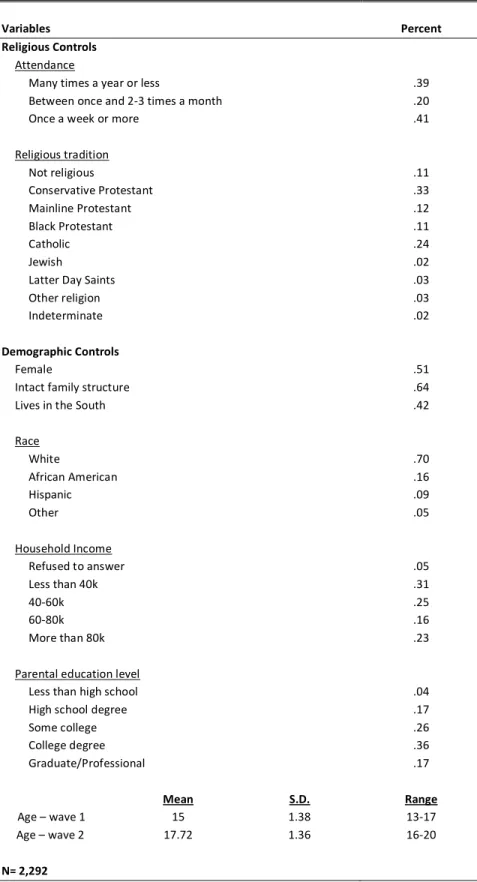
demographic control variables described above, of which the descriptive statistics can be found
in Table 9 in the Appendix. I estimate these models with lagged dependent variables using
Waves 1 and 2 of the NSYR. I incorporate lagged dependent variables to address some of the
potential causality issues between religious centrality and religious identity salience and
adolescent behavior.3 I utilize logistic regression to analyze having casual sex and donating
money as dependent variables; I likewise employ multinomial regression to analyze drinking
alcohol and volunteering. I use multinomial logistic regression for these two behaviors because a
test of the proportional odds assumption failed using a regular ordinal logistic model.
Models 1 and 2 in Tables 2 and 3 show the relationships between religious centrality
(Model 1) and religious identity salience (Model 2) with each of the four behaviors, net of the
other religious and demographic control variables. These models give an initial picture of how
20
representative of previous studies that did not have both variables to utilize in analysis. In
addition, Models 1 and 2 set up Model 3 in Tables 2 and 3, in which I put both variables in the
logistic or multinomial logistic regression together to assess their relationship to each other and
to each behavior in question.
To assess RQ2, I will look to the coefficient size and statistical significance of religious
centrality and religious identity salience in Model 3. Should religious centrality and religious
identity salience have distinct empirical effects on behavior, both coefficients should be
statistically significant. In addition, I run a Wald test to determine if the difference between the
two variables in Model 3 is statistically significant.
In answering RQ3, I utilize the KHB-method for comparing logistic regression coefficients
between same-sample nested models (Karlson, Holm, and Breen 2012). Had religious centrality
and religious identity salience as variables lent themselves to linear models, assessing the
confounding influence of religious identity salience on the relationship between religious
centrality and the outcome of interest would be rather simple. I could compare the coefficient
sizes of religious centrality from a model where centrality was included by itself (a reduced
model) to one where centrality and identity salience were included together (a full model); the
change in the centrality coefficient size from the reduced to full model could be attributed to
the theorized indirect effect of centrality through identity salience on the outcome of interest.
However, in logistic and multinomial logistic regression models, the error variance of the model
overall is fixed. As a result, coefficients of the same variable across nested models are affected
not just by the added independent variables, but by the error variance constraint as well. This
means the coefficients cannot be compared across nested models without taking the constraint
into account. Rescaling of coefficients is required to solve this problem. Karlson et al. (2012:42)
21
probit model will alter the coefficient of x whether or not z is correlated with x…Consequently,
logit or probit coefficients from different nested models are not measured on the same scale
and are therefore not directly comparable.”
Applied to RQ3, this means that the change in coefficient size of religious centrality from
a reduced to full model is the result of both the theorized confounding influence of identity
salience and the need for rescaling of the full model. Using the Karlson, Holm, and Breen (KHB)
method, I address this problem by regressing identity salience on centrality, creating an identity
salience variable of the residuals from this regression, and then substituting this new
residualized identity salience variable into the full model to create a residualized full model,
which I call Model 1 Residualized (M1R). Using a residualized version of identity salience in the
full model leaves a centrality coefficient that is independent of identity salience and thus
imitates the centrality coefficient in the reduced model where identity salience was not present.
The difference between the two centrality coefficients in the full model (Model 3) and the
residualized full model (M1R) can be directly compared in terms of their size and tested for
statistical significance. If religious identity salience does mediate the relationship between
religious centrality and behavior, the religious centrality coefficient size in M1R should decrease
by a statistically significant amount with the addition of religious identity salience in Model 3.
For more information on the formula used to conduct this test and this method overall, see
Karlson et al. (2012).
I will answer RQ4 by comparing changes of predicted probability of behavior from low to
high religious centrality from Model 1 Residualized (M1R) to Model 3 in Tables 2 and 3. If not
empirically disentangling religious centrality from religious identity salience has influenced the
22
probabilities from low to high religious centrality should change substantially from M1R to
Model 3.
Finally, I answer RQ5 by creating dummy variables representing the four categories
created when crossing the dichotomous variables of religious centrality and religious identity
salience: Low centrality – Low salience (LC – LS), Low centrality – High salience (LC – HS), High
centrality – Low salience (HC – LS), and High centrality – High salience (HC – HS). I run a logistic
or multinomial logistic regression model (Model 4) on each behavior using these variables as the
primary predictors.4 Omitting the HC – LS category as the reference category will allow me to
see the joint effect on behavior of having both high centrality and high religious identity salience
in comparison to having high centrality but low religious identity salience. If the behavioral
outcomes of the two groups are substantially different, the coefficient for the HC – HS variable
should be statistically significant. Additionally, I run a joint test of significance on Model 4 to
confirm that the overall interaction between these three variables, representing the interaction
Total 2,292 100.00
Extremely important 466 20.33 100.00 Very important 705 30.76 79.67 Somewhat important 708 30.89 48.91 Not very important 258 11.26 18.02 Not important at all 155 6.76 6.76 - w1 Freq. Percent Cum. importance of faith
daily life - NOTES
1
More evidence that this measure is standard and comparable to other measures is its
relationship to a similar question asked in another large, longitudinal study of adolescents, the
National Longitudinal Study of Adolescent Health. This study measures religious centrality by
asking, “How important is religion to you: very important, fairly important, fairly unimportant, or
not important at all.” Roughly 50% of respondents reported that religion was very important to
them, with the other 50% citing religion as fairly important to not important at all. Assuming
that the fairly important category in AddHealth is capturing the same group as the somewhat
important category in the NSYR and that AddHealth’s very important category captures the very
and extremely important NSYR categories, we see that 50% of respondents in the NSYR also
report a high level of religious importance.
2
While other research has utilized this exact question (Vaisey 2009) or a close variation
(Bellah et al. 1989; Hunter 2000) to operationalize moral authority, this usage does not discount
its legitimacy as a measure of religious identity salience. Substantively, the question does ask
about religion as a moral authority in comparison to alternative moral authorities. However, the
cognitive process of ranking religion in comparison to these alternative moral authorities is what
makes this question also a measure of religious identity salience. Identity salience is defined as
the readiness or propensity to act on an identity in a specific situation(Ervin and Stryker
24
2001:34). In choosing religion as the moral authority to which they would look in a situation in
which they are unsure, adolescents are indicating their propensity to act on their identity as a
religious person by consulting religious authority.
3
For example, I posit that that a respondent's religious identity salience influences
his/her frequency of drinking alcohol. However, the converse is also possible: drinking alcohol
frequently could cause a respondent to perceive that her religious identity is less salient in order
to reduce the emotionally painful feeling of dissonance between prevailing religious moral
culture and actual behavior. Therefore, lower levels of religious identity salience at Wave 1 may
be a function of having drunk alcohol frequently before Wave 1. I control for the relationship
between pre-Wave 1 frequency of drinking and religious identity salience by including a lagged
dependent variable for frequency of drinking. This method allows me to come closer to isolating
the effect of religious identity salience on the change in drinking behavior from Wave 1 to Wave
2.
4
Technically, Model 4 is an interaction model. It could be run differently by including in
the model an interaction term created by multiplying religious centrality and religious identity
salience together. However, this presentation of the interaction shows only whether or not the
interaction between these variables is significant above and beyond a linear effect. This type of
interaction model would not show the specific parts of the interaction (the comparison between
IV. Results
The presentation of results follows the order of the research questions, which together
comprise a systematic exploration of the empirical intersections of religious centrality and
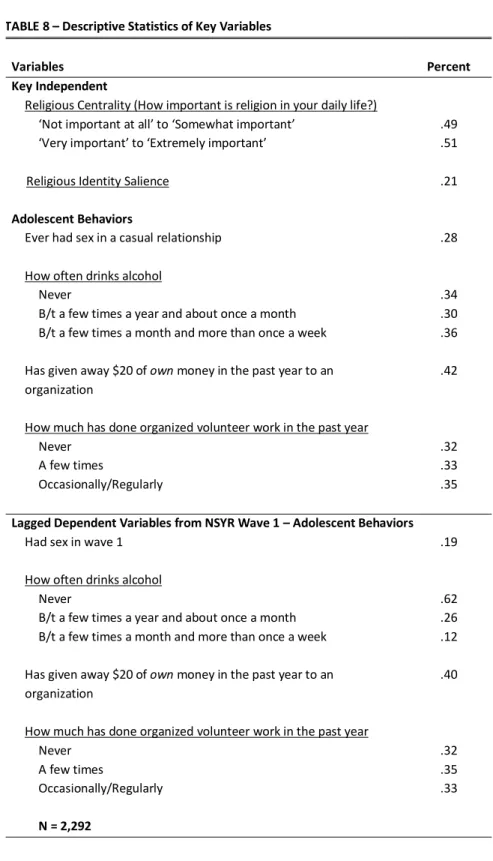
religious identity salience. Descriptive statistics on each variable used in the following analyses
can be found in Tables 8 and 9 in the Appendix. These analyses show whether religious
centrality and religious identity salience are empirically distinct (RQ1) and have empirically
distinct effects on various adolescent behaviors (RQ2). Additionally, these analyses determine
whether scholars have over or underestimated the substantive association between religious
centrality and behavior by not accounting for religious identity salience (RQ3), and whether
religious centrality is at least partially mediated by religious identity salience, as theory would
suggest (RQ4). Finally, I present analyses that compare the behavioral outcomes of adolescents
who have high religious centrality but low religious identity salience to those who have high
religious centrality and high religious identity salience (RQ5).
Table 1 displays a crosstab of religious centrality and religious identity salience.
In answer to RQ1, adolescents who have high religious centrality do not typically also have high
religious identity salience. While these concepts are highly correlated with a statistically
significant chi-square test of 30.14, approximately 64% of those who say that religion is very or
extremely important in their lives (high religious centrality) do not also say they look to religion
over other sources of moral authority when unsure of what to do in a given situation (high
religious identity salience). Thus, religious centrality and religious identity salience are
undeniably distinct from each other empirically. Were religious centrality and religious identity
26
extremely important in their lives also would say they look to religion over other sources of
moral authority when unsure of what to do in a given situation. In other words, the highest cell
counts in Table 1 would be on the diagonal from upper left to lower right, not within the first
column.
TABLE 1 – Crosstab of Religious Centrality and Religious Identity Salience Religious Identity Salience
Religious Centrality
Low High Total
Low 1,060
94.65%
61 5.44%
1,121 100%
High 757
64.65%
414 35.35%
1,171 100% χ2 = 30.14*** N = 2,292
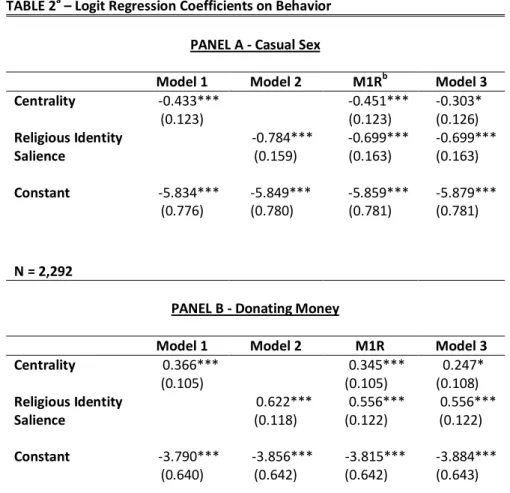
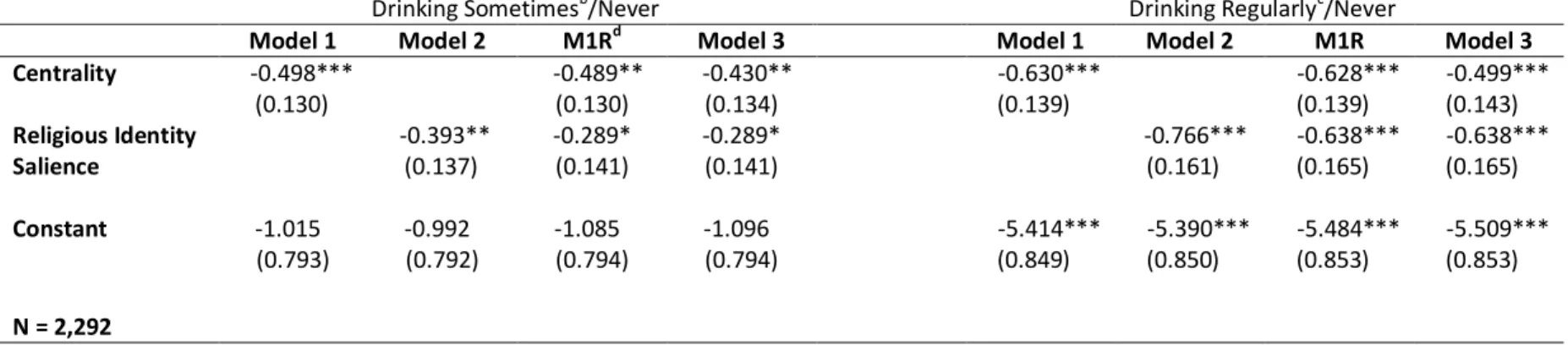
Tables 2 and 3 present logistic (Table 2) and multinomial logistic (Table 3) regression
models on four different adolescent behaviors: having casual sex, frequency of drinking alcohol,
volunteering, and donating money. Models 1 and 2 isolate the relationships between behavior
and religious centrality and religious identity salience, respectively, net of the additional
religious and demographic controls. These models show that for likelihood of having casual sex
and drinking alcohol sometimes or frequently, religious centrality and religious identity salience
have negative, significant associations – meaning that adolescents who have high religious
centrality or high religious identity salience are significantly less likely to participate in these
activities in comparison to their peers who have low religious centrality or low religious identity
salience. However, such a consistent pattern does not emerge for formally volunteering and
donating money. In regards to donating money, both high religious centrality and high religious
identity salience are positively and significantly associated with donating $20 or more of one’s
own money in the past six months. Yet while high religious centrality significantly increases the
likelihood that an adolescent will volunteer, high religious identity salience does not have an
27
isolation of each other, religious centrality and religious identity salience are significantly
associated with the likelihood of having casual sex, drinking alcohol, and donating money.
Volunteering behavior does not follow this pattern, as only religious centrality is related to
frequency of giving time in volunteering activities.
TABLE 2a – Logit Regression Coefficients on Behavior PANEL A - Casual Sex
Model 1 Model 2 M1Rb Model 3 Centrality -0.433***
(0.123) -0.451*** (0.123) -0.303* (0.126) Religious Identity Salience -0.784*** (0.159) -0.699*** (0.163) -0.699*** (0.163)
Constant -5.834*** (0.776) -5.849*** (0.780) -5.859*** (0.781) -5.879*** (0.781)
N = 2,292
PANEL B - Donating Money
Model 1 Model 2 M1R Model 3
Centrality 0.366*** (0.105) 0.345*** (0.105) 0.247* (0.108) Religious Identity Salience 0.622*** (0.118) 0.556*** (0.122) 0.556*** (0.122)
Constant -3.790*** (0.640) -3.856*** (0.642) -3.815*** (0.642) -3.884*** (0.643)
N = 2,292
Notes:a All models include: 1) lagged dependent variables of the outcome of
interest from Wave 1 of the NSYR, and 2) a series of religious and demographic controls which can be found in Table 9 of the Appendix
b
M1R: Model 1 Residualized using the KHB method Standard errors in parentheses
***p<0.001, ** p<0.01, * p<0.05
To answer RQ2, whether religious centrality and religious identity salience have distinct
empirical relationships with behavior, I look to Model 3 across all four behaviors in Tables 2 and
TABLE 3a – Multinomial Logistic Regression Coefficients on Behavior
PANEL A – Drinking Alcohol
Drinking Sometimesb/Never Drinking Regularlyc/Never
Model 1 Model 2 M1Rd Model 3 Model 1 Model 2 M1R Model 3
Centrality -0.498*** (0.130) -0.489** (0.130) -0.430** (0.134) -0.630*** (0.139) -0.628*** (0.139) -0.499*** (0.143) Religious Identity Salience -0.393** (0.137) -0.289* (0.141) -0.289* (0.141) -0.766*** (0.161) -0.638*** (0.165) -0.638*** (0.165)
Constant -1.015 (0.793) -0.992 (0.792) -1.085 (0.794) -1.096 (0.794) -5.414*** (0.849) -5.390*** (0.850) -5.484*** (0.853) -5.509*** (0.853)
N = 2,292
PANEL B – Volunteering
Volunteering A Few Times/Never Volunteering Occasionally or Regularly/Never
Model 1 Model 2 M1R Model 3 Model 1 Model 2 M1R Model 3
Centrality 0.198 0.200 0.137 0.441*** 0.445*** 0.410**
(0.125) (0.125) (0.129) (0.128) (0.128) (0.132)
Religious Identity Salience 0.333* (0.148) 0.294 (0.153) 0.294 (0.153) 0.274 (0.149) 0.162 (0.154) 0.162 (0.154)
Constant 3.330*** 3.322*** 3.334*** 3.304*** 1.917* 1.932* 1.919* 1.903* (0.755) (0.755) (0.755) (0.755) (0.774) (0.772) (0.774) (0.774) N = 2,292
Notes: a All models include: 1) lagged dependent variables of the outcome of interest from Wave 1 of the NSYR, and 2) a series of religious and
demographic controls which can be found in Table 9 of the Appendix
b
Between a Few Times a Year and about Once a Month
c
Drinking A Few Times a Month or More
d M1R: Model 1 Residualized using the KHB method
Standard errors in parentheses ***p<0.001, ** p<0.01, * p<0.05
29
to see the relationship to behavior of each variable, controlling for the other and the additional religious
and demographic variables. Should centrality and salience not be distinctly related to behavior, either
one or both of their coefficients in Model 3 would be statistically insignificant. This is not the case.
Rather, for having casual sex, drinking alcohol frequently or sometimes, and donating money, high
religious centrality and high religious identity salience have significant, empirically distinct associations
with behavior with consistent directions of influence across the three outcomes. In addition, the
direction of the relationship with each behavior is consistent with the direction demonstrated in Models
1 and 2, negative for having casual sex and drinking alcohol and positive for donating money. I present
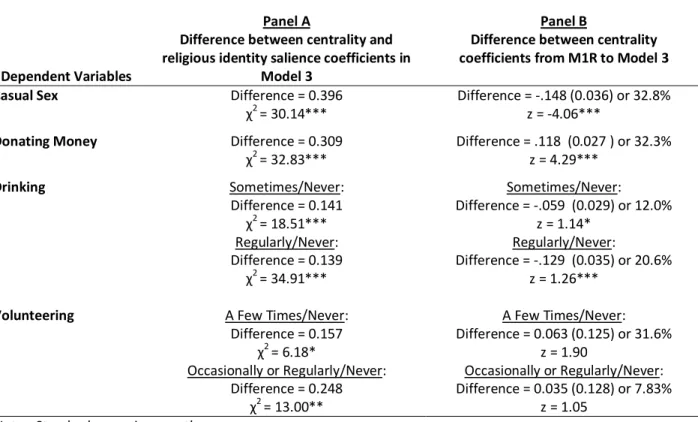
Wald tests for the differences between the coefficient sizes of religious centrality and religious identity
salience in Model 3 for each behavior in Panel A of Table 4. These tests show that the differences in the
two coefficient sizes are statistically significant, meaning that religious centrality and religious identity
salience are related to behavior at least somewhat independently of each other. Again, of note is that
volunteering does not follow this pattern. Rather, neither high religious centrality nor high religious
identity salience are significantly related to volunteering a few times a year, and only high religious
centrality is significantly and positively associated with volunteering occasionally or regularly. Religious
identity salience has no association with volunteering occasionally or regularly (this is to be expected as
religious identity salience was not significant for this behavior in Model 2).
While Model 3 shows that religious centrality and religious identity salience have empirically
distinct relationships with some behaviors, this does not mean that their relationships are not
somewhat shared with each other. Religious identity salience could mediate, at least partially, the
relationship between religious centrality and behavior. To test this idea (RQ3), I look to the change in
the coefficient size of religious centrality from M1R (which imitates the centrality coefficient in Model 1
30
Panel B of Table 4 shows that for casual sex, drinking, and donating money, the coefficient size
of religious centrality dropped by a statistically significant amount when religious identity salience was
added into the model. The coefficient size of religious centrality decreased by 32.8% for casual sex,
20.6% for drinking regularly, and 32.3% for donating money; it did not change significantly in relation to
volunteering behavior. Thus, while religious centrality and religious identity salience may have
statistically distinct relationships with behavior (as determined by RQ2), they are correlated such that
religious centrality partially operates through religious identity salience in influencing the likelihood of
having casual sex, drinking regularly, or donating money.
TABLE 4 – Statistical Tests Comparing Coefficient Sizes within Model 3 and between M1R and Model 3
Dependent Variables
Panel A
Difference between centrality and religious identity salience coefficients in
Model 3
Panel B
Difference between centrality coefficients from M1R to Model3
Casual Sex Difference = 0.396
χ2 = 30.14***
Difference = -.148 (0.036) or 32.8% z = -4.06***
Donating Money Difference = 0.309 χ2 = 32.83***
Difference = .118 (0.027 ) or 32.3% z = 4.29***
Drinking Sometimes/Never:
Difference = 0.141 χ2 = 18.51*** Regularly/Never: Difference = 0.139
χ2 = 34.91***
Sometimes/Never:
Difference = -.059 (0.029) or 12.0% z = 1.14*
Regularly/Never:
Difference = -.129 (0.035) or 20.6% z = 1.26***
Volunteering A Few Times/Never:
Difference = 0.157 χ2 = 6.18*
Occasionally or Regularly/Never: Difference = 0.248
χ2 = 13.00**
A Few Times/Never: Difference = 0.063 (0.125) or 31.6%
z = 1.90
Occasionally or Regularly/Never: Difference = 0.035 (0.128) or 7.83%
z = 1.05
Notes:Standard errors in parentheses
***p<0.001, ** p<0.01, * p<0.05
Given that religious centrality partially is mediated by religious identity salience, has not
31
the more commonly used measure of religious centrality and various behaviors (RQ4)? To answer this
question, I present predicted probability changes from low to high religious centrality from M1R to
Model 3 in Table 5. If not disentangling religious centrality from religious identity salience affected the
estimates of the relationship between religious centrality and behavior, the difference in predicted
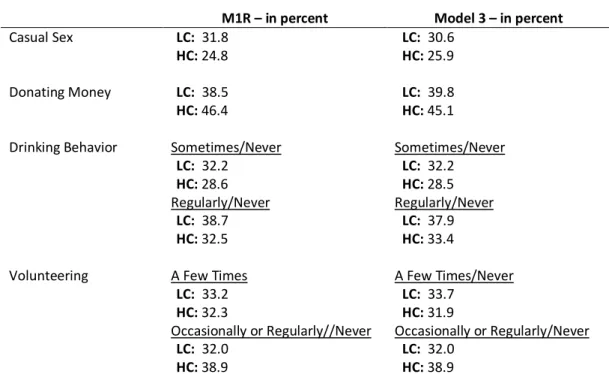
probabilities from low centrality to high centrality should change from M1R to Model 3. Table 5 shows
that for each behavior, the difference in the likelihood of participating in that behavior due to going
from low to high religious centrality does not change from M1R to Model 3. In sum, not including
religious identity salience in models that look at the relationship between religious centrality and
behavior has not impacted scholars’ assessments of the association of religious centrality to various
behaviors in any substantive way.
TABLE 5 – Predicted Probabilities for Likelihood of Engaging in Behavior for Respondents with Low Religious Centrality (LC) and High Religious Centrality (HC)
M1R – in percent Model 3 – in percent Casual Sex LC: 31.8
HC: 24.8
LC: 30.6 HC: 25.9 Donating Money LC: 38.5
HC: 46.4
LC: 39.8 HC: 45.1 Drinking Behavior Sometimes/Never
LC: 32.2 HC: 28.6 Regularly/Never
LC: 38.7 HC: 32.5
Sometimes/Never LC: 32.2
HC: 28.5 Regularly/Never
LC: 37.9 HC: 33.4 Volunteering A Few Times
LC: 33.2 HC: 32.3
Occasionally or Regularly//Never LC: 32.0
HC: 38.9
A Few Times/Never LC: 33.7
HC: 31.9
Occasionally or Regularly/Never LC: 32.0
HC: 38.9
The final exploration question regarding these two variables is not about how one variable
32
Are adolescents who have high religious centrality and religious identity salience more, the same, or less
likely to engage in certain behaviors than those who have high religious centrality but low religious
identity salience? Table 6 shows the logistic regression coefficients that allow for this comparison.
Adolescents who have high religious centrality and high religious identity salience (HC – HS) have
significantly different likelihoods of engaging in behavior than adolescents who report high religious
TABLE 6a – Logit and Multinomial Logit Regression Coefficients on Behavior by Religious Centrality-Religious Identity Salience Category
Casual Sex
Donating
Money Drinking Volunteering
Logit Multinomial Logit
Sometimesb Regularlyc A Few Times Occasionally or Regularly
Model 4 Model 4 Model 4 Model 4 Model 4 Model 4
LC - LS -0.0149 (0.331) -0.206+ (0.114) 0.421** (0.141) 0.505*** (.150) -0.129 (0.137) -0.427** (0.140) LC - HS 0.247+
(0.131) 0.0644 (0.286) 0.186 (0.333) -0.185 (0.389) 0.119 (0.340) -0.126 (0.356) HC - HS -0.827***
(0.186) 0.621*** (0.135) -0.304 (0.156) -0.623*** (0.183) 0.304 (0.172) 0.135 (0.171) Constant -6.163***
(0.794) -3.646*** (0.649) -1.523 (0.811) -6.011*** (0.872) 3.44*** (0.765) 2.32** (0.784)
N = 2,292
Notes: a All models include: 1) lagged dependent variables of the outcome of interest from Wave 1 of the NSYR, and
2) a series of religious and demographic controls which can be found in Table 9 of the Appendix
b
Between a Few Times a Year and about Once a Month
c Drinking A Few Times a Month or More d
LC = Low Centrality, LS = Low Salience, HC = High Centrality, HS = High Salience
e
HC-LS is the reference category Standard errors in parentheses
***p<0.001, ** p<0.01, * p<0.05, + p<0.1
Model 4 joint tests of significance of LC-LS, LC-HS, and HC-HS Casual Sex: χ2 = 31.39***
Donating Money: χ2 = 33.96*** Drinking:
Sometimes: χ2 = 18.58*** Regularly: χ2 = 34.54*** Volunteering:
33
centrality but low religious identity salience (HC – LS). HC – HS adolescents are significantly less likely to
have casual sex and drink alcohol regularly, and more likely to donate money than their HC – LS peers.
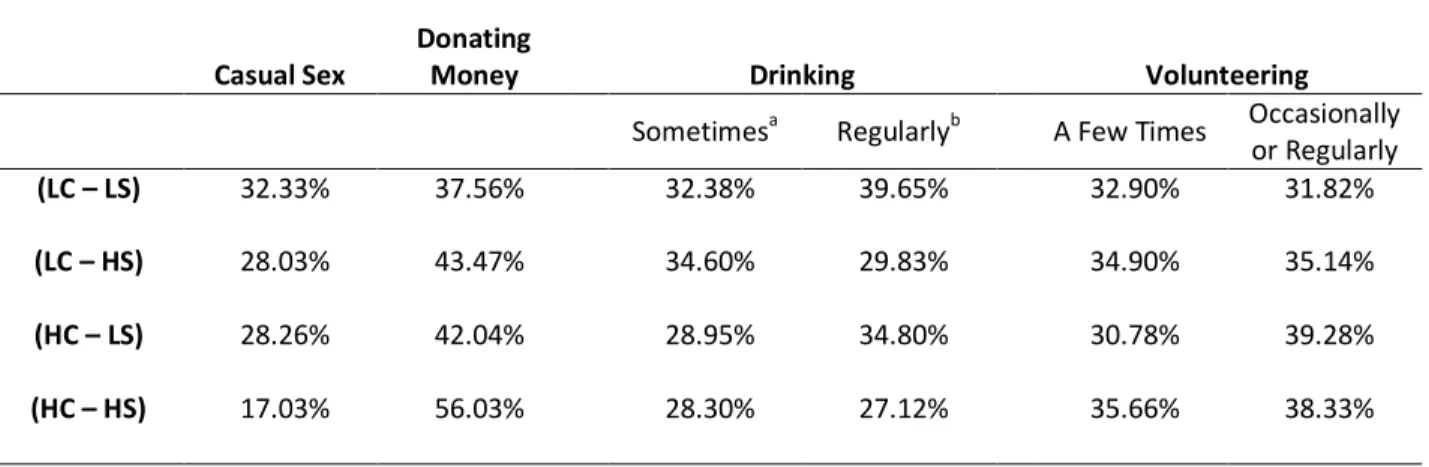
Specifically, HC – HS adolescents have a 17% likelihood of having casual sex, versus their HC – LS peers
who have a 28.26% likelihood of the same thing. In addition, HC – HS adolescents are 7.6% less likely to
drink alcohol regularly and approximately 14% more likely to donate money than their HC – LS peers.
However, for volunteering, there is again a different pattern in comparison to the other behaviors. HC –
HS adolescents are just as likely as HC – LS adolescents to volunteer (39% in comparison to 38%,
respectively).
TABLE 7 – Predicted Probabilities for Likelihood of Engaging in Behavior by Religious Centrality-Religious Identity Salience Category
Casual Sex
Donating
Money Drinking Volunteering
Sometimesa Regularlyb A Few Times Occasionally or Regularly
(LC – LS) 32.33% 37.56% 32.38% 39.65% 32.90% 31.82%
(LC – HS) 28.03% 43.47% 34.60% 29.83% 34.90% 35.14%
(HC – LS) 28.26% 42.04% 28.95% 34.80% 30.78% 39.28%
(HC – HS) 17.03% 56.03% 28.30% 27.12% 35.66% 38.33%
Notes: a Between a Few Times a Year and about Once a Month
b
V. Discussion
Studies linking religious identity to behavioral outcomes historically have
operationalized the strength of religious identity in two ways: 1) through general importance
questions that measure the centrality of religion to a person’s identity, and 2) through questions
that ask for behavioral reports of activities associated with a religious identity. I have taken
research in the identity theory tradition on psychological centrality and identity salience and
placed it in a religious context to explore how these two measures of religious identity are
empirically and substantively related, and how their relationship affects our assessments of the
association between religious identity and behavior.
I posed five research questions in this paper, which together, comprised a thorough
exploration of these two concepts across four different behaviors. I found that: 1) although the
statistical correlation between the two concepts is strong, substantively, people who have high
religious centrality do not overwhelmingly also have high religious identity salience; 2) religious
centrality and religious identity salience have empirically distinct relationships with different
behaviors; 3) religious centrality partially operates through religious identity salience in
influencing the likelihood of some behaviors; 4) not accounting for religious identity salience in
statistical models looking at the relationship between religious centrality and behavior has not
impacted our assessments of the association between centrality and behavior in any substantive
way; and 5) religious centrality and religious identity salience interact, such that adolescents
who feel religion is an important identity and have a high likelihood of acting on it are more or
less likely to participate in certain behaviors than adolescents who have only high religious
35
These findings bring forward a number of questions, as well as suggest a number of
theoretical implications for future study of religious identity and behavior. First, following RQ1,
what is the disconnect between religious centrality and religious identity salience such that
approximately 64% of adolescents who have high religious centrality do not also have high
religious identity salience?There are two approaches to answering this question. One is from a
purely theoretical perspective, considering the nature of religious centrality and religious
identity salience as concepts. Remember that an identity’s centrality stems primarily from an
individual’s values and interests, while an identity’s salience is more a function of the
commitment to the social relationships from which the identity emerged. In the case of the 64%
of adolescents with high religious centrality but low religious identity salience, theory would
suggest that they value religion and have a vested interest in it, but that the social relationships
underlying their other identities are more important than their religious social attachments.For
example, one easily can imagine a teen who attends church weekly and highly values religion,
but doesn’t have any close peer relationships in her church. Her closest relationships are with
friends who don’t share her same religion or aren’t religious at all. Thus, she looks to them first,
rather than religion, when she is unsure of what to do.
While this straightforward explanation of the disconnect between religious centrality
and religious identity salience is plausible, it also is rather simplistic. It suggests a relationship
between religious centrality and religious identity salience consonant with the assumption that
centrality operates through salience in influencing behavior, which I have shown with RQ3 is
only partially true. In other words, the approach above implies that adolescents with low
religious identity salience are not influenced by religious scripts at all.
However, Model 3 in Tables 2 and 3 indicate otherwise.Model 3 shows that religious