Timing and Type of Alcohol Consumption
and the Metabolic Syndrome - ELSA-Brasil
Bruna Angelo Vieira1, Vivian Cristine Luft1,2*, Maria Inês Schmidt1, Lloyd
Ellwood Chambless3, Dora Chor4, Sandhi Maria Barreto5, Bruce Bartholow Duncan1
1 Graduate Studies Program in Epidemiology and Hospital de Clínicas de Porto Alegre, Federal University of Rio Grande do Sul (UFRGS), Porto Alegre, Brazil, 2 Food and Nutrition Research Center, Hospital de Clínicas de Porto Alegre (HCPA-UFRGS), Porto Alegre, Brazil, 3 Department of Biostatistics, University of North Carolina, Chapel Hill, North Carolina, United States of America, 4 Department of Epidemiology, National School of Public Health, Oswaldo Cruz Foundation, Rio de Janeiro, Brazil, 5 Graduate Studies Program of Public Health, Federal University of Minas Gerais (UFMG), Belo Horizonte, Brazil
Abstract
The prevalence of the metabolic syndrome is rising worldwide. Its association with alcohol intake, a major lifestyle factor, is unclear, particularly with respect to the influence of drinking with as opposed to outside of meals. We investigated the associations of different aspects of alcohol consumption with the metabolic syndrome and its components. In cross-sectional analyses of 14,375 active or retired civil servants (aged 35–74 years) participating in the Brazilian Longitudinal Study of Adult Health (ELSA-Brasil), we fitted logistic regression models to investigate interactions between the quantity of alcohol, the timing of its con-sumption with respect to meals, and the predominant beverage type in the association of alcohol consumption with the metabolic syndrome. In analyses adjusted for age, sex, edu-cational level, income, socioeconomic status, ethnicity, smoking, body mass index, and physical activity, light consumption of alcoholic beverages with meals was inversely associ-ated with the metabolic syndrome (4 drinks/week: OR = 0.85, 95%CI 0.74–0.97; 4 to 7 drinks/week: OR = 0.75, 95%CI 0.61–0.92), compared to abstention/occasional drinking. On the other hand, greater consumption of alcohol consumed outside of meals was signifi-cantly associated with the metabolic syndrome (7 to 14 drinks/week: OR = 1.32, 95%CI 1.11–1.57;14 drinks/week: OR = 1.60, 95%CI 1.29–1.98). Drinking predominantly wine, which occurred mostly with meals, was significantly related to a lower syndrome preva-lence; drinking predominantly beer, most notably when outside of meals and in larger quan-tity, was frequently associated with a greater prevalence. In conclusion, the alcohol— metabolic syndrome association differs markedly depending on the relationship of intake to meals. Beverage preference—wine or beer—appears to underlie at least part of this differ-ence. Notably, most alcohol was consumed in metabolically unfavorable type and timing. If further investigations extend these findings to clinically relevant endpoints, public policies should recommend that alcohol, when taken, should be preferably consumed with meals.
a11111
OPEN ACCESS
Citation:Vieira BA, Luft VC, Schmidt MI, Chambless LE, Chor D, Barreto SM, et al. (2016) Timing and Type of Alcohol Consumption and the Metabolic Syndrome - ELSA-Brasil. PLoS ONE 11(9): e0163044. doi:10.1371/journal.pone.0163044
Editor:Osama Ali Abulseoud, National Institue on Drug Abuse, UNITED STATES
Received:February 29, 2016
Accepted:September 1, 2016
Published:September 19, 2016
Copyright:© 2016 Vieira et al. This is an open access article distributed under the terms of the
Creative Commons Attribution License, which permits unrestricted use, distribution, and reproduction in any medium, provided the original author and source are credited.
Data Availability Statement:The authors confirm that all data underlying the findings are fully available without restriction. The data used in this study is available for research proposals on request to the ELSA's Datacenter and to the ELSA's Publications Committee (publiELSA). Additional information can be obtained from the ELSA's Datacenter ([email protected]).
Introduction
The metabolic syndrome is a complex of interrelated risk factors which predict cardiovascular disease and type 2 diabetes [1]. Its prevalence is rising worldwide, representing an important public health problem [2–4]. It is related to many lifestyle behaviors of modern world [5], including alcohol consumption, a common exposure [6,7].
Moderate alcohol intake appears to offer benefits for health, including a lower risk of cardio-vascular disease [8,9], diabetes [10] and mortality [8–12]. However, few epidemiological studies have evaluated the role of the timing of alcohol consumption, i.e., with or outside of meals, in these associations. Some smaller studies have found more favorable associations of alcohol consumption with metabolic markers [7,13], general mortality [14] and cardiovascular events when it was taken with meals [15]. However, to our knowledge, none have to date investigated the impact of the timing of consumption with respect to the metabolic syndrome.
Considering that investigation of alcohol´s relationship to the metabolic syndrome [16–19] and different syndrome components [20–27] has not considered the moment of ingestion, we propose to investigate the extent to which the timing of alcohol consumption and beverage type alter these associations.
Materials and Methods
The Brazilian Longitudinal Study of Adult Health (ELSA-Brasil), as previously described [28,29], is a prospective cohort study designed to investigate principally diabetes and cardio-vascular diseases. Study volunteers, enrolled in six Brazilian states, are active or retired civil ser-vants (35–74 years) of universities or research institutions [28]. Of a total of 15,105
participants, we excluded from these baseline cross-sectional analyses individuals with incom-plete alcohol consumption data (N = 25); not having the data required for metabolic syndrome classification (N = 288) or for covariates used in modeling (N = 417), leaving 14,375 subjects for analysis. ELSA-Brasil was approved by the Ethics Committees of the Hospital de Clínicas de Porto Alegre (06–194), Hospital Universitário da Universidade de São Paulo (669/06), Fun-dação Oswaldo Cruz (343/06), Universidade Federal de Minas Gerais (186/06), Universidade Federal da Bahia (027–06) and Universidade Federal do Espírito Santo (041/06). All partici-pants gave written consent to participate.
Participants were instructed not to consume alcoholic beverages on the day before the examination and to fast for 12 hours. We obtained sociodemographic data and habits of alco-hol consumption and physical activity in leisure-time by interview [30,31]. Participants replied to a standard questionnaire on frequency and quantity consumed of each type of alcohol bever-age (drinks/week). We considered as one drink of alcohol 1 can/bottle of beer (350ml), 1 glass of wine (120–150 ml) or 1 shot of spirits (40 ml). Those abstaining or consuming less than 1 drink/week were considered not to drink regularly, and those consuming at least 1 drink/week were grouped into four categories (up to 4 drinks/week, 4 to 7 drinks/week, 7 to 14 drinks/ week, more than 14 drinks/week). To characterize the timing of alcohol consumption, we asked “Considering all the alcoholic beverages that you consume, how often do you drink with meals?”, and analyzed responses as: “Most frequently with meals”, “Both with and outside of meals” and “Most frequently outside of meals”. Binge drinking was defined as consuming 5 or more drinks within a two hour period more than once a month. Wine (or beer) was considered the predominant beverage if it constituted>50% of total consumption. Leisure-time physical activity was defined by the weighted sum of the time of physical activity per week, using the long version of the International Physical Activity Questionnaire (IPAQ), according to its guidelines for data processing and analysis. Metabolic equivalent minutes (MET-minutes) were computed for walking, moderate-intensity activities, and vigorous-intensity activities
Brazilian Ministry of Science and Technology (Financiadora de Estudos e Projetos -http://www. finep.gov.br/- and the National Council for Scientific and Technological Development - CNPq -http://cnpq. br/) [grant numbers 01 06 0010.00 RS, 01 06 0212.00 BA, 01 06 0300.00 ES, 01 06 0278.00 MG, 01 06 0115.00 SP, 01 06 0071.00 RJ]. The funders had no role in study design, data collection and analysis, decision to publish, or preparation of the manuscript.
Competing Interests:The authors have declared
using the following formulas: Walking MET-minutes/week = 3.3walking minuteswalking
‘days’; Moderate MET-minutes/week = 4.0moderate-intensity activity minutesmoderate days; Vigorous MET-minutes/week = 8.0vigorous-intensity activity minutes
vigorous-intensity days. A combined total physical activity MET-minutes/week was computed as the sum of Walking + Moderate + Vigorous METs/week scores [32]. Ethnicity was defined by the participant’s self-declared skin color/race following the standard approach used to obtain offi-cial Brazilian statistics.
The definition of social class was derived from the ELSA database and takes into consider-ation a detailed analysis of participants' current job tasks. First, the occupconsider-ation of each partici-pant was classified using the Brazilian job-occupational matrix. Next, the expected income of each participant was derived from his educational level (average market value), and his socio-economic status was estimated using the mean of his observed and expected income. Then, the average of the means of participants having the same occupation was used to obtain an occupa-tional socioeconomic status score. Using these occupaoccupa-tional socioeconomic status scores, occu-pations were grouped into social classes so as to achieve a minimum intra-stratum and
maximum between-stratum variance of the scores. Finally, for this report, social class was cate-gorized into three levels: high, middle, and low.
We measured weight, waist circumference and height while fasting, and defined nutritional status using the standard Body Mass Index (BMI) categories. We used the average of the last two of three blood pressure measurements in analyses [33].
Blood glucose was determined by the enzymatic hexokinase method; and total cholesterol, triglycerides, high-density lipoprtein cholesterol (HDL-C) and low-density lipoprotein choles-terol (LDL-C) by enzymatic calorimetric methods [34] at a central laboratory.
The metabolic syndrome was defined as the presence of at least three of the following fac-tors: elevated fasting glucose (100 mg/dL or use of hypoglycemic medication), elevated tri-glycerides (150 mg/dL or use of fibrates and/or nicotinic acid), low HDL-C (<40 mg/dL for men,<50 mg/dL for women, or use of fibrates and/or nicotinic acid), elevated blood pressure (systolic blood pressure135 mmHg and/or diastolic blood pressure85 mmHg or con-firmed use of antihypertensive medication) and abdominal obesity (waist circumference94 cm for men and80 cm for women) [1].
We present descriptive statistics for continuous variables as median (interquartile range) and for categorical data as absolute and relative frequencies. We investigated the association of aspects of alcohol consumption with the presence of metabolic syndrome and its components (as dichotomous outcomes) through construction of adjusted logistic regression models using a parameterization to represent interactions between the amount of alcohol consumed, the pre-dominant beverage type (wine, beer or other) and the timing of consumption (mostly with meals, mostly outside of meals, or equivalently with and outside of meals).
Within this strategy, we tested the global difference in outcomes between the timings of ingestion by evaluating the significance of the difference between the sets of coefficients for ingestion with meals and outside of meals, when each is taken as a group [chi-square with degrees of freedom = 2(number of alcohol levels minus one)].
Analyzes were performed using SAS software (Statistical Analysis System, SAS Institute Inc., Cary, N.C.), version 9.4, and statistical significance was defined as p<0.05.
Results
Overall, 7,835 (54.5%) participants were women, 7,514 (52.3%) white, 7,588 (52.8%) had a uni-versity degree, and 5,937 (41.3%) were classified as middle class. Most (8.208, 57.1%) had never smoked; 9,064 (63.1%) were either overweight or obese. We observed that 6,933 (48.2%) reported regular alcohol consumption (at least 1 drink/week). Of these, 3,306 (47.7%) con-sumed up to 4 drinks/week, 1,365 (19.7%) between 4 and 7 drinks/week, 1,436 (20.7%) between 7 and 14 drinks/week and 826 (11.9%) more than 14 drinks/week. Among those who reported drinking alcohol regularly, 3,681 (53.1%) drank alcohol most frequently outside of meals, 2,714 (39.2%) most frequently with meals and only 538 (7.8%) drank equivalently during and outside of meals. With respect to beverage type, 2,035 (29.3%) drank predominantly wine, 3,943 (56.9%) predominantly beer, 334 (4.8%) predominantly spirits, and 621 (9.0%) drank without a predominant beverage. Of those who drank mostly with meals, 1,318 (48.6%) drank predom-inantly wine. Of those who drank mostly outside of meals, 2,671 (72.6%) drank predompredom-inantly beer.
We ascertained the metabolic syndrome in 6,325 (44.0%) individuals. Among the entire sample, 6,380 (44.4%) individuals had high blood pressure, 10,300 (71.7%) elevated fasting glu-cose, 4,505 (31.3%) elevated triglycerides, 2,647 (18.4%) reduced HDL-C and 9,037 (62.9%) ele-vated waist circumference.
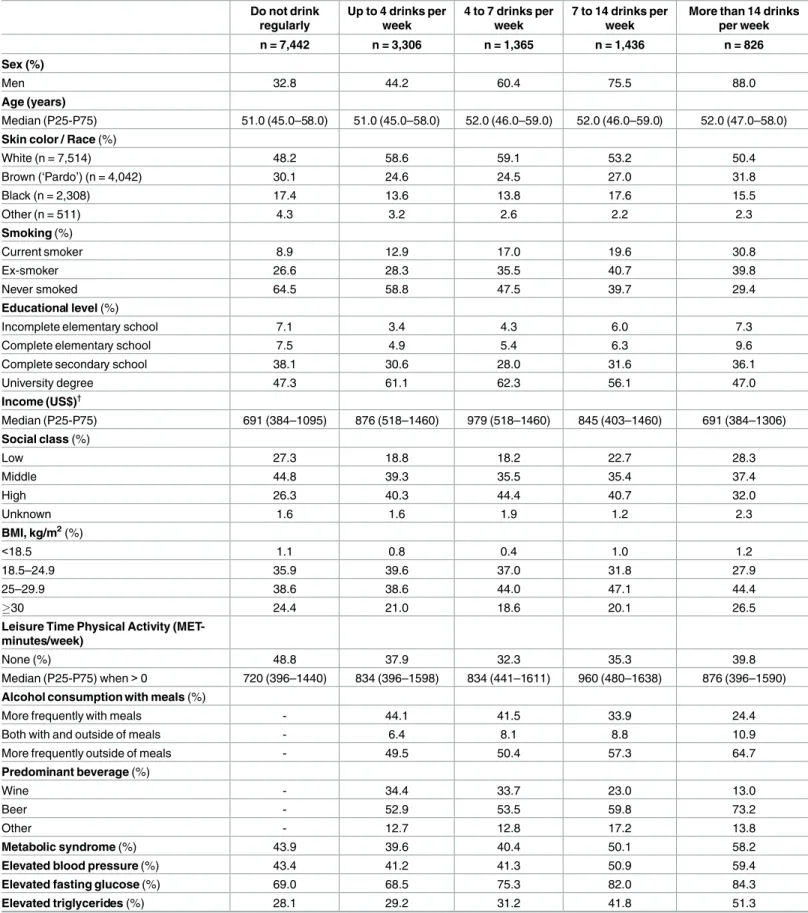
Table 1presents sociodemographic, anthropometric, metabolic and behavioral characteris-tics of the study population by different quantities of alcohol consumed. In general, all mea-sured characteristics were statistically associated (p<0.001) with the quantity of alcohol consumed. Among individuals who consumed larger quantities, more were men, smokers, and overweight. As the amount consumed per week increased, the proportion of subjects consum-ing predominantly beer increased as well.
Table 2shows the same characteristics of the participants by quantity of alcohol consumed, presented separately for consumption mostly with meals or mostly outside of meals. The unad-justed prevalence of the metabolic syndrome was always greater with consumption outside of meals.S1 Tablepresents these characteristics by the predominant type of beverage consumed (wine or beer). The unadjusted prevalence of the metabolic syndrome was notably greater with beer consumption, independently of quantity consumed.
Table 1. Characteristics of participants, by quantity of alcohol consumed. ELSA-Brasil, 2008–2010 (n = 14,375). Do not drink
regularly
Up to 4 drinks per week
4 to 7 drinks per week
7 to 14 drinks per week
More than 14 drinks per week
n = 7,442 n = 3,306 n = 1,365 n = 1,436 n = 826
Sex (%)
Men 32.8 44.2 60.4 75.5 88.0
Age (years)
Median (P25-P75) 51.0 (45.0–58.0) 51.0 (45.0–58.0) 52.0 (46.0–59.0) 52.0 (46.0–59.0) 52.0 (47.0–58.0) Skin color / Race (%)
White (n = 7,514) 48.2 58.6 59.1 53.2 50.4
Brown (‘Pardo’) (n = 4,042) 30.1 24.6 24.5 27.0 31.8
Black (n = 2,308) 17.4 13.6 13.8 17.6 15.5
Other (n = 511) 4.3 3.2 2.6 2.2 2.3
Smoking (%)
Current smoker 8.9 12.9 17.0 19.6 30.8
Ex-smoker 26.6 28.3 35.5 40.7 39.8
Never smoked 64.5 58.8 47.5 39.7 29.4
Educational level (%)
Incomplete elementary school 7.1 3.4 4.3 6.0 7.3
Complete elementary school 7.5 4.9 5.4 6.3 9.6
Complete secondary school 38.1 30.6 28.0 31.6 36.1
University degree 47.3 61.1 62.3 56.1 47.0
Income (US$)†
Median (P25-P75) 691 (384–1095) 876 (518–1460) 979 (518–1460) 845 (403–1460) 691 (384–1306) Social class (%)
Low 27.3 18.8 18.2 22.7 28.3
Middle 44.8 39.3 35.5 35.4 37.4
High 26.3 40.3 44.4 40.7 32.0
Unknown 1.6 1.6 1.9 1.2 2.3
BMI, kg/m2(%)
<18.5 1.1 0.8 0.4 1.0 1.2
18.5–24.9 35.9 39.6 37.0 31.8 27.9
25–29.9 38.6 38.6 44.0 47.1 44.4
30 24.4 21.0 18.6 20.1 26.5
Leisure Time Physical Activity (MET-minutes/week)
None (%) 48.8 37.9 32.3 35.3 39.8
Median (P25-P75) when>0 720 (396–1440) 834 (396–1598) 834 (441–1611) 960 (480–1638) 876 (396–1590) Alcohol consumption with meals (%)
More frequently with meals - 44.1 41.5 33.9 24.4
Both with and outside of meals - 6.4 8.1 8.8 10.9
More frequently outside of meals - 49.5 50.4 57.3 64.7
Predominant beverage (%)
Wine - 34.4 33.7 23.0 13.0
Beer - 52.9 53.5 59.8 73.2
Other - 12.7 12.8 17.2 13.8
Metabolic syndrome (%) 43.9 39.6 40.4 50.1 58.2
Elevated blood pressure (%) 43.4 41.2 41.3 50.9 59.4
Elevated fasting glucose (%) 69.0 68.5 75.3 82.0 84.3
Elevated triglycerides (%) 28.1 29.2 31.2 41.8 51.3
quantities with meals and lesser quantities outside of meals showed no statistically significant associations.
Fig 2presents crude and adjusted associations of alcohol consumption with metabolic syn-drome components according to the timing of such consumption. Taking as a reference abstention/occasional drinking, in the adjusted analyses lesser (<7 drinks/week) consumption of alcohol, when mostly taken with meals, was inversely associated, in at least one category of quantity consumed, with elevated triglycerides and low HDL-C. In contrast,>7 drinks/week when mostly taken outside of meals was associated, in at least one category of quantity con-sumed, with an increased odds of elevated blood pressure, elevated fasting glucose, elevated tri-glycerides and elevated waist circumference. Consumption both with and outside of meals was inversely associated with low HDL-C at all levels of consumption.
The predominance of wine or beer modified the above associations for the metabolic syn-drome (p = 0.002), and for its components elevated blood pressure (p = 0.001) and hypertrigly-ceridemia (p = 0.009). Thus, we further stratified analyses with crude results for the metabolic syndrome being presented inFig 1C(for wine) andFig 1E(for beer) and equivalent adjusted analyses inFig 1D and 1F. In comparison with the results ofFig 1B, predominantly wine drink-ers (Fig 1D) did not display an increasing association with the metabolic syndrome as quantity increased, with the only statistically significant association being seen for 1–4 drinks/week mostly with meals (OR = 0.69, 95%CI 0.56–0.83). Predominantly beer drinkers (Fig 1F), on the other hand, showed an increasing association with the metabolic syndrome at greater quanti-ties ingested, being monotonically greater and statistically significant only at higher quantiquanti-ties consumed mostly outside of meals (OR = 1.45, 95%CI 1.20–1.76 for 7–14 drinks/week; and OR = 1.70, 95%CI 1.35–2.14 for more than 14 drinks/week).
Fig 3presents the adjusted associations of quantity of alcohol consumed with individual syndrome components separately for both timing and for the predominant beverage con-sumed, wine or beer. Equivalent crude associations are shown inS1 Fig. With respect to ele-vated blood pressure, predominantly wine consumption, independent of its timing, tended to associate with less elevated blood pressure, whereas predominantly beer consumption, when taken outside of meals in greater quantity, was associated with a monotonically increasing greater frequency of elevated blood pressure. For elevated fasting glucose, quantities of pre-dominantly wine consumption showed no consistent pattern, whereas prepre-dominantly beer consumption outside of meals was consistently associated with greater frequencies. For ele-vated triglycerides, lesser quantities of consumption, when predominantly wine, were margin-ally associated with lesser frequencies, whereas greater quantities of consumption, when predominantly beer, were associated with greater frequencies, especially outside of meals. Greater alcohol consumption was always associated with lesser frequencies of low HDL-C. Finally, for elevated waist circumference, an inconsistent association was seen for predomi-nantly wine drinkers, whereas greater consumption by predomipredomi-nantly beer drinkers was
Table 1. (Continued)
Do not drink regularly
Up to 4 drinks per week
4 to 7 drinks per week
7 to 14 drinks per week
More than 14 drinks per week
n = 7,442 n = 3,306 n = 1,365 n = 1,436 n = 826
Reduced HDL-C (%) 22.9 15.6 12.8 11.6 10.3
Elevated waist circumference (%) 64.9 59.4 60.9 60.7 65.6
P25-75 = Percentile 25–75
†Net monthly incomeper capita;2009 conversion rate of 1.8 Brazilian reais = 1 US dollar.
Table 2. Characteristics of participants, by timing of alcohol consumption (mostly with/outside of meals). ELSA-Brasil, 2008–2010 (n = 14,375). Do not drink
regularly
Up to 4 drinks per week 4 to 7 drinks per week 7 to 14 drinks per week More than 14 drinks per week
With Outside With Outside With Outside With Outside
n = 7,442 n = 1,459 n = 1,635 n = 566 n = 689 n = 487 n = 823 n = 202 n = 534 Sex (%)
Men 32.8 42.9 46.4 59.9 61.8 76.4 75.7 90.6 87.8
Age (years)
Median (P25-P75) 51 (45–58) 53 (46–59) 49 (44–56) 55 (47–62) 50 (45–56) 56 (48–62) 50 (45–56) 55 (48–62) 51 (46–57) Skin color / Race (%)
White (n = 7,514) 48.2 68.1 49.3 71.4 48.8 70.2 41.6 68.3 42.3
Brown (‘Pardo’) (n = 4,042)
30.1 18.8 30.5 18.4 29.3 15.0 35.0 18.8 37.6
Black (n = 2,308) 17.4 9.9 16.9 7.8 18.7 12.5 21.0 11.9 17.0
Other (n = 511) 4.3 3,2 3.3 2.4 3.2 2.3 2.4 1.0 3.1
Smoking (%)
Current smoker 8.9 8.0 17.5 9.7 24.0 10.9 24.0 15.9 36.9
Ex-smoker 26.6 26.9 28.9 36.2 35.1 44.1 38.8 48.5 35.4
Never smoked 64.5 65.1 53.6 54.1 40.9 45.0 37.2 35.6 27.7
Educational level (%) Incomplete elementary school
7.1 2.1 4.5 3.2 5.2 4.3 7.4 5.0 8.6
Complete elementary school
7.5 3.7 6.3 3.4 7.7 5.5 7.0 6.9 11.4
Complete secondary school
38.1 22.5 39.0 17.0 37.6 19.9 40.5 22.8 42.5
Universuty degree 47.3 71.7 50.2 76.4 49.5 70.3 45.1 65.3 37.5
Income (US$)†
Median (P25-P75) 691 (384–1095) 1095 (633–1498) 691 (384–1152) 1095 (806–1729) 691 (384–1152) 1095 (633–1498) 691 (384–1095) 1095 (576–1460) 576 (345–1095) Social class (%)
Low 27.3 13.9 24.0 13.8 23.1 18.5 26.7 20.3 33.2
Middle 44.8 32.2 46.5 22.8 45.1 21.4 44.1 22.8 42.7
High 26.3 52.4 28.0 60.3 30.9 58.3 28.3 54.5 22.1
Unknown 1.6 1.5 1.5 3.1 0.9 1.8 0.9 2.4 2.0
BMI, kg/m2(%)
<18.5 1.1 1.0 0.6 0.5 0.4 0.6 1.2 0.5 1.7
18.5–24.9 35.9 42.7 37.2 37.6 36.1 33.9 30.7 27.2 27.7
25–29.9 38.6 36.5 40.3 44.3 43.1 48.9 45.6 48.0 42.1
30 24.4 19.8 21.9 17.6 20.4 16.6 22.5 24.3 28.5
Leisure Time Physical Activity (MET-minutes/week)
if = 0 (%) 48.8 32.4 42.6 25.3 38.2 25.7 41.7 24.3 45.5
Median (P25-P75) when>0
720 (396–1440) 800 (396–1554) 875 (400–1680) 819 (419–1588) 819 (452–1611) 960 (480–1671) 960 (480–1592) 924 (438–1676) 792 (396–1470) Predominant beverage (%)
Wine - 49.9 20.0 53.0 18.9 46.6 8.3 31.2 4.3
Beer - 36.9 67.9 32.0 69.5 32.9 77.0 50.0 83.9
Other - 13.2 12.1 15.0 11.6 20.5 14.7 18.8 11.8
associated with greater waist circumference, independent of timing. Throughout these compar-isons, consumption of wine in lesser quantities with meals was generally more protective than when taken outside of meals, although confidence intervals almost always overlapped. No clear pattern was seen with respect to timing of consumption for predominantly beer drinkers at greater quantities, with exception of triglycerides (p = 0.04 for overall heterogeneity across timings).
Analyses adjusting additionally for binge drinking and for a previous diagnosis and/or drug treatment for diabetes, hypertension and dyslipidemia produced no important differences in results (data not shown).
Discussion
In this large sample, the association of alcohol ingestion with the metabolic syndrome depends on much more than the mere quantity ingested. When taken with meals, alcohol was consis-tently associated with a lower frequency of the metabolic syndrome than when taken outside of meals. This translated into the syndrome being significantly less frequent in those taking alco-hol in smaller quantities with meals, and significantly more frequent in those taking alcoalco-hol in larger quantities outside of meals. Beverage type appeared to explain much, but not all, of these associations, with wine in small doses being generally associated with lower frequency of the syndrome and its components, and beer, in larger doses, being associated with a greater fre-quency of the syndrome and all of its components except HDL-C. Largest differences between those predominantly consuming beer or wine were seen for elevated blood pressure and ele-vated triglycerides. Consistent with many previous studies, greater alcohol consumption, inde-pendent of timing or beverage type, was associated with higher HDL-C levels [13,21,22,24,
35,36]. Most alcohol was consumed in metabolically unfavorable type and timing.
A recent meta-analysis summarized data on the association of quantity of alcohol consumed with the metabolic syndrome [37]. In comparison with non-drinkers in this meta-analysis, light consumption of alcoholic beverages (5 g/day) was associated with a lower risk of the syndrome (RR = 0.86, 95%CI 0.75–0.99), while excessive consumption (>35 g/day) was associ-ated with greater risk (RR = 1.84, 95%CI 1.34–2.52). However, we know of no previous study
Table 2. (Continued)
Do not drink regularly
Up to 4 drinks per week 4 to 7 drinks per week 7 to 14 drinks per week More than 14 drinks per week
With Outside With Outside With Outside With Outside
n = 7,442 n = 1,459 n = 1,635 n = 566 n = 689 n = 487 n = 823 n = 202 n = 534 Metabolic syndrome
(%)
43.9 37.1 41.7 37.3 43.3 47.0 51.8 53.5 59.7
Elevated blood pressure (%)
43.4 40.6 42.1 40.5 42.5 48.9 52.7 54.5 61.4
Elevated fasting glucose (%)
69.0 67.8 69.6 75.8 75.8 81.3 81.8 85.2 83.5
Elevated triglycerides (%)
28.1 25.8 32.1 26.3 35.0 34.7 45.9 42.1 54.9
Reduced HDL-C (%) 22.9 14.3 16.6 10.3 14.7 8.8 12.3 10.4 10.3
Elevated waist circumference (%)
64.9 57.4 60.3 59.7 61.7 60.4 60.6 63.4 66.1
P25-75 = Percentile 25–75
†Net monthly household incomeper capita;2009 conversion rate of 1.8 Brazilian reais = 1 US dollar.
which has incorporated quantity, timing and beverage type in the investigation of alcohol con-sumption´s associations with the metabolic syndrome.
The few studies which have investigated the influence of timing of consumption with respect to meals on metabolic syndrome components report findings in consonance with ours. The prevalence of elevated blood pressure among non-drinking Italians (42.8%) and Ameri-cans (40.4%) was higher than among those who drank alcohol with meals (36.6% and 39.8%), but not higher than among those who drank alcohol outside of meals (42.8% and 41.4%) [7].
Fig 1. Association between alcohol consumption and the metabolic syndrome, when this consumption was either mostly with or mostly outside of meals. (A) Crude. (B) Adjusted through logistic regression for sex, age, skin color/race, smoking, BMI, educational level, net monthly household incomeper capita, social class and physical activity. (C and E) Crude, additionally stratified by predominant consumption of wine or beer. (D and F) Adjusted for the same covariates, and additionally stratified by predominant consumption of wine or beer.
Fig 2. Association between alcohol consumption and components of the metabolic syndrome, when this consumption was either mostly with or mostly outside of meals. (A, C, E, G and I) Crude. (B, D, F, H and J) Adjusted through logistic regression for sex, age, skin color/race, smoking, BMI, educational level, net monthly household incomeper capita, social class and physical activity.
Fig 3. Association between alcohol consumption and components of the metabolic syndrome, when this consumption was either mostly with or mostly outside of meals. Data are presented separately by predominant beverage type. Adjusted associations. Adjustment performed through logistic regression for sex, age, skin color/race, smoking, BMI, educational level, net monthly household incomeper capita, social class and physical activity. (A, C, E, G and I) Predominantly wine. (B, D, F, H and J) Predominantly beer.
Few studies have investigated major clinical endpoints. An Italian case-control study found that, in comparison with non-drinkers, odds of having a myocardial infarction were 50% lower (OR = 0.50, 95%CI 0.30–0.82) for those taking 3 or more drinks/day with meals, but not among those who consumed a similar quantity outside of meals (OR = 0.98, 95%CI 0.49–1.96) [15]. In an additional large cohort study, in comparison with non-drinkers, men who drank wine with meals, but not those who drank outside of meals, had lower risk of death from all causes (RR = 0.64, 95%CI 0.49–0.82), from cardiovascular diseases (RR = 0.50 95%CI 0.33– 0.74); and from coronary heart disease (RR = 0.48 95%CI 0.30–0.76). Among women in this study, for whom many fewer deaths accrued, those who drank wine outside of meals experi-enced much greater all-cause mortality (RR = 3.48, 95%CI 1.25–9.66). Independent of the quantity of alcohol consumed, those who drank with meals experienced significantly lower all-cause death rates than those who drank outside of meals [14].
Although a greater number of studies exist, the literature is less clear on the relative effects of different types of beverages on cardiometabolic disease. A meta-analysis evaluating the rela-tionship between beer, wine and distillates with cardiovascular disease found similar dose-response curves for beer and wine, both showing a reduction of approximately 33% in events for those who consumed 25 g/d [11]. One cross-sectional study reported 40% greater odds (95%CI 10%– 70%) of having a large waist-hip ratio in non-wine (predominantly beer) drink-ers, and a 50% lesser odds (95%CI 21%—95%) in wine drinkers [38]. A meta-analysis sug-gested that beer consumption, especially in larger quantities, is associated with large waist circumference [39]. Sun and colleagues [37], in a recent meta-analysis of alcohol consumption and the metabolic syndrome, found an insufficient number of studies to evaluate differences in risk of the syndrome by beverage type.
The apparent cardioprotective effects of alcohol ingestion may act through a series of mech-anisms, including anti-inflammatory effects, inhibition of platelet aggregation and alterations in lipid metabolism [40]. Those who drink moderate quantities of alcohol had lower levels of several inflammation markers, including fibrinogen, C-reactive protein (CRP), leucocytes and elevated plasma viscosity [41]. Experimental studies in isolated adipose tissue show that alcohol decreases levels of interleukin-6 (IL-6), interleukin-8 (IL-8), tumor necrosis factor-α(TNF-α), and monocyte chemotaxic factor -1 (MCP-1) [42].
An anti-inflammatory effect of alcohol with meals might provide greater benefit than one occurring outside of meals. Nutrient overload produces oxidative stress [43]. A diet rich in corn oil and lard stimulates greater absorption of lipopolysaccharide, a major pro-inflammatory stimulant, from the gut [44]. In a small randomized trial, consumption of 4 drinks of wine with dinner for 4 weeks increased total plasma anti-oxidant capacity and suppressed nuclear factor kappa B (NF-κB) activation in peripheral blood mononuclear cells 1 hour after a meal [45].
Alcohol has also been shown, in vitro, to lower endothelial adhesion molecule expression [46] and, in moderate doses, to increase the release of nitric oxide from the endothelium [47]. Moderate consumption also increases HDL-C and alters many of its actions as well as inhibits oxidation of LDL-C and other apoB-containing lipoproteins [48]. A small, short-term clinical trial demonstrated that red wine taken with a mid-day meal reduced post-prandial blood pres-sure and nocturnal dipping in systolic blood prespres-sure [49]. Another small randomized trial demonstrated that alcohol taken with white bread significantly lowered post-prandial hyper-glycemia [50].
higher risk for cardio-metabolic abnormalities associated with excessive alcohol intake. A Korean epidemiologic study shows that heavy alcohol consumption was associated with signifi-cantly higher odds ratios for high blood pressure (30–79.9g/d: OR = 1.45, 95%CI 1.12–1.87;
80g/d: OR = 1.88, 95%CI 1.32–2.68), high triacylglycerol (30–79.9g/d: OR = 1.37, 95%CI 1.05–1.77;80g/d: OR = 1.76, 95%CI 1.23–2.50) and large waist (80g/d: OR = 2.02, 95%CI 1.22–3.34) in men, and high fasting blood glucose (30g/d: OR = 2.12, 95%CI 1.13–3.97) and high triacylglycerol (30g/d: OR = 2.19, 95%CI 1.21–3.97) in women. Odds ratios for the met-abolic syndrome and its components tended to increase with increasing alcohol consumption [51]. Kim and colleagues [52] also found, comparing with non-drinkers, heavy drinkers (30g/d) suffered the largest incidence of metabolic syndrome (OR = 2.11; 95%CI 1.25–3.56). In a Mediterranean cohort [22], people who consumed7drinks/week presented a signifi-cantly higher risk of developing metabolic syndrome (OR = 1.80; 95%CI 1.22–2.66), hypertri-glyceridemia (OR = 2.07; 95%CI 1.46–2.93) and impaired fasting glucose (OR = 1.54; 95%CI 1.16–2.04) when compared with non-drinkers. In addition, beer consumption was associated with higher risk for the metabolic syndrome (p for trend = 0.03) and a higher risk of hypertri-glyceridemia (OR = 1.81; 95%CI 1.02–3.20).
Furthermore, the harmful use of alcohol contributes to many other types of disease and injury. Worldwide, harmful alcohol consumption is a component cause of more than 200 dis-ease and injury conditions, and is believed responsible for 5.9% of all deaths and 5.1% of overall disability, most notably those due to liver cirrhosis, cancers and injuries, as well as due directly to alcohol dependence [6]. Additionally, alcohol consumption contributes in large measure to the excessive violence that permeates Brazilian society [53].
National guidelines for alcohol drinking frequently discourage consumption [54]. The 2015–2020 Dietary Guidelines for Americans recommend that if alcohol is consumed, it should be in moderation, and explicitly do not recommend that abstainers begin drinking for any rea-son [55]. Yet alcohol consumption remains persistent in societies across the world, despite the huge disease burden it produces. Our findings suggest that much of the untoward cardio-meta-bolic effects of alcohol consumption may be due to habits other than mere quantity consumed, which, while dominant in the ELSA-Brasil sample, are logically susceptible to change. Two recent guidelines, from Canada and Australia [56,57], emphasize that alcohol is best consumed with meals. However, their justification is based on the observation that meals slow the absorp-tion of alcohol, rather than that such timing of consumpabsorp-tion is associated with a more favor-able cardiometabolic profile.
Important strengths of our study are its large sample size, standardized measurement tech-niques, and the inclusion of questions which permit the more comprehensive analysis pre-sented. However, limitations to our report also merit comment. The cross-sectional nature of our analyses make inferences of causality more difficult. Self-report of alcohol consumption is subject to recall bias, especially, as in our case, when assessment is obtained by interview, as participants tend to give answers perceived as socially desirable. Due to this bias, alcohol con-sumption might be underestimated, especially in groups with higher concon-sumption. It is unclear, however, how disease presence would bias associations with timing of consumption and beverage type, the more novel and relevant aspects of our findings. Additionally, residual confounding, particularly by socioeconomic status, must always be considered, given that alco-hol consumption is a very socially determined habit.
Conclusions
Specifically, light consumption of alcoholic beverages with meals was associated with a lesser frequency of the syndrome and many of its elements, while greater consumption, particularly outside of meals, was associated with higher frequencies. Wine, which was taken mainly with meals, appeared to explain part of the mealtime associations, while beer, taken mainly outside of meals, appeared to explain part of associations of consumption outside of meals. If further investigations confirm these findings, and demonstrate that similar associations exist for clini-cal endpoints such as myocardial infarction and diabetes, public policies, in addition to favor-ing interventions to limit harmful consumption, should recommend that alcohol, when taken, should be preferably consumed with meals.
Supporting Information
S1 Fig. Alcohol consumed, mostly with/outside of meals, predominant wine or beer, and components of metabolic syndrome. Crude association. Left side panels A, C, E, G and I:
pre-dominant wine. Right side panels B, D, F, H and J: prepre-dominant beer. (TIF)
S1 Table. Characteristics of participants, by type of beverage predominantly consumed (mostly wine/beer). ELSA-Brasil, 2008–2010 (n = 5,978). P25-75 = Percentile 25–75†Net monthly incomeper capita;2009 conversion rate of 1.8 Brazilian reais = 1 US dollar. (DOCX)
Author Contributions
Conceptualization: BBD MIS SMB DC.
Data curation: BAV VCL.
Formal analysis: BAV VCL LEC.
Funding acquisition: BBD MIS SMB DC.
Project administration: BBD MIS SMB DC.
Software: BBD MIS SMB DC.
Writing – original draft: BAV VCL BBD MIS.
Writing – review & editing: DC SMB LEC.
References
1. Alberti KGMM, Eckel RH, Grundy SM, Zimmet PZ, Cleeman JI, Donato KA, et al. Harmonizing the Met-abolic Syndrome A Joint Interim Statement of the International Diabetes Federation Task Force on Epi-demiology and Prevention; National Heart, Lung, and Blood Institute; American Heart Association; World Heart Federation; International Atherosclerosis Society; and International Association for the Study of Obesity. Circulation. 2009; 120:1640–5. doi:10.1161/CIRCULATIONAHA.109.192644PMID: 19805654
2. Borch-Johnsen K. The metabolic syndrome in a global perspective. Dan Med Bull. 2007; 54:157–9. PMID:17521535
3. Mozumdar A, Liguori G. Persistent Increase of Prevalence of Metabolic Syndrome Among U.S. Adults: NHANES III to NHANES 1999–2006. Diabetes Care. 2011; 34(1):216–9. doi:10.2337/dc10-0879 PMID:20889854
5. Dima-Cozma C, GavrilutăC, Mitrea G, Cojocaru DC. The importance of healthy lifestyle in modern soci-ety: a medical, social and spiritual perspective. European Journal of Science and Theology, 2014; 10 (3):111–20.
6. World Health Organization (WHO). Global status report on alcohol and health– 2014. Geneva, Switzer-land, World Health Organization. 2014;1–376.
7. Della Valle E, Stranges S, Trevisan M, Krogh V, Fusconi E, Dorn JM, et al. Drinking habits and health in NorthernItalian and American men. Nutr Metab Cardiovasc Dis, 2009; 19(2):115–22. doi:10.1016/j. numecd.2008.03.006PMID:18678475
8. Ronksley PE, Brien SE, Turner BJ, Mukamal KJ, Ghali WA. Association of alcohol consumption with selected cardiovascular disease outcomes: a systematic review and meta-analysis. BMJ, 2011; 342:1–13.
9. Zhang C, Qin YY, Chen Q, Jiang H, Chen XZ, Xu CL, et al. Alcohol intake and risk of stroke: A dose-response meta-analysis of prospective studies. Int J Cardiol, 2014; 1–9.
10. Baliunas DO, Taylor BJ, Irving H, Roerecke M, Patra J, Mohapatra S, et al. Alcohol as a risk factor for type 2 diabetes: A systematic review and meta-analysis. Diabetes Care. 2009; 32(11):2123–32.
11. Costanzo S, Di Castelnuovo A, Donati MB, Iacoviello L, de Gaetano G. Wine, beer or spirit drinking in relation to fatal and non-fatal cardiovascular events: a meta-analysis. Eur J Epidemiol. 2011; 26 (11):833–50. doi:10.1007/s10654-011-9631-0PMID:22076059
12. Huang C, Zhan J, Liu YJ, Li DJ, Wang SQ, He Q. Association Between Alcohol Consumption and Risk of Cardiovascular Disease and All-Cause Mortality in Patients With Hypertension: A Meta-Analysis of Prospective Cohort Studies. Mayo Clin Proc., 2014; 89(9):1201–10. doi:10.1016/j.mayocp.2014.05. 014PMID:25091872
13. Galán I, Valencia-Martín JL, Guallar-Castillón P, Rodríguez-Artalejo F. Alcohol drinking patterns and biomarkers of coronary risk in the Spanish population. Nutr Metab Cardiovasc Dis, 2014; 24(2):189– 97. doi:10.1016/j.numecd.2013.07.002PMID:24418385
14. Trevisan M, Schisterman E, Mennotti A, Farchi G, Conti S, Risk Factor And Life Expectancy Research Group. Drinking pattern and mortality: the Italian Risk Factor and Life Expectancy pooling project. Ann Epidemiol, 2001; 11(5):312–9.
15. Augustin LSA, Gallus S, Tavani A, Bosetti C, Negri E, Vacchia C. Alcohol Consumption and Acute Myo-cardial Infarction: A Benefit of Alcohol Consumed With Meals?. Epidemiology, 2004; 15(6):767–9. PMID:15475728
16. Fujita N, Takei Y. Alcohol consumption and metabolic syndrome. Hepatol Res. 2011; 41(4):287–95. doi:10.1111/j.1872-034X.2011.00787.xPMID:21426447
17. Yokoyam a H, Hiroshi H, Ohgo H, Hibi T, Saito I. Effects of excessive ethanol consumption on the diag-nosis of the metabolic syndrome using its clinical diagnostic criteria. Intern Med 2007; 46:1345–52. PMID:17827831
18. Freiberg H, Cabral HJ, Heeren TC, Vasan RS, Curtis A, Ellison R. Alcohol consumption and the preva-lence of the metabolic syndrome in the U.S.: a cross-sectional analysis of data from the Third National Health and Nutrition Examination Survey. Diabetes Care 2004; 27:2954–9. PMID:15562213
19. Santos AC, Ebrahim S, Barros H. Alcohol intake, smoking, sleeping hours, physical activity and the metabolic syndrome. Prev Med 2007; 44:328–34. PMID:17239432
20. Lee KW, Park BJ, Kang HT, Lee YJ. Alcohol-drinking patterns and metabolic syndrome risk: the 2007 Korean National Health and Nutrition Examination Survey. Alcohol. 2011; 45(5):499–505.
21. Chen CC, Lin WY, Li CI, Liu CS, Li TC, Chen YT, et al. The association of alcohol consumption with metabolic syndrome and its individual components: the Taichung community health study. Nutr Res. 2012; 32(1):24–9. doi:10.1016/j.nutres.2011.11.004PMID:22260860
22. Barrio-Lopez MT, Bes-Rastrollo M, Sayon-Orea C, Garcia-Lopez M, Fernandez-Montero A, Gea A, et al. Different types of alcoholic beverages and incidence of metabolic syndrome and its components in a Mediterranean cohort. Clin Nutr. 2013; 32(5):797–804. doi:10.1016/j.clnu.2012.12.002PMID: 23305606
23. Chen L, Smith GD, Harbord RM, Lewis SJ. Alcohol Intake and Blood Pressure: A Systematic Review Implementing a Mendelian Randomization Approach. PLoS Med 2008; 5(3):461–71.
24. Rimm EB, Williams P, Fosher K, Criqui M, Stampfer MJ. Moderate alcohol intake and lower risk of coro-nary heart disease: meta-analysis of effects on lipids and haemostatic factors. BMJ 1999; 319:1523– 28. PMID:10591709
25. Baliunas DO, Taylor BJ, Irving H, Roerecke M, Patra J, Mohapatra S, et al. Alcohol as a risk factor for type 2 diabetes: A systematic review and meta-analysis. Diabetes Care. 2009; 32(11):2123–32.
27. Athyros VG, Liberopoulos EN, Mikhailidis DP, Papageorgiou AA, Ganotakis ES, Tziomalos K, et al. Association of drinking pattern and alcohol beverage type with the prevalence of metabolic syndrome, diabetes, coronary heart disease, stroke, and peripheral arterial disease in a Mediterranean cohort. Angiology. 2008; 58(6):689–97.
28. Schmidt MI, Duncan BB, Mill JG, Lotufo PA, Chor D, Barreto SM, et al. Cohort Profile: Longitudinal Study of Adult Health (ELSA-Brasil). Int J Epidemiol. 2014;1–8.
29. Aquino EM, Barreto SM, Bensenor IM, Carvalho MS, Chor D, Duncan BB, et al. Brazilian Longitudinal Study of Adult Health (ELSA-Brasil): objectives and design. Am J Epidemiol. 2012; 175(4):315–24. doi: 10.1093/aje/kwr294PMID:22234482
30. Chor D, Alves MG, Giatti L, Cade NV, Nunes MA, Molina Mdel C, et al. Questionnaire development in ELSA-Brasil: challenges of a multidimensional instrument. Rev Saude Publica. 2013; 47 Suppl 2:27– 36 PMID:24346718
31. Schmidt MI, Griep RH, Passos VM, Luft VC, Goulart AC, Menezes GM, et al. Strategies and develop-ment of quality assurance and control in the ELSA-Brasil. Rev Saude Publica, 2013; 47(2):105–12.
32. IPAQ. Guidelines for Data Processing and Analysis of the International Physical Activity Questionnaire (IPAQ). Available:http://www.ipaq.ki.se.
33. Bensenor IM, Griep RH, Pinto KA, Faria CP, Felisbino-Mendes M, Caetano EI, et al. Routines of organi-zation of clinical tests and interviews in the ELSA-Brasil investigation center. Rev Saude Publica, 2013; 47(2):37–47.
34. Fedeli LG, Vidigal PG, Leite CM, Castilhos CD, Pimentel RA, Maniero VC, Mill JG, Lotufo PA, Pereira AC,Bensenor IM. Logistics of collection and transportation of biological samples and the organization of the central laboratory in the ELSA-Brasil. Rev Saude Publica., 2013; 47(2):63–71.
35. Wakabayashi I. Association between alcohol drinking and metabolic syndrome in Japanese male work-ers with diabetes mellitus. J Atheroscler Thromb. 2011; 18(8):684–92. PMID:21566345
36. Stoutenberg M, Lee DC, Sui X, Hooker S, Horigian V, Perrino T, Blair S. Prospective study of alcohol consumption and the incidence of the metabolic syndrome in US men. Br J Nutr. 2013; 110(5):901–10. doi:10.1017/S0007114512005764PMID:23340203
37. Sun K, Ren M, Liu D, Wang C, Yang C, Yan L. Alcohol consumption and risk of metabolic syndrome: a meta-analysis of prospective studies. Clin Nutr. 2014; 33(4):596–602. doi:10.1016/j.clnu.2013.10.003 PMID:24315622
38. Duncan BB, Chambless LE, Schmidt MI, Folsom AR, Szkio M, Crouse JR III, Carpenter MA. Associa-tion of the Waist-to-Hip Ratio Is Different with Wine than with Beer or Hard Liquor ConsumpAssocia-tion. Am J Epidemiol. 1995; 142:1034–8. PMID:7485048
39. Bendsen NT, Christensen R, Bartels EM, Kok FJ, Sierksma A, Raben A, Astrup A.Is beer consumption related to measures of abdominal and general obesity? A systematic review and meta-analysis. Nutr Rev. 2013 Feb; 71(2):67–87. doi:10.1111/j.1753-4887.2012.00548.x
40. Hampton SM, Isherwood C, Kirkpatrick VJ, Lynne-Smith AC, Griffin BA. The influence of alcohol con-sumed with a meal on endothelial function in healthy individuals. J Hum Nutr Diet. 2010; 23(2):120–5. doi:10.1111/j.1365-277X.2009.01021.xPMID:20113387
41. Imhof A, Woodward M, Doering A, Helbecque N, Loewel H, Amouyel P, et al. Overall alcohol intake, beer, wine, and systemic markers of inflammation in western Europe: results from three MONICA sam-ples (Augsburg, Glasgow, Lille). Eur Heart J, 2004; 25(23):2092–100. PMID:15571824
42. Wandler A, Bruun JM, Nielsen MP, Richelsen B. Ethanol exerts anti-inflammatoryeffects in human adi-pose tissue in vitro. Mol Cell Endocrinol. 2008; 296(1–2):26–31. doi:10.1016/j.mce.2008.09.006 PMID:18840498
43. Muñoz A, Costa M. Nutritionally mediated oxidative stress and inflammation. Oxid Med Cell Longev. 2013; 2013:610950. doi:10.1155/2013/610950. Epub 2013 Jun 13. PMID:23844276
44. Cani PD, Amar J, Iglesias MA, Poggi M, Knauf C, Bastelica D, et al. Metabolic endotoxemia initiates obesity and insulin resistance. Diabetes. 2007 Jul; 56(7):1761–72. Epub 2007 Apr 24. PMID: 17456850
45. Schrieks IC, van den Berg R, Sierksma A, Beulens JW, Vaes WH, Hendriks HF. Effect of red wine con-sumption on biomarkers of oxidative stress. Alcohol Alcohol. 2013; 48(2):153–9. doi:10.1093/alcalc/ ags086PMID:22859618
46. Sacanella E, Estruch R. The effect of alcohol consumption on endothelial adhesion molecule expres-sion. Addict Biol. 2003; 8(4):371–8. PMID:14690873
47. Toda N, Ayajiki K. Vascular actions of nitric oxide as affected by exposure to alcohol. Alcohol Alcohol. 2010 Jul-Aug; 45(4):347–55. doi:10.1093/alcalc/agq028. Epub 2010 Jun 2. PMID:20522422
49. Foppa M, Fuchs FD, Preissler L, Andrighetto A, Rosito GA, Duncan BB. Red wine with the noon meal lowers post-meal blood pressure: a randomized trial in centrally obese, hypertensive patients. J Stud Alcohol. 2002; 63(2):247–51. PMID:12033702
50. Brand-Miller JC, Fatema K, Middlemiss C, Bare M, Liu V, Atkinson F, et al. Effect of alcoholic beverages on postprandial glycemia and insulinemia in lean, young, healthy adults. Am J Clin Nutr. 2007 Jun; 85 (6):1545–51. PMID:17556691
51. Yoon YS, Oh SW, Baik HW, Park HS, Kim WY. Alcohol consumption and the metabolic syndrome in Korean adults: the 1998 Korean National Health and Nutrition Examination Survey. Am J Clin Nutr. 2004 Jul; 80(1):217–24. PMID:15213051
52. Kim BJ, Kim BS, Kang JH. Alcohol consumption and incidence of metabolic syndrome in Korean men. A 3-year follow-up study. Circ J. 2012; 76(10):2363–71. PMID:22785081
53. Reichenheim ME, de Souza ER, Moraes CL, de Mello Jorge MH, da Silva CM, de Souza Minayo MC. Violence and injuries in Brazil: the effect, progress made, and challenges ahead. Lancet. 2011; 377 (9781):1962–75. doi:10.1016/S0140-6736(11)60053-6PMID:21561649
54. Centers for Disease Control and Prevention (CDC). Available:http://www.cdc.gov/alcohol/faqs.htm. 55. U.S. Department of Health and Human Services and U.S. Department of Agriculture. 2015–2020
Die-tary Guidelines for Americans. 8th Edition. December 2015. Available:http://health.gov/ dietaryguidelines/2015/guidelines/.
56. Canadian Centre on Substance Abuse (CCSA). Canada’s Low-Risk Alcohol Drinking Guidelines. Avail-able: http://www.ccsa.ca/Resource%20Library/2012-Canada-Low-Risk-Alcohol-Drinking-Guidelines-Brochure-en.pdf.
57. Government Australian. Department of Health and Ageing. New national guidelines for alcohol con-sumption. Available:http://www.alcohol.gov.au/internet/alcohol/publishing.nsf/content/