
A spring-loaded bottom-sampler
8
0
0
Full text
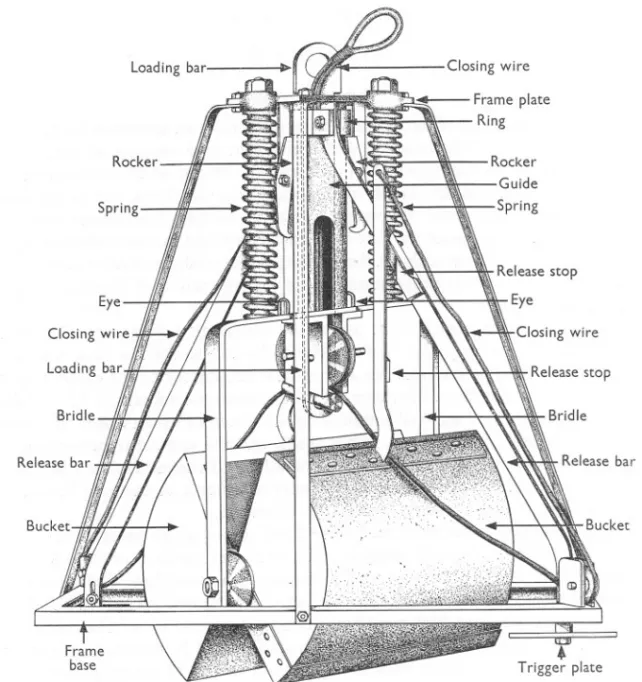
(2) w. SMITH. 258. AND A. D. McINTYRE. It is carried by an inverted U-shaped bridle which is attached at both ends of the axle. The horizontal bar of the bridle is bored so that the bridle and bucket can move vertically on a tubular guide (Fig. I) fixed at the centre of the frame. This vertical movement is limited to 3 in. by stops. Two springs. Loading bar. Rocker. Closing wire. Rocker Guide. Spring. Spring. Eye. . Trigger plate. Fig. I. Diagram of sampler, in the unloaded position (overall dimensions, 26 x 26 x 20 in.).. (each loading 5° lb./in.) are placed so that their lower ends bear against the bridle and their upper ends against the underside of the frame plate. Each spring is located by an internal rod on the bridle (Fig. 3A) which slides into a tube attached to the frame plate. To the middle of the bridle is secured a loading bar which passes up the centre of the guide and projects through the frame plate. In loading, this bar is pulled up by means of a loading lever,.
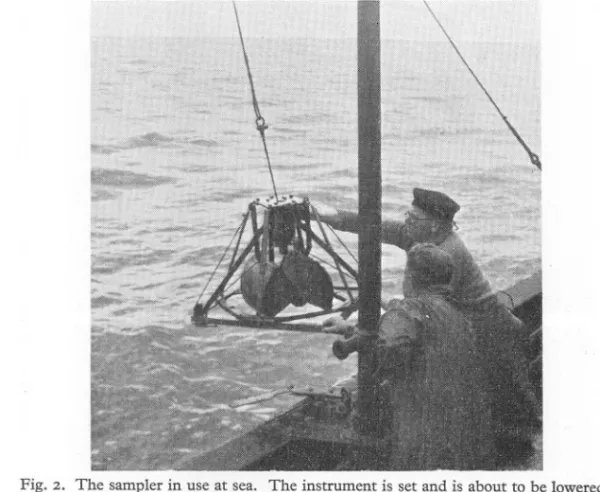
(3) A SPRING-LOADED. BOTTOM-SAMPLER. 259. and the bucket is raised against the pressure of the springs until two eyes on the bridle come within reach of two rockers attached to the frame plate. The rockers engage in the eyes and hold the bucket in the loaded position against the pressure of the springs. The faces of the rockers bearing in the eyes are set at such an angle that a horizontal component of the pressure tends to, free the rockers from the eyes, releasing the bucket. This movement of the rockers is prevented by a ring against which the upper ends of the rockers bear when. Fig. 2. The sampler in use at sea. The instrument is set and is about to be lowered. The loading bar has been removed.. the apparatus is in the loaded position. The ring is fixed by knuckle joints to two release bars which terminate in trigger plates below the frame at diagonally opposite comers. When the sampler strikes the bottom squarely, the pressure on both trigger plates causes the ring to move up. This allows the rockers to swing free of the eyes and the open bucket is forced into the soil by the springs. When the instrument is set the loading bar may be removed (as in Fig. 2), but when the sampler is in continuous use it has been found convenient to leave the bar in position. A wire attached to the end of each arm of the bucket passes over pulleys on the frame and bridle, up through the centre of the guide, and is shackl~d above the frame plate to the warp from the ship. When the sampler is being lowered the closing wire bears the weight, and the bucket is prevented from closing by 17-2.
(4) IV 0\ 0. ~ C/) ~ ...... >-J ~ )Z t:) ?> t:) ~ (j ...... Z >-J ><: ~ tI1. A. B. Fig. 3. A, the bucket, closed. B, the sampler, closed, with the loading bar in position..
(5) A SPRING-LOADED. BOTTOM-SAMPLER. 261. stops on the arms bearing againstsimilar stops on the releasebars (Fig. I). The release of the bucket when the sampler hits the bottom disengagesthe arms from the stops so that hauling on the warp first closesthe bucket, then lifts the sampler off the bottom, The bucket has a radius of 17t em. and a length of 32 em., and is constructed of 1 in. (3'2 mm.) sheet metal. The area of bottom sampled is lo m.2. The top of the bucket is covered with fine-mesh gauze. The arms which are riveted to the bucket are 28 em. long and are of I x 1 in. flat iron. The bridle is made from two pieces of I1 x t in. flat iron bent at right angles, and welded. to a t in. plate 3 in. square which is bored to slide on the central guide. The guide is IOin. long and of Ii in. diameter tube. It has a i in. slot on each side extending upwards from the lower end for 5 in. The base of the frame consists of four bars of I x 1 in. angle iron 26 in. long, and from each side of the frame an upright bar of I x 1 in. flat iron runs to the frame plate, which is 8 in. square and. 1 in.. thick. The angle iron used for the base proved to be too. light, and was strengthened by cross-bars (see Figs. 2 and 3B). The loading bar is I x 1 in. flat iron and has a loop welded to the top. The apparatus is 20 in. high and weighs IOOlb. (45 kg.). RESULTS Previous work (Thamdrup, 1938) indicates that the van Veen is more efficient than the Petersen grab, and experience at Aberdeen with the van Veen, Petersen, and Plymouth samplers has shown that the van Veen was the most satisfactory over a wide range of conditions. The van Veen has thus been in general use at Aberdeen, and since it is obvious that any new sampler must be compared with the most efficient of the older models, tests have been carried out using the lo m2. van Veen and the Smith sampler. The samplers were used from the ship at anchor on various grounds and at different depths, the order of use being determined from a table of random numbers. The volumes, in litres, of material taken in each sample are set out below: (I) Domoch Firth, 9 m, depth, muddy sand Smith sampler 3'75 3'5 2'5 3'25 v, Veen sampler 4'0 3'5 3'0 2'5 (2) Domoch Firth, 13 m, depth, muddy sand Smith sampler 4'5 2'5 4'5 4'5 v, Veen sampler 2'25 2'5 2'25 2'0 (3) Domoch Firth, 24 m. depth, muddy gravel Smith sampler 4'75 4'75 5'0 4'0 v. Veen sampler 3'25 4'0 3'0 2'75 (4) Domoch Firth, 24 m, depth, mud Smith sampler 5'0 4'0 4'75 5'5 v, Veen sampler 3'0 3'0 3'5 3'25 (5) Aberdeen Bay, 37 m. depth, hard sand Smith sampler 3'5 1'5 4'0 4'0 v. Veen sampler 2'0 3'5 2'5 2'0. Mean 3'25 per .'. m.' Mean 3'25 Mean 4'0. per. Mean 2'25. .'0 m". Mean 4'6 per .'. m" Mean 3'25 Mean 4'8 per Mean 3'2 3'5. 3'5. 3'0. Mean 3'3 per. 1'5 0'5 3'5 Mean 2'2. .'. m" -k m".
(6) W. SMITH. 262. AND A. D. McINTYRE. For test number (5) above, a detailed analysis was made and the frequencies of the various organisms taken are shown in Table I. In nearly every comparison the Smith sampler gave a higher population estimate, and statistical analysis showed that the difference between the two samplers in this respect was significant at the I % level. TABLEI Aberdeen Bay. Depth 37 m. Bottom, hard sand. The mean numbers of animals taken in seven dips with the van Veen and Smith samplers respectively. van Veen sampler. Gastropods Nucula Thyasira Montacuta Cyprina Dosinia Venus fasciata T ellina fabula Abra Gari fervensis Cultellus Thracia Other lamellibranchs Ophiuroids Echinoids Crustacea Aphroditidae Goniada Nepthys Lumbriconereis Other errant polychaetes Ariciidae Spionidae Magelona Cirratulidae CWorhaemidae Other sedentary polychaetes. Smith sampler 2'0 23'0 1'3 1,6 2'3 13'6 3'9 6'1 6'1 1'1 0'4 2'3 0'7 4'4 4'0 6'0 2'4 3'3 2,6 1,6 1'1 5'1 2'0 1'0 2'0 1,6 0'9. 0'1 20'4 1'1 2'7 1'3 11'1 2'3 5,6 3'9 1'3 0 1,6 0'3 3'0 3'9 3'4 2'0 2'9 1'7 1'3 0'3 2'9 0'7 0'3 1'7 1'3 0'7. On two occasions the new sampler was compared with atm.. 2. Petersen grab,. with the followingresults (volumes in litres): (I) Smith Bank, 37 m, depth, fine sand Smith. t m.". sampler Petersen. sampler. 4'0 3'0. 6'0 4'0. 5'0 5'0. 4'0. 4'0. 4'0. 3'5. 4'0. 5'0. Mean 4'4 Mean 4'0. per per. .'0m.". t m.". (2) Off Smith Bank to northwest, 73 m. depth, mud Smith. sampler. 2'5. 2'0. l m." Petersen sampler 2'5 3'0. 4'0. 5'0. 2'5. 2'0. Mean 3'0 per +0 m," Mean 2'75 per t m,". It is of interest that the smaller sampler tended to take a larger volume. Apart from such specific tests, an indication of the relative performance of the two samplers is given by figures collected during routine surveys over.
(7) A SPRING-LOADED. BOTTOM-SAMPLER. 263. a period of several months. The followingcomparisons are from recent data (volumes in litres): (I) Smith Bank, 37-40 m. depth, fine sand Smith sampler 52 dips Mean volume 3'9 Range 1'0-7'0, v. Veen sampler 165 dips Mean volume 3'4 Range 0'25-6'0, (2) Smith Bank, 37-40 m, depth, shell gravel Smith sampler 9 dips Mean volume 5'0 Range 4'0-7'0, v, Veen sampler 15 dips Mean volume 4'5 Range 0'5-6'0, (3) Off Smith Bank to northwest, 62-73 m, depth, mud Smith sampler 9 dips Mean volume 3'0 Range 2'0-5'0 v. Veen sampler 9 dips Mean volume 2'1 Range 0'5-3'5.. DISCUSSION. The abovetests show that the new sampler is more efficientthan the van Veen in the areas visited. Perhaps the most significant feature, however, is not shown by these data. The opportunity to comparethe two instruments usually arose during a general bottom-sampling programme. On several occasions the comparison had to be abandoned because bad weather prevented the van Veen from operating. On each occasion,however, it was found possible to complete the programme with the Smith sampler only, which continued to give samples of reasonably consistent volume even under the most trying weather conditions. The success of the new sampler in bad weather is .due to its inability to release until resting squarely on the bottom. If it strikes the bottom unevenly only one of the release arms is operated and, since the arms are connected to the ring by knuckle joints, movement of one arm merely causes the ring to pivot. Release cannot take place until the other arm is also raised, i.e. until the apparatus is settled on the bottom. A distinctive feature of the new sampler is connected with its method of closing. A great part of the superiority of the van Veen over the Petersen grab is probably due to the leverage effect exerted by the arms in closing the jaws. This leverage effect is greatest when the van Veen is fully open, and decreases as the jaws close and the arms come together. In the new sampler, however, the pull on the arms is downward, and the leverage effect increases as the sampler digs into the ground and reaches a maximum as the jaws come together. Another feature of the new sampler is the gauze covering on top of the bucket. Because of this the down-wave produced on descent is relatively small, and this may help to account for the high proportion of active surfacedwelling forms, such as euphausiids and amphipods which have been found in the new sampler. In surveys of Smith Bank, for example, the new sampler took on the average twice as many amphipods as the van Veen. Samplers with a solid upper surface must set up a considerable down-wave, and this will tend to wash small surface animals out of the sampler's reach. It is also important.
(8) 264. W. SMITH. AND A. D. McINTYRE. that, sincethe bucket closescompletely,no material is lost in hauling. Further, the mesh of the gauze covering is considerably finer than that of the gauze used in sieving. In its present form, the theoretical maximum depth to which the new sampler can bite is 7 em., and it is of interest to note that the depth to which it has in fact been digging, calculated from its average volume of 41., is 6'7 em. It is felt that there is a considerablereserve of power in the sampler, and alterations are being contemplated which would give an increased depth of bite. Once the routine of loading and operating the new sampler has become familiar, it can be used almost as quickly as the van Veen. Working from F.R.S. Explorerat a depth of 4° m. the averagetime taken to complete three dips with the van Veen was 14min., and with the new sampler 15 min.,a negligible difference. SUMMARY. A new bottom-sampler is described. It covers a surface area of lo m.2 and digs toa depth of almost 7 em. The sampler consists of a bucket which is driven into the soil by springs and is closed by the hauling in of the warp. The apparatus can sample only when resting squarely on the bottom, and was designed to work on hard sand and in bad weather. It has been shown to be successful in both these respects. Specific tests and experience under various conditions show it to be more generally satisfactory than any of the other samplers used. REFERENCES HOLME,N. A., 1949. A new bottom-sampler. J. Mar. bioi. Ass. U.K., Vol. 28, pp. 323-32. THAMDRUP,H. M., 1938. Der van Veen-Bodengreifer. Vergleichsversuche iiber die Leistungsfiihigkeit des van Veen- und des Petersen-Bodengreifers. J. Cons. into Explor. Mer, Vol. 13, pp. 206-12..
(9)
Figure
Related documents
Conclusions: Based on the results of the study, drama yielded more positive outcomes in both knowledge gained and in attitudinal change among in-school adolescents than
Systemic symptoms of dysmenorrhea (fatigue, headache, nausea, vomiting, lack of energy, syncope) de- creased in the fenugreek seed group (p<0.05).. No side effects were reported
quences for Antarctic-India break-up". "The Jurassic history of the Africa-Antarctica Corridor – new con- straints from magnetic data on the conjugate continental
Key Words: Analytic training, auditory learning, aural rehabilitation, cognitive changes, computer assisted therapy, interactive communication strategies, listener confidence,
Among the others, erosion control and natural hazards are the most critical issues in coastal management, because they can seriously damage the environmental and
Lucy came across some old school books yesterday. I came across my old love letters in a shoebox. I came across Julie’s glasses in the bathroom. Get on with means: 1) Have a
venereal transmission of gonococcal infec-. lions
