APPLICATION OF A CUSTOMER RELATIONSHIP
MANAGEMENT SYSTEM FOR A LARGE INDEPENDENT
TRAVEL AGENT
R. Shaw, A.S. Atkins
Faculty of Computing, Engineering and Technology, Staffordshire University, Octagon, Stafford, UK
E-mail: [email protected] [email protected]
ABSTRACT
Customer Relationship Management (CRM) is a popular catchphrase and is perceived by many companies to be an important factor in achieving competitive advantage. CRM is considered to be one of the four key areas of emerging digital firms, seamlessly linking manufacturing plants, offices and marketing in a global economy. CRM has unfortunately been characterized with over 60% failure during 2001. The paper describes the successful implementation of a pilot CRM project for a large independent travel agent operating in the UK with a turnover of £500 million and a work force of over 2,000. The paper describes the CRM trial, supported by a Virtual Private Network (VPN) which showed an increase in sales of £150,000 which, if implemented across the business, would have increased sales by £1.2 million. The paper provides an example of a successful implementation in an area which is categorized with a high failure rate of CRM implementations.
KEYWORDS
Customer Relationship Management, Data Warehousing, Data Mining, Mobile Technology, Homeworking.
1.
INTRODUCTION
Although Customer Relationship Management (CRM) has become a popular buzzword in IT, it has roots from within business strategy and has evolved from relationship marketing [Marsh, Atkins 2005]. Following the Pareto principle, it is an accepted rule that 80% of a companies profit is generated by 20% of its customers and the cost of obtaining new customers is between four and seven times higher than the cost of retaining existing customers [Findley 2000, Dyche 2002]. Organisations can increase profits between 20 and 125% by retaining just 5% of their most profitable customers [Payne 2000]. CRM can be defined as “the infrastructure that enables the delineation of and increase in customer value and the correct means by which to motivate valuable customers to remain loyal” [Dyche 2002] and is a means by which businesses can achieve a “one-to-one” relationship with each customer. In the case of small businesses, this relationship is built up over a period of time by getting to know each individual customer through repeated contact (for example local shops, garages, barbers etc.) [Barnes 2000]. However, for larger businesses, this personalised relationship is difficult to achieve across the whole company in traditional business operations. It is through the use of data warehouses and data mining technologies that CRM has become possible, particularly for large businesses and some SME’s. The technological changes needed to meet growing customer expectations are pushing businesses into adopting IT supported CRM. CRM is one of the four major segments of the emerging digital firm, the others being Supply Chain Management (SCM) systems, Enterprise systems and Knowledge Management Systems respectively [Laudon, Laudon 2004].
It has been suggested that there are three phases in a Customer:Business relationship life cycle, namely customer acquisition, enhancement of customer satisfaction and customer retention [O’Brien, 2004]. CRM is a tool that is used to support or develop these phases and consequently many larger businesses are being pushed/pulled into implementing IT based CRM systems to maintain competitive advantage. Many leading
firms such as Wall-Mart, Proctor & Gamble, Dell Computers and AVNET Marshall are extending their business networks to form digital firms by electronic integration with suppliers and customers.
Research by Seybold and Marshak [1998] suggests that there are five stages to building an IT-supported CRM which are outlined as follows:-
1. Make it easy for customers to do business with you 2. Focus on the end customer for your products and services
3. Re-design your customer facing business processes from the end customers point of view
4. Wire your company for profit by designing a comprehensive, evolving electronic business architecture
5. Foster customer loyalty.
2. IMPLEMENTATION OF A VIRTUAL PRIVATE NETWORK TO
SUPPORT CRM ANALYSIS
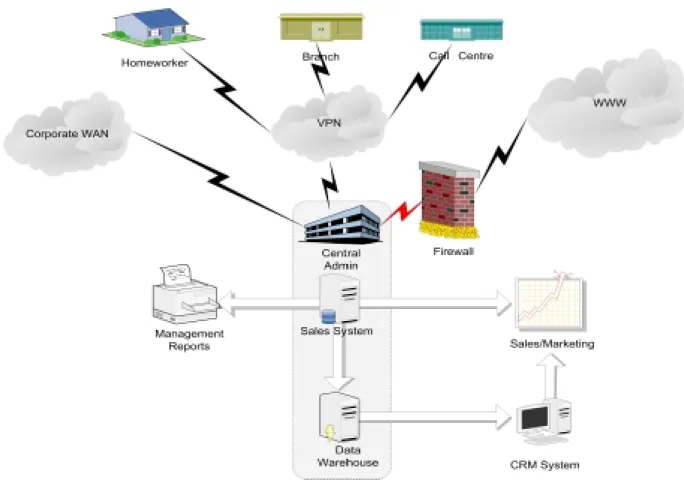
A large independent travel agent consisting of three main business units - Retail, Call centre and Home worker - has recently followed a period of expansion through acquisition to build market share within the UK. The Retail business unit consists of 92 high street shops (branches), which is the traditional sales channel of the company, using IP-ViewData. IP-ViewData is a commercial data base booking system used extensively in the UK and enables travel agents to view available holidays, prices etc. and to book or sell the holiday to their customer. Each shop has a centralised sales system, running across a Virtual Private Network (VPN) allowing the sales records to be stored in a central data repository, allowing for CRM analysis to be performed as illustrated in Figure 1.
The homeworker business unit consists of over 600 sales people. The customer contacts the homeworker by telephone and using IP-ViewData the homeworker is able to view and book available holidays. The customer has usually seen the holiday advertised on Teletext, or in a newspaper. The sales person talks the customer through the sales process, adding value to the purchase with such items as insurance, car hire etc. and the sales records are stored in the centralised system using a VPN as illustrated in Figure 1.
In the case of the call centre, the company operates three call centres which work in a similar way to the homeworker business, except that all of the staff are based in one place. Holidays etc. are advertised via Teletext, together with the telephone number of the call centre. Customers contact the call centre and are taken through the selling process in exactly the same way as with homeworkers.
The paper describes an evaluation of IT based CRM as part of the travel agent’s business strategy. The business has a turnover of approximately £500 million per annum and a workforce of over 2,000. The company has recently embarked on a period of expansion by the acquisition of small travel agents businesses within the UK. As a consequence of these acquisitions, the company had a collection of disparate sales systems and an infrastructure that was not amenable for the use of CRM analysis. The cost of maintaining these incongruent sales systems and the difficulties in producing meaningful information for the business managers was placing an ever increasing burden on the business. It became clear that the disparate sales systems and the ISDN based network were hampering the Travel Agent from integrating its separate business units and from expanding its business. Prior to the VPN implementation, the increasing usage of corporate e-mail, Intranet and growing Internet access was causing an increase in communications costs. Consequently there was a drive to reduce communication costs which were continually rising and also to prevent a sharp increase in costs if the central system was implemented using the existing ISDN based infrastructure.
Figure 1. Representation of CRM connection into the VPN
To control these costs a leased line VPN was proposed which, based on the current and predicted costs, would give savings of £237,600 in the first year and £716,800 in subsequent years. The VPN would also allow controlled access to the Internet and provide for the development of mobile systems to customers, which is considered by the company as a possible future revenue stream. The introduction of the centralised sales system, running across a VPN has allowed the Travel Agent to develop strategic initiatives to strengthen the business and enhance its market share by future e-Sales developments of internet and m-Commerce. Following the installation and commission of the new sales system, a CRM pilot project was run to allow the business to ascertain the benefits of implementing a full CRM system. The cost of migrating the system to a VPN to enable CRM analysis to be performed is outlined in Table 1.
Installation costs Pre VPN operating costs Post VPN operating costs VPN £101,200
PC £368,000 Server £10,000
Total cost £479,200 (b) £1,200,000 (a) £483,200 * (c)
Savings year 1 £237,600 [a-(b+c)] Savings year 2 …. £716,800 [a-c]
* Note. Consists of yearly line rental and maintenance costs for VPN network
3. CUSTOMER RELATIONSHIP MANAGEMENT TRIAL
Following completion of the installation of the VPN system, which was completed in a phased approach and implemented at five sites per week over an 8 month period, the CRM trial was started.
3.1 Stage 1 - Data extraction
The implementation of the new VPN based system has now enabled the total sales data for the company to reside in a central repository, which was a major problem with the original ISDN based system. To be able to initiate a CRM trial the data needed to be extracted from each of the original stand-alone in-store systems and merged into a centralised data base. This process was carried out by a third party vendor over a period of 2 weeks. The data was extracted using Structured Query Language (SQL) on the centralised data to provide a sub-set of data required for the CRM trial.
3.2 Stage 2 - Data cleansing
During the initial data extraction, some routine data cleaning was performed, specifically to ensure that blank records and data that had been used as part of sales staff training was not extracted from any of the stand-alone systems. Data cleansing was also required on the extracted data to ensure no erroneous results were obtained, using a specialist CRM company. The company cleaned this extracted data, which involved the removal of duplicate records, entered where someone had booked separate holidays from different locations, records with data missing and records with incorrect data, for example a mismatch in address and postcode. The cleaned data was then imported into the CRM system and a number of trial runs were performed to ensure the data cleansing and validation was performed correctly, this process taking approximately 3 weeks to complete. As a final check to ensure that this CRM data was valid and accurate, specific reports were generated and matched against the same reports from the original sales systems, for validation by staff as depicted in Figure 2.
3.3 Stage 3 – Processing
Once the CRM system had been created and the data verified, the trial system went live. To ensure minimal disruption to the business during the trial, data was selected from only ten stores (those nearest to the Administration Head Quarters). The data used in the CRM trial contained records for all holiday types and destinations. It was decided to use a sub-set of data to target cruise customers, as they were the most profitable segment, with the highest profit margin and they were few enough in number to ensure that any sales increase would not overburden the sales staff.
3.4 Stage 4 – Evaluation
A specific segment of cruise customers, (approximately 2000) were selected for the trial, and customer specific letters and cruise literature were sent to each one. Owing to the existing structure of the business, responses to the trial were not collated centrally and consequently specific figures for the response rate were not obtained. A formative indication from the staff associated with the branches used in the trial indicated that there was a higher response rate than the normal mass marketing mail shot. Royal Bank found that effective segmentation of customers generated a response rate of 30%, compared to 3% for the banking industry [Laudon, Laudon 2004]. One unexpected benefit noted was that a saving in postage costs of £10,000 was made when the CRM trial postage costs were compared against the normal mass mail-shot costs.
In order to make comparative analysis of the sales figures to determine the effect of the CRM trial, a 4 week trading period was used. This allowed for a comparison of the same trading period from the previous year to eliminate any seasonal variation. From the analysis, it was determined that the CRM trial; gave an increase
in sales of £150,000, compared to the previous years figure and if this was applied throughout the business this would have increased sales by £1.2 million per annum.
The CRM system was initially populated with a one-off data extraction from historical sales. During the trial period, the CRM system was not refreshed with new sales data as the trial only required one initial data extraction. If a full CRM system had been implemented at a cost of £350,000, as outlined in Figure 2 (stages 11 and 12), it was anticipated that further refinements would result in increasing sales. However because of the cost associated with a full roll-out of the CRM system and associated maintenance costs of 12.5% pa (subject to negotiation) the trail was postponed.
4.
CONCLUSION
It is commonly accepted that CRM implementations have a failure rate of 60-70%. Various reasons have been given for these failures [Turban, et al 2001], among them:
• Failure to identify and focus on the business specific problems
• Lack of active senior management (non-IT) support
• Poor user acceptance
• Trying to automate a poorly defined process
It was accepted by the businesses senior management that the trial was a success, and proved that CRM was a valuable tool for increasing sales. Further, the implementation of the CRM system was a success. Following the trial, a post project review was held to determine how and why the implementation was successful, to ascertain best practice for the company. The following factors contributed to the success of the implementation and trial:
• A phased approach to implementation
• A good understanding of the business and its processes
• CRM champion (Marketing manager)
• Small segment evaluation
This trial has shown that implementing CRM systems can give businesses increased sales and profit, specifically by targeting those customers who provide the maximum margin to the business. Further work is required to analyse the effect of a data refresh on the CRM system and to perform CRM analysis on further customer segments.
REFERENCES
Barnes, J. G., “Secrets of Customer Relationship Management” McGraw-Hill, 2001
Dyche, J. “The CRM handbook”, Addison-Wesley, 2nd printing, March 2002
Findlay, C., 2000. CRM: What’s it all about? Latitude Solutions Limited. From http://crm.ittoolbox.com/documents/documents.asp?i=1222
Laudon, K. C, Laudon, J. P., Management Information Systems, Pearson Prentice Hall, 2004
Marsh, A., Atkins A. S., ‘Customer Relationship Management in an Electronic Economy’ International Conference on E- business and Telecommunication Networks (ICETE) Vol 1, pp 103-110, August 2004 ISBN 972-8865-15-5
O’Brien, J., Management Information Systems, 6th Edition, & Hill, 2004
Payne, A., 2000. Customer Relationship Management. Key note address to the inaugural Meetign of the Customer Management Foundation, London. From http://crm.ittoolbox.com/documents/documents.asp?i=922
Seybold, P. B., Marshak, R., “Customer.com: How to create a profitable business strategy for the internet and beyond”. New York : Times Books, 1998.
Turban, E., McLean, E., Wetherbe, J., “Information Technology for Management”, 3rd Edition, While International, 2001