UNDERSTANDING THE CONCEPT OF CLOUD COMPUTING, IT’S ADOPTION & SECURITY CONCERNS IN
ORGANIZATIONS
Jaipal Marripally1, Dr Arvind Kumar Sharma2
Department of Computer Science and Engineering 1,2
OPJS University, Churu (Rajasthan)
ABSTRACT
Cloud computing is worldview spurting as of late with its "pay-as-you-go" IT planning of action as its
lead. Its quality is getting to be plainly obvious wherever in the media and in these present reality
organizations that have officially embraced it. This work expects to pick up knowledge and see what is
going on account of Indian market towards adoption of cloud computing early technology. A specific
level of mindfulness is as of now introduced among Indian organizations in which Security depicts itself
as the hindrance for firms hoping to incorporate cloud services. Early adopters recognize a few
components worth specifying for this technology to end up plainly more appealing and as a major
aspect of its steady advancement. The effect of another technology on economic development can be
seen just when it is broadly utilized and diffused in a general public. Discussing dissemination, it is the
aftereffect of an affix of choices to begin making utilization of the new technology; such choices come
generally from an examination of its uncertain advantages and the comparing expenses of adoption. For
financial specialists, analyzing the components of development, and for technology designers, it is basic
to get a grip of the variables behind the decision whether to receive it or not.
1. CLOUD COMPUTING: AN OVERVIEW
A few cloud sellers, clients and investigators characterize cloud computing in basic terms as IT services
prepared to do progressively scale themselves as required and are in the domain of an outsider.
Cloud computing passes on to essential economic ramifications:
Drift of capital consumptions (CAPEX) to operational costs (OPEX)
Implied diminishment in OPEX identified with framework operations.
A development from CAPEX to OPEX brings down generously the intrinsic monetary impediments for
spending should be distributed keeping in mind the end goal to obtain new equipment and
programming licenses for a specific venture, which thus yields a settled cost in spite of the venture
achievement. Then again, for those running under an outsourced way (oversaw facilitating), commonly,
cause on introductory charges comparing to operational expenses of one month and an agreement of
one year of expenses ahead of time [1].
So as to be financially savvy it is critical to boost utilization out of each and every server. The most
recent technological change that fills in as an impetus to achieve a high utilization rate and which is the
center factor in charge of boosting the Cloud as the real IT worldview is virtualization. This technology
fundamentally empowers a physical server to be parceled into a few virtual servers. Thusly, each of
these virtual servers acts all in all individual server fit for working with an operating framework and
complimentary applications. As we will see, these single servers are the fundamental units that can be
offered as a cloud computing administration [2].
Another normal for the Cloud is its capacity to act flexibly (scale progressively) as indicated by request,
this is, as prerequisites develop (or contract) so does the assets. Any normal application begins up with
an essential arrangement of assets and in face of pinnacle conditions a greater amount of these assets
are required [3]. Keeping in mind the end goal to keep up a decent execution notwithstanding amid
crest blasts, under the genuine model (not with the Cloud), one must form enough limit, this implies
over-stocking equipment for the particular undertaking. The lead time for conveying these committed
equipment assets takes significant time (weeks or even months). Utilizing a cloud situation, a few assets,
as of now virtualized, can be added or discharged in light of use stream in a programmed way. On
account of this automation, the expenses caused are combined with the use of the additional assets
only amid the time they remain conveyed.
2. EMERGENCE OF CLOUD COMPUTING IN ORGANIZATIONS
Cloud computing was not conceived completely fashioned in a squint from technology existing in 2005.
Over forty years of its establishment technologies bolster it. The procedure to accomplish the real stage
has been evolutionary and includes differentiating fields. This heap of advances delineates an innovative
move on how IT will function in a future. Around ten years prior or somewhere in the vicinity, the Cloud
as an element was indicated oftentimes in application charts as a symbol of the Internet, which thus
The protocol TCP/IP (Transmission Control Protocol/Internet Protocol) was composed as the
consequence of the push to institutionalize organizing technology to give association among frameworks
and turned out to be broadly utilized since the formation of the Internet in 1980s. With the control of
the web and HTTP since late 1990s, the circumstance handed again over professional of a thin-customer
model. This past stride was fundamental before doing the move into cloud computing age. Some other
noteworthy and not generally obvious stages merit saying, similar to the chain of movements from
centralized server to customer server and afterward into web; the other one is the advancement of how
server farms are outlined, sent, controlled, worked and overhauled.
The product part of the advancement is involved three surges of development: Virtualization, Service
Oriented Architecture (SOA), and Software-as-a-Service (SaaS). SaaS is more a plan of action
development as opposed to a technological one. Typically programming for undertakings was offered
under an existence time authorizing model, as such, the client purchased the privilege to make
utilization of a specific application amid an unspecified timeframe for a settled (and consistently high)
cost. Also, clients needed to pay around 18 for each penny a greater amount of the aggregate cost for
upkeep and support, with which they got application redesigns and coordinate help as an
administration. Under SaaS model, clients don't have to purchase the product, rather, they lease it. The
material expense is relative with its utilization. A client pays for access to an application for a specific
period (days, weeks, months, years), with the choice of ending the use at whatever point she chooses.
That is the reason SaaS is viewed as a compensation as-you-go or on-request model [5].
3. LAYERS OF CLOUD COMPUTING
SaaS was renamed after a previous model presented quite recently, in which an application could be
leased specifically from an Application Service Provider (ASP). It was on account of this antecessor that
the idea of pay-as-you-go was right off the bat connected into the product business, along these lines
decreasing the underlying capital speculation required beforehand in the conventional model in advance
of specified. Another preferred standpoint of drawing in into this model was that you disposed of the
way toward procuring equipment and programming since the services were immediately accessible and
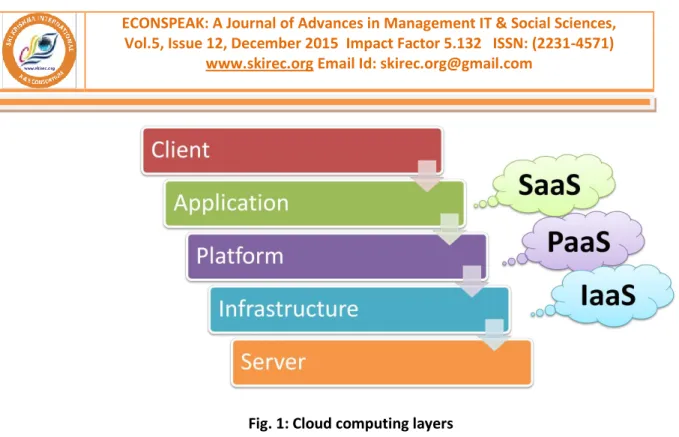
could be initiated as required. The request in which we will display the layers involved in cloud
computing offering is in connection with adaptability and unpredictability levels to be overseen in the
Fig. 1: Cloud computing layers
INFRASTRUCTURE AS A SERVICE (IaaS)
The first in the rundown is called Infrastructure as a Service (IaaS), which gives the most measure of
adaptability adjoin likewise greater intricacy. The client can get a handle on control over any virtual
machine picture, offered by an IaaS supplier, running the operating arrangement of her inclination and
initiate it at whatever point she needs. An engineer can arrange these pictures to run any application.
Transmission capacity, as a commodity, is consumable and charged in view of the travel to/from the
framework. Additionally, stockpiling is generally accounted per gigabyte in a month to month premise.
The immense adaptability of IaaS originates from the level of control one can saddle over the assets
utilization alongside its relating interest of ability required to direct the operations adequately [6].
STAGE AS A SERVICE (PaaS)
In the following level we discover PaaS, which allow less communication with the mainstays of the
framework. At the end of the day, association (organization) with the virtual operating framework is not
required. The client does not have to stress over the fundamental stage (OS operations) while creating
applications. Nonetheless, the client needs to accomplish the programming dialects accessible from the
supplier.
PROGRAMMING AS A SERVICE (SaaS)
SaaS assigns those applications and services accessible on request as we have just said some time
recently. Also, there is another class called Framework as a Service (FaaS), despite the fact that not
that the likenesses it imparts to SaaS. On the specific instance of FaaS, it is a complimentary
environment for a specific SaaS framework to degree its base capacities by coding further functionalities
utilizing the structure of that specific application supplier.
PRIVATE CLOUDS
Otherwise called inside clouds or corporate clouds, these are alterations of standard clouds where the
fundamental server farms are situated on premises and oversaw by an association to give cloud
computing services to its individuals. These assets are not offered to basic open. A private cloud can
work in a lower scale however fundamentally the same as an open cloud when an association has
enough supporters and adequate general limit. With a specific end goal to work private cloud,
organizations must experience critical changes to their operations, for example, making components to
move its applications or information into an open cloud when need arrives. In spite of the fact that, the
alternative of executing a private cloud may be considered as a perfect arrangement, there are worries
that organizations ought to break down to begin with, some of them are:
Reduced scale can't accomplish economies of scale.
Legacy frameworks and applications are difficult to migrate into clouds. These must should be
re-classified to work all the more proficiently under an institutionalize structure.
In-house does not really converts into greater security. This issue has been the most huge for
endeavors hoping to have their information and frameworks running in server farms behind their
restrictive firewalls. Clearly, speculation and exertion towards security fixing must be spent by them.
HYBRID CLOUDS
As the term may suggest, these are usage that join perspectives from open and private clouds. A
situation where it could be reasonable to pick this sort of cloud is the point at which the quality of a
private cloud as far as limit has been drained and additional limit must be procured from elsewhere
off-premises [7].
4. WAYS TO ADOPT THE CLOUD
Conceivable situations where cloud computing execution bodes well are, for instance, for a situation
where an application should be created and sent for an express brief timeframe. Thus, the association
smothers the underlying capital cost for provisioning the equipment expected to run it. At whatever
point an application is running, scale necessities have a tendency to shift in various ways. Once in a
money related or exchanging application that encounters request blasts at whatever point showcase
opens and closes. Another run of the mill circumstance where sites persevere through high movement is
amid regular shopping periods, for example, Christmas or the next days of Thanksgiving. These
vacillations require extra limit should applications can perform consistently ensuring normal execution
to every one of its guests.
On the off chance that you consider to arrangement sufficient foundation to deal with tops, the costs
acquired will increment by a similar factor of the limit overabundance. Proficiency is the main preferred
standpoint picked up by buying vast volumes of foundation; be that as it may, contrasted with the
general size of the requested speculation to adapt to the pinnacles, benefits are negligible. Give us a
chance to examine this announcement; at whatever point an activity burst (top) shows up, the entire
hidden foundation will achieve greatest utilization rates for the application (site) on request, be that as
it may, when the pinnacle smoothes the additional framework will remain lingered or underutilized.
Regardless, with regards to cloud computing model, an association can deal with unsurprising crests
without acquiring in pointless extra expenses. At the point when movement flux emerges, you can
initiate the same number of complimentary virtual pictures to adapt to abundance loads. What is
awesome about this approach is that you just need to pay for the time these examples are performing
on the web (dynamic) [8].
An endeavor can pick up an economical use in a circumstance where non-critical applications can be
sent into the cloud, as it were, frameworks that are not vital to the general business. Inside an
association there are segment applications that fill inner needs, which are ideal possibility to be
migrated into a cloud environment, in this way sparing restricted IT assets. To say a case, reinforcement
stockpiling frameworks are basic for every day operations and expend profitable IT assets to keep up
them working; to mitigate this, a reinforcement framework can be obtained specifically from a cloud
specialist organization. Thusly, the reinforcement arrangement is a center competency of the supplier,
who can play out that assignment in a more economical and proficient way than utilizing the customer
organization’s IT assets. Liberated inward assets at that point can be centered on more vital business
ventures [9].
5. WAYS NOT TO ADOPT CLOUD COMPUTING
Albeit high anticipations are still upon cloud computing, this technology is not appropriate in each
specified some time recently, inheritance frameworks don't adjust flawlessly to cloud prerequisites.
Server farms intended for cloud computing are based on commodity foundation (equipment and
programming), in this manner, applications running on them are particularly outlined in light of that
reason. Institutionalization is in site with virtual machines running Linux or Windows as the operating
framework. Inheritance applications, unexpectedly, are sent on certain operating frameworks, for
example, VMS or HP-UX. Heritage applications were outlined some time before the presence of cloud
computing and with no further vision on setting them up to migrate to another foundation not quite the
same as its proprietors‟, consequently, significant endeavors must be done in the event that you need
them to be changed over into cloud-agreeable applications. It is recommendable to break down the rest
of the life of these frameworks and whether they are potential contender to work in the cloud,
assuming this is the case, the recommendable choice is to update and arrange them starting from the
earliest stage [10].
Other classification of frameworks that must be treated with wary are those that procedure private or
high-touchy data, for example, the ones utilized as a part of medicinal services division, where security
consistence is incredibly fragile and is managed, in the United States, by the HIPAA (Health Insurance
Portability and Accountability Act). Regardless of when this sort of touchy information is required to be
migrated, uncommon care and additional security measures must be taken to guarantee its assurance as
it is finished with data contained in the inward IT foundation.
For instance, how to ensure appropriate cancellation of secret data contained in computerized arrange?
As a rule, at whatever point computerized data is eradicated from a plate it is not accurately erased, yet
rather labeled for an erasure operation. At that point, let us say, when another application running in
the framework needs to spare information onto a similar circle, the likelihood this new information
overwrites the past data contained in that same position, already set apart as erased, the previous
information is then genuinely devastated. In the event that you have coordinate control or responsibility
for plate you can decide to reformat the circle to guarantee legitimate cancellation of past information;
in any case, for data contained in a cloud foundation, it is put away on circles imparted to different
levels. In this way, certain level of control is lost over how to appropriately manage information erasure,
as such; you can summon to erase a specific record, despite the fact that there is no real way to
6. PHENOMENON OF SECURITY AND VULNERABILITY IN CLOUD COMPUTING
A wonderful statement is brought into scene, which says that when utilizing a cloud benefit, aegis
against threats is set up nearer to where those dangers are discovered, in this way facilitating and
raising adequacy for ensuring clients against security dangers (e.g. malware). Notwithstanding, the
worry about security dependably strike first by addressing, is the cloud totally protected? Give us a
chance to turn our regard for a current episode happened in the turf of one of the greatest mammoths
and contenders of cloud computing services, Amazon.com; which demonstrates that the cloud is not by
any stretch of the imagination secure. In any case, it is more open in economic terms, with larger
amounts of effectiveness and versatility, and similarly (pretty much) protected as corporate computing.
A point on its support is that, because of the way that it is developed and worked by committed
procedures, it checks with the guarantee and assets to position itself in a high-minded cycle of ceaseless
improvement and building information from its deficiencies. Give us a chance to take the case of
business flying, which is not totally impenetrable either, in any case, it is currently significantly more
secure than it was earlier; and the reason is on account of it persevered on comparative obligations of
consistent change. Proceeding with this illustration, we don't stop flying thinking of it as is just 99.99 for
every penny safe; on a similar route, in the years to come, we ought not escape from cloud computing in
light of the fact that the rare events of an episode like the one encountered by Amazon.com [11].
Cloud computing is seen as the following borderland for corporate computing, despite the fact that its
comparing dangers in regards to outside suppliers oversee corporate data is ruining its adoption. As
indicated by a review performed by Symantec, scarcely one out of ten early adopter firms apply
unequivocal arrangements to ensure information insurance on the cloud, while the others are as yet
uninformed of the security dangers related.
The achievement of cloud computing lays on the confirmation and dependence that happen when the
information security bunches have the entire edge about the security position and measures of cloud
suppliers. Hazard and security specialists win distrustful about cloud computing suppliers towards the
mindful organization to protect their customers‟ data and security. Nonetheless, these specialists
cannot keep the use or access to technologies, for example, cloud computing, videoconferencing,
versatile, or social.
It is prominent not to dismiss cloud computing totally because of security issues alone. It is astute to
overpowering, in this manner organizations should make a point by point cost/advantage investigation.
Also, cloud computing suppliers may have IT security qualities that fit or outperform those in your
association. Changing to a cloud administration may in actuality upgrade your security position. A few
criteria to search for while assessing cloud suppliers are:
Construction of uniform IT environments. Normally cloud suppliers have no compelling reason to
work with the multifaceted design of inheritance frameworks and foundation that dwell in a few
organizations. It is a typical practice for cloud suppliers to manufacture their server farms utilizing
indistinguishable programming and equipment. In this sort of climate it is anything but difficult to
recognize a broken component and along these lines, respond immediately.
Comply with industry affirmations, which illustrate, at some degree, its security shrewdness. Cloud
suppliers are cognizant that issues identified with security are a portion of the principle deterrents
for spreading cloud computing services. As a countermeasure, a few suppliers are grasping
extensively acknowledged industry gauges, with the desire of managing some of these hindrances.
In spite of the fact that, these confirmations without anyone else's input are deficient, at any rate
give a factor to be mulled over. It merits saying that these accreditations were not made particularly
for cloud computing services.
Development of best in class danger insight and administration qualities. Among cloud services,
those identified with security have an expansive perspective of hazards because of the high
measures of activity handled. Endeavors may be intrigued should the supplier misuses this view to
obtain and advantage towards risk insight and the ability to respond immediately.
Having exceptionally qualified security faculty. Since organizations present important data to their
specialist organizations, it is smarter to concur with the way the supplier ensures it. This point has a
great deal to do with the level of aptitude and insightful of the staff accessible on the supplier's side.
After the investigation, the cloud independent from anyone else does not really respect pretty much
assurance. What is expected to do is an assessment on the level of assurance development of the
specialist organization, as it has been done regularly in a customary outsourcing operation. Considering
the cloud suppliers have officially manufactured each one of those perspectives, for example, actualizing
set up security forms, norms, rules, and acquiring prepared work force, to secure their key IT
Guarantee information insurance while in stream, utilize, store, and cancellation. There are
suppliers that supply safe information exchanges all through their turf by utilizing HTTPs.
Furthermore, few others offer information very still security, similar to encryption. Less work with
secure courses for information being used, at the end of the day, live inside the application; and
guarantee of appropriate information cancellation. What is requested are services fit the bill to
ensure the information amid its whole life cycle; this is, from the snapshot of information creation
inside the cloud environment, till its authoritative air. Notwithstanding, it is savvy to perceive that as
of now, cloud computing industry out and out is not yet at that required level.
Managing access and character control. A colossal test exists for endeavoring to keep get to and
character control through an air that might be included private foundation, open and private clouds.
A propensity among cloud clients is that they are learning on the best way to pick the most fitting kind
of cloud as per their particular needs. They think about choices from open, private and cross breed
clouds viewing at their cost, practical, and security necessities. These days, there exist more than 78
industry bunches taking a shot at the creation and meaning of norms for cloud computing, among them,
48 purport to have components concerning security. A case of these gatherings is the Storage Network
Industry Association (SNIA), which is attempting to concoct gauges identified with capacity and
information administration. Another is the National Institute of Standards and Technology (NIST), which
is an unmistakable benchmarks body in the United States, despite the fact that it has couple of
particular cloud computing working gatherings and distributions [12].
7. CONCLUSION
The fanatic of cloud services arrangements existing in the market these days give an abundant scope of
alternatives that can be connected to various IT necessities. As cloud computing market advances and
develops consenting to its customers‟ needs, offered arrangements will in the end achieve the level of
modernity required. To that regard, security issues are the primary deterrents yet to overcome, not just
to fortify the fundamental IT framework (server farms) possessing the supplier, yet in addition how to
manage interruptions in the coherence of the services and how to ensure benefit accessibility. Be that as
it may, as results envisioned, for some different organizations, benefits move the adjust towards
REFERENCES
1. Craig, Russell, et al. Cloud Computing in the Public Sector: Public Manager’s Guide to Evaluating and
Adopting Cloud Computing. s. l.: Cisco Internet Business Solutions Group (IBSG), 2009.
2. Howarth, Fran. Benefits of cloud-based service for web security. White Paper. s. l.: Bloor Research,
February 2010.
3. Babcock, Charles. Management Strategies for the Cloud Revolution. s. l.: McGraw-Hill, 2010.
4. Gartner. http://www.gartner.com/technology/initiatives/cloud-computing.jsp. gartner.com.
[Online]Gartner. [Cited: July 01, 2011.] http://www.gartner.com/technology/home.jsp.
5. Peters, Brad. Cloud Computing R.I.P? Forbes. [Online] May 05, 2011. [Cited: July 01, 2011.]
http://blogs.forbes.com/bradpeters/2011/05/05/cloud-computing-r-i-p/.
6. Enterprise Innovation. Despite warnings, 70% of cloud users don't care about security. Enterprise
Innovation. [Online] April 21, 2010. [Cited: July 01, 2011.]
http://www.enterpriseinnovation.net/content/despite-warnings-70-cloud-users-dont-care-about-security?page=0%2C0.
7. IDC. IDC Cloud Research. idc.com. [Online] IDC. [Cited: July 01, 2011.]
http://www.idc.com/prodserv/idc_cloud.jsp.
8. Software & Information Industry Association. Guide to Cloud Computing for Policymakers. s. l.:
Software & Information Industry Association, 2011.
9. Rosenberg, Jothy and Mateos, Arthur. The Cloud at Your Service. Greenwich: Manning, 2011.
10. Mather, Tim, Kumaraswamy, Subra and Latif, Shahed. Cloud Security and Privacy. Sebastopol:
O’Reilly Media, Inc., 2009.
11. Webroot. SaaS Secures in uncertain times. White Paper. s.l. : Webroot Software Inc., 2009.
12. Muduganti, Rukmini Reddy, Sogani, Shravan Kumar and Hexmoor, Henry. Washington, DC, USA:
IEEEComputer Society, 2005. ITCC '05 Proceedings of the International Conference on Information