A Routing Algorithm for Extending Mobile Sensor
Network’s Lifetime using Connectivity and Target
Coverage
Kalpana Murugan
1and Al-Sakib Khan Pathan
21Department of Electronics and Communication Engineering, Kalasalingam Academy of Research and Education, Krishnan Kovil, India 2Department of Computer Science and Engineering, Southeast University, Bangladesh
Abstract: In this paper, we propose an approach to improving the network lifetime by enhancing Network CONnectivity (NCON) and Target COVerage (TCOV) in randomly deployed Mobile Sensor Network (MSN). Generally, MSN refers to the collection of independent and scattered sensors with the capability of being mobile, if need be. Target coverage, network connectivity, and network lifetime are the three most critical issues of MSN. Any MSN formed with a set of randomly distributed sensors should be able to select and successfully activate some subsets of nodes so that they completely monitor or cover the entire Area of Interest (AOI). Network connectivity, on the other hand ensures that the nodes are connected for the full lifetime of the network so that collection and reporting of data to the sink node are kept uninterrupted through the sensor nodes. Keeping these three critical aspects into consideration, here we propose Socratic Random Algorithm (SRA) that ensures efficient target coverage and network connectivity alongside extending the lifetime of the network. The proposed method has been experimentally compared with other existing alternative mechanisms taking appropriate performance metrics into consideration. Our simulation results and analysis show that SRA performs significantly better than the existing schemes in the recent literature.
Keywords: Connectivity, Socratic, Lifetime, Network, Sensor, Target.
1.
Introduction
Wireless Sensor Network (WSN) has been a topic of numerous research works and practical implementation efforts in the recent decades. While we find a wide range of applications of it in the real-life scenarios, the research efforts on various issues of WSN and on various forms of it are still ongoing. That is why till today, this is considered as an emerging technology. In fact, reaching a saturation point of the research works in this and related areas will still take some years.
Today, practical applications of WSN include security surveillance, environmental monitoring, smart homes and offices, object tracking, traffic management, navigation, and so on. In some of these applications, the sensor nodes are randomly distributed (e.g., forest fire monitoring) while in some other applications (e.g., smart home), the deployment is made in a controlled manner. The number of sensors in a network and the coverage area of a network also vary from one setting to another. Irrespective of any particular application, lifetime [1], [2] of the network is always given the highest importance because, without ensuring appropriate network lifetime that an application scenario needs it for, there would not be any real utility of the network. Sensor
nodes are basically small wireless devices with limited power (i.e., battery life), radio transmission range, and storage capability. Hence, energy usage should be done as efficiently as possible.
Sometimes, a sensor node is called a mote. A mote can collect information, process it, and communicate with other connected nodes in the network. As the device is typically tiny in size and powered by (often) irreplaceable batteries, it is required to consume low amount of energy, operate in high density environment, should be somewhat autonomous to be able to operate in unattended conditions, and be adaptive to the environment where it is deployed in. Hence, in addition to the battery’s maximum service issue, other resource limitations and operational requirements also greatly define the network’s usability. When mobility is considered in such a network (that is formed by such tiny devices), the challenges increase by a great multitude. Hence, in spite of the availability of numerous works on lifetime issues, better or more efficient power management or longevity of the network would always be a topic of research interest for usual WSNs. If the tiny sensors get more advanced circuitries and power providing mechanisms in future, then the issue would be about how efficiently the lifetime could be increased with even relatively smaller devices with similar configuration that we take into consideration today. For other variations of it or specialized setting like for instance, Mobile Sensor Network (MSN), issues like network coverage and connectivity would be the integral aspects of the core research questions.
minimize the disadvantages. It has two steps: the anticipated configuration and the scheduling process. The authors in that work present a comparative study to illustrate the efficacy of that type, especially to optimize coverage when a large AoI is considered.
Mobile Sensor Network (MSN) is basically a cluster of movable sensors. Once the initial deployment is done (of mainly random type), the sensor nodes are capable of changing their locations. In general, mobility can be applied to all the nodes. It can be either active or passive. In case of active mobility, these sensors are capable of finding their own shortest paths and move. On the other hand, while in passive mobility, they are assisted by human or environmental conditions.
In MSN, the sensor deployment is considered to be a very challenging task because it affects the quality of network coverage and connectivity [4], [5], [6]. During our investigation in the area, we have found that many of the existing studies are rightly aimed at improving the quality of network connectivity and target coverage. However, while doing that, little attention was given to the enhancement of network lifetime of the MSN. This is why; the objective of this work is to fill this gap by proposing the Socratic Random Algorithm (SRA), which is aimed at achieving effective network connectivity and target coverage while improving the overall network lifetime. We prove in this work that it is possible to balance the loads of different sensors and improve the network lifetime side-by-side.
The rest of the paper is organized as follows: Section 2 presents the related previous works, Section 3 presents our proposal along with the system model and basic information, Section 4 shows the simulation environment, results, and analysis of our mechanism, and finally, Section 5 concludes this paper with future research directions.
2.
Related Works and Motivation
In a Mobile Sensor Network, sensors work cooperatively to sense, process and route the data to the base station (i.e., sink or BS). In performing all these operations, if needed, node’s mobility capability is used. There are quite a good number of previous works that address these issues, some of which have been reviewed in this work. We have chosen those works that have explicitly or in some way address the issues of connectivity and target coverage problem. Also, we have considered the works that mention some kind of node mobility in the network.
An optimal node deployment strategy for WSN is presented in [7] that aims to ensure robustness to node failures, reduce computation and communication overheads, and guarantee good coverage and network connectivity. In fact, coverage and connectivity can directly impact the network lifetime and operation. The main objective of this work is to obtain optimal conditions for connectivity with coverage in wireless sensor networks. The authors develop a heuristic for some versions of the problem and with thorough simulation studies, they show the efficiency of the heuristic. The work also determines the probability of finding a path between a given pair of nodes over a given topology of WSN, which provides a measure of connectivity with coverage of the
network.
The work in [8] considers a WSN with uniformly distributed sensor nodes. The authors consider a scenario when energy hole appears due to the battery exhaustion of some nodes in the crucial parts of the network. This kind of hole in the network may disconnect some nodes of the network and hence, data cannot be properly sent from the disconnected portion to the sink even if most of the sensors have enough remaining energy. Such energy imbalance in the network could prematurely end the lifetime of a part of the network while total average energy could still be of significant level. Considering such scenario, the authors introduce a theoretical structure and develop a sensor placement strategy to tackle energy holes problem in corona-based WSNs. In this scheme, in each corona, energy consumption is balanced to prolong the network lifetime alongside maintaining the coverage and connectivity. Experimental results show that the maximum network lifetime can be achieved if the energy consumption ratio among the coronas could be kept equal (more or less). However, the negative aspect of the work is that forming that kind of coronas in the network would consume energy. Also, if there is a periodic formation or area delineation needed, the optimal interval must be studied. Hence, the work is based on some unknown factors and strong assumptions which have not been supported with adequate information. The deployment of mobile sensors is a fundamental problem for Mobile Sensor Network as the deployment should aim to provide target coverage and network connectivity alongside the requirement of allowing mobile sensors.
Being powered by irreplaceable batteries, sensors are usually very much energy-constrained and hence, energy consumption should be kept at a minimum. It is also needed to minimize the movements of the sensors as any kind of movement rapidly drains energy. Indeed, a moving sensor node consumes significantly higher amount of energy than a mere static sensing node. Keeping these issues in mind, in the work presented in [9], the authors focus on moving sensors to cover discrete targets and form a connected network with minimum movements and energy consumption.
network. The tessellation form after placing a group of sensors is regular rectangle. The experimental results show that the method increases the coverage lifetime by more than two times of the original lifetime. Multi-Objective Deployment Strategy (MODS) [13] for WSN uses several objective evolutionary protocols to obtain the optimal solution for the deployment problem. The authors consider various deployment constraints like cost, coverage, and connectivity.
In [4], coverage and connectivity problems of randomly deployed mobile sensors are discussed and the combination of algorithms such as the Basic algorithm, the TV-Greedy algorithm, and Steiner minimum tree is made. For target coverage, Basic algorithm and TV-Greedy algorithm are used and for network connectivity, Steiner minimum is used. Here, we mention the gist of the two algorithms.
Basic algorithm: Covers the uncovered region in a network.
The graph is constructed to determine the minimum clique partitions. After obtaining the clique partition, the Extended-Hungarian algorithm is used to determine which sensor should be dispatched to cover the targets in each clique. Finally, it reduces the number of sensors that need to move. Target based Voronoi Greedy algorithm (TV-Greedy): Minimizes the total movement distance of sensors to cover targets. In this, sensor node selection is based on independent routes, target group, and neighborhood. Steiner minimum tree with constrained edge length is used. Initially, the Steiner points are needed to connect sensor node with target node. To move optimal number of sensors to these points, an Extended-Hungarian method is used. By using this, an Euclidean minimum Spanning Tree (ECST) is constructed and each edge of the spanning tree is separated into the sections with length. ECST with Hungarian algorithm is used to solve the NCON problem.
Another work as reported in [14] shows the sensing characteristics of randomly deployed Mobile Sensor Networks (MSNs). A central theme of the work is that it analyzes the coverage redundancy problem for MSNs where the sensing ranges are covered with normal distribution. In this work, the authors also present a calculation model for node redundancy degree which requires no location information. It gives an estimation of minimal number of working nodes to ensure the network’s quality of coverage. Based on the analytical result, ENCP (Energy-efficient Nonlinear Coverage Control Protocol) is introduced, which could shut down all the redundant nodes satisfying the redundancy condition. The authors show that their objective of coverage and energy conservation has been met with minimal number of nodes. However, as some basic requirements/assumptions, the strategy requires that the monitoring area is large enough and the sensor deployments are highly dense.
[15] discusses a network scenario with huge surface in which several nodes may need to be active in parallel in order to converge more rapidly. Quicker convergence means that nodes become active or asleep rather than expectancy or being in start mode which would lead to energy consumption and would decrease the lifetime. By introducing an efficient algorithm for the operation in the network, the work
maximizes the total lifetime. In [16], the authors show that by using an efficient algorithm, average number of active nodes, average remaining energy of the nodes, network coverage, and the average number of control packets can be improved. In [17], Multi-Objective Flower Pollination Algorithm (MOFPA) is discussed to improve the network coverage and minimize the energy consumption. This is an algorithm that determines a set of optimal solutions which establish a tradeoff between the different objective functions.
Energy Efficient Connected Coverage (EECC) is proposed in [18] to maximize the lifetime of a WSN. Various factors that could affect the network lifetime are: impulsive energy hole, communication hole, and coverage hole. Hence, EECC takes into consideration some metrics like remaining energy, coverage and connectivity as the Quality of Service (QoS) metrics. In this mechanism, if a sensor does not participate in coverage activity, it has to serve as a relay node to lessen the burden of the sensing node. Here, the function of a relay node is to relay or forward the sensed data from the actual sensing node, i.e., the sensing node is involved only at the initial stage of sensing and not for the rest of the transmission and forwarding stage. To support this strategy, non-disjoint cover sets are formed using three things: coverage, connectivity, and remaining energy of every participating sensor node in the network.
In [19], the authors present an extended version of EECP (Energy Efficient Coverage Preserving Protocol) [20], which determines the set covers based on the coverage probability and network lifetime. To dynamically select cluster heads, a clustering mechanism is used which is based on the remaining energy, distance, and degree of the nodes. Maximum Energy Path (MEP) routing algorithm is proposed in [21] to improve the energy efficiency of WSN by using sink relocation strategy. The authors take a scenario into consideration that the distantly located sensors (from the sink) relay their data via multiple hops to reach the sink, for which the nodes near to the sink need to remain kind of always active in forwarding those readings. This kind of handling of relatively heavier traffic drains out the energy of the nodes located near the sink in a faster pace than that of those located at a distance. This could eventually create communication holes around the sink and consequently, sink could get disconnected from the rest of the network – i.e., prematurely ending the network’s intended lifetime. To solve this problem, the authors propose relocating the sink to different positions to gather the data. This could largely solve the communication hole problem and enhance the lifetime of the network. Hierarchical Energy Tree based Routing Algorithm (HETRA) is proposed in [22] which is based on hierarchical energy tree constructed using the available energy in each node. The authors show that this algorithm performs well in terms of data packets transmitted, overall throughput, network lifetime, and data packets average network lifetime product.
strategic formation of the network. They propose two routing algorithms: LETCSN, with centralized sink node and LETSSN, with centralized sink node and secondary sink nodes, which operate in a network of sensor nodes deployed in some fixed patterns.
3.
Our Proposed Mechanism
Based on the discussion presented in the previous section, we are motivated to propose our mechanism in this section. First, we present the system model and necessary assumptions that are basically adopted from the work in [4], then mention the problem formulation and describe the scheme in detail.
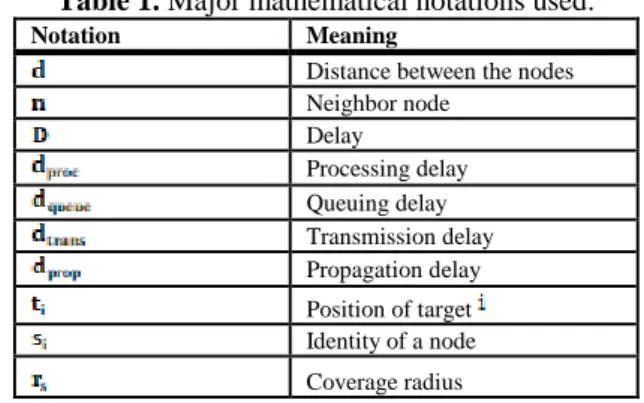
Table 1. Major mathematical notations used.
Notation Meaning
Distance between the nodes Neighbor node
Delay
Processing delay Queuing delay Transmission delay Propagation delay
Position of target Identity of a node
Coverage radius
3.1 System Model and Assumptions
Let there be p targets, with known locations to be covered and q mobile sensors, that are randomly deployed in the AoI. The working method of the system is as follows:
1. Each sensor knows its own position using a built-in GPS (Global Positioning System) unit or by means of some kind of localization service in the network. 2. A sensor is able to choose the correct shortest path
to the destination based on node’s energy.
3. The system determines where the sensors should move (if needed) and which sensors should move in order to guarantee various performance aspects of the network.
4. There are two key models in the system: first one is the network model, with the sensing radius and the communication radius respectively. Multiple sensors cover a sink. Each sensor can cover more than one target with some concentric circle. The other is the mobility model that describes that the sensors can move whenever needed towards any direction. Also, they are capable of stopping anywhere in the target area.
5. Energy consumption required for a sensor’s movement is represented by the distance that it moves. The movement distance of sensor to cover target is denoted by , i.e., is the distance between and . Likewise, the movement distance of sensor to connect with sensor is
. 3.2 Definitions
Considering the scenario mentioned above, let us note down the basic definitions we would use:
Definition 1: Mobile Sensor Deployment (MSD) problem –
If there are targets with known positions and mobile sensors that are randomly deployed on the target area, the MSD problem tries to find the minimum number of movements to be done by the mobile sensors. If a sensor moves to a new location, the following objectives should be met:
1. At least one mobile sensor covers every target. 2. The network formed by all the moved sensors
should still be a connected one.
Definition 2: Target Coverage problem - Given targets
with known locations and q mobile sensors deployed randomly on the configuration area, move sensors to new positions so that all the targets are covered and the total number of sensor movements is reduced.
Definition 3: Network connectivity problem - Given a sink
(or, base station), set of coverage sensors and rest of the mobile sensors after the target coverage problem is solved, network connectivity issue seeks deployment of the rest of the mobile sensors to connect coverage sensors and the sink with minimum movement.
3.3 Socratic Random Algorithm (SRA)
In this section, we propose the Socratic Random Algorithm (SRA) which improves the target coverage and network connectivity while taking care of the overall lifetime of the network. Before describing our algorithm, we refer to Table 1 that shows the major mathematical notations used in the paper.
In the MSN, the mobile sensors are deployed in a random manner to identify the sink node via intermediate nodes. Among several groups of sensors, normal sensors are subdivided into clusters as shown in Figure 1. Each cluster has a target, some normal sensors, and a Cluster Head (CH). The data to be sensed are collected by the CH and transferred to the Base Station (BS or sink – these terms are used interchangeably in this paper) and then the processed information is sent to the normal sensor of another cluster group through CH.
Figure 1. System architecture.
The basic idea of SRA is to select the nodes based on the random approach for target coverage [23] which helps improve the network lifetime by means of target coverage and network connectivity, packet delivery ratio, and the overall, energy consumption of the network. The algorithm is presented in Figure
__________________________________________
SRA Algorithm:Input: ; //Positions of targets
//Condition and IP address of the nodes
Output: //Identification of the nearest nodes 1 Deploy the sensors
2 Determine between each node
3 Find the // Nearest neighbor node 4 Calculate from the received packets using the equation:
5 Send the packet to receiver in its own time slot 6 check Bit Error Rate and noise for every packet 7 if conflict occurs; then
8 Record conflict message 9 return to 6
10 else
11 Send packet to all neighbor nodes 12 Process and send to base station 13 return
____________________________________________
Figure 2. Pseudocode for SRA.
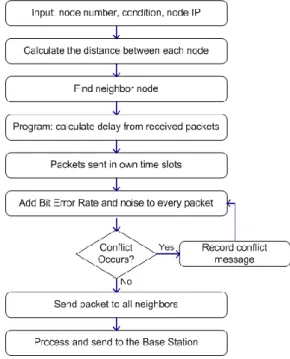
The flow diagram of SRA algorithm is shown in Figure 3.
Figure 3. Flow diagram of SRA.
By using Steiner minimum tree with constraint energy length solution [4], Figure 4(a) shows the random arrangement of number of movable sensors and Figure 4(b) shows the sensors moving to another location and they are interconnected with the nearest neighbor nodes in order to minimize the movement distance. It is also used to reduce the number of sensors that have to be moved.
The problem can be solved with the following steps:
• Construct Steiner edge length tree covering all the sensors and the sink node.
• Relocate the rest of the mobile sensors to connect sensor node and sink node.
• Dispatch the dedicated sensor to cover each target.
(a) (b)
Figure 4. Illustration of Steiner Minimum Tree: (a) Initial position of sensors; (b) Relocation of sensors.
4.
Experimental Analysis
We used ns-2 simulator [23] for our simulation experiments. The core simulation parameters are shown in Table 2. In our setting, we consider that at the initial stage, all sensors have the same amount of energy. There are also some tunable parameters: 1) the number of sensor nodes, ; 2) network coder sensor. The Figure 5(a) shows the random initial deployment of 100 nodes and Figure 5(b) shows the output window showing the simulation scenario of the proposed system with concentric circles at 2.42ms.
Table 2. Simulation Parameters.
Parameter Value/Type
Simulation Area 1500m × 1500m
Number of Nodes 100
Channel Wireless Channel
Propagation Free-Space
Network interface type Wireless physical interface
Mac-type Mac 802.11
Interface queue type Drop-tail
Antenna Omni-antenna
Routing Protocol BTS/TV/EX-H/SRA
(a)
(b)
Figure 5. Simulation scenario. (a) Initial deployment of nodes; (b) Deployment of nodes with concentric circles.
4.2 Simulation and Analysis
Figure 6(a). Energy vs. Time.
Figure 6(b). Packet Delivery Ratio vs. Time.
Figure 6(c). Data Packets delivered vs. Transmission Range. Finally, the Figure 6(e) shows that the network connectivity is increased in case of SRA than the other routing algorithms. In all cases, SRA’s performance is significantly higher than that of the other routing algorithms.
Figure 6(a) shows the energy consumption for BTS, TV Greedy, Ex-Hungarian, and SRA. It shows that the SRA routing algorithm consumes relatively lower power than that of the other routing algorithms. Figure 6(b) is plotted with the packet delivery ratio and time, which shows that the packet delivery ratio is maximum for SRA when compared to BTS, TV Greedy, and Ex-Hungarian.
Figure 6(c) is plotted with the data packets delivered and transmission range. The data packets delivered are maximum when the transmission range is increased. This also shows that SRA performs better than the other routing algorithms. Figure 6(d) is plotted for the latency and transmission range.
This figure shows that SRA has relatively lower latency than the other compared routing algorithms.
Figure 6(d). Latency vs. Transmission Range.
Figure 6(e). Network Connectivity vs. Time. Overall, our approach shows some notable gains against the existing alternatives. While the implementation considered an environment with a set of pragmatic assumptions, in other settings also, the algorithm could show good gains because of its inherent working mechanism.
5.
Conclusions and Future Works
In this work, an efficient routing algorithm named, Socratic Random Algorithm (SRA) is proposed and implemented. The issues of TCOV, NCON, and network lifetime are the main issues considered for Mobile Sensor Networks. SRA provides an optimal solution for such a setting and helps minimize the sensors’ movements.
especially in a dynamic Wireless Sensor Network [24], [25] setting.
6.
Acknowledgement
This work was partially supported by the authors’ institutions. Dr. Kalpana Murugan is the corresponding author.
References
[1] M. Kalpana, A.-S.K. Pathan, “Prolonging the Lifetime of Wireless Sensor Networks using Secondary Sink Nodes,” Telecommunication Systems, Volume 62, Issue 2, Springer US, pp. 347-361, 2016.
[2] A.-S.K. Pathan, C.S. Hong “SERP: Secure Energy-efficient Routing Protocol for Densely Deployed Wireless Sensor Networks,” Annals of Telecommunications, Volume 63, Numbers 9-10, pp. 529-541, 2008.
[3] A. Boualem, Y. Dahmani, A. Maatoug, C. De-runz, “Area Coverage Optimization in Wireless Sensor Network by Semi-random Deployment,” Proceedings of the 7th International Conference on Sensor Networks (SENSORNETS’18), pp. 85-90, 2018.
[4] Z. Liao, J. Wang, S. Zhang, J. Cao, G. Min, “Minimizing Movement for TCOV and NCON in Mobile Sensor Networks,” IEEE Transactions on Parallel and Distributed Systems, Volume: 26, Issue: 7, pp. 1971-1983, 2015. [5] M.H. Rehmani, A.-S.K. Pathan. Emerging Communication
Technologies Based on Wireless Sensor Networks: Current Research and Future Applications. ISBN: 9781498724852, CRC Press, Taylor & Francis Group, USA, 2015.
[6] S. Lei, A.V. Vasilakos, J. Lloret, A.-S.K. Pathan, “Guest Editorial: Special Issue on Recent Advance on Mobile Sensor Systems,”, Telecommunication Systems, Volume 52, Issue 4, Springer, pp. 2407-2409, 2013.
[7] J.N. Al-Karaki, A. Gawanmeh, “The Optimal Deployment, Coverage, and Connectivity Problems in Wireless Sensor Networks,” IEEE Access, Volume 5, pp. 18051-18065, 2017.
[8] H.H. Ekal, J.W. Abdullah, “Analytical Modeling of Innovative Sensor Placement Strategy For Corona-Based Wireless Sensor Networks,” Journal of Engineering Science and Technology Vol. 12, No. 9, pp. 2461-2475, 2017.
[9] D. Kaur, M. Kaur, “An Approach of Mobile Wireless Sensor Network for Target Coverage and Network Connectivity with Minimum Movement,” International Research Journal of Engineering and Technology, Volume: 04, Issue: 01, pp. 1275-1280, 2017.
[10]C.N. Abhilash, S.H. Manjula, K.R. Venugopal, “Optimal Connectivity for Target Coverage Using Prediction Filter in Wireless Sensor Networks,’’ 2017 International Conference on Wireless Communications, Signal Processing and Networking (WiSPNET), 22-24 March, 2017.
[11]D.P. Singh, B. Pant, “An approach to solve the target coverage problem by efficient deployment and scheduling of sensor nodes in WSN,” International Journal of System Assurance Engineering and Management, Volume 8, Issue 2, Springer, pp. 493-514, 2017.
[12]D.P. Singh, R.H. Goudar, S. Rao, “Coverage lifetime improvement through efficient deployment of sensor nodes in WSN,” International Journal of System Assurance Engineering and Management, Volume 7, Issue 2, Springer, pp. 201-212, 2016.
[13]M.A. Benatia, M. Shahnoun, D. Baudry, A. Louis, A. El-Hami, B. Mazari, “Multi-Objective WSN Deployment Using Genetic Algorithms Under Cost, Coverage, and Connectivity Constraints,” Wireless Personal Communications, Volume 94 Issue 4, Springer, pp. 2739-2768, 2017.
[14]Z. Sun, G. Zhao, X. Xing, “ENCP: a new Energy-efficient Nonlinear Coverage Control Protocol in mobile sensor Networks,” EURASIP Journal on Wireless Communications and Networking, DOI 10.1186/s13638-018-1023-7, 15, 2018. [15]P.P. Rezaeiye, P.P. Rezaeiyeh, E.K. Sadegh, “Using the Learning Coverage Model to Increase the Wireless Sensor Networks Lifetime,” Revista Publicando, 5(16), pp. 80-103, 2018.
[16]A. Pakmehr, A. Ghaffari, “Coverage Improving with Energy Efficient in Wireless Sensor Networks,” Journal of Information Systems and Telecommunication, Vol. 5, No. 1, January-March 2017.
[17]F. Hajjej, R. Ejbali, M. Zaied, “Multi Objective Nodes placement Approach in WSN based on Nature Inspired Optimisation Algorithms,” The Second International Conference on Advances in Sensors, Actuators, Metering and Sensing, 2017.
[18]J. Roselin, P. Latha, S. Benitta, “Maximizing the wireless sensor networks lifetime through energy efficient connected coverage,” Ad Hoc Networks, Volume 62, pp. 1-10, 2017. [19]P. Chaturvedi, A.K. Daniel, “A novel sleep/wake protocol for
target coverage based on trust evaluation for a clustered wireless sensor network,” International Journal of Mobile Network Design and Innovation, Vol.7 No.3/4, Inderscience, pp. 199-209, 2017.
[20]P. Chaturvedi, A.K. Daniel, “Trust based energy efficient coverage preserving protocol for wireless sensor networks,” 2015 International Conference on Green Computing and
Internet of Things (ICGCIoT), DOI:
10.1109/ICGCIoT.2015.7380583, 2015.
[21]G.M.R. Jebamani, M. Kalpana, “Sink Repositioning Method to Improve the Energy Consumption in Wireless Sensor Networks,” International Conference on Electrical, Information and Communication Technology, 6 March 2015. [22]M. Kalpana, R. Dhanalakshmi, P. Parthiban, “Prolonging the
Lifetime of Wireless Sensor Networks Interconnected to Fixed Network Using Hierarchical Energy Tree Based Routing Algorithm,” The Scientific World Journal, Volume 2014, Article ID 158420, 12 pages, 2014.
[23] The Network Simulator - ns-2, available at: https://www.isi.edu/nsnam/ns/ [last accessed: October 29, 2018]
[24]H.R. Faragardi, M. Vahabi, H. Fotouhi, T. Nolte, T. Fahringer, “An efficient placement of sinks and SDN controller nodes for optimizing the design cost of industrial IoT systems,” Software: Practice and Experience. Volume 48, Issue 10, pp. 1893-1919, 2018.