Standard Practice for
Classification of Soils for Engineering Purposes (Unified
Soil Classification System)
1This standard is issued under the fixed designation D 2487; the number immediately following the designation indicates the year of original adoption or, in the case of revision, the year of last revision. A number in parentheses indicates the year of last reapproval. A superscript epsilon (e) indicates an editorial change since the last revision or reapproval.
This standard has been approved for use by agencies of the Department of Defense.
1. Scope*
1.1 This practice describes a system for classifying mineral and organo-mineral soils for engineering purposes based on laboratory determination of particle-size characteristics, liquid limit, and plasticity index and shall be used when precise classification is required.
NOTE 1—Use of this standard will result in a single classification group
symbol and group name except when a soil contains 5 to 12 % fines or when the plot of the liquid limit and plasticity index values falls into the crosshatched area of the plasticity chart. In these two cases, a dual symbol is used, for example, GP-GM, CL-ML. When the laboratory test results indicate that the soil is close to another soil classification group, the borderline condition can be indicated with two symbols separated by a slash. The first symbol should be the one based on this standard, for example, CL/CH, GM/SM, SC/CL. Borderline symbols are particularly useful when the liquid limit value of clayey soils is close to 50. These soils can have expansive characteristics and the use of a borderline symbol (CL/CH, CH/CL) will alert the user of the assigned classifications of expansive potential.
1.2 The group symbol portion of this system is based on laboratory tests performed on the portion of a soil sample passing the 3-in. (75-mm) sieve (see SpecificationE 11).
1.3 As a classification system, this standard is limited to naturally occurring soils.
NOTE 2—The group names and symbols used in this test method may
be used as a descriptive system applied to such materials as shale, claystone, shells, crushed rock, etc. SeeAppendix X2.
1.4 This standard is for qualitative application only. NOTE 3—When quantitative information is required for detailed
de-signs of important structures, this test method must be supplemented by laboratory tests or other quantitative data to determine performance characteristics under expected field conditions.
1.5 This standard is the ASTM version of the Unified Soil Classification System. The basis for the classification scheme is the Airfield Classification System developed by A.
Casa-grande in the early 1940’s.2It became known as the Unified
Soil Classification System when several U.S. Government Agencies adopted a modified version of the Airfield System in 1952.
1.6 This standard does not purport to address all of the safety concerns, if any, associated with its use. It is the responsibility of the user of this standard to establish appro-priate safety and health practices and determine the applica-bility of regulatory limitations prior to use.
1.7 This practice offers a set of instructions for performing one or more specific operations. This document cannot replace education or experience and should be used in conjunction with professional judgment. Not all aspects of this practice may be applicable in all circumstances. This ASTM standard is not intended to represent or replace the standard of care by which the adequacy of a given professional service must be judged, nor should this document be applied without consideration of a project’s many unique aspects. The word “Standard” in the title of this document means only that the document has been approved through the ASTM consensus process.
2. Referenced Documents 2.1 ASTM Standards:3
C 117 Test Method for Materials Finer than 75-µm (No. 200) Sieve in Mineral Aggregates by Washing
C 136 Test Method for Sieve Analysis of Fine and Coarse Aggregates
C 702 Practice for Reducing Samples of Aggregate to Testing Size
D 420 Guide to Site Characterization for Engineering De-sign and Construction Purposes
D 422 Test Method for Particle-Size Analysis of Soils D 653 Terminology Relating to Soil, Rock, and Contained
Fluids
1This standard is under the jurisdiction of ASTM Committee D18 on Soil and Rock and is the direct responsibility of Subcommittee D18.07 on Identification and Classification of Soils.
Current edition approved May 1, 2006. Published June 2006. Originally approved in 1966. Last previous edition approved in 2000 as D 2487 – 00.
2Casagrande, A., “Classification and Identification of Soils,” Transactions, ASCE, 1948, p. 901.
3For referenced ASTM standards, visit the ASTM website, www.astm.org, or contact ASTM Customer Service at [email protected]. ForAnnual Book of ASTM Standardsvolume information, refer to the standard’s Document Summary page on the ASTM website.
*A Summary of Changes section appears at the end of this standard.
D 1140 Test Method for Amount of Material in Soils Finer Than the No. 200 (75-µm) Sieve
D 2216 Test Methods for Laboratory Determination of Wa-ter (Moisture) Content of Soil and Rock by Mass D 2217 Practice for Wet Preparation of Soil Samples for
Particle-Size Analysis and Determination of Soil Con-stants
D 2488 Practice for Description and Identification of Soils (Visual-Manual Procedure)
D 3740 Practice for Minimum Requirements for Agencies Engaged in the Testing and/or Inspection of Soil and Rock as Used in Engineering Design and Construction
D 4083 Practice for Description of Frozen Soils (Visual-Manual Procedure)
D 4318 Test Methods for Liquid Limit, Plastic Limit, and Plasticity Index of Soils
D 4427 Classification of Peat Samples by Laboratory Test-ing
D 6913 Test Methods for Particle-Size Distribution (Grada-tion) of Soils Using Sieve Analysis
E 11 Specification for Wire Cloth and Sieves for Testing Purposes
3. Terminology
3.1 Definitions—Except as listed below, all definitions are in accordance with Terminology D 653.
NOTE 4—For particles retained on a 3-in. (75-mm) U.S. standard sieve,
the following definitions are suggested:
Cobbles—particles of rock that will pass a 12-in. (300-mm) square opening and be retained on a 3-in. (75-mm) U.S. standard sieve, and
Boulders—particles of rock that will not pass a 12-in. (300-mm) square opening.
3.1.1 clay—soil passing a No. 200 (75-µm) U.S. standard sieve that can be made to exhibit plasticity (putty-like proper-ties) within a range of water contents and that exhibits considerable strength when air dry. For classification, a clay is a fine-grained soil, or the fine-grained portion of a soil, with a plasticity index equal to or greater than 4, and the plot of plasticity index versus liquid limit falls on or above the “A” line.
3.1.2 gravel—particles of rock that will pass a 3-in. (75-mm) sieve and be retained on a No. 4 (4.75-(75-mm) U.S. standard sieve with the following subdivisions:
Coarse—passes 3-in. (75-mm) sieve and retained on3⁄4-in.
(19-mm) sieve, and
Fine—passes 3⁄4-in. (19-mm) sieve and retained on No. 4
(4.75-mm) sieve.
3.1.3 organic clay—a clay with sufficient organic content to influence the soil properties. For classification, an organic clay is a soil that would be classified as a clay except that its liquid limit value after oven drying is less than 75 % of its liquid limit value before oven drying.
3.1.4 organic silt—a silt with sufficient organic content to influence the soil properties. For classification, an organic silt is a soil that would be classified as a silt except that its liquid limit value after oven drying is less than 75 % of its liquid limit value before oven drying.
3.1.5 peat—a soil composed of vegetable tissue in various stages of decomposition usually with an organic odor, a dark-brown to black color, a spongy consistency, and a texture ranging from fibrous to amorphous.
3.1.6 sand—particles of rock that will pass a No. 4 (4.75-mm) sieve and be retained on a No. 200 (75-µm) U.S. standard sieve with the following subdivisions:
Coarse—passes No. 4 (4.75-mm) sieve and retained on No. 10 (2.00-mm) sieve,
Medium—passes No. 10 (2.00-mm) sieve and retained on No. 40 (425-µm) sieve, and
Fine—passes No. 40 (425-µm) sieve and retained on No. 200 (75-µm) sieve.
3.1.7 silt—soil passing a No. 200 (75-µm) U.S. standard sieve that is nonplastic or very slightly plastic and that exhibits little or no strength when air dry. For classification, a silt is a fine-grained soil, or the fine-grained portion of a soil, with a plasticity index less than 4 or if the plot of plasticity index versus liquid limit falls below the “A” line.
3.2 Definitions of Terms Specific to This Standard:
3.2.1 coeffıcient of curvature, Cc—the ratio (D30) 2
/ (D103D60), where D60, D30, and D10 are the particle sizes
corresponding to 60, 30, and 10 % finer on the cumulative particle-size distribution curve, respectively.
3.2.2 coeffıcient of uniformity, Cu—the ratio D60/D10, where
D60and D10are the particle diameters corresponding to 60 and
10 % finer on the cumulative particle-size distribution curve, respectively.
4. Summary
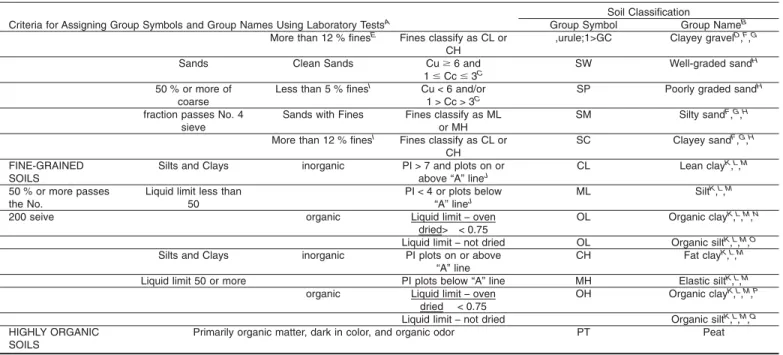
4.1 As illustrated in Table 1, this classification system identifies three major soil divisions: coarse-grained soils, fine-grained soils, and highly organic soils. These three divi-sions are further subdivided into a total of 15 basic soil groups.
TABLE 1 Soil Classification Chart
Criteria for Assigning Group Symbols and Group Names Using Laboratory TestsA
Soil Classification
Group Symbol Group NameB COARSE-GRAINED
SOILS
Gravels Clean Gravels Cu$4 and 1#Cc#3C GW Well-graded gravelD More than 50 % retained on No. 200 sieve More than 50 % of coarse fraction retained on No. 4 sieve
Less than 5 % finesE Cu < 4 and/or 1 > Cc > 3C
GP Poorly graded gravelD
Gravels with Fines Fines classify as ML or MH
GM Silty gravelD,F,G
TABLE 1 Continued Criteria for Assigning Group Symbols and Group Names Using Laboratory TestsA
Soil Classification
Group Symbol Group NameB More than 12 % finesE
Fines classify as CL or CH
,urule;1>GC Clayey gravelD ,F
,G Sands Clean Sands Cu$6 and
1#Cc#3C
SW Well-graded sandH 50 % or more of
coarse
Less than 5 % finesI
Cu < 6 and/or 1 > Cc > 3C
SP Poorly graded sandH fraction passes No. 4
sieve
Sands with Fines Fines classify as ML or MH
SM Silty sandF,G,H More than 12 % finesI Fines classify as CL or
CH
SC Clayey sandF,G,H FINE-GRAINED
SOILS
Silts and Clays inorganic PI > 7 and plots on or above “A” lineJ
CL Lean clayK ,L
,M 50 % or more passes
the No.
Liquid limit less than 50
PI < 4 or plots below “A” lineJ
ML SiltK,L,M 200 seive organic Liquid limit − oven
dried> < 0.75
OL Organic clayK ,L
,M ,N Liquid limit − not dried OL Organic siltK,L,M,O Silts and Clays inorganic PI plots on or above
“A” line
CH Fat clayK,L,M Liquid limit 50 or more PI plots below “A” line MH Elastic siltK
,L ,M organic Liquid limit − oven
dried < 0.75
OH Organic clayK,L,M,P Liquid limit − not dried Organic siltK,L,M,Q HIGHLY ORGANIC
SOILS
Primarily organic matter, dark in color, and organic odor PT Peat ABased on the material passing the 3-in. (75-mm) sieve.
BIf field sample contained cobbles or boulders, or both, add “with cobbles or boulders, or both” to group name. CCu = D
60/D10 Cc 5 ~D30!2
/
D103 D60DIf soil contains$15 % sand, add “with sand” to group name. EGravels with 5 to 12 % fines require dual symbols:
GW-GM well-graded gravel with silt GW-GC well-graded gravel with clay GP-GM poorly graded gravel with silt GP-GC poorly graded gravel with clay
FIf fines classify as CL-ML, use dual symbol GC-GM, or SC-SM. GIf fines are organic, add “with organic fines” to group name. HIf soil contains$15 % gravel, add “with gravel” to group name. ISands with 5 to 12 % fines require dual symbols:
SW-SM well-graded sand with silt SW-SC well-graded sand with clay SP-SM poorly graded sand with silt SP-SC poorly graded sand with clay
JIf Atterberg limits plot in hatched area, soil is a CL-ML, silty clay.
KIf soil contains 15 to 29 % plus No. 200, add “with sand” or “with gravel,” whichever is predominant. L
If soil contains$30 % plus No. 200, predominantly sand, add “sand ” to group name. M
If soil contains$30 % plus No. 200, predominantly gravel, add “gravelly” to group name. N
PI$4 and plots on or above “A” line. OPI < 4 or plots below“ A” line. PPI plots on or above “A” line. QPI plots below “A” line.
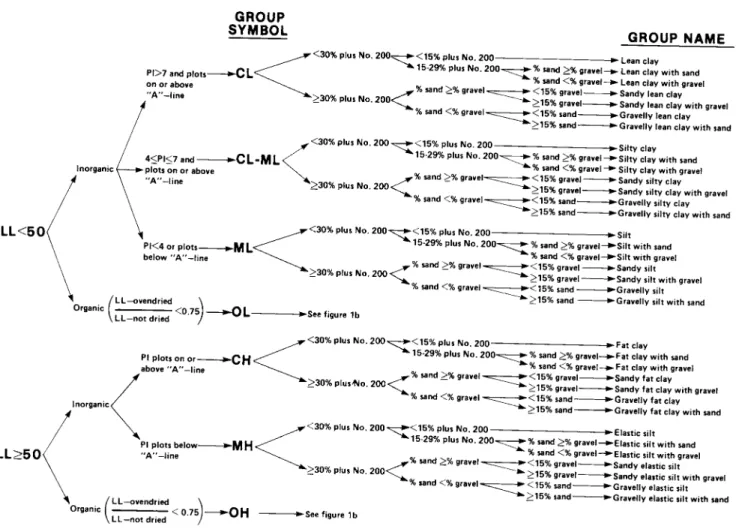
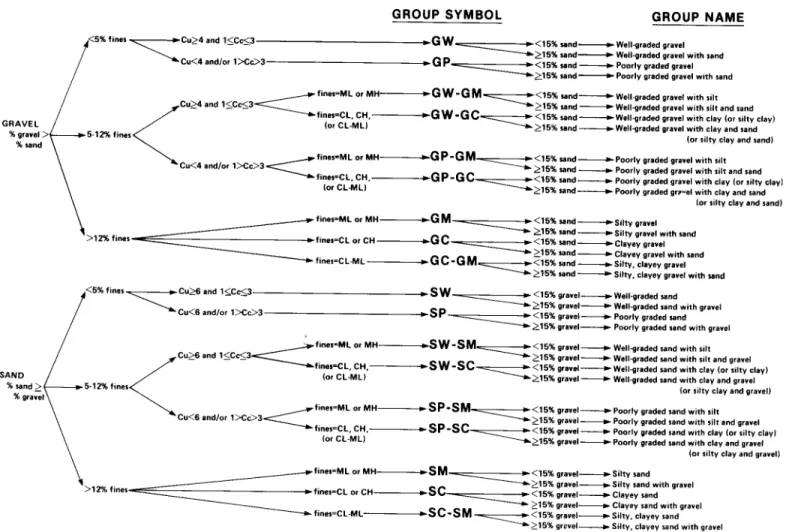
4.2 Based on the results of visual observations and pre-scribed laboratory tests, a soil is catalogued according to the basic soil groups, assigned a group symbol(s) and name, and thereby classified. The flow charts, Fig. 1 for fine-grained soils, andFig. 3 for coarse-grained soils, can be used to assign the appropriate group symbol(s) and name.
5. Significance and Use
5.1 This standard classifies soils from any geographic loca-tion into categories representing the results of prescribed laboratory tests to determine the particle-size characteristics, the liquid limit, and the plasticity index.
5.2 The assigning of a group name and symbol(s) along with the descriptive information required in Practice D 2488 can be used to describe a soil to aid in the evaluation of its significant properties for engineering use.
5.3 The various groupings of this classification system have been devised to correlate in a general way with the engineering behavior of soils. This standard provides a useful first step in any field or laboratory investigation for geotechnical engineer-ing purposes.
5.4 This standard may also be used as an aid in training personnel in the use of PracticeD 2488.
5.5 This standard may be used in combination with Practice D 4083 when working with frozen soils.
NOTE 5—Notwithstanding the statements on precision and bias
con-tained in this standard: The precision of this test method is dependent on the competence of the personnel performing it and the suitability of the equipment and facilities used. Agencies that meet the criteria of Practice
D 3740 are generally considered capable of competent and objective testing. Users of this test method are cautioned that compliance with PracticeD 3740does not in itself assure reliable testing. Reliable testing
FIG. 1 Flow Chart for Classifying Fine-Grained Soil (50 % or More Passes No. 200 Sieve)
FIG. 2 Flow Chart for Classifying Organic Fine-Grained Soil (50 % or More Passes No. 200 Sieve)
D 2487 – 06
depends on several factors; Practice D 3740 provides a means for evaluating some of those factors.
6. Apparatus
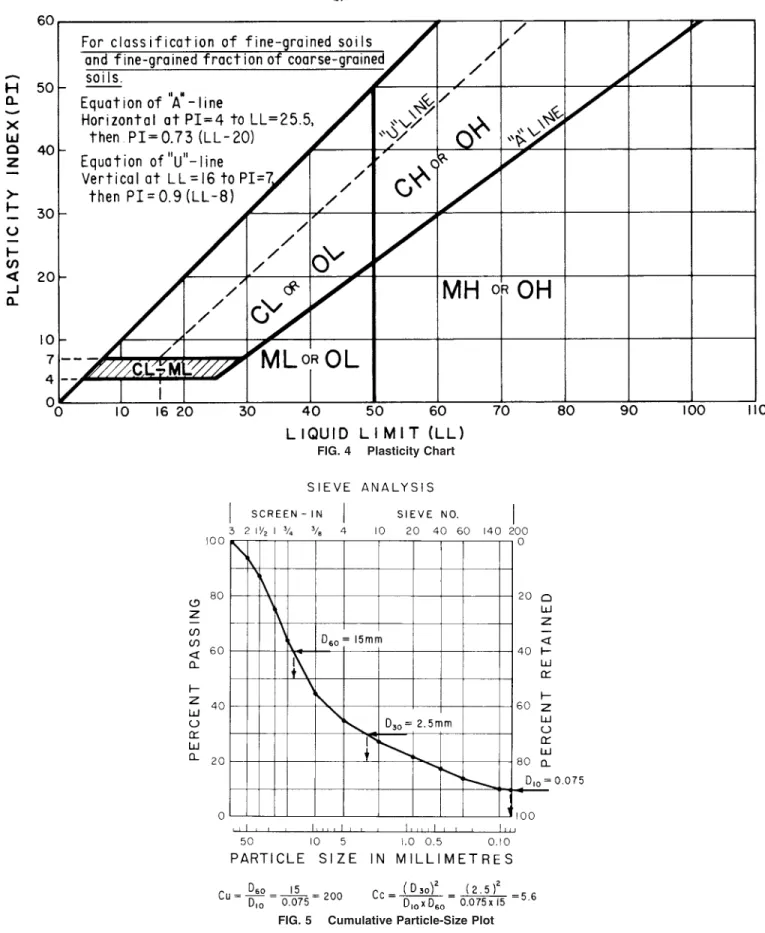
6.1 In addition to the apparatus that may be required for obtaining and preparing the samples and conducting the prescribed laboratory tests, a plasticity chart, similar toFig. 4, and a cumulative particle-size distribution curve, similar toFig. 5, are required.
NOTE 6—The “U” line shown onFig. 4has been empirically
deter-mined to be the approximate “upper limit” for natural soils. It is a good check against erroneous data, and any test results that plot above or to the left of it should be verified.
7. Sampling
7.1 Samples shall be obtained and identified in accordance with a method or methods, recommended in GuideD 420or by other accepted procedures.
7.2 Test Methods D 6913 provides guidance on selecting size of specimen. Two test methods are provided in this standard. The methods differ in the significant digits recorded and the size of the specimen (mass) required. The method to be used may be specified by the requesting authority; otherwise Method A shall be performed. Whenever possible, the field samples should have weights two to four times larger than shown.
7.3 If the field sample or test specimen is smaller than the minimum recommended amount, the report shall include an appropriate remark.
8. Classification of Peat
8.1 A sample composed primarily of vegetable tissue in various stages of decomposition and has a fibrous to amor-phous texture, a dark-brown to black color, and an organic odor should be designated as a highly organic soil and shall be classified as peat, PT, and not subjected to the classification procedures described hereafter.
8.2 If desired, classification of type of peat can be per-formed in accordance with Classification D 4427.
9. Preparation for Classification
9.1 Before a soil can be classified according to this standard, generally the particle-size distribution of the minus 3-in. (75-mm) material and the plasticity characteristics of the minus No. 40 (425-µm) sieve material must be determined. See 9.8 for the specific required tests.
9.2 The preparation of the soil specimen(s) and the testing for particle-size distribution and liquid limit and plasticity index shall be in accordance with accepted standard proce-dures. Two procedures for preparation of the soil specimens for testing for soil classification purposes are given in Appendixes X3 and X4. Appendix X3 describes the wet preparation method FIG. 3 Flow Chart for Classifying Coarse-Grained Soils (More Than 50 % Retained on No. 200 Sieve)
FIG. 4 Plasticity Chart
FIG. 5 Cumulative Particle-Size Plot
D 2487 – 06
and is the preferred method for cohesive soils that have never dried out and for organic soils.
9.3 When reporting soil classifications determined by this standard, the preparation and test procedures used shall be reported or referenced.
9.4 Although the test procedure used in determining the particle-size distribution or other considerations may require a hydrometer analysis of the material, a hydrometer analysis is not necessary for soil classification.
9.5 The percentage (by dry weight) of any plus 3-in. (75-mm) material must be determined and reported as auxiliary information.
9.6 The maximum particle size shall be determined (mea-sured or estimated) and reported as auxiliary information.
9.7 When the cumulative particle-size distribution is re-quired, a set of sieves shall be used which include the following sizes (with the largest size commensurate with the maximum particle size) with other sieve sizes as needed or required to define the particle-size distribution:
3-in. (75-mm) 3⁄4-in. (19.0-mm) No. 4 (4.75-mm) No. 10 (2.00-mm) No. 40 (425-µm) No. 200 (75-µm)
9.8 The tests required to be performed in preparation for classification are as follows:
9.8.1 For soils estimated to contain less than 5 % fines, a plot of the cumulative particle-size distribution curve of the fraction coarser than the No. 200 (75-µm) sieve is required. A semi-log plot of percent passing versus partical-size or sieve size/sieve number is plotted as shown inFig. 5.
9.8.2 For soils estimated to contain 5 to 15 % fines, a cumulative particle-size distribution curve, as described in 9.8.1, is required, and the liquid limit and plasticity index are required.
9.8.2.1 If sufficient material is not available to determine the liquid limit and plasticity index, the fines should be estimated to be either silty or clayey using the procedures described in Practice D 2488and so noted in the report.
9.8.3 For soils estimated to contain 15 % or more fines, a determination of the percent fines, percent sand, and percent gravel is required, and the liquid limit and plasticity index are required. For soils estimated to contain 90 % fines or more, the percent fines, percent sand, and percent gravel may be esti-mated using the procedures described in PracticeD 2488 and so noted in the report.
10. Preliminary Classification Procedure
10.1 Class the soil as fine-grained if 50 % or more by dry weight of the test specimen passes the No. 200 (75-µm) sieve and follow Section3.1.2.
10.2 Class the soil as coarse-grained if more than 50 % by dry weight of the test specimen is retained on the No. 200 (75-µm) sieve and follow Section 12.
11. Procedure for Classification of Fine-Grained Soils (50 % or more by dry weight passing the No. 200 (75-µm) sieve)
11.1 The soil is an inorganic clay if the position of the plasticity index versus liquid limit plot,Fig. 4, falls on or above the “A” line, the plasticity index is greater than 4, and the presence of organic matter does not influence the liquid limit as determined in11.3.2.
NOTE 7—The plasticity index and liquid limit are determined on the
minus No. 40 (425 µm) sieve material.
11.1.1 Classify the soil as alean clay,CL, if the liquid limit is less than 50. See area identified as CL onFig. 4.
11.1.2 Classify the soil as afat clay,CH, if the liquid limit is 50 or greater. See area identified as CH onFig. 4.
NOTE 8—In cases where the liquid limit exceeds 110 or the plasticity
index exceeds 60, the plasticity chart may be expanded by maintaining the same scale on both axes and extending the “A” line at the indicated slope. 11.1.3 Classify the soil as a silty clay, CL-ML, if the position of the plasticity index versus liquid limit plot falls on or above the “A” line and the plasticity index is in the range of 4 to 7. See area identified as CL-ML onFig. 4.
11.2 The soil is an inorganic silt if the position of the plasticity index versus liquid limit plot,Fig. 4, falls below the “A” line or the plasticity index is less than 4, and presence of organic matter does not influence the liquid limit as determined in11.3.2.
11.2.1 Classify the soil as asilt, ML, if the liquid limit is less than 50. See area identified as ML on Fig. 4.
11.2.2 Classify the soil as anelastic silt, MH, if the liquid limit is 50 or greater. See area identified as MH onFig. 4.
11.3 The soil is an organic silt or clay if organic matter is present in sufficient amounts to influence the liquid limit as determined in11.3.2.
11.3.1 If the soil has a dark color and an organic odor when moist and warm, a second liquid limit test shall be performed on a test specimen which has been oven dried at 11065°C to a constant weight, typically over night.
11.3.2 The soil is an organic silt or organic clay if the liquid limit after oven drying is less than 75 % of the liquid limit of the original specimen determined before oven drying (see Procedure B of Practice D 2217).
11.3.3 Classify the soil as an organic silt or organic clay,
OL, if the liquid limit (not oven dried) is less than 50 %. Classify the soil as an organic silt,OL, if the plasticity index is less than 4, or the position of the plasticity index versus liquid limit plot falls below the “A” line. Classify the soil as an
organic clay,OL, if the plasticity index is 4 or greater and the position of the plasticity index versus liquid limit plot falls on or above the “A” line. See area identified as OL (or CL-ML) on Fig. 4.
11.3.4 Classify the soil as anorganic clay or organic silt,
OH, if the liquid limit (not oven dried) is 50 or greater. Classify the soil as anorganic silt,OH, if the position of the plasticity index versus liquid limit plot falls below the “A” line. Classify the soil as anorganic clay,OH, if the position of the plasticity index versus liquid-limit plot falls on or above the “A” line. See area identified as OH onFig. 4.
11.4 If less than 30 % but 15 % or more of the test specimen is retained on the No. 200 (75-µm) sieve, the words“ with sand” or “with gravel” (whichever is predominant) shall be added to the group name. For example, lean clay with sand, CL; silt with gravel, ML. If the percent of sand is equal to the percent of gravel, use “with sand.”
11.5 If 30 % or more of the test specimen is retained on the No. 200 (75-µm) sieve, the words “sandy” or“ gravelly” shall be added to the group name. Add the word “sandy” if 30 % or more of the test specimen is retained on the No. 200 (75-µm) sieve and the coarse-grained portion is predominantly sand. Add the word “gravelly” if 30 % or more of the test specimen is retained on the No. 200 (75-µm) sieve and the coarse-grained portion is predominantly gravel. For example, sandy lean clay, CL; gravelly fat clay, CH; sandy silt, ML. If the percent of sand is equal to the percent of gravel, use “sandy.”
12. Procedure for Classification of Coarse-Grained Soils (more than 50 % retained on the No. 200 (75-µm) sieve) 12.1 Class the soil as gravel if more than 50 % of the coarse fraction [plus No. 200 (75-µm) sieve] is retained on the No. 4 (4.75-mm) sieve.
12.2 Class the soil as sand if 50 % or more of the coarse fraction [plus No. 200 (75-µm) sieve] passes the No. 4 (4.75-mm) sieve.
12.3 If 12 % or less of the test specimen passes the No. 200 (75-µm) sieve, plot the cumulative particle-size distribution, Fig. 5, and compute the coefficient of uniformity, Cu, and coefficient of curvature,Cc, as given in Eqs 1 and 2.
Cu5D60/D10 (1)
Cc5~D30!2/~D103D60! (2)
where:
D10, D30, and D60= the particle-size diameters
correspond-ing to 10, 30, and 60 %, respectively, passcorrespond-ing on the cumula-tive particle-size distribution curve,Fig. 5.
NOTE 9—It may be necessary to extrapolate the curve to obtain the D10
diameter.
12.3.1 If less than 5 % of the test specimen passes the No. 200 (75-µm) sieve, classify the soil as a well-graded gravel,
GW, orwell-graded sand,SW, if Cu is greater than or equal to 4.0 for gravel or greater than 6.0 for sand, and Cc is at least 1.0 but not more than 3.0.
12.3.2 If less than 5 % of the test specimen passes the No. 200 (75-µm) sieve, classify the soil as poorly graded gravel,
GP, or poorly graded sand, SP, if either the Cu or the Cc
criteria for well-graded soils are not satisfied.
12.4 If more than 12 % of the test specimen passes the No. 200 (75-µm) sieve, the soil shall be considered a coarse-grained soil with fines. The fines are determined to be either clayey or silty based on the plasticity index versus liquid limit plot onFig. 4. (See9.8.2.1if insufficient material available for testing) (seeNote 7).
12.4.1 Classify the soil as a clayey gravel, GC, or clayey sand, SC, if the fines are clayey, that is, the position of the plasticity index versus liquid limit plot,Fig. 4, falls on or above the “A” line and the plasticity index is greater than 7.
12.4.2 Classify the soil as asilty gravel,GM, orsilty sand,
SM, if the fines are silty, that is, the position of the plasticity index versus liquid limit plot,Fig. 4, falls below the “A” line or the plasticity index is less than 4.
12.4.3 If the fines plot as a silty clay, CL-ML, classify the soil as asilty,clayey gravel, GC-GM, if it is a gravel or asilty,
clayey sand, SC-SM, if it is a sand.
12.5 If 5 to 12 % of the test specimen passes the No. 200 (75-µm) sieve, give the soil a dual classification using two group symbols.
12.5.1 The first group symbol shall correspond to that for a gravel or sand having less than 5 % fines (GW, GP, SW, SP), and the second symbol shall correspond to a gravel or sand having more than 12 % fines (GC, GM, SC, SM).
12.5.2 The group name shall correspond to the first group symbol plus “with clay” or “with silt” to indicate the plasticity characteristics of the fines. For example, well-graded gravel with clay, GW-GC; poorly graded sand with silt, SP-SM (See 9.8.2.1 if insufficient material available for testing).
NOTE 10—If the fines plot as asilty clay,CL-ML, the second group
symbol should be either GC or SC. For example, a poorly graded sand with 10 % fines, a liquid limit of 20, and a plasticity index of 6 would be classified as a poorly graded sand with silty clay, SP-SC.
12.6 If the specimen is predominantly sand or gravel but contains 15 % or more of the other coarse-grained constituent, the words “with gravel” or “with sand” shall be added to the group name. For example, poorly graded gravel with sand, clayey sand with gravel.
12.7 If the field sample contained any cobbles or boulders or both, the words “with cobbles,” or “with cobbles and boulders” shall be added to the group name. For example, silty gravel with cobbles, GM.
13. Report
13.1 The report should include the group name, group symbol, and the results of the laboratory tests. The particle-size distribution shall be given in terms of percent of gravel, sand, and fines. The plot of the cumulative particle-size distribution curve shall be reported if used in classifying the soil. Report appropriate descriptive information according to the proce-dures in Practice D 2488. A local or commercial name or geologic interpretation for the material may be added at the end of the descriptive information if identified as such. The test procedures used shall be referenced.
NOTE 11—Example: Clayey Gravel with Sand and Cobbles (GC)—
46 % fine to coarse, hard, subrounded gravel; 30 % fine to coarse, hard, subrounded sand; 24 % clayey fines, LL = 38, PI = 19; weak reaction with HCl; original field sample had 4 % hard, subrounded cobbles; maximum dimension 150 mm.
In-Place Conditions—firm, homogeneous, dry, brown, Geologic Interpretation—alluvial fan.
NOTE 12—Other examples of soil descriptions are given in Appendix
X1.
14. Precision and Bias
14.1 Criteria for acceptability depends on the precision and bias of Test Methods D 422, D 1140 and D 4318.
15. Keywords
15.1 Atterberg limits; classification; clay; gradation; gravel; laboratory classification; organic soils; sand; silt; soil classifi-cation; soil tests
APPENDIXES (Nonmandatory Information)
X1. EXAMPLES OF DESCRIPTIONS USING SOIL CLASSIFICATION X1.1 The following examples show how the information
required in 13.1 can be reported. The appropriate descriptive information from Practice D 2488 is included for illustrative purposes. The additional descriptive terms that would accom-pany the soil classification should be based on the intended use of the classification and the individual circumstances.
X1.1.1 Well-Graded Gravel with Sand (GW)—73 % fine to coarse, hard, subangular gravel; 23 % fine to coarse, hard, subangular sand; 4 % fines; Cc = 2.7, Cu = 12.4.
X1.1.2 Silty Sand with Gravel (SM)—61 % predominantly fine sand; 23 % silty fines, LL = 33, PI = 6; 16 % fine, hard, subrounded gravel; no reaction with HCl; (field sample smaller than recommended).In-Place Conditions—Firm, stratified and contains lenses of silt 1 to 2 in. thick, moist, brown to gray; in-place density = 106 lb/ft3and in-place moisture = 9 %.
X1.1.3 Organic Clay (OL)—100 % fines, LL (not dried) = 32, LL (oven dried) = 21, PI (not dried) = 10; wet, dark brown, organic odor, weak reaction with HCl.
X1.1.4 Silty Sand with Organic Fines (SM)—74 % fine to coarse, hard, subangular reddish sand; 26 % organic and silty dark-brown fines, LL (not dried) = 37, LL (oven dried) = 26, PI (not dried) = 6, wet, weak reaction with HCl.
X1.1.5 Poorly Graded Gravel with Silt, Sand, Cobbles and Boulders (GP-GM)—78 % fine to coarse, hard, subrounded to subangular gravel; 16 % fine to coarse, hard, subrounded to subangular sand; 6 % silty (estimated) fines; moist, brown; no reaction with HCl; original field sample had 7 % hard, sub-rounded cobbles and 2 % hard, subsub-rounded boulders with a maximum dimension of 18 in.
X2. USING SOIL CLASSIFICATION AS A DESCRIPTIVE SYSTEM FOR SHALE, CLAYSTONE, SHELLS, SLAG, CRUSHED ROCK, ETC.
X2.1 The group names and symbols used in this standard may be used as a descriptive system applied to materials that exist in situ as shale, claystone, sandstone, siltstone, mudstone, etc., but convert to soils after field or laboratory processing (crushing, slaking, etc.).
X2.2 Materials such as shells, crushed rock, slag, etc., should be identified as such. However, the procedures used in this standard for describing the particle size and plasticity characteristics may be used in the description of the material. If desired, a classification in accordance with this standard may be assigned to aid in describing the material.
X2.3 If a classification is used, the group symbol(s) and group names should be placed in quotation marks or noted with some type of distinguishing symbol. See examples.
X2.4 Examples of how soil classifications could be incorporated into a description system for materials that are not naturally occurring soils are as follows: X2.4.1 Shale Chunks—Retrieved as 2- to 4-in. pieces of shale from power auger hole, dry, brown, no reaction with HCl.
After laboratory processing by slaking in water for 24 h, material classified as “Sandy Lean Clay (CL)”—61 % clayey fines, LL = 37, PI = 16; 33 % fine to medium sand; 6 % gravel-size pieces of shale.
X2.4.2 Crushed Sandstone—Product of commercial crush-ing operation; “Poorly Graded Sand with Silt (SP-SM)”—91 % fine to medium sand; 9 % silty (estimated) fines; dry, reddish-brown, strong reaction with HCl.
X2.4.3 Broken Shells—65 % gravel-size broken shells; 31 % sand and sand-size shell pieces; 4 % fines; Cc = 2.4, Cu = 1.9; would be classified as “Poorly Graded Gravel with Sand (GP)”.
X2.4.4 Crushed Rock—Processed gravel and cobbles from Pit No. 7; “Poorly Graded Gravel (GP)”—89 % fine, hard, angular gravel-size particles; 11 % coarse, hard, angular sand-size particles, dry, tan; no reaction with HCl; Cc = 2.4, Cu = 0.9.
X3. PREPARATION AND TESTING FOR CLASSIFICATION PURPOSES BY THE WET METHOD X3.1 This appendix describes the steps in preparing a soil
sample for testing for purposes of soil classification using a wet-preparation procedure.
X3.2 Samples prepared in accordance with this procedure should contain as much of their natural water content as possible and every effort should be made during obtaining, preparing, and transportating the samples to maintain the natural moisture.
X3.3 The procedures to be followed in this standard assume that the field sample contains fines, sand, gravel, and plus 3-in. (75-mm) particles and the cumulative particle-size distribution plus the liquid limit and plasticity index values are required (see 9.8). Some of the following steps may be omitted when they are not applicable to the soil being tested.
X3.4 If the soil contains plus No. 200 (75-µm) particles that would degrade during dry sieving, use a test procedure for determining the particle-size characteristics that prevents this degradation.
X3.5 Since this classification system is limited to the portion of a sample passing the 3-in. (75-mm) sieve, the plus 3-in. (75-mm) material shall be removed prior to the determi-nation of the particle-size characteristics and the liquid limit and plasticity index.
X3.6 The portion of the field sample finer than the 3-in. (75-mm) sieve shall be obtained as follows:
X3.6.1 Separate the field sample into two fractions on a 3-in. (75-mm) sieve, being careful to maintain the natural water content in the minus 3-in. (75-mm) fraction. Any particles adhering to the plus 3-in. (75-mm) particles shall be brushed or wiped off and placed in the fraction passing the 3-in. (75-mm) sieve.
X3.6.2 Determine the air-dry or oven-dry weight of the fraction retained on the 3-in. (75-mm) sieve. Determine the total (wet) weight of the fraction passing the 3-in. (75-mm) sieve.
X3.6.3 Thoroughly mix the fraction passing the 3-in. (75-mm) sieve. Determine the water content, in accordance with Test Method D 2216, of a representative specimen with a minimum dry weight as required in7.2. Save the water-content specimen for determination of the particle-size analysis in accordance withX3.8.
X3.6.4 Compute the dry weight of the fraction passing the 3-in. (75-mm) sieve based on the water content and total (wet) weight. Compute the total dry weight of the sample and calculate the percentage of material retained on the 3-in. (75-mm) sieve.
X3.7 Determine the liquid limit and plasticity index as follows:
X3.7.1 If the soil disaggregates readily, mix on a clean, hard surface and select a representative sample by quartering in accordance with Practice C 702.
X3.7.1.1 If the soil contains coarse-grained particles coated with and bound together by tough clayey material, take extreme care in obtaining a representative portion of the No. 40 (425-µm) fraction. Typically, a larger portion than normal has to be selected, such as the minimum weights required in7.2. X3.7.1.2 To obtain a representative specimen of a basically cohesive soil, it may be advantageous to pass the soil through a3⁄4-in. (19-mm) sieve or other convenient size so the material
can be more easily mixed and then quartered or split to obtain the representative specimen.
X3.7.2 Process the representative specimen in accordance with Procedure B of PracticeD 2217.
X3.7.3 Perform the liquid-limit test in accordance with Test MethodD 4318, except the soil shall not be air dried prior to the test.
X3.7.4 Perform the plastic-limit test in accordance with Test MethodD 4318, except the soil shall not be air dried prior to the test, and calculate the plasticity index.
X3.8 Determine the particle-size distribution as follows: X3.8.1 If the water content of the fraction passing the 3-in. (75-mm) sieve was required (X3.6.3), use the water-content specimen for determining the particle-size distribution. Other-wise, select a representative specimen in accordance with PracticeC 702with a minimum dry weight as required in7.2. X3.8.2 If the cumulative particle-size distribution including a hydrometer analysis is required, determine the particle-size distribution in accordance with Test MethodD 422. See9.7for the set of required sieves.
X3.8.3 If the cumulative particle-size distribution without a hydrometer analysis is required, determine the particle-size distribution in accordance with Test MethodC 136. See9.7for the set of required sieves. The specimen should be soaked until all clayey aggregations have softened and then washed in accordance with Test Method C 117prior to performing the particle-size distribution.
X3.8.4 If the cumulative particle-size distribution is not required, determine the percent fines, percent sand, and percent gravel in the specimen in accordance with Test MethodC 117, being sure to soak the specimen long enough to soften all clayey aggregations, followed by Test Method C 136using a nest of sieves which shall include a No. 4 (4.75-mm) sieve and a No. 200 (75-µm) sieve.
X3.8.5 Calculate the percent fines, percent sand, and per-cent gravel in the minus 3-in. (75-mm) fraction for classifica-tion purposes.
X4. AIR-DRIED METHOD OF PREPARATION OF SOILS FOR TESTING FOR CLASSIFICATION PURPOSES X4.1 This appendix describes the steps in preparing a soil
sample for testing for purposes of soil classification when air-drying the soil before testing is specified or desired or when the natural moisture content is near that of an air-dried state.
X4.2 If the soil contains organic matter or mineral colloids that are irreversibly affected by air drying, the wet-preparation method as described in Appendix X3 should be used.
X4.3 Since this classification system is limited to the portion of a sample passing the 3-in. (75-mm) sieve, the plus 3-in. (75-mm) material shall be removed prior to the determi-nation of the particle-size characteristics and the liquid limit and plasticity index.
X4.4 The portion of the field sample finer than the 3-in. (75-mm) sieve shall be obtained as follows: X4.4.1 Air dry and weigh the field sample.
X4.4.2 Separate the field sample into two fractions on a 3-in. (75-mm) sieve.
X4.4.3 Weigh the two fractions and compute the percentage of the plus 3-in. (75-mm) material in the field sample.
X4.5 Determine the particle-size distribution and liquid
limit and plasticity index as follows (see 9.8for when these tests are required):
X4.5.1 Thoroughly mix the fraction passing the 3-in. (75-mm) sieve.
X4.5.2 If the cumulative particle-size distribution including a hydrometer analysis is required, determine the particle-size distribution in accordance with Test MethodD 422. See9.7for the set of sieves that is required.
X4.5.3 If the cumulative particle-size distribution without a hydrometer analysis is required, determine the particle-size distribution in accordance with Test Method D 1140followed by Test Method C 136. See 9.7 for the set of sieves that is required.
X4.5.4 If the cumulative particle-size distribution is not required, determine the percent fines, percent sand, and percent gravel in the specimen in accordance with Test MethodD 1140 followed by Test Method C 136using a nest of sieves which shall include a No. 4 (4.75-mm) sieve and a No. 200 (75-µm) sieve.
X4.5.5 If required, determine the liquid limit and the plas-ticity index of the test specimen in accordance with Test MethodD 4318.
X5. ABBREVIATED SOIL CLASSIFICATION SYMBOLS X5.1 In some cases, because of lack of space, an
abbrevi-ated system may be useful to indicate the soil classification symbol and name. Examples of such cases would be graphical logs, databases, tables, etc.
X5.2 This abbreviated system is not a substitute for the full name and descriptive information but can be used in supple-mentary presentations when the complete description is refer-enced.
X5.3 The abbreviated system should consist of the soil classification symbol based on this standard with appropriate lower case letter prefixes and suffixes as:
Prefix Suffix
s = sandy s = with sand g = gravelly g = with gravel
c = cobbles b = boulders
X5.4 The soil classification symbol is to be enclosed in parentheses. Some examples would be:
Group Symbol and Full Name Abbreviated CL, Sandy lean clay s(CL) SP-Sm, Poorly graded sand with silt and gravel (SP-SM)g GP, poorly graded gravel with sand, cobbles, and
boulders
(GP)scb ML, gravelly silt with sand and cobbles g(ML)sc
SUMMARY OF CHANGES
In accordance with Committee D18 policy, this section identifies the location of changes to this standard since the last edition (2000) that may impact the use of this standard.
(1) Added Test MethodD 6913to Section2and7.2. (2) Corrected 7.2in selecting size of a sample.
(3) Corrected ExampleX2.4.3.
ASTM International takes no position respecting the validity of any patent rights asserted in connection with any item mentioned in this standard. Users of this standard are expressly advised that determination of the validity of any such patent rights, and the risk of infringement of such rights, are entirely their own responsibility.
This standard is subject to revision at any time by the responsible technical committee and must be reviewed every five years and if not revised, either reapproved or withdrawn. Your comments are invited either for revision of this standard or for additional standards and should be addressed to ASTM International Headquarters. Your comments will receive careful consideration at a meeting of the responsible technical committee, which you may attend. If you feel that your comments have not received a fair hearing you should make your views known to the ASTM Committee on Standards, at the address shown below.
This standard is copyrighted by ASTM International, 100 Barr Harbor Drive, PO Box C700, West Conshohocken, PA 19428-2959, United States. Individual reprints (single or multiple copies) of this standard may be obtained by contacting ASTM at the above address or at 610-832-9585 (phone), 610-832-9555 (fax), or [email protected] (e-mail); or through the ASTM website (www.astm.org).