1
South Stormont South Dundas Business Retention & Expansion Project Phase 1 BUSINESS RETENTION + EXPANSION
MAINTAIN ET EXPANSION DES ENTREPRISES
SOUTH STORMONT
SOUTH DUNDAS
BUSINESS RETENTION &
EXPANSION PROGRAM 2007
2
South Stormont South Dundas Business Retention & Expansion Project Phase 1
WRITTEN BY: Yvonne Mabo & Anne Marie Waddell for the South Stormont and South Dundas BR+E WITH ASSISTANCE FROM: Members of the Leadership Team,
the Task Force Committee & the OMAFRA BR+E Team
LOCAL SPONSORS: SD&G Community Development Corporation Eastern Ontario Training Board GOVERNMENT SPONSORS: Industry Canada Ministry of Agriculture, Food and Rural Affairs ACKNOWLEDGEMENTS: We would like to thank the members of the Leadership Team, Task Force Committee and the volunteer visitors for their dedication and time to the project.
A message from the Team Leader, Anne Marie Waddell
It is my pleasure to present this document; clearly the information gleaned from this business retention and expansion program is the ticket to future success. Why did we do it? I will let the following quote explain our reasoning.
“When I started out in business, I spent a great deal of time researching every detail that might be pertinent to the deal I was interested in making. I still do the same today. People often comment on how quickly I operate, but the reason I can move quickly is that I ’ ve done the background work first, which no one usually sees. I prepare myself thoroughly, and then when it is time to move ahead, I am ready to sprint. ” -Donald Trump
3
South Stormont South Dundas Business Retention & Expansion Project Phase 1
MESSAGE FROM
THE MAYOR
MESSAGE FROM
THE MAYOR
On behalf of staff and Council of the Township of South Stormont, it is my pleasure to provide you with our first Business Retention and Expansion (BR+E) Project Report complete with Action Plans.
We once again, express publicly, our appreciation for the hard work and ef-forts put forth by all of the individuals involved in producing this final BR+E Report. A huge number of specially trained volunteers and a Task Force vis-ited several mall businesses within the Townships of South Dundas and South Stormont. The information gathered has been pulled together and reported within.
Financial partners included Industry Canada, Ontario Ministry of Municipal Affairs and Housing, Eastern On-tario Development Corp. of Stormont, Dundas and Glengarry Community Futures, Eastern OnOn-tario Training Board and the Townships of South Dundas and South Stormont.
As Mayor, I strongly support a shared approach, as we have to pull together in joint initiatives because it‘s eas-ier to get resources. Furthermore, we are eager to assist our local businesses with the revitalization of the shop-ping plazas as well as other local tourism improvements. This initiative will contribute towards achieving these goals.
Bryan McGillis, Mayor
This Business Retention and Expansion project is yet another milestone in the growth of our vibrant and ro-bust community in South Dundas. On behalf of CounciI, I would like to personally thank the organizers, par-ticipants and volunteers who took part in this project. I would also like to thank all of our funding partners for their support and commitment in bringing this BR&E initiative to fruition in our Townships
It is such a privilege to represent South Dundas, a community of beauty, serenity, and rich heritage; it truly is a special place.
Charles Barkley, Mayor
Over the years, the South Dundas community has been transformed. It is evolving. We now have more reasons than ever for the next generation of east-ern Ontarians to choose South Dundas as a place to stay, grow, put down roots, raise a family, and to enjoy the best years of their lives.
We are entering a new era for our communities and it is a pleasure to be work-ing in partnership with our neighbours, South Stormont. We only have our-selves to look to for the answer to any future growth.
Our business community has the potential to make tremendous impact on the growth and diversification of South Dundas‘ economy. By the show of partici-pation in this Business retention and expansion project, it is evident that these individuals and businesses are committed not only to the success of their per-sonal endeavours, but also to the greater good of this community and its people.
4
South Stormont South Dundas Business Retention & Expansion Project Phase 1
TOWNSHIPS OF SOUTH STORMONT SOUTH DUNDAS
BUSINESS RETENTION AND EXPANSION PROJECT
LEADERSHIP TEAM
Betty de Haan CAO, South Stormont
Hilton Cryderman Planning/Zoning Administrator/Chief Building Official South Stormont
Stephen McDonald CAO, South Dundas
Anne Marie Waddell BR+E Team Leader
Economic Development Officer, South Dundas
Yvonne Mabo BR+E Project Coordinator
TASK FORCE
John Allison John Allison Real Estate, Morrisburg
Angela Besner BMO, Ingleside
John Cameron Stewart’s Home Hardware, Ingleside
Les Cruickshank Cruickshank Construction, Morrisburg
Evonne Delegarde Former retail store owner, Iroquois
Del Jones Councillor, South Dundas
Kathleen Knezevic RBC, Iroquois
Mike McInnis Formerly with McInnis, MacEwen, Horner and
Pietersma, Morrisburg Donna Primeau Showcase Video, Long Sault
Glenna Schaillee St. Lawrence College, Brockville Campus Kim Stewart Stewart’s Home Hardware, Ingleside Martin Timmers Foodland Grocery Store, Ingleside
Cindy Woods Howard Smith Credit Union, Long Sault & Councillor, South Stormont
5
South Stormont South Dundas Business Retention & Expansion Project Phase 1
TABLE OF CONTENTS
TITLE PAGE
SOUTH STORMONT AND SOUTH DUNDAS BR+E EXECUTIVE SUMMARY ... 1
HIGHLIGHTS OF THE BR+ESTUDY BY SURVEY SECTION ... 1
BUSINESS MARKETS ... 2
FINANCIAL DEVELOPMENT ... 2
WORKFORCE DEVELOPMENT ... 2
LOCAL COMMUNITY ... 2
RETAIL/SERVICE BUSINESS ... 3
COMMUNITY QUESTIONS ... 3
PROPOSED ACTIONS ... 4
BACKGROUND OF OUR PROJECT ... 4
SOUTH STORMONT ... 5
SOUTH DUNDAS ... 5
FUNDING ... 5
BUSINESS RETENTION AND EXPANSION PROCESS ... 6
COMPANY INFORMATION ... 7
BUSINESS CLIMATE ... 9
LOCAL GOVERNMENT AND OTHER ORGANIZATIONS ... 10
FUTURE PLANS ... 12 BUSINESS DEVELOPMENT ... 13 Energy Sources ... 14 Information Technology ... 16 BUSINESS MARKETS ... 17 FINANCIAL DEVELOPMENT ... 19 WORKFORCE DEVELOPMENT... 19 LOCAL COMMUNITY ... 21 COMMUNITY QUESTIONS ... 25 KEY ACTIONS ... 27
SOUTH STORMONT and SOUTH DUNDAS BR+E EXECUTIVE SUMMARY
The Townships of South Stormont (SS) and South Dundas (SD) partnered to conduct a community-based Business Retention and Expansion study of their 4 plaza areas.
A 5 member Leadership Team and 13 member Task Force of community leaders oversaw the project while an army of 44 committed community Volunteers conducted the surveys.
The business plaza areas of the four communities of Iroquois, Morrisburg, Ingleside and Long Sault have much in common. All were built as a result of the construction of the St. Lawrence Seaway, all are the same age and with the exception of the Morrisburg Plaza there has been little change to the structures over the past 50 years.
Of the 96 Retail/Service businesses in the 4 plaza areas, 82 business owners/managers agreed to be interviewed (22 from South Stormont and 60 from South Dundas) for a participation rate of 85.4%. The 82 businesses surveyed represent 257 full-time, 202 part-time and 40 seasonal employees. An overall profile of the South Stormont (SS) and South Dundas (SD) business participants showed that:
SS-- 40% are corporations, 30% sole proprietors and 15% partnerships with 20% of the total being franchises
SD—41% are corporations, 34% sole proprietors and 12% partnerships with 16% of the total being franchises
Majority of the business owners are involved in the daily operations—SS 95% and 88% in SD
68% of SS and 71% of SD store owners/managers live in their communities
Family owned businesses—60% SS and 59% SD
Ages of businesses in SS 40% are 11-25 years old, 20% 1-3 years and 20% over 35 years while in SD 34% 4-10 years old and 31% over 35 years in operation
Highlights of the BR+E Study by Survey Section
Business Climate
In SS 70% and in SD 80% of the businesses rated their area as good to excellent as a place to do business
Main barriers to expansion identified in SS—lack of proactive business recruitment 63% and business taxes 31% and in SD taxes 42% availability of financing 32%
Moderate to high levels of satisfaction with most provincial and township departments with differences between townships in policing (SS 94% satisfaction and SD 74%), garbage removal (SS 61% satisfaction and SD 82%), street repair (SS 79% satisfaction and SD 50%), recreational facilities (SS 57% satisfaction and 68% in SD)
In SS 70% moderate to high level of satisfaction with Chamber of Commerce and 33% with Economic Development while in SD 86% satisfaction with Chamber, 79% with BIA and 83% with Economic Development
Recommended areas for improvement in SS—have public transportation 79%, increase population 50% and develop appropriately zoned land 50% while in SD the top recommendations were reduce taxes 87%, develop appropriately zoned land 75% and improve access to research and development 71%.
Future Plans
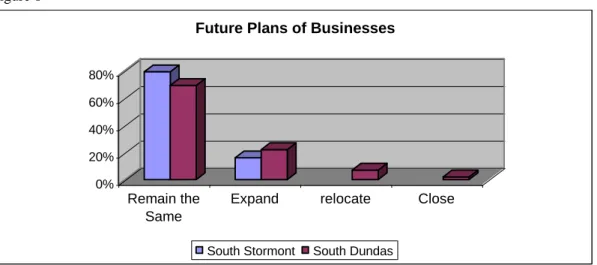
In SS 79% of businesses plan to remain the same, 16% plan to expand and 1 business plans to close while in SD 69% plan to remain the same, 24% plan to expand and 2 plan to close
83% of SS businesses and 78% of SD businesses anticipate the same or higher dollar sales this year
Business Development
In SS 60% of the businesses are single location businesses and in SD 68%
In SS 75% and in SD 55% of owners/managers are satisfied with their business location
Of those dissatisfied in SS the main reasons are condition of building 60% and general appearance of building 60% while in SD 42% indicate dissatisfaction because there is no opportunity to expand, 35% state high business taxes
Business Development Cont’d
37% of SS businesses lease their building while 51% of SD businesses lease
Majority of businesses‘ energy sources are hydro/electricity and gas—with 80% of SS and 86% of SD businesses concerned with energy costs
4 SS and 11 SD businesses requested information/assistance on energy conservation and efficiency
In SS 92% of business use email and 84% advertise on the web while in SD 88% use email and 80% advertise on the web
47% of SS and 39% of SD businesses indicate they have the technology they need citing start-up and ongoing costs as barriers to expanding their technological uses
Top factors in SS for improving competitiveness in the next 3 years are improving customer service, having reasonably priced water/sewer systems and controlling energy costs while in SD the main factors identified are improving customer service, developing local markets and having telecommunication services available
Business Markets
In SS 87% of current total dollar sales is in the area and in SD 90%
In SS 65% predict an increase in total dollar sales this year over last year while 52% of SD businesses predict an increase
SS businesses market their goods and services by sponsoring local events 72%, and sending out flyers/brochures 67% while in SD owners/managers use business cards 75%, sponsor local events 66% and send out flyers/brochures 66%
Financial Development
The main financial lending source investigated, secured, used for operations and expansion in both SS and SD was banks with the use of credit unions in SS and private money in SD the second lending source of choice
Financial planning is done yearly by 37% of SS businesses and by 22% of SD businesses, monthly by 14% of SS businesses and 22% of SD businesses with no financial planning at all done by 20% of SS businesses and 28% of SD businesses
2 SS and 7 SD requested financial planning information Workforce Development
35% of SS and 26% of SD businesses have increased their number of employees in the last 3 years
20% of SS and 34% of SD businesses predict the need for an increase in employees in the next 3 years—13 in SS and 67 in SD
Identified areas where workforce needs skill improvement: customer service, sales and marketing and computer software usage
84% of SS and 74% of SD do in-house training
Employee retention by businesses in both townships is high Local Community
37% of SS and 52% of SD respondents are aware of Economic Development plans for their area and of these 29% in SS and 30% in SD felt the plans were being effectively implemented
Survey participants identified lifestyle, availability of utilities, telecommunication infrastructure, reasonable labor and transportation costs and support from local residents and businesses as benefits of doing business in SS and SD
The main disadvantages detailed include high taxes, small size of local markets and the lack of availability of appropriately zoned land
The main activities which local business groups and economic development could provide as support to local business include joint advertising and marketing, trade shows, and business networking sessions
Retail/Service Business
16% of SS and 49% of SD business owners/managers are aware of strategies and plans that promote and manage their commercial area
In SS the Chamber of Commerce and in SD the Chamber, BIA and Committee of Council are the main business organizations
SS reported cooperative advertising/joint marketing, building and sign improvement loan/grant programs would benefit their businesses while SD indicated physical improvements in public areas, retail and special event coordination and business directories/brochures and maps would be helpful
The top 3 suggestions for improving SS business environment include more and better signage (roadside and highway), financial support for store facades (including plants, trees, street furniture and exterior) and more and better festivals while SD recommended more and better festivals, more niche market specialty shops and financial support to improve store facades
Vandalism, litter and vacancies/turnovers were of concern in SD Community Questions
Strengths of the areas were listed as location, history, lifestyle and our friendly people
Main ideas of how our plazas could improve include beautification of plazas, improved/updated and additional signage, reducing litter and vandalism (SD) and having better garbage pick up and recycling (SS)
Mall/community activities which would benefit their businesses –top 3 on the list in SS are shop locally programs, riverfront activities and customer appreciation days while in SD the top 3 are shop locally, customer appreciation days and street festivals
Proposed Actions Beautification of plaza
plantings (trees, shrubs, flowers, planters)
façade improvements
window displays (vacant stores)
signage
Entrances and Gateways Improvement highway signage
roadside advertisements
visual identity – unifying theme/banner Community Assets Development
festivals and events: Riverfront activities
Christmas Parades
Street Festivals
Farmers‘ Market physical setting:
public amenities (washrooms, parks)
graffiti/litter/vandalism
street furniture (benches, garbage receptacles, cigarette butt holder etc.) waterfront:
recreational trails
access recreational programs
Business Development
business directories, brochures, maps
strategic recruitment of new businesses:
market analysis and strategic development plan joint marketing:
organization of special events
uniform hours of operation
customer appreciation/service
advertising
business networks (tradeshows, seminars)
―shop locally‖ campaign
Business Training/Support business planning marketing financial planning succession planning customer service energy conservation
Safety and Security Planning policing
lighting
parking
traffic flow
street repairs
BACKGROUND of OUR PROJECT
Recently the Township of South Stormont and the Township of South Dundas have partnered to conduct a community-based Business Retention and Expansion Project using the model developed by the Ontario Ministry of Agriculture and Food and Rural Affairs. Included in this program is a web-based application customized for rural communities and available at no cost to communities less than 100,000 in population.
―No matter the size of the community or municipality, community leaders are all interested in building strong vibrant local communities. Businesses and the jobs they create are critical components of strong economies. Strong local economies cannot exist without a growing business/job creation sector. Supporting the development and growth of local businesses is fundamental to achieving this objective.
Strategies such as business recruitment, strategic alliances and partnerships, entrepreneurship, workforce development, downtown revitalization, tourism development etc. are often implemented as part of an overall economic development strategy. During the past number of years an increasing number of municipalities have begun to focus on providing greater support to their existing business sector. A variety of business visitation models have been implemented in an attempt to understand the needs of local businesses and thereby develop and implement actions to support the retention and growth of existing businesses.‖ – OMAFRA - REDDI website
The business plaza areas of the four communities of Iroquois, Morrisburg, Ingleside and Long Sault in the Townships of South Dundas and South Stormont have much in common. All were built as a result of the construction of the St. Lawrence Seaway, all are the same age and, with the exception of the Morrisburg Plaza, there has been little change to the structures over the past fifty years. Conducting BR+E is the first step in establishing the need for a downtown building and enhancement project. The Economic Development Advisory Committees of both Townships have endorsed this process citing that it complies with the goals and recommendations in the existing Economic Development Strategic Plans for each of the Townships. Members of Council of each Township supported the process. OUR COMMUNITIES
South Stormont
Located on the mighty St. Lawrence River in picturesque southeastern Ontario, South Stormont offers the relaxed lifestyle of country living with major metropolitan areas just a short drive away. South Stormont is immediately adjacent to Cornwall, Canada's Seaway City. With its rural/urban blend, South Stormont offers an enviable choice of warm inviting villages, or rolling countryside. Whether it's a business visit or a vacation, individuals will find much to do and friendly people to make their stay a pleasant one.
South Stormont, situated on the broad St. Lawrence River just west of the City of Cornwall, is a community of just over 12,000. The Township is 1 hour west of Montreal, 1 hour south of Ottawa, and 3 ½ hours from Toronto. Located in the heart of Canada‘s highway and rail ‗Corridor-route‘, South Stormont provides rapid and efficient access to three of the nation‘s four principal metropolitan markets.
South Stormont has international access, too. There are bridge crossings in Cornwall, 10 minutes east, and at Johnstown, 30 minutes west. These two international access points to the United States are a half days drive to Syracuse, Buffalo, Boston and New York. In addition, there are two, international airports, each within an hour‘s drive.
South Dundas
In South Dundas the St. Lawrence River provides a stunning backdrop to the small towns, rolling farmland and popular tourist attractions in the township. There is plenty to do in South Dundas, whether one has only a few hours or a week. South Dundas is the home of Upper Canada Village. This site preserves Ontario's unique heritage and offers visitors an entertaining and educational interpretation of how early Canadians lived during the 1860‘s. Enthusiasts can cycle or drive our scenic routes along the St. Lawrence River, seek out the many murals depicting our history and heritage, or enjoy a comedy at our Upper Canada Playhouse theatre. Special events and festivals fill the calendar throughout the year.
Having a population of approximately 10,500, South Dundas residents enjoy an excellent quality of life. It is a mix of villages surrounded by beautiful countryside and bordering the St. Lawrence River to the south. Visitors and residents enjoy the quiet lifestyle of rural Ontario with all its amenities - schools, churches, retail stores, professional and medical services, recreation facilities, just to name a few.
The community has excellent transportation links to the larger urban centers (Ottawa, Montreal, Kingston, Toronto). The area offers many recreational activities like golfing, fishing, scuba diving, hiking, biking, cross country skiing, snowmobiling and boating or just relaxing on the shores of the St. Lawrence River. South Dundas offers you a lifestyle.
Funding
The Townships of South Dundas and South Stormont, as partners, received funding for their project from the SD&G Community Futures Corporation as part of the Eastern Ontario Development Program (EODP). The EODP is a $10 million Government of Canada initiative, which promotes socio-economic development in Eastern Ontario, encourages a competitive and diversified regional economy, and contributes to the successful development of business and job opportunities and
sustainable, self- reliant communities. Other partners include the Ministry of Agriculture, Food and Rural Affairs and the Eastern Ontario Training Board.
After securing funding, a Project Coordinator was hired and a Leadership Team was determined. The Business Retention and Expansion Ontario model was introduced to Iroquois, Morrisburg, Ingleside and Long Sault plaza business owners/managers in December 2006 through media releases and individual business visits by a member of the Leadership Team and the Project Coordinator. Business owners were given an information pamphlet outlining the program goals, stages and timelines. After the initial business visits were completed, a thirteen member Task Force consisting of a broad-based group of community leaders, representing our four communities, was established. In mid January 2007 forty-four highly skilled, enthusiastic Volunteer Visitors were trained. Over a two and a half week time period our talented Volunteer Visitors conducted 82 confidential interviews with local businesses to determine business needs, concerns and recommendations for improvements.
Business Retention and Expansion Process
A Business Retention and Expansion (BR+E) project is a proven, community based, volunteer-driven economic development study designed to encourage existing local businesses to stay and grow in our communities.
There are four phases in the BR+E Program
Stage 1: Business Visits: Trained volunteers conducted an intensive, structured business survey to identify I issues and opportunities.
Stage 2: Immediate Follow Up: The Leadership Team and Task Force reviewed the survey results and planned follow up.
Stage 3: Strategic Planning: From the survey results the Leadership Team and Task Force conducted a comprehensive analysis. Using this information, their community knowledge and a strategic planning process they developed Proposed Action Plans to address the needs identified by the survey.
Stage 4: Implementation of Plans: At a Public Meeting the survey results were shared and a presentation of recommended actions was given. Members of the communities participated in work sessions to review the recommended actions and brainstorm additional ideas. The proposed actions were prioritized and preliminary next steps were determined.
The goals of the South Stormont and South Dundas B R + E study:
Encourage public and private sectors to work together
Contribute to the Townships‘ Strategic Planning for economic development
Provide the Business Sector with a direction for its future
Allow investors to understand the local economy of the area
Identify training needs of the business sector
Identify ways to assist the existing businesses to broaden their markets within their communities and beyond
Assist Business Groups in identifying strategies and work plans to support local businesses while avoiding duplication and potential conflicts
Improve communications between all stakeholders and develop partnerships for new projects
Demonstrate to local businesses that the community appreciates their contribution to the local economy
Develop a clearer understanding by community members of why economic development is important and how each sector of the community contributes
Build stronger community volunteer base
Following are the South Stormont/South Dundas survey results. They provide valuable insights into future economic development activities and job creation in our communities.
COMPANY INFORMATION
The goal of South Stormont and South Dundas BR+E study was to interview at least 75 percent of the 96 retail and services managers/owners in the Iroquois, Morrisburg, Ingleside and Long Sault Plaza areas. A total of 82 business owners/managers agreed to be interviewed, resulting in an 85.4 percent participation rate. The following table shows the breakdown of retail and service businesses by town and the number of businesses that participated.
Figure 1 0 5 10 15 20 25
Ingleside Long Sault Iroquois Morrisburg
BR+E Participating Retail & Service Businesses
Retail Service
The businesses surveyed represented over 257 full-time employees, 202 permanent part-time employees and
40 seasonal/temporary employees (499 in total). The majority (68%) of employees live within the municipality. Figure 2 0% 20% 40% 60% Full-time Part-time Other
Status of Employees
South Stormont South Dundas
Of the 22 businesses interviewed, 40% were corporations, 30% were sole proprietorships, 15% were partnerships, 5% branch plant and 10% were another form. Twenty percent of the total businesses were franchises.
South Dundas:
Of the 60 businesses interviewed, 41% were corporations, 34% sole proprietorships, 12% partnerships, 3% non-profit corporations and 10% were another form. Sixteen per cent of the businesses were franchises.
In both townships the majority of the business owners were involved in the day-to-day operations, 95% in South Stormont and 88% in South Dundas. In South Stormont 68% of the storeowners were residents of the community with 71% of the South Dundas owners residents of the community. Both townships had similar information regarding location of businesses‘ head offices within the township with 68% in South Stormont and 74% in South Dundas. In South Stormont 26% of the businesses had head offices elsewhere in Ontario and 5% outside Canada. In South Dundas 22% of the businesses had head offices elsewhere in Ontario, 2% outside Ontario and 2% outside Canada. Both townships had similar percentage breakdown of family-owned businesses with 60% in South Stormont and 59% in South Dundas.
The age of businesses in South Stormont and South Dundas varied from less than one year to over 35 years. The following graph indicates the age range of businesses surveyed.
Figure 3
In South Stormont 70% of the businesses had a Business Plan, 58% had a Marketing Plan and 47% a Succession Plan. In South Dundas 56% had a Business Plan, 47% had a Marketing Plan and 25% had a Succession Plan. Lack of succession planning is often a concern cited in business literature, particularly for businesses with aging owners.
0% 10% 20% 30% 40% < 1 1 - 3 4 - 10 11- 25 26 - 35 > 35 Age of Businesses
The size of businesses ranged from one employee/owner businesses to establishments with up to 51 employees. The majority of businesses in both townships employ 1-4 people. The range of business sizes in the two townships is illustrated in the following chart.
Figure 4
BUSINESS CLIMATE
This section of the survey reviewed the business climate in South Stormont and South Dundas. It gathered information on the owner/managers‘ perceptions of the climate and factors which facilitate/hamper the development of businesses in our area.
The businesses‘ general impressions of the community as a place in which to do business were positive. The majority of those interviewed in both townships rated their area as good to excellent, 70% in South Stormont and 80% in South Dundas. Seventy-five percent (75%) and sixty-five percent (65%) respectively in South Stormont and South Dundas expressed no change in attitude in the last three years. Of those who did express a change, their current attitudes were less positive than in the past three years, 60% in both townships. No clear indication for this response was given.
A component of business climate is the identification of barriers to the expansion of existing businesses and the development of new businesses in the community.
In South Stormont the most significant barriers identified were lack of proactive new business recruitment (63%), business taxes (31%), availability of skilled labour (25%), business insurance (19%), availability of financing (13%), resistance from local business (13%) and water/sewer fees (13%).
In South Dundas the business owners weighted the significance of the barriers differently. In this township, the main concerns were business taxes (42%), availability of financing (32%) and lack of proactive new business recruitment (30%). Other noteworthy factors identified, in order, were water/sewer capacity (23%), availability of properly zoned land (21%), availability of skilled labour (19%), water/sewer fees (19%), serviced land (17%), and the availability of different sized parcels of land (15%).
Size of Businesses ( # of businesses)
0 5 10 15 20 25 30 Owner(s) 1 - 4 5 - 9 10 - 14 15 - 19 20 - 29 30 - 49 50 - 99
Figure 5
Barriers to Expansion
0% 10% 20% 30% 40% 50% 60% 70%
Lack of business recruitment Business taxes Availabilty of skilled labour Business insurance Availabilty of financing Resistance from local business Water/Sewer fees Water sewer capacity Different sized parcels of land Serviced land
South Stormont South Dundas
Local government and other organizations
In the course of developing and running their businesses, owners/managers require services from the local government and other organizations.
Businesses interviewed in both townships had a high level of satisfaction with the following services provided by local government: health departments, health unit approvals, fire prevention, and public utilities. In South Stormont business owners were very satisfied or moderately satisfied (94%) with policing while only 74% of the business owners in South Dundas indicated they were very satisfied or somewhat satisfied. South Stormont was more satisfied with their snow removal (85%) than South Dundas (75%).
In the two townships significantly different levels of satisfaction were expressed in the areas of planning/engineering/zoning permits, street repair and garbage removal. In South Stormont garbage removal is a concern with a 61% satisfaction level while South Dundas merchants indicate an 82% satisfaction level. Street repair is a bigger concern in South Dundas with a 50% satisfaction level than South Stormont where the satisfaction level is 79%. In the area of planning/engineering/zoning permits there is a 66% level of satisfaction in South Stormont and 74% level of satisfaction in South Dundas.
Community organizations such as medical, and health services and schools, including post secondary, as well as libraries, were ranked as satisfactory or very satisfactory by the majority of firms.
Business owners in both townships expressed less satisfaction with cultural and recreational facilities in their areas. In South Stormont there was a 60% level of satisfaction with cultural facilities and 57% level of satisfaction with recreational facilities. In South Dundas the business owners said they had a
77% level of satisfaction with Cultural facilities and 68% level of satisfaction with recreational facilities.
There were a number of survey questions regarding the province and its ministries as well as federal government departments and local business organizations. Most of the firms interviewed rated -No Contact- with the provincial and federal agencies as their response. This is significant given that they have an impact on business yet the majority of firms interviewed never had contact with them. Interestingly enough, South Stormont had a 90% very or somewhat satisfied rating for Ontario as a place to do business while South Dundas had a 74% satisfaction level.
The South Stormont businesses which have had contact with local business organizations were, on the whole, moderately satisfied with these organizations. In South Stormont 70% of the business owners/managers were very or somewhat satisfied with the Chamber of Commerce, 67% somewhat satisfied with Business Improvement and only 33% level of satisfaction with the Economic Development in their area. In South Dundas the responses were significantly different with an 86% level of satisfaction with the Chamber of Commerce, 79% satisfaction rating for the BIA and an 83% kudos for their Economic Development Corporation.
In South Stormont the level of satisfaction was fair to poor indicating a need for improvement in the following areas:
availability of public transportation
increased population/market
availability of appropriately zoned land
availability of skilled labour
reduction in municipal taxes Figure 6
South Stormont - Areas to Improve
79% 50% 50% 47% 44% availability of public transportation increased population/market availability of
appropriately zoned land availability of skilled labour
reduction in municipal taxes
South Dundas business owners/managers‘ level of satisfaction was fair to poor indicating a need for improvement in the following areas:
reduction in municipal taxes
availability of appropriately zoned land
better access to employee training and use of training facilities
improved access to research and development
reduced cost of construction
increased population/market Figure 7
FUTURE PLANS
During the interviews, the business contacts were asked questions regarding future plans for their organization. Specific topics included expansion plans and factors affecting expansion and closures. In South Stormont 79% of the businesses plan to remain the same size while 16% plan to expand. One business indicated intent to close because of a reduction in the number of customers. The 3 businesses with plans to expand were going to provide additional customer services. Two of the three businesses with expansion plans intend to increase floor space, add product lines, invest in new equipment and/or technology, employ more skilled labour and improve their business processes. All the businesses with expansion plans were going to use cash to finance their expansions while 2 businesses planned to use lines of credit and 1 business indicated new owner equity, private investment and short and long term bank loans would be used.
In South Dundas 69% of the businesses plan to remain the same size while 24% plan to expand. Four businesses (7%) plan to relocate with 1 of these businesses planning to move outside the municipality. Two South Dundas businesses (3%) plan to close their doors because of loss of customers, lack of profitability and inability to find a buyer for their business.
One South Dundas business that indicated expansion plans, identified challenges with securing financing, developing marketing and business plans and finding an appropriate building. The 4 businesses planning expansions will use cash and their lines of credit, while 2 plan to use private investments and short-term bank loans.
South Dundas - Areas to Improve
87% 75% 71% 70% 69% 68% reduction in municipal taxes availability of
appropriately zoned land better access to employee training and use of
training facilities improved access to research and development reduced cost of construction increased population/market
Later in the report, business development responses indicate that 83% of South Stormont and 78% of South Dundas businesses anticipate the same or higher total dollar sales for this year. On the same note, many have expressed that they have seen no significant change or an increase in sales over the past 3 years.
Future plans of businesses appeared optimistic as the majority of businesses in both townships planned to stay the same size or expand.
Figure 8 0% 20% 40% 60% 80% Remain the Same
Expand relocate Close
Future Plans of Businesses
South Stormont South Dundas
BUSINESS DEVELOPMENT
The business development section of the survey considered the factors and strategies that impact growth of businesses. These ranged from site considerations to energy sources, technologies implemented, and factors that make a business competitive in its market.
Of the South Stormont businesses surveyed, 60% were single location. Of the businesses with more than one location 25% were elsewhere in the municipality, 63% indicated other locations outside the municipality but in the county, 63% elsewhere in Ontario, 25% in another province and 13% outside Canada.
In South Dundas 68% of the businesses were single locations. Of the businesses with more than one location 32% were elsewhere in the municipality, 47% outside the municipality but in the county, 42% indicated other locations elsewhere in Ontario, 32% in another province and 21% outside Canada.
In terms of their business location, 75% of South Stormont business owners/managers were completely satisfied and 10% somewhat satisfied with their current site. Those that were not completely satisfied had the following main concerns: condition of the building (60%), general appearance of the site (60%), site too small (20%), no opportunity for expansion (20%), availability of skilled labour (20%) and other deficiencies (40%) were reported.
Figure 9
In South Dundas 55% of the business owners were completely satisfied with their current site with 45% somewhat satisfied. Their reasons for not being completely satisfied included: no opportunity to expand (42%), business taxes (35%), site too small (31%), general appearance of the site (31%) and other reasons (31%).
Of the businesses leasing in South Stormont (37%) none anticipated problems renewing their lease. In South Dundas 51% of the businesses leased their business location and one indicated potential problems in renewing their lease.
Figure 10
South Dundas Site Concerns
42%
35% 31%
31% 31%
No opportunity too expand Business taxes
Site too small
General Appearance of site
Other Reasons
South Stormont Site Concerns
60% 60% 20% 40% Condition of building General Appearance Site too small Other deficiencies
Energy Sources
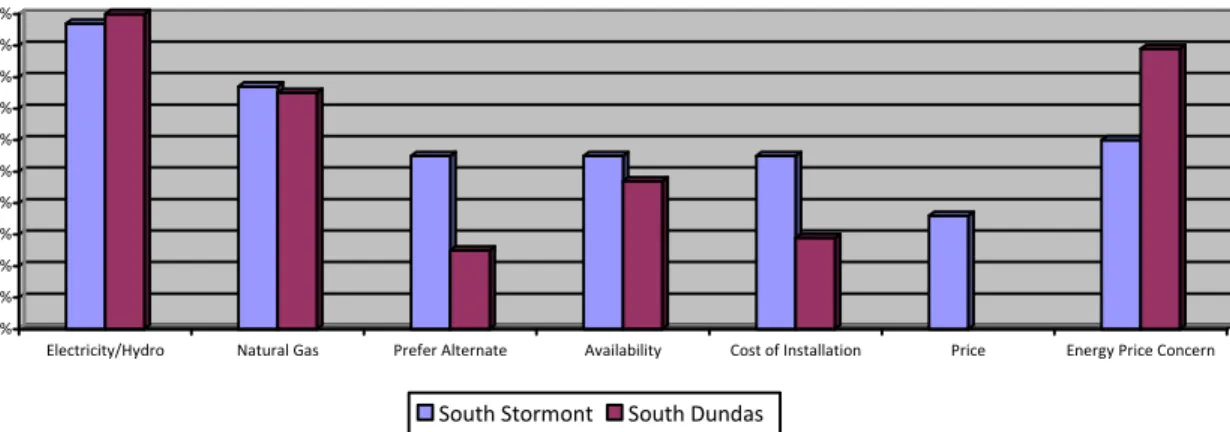
In an attempt to better understand what energy sources businesses were using, the firms were asked to identify what they were currently using and what they would prefer to use. In South Stormont 90% reported they use electricity/ hydro and 65% use natural gas. When asked what they would prefer to use for energy 25% reported alternate energy sources to natural gas and hydro/electricity but the main reasons they did not use their preferred energy source was availability (29%) and cost of installation (29%) while a significant percent (57%) reported ―other‖ reasons for not using their preferred energy source.
In South Dundas 89% of the businesses reported they use hydro/electricity and 75% use natural gas. Fifty-three percent of the businesses prefer hydro/electricity and 82% prefer natural gas. Like their South Stormont counterparts the South Dundas business owners indicated a range of preferred alternatives with cost of installation (38%), availability (38%) and ―other‖ (38%) as reasons for not making changes. Cost of energy is a concern for 80% of the South Stormont businesses and 86% of the South Dundas businesses.
Information and/or assistance with engineering or technical support with respect to energy conservation and efficiency was requested by a total of 15 of the businesses interviewed, 11 in South Dundas and 4 in South Stormont.
Figure 11 0% 10% 20% 30% 40% 50% 60% 70% 80% 90% Hydro/electricity Use
Natural Gas Use Preference to Alternate
Availablilty Cost of Installation Other reasons Concern Energy Uses & Concerns
Information Technology
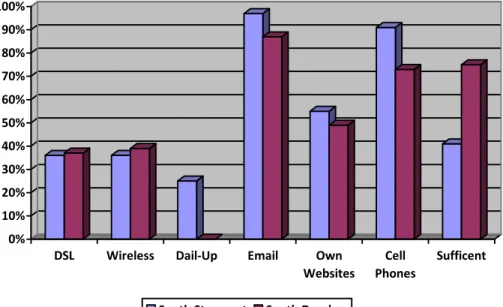
The use of information technology was prevalent in most businesses in our study and included computers, digital and cell phones and the internet. Cable and DSL were used by 50% of South Stormont businesses and over 74% of the South Dundas businesses for internet connectivity. The use of internet-ready devices such as PDA and pagers was not as prevalent with 25% of the owners/managers in South Stormont and 16% in South Dundas reporting their use.
In both townships the most popular Internet uses were e-mail and business websites. In South Stormont 92% use email and 84% have their own website or use others‘ websites to advertise. In South Dundas 88% of the businesses use email and 80% have their own website or use others‘ websites. Following in popularity were e-commerce, customer service, marketing and distribution /supplier network reported by about one third of both townships owners/managers. Cell phones and digital phones were common. In South Stormont 63% use cell phones and 81% use digital phones with similar statistics in South Dundas of 67% reporting cell phone and 76% digital phone usage. While 47% of South Stormont and 39% of South Dundas businesses indicated they had the technology they needed, those wanting to implement new technology identified start-up and on-going costs as the biggest barriers.
Figure 12 0% 20% 40% 60% 80% 100%
Cable/DSL Email Websites Cell Phones Sufficient
Internet Uses
Forty-four percent of South Stormont businesses belong to a buyer/supplier network while a further 44% felt it would be of benefit to do so. In South Dundas 39% belong to a buyer/supplier network and 38% responded it would be beneficial to their business.
Our Township businesses identified the following factors as being very important to ensuring their competitiveness in the next three years:
South Stormont South Dundas
Improving customer service 87% 85%
Developing local markets 50% 84%
Enhancing workplace skills 60% 65%
Controlling energy costs 67% 57%
Having reasonably priced water/sewer systems 69% 61%
Having telecommunication services available 56% 68%
Doing strategic marketing 64% 60%
Developing business plans 46% 53%
Developing markets outside the area 29% 59%
Having labour available 56% 45%
Adding/changing products and services 45% 55%
Ensuring workplace health and safety 50% 53%
Ability to access capital 25% 48%
BUSINESS MARKETS
This section of the interview considered what businesses do in their market quest to identify customer needs, stay competitive and increase their sales.
Collaboration with other businesses can lead to increased market performance. Forty-seven percent of the South Stormont owners/managers interviewed were interested in pursuing joint marketing with other business, 35% were interested in collaborating and networking and 12% would consider joint product purchasing. Forty-seven percent of the South Stormont businesses indicated they were not interested in any collaborative activities with other businesses. In South Dundas 54% wanted no collaboration while 34% indicated interest in collaborating and networking, 30% in developing joint markets and 14% in joint product purchasing.
When considering where firms were marketing their products, there was a slight trend of consistent or decreased selling outside of their areas. In South Stormont sales outside the area but within Ontario remained constant at 9% while sales outside Ontario, but within Canada dropped by 1% in the last 3 years. Sales to the U.S. have remained constant at 1%. Correspondingly, in South Dundas sales outside the area but within Ontario have dropped by 2% in the last 3 years while sales outside Ontario and within Canada have remained constant at 1%. Like South Stormont our South Dundas owners/managers report consistent sales of 1% to the U.S. over the last 3 years. Both townships report slight sales increases in their areas in the last 3 years with South Stormont reporting a 1% increase and South Dundas a 2% increase.
In South Stormont 65% of the businesses indicate they anticipate higher dollar sales this year over last year while 18% are confident their sales will remain the same. This is positive news since 37% of the South Stormont businesses believe their competition has increased.
In South Dundas 52% of the businesses predict higher sales this year over last and 26% believe their sales records will be the same as last years. South Dundas businesses indicate a 34% increase in competition in their area.
Market research information was an important component of business growth and development. South Stormont and South Dundas identified similar market research and trend information sources as important to their business success, namely:
South Stormont South Dundas
Industry/Association newsletters 55% 67%
Industry/Association websites 45% 50%
Suppliers 45% 62%
Trade Shows 55% 52%
Networking 36% 52%
Business owners/managers in both South Stormont and South Dundas reported that they use similar strategies to identify customer needs. Their top methods of gathering customer feedback is by:
South Stormont South Dundas
Informal customer contacts 71% 89%
Customer complaints 59% 77%
Sales Calls 24% 32%
Electronic communications 24% 32%
Customer Surveys 18% 30%
Businesses in South Stormont primarily market their products and services by sponsoring local events (72%), sending out flyers and brochures (67%), using business cards (56%) and advertising on the Internet (44%). Similarly, in South Dundas businesses market themselves by using business cards (75%), sponsoring local events (66%), sending out flyers and brochures (66%) and using the Internet (46%). Figure 13 0% 10% 20% 30% 40% 50% 60% 70% 80% Sponsor Local Events Flyers & Brochures Business Cards Internet
Prevalent Methods of Marketing
FINANCIAL DEVELOPMENT
Having surveyed the businesses' future expectations, the interview tool then gathered information on their previous 3 years‘ financial history. In this section, financial lending sources investigated, secured, used for operations and expansions were discussed as well as behavior regarding planning and reviewing of financial performance. In our study chartered banks were the main financial source investigated by 80% of South Stormont and 86% of South Dundas businesses with 88% of South Stormont and 77% of South Dundas securing bank loans. The second main source of business funds for South Stormont investigated (40%) and secured (25%) was Credit Unions. In South Dundas the second main source of funds that was investigated (23%) and secured (31%) was private money. Of the capital secured, 85% of South Stormont businesses used the money for operations and 67% used it for expansion. In South Dundas 91% of the businesses used the secured money for operations and 90% for expansion.
In terms of financial planning, there was a range of time-frames in use with 22% of South Stormont and 37% of South Dundas businesses planning their financial performance yearly and 28% of South Stormont and 34% of South Dundas businesses reviewing monthly. It is noteworthy that 17% of South Stormont businesses do not plan their financial performance and 28% do not review their actual performance at all. In South Dundas 20% of the businesses do not plan their financial performance and 20% do not review their actual financial performance.
In total 9 businesses in our study requested financial planning information, 2 from South Stormont and 7 from South Dundas. No businesses asked for assistance related to financial planning. In South Dundas 2 businesses asked for assistance with business planning and 2 for succession planning while 1 asked for information regarding succession planning.
WORKFORCE DEVELOPMENT
Business Retention and Expansion recognizes that up to 80% of new jobs come from existing businesses. As indicated earlier in this report, the majority of those interviewed identified an increase in sales in the last year and anticipated further increases in the next three years. New workers may require additional training, while existing workers may need motivation and empowerment. They too may need to upgrade their skills and receive professional development. This section considered workers‘ availability, workers' skills, training sources and the factors responsible for the businesses‘ growth requirements.
In our study, 35% of South Stormont and 26% of South Dundas businesses reported an increase in the number of employees in the past three years. The main reasons for this increase in South Stormont is an increase in sales (44%), introduction of new products or services (44%) and an increase in market share (44%). South Dundas interviewees credited an increase in sales (68%), a decrease in market competition (50%) and an increase in market share (50%) for this increase in employees. In the next 3 years 70% of the South Stormont businesses predict they will stay the same and 20% forecast an increase in employees. Similar optimism exists in South Dundas with 60% of the businesses predicting their employment numbers will remain the same while 34% believe they will increase their complement of employees.
Future Sales & Employee Growth
0% 20% 40% 60% 80%
increase in employees employees to stay the same increase in sales increase of market share
South Stormont South Dundas Figure 14
Availability of workers was deemed fair to poor by 61% of South Stormont businesses and 42% of South Dundas businesses. Forty-two percent of the South Stormont businesses felt the quality of the area‘s workforce was good to excellent while 68% of South Dundas owners/managers rated their areas workforce as good to excellent.
Employers in our study identified the following areas where our workforce needed skill improvements:
South Stormont South Dundas
Customer Service 33% 44%
Sales and Marketing 40% 42%
Computer software usage 29% 41%
Working with others 29% 35%
Oral Communications 14% 30%
Most of the businesses in our study do their own in-house training, 84% of South Stormont and 74% of South Dundas businesses. Employers in our study also used customized training for their employees, 32% in South Stormont and 38% in South Dundas. The most significant barriers to employee training were identified as:
South Stormont South Dundas
Cost 36% 43%
Distance to training facilities 29% 17%
Loss of productivity during training periods 14% 23%
Availability of Training locally 14% 23%
Other 36% 26%
Stability of the work force was rated good to excellent by 50% of South Stormont businesses and 68% of South Dundas businesses. The vast majority of the businesses in our study indicated they had no difficulties in retaining employees, 95% in South Stormont and 88% in South Dundas. Three South Dundas employers did identify wages as the main reason employees change jobs. A total of 4 businesses in our study requested employee retention strategies, 1 from South Stormont and 3 from South Dundas.
Employers from South Stormont indicated they would need 13 additional employees in the next 3 years while South Dundas is predicting an increase of 67 employees. The need will be primarily in the areas of sales, clerical, skilled and unskilled labour.
LOCAL COMMUNITY
In this section of the survey, business employers reflected on the characteristics of their community. Consideration was given to such things as the economic development plan, advantages and disadvantages of doing business in South Stormont and South Dundas, and other factors related to doing business in the community.
When surveyed, 53% of the South Stormont and 47% of the South Dundas respondents were interested in participating as a Business Ambassador for their community.
When asked if their community had an Economic Development plan 37% of South Stormont‘s respondents indicated they were aware of the plan and only 29% believe it is being effectively implemented. Of those surveyed in South Dundas 52% were aware of their area‘s Economic Development plan and 48% responded that it was being well implemented. This appears to be an issue that requires attention.
Business retention and expansion usually implies that a business is currently pleased with the community and willing to make a continued or further investment locally. What are the advantages of doing business in this area? Responses from both townships were similar in a few areas. The major advantage identified was the lifestyle offered by the local environment with a 100% good to excellent rating from South Stormont and a 92% evaluation from South Dundas participants. Business owners emphasized the availability of utilities, our telecommunications infrastructure, reasonable labour and transportation costs and access to markets as benefits to doing business in our areas. Support from local residents was identified as a positive feature of doing business in our areas with a significant 94% good to excellent rating from South Stormont and a moderate 67% from South Dundas. Support from local businesses was also perceived as positive with a 61% rating from South Stormont and 62% rating from South Dundas merchants.
Figure 15
Satisfaction of Local Environment
0% 20% 40% 60% 80% 100% 120% Local lifestyle Support of local residents Support from local businesses
When data from the study was reviewed it was noted that there were significant differences in assessments of factors of doing business in our communities by South Stormont and South Dundas owners/managers. In general South Stormont was significantly more positive in their good to excellent ratings than South Dundas:
South Stormont South Dundas
Water/sewer capacity 94% 61%
Development charges 80% 39%
Municipal by-laws 78% 48%
Local permit process 78% 45%
Support from municipality 72% 43%
Land costs 75% 43%
Construction costs 69% 32%
Access to training 63% 26%
Four main factors emerged as disadvantages of doing business in South Stormont and South Dundas. Taxes were of concern in both areas with a fair to poor rating of 44% in South Stormont and 87% rating in South Dundas. The small size of the local markets, the lack of availability of appropriately zoned land for future development and the lack of local transportation were also significant negative factors to the merchants in our townships.
Figure 16
0% 20% 40% 60% 80% 100%
Water/Sewer Capacity Municapal By-Laws Support from Municipality Construction Costs
Factors to Doing Business
In identifying activities which local business associations and economic development offices could provide, businesses expressed an interest in receiving assistance in the following areas:
South Stormont South Dundas
Joint advertising and marketing 72% 63%
Trade Shows 39% 53%
Business Networking sessions 44% 43%
Marketing Seminars 28% 41%
Website development 17% 35%
Attraction of Related Supply/Service businesses 28% 27% RETAIL/SERVICE BUSINESS
In the Retail/Service portion of our survey business owners/managers were asked to identify existing promotional strategies managing the commercial district and organizations that represent their area. Survey participants were given the opportunity to indicate programs and services that would benefit local businesses as well as the opportunity to make recommendations of how the businesses could become more competitive. In this section business owners/managers were asked to give candid evaluations of the condition of their commercial district.
When asked if there was a strategy in place that promotes and manages their commercial district 16% of South Stormont and 49% of South Dundas indicated they were aware of a plan. The remainder of the survey participants indicated that either a plan didn‘t exist or they didn‘t know about a plan. Of the respondents who did indicate the existence of a plan the responses were as follows when queried about specific details of the plan:
South Stormont South Dundas Identifies issues important to the future of my business 67% 48% Proposes specific actions to address identified issues 67% 44%
Is comprehensive and integrated 0% 42%
Focuses primarily on retail marketing and promotion 0% 74% In South Stormont the Chamber of Commerce was identified as the main business organization while South Dundas acknowledged the Business Improvement Area Association (BIA), the Chamber of Commerce and Committee of Council.
South Stormont participants identified the main programs or services that would benefit their businesses, in order of priority, as:
1. Cooperative advertising/joint marketing
2. Building improvement loan/grant programs (tied) 2. Sign improvement loan/grant programs
3. Physical improvements in public areas (tied) 3. Business directories, brochures and maps 4. Retail and special event coordination
South Dundas respondents‘ data indicates the following programs and services as most important to them:
1. Physical improvements in public areas 2. Retail and Special event coordination (tied) 2. Business directories, brochures and maps 3. Cooperative advertising/joint marketing 4. Sign improvement loan/grant program 5. Networking events
In an attempt to hone their skills survey participants in both townships identified an interest in participating in similar workshops. The topics they felt would be most beneficial are:
Retaining existing and attracting new customers
Marketing
Customer Service training
Staff training and development
In addition, South Stormont identified a workshop focused on evaluating market opportunities as beneficial while South Dundas indicated a desire for a session on visual merchandising.
South Stormont listed their top 3 suggestions for improving the retail business environment as: 1. More and better signage
2. Financial support to improve store front facades 3. More and better festivals
In comparison, South Dundas list was slightly different: 1. More and better festivals
2. More niche market specialty shops
3. Financial support to improve store front facades tied with more and better signage In general, business owners/managers were enthusiastic about giving feedback on the condition of their commercial district. When asked what was in fair condition or needed improvement in the physical setting of their plazas the following factors were weighted differently by township participants as indicated below:
South Stormont South Dundas
Plants, trees, flowers 78% 38%
Public amenities e.g. washrooms 72% 68%
Street furniture 61% 45%
Graffiti/litter 41% 68%
In the Gateway/Entrance portion of the survey township participants identified the following areas as fair or needing improvement:
South Stormont South Dundas
Exterior facades 78% 49%
Visual identity of the area-
Unifying banner 73% 52%
Roadside advertising 72% 66%
Highway signage/tourism
Directional signs 66% 44%
A significant number of respondents in both townships identified public transit and accessibility for disabled as poor or needs improvement in the ―Transportation‖ portion with the survey. In SD 41% are not satisfied with the traffic flow in their plaza.
In the ―Other Issues‖ section the most significant concern expressed was vandalism by South Dundas respondents.
In the ―Competitive Position‖ portion of the survey businesses were asked about the appropriate mix of businesses, appropriate range of quality/price of target markets and number of vacancies/turnovers. Twenty-eight percent or less of South Stormont respondents indicated these factors as fair or needed improvement. In South Dundas 85% felt the number of vacancies/turnovers was fair or needed improvement and likewise 60% indicated work needed to be done to improve the range of quality/price for target markets. Fifty-one percent of South Dundas businesses reported the appropriate mix of businesses as fair to needing improvement.
Significant numbers of survey participants gave a rating of fair to needs improvement in the joint marketing section. See details below:
Advertising campaigns 69% 64%
Customer service programs 66% 73%
Organization of special events 51% 61%
Uniform hours of operation 47% 62%
Community Questions
In our Community Questions section, which was an open-ended format, respondents were asked for candid feedback on community assets, what changes should be made in the plazas to enhance their businesses and to identify plaza and community activities which would benefit their businesses. When asked to comment on our communities‘ greatest strengths participants from both areas identified our green space and the St. Lawrence River as an appealing asset to living in our area. Some respondents felt the waterfront was underutilized and underdeveloped and that local history and geography should be used to promote the area to attract more businesses, residents and tourists. Those surveyed made many positive comments about the value of their quiet, safe and friendly communities where people are caring and always willing to help their neighbours. Our location, with our close proximity to major cities, was seen by some as an advantage or selling feature in attracting new businesses while others felt this was a disadvantage as residents can easily travel to Cornwall or Ottawa to shop. Survey respondents in some communities felt that all required amenities were available in their area while others were able to identify retail businesses, which they felt, would benefit the community residents and business owners by keeping shoppers buying locally.
Survey participants had abundant ideas about how their plaza areas could be improved. Business owners in both townships‘ top three recommendations were similar. Their number one priority was the beautification of their plazas. The kind of beautification/improvement was somewhat different in the four communities with some wanting new facades, some recommending flowers and trees, some wanting more benches and one recommending a promenade with tables and sun canopies. Their second recommendation for action was improved, updated or additional signage. The third significant recommendation that came from the responses was the need to keep the plazas cleaner by reducing litter.
In South Stormont garbage pickup and recycling were identified as important issues to be improved while South Dundas participants focused on vandalism, loitering, bikes and skateboarders and requested more police patrol. Both townships identified a need for better advertisement of all businesses in their communities and that work needed to be done to attract new businesses to ensure all vacant storefronts are filled. There were some recommendations for consistent and/or extended store hours. In South Dundas concerns were expressed about the parking and sidewalk areas with specific recommendations for improvements being given.
Of interest to local business groups and service clubs, businesses stressed the importance of increasing the number of festivals, community and mall activities to attract people to our areas.
The top mall activities that participants felt would benefit their businesses in South Stormont, in order of priority, were:
1. Shop Locally programs 2. Riverfront activities
3. Customer Appreciation Days 4. Christmas parades
5. Street Festivals 6. Farmers‘ market (tie) 6. Sidewalk sales (tie)
Recommendations, in order of priority, in South Dundas were: 1. Shop Locally programs
3. Street Festivals 4. Christmas parades 5. Sidewalk sale 6. Farmers‘ market 7. Riverfront festivals (tie) 8. Golf Tournaments (tie)
South Stormont business owners said the complaints they hear from their customers most often is a need to shop in Cornwall because of a lack of local goods and services. A need for an LCBO (in Ingleside) and a Tim Horton‘s (Ingleside and Long Sault) were identified. Lack of public transportation and inconvenient store hours for shift workers also made the list.
In South Dundas a number of customer complaints were mentioned with the most common ones including lack of a variety of goods and services available in the plazas, lack of local employment, minimal activities for youth, vandalism, lack of public washrooms in the mall and inconsistent store hours of operation.
Business leaders in our study readily identified ways we can improve our communities and support their businesses. Now, it‘s time for ACTION!
Key Actions
Key Action 1 - Beautification of Plazas
Recommendation1.1: The Township will collaborate with business and community champions and committed store owners/managers to establish committee(s) to develop plans, determine finances, and set priorities.
Objective: To attract customers by making the business plazas more appealing and inviting.
INITIATIVES:
If required hire a consultant to work with planning committees, store owners/managers and township personnel to create a design/plan for each plaza façade or upgrade—consider phasing in changes with specific timelines Facilitate the development of a unifying theme/banner for each community Ensure signage that is consistent and attractive and follows the unified theme Apply for grants
Timeframe: planning –2007
Key Action 2 - Entrance and Gateway Improvements
Recommendation 2.1: The Townships will facilitate a process that will lead to the development of a visual identity or unifying theme/banner for each township that is used in all township brochures, websites, signage and other promotional materials.
Objective: to make the plazas a destination of choice for patrons
Initiatives:
If required hire consultant/ specialist to conduct workshop(s) with selected councilors and township personnel, BIA, C of C, and other community champions to determine theme/banner, motto, colour, etc for each township. Note: This image should also be coordinated with the plaza beautification program
Increase and improve plaza highway signage that coordinates with township theme/banner identity
Improve/Standardize plaza signage for a unifying look which reflects the township/ plaza theme/banner
Considerations (How):
Planting of trees, flowers, planters
Improving plaza facades for intimate village feeling
Improving plaza lighting with effective, energy efficient lighting Maintain and/or develop green space