The Structure of the
New IT Frontier:
Market Oriented Computing – Part II
In this article we dig into the details of the Infrastructure-as-a-Service (IaaS) solutions, which are the most popular outcome of this technology, and introduce a new phenomenon called Market Oriented Cloud Computing. Enterprise CIOs focus to deliver return on in-vestment and/or provide strategic advantage with applications and services that align to
the business (and difficult for competitors to
copy). Most CIOs have excess capacity and a huge investment in equipment. With an oversupply of servers and constant requests for more, they are looking to use their inter-nal infrastructure more effectively. The re-cent global recession helped grow the hype around Cloud Computing as an alternative, and many are adopting the cloud ideas inter-nally before buying whole-heartedly into the public cloud.
The commoditization of infrastructure through
virtualization and super efficient management
in hosted data centers lowers the cost of de-livering the compute and storage needed to a price lower than the costs of purchasing and maintaining current IT infrastructures. A majority of enterprises have successfully in-stalled some form of virtualization or plan to do so in a short time1. However, only about
2-5% have built an internal cloud, mostly just
based on Virtual Machines (VM’s). Only a few large organizations have the man-pow-er and budget to get the same economies of scale that hosting companies provide. Secu-rity, control, trust and lock-in concerns are temporary with a new wave of innovation coming that makes it easier to move into the cloud. While some start-ups, small companies and non-strategic compute business areas are moving to the cloud now, the smart ones are developing their IT transformation strategy to focus on innovation to take full advantage of Cloud Computing’s first outcome is the de
-livery of an infrastructure model that is ap-proaching commodity like prices and fast im-plementation times. The main adopters of the public cloud are start-ups, small companies, enterprise test-beds, non-critical applications and delivery of back-up resources. There is a high amount of innovation expected above this commodity layer, namely in platforms (platform as a service) area leading to what we call Market Oriented Cloud Comput-ing (MOCC). Partial adoption of MOCC is happening now inside private clouds with full adoption expected once security, con -trol, trust and “standards” are in place. The cloud qualities enterprises are adopting in-clude reservation aware scheduling, ability to apply Quality of Service (QoS) policies with alternative offers, Virtualization, sup -port of multi-tenant and multi-applications of same resources, ability to apply pricing and charge-back policies and more. This is driving high demand for platforms that help enterprises move into the cloud.
In the previous article we provided an over-view of Cloud Computing. We covered the reference model and provided some real
ex-amples of IT companies operating in the field.
Christian Vecchiola
1,
Dexter Duncan
2,
and Rajkumar Buyya
1,21
CLOUDS Lab, Department of
Computer Science and Software Engineering, The University of
Melbourne, Parkville, Victoria, Australia.
{csve, raj}@csse.unimelb.edu.au
2
Manjrasoft Pty. Ltd., Melbourne, Victoria, Australia.
0 Infrastructure Infrastructure Infrastructure Infrastructure Infrastructure Infrastructure Infrastructure Infrastructure Infrastructure Infrastructure Infrastructure Infrastructure/ Platform Infrastructure Platform Infrastructure/ Platform Platform, Infrastructure (M) Infrastructure (M) Infrastructure (M) Infrastructure (M) Infrastructure Infrastructure (M) Infrastructure Infrastructure Service Type Vendor Product PAYG Monthly PAYG, Monthly PAYG, Plans PAYG PAYG PAYG PAYG, Plan PAYG PAYG, Licensing PAYG, Monthly ND PAYG PAYG PAYG PAYG ND Free, Consulting ND Monthly ND ND PAYG Product EC2 [C], S3 [S], CloudFront [Cnt], … Joyent Cloud [C] Cloud Servers [C] Cloud Files [S], Cloud Sites [SD,C,S] [C] [C] [C] [C,SD] vCloud Express [C], Enterprise Cloud [C] vCloud Express Beta[C] [C,SD] Synaptic Compute as a Service [C], Synaptic Storage as a Service [S], Synaptic Hosting as a Service [C,S]
IBM Smart Business Services [C,S,..] vCloud Express [C] AppEngine [C] [C,S]
Azure [C,S], Dynamic Data Centre Toolkit [C,S] [C] [C] [C, SD] [C,S,SD] [C] [Cnt] [Cnt] Amazon Joyent Rackspace/Mosso ElasticHosts FlexiScale Rightscale Cloud Central (Australia) Terremark Melbourne IT (Australia) Rejila (Australia) AT&T IBM VMWare Google Heroku Microsoft Enomaly Eucalyptus Elastra Skytap Zimory Akamai Nirvanix the fast time to market that pay-per-use,
elas-tic services deliver. This new focus on build-ing demand-based private network clouds to work seamlessly with Public Clouds is a natural step we call Market Oriented Com-puting. Furthermore, as adoption of Cloud Computing becomes more prevalent a new area called Market Oriented Cloud Comput-ing2 begins to take shape.
Companies that help organizations align their internal infrastructure to move easily into the cloud are the new heroes and therefore the new winners.
Brief Overview of Infrastructure as a Service (IaaS) – offering compute and storage as a commodity
Infrastructure-as-a-Service (IaaS) solutions deliver customizable IT infrastructures on demand. This is the most popular form of delivering IT services introduced by Cloud Computing, and it is also the most consoli-dated one. Table 1 shows some of the biggest players in the IaaS sector. The range of offer-ings varies from bare metal servers to entire virtual infrastructures customized for web applications. Some vendors own the underly-ing physical infrastructure serviced to users while others rely on these providers and pro-vide additional value such as system design and application packaging. The most com-mon pricing strategy is pay-as-you-go but many vendors also offer monthly plans.
Amazon is definitely the most popular player in the field of Infrastructure on demand. The
company launched Elastic Compute Cloud (EC2) three years ago and it is now the king
1 From Forrester 2009 survey of 2,600 decision-makers from small and large companies in the US and Europe. http://www.reuters.com/article/pressRelease/idUS126722+04-Mar-2009+BW20090304 2 R. Buyya, C. S. Yeo, S. Venugopal, J. Broberg, and I. Brandic, Cloud Computing and Emerging IT Platforms: Vision, Hype, and Reality for Delivering Computing as the 5th
Utility, Future Generation Computer Systems, Volume 25, Number 6, Pages: 599-616, ISSN: 0167-739X, Elsevier Science, Amsterdam, The Netherlands, June 2009
Table 1. Comparison table of the major IaaS vendors Legend:
C: Compute S: Storage Cnt: Content (CDN) H: Hosting
SD: System Design and Application Packaging
(M): The vendor does not provide any infrastructure support but only the management software ND: Not Disclosed
PAYG: Pay As You Go
The main adopters of
the public cloud are
start-ups, small
com-panies, enterprise
test-beds, non-critical
appli-cations and delivery of
of offering a pay-as-you-go elastic host-ing service and a reference model for many other vendors providing compute on demand services. The entire IaaS offering of Amazon, which goes under the umbrella of Amazon Web Services, also includes Simple Storage
Service (S3) providing virtual storage on de -mand that is combined with EC2 for an in-tegrated solution and maximum savings. The list of Amazon customers ranges from very large enterprises to the end users that simply enter credit card details to instantly provi-sion virtual servers. Another big player in the
field is Joyent, which provides hosting, infra -structure, and application services for clients looking to run collaborative applications for their users. Joyent offers compute on demand and web application virtualization and helps to successfully scale social network websites like LinkedIn and Facebook, with nearly have
300 million users. On the same line, GoGrid,
ElasticHosts, Rackspace, FlexiScale, Right-Scale, Melbourne IT and TerraMark provide bare metal virtual servers and storage space on demand.
Some vendors specialize by providing added value on top of the basic IaaS offerings. For example, RightScale eliminates vendor
lock-in by lettlock-ing the user choose the specific vir -tual infrastructure (Amazon, VMWare, etc) and software stack to compose their virtual environment (SkyTap). Other vendors, such
as Cloud Central and Rejila, add specific
features for composing your own virtual in-frastructure and automating application pack-aging and deployment. Other solutions are
completely specialized in providing a flexible
and full featured virtual infrastructure design environment and rely on others to provide bare metal virtual servers or storage (Elastra, CohesiveFT).
With the exception of Google Inc, which offered a Cloud Computing model from in-ception, the big players of IT such as IBM, Microsoft, Sun, and AT&T made their move quite late and mostly concentrate their efforts in supporting service providers with infra-structure management software and vertically integrated service offerings.
Finally, if you want to build your own Cloud on your premises or elastically manage your datacenter, without leveraging integrated so-lutions such as those proposed by IBM and VMWare, virtual infrastructure management platforms like Enomaly Enterprise Cloud, Eucalyptus Enterprise Edition, or Zimory are
your best choice. Table 2. Future evolution of the Cloud Computing Market
Service Type
Time Frame Product Product
Some Cloud Computing Adoption Rapid Cloud Computing Adoption Cloud Computing is Mainstream Confusion, trust, security, control concerns, jurisdiction issues slow down early adoption Market Oriented Platforms (i.e. Manjrasoft) enter Market; Period of Innovation Begins Security, control and trust issues overcome. Legacy Private Networks Cloud-enabled private infrastruc-tures: provisioning on demand and virtualization. Market Oriented Cloud Computing Blurs line between Private/Public 2006 – 2010: Cloud Computing Thinking Formation 2010 – 2012: Partial Market Oriented Cloud Computing Adoption 2013 onward: Full Market Oriented Cloud Computing Adoption
This is just a selection of the plethora of ven-dors that offer compute and storage services on demand. Such services are the founda-tion for turning capital expense (CapEx) into an Operating Expense (OpEx) on corporate balance sheets and are called Infrastructure as a Service or IaaS. IaaS is fast approach-ing pricapproach-ing models that look like commodity based pricing and the opportunity of exploit-ing Public Clouds to elastically shape your IT infrastructure is tempting. Rackspace offers compute time for less than 2¢ per hour with additional charges for bandwidth between 8¢ and 22¢ per GB/month. For comparison, Amazon has bandwidth rates between 10¢ and 17¢ per GB/month. Their EC2 compute service starts at 10¢ for a small Linux server with a slightly higher price for Windows.
Both charge 15¢ per GB for storage with ad -ditional charges of 1¢ per request.
Most CIOs need to ensure that their private data center infrastructure evolves to integrate
the new “commoditized” Public Cloud of -ferings. This allows them to maximize their existing investment and opens up opportunity
for a future “unified design” where you easily
move your data and share compute resources in a federated model either for purposes of managing peak load (cloud bursting), mini-mizing time and money (brokering) or as a disaster recovery solution. To make this hap-pen, some key features of the Cloud,
virtuali-zation, provisioning on demand & Quality of Service (QoS) based workload management,
are being integrated into privately owned infrastructure. This gives the dynamic elas-tic infrastructure and on-demand, self-serve, self-managed, internet enabled, and con-sumption based structure needed to take ad-vantage of hybrid or inter-cloud offerings.
Companies that help
organizations align their
internal infrastructure
to move easily into
the cloud are the new
heroes and therefore
the new winners.
A Look at the Future:
Market Oriented Cloud Computing
Where is the focus now? What is Cloud 2.0 now that a commodity layer of infrastructure is underway? The window of innovation over the next few years is now clearly focused above this commodity layer. You are not go-ing to make your enterprise hardware cheaper than the big boys operating in the IaaS space. This means that the real place of innova-tion and growth is in Platform-as-a-Service (PaaS) and Software-as-a-Service (SaaS) playground. Expect to see traditional infra-structure and virtualization companies play-ing aggressively in the Platform area through in-house development or acquisitions. In par-ticular, there is a high amount of innovation beginning to occur above the infrastructure layer, namely in the PaaS area, leading to what we call Market Oriented Cloud Com-puting (MOCC).
Market Oriented Cloud Computing encom-passes approaches and technologies enabling the trading of IT services, and their seamless integration into the existing infrastructure, ac -cording to service level agreements established to ensure the desired Quality of Service. Table 2 shows the expected evolution of the Cloud Computing Market into the adoption of market-based strategies that shape the IT
infrastructure of tomorrow. Partial adoption of MOCC is happening now inside Private Clouds with full adoption expected once
se-curity, control, trust and “standards” are in
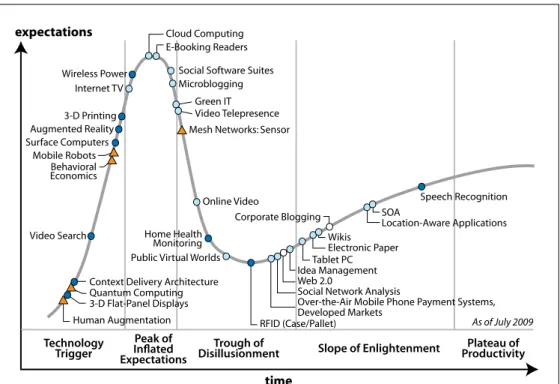
place. While we do not expect 100% of the market to move to the Cloud in three years, the mainstream adoption of Cloud Com-puting is in-line with Gartner Hype Cycle (Figure 1). In the near-term, enterprises are
“cloudifying” their infrastructure, which is
a partial adoption of the longer term trend to Market Oriented Cloud Computing. The
“Cloud Qualities” that enterprises are add -ing include many areas that allow them to add applications and demand without buy-ing additional hardware for an overall high resource utilization. These qualities include reservation aware scheduling, ability to apply
dynamic QoS policies, virtualization, support
of multi-tenancy and multiple applications on the same resources, ability to apply pricing and charge-back policies and more.
Market Oriented Cloud Computing: What More?
How does Market Oriented Cloud Comput-ing differ from Cloud ComputComput-ing? Is it really a step forward or just another buzzword used to add more confusion?
The Cloud Computing model already intro-duces on demand provisioning, consumption
based subscriptions, and also promises QoS
based delivery of IT services. However, at
present, service providers have inflexible pric
-ing, generally limited to flat rates or tariffs
based on usage thresholds, and consumers are restricted to offerings from a single provider at a time. Also, many providers have proprietary interfaces to their services thus restricting the ability of consumers to swap one provider for another. For Cloud computing to reach a broad and seamless adoption, it is required that the services follow standard interfaces. This ena-bles full commoditization and thus, would pave the way for the creation of a market in-frastructure for trading in services.
What characterizes Market Oriented Cloud Computing is the realization of a virtual mar-ket place – Cloud Exchange – where IT serv-ices are traded and brokered dynamically. This only happens if enterprises seamlessly move from one provider to another, without conversion costs and in a completely dynam-ic manner. Organizations are building their internal Private Clouds to be similar to Public
Clouds. This is the first step that enables the
transparent integration of the publicly provi-sioned IT services with the private premises.
Figure 1. Gartner technology hype cycle expectations
time
Source: Gartner (July 2009)
x
Technology
Trigger ExpectationsInflatedPeak of DisillusionmentTrough of Slope of Enlightenment ProductivityPlateau of
As of July 2009 Video Search Mobile Robots Surface Computers Augmented Reality 3-D Printing Internet TV Wireless Power Cloud Computing E-Booking Readers
Social Software Suites Microblogging
Green IT Video Telepresence Mesh Networks: Sensor
Online Video
Corporate Blogging Behavioral
Economics
Human Augmentation Context Delivery Architecture Quantum Computing 3-D Flat-Panel Displays
Home Health Monitoring Public Virtual Worlds
RFID (Case/Pallet) Tablet PC Idea Management Web 2.0
Social Network Analysis
Over-the-Air Mobile Phone Payment Systems, Developed Markets SOA Location-Aware Applications Wikis Electronic Paper Speech Recognition
Infrastructure-as-a-Service (IaaS)
solu-tions deliver
customiz-able IT infrastructures
on demand.
What is missing is the availability of a market where desired services are published and then automatically bid by matching the require-ments of customers and providers. Some are already moving in this direction: Amazon
introduced the concept of “spot instances”
that are dynamically offered by the provider according to their availability and bid by the customer. Their effective usage and consump-tion is then determined by the spot price es-tablished by Amazon and the maximum price provided by the customers.
Market Oriented Computing has the same characteristics as Cloud Computing; there-fore it is a dynamically provisioned unified computing resource allowing you to manage software and data storage as on aggregate capacity resulting in “real-time” infrastruc-ture across public and private infrastrucinfrastruc-tures. Market Oriented Cloud Computing goes one step further by allowing spread into multiple public and hybrid environments dynamically composed by trading service.
The realization of above Cloud Exchange is technically possible today, but not probable given the lack of standards and overall im-maturity of the market. As vendors jockey to put forward their standard, and as concerns on security and trust begin to disappear, en-terprises will move to take advantage of the new frontier of commodity like prices and quick time to market. Moreover, the presence of a demand based market place represents an opportunity for enterprises to shape their infrastructure for dynamically reacting to workload spikes and cut maintenance costs. It also allows possibility to temporary lease some in-house capacity during low usage pe-riods, thus better Return on Investment. The Cloud Exchange is a meeting point where these new opportunities are provided.
Realizing the Vision: A Platform for Market Oriented Cloud Computing
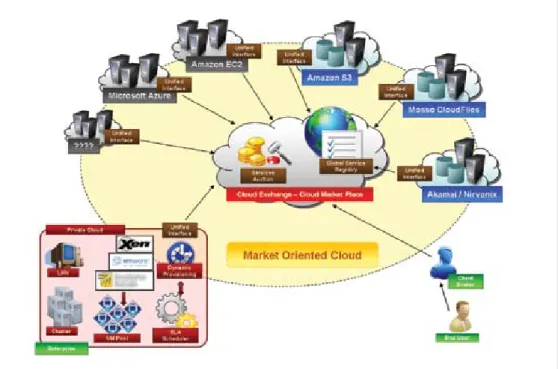
Figure 2 illustrates the key components that shape the future scenario of Cloud
Comput-ing. In this vision, the “market place” plays a
fundamental role. The dynamic provisioning of services from different vendors increases the competition in the value offering, result-ing in a more consistent effort in providresult-ing a high quality and more accessible service.. To achieve this, Cloud providers no longer deploy traditional system-centric resource management architectures that do not pro-vide incentives to share their resources and
regard all service requests with equal im-portance. Instead, market-oriented resource management is necessary to regulate the supply and demand of Cloud resources to achieve market equilibrium (where supply = demand), providing feedback in terms of eco-nomic incentives for both Cloud consumers
and providers, and promoting QoS-based re -source allocation mechanisms that differenti-ate service requests based on their utility. In
addition, clients benefit from the “potential”
cost reduction of providers, which leads to a more competitive market and thus lower pric-es. This is the role of the market place.
From the provider point of view a specific in -frastructure is put in place to effectively take advantage of the demand based market place.
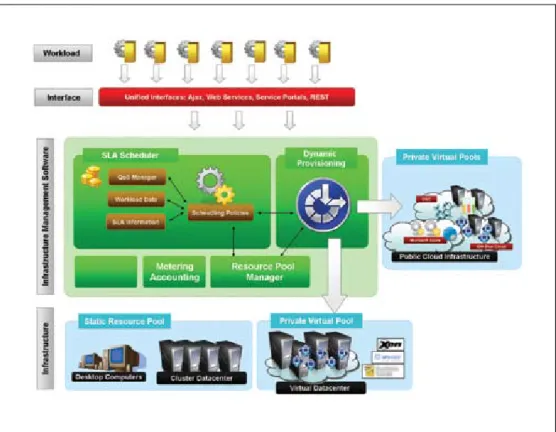
Figure 3 shows a component based view of
the infrastructure supporting MOCC.
• Public Interface Access. These are a set of standard interfaces for delivering IT services to end users and publishing them in the mar-ket place. These interfaces identify the access points of each Cloud Service provider. • SLA3-based resource allocator and workload
manager. The SLA Resource Allocator and Workload Manager are responsible for en-suring that IT services are delivered with the
desired QoS. This layer is a fundamental com -ponent and includes different operations such as resource and application metering, billing, accounting and market based scheduling.
Figure 2: Global Cloud exchange and market infrastructure for trading services
3 SLA: Service Level Agreement
Most CIOs need
to ensure that their
private data centre
infrastructure evolves
to integrate the new
“commoditized” Public
• Virtualization Layer. Virtual Machine tech-nology allows workload isolation, server
con-solidation, multi-tenancy, fine grain tuning of
allocated resources, and execution sandbox-ing. Moreover, virtual machine instances are started and stopped on-demand on a single physical machine to meet accepted service
requests, hence providing maximum flexibil
-ity to configure various partitions of resourc -es on the same physical machine to different
specific requirements of service requests.
• Physical Infrastructure. It provides the horse power required to execute the Cloud work-load. IaaS providers maintain multiple data-center that are maintained and made accessi-ble through virtual infrastructure management software, such as those presented previously (vCloud express, Dynamic Data Center Toolkit, and others).
Such architecture ensures that crucial busi-ness operations of companies are performed
with confidence by meeting deadlines. Criti
-cal QoS parameters that change over time,
such as time, cost, reliability and trust/secu-rity, characterize the future Cloud Computing
market and a flexible and open infrastructure
is the way to go for realizing this vision. The similar infrastructure and component stack is expected within the private premises of the enterprise. In order to seamlessly inte-grate Public Cloud resources, the internal IT organization follows the same resource man-agement model found in public infrastructure, on a different scale. In addition, two distinc-tive features have to be considered:
• Heterogeneity of resources. Private Clouds tend to be composed by different resources, such as clusters, data-centers, workstations, and possibly Computing Grids. These sources are either virtual or physical. This re-quires uniform access and way of leveraging these resources.
• Dynamic provisioning. Public Clouds address the need of integrating additional resources into the existing infrastructure during peak loads. In a true market oriented offering these operations are not performed statically but are triggered by the constraints of the current workload. SLA aware schedulers identify the additional resources (storage, compute,
or other) required to meet the QoS require -ments and resources are obtained by means of a market mediated negotiation with avail-able providers.
Figure 4 describes the general architecture of a Private Cloud augmented with market ori-ented capabilities.
Figure 3. High-level market-oriented Cloud architecture for Cloud services providers
Market Oriented Cloud Platform Cloud Quality (CQ) Characteristic Easy to Deploy Pay as you Go Demand Based Multi-tenant Scalability Workload Distribution Failure Management Flexibility Elasticity Service Oriented Architecture Easy to Manage Self Managed Quality of Service (QoS)
High Resource Usage
Write once and deploy in multiple run-time environments. Pricing/Accounting modules to allow you to price based on resource usage
Dynamic Provisioning based on QoS
Resource Sharing: ability to host multiple users and applications across same infrastructure
From the small local network to the data-centre. Scalable services for handling increased workloads and potentially large infrastructures.
Provide custom workload Distribution Algorithms
Strong support for failover and content replication. VMs can be easily migrated from one node to other.
Customizable Services based on needs of applications. Pluggable and extensible architectures for implementing the system infrastructure.
Dynamic Provisioning to VM based on QoS from public and private resources.
Service-based approach for infrastructure, workload manage-ment, and application submission.
Monitoring, Reservation, Meter and Charging features. Auto plug scheduler as required – dynamic provisioning of scheduler
Extensible set of parameters controlling the scheduling of workloads. Ability of dynamically change the value of these parameters in order to meet the continuously changing business needs of the enterprise.
Combination of Multi-tenant and Provisioning based on QoS results in high utilization rate
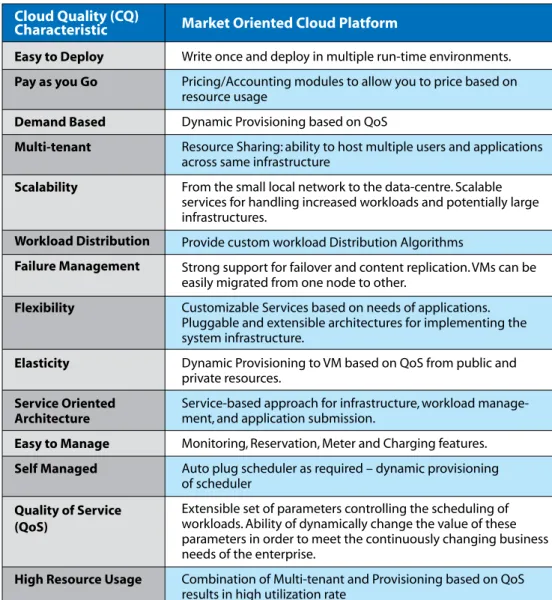
Table 3: Expected features for a Market Oriented Cloud Computing Platform From a customer point of view, a Cloud
based commercial offering for enterprises is expected to:
• Support customer-driven service
manage-ment based on customer profiles and request -ed service requirements
• Define computational risk management tactics
to identify, assess, and manage risks involved in the execution of applications with regards to service requirements and customer needs • Derive appropriate market-based resource management strategies that encompass both customer-driven service management and com-putational risk management to sustain SLA oriented resource allocation
• Incorporate autonomic resource manage-ment models that effectively self-manage changes in service requirements to satisfy both new service demands and existing serv-ice obligations
• Leverage VM technology to dynamically assign resource shares according to service requirements.
These requirements are most likely addressed by Platform-as-a-Service offerings rather than a pure IaaS. There is now a vacuum in the area of infrastructure and applications
plat-forms that many vendors are rushing to fill.
The Platform as a Service (PaaS) market is growing at 160% annual growth rate (accord-ing to IDC, Gartner, AMR and William Blair & Co) and expected to reach to just around USD $9 to 10 Billion in 2012. This is by far the highest growth area in the Cloud.
To understand this better, we put together
“Cloud Quality” Characteristics needed for
enterprises to Cloud-enable their infrastruc-ture. The Market Oriented Cloud Platform
delivers on the qualities by being flexible
with ability to easily work in multiple pro-gramming and multiple run-time environ-ments. A new framework race is now happen-ing that allows enterprises to manage based on the new demand based commodity infra-structure. These frameworks need to make it easy to manage, provision, monitor, secure and change resources when needed or based on pre-determined service levels that match the applications.
There is a shift from today’s supply-driven
“build to peak” to a demand-driven,
service-oriented approach. This results in real-time IT infrastructure with little spare capacity, but also gives more freedom to focus on
busi-ness strategies rather than maintenance and system engineering. A Market Oriented Plat-form allows easy abstraction of underlying hardware and provides an elastic architecture that provisions and de-provisions on demand
based on QoS requirements.
It is important for the platform to be flexible,
easily customizable, and extensible while be-ing service oriented to provide unique SLA/
QoS & Web Services management, security
and dynamic provisioning. This includes the ability to remotely control, monitor and dy-namically change single and groups of nodes, which is not only important to simplify the management, but also to identify and remove bottlenecks.
Many of the existing middleware platforms are proprietary and tied to their infrastruc-ture or applications’ service such as Goog-le’s App Engine and SalesForce’s Force. com. Most of the non-proprietary ones are
IaaS offerings
com-moditize
infrastruc-ture and hardware
and allow enterprise
to elastically reshape
their IT infrastructure.
Java/Linux based, with a few that rely on .NET framework. Outside those mentioned above, other companies providing Platform
as a Service are: 3Tera, Apprenda, DataSy -napse, Manjrasoft and Univa UD. For what concerns Market Oriented Cloud Computing, two initiatives are worth mentioning: Aneka and Gridbus Service Broker. Aneka is a mid-dleware platform that provides an easy way to deploy Computing Clouds on top of het-erogeneous infrastructure thus allowing the integration of Public and Private Clouds [1].
It supports QoS based resource management
and schedules the execution of applications
according to their available budget and QoS
constraints. The same features are integrated in the Gridbus Service Broker that provides a general brokering service for data intensive applications, which can be scheduled on large variety of middleware: legacy job submission systems, Computing Grids, Public and Pri-vate Clouds [2].
Summary
Infrastructure-as-a-Service solutions consti-tute the most popular and consolidated ap-proach for dynamically delivering IT serv-ices introduced by Cloud Computing. IaaS
offerings commoditize infrastructure and hardware and allow enterprise to elastically reshape their IT infrastructure. While the es-sence of Cloud Computing is provisioning IT services on demand, and IaaS value proposi-tions are considerable step towards this
direc-tion, the flexible, efficient, and profitable use
of these is still far away. The market segment of infrastructure on demand is now mature and a solid base on top of which build ad-ditional services that will lead to the wide-spread adoption of Cloud Computing. To make this happen, it is necessary to adopt a market oriented approach where IT serv-ices are traded, provisioned, and advertised in competitive and open environment. This is the vision proposed by Market Oriented Cloud Computing. In this article we have character-ized the fundamental properties of such a mod-el and listed a set of requirements that service providers and service consumers (i.e. Enter-prises) need to meet in order to realize this vision. Market Oriented Cloud Computing is the natural evolution of Cloud Computing and
identifies a scenario where the virtual public
infrastructure is seamlessly and dynamically integrated with the private premises.
I need fresh business
strategies to deal with
the challenges faced
Simon Watt, Chief Intelligence Officer
(Would benefit from attending this marcus evans’ summit)
17 – 19 February 2010
RACV Royal Pines Resort Gold Coast Queensland, Australia
[email protected] www.govciosummit.com
The intelligence behind the world's leading business events
www.marcusevans.com
The Government CIO Summit 2010 will offer the perfect setting for participants to present their products and services directly to the key decision makers and gate keepers of Australia’s IT budgets. Over three days participants will meet and interact with senior level IT executives through a number of structured one-to-one meetings and networking opportunities. In addition, participants will attend the strategic summit sessions led by the thought leaders of the IT community. This networking event presents a unique opportunity to develop significant and beneficial business relations.
To realize this vision, Platform-as-a-Service solutions play a fundamental role. In the next article, we illustrate how to leverage these solutions to provide a heterogeneous, dynamic, and market oriented environment for Cloud Computing.
References
1. Christian Vecchiola, Xingchen Chu, and Rajkumar Buyya, Aneka: A Soft-ware Platform for .NET-based Cloud Computing, High Speed and Large Scale Scientific Computing, 267-295pp, W. Gentzsch, L. Grandinetti, G. Joubert (Eds.), ISBN: 978-1-60750-073-5, IOS Press, Amsterdam, Netherlands, 2009. 2. Rajkumar Buyya, Suraj Pandey, and Christian Vecchiola, Cloudbus Toolkit for Market-Oriented Cloud Comput-ing, Proceeding of the 1st Internation-al Conference on Cloud Computing (CloudCom 2009, Springer, Germany), Beijing, China, December 1-4, 2009.