Financial Reporting Council
Report
Professional discipline
March 2015
Extended auditor’s reports
A review of experience in the first year
Financial Reporting Council
The FRC is responsible for promoting high quality corporate
governance and reporting to foster investment. We set the UK
Corporate Governance and Stewardship Codes as well as
UK standards for accounting, auditing and actuarial work. We
represent UK interests in international standard-setting. We also
monitor and take action to promote the quality of corporate reporting
and auditing. We operate independent disciplinary arrangements
for accountants and actuaries; and oversee the regulatory activities
of the accountancy and actuarial professional bodies.
The FRC does not accept any liability to any party for any loss, damage or costs howsoever arising, whether directly or indirectly, whether in contract, tort or otherwise from any action or decision taken (or not taken) as a result of any person relying on or otherwise using this document or arising from any omission from it.
© The Financial Reporting Council Limited 2015
The Financial Reporting Council Limited is a company limited by guarantee. Registered in England number 2486368.
Financial Reporting Council
Extended auditor’s reports:
A review of experience in the first year
Contents
Page
Executive Summary 4
The Survey of Experience in the First Year 8
Background to the development of the extended auditor’s report in the UK 8
Extent of the survey 11
Reporting of risks 14
Reporting of materiality 26
Describing the scope of the audit 33
Going concern disclosures in auditor’s reports 40
Location of the auditor’s opinion 42
The use of standard language in auditor’s reports 44
The use of diagrams and graphs 46
Audit committee reporting of significant issues 49
The Views of Investors – The IMA Auditor Reporting Awards 52
Emerging feedback from Audit Quality Review 56
Aspirations for Future Developments 57
Appendices 62
1 The requirements and guidance relating to the extended auditor’s report
in ISA (UK and Ireland) 700 (Revised June 2013) “The Independent Auditor’s Report on Financial Statements”
2 The relevant Principles included in the September 2012 UK Corporate Governance Code and the related requirements and guidance in ISA (UK and Ireland) 260
(Revised October 2012) “Communication with Those Charged with Governance” 3 The FRC’s pro forma illustrative auditor’s report
1
2
3
4
5
6
1
EXECUTIVE SUMMARY
The Financial Crisis of 2008 brought into sharp focus the concerns of investors and others about the effectiveness of company stewardship generally and about the effectiveness of the audit in supporting this. In particular, concerns were raised about whether the binary (i.e. pass/fail) auditor’s report continued to be fit for purpose in providing adequate transparency about the audit and the auditor’s insights about the company, based on its work. The FRC’s response was to seek to improve company stewardship through coordinated changes to the UK Corporate Governance Code (the Code) and to Auditing Standards.
With respect to the Code a new Main Principle was introduced “The board should present a fair,
balanced and understandable assessment of the company’s position and prospects”, with a supporting provision requiring the Board to state that the Annual Report and Accounts is fair, balanced and understandable. A further supporting provision was also introduced into the Code requiring the Annual Report of a company to include a separate report describing the work of the Audit Committee which, among other things, describes the significant issues that the Committee considered in relation to the financial statements and how these issues were addressed. The FRC has reported on the implementation of the changes to the Code in “Developments in Corporate Governance and Stewardship 2014” published in January 2015.
The FRC’s response with respect to audit was to introduce new requirements for auditor’s reports on companies subject to the Code, with effect for periods commencing on or after 1 October 2012. The auditor was required to report by exception on the “fair, balanced and understandable” statement and on the report on the work of the Audit Committee, and to provide greater transparency about the audit. Greater transparency was addressed by requiring auditors to include within their reports:
a) A description of those assessed risks of material misstatement that were identified by the auditor and which had the greatest effect on the overall strategy; the allocation of resources in the audit; and directing the efforts of the engagement team;
b) An explanation of how the auditor applied the concept of materiality; and
c) A summary of the audit scope, including an explanation of how the scope was responsive to the assessed risks of material misstatement described in (a) and the concept of materiality as described in (b). The Auditing Standard encouraged auditors to be entity specific (i.e. to provide explanations that can be related directly to the specific circumstances of the audited entity rather than generic or abstract explanations expressed in standardised language). It also encouraged the auditor to coordinate descriptions of overlapping topics and to avoid duplication of reporting about them whilst having appropriate regard to the separate responsibilities of the auditor and the Board for directly communicating information primarily in their respective domains.
The Survey addresses the implementation of these changes to UK Auditing Standards which have given rise to what has become known as “the extended auditor’s report”.
Scope of Survey of extended auditor’s reports issued in the first year
With respect to the new auditor’s report requirements, outlined above, the FRC deliberately chose not to publish detailed illustrative examples of auditor’s reports. The FRC was concerned that publishing such illustrations would establish norms that might stifle innovation. The FRC chose, therefore, to allow individual engagement partners and audit firms to innovate as they thought fit within the framework of the
1
new requirements. The Survey explores both whether the new requirements appear to have been compliedwith and areas of innovation.
Between July and September 2014 the FRC carried out a detailed analysis of 153 extended auditor’s reports (63 of which were of FTSE 100 companies) that had been published at that time. Almost all of these reports (147 out of 153) were issued by the four largest audit firms.
The analysis was performed by staff of the FRC reading both the extended auditor’s report and the report of the Audit Committee and responding to a number of questions about what they had read. Some of the questions required the recording of objective information such as the number of risks reported by the auditor. Other questions involved making subjective judgments such as the extent to which the description of a risk described specific circumstances of an entity or were written in generic terms.
Although the subject matter of this Review is the extended auditor’s report, there is some overlap between the reporting of risks by the auditor and the reporting of significant issues by the Audit Committee. This Review includes some (necessarily subjective) observations concerning how well the descriptions of risks in the extended auditor’s report complemented the description of the equivalent significant issues provided by the Audit Committee.
Overview of Survey findings
The Survey confirmed that auditors appeared not only to have met the new requirements but in many cases had made, sometimes quite radical, further changes to auditor’s reports going beyond the changes required by the FRC. A particular conclusion of the Survey was that each of the audit firms had adopted different approaches to the extended auditor’s report and had, therefore, been innovative in different ways. The FRC considers the extent of innovation and the diversity of approaches adopted to be very encouraging. Significant innovation was found in the following areas:
• Disclosing the materiality benchmark used.
• Disclosing the magnitude of unadjusted differences being reported to the Audit Committee. • Reporting of detailed audit findings with respect to identified risks.
• Experimentation with detailed broader explanation of the audit scoping process. • Improved presentation of auditor’s reports through the use of diagrams and graphs. • Addressing going concern disclosures in auditor’s reports.
• Locating the auditor’s opinion at the beginning of the auditor’s report rather than at the end. • Moving generic descriptions of the scope of an audit to a web-site.
1
The IMA
1Auditor Reporting Awards
An important source of evidence of investor views regarding extended auditor’s reports can be found in the comments of the judges of the Investment Management Association’s Auditor Reporting Awards which were presented in November 2014. We have reproduced some of their observations many of which resonate with our own findings. For example, the judges:
• Liked risks that are entity specific.
• Liked quantification of individual risks so that investors can assess their materiality. • Would like to see more information about why the level of materiality was chosen.
• Liked discussion of what the auditor found, whether the company’s approach was satisfactory or whether the auditor questioned management’s judgment.
• Liked reports that had an engaging layout, particularly through use of tables and charts.
The judges also stated that auditor’s reports which included the auditor’s findings and graduated those findings to be the most insightful and engaging for investors.
Discussions with investors and audit firms
Following completion of the Survey we had a number of meetings (between October 2014 and January 2015) with investors and audit firms to both discuss our findings and to seek their views as to how well the first year of extended auditor reporting went from the perspective of their firm or organisation and their plans and aspirations looking forward to the second year and beyond.
There are a number of perceived improvements that could be made, working within the framework of the new requirements that are recognised by both investors and audit firms. These include:
• Improving the granularity of the reporting of risks.
• Providing more information to explain why a particular materiality benchmark was chosen. • Disclosing more information about qualitative aspects of materiality.
• Providing clearer explanations as to how the audit scope was affected by the auditor’s risk assessment and materiality judgments.
• More disclosure of comparative information and explanations of changes from one period to another. The investors and audit firms also suggested some more aspirational changes which include:
• Introducing a discussion within either the auditor’s report or the Audit Committee report as to why an auditor raises a risk that is not also dealt with by the Audit Committee in its report.
1
• Including the new information provided in the extended auditor’s report in the preliminary announcement.• Providing an opportunity for stakeholders to challenge the proposed scope of the audit by publishing the audit plan in advance of the year end.
• Providing more encouragement for the reporting of issues arising from the quality of company’s systems. One of the more interesting innovations has been the reporting of findings by certain audit engagement partners. One firm has announced an intention to adopt this practice more widely. Although investors are generally supportive of this practice, we have heard that some Audit Committees are resistant to such a development and that some audit firms would like to see a safe harbour provision put in place for the protection of auditors.
Findings of the FRC’s Audit Quality Review Team
Although the overall message from this Review is upbeat regarding progress made by the audit firms in writing the new style auditor’s reports, a cautionary note is emerging from the work of the FRC’s Audit Quality Review Team.
During the FRC’s Audit Quality Reviews, it assesses whether the descriptions of work undertaken by auditors in extended auditor’s reports are consistent with the evidence of the work actually performed. In some instances the FRC has identified inaccuracies in the auditor’s descriptions of the nature or extent of the audit procedures performed. The FRC has brought these matters to the attention of the relevant audit firms and reminded all the major firms of the importance of ensuring that their auditor’s reports accurately reflect the work performed.
The FRC’s objective to maintain the momentum of this initiative
From the FRC’s perspective, the response of audit firms to these changes has been most encouraging. Each of the largest audit firms has adopted a distinctive approach to meeting the new requirements of Auditing Standards and there has been a notable absence of the use of standard language (boiler-plate) in almost all of the auditor’s reports that we looked at. Many audit firms have demonstrated considerable innovation by going further in seeking to improve their auditor’s reports than the minimum requirements established by the FRC in the Auditing Standards.
Audit firms and audit engagement partners are, of course, dependent upon feedback from investors and other users of company Annual Reports to inform them about the usefulness of their extended auditor’s reports. Feedback from investors as to what they find useful and what is of less use will be of critical importance going forward. To make investor feedback more widely available we have included within this Review feedback from the judging panel of the IMA Auditor Reporting Awards and comments we have received in our one on
2
Background to the development of the extended auditor’s
report in the UK
In 2012, arising from its work on audit quality the FRC was aware of the concerns of users of auditor’s reports that the traditional binary (i.e. pass/fail) audit opinion, supported by legalistic caveats and provisos, may no longer be fit for purpose.
In 2007 the FRC issued a Discussion Paper “The auditor’s report: A time for change?” which
explored a number of possible options. Arising from this discussion paper, the FRC introduced requirements for the auditor’s report to explicitly address those matters where the auditor is required to report certain matters by exception, by requiring the auditor’s report to describe them and to state that the auditor has nothing to report in respect of them. A further innovation introduced at that time was to make the auditor’s report more concise by enabling the detailed description of the scope of an audit to be excluded from the auditor’s report and instead to be cross referred to on the FRC’s web-site.
These changes were seen as being the first phase of the FRC’s work on the auditor’s report. The second phase was to undertake research to better understand what could realistically be done to make auditor’s reports more informative. In the feedback statement on its proposals, in 2008, the FRC stressed that the revised auditing standard did not preclude auditors from including additional comment in the auditor’s report to highlight matters which they regard as relevant to a proper understanding of their work. The FRC amended its auditor reporting standard to facilitate the inclusion of such additional comments in the auditor’s report. However, this did not seem to stimulate additional comments being made in UK auditor’s reports.
The aftermath of the Financial Crisis of 2008 significantly increased the intensity of the focus on the effectiveness of company stewardship and the adequacy of the communications to the market made by both Audit Committees and auditors. The FRC therefore embarked on further consultations and evidence gathering. In early 2011, arising from feedback to its Consultation Paper “Effective Company Stewardship
– Enhancing Corporate Reporting and Audit” the FRC concluded, among other things, that:
• More needs to be done to demonstrate that auditors are achieving the fundamental purpose of an audit – namely to carry out an independent check into whether a company’s financial statements, including the decisions, judgments and estimates involved have been properly prepared and are fair and balanced. • Auditors can and should provide increased insight into the audit process so as to re-assure users of
financial statements that all material matters have been properly disclosed.
• It would be appropriate to revise the Auditing Standards that govern both reporting by auditors to Audit Committees and reporting to users in the auditor’s report, to make the contribution of auditors to stewardship more transparent.
2
Overview of the changes made to the Code in 2012 (See Appendix 2)
In 2012, arising from its 2011 Consultation, the FRC made simultaneous changes to the Code and to the Auditing Standards to accomplish the above objectives. With respect to the Code a new Main Principle was introduced: “The board should present a fair, balanced and understandable assessment of the
company’s position and prospects”. A new provision in the Code requires the directors to make a statement
in the Annual Report that “they consider the Annual Report and accounts, taken as a whole, is fair, balanced and understandable and provides the information necessary for shareholders to assess the company’s performance, business model and strategy”.
Another new Code Provision requires the Audit Committee, where requested by the Board, to “provide advice on whether the Annual Report and accounts, taken as a whole, is fair, balanced and understandable and provides the information necessary for shareholders to assess the company’s performance, business model and strategy”. A further new Code Provision requires the Annual Report of a company to include a separate report describing the work of the Audit Committee (the Audit Committee Report) including the significant issues that the committee considered in relation to the financial statements and how these issues were addressed. In parallel with these changes, the auditing standard that governs reporting by auditors to those charged with governance (i.e. the Board and as applicable the Audit Committee) was revised to require the auditor to communicate to the Audit Committee the information the auditor believes will be relevant to the Board and the Audit Committee in fulfilling their responsibilities, including their new responsibilities relating to the application of the new Code Principle and related reporting. Such communications by the auditor should enable the Board and Audit Committee to understand the rationale and the supporting evidence the auditor has relied on when making significant professional judgments in the course of the audit and in forming an opinion on the financial statements.
Overview of the changes made to the UK auditor’s report (See Appendix 1)
In making the changes described above, the FRC took account of the widely held belief that primary responsibility for disclosing information about a company appropriately rests with the company rather than with the auditor. Disclosure of information about the company, in connection with issues considered by the Audit Committee (including those drawn to its attention by the auditor), should, therefore, be the primary responsibility of the company, including as necessary the Audit Committee rather than the auditor. However, the auditing standard governing auditor’s reports was revised to require the auditor to report by exception if the Board’s statement in the Annual Report is inconsistent with the auditor’s knowledge acquired in the course of performing the audit or the matters disclosed by the Audit Committee in the section of the Annual Report describing its work do not appropriately communicate matters communicated by the auditor to the Audit Committee. The auditor is, therefore, required to report such matters in its report should the Audit Committee fail to do so.
2
a) Describe those assessed risks of material misstatement that were identified by the auditor and which had the greatest effect on the overall audit strategy; the allocation of resources in the audit; and directing the efforts of the engagement team;
b) Provide an explanation of how the auditor applied the concept of materiality in planning and performing the audit; and
c) Provide a summary of the audit scope, including an explanation of how the scope was responsive to the assessed risks of material misstatement and the auditor’s application of the concept of materiality, as disclosed in the auditor’s report.
To encourage innovation, the above requirements were deliberately set at a high level. The only prescriptive requirement is that the discussion of materiality must specify the threshold used by the auditor as being materiality for the financial statements as a whole.
2
Extent of the survey
Our Survey encompassed the Audit Committee reports and auditor’s reports of 153 companies. With two exceptions, the Institute of Chartered Accountants in England & Wales (ICAEW) and the Financial Reporting Council (FRC), these companies are listed on the UK’s Main Market.
The 153 companies which we surveyed were selected from those Annual Reports that included extended auditor’s reports which became publicly available during the period between July and September 2014. Although there was no particular science behind our selection we endeavoured to include companies from a wide range of industry sectors and to focus on auditor’s reports of larger companies. For example 63 (41%) of the Annual Reports in our Survey were of auditor’s reports of FTSE 100 companies. Arising from the timing of our Survey and our focus on the auditor’s reports of larger companies, and as can be seen from Table 1, almost all of the auditor’s reports we surveyed were issued by the four largest audit firms.
TABLE 1 Analysis of auditor’s reports surveyed by audit firm and market
FTSE
100
No.
FTSE
100
%
FTSE
250
2No.
FTSE
250
%
TOTAL
No.
TOTAL
%
Deloitte LLP
(Deloitte) 14 22 28 31 42 27
EY LLP
(EY) 7 11 14 16 21 14
KPMG Audit Plc
(KPMG) 15 24 22 25 37 24
PwC LLP
(PwC) 26 41 21 23 47 31
BDO LLP
(BDO) 1 2 2 2 3 2
Grant Thornton UK LLP
(Grant Thornton) - - 2 2 2 1
haysmacintyre LLP
(haysmacintyre) - - 1 1 1 1
2
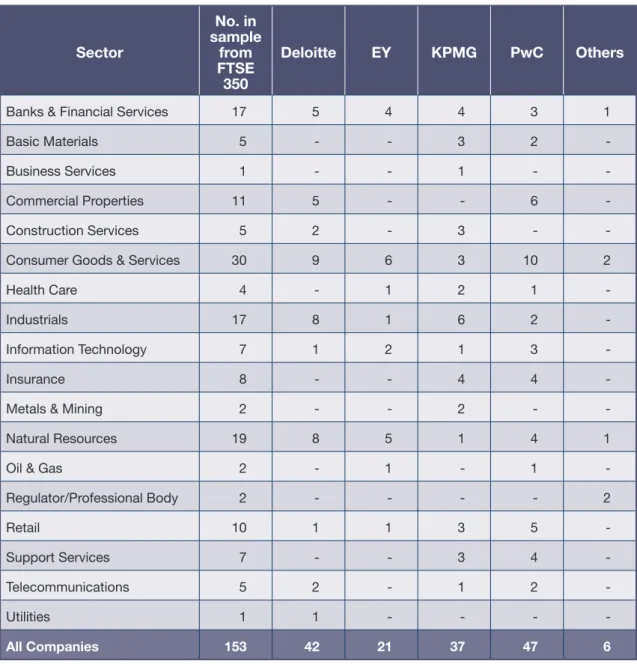
Table 2 provides an analysis of the companies surveyed by industry sector and audit firm. TABLE 2 Analysis of auditor’s reports surveyed by industry sector and audit firm
Sector
No. in
sample
from
FTSE
350
Deloitte
EY
KPMG
PwC
Others
Banks & Financial Services 17 5 4 4 3 1
Basic Materials 5 - - 3 2
-Business Services 1 - - 1 -
-Commercial Properties 11 5 - - 6
-Construction Services 5 2 - 3 -
-Consumer Goods & Services 30 9 6 3 10 2
Health Care 4 - 1 2 1
-Industrials 17 8 1 6 2
-Information Technology 7 1 2 1 3
-Insurance 8 - - 4 4
-Metals & Mining 2 - - 2 -
-Natural Resources 19 8 5 1 4 1
Oil & Gas 2 - 1 - 1
-Regulator/Professional Body 2 - - - - 2
Retail 10 1 1 3 5
-Support Services 7 - - 3 4
-Telecommunications 5 2 - 1 2
-Utilities 1 1 - - -
-All Companies 153 42 21 37 47 6
The Survey addresses separately each of the new requirements of the Auditor Reporting Standard: a) The reporting of risks;
b) The reporting of materiality; and
2
The Survey also addresses areas of innovation within the following four subject areas that go beyond thenew requirements in the Auditor Reporting Standard: a) Going concern disclosures;
b) Location of the auditor’s opinion within the auditor’s report; c) The use of standard language; and
d) The use of diagrams and graphs.
Finally the Survey addresses how well the descriptions of risks in the extended auditor’s report complemented the description of the equivalent significant issues provided by Audit Committees in their reports.
2
Reporting of risks
Number of assessed risks of material misstatement reported in the auditor’s
report
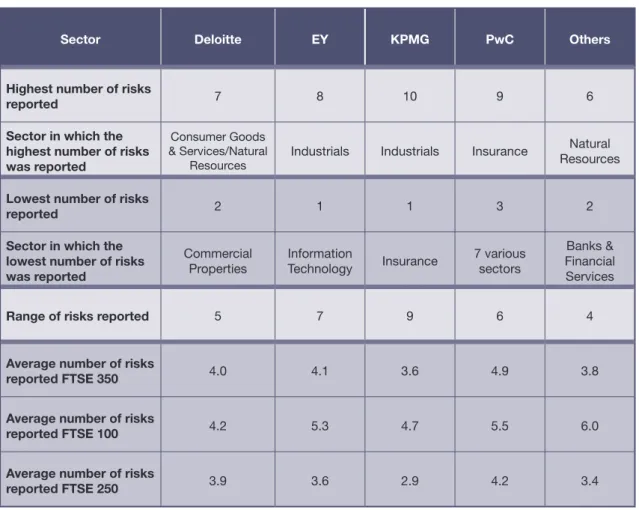
Table 3 analyses the number of assessed risks of material misstatement reported by audit firm, highlighting the highest and lowest numbers of risks reported. The number of risks reported ranged from 1 to 10 - the highest number of risks was reported in the auditor’s report for Rolls Royce. It is interesting to note that each of the four largest audit firms reported more risks on average for FTSE 100 companies than for FTSE 250 companies.
TABLE 3 Analysis of risks reported by audit firm
Sector Deloitte EY KPMG PwC Others
Highest number of risks
reported 7 8 10 9 6
Sector in which the highest number of risks was reported
Consumer Goods & Services/Natural
Resources Industrials Industrials Insurance
Natural Resources Lowest number of risks
reported 2 1 1 3 2
Sector in which the lowest number of risks was reported
Commercial
Properties Information Technology Insurance 7 various sectors
Banks & Financial Services
Range of risks reported 5 7 9 6 4
Average number of risks
reported FTSE 350 4.0 4.1 3.6 4.9 3.8
Average number of risks
reported FTSE 100 4.2 5.3 4.7 5.5 6.0
Average number of risks
reported FTSE 250 3.9 3.6 2.9 4.2 3.4
The reporting of standard risks in some auditor’s reports
Some auditor’s reports (routinely, but not exclusively, those from PwC) included one or both of the following “standard risks” as assessed risks of material misstatement:
a) The risk of fraud in revenue recognition; and b) The risk of management override of controls.
2
PwC’s basis for doing so was that it considered these to be important risks which merited being addressedin the auditor’s report. Its view reflected the Auditing Standards deeming both of these to be significant risks i.e. “an identified and assessed risk of material misstatement that, in the auditor’s judgment, requires special audit consideration”3 .
However, it was not the FRC’s intent that so called “significant risks” as defined in Auditing Standards should, as a matter of course, be presumed to be an assessed risk of material misstatement that is required to be described in the auditor’s report4. The intent of the requirement was for the auditor to discuss in the auditor’s report those risks which had the greatest effect on the audit strategy, resources and effort. The guidance to ISA (UK and Ireland) 700 notes that the auditor uses its judgment to determine which if any of the significant risks meet the criteria set out in paragraph 19A of ISA (UK and Ireland) 700.
In some instances these risks clearly had an effect on the audit strategy. For example, in PwC’s auditor’s report on GKN plc fraud in revenue recognition and PwC’s response thereto was described as follows:
Area of focus How the scope of our audit addressed the area of focus
Fraud in revenue recognition
ISAs (UK & Ireland) presume there is a risk of fraud in revenue recognition because of the pressure management may feel to achieve the planned results.
We focused on this area because the timing of revenue recognition and its presentation in the income statement has inherent complexities and requires the Directors to exercise judgement. The complexities and judgement include, but are not limited to:
• the pricing of non-contractually agreed elements of revenue, such as rebates and on-going pricing discussions with customers; and
• the recognition of revenue within specific revenue risk sharing partnerships (RRSPs) and bill and hold arrangements within the Aerospace segment.
As the foundation of the evidence we obtained regarding the revenue recognised during the year, we evaluated the relevant IT systems and tested the internal controls over the completeness, accuracy and timing of revenue recognised in the financial statements.
We tested the timing of revenue recognition, taking into account contractual obligations, and in particular assessed whether the Group had appropriately recorded revenue based on whether complex contractual arrangements, such as bill and hold arrangements and long term contract accounting had been appropriately applied. We assessed management’s judgements and validated their accuracy by agreement to post year end settlements reached with customers.
We also responded to the risk that manual adjustments could override standard procedures to misstate revenue by auditing manual journals relating to revenue so as to identify unusual or irregular items.
2
Area of focus How the scope of our audit addressed the area of focus
Risk of management override of internal controls ISAs (UK & Ireland) require that we consider this because management is in a unique position to perpetrate fraud as a result of their ability to manipulate accounting records and prepare fraudulent financial statements by overriding controls that otherwise appear to be operating effectively.
We assessed the overall control environment of the Group, including the arrangements for staff to whistle-blow inappropriate actions, interviewed senior management and the Group’s Corporate audit function and reviewed the Board minutes of the Company.
We examined the significant accounting estimates and judgements relevant to the financial statements for evidence of bias by the Directors that may represent a risk of material misstatement due to fraud. We planned unpredictability into our audit plan and executed procedures which included testing of immaterial items and performing procedures on out of scope balances. We also tested key reconciliations and journal entries to identify unusual or irregular items.
Extract from PwC’s auditor’s report on GKN plc
In the various tables that follow in this Survey, except where we use the term “Standard Risks”, we are referring to all risks reported in the auditor’s report.
Taking all companies in our sample the average number of risks reported is 4.2. Deloitte (4.0); EY (4.1); and KPMG (3.6) are below the average number of risks reported and only PwC (4.9) is above the average. However, the data is affected by the inclusion in some auditor’s reports (especially, but not exclusively, those issued by PwC) of standard risks. If the standard risks are removed from the analysis the average number of risks reduces from 4.2 to 3.5 with Deloitte (4.0); EY (3.8); and KPMG (3.6) all above the average and PwC at 2.9 being below the average. The fact that flexing the data by removing standard risks moves a firm from being the only one above the average to being the only one below the average indicates the significance of the inclusion of standard risks to our analysis.
Number of assessed risks of material misstatement reported by industry sector
In Table 4 we have analysed the number of risks disclosed by industry sector. We have analysed our sample between the FTSE 100, FTSE 250 and the total sample. Although we have analysed the number of risks for each sector by audit firm we do not include this analysis in this Survey because the sample sizes in a number of cases are so small the results may not be truly indicative of the risks reported in the sector by the various audit firms.2
TABLE 4 Reporting of risks by industry sectorSector
FTSE 100 companies FTSE 250 companies All (FTSE 350) companies
Number of companies
Number of risks reported
Number of companies
Number of risks reported
Number of companies
Number of risks reported
Total Non-standar
d
Total Non-standar
d
Total Non-standar
d
Banks & Financial Services 5 5.8 4.8 12 3.4 3.0 17 4.1 3.5
Basic Materials 2 5.0 5.0 3 2.7 2.0 5 3.6 2.8
Business Services 1 4.0 4.0 - - - 1 4.0 4.0
Commercial Properties 2 3.0 3.0 9 3.8 2.4 11 3.6 2.5
Construction Services 1 2.0 2.0 4 3.0 3.0 5 2.8 2.8
Consumer Goods & Services 15 5.0 4.5 15 4.5 3.8 30 4.6 3.7
Health Care 3 4.7 4.7 1 1.0 1.0 4 3.8 3.3
Industrials 4 6.0 6.0 13 3.4 3.0 17 4.1 3.7
Information Technology 2 4.5 2.5 5 3.6 2.8 7 3.9 2.7
Insurance 5 5.4 4.2 3 2.7 2.0 8 4.5 3.4
Metals & Mining - - - 2 4.5 4.5 2 4.5 4.5
Natural Resources 10 5.2 4.7 9 3.8 3.4 19 4.4 4.0
Oil & Gas 1 8.0 8.0 1 6.0 4.0 2 7.0 5.5
Regulator/Professional Body - - - 2 3.0 2.5 2 3.0 2.5
18 Extended auditor’s reports: A review of experience in the first year (March 2015)
2
It can be seen from Table 4 that the average total number of risks reported for companies from the FTSE 100 (5.0) is substantially higher than the total number of risks reported for companies in the FTSE 250 (3.6). It is possible that this reflects differences in the average size and complexity of FTSE 100 Groups compared to FTSE 250 Groups giving rise to a greater number of reported risks, but we have not been able to research this.
Which risks are reported?
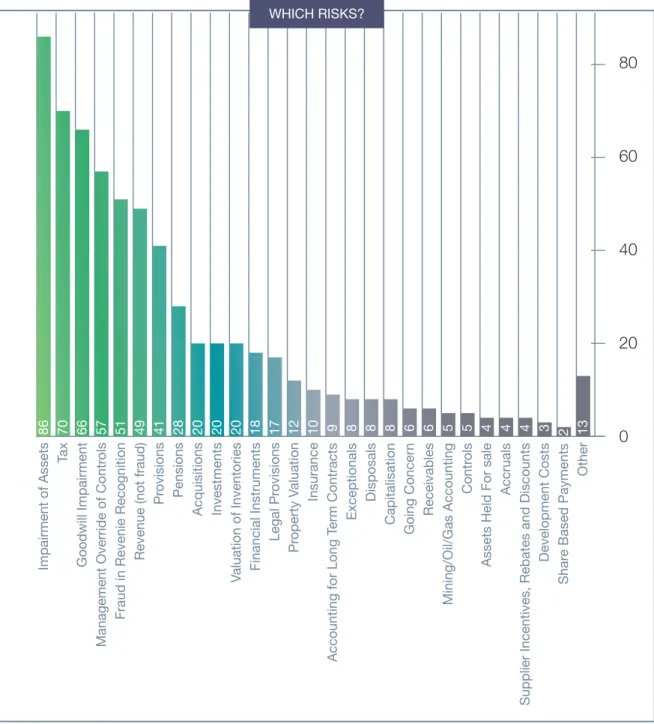
As can be seen from the graph in Table 5 there is a broad range of risks reported. TABLE 5 Analysis of reported risks
Other
Shar
ed Based Payments
Development Costs
Accruals
Assets Held For sale
Contr ols Mining/Oil/Gas Accounting Receivables Going Concer n Capitalisation Disposals Exceptionals erm Contracts Insurance Pr operty V aluation Legal Pr ovisions Financial Instruments
Valuation of Inventories
Investments
Acquisitions
Pensions
Pr
ovisions
Revenue (not fraud)
Fraud in Revenie Recognition
ols
Goodwill Impairment
Ta
x
Impairment of Assets
Impairment of Assets
86
Tax
70
Goodwill Impairment
66
Management Override of Contr
ols
57
Fraud in Revenie Recognition
51
Revenue (not fraud)
49 Pr ovisions 41 Pensions 28 Acquisitions 20 Investments 20
Valuation of Inventories
20 Financial Instruments 18 Legal Pr ovisions 17 Pr operty V aluation 12 Insurance 10
Accounting for Long T
erm Contracts 9 Exceptionals 8 Disposals 8 Capitalisation 8 Going Concer n 6 Receivables 6 Mining/Oil/Gas Accounting 5 Contr ols 5
Assets Held For sale
4
Accruals
4
Supplier Incentives, Rebates and Discounts
4
Development Costs
3
Shar
e Based Payments
2 Other 13
80
60
40
20
0
WHICH RISKS?2
The 15 highest ranked risks reflect 565 instances of reported risks and comprise 87% of the total numberof risks (650) reported by auditors in our Survey. Impairment of assets and goodwill represent 23% of the risks reported. It is perhaps surprising (in the context of FTSE 350 companies) that the next highest risk relates to taxation. However, a number of the taxation issues arise in overseas jurisdictions or relate to deferred taxation balances including the recoverability of deferred tax assets. Financial instruments at only 3% of the total may also be surprising. This seemingly low percentage may be accounted for by financial instrument valuation issues being coupled in our analysis with impairment considerations and perhaps the relatively small number of banks included within the Survey. “Management Override of Controls” and “Fraud in Revenue Recognition” are the standard risks discussed earlier in this Survey.
For illustrative purposes we set out below examples from auditor’s reports of descriptions of the top four non-standard risks:
Asset impairment (other than Goodwill)
Impairment of property, plant and equipment (charge in year £5.3m, closing net book value £268m) Refer to page 44 (Audit Committee statement), pages 73 and 75 (accounting policy) and pages 79 and 84 (financial disclosures)
The risk –
The economic climate and levels of competition remain challenging for the Group. The Group has completed a Strategic Review, details of which were announced in the half year statement, and as a result has decided to close or curtail some of its operations. There is therefore a risk that the impairment charge may be misstated. Determining the level of impairment involves forecasting and discounting future cash flows and estimation of recoverable amounts which are inherently uncertain. This is one of the key judgmental areas that our audit has concentrated on.
Our response
-Our audit procedures included, among others, considering the impairment risk associated with the following different types of asset:
• In respect of assets within shops which continue to trade we critically assessed and challenged the Group’s impairment model. This included consideration of the discounted cashflow forecasts on a shop by shop basis and assessing the cashflow forecasts against the historical performance of those shops and against the Group’s budgets. We assessed the appropriateness of the discount rate including benchmarked it against similar national retailers. We also recalculated the impairment model to assess the sensitivity of the key assumptions including growth rate and discount rate;
• …
2
Goodwill impairment
Area of focus How the scope of our audit addressed the area of focus
Goodwill impairment reviews
We focused on this area because the Group carries significant goodwill and acquired intangible asset balances. There is judgement in the identification and aggregation of cash generating units (CGUs) and in the assumptions used in the annual goodwill impairment review.
We tested management’s impairment analysis by examining their identification and aggregation of CGUs and by evaluating the underlying assumptions through assessment of forecast, market conditions and sensitivity analysis and through assessing the historical accuracy of forecasts and budgets. We assessed management’s calculation of discount rates and perpetuity growth rates and we tested the integrity of the valuation model.
Extract from PwC’s auditor’s report on Pearson plc
Taxation
The assessment of the carrying value of deferred tax assets for trading losses. We evaluated the integrity of the forecast models and considered the appropriateness of management’s assumptions and estimates in relation to the likelihood of generating suitable future taxable profits to support the recognition of deferred tax assets. We evaluated the historical accuracy of forecasting and the integrity of the forecast models and as a result of these procedures, we formed our own view on the Group’s capacity to get effective relief for tax losses over the forecast period.
2
Revenue recognition
Risk How the scope of our audit responded to the risk
Revenue recognition on:
• significant long-term contracts, due to the financial effects of judgments, including future milestone success, associated with determining the percentage of contract completion at the balance sheet date and risks associated with completing the contract; and • delivery of goods, due to the complex
contractual terms with regards to the transfer of risk and reward and therefore the appropriate point at which revenue should be recognised.
Our audit work assessed the adequacy of the design and implementation of controls over long-term contract accounting. We reviewed the contract risk registers and evidence for the progress made against the contract to confirm that revenue and profit recognised to date are based on management’s current best estimate of the degree of contract completion. We understood and challenged management’s assumptions by referring to evidence including signed contract terms and latest project status reports, and discussing contract progress and future risks with contract engineers. We also assessed the reliability of management estimates through consideration of the historical accuracy of prior period management estimates.
In response to the risk of inappropriate revenue cut-off arising from complex contractual terms, we reviewed contractual evidence to understand how the specific terms were captured and the appropriate revenue recognition policies applied. We then performed a sample test of sales recognised either side of the year end to substantiate that the appropriate terms of the relevant contracts had been satisfied and that the risks and rewards associated with the contract had passed to the customer. We used external evidence such as shipping documentation or client acceptance where available, to confirm that revenue had been recognised in the appropriate period.
Extract from Deloitte’s auditor’s report on Chemring Group PLC.
The granularity of risk reporting
ISA (UK and Ireland) 700 requires that “in order to be useful to users of the financial statements, the explanations of the matters required to be set out in the auditor’s report by paragraph 19A shall be described … in a way that enables them to be related directly to the specific circumstances of the audited entity and are not, therefore, generic or abstract matters expressed in standardised language”.
From our Survey some auditor’s reports appear to be more granular than others. An example of a more granular risk disclosure is that provided by KPMG in their auditor’s report on Cable & Wireless Communications plc.
2
Business transformation
Business transformation (see notes 2.3.5, 2.8, notes 5.1.9, 5.1.10, 5.1.11, 5.1.13, 5.1.15 for accounting policies and note 5.2.4 for critical accounting estimates and judgements and note 5.9 for events after the reporting period).
Risk
In 2014, the asset disposals (Macau and Islands) led to the Group undertaking a business transformation programme that has given rise to significant restructuring and redundancy costs of US $ 174 million in the continuing Group. These costs have been classified as “exceptional costs” in the Group’s Consolidated income statement.
The Group’s transformation programme is considered to be a significant risk due to the level of judgement required to be applied in establishing the restructuring provisions.
The Group committed to market and seek a buyer for their Monaco Telecom business. This sale was not completed as at 31 March 2014 and was subject to regulatory approval. The Group determined that the uncertainty surrounding the sale process, together with the fact that regulatory approval was a substantive hurdle, prevented classification of the business as held for sale and a discontinued operation at 31 March 2014.
Classification of this business as held for sale and a discontinued operation would lead to significant differences in the presentation of the Group’s results for the year and its gross assets and liabilities. As a result this is one of the key judgement areas of our audit.
Our response …
Extract from KPMG’s auditor’s report on Cable & Wireless Communications plc
We have evaluated (necessarily somewhat subjectively) the descriptions of the risks in each of the 153 auditor’s reports in our Survey. Our overall conclusion is that 61% of the risks were written in a more granular and less generic matter and 39% were largely generic in nature using more standardised language. In the second year of implementation audit engagement partners may wish to assess whether their disclosures of risk are sufficiently granular.
An analysis of our evaluations by firm, see Table 6, shows that there are differences between the firms – for example KPMG seems to have provided the most granular non-standardised risk disclosures. Excluding KPMG from the analysis would result in an approximate 50/50 split between granular and generic risk descriptions.
2
TABLE 6 Analysis by audit firm of the granularity of the reporting of risksGranular risks that cite specific
circumstances Generic risks written in more standardised language
Deloitte 50% 50%
EY 52% 48%
KPMG 89% 11%
PwC 49% 51%
Other firms 83% 17%
TOTAL 61% 39%
KPMG’s experiment in reporting detailed findings with respect to the reported
risks
KPMG’s auditor’s reports in relation to three companies described KPMG’s findings with respect to each identified risk. These auditor’s reports are each signed by the same engagement partner and relate to the following companies:
a) Kazakhmys plc;
b) New World Resources plc; and c) Rolls Royce Holdings plc.
2
For illustration, set out below is an extract from the auditor’s report relating to Rolls Royce Holdings plc:
Opinions and conclusions arising from our audit
1 Our opinion on the financial statements is unmodifiedWe have audited the financial statements of Rolls-Royce Holdings plc for the year ended 31 December 2013 set out on pages 75 to 129. In our opinion:
őthe financial statements give a true and fair view of the state of
the Group’s and of the parent company’s affairs as at 31 December 2013 and of the Group’s profit for the year then ended;
őthe Group financial statements have been properly prepared in
accordance with International Financial Reporting Standards as adopted by the European Union (Adopted IFRS);
őthe parent company financial statements have been properly
prepared in accordance with UK Accounting Standards; and
őthe financial statements have been prepared in accordance with
the requirements of the Companies Act 2006 and, as regards the Group financial statements, Article 4 of the IAS Regulation. 2 Our assessment of risks
In arriving at our opinions set out in this report, the risks that had the greatest effect on our audit and the key procedures we applied to address them are set out below. Those procedures were designed in the context of the financial statements as a whole and,
consequently, where we set out findings we do not express any opinion on these individual risks.
The basis of accounting for revenue and profit in the Civil aerospace business
Refer to page 81 (Key areas of judgement – Long-term aftermarket contracts), page 83 (Significant accounting policies – Revenue recognition) and page 44 (Audit committee report – Financial reporting)
ő The riskThe amount of revenue and profit recognised in a year on the sale of engines and aftermarket services is dependent, inter alia, on the appropriate assessment of whether or not each long-term aftermarket contract for services is linked to or separate from the contract for sale of the related engines. As the
commercial arrangements can be complex, significant judgement is applied in selecting the accounting basis in each case. The most significant risk is that the Group might inappropriately account for sales of engines and long term service agreements as a single arrangement for accounting purposes as this would usually lead to revenue and profit being recognised too early because the margin in the long term service agreement is usually higher than the margin in the engine sale agreement.
ő Our response We made our own independent assessment, with reference to the relevant accounting standards, of the accounting basis that should be applied to each long-term aftermarket contract entered into during the year and compared this to the accounting basis applied by the Group.
ő Our findings We found that the Group has developed a framework for selecting the accounting basis to be used which is consistent with accounting standards and has applied this consistently. For almost all the agreements entered into during this year, it was clear which accounting basis should apply. Where there was room for interpretation, we found the Group’s judgement to have been balanced.
The measurement of revenue and profit in the Civil aerospace business
Refer to page 81 (Key areas of judgement – Long-term aftermarket contracts), page 83 (Significant accounting policies – Revenue recognition) and page 44 (Audit committee report – Financial reporting)
ő The risk The amount of revenue and profit recognised in a year on the sale of engines and aftermarket services is dependent, inter alia, on the assessment of the percentage of completion of long-term aftermarket contracts and the forecast cost profile of each arrangement. As long-term aftermarket contracts can extend over significant periods and the profitability of these arrangements typically assumes significant life-cycle cost improvement over the term of the contracts, the estimated outturn requires significant judgement to be applied in assessing engine flying hours, time on wing and other operating parameters, the pattern of future maintenance activity and the costs to be incurred. The inherent nature of these estimates means that their continual refinement can have an impact on the profits of the Civil aerospace business that can be significant in an individual financial year. The assessment of the estimated outturn for each arrangement involves detailed calculations using large and complex databases with a significant level of manual intervention.
ő Our response We tested the controls designed and applied by the Group to provide assurance that the estimates used in assessing revenue and cost profiles are appropriate and that the resulting estimated cumulative profit on such contracts is accurately reflected in the financial statements; these controls operated over both the inputs and the outputs of the calculations. We challenged the appropriateness of these estimates for each programme and assessed whether or not the estimates showed any evidence of management bias. Our challenge was based on our assessment of the historical accuracy of the Group’s estimates in previous periods, identification and analysis of changes in assumptions from prior periods and an assessment of the consistency of assumptions across programmes, detailed discussions and assessments of the achievability of the Group’s plans to reduce life-cycle costs and an analysis of the impact of these plans on forecast cost profiles taking account of contingencies and analysis of the impact of known technical issues on cost forecasts. Our analysis considered each significant airframe that is powered by the Group’s engines and was based on our own experience supplemented by discussions with an aircraft valuation specialist engaged by the Group. We assessed whether the valuer was objective and suitably qualified. We also checked
the mathematical accuracy of the revenue and profit for each arrangement and considered the implications of identified errors and changes in estimates.
ő Our findings Our testing identified weaknesses in the design and operation of controls. In response to this we assessed the
effectiveness of the Group’s plans for addressing these weaknesses and we increased the scope and depth of our detailed testing and analysis from that originally planned. We found no significant errors in calculation. Overall, our assessment is that the assumptions and resulting estimates (including appropriate contingencies) resulted in mildly cautious profit recognition.
Rolls-Royce Holdings plc annual report 2013 130 Other information
INDEPENDENT AUDITOR’S REPORT
2
These auditor’s reports have created considerable interest from investors and other users of auditor’s reportsnot only in the UK but also internationally. Tony Cates the head of audit at KPMG UK LLP explains some of the reasoning behind KPMG’s experiment as follows:
But what next?
The challenge is this. As it stands a new audit report tells shareholders the key risks and the auditor’s response to them - what the auditor did to address them. In other words, what rocks did the auditor check under and how did he go about turning them over? However, it is not telling shareholders what the auditor found when he looked under those rocks. It does not say, for example, how acceptable the policies, estimates or disclosures were.
So we asked ourselves a simple question. Why not?
If we truly want audit to make a difference, not only do we have to ask these challenging questions, but offer bold answers – daring to think differently? So we have put it to the test by issuing a small number of audit reports that extend the new audit report, beyond the minimum required, by also setting out what we found. With the agreement of our clients, Rolls-Royce Holdings plc and New World Resources …the audit reports to their shareholders do just that. So whilst our KPMG reports normally set out under each audit issue, “the risk” and “our response”, on these occasions we have added “our findings”.
So what did we learn from the experience?
Well unsurprisingly, distilling all the professional judgments that go into an audit into a few words was not always straightforward. In particular, a binary finding – eg, that an estimate is acceptable – would be of little value; after all, that the estimates are acceptable is inherent in an overall clean opinion. Instead what is required is graduated findings that say whereabouts in a range matters sit. And explaining an accounting estimate was simpler than the relative merits of an accounting treatment.
Our experience would, I trust, provide valuable insight for the Financial Reporting Council (FRC) if they choose to require this approach across the profession. We’d need to be careful however, that any auditing standard would not “standardise” the report – which would be a step back to the old days of boiler-plate – but provides a framework to enable comparison between companies. However, I should not seek absolute “grading” consistency, which would be difficult to achieve: there is greater value in the application of professional judgment than in the result of a mechanical process.
However, we didn’t put this innovation to the test primarily for the “practical tips”. Rather I want this innovative audit report to kick-start debate: by showing investors, audit committees, companies and the audit profession as a whole, what could be achieved.
The FRC encourages experimentation by auditors and will be particularly interested in the reaction of investors and users to auditor’s reports of this ilk. However, care needs to be taken with the inclusion of such findings in an auditor’s report so as not to inappropriately include discrete opinions on separate elements
2
Reporting of materiality
Introduction
ISA (UK and Ireland) 700 establishes a general requirement for the auditor’s report to explain how the auditor applied the concept of materiality in both planning and performing the audit. Its only detailed requirement is that the explanation shall specify the threshold used by the auditor as being materiality for the financial statements as a whole.
All of the auditor’s reports in our Survey met these two requirements. However, there is quite a wide range of further informational content with respect to materiality as between individual auditor’s reports.
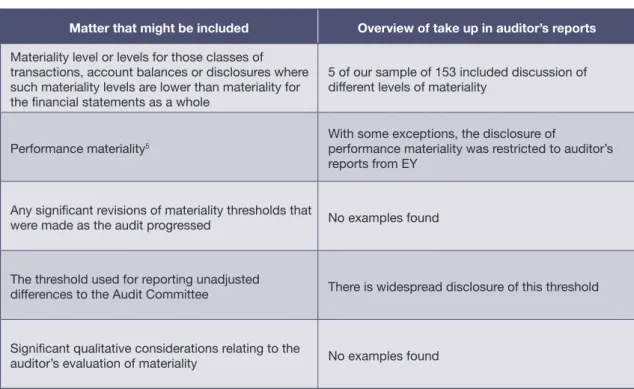
ISA (UK and Ireland) 700 paragraph A13B suggests five further matters that the explanation might include. Table 7 illustrates that the take up of these matters varies quite widely:
TABLE 7 Matters that ISA (UK and Ireland) 700 suggests might be included in an explanation of materiality
Matter that might be included Overview of take up in auditor’s reports
Materiality level or levels for those classes of transactions, account balances or disclosures where such materiality levels are lower than materiality for the financial statements as a whole
5 of our sample of 153 included discussion of different levels of materiality
Performance materiality5 With some exceptions, the disclosure of performance materiality was restricted to auditor’s
reports from EY Any significant revisions of materiality thresholds that
were made as the audit progressed No examples found
The threshold used for reporting unadjusted
differences to the Audit Committee There is widespread disclosure of this threshold
Significant qualitative considerations relating to the
auditor’s evaluation of materiality No examples found
Two further matters not cited as examples of further matters in ISA (UK and Ireland) 700 are:
a) the benchmark used by the auditor in determining materiality for the financial statements as a whole; and
b) the percentage applied to the benchmark to determine materiality for the financial statements as a whole.
2
The benchmark used by the auditor in determining materiality for the financial statements as a whole isstated in 148 of the 153 (97%) auditor’s reports in our Survey. Of these, 128 (84%) of the auditor’s reports described the percentage that was applied to the benchmark in order to determine materiality for the financial statements as a whole. 37 of the auditor’s reports disclosed the reasoning behind the choice of the benchmark. Approximately 50% of the auditor’s reports which disclosed the auditor’s reasoning were issued by Deloitte. The most common threshold used by auditors in the reports surveyed was 5% of either profit before tax or an adjusted measure of profit before tax. 79% of the auditor’s reports surveyed indicated that materiality for the financial statements as a whole was based on either profit before tax or a proxy measure for profit before tax.
The wide range of materiality benchmarks used
Our Survey has revealed a wide range of benchmarks being used by auditors in their application of the concept of materiality. The Survey has also revealed that when similar benchmarks are used there is quite a wide range of percentages applied to those benchmarks. It is difficult to understand the rationale for these ranges absent explanations in the auditor’s reports. However, the ranges do reveal that a significant degree of judgment appears to be used by auditors in their determination of the materiality benchmarks.
The Auditing Standards do not stipulate criteria for the determination of materiality benchmarks. They do however set out, as guidance, the following factors that may affect the identification of an appropriate benchmark:
a) The elements of the financial statements (for example, assets, liabilities, equity, revenue, expenses); b) Whether there are items on which the attention of the users of the particular entity’s financial statements
tends to be focused (for example, for the purpose of evaluating financial performance users may tend to focus on profit, revenue or net assets);
c) The nature of the entity, where the entity is in its life cycle, and the industry and economic environment in which the entity operates;
d) The entity’s ownership structure and the way it is financed (for example, if an entity is financed solely by debt rather than equity, users may put more emphasis on assets, and claims on them, than on the entity’s earnings); and
e) The relative volatility of the benchmark.
The Auditing Standards also recognise that the use of normalized profits as a benchmark may be appropriate. The range of benchmarks used is depicted graphically in Table 8.
2
TABLE 8 Range of materiality benchmarks used
Table 9 shows the range of benchmarks used analysed by audit firm. TABLE 9 Range of materiality benchmarks used analysed by audit firm
MATERIALITY
BENCHMARKS Deloitte EY KPMG PWC Others Total
Adjusted profit measure 25 9 16 25 1 76
Profit before tax 9 7 15 14 1 46
Revenue 1 3 1 2 7
Total assets 2 1 1 3 1 8
Equity 4 2 6
Gross written premiums 2 2
Non-current assets 1 1
Total expenditure 1 1
Not disclosed 1 1 4 6
Grand Total 42 21 37 47 6 153
0.00
0.02
0.04
0.06
0.08
0.10
0.12
0.14
Adjusted Profit Total Equity Gross Revenue profit before assets written
measure premiums
12
%10
%8
%6
%4
%2
%0
%RANGE OF BENCHMARKS USED
n
Maxn
Averagen
Min2
There is quite a wide variety of proxy measures of profit before tax including, for example:5% of profit before taxation and non-recurring exceptional items
Extract from EY’s auditor’s report on Computacenter plc
4.1% of pre-tax profit before special items and remeasurements, and below 1% of equity. Pre-tax profit is normalised for the materiality calculation to exclude impairments, remeasurements and other one off items that are audited separately and would, if included, significantly distort the materiality calculation year on year.
Extract from Deloitte’s auditor’s report on Anglo American plc
Overall materiality was determined through taking 5% of profit before taxation adjusted for own credit, the provision for payment protection insurance redress payments and claims management costs, the provision for interest rate hedging products redress and claims management costs, goodwill impairment and costs to achieve Transform. The removal of these items mitigates undue volatility in determining our materiality.
Extract from PwC’s auditor’s report on Barclays plc
The materiality for the financial statements as a whole was set at £13.0 million. This has been determined with reference to a benchmark of Group profit before taxation which we consider to be one of the principal considerations for members of the company in assessing financial performance of the Group. Materiality represents 8.5% of group profit before taxation adjusted for the rationalisation costs set out in Note 4 (Non-recurring operating items and non-operating items) and 11.8% of the Group profit before taxation as disclosed on the face of the income statement.
Extract from KPMG’s auditor’s report on Carillion plc
One investor (Citi Research) has commented that “we are interested to see auditors relying for their own calculations on a number, which is not defined in IFRS, which often includes adjustments other than truly ‘exceptional’ ones and on which historically auditors have been unwilling to pass any judgment”. Auditing Standards do not require materiality to be based on an IFRS metric and it will be interesting to see the reactions of other investors to the wide range of benchmarks being used by auditors.
Magnitude of unadjusted differences being reported to the Audit Committee
There is widespread disclosure of the threshold used for reporting unadjusted differences to the Audit2
We agreed with the audit committee to report to it the following misstatements that we identified through our audit: (i) all material corrected misstatements; (ii) uncorrected misstatements with a value in excess of £4 million for income statement items (or £8 million for balance sheet reclassifications); and (iii) other misstatements below that threshold that we believe warranted reporting on qualitative grounds.
Extract from KPMG’s auditor’s report on Rolls Royce plc (Note £4 million is 4.7% of the materiality for the Group financial statements as a whole of £86 million)
For our sample of 153 companies, unadjusted differences being reported to Audit Committees averaged 4% of the materiality level for the financial statements as a whole. As can be seen from Table 10, three of the largest four audit firms indicated that on average they reported unadjusted differences of 5% of materiality for the financial statements as a whole. The fourth firm (Deloitte) on average reported differences of 2% of materiality for the financial statements as a whole.
TABLE 10 Reporting of unadjusted differences as a percentage of materiality for the financial statements analysed by audit firm
Deloitte EY KPMG PwC Other All Firms
Together
Range of Materiality 5%-2% 7%-2% 10%-2% 10%-3% 5%-2%
Mean of Materiality 2% 5% 5% 5% 3% 4%
Performance Materiality
Performance materiality means the amount or amounts set by the auditor at less than materiality for the financial statements as a whole to reduce to an appropriately low level the probability that the aggregate of uncorrected and undetected misstatements exceeds materiality for the financial statements as a whole. With respect to the four largest firms, with the exception of auditor’s reports for two companies, the reporting of Performance Materiality is restricted to auditor’s reports from EY. Table 11 illustrates the range of measures of performance materiality used.
TABLE 11 Range of measures of performance materiality used Auditor Performance
Materiality set at 50% of planning
materiality
Performance Materiality set at
70% of planning materiality
Performance Materiality set at
75% of planning materiality
Total
Deloitte - 2 - 2
EY
10
-
9
19
KPMG - - -
-PwC - - -
2
Two extracts from EY auditor’s reports that address performance materiality are:On the basis of our risk assessments, together with our assessment of the overall control environment, our judgement is that performance materiality was 75% [2012: 75%] of our materiality, namely £11.25 million [2012: £ 11.25 million]. Our objective in adopting this approach was to ensure that uncorrected and undetected audit differences in all accounts did not exceed our planning materiality level.
Extract from EY’s auditor’s report on AMEC plc
On the basis of our risk assessments, together with our assessment of the Group’s overall control environment, our judgement is that performance materiality for the Group should be 50% of materiality, namely £3.0 million. Our approach is designed to have a reasonable probability of ensuring that the total of uncorrected and undetected audit differences does not exceed our materiality of £6.1 million for the financial statements as a whole.
Extract from EY’s auditor’s report on Enterprise Inns plc
An example of a discussion relating to Performance Materiality from Deloitte appears in its auditor’s report on Vodafone.
On the basis of our risk assessments, together with our assessment of the Group’s overall control
environment, our judgement is that overall performance materiality for the Group should be 70% of planning materiality, namely £350 million. Our objective in adopting this approach is to ensure that total detected and undetected audit differences do not exceed our planning materiality of £500 million for the financial statements as a whole.
Extract from Deloitte’s auditor’s report on Vodafone plc
An example of a discussion relating to Performance Materiality from BDO appears in its auditor’s report on Randgold Resources Limited.
On the basis of our risk assessment, together with our assessment of the group’s control environment, our judgment is that performance materiality for the financial statements should be 75% of materiality, which equates to US$ 22.7 million for the financial statements as a whole. Our objective in adopting this approach is to ensure that total detected and undetected audit differences do not exceed our materiality of US$ 30.2 million for the financial statements as a whole.
2
In a very few auditor’s reports there is discussion of the concept of performance materiality without reference to the specific measurement of performance materiality that the auditor had used. An example of this can be found in Deloitte’s auditor’s report on British Sky Broadcasting Group plc.
We also determine a level of performance materiality which we use to determine the extent of testing needed to reduce to an appropriately low level the probability that the aggregate of uncorrected and undetected misstatements exceeds materiality for the financial statements as a whole.