This document and trademark(s) contained herein are protected by law as indicated in a notice appearing later in this work. This electronic representation of RAND intellectual property is provided for non-commercial use only. Unauthorized posting of RAND PDFs to a non-RAND Web site is prohibited. RAND PDFs are protected under copyright law. Permission is required from RAND to reproduce, or reuse in another form, any of our research documents for commercial use. For information on reprint and linking permissions, please see RAND Permissions.
Limited Electronic Distribution Rights
Visit RAND at www.rand.org Explore RAND Education View document details
For More Information
Purchase this document Browse Books & Publications Make a charitable contribution
Support RAND
This PDF document was made available from www.rand.org as a public service of the RAND Corporation.
6
Jump down to document
The RAND Corporation is a nonprofit research organization providing objective analysis and
effective solutions that address the challenges facing the public and private sectors around the world.
THE ARTS CHILD POLICY CIVIL JUSTICE EDUCATION ENERGY AND ENVIRONMENT HEALTH AND HEALTH CARE INTERNATIONAL AFFAIRS NATIONAL SECURITY POPULATION AND AGING PUBLIC SAFETY SCIENCE AND TECHNOLOGY SUBSTANCE ABUSE TERRORISM AND HOMELAND SECURITY TRANSPORTATION AND INFRASTRUCTURE WORKFORCE AND WORKPLACE
This product is part of the RAND Corporation monograph series. RAND monographs present major research findings that address the challenges facing the public and private sectors. All RAND monographs undergo rigorous peer review to ensure high standards for research quality and objectivity.
The Benefits to Taxpayers
from Increases in Students’
Educational Attainment
Stephen J. Carroll, Emre Erkut
EDUCATION
The RAND Corporation is a nonprofit research organization providing objective analysis and effective solutions that address the challenges facing the public and private sectors around the world. RAND’s publications do not necessarily reflect the opinions of its research clients and sponsors.
R
®
is a registered trademark.© Copyright 2009 RAND Corporation
Permission is given to duplicate this document for personal use only, as long as it is unaltered and complete. Copies may not be duplicated for commercial purposes. Unauthorized posting of RAND documents to a non-RAND Web site is prohibited. RAND documents are protected under copyright law. For information on reprint and linking permissions, please visit the RAND permissions page (http://www.rand.org/ publications/permissions.html).
Published 2009 by the RAND Corporation
1776 Main Street, P.O. Box 2138, Santa Monica, CA 90407-2138 1200 South Hayes Street, Arlington, VA 22202-5050 4570 Fifth Avenue, Suite 600, Pittsburgh, PA 15213-2665
RAND URL: http://www.rand.org
To order RAND documents or to obtain additional information, contact Distribution Services: Telephone: (310) 451-7002;
Fax: (310) 451-6915; Email: [email protected]
The research in this report was produced within RAND Education, a unit of the RAND Corporation, with support from the William and Flora Hewlett Foundation.
Library of Congress Cataloging-in-Publication Data
Carroll, Stephen J., 1940–
The benefits to taxpayers from increases in students’ educational attainment / Stephen J. Carroll, Emre Erkut.
p. cm.
Includes bibliographical references. ISBN 978-0-8330-4742-7 (pbk. : alk. paper)
1. Public schools—United States—Finance. 2. Education—United States— Finance. 3. Income tax—United States. I. Erkut, Emre. II. Title.
LB2825.C315 2009 379.1'10973—dc22
iii
Preface
Meeting the educational demands of the future will be expensive; however, in most states, public schools from kindergarten through the university level already experi-ence budgetary challenges. Policymakers face a fundamental challenge—motivating taxpayers to provide the funds needed to meet mounting education needs.
This report examines the financial benefits that taxpayers realize when students’ educational attainment is increased. We find that the benefits to taxpayers from increases in students’ educational attainment are very high. Regardless of a student’s gender or race/ethnicity, raising his or her level of education leads, on average, to substantially increased payments into, and reduced demands on, the public budget. We consider the cost of providing additional education to students, although we do not explore the question of what it would cost to motivate students to stay longer in school. Our analy-sis indicates that taxpayers accrue benefits from programs and policies that succeed in raising students’ education levels, and those benefits are entirely separate from the benefits that the students themselves gain through increased education. Accordingly, taxpayers, including those who do not have children in school, have a stake in develop-ing programs and policies that effectively and efficiently increase education levels.
This report’s findings should be of interest to a broad range of policymakers, researchers, administrators, teachers, and parents.
This research was conducted within RAND Education, a division of the RAND Corporation, with support from the William and Flora Hewlett Foundation.
v
Contents
Preface . . . iii
Figures . . . ix
Tables . . . xi
Summary . . . .xiii
Acknowledgments . . . .xxi
Abbreviations . . . xxiii
ChAPTeR One Introduction . . . 1
The Problem . . . .1
Research Objective . . . .2
The Costs of Providing Education Versus the Overall Costs of Increasing Educational Attainment. . . 2
Research Questions . . . .3
Illustrative Examples . . . .5
Previous Research . . . .7
Definition of Terms . . . .9
Organization of the Report . . . .10
ChAPTeR TwO Analytic Approach . . . .13
Independent Variables . . . .13
Education and Earnings . . . .14
Tax Payments . . . .18
Federal Income Taxes . . . .18
State and Local Taxes . . . .19
Payroll Taxes . . . .19
Social Program Participation and Costs . . . .19
Incarceration Costs . . . .21
Estimating the Effects of Increased Education . . . 22
vi The Benefits to Taxpayers from Increases in Students’ Educational Attainment
Critical Assumptions . . . .25
Putting the Results in Perspective . . . 27
ChAPTeR ThRee Payments for Taxes and Social Programs . . . .29
Taxation Mechanisms . . . .29
Educational Attainment and Earnings . . . .31
Federal and State Tax Rates . . . .32
Federal Income Tax Rates . . . .32
Payroll Tax Rates . . . .33
Average State Tax Rates . . . 34
The Effects of Increased Educational Attainment on Tax Payments . . . 34
Related Studies . . . 36
The Effects of Multilevel Increases in Educational Attainment on Tax Payments . . . .37
Sensitivity Analysis . . . .37
Summary . . . .39
ChAPTeR FOuR Spending on Social Support Programs . . . .41
Background . . . .41
Analytic Approach . . . 42
Effects of Educational Attainment on the Costs of Welfare Programs . . . 44
Effects of Educational Attainment on the Costs of Housing Subsidies . . . 46
Effects of Educational Attainment on the Costs of Food Stamps . . . .47
Effects of Educational Attainment on Supplemental Security Income Spending . . . .49
Effects of Educational Attainment on Medicaid Spending . . . 50
Effects of Educational Attainment on Medicare Spending . . . .52
Effects of Educational Attainment on the Costs of Unemployment Insurance . . . .53
Effects of Educational Attainment on Social Security Spending . . . .55
Effects of Educational Attainment on Spending on Social Programs . . . 56
Sensitivity Analysis . . . .58
Summary . . . 60
ChAPTeR FIve educational Attainment and Spending on the Corrections System . . . .61
Analytic Approach . . . .62
The Effect of Educational Attainment on Crime Rates . . . .63
Effects of Educational Attainment on Incarceration Costs . . . .65
Sensitivity Analysis . . . .67
Contents vii
ChAPTeR SIx The Costs of Providing Additional education . . . .69
ChAPTeR Seven educational Attainment and Public Revenues and Costs . . . .73
Effects of Increases in Education on the Public Budget . . . .73
Tax Payments . . . .73
Spending on Social Support and Insurance Programs . . . .74
Incarceration Costs . . . .74
Costs of Increased Education . . . .75
Net Benefits from Increased Educational Attainment . . . .75
The Effects of Increased Educational Attainment: An Example . . . 80
Sensitivity Analysis . . . .82
Putting the Estimates in Perspective . . . 84
Summary . . . .85
APPenDIxeS A. Data and Sources . . . 87
B. estimating Tax Payments . . . .91
C. Social Program Participation and Costs . . . .95
D. Incarceration Cost estimations . . . 111
ix
Figures
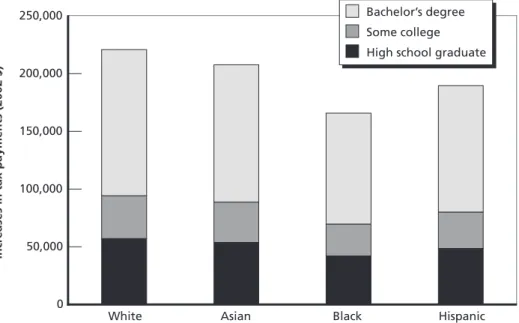
3.1. Present Value of Lifetime Increases in Tax Payments Resulting from
Increased Education, U.S.-Born Men . . . .35
3.2. Present Value of Lifetime Increases in Tax Payments Resulting from
Increased Educational Attainment, U.S.-Born Women . . . 36
4.1. Expected Annual Welfare Program Spending for a U.S.-Born Hispanic
Woman . . . .45
4.2. Expected Annual Public Housing Subsidies for a U.S.-Born Hispanic
Woman . . . .47
4.3. Expected Annual Food Stamp Benefits for a U.S.-Born Hispanic Woman . . . 48
4.4. Expected Annual Supplemental Security Income for a U.S.-Born Hispanic Woman . . . 50
4.5. Expected Annual Medicaid Benefits for a U.S.-Born Hispanic Woman . . . .51
4.6. Expected Annual Medicare Benefits for a U.S.-Born Hispanic Woman . . . .53
4.7. Expected Annual Unemployment Compensation for a U.S.-Born Hispanic Woman . . . 54
4.8. Expected Annual Social Security Benefits for a U.S.-Born Hispanic
Woman . . . 56
4.9. 2002 Value of Lifetime Decrease in Social Program Spending Resulting
from Increased Education for U.S.-Born Men . . . .57
4.10. 2002 Value of Lifetime Decrease in Social Program Spending Resulting
from Increased Education for U.S.-Born Women . . . .58
5.1. 2002 Value of Lifetime Decrease in Incarceration Spending Resulting
from Increased Education for U.S.-Born Men . . . 66
5.2. 2002 Value of Lifetime Decrease in Incarceration Spending Resulting
from Increased Education for U.S.-Born Women . . . .67
7.1. Benefits and Costs of Raising the Education of a U.S.-Born Hispanic
xi
Tables
2.1. Ratio of Median Usual Weekly Earnings of Full-time Wage and Salary
Workers 25 Years and Over, by Educational Attainment . . . .16
2.2. Percentage of Persons Age 25 to 64 Who Are Employed, by Race/Ethnicity, Gender, and Education Level, 1992–2007 . . . .17
3.1a. Average 2002 Individual Annual Earnings, by Ethnicity and Education Level . . . .32
3.1b. Average 2002 Family Annual Income, by Ethnicity and Education Level . . . .32
3.2. Average Federal Income Tax Rates and Related Data, by Income . . . .33
3.3. Statutory 2002 Payroll Tax Rates and Medicare Tax Cap . . . .33
3.4. State and Local Tax Rates for 2002, U.S. Average. . . 34
3.5. Increased Tax Payments Associated with Increasing Educational Attainment from High School Dropout to College Graduate, U.S.-Born Men and Women . . . 38
3.6. Range of Percentage Reduction in Tax Payments If the Effect of Increased Education Is Reduced 25 Percent, U.S.-Born Men and Women . . . 38
3.7. Smallest Estimated Effect of Increased Education on Tax Payments If Effect of Increased Education Is Reduced 25 Percent, U.S.-Born Men and Women . . . .39
4.1. Medicare and Medicaid Benefit Estimates, 2002 . . . 44
4.2. Range of Percentage Reduction in Social Program Spending If Effect of Increased Education Is Reduced 25 Percent, U.S.-Born Men and Women . . . .59
4.3. Smallest Estimated Effect of Increased Education on Reduction in Social Program Spending If Effect of Increased Education Is Reduced 25 Percent, U.S.-Born Men and Women . . . .59
5.1. Educational Attainment for Inmates and the General Population . . . .61
5.2. Total and Unit Costs of Incarceration, 2002 . . . .62
5.3. Present Value of Reduced Spending on Incarceration Associated with Increasing Educational Attainment from High School Dropout to College Graduate for U.S.-Born Individuals . . . 68
7.1. Effects of Increasing Education from High School Dropout to High School Graduate on Public Revenues and Costs for a U.S.-Born White Male . . . .76
xii The Benefits to Taxpayers from Increases in Students’ Educational Attainment
7.2. Benefits to Taxpayers from Increasing Educational Attainment from Less Than High School to High School Graduate, U.S.-Born Men
and Women . . . 77
7.3. Benefits to Taxpayers from Increasing Educational Attainment from High School Graduate to Some College, U.S.-Born Men and Women . . . .78
7.4. Benefits to Taxpayers from Increasing Educational Attainment from Some College to College Graduate, U.S.-Born Men and Women . . . .79
7.5. Benefits to Taxpayers from Increasing Educational Attainment from High School Dropout to College Graduate, U.S.-Born Men and Women . . . 80
7.6. Net Benefits from Increased Educational Attainment Among U.S.-Born Hispanics . . . .82
7.7. Range of Percentage Reduction in Net Benefits to Taxpayers If the Effect of Increased Education Is Reduced 25 Percent . . . .82
7.8. Smallest Estimated Effect of Increased Education on Net Benefits If Effect of Increased Education Is Reduced . . . .83
B.1. Estimated Two-Part Model of 2002 Payroll Tax Payments . . . 92
B.2. Estimates of 2002 Federal and State Tax Payments . . . 94
C.1. Estimated Two-Part Model of 2002 Welfare Income (Temporary Assistance to Needy Families, General Assistance, Other) . . . 98
C.2. Estimates of 2002 Subsidized Housing Participation . . . 99
C.3. Estimated Two-Part Model of 2002 Food Stamp Income . . . 101
C.4a. Estimated Two-Part Model of 2002 SSI Income . . . 102
C.4b. Estimated Two-Part Model of 2002 SSI Income . . . 103
C.5. Estimates of 2002 Medicaid Participation . . . 105
C.6. Estimates of 2002 Medicare Participation . . . .106
C.7. Estimated Two-Part Model of 2002 Unemployment Insurance Income . . . 108
C.8a. Estimated Two-Part Model of 2002 Social Security Income . . . .109
xiii
Summary
Policymakers in most states face a fundamental challenge—motivating taxpayers to provide the funds required to meet mounting educational needs. The level of education needed to succeed in labor markets and support economic growth is increasing rap-idly. But, in most states, public schools from kindergarten through the university level already face budgetary limits, and meeting the demands of the future will be expen-sive. Taxpayers who do not have children in public school frequently question why they should contribute more to the support of educational institutions, or why those who stand to benefit the most—the students—should not pay more for their education.
In this study, we explore the financial benefits that taxpayers enjoy as a result of increases in students’ education levels. We specifically address three research questions: How do increases in an individual’s educational attainment affect
tax revenues
•
program expenditures and revenues for a range of social support and insurance
•
programs
spending for prisons and jails?
•
We then subtract the costs of providing additional education to a student from the estimated effects of an increase in his or her education level on public spending and revenues to estimate the net benefit to taxpayers resulting from the increase in an indi-vidual’s education.
Our findings indicate that an increase in a student’s educational attainment— say, completing high school rather than dropping out—results in substantial benefits to taxpayers over time. For example, if a U.S.-born, Hispanic man who would have dropped out of high school were to obtain a high school diploma instead, the dis-counted present value of the net benefits to taxpayers equals about $87,000 in 2002 dollars. The comparable result for a U.S.-born, Hispanic woman is almost as large, with net benefits equal to about $83,000 in 2002 dollars. The results for other racial and ethnic groups are similar.
Our analysis focuses on the net benefits to taxpayers from increases in educational attainment. However, this is not a cost-benefit analysis of specific programs, since we
xiv The Benefits to Taxpayers from Increases in Students’ Educational Attainment
do not consider the costs of developing and operating programs and policies aimed at encouraging students to pursue higher education levels. Consequently, we do not know how the benefits from increases in education levels to taxpayers compare with the costs of policies and programs that induce students to increase their education. Our objec-tive is to demonstrate that taxpayers gain certain benefits from programs and policies that result in greater educational attainment, even if the taxpayers do not have children in school, and that taxpayers should consequently consider these benefits in assessing the importance of developing and implementing programs and policies to increase education levels.
Analytic Approach
To address the research questions, we estimate the extent to which increased educa-tional attainment will result in three types of benefits to taxpayers:
increases in federal, state, and local tax revenues and increases in contributions to
•
social support and insurance programs, such as Social Security and Medicare reductions in public expenditures on social support and insurance programs
•
reductions in public expenditures on incarceration—the costs of operating state
•
prisons and county and municipal jails.
By “increased educational attainment,” we mean more time in school, rather than “better” education in the sense of the schools doing a better job. Similarly, when we talk about additional spending on education, we mean the spending required to serve individuals in school longer; we do not consider the costs of programs aimed at induc-ing students to remain in school longer.
We use a nationally representative sample of roughly 40,000 individuals covered in all months of 2002 by the Survey of Income and Program Participation (SIPP) to model the effects of education level (some high school, high school graduation, some college, and college graduation) on public revenues and expenditures, depending on an individual’s age, gender, and race/ethnicity—African-American (black), Asian, His-panic, Native American, or non-Hispanic white (white).
We estimate the effects of education level on federal, state, and local tax payments and payments into social support and insurance programs throughout the entire work-ing life of an adult, uswork-ing appropriate survival rates. We use federal data to estimate payments of federal taxes and contributions to social support and insurance programs, such as Social Security and Medicare. State and local tax schedules vary across the country, so we use U.S. national average state and local tax schedules to estimate state and local tax payments.
Summary xv
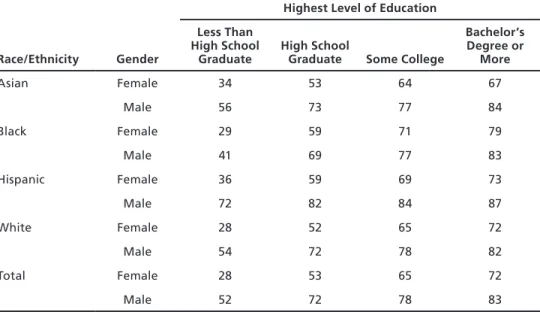
We examine the effects of education level on program spending for eight of the country’s largest social support and insurance programs for which sufficient data on program participation and program spending are available. Different segments of the population participate at different rates in social support and insurance programs. Consequently, we conduct separate analyses for different groups distinguished by gender and race/ethnicity. Because the social programs we examine are all national programs, we use the national sample to model the effects of educational attainment on (1) the likelihood that a person will enroll in a social support or insurance program and (2) the amount of benefit that a person will receive from a social support program upon enrollment.
Incarceration rates and the costs of operating prisons and jails vary across the country. Because federal prisons house a small percentage of prisoners, we focus on the effects of education on the costs of operating state prisons and local jails. We use U.S. national average data to estimate the effects of education level on the probability of incarceration in state prisons or in county and municipal jails for each combina-tion of age, race/ethnicity, and gender. We use the nacombina-tional average cost per inmate of operating state prison system and county and municipal jails to estimate the effects of increased educational attainment on the costs of incarceration.
We use national average operating cost estimates for public secondary and post-secondary education systems to estimate the costs of providing additional education. We assume that the costs of providing additional education to a student equal the national average operating costs per student at each level of education. We subtract the costs of providing additional education from the resulting benefits to estimate the net benefits to taxpayers from increased educational attainment.
Because the benefits to taxpayers of additional education are spread over an indi-vidual’s lifetime—as he or she pays more in taxes, places fewer demands on social sup-port programs, and does not engender incarceration costs—we estimate the expected effects of increased education over each year of an individual’s lifetime and then dis-count the annual benefits to calculate their current values at age 18. Because much of our data are for 2002, we discount all dollar amounts to 2002 dollars, at an annual rate of 3 percent. We then estimate the net benefit of increased educational attainment to taxpayers in 2002 dollars.
Because of data limitations in the SIPP, it is not possible to estimate similar effects for immigrants—those young enough to obtain additional U.S.-based education at the high school or postsecondary level—as for the native-born. For that reason, we focus our report on results for U.S.-born individuals. However, we did include immigrants in our sample and estimated models to differentiate between native- and foreign-born individuals. While not definitive, estimates for immigrants comparable to those we present here for the native-born suggest that the benefits from increased education for immigrants will be of a similar order of magnitude.
xvi The Benefits to Taxpayers from Increases in Students’ Educational Attainment
Payments for Taxes and Social Support and Insurance Programs
Greater educational attainment increases the likelihood that an individual will be employed and the level of his or her wages or salary when employed. The available evi-dence strongly indicates that more education increases an employed person’s earnings capacity (their wage when employed) by at least 7 to 10 percent per additional year of schooling. The higher earnings realized by more highly educated people result in higher tax payments and higher payments to social support and insurance programs.
We model tax and social support and insurance payments as a function of educa-tion level, age, and demographic characteristics. For every populaeduca-tion group, increases in an individual’s education level result in substantial increases in payments into tax and social support and insurance programs. Graduating from college rather than ending schooling with some college provides the largest impact on tax payments, followed by obtaining a high school diploma rather than dropping out of high school. The differ-ence between the tax payments made by a person with a high school diploma and an otherwise similar person with some college is smaller, but still substantial.
The effects of increases in education on tax and social insurance payments are generally greater for men than for women at all education levels and in all race/ethnic groups.
Spending for Social Support and Insurance Programs
Because an increase in educational attainment increases both the likelihood of employ-ment and an individual’s wages when employed, it reduces the likelihood that the indi-vidual will participate in social support programs. The higher earnings resulting from greater educational attainment also reduce the amount that a more highly educated person collects when he or she does participate in most social support programs.
Analyses focused on the benefits of increased education to students or to society as a whole generally view public assistance costs as transfer payments. From this per-spective, reductions in social support payments resulting from increases in educational attainment simply reduce transfers from taxpayers to social support program partici-pants, with no benefits to society as a whole except for reductions in the administrative costs of social support programs. But, from the perspective of taxpayers, who provide the funds that social support programs distribute to participants, reductions in the costs of social support programs resulting from increased education are a benefit.
We model participation in each of eight social support programs as a function of education level, age, and demographic characteristics. Except for Unemployment Insurance and Social Security, increases in an individual’s education level result in substantial reductions in the likelihood of participation and in benefits paid when the individual participates. Unemployment Insurance is an exception in that the level
Summary xvii
of compensation received depends on the person’s last salary, which in turn depends on that person’s level of education. Social Security is an exception in that the retire-ment compensation received under the retireretire-ment subprogram depends on the person’s cumulative contribution during the entire time he or she spent in the work force, which in turn is highly sensitive to that individual’s level of education.
The greatest reductions in spending on social support programs result from grad-uating from high school rather than dropping out. Beyond the high school diploma, some college has a greater impact for women and a college degree has greater impact for men.
Spending for Prisons and Jails
Research strongly demonstrates that education reduces the likelihood that an individ-ual will engage in criminal activity. Increases in educational attainment consequently reduce the likelihood that an individual will be incarcerated. Reductions in the size of the prison and jail population decrease the costs of operating and maintaining correc-tional facilities. Because federal prisons hold a small share of inmates and account for a small fraction of nationwide incarceration, we concentrate on the savings that would be achieved on spending for state prisons and county and municipal jails.
Analyses of the effects of increased education on the costs of the criminal justice system often account not only for incarceration costs but also the other criminal justice system costs, such as police and adjudication. Because of resource limitation, we lim-ited our analysis to the effects of increased education on incarceration costs.
Increases in educational attainment yield the greatest savings in incarceration costs among those who graduate from high school rather than dropping out. The sav-ings to the public budget are less from those who have some college education rather than none, and rather little from those who graduate from college compared to settling for some college. Even for the highest-risk population subgroups of black and Hispanic men, a bachelor’s degree results in just a small increase in incarceration savings com-pared with entering but not graduating college.
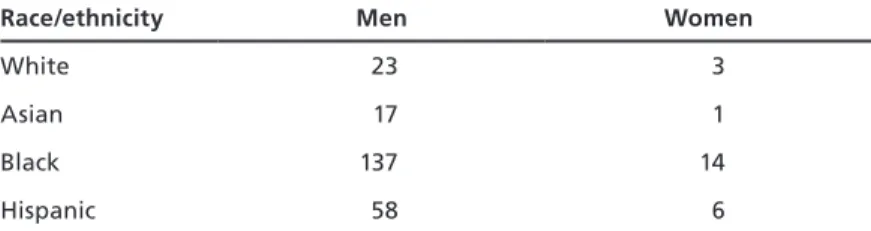
For both men and women, the primary savings on the costs of incarceration result from increased education within the black population. For each race/ethnicity group, the magnitude of savings within each female group is generally about one-tenth of that in the corresponding male group.
The Cost of Additional Education
Increasing educational attainment requires higher spending to provide the additional education. Our estimates are based on U.S. national average costs of public education.
xviii The Benefits to Taxpayers from Increases in Students’ Educational Attainment
In the 2001–2002 school year, the closest corresponding school year to the calendar year 2002, in which our data were collected, the national average current expenditure per student in average daily attendance (ADA) in public K–12 education was about $7,700. That school year, it cost taxpayers about $7,600 per full-time equivalent (FTE) student to provide additional education in a public two-year college and about $10,000 per FTE to provide additional education in a public four-year college or university.
These are the additional costs of providing additional education. They do not include the costs of programs and policies aimed at motivating students to obtain addi-tional education.
Net Benefits to Taxpayers
The net benefits to taxpayers of increased educational attainment equal the sum of the increases in public revenues and the reductions in public spending resulting from increased education minus the cost of providing the additional education.
To illustrate the calculations: On average, increasing a U.S.-born, white man’s educational attainment from less than high school graduation to high school gradu-ation would result in increased tax payments over his lifetime equal to $54,000. (All the figures in this paragraph are presented in 2002 dollars, in discounted present value to age 18). The increase in his education level would also result in reduced future demands on social support programs and reduced future incarceration costs equal to about $22,000 and $13,000, respectively. Thus, the average total public benefits of increasing a U.S.-born, white male’s education level from less than high school to high school graduate would equal about $89,000. Providing the additional education would cost about $15,000, so the net benefit to taxpayers would be about $74,000. In sum, if a U.S.-born, white male who would drop out of high school were to instead graduate high school, taxpayers would realize net benefits equal, in discounted present value, to about $74,000.
The benefits to taxpayers from increased educational attainment clearly exceed the costs of providing the additional education by a large margin for the members of every population group. Regardless of a student’s gender or race/ethnicity, raising the level of education he or she attains creates high net benefits for the public budget.
Again, we note that these results pertain to the net benefits to taxpayers of increases in students’ educational attainment. We do not consider the costs of develop-ing and operatdevelop-ing programs and policies aimed at inducdevelop-ing students to pursue higher education levels.
Summary xix
Sensitivity Analyses
To test how sensitive our results are to our estimates of the effects of increases in edu-cation level, we recalculated the benefits to taxpayers from an increase in eduedu-cation for each demographic group assuming that the effects of increases in education on tax payments, social program costs, and incarceration costs were each 25 percent smaller than our original estimate. Reducing the estimated effect of increasing education from less than high school to high school graduate by 25 percent resulted in a reduction in the discounted present value of lifetime net benefits to taxpayers of 28 to 34 percent, depending on the demographic group, for U.S.-born men and women. The results of similar sensitivity analyses for the effects of increasing education from high school graduate to some college and for the effect of increasing education from some college to college graduate were very similar.
The present value of net benefits to taxpayers from an increase in education are substantial even if we assume the effects of education on public revenues and costs are 25 percent smaller than our estimates. We estimate that the benefit to taxpayers from increasing an individual’s education from less than high school to high school gradu-ate is at least $51,000 (present value, net of the cost of providing the additional educa-tion) for each U.S.-born demographic group. If we assume that the effect of increasing education from high school graduate to some college is 25 percent smaller than our estimate, the benefit to taxpayers is still at least $24,000 (present value, net of the cost of providing the additional education), depending on the demographic group. For the increase in education from some college to college graduate, the benefit to taxpayers, assuming a 25-percent-smaller effect of education level, is at least $53,000 (present value, net of the cost of providing the additional education), depending on the demo-graphic group.
Putting the Results in Perspective
As noted previously, we use data collected in 2002 to estimate the models used in this analysis. In doing so, we assume that the estimated relationships between education level and governmental revenues and costs will remain approximately the same into the future. Specifically, we assume that the effects of education on earnings and, con-sequently, on tax payments and participation in social programs, in the future will be essentially the same as the effects observed in 2002. We also assume that federal, state, and local tax structures, social support programs, and incarceration patterns will not change substantially in the future.
Changes in some of these relationships are likely to occur at some future date. Consequently, the estimates presented here cannot be viewed as precise. However, the magnitudes of the estimates are generally so large that, even if changes in these
rela-xx The Benefits to Taxpayers from Increases in Students’ Educational Attainment
tionships substantially reduce the effects of increased educational attainment on gov-ernment revenues and costs, the net benefits to taxpayers will still be substantial. More-over, changes that increase the effects of education level on government revenues and costs are more likely than are changes that reduce the effects. If such changes occur, the estimates presented here will understate the effects of increased educational attainment on government revenues and costs.
Our analysis assumes that the relationships observed in the data are causal. That is, we assume that the differences in contributions to government revenues and costs between more highly educated and less highly educated people are the result of the differences in their levels of education. There is abundant evidence that increased edu-cational attainment leads to increases in earnings and that earnings are related to con-tributions to government revenues and costs. It is possible that some other factor is related to both the level of an individual’s education and his or her contributions to government revenues and costs. But it is clear that education is a dominant factor, even if there are others. Moreover, the magnitude of the effect of education on earnings has grown consistently over time. Because we assume that the relationships between edu-cational attainment and contributions to government revenues and costs that existed in 2002 will continue over time, our estimates do not reflect the effects of increases in the effect of educational attainment on earnings and, consequently, on government revenues and costs.
The bottom line is that these estimates, notwithstanding the inherent uncertain-ties in estimating future trends and patterns, show that increased educational attain-ment yields significant benefits to taxpayers. We recognize that the greatest gains accrue to those whose education levels are improved and that increases in educational attain-ment also provide numerous types of noneconomic benefits in addition to economic benefits. However, this analysis indicates that raising an individual’s level of education creates high benefits for the public budget, benefits that should be considered in assess-ing the importance of findassess-ing, fundassess-ing, and implementassess-ing programs aimed at increas-ing educational attainment.
xxi
Acknowledgments
We are indebted to several RAND colleagues who contributed to this study. Richard Neu, J. R. Lockwood, and Lynn Karoly reviewed earlier drafts of this report. Their insightful comments and suggestions provided significant contributions to this analy-sis. We also thank Shelley Wiseman for helping us with the structure and clarity of this report, Nancy Good and Christopher Dirks for helping with the preparation of this report, and James Torr, whose editorial expertise greatly improved the overall quality of this report.
xxiii
Abbreviations
ADA average daily attendance CPS Current Population Survey EITC Earned Income Tax Credit FTE full-time equivalent
GED General Educational Development credential HSG high school graduate
HUD U.S. Department of Housing and Urban Development OLS ordinary least squares
SIPP Survey of Income and Program Participation SSI Supplemental Security Income
1
ChApTEr OnE
Introduction
The Problem
Policymakers in most states face a fundamental challenge—motivating taxpayers to provide the funds required to meet the mounting educational needs of the nation’s population. This challenge is driven by major economic and social waves shaping the nation. The level of education that an individual needs to be competitive in the work-place has been increasing for the past 20 years.1 The high-paying industrial jobs that
used to be available to people who lacked even a high school diploma have largely dis-appeared. The service-related jobs taking their place require a level of knowledge and skill that require a high school diploma at a minimum. And many jobs can be obtained only after completing programs offered at colleges and universities. High school gradu-ation and preferably some postsecondary educgradu-ation have effectively become minimum requirements for rewarding employment.
At the same time, significant and growing segments of the U.S. population have traditionally experienced relatively low levels of educational attainment. If cur-rent trends continue, an increasing fraction of the population will lack the education needed to succeed in the labor market.
K–12 public school spending as a percentage of personal income has declined since the mid-1970s (Carroll et al., 2005). And studies have suggested that higher edu-cation systems also face mounting fiscal challenges (Benjamin and Carroll, 1997). K–12 schools and postsecondary institutions across the country face budgetary restrictions.
Meeting anticipated demands and expanding educational attainment will be expensive. Quite reasonably, taxpayers and their representatives ask why they should contribute more to the support of educational institutions. Shouldn’t those who directly benefit from more schooling pay their own way? And if they choose not to invest in their own education, isn’t that their problem? Until good answers can be provided to such questions, it will be difficult to convince federal, state, and local policymakers that they should make the investments necessary to increase students’ educational attainment.
2 The Benefits to Taxpayers from Increases in Students’ Educational Attainment
Research Objective
Discussions of programs and policies that can affect students’ educational attainment often focus on the consequences for students and for society as a whole. We do not question the relevance of those perspectives. However, taxpayers who do not have chil-dren in school or who do not see their well-being as tightly linked to the quality of the labor force may object to supporting programs and policies that do not benefit them directly. Our objective is to demonstrate that programs and policies that result in increased educational attainment provide benefits to all taxpayers, even those who do not have children in school. We show that, totally aside from the benefits that accrue to individuals who increase their educational attainment, taxpayers reap significant benefits from other people’s increases in educational attainment.2 These benefits should
be considered in discussions of public investments in education.
We do not suggest that policies and programs ought to be adopted or rejected solely because of their effects on taxpayers. But we do suggest that taxpayers will realize some benefits from programs and policies that increase students’ education levels and should, consequently, take account of these benefits in considering policy options.
The Costs of Providing Education Versus the Overall Costs of Increasing Educational Attainment
In Chapter Seven, we provide estimates of the benefits that increases in educational attainment have for taxpayers, net of the cost of providing the additional education (we discuss such costs in Chapter Six). However, programs and policies that seek to increase students’ educational attainment must not just provide the additional educa-tion, but also motivate students to pursues and complete the additional education. An important limit on the scope of our study is that we do not consider either the kinds of programs or policies that would be needed to induce individuals to stay in school longer or the costs of such programs or policies. We consider only the benefits to tax-payers when an individual’s education is increased.
Because we do not account for the costs of programs that induce individuals to pursue higher levels of education, our study is not a cost-benefit analysis. We do not suggest that benefits to taxpayers of such programs will necessarily exceed their costs, and it is certainly possible that they may not. A cost-benefit analysis of a program aimed at increasing educational attainment would have to consider several complexities. One such complexity is that the program would not be perfectly effective: Some program
2 In the context of cost-savings or cost-benefit analysis, our objective is the equivalent of calculating the “shadow price,” or the economic value (positive or negative) for taxpayers of increasing an individ-ual’s educational attainment. In this case, we focus on the shadow price solely from the perspective of taxpayers, as would be the case in a cost-savings analysis, rather than the full economic value to society, as would be estimated in a cost-benefit analysis. For further discussion of shadow prices in the context of cost-savings and cost-benefit analysis of social programs, see Karoly (2008).
Introduction 3
participants will not attain a higher level of education despite their participation. As an example, a program aimed at increasing the likelihood that students will achieve a high school diploma rather than dropping out may involve both students who would have completed high school had they not participated in the program and students who drop out despite their participation. Any cost-benefit analysis would have to recognize that only those participants whose education level is affected by the program will gen-erate additional benefits to taxpayers, whereas all participants will engender costs. A second complexity is that a cost-benefit analysis would have to consider the benefits to program participants and other nonparticipants, such as participants’ parents, and to society as a whole as well as benefits to taxpayers.
Again, our objective is to examine one part of that broader calculation: the exis-tence and magnitude of taxpayer benefits when an individual’s education is increased. We leave to others the comparison of the costs of a specific program to its benefits for all stakeholders. Moreover, we do not offer a position on state support for education. We seek only to estimate the benefits that taxpayers—even those who do not have chil-dren in school—realize from increases in educational attainment.
Research Questions
In this study, we explore the benefits of increased educational attainment for taxpay-ers. We recognize that the greatest gains accrue to those whose education levels are improved and that increases in educational attainment also provide numerous types of noneconomic benefits in addition to economic benefits. However, we concentrate on three types of economic benefits to those who would have to pay the costs of policies and programs aimed at raising educational attainment. Specifically, we estimate the extent to which increased education results in
increases in federal, state, and local tax revenues and in contributions to social
•
support and insurance programs such as Social Security and Medicare reductions in public expenditures on social support and insurance programs
•
reductions in public expenditures on incarceration—the costs of building and
•
operating state prisons and county and municipal jails.
We use national data to estimate the relationships between an individual’s increased educational attainment and his or her contributions to public revenues, expenditures, and incarceration costs. We then use these estimates to compute the discounted present value of the effects that the increase in an individual’s educational attainment has on the public budget—effects that would be incurred over the individ-ual’s lifetime—to estimate the benefits to taxpayers of the increase in the individindivid-ual’s educational attainment.
4 The Benefits to Taxpayers from Increases in Students’ Educational Attainment
We discount all dollar values to age 18. That is, we calculate the discounted pres-ent value, in 2002 dollars, of the estimated streams of contributions to and draws on the public budget at age 18 for an individual given his or her level of schooling and demographic group. We assume the appropriate discount rate is 3 percent per year.
Different segments of the population participate at different rates in social support programs. For example, some social support programs, such as Temporary Assistance to Needy Families and the Supplemental Nutrition Assistance Program,3 have
tradi-tionally served low-income women with young children. Consequently, an increase in the education of a woman will, on average, more greatly reduce welfare payments than will an equal increase in the education of a man. In contrast, the effect of educa-tion on incarceraeduca-tion rates and consequent costs is more marked for men because very few women, regardless of education level, are incarcerated. Therefore, we conducted separate analyses for eight different population groups distinguished by gender and race/ethnicity—African-American (black), Asian, Hispanic, and non-Hispanic white (white).
To generate our estimates, we use data from the Survey of Income and Program Participation (SIPP) (U.S. Census Bureau, 2005a, 2005b, 2005c), which provides, for each individual, his or her education level and place of birth (U.S.-born or immigrant). However, the SIPP data do not indicate an immigrant’s age (or year) of arrival, where an immigrant was educated, or an immigrant’s English-language proficiency. Thus, it is not possible with the SIPP data to estimate the effect of increased education for immi-grants young enough to obtain additional U.S.-based education at the high school or post-secondary level on such outcomes as taxes paid, benefits received, and incarcera-tion costs. For that reason, we focus our report on results for U.S.-born individuals.
However, we did include immigrants in our sample, and we estimated models to differentiate between U.S.- and foreign-born individuals. While not definitive, esti-mates for immigrants comparable to those we present here for the native-born suggest that the benefits from increased education for immigrants will be of a similar order of magnitude. However, more-precise estimates of the effects of additional schooling for immigrants will require data as rich as the SIPP but with information on where an immigrant was educated and his or her English-language proficiency.
The SIPP includes a nationally representative sample of the U.S. population. It includes some, but very few, Native Americans. Because we want the empirical esti-mates to reflect the relationships between education level and government revenues and costs for the U.S. population as a whole, we include Native Americans in the esti-mates. However, because there are so few Native Americans in the sample, we cannot be sure that the specific results for that group accurately reflect the experience of Native Americans. Accordingly, we do not present estimates of the effects of increased
Introduction 5
cation among Native Americans’ on their contributions to government revenues and costs.
Our analytic approach as it relates to the specific research questions is described in more detail in subsequent chapters of this report.
Illustrative Examples
The following examples illustrate the ways in which the results presented here might bear on policy decisions. The examples are hypothetical, but they are based on analyses of actual educational programs and policies.
First, consider a one-year preschool program that serves disadvantaged children and costs the government $5,000 per child. Suppose a rigorous evaluation of the pro-gram demonstrates that it results in a number of positive outcomes, one of which is a 10-percentage-point increase in participants’ high school graduation rate. (Many of the children in the program would have completed high school even if they had not been involved in the program. And some of the children in the program drop out of high school despite their participation in the program.) The issue is how to place a monetary value to taxpayers on that outcome.
We could estimate the present value of the difference in the taxes paid by a high school graduate versus a high school dropout over his or her lifetime. We could simi-larly estimate the present value of the lifetime differences in expenditures by social sup-port programs and in incarceration costs between a high school graduate and a high school dropout. However, we would also need to account for the fact that when a stu-dent stays in school rather than dropping out, taxpayers would have to pay for the addi-tional years of schooling, and we would have to subtract the cost of those addiaddi-tional years of schooling from the benefits that accrue from higher educational attainment.
Let’s say that the resulting estimate of the present value to taxpayers of a high school graduate over a high school dropout is $80,000. Suppose $5,000 is spent on every child in the preschool program. Because the program causes only 10 percent of the children to reach the higher education level, the present value benefit to taxpayers of the program is $8,000 per child included in the program compared with the pro-gram cost of $5,000 per child.
Second, consider a program at the high school level emphasizing small learning communities, long-term student-teacher relationships, and a rigorous curriculum. Sup-pose such a program were found to increase high school graduation rates 16 percentage points at a cost of $6,000 per child. The effects on the public budget resulting from inducing a student to complete high school rather than dropping out is the same, an increase of $80,000, present value. In this hypothetical example, because the high school–based program caused 16 percent of the children to reach the higher
educa-6 The Benefits to Taxpayers from Increases in Students’ Educational Attainment
tion level, the present value benefit to taxpayers of the program is $12,800 per child included in the program compared with the program cost of $6,000 per child.
Note that we do not consider other benefits to taxpayers that might result from either example program. For example, a preschool program might reduce the rate of grade repetition or the use of special education, saving the associated costs to the schools and, consequently, to the taxpayers. A rigorous high school program might reduce substance abuse among participants, reducing public health and police costs. We omit these benefits to taxpayers because they are unique to the particular interven-tion and would not apply to alternatives.
However, notwithstanding the benefits to taxpayers that are unique to either example, many of the principal effects of increasing a student’s education are the same for both. More generally, there are a large number of possible programs and policies that might affect students’ educational attainment. Our objective is not to focus on any particular policy or program, but, rather, to note that taxpayers will benefit from a successful policy or program and, therefore, taxpayers should consider the merits of proposals even if they do not have children in school.
Note, also, that these examples do not require that we value, as would be the case in a cost-benefit analysis, the private benefits to participants in either program, such as higher lifetime earnings or other benefits that accrue from greater educational attain-ment. Nor must we value the private benefits to nonparticipants from the improved outcomes of participants, such as lower rates of crime and the reductions in the associ-ated pecuniary and nonpecuniary crime victim costs.
Third, consider an example focused on the effects of a proposed decrease in school funding. Governor Arnold Schwarzenegger of California has proposed a budget for fiscal 2009 that would cut state higher education funding by roughly $300 million. This cut in higher education funding, coupled with planned increases in student fees, could deny access to more than 9,000 students at the University of California (UC) and more than 18,000 students at California State University (CSU). Some of those denied access to the state’s public four-year colleges and universities will attend pri-vate schools or community colleges, which cannot restrict the enrollment of eligible students. However, community colleges also face significant funding cuts under the proposed budget. Funding cuts, coupled with increased enrollments by students who would otherwise have enrolled in UC or CSU, will result in significant reductions in the classes and support services available to students in community colleges and, consequently, in both the proportion of community college entrants who complete a two-year program and in the proportion of students who continue on to a bachelor’s degree. Suppose the budget cuts were enacted and, as a result 5,000 fewer students completed some college and 5,000 fewer students completed a bachelor’s degree. If the present-value benefits to taxpayers of some college are and a bachelor’s degree are $40,000 and $75,000 per student, respectively, the proposed budget cuts would save
Introduction 7
taxpayers about $300 million, but cost taxpayers future benefits of which the present value is about $575 million.
Here too, we do not value, as would be the case in a cost-benefit analysis, reduc-tions in private benefits to students whose education levels would be reduced by the budget cuts, such as higher lifetime earnings or other benefits that accrue from greater educational attainment, nor do we value the costs to society resulting from a less well-educated labor force. Rather, we note that taxpayers who do not have children likely to attend college and who feel that the students who benefit from increased education ought to bear the costs of those increases will still lose benefits when budgets are cut and students’ access to education is consequently reduced.
Previous Research
There have been numerous analyses of programs aimed at improving some aspect of the quality of education. Some of these programs are designed to increase students’ tion levels. Others are designed to improve some other aspect of the quality of educa-tion, but they also affect students’ education levels. However, these analyses generally focus on the effects that the program being evaluated has on the students involved, including increases in their educational attainment and, sometimes, on their families and the society more generally. Such analyses generally do not examine the programs’ effects on taxpayers in detail.
Also, analyses focused on the benefits of increased education to the students or to society as a whole generally view public assistance costs as transfer payments. An increase in a student’s education reduces the likelihood that he or she will participate in social support programs and, consequently, reduces social support program costs. From the perspective of society as a whole, this simply means that fewer funds are transferred from taxpayers to beneficiaries. The only consequent savings from this per-spective are reductions in the administrative costs of social support programs. But, from the perspective of taxpayers, who provide the funds that social support program distribute to participants, the reductions in the costs of social support programs result-ing from increased education are a benefit.
Krop (1998) conducted analyses similar to ours. However, his specific results are not directly comparable with ours, for two reasons. First, because his objective was to estimate the effects of increasing black and Hispanic education levels to that of whites, he reported the aggregate effects of increasing black and Hispanic education levels on government costs and revenues for the entire U.S. population of blacks and Hispanics born in 1990. He did not report the effects of increases in education on an individual’s contributions to and draws on public budgets. Second, Krop examined the effects of increased education on the costs of the social support programs in effect in 1991. The 1996 Personal Responsibility and Work Opportunity Reconciliation Act and the 1997
8 The Benefits to Taxpayers from Increases in Students’ Educational Attainment
Balanced Budget Act dramatically restructured the social support system, eliminat-ing some programs, introduceliminat-ing some new programs, and imposeliminat-ing more-streliminat-ingent eligibility rules and lifetime-total and one-time caps on participation in the income-support programs that were continued.
Although Krop’s empirical results cannot be directly compared with ours, his general findings are suggestive. He found that increases in education yield substantial increases in tax revenues and in contributions to social support programs and substan-tial reductions in public spending for social support programs and incarceration.
Belfield and Levin (2007) estimate the effects of graduating from high school rather than dropping out on public revenues and costs, focusing on California. They distinguish between men and women by race/ethnicity for whites, blacks, and Hispan-ics. They do not consider place of birth. They assume that students who are induced to graduate from high school rather than dropping out will continue on to college at a rate equal to the national average rate of college continuation by those in the lowest quartile of academic achievement, and the researchers compare estimates for high school drop-outs with those for high school graduates without differentiating level of education above high school. Consequently, their results are not directly comparable with our estimates.
Belfield and Levin estimate the effects of completing high school on the present value of lifetime federal and California state and local tax revenues. Their estimate of the present value, in 2005 dollars, of the additional federal state and local tax payments resulting from high school graduation rather than dropping out is about $101,000. The increase in tax payments resulting from high school graduation ranges from about $49,000 for black women to about $182,000 for white men.
Belfield and Levin examine the effects of high school completion on federal, state, and local (California) spending on three welfare programs and on the costs of crime, including spending on the criminal justice system, corrections, crime prevention, and publicly provided health care. Because they do not consider seven of the ten social support programs that we examine, their estimates of the effects of completing high school on social support program costs are not comparable with ours. And, because we consider only the effects of increased educational attainment on incarceration costs and do not consider the other types of crime-related costs to taxpayers that Belfield and Levin include in their analysis, their estimates of the effects of completing high school on crime-related costs are not comparable with ours.
Rouse (2005) estimates the effects of graduating from high school, rather than dropping out, on federal and national average state income tax payments and Social Security payments. She compares total tax payments by high school dropouts with tax payments for high school graduates and with tax payments by individuals who have a high school diploma or greater level of education. She presents estimates for each of three different assumptions regarding future annual earnings growth and for each of
Introduction 9
three different discount rates. However, she does not distinguish among gender, race/ ethnicity, or place of birth.
Assuming 0 percent annual growth in earnings and a 3.5 percent discount rate, Rouse estimates that the effect of completing high school, rather than dropping out, on the discounted present value (2004 dollars) of federal and state income taxes paid is about $42,000 and that the effect on total income and Social Security taxes paid is about $70,000. The corresponding estimates for high school graduate or more school-ing are about $104,000 in federal and state income taxes and about $155,000 for total income and Social Security taxes.
In addition to these studies focusing specifically on the economic value of rais-ing educational attainment, efforts have been made, in various cost-benefit studies of social programs, to attach an overall value to raising an individual’s level of education, either in terms of benefits to taxpayers or to society as a whole. For example, Masse and Barnett (2002), Reynolds et al. (2002), and Karoly and Bigelow (2005) estimate the economic value of the higher educational attainment, measured for participants in various high-quality preschool programs relative to program nonparticipants.
Aos et al. (2004) also estimate the value of higher educational attainment in their cost-benefit analysis of an array of early intervention and prevention programs for chil-dren and youth. In terms of taxpayer benefits, these studies account primarily for the effect of increased years of schooling on income and payroll taxes, a more limited set of benefits than we account for in this study. Moreover, these studies typically do not report the estimated economic values associated with raising education levels that they employ in their cost-benefit analyses.
Definition of Terms
Research has traditionally measured education in terms of years of schooling com-pleted. However, in this study, we concentrate on the level of education received by an individual instead of years completed. The levels we consider are as follows:
Less than high school education.
• Because federal law requires that young people go to school until they are 16 years old, most individuals who choose to end their schooling before high school graduation have completed at least their sophomore year. On the other hand, some may complete most of their senior year before leav-ing high school. For this study, a high school dropout is any individual who does not earn a high school diploma or a General Educational Development credential (GED).
high school graduate.
• An individual of any age who earns a high school diploma or a GED but does not go on to college is a high school graduate.
10 The Benefits to Taxpayers from Increases in Students’ Educational Attainment
Some college.
• An individual who earns some college credits but does not earn a (typically four-year) bachelor’s degree. Individuals with some college may have earned a (typically two-year) associate’s degree.
College graduate.
• An individual who earns a bachelor’s degree or more.
We chose to concentrate on levels of education rather than years of schooling for several reasons. First, beginning in the 1980s, the Census Bureau adopted a degree-based system for the Census and the Current Population Survey (CPS). Our use of a level-of-education approach will enhance the comparability of our study with research that uses Census and CPS data. Second, we believe that today’s labor market places greater value on degrees than it does on the underlying number of years of education. In an economy in which clerical tasks are increasingly automated and delegated to computers and in which many, or even most, new jobs are created in technology sec-tors, receiving a college degree matters much more than making the jump from 15 years of schooling to 16—even if they amount to the same thing. Our key data source, the SIPP, collects education data by level of education and degrees obtained as well as years of education.
We use the terms educational attainment and education level to refer to the level of schooling that an individual completes. This study is not about “better” education in the sense of schools doing a better job. In our analysis, we treat all benefits as incremen-tal and relative to the respective baseline of the increase in attainment. For instance, if we want to assess the benefit to taxpayers of a student earning a high school diploma rather than dropping out, the benefit is the difference in expected tax payments, social program costs, and the costs of incarceration between the average high school gradu-ate and the average high school dropout, and not simply the expected values for high school graduates per se. We apply a similar logic to all costs and benefits.
We use the term benefits to taxpayers to refer to the benefits that taxpayers gain when an individual completes a higher level of schooling. In this study, we focus on benefits to taxpayers; we do not consider either the direct, or private, benefits from edu-cational attainment that students obtain from an increase in their education, nor do we consider either the private or social benefits that accrue to the society as a whole when an individual completes a higher level of schooling.
Organization of the Report
This report is organized as follows. Chapter Two outlines our approach to the analy-ses. Chapter Three examines the relationships between educational attainment and tax revenues and contributions to social support and insurance programs. Chapter Four examines the relationships between educational attainment and spending on social support and insurance programs. Chapter Five examines the relationships between
Introduction 11
educational attainment and spending for prisons and jails. Chapter Six presents esti-mates of the costs of providing additional education. Chapter Seven calculates the ben-efits to taxpayers from increases in educational attainment. Chapter Eight summarizes our findings.
We also include several appendixes. Appendix A describes the data used in the analyses. Appendix B presents the empirical analyses used to estimate the effects of increased educational attainment on tax payments. Appendix C presents the empirical analyses used to estimate the effects of increased educational attainment on participa-tion in social programs and the resulting costs. Appendix D presents the empirical analyses used to estimate the effects of increased educational attainment on incarcera-tion and the resulting costs.
13
ChApTEr TwO
Analytic Approach
There is abundant evidence that people with more schooling earn higher wages and salaries. There is also evidence that more highly educated people are more likely to be employed and to work full-time when employed. A direct result of higher earnings and greater employment is increased income and, consequently, increased payments in income taxes and “consumption” taxes, such as sales, real estate, and excise taxes. Also, individuals with higher incomes are more likely to succeed using their own resources and, consequently, less likely to use social support systems. Finally, individuals better able to support themselves are less likely to resort to crime and, consequently, less likely to be incarcerated.
We use a nationally representative sample of roughly 40,000 individuals covered in all months of 2002 by the SIPP (U.S. Census Bureau, 2005a, 2005b, 2005c) to estimate the relationships between education level and various government revenues and costs.1 We use the estimated relationships between education level and various
government revenues and costs to project the effects of increases in an individual’s edu-cational attainment on governmental revenues and costs over the individual’s lifetime. In doing so, we assume that the estimated relationships between education level and governmental revenues and costs observed in 2002 will remain approximately the same into the future.
In projecting the effects of increasing an individual’s education, we estimate his or her contributions to and draws on public revenues from age 18 through age 79. We assume that all schooling occurs consecutively and that the effects of an individual’s educational attainment begin immediately on completion of schooling. For example, we assume that a high school graduate attends school through age 17 and interacts with the public budget from age 18 onward.
Independent Variables
The independent variables in the models described below are