ABILITIES
EFFECT
BEHAVIOUR
CIRCUMSTANCES
CHOICE PROCESSES
Skills Knowledge Physical Institutional Technological Social and cultural Economic Intuitive behaviour Habitual behaviour Reasoned behaviourMARCH 2014
INFLUENCING BEHAVIOUR
MORE EFFECTIVE ENVIRONMENTAL POLICY
THROUGH INSIGHT INTO HUMAN BEHAVIOUR
its integrated approach and strategic advice, the Council strives to provide greater depth and breadth to the political and social debate, and to improve the quality of decision-making processes.
Composition of the Council H.M. (Henry) Meijdam, Chair
A.M.A. (Agnes) van Ardenne-van der Hoeven M. (Marjolein) Demmers MBA
E.H. (Eelco) Dykstra, MD L.J.P.M. (Léon) Frissen J.J. (Jan Jaap) de Graeff Prof. Dr P. (Pieter) Hooimeijer Prof. N.S.J. (Niels) Koeman M. E. (Marike) van Lier Lels Prof. Dr G. (Gerrit) Meester A.G. (Annemieke) Nijhof MBA Prof. Dr W.A.J. (Wouter) Vanstiphout General Secretary
Dr R. (Ron) Hillebrand
Council for the Environment and Infrastructure Oranjebuitensingel 6 P.O. Box 20906 NL-2500 EX The Hague The Netherlands [email protected] www.rli.nl
INFLUENCING
BEHAVIOUR
MORE EFFECTIVE ENVIRONMENTAL POLICY
THROUGH INSIGHT INTO HUMAN BEHAVIOUR
This advisory report is accompanied by Infl uencing Behaviour: a Behaviour
Analysis Framework for the development of more effective environmental policy
and the Behaviour Quick Scan (in Dutch only).
More effective environmental policy through insight into human
behaviour
The Netherlands faces the challenge of rendering both society and the economy more sustainable. This advisory report is concerned with ways in which the insights gained from behavioural science research can be used in pursuit of environmental objectives. That such knowledge is a valuable instrument is perhaps obvious. So why does the process of applying it demand special attention?
The government assumes a directorial role wherever there are generally recognized objectives which will serve society’s interests but which will not be achieved ‘automatically’. Ensuring a clean, sustainable environment is just such an objec-tive. Interventions are required because people will not necessarily ‘do the right thing’ without encouragement.
Individual behaviour is infl uenced by many factors, including personal circum-stances, motives, and choices. Some people attach little or no importance to the quality of the environment; others simply cannot appreciate the consequences of poor environmental quality. Some believe that acting in an environmentally responsible – or ‘sustainable’ – manner is more diffi cult or expensive than the alternative. And sometimes, sustainable behaviour may not be not the obvious choice. In short, human behaviour is complex and variable.
The public’s response to policy measures cannot always be predicted using traditional assumptions about the rationality of behaviour. If current knowledge regarding how people respond to certain situations and why they respond in a certain way is used in a (more) deliberate and systematic way, it will be possible to enhance the effectiveness of environmental policy. Fortunately, a substan-tial body of knowledge is available: we now know far more about how human behaviour works and how people are likely to respond to certain (policy) inter-ventions. Much of this knowledge is already being applied to support policy-making processes. In 2009, the Scientifi c Council for Government Policy (WRR) produced an advisory report entitled De menselijke beslisser: over de psychologie van keuze en gedrag (‘The human decision-maker: on the psychology of choice
van keuze en gedrag (‘The human decision-maker: on the psychology of choice
van keuze en gedrag
and behaviour’), in which it recommended that insights gained from behavioural science research should be applied in support of policy to the greatest extent possible.
The Council for the Environment and Infrastructure (Rli) is now going a step further. We have established direct links between insights into human behaviour and the various policy alternatives by means of the Behaviour Analysis Framework
developed to accompany this report. This Framework can assist policy-makers in identifying relevant factors which determine behaviour, such as the individual’s knowledge and skills, his or her motives, the infl uence of personal circumstances,
and the processes by which choices are made in a given situation. The Framework has been distilled to form a practical aid, the Behaviour Quick Scan, use of which makes it far simpler to take human behaviour into account when selecting appropriate policy instruments. Those instruments cover a broad spectrum, from prescriptive or proscriptive legislation to the facilitation of private initiatives. Together with the Behaviour Analysis FrameworkBehaviour Analysis FrameworkBehaviour Analysis Framework and the and the Behaviour Quick Scan, this advisory report consists of three parts.
Four case studies are presented in detail on the Council’s website at www.rli.nl (in Dutch only). They relate to four policy domains: mobility (peak-hour avoidance), energy (reduction of household energy consumption), food (reduc-tion of wastage), and waste management (separa(reduc-tion of household refuse fl ows at source).
Effective use of behavioural insights to support environmental policy requires input from various domains and disciplines. It is therefore important that the representatives of those disciplines understand each other: they must speak a common language, although it is not always possible to avoid the use of scientifi c terminology altogether. A glossary of such terms has been appended to this report.
This advisory report is intended to offer the government ways in which to apply behavioural knowledge in a targeted and responsible manner. It should be remembered that the analysis of individual human behaviour can sometimes demand an examination of extremely specifi c aspects: everyday and seemingly mundane choices, decisions and actions.
FOREWORD
3PART 1: ADVICE
101 Background and advice question
112 A behaviour analysis framework for the development of
more effective environmental policy
173 Insights into promoting sustainable behaviour
214 Embedding behavourial knowledge within policy and
policy procecesses
275 The behaviour analysis framework in practice
355.1 Peak-hour avoidance 35
5.2 Energy-effi ciency measures in the home 38
5.3 Reduction of food wastage 43
5.4 Separation of organic waste 45
PART 2: ANALYSIS
48Introduction
491 Developing government policy
511.1 How does government policy come into being? 51
1.2 Base policy strategies on more than considered and reasoned
behaviour 53
1.3 Embedding behavioural knowledge within the organisation 54
1.3.1 Policy staff with behavioural knowledge 55
1.3.2 Behavioural Insights Teams 55
1.3.3 Commitment to the use of behavioural knowledge 57
2 An exploration of individual behaviour
592.1 Human behaviour is both associative and systematic 60
2.2 Abilities enable people to adopt certain behaviour 62
A1 Knowledge 63
2.3 Motives infl uence the propensity to sustainable behaviour 63 M1 Values 64 M2 Emotions 64 M3 Beliefs 65 M4 Attitudes 66 M5 Personal norms 66 M6 Social norms 67 M7 Problem awareness 67
M8 Self- effi cacy 68
M9 Response effi cacy 68
2.4 Circumstances infl uence sustainable behaviour in both a positive and negative way 69
C1 Physical circumstances 70
C2 Technological circumstances 71
C3 Economic circumstances 72
C4 Social and cultural circumstances 73
C5 Institutional circumstances 73
2.5 Choice processes as a determinant of behaviour 74
CP1 Habitual behaviour 75
CP2 Intuitive behaviour 75
CP3 Reasoned behaviour 79
3 Policy instruments to promote sustainable behaviour
813.1 Top-down: the government at the helm 83 3.1.1 What is the problem? Analyse and identify the behaviour which
causes environmental problems 83
3.1.2 What is the objective: specify the desired outcome of policy in
behavioural terms 85
3.1.3 What is the most appropriate instrument? Policy instruments which will promote more sustainable behaviour and ways in which to
maximise effectiveness 86
3.1.4 Establishing the effects of policy: evaluation 106
3.2 Bottom-up: society at the helm 107
4 What can - and must - the government do to promote
sustainable behaviour?
1134.1 The legitimacy of environmental policy 113
4.2 Government strategies to infl uence behaviour are always
normative in nature 114
4.3 Is the government entitled to stimulate sustainable behaviour? 115
4.4 Is the private sector allowed to exert greater infl uence than the
4.5 Should the government attempt to change behaviour in the
interests of sustainability? 120
4.6 Behavioural knowledge in policy: promoting (more) sustainable
behaviour without manipulation 122
LITERATURE AND REFERENCES
124APPENDIX
138Glossary
139Responsibility and acknowledgements
145HOOFDSTUK KOP
PART 1 | ADVICE
1
BACKGROUND AND
ADVICE QUESTION
People’s everyday actions – what they do or don’t do – can have a signifi cant infl uence on their environment and on the very structure of society itself. This much is obvious: the behavioural choices that we make every day, consciously or otherwise, form the basis of our requirements in terms of energy, space, food, and resources. How do we heat our homes? How do we travel – whether to work or on holiday? What factors infl uence the way in which we purchase, use, reuse and dispose of products, what we eat, or how we use public services? What factors determine the choices we make? And how can people be encouraged to make more sustainable choices?
Human behaviour is one of the most signifi cant factors which determine whether governmental objectives will be achieved, and hence whether the transition to a fully sustainable society will be successful. Individual choices combine to form society’s overall impact on the environment. Signifi cant progress towards long-term sustainability can be made by ensuring the availability of ‘cleaner’, more responsible products and solutions (e.g. ‘green’ energy, low-emission vehicles, and better public transport), and through innovations in our social, economic and technology systems (such as greater reuse of resources within the ‘circular economy’ concept). However, all such changes demand careful examination of the way in which people respond to such innovations. It is the public responseresponseresponse to to a specifi c innovation which will largely determine whether the intended effects will be achieved.
This advisory report focuses on human behaviour and its role in achieving environmental objectives. The advice question is therefore:
“How can government policy make effective use of behavioural insights in order to encourage people to make more environmentally responsible choices and to behave in a more sustainable manner?”
This question is prompted by two observations. First, the Council notes a signifi cant increase in scientifi c knowledge about the factors infl uencing environ-mental behaviour. Second, the Council believes that government policy can be vastly enhanced if this knowledge is taken into account when selecting and developing policy instruments. Much of the (new) knowledge has been explicated elsewhere, notably in the Scientifi c Council for Government Policy’s report De menselijke beslisser: WRR, 2009). The Council for Social Development (RMO) is
menselijke beslisser: WRR, 2009). The Council for Social Development (RMO) is
currently preparing its own advisory report on the application of behavioural knowledge in policy processes. This should not be regarded as unnecessary duplication. The current document focuses on the question of how environmental policy can be made more effective through the use of behavioural knowledge. Further to its remit, the RMO is contributing to the social debate regarding the acceptability of ‘nudges’: government measures intended to bring about behaviour change. The RMO is therefore examining whether the government can preserve the autonomy of the individual based on new insights in the fi elds of psychology and behavioural economics. Its advisory report views nudges as a means by which the government can encourage certain types of behaviour without impinging on the individual’s freedom (Thaler & Sunstein, 2008). In the current document, the Rli examines the entire range of policy instruments (including ‘nudging’), their potential value, and the role that behavioural knowledge can and should play. The RMO’s advisory report on the other hand is primarily concerned with the applicability and acceptability of nudges and with the relevant normative considerations with regard to the acceptable bounds of government authority.
As the transition towards the sustainable society progresses, the ‘low-hanging fruit’ of the more obvious policy options is already being harvested. It is now becoming increasingly important to engage the public in the pursuit of
environmental objectives. The use of behavioural insights can help in this regard. For example, partly as the result of incentive measures and partly as the result of more stringent legislative requirements, cars have become more fuel-effi cient and cause less emissions. Technology, however, is not the only relevant factor for environmental effects. Also signifi cant are actual car usage (kilometres driven), route planning to avoid congestion, and an ‘economical’ driving style, all of which help to determine whether the full potential of cleaner vehicle technology will be realised in practice.
Although behaviour is a constant consideration within government policy, scientifi c knowledge about human behaviour has not always been used to full effect when developing that policy. Conversely, the way in which policy decisions infl uence behaviour has not been taken fully into account. The choices made with regard to spatial structure, for example, infl uence where people live and how they opt to travel to and from their place of work. Factors such as accessibility and the design of road and rail networks have a major impact on the availability and attractiveness of people’s mobility options. To date, the primary instrument for government policy aimed at infl uencing behaviour has been the provision of information. Policy aimed at changing behaviour demands a broader vision, however. In practice, almost every policy decision will have behavioural ramifi cations. Spatial policy, legislation, and fi nancial instruments (whether in the form of penalties, subsidies, or pricing measures) for instance are also often intended to bring about a change in behaviour. When applying the various policy
instruments, it is therefore important to take express account of both the intended behavioural effects and those already achieved. This is not yet standard practice. Policy development may be based on unsubstantiated assumptions about the way behaviour works, which – from a psychological perspective –may be a pitfall. In many cases, the assumptions are concerned with the rationality of behaviour, as refl ected by the use of ‘traditional’ instruments such as subsidies, fi nes, and prohibitions. Or policy-makers allow themselves to be led by their own intuitive assumptions – based on nothing more than personal experience – in selecting policy instruments. It is of course diffi cult to ignore the personal perspective altogether, adopting an entirely objective approach when seeking the most effective instruments to facilitate and encourage sustainable behaviour on the part of groups or individuals. The policy departments of the various ministries generally have ample legal and economic knowledge on hand, but expertise in the behavioural sciences (psychology, sociology, and behavioural economics) is less well represented. Furthermore, perhaps even as a result of this omission, they do not fully appreciate the contribution that such expertise could make to the quality and effectiveness of policy.
Figure 1: Assumptions about the motives for certain behaviours are not always borne out by actual behaviour
If it is not clear precisely what type of behaviour a policy instrument seeks to change and how, it will inevitably be diffi cult to assess the actual effect of that policy on behaviour. A further complication is that policy-makers often make assumptions about the mechanisms which determine the success or failure of a measure rather than subjecting the processes involved to careful analysis and learning from experience. In some cases, there is no post-evaluation at all. This is not only regrettable in view of the costs, time and effort which go into devising and implementing the policy, but also because it becomes impossible to identify any adverse or undesired side effects. For example, the government implemented a subsidy scheme for homeowners to fi nance energy-effi ciency measures
such as insulation. The take-up was very much lower than hoped or expected. Why? Is there an alternative approach which will succeed in reducing energy Source: Donald Duck Calendar 2013.
consumption? Also, the subsidy scheme proved to have the undesired effect in that the scheme was mainly used by homeowners who had already decided to implement energy-effi ciency measures and would have done so even without government assistance.
Research confi rms that various factors infl uence behaviour, and that these factors combine in a complex way to determine the behaviour a person will adopt in a given situation. It is therefore not possible to arrive at any ‘standard’ solutions to infl uence behaviour which will guarantee that policy measures become more effective. The purpose of this advisory report is to draw attention to the now extensive balanced body of behavioural knowledge, which can and should be used to arrive at more effective policy. To make the fi rst important steps in this process, the Council has developed a Behaviour Analysis Framework, which is described in greater detail below. We then go on to present a number of recommendations whereby policy – and environmental policy in particular – can draw upon behavioural insights in the interests of greater effectiveness. The Council’s recommendations are based on current scientifi c insights, analyses of the effects of (environmental) policy in the Netherlands and elsewhere in Europe, and the application of our analysis framework to a number of real-life case studies.
The Behaviour Analysis Framework can be applied within various domains and to various types of behaviour. In this advisory report, the focus is on four domains: 1) personal mobility; 2) household energy effi ciency; 3) food (wastage); and 4) domestic waste management. These domains have been selected as those in which the behaviour of individuals has greatest infl uence on environmental quality. In 2007, the (then) 27 member states of the European Union accounted for 74% of the world’s greenhouse gas emissions, 74% of acidic emissions, 72% of emissions which erode the ozone layer, and 70% of the global extraction of natural resources required (directly or indirectly) for private consumption (European Environment Agency, 2012). Alongside the choices made in the private sphere, those made in the workplace also do much to determine our ability to attain environmental objectives. Although it is possible to establish various links between the private and professional spheres, this advisory report focuses on the former: the individual’s role as consumer.
The Council’s examination of the effectiveness of environmental policy in this private sphere is largely based on knowledge drawn from the disciplines of psychology and behavioural economics. Measurable targets for behaviour change can be formulated from the environmental objectives at the system level. Incidentally, in the Council’s view, achieving behaviour change is not solely a question of increasing the contribution that (individual) behaviour makes towards the attainment of environmental objectives. It also entails offering (groups of) people the opportunity to devise and develop their own alternatives to today’s
non-sustainable society. Nevertheless, this advisory report is chiefl y concerned with the ways in which government (at all levels) can infl uence behaviour
through policy. It devotes less attention to behaviour change as a result of private initiatives.
Although this report is concerned with behaviour at the individual level, and hence with very specifi c, every-day aspects, the Council wishes to stress that it does not support government policies aimed at infl uencing every last detail of the individual’s life. Rather, the Council wishes to urge government to take relevant factors – those which can infl uence or determine behaviour – into account in all policy decisions, irrespective of the type of policy.
In Chapter 2 below, we describe the Behaviour Analysis Framework which accompanies and underpins this advisory report. It provides a fi rm foundation for the development of effective policy strategies to encourage sustainable behaviour. Chapter 3 presents a number of general behavioural insights which are relevant to policy-making processes. In Chapter 4, the Council makes recommendations whereby (the use of) behavioural insights can be fi rmly established within policy processes. The fi nal chapter of Part 1 illustrates the use of the Behaviour Analysis Framework in four relevant case studies. Part 2 of the report provides a more detailed description of how the Council has arrived at its fi ndings and recommendations.
2
WORK FOR THE DEVELOPMENT
OF MORE EFFECTIVE
ENVIRONMENTAL POLICY
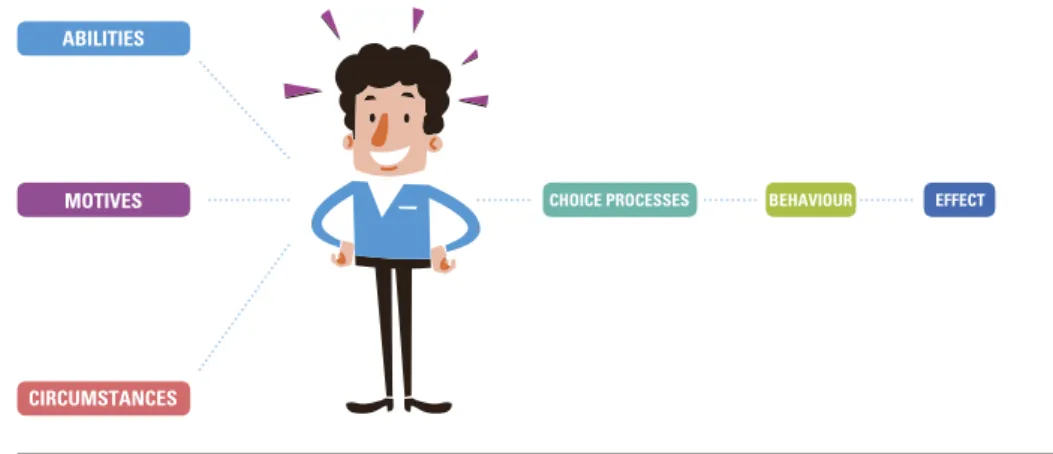
The Council for the Environment and Infrastructure has developed a Behaviour Analysis Framework which will support policy development processes by providing insights into the mechanisms and processes underlying human behaviour. The complete Framework is published separately to accompany this advisory report. The theoretical evidence base for the Framework is described in Part 2 (Chapters 2 and 3). The Behaviour Analysis Framework is largely based on knowledge drawn from the disciplines of psychology and behavioural economics. It seeks to establish a balance between the practical value of that knowledge for policy-makers and the desire to do justice to the depth of scientifi c knowledge and experience that has been developed in recent years. The Framework will assist policy-makers in determining what (types of) behaviour can or should be changed in order to address a specifi c environmental policy challenge. The knowledge it reveals will support the development of new policy strategies and instruments. The Council has identifi ed four key aspects which are particularly relevant to the promotion of sustainable behaviour and the effect of any process of behaviour change: abilities, motives, circumstances, and choice processes (see Figure 2).
Figure 2: The four key aspects of behaviour
These four factors determine behaviour; they not only encapsulate the mechanism of behaviour but also provide a potential basis for policy intended to promote sustainable behaviour.
‘Abilities’ refers to the knowledge and skills which people require in order to display or adapt certain behaviour. For example, if a person has never learned
MOTIVES CHOICE PROCESSES BEHAVIOUR EFFECT
ABILITIES
to ride a bicycle, a policy which promotes commuting by bicycle in preference to the car will have little or no effect on that person.
‘Motives’ are the reasons people have for adopting certain types of behaviour. These motives can be extremely diverse. They are infl uenced by the importance people attach to what others do in a given situation, as well as their assessment of their own ability to change their behaviour.
‘Circumstances’ refers to the individual’s personal situation, including the physical setting, which also has an infl uence on behaviour. Someone who lives in an untidy, run-down neighbourhood has less incentive to refrain from discarding yet more rubbish on the street. Financial circumstances are also relevant: the decision to replace a central heating boiler with a more energy-effi cient model will be infl uenced by considerations of affordability.
The way in which people actually behave in practice is determined by a succession of conscious and unconscious ‘choice processes’. One example of an unconscious choice process is when a driver shifts gear based on engine tone.
In practice, the relationship between the four factors suggested by behavioural science and actual behaviour is rarely direct or linear. Moreover, actual behaviour is infl uenced by mutual interdependencies between the factors. The policy-maker wishes to bring about behaviour change for one key reason: to achieve an (environmental) effect. Astute use of scientifi c knowledge about the factors which determine behaviour can assist in this process, whereby it is not always necessary to communicate the desired effect to the target group.
The Behaviour Analysis Framework comprises six stages, each of which entails answering a series of questions.
1. Stage 1 defi nes and delineates the policy issue using a set of exploratory questions which identify the role of human behaviour within the policy domain concerned. The objective for behaviour change can then be established. 2. In Stage 2, outline questions are used to establish the relevant determinants
of behaviour and possible points of departure for policy strategies. 3. Stage 3 ‘zooms in’ to examine the characteristics of specifi c determinants
using more specifi c questions which focus on the behaviour in question. 4. In Stage 4, practicable policy strategies are identifi ed based on the abilities,
motives, circumstances and choice processes of the target group, as relevant to the policy issue and the associated behaviour.
5. Stage 5 entails a closer examination of the specifi c policy instruments that, based on the results of Stages 3 and 4, are likely to effectively bring about behaviour change which will result in the attainment of the environmental objectives. These instruments can be selected from the entire range at the government’s disposal, which includes:
• Physical and technological instruments • Legislative instruments
• Economic and fi nancial instruments • Communication instruments
6. The sixth and fi nal stage is the post-evaluation. Has the policy served to alter behaviour in a way which achieves the desired effect (or is it likely to do so in future)? The evaluation will also assess the processes through which the policy effects were realised, in order to allow continuous updating and improvement of behavioural knowledge.
The Council advises policy-makers to use the Behaviour Analysis Framework as an aid in developing effective policy. It will help them to identify the factors which determine behaviour, and which will therefore play a role in the formulation of environmental policy, while requiring no in-depth knowledge of psychology or behavioural economics.
The incorporation of factors which determine behaviour into policy instruments will result in a broad spectrum of (new) policy options, without necessarily calling for any immediate prioritisation. The process will help policy-makers to consider which interventions are most likely to prove effective. When eventually setting priorities and selecting policy instruments for actual implementation (or a combination thereof), the relationship between the instrument and the behaviour that is to be changed is just one of the criteria to be observed. Others include: • The likely contribution to the attainment of the environmental objectives and
the improvement of environmental quality in general • The costs of the policy
• The feasibility of achieving behaviour change based on the determinants identifi ed • The relationship (whether benefi cial or adverse) between the instruments and
3
INSIGHTS INTO PROMOTING
SUSTAINABLE BEHAVIOUR
On the basis of a study of the literature examining the effect of behaviour within environmental policy (see Part 2, Chapters 2 and 3) and the application of the Behaviour Analysis Framework to four practical case studies (see www.rli.nl), the Council has identifi ed some key insights which will support the development of environmental policy. The four policy domains considered in this advisory report are personal mobility, domestic energy consumption, food (wastage), and household waste management (see Chapter 5). The insights relate to behavioural factors to which attention should be devoted when devising policy strategies to supplement existing measures. In this chapter, we describe a few important insights in order to illustrate the intent of this advisory report. Although these insights may already be known to many policy-makers, it is also clear that they have yet to be given a prominent place in the practice of policy development.
The behaviour of others can encourage sustainable behaviour
People can inspire each other to adopt more sustainable behaviour. Social norms play a signifi cant part in this respect. Individuals often base their decisions on how others behave in certain circumstances, how they believe other people will behave, or what they believe is expected of them. Civil initiatives which successfully promote sustainable behaviour therefore can motivate a wider public to adopt more sustainable behaviour. However, the converse also applies: a bad example can encourage others to follow suit. For this reason, it is important that due attention is devoted to social norms. Sustainable behaviour can be encouraged by redesigning the social and physical environment, whereby it is made clear that sustainable behaviour is the social norm (rather than drawing attention to irresponsible behaviour). A clean, graffi ti-free wall is a physical manifestation of the social norm of responsible behaviour; a wall smothered in daubs and spray-painted ‘tags’ has precisely the opposite effect. This form of communication is far from straightforward in practice because it is necessary to promote the desired social norms in a manner which is appropriate to the circumstances in which the behaviour concerned is to occur. A sign prohibiting littering will have no effect if the street is already awash with discarded food wrappers or rubbish bags – indeed, the sign may actually encourage further unsustainable behaviour. Therefore it is essential that all policy instruments refl ect and promote the same social norm.
Unsustainable behaviour is often due to habit
In general, people do not always act on the basis of carefully considered choices. They often do what they have always done; such behaviour is habitual. Policy strategies must therefore devote considerable attention to changing such
‘ingrained’ behaviour. As far as unsustainable behaviour is concerned, this can be achieved in various ways:
• By altering the circumstances in which unsustainable behaviour becomes habitual
This can be done through restructuring (parts of) the physical environment, or by focusing specifi cally on the factors which underlie unconscious decisions. • By restructuring the setting in a way which introduces new, sustainable options
Habits will then be broken and people will be far less likely to continue their undesirable behaviour. For example, a person who moves house can be
encouraged to fi nd an alternative way of travelling to work, with less reliance on the private car. Another example is the national Het Nieuwe Rijden programme (literally, ‘the New Driving’, aimed to promote ecodriving), which seeks to instil sustainable behaviour from the outset by targeting young people as they prepare for their driving test (Brunsting et al., 2013).
• By drawing people’s attention to their ingrained habits while simultaneously offering attractive and practicable alternatives
Government authorities have various instruments at their disposal, including personal advice, warnings, and feedback using (new) technology. These communication instruments must be applied in combination with other types of instrument, since information alone is generally not enough to change habitual behaviour. The conditions which govern behaviour (such as regulations or pricing) should be such as to encourage the abandonment of bad habits. It may also be appropriate to allow people to experience the desired new behaviour, e.g. by allowing free use of public transport services for a trial period. A successful example of this proactive approach is the Smaaklessen
(‘Taste Lessons’) programme in which primary school pupils are introduced to food products such as fruit and vegetables, and are thus encouraged to adopt a healthy diet (Brunsting et al., 2013).
Make sustainable behaviour the attractive and easy option
People generally try to avoid behaviour which is seen as unattractive or that contravenes what appeals to them or what they consider ‘right’. People are easier encouraged to adopt certain behaviour if it appeals to them and addresses what they consider important, or if it is obvious. So, to encourage sustainable behaviour, policy must therefore devote attention to attractiveness and convenience. Sustainable behaviour must never be the disagreeable or diffi cult option. It is, however, acceptable for sustainable behaviour to involve some degree of challenge since this will allow people to take credit for their achievements. They will feel that they are indeed making a contribution, and this feeling of self-determination can affect behaviour in various other areas.
Especially when sustainable behaviour cannot be made attractive in itself, it is important that people will realise they can actually play a part in achieving environmental objectives, and that making their contribution is made as easy as possible for them. If people are to manage their household waste effectively, for example, recycling depots must be readily accessible and located in an attractive, safe setting, with ample public information about hours of operation etc.
Sustainable behaviour can be made more attractive by devoting attention to the way in which the options are presented. If litter bins with separate compartments for plastic, paper and organic waste are installed in public locations, waste separation at source will be made more convenient and will become more self-evident.
New technology creates new opportunities for sustainable behaviour
The (re)design of the technological environment and the use of new technology offers many new opportunities for policy and practice. Moreover, the introduction of new technology calls for very little effort or input on the part of consumers. There are three ways in which technology products and services can infl uence sustainable behaviour.
First, technology infl uences the environmental effects of the production and/ or use of consumer goods. Recent years have seen various innovations in areas such as home insulation materials, while electric vehicles are now a viable alternative to those with an internal combustion engine. Ensuring the availability of sustainable technology which closely complements people’s behaviour is therefore essential if that behaviour is to be made more sustainable.
The consumer must be able to form an accurate impression of how his or her use of a certain product or technology will help to resolve environmental problems. A policy which actively promotes research and development of the application of new ‘green’ technology will therefore also help to promote sustainable behaviour on the part of the general public. The same may be said of policies which offer consumers incentives to purchase and use sustainable products, perhaps in the form of reduced-interest loans or tax concessions.
Second, technology also has a direct infl uence on behaviour. The technological environment in the home, the workplace and elsewhere infl uences choices by virtue of the options it makes available and those which it restricts. If a consumer has ready access to a car, there is a far greater likelihood that he or she will use it in preference to public transport. The speed and comfort of modern vehicles makes it all the more tempting to do so. Public transport will be a more attractive option for longer journeys if it is made more accessible, more convenient, and more comfortable.
Third, new ‘smart’ technology can encourage consumers to make
environmentally responsible choices. For example, a car’s on-board computer might provide personal feedback, prompting the user to adopt a more effi cient driving style. The rapid emergence of intelligent systems, in combination with the development of new knowledge of the way in which systems affect behaviour,
offers many opportunities to effectively promote sustainable behaviour at the individual level. Smart meters provide personal feedback about energy and water consumption in the home, while similar immediate feedback in the car helps the motorist to maintain optimum fuel effi ciency. It is even possible to instil a sustainable driving style in the virtual environment of a driving school simulator. The widespread adoption of the smartphone creates plentiful opportunities for personal feedback (perhaps about the user’s own behaviour compared to that of others in the neighbourhood) and personalised information, such as warnings of congestion along the user’s intended route
Spatial planning offers opportunities to align behaviour with environmental objectives
The choices made in the initial stages of structuring the human environment will often determine the degree to which people (are able to) display sustainable behaviour in the longer term. Concentrating residential districts close to public transport hubs will, for example, result in a completely different mobility pattern to that seen when accessibility relies chiefl y on the road network (VROM Council, 2009). Even household energy and water consumption can be infl uenced by choices made in the early stages of the spatial planning process. Where attention is devoted to the relationship between such choices and human behaviour, urban planning instruments can be used to promote sustainable behaviour, making it the ‘automatic’ choice.
Different target groups will be reached through different types of policy
Many people are willing to adopt more sustainable behaviour. However, there are major differences in how far they are willing and able to go to achieve the desired change. Not every member of society can make an equal contribution to the attainment of a policy objective, and not everyone will display the same level of unsustainable behaviour. People live in widely varying circumstances, and they have different skills and motives to act sustainably. Socio-economic, demographic and cultural characteristics infl uence all aspects of behaviour (including
sustainable behaviour) and hence the degree to which people have already adopted more sustainable behaviour, their perception of how environmentally responsible they already are, and the degree to which they have access to information. For policy to be fully effective, these factors must be taken into account. For this, the standard target group segmentation models are unlikely to be adequate. Where people share certain behavioural characteristics, a policy strategy tailored specifi cally to this group will be more effective than one which addresses the entire population. Policy in each domain should refl ect the wishes, requirements, values and capabilities of the target group, as well as the specifi c characteristics of their behaviour. It will then be possible to apply the relevant policy instruments in a direct and effective manner, thus fostering greater support for the policy itself. For example, policy on household energy effi ciency could
be designed to take account of consumers’ actual housing situation, or could address groups of people who share common motives.
The Council wishes to see behavioural knowledge integrated into policy and policy processes in an effective manner. To this end, we make a number of organisational and process-related recommendations to the government and parliament.
Recommendation 1: Use behavioural knowledge to improve environmental policy
Het betrekken van beschikbare gedragskennis bij de beleidsontwikkeling heeft belangrijke voordelen:
• Existing policy instruments will be made more effective
Knowledge of the mechanisms underlying human behaviour should be applied when developing and implementing policy instruments. Doing so will ensure that policy strategies are more targeted and more effective, comprising a series of mutually reinforcing policy instruments which, in combination, will simultaneously address various important determinants of behaviour.
• Assumptions can be tested
The use of the available behavioural knowledge will make it possible to test the implicit assumptions about behaviour on which policy instruments are based, applying a critical and evidence-based approach. If those assumptions are then found to be false, the instruments can be revised accordingly.
• The use of behavioural knowledge will provide new points of departure for policy and relevant instruments
The development and application of communications technology (as in the use of the smart energy meter or personal feedback via a smartphone ‘app’) offers new opportunities to develop effective policy instruments which are situation-specifi c and highly targeted.
• Public commitment, acceptance and support for policy will be
enhancedBehavioural knowledge provides an understanding of people’s motives. If the factors which determine behaviour are carefully researched as part of the policy development process, it will become possible to achieve a better ‘match’ between policy and the target groups’ own motives and frame of reference.
• The arguments in favour of policy will be strengthened
Where policy is based on a thorough problem analysis, which integrally includes a behaviour analysis, the evidence and arguments supporting policy
EMBEDDING BEHAVIOURAL
KNOWLEDGE WITHIN POLICY
(decisions) will be strengthened. This increases the legitimacy of the policy, and hence acceptance and public support.
Recommendation 2: Increase the legitimacy of environmental policy through transparency regarding the use of behavioural knowledge in its development; devote attention to ethical dilemmas
The use of behavioural knowledge to encourage the public to adopt more sustainable behaviour raises certain normative and ethical issues. These aspects relate to the way the government can attempt to infl uence the individual’s conscious as well as unconscious choices and actions in order to achieve environmental objectives, and the degree to which the government could and should go. In the Council’s opinion, it is entirely appropriate for the government to use available behavioural knowledge in order to increase the effectiveness of environmental policy. However, it must do so only insofar as the resultant policy seeks to attain democratically legitimated objectives, and only if it offers full transparency and accountability with regard to the methods and resources applied and to the intended effects on behaviour. In order to assess whether the infl uence is justifi ed, the fact whether people may feel manipulated should also be taken into account. In the Council’s view, all government policy instruments have some conscious or subconscious effect on behaviour. This applies equally to prescriptive or proscriptive legislation, fi nancial incentives, and ‘nudges’. All such instruments, in all policy domains, raise comparable normative issues. In practice, the individual’s freedom of choice is frequently restricted by government interventions. Nevertheless, the Council takes the view that all policy instruments must offer the individual the greatest possible opportunity to make choices which are appropriate to his or her own circumstances. The justifi cation for this standpoint is set out in greater detail in Part 2, Chapter 4. As previously noted, the Council for Social Development (RMO) is currently preparing an advisory report examining the possibilities and limitations of deliberate behaviour change. That report will take both political (normative) considerations and empirical evidence into account, in relation to factors such as the type of instrument and the policy domain concerned.
Recommendation 3: Address the diversity of environmental policy issues by making a thorough analysis of the relevant determinants of behaviour
Environmental policy issues have diverse characteristics, whereby various types of human behaviour must be taken into account. This demands a care-fully compiled set of policy instruments which addresses both the unique circumstances and the relevant determinants of behaviour in each case. The instruments to be implemented must be selected on the basis of a thorough behavioural analysis so that each instrument deployed has the greatest possible infl uence on the most relevant determinants of behaviour. In many cases,
the determinants interact, whereby an integrated package of measures will be more effective than any one measure applied in isolation. For example, efforts to increase awareness through public information alone will rarely be enough to bring about the desired behaviour change, and neither will solely altering the costs-benefi ts ratio of certain behaviour by means of penalties, taxes, or subsidies. Different determinants of behaviour provide different points of departure for policy, and each calls for its own carefully devised set of instruments (see Section 3.1.3 in Part 2). Central government should therefore work alongside provincial and local authorities to arrive at a package of mutually reinforcing policy instruments drawn from each level of government responsibility. Incidentally, an analysis or empirical assessment may also reveal that certain instruments are not mutually reinforcing but actually detract from one another, or that one instrument used in isolation (such as a prohibition) is enough after all. Arriving at an effective mix of policy instruments is no easy task. The Behaviour Analysis Framework developed by the Council to accompany this advisory report – the evidence base for which is described in Part 2, Chapters 2 and 3 – provides a useful tool with which policy objectives can be formulated in a way which draws upon current knowledge about human behaviour and its determinants but which requires no specialist knowledge of the scientifi c terminology. It should be remembered that the Framework does not present ready-made solutions ‘on a plate’. It will however help in identifying relevant behavioural aspects and in defi ning the scope and content of a policy problem. In many cases, it will remain necessary to draw upon (specialist) behavioural expertise when devising the policy itself.
In April 2011, the government adopted a new methodology for the assessment of policy and legislation: the Integrated Assessment Framework (Integraal Afwegingskader, IAK), thus underscoring the importance of thorough policy
Afwegingskader, IAK), thus underscoring the importance of thorough policy
Afwegingskader
development within a sound and structured framework. A comprehensive explanation is given in Part 2, Section 1.1. The IAK provides an analytical, phased approach whereby decisions relating to policy and legislation can be made in an effective, transparent and accountable manner. The Council’s Behaviour Analysis Framework is appropriate to the structure of the IAK but ‘zooms in’ to examine behavioural aspects in greater detail.
Recommendation 4: Promote the use of behavioural knowledge by ensuring its ongoing availability within the governmental organisation
Available knowledge about human behaviour is extremely relevant and useful, but it is also extensive and complex. Moreover, behavioural knowledge is constantly expanding. Ensuring the structural availability and use of this knowledge to support the development of policy strategies in pursuit of environmental objectives is therefore a major challenge. Not every policy department has the necessary expertise on hand. If behavioural knowledge is to be embedded in policy processes, it is essential that the relevant expertise is
indeed available. Ministries must therefore devote attention to staffi ng capacity, professional expertise, and organisation. The Council notes that some progress is being made. In 2013, for example, the Joint Council of Secretaries General asked the Scientifi c Council for Government Policy (WRR) to produce a report examining ways in which new behavioural knowledge can contribute to central government’s policy-making processes (Ministry of Economic Affairs, 2013). The Council sees a number of ways in which the process can be furthered:
• Deploy staff with specialist knowledge of behavioural science
The policy directorates can improve the quality of their policies by involving staff with the necessary behavioural knowledge in policy-making, doing so in a structured and systematic way. These staff will be able to learn from their counterparts in other ministries, perhaps by means of an interdepartmental Centre of Expertise.
• Establish Behavioural Insights Teams
The Ministry of Infrastructure and Environment has recently set up a ‘Behavioural Insights Team’ (BIT), a concept pioneered in the United Kingdom1. As the name suggests, it will encourage the use of knowledge gained through behavioural science research to support policy processes. A BIT can continually coordinate systematic analysis of behavioural aspects and assist in devising appropriate solutions to current issues. In the Council’s opinion, however, it is essential to ensure that behavioural knowledge does not become the exclusive responsibility of a BIT. In other words, even where such a team is in place, the policy directorates themselves must remain alert to the signifi cance of behavioural knowledge to their particular policy domain.
• Ensure commitment to the use of behavioural knowledge
A government directive may make the use of the IAK mandatory in policy-making prior to the submission of a proposal to the relevant committee, whether at the administrative or ministerial level. Such a requirement would demonstrate the government’s commitment to embedding the IAK concept fi rmly within policy development processes. In the Council’s view, similar commitment to the structural use of behavioural knowledge in those processes is essential throughout the government apparatus.
Recommendation 5: Learn from small-scale policy experiments, and use this knowledge to further improve policy
The Council considers it important to create opportunities to test policy intended to promote sustainable behaviour. Prior to the full roll-out of a policy strategy, it will be useful to conduct trial or ‘test bed’ projects on a smaller
1 At the initiative of British Prime Minister David Cameron, the Cabinet Offi ce (responsible for the effec-tive running of government) set up a Behavioural Insights Team to promote the use of insights gained through academic research within policy processes. Various UK ministries – including the Department of Energy and Climate Change, the Department for Transport, and the Department of Environment, Food and Rural Affairs – now have similar teams, albeit with different nomenclature.
scale, in which new insights are evaluated. The proposed strategy can then be amended as necessary. A further advantage will be an increase in support for the policy once the public see the (positive) effects of the policy experiments. The implementation of new policy, particularly if undertaken by local authorities adopting varying approaches, represents many opportunities for experiments ‘in the fi eld’, which in turn will provide a good arena for further academic research. Policy strategies should be formulated as specifi cally as possible, with measurable performance indicators. Their effectiveness and effects can then be subject to thorough and accurate evaluation. Here, it is not only important to evaluate the effects of policies on behaviour, but it is equally important to study effect on the factors that infl uence this behaviour (does the policy work as intended?), as well as the effects on well-being and environmental quality. In addition, a process evaluation will be needed. Section 3.1.4 in Part 2 lists the points for attention when conducting policy experiments. Of course, it will be neither necessary nor possible to work with experiments in every instance. Where policy is implemented on a large scale, a thorough policy evaluation which takes account of behavioural aspects will be required. It will be useful to monitor the work and achievements of the United Kingdom’s Behavioural Insights Team which has formed various alliances with universities and research institutes. The government can thus offer researchers opportunities for fi eld experiments in return for knowledge which can be used to support policy processes.
Recommendation 6: Ensure that government policy builds upon the creativity of civil sustainability initiatives
There are numerous civil initiatives in which individuals and organisations have joined forces to address sustainability issues. These include ‘green’ energy cooperatives, urban agriculture projects, and car-pooling schemes, to give three very different examples. The motives are equally diverse. However, all initiatives seek to encourage sustainable behaviour at the individual level with no government intervention. They offer viable and
credible alternatives to established practices, thus inspiring people to abandon unsustainable behaviour. The Council regards civil initiatives as a valuable catalyst for change, and a channel through which sustainable behaviour may be encouraged. There is no need for the government to intervene in such initiatives, attempting to infl uence public opinion or attitudes. The initiatives themselves are an expression of society’s opinions and attitudes, whereby it should be remembered that the government itself is part of society. The civil initiatives seen thus far are extremely diverse in terms of scale, objectives, and target group. The challenge now is to align and coordinate the initiatives with government policy in order to achieve a mutually reinforcing effect. It is a challenge which places high demands on the competences of policy-makers and on the effectiveness of administrative and political processes.
The government’s role in those initiatives is that of facilitator; it must adopt a ‘hands off’ approach, accepting the initiatives, appreciating their worth, and encouraging their emulation. Moreover, the government should draw upon the experiences and lessons learned from the initiatives within its own policy development processes.
5
THE BEHAVIOUR ANALYSIS
FRAMEWORK IN PRACTICE
This chapter presents the results of the practical application of the Behaviour Analysis Framework developed by the Council in four actual case studies, each addressing a particular policy domain. The results demonstrate that the Framework reveals some policy options which may not have been immediately obvious. However, the conclusions drawn should not be taken as fi rm recommendations from the Council. Supplementary (policy) analysis, experiments, and research should be undertaken to ascertain whether the insights gained can usefully be applied within policy to encourage more sustainable behaviour. Because the analysis relates to behaviour at the individual level, the proposed solutions are often concerned with small, everyday matters. This gives rise to a detailed description of how certain behaviours should be taken into account, as well as the factors which infl uence or determine those behaviours. Again, the Council wishes to stress that it does not wish to see the government involving itself in every last detail of the citizen’s life. Many of the ideas and suggestions are not necessarily addressed to the government alone, since they require the input of private sector parties able to infl uence people’s behaviour in various ways.
The fi ndings described below are based on an extensive analysis, made using the Behaviour Analysis Framework developed to accompany this advisory report, of four topical themes within the policy domains listed in Chapter 1:
1. Personal mobility: peak-hour avoidance
2. Household energy consumption: energy-effi ciency measures in the home 3. Food: reduction of food wastage
4. Domestic waste management: separation of organic waste
The full analysis reports are available online at www.rli.nl (in Dutch only). For a substantiation of the fi ndings below, the reader is referred to the online versions. These also include a comprehensive list of sources and references, which are therefore omitted from the current document.
5.1 Peak-hour avoidance
The case study within the policy domain of mobility is concerned with projects intended to reduce peak-hour congestion through encouraging drivers to avoid peak hours. Such projects supplement the existing research with comprehensive
information about the factors which determine their success. The participants (those participating in peak-hour avoidance trial projects) are predominantly male, aged between 29 and 59, married with children, with a graduate level (or equivalent) education, owning more than one vehicle (usually not a lease car), and in full-time employment at a permanent location to which they drive by a set route with regular high congestion. Further examination of the peak-hour avoidance policy using the Behaviour Analysis Framework offers some points of departure for more effective policy, i.e. further reduction of the number of journeys made during peak hours, with a concomitant increase in those made at other times of day.
Location
The most obvious locations in which to recruit motorists willing to alter their behaviour (i.e. to avoid peak hours) are those in which congestion is particularly high, whereby personal interests are therefore most marked (high problem awareness). Regular users of high-congestion routes are identifi ed using automated registration plate recognition systems, and are contacted directly by letter. (This approach calls for attention to be devoted to personal privacy.) Because only a relatively short stretch of road is designated as the ‘target area’ for peak-hour avoidance, it is easier for potential participants to fi nd valid alternative routes (greater self-effi cacy). The presence of bus and cycle lanes in city centres places the emphasis on the importance of alternatives to car use (including peak-hour use) and can be made permanent.
Time vs circumstances
The majority of those who took part in the peak-hour avoidance trial projects were already in the habit of travelling at the beginning or end of the peak period. They were therefore required to make only a slight adjustment to their regular behaviour in order to meet the criteria for peak-hour avoidance. Motorists who usually travel at the height of the peak hour were less well represented. This is partly because ‘peak hours’ were defi ned very broadly, meaning driving outside those times demands a major alteration of behaviour. This group will derive greatest benefi t if the circumstances which require them to travel at the height of the peak hour are made more fl exible. In part, this will entail altering or dispensing with certain perceptions, assumptions and habits (that of the standard 9-to-5 working day, for example), although behaviour is often determined by actual circumstances: school hours, the availability of childcare, working hours (both those of the individual concerned and their partner) etc. It will be useful to talk to families, schools, and employers – perhaps through existing partnerships to encourage peak-hour avoidance – to investigate means by which the external circumstances can be adapted to allow peak-hour avoidance or to achieve better distribution of traffi c fl ows throughout the day. This process may also reveal obstacles raised by the corporate culture of employer organisations.
Role models
There are many people who already avoid peak hours every day. They may do so expressly to avoid congestion, because they live close to their place of work, or because they prefer to cycle rather than drive. Information regarding exact numbers or motives is not available: further research is required. If this information is then widely publicised, a strong social norm will be established, and those who display sustainable behaviour can be held up as role models worthy of emulation. In its role as employer, the government (at all levels) can set an example.
Technology
There is relatively strong opposition to the idea of fi tting cars with registration systems. This is partly due to reasons of privacy, but linking a named individual to a specifi c vehicle also creates opportunities for fraud (e.g. using a second vehicle for peak-hour journeys). Existing roadside camera systems appear to be a reliable and inexpensive alternative. And given the widespread use of smartphones, it should also be possible to apply app-based technology rather than installing a ‘black box’ in the car itself. This would also open up the possibility of personalised feedback and information about alternative routes or public transport options. Those willing to adopt such systems could be rewarded with, say, an up-to-date sat-nav app for which any usage charges refl ect the level of sustainable behaviour.
Parking management
Restricting the number of parking places available and increasing fees is a relatively inexpensive way of reducing traffi c volume in the city centre, including peak-hour volume. Providing fewer parking places does not impinge directly on personal freedom of choice. It does however make driving into the city a far less attractive option. The remaining parking places should have good access to alternative public transport services in order to facilitate transferring.
Simplicity
Peak-hour avoidance projects should present potential participants with a clear and positive proposition. Many of those who did not take part in the trial projects report that they did not understand the proposition or the objective. It is therefore necessary to start with a more positive picture than is currently the case. ‘Peak-hour avoidance’ is a negative or at best neutral formulation, yet there is much to be gained in terms of time, predictability, comfort, accessibility, and reduced costs. If people are offered a way in which to save time and money while enjoying greater comfort and knowing exactly when they will arrive at their destination, many will eagerly seize the opportunity. An element of competition might even enhance this.
Concluding remarks
Policy intended to encourage peak-hour avoidance has been extensively tested and refi ned as necessary. It has proven its effectiveness and will implemented on a wider scale. Nevertheless, it has proven very diffi cult to reach the ‘hardcore’ peak-hour motorists, who seem very set in their ways. Are they unwilling to change their behaviour? Are they unable to do so? Is it just too diffi cult to plan ‘smarter’ alternatives? Rewards, avoidance plans, and feedback will only be effective if the circumstances which determine this group’s mobility patterns are made more fl exible. The societal debate should devote greater attention to the interplay between factors such as accessibility, working hours, school hours, employment participation, and the life-work balance.
5.2 Energy-effi ciency measures in the home
The government wishes to encourage households to reduce energy consumption by means of various energy-effi ciency measures. It has already introduced or announced a number of programmes, including Blok voor BlokBlok voor BlokBlok voor Blok, the Energy Label, , the Energy Label, and a revolving fund for investments in energy-effi ciency measures.
Blok voor Blok (‘Block by Block’) is a series of trial projects undertaken as a
public-Blok voor public-Blok (‘Block by Block’) is a series of trial projects undertaken as a
public-Blok voor public-Blok
private partnership, in which the owners or tenants of all dwellings in a street or neighbourhood are encouraged to install insulation, double glazing, and other energy-effi ciency measures at subsidised prices. Its experimental nature lies mainly in the focus on the demand side of the market.
The Energy Label scheme is the Netherlands’ national implementation of the European Directive which requires the energy effi ciency of a building to be rated and recorded, thus providing information for potential purchasers and encouraging owners to improve energy performance by investing in energy-effi ciency measures.
The revolving fund is another public-private partnership in which commercial lenders provide reduced-interest loans to cover investments in energy-effi ciency measures. The application of the Behaviour Analysis Framework reveals that these instruments will have a mutually reinforcing effect if they are interlinked. The Energy Label serves to increase awareness and knowledge about the possibilities for reducing energy consumption, while the revolving fund will help to lower the fi nancial threshold. The insights and knowledge gained from the Blok voor Blok
programme demonstrate that offering an attractive range of energy-effi ciency options helps in managing expectations and assumptions. Consumers are often uncertain of the potential benefi ts of certain measures due to a lack of knowledge and restricted choice. They may feel that making alterations to their home is ‘too much bother’. They need a complete proposal, covering all aspects including costs, together with good after-sales service (so they will learn to operate any new devices). When asked to state their motives for investing in energy-effi ciency
measures, homeowners generally cite increased comfort and lower energy bills. The research concludes that sustainability considerations form the most important motive for applying energy-effi ciency measures. If the Energy Label scheme is to encourage investments, these considerations must be brought to the fore, and the required investment costs should not be too high. The Energy Label scheme is soon to be revised, whereby the cost of obtaining a rating will be signifi cantly reduced (to well under €50). Unfortunately, the reported energy effi ciency and the estimated costs and benefi ts of improvement measures will be somewhat less accurate, due to the simplifi cation of the label itself and the fact that no physical inspection will be made. The former label did not devote attention to user comfort, and neither does its replacement (as yet). The simplifi cation of the system will result in an increase in the number of providers offering the Energy Label rating. This may erode public trust in its reliability, particularly given that the traditional providers – the government and energy companies – are seen as particularly reliable sources of information (Veltman & Welzen, 2012). A logo denoting that the Energy Label and its provider are offi cially approved by the government, the local authority, and the energy company may help to dispel any doubts.
The Blok voor BlokBlok voor BlokBlok voor Blok project was prompted by a desire to develop the demand project was prompted by a desire to develop the demand side for energy-effi ciency measures which will help to create an independently functioning market for such measures. However, evaluations of the pilot projects thus far suggest that demand has not come to full maturity due to the limited quality of the supply side. Smaller contractors in particular fi nd it diffi cult to produce a full project proposal and generally do not possess the skills necessary to manage customers’ expectations effectively. The construction industry federation Bouwend NederlandBouwend NederlandBouwend Nederland acknowledges this problem and intends to take acknowledges this problem and intends to take remedial action. However, doing so is not exactly a priority; it is just one of 62 ‘action points’ on a very long list. One way in which to improve the situation might be for selected homeowners to act as ‘street ambassadors’. Having had the various energy-effi ciency measures installed in their own homes, they would then share their positive experiences with others in the neighbourhood and recommend certain providers.
Decisions regarding the implementation of energy-effi ciency measures are informed by factors such as the physical condition of the dwelling, whether any measures are already in place, and planned (major) maintenance. Timing is therefore of the essence, both in terms of offering the measures and of actually installing them. An individual, ‘tailor-made’ approach is required. It calls not only for expert knowledge in energy-effi ciency measures themselves, but also in contract and procurement management. The supply side of an independently functioning market can do much to infl uence the demand side by increasing the reliability of both the solutions and their providers. To that end, those providers must be able to identify the interests of their customers and have the skills