is a rose – A Performative Installation in the Context of Art and Technology
Charlotte Triebus, Bastian Dewitz, Ivana Družetić, Calvin Huhn, Paul Kretschel, Christian Geiger
Faculty of Media Hochschule Düsseldorf
Münsterstraße 156, 40476 Düsseldorf
{charlotte.triebus, bastian.dewitz, ivana.druzetic, calvin.huhn, paul.kretschel, christian.geiger}@hs-duesseldorf.de
Abstract
The advancing technology allows new forms of contemporary art expressions which, however,
require a large set of skills to be developed and therefore involve a team with diverse
backgrounds. In this paper, we present implementation details and the artistic background of the
art piece is a rose that was developed and exhibited in 2019. Based on this example and our
previous experience of work on different art applications, we provide an insight into the interdisciplinary work between artists and developers.
1 Introduction
The diversity of new technologies and their possible applications have considerably expanded
the creative possibilities and the scope of artistic practices. Artists that are using technology as a
medium are continually testing the boundaries of what is conventionally considered art,
simultaneously developing a new notion of aesthetics.
Ever since the paradigm shift from modernism to postmodernism in the 1960ies, art has been
increasingly changing its form from a fixed, distant and observable object (material piece of
artwork or a performative work) to an immersive experiencecreated at the moment of interaction
of new genres likelive artandperformance art1, which are often based in their non-repeatability,
and thus named as ephemeral art [Coog11]. This period was generally marked by an
advancement of interdisciplinarity and questioning of the long indisputable notions of artwork,
author, necessity of a medium and the artistic market itself. The institutions that have long been
considered as the gatekeepers of the exclusive art – museums, galleries, theatres, etc. – have,
since then, been gradually embracing the idea of the permeability of their structures and
processes through participatory approaches and flexible curatorial concepts [see Smith12].
A few decades later, towards the end of the 20th century, the development of ubiquitous
technology takes place, imbuing almost all human activities with some of its forms. This
phenomenon is widely known as democratization of technology [Frie99] and is in the HCI
context closely related to another type of paradigm shift, namely the one from second to third
wave of HCI [HaST07, Bøde15]. Stating several intellectual commitments of the third wave HCI,
Harrison at al. emphasize the notion that “meaning is constructed on the fly, often
collaboratively, by people in specific contexts and situations”, and position “ interaction itself
(...) [as] an essential element in meaning construction” [HaST07]. Open for this kind of
considerations, the third wave of HCI reveals a potential common ground with contemporary art.
The latest interactive tech products, especially those in the field of Mixed Reality, can be
evaluated concerning the impression of immersion, additionally expanding the artistic
playground. Whether and to what extent the topics democratization of technology, the third wave
of HCI and new tendencies in art have been interrelated exceeds the subject o f this paper.
However, the potential for interdisciplinary collaboration between art and interactive technology,
anchored in their essentially very similar motivations for interactivity and immersivity, can be
defined as its backbone.
Although it has been gaining a considerable public visibility only in the last decades, the
collaboration between art, science and technology (AST) is not as novel as it might seem.
1 The performance art owes a lot to dance as one of the art forms it originated from [Gold11], which is important in the context of the paper later on.
Already in 1967, more than half a century ago, one of the most known AST programs was
initiated in the USA by artist Robert Rauschenberg and engineer Billy Klüver under the name
“Experiments in Art and Technology” (EAT) [Shan05]. The EAT was a platform that was
connecting 2000 artists and an equal number of engineers and had set a ground-breaking
foundation for similar endeavors. One of the leading interdisciplinary hubs in the world today is
the MIT Media Lab. Professor Neri Oxman, the founder and director of the Mediated Matter, one
of the Lab´s research groups, presented the Krebs Cycle of Creativity [Oxma16] – an
antidisciplinary hypothesis and the attempt to work regardless of disciplinary boundaries towards
a more interdisciplinary, entangled approach of research. Institutions such as Zentrum für Kunst
und Medientechnologie (ZKM) in Karlsruhe or the Ars Electronica Center in Linz are still
among the best examples of European AST programs [Shan05]. There is a growing number of
AST programmes funded by local governments and the EU. Both art and technology have been
contributing to their encounters in their own way. By using technology as its new medium, art
witnesses not only the prospects of technological accessibility but also reconfirms its postmodern
tendency to subsume and refer to everything that surrounds it. Contemporary art both intuitively
appropriates technology as a medium of its expression, at the same time wittingly commenting it
and reflecting on its role as such.
In the rest of the paper we will touch upon related work on interdisciplinary collaborations in art
and technology and offer a terminology for differentiation between various types of application
of interactive technology in the field of art in order to delineate the specific nature of the
artist-technologist collaboration. As our best practice example, we will bring closer the
conceptual and technical aspects of the artwork is a rose , open a discussion about the experience
of the interdisciplinary collaboration on this specific project through own participant observations and offer some conclusions.
2 Related Work
There is a wide range of works that offer a comprehensive overview on the achievements in the
Science, and Technology” by Wilson [Wils02] and the thought provoking collection of essays
“Art@Science” edited by Sommerer and Mignonneau [SoMi98]. The practical side of artistic
applications of technology has been also widely reported. However, there are not many works
that discuss the actual experience of collaboration between the artists and technology experts. An
interdisciplinary view on the challenges and potentials that partnerships in dance and technology
open, is given by Whatley and Sabiescu, who describe the “tight interplay between theory and
practice, research and arts making” as a “gradual configuration of intertwined and mutually
influencing interdisciplinary artscapes and (...) knowledgescapes” [WhSa16]. How the process
of collaboration and implementation in art, design and technology works out in practice, with a
number of illustrative case studies, is also reported by Earnshaw [Earn17]. From an HCI design
perspective, a recent work by Pender and Lamas p resents three case studies, one of which is
related to physiological computing for performing arts, that demonstrates various challenges
specifically in the exploratory front end of a design process in the transdisciplinary creative
collaboration [PeLa20]. As an AR developer, Portalés gives an interesting personal insight and
reports on lessons learned from her own experience in collaboration with artists [Port18]. 3 Collaboration between Art and Technology
The application of interactive technology in the field of art and culture has been one of the main
research interests of our interdisciplinary team during the last five years. Through different
national and international projects, we collaborate both with traditional cultural institutions and
the independent cultural scene, create synergies with private companies in the field of creative
industries and venture into experimental projects that support individual artistic concepts through artistic residencies. The developers in our team work side by side with artists, cultural anthropologists, exhibition and communication designers, bringing different perspectives
inherited from diverse disciplinary backgrounds into discussions. On the one hand, our work in
the field of art focuses on the use of interactive technologies for conveying, interpreting and
curating already existing artistic or cultural content. This kind of projects are usually conducted
together with institutions that need expert support in using new technological tools. User
studies that are of central importance for such actors. On the other hand, we offer a space for
collaboration and creation of new artistic content, supporting artists with technology tools and
expertise throughout their creative process. In this case, the artwork is not (necessarily) created
with a user/visitor in mind but designed according to the artistic concept of its author. This kind
of interdisciplinary collaboration highly relies on the mutual professional respect and trust in the
choices an d visions of the artist, which we will further touch upon in the discussion part of the
paper.
When trying to define the role of interactive technology in relation to an artistic content, a
taxonomy can be offered where the interactive technology is seen as a tool for: experiencing art
(A), augmenting art (B), creating art (C), as well as an art form in itself (D). While experiencing
art (A) can be exemplified with various forms of virtual museums and exhibitions which use
technology for transferring artistic content across space and time and is often used as a sort of
documentation or archival, augmenting art (B) usually extends the basic artistic content with
additional information or effects and is thus often related to AR technologies. Both are mostly,
but not strictly, developed in collaborations with institutions. The role of interactive technologies
in creating art(C) in the artistic field is one that marks the transformation between an auxiliary
tool towards a creative, authoring tool. Depending on their level of accessibility and usability,
they can be used by amateurs and/or artists. Finally, the fourth type of technology application,
the interactive technologies as an artform in itself (D), is almost always related to a particular
artistic appropriation. It is not necessarily following any rules derived from HCI design
approaches, but is rather characterized by an idiosyncratic logic created by the artist, mastering
of which is inseparable from the artistic meaning attached to it.
The suggested interrelations between the types of technology application (A-D) and their
contexts are used here as a simplified depiction of art and technology relations and a clear
demarcation of our field of interest in this paper. In the following pages we will be focused
precisely on the last category (D), exemplified by an interactive performative installation emerged from an interdisciplinary collaboration.
4 The Performative Installation is a rose
4. 1 Description
The interactive performative art installationis a rose (2019) created by artist Charlotte Triebus
and an interdisciplinary team is aiming at the question of agency from an artistic point of view,
focusing on the interaction of different agents and exploring the intersection of art, dance and
science. Moreover, the work is inspired by nature’s strategies where communication between
species is driven by subtle expression abilities [RoFi99], hardly visible to the human perception
apparatus.
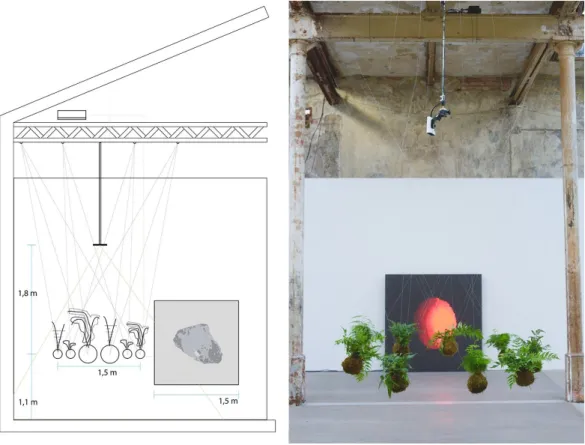
The mixed media installation is composed of a set up circle of nine hanging plants, the roots of
which grow in a ball of moss, a low-resolution LED screen, a tracking system (with an Azure
Kinect) and a computer with a small form factor. The computer runs the tracking software which
detects movements and imprints of the visitors through the impact the same produces in the
leaves of the hanging plants. Asparagus plumosuswas chosen as the preferred plant to exhibit up
to the tiniest movements. The plants hang from the ceiling on three thin nylon cords each to
bring back the plant to its initial position as quickly as possible after moving it. The mounting,
featuring 27 transparent cords appears very light, however small light reflections are visible when moving around the installation. The interaction with the plants, caused either by direct
touch or indirect breeze of air, is captured as a seismographic impression of the plants and is
displayed on an 1.5mx1.5m 2 low resolution LED-screen. The screen is showing an interactive,
computer generated modulation of a three dimensional, red sphere, designed as a raster graphic,
which is rotating around its own axis.
The animation shows each impact in real-time, using different means of deformation (such as
growing, notching, tilting). The intensity of the impact corresponds to the interaction caused by
breeze or touch, however the exact location of the transformation is rather not selectable. All
impressions received by the plants add up over a day as a unified interaction and manifest
themselves in the shape of a unique daily object shown on the screen. In this way the resulting
thus represent a temporal-spatial, living representation of a non-repeatable constellation of movements in the exhibition space.
Fig. 1: is a rose set-up at Baumwollspinnerei Leipzig 2019/2020
The titleis a rose relates to the quotation Rose is a rose is a rose is a rose by Gertrude Stein, that
refers to different layers of possible interpretations and (visual or verbal) metaphors, one
expression may bear. It is a conceptual quotation taken from literature studies and philosophy,
stating the possibility of various potential connotations of the same modes of presentation and
representation. In general, the metaphor of a rose in reference to the described artwork (which in
this case despite its colours is obviously no rose) convey the doubting of reality and its derived
implied qualities. Comparing asparagusplants to roses underlines a discrepancy of expectation
and reality as it shows parallels towards the dichotomy of the “romantic, innocent” plant and its
The work is a rose was realized in 2019 and premiered at Baumwollspinnerei Leipzig in
November. It was also shown at tanzhaus nrwin Düsseldorf and the gallery Priska Pasquerin
Cologne from January till April 2020. 4. 2 Artistic Background
The theoretical background of is a rose targets two main aspects: The question of agency (the
competence to act) of animate and inanimate objects such as the questioning of the traditional
dichotomy of nature and culture.
is a rose is categorized as a performative installation, alluding to being set at the intersection
between contemporary art and contemporary dance. Understanding is a rose as a piece of
performance draws attention to the fact that it places its focus on the body as a legitimate
material, the body and its movement being seen as a potential that enables to act and engage with
the other. This ability to act relates to the term of agency in sociology [EmMi98] and
performance [Böhm16] studies. Whoever is able to act and is enabled to take part in the
formation of the piece transforms into an active or passive agent (see also [Witz16]) of the same.
Agency means the capacity of an individual to act independently. Questioning humans to be the
only agents within a performative arrangement to own agency, the discussion is open towards
not only the audience but also other types of objects as agents within this structure. Given that
individuals of other forms (such as living plants [Bara12]) have their own agency, the artwork is
a rose creates a link between the formally unequal interacting parties.
Taking into account the definition of agents and agency mentioned earlier, we are able to define
two different types of agents in this case – the visitor, being able to detect one’s ability to interact
and modify the installation, and the plants, serving as the transforming agent from touch to
visual. Perceiving an own modus of communication between the visitor and the plants, the
impression of a mimetic [Dörr16], reciprocal observation is created. Plants and humans are
forming a network where each part is owning a sensory system. The perception of the visitors'
own body forms part of the work of art and transforms the visitor in this moment into an active
Plants are widely considered passive, almost like they would not be living organisms. A reason
could be that their own growth and movement is normally not perceivable by the human eye. On
the other hand, the term nature has its own strong connotation in different epochs, religion and
traditional symbolism. Research of sociology and philosophy reveals a common understanding
of nature as a moral, historically-romantic construct [Bara12]. The 20th century develops a
definition of nature way more abstract and more active – scientists do not only observe nature as
given but reflect on it as being an active stakeholder of the ecosystem [see also Reck00]. With is
a rosethe artist is insinuating the analogy between artificial functions and natural capabilities in
plants and intends to open the discussion for breaking the dichotomy between the traditionally
connoted term of nature and contemporary technology (standing for the term culture).
Recent biological research has shown that plants are responding way more to their environment
than commonly expected. Apart from well known functions of response to sunlight and
humidity, biological organisms are able to actuate or react to events or messages sent by other
organisms close by. It is a communication [RoFi99] established due to sensing the environment
around. To draw a direct connection between natural and technological resources, the artist
decided to use plants as natural interfaces for an interdependent interaction between the visitors
and the exhibited plants, in order to open up a discussion to consider plants as an equitable actor.
There are two present forms of equitability present: the plant being equitable towards the visitor
in terms of agency as well as the surveillant plant being equitable to a technological device.
Other than projects using biological sensors [for example SaMa19], the movement of the plant is
tracked visually (passively) only illustrating the possible biological process for interactive use. 5 Technical Implementation
The software implementation was carried out in an iterative and agile development process that
was aimed at being very responsive to changing demands of the artist. Compared to other
development of standalone computer systems, it was challenging to specify what kind of system
had to be created since the artist’s vision of the installation was still in development as the initial
main aspects: the detection of movement of plants and the deformation of the computer generated sphere.
The detection of movement was the most experimental part of the development. Different
approaches were considered, e.g. using diverse microelectronics or camera images. By testing
different approaches and considering advantages and disadvantages from technical, pragmatic
and artistic perspective, it was decided to use an Azure Kinect IR-Depth-sensor to detect
movement of plants and using basic image processing operations of the depth image such as
thresholding and calculating difference between two images, as most reliable and most
promising. The system is designed in a semi-autonomous manner: After the initial setup, a
supervising operator marks the position of each plant in the depth image and defines clipping
planes. During startup, the system automatically gathers noise data for each plant to determine
threshold values for each plant. If during the runtime the determined noise threshold for a
specific plant is exceeded, that plant is moving. The deformation is done in the
3D-realtime-engine Unity3D 2019. The three-dimensional sphere is procedurally generated by
subdividing a icosahedron multiple times to create a three dimensional sphere with 40962
vertices and rendering it with a resolution of 180x180 pixels and a custom shader that creates the
impression of red LEDs with 5 discrete levels of light emission. Multiple invisible deformers
move on the sphere‘s surface and deform the sphere’s mesh with a distance dependent
smoothstep modulated multi-octave perlin noise with individual parameters for each deformer
that were designed to produce shapes of natural stones. The strength of deformation of each point
is controlled by the strength of detected movement of a manually assigned plan.
As is a rose is intended to be exhibited at different locations, one challenge was to make it
possible to remotely monitor and maintain the application. This is done using a remote desktop
software and plain- text configuration files that allow to examine the system status at any time. 6 Discussion and Conclusion
Using interactive technology in the field of art remains a challenge for all stakeholders. In
either transmitting existing artistic content (A), augmenting existing art (B), or using interactive
technology as an amalgam of auxiliary and creative tool (C), projects belonging to category D,
where technology is used as an artform itself, do need a different approach in the process of
creation.
Art projects cannot be characterized as homogeneous because they usually aim for uniqueness.
This often involves more human resources, as each art piece that incorporates technology
requires individual development and a diverse team that provides backgrounds in various fields
of engineering and science to support the creation of the artist’s vision. As interdisciplinary
collaboration implies using different approaches and expectations, challenges arise in regards to
differing vocabularies,norms,working practicesand paradigmsthat allow the evaluation of the
project outcome [Earn17]. Furthermore, the object of the evaluation itself is subject to
discussion: while the developer evaluates the understanding and usability of the work from the
perspective of the users/ visitors, the artist evaluates the extent to which the outcome manifests
the intended artistic vision. For example, art pieces do not necessarily have to be task-oriented or
user-centered from the HCI point of view and could still function properly from the artist’s point
of view. This is comparable to the difficulty of evaluating non-task-oriented systems, that need
their own methods and techniques for evaluation [HaST07].
A big challenge for the supporting team seems to be the discrepancy of, on the one hand,
assisting and consulting the artist in creating an art piece that utilizes state-of-the-art technology
by providing expert insight into a field of engineering, and on the other hand, accepting that
some rules from the very same field do not apply for art.
In the case of is a rose we experienced the discussion where HCI developers wanted to make
sure that the usage of the plants as a natural interface is obvious to each visitor – the artist
nevertheless was very pleased by visitors being puzzled and insecure whether to interact with the
installation or not. The purpose set by the artist was rather the exploration of the possibility of
interaction than the successful communication of the task. The same applies to the deformation
strong and clear impact of each interaction, the artist however decided for a subtle and not assessable impact to underline the perception of exploration for the visitor.
From our point of view, each constellation of the stakeholders brings divergent starting points
and goals to an art project and they have to be considered individually. A proposed way in order
to develop a good work environment is a clear decision structure and the open and respectful
communication between each stakeholder. In order to target a common vocabulary it is necessary
to clarify milestones and common wording. Currently, we are working on deriving guidelines
that emerged from reflecting on the challenges, obstacles and successes encountered during the
process, and which might be reconsidered by other similar projects and simplify the development
process by providing best-practise structures and communication strategies.
The plants incorporate the concept of tangibleshuman-computer interaction by not only adding a
way of manipulating data by interacting but also Literature
[Bara12] Barad, Karen: Nature’s Queer Performativity. In: Kvinder, Køn & Forskning Nr.1-2, 2012, p. 25-53
[Bødk15] Susanne Bødker. 2015. Third-wave HCI, 10 Years Later - participation and Sharing. interactions 22, 5:2015, p. 24–31.
[Böhm16] Böhme, Hartmut: Agency, Performativität und Magie der Dinge. In: Beseelte Dinge. Design aus Perspektive des Animismus. transcript,2016, p. 25 - 51.
[Coog11] Coogan, Amanda: What is...Performance Art?. Irish Museum of Modern Art 2011. p. 4-21.
[Dörr16] Dörrenbächer, Judith: Design zwischen Anthropomorphismus und Animismus. In: Beseelte Dinge. Design aus Perspektive des Animismus. transcript,2016, p. 71 - 94.
[Earn17] Earnshaw, Rae: Art, Design and Technology: Collaboration and Implementation. 1st ed. Springer. 2017 [EmMi98] Emirbayer, M.; Mische, A.: What Is Agency? In: American Journal of Sociology, Vol. 103, No. 4 The University of Chicago Press (January 1998), p. 962-1023
[Frie99] Friedman, T.L. (1999). The Lexus and the Olive Tree: Understanding Globalization. New York: Random House.
[Gold11] Goldberg, RoseLee: Art: From Futurism to the Present. 3rd ed. Thames and Hudson, New York 2011. [HaST07]Harrison, S., Sengers, P., Tatar, D.: The Three Paradigms of HCI. Alt. CHI 2007, ACM Press, New York 2007. p.1–18. [Oxma16] Oxman, Neri: Age of Entanglement. In: MIT Press, https://jods.mitpress.mit.edu/pub/AgeOfEntanglement
2016
[PeLa20] Pender, H.; Lamas, D.: The Challenging Front Ends of Accelerated Transdisciplinary Design Processes. In: ARTECH 2019: Proceedings of the 9th International Conference on Digital and Interactive Arts. ACM New York 2020. Article No.: 44, p. 1–8.
[Port18] Portalés, Christina: When Augmented Reality Met Art: Lessons Learned from Researcher–Artist InterdisciplinaryWork. In: Multimodal Technologies and Interact. 2018, 2(2), 17
[Reck00] Reck, Hans Ulrich: Neue Natürlichkeit? Alte Vorstellungen, skeptische Betrachtungen. In: Breidbach, O.; Lippert, W. (Hrsg.): Die Natur der Dinge. Springer-Verlag Wien 2000,p. 29-37
[RoFi99] Robinson, D.; Fitter, A.: The magnitude and control of carbon transfer between plants linked by a common mycorrhizal network, Journal of Experimental Botany, Vol. 50, No. 330, p. 9–13, January 1999
[SaMa19]Sareen, H.; Maes, P.: Cyborg Botany: Exploring In-Planta Cybernetic Systems for Interaction. CHI’19 Extended Abstracts, May 4-9, ACM 2019
[Shan05] Shanken, A. Edward: Artists in Industry and the Academy: Collaborative Research, Interdisciplinary Scholarship and the Creation and Interpretation of Hybrid Forms. Leonardo 2005, 38, p. 415–418.
[Smit12] Smith, Terry: Thinking Contemporary Curating. Independent Curators International (ICI), New York 2012. [SoMi98] Sommerer, C. (Ed.), Mignonneau, L. (Ed.): Art@Science. 1st Edition. Springer 1998.
[WhSa16] Whatley, S.; Sabiescu, G. A.: Interdisciplinary Collaborations in the Creation of Digital Dance and Performance: A Critical Examination. In: Cultural Heritage in a Changing World. Ed.: Borowiecki, J. K.; Forbes, N.; Fresa, A. Springer 2016. p.111-124.
[Wils02] Wilson, Stephen: Information Arts Intersections of Art, Science, and Technology. Leonardo 2002.
[Witz16] Witzgall, Susanne: Immanente Relationen: Von der Handlungsmacht der Dinge zur nicht-repräsentionalistischen Kunst und relationalem Design. In: Beseelte Dinge: Design aus Perspektive des Animismus. transcript, 2016, p. 97-117