THE FRACTURED VALUES OF BEST INTERESTS: STRUGGLES AND SPACES OF TRANSNATIONAL ADOPTION
Stevie Larson
A dissertation submitted to the faculty at the University of North Carolina at Chapel Hill in partial fulfillment of the requirements for the degree of Doctor of Philosophy in the Department
of Geography.
Chapel Hill 2016
ii © 2016 Stevie Larson
iii
ABSTRACT
Stevie Larson: The Fractured Values of Best Interests: Struggles and Spaces of Transnational Adoption
(Under the direction of John Pickles)
Transnational adoption of children has been in practice for over sixty years, and it has developed and formalized to such an extent that scholars regard it as an efficient (even ruthless) system. But this approach largely fails to explain transnational adoption’s unruly heterogeneity, historical volatility, and highly uneven geography. I propose an alternative framework, one that approaches transnational adoption as an assemblage of social actors in struggle. The dissertation maps this assemblage as it shifts through three conjunctural eras – struggles over regulation of proper adoption conduct, class war over the rights and benefits in adoption, and disruptive subjectivities of adult adoptees – through each era’s primary civil society actors and agitators, the content and strategy of their organizing, and the lasting functions and consequences of their actions. Focusing particularly on the state of Minnesota and its unexpectedly large and politically active adult Korean adoptee community, I draw from civil society archives and adoptive parent and adoptee interviews to narrate a ‘people’s history’ of transnational adoption from the 1950s to today. This history demonstrates that the most defining issues that have structured and
iv
It takes immense discipline, focus, and an all-around productive work ethic to undertake a project like this one. Or so I hear. On my more honest days I toss aside my weekly and monthly schedulers – an admirable archive of the self-imposed deadlines I missed, namely, all of them – and give in to wandering. To be sure, these perambulatory desires have led me down many a cul-de-sac of pointless distractions, but on my much more honest days I always return to the source
of my restlessness: the terrains of struggle. My experiences and affective commitments to struggle have defined my academic training, just as my knowledge of certain radicals and their struggles inspired me to pursue the research for this dissertation. I have a hunger to read about,
speak to, and be present for the politics such struggles evince, no matter the quiescence or turbulence of the times; this hunger brings out my best work, lost days ‘on the clock’ be damned.
It turns out there were truly astounding struggles to be present for during my graduate career and in the research and writing for my dissertation. An incomplete list: the Arab Spring, Occupy, Idle No More, Black Lives Matter, and uprisings from Wisconsin to Greece to Hong Kong. I dedicate
this to them. They kept me honest, inspired, and yes, focused in my scholarly work. I was also present for the passing of giants (Eduardo Galeano), especially a cohort of lion-hearted Asian American radicals who have influenced me greatly (Fred Ho, Yuri Kochiyama, Grace Lee Boggs). I dedicate this to them also; among other things, they have shown how much
can be done in just one lifetime – and how critical it is to engage a lifetime with both urgency and profound patience. I needed both of those qualities to bring the dissertation to fruition. But on this most honest of honest days, I must say I had but one person in mind for a dedication: Gabriel Dominic Johnson-Ortiz. Let me tell you something about Gaby: he had more enthusiasm and faith in social movements than anyone I’ve ever known, but he didn’t show it with eloquent
speeches, radical lifestyle points, or obsessively building up activist street cred. He showed it through unwavering respect, humility, solidarity, and simply showing up. Through his actions,
he taught me how to love your people, and he did it with ease and kindness. None of these comradely qualities were ever intuitive for me; I had to learn them, and Gaby was my educator. I owe my productive restlessness – my insistence on being present for the struggles, whenever and
v
ACKNOWLEDGMENTS
“A book has neither object nor subject; it is made of variously formed matters, and very different dates and speeds. To attribute the book to a subject is to overlook this working of matters, and the exteriority of their relations. It is to fabricate a beneficent God to explain geological movements” (Deleuze & Guattari, 1987: 3).
This dissertation snapped itself together from assemblages aplenty: conversations, disputes, affinities, the free play of things, the cutting of things to order, the free play all over again. Here is an incomplete map of this activity, as true as I can get to how the mysterious making of knowledge – and its many, many secret agents – came to these pages. All these relations made it here; I am less the author than someone fortunate enough to have interpreted it.
vi
I got my first real glimpse of adoptee politics at a national convergence I helped organize, the 2011 Asian/Pacific Islander American (APIA) Spoken Word and Poetry Summit in
Minneapolis/St. Paul. Radical Korean adoptees made up part of the Summit organizing crew and also hosted workshops at the Summit that exposed the other non-adoptee attendees to some of the critical historical context and contemporary issues of Korean transnational adoption. After talking further with fellow Summit organizers and adoptees Julayne Lee and Katie Hae Leo, I was convinced to pursue adoptee (and adoption) politics in a dissertation research project.
Ilona Moore learned about the project early on and put me in contact with Kelly Condit-Shrestha, who at the time was conducting a far more ambitious epic of a dissertation on the history of adoption – period. For reasons still unknown to me, Kelly didn’t just offer to talk – she arranged a get-together of the major Korean adoption studies folk in town to meet me for dinner. I remember feeling both astounded at this generosity and terrified to start making introductions well before I even knew what I was doing. It was the best collegial shove in the right direction one can expect from someone who still had almost no inkling as to who I was.
Misrecognition has vexed the process of meeting and talking to adoptees. Facing the prospect of running around with an adoptee community that has been forceful about speaking for themselves rather than ceding their experiences for non-adopted individuals to tell, I was
vii
cases (which were thankfully few), I corrected the mistake as soon as I realized it, but at times this realization occurred so late that a few of my relationships were damaged, perhaps irreparably so. This paragraph is for them – not as empty apologia, but as a commitment to the careful ethics of scholarship that they taught me (directly and indirectly) through these experiences.
My pathway to meeting and interviewing adoptive parents looked far more forlorn, as I was half-convinced that most members of adoptive parent group Organization for a United Response (OURS) were dead or long moved elsewhere. But I was very lucky to find in OURS Magazine that their former Board members had listed their addresses and phone numbers; even some thirty or forty years later, this contact information was still correct for some of the parents. I was also lucky in cold-calling the North American Council on Adoptable Children to have reached Joe Kroll, who at that time was NACAC’s Executive Director and a former OURS member. Between Joe’s gracious offerings from his contacts as well as the listings from the
OURS Magazine, I was slowly able to find OURS parents. Judith Anderson and Connie Anderson also were keen to supply additional contact information for others. Both Connie and Judith also lent me old materials to review, and Joe let me peruse NACAC records – another treasure trove. These three gave me gold and never thought once of compensation.
I ultimately got to talk to plenty of people – well more than I could officially interview. Ordinarily I would recount their names here, but the adoptee and adoptive parent communities are so small and tight-knit that doing so would risk violating the confidentiality and privacy I had assured them. I express my deep and abiding thanks to them despite their necessary anonymity.
viii
Many thanks to Kimberly McKee for her robust engagement and feedback on initial writings of my research at the 2015 Association for Asian American Studies conference in Chicago. I also enjoyed excellent audiences at other conferences where I presented this research prior to the dissertation’s completion.
I am grateful to all the staff (especially Linnea Anderson) who helm the Social Welfare History Archives and the University Archives at University of Minnesota’s Elmer L. Andersen Library. Their constant support and suggestions have made my three years of visits and return visits to all those boxes of old records immensely pleasurable. The same can be said for the many librarians working at the Gale Family Library at the Minnesota Historical Society.
Kim Park Nelson first informed me of the biennial Alliance for the Study of Adoption and Culture conference, which I attended in 2014. Had I not attended, I assuredly would have never crossed paths with Matine Spence, who had conducted an oral history with Harriet Fricke and amassed several of her materials. She graciously shared these items with me, which easily propelled my research further than any other chance discovery I uncovered along the way.
ix
interview and all of my responses to global inquirers. Still, this brief episode instilled a certain confidence in moving forward with my project.
Yousuf Al-Bulushi, Adam Bledsoe, Chris Courtheyn, Mabel Gergan, Pavithra Vasudevan, Priscilla Vaz, Willie Wright: one could not ask for a more supportive cadre of students in my Geography program. They believed in this project ever since its commencement. Many additional thanks to other comrades who provided timely encouragement and occasional productive shaming: Cassandra Hartblay, Ahsan Kamal, Aron Sandell, Marwa Yousif, Anusha Hariharan, Ben Rubin, Mike Hawkins, Francisco Laso, Katie Merriman, Conor Harrison, Kevin Van Meter and the Team Colors Collective (their influence runs deep in these pages). And Haruna Suzuki, who in addition to her wisdom and fellowship also helped me transcribe interviews – one of those lifesaving tasks that actually appreciates in value over time.
My dissertation advisor, John Pickles, knew exactly when and how to guide me from the beginning of my graduate career. Fellow dissertation committee members Jennifer Ho, Sara Smith, Alvaro Reyes, and Michael Hardt have come through whenever I needed them, and more importantly, they have respected my trajectory even when it has diverged from theirs. And I would be remiss to overlook the University of North Carolina’s material and financial support, specifically the Royster Society of Fellows and a Department of Geography SEED grant.
x
TABLE OF CONTENTS
LIST OF TABLES...xiv
LIST OF FIGURES...xv
LIST OF ABBREVIATIONS...xvi
CHAPTER 1: GENEALOGIES AND GEOGRAPHIES OF ADOPTION POLITICS...1
Introduction...1
Korean transnational adoption in three conjunctures...12
First conjuncture: struggle over conduct...13
Second conjuncture: struggle over class...14
Third conjuncture: struggle over subjectivity...16
Current scholarship...17
Geographies of children, families, and kinship...18
Critical adoption studies...20
Objectives and methodology...22
Overview of chapters...27
CHAPTER 2: “PUNCHING IN A PILLOW”: REGULATORY REGIMES AND MIGRANT AUTONOMIES IN CHILD WELFARE...32
Introduction...32
Regulating welfare in theory and in practice...36
xi
Reluctant deregulation...46
Experimenting with dispersion...51
Conclusion...56
CHAPTER 3: A “NEW APPROACH” TO ADOPTION: MINNESOTA AGENCIES AND IMPROVISED BIOPOLITICS...57
Introduction...57
Minnesota and cost of successful governmentality...63
A new approach: Placing children? or keeping parents?...73
Splitting the welfare subject...76
Improvisations and unintended consequences...78
Conclusion...86
CHAPTER 4: WHISTLING IN THE CRISIS: SILOES AND SCHISMS OF THE CHILD WELFARE INSURGENCIES...88
Introduction...88
Interpreting the welfare rights struggle in the welfare crisis...93
Charging genocide: community control vs. humanitarian calculation...101
Porous geographies of child advocacy...109
“Society will reap what it sows”: Revanchism and racial deva-station...114
Landmines out of landmarks: The case of 1980s family preservation law in Minnesota...117
Conclusion...124
CHAPTER 5: IMPERMANENCY PLANNING: ADOPTIVE PARENT ORGANIZING IN THE NEOLIBERAL TURN...126
Introduction...126
xii
Whiteness unsecured...139
“Get your culture”: The politics of a culture camp...147
A Pyrrhic victory: The death of American Dream...151
Conclusion...157
CHAPTER 6: DESIRES FOR SECURITY, DESIRES FOR THREAT: RACIAL AFFECT AND ADOPTEE POLITICIZATION...159
Introduction...159
From racial identity to affect…...166
Adoptee organizing in four cuts…...172
Reconciliation…...172
Redemption…...175
Recognition…...178
Refusal…...180
Conclusion…...183
CHAPTER 7: MOLECULES IN A DYING ENGINE: ASSESSING THE TWILIGHT OF KOREAN ADOPTION…...186
Introduction…...186
Marketization and a new welfare squeeze…...191
Evading in other directions: Child exchanges and adoptee encounters…...194
Returns, revolts, revisions, and the politics of tongil…...199
Return: Intimate disappointments, geopolitical entanglements…...199
Revolt: Harnessing the biopolitical…...201
Revision: ‘Best interests’ in real time…...204
xiii
Conclusion…...209
CHAPTER 8: INTERPRETING UNEVEN STRUGGLES…...211
Who organizes the sea? ...211
Struggle over conduct: Adventures in deregulation...213
Struggle over class: Decomposing child welfare, recomposing impermanency...214
Struggle over subjectivity: Becoming adoptees, or adoptees becoming...216
Theoretical contributions and limitations...217
Methodological contributions and limitations...220
Future work...222
The fractured values of “best interests”...224
xiv
LIST OF TABLES
Table 2.1 – ISS and Holt Adoptive Placements from South Korea, 1956-1965…...45 Table 3.1 – Share of Minnesota Adoptions by Public, Private, and Independent
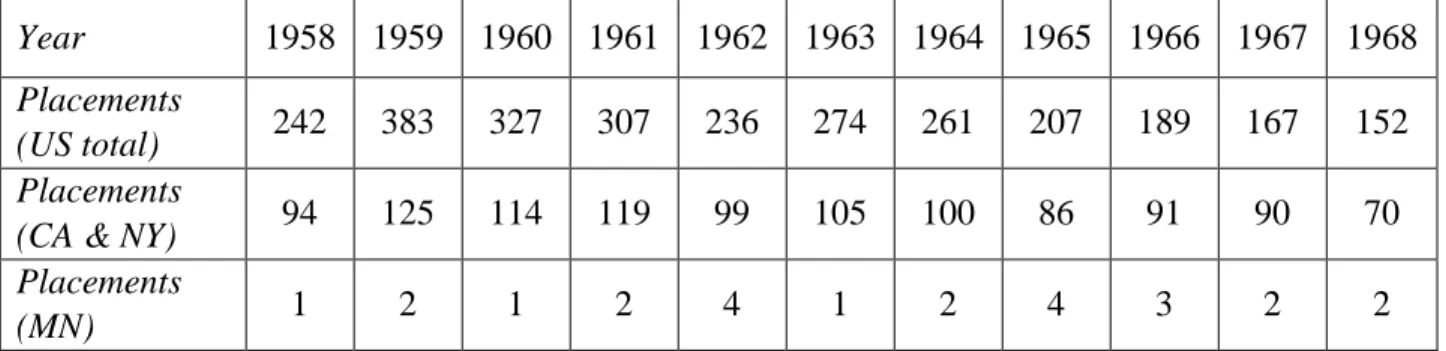
Practitioners, 1918-1948…...66 Table 3.2 – Intercountry Adoption Placements in the United States by the
International Social Service, 1958-1968…...69 Table 4.1 – The Expansion of Civil Society in Child Welfare…...90 Table 5.1 – Growth in Korean Adoptees and OURS Membership in Minnesota,
xv
LIST OF FIGURES
Figure 1.1 – Transnational Adoptions to the US, 1950-2015...2
Figure 1.2 – Total Transnational Adoptees in the US by Country of Origin...3
Figure 1.3 – Transnational Adoption Share (per thousand) of Annual Population Change, 1950-2015...7
Figure 1.4 – Interpretive Approaches to the Transnational Adoption System...10
Figure 1.5 – Korean Adoptions to the United States, 1950-2014...13
Figure 3.1 – Nonwhite Adoption Decrees Granted in Minnesota by Race, 1960-1978...59
Figure 3.2 – Minnesota Foreign Adoption Decrees, 1950-1969...67
Figure 4.1 – AFDC Caseloads and Payments (Minnesota vs. United States), 1938-1970...97
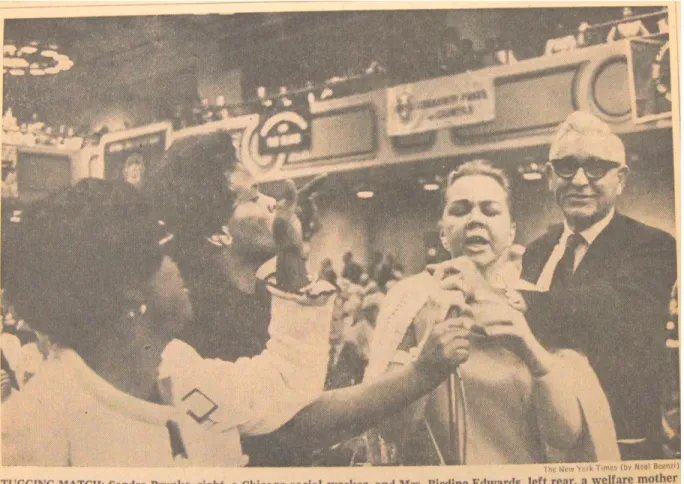
Figure 4.2 – Confrontation at the 1969 National Conference on Social Welfare...99
Figure 4.3 – “They Are All Ours”...113
Figure 5.1 – Race and Transnational Adoption in the US, 1980s...140
Figure 5.2 – Siloing Korean Adoptees from Black Populations: Cities and Towns in Minnesota, 1990...141
Figure 5.3 – Siloing Korean Adoptees from Black Populations: Cities and Towns in the Twin Cities Area, 1990...142
xvi
LIST OF ABBREVIATIONS
AFA Adoptive Families of America
AFDC Aid to Families with Dependent Children ASK Adoptee Solidarity Korea
CBM Council on Black Minnesotans
CHS Children’s Home Society of Minnesota COAC Council on Adoptable Children
CUB Concerned United Birthparents CWLA Child Welfare League of America
FAP Family Assistance Plan
GOA’L Global Overseas Adoptees’ Link ICWA Indian Child Welfare Act
IKAA International Korean Adoptee Associations INS Immigration and Naturalization Service ISS International Social Service
JCICS Joint Council on International Children’s Services
KEEP-DPRK Korea Exposure & Education Program – Democratic People’s Republic of Korea
KSS Korea Social Service
KUMFA Korean Unwed Mothers Families’ Association KUMSN Korean Unwed Mothers Support Network LSS Lutheran Social Service of Minnesota
xvii
MARN Minnesota Adoption Resource Network MEPA Multi-Ethnic Placement Act
MPAK Mission to Promote Adoption in Korea
MPR Minnesota Public Radio
MWRO Minnesota Welfare Rights Organization NABSW National Association of Black Social Workers NACAC North American Council on Adoptable Children NCFA National Council for Adoption
NCSW National Conference on Social Welfare NWRO National Welfare Rights Organization OURS Organization for a United Response PAMY Parents to Adopt Minority Youngsters
TRACK Truth and Reconciliation for the Adoption Community of Korea
WARN Women of All Red Nations
CHAPTER 1
Genealogies and Geographies of Adoption Politics
It is hubris to think that one legislation, one policy, one process, or one standard will address the multiplicity of problems plaguing intercountry adoption. The system is simply too complex, too big, and encompasses too many players, agencies, governments, and political and monetary interests.
--Bert Ballard (Vollmers, 18 August 2011)
Introduction
Transnational1 adoption of children has existed for over sixty years as a formalized practice. Its characteristic features are but two: 1) permanent termination of birthparents' rights to a child (rendering them a legal ‘orphan’ that can be adopted) and legal recognition of adoptive parents’ rights to claim this child as kin, and 2) the child's international transfer across state jurisdictions, normally regulated by specialized immigration procedures and designated facilitators (i.e. adoption agencies). During the first half of the twentieth century, formal child adoption of any kind in the United States was rare and usually temporary due to scant regulations and eugenic norms that valorized the preservation of bloodline kinship (Carp, 1998).
Transnational adoption existed in Europe as a response to child refugees from WWI, but these were arranged through a temporary foster care system that expected eventual reunion of the
1 “Transnational” is neither an objective nor universally recognized descriptor of this kind of adoption. The US
2
children with their birth families and home countries; there was no such parallel in the US, given its restrictive immigration laws (Briggs & Marre, 2009). These prevailing dynamics changed in the wake of World War II and the Korean War, when children without guardianship – either orphaned or separated from their kin – numbered significantly among the wars' civilian survivors. Welfare agencies, humanitarian aid organizations, and international child welfare monitors pressured governments involved in post-war reconstruction to prioritize legal and infrastructural assistance for children. Since then, half a million children have been
transnationally adopted, the majority placed with adoptive families in the United States and Europe (Hübinette, 2006). This migration stream has been historically and geographically uneven: a decade ago, transnational adoption into the US peaked at nearly 23,000 children per year (compared to 6,400/year today, or a 72% drop), and while over 100 countries now have transnational adoption programs, four of these countries – South Korea, China, Russia, and Guatemala – account for 60% of all adoptees in the US (see Figures 1.1 & 1.2).
3
Figure 1.2. Source: Bureau of Consular Affairs, US Department of Homeland Security, and the former US Immigration & Naturalization Service.
The gradual institutionalization of transnational adoption – especially the establishment of commercial “baby markets” (Freundlich, 2000; Goodwin (Ed.), 2010; Noonan, 2004) and new protections of adoptees through human rights and international law (Freundlich, 2007; Smolin, 2004 & 2006; Sotiropoulos, 2008) – is paradoxical, however. As the opening epigraph from adoptee and academic Bert Ballard summarizes, transnational adoption is defined by its astounding heterogeneity rather than standards and norms. Adoptee ‘sending countries’ have enormous variation in the laws and policies that regulate transnational adoption (even among those subject to the Hague Convention on Intercountry Adoption2), and the variability among
2 Officially known as the Hague Convention on Protection of Children and Cooperation in Respect of Intercountry
Adoption, the convention was developed by the Hague Conference on Private International Law beginning in 1990, fully drafted in 1993, and effective 1995. Its ratification has been slow and uneven; the United States signed the convention in March 1994 but didn’t ratify it until December 2007, and South Korea – a sixty-year transnational adoption participant – finally signed the convention in May 2013, with no set ratification date. Both proponents and critics alike have argued that although the Convention has successfully pressured many states to develop stronger internal oversight, its vague language and inadequate mandates allow for wide latitude in regulatory objectives and content. Moreover, the compact lacks mechanisms for enforcement, especially in cases of child trafficking violations (Smolin, 2004 & 2010; Ryan, 2006; Rotabi & Gibbons, 2012; Trenka & Smolin, 27 May 2013).
4
facilitators (often, orphanages) is even more immense. As one of the primary ‘receiving
countries’, the United States itself has no federal legislation on transnational adoption beyond the mere logistical details of adoptee immigration channels (Smolin, 2006). There are no federal laws or policies that regulate facilitators; such regulations are determined at the state level, and thus vary widely in scope (as is the case with child welfare generally in the United States) (O’Halloran, 2015). Many activities in transnational adoption are very laxly regulated if at all: the orphanages’ procurement of children (historically achieved through means legal and extra-legal), termination of birthparents’ rights to render the child adoptable (again, achieved legally and extra-legally), the operations of facilitators, and of course, everything that happens after the child is placed with a family, which can include uncompleted adoptions, adoption disruptions and dissolutions, extra-legal transfers of children to other families, and failures to complete adoptee naturalization.3
Yet this heterogeneity has not deterred most observers from calling transnational adoption a ‘system,’ interpreted and rationalized as such by two broad and somewhat opposed camps. For its proponents, transnational adoption is an ongoing project of regulatory calculation, a set of arrangements that strive to ensure the “best interests” of the child to be adopted while minimizing the inevitable harm created in the process (Smolin, 2006). Transnational adoption in this sense is merely one vehicle of a larger global redistribution of children for the greater good of everyone involved (Carp, 1998; National Committee for Adoption, 1985; Adams, 1975). For its critics, transnational adoption is but another project of coercive domination, a series of
3 The 2000 Child Citizenship Act – an attempt to end this latter problem by bestowing automatic retroactive
5
mechanisms intended to reproduce center/periphery inequities and dependencies while asserting hegemonic control in the furtherance of militarism (and in particular, the securitization of US interests) (Pate, 2014; Briggs & Marre, 2009; Hübinette, 2006). The implication is that
transnational adoption is still a calculation of interests; the only difference is that the calculation favors a ruling bloc that arranges adoption to best maintain global order.
While I am strongly sympathetic with this latter interpretation (as are many critical adoption scholars), I believe both approaches exhibit similar analytical limitations:
1) They risk falling into a kind of functionalism, which can reduce all phenomena to a universal imperative (benevolent calculation or ruthless domination) that has no analytical grounding. 2) They tend to pose spaces as fixed, activated by transnational adoption only in the ways that they function in the global whole (poor or hazardous enough to send children to a better life, wealthy or secure enough to protect these children) based on presumably ‘natural’ conditions. 3) They pose a politics of interest, whereby everyone’s “natural” interests based on their positions (i.e. a child wants a family, an adoptive parent wants a child, a global hegemon wants geopolitical order) determine political decisions. These interests are considered conducive (by cooperation and force) to exacting a totalizing order in transnational adoption that renders heterogeneity as mere variations in an otherwise proficient system.
6
raised in Minnesota, or about 16,000-23,000 adoptees total; while Korean adoptees account for roughly 10% of the entire Korean American population, they may constitute more than 50% of all Korean Minnesotans (Koo, 2008).
Scholars and practitioners have identified distinctions about Minnesota to explain this anomaly. Least convincing are the pronouncements of unique Minnesota cultural traits of compassion, openness, and other supposedly Scandinavian values (Swedes were a significant contingent among Minnesota’s first European settlers, although the largest stock was German) that made prospective parents more open to accepting foreign-born children (Nelson, 2016; Hübinette, 2006; Koo, 2008); no evidence supports these claims despite their speculative popularity. More notable is Minnesota’s overwhelming whiteness (over 98% as late as the 1970s), which some (Meier, 1998) have confusingly claimed produces a more tolerant
environment for non-white adoptees; Nelson (2016) more productively argues that predominant whiteness – and a near absence of non-white populations – aligns with the assimilatory,
normalizing ideal of adoption that parents assume is most appropriate for children who look ‘different’. Minnesota’s progressive leadership in child welfare legislation has also been elaborated as a factor (J.R. Kim, 2010; Meier, 1998). The strongest evidence of Minnesota’s leadership can be found in its early infrastructural and logistical advantages in relation to Korea, including a temporary period when Minnesota agencies enjoyed institutional relationships with all four Korean child-sending agencies, as well as Children’s Home Society of Minnesota’s decades-long employment of Hyun Sook Han, a Korean-born and trained social worker who served as a liaison and adoption advocate between the two countries (Meier, 1998).
7
Figure 1.3. Source: Minnesota Department of Public Welfare, National Council for Adoption, Bureau of Consular Affairs, US Department of Homeland Security, former US Immigration and Naturalization Service, and US Census.
8
Thus, while most adoption scholars have viewed local spaces as “touching-down” points that are put to work for a seamless, systemic order, I argue that Minnesota’s history of Korean adoption illustrates a more compelling reality: transnational adoption is locally produced through organizing, strategy, struggle, and uneasy stabilization – a fractured totality that is never
9
While many explain away this turbulence as ephemeral to the adoption ‘system’ (Roorda, 2009; Pertman, 2000; Patton, 2000), I consider it central, for the simple reason that civil society’s
plenary power in adoption is also the source of its fracturing: it has the dubious authority to manage realms of self-management (including but not limited to children, individual families, and marginalized communities) that are always bursting with uncontrollable autonomy.
The implications of this approach are crucial:
1) No universal function of transnational adoption is assumed; rather, there are multiplicities of functions that, when successfully organized, align around collective strategies. These strategies respond to irresolvable problems of transnational adoption – what is right? who gains? what subjects are needed? – activated not by the interests of social actors, but their values. Values are distinct from interests in their incommensurability, their articulation and enactment not of
individual needs but of entire worlds (Graeber, 2001). Values extend beyond the economic realm to questions of what the social, cultural, and ethical are and should be (Grossberg, 2010).
Transnational adoption is a terrain on which actors attempt to structure the world around a multiplicity of values.
2) Space is not assumed as fixed, and neither are its “place characteristics”; space is relationally produced and radically contingent (Massey, 1994 & 2005). The deployment of collective strategies – and the struggles against other deployed strategies – may result in temporary
stabilization of a space for transnational adoption, but the problems and contradictions are never fully resolved. Thus the “optimal conditions” that make a space “work” for transnational
adoption are not natural, but contextual and conjunctural.
10
order, it produces and reproduces global differentiation, a fractured totality that thrives on problems, that transforms through crises and failures. Different people and different values are brought into exchange, organization, and conflict through transnational adoption, but their differences are not smoothed out.
The contrast between this approach and two main approaches previously outlined is diagrammed in Figure 1.4. The oldest of these approaches – the ‘ideal’ articulated by social workers – imagines a stable governing order that brings differing interests onto an equitable plane of decision-making; this expectation not only frames the ‘best interests’ ethos of adoption practitioners and proponents, but also elevates the so-called “adoption triad” (Freundlich, 2001), the unity of three figures – the birthparent, the adoptive parent, and the adoptee – into a
symbiotic relationship that sufficiently meets everyone’s interests. Through proper regulations,
11
transnational adoption is systematized into an efficient stream of procedures and contact points that can be endlessly corrected and adjusted when the system doesn’t ‘work’ for the participants. The recent ‘critical’ approach advanced by scholars and activists rightfully points out the
impossibility of equity in transnational adoption (inequities and oppression here represented as slash marks in the diagram), particularly the farce of an “adoption triad” where one triad point (the birthparent) is suppressed, as well as the dangers and potential extra-legal pathways an adoptee may go through when their rights are also violated. Note, however, that this viewpoint
does not view these failures as the product of an unworkable system; rather, the critique is that the system works too well in dominating and oppressing marginalized peoples. This critique locates its politics in elevating those who are disadvantaged in this system and determining alternative, social justice-based transnational adoption orders around the needs of the
marginalized. Powerful as this may be, the similarities between these two approaches suggest less a clash between two worlds and more a tree and its radicle, per Deleuze & Guattari (1987) – that is, a cleaving of the unity proposed by the “best interests” framework that still returns to and reproduces this framework in order for its critique to retain significance (16).
The ‘relational’ approach that frames this dissertation begins with a very different problem – namely, the reality that transnational adoption has formalized and transformed in significant ways despite its thoroughly incomplete systematization – that paints a different picture. There is no man behind the curtain – that is, the ‘machine’ was never a machine, and its attendant successes and injustices have rarely been achieved by design but through the working and unworking of heterogeneous entities and uneven relations – and therefore, we cannot begin by analyzing the presumed hegemonic order of transnational adoption; rather we must begin by
12
refuses to sit still. The task is to map what has perennially gone uncharted and disregarded by decades of scholarship: the entangled projects and their functions, the multiplicities of kinship that refuse to behave anything like a ‘triad’, the movement of children through concentrations of activity that function as gravity wells more than coding centers, and most importantly, the spheres of influence that emerge from the productive friction of colliding actors and their values, where struggle and strategy over urgent problems have made transnational adoption the
innovative, unpredictable, and polarizing animal it is today. To recall once again Ballard’s epigraph, it is this heterogeneity that defines transnational adoption practice; the challenge is to examine the productive volatility of this heterogeneity on its own terms.
Korean transnational adoption in three conjunctures
This dissertation thus unfolds through an analysis of these struggles – a ‘people’s history’ of transnational adoption that extends over sixty years and focuses specifically on the diaspora of South Korean children into Minnesotan families. But this people’s history is primarily framed around the genealogical developments and geographical transformations that resulted from these struggles, and is less insistent on relaying all the details of the struggles themselves. As Dreyfus & Rabinow (1982) explain regarding Foucault’s analysis of power,
Actors more or less know what they are doing when they do it and can often be quite clear in articulating it. But it does not follow that the broader consequences of these local actions are coordinated. The fact that individuals make decisions about specific policies or particular groups jockey for their own advantage does not mean that the overall activation and directionality of power relations in a society implies a subject…. There is a logic to the practices. There is a push towards a strategic objective, but no one is pushing. The objective emerged historically, taking particular forms and encountering specific obstacles, conditions and resistances. Will and calculation were involved. The overall effect, however, escaped the actors’ intentions, as well as those of anybody else. As Foucault phrased it, “People know what they do; they frequently know why they do what they do; but what they don’t know is what what they do does” (personal
communication)” (187)
13
specific cultural, political, economic, and social problems that define a historical-spatial context and condition the emergence of new possibilities, both emancipatory and repressive (Pickles, 2012; Grossberg, 2010). Although the definition and interpretation of conjunctures is highly subjective, the activity is invaluable for asking the most relevant questions and focusing on the most productive objects of study. Thankfully, enough scholarship on transnational adoption has emerged to pinpoint three critical conjunctures in Korean transnational adoption history, which can also be discerned in Figure 1.5.
Figure 1.5. Source: Bureau of Consular Affairs, US Department of Homeland Security, and the former US Immigration & Naturalization Service.
First conjuncture: struggle over conduct
The first adoptions of Korean children were arranged by US servicemen immediately prior to and during the Korean War, but they only gained public prominence in the early 1950s through sensationalized accounts of larger-than-life individuals, such as Christian evangelist and entrepreneur Harry Holt and acclaimed author Pearl Buck (Kim, 2009). Due to an opportunity
14
provided by the 1953 Refugee Relief Act as well as extensive lobbying, these independent adoption schemes – Holt’s being the most prominent – were able to bypass existing refugee immigration quotas. Holt in particular became well-known for sending lawyers to Korea to complete the adoption in the adoptive parents’ absence; so-called “proxy adoption” was as yet unregulated. Such schemes generated selective geographies of influence; Buck’s homebase in Pennsylvania and Holt’s operations in Oregon made adoptions logistically easier for East and West Coast residents, and it is believed that most of the 8,000 Koreans adopted during the 1950s and 1960s arrived in these regions. Very few licensed adoption placement agencies in the US were directly involved in arranging Korean adoptions during this time; most were appalled at the public embrace of Holt’s and Buck’s operations, whose reckless and frequently improvisational operations flew in the face of welfare agencies’ practices of careful deliberation, scrutiny, and adherence to standards and self-designed regulations, all of which were claimed to be in the “best interests of the child” (Nelson, 2009). The proceeding struggle between welfare agencies and independent facilitators in Korean adoption consumed a great deal of organizing activity in the 1950s to 1960s, and it mirrored similar tensions between independent and licensed groups competing for parent clients in domestic adoption. My examination of this era is thus focused on the struggle over conduct – what is the right way to do adoption? – and the strategies that
emerged to produce relatively stable governance of these competing values.
Second conjuncture: struggle over class
15
16
Third conjuncture: struggle over subjectivity
17
the degree of adoptees’ allegiance or fugitivity produced in their relational and discursive networks of race, nation, kinship, and welfare.
While all of these conjunctures are defined and explored at the national scale, the
iterations of their constitutive struggles at the local scale in Minnesota are of particular interest in this work. I repeatedly expected that the grand battle lines already documented by child welfare scholars would play out in miniature form among the civil society actors in Minnesota, but my research revealed quite divergent trajectories unfolding at the local level (discussed further in Chapters 3, 5 and 6). Whenever possible I have avoided casting Minnesota as an ‘anomaly’ in these overall trends, instead interpreting and analyzing how Minnesota’s unusual (but often singularly important) terrain of organizing relates to the larger conjunctures and their temporary resolutions. Overall, I am inclined to interpret this geographic disparity either as additional evidence of the unwieldy heterogeneity and incomplete systematization that anchors this
dissertation’s main argument – or as a provocation that the majority of child welfare scholarship so far, including my contribution here, is far too comfortable with engaging child welfare as an epistemologically legible object than is warranted (that is, perhaps our window into adoption is far smaller and dimmer than we care to admit). I leave it to the reader to arrive at their own conclusions on this matter.
Current scholarship
18
interdisciplinary scholarship on the subject, fielding pathbreaking research in sociology,
anthropology, cultural studies, legal studies, and ethnic studies, among others. This dissertation engages most directly with two nodes of this conversation: the work of geographers – many employing feminist theories and methods – who have advanced geopolitical and biopolitical approaches to children, families, and kinship; and a contingent of interdisciplinary scholars that can best be described as constituting a “critical adoption studies” tendency, challenging
prevailing norms in adoption discourse and centering the voices and experiences of those subjugated by child welfare practice.
Geographies of children, families, and kinship
Dani Meier (1998) – one of the first trained geographers to research transnational adoption – once asserted that “there is no substantive geographic literature on the topic of intercountry adoption….Despite its being an entirely geographic phenomenon and ripe for many avenues of geographic exploration, the subject has rarely been considered by geographers” (1). Meier’s assessment rings true nearly twenty years later, although there are signs of an emergent adoption geography – including a 2015 special issue of Social & Cultural Geography devoted solely to the topic, examining child trafficking law (van Wichelen, 2015), relatedness and
19
families and their circles, but also geopolitical doctrine, welfare state policy, humanitarian aid, and global restructurings of race, gender, and class. This merely confirms Mountz & Hyndman’s (2006) feminist argument that global processes and procedures always proceed at the level of the intimate, in contrast to dominant masculinist discourses that pose intimate, local, domestic space as epiphenomenal and “private” compared to the global political economy and its “public” geopolitical workings.
This dissertation contributes to a few strands of this geographical scholarship. One key strand uses a feminist geopolitics lens to examine the role of children and family in the
materialities and discourses of war, conflict, and humanitarianism (Loyd, 2009; Dowler, 2012; Cowen & Gilbert, 2008). Appeals to the sanctity of these figures – often through an implicit reinforcement of global hierarchies and devaluations of bodies – certainly motivated
humanitarian groups to advocate postwar transnational child adoption, especially given their seemingly magical ability to cast children as “non-political” entities to be surgically extracted from presumed enemy populations (a characterization also carried out by governments, as noted by Kleinfeld (2009)). But while this dissertation further examines these humanitarian politics, its primary concern is the many contortions various actors went through to reckon with what I call the “impermanency” of their adopted children – that is, the risk of the child’s failure to fully assimilate (and thus the parent’s failure as well). These fears have a well-documented history, as accounted for by Stoler (2002), McClintock (1995), and Young (1995), who found that the commingling of colonizers with the colonized in global projects of domination was a great source of anxiety for ruling states, as fears of miscegenation, racial degeneracy, and the
20
(2013) and Katz (2008) show how the anxieties and fears around children today are primarily activated by national and global political/economic insecurities, especially in an age of generalized precarity (Lorey, 2015), where shifting, uneven protections for differentiated children and families come to constitute national security concerns (Martin, 2011 & 2012b). I explore this dynamic further in several of my chapters which illustrate how the entanglements of whiteness, security, biopolitics, welfare, and neoliberalism were a critical source of political organizing in the history of transnational adoption in the United States that has received little attention from scholars thus far.
Critical adoption studies
21
and societies that result. But I would argue that a far more important reason is the emergence of what Eleana Kim (2010) calls an “adoptee counterpublic” (6), a “diacritical relation to dominant publics” that aims to “[bring] intimate narratives and expressions of adoptee subjectivity into multiple national and transnational public spheres” (14-15). A key strategic anchor of this adoptee counterpublic is a contingent of adoption scholars who are adoptees themselves.
Kim’s framing of the adoptee counterpublic is specific to Korean adoptees, but critical adoption scholarship has been significantly advanced by a much wider range of adoptees, reflecting the varying voices who have long been subjugated by adoption practice. Fessler’s The Girls Who Went Away (2006) and Roberts’ Shattered Bonds (2002) have been seminal in
centering the experiences of marginalized birthmothers and adoptees, using ethnography and critical legal studies to contextualize the political content of adoption – especially race and class oppression – that is either ignored or inadequately addressed in adoption scholarship. One of the more controversial contributions that also emerged during this time, the anthology Outsiders Within (2006), proved to be a clear political statement as much as a pioneering artistic and scholarly achievement. Entirely written and edited by nonwhite adult adoptees, the anthology included contributions from many transnationally adopted individuals (including editing by two adopted Koreans, Jane Jeong Trenka and Sun Yung Shin, both Minnesotan) but explicitly identified all contributors as transracial adoptees – a symbolic encounter between transnational and domestic transracial adoptees that also re-raised a longstanding transracial adoption debate that most child welfare practitioners had considered antiquated.
22
US imperialism and the technology of the orphanage is a valuable extrapolation on the crafting of governable objects in the chaos of war, as is Choy’s (2009) analysis of the governing troubles of welfare agencies as they strove to maintain ‘race-matching’ standards with the first Korean adoptees. My work identifies two additional ‘ungovernable’ entities in the melee – independent facilitators and prospective adoptive parents – and further contextualizes the burden of ‘race-matching’ within a time of shifting demographics of Black internal migration in the US. Scholars like Briggs (2012) and Solinger (2001) have done a great service in locating the trenchant race, class, and gender divisions in adoption as a byproduct of the late 1960s/1970s crisis in the US and the particular punishments suffered by women of color in the aftermath. They have greater difficulty relating the sudden increase in transnational adoptions to such significant political changes; here I have attempted to do so, in part by theorizing the position of whiteness and white adoptive parent groups within the uncertainties of neoliberal economic restructuring. Finally, contemporary transnational adoptee politics has received significant attention, inordinately devoted to adoptee racial identity (Nelson, 2016; Brian, 2012; Eng & Han, 2006; Koo, 2008) and adoptee transnational activism (E. Kim, 2010 & 2012; Cherot, 2006; Zayd, 18 August 2012). This dissertation complements the examination of activism in South Korea with organizing occurring in the US, and explores other theorizations of race beyond the common White/Other distinction that is often deployed in transracial adoptee research.
Objectives and methodology
23
records of their activities to two archives in Minnesota: the Social Welfare History Archives at the University of Minnesota (home to records of the International Social Service and the Children’s Home Society of Minnesota, among others) and the Gale Family Library at the Minnesota Historical Society (home to the records of the Minnesota Department of Public Welfare and many other state and country agencies). I reviewed thousands of these agency documents for the banal yet revealing accounts of recurring problems and the organizing and strategies devised to meet them, unabashedly discussed in meeting minutes, correspondence, memoranda, newsletters, and internal reports.
Unlike the comprehensiveness and candor found in most of the archival documents of welfare agencies, the archives of civil society actors from the Civil Rights movement on up to today were often less than forthcoming. This is due to the sheer amount of lost materials (especially in the case of more ephemeral, grassroots organizations) as well as the increase in professional networking and correspondence between actors that promotes ‘tidier’ organizational materials and obscures internal discussions and messy conflicts. The 1970s-1980s materials of adoptive parent groups like OURS (the Organization for a United Response) is a case in point; while I was able to locate over two decades’ worth of the OURS Magazine (over 120 issues), its content rarely included accounts of the everyday organizing of the group; some of the former OURS members I met still retained magazine issues, but no meeting minutes or correspondences with other groups. The dearth of archives is even greater with contemporary adult adoptee groups in Minnesota, who arrange most of their internal documentation online. Some do retain listservs and email chains of meeting minutes and organizational debates, but they were
24
materials such as online newsletters and event flyers convey a sense of adoptee activities but offer few hints on the organizing behind them.
To address this problem, I arranged interviews with 20 former OURS members and 30 adoptees who were involved in at least one year of adoptee organizing in Minnesota.4 I identified former OURS members through the back issues of their magazines, which listed names of OURS Board members as well as their addresses and phone numbers (some of which had not changed even 30 to 40 years later); from these contacts I snowball sampled to other former members they knew. I had already established contact with adult adoptees through three years of living in the Twin Cities and organizing with the Asian American community there; from these contacts I did further snowball sampling, and I independently contacted local adoptee groups like AK
Connection and AdopSource for additional interviewees. My intention in collecting these
particular interview subjects was not to generate a representative sample; because of their arrival via private transactions and years growing up in isolation of each other, it is impossible to verify any demographic breakdown of who Minnesota’s adoptees are or even where they live. Rather, I focused exclusively on adoptees who had organized in the community – a mere fraction of all adoptees in Minnesota – and aimed for a wide range of viewpoints based on the activities people participated in, including cultural programming, post-adoption services, adoptee art, adoptee scholarship, solidarity organizing with other people of color, and national and transnational activism. I also reviewed all issues of Korean Quarterly, a local newspaper founded in 1997 by
4 In the case of my adoptee interviewees, this criteria established a reasonably limited space (Minnesota) from which
25
adoptive parents that covers Minnesota’s Korean community; articles on Korean adoptee organizing have been common throughout the twenty years of its existence.
I should note that while comprehensive statistical data on transnational adoptees is generally non-existent, I still scoured all the archives I perused for any data I could find. The US Department of Homeland Security (and the former Immigration and Naturalization Service) has kept track of all “immigrant orphans” adopted into the US for decades based on sending country (and occasionally, race and gender), although the tabulation of these numbers is less reliable prior to 1976. State-level data on foreign adoptees admitted was not systematically tracked prior to the 1990s and likely has never existed in certain states; the Minnesota Department of Public Welfare’s accounting of its adoptees was highly variable and unreliable throughout its existence, although I fortunately located a chart that tracked Minnesota transnational adoptees by sending country from 1968 to 1978 (provided by the Department to a likely curious OURS organization, which they then published in an issue of their magazine). The National Council for Adoption occasionally conducted state-level surveys beginning in the 1980s, from which I also drew data. Additionally, I located and compiled agency adoptive placement numbers (such as Children’s Home Society of Minnesota, International Social Service, Holt, etc.) from their respective records in the archives. Most surprising was a recurring list (every two months) of new adoptee placements that ran in the OURS Magazine for the better part of its syndication; compiled from Minnesota agency mass listings and voluntary family announcements sent to OURS, I
26
nationally distributed magazine today. All figures, graphs, charts, maps, and tables in this dissertation are based on this dizzying statistical collage.
Upon completing all of my interviews and archival reviews from 2013 to 2015 in Minnesota, I divided the data chronologically by conjuncture (with some leeway on each era’s boundary years) and then coded for key issues and areas of struggle that were frequently mentioned, had the longest duration, or received considerable investment of time and energy (such as a conference, symposium, or national campaign). Based on this coding, I identified the most primary struggles of a given conjuncture and proceeded to examine accounts of this struggle to determine participant actors, content, strategy, and function. This task became more difficult the more recent the conjuncture, given the increasing number of civil society actors in play; for the sake of narrative clarity, some less significant elements of these struggles have been simplified or omitted from discussion.
This project attempts what Midnight Notes Collective (1990) calls a “reading of the struggles,” an autonomist Marxist approach that determines the general composition of state, capital, and civil society by interpreting the function of organizing, social movements, and everyday acts of refusal and resistance. While this approach is invaluable for illuminating interesting political trajectories ‘from below’ that would otherwise be overlooked ‘from above’ (that is, by overemphasizing the machinations of capital, state, and other ‘systems’), I should note two significant caveats to my analysis. My designation of struggle in this dissertation is broad; some of the groups and organizations I analyze can be considered movements or
27
“reading of struggle” concentrates first and foremost on legible revolts that are legibly organized, but mine does not, simply because legible, organized revolt in the domain of child welfare is historically rare. In my desire to forefront struggle as a continuing influence on transnational adoption throughout the last sixty years, I have opted to expand my reading of struggles as “value struggles” that “[constitute] an ongoing tension in the social body” (De Angelis, 2007: 30). Put another way, I am reading where this ongoing tension becomes too unbearable due to the emergence of new social actors, new value struggles, and new irresolvable problems.
Secondly, I have tried to be as meticulous as possible in giving prominent ‘forgotten’ organizations and movements in adoption history their due, even though many of them are not typically considered radical, or even Leftist. A great many organizations that I explore in-depth – the OURS adoptive parents group, plenty of Korean adoptee groups – have eschewed any kind of political analysis or position. The reader should not assume that my extended assessment of these groups suggests my own personal alignment with their work, their vision, or their politics (and they do have politics, even if unstated). Nor should any critiques of these groups that I make, or problems that I forefront, suggest personal opposition. While I bring my own framework and worldview to such groups and am thus no objective observer, wherever possible I have attempted to render an accurate reading of how the organizing of such groups functions – regardless of whatever they have said or done that could be called “political.”
Overview of chapters
28
key agents in the societal transition toward the dominance of biopolitical power, the ability of child welfare and adoption agencies to deploy this power effectively was limited in the 1950s. Their efforts to stem the wellspring of independent adoption facilitators that dominated the emergent Korean adoption economy were remarkably futile, as were their uninspired attempts to depress public interest in and support for independent adoptions. Regarding operations like Holt Adoption Program as both a threat to good adoption conduct and a potentially dominant
competitor, welfare agencies innovated a number of strategies to strengthen their regulatory reach. I argue that these strategies attempted to modulate and ‘cooperate’ with the autonomy of adoptive parents and independent facilitators, a notable shift from their earlier strategies of compelling subjects into disciplinary allegiance to welfare standards and values.
Subsequently, child welfare facilitators underwent significant deregulation and
decentralization of their authority, setting conditions for radical experimentation in social work. As discussed in Chapter 3, “A ‘New Approach’ to Adoption: Minnesota Agencies and
29
“reproductivity deal”: a radical strategy for inducing “hard-to-keep” prospective parents’
allegiance to the welfare agency by gifting them with an altruistic wage – an opportunity to be a ‘good’ and selfless welfare subject.
By the 1970s, adoptive parent groups weren’t the only ones taking advantage of these changes among agencies; the welfare crisis delegitimized the governing institutions to such an extent that a flowering of new civil society actors rushed in to determine a different path. Chapter 4, “Whistling in the Crisis: Siloes and Schisms of the Child Welfare Insurgencies” overviews the primary actors and definitive battle lines of this era, especially around welfare policy, transracial adoption, and the rights of children and their birthparents. While militant in many sectors, this insurgency did not have the same effect as a social movement due to the preponderance of professionals, the strong attachment to expanding civil society rather than confronting root problems, and persistent raced and classed forms of isolation and non-encounter (as seen in the case of OURS, a Minnesota-based adoptive parent organization). I trace the convergence of these actors and issues in the case of 1980s family preservation law and its subsequent failure against a backdrop of state devolution and demobilization.
30
that these anxieties were less concerned with assimilating their children successfully (or
exposing them to their ‘culture’) than with reinforcing the seemingly stable relationship between whiteness and security – despite growing neoliberal precarity and the unknown incipient futures of their adopted children.
The self-securitizing siloes of adoptive parent organizing in Minnesota (as in other states) may not have shaped how all Korean adoptees were raised, but it is nevertheless striking how contemporary adult adoptee politics is similarly delimited by a lack of movement-building encounters. Although much scholarship over the years has explained this issue as an effect of adoptees’ largely successful assimilation into white privilege, I argue that a fixation on phenotypic racial identity and its assumed privileges misses a more profound tension that presides over adult adoptee subject formation. In Chapter 6, “Desires for Security, Desires for Threat: Racial Affect and Adoptee Politicization,” I theorize this tension as derivative of global processes of colonization and racial ordering that continue to intensify in their protection of the dominated and expulsion of those desiring escape from domination. I thus situate the discordant range of adult adoptee activities from the 1990s to today on a spectrum of racial affect, wherein the identity politics and representation-based work that characterizes the majority of adoptee subject formation tends toward an affective desire for securitized whiteness, while cross-racial and transnational encounters in others’ political work suggest alternative desires that have yet to settle on an emancipatory project.
31
primacy of international child removal. The Law’s passage was remarkable given that a significant contingent of its supporters and lobbyists were repatriated adult adopted Koreans, including its de facto leader Jane Jeong Trenka. While these new regulations may not end Korean transnational adoption, they are symptomatic of broader trends among welfare agencies, adoptive parents, and adult adoptees – trends which are partly unanticipated results of the previous decades of struggle described in this dissertation. Amidst private welfare institutions forced into fiscal pragmatism and adoptive parents forming desperate online networks as a security buffer, adoptee struggles in Korea suggest both new limitations and possible
32
CHAPTER 2
“Punching in a Pillow”: Regulatory Regimes and Migrant Autonomies in Child Welfare
Introduction
From the moment of the first child refugee crises in Europe during WWII, US and international agencies specializing in humanitarian aid and welfare insisted that the situation be met with sober action through legal, well-regulated, and easily monitored institutions. For them, it was in the “best interests of the child” to alleviate the risks to the child’s life; the appropriate mechanisms for doing so necessitated careful evaluation of each individual child and their circumstances, including legal constraints, access to the child’s remaining kin, long-term viability of resources and funding for the child’s future plan, and local and state support from political bodies. While the plans for each child could and did vary (including orphanages, residential homes, placement with foreign military stationed in the child’s home, overseas placement, or reunion with the child’s kin), welfare agencies wanted to insure these plans were carried out in the right way – in this case, unsurprisingly, according to the standards that increasingly characterized professional welfare and social work.
33
adoption.) This semblance of authority was undermined, however, by the rapid emergence of independent child adoption outfits throughout the US and world. At various turns evangelical, entrepreneurial, or simply opportunistic, these groups capitalized on the moral and social crises of the war – and the enhanced opportunity for extra-legal activities they provided – to launch child-saving missions through whatever means they had at their disposal. These adoption
“schemes,” as welfare agencies contemptuously called them, were as functionally different from professional institutions as they were from each other. Some had the backings of churches, charities, or businesses; others were the brainchilds of individual lawyers, soldiers, and middlemen with the right connections. Some pretended to operate as licensed agencies to successfully pass muster with welfare organizations; some stayed as low-profile as possible; others flaunted their non-welfare designs proudly, hoping to withstand regulatory scrutiny through popular fervor and media favor. By and large they were decentralized and did not coordinate with each other. But they nonetheless embodied a set of shared practices that posed a serious challenge to the welfare agencies’ vision. For them, the ‘plan’ for the child was simple: ‘saving’ as many children as possible from the horrors of brutal (and presumably Communist) post-war regimes, and permanently placing them as quickly as possible with loving (and presumably Christian) families in the West. They adhered to these principles – permanent displacement, adoption as the only plan, processing children en masse with utmost speed – by indefatigably fighting, undermining, and evading all bureaucratic and regulatory requirements they disagreed with. Affronted, the welfare agencies fought back, aiming to force the
independent ‘schemes’ into submission, irrelevance, or extinction.
34
shared mutual hostility. But in the postwar conjuncture, the particularly dire straits of child refugees – combined with the astounding early success of independent adopters in procuring them – clarified the struggle as a problem of governance: what values, ideas, and practices are the right ones for conducting the adoption of a child? ‘Struggle’ may seem to be an inappropriate term for the dynamic between agencies and independent adopters; they colluded with each other around common goals as much as they fought each other, their squabbles were largely parochial and isolated from the major social movements of the time, and their most confrontational tactics were neither pickets nor marches nor direct actions of civil disobedience, but rather public relations ploys and angrily worded correspondences to each other. Still, ‘struggle’ best captures the situation of the actors involved: thrown into a domain where multiple visions of the world are competing, with no clear dominant authority or hegemon. This struggle does not unfold like an all-out war, since the social actors in play are not trying to extinguish each other; their common objective is establishing social order, and their maneuvers strive to negotiate an assemblage of different beliefs and different behaviors that nevertheless can be controlled – an ordered disorder.
I call this a “struggle in the circuits”: the tensions and fractures in the circuits of control (Deleuze, 1992; Puar, 2007) that permeate civil society. While this chapter agrees with
35
and state welfare and social service departments are fairly adequate in surveilling adoption activity that falls under their authority, but there are also networks of gray and black markets in children that weave in and out of these agencies’ purview and often go completely unnoticed. Nor are such underground markets the workings of malevolent criminals; they are often
orchestrated by families and communities out of shared needs, desires, and frustrations and fears over welfare state scrutiny. And all of this pales in comparison to everyday kinship practices – especially among the poor, the indigenous, and people of color – of casual and informal adoption that have existed for decades without interference from the child welfare ‘system.’
In other words, the reason why child welfare is consumed by a ‘struggle in the circuits’ is because it cannot solve autonomy: the autonomous choices to enforce or not enforce laws (or follow or not follow them), the clashing autonomies of each child welfare institution tasked with working together, the wholly autonomous decision to evade child welfare and carve out one’s own path instead (for better or worse). Yet I argue in this chapter that the very failure of child welfare’s self-appointed regulators to discipline autonomy in a systematized fashion helped lay the groundwork for them to develop a different regulatory regime – one that did not succeed so much as create new conditions. Their struggle with independent adopters in the postwar
transnational adoption craze proved to be a crucial catalyst of this shift in three ways: enclosure, segmentation, and dispersion. For one, the immense appeal of independent adoption provoked methods of enclosure from welfare agencies, as they sought to appropriate their methods and eventually capture their clientele and cachet. Secondly, the impossibility of enclosing all ‘rogue’ autonomous efforts prompted agencies to explore the benefits of producing spaces of
36
many subjects, exemplified by the first transnational adoption boom and the upsurge of Black children in Northern cities due to the Great Migration – a key weakness for agencies that were originally organized to govern a localized and assumedly fixed population. This thorny issue required a gradual and uneven dispersion of welfare agency power, shifting from their previous
de facto plenary authority to a more elastic network of relations with organizations – including non-professional, grassroots groups – that could be counted on to better regulate the migrant autonomies of birthparents, adoptive parents, and adoptees. In Minnesota, one such agency’s repositioning – elaborated further in Chapter 3 – helped pave the way for the state to lead the second transnational adoption boom.
Regulating welfare in theory and in practice