Empowering Elegant Cloud Services Owing To Remote
Signification
Abdulraheem Shaik1, Ingilela Ravi Shireesh2 1
Student Of M.Tech (CSE),2Asst.Prof. and Department Of Computer Science Engineering, Geethanjali Institute Of Science And Technology, Kovur, Nelloredt.
Abstract:
We create cloud-helped remote detecting systems for empowering dispersed agreement estimation of obscure parameters in a given geographic range. We first propose an appropriated sensor system virtualization calculation that looks for, chooses, and directions Internet-available sensors to perform a detecting undertaking in a particular locale. The calculation focalizes in linearithmic time for expansive scale organizes, and obliges trading various messages that is at most direct in the quantity of sensors. Second, we outline an awkward, appropriated calculation that depends on the chose sensors to gauge an arrangement of parameters without obliging synchronization among the sensors. Our reproduction results demonstrate that the proposed calculation, when contrasted with traditional ADMM (Alternating Direction Method of Multipliers), diminishes correspondence overhead essentially Without trading off the estimation mistake. Furthermore, the joining time, however builds somewhat, is Still straight as on account of ordinary ADMM.
Keywords: Remote Sensing (RS), Cloud Computing (CC), IOE (Internet of Everything Enabler), CARS (Cloud Aided Remote Sensing).
I. Introduction:
The Major part or motivation behind Remote Sensing is to get or gather information remotely or continuously from all over without requiring physical field visits and this is finished with the assistance of tactile things or items (sensors, SAN and so on). As the Cloud Computing is the risen progressing exploration innovation which permit productive calculation by concentrating stockpiling and memory. The majority of the associations are utilizing this innovation as it is simple and sparing to utilize. At present, a considerable lot of the examines are going ahead, to check whether this innovation can be executed for dodging the limit of Remote Sensing too. Thus, the new innovation CARS is risen up out of this which is the blend of distributed computing and remote detecting. So CARS can then be seen as a developing innovation that has incredible potential for empowering IOE (Internet of Everything) accordingly empowering savvy cloud administrations. What's more, this innovation is then given to all the gadgets, for example, sensors of cell phones, PDAs, versatile terminal etc, a considerable lot of the applications have been created which are utilizing
CARS like Nimbits [8], Thing Speak [10] Pachube Platform [9], and so forth. It will offer ascent to better remote detecting applications to the general public, once it is effectively created with no blemishes, yet there are numerous issues discovered due to the confinements of remote detecting as far as force, Memory, CPU (restricted capacity), etc, which all should be overcome to execute this innovation faultlessly and make best utilization of points of interest of distributed computing to enhance and amplify their capacities. This paper introduces a diagram of CARS and its Architecture that is utilizing distributed computing to empower remote detecting administrations. The objective of this paper is to talk about in detail the flow investigate that addresses these issues. We survey the proposed Architecture, its applications, Services and investigate the up and coming examination challenges in CARS Architecture.
II. Cloud Computing's Impact:
and get ready for work. As she strolls to her auto, she peruses the morning's news on her advanced cell that was prefetched for her and disseminated to her telephone by her cloud administrations. In the event that she has not completed her perusing when she gets in her auto, the cloud can perform a content to-discourse change of her news articles and read them to her as she drives. Endless supply of the news, she can stream her music storehouse to her auto. Once at work, Alice can flawlessly move from her office to meeting rooms for the duration of the day while maintaing access to every last bit of her data, applications, and sessions because of her cloud administrations being open from any machine. Indeed, even subsequent to returning home, she can unwind with her most loved PC amusement through her desktop PC. On the off chance that facilitated by her cloud supplier, she won't lose advance in her diversion regardless of the fact that the force fizzles; rather, she can keep playing through her advanced cell. To empower such a situation, we must address new difficulties in securing the data put away on the cloud and the entrance to it. The appropriation of distributed computing as a piece of pervasive frameworks will influence security in pervasive frameworks. By utilizing the cloud as a preparing and stockpiling powerhouse for pervasive frameworks, the center of security in these frameworks will move to guaranteeing that the information and handling controlled by an outsider is secure, and the transmission of information between the cloud and the pervasive framework is secured. Further, following pervasive frameworks regularly empower clients to sign on from any number of gadgets, as exhibited in the sample above, verification components will likewise be of high significance. Distributed computing can propel the pervasive registering objective of making PCs undetectable to the client. Cloud frameworks can perform complex assignments while uncovering a little, compact interface to the client. Moreover, the interest for little, versatile, and vitality productive frameworks by pervasive figuring applications will drive the movement of distributed computing. The advantages that distributed computing can convey to pervasive processing must not be invalidated by prompting unstable frameworks or prominent security components. Any assault on a framework reduces the imperceptibility of the pervasive figuring vision [2] as it can bring about a mixture of harming results. Moreover, any prominent security system in a framework reduces this vision and occupies the client from their objectives. B. Current Technologies Cloud figuring gives efficiencies to associations. Instead of endeavoring to look after fixing, reinforcement and recuperation administrations, and programming permitting for several machines, associations utilizing cloud innovations can essentially make clients' machines into comforts that get to net-work stockpiling or terminals for remote
reckoning.These cloud-based systems can be instantiated in various approaches:
• Terminal Services: Microsoft’s Remote Desktop,
Virtual Network Computing (VNC), and Citrix’s
terminal services clients allow users to access an entire desktop environment from a remote server.
• Web-Based Productivity Tools: The Docs Web application from Google and the Office Web Apps from Microsoft are two examples of software as a service. These tools provide users with remote data storage and provide software through a Web browser.
Google’s Chrome operating system is designed to
provide only a Web browser, making the computer a terminal to Webbased applications.
• Window Forwarding:Unix and Linux-based systems have long had the ability to forward individual graphical windows to remote systems. This allows a client system to render the window and manage the interface while still executing the application on the server system, possibly in closer proximity to the data.
•Remote Storage:Amazon’s Simple Storage Service and Mozy’s online backup services allow a user to
example of an operating system that has been greatly simplified, largely operating to support a Web browser. With greater network availability, client devices are more likely to resemble terminals to remote resources. This approach will allow pervasive system interfaces to become smaller and lighter without sacrificing functionality. As an example, a recent demonstration showed a smartphone running a notoriously graphically/compute intensive game [3]. In the demonstration, a computation system simply pushed the rendered pixels for the Smartphone to display, reducing the Smartphone into a simple input/output device. With the pervasive computing researchers working on mechanisms to determine which computation to perform on the client and which to perform remotely, we are likely to see seamless execution across heterogeneous devices.
III. Limitations Of Cloud Computing
While likely to play an important role in the future of technology, cloud computing is not without its limitations. However, these limitations are also opportunities for cyber security researchers to influence technological advancement in a way that eliminates modern security problems. The following are some prominent limitations:
• Lack of Control and Interoperability: When users and organizations place their data in cloud systems and become reliant on a cloud provider, they lose some control and flexibility over their data and processing. Further, because providers may not be interoperable, the users and organizations may be unable to transfer their assets to another provider should the need arise.
• Lack of Privacy: To use cloud services, users and organizations expose their data to the cloud provider. In some contexts, this exposure may be unacceptable.
• Safety of Cloud Servers: Cloud service providers aggregate a great deal of data, making them an attractive target for attackers. These servers must be protected while still being able to flexibly support services for clients.
• Client Authentication: Clients must be able to regularly authenticate to a variety of remote service providers. The current client authentication approach, using passwords, does not scale and largely forces users into poor practices. A better approach must be developed.
• Resource Allocation:While cloud providers services are likely to perform most operations, some services may be delivered more efficiently if client support is integrated. Automatically detecting and utilizing client resources is a key area of research to support cloud computing.
•Connectivity and Mobility: Cloud services naturally require network connectivity between the client and the service provider; however, these services may be unavailable to users in remote locations or on airplanes. We now discuss each of these limitations and their opportunities in greater detail. A. Lack of Control and Interoperability In out-sourcing their data
and computation, organizations and users lose a degree
of control over their data. If all of a user’s data is
stored by the provider and the provider is no longer available, the user cannot obtain his or her data. If the provider changes their terms of service in a way that is not acceptable to the user, the user may have no options to transport his data to another system. In the case of software-as-as-service providers, organizations are restricted to the applications provided by the cloud service provider. If the cloud service provider does not offer a particular service or feature, organizations have no convenient way of adding the functionality. In traditional computing, users can use scripting or compiled languages to perform processing, giving them greater flexibility and control. Opportunities: With multiple providers and competition, users can regain control over their data. With a clear, universal application programming interface (API) to cloud
services and the user’s authorization, competing
service providers would be able to access and manipulate the data on another service provider. Such an API would also enable pervasive systems to run seamlessly between providers and allow interaction between users on different providers. Another possible solution is the deployment of systems such as cloudlets [4]. Platform providers host virtual machine images which users must populate to perform their computation. These systems provide users more control, but may require user applications to be written for the system. Some languages and programs are sandbox-aware, such as Java, while others can be executed in chroot environments. However, some variants of attack code are able to break out of virtualized environments, allowing access to the system. Accordingly, research that can secure or provably verify the integrity of these environments will allow cloud providers to grant greater access and flexibility to their users without sacrificing security. B. Lack of Privacy In many cloud systems, the provider
mines the user’s data in order to provide advertising or
additional protections. Cloud computing systems have become an attractive target to attackers [8]. Further, while these providers may currently be trustworthy entities, they are not immune to business failures. If a
cloud provider’s business fails, it may sell off user data
as an organizational asset. These providers can also be acquired by other organizations, which would obtain
the user’s information. Opportunities: By leveraging
support from resource constrained devices, users can reduce the attractiveness of stored cloud data to adversaries. Currently, most cloud data is stored in an unencrypted format or in an encrypted format in which the cloud provider holds the encryption/decryption keys. Instead, we can restrict cloud computing data stores to handling only encrypted data and rely upon
the user’s explicit approval to access the data. Rather
than requiring the user to be involved in encryption/decryption, the user could use a third-party broker to provide unlocking support to the cloud, allowing the cloud to decrypt pieces of data needed to
satisfy a user’s request. By doing so, resource
constrained devices would still be able to interact with the cloud while maintaining the security of their data. With such systems, an insider or external attacker at that organization would be unable to access user data that was not actively being processed by the cloud. When combined with homomorphism encryption schemes for Web application providers, only the user would ever have access to the unencrypted information. To ensure availability in case of an attack or disaster, cloud data must also be stored redundantly at multiple physical locations. Data storage may be provided by multiple provider organizations to ensure no organization has exclusive control or responsibility over the user/organizational data. D. Client Authentication With so much remote execution, cloud computing requires robust credential management that enable secure logins to multiple cloud services from multiple devices in a seamless manner. The password schemes currently employed are a burden on users and have practically forced users into poor practices. Generally, users can remember a small number of passwords, yet each Web resource generally requires users to develop a unique set of credentials. Services such as OpenID, which allow users to have a single set of credentials for multiple sites, are powerful, but may be inappropriate for sensitive institutions such as banks or government sites. Users may instead be able to use one-time-password devices, but they would need to have a unique device for each remote site to prevent one site from being able to use the credentials to authenticate to another.
IV. Background:
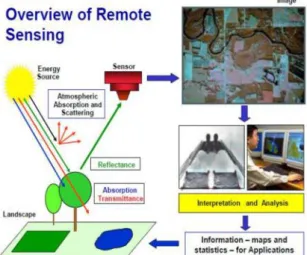
CARS are the combination of cloud computing and remote sensing, which provide cloud aided remote sensing services to users through the Internet and Sensor or Sensing devices. Remote Sensing is defined
in [1] as follows: “It is a science of Acquiring,
Processing and Interpreting Images and related data
that are obtained from ground based, air-or space
instruments.” Cloud Computing is defined in [3] as follows: “Cloud Computing is Internet-based computing, whereby shared resources, software and information are provided to computers and other devices on-demand.”
Fig: . Cloud Aided Remote Sensing (CARS)
computing to not just smart-sensing users but a much
broader range of sensing subscribers.” This emphasizes that Remote sensing benefits from Cloud Computing featuresstorage and data processing, and also reveals a CARS Services- moving part of the computation and the storage away from sensory devices or SANS. Thus
CARS can be defined as: “An Infrastructure which provide Ubiquitous Computing with the help of Sensors, Clouds and Internet as a communication
medium” In CARS, the previous or conventional ways
of collecting and processing sensory data have been transferred to cloud and thus the limitation of remote sensing have been reduced, so the acquisition and processing mode of remote sensing applications have been totally changed. CARS now
enables:-1. Distributed Sensory Data Collection: Sensed data
can be collected from the distributed environment at one place.
2. Global Resource and Data Sharing: Resources like
sensors etc and sensed Information can be shared globally among the world.
3. Remote and Real Time Data Access: Sensed data
can be accessed and analyzed in real time from anywhere.
4. Elastic Resource Provisioning and Scaling: Where
service users can provision and scale up and down their needed resources based on demand.
5. Pay-as-you-go Pricing Models: where cloud users
can request, release, and pay for resources whenever needed.
V. Conclusion:
pervasive systems as an opportunity to bring stronger security to pervasive systems. If cyber security researchers are involved in the evolution of this process, they can influence the process and change the current cyber security battlefield to one more amenable to the defenders. Advancements in virtual machine isolation, homomorphic encryption, client authentication, resource management, and secure opportunistic computing will facilitate the adoption of cloud computing while ensuring greater security and privacy for users.We propose cloud-based remote sensing algorithms for enabling distributed estimation of unknown parameters via sensor network virtualization. The algorithm has the following phases: sensor search, domain pruning, benefit matrix construction, virtual-participatory sensor assignment solver, and distributed estimation. Using simulation, we show that the proposed algorithms reduce communication overhead significantly without compromising the estimation error when compared to the traditional ADMM algorithm. We also show that the convergence time of our proposed algorithms maintain linear convergence behavior, as in the case of conventional ADMM.
VI. References :
[1] S. Abdelwahab, B. Hamdaoui, M. Guizani, and A. Rayes. Enabling smart cloud services through remote sensing: An internet of everything enabler. Internet of Things Journal, IEEE, 1(3):276–288, June 2014. [2] M. T. Beck, A. Fischer, H. de Meer, J. F. Botero, and X. Hesselbach.A distributed, parallel, and generic virtual network embedding framework. In Communications (ICC), 2013 IEEE International Conference on, pages 3471–3475. IEEE, 2013.
[3] A. Belbekkouche, M. Hasan, A. Karmouch, et al. Resource discovery and allocation in network virtualization. Communications Surveys & Tutorials, IEEE, 14(4):1114–1128, 2012.
[4] K. Birman. The promise, and limitations, of gossip protocols. ACM SIGOPS Operating Systems Review, 41(5):8–13, 2007.
[5] S. Boyd, A. Ghosh, B. Prabhakar, and D. Shah. Randomized gossip algorithms. Information Theory, IEEE Transactions on, 52(6):2508–2530, 2006. [6] S. Boyd, N. Parikh, E. Chu, B. Peleato, and J. Eckstein. Distributed optimization and statistical learning via the alternating direction method of multipliers. 2011.
[7] X. Cheng, S. Su, Z. Zhang, H. Wang, F. Yang, Y. Luo, and J. Wang. Virtual network embedding through topology-aware node ranking. ACM SIGCOMM Computer Communication Review, 41(2):38–47, 2011. [8] R. Duan and S. Pettie.Linear-time approximation for maximum weight matching. Journal of the ACM (JACM), 61(1):1, 2014.
[9] S. Ferretti. Gossiping for resource discovering: An analysis based on complex network theory. Future Generation Computer Systems, 29(6):1631–1644, 2013.