The Effectiveness of Goat Milk to Increase the Volume of Breast
Milk and Protein Content among Lactating Women:
Randomized Controlled Trial Evidence
Prita Alvina Reviana1), Yulia Lanti Retno Dewi2), Vitri Widyaningsih2)
1)Masters Program in Public Health, Universitas Sebelas Maret
2) Faculty of Medicine, Universitas Sebelas Maret
ABSTRACT
Background: Breast milk is a natural food to fulfill the nutritional needs of infants during the first 6 months of life. Nutrition is one of the factors that influence milk production. Protein is one of the most important nutrient factors needed by nursing mothers to increase milk production. This study aimed to analyze the effectiveness of giving goat milk to increase breast milk production. Subject and Method: A randomized controlled trial (RCT) was conducted in Madiun, East Java, in October 2019. A sample of 100 lactating mothers who had infants aged 1-3 months was selected by purposive sampling and divided into 2 groups. The dependent variables were an increase in milk production and protein intake. The independent variable was the effectiveness of giving goat milk. The data were collected by observation and 24-hour food recall sheets. The data were analyzed by t test run on Stata 13 program.
Results: After having goat milk, the average of breast milk production in the intervention group (Mean= 121.5; SD= 12.81) was higher than in the control group (Mean= 97.06; SD= 13.59), (ES= 0.81; p<0.001). Protein intake after having goat milk was higher in the intervention group (Mean= 92.60; SD= 4.54) than control group (Mean 83.36; SD= 4.26), (ES= 2.10; p < 0.001).
Conclusion: Goat milk is effective for increasing milk production and protein intake in lactating mothers.
Keywords: goat milk, breast milk, protein
Correspondence:
Prita Alvina Reviana, Masters Program in Public Health, Universitas Sebelas Maret, Jl. Ir. Sutami 36A, Surakarta, Central Java, Indonesia. Email: [email protected]. Mobile: +6282334673976
BACKGROUND
Children are the next generation of the nation, so they should be given the best nutrition at the beginning of their lives. Breast milk (ASI) is the main natural food for newborns, because breast milk can fulfill the baby's needs for baby's energy and nutrition during the first 4-6 months of his/her life, so as to achieve optimal growth and development (Anggraini et al., 2017).
Breastfeeding for infants is expected to be able to create the achievement of the
3rd Sustainable Development Goals
(SDGs), whivh is to stop infant and toddler mortality in 2030, with all countries trying to reduce neonatal mortality at least until
12 per 1,000 live births. According to the World Health Organization (WHO) and the United Nations Childrens Fund (UNICEF), it is recommended that mothers breastfeed their babies within the first hour after deli-very and continue until the age of the first 6 months of the baby's life (Felly, 2018).
Coverage of exclusive breastfeeding in Madiun City in 2017 was 901 infants (70.5%) out of 1,278 babies examined. This is still below the target of 80% of exclusive breastfeeding coverage (Madiun Health Profile, 2018).
frequency of breastfeeding, maternal age, parity, frequent breastfeeding, stress, acute illness, smoking, alcohol consumption, breast care and use of contraceptives (Yanti et al., 2018). Breastfeeding in the first 3 months is very important for nursing mothers (Atika et al., 2018). The amount of milk produced is enough for the baby, so the mother will also do exclusive breast-feeding in the following month (Sattari et al., 2019).
Goat milk as a source of good protein nutrition (Jasny et al., 2019). There are differences that cause goat milk has good characteristics (Krug et al., 2018). Goat's milk is whiter than cow's milk because goat's milk does not contain carotene which causes a slightly yellowish color. Goat milk fat has easier to digest properties than cow's milk, because the glubula diameter of goat milk fat is smaller in diameter (Hage-man et al., 2019). Protein from goat's milk is easier to digest and more efficient at absorbing its amino acids because the casein size in goat milk is smaller (Wang et al., 2019).
Drinking goat's milk regularly will help postpartum mothers to launch breast milk. A cup of goat's milk has 33 percent more calcium compared to cow's milk. This content is thought to be one of the support-ing substances of breast milk production (Zenebe et al., 2018).
Based on preliminary research by doing interviews to 12 breastfeeding mothers conducted at 4 Independent Mid-wife Practice clinics in Madiun, 7 mothers gave additional formula milk to their babies because of the low production of breast milk. The author was interested in conduct-ing experimental research on the effecttive-ness of giving goat milk to nursing mothers to increase breast milk production.
SUBJECTS AND METHOD 1. Study Design
This type of study was an experimental ran-domized controlled trial design. Data col-lection was carried out in 3 places of inde-pendent/private practice Midwives in Madiun, in October 2019.
2. Population and Sample
The population used in this study was nursing mothers for 1-3 months. The total sample were 100 research subjects. Sam-pling was using random samSam-pling tech-nique and included in 2 groups, namely intervention and control by using purposive sampling techniques in the area of Madiun, East Java.
3. Study Variables
The dependent variables were breast milk and protein volumes. The independent variable was goat milk.
4. Operational Definition of Variables
Goat milk administration was an
acti-vity of giving pure goat milk in the form of pure powder by 1 box containing 10 sachets weighing 20 g/sachets, which would be consumed by 1 sachet per day regularly by brewing 150 cc of warm water without add-ing sugar. Given to 50 research subjects included in the intervention group, while 50 control subjects were not given goat milk. The measuring instrument used was an observation sheet. The measurement scale was categorical.
Frequency of breastfeeding was the
number of times a mother breastfeeding or emptying her breast milk within 1 day, by pumping or breastfeeding directly. The measuring instrument was observation sheet. The measurement scale was conti-nous.
Duration of breastfeeding was the
sheet. The measurement scale was continous.
Amount of breastmilk was the amount
of milk produced by the mother in a single pumping. The tool for pumping breast milk is an electric breast pump. The measuring instrument was a chemical measuring cup. The amount of breastmilk would be record-ed on the observation sheet. The measure-ment scale used was a continuous scale.
The amount of protein intake was the
amount of protein consumed by nursing mothers for 1 full day. Measuring instru-ments used 24-hour food recall sheets, tables of food consumed by mothers would be processed with the application of the 2007 survey nutrition. The measurement scale was continous.
5. Data analysis
Univariate data analysis was grouped
according to the data scale. Bivariate ana-lysis used a two-group t test. Data was pro-cessed by using the Stata 13 program.
6. Study Ethic
This study was conducted based on re-search ethics, namely informed consent, anonymity, confidentiality, and ethical eligibility. Ethics permission in this study was obtained from the Health Research Ethics Commission of Dr. Moewardi Hos-pital, Surakarta, Indonesia, No. 1.187/X/-HREC/2019.
RESULTS 1. Univariate Analysis
Table 1 showed that the sample of breast-feeding mothers studied had on average been breastfeeding for 2 months. Frequ-ency of breastfeeding per day on average of 8.5 times/day.
Table 1. Sample characteristics (continous data)
Characteristics n Mean SD Min. Max.
Parity 100 2.58 0.67 2 4
Duration of breastfeeding (month) 100 2.12 0.79 1 3 Frequency of breastfeeding (per day) 100 8.46 0.50 8 9 Protein before intervention (g) 100 75.97 3.19 70.21 80.55 Protein after intervention (g) 100 87.98 6.38 75.21 99.73 Breast milk before intervention (ml) 100 86.21 13.19 65.20 110 Breast milkafter intervention (ml) 100 109.28 18.19 75.70 146
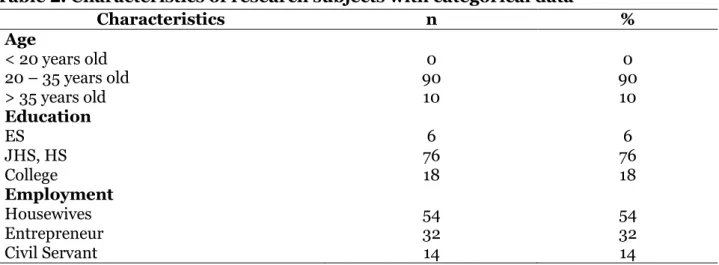
Table 2 showed that the sample of breast-feeding mothers studied was 20 - 35 years old on average. Education was generally
middle or high school. About half of all breastfeeding mothers studied worked at home as housewives.
Table 2. Characteristics of research subjects with categorical data
Characteristics n %
Age
< 20 years old 0 0
20 – 35 years old 90 90
> 35 years old 10 10
Education
ES 6 6
JHS, HS 76 76
College 18 18
Employment
Housewives 54 54
Entrepreneur 32 32
Bivariate Analysis
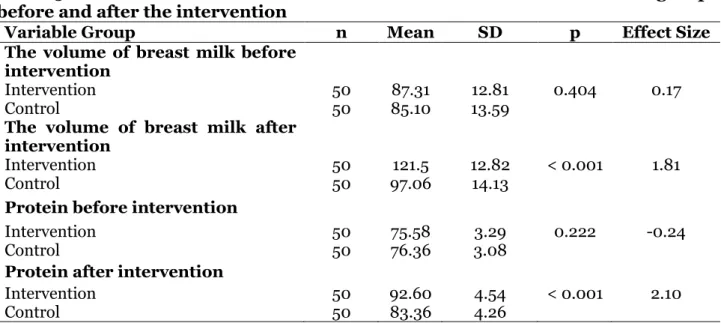
Table 3. t test differences in the mean of the intervention and control groups before and after the intervention
Variable Group n Mean SD p Effect Size
The volume of breast milk before intervention
Intervention 50 87.31 12.81 0.404 0.17
Control 50 85.10 13.59
The volume of breast milk after intervention
Intervention 50 121.5 12.82 < 0.001 1.81
Control 50 97.06 14.13
Protein before intervention
Intervention 50 75.58 3.29 0.222 -0.24
Control 50 76.36 3.08
Protein after intervention
Intervention 50 92.60 4.54 < 0.001 2.10
Control 50 83.36 4.26
Table 3 showed that there was no statistically significant difference in the volume of breast milk before the interven-tion (p= 0.404). The findings showed that randomization succeeded in making the two groups comparable in various vari-ables, including the volume of breast milk before the intervention. With randomiza-tion, each breastfeeding mother in the sample has the same probability of being selected into the goat milk group and the control group.
After the intervention, the average volume of breastfeeding of breastfeeding mothers in the intervention groups was higher (Mean= 121.5; SD= 12.81) than in the control group (Mean= 97.06; SD= 13.59) and the difference was statistically significant (p <0.001). Table 3 also showed that giving goat milk gave a quite large Effect Size (ES = 0.81). So it was concluded that the provision of goat milk was effective for increasing the volume of breast milk for nursing mothers.
There was no statistically significant difference in protein intake before the intervention (p= 0.222). The findings showed that successful randomization
made the two groups comparable on various variables, including protein intake before the intervention. By randomization, each breastfeeding mother in the sample had the same probability of being selected into the goat milk group and the control group.
After the intervention, the average protein intake of breastfeeding mothers in the intervention group was higher (Mean= 92.60; SD= 4.54) than in the control group (Mean 83.36; SD= 4.26) and the difference was statistically significant (p<0.001). Table 3 also showed that giving goat milk gives a fairly large Effect Size (ES= 2.10). So it was concluded that giving goat milk was effective for increasing protein intake of nursing mothers.
DISCUSSIONS
1. Effectiveness of giving goat milk to breast milk production for nursing mothers
study that state that regular consumption of goat milk for 7-10 days will increase breast milk production (Pazolla et al., 2019). Other studies suggest that regular goat milk can increase breast milk production by 15 ml - 30 ml in every pumping (Garovic, 2018).
Goat milk is milk derived from types of dairy goats (Wang et al., 2019). Etawa goat milk has a composition that is richer than other types of goat milk, and has no pungent and fishy odor (Ratya et al., 2017). Goat milk was used as an alternative nutri-tional intake for children who were allergic to cow's milk (Lurette et al., 2018). Con-suming goat milk regularly would help pregnant women to have good breast milk, so that after the fetus was born, breast milk would run smoothly. Sufficient volume of breast milk would lead to exclusive breast-feeding behavior (Atika et al., 2018). A cup of goat's milk has 33% more nutrients com-pared to cow's milk (Huang et al., 2018). Goat milk is herbal, and it can stimulate the hormone prolactin gradually and would get maximum results after 7-10 times con-sumption (Felly, 2018).
Consuming goat's milk regularly for 10 days would increase breast milk produc-tion, so the baby's daily milk consumption needs can be fulfilled and the baby's immu-nity would be formed properly due to the application of exclusive breastfeeding.
2. The effectiveness of giving goat milk to the protein intake of nursing mothers
The results of this study indicated that goat milk was effective in increasing the protein intake of nursing mothers which was statis-tically significant. The result of this study was in line with study done by Rupp et al., (2018), which stated that regular consump-tion of goat milk can help the synthesis of the hormones prolactin and oxytocin, so as to increase milk production and
expendi-ture. Another study stated that by con-suming goat milk, it can increase appetite because in goat milk, there is a greater vita-min B1 content than cow's milk (Ziarnoet al., 2019).
Protein is an important nutrient that is needed in building and repairing various tissues in the body (McRae, 2019). Protein also plays an important role in the growth and development of infants in the early days of their lives (Rosartio et al., 2017). Protein is also much needed to help reco-very after pregnancy and childbirth (Yanti-net et al., 2018). Types of foods that contain protein are meat, chicken, fish and seafood, eggs, cheese, milk, yogurt, and other pro-tein sources (Puspitarini, 2018). Goat milk protein has small particles that are easily absorbed by the body (Ziarno et al., 2019).
Goat milk contained protein with small particles so that it was easily absorbed by the body while meeting the daily protein needs of nursing mothers.
AUTHOR CONTRIBUTIONS
Prita Alvina Reviana as the main researcher has roles to carry out the study, the formulation of study articles, and data processing. Yulia Lanti Retno Dewi has roles in arranging the background and discussion of the study. Vitri Widyaningsih has roles in discussing the methodology and study results
FUNDING AND SPONSORSHIP
There was no external funding.
CONFLICT OF INTEREST
There was no conflict of interest.
ACKNOWLEDGEMENT
study. Thank you to all nursing mothers who have been willing and cooperative to be the subject of research.
REFERENCE
Angriani R, Sudaryati E, Lubis Z (2017). Relationship of frequency of breast-feeding with the smooth production of breast milk of post-partum mothers in the work area of South Peusangan Pu-blic Health Center, Bireuen Regency, Aceh Province. J Muara Sains, Tek-nologi Kedokteran, dan Ilmu Kesehat, 2(1): 299-304. https:// jour-nal.untar. ac.id/index.php/jmistki/article/down load/2110/1408
Atika Z, Salimo H, Dewi YLR (2018). Multi-level analysis on the determinants of exclusive breastfeeding at Gunung Anyar Community Health Center, Surabaya, Indonesia. J Matern Child Health, 3(3): 176–183. https://doi.-org/10.26911/thejmch.2018.03.03.02 Dinkes Jatim (2018). East Java Province
Health Profile in 2017. Surabaya: Din-kes Jatim. https://www.depDin-kes.go.id- https://www.depkes.go.id-/resources/download/profil/PROFIL _KES_PROVINSI_2017/15_Jatim_2 017.pdf
Dinkes Kota Madiun (2018). Madiun City Health Profile in 2017. Madiun: Din-kes Kota Madiun. http://dinDin-kes.ma- http://dinkes.ma- diunkota.go.id/wp-content/uploads/- 2018/10/PROFIL-KESEHATAN-20-17.pdf
Felly E (2018). Factors that influence exclu-sive breastfeeding. J Penelit Kesehat, 9(2):101-113. https://ejournal.unsrat.-ac.id/index.php/eclinic/article/downl oad/18524/18052
Garovic VD (2018). The consumption of goat milk in nursing mothers. Food Nutrition, 59(3):555-557. doi: 10.1161 /hypertensionaha .111 .184192
Hageman JHJ, Danielsen M, Nieuwenhuize AG, Feitsma AL, Dalsgaard TK (2019). Comparison of bovine milk fat and vegetable fat for infant formula: Im-plications for infant health. Int Dairy J, 92:37-49. doi: 10.1016/j.idairyj.20-19.01 .005
Huang Y, Ouyang YQ, Redding SR (2018). Previous breastfeeding experience and its influence on breastfeeding outcomes in subsequent births: A systematic review. Women and Birth. doi: 10.1016 /j.wombi .2018.09.003 Jasny E, Amor H, Baali A (2019). Mother’s
knowledge and intentions of breast-feeding in Marrakech, Morocco. Arch Pediatr. doi: 10.1016/j.arcped.2019.-05.007
Kemenkes (2017). Indonesian Health Pro-file of 2016. Jakarta: Kemenkes. https://www.depkes.go.id/resources- /download/pusdatin/profil-kesehat- an-indonesia/Profil-Kesehatan-Indo-nesia-2016.pdf
Krug C, Morin P-A, Lacasse P (2018). A randomized controlled trial on the effect of incomplete milking during the first 5 days in milk on culling hazard and on milk production and composition of dairy goat. J Dairy Sci, 101(5):4367-4377. doi: 10.3168/jds.2-017-14021
Lurette A, De Boissieu C, Morin E, Hassoun P, Moulin CH (2018). Improved ma-nagement to limit milk production losses resulting from the transition to once-a-day milking in dairy goat. Small Rumin Res, 165(6):8-16. doi: 10.1016/ j.smallrumres.2018.06.07 McRae MJ (2019). Exclusive breastfeeding,
Pazzola M, Stocco G, Dettori ML, Bittante G, Vacca GM (2018). Effectiveness of soy milk and goat's milk for nursing mothers. J Dairy Sci, 102(5):3947-3955. doi: 10.3168/jds.2018-15397 Puspitarini OR, Herbani M (2018). Protein
content, fat content and non-fat solid pasteurized goat milk in refrigerator storage. J Apl Teknol Pangan, 7(1):12-14. doi: 10.17728/jatp. 2162.
Ratya N, Taufik E, Arief I (2017). Chemical, physical and microbiological charac-teristics of Ettawa crossbreed milk in Bogor. J Ilmu Produksi dan Teknol Has Peternak, 05(1):1-4. doi: 10. 12-823/jtekno.2017-1394
Rosartio R, Suranindyah Y, Bintara S, Ismaya I (2017). Production and com-position of Ettawa crossbreed milk in the highlands and lowlands of Yogya-karta. Bul Peternak, 39(3):180.doi: 10.21059/bulle-tinternak.v39i3.7986 Rupp R, Huau C, Caillat H (2019). Dairy
goat saenen for the fulfillment of nu-tritional nursing mother. J Dairy Sci, 102 (6): 5242-5253.doi: 10.3168/jds-.2018-15664
Sattari M, Serwint JR, Levine DM (2019). Maternal implications of breastfeed-ing: a review for the internist. Am J Med. doi: 10.1016/j.amjmed.2019.02-.021
Sinta P, Salimo H, Pamungkasari P (2017). Multilevel analysis on the biosocial
and economic Determinants of Exclu-sive Breastfeeding. J Matern Child Health, 2(4): 356–370. https://doi.-org/10.26911/thejmch.2017.02.04.06 Wang Y, Zhang Y, Chi X (2019). Inter-national Immunopharmacology Anti-inflammatory mechanism of ginseno-side Rg1: proteomic analysis of milk from goats with mastitis induced with lipopolysaccharide. Immunophar ma, 12(2):382-391. doi: 10.1016/j.in timp. 2019.03.048
Yanti HF, Yohanna WS, Nurida E (2018). The smooth production of breast milk in post-partum mothers is seen from the initiation of early breastfeeding and baby's suction. J AisyahJ Ilmu Kesehat,3(1): 39. doi: 10.30604/ jika. v3i1.74
Zenebe T, Ahmed N, Kabeta T, Kebede G, Medicine V, Box PO (2017). Review on medicinal and nutritional values of goat milk, 3(3):30-39. doi: 10.5829/ idosi.ajn .2014.3.3.93210