Abstract— An experiment based on distance vector multicast routing protocol (DVMRP) is described with the procedure of multicasting a network using distance vector. This paper describes an efficient data communication within a network using multicasting technique. Multicast distance vector routing protocol combines some of the features of RIP (Routing Information Protocol) with the Truncated Reverse Path Broadcasting (TRPB) algorithm. The purpose of DVMRP is to keep track of the return paths to the source of multicast datagram. A router that routes both multicast and unicast datagram’s must run two separate routing processes. DVMRP deals with sending multicast datagram’s to the multicast group. Multicasting is done through DV (Distance Vector) routing table. Usually Multicast distance vector routing does not share its routing table with its neighbors. It can be built from the scratch or delay information that can be shared from the neighbors. Multicast datagram packets are forwarded to the multicast group through a minimum cost path. After completing its task, the old routing table can be neglected and destroyed whereas the delay information is shared periodically. This is a source based routing protocol based on RIP. For efficient transmission of the data through Multicast distance vector routing, four strategies can be used namely Flooding, Reverse Path Forwarding, Reverse Path Broadcasting, Reverse Path Multicasting. Here routers are enabled with routing tables to monitor the data transmissions in the network. DVMRP results in reliable and fast transferring of data between the source and destination in a network.
Index Terms— Multicast Routing, Multicast packets,
DVMRP, Router.
I. INTRODUCTION
Delivering of packets from a single source (Sender) to a single destination (Receiver) is called Unicast. In Unicast
Communication, relationship between the source and
destination is One-to-One [3]. Here both source and destination addresses in IP datagram are unicast addresses, assigned to the hosts. Protocols providing Unicast communication is meant as Unicast Protocols.
Communicating with all the hosts that can be called as destinations using a single source (Sender) can be called as
Broadcast Communication. Here the relationship between
the source and destination is One-to-All [3]. Internet does not
Manuscript received June 15, 2012.
G.Naveen Samuel, Computer Science and Engineering, Joe Suresh Engineering College, (e-mail: [email protected]). Tirunelveli, India, Mobile No: 8508987060.
D.Damiel, Information Technology, Karunya University, Coimbatore, India, (e-mail: [email protected]).
explicitly support broadcasting because of huge amount of traffic it would create with higher bandwidth. Imagine the traffic generated in the Internet if one person wanted to send a message to everyone connected in the internet.
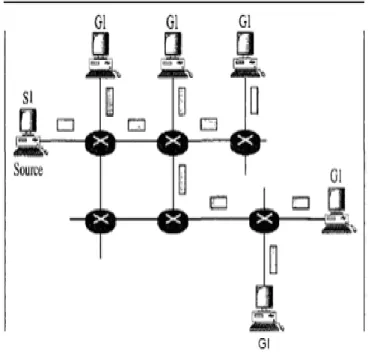
In networking, an emerging trend evolves with the delivery of packets from one or more senders to a group of receivers. This mechanism includes bulk data transfer, continuous media streaming, updating web cache, data feeds and interactive gaming [9]. In these applications, a process called multicast is used in extreme. Sending of a packet from one source (Sender) to multiple destinations (Receivers) using a single operation – send is called as Multicast
Communication. Multicast packets sent among hosts are the
Multicast Groups. Multicast communication is not a connection oriented. Multicast datagram is transmitted over the destination group members that are reliable as unicast IP datagram.
Fig. 1 Multicasting
When a router receives a multicast packet, it may have destinations in more than one network. Forwarding of a single packet to members of a group requires a shortest path tree [4]. If there are ‗n‘ groups, ‗n‘ shortest path trees are needed. Two approaches have been used to solve the problem: Source based trees and Group shared trees.
Multicast Data Transmission Using Distance
Vector Multicast Routing Protocol
II. RELATED WORKS
Today‘s challenging economy demands that enterprises leverage the value of their current technology investments to increase productivity, while at the same time decreases their operating costs. As a result, enterprises are beginning to explore the benefits of sending single data to multiple destinations using Internet Protocol (IP) based network that can deliver significant cost savings and help to provide for enterprise continuity [9]. In computer networking, multicast is the delivery of a message or information to a group of destination computers simultaneously in a single transmission from the source creating copies automatically in other network elements, such as routers, only when the topology of the network requires it. IP multicast is a technique for one-to-many communication over an IP infrastructure in a network. It scales to a larger receiver population by not requiring prior knowledge of whom or how many receivers there are. Multicast uses network infrastructure efficiently by requiring the source to send a packet only once, even if it needs to be delivered to a large number of receivers [1, 17]. The nodes in the network take care of replicating the packet to reach multiple receivers only when necessary. The most common transport layer protocol to use multicast addressing is User Datagram Protocol (UDP). By its nature, UDP is not reliable- messages may be lost or delivered out of order. Reliable multicast protocols such as pragmatic general multicast (PGM) have been developed to add loss detection and retransmission on top of IP multicast [14]. IP multicast is widely deployed in enterprises, commercial stock exchanges, and multimedia content delivery networks. A common enterprise use of IP multicast is for IPTV application such as distance learning and televised company meetings. The purpose of this project is to transfer the messages to the users of the multicast group i.e., single user to the multiple user of the assigned group. The main advantages of the multicast distance vector routing protocol is that DVMRP is cheaper and cost effective when compared to other alternatives for increasing LAN and WAN capacities, Reduces the load on the sending server, which no longer supports sequential or concurrent unicast sessions due to scalability factor. Gets rid of network congestion that is caused by existing application, which is inefficiently transmitting to other groups., Saves cost in utilization of network and server resources, As more users are added over the network, there is no change in the amount of bandwidth over the users, Can add new types of applications due to the multicasting mode of transmission [5, 9]. The action that carried out in this project is that the message has been transmitted to the multicast group. Thus the single message can be transmitted without congestion and group of users without message replication. Distance Vector routing is implemented in various environmental networks that has resulted in an efficient communication process. Now multicasting procedure is enveloped with Distance vector routing so as to produce a shortest path before transmission of messages between nodes and each router is displayed with a routing table to process on with an idea of the paths with its delay information. This enhances with a secure, reliable and fast transmission of data within a network structure.
III. SEVERAL WAYS OF MULTICAST ABSTRACTION
Using a single send operation, the data‘s are sent and those sent data copies are delivered to many receivers in several ways:
One-to-All Unicast: Sender uses separate unicast transport connection to each receiver [16]. Sender‘s transport layer is duplicated and transmitted over each of the individual connections. Fig.2 shows the One-to-All unicast communication process.
Fig.2 One-to-All Unicast
Application Level Multicast: Unicast transmission is used but involving replication and forwarding of data by the receivers [12] as shown in Fig.3. Here sender transmits data to some receivers and those receivers may duplicate and forward copies of data to other receivers.
Fig.3 Application Level Multicast
Explicit Multicast: Router involves replication and
forwarding of data copies on the multiple links to reach the receivers. It provides explicit multicast support in the network layer. Fig. 4 shows an explicit multicast transmission.
Fig.4 Explicit Multicast
transmissions are made only with a structured routing table.
IV. DISTANCE VECTOR MULTICAST ROUTING PROTOCOL
Unicast distance vector routing is very simple; extending it to support multicast routing is complicated. Multicast routing does not allow a router to send its routing table to its neighbors. The ideas are to create a table from scratch by using the information from the unicast distance vector tables. Multicast distance vector routing uses source-based trees, but the router never actually makes a routing table. When a router receives a multicast packet, it forwards the packet as though it is consulting a routing table [11]. We can say that the shortest path tree is evanescent. After its use (after a packet is forwarded) the table is destroyed. To accomplish this, the multicast distance vector algorithm uses a process based on four decision-making strategies can improve the shortcomings of the previous one. They are
Flooding
Reverse Path Forwarding(RPF) Reverse Path Broadcasting(RPB) Reverse Path Multicasting(RPM)
a) Flooding:
In flooding strategy each router sends the incoming packet to the every interface except the one from which it was received. Flooding accomplishes the first goal of multicasting i.e., every network with active members receives not a multicast [10]. Although, flooding is broadcast, not a multicast, there is another problem: it creates loops. This will be overcome by the next strategy.
b) Reverse Path Forwarding (RPF):
RPF is a modified flooding strategy. To prevent loops, only one copy is forwarded; the other copies are dropped. In RPF, a router forwards only the copy that has travelled the shortest path from the source the router. To find this copy, RPF uses the unicast routing table. The router receives a packet and extracts the source address( a unicast address). It consults its unicast routing table an though it wants to send a packet to source address [17]. The routing table tells the router the next hop. If the multicast packet has just come from the hop defined in the table, the packet has travelled the shortest path from source to the router because the shortest path is reciprocal in unicast distance vector routing protocols. If the path from A to B is the shortest, then it is also the shortest from B to A. The router forwards the packet if it has travelled from the shortest path; it discards it otherwise. This strategy prevents loops because there is always one shortest path from the source to router [14]. If a packet leaves the router an comes back again, it has not travelled the shortest path. Fig.5 shows the procedure of enforcing a Reverse path forwarding technique.
Fig.5 Reverse Path Forwarding
c) Reverse Path Broadcasting (RPB):
RPF guarantees that each network receives a copy of the multicast packet without formation of loops. However, RPF does not guarantee that each network receives only one copy; a network may receive two or more copies. The reason is that RPF is not based on the destination address (a group address); forwarding is based on the source address. To eliminate duplication, we must define only one parent router for each network we must have this restriction: A network can receive a multicast packet from a particular source only through a designated parent router [15]. Now the policy is clear. For each source, the router sends the packet only out of those interfaces for which it is the designated parent. This policy is called reverse path broadcasting (RPB). Fig.6 shows a structure of RPB, guarantees that the packet reaches every network and that every network receives only one copy.
Fig.6 Reverse Path Broadcasting
d) Reverse Path Multicasting (RPM):
As you have noticed, RPB does not multicast the packet, it broadcasts it. This is not efficient. To increase efficiency, the multicast packet must reach only those networks that have active members for broadcasting to multicasting; the protocol uses two procedures, pruning and grafting.
sending multicast messages for this group through that interface. Fig.7 shows an RPM state after Pruning. Now if this router receives prune messages from all downstream routers. It in turn, sends a prune message to its upstream router.
Fig.7 RPM (after pruning)
After Pruning in enhanced in the network, the useless routes are evacuated from the structure and only those needed routes are shown with the transactions. Those pruned route is enhanced in the network using dotted lines showing no connection between the nodes.
Fig.8 RPM (after grafting)
When if a leaf router (a router at the bottom of the tree) has sent a prune message but suddenly realizes, through IGMP that one of its networks is again interested in receiving the multicast packet? It can send a graft message. Fig.8 Shows the RPM state after the grafting process is made. The graft message forces the upstream router to resume sending the multicast messages. While grafting occurs, then those pruned routes are analyzed and the needed route for propagation of the message is grafted and considered for transferring data in the network.
V. IMPLEMENTATION OF DISTANCE VECTOR ROUTING
DVMRP can be termed as a ―broadcast & prune‖ multicast routing protocol. It builds per-source group multicast delivery trees by pruning (removing branches from) the source‘s truncated broadcast tree. It performs Reverse Path Forwarding checks to determine when multicast traffic should be forwarded to downstream interfaces [1, 9]. In this way, source-rooted shortest path trees can be formed to reach all group members from each source network of multicast traffic.
Fig.9 Performance Analyzer
A performance analyzer is introduced between the routers to analyze the 1) Separation of multicast traffic with the measurement of its statistics, 2) Internal information of the routers are estimated, 3) A specific structure of mapping is introduced between multicast traffic and internal information estimated. Performance analyzer is equipped along with a tunnel as shown in Fig.9. Different sets of routers connected along a network are placed inside a tunnel structure. Here the router can be multicast or unicast routers. Several systems are connected with the routers for communicating with them. In those connected systems, some of them may be useful for a transmission to succeed but some of them will be useless for the communication. For analyzing the state of the system (Useful or useless), a performance analyzer is enhance in this mechanism.
Fig.10 DVMRP Multicast
Analyzer finds the status of the message that is survived along the network. It identifies the message status and reports in two different states such as:
1) Prune Message: It searches the multicast group addresses
that are to be prune and analyses the valid and invalid period of propagation, if finds an invalid period then the group address involves the mechanism of Pruning.
Fig.11 Valid and Invalid Time Period
Fig.11 shows the ongoing process with the time period allocation which can be valid or invalid. Here periodic calculations of the time period are made only by performance analyzer present in the structure. It is maintained only by those Prune and Graft message evolved in this process. According to RPM, when the datagram is sent from the source, passes through entire network. Datagram is delivered to all leaf routers and may transmit a prune message, when there is no group member. If the router that has sent a prune message in previous transmission finds new group members, it sends a graft message. Graft messages restore the previously pruned branches of the multicast network [4, 16].
Destination Delay Outgoing
Node
A 0 -
B 1 B
C Infinity -
D 1 D
Table.1 Routing Table
Destination- Final destination of the Packet(usually multicast group users).
Delay - It is the time taken for the transmission of the packet i.e., Least Propagation Delay (LPD) between the users.
Outgoing Node-Next hop through which the message to be
transmitted
At first the Distance vector Multicast Routing protocol maintains the routing table by initializing the routing table by assigning the infinity value to the non-neighborhood nodes and minimum delay between the systems by sending the message and reception of the response from the system. Then the router sends the routing table shown in table.1 to the neighboring nodes and by accessing the routing tables each router updates its routing table [7, 18]. Distance vector enhances the shortest path of the route nodes and makes a process of detecting is cost with the delay information which is constructed to be the routing table. Thus the distance vector routing table updates and sends the message through the minimum path cost.
VI. NEED FOR MULTICAST ROUTING PROTOCOL
Majority of networking applications purely rely on point-to-point transmission. Over these past few years, networking field has seen a rise in number of new applications that supports multicast transmission. Utilization of point-to-multipoint transmission has been limited to local area network applications. As multicast routing protocols define their delivery paths across an internetwork, it is widely used in several applications [5, 6]. It reduces the network load, as a single packet is transmitted by the source which is then replicated at forks in multicast delivery tree. For defining a multicast group, a multicast address is assigned to a set of receivers. It constructs a multicast delivery tree in which the multicast packets are to be forwarded. It discovers the resources in the network to generate delivery trees. While multiple routers are connected within a network, the process of pruning useless links when hosts leave group and grafting new links when new hosts join a group [13]. Whole additional levels of complexity are added when considerations are given for exactly how the tree should be formed and how trees are built across inter-domain boundaries. This kind of detail includes the specific protocols and their features. Suffice it to say that a high level explanation of ―routing‖ is that it is the process of building the tree, and it occurs when a leaf router initiates a join toward a group‘s source(s) [12]. Routing results in the creation of forwarding state. A router uses this state to look up a group address and determine which outgoing node interfaces a multicast packet that should be forwarded on.
VII. PERFORMANCE ANALYSIS
DVMRP provides a simple model when compared to other multicast routing protocols by making a pure source specific multicast distribution trees for deploying and troubleshooting [2, 17]. It uses a own topology mechanism by updating the routing table each time for enhancing a secure and fast transmission of messages in a network. Multicast routing maintains an efficient data transmission by calculating the shortest path in the network whereas other routing algorithm may transmit the message through the network without any subsequent path [13, 16]. DVMRP routing table that are constructed in multicasting technique can be the enhanced part of the forwarding table, in which it shows the specific delay of the transmission. Routing table of each router are automatically updated and deleted for each round or for each data transfers that could enable a continuous task in the network. By introducing a performance analyzer in this task, we could grasp that the traffic intensity of this multicast data transmission using DVMRP is low. By analysis, only the valid period can be noted in the whole traffic made in the network which would be 49.1% over the monitored link. Thus it makes a fast data transmission and it can be a reliable structure in networking. Networking can be entitled with this DVMRP to make a secure and fast transmission than other protocols which could identify its transmission path as earlier in the network environment.
An enhanced mechanism is dedicated here to survive fit, in this fast changing world. Multicast data transmission using distance vector multicast routing protocol has brought a revolutionary change in the communication field. Routing table concept for multicast data transmission makes an affordable communication in the network. Delivery trees that are identified along the network can be efficient. Multicasting is made effective using DVMRP procedure for enhancing a secure transmission of data. Implementation of this mechanism can endure a cost effective, a reliable and a responsible data transmission. Multicasting procedure can be implemented in upcoming communication fields to make an effective action. Several enhancements can be made along this routing protocol to make a useful propagation. Multicasting using DVMRP is a humble work, which can be subjected to further improvements. In future, this core model can be developed with some enhancing software which would specify only a secure multicasting task in data transmission and can be used in the development of Wide area networks.
REFERENCES
[1] Behrouz A.Forouzan , ―DATA COMMUNICATION AND NETWORKING‖, McGraw-Hill Forouzan Networking Series, New York, NY 10020.
[2] Beau Willaimson, ―Developing IP Multicast network vol-I‖, Cisco Press, IN466290 USA.
[3] Yuan-Cheng Lai , Nat. Chiao Tung Univ., Hsinchu Ying-Dar Lin ; Wei-Che Yu ; Yuh-Tay Lin, ―GMNF-DVMRP: a modified version of distance vector multicast routing protocol‖, Computer Communications and Networks, 1997. Proceedings. Sixth International Conference on 22-25 Sep 1997, Pg:65 – 68.
[4] David Mosofis, Kevin Almeoth, ―Multicast Sockets/Practical guide for programs‖ Morgan Kaufmann publishers, San Fransisco, CA. [5] Tzu-Lun Huang,, D.T. Lee on ELSEVIER, ―A distributed multicast
routing algorithm for real-time applications in local area networks‖ paper on journals of parallel and distributed computing.
[6] Javvin Technologies, Inc., ―Network Protocols Handbook‖, Javvin Press ,May 15, 2007, Pg:45-82,Pg:235-247.
[7] Russ White; Danny McPherson; Sangli Srihari, ―Practical BGP‖, Addison-Wesley Professional, July 06, 2004 , Print ISBN- 10: 0-321-12700-5, Print ISBN-13: 978- 0 -321-12700 -6, Pg:198-223. [8] Arie D. Jones, ―Interdomain Multicast Routing: Practical Juniper
Networks and Cisco Systems Solutions‖, Addison-Wesley Professional, April 24, 2002, Print ISBN-10: 0-201-74612-3, Print ISBN-13: 978-0-201-74612-9.
[9] Uemo, S. , Kato, T. , Suzuki, K. , ―Analysis of Internet multicast traffic performance considering multicast routing protocol‖, Network Protocols, 2000. Proceedings of International Conference on 2000, Pg: 95 – 104.
[10] Jeff CCIE #1919 Doyle; Jennifer DeHavenCCIE #1402 Carroll, ―Routing TCP/IP, Volume II (CCIE Professional Development)‖, Cisco Press, April 11, 2001, Print ISBN-10: 1-57870-089-2, Print ISBN-13:978-1-57870-089-9, Pg:687-801.
[11] Eiji Oki; Roberto Rojas-Cessa; Mallikarjun Tatipamula; Christian Vogt, ―Advanced Internet Protocols, Services, and Applications‖, John Wiley & Sons, April 24, 2012, Print ISBN:978-0-470-49903-0, Web ISBN:0-470499-03-6, Pg: 21-59, 75-117.
[12] ―The Current State Of IP Multicast. (Technology Information)‖ , Network Computing | March 1, 1998.
[13] Ruay-Shiung Chang and Yun-Sheng Yen, ―A Multicast Routing Protocol with Dynamic Tree Adjustment for Mobile IPv6*‖, Journal Of Information Science And Engineering 20, 1109-1124 (2004). [14] R. Manoharan and E. Ilavarasan, ―Impact of Mobility on the
Performance of Multicast Routing Protocols in MANET‖, International Journal of Wireless & Mobile Networks (IJWMN), Vol.2, No.2, May 2010.
[15] Charlie Schluting, ―Networking 101: Understanding Multicast Routing‖, Enterprise Networking Planet, Jul 27, 2006.
[16] John T. Moy, Addison Wesley Longman, ―Anatomy of an Internet Routing Protocol‖, The Internet Protocol Journal - Volume 2, No. 2 , ISBN 0-201-63472-4, 1998.
[17] Yuan-Cheng Lai*, Ying-Dar Lin, Wei-Che Yu, ―GMNF-DVMRP: an
enhanced version of distance vector multicast routing protocol‖, International Journal of Communication Systems, Volume 11, Issue 2, pages 93–101, March/April 1998.
[18] XUE Jian-Sheng, WANG Guang-Xing, ―A Routing Assistant Reliable Multicast Method Based on DVMRP‖, Computer Science, 2006-2007. [19] LI Guo-bin, ZHANG Yan-li, ―Management on Address & Host Group of IP Multicast[J]‖; Computer Knowledge and Technology;2006-08.
G.Naveen Samuel has completed his Bachelor of Engineering (CSE) in Sivanthi Aditanar College of Engineering and he is continuing his Master Degree (CSE) in Joe Suresh College of Engineering and doing his research project in Network Security.