35
A NOVEL APPROACH FOR SECURED DATA MAINTENANCE
IN CLOUD STORAGE
Ms. S.Jeevitha Mr.M.Rajesh Dr. T. Senthil Prakash
II Year M.E(CSE) Assistant Professor Professor & HOD
Shree Venkateshwara Hi-Tech Shree Venkateshwara Hi-Tech Shree Venkateshwara Hi-Tech
Engg College, Gobi Engg College, Gobi, Engg College, Gobi
[email protected] [email protected] [email protected]
ABSTRACT
Data integrity maintenance is the major objective in cloud storage. It includes audition using TPA for unauthorized access.
This work implements protecting the data and regeneration of data if someone mishandles it. This job will be assigned to a Pr oxy
server. The data of the users will be stored in public and private area of the cloud. So that only public cloud data will be accessed by
user and private cloud will remain more secured. Once any unauthorized modification is made, the original data in the private cloud
will be retrieved by the Proxy server and will be returned to the user. Every data stored in the cloud will be generated with a Hash
value using Merkle Hash Tree technique. So modification in content will make changes in the Hash value of the document as well.
Proxy also perform signature delegation work by generating private and public key for every user using OEAP Algorithm so that the
security will be maintained. In our proposed we implement this scenario in a multi owner environment in which one document wi ll be
access by user groups. In this context, the access limit should be properly maintained so that no user for other group should be
allowed to modify a particular group's data. Also, if any modifications made in that data, it will be informed to the user as well by the
proxy.
1. INTRODUCTION
Cloud computing is recognized as an alternative to traditional
information technology due to it is intrinsic resource sharing
with low maintenance characteristics. In cloud computing, the
cloud service providers (CSPs), such as Amazon and others
are able to deliver various service to cloud users with the help
of powerful data centers. By shifting the local data
management systems into cloud servers and users may enjoy
high quality services and save significant investments on
them local infrastructures. One of the most fundamental
services are offered by cloud providers was data storage. Let's
consider a limited data application the company allows its
staffs in the same group or department to stored and shared
files in the cloud. By utilizing the cloud that the staffs could
be completely released from the troublesome local data
storehouse and maintenance. However, it is also poses a
significant risk to the confidentiality of those stored files.
Specifically the cloud servers is managed by cloud providers
is not fully trusted by users while the data files stored in the
cloud might be confidential and sensitive such as business
plans. To preserves data privacy is primary solution for
encrypt data files and then uploaded the encrypted data into
the cloud [2]. Unfortunately, the designing of the efficient
and secure data sharing scheme for groups in the clouds is not
an easy task due to the following challenging issues.
First of all identity the privacy is being one of the most
significant restriction for the wide deployment of cloud
computing. Here not holding the guaranteed of identity
privacy user may be unwilling to append in cloud computing
systems because their real identities can be easily disclose to
cloud providers and also attackers. On the other hand its
unconditional identity privacy might incur the abuse of
privacy for example the misconduct staff could deceive
36
traceable. Therefore, traceability and which are enables theTPA to expose the real identity of a user’s are also highly
desirable.
Second, it is highly recommended that any member in the
groups should able to fully enjoy the data storing as well as
sharing services provided by the cloud which are defined as
the multiple owner manner. Compare with the single owner
manner where only the group manager could store and
modify data in the cloud, the multiple owner manners are
more flexible in practical applications. More concretely, each
users in the groups are able to not only read data and also
modify his or her part of data in the entire data file shared to
the company. Last but not the least so that groups are
normally dynamic in practice, e.g., new staff cooperation and
current employee revocation in the company. The changes of
membership makes secure data sharing extremely
problematic. On one hand, the anonymous systems can
challenges modern granted users can learn the content of data
files stored before their cooperation, because it is not possible
for new granted users to contact with anonymous data owners
and access the corresponding decryption keys. On the other
hand the efficient membership repeal mechanism without
updating the classified keys of the remaining users has also
desire to minimize the complexity of key management. Many
security schemes for data sharing on untrusted servers had
been proposed. In these approaches, data owners are able to
store the encrypted data files in mistrustful storage with
distributed the corresponding decryption keys are only to
authorized users. Thus, unauthorized users as well as storage
servers could't learn the content of the data files because they
don’t have knowledge of the decryption keys.
However, the complexity of user participation and repeal in
these schemes are linearly increasing with the numbers of
data owners as well as the number of revoked users,
respectively. By setting the group with a single attribute, we
proposed a secure provenance scheme is established on the
cipher text policy attribute established encryption technique,
which are allows any member in a group to share data with
others. However, the issue of user revocations are not
addressed in their scheme. We presented a scalable and fine
grained data access control scheme on cloud computing based
on the key policy attributes based on by encryption technique
with the implementation of Proxy Server. Unfortunately, the
single owner manner hinders the adoption of theirs scheme
into the case, where all users are granted to store and share
data. Hence we are implementing a group based Data owner
system.
2.OVERVIEW
The main aim of the project is to support dynamic groups
efficiently. We provide secure and privacy-preserving access
control to users, which guarantees any member in a group to
anonymously utilize the cloud resource. To achieve secure
data sharing for dynamic groups in the cloud, we expect to
combine the group signature or group master key and
dynamic broadcast encryption techniques.
Specially, the group signature scheme enables users to
anonymously use the cloud resources, and the dynamic
broadcast encryption technique allows data owners to
securely share their data files with others including new
joining users. The proxy server computes the revocation
parameters and make the result public available by migrating
them into the cloud. Such a design can significantly reduce
the computation overhead of users to encrypt files and the
cipher text size. Specially, the computation overhead of users
for encryption operations and the cipher text size is constant
and independent of the revocation users. The proxy maintain
the signature delegation work which generates the private and
public key of each group so that the permission for the access
of file can be restricted. Revocation is user is performed if
any user make unauthenticated action on any data in the
cloud. Also if a data has been modified by the user it will be
detected, penalized and the code will be regenerated by the
proxy.
In this the user revocation is performed by the group manager
via a public available revocation list (RL), based on which
37
confidentiality against the revoked users. The list ischaracterized by time stamp t1,t2,…tr. In the proposed
system once the user time stamp over does not wait for the
group manager to update the time stamp or revocation list
here once the time over the user immediately send request for
extra time for access the data to the cloud. Then the cloud
will send that request to the group manager once the see it
and give permission then the cloud will time to access the
data but if the group manager did not give permission then
the cloud will not give permission for access of the data.
3.RELATED WORKS
Advances in networking technology and an increase in the
need for computing resources have prompted many
organizations to outsource their storage and computing needs.
This new economic and computing model is commonly
referred to as cloud computing and includes various types of
services such as: infrastructure as a service (IaaS), where a
customer makes use of a service provider’s computing,
storage or networking infrastructure; platform as a service
(PaaS), where a customer leverages the provider’s resources
to run custom applications; and finally software as a service
(SaaS), where customers use software that is run on the
provider’s infrastructure. Cloud infrastructures can be
roughly categorized as either private or public. In a private
cloud, the infrastructure is managed and owned by the
customer and located on-premise (i.e., in the customer’s
region of control). In particular, this means that access to
customer data is under its control and is only granted to
parties it trusts. In a public cloud the infrastructure is owned
and managed by a cloud service provider and is located
off-premise (i.e., in the cloud service provider’s region of
control). This means that customer data is outside its control
and could potentially be granted to untrusted parties.
Storage services based on public clouds such as Microsoft’s Azure storage service and Amazon’s S3 provide customers
with scalable and dynamic storage. By moving their data to
the cloud customers can avoid the costs of building and
maintaining a private storage infrastructure, opting instead to
pay a service provider as a function of its needs. For most
customers, this provides several benefits including
availability (i.e., being able to access data from anywhere)
and reliability (i.e., not having to worry about backups) at a
relatively low cost. While the benefits of using a public
cloud infrastructure are clear, it introduces significant
security and privacy risks. In fact, it seems that the biggest
hurdle to the adoption of cloud storage (and cloud computing
in general) is concern over the confidentiality and integrity of
data. While, so far, consumers have been willing to trade
privacy for the convenience of software services (e.g., for
web-based email, calendars, pictures etc…), this is not the
case for enterprises and government organizations. This
reluctance can be attributed to several factors that range from
a desire to protect mission-critical data to regulatory
obligations to preserve the confidentiality and integrity of
data. The latter can occur when the customer is responsible
for keeping personally identifiable information (PII), or
medical and financial records. So while cloud storage has
enormous promise, unless the issues of confidentiality and
integrity are addressed many potential customers will be
reluctant to make the move. To address the concerns outlined
above and increase the adoption of cloud storage, we argue
for designing a virtual private storage service based on new
cryptographic techniques. Such a service should aim to
achieve the “best of both worlds” by providing the security of
a private cloud and the functionality and cost savings of a
public cloud. More precisely, such a service should provide
(at least): confidentiality: the cloud storage provider does not
learn any information about customer data integrity: any
unauthorized modification of customer data by the cloud
storage provider can be detected by the customer non
repudiation: any access to customer data is logged, while
retaining the main benefits of a public storage service:
Availability: customer data is accessible from any machine
and at all times
Reliability: customer data is reliably backed up
Efficient retrieval: data retrieval times are comparable to a
38
Data sharing: customers can share their data with trustedparties.
An important aspect of a cryptographic storage service is that
the security properties described above are achieved based on
strong cryptographic guarantees as opposed to legal, physical
and access control mechanisms. We believe this has several
important benefits.
There are number of similar works has been contributed by
number of users. A secure data regeneration scheme for cloud
storage has been developed which includes a new
cryptographic method for secure Proof of Ownership (PoW),
based on the joint use of convergent encryption and the
Merkle-based Tree, for improving data security in cloud
storage systems, providing dynamic sharing between users
and ensuring efficient data deduplication. This idea consists
in using the Merkle-based Tree over encrypted data, in order
to derive a unique identifier of outsourced data. On one hand,
this identifier serves to check the availability of the same data
in remote cloud servers. On the other hand, it is used to
ensure efficient access control in dynamic sharing scenarios.
It propose a solution that provides both security and
regeneration and retains benefits offered by each technique.
ClouRegen makes use of convergent encryption but prevents
the dictionary attacks. The components involved in
ClouRegen are: the basic cloud storage provider, a metadata
manager and an additional server. The server guarantees data
confidentiality even for predictable files. The metadata
manager provides a system for key-management and
block-level regeneration. Convergent encryption (CE) is a
technique that can meet the requirements of two conflicting
solutions between regeneration and encryption. In CE, the
encryption key is derived and computed based on the data
provided. For instance, the key can be the result of the hash
of the data segment. However, convergent en- cryption has
various well-known weaknesses despite of its suitability. One
common vulnerability is the dictionary attack, in which an
attacker manages to generate a potential encryption key and,
by comparing the two cipher texts, check whether a file has
already been stored or not.
A Fast and secure backups with encrypted
de-regeneration has also been focused on the security and
efficiency of cloud storage, namely that clients outsource
their data to cloud storage servers. While cloud storage offers
compelling scalability and availability advantages over the
current paradigm of “one storing and maintaining its own IT systems and data”, it does not come without security
concerns. This has led to studies on cloud storage security
and efficiency, which are, however, addressed separately as
we discuss below. From the perspective of cloud storage
security, there have been two notable notions:
Proof of Data Possession (PDP):
This notion was introduced by Ateniese et al. [2]. It allows a
cloud client to verify the integrity of its data outsourced to the
cloud in a very efficient way (i.e., far more efficient than the
straightforward solution of downloading the data to the
client-end for verification). This notion has been enhanced in
various ways [8, 3, 15].
Proof of Retrievability (POR):
This notion was introduced by Juels and Kaliski
[10]. Compared with PDP, POR offers an extra property that the client can actually “recover” the data outsourced to the cloud (in the flavor of “knowledge extraction” in
zero-knowledge proof). This notion has been enhanced and
extended in multiple aspects From the perspective of cloud
storage efficiency, deduplication technique has become a
common practice of many cloud vendors. In our data integrity
protocol the TPA needs to store only a single cryptographic
key irrespective of the size of the data file F and two
functions which generate a random sequence. The TPA does
not store any data with it. The TPA before storing the file at
the archive, pre-processes the file and appends some meta
data to the file and stores at the archive. At the time of
verification the TPA uses this meta data to verify the integrity
of the data. It is important to note that our proof of data
integrity protocol just checks the integrity of data. But the
data can be stored, that is duplicated at redundant data centers
to prevent the data loss from natural calamities. If the data
39
deletion of data at the client side ,it requires an additionalencryption of fewer data bits. So this scheme supports
dynamic behaviour of data.
4. PROBLEM STATEMENT
The cryptographic storage system that enables secure file
sharing on un-trusted servers. By dividing files into file
groups and encrypting each file group with a unique
file-block key, the data owner can share the file groups with
others through delivering the corresponding lockbox key,
where the lockbox key is used to encrypt the file-block keys.
However, it brings about a heavy key distribution overhead
for large-scale file sharing. Additionally, the file-block key
needs to be updated and distributed again for a user
revocation.
5.SYSTEM MODEL
5.1Cloud Server
A local Cloud which provides priced abundant storage
services are been created in this module. The users can
upload their data in the cloud. This module can be developed
where the cloud storage can be made secure. The cloud is not
fully honorable by users since the CSPs are very likely to be
outside of the cloud users’ trusted domain. Similar to that the
cloud server is genuine but curious. That is, the cloud server
will not maliciously delete or modify user data due to the
protection of data investigating schemes, but will try to learn
the content of the stored data and the identities of cloud users.
This essentially means that the owner (client) of the data
moves its data to a third party cloud storage server which are
supposed to presumably for a fee truly store the data with it
and provide it back to the owner whenever required.
The cloud server provides privilege to generate secure
multi-owner data sharing scheme called MONA. It denotes
that any user in the group can securely share data with others
by the cloud. This scheme is able to support dynamic groups
comfortably. Respectively, new granted users can directly
decrypt data files uploaded before their participation without
contacting with data owners but within the group.
5.2Proxy Server Deployment
Group manager takes charge of followings,
Signature Generation
Signature Verification
Content Regeneration
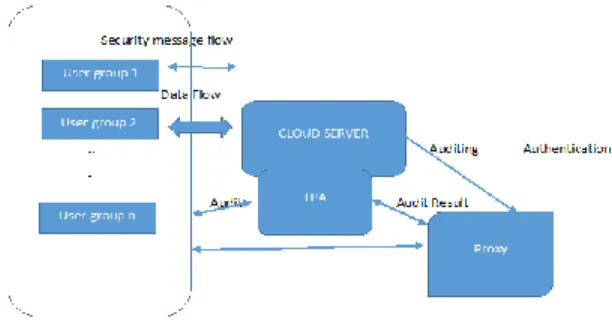
A proxy agent acts on behalf of the data owner to regenerate
authenticators and data blocks on the servers during the repair
procedure. Notice that the data owner is restricted in
computational and storage resources compared to other
entities and may becomes off-line after the data upload
procedure. The proxy, who would always be online, is
supposed to be much more powerful than the data owner but
less than the cloud servers in terms of computation and
memory capacity. To save resources as well as the online
burden potentially brought by the periodic auditing and
accidental repairing, the data owners resort to the TPA for
integrity verification and delegate the reparation to the proxy.
Considering that the data owner cannot always stay online in
practice, in order to
Fig. 5.2 Cloud Regeneration Architecture
keep the storage available and verifiable after a malicious
corruption, we introduce a semi-trusted proxy into the system
model and provide a privilege for the proxy to handle the
40
signature using OAEP based key delegation which providesunique private and public key for each group registered in the
cloud. So the users can access theS document provided by its
own group only.
The users can view other groups document using private key
of the other groups. If he modifies other group content he will
be revoked by the cloud server.
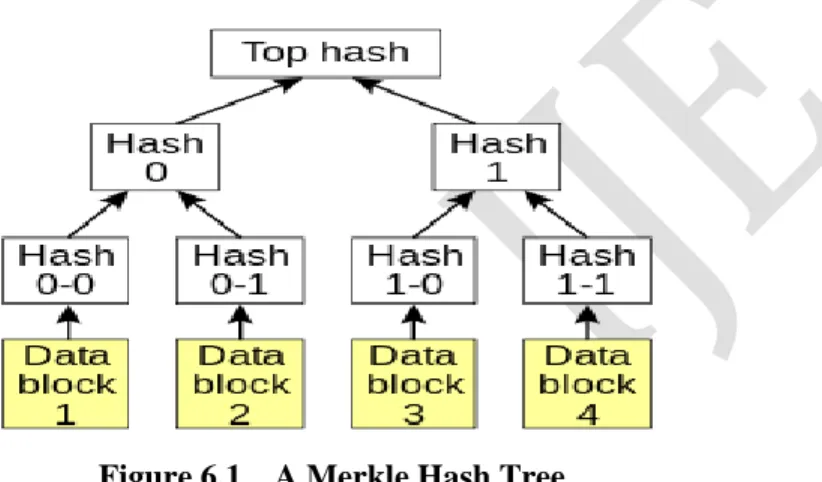
6.MERKLE HASH TREE BASED ARCHIVING:
This technique tries to verify a proof that the data stored by a
user at cloud is not modified and thereby the integrity of the
data is assured. Cloud archive is not defrauding the owner, if
cheating, in this context, means that the storage archive might
delete some of the data or may magnify some of the data.
While developing proofs for data possession at untrusted
cloud storage servers we are often defined by the resources at
the cloud server as well as at the client.
Figure 6.1 A Merkle Hash Tree
In this scheme, unlike in the key hash way scheme, only a
single key can be used irrespective of the size of the file or
the number of files whose retrievability it is want to verify.
Also the archive needs to access only a small portion of the
file F unlike in the key has scheme which required the annals
to process the entire file F for each protocol verification. If
the prover had magnify or deleted a substantial allocation of
F, then with high probability it will also have suppressed a
number of sentinels.
7.CONCLUSION
In this paper, we propose a public investigating scheme for
the regenerating-code-based cloud storage system, where the
data owners are privileged to delegate TPA for their data
validity checking. To protect the original data privacy against
the TPA, we randomize the coefficients in the beginning
rather than applying the blind technique during the auditing
process. Considering that the data owner cannot always stay
online in practise, in order to keep the storage available and
verifiable after a malicious corruption, we introduce a semi
trusted proxy into the system model and provide a privilege
for the proxy to handle the reparation of the coded blocks and
authenticators. To better appropriate for the
regenerating-code-scenario, we mapping our authenticator based on the
BLS signature. This authenticator can be efficiently generated
by the data owner simultaneously with the encoding
procedure. Extensive analysis shows that our scheme is
provable secure, and the performance evaluation shows that
our scheme is highly efficient and can be feasibly integrated
into a regenerating-code-based cloud storage system.
8.REFERENCE
[1] J. Stanek, A. Sorniotti, E. Androulaki, and L. Kencl, “A
secure data regeneration scheme for cloud storage,” in
Technical Report, 2013.
[2] J. R. Douceur, A. Adya, W. J. Bolosky, D. Simon, and M.
Theimer, “Reclaiming space from regenerate files in a
serverless distributed file system.” in ICDCS, 2002, pp. 617–
624.
[3] P. Anderson and L. Zhang, “Fast and secure laptop
backups with encrypted de-regeneration,” in Proc. of
USENIX LISA, 2010.
[4] M. Bellare, S. Keelveedhi, and T. Ristenpart, “Dupless: Serveraided encryption for deregenerated storage,” in
USENIX SecuritySymposium, 2013.
[5] G. R. Blakley and C. Meadows, “Security of ramp
schemes,” in Advances in Cryptology: Proceedings of
41
Blakley and D. Chaum, Eds. Springer-Verlag
Berlin/Heidelberg, 1985, vol. 196, pp. 242–268.
[6] J. Li, X. Chen, M. Li, J. Li, P. Lee, and W. Lou, “Secure
regeneration with efficient and reliable convergent key
management,” in IEEE Transactions on Parallel and
Distributed Systems, 2014, pp. vol. 25(6),
include Networking, Cloud Computing, and Data Mining.
pp. 1615–1625.
[7] S. Halevi, D. Harnik, B. Pinkas, and A. Shulman-Peleg,
“Proofs of ownership in remote storage systems.” in ACM
Conference on Computer and Communications Security, Y.
Chen, G. Danezis, and V. Shmatikov, Eds. ACM, 2011, pp.
491–500.
[8] C. Liu, Y. Gu, L. Sun, B. Yan, and D. Wang, “R-admad:
High reliability provision for large-scale de-regeneration
archival storage systems,” in Proceedings of the 23rd
international conference onSupercomputing, pp. 370–379.
[9] M. Li, C. Qin, P. P. C. Lee, and J. Li, “Convergent
dispersal: Toward storage-efficient security in a
cloud-of-clouds,” in The 6th USENIX Workshop on Hot Topics in
Storage and File Systems, 2014.
[10] J. S. Plank and L. Xu, “Optimizing Cauchy
Reed-solomon Codes for fault-tolerant network storage
applications,” in NCA-06: 5thIEEE International Symposium
on Network Computing Applications, Cambridge, MA, July
2006.
[11] D. Harnik, B. Pinkas, and A. Shulman-Peleg, “Side
channels in cloud services: Regeneration in cloud.
[12] J. S. Plank, S. Simmerman, and C. D. Schuman,
“Jerasure: A library in C/C++ facilitating erasure coding for
storage applications - Version 1.2,” University of Tennessee,
Tech. Rep. CS-08-627, August 2008.
[13] M. O. Rabin, “Efficient dispersal of information for
security, load balancing, and fault tolerance,” Journal of the
ACM, vol. 36, no. 2, pp. 335–348, Apr. 1989.
[14] A. Shamir, “How to share a secret,” Commun. ACM, vol.
22, no. 11, pp. 612–613, 1979.
AUTHORS BIOGRAPHY
Ms. S.Jeevitha Pursuing ME(CSE) degree
in Shree Venkateshwara Hi- Tech
Engineering College, Erode, India in 2014-2016 and B.E (CSE) degree from the Sasurie College of Engineering, Tirupur ,India in 2010-2014 .She is a Member of Computer Society of India (CSI). She published 1 National Conferences, 4 Workshops. Her research interests include Networking, Cloud Computing.
Mr. M. Rajesh M.E, Ph.D. in Cloud Computing. Now He is currently working
as Assistant Professor in Shree
Venkateshwara Hi-Tech Engineering
College, Gobi, Tamil Nadu, and India.
His research interests include
Networking, Data Bases, Artificial
Intelligence, Software Engineering etc., He has published several papers in 4 International Journals.
Dr.T.Senthil Prakash received the Ph.D.
degree from the PRIST University,
Thanjavur, India in 2013 and M.E(CSE)
degree from Vinayaka Mission’s
University, Salem , India in 2007 and
M.Phil.,MCA.,B.Sc(CS) degrees from
Bharathiyar University, Coimbatore India, in 2000,2003 and
2006 respectively, all in Computer Science and Engineering.
He is a Member in ISTE New Delhi, India, IAENG, Hong
Kong..IACSIT, Singapore SDIWC, USA. He has the
experience in Teaching of 10+Years and in Industry 2 Years.
Now He is currently working as a Professor and Head of the
Department of Computer Science and Engineering in Shree
Venkateshwara Hi-Tech Engineering College, Gobi, Tamil
Nadu, and India. His research interests include Data Mining,
Data Bases, Artificial Intelligence, Software Engineering
etc.,He has published several papers in 17 International