The Effects of Pride and Admiration on Pain Kara Thio
University of North Carolina at Chapel Hill Spring 2013
A thesis presented to the faculty of The University of North Carolina at Chapel Hill in partial fulfillment of the requirements for the Bachelor of Science degree with Honors in Psychology.
Co-advisor_________________________
Co-advisor_________________________
Abstract
While positive affect has been shown to have a modulatory effect on the experience of pain, it is unclear what contributions are made by specific positive emotions. This study explored whether or not two positive emotions, pride and admiration, can increase tolerance time to a noxious stimulus. Forty-seven participants from the University of North Carolina at Chapel Hill’s
Introductory Psychology Course’s Participant Pool were randomly assigned to three groups, who wrote for 10 minutes about a previous experience. One group wrote about a time they
Acknowledgements
I would like to express my upmost appreciation and thanks to my co-advisors, Dr. Mark Hollins and Dr. Sara Algoe, for graciously allowing me to explore and combine my interests from both labs into one project, especially when my interests didn’t align exactly with the
research emphases of either lab. Dr. Hollins’ and Dr. Algoe’s invaluable expertise, guidance, and encouragement were critical not only to the development and successful execution of my honors thesis, but also to my growth as a researcher.
In addition, an enormous thanks to Dr. Hollins, Dr. Algoe, and Dr. Jeannie Loeb for serving on my honors committee. Time is precious, and I greatly appreciate them giving up some of theirs in order to listen, familiarize themselves with, and provide helpful feedback and
reflection to my project.
To the Somatosensory lab, especially Dr. Hollins, Mr. Daniel Harper, and Mr. Michael Oehler, I am deeply grateful not only for allowing me to share their space, but also for their utmost consideration, advice, support, and encouragement to a successful implementation of my project. To the Emotions and Social Interactions lab, especially Dr. Algoe and Ms. Lahnna Catalino, I really appreciate their valued assistance, encouragement, and contribution to the measures in my project. And to the Psychology Department Honors Program, especially Dr. Beth Kurtz-Costes and Dr. Donald Baucom, I would like to thank for their irreplaceable guidance and support.
The Effects of Pride and Admiration on Pain
Pain can be an unwelcomed experience, causing discomfort and distress. However, the experience of pain is a way for the body to communicate to itself that something is wrong. Thus, pain promotes positive or corrective behavior. For example, pain can draw attention to a wound such as a cut, leading the person to disinfect and cover it. Or, pain can be a sign that an external stimulus is harmful, such as getting burned, and the person needs to stop touching the hot object and get away from it. While such benefits may result from short term experiences of pain, there are no benefits from long term experiences of pain.
Chronic pain does not promote any advantageous behavior or create any sort of relief, but instead causes discomfort and negative affect. People from all cultures have searched for ways to alleviate pain, from acupuncture and herbal remedies in traditional Chinese culture to
pharmaceutical drugs in contemporary Western culture (Brannon & Feist, 2010). However, could there be a more common and attainable way to relieve chronic pain? As chronic pain creates a negative experience for the body, it may be counteracted through positive experiences. The present study will further explore the effect positive emotions may have on the experience of pain by reviewing literature documenting pain relief during the experience of positive affect in clinical populations, pain reduction through positive mood in laboratory studies, and theories behind why specific emotions may affect the experience of pain.
Pain Relief and Positive Emotions in Clinical Populations
(Hu & Gruber, 2008). Positive affect was defined as energetic, attentive, and seeking pleasurable activity, whereas negative affect was emotional pain and distress; low states of positive affect were defined as sad or tired, and low states of negative affect as calm or serene (Hu & Gruber, 2008). Participants with higher positive affect and lower negative affect were more likely to report feeling healthier, be more active, and be less negatively affected by their symptoms than participants who had a higher negative affect and lower positive affect (Hu & Gruber, 2008). Although these participants may have experienced pain as a result of their illnesses, the direct relationship that their positive and negative affect states had with pain specifically is unclear.
The Dynamic Model of Affect (DMA) has been suggested to explain this relationship between pain and affect (Zautra et al., 2001). According to the DMA, people process and integrate lots of information in order to make affective judgments, but when people experience stress, such as pain, their ability to simultaneously attend to various emotional states decreases. Thus, during a painful episode, people only have enough resources to attend to positive affect or negative affect, but not both at the same time (Zautra et al., 2001). Indeed, women with
fibromyalgia and arthritis were found to experience mostly high positive affect and low negative affect, or vice versa, while they experienced high amounts of pain (Zautra et al., 2001; Zautra et al., 2005).
emotions creates an accumulation of resources that help a person cope with future negative experiences (Fredrickson, 2004).
One way positive emotions might lead to a decrease in pain is by decreasing the amount of pain catastrophizing (Ong, Zautra, & Reid, 2010). Researchers asked patients suffering from pain to keep a diary to record their emotions, pain catastrophizing, and pain levels each day (Ong et al., 2010). They found that patients with higher levels of psychological resilience, the ability to effectively endure and deal with adversity, experienced higher levels of daily positive emotions compared to patients with lower levels of psychological resilience; thus, these patients tended to experience less pain catastrophizing. The authors theorized that experiencing positive emotions prevented participants from focusing on the pain; therefore, an exaggerated pain experience that would normally result from pain catastrophizing was avoided (Ong et al., 2010).
The above studies have all demonstrated a relationship between positive affect and a decrease in pain experience among clinical pain patients. However, because these studies are correlational in nature, they cannot assert that positive affect is indeed the cause of this pain relief. Thus, further exploration of the effects of positive emotion on pain is needed in controlled, laboratory studies.
Pain Reduction through Positive Emotions in Laboratory Studies
feelings and a desire to get away from the stimulus. Pleasant stimuli will evoke a response from the appetitive system, creating positive emotions and a desire to get closer to the stimulus (Lang, 1995).
In respect to emotions, this means that evoking a positive emotion will trigger the appetitive system and inhibit the aversive system, thus decreasing susceptibility to pain (Lang, 1995). This phenomenon could be illustrated through the presentation of pleasant and unpleasant pictures, which allows for a controlled stimulation of positive and negative emotions (Lang, 1995). When the aversive system is activated with unpleasant pictures, it automatically
anticipates a noxious stimulus and is therefore primed to produce an avoidance response; when pleasant pictures activate the appetitive system, this response is inhibited. Thus, this theory was termed motivational priming (Lang, 1995).
As the motivational priming hypothesis predicts (Lang, 1995), participants who looked at positive pictures during a cold pressor test were able to withstand the task longer than
participants who looked at neutral pictures, and participants who looked at negative pictures could not withstand the test as long as participants who looked at neutral pictures (de Wied & Verbaten, 2001). The cold pressor test involved participants submerging their hand in painfully cold water around 2°C for as long as they could tolerate it (up to a 230s time limit). While de Wied and Verbaten (2001) acknowledged the pictures might affect tolerance through pure distraction, because only the pleasant pictures affected tolerance to the cold water, the distraction argument becomes invalid as it would predict that both pleasant and unpleasant pictures should both increase tolerance (de Wied & Verbaten, 2001).
states that activating the appetitive system with positive pictures inhibits the aversive system’s flight response to pain, the appraisal hypothesis posits that viewing pleasant pictures leads participants to appraise the noxious stimulus as less negative; thus, while the priming processes may cause participants to be more open to enduring the noxious stimulus longer, the appraisal processes may complement this by making the noxious stimulus seem less negative or making the participants feel more capable of handling it (de Wied & Verbaten, 2001). While de Wied and Verbaten (2001) found these hypotheses to be consistent with their results, results from a second experiment showed that not all unpleasant pictures had the same effects on tolerance.
Similarly, different types of pleasant pictures were found to have different effects on pain tolerance (Meagher, Arnau, & Rhudy, 2001). In one experiment, Meagher et al. (2001) presented a slideshow of nurturant or erotic pictures to participants before they engaged in a cold pressor task. The motivational priming theory (Lang, 1995) predicts that the pleasant and most arousing pictures (erotic) would lead to the most resilience against pain from the cold water, whereas the pleasant, but low arousing nurturant pictures would not (Meagher et al., 2001). However, the erotic pictures only increased tolerance threshold for male participants. But, Meagher et al. (2001) reasoned that these results were consistent with the motivational priming theory because women had not only rated the pleasant, erotic pictures as arousing, but also as disgusting. Thus, both the appetitive and aversive system were activated, canceling the effects of each other out (Meagher et al., 2001).
allows us to foster resources and help us cope with stressful situations (Fredrickson, 2004), then such a direct approach may have a stronger effect. Instead of relying on external stimuli to induce positive emotions, it could be that one’s own values of self-worth are enough to build and/or enforce a positive mindset and affect one’s experience of pain.
Researchers directly induced mood in participants by having them read depressive and elative Velten statements (Velten, 1986), and then try to experience what the statement said (Zelman, Howland, Nichols, & Cleeland, 1991). These elative statements, such as “If your attitude is good, then things are good, and my attitude is good,” had been found to induce a positive mood with feelings characterized by participants as “ambitious,” “confident,” “good,” “more able to accomplish something today,” and “optimistic,” to name a few (Velten, 1968). When participants read these elative statements before immersing their hand into a painfully cold water bath, they were able to tolerate the water longer than they were able to when they read neutral statements (Zelman et al., 1991). Conversely, when participants read depressive
statements such as “I have too many bad things in my life” (Velten, 1968), they were unable to tolerate the water as long as when they read the neutral statements (Zelman et al, 1991).
Zelman et al. (1991) demonstrate the effectiveness of targeting self-relevant positive states. However, these participants were aware of and were encouraged to feel specific positive or negative feelings (Zelman et al., 1999). If clinical patients with higher positive affect
experience more resilience to pain without having any positive emotion induced by an
stimulus, such as a cold water bath. Past research has induced specific emotions that were high in arousal in order to affect participants’ experience of cold water pain (de Wied & Verbaten, 2001; Meagher et al., 2001). While the DMA posits that high positive affect in general is needed in order to keep negative affect and pain to a minimum (Zautra et al., 2001) and the motivational theory argues that pleasant stimuli are needed to activate the appetitive system to inhibit the aversive system in order to decrease the severity of the pain experience (Lang, 1995), both agree that experiencing positive emotions seems to negate pain. However, it has yet to be determined if re-experiencing positive emotions can be strong enough to affect pain.
Rationale for Pride and Admiration
While previous research has shown that general positive affect can modulate the pain experience (Zautra et al., 2001; Zautra et al., 2005), it does not indicate which specific positive emotions can produce the same (or any) effect if they are internally induced. Thus, the author of this study would like to determine whether or not re-experiencing two specific positive emotions can help participants tolerate their hand in a cold water bath longer than participants who
experience no emotion in particular. This author chose pride and admiration as the two positive emotions.
primed into a goal-directed, persevering frame of mind. This might activate the appetitive system, inhibit the instinct to get away from a noxious stimulus (Lang, 1995) such as the cold water bath, and lead to greater tolerance time to the cold water as compared to participants who did not have pride evoked. Additionally, as those who experience pride want to continue feeling good about themselves, they are more likely to act in ways that maintain their proud state (Tracy & Robins, 2007). Thus, if participants who experience pride are faced with the task of tolerating cold water for as long as they can, they may be more likely to keep their hand in the water for longer periods of time.
While pride is considered a self-conscious emotion (Tracy & Robins, 2007), admiration is considered an “other-praising” emotion (Algoe & Haidt, 2009). Elevation and admiration have
been found to produce different motivations in participants: experiencing elevation caused participants to want to imitate positive behavior, and experiencing admiration caused participants to want to do well at a task (Algoe & Haidt, 2009). Individuals experiencing admiration have witnessed someone with “extraordinary displays of skill, talent, or achievement” and were
inspired to become successful as well (Algoe & Haidt, 2009). Thus, participants who experience admiration may be primed to want to do well at a task such as enduring a cold water bath for as long as possible. However, transforming feelings of admiration for others into motivation for the self may take more mental steps than transferring feelings of pride for the self into motivation for the self. Thus, it is unknown whether inspiration (due to admiration) would be as motivating as self-efficacy (due to pride) in tolerating a cold water bath.
The Present Study
this study will be testing the effects of feeling pride and admiration before participants place their hand in a painfully cold water bath. I hypothesize that the participants who experience a positive emotion before a cold pressor task will endure the cold water longer than participants who experience no emotion in particular. Furthermore, I predict that participants who experience pride will tolerate the cold water longer than participants who feel admiration.
Methods Participants
There were 47 subjects over the age of 18 recruited for this study from the Introductory Psychology Participant Pool website at the University of North Carolina at Chapel Hill. Of these participants, 17 were male, 30 were female, four were left handed, and 43 were right handed. Thirty-four subjects were White/Caucasian, five were Black/African-American, four were East Asian, four were South Asian, and four were Hispanic. However, because they did not follow directions in the writing prompt of the study, two participants were excluded from analysis, leaving a total of 45 participants in the data set. Prior to their arrival, participants were assigned to one of three conditions, designated by the emotion that was to be evoked by a writing task: pride, admiration, or no emotion in particular (control). This assignment was performed by randomly assigning a participant to each of the conditions before a participant could be assigned to that condition again. All procedures and materials were approved by the University of North Carolina at Chapel Hill Institutional Review Board, and written informed consent was obtained from all subjects.
Measures
Qualtrics. An online survey website was used to both create and access the surveys subjects completed. All subjects accessed the surveys on an IBM Lenovo computer in the lab room.
Survey Measures. Various trait measures were assessed to control for any possible effects they might have on tolerance.
Participants’ outlook towards positive and negative emotions was measured with the Positive Valuation scale (Catalino, n.d). This included 14 statements that participants rated on a 1-6 Likert scale.
Participants’ beliefs about their reactions towards positive and negative emotions were assessed with the Savoring Beliefs Inventory (Bryant, 2003). This is a 24-statement survey that participants rated on a Likert scale from 1-7.
How participants react to unpleasant experiences and pain was assessed with the Self-Compassion scale (Neff, 2003). This contains 26 statements that participants rated on a Likert scale from 1-5.
Self-esteem was assessed before and after the cold water bath with the Rosenberg Self Esteem Scale (Rosenberg, 1965). This is a 10-statement survey that participants rated on a Likert scale from 1-7. Self-esteem was measured twice to see if participants’ experience with the cold water impacted their self-esteem.
Participants’ tendency to catastrophize pain was assessed through the Pain
Catastrophizing scale (Sullivan, Bishop, & Pivik, 1995). This was a 13-statement survey that participants rated on a Likert scale from 0-4.
Cold Pressor. About 1.5-2 gallons of refrigerated tap water was used for the cold pressor. The container was an IglooTM Ice Cube container with a capacity of 11 L, and was divided diagonally by a removable nylon board. This divider had holes perforated in it to allow the movement of water between the two sides. An aquatic air pump was attached to the divider in order to continuously circulate the water. Ice was added to the compartment on one side of the divider to adjust it to about 6° Celsius, and subjects placed their non-dominant hand in the compartment without ice.
There were two chairs placed side-by-side. The cold pressor was placed on a chair so that when participants sat down in the chair next to it, they could easily place their hand in the cooler.
Manipulation Checks. These manipulation checks are described in detail in Appendix A. To determine whether or not emotions were elicited from the writing task, participants were asked to rate the extent they felt 24 emotions, both positive and negative, from 0-6, with 0 being “Not at all,” and 6 being “Very Much”. Participants were also asked to rate their mood from 0-100, 0 being “the most miserable and depressed I have ever felt”, and 100 being “the most joyous and happy I have ever felt.” This was asked both after the writing task and after the cold pressor task.
task in regards to when they first placed their hand in the cold water bath and right before they removed their hand from the cold water bath.
Coping Strategies. To assess the types of coping strategies participants utilized during the cold pressor task, participants rated six statements from 0-6, with 0 being “not at all”, and 6 being “very much”. These statements are described in Appendix B, and assessed participants’ thoughts, motivations, and experience during the cold pressor task.
Procedure
Subjects were presented with an overview of the study that included a description and visual of the cold pressor, and gave informed consent before starting the study. They were told that they would answer questionnaires about themselves, complete a writing task, undergo a cold pressor task, and then answer more questionnaires.
Participants took 10-15 minutes to complete the initial questionnaires on a lab computer, and then up to 10 minutes to complete the writing task. The experimenter timed the writing task with a stopwatch to ensure participants did not exceed the 10-minute limit, and gave the
participants a 1-minute warning before time was up. If participants asked the experimenter if they could move on to the next task before the 10 minutes were up, the experimenter allowed them to do so. The writing task instructed participants to write about a time they either
experienced pride or admiration, or about their typical morning routine (the control condition). For the pride condition, participants were prompted to write:
For the admiration condition, participants were prompted to write:
“…about a recent time when you felt admiration, inspiration, or awe toward someone close to you because of a display or his or her particular skills or talents. It does not matter how big or small the positive action, just please choose something that made you feel admiration at the time, and still makes you feel this way when you think about it.”
For the control condition, participants were prompted to write:
“…about how you get ready for school. We would like you to tell us about your typical morning routine to get ready for school each day starting from the time you wake up. It does not matter how big or small the action, just please give us as much detail as you can.”
The full prompt for each condition can be found in Appendix C. With the exception of the first 15 participants, the experimenter was blind to the conditions the participants were in.
Following the writing task, participants went into an adjacent room in the lab. This room contained two chairs side by side: a chair that participants would sit on and a chair that the cold pressor rested on. Participants were told to immerse their non-dominant hand up to their wrist in the cold water; thus, the cooler was placed on their non-dominant side. The experimenter
used a stopwatch to time participants’ tolerance to the water from the moment their hand was first completely submerged to the moment their hand was completely removed from the water. Participants were given paper towels to dry their hand off. Before the cold pressor task, the experimenter took the temperature of the water using a digital thermometer to ensure it was in the appropriate range.
Following the cold pressor task, participants returned to the computer and completed the rest of the questionnaires, which included follow-up questions pertaining to the writing task and cold pressor task (including the manipulation checks and coping strategies), and demographic questions. Participants were then debriefed.
Results Tolerance Time
Seven participants reached the maximum tolerance time and were excluded from the data set because the experimenter told them to remove their hand from the water. This was an
inaccurate representation of their tolerance time as this poses a limit on tolerance, and
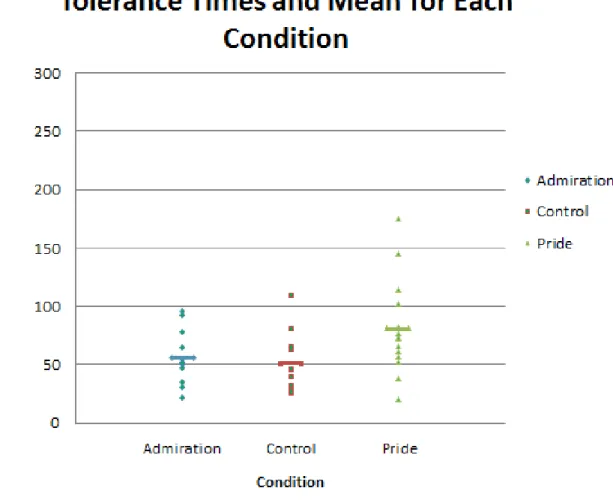
demonstrated a possible ceiling effect. Thus, 38 participants were included in data analysis1. Tolerance time for each subject was recorded by the experimenter using a stopwatch, and was converted into seconds for analysis. Tolerance times were compared using a one-way ANOVA, which showed that there was a significant difference among the tolerance times of each condition (F(2,35)=3.456, p=.043).
Independent t-tests were also used for selected comparison of the pride and admiration conditions, pride and control conditions, and admiration and control conditions. There was an approaching significant difference in tolerance times between the pride and admiration
(t=2.141, p=.043), and no significant difference between the admiration and control conditions (t=.406, p=.689).
As displayed in Figure 1, participants in the pride condition (N=15) had a mean tolerance time of 81.400 (SD=39.6877), participants in the admiration condition (N=12) had a mean tolerance of 56.083 (SD=23.1456), and participants in the control condition (N=11) had a mean tolerance of 51.909 (SD=26.1781).
Manipulation Checks
The means and standard deviations for the mood, positive emotions, negative emotions, admiration, inspiration, satisfaction, and proud emotions felt during the writing task are
displayed in Table 1.
Mood. Mood was assessed using a one-way ANOVA on the mood reported after completing the writing task, and there is no significant difference in the average mood reported among the conditions (F(2, 34)= 2.021; p=0.148), as shown in Table 2.
Emotions. Student’s t-tests were used to compare the positive emotions, negative emotions, admiring, inspired, satisfied, and proud emotions felt during the writing task.
There is a significant difference in the positive emotions reported between the pride and control conditions (t(24)= 2.061; p=0.050) and the admiration and control conditions (t(21)= 4.206; p<0.001), as shown in Table 3. There is not a significant difference in the negative emotions reported between the pride and control conditions (t(24)=0.253; p=0.802) or the admiration and control conditions (t(21)=- -0.354; p=0.727), also shown in Table 3.
(t(19.136)=-5.357; p<.001), as shown in Table 4. There is also a significant difference in how inspired participants felt between the admiration and control conditions (t(21)= 9.459; p<.001), and the pride and admiration conditions (t(23.071)= -2.815; p=0.010), also shown in Table 4.
The satisfied and proud emotions can be specifically identified with pride. There is a significant difference in how proud participants felt between the pride and control conditions (t(24)= 4.734; p<.001), but no significant difference in the proudness felt between the pride and admiration conditions (t(25)= -0.263; p=0.795), as shown in Table 5. There is not a significant
difference in how satisfied participants felt during the writing task between the pride and control conditions (t(24)= 1.301; p=0.206) or the pride and admiration conditions (t(25)=0.054;
p=0.958), also shown in Table 5. Coping Strategies
To identify whether or not participants may have utilized different coping strategies depending on the condition they were placed in, a one-way ANOVA was run on each of the coping strategies. This ANOVA revealed no significant differences among the conditions for any of the coping strategies (all F’s >0.009; all p’s > 0.443). The means and standard deviations of the coping strategies among the conditions are displayed in Table 6.
Discussion
This study aimed to explore the effects that pride and admiration might have on participants’ tolerance of a cold water bath. It was predicted that if participants experience a positive emotion before the cold pressor task, they will tolerate the water longer than participants in the control condition, who did not experience a positive emotion. Furthermore, it was
Although there was not a significant difference in how well the participants reported feeling in the mood question presented after the writing task, the other writing task manipulation checks showed that participants in the pride and admiration conditions did experience a greater amount of positive emotions than those in the control condition. Additionally, the admiration condition effectively evoked the most admiration and inspiration. In contrast, while the pride condition evoked more satisfaction and proudness than the control condition, it did not differ significantly from the admiration condition. However, this could be explained because the word “proud” is often associated with being “proud of someone.” Thus, participants in the admiration condition may have interpreted the word as such and reported feeling proud of the people they admired.
There was a significant difference in the tolerance times between the pride and control condition, but not between the admiration and control conditions. Additionally, there was a trending significant difference between participants in the pride and admiration conditions. One possible explanation is that the feelings of pride and admiration have different potencies or effects on tolerance. However, it is unknown the conscious effects that these emotions may have in dealing with the noxious stimulus, as there were no differences in the coping strategies used in the participants among the conditions.
positive a state and who do not have such emotions to protect and preserve; thus, they may be more willing to endure the noxious stimulus longer. But if this holds true, why does the pride condition have a significantly greater mean tolerance than the control condition?
Perhaps the experience of pride could potentially be strong enough to allow participants to endure a noxious stimulus longer than those who did not experience pride. Because pride is a more self-relevant emotion and can cause elation in response to an already achieved success (Tracy and Robins, 2007), it may cause stronger and more durable effects toward the endurance of a noxious stimulus. In contrast, the inspiration to do well as a result of admiration (Algoe and Haidt, 2009) may be diluted and less resilient to degradation in the presence of a noxious
stimulus. Thus, perhaps the positive emotion of pride allows a stronger buffer of personal resources (Fredrickson, 2004).
Similarly, maybe admiration evoked through writing is not strong enough to produce the predicted positive effects and affect tolerance levels. If the motivational priming theory (Lang, 1995) were to be applied, it may be that the admiration evoked did not activate the appetitive system enough to inhibit the aversive system and increase pain tolerance, whereas pride did. As explored in previous studies testing the effects of different positive emotions on the experience of pain, a positive emotion of high arousal is required to produce an effect on the pain system (Meagher et al., 2001). Thus, it may be that admiration on its own is not powerful enough to have an effect on the pain system.
The fact that there were quite a few participants who reached the maximum tolerance time (7 out of 45 participants) and were removed from analysis demonstrates a ceiling effect resulting from the moderate (6° C) water temperature. This temperature made the water tolerable to more participants, allowing them to endure the water to the maximum time. If the water was colder, fewer participants might have reached the maximum time allotted, and the more
representation from each condition may have enhanced or altered the data.
Works Cited
Algoe, S. B., & Haidt, J. (2009). Witnessing excellence in action: The 'other-praising' emotions of elevation, gratitude, and admiration. The Journal of Positive Psychology, 4, 105-127. doi: 10.1080/17439760802650519
Brannon, L. & Feist, J. (2010). Health Psychology: An Introduction to Behavior & Health, (7th edition). Belmont, CA: Wadsworth/Cengage.
Bryant, F. B. (2003). Savoring beliefs inventory (SBI): A scale for measuring beliefs about savouring. Journal of Mental Health, 12, 175-196. doi: 10.1080/0963823031000103489 de Wied, M., & Verbaten, M. N. (2001). Affective pictures processing, attention, and pain
tolerance. Pain, 90, 163-172. doi: 10.1016/S0304-3959(00)00400-0
Gosling, S. D., Rentfrow, P. J., & Swann, W. B. (2003). A very brief measure of the big-five personality domains. Journal of Research in Personality, 37, 504-528.
doi:10.1016/S0092-6566(03)00046-1
Fredrickson, B. L. (2004). The broaden-and-build theory of positive emotions. Philosophical Transactions of the Royal Society of London. Series B, Biological sciences, 359, 1367-1377. doi: 10.1098/rstb.2004.1512
Jennings, P. D., McGinnis, D., Lovejoy, S., & Stirling, J. (2000). Valence and arousal ratings for Velten mood induction statements. Motivation and Emotion, 24, 285-297. doi:
10.1023/A:1010745016868
Lang, P. J. (1995). The emotion probe. Studies of motivation and attention. The American Psychologist, 50, 372-385. doi: 10.1037/0003-066X.50.5.372
Neff, K. D. (2003). The development and validation of a scale to measure self-compassion. Self and Identity, 2, 223-250. doi: 10.1080/15298860390209035
Ong, A. D., Zautra, A. J., & Reid, M. C. (2010). Psychological resilience predicts decreases in pain catastrophizing through positive emotions. Psychology and Aging, 25, 516-523. doi: 10.1037/a0019384
Rosenberg, M. (1965). Society and the adolescent self-image. Princeton, NJ: Princeton University Press.
Sullivan, M. J., Bishop, S. R., & Pivik, J. (1995). The pain catastrophizing scale: Development and validation. Psychological Assessment, 7, 524-532.
Tracy, J. L., & Robins, R. W. (2007). Emerging insights into the nature and function of pride. Current Directions in Psychological Science, 16, 147-150. doi: 10.1111/j.1467-8721.2007.00493.x
Velten, E. (1968). A laboratory task for induction of mood states. Behaviour Research and Therapy, 6, 473-482. doi: 10.1016/0005-7967(68)90028-4
Williams, L. A., & DeSteno, D. (2008). Pride and perseverance: The motivational role of pride. Journal of Personality and Social Psychology, 94, 1007-1017. doi: 10.1037/0022-3514.94.6.1007
Zautra, A., Smith, B., Affleck, G., & Tennen, H. (2001). Examinations of chronic pain and affect relationships: Applications of a dynamic model of affect. Journal of Consulting and Clinical Psychology, 69, 786-795. doi: 10.1037/0022-006X.69.5.786
1
Appendix A Manipulation Checks
Mood question: Participants will see a horizontal line with numbers in 10 unit increments, ranging from 0 (the most miserable and depressed I have ever felt) to 100 (the most joyous and happy I have ever felt), with a marker that can be slid along the scale using the cursor. They will see the following instruction and question:
1. Please slide the marker to the place on the scale that most accurately depicts your current mood.
2. How are you feeling right now, at this moment?
Pain rating questions: Participants will see a horizontal line with depicting a scale from 0 to 10, where 0 represents “No Pain” to “Most intense pain imaginable,” with a marker that can be slid along the scale using the cursor. They will see the following 2 questions:
3. When you first placed your hand in the cold water, how would you rate your pain? Please indicate on the scale below from 0-10 where 0 indicates “no pain” and 10 indicates the “most intense pain imaginable”
4. Right before you removed your hand from the cold water, how would you rate your pain? Please indicate on the scale below from 0-10 where 0 indicates “no pain” and 10 indicates the “most intense pain imaginable”
State Measures
Please indicate how you felt during or as a result of writing the story on a scale from 0-6, 0 corresponding to “not at all” and 6 corresponding to “very much.”
Not at all 0 1 2 3 4 5 6 Very Much ___ satisfied ___ guilty ___ frustrated ___ ashamed ___ disgusted ___
appreciative
___ amused ___ proud ___ rejected ___ admiring ___ sad ___ indebted ___ loving ___ resentful ___ grateful ___ inspired ___ angry ___ peaceful ___
embarrassed
___
misunderstood ___warm ___open ___ suspicious ___contemptuous
2. How easy or difficult was it to write for the full time allotted on this topic? very difficult -3 -2 -1 0 1 2 3 very easy
Please indicate, in a word or phrase, the type of story you were asked to write about: _____ 3. Please estimate how many minutes you took to write the story:
Appendix B Coping Mechanisms
Follow-up questions about experience with the cold water: Participants will see a matrix questionnaire containing the following 6 questions. They will be asked to rate the extent they agree to each question with a scale ranging from 0, “not at all,” to 6, “very much.”
Instructions: We know that lots of things go through people’s minds when they do any specific task. The following statements may or may not apply to you. Although some statements may seem related to each other, please rate each statement on its own on a scale ranging from 0-6, 0 corresponding to “not at all” and 6 corresponding to “very much.”
While your hand was in the cold water…
5. To what extent did you believe you were capable of keeping your hand in for a long time? 6. To what extent did you try to distract yourself with other thoughts?
7. To what extent did you try to think that the water wasn’t that cold? 8. To what extent did you think about the story that you told?
9. To what extent did you feel motivated to try and keep your hand in the water as long as you could?
Appendix C
Writing Instructions for Each Condition Condition 1: ADMIRATION
Remember: This writing task is completely confidential. If you’d like, you’re welcome to use pseudonyms instead of real names. We are just interested in the story. These excerpts will be kept for data analysis.
Please think about your interactions for the last few months. We would like you to tell us about a recent time when you felt admiration, inspiration, or awe toward someone close to you because of a display or his or her particular skills or talents. It does not matter how big or small the positive action, just please choose something that made you feel admiration at the time, and still makes you feel this way when you think about it.
Some examples might be demonstrating a great physical or mental ability, or doing something particularly courageous or commendable. Please take time to imagine what the positive event was like and try to relive it again in your mind’s eye. Then describe what made you feel this way as vividly and in as much detail as you can.
The following questions may help you with this task: What were you feeling? What made you feel that way? What was important for you? What led up to that feeling? Did that event set off some chain of thoughts or fantasies that enhanced your feelings? What were they?
Please describe the event and your feelings as vividly and in as much detail as you can for about 10 minutes —just as long as it takes to tell the story. This page contains the text box in which you may write your story about the event. Again, there is no need to worry about spelling or grammar – we are just interested in finding out more about this type of event as it happens in everyday life.
Condition 2: PRIDE
Remember: This writing task is completely confidential. If you’d like, you’re welcome to use pseudonyms instead of real names. We are just interested in the story. These excerpts will be kept for data analysis.
Please think about yourself for the last few months. We would like you to tell us about a recent time when you felt really proud, accomplished, or successful with yourself because of
something you did. It does not matter how big or small the positive action, just please choose something that made you feel pride at the time, and still makes you feel this way when you think about it.
The following questions may help you with this task: What were you feeling? What made you feel that way? What was important for you? What led up to that feeling? Did that event set off some chain of thoughts or fantasies that enhanced your feelings? What were they?
Please describe the event and your feelings as vividly and in as much detail as you can for about 10 minutes —just as long as it takes to tell the story. This page contains the text box in which you may write your story about the event. Again, there is no need to worry about spelling or grammar – we are just interested in finding out more about this type of event as it happens in everyday life.
Condition 3: Routine Behavior
Remember: This writing task is completely confidential. If you’d like, you’re welcome to use pseudonyms instead of real names. We are just interested in the story. These excerpts will be kept for data analysis.
Please think about how you get ready for school. We would like you to tell us about your typical morning routine to get ready for school each day starting from the time you wake up. It does not matter how big or small the action, just please give us as much detail as you can.
Some examples might be how many times you snooze your alarm clock, do you use a clock for an alarm or something else like a cellphone, what type of toothpaste do you use, or what do you eat for breakfast. Please take time to imagine what the event was like and try to relive it again in your mind’s eye. Then describe the event as vividly and in as much detail as you can.
The following questions may help you with this task: What were you thinking? What made you think that? In what order did you complete these activities? Why do you complete them in that order?
Please describe the event and your feelings as vividly and in as much detail as you can for about 10 minutes —just as long as it takes to tell the story. This page contains the text box in which you may write your story about the event. Again, there is no need to worry about spelling or grammar – we are just interested in finding out more about this type of event as it happens in everyday life.
Table 1
Mean and standard deviations of mood, positive emotions, negative emotions, admiring, inspired, satisfied, and proud emotions felt during the writing task.
Admiration Pride Control
Measures Mean SD Mean SD Mean SD
Mood 62.667 17.8902 73.500 12.7022 70.909 10.6626
Positive
Emotions 4.1742 1.11506 3.2345 1.46728 2.1074 1.24171
Negative
Emotions .4231 .52634 .6064 .80766 .5245 .82621
Admiring 5.417 .7930 2.400 1.9928 1.182 1.6624
Inspired 5.000 1.2060 3.200 2.0771 .545 1.0357
Satisfied 4.167 1.8007 4.200 1.4243 3.364 1.8586
Proud 4.250 2.0505 4.067 1.5796 1.182 1.4709
Table 2
One-Way ANOVA for the mood assessment after the writing task.
Variable df F Significance Mood (20, 16) 1.231 0.340
Table 3
Student’s t-tests comparing the positive emotions and negative emotions felt during the writing task among the conditions.
Measures Admiration vs. Control Pride vs. Control
Positive Emotions 4.206** 2.061*
Negative Emotions -.354 .253
Table 4
Student’s t-tests comparing the admiring and inspiring emotions felt during the writing task among the conditions.
Measures Pride vs. Admiration Control vs. Admiration
Admiring -5.357** 7.685**
Inspired -2.815* 9.459**
*p<.05 **p<.001
Table 5
Student’s t-tests comparing the satisfied and proud emotions felt during the writing task among the conditions.
Measures Admiration vs. Pride Control vs. Pride
Satisfied .054 1.301
Proud -.263 4.734**
*p<.05 **p<.001
Table 6
Mean and standard deviations of the coping strategies used during the cold pressor task.
Admiration Pride Control
Measures Mean SD Mean SD Mean SD
Capable of keeping hand
in long
3.667 1.5570 3.733 1.9074 3.200 2.2509
Distract with other thoughts
3.583 2.1515 3.533 1.8465 3.400 1.6465
Water isn’t
cold 3.417 2.1515 2.733 1.7512 2.400 1.9551
Think about
story 1.083 1.7299 .933 1.5796 .300 .9487
Motivated to keep hand in
long
4.000 1.9540 3.933 1.5796 3.400 2.2211
Pain is