VOTER BEHAVIOR IN ELECTIONS WITHOUT PARTY LABELS
John P. Lappie
A dissertation submitted to the faculty at the University of North Carolina at Chapel Hill in partial fulfillment of the requirements for the degree of Doctor of Philosophy in the Department
of Political Science in the College of Arts and Sciences.
Chapel Hill 2015
Approved by: Thomas M. Carsey Virginia Gray
Michael B. MacKuen Isaac Unah
ii
iii ABSRACT
John P. Lappie: Voter Behavior in Elections without Party Labels (Under the direction of Thomas M. Carsey)
If there is consensus on anything in Political Science, it is that party matters to voters. Beyond this point there is considerable dispute. Scholars have focused most of their attention on high profile partisan elections, giving rather less attention to non-partisan elections and
primaries. I refer to the latter as Elections without Party Labels (EWPLs). This is unfortunate, because EWPLs can be used to gain leverage on questions about the role of party for American voters, questions that are difficult to answer by examining only formally partisan elections. In this dissertation I examine voter behavior in EWPLs. In Chapter One, I argue that party
iv
ACKNOWLEDGEMENTS
v
TABLE OF CONTENTS
LIST OF TABLES ... ix
LIST OF FIGURES ... xii
CHAPTER ONE: Introduction to Voter Behavior in Elections without Party Labels ... 1
1.2 The Importance of EWPLs ... 2
1.3 EWPLs as Leverage ... 3
Bibliography ... 7
CHAPTER TWO: Basis of Party Identification and Voter Behavior in the Presence of Cross-Pressure ... 10
2.1Introduction ... 11
2.2Theory ... 12
2.2.1 Party as a Psychological or Social Attachment ... 12
2.2.2 Rational Theories of Party Identity ... 14
2.2.3 Basis of Partisanship and Cross-Pressure ... 15
2.2.4 Candidate Quality, Non-Partisan Elections, and Judicial Elections ... 18
2.2.5 Types of Partisanship, Candidate Quality, Judicial Elections, and Cross-Pressure ... 20
2.3 Data and Methods ... 22
vi
2.3.2 Statistical Model ... 25
2.4 Models and Results ... 26
2.4.1 Support for Gordon Across Treatments... 26
2.4.2 Party and Assessment of Candidate Quality ... 27
2.4.3 Basis of Partisanship and Support for Gordon ... 29
2.5 Discussion and Conclusion ... 33
Bibliography ... 37
CHAPTER THREE Education, Quasi-Partisan Campaigns, and Ballot Roll-Off in Elections without Party Labels ... 41
3.1 Introduction ... 42
3.2 A Theory of Voter Participation in EWPLs ... 44
3.2.1 Information, Party, and Ballot Roll-Off ... 44
3.2.2 Education and Participation in EWPLs; or for whom is party important? ... 46
3.2.3 Candidate Decisions and Voter Participation in EWPLs ... 47
3.3 Data and Methods ... 49
3.3.1 Samples, Models, and Data ... 49
3.3.2 Dependent Variable ... 51
3.3.3 Key Independent Variables... 51
3.3.4 Identifying Campaigns as Quasi-Partisan or Truly Non-Partisan ... 52
3.3.5 Controls ... 54
3.3.6 Statistical Models ... 55
vii
3.5 Discussion and Conclusion ... 57
Bibliography ... 60
CHAPTER FOUR: Education, Quasi-Partisan Campaigns, and Preference Congruent Voting in Non-Partisan Elections ... 64
4.1 Introduction ... 65
4.2 A Theory of Preference-Congruent Voting in Non-Partisan Elections ... 67
4.2.1 Heuristics ... 67
4.2.2 Party and Preference-Congruent Voting ... 68
4.2.3 Education and Voter Behavior in Non-partisan elections. ... 71
4.2.4 Candidate Behavior: Does it affect voters? ... 72
4.3 Data and Methods ... 74
4.3.1 Samples, Case Selection, and Data ... 74
4.3.2 Dependent Variable ... 77
4.3.3 Key Independent Variables ... 77
4.3.4 Controls ... 78
4.3.5 Method ... 79
4.4 Results ... 79
4.5 Discussion and Conclusion: Are Non-Partisan Elections Discriminatory? ... 83
Bibliography ... 86
CHAPTER FIVE: Voter Behavior in Elections without Party Labels, a Conclusion ... 91
5.2 Summary of Results ... 91
viii
5.4 EWPLs: Normative Implications ... 95
5.5 Conclusion ... 96
Bibliography ... 98
APPENDIX A ... 99
Models broken down by party of respondent ... 99
Logistic Regression Tables ... 103
Predicted Probabilities, Alternative Factors ... 108
Descriptive Statistics ... 117
APPENDIX B ... 122
ix
LIST OF TABLES
Table 2.1: Model 1, Probability of Vote for Gordon among partisan
respondents, by treatment ... 26
Table 2.2: Model 2, probability of evaluating Gordon as more qualified, by treatment. Partisan respondents. ... 28
Table 2.3: Probability of Voting for Gordon by Psychological and Objective Partisanship ... 30
Table 2.4: Diagnostic Regression ... 33
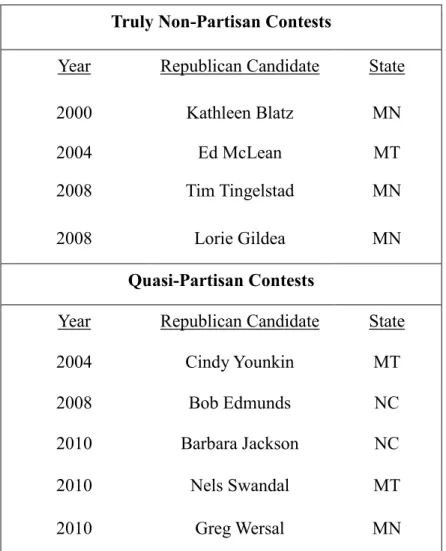
Table 3.1: Case Selection, Truly Non-Partisan Contests ... 54
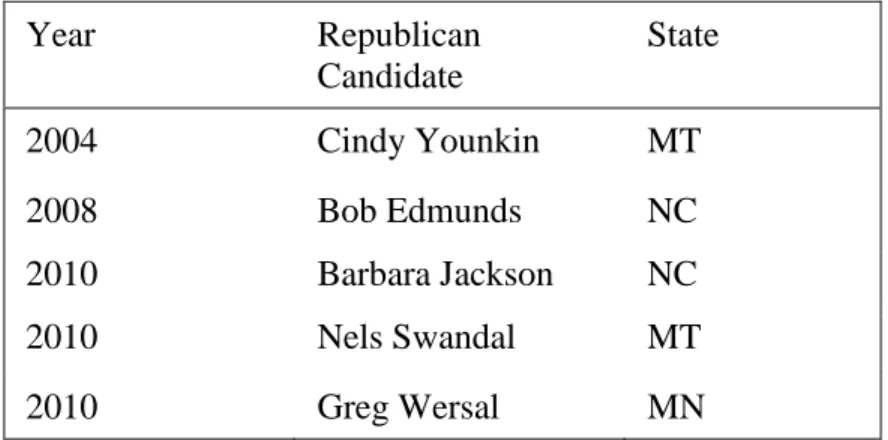
Table 3.2: Case Selection, Quasi-Partisan Contests ... 54
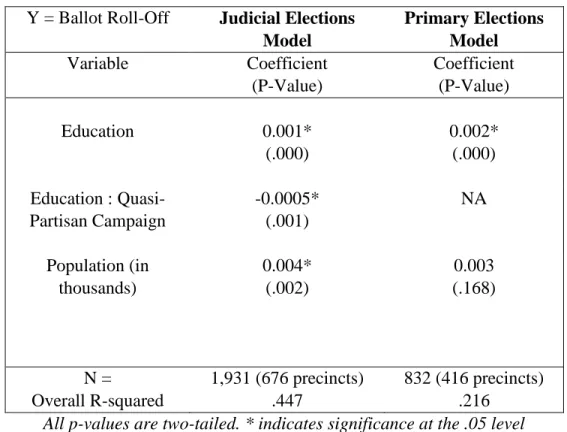
Table 3.3: Abridged Results ... 56
Table 4.1: Contest Selection ... 76
Table 4.2: Determinants of Republican Judicial Vote, abridged ... 80
Table 2.5: Model 1, Broken down by party of respondent ... 99
Table 2.6: Model 2, broken down by party of respondent ... 100
Table 2.7: Model 3, broken down by party of respondent ... 101
Table 2.8: Diagnostic regression, broken down by party of respondent ... 102
Table 2.9: Model 1, Probability of vote for Gordon from Independent respondents, by treatment... 103
Table 2.10: Model 2, probability of assessing Gordon as more qualified, independents only ... 103
Table 2.11: Model 1, Partisan Respondents... 104
Table 2.12: Model 1, Independent respondents ... 105
Table 2.13: Model 2, Partisan Respondents... 106
x
Table 2.15: Model 3 ... 107
Table 2.16: Diagnostic Regression ... 108
Table 2.17: Model 1, with Race variable. Partisans only ... 109
Table 2.18: Model 2, with Race variable. Partisans only ... 109
Table 2.19: Model 1, by Gender. Partisans only... 110
Table 2.20: Model 2, with Gender variable. Partisans only. ... 110
Table 2.21: Model 1, with Philosophy of Candidates. Partisans Only ... 111
Table 2.22: Model 2, with Philosophy of Candidates. Partisans Only ... 111
Table 2.23: Model 1, with Political Knowledge Variable. Partisans only. ... 112
Table 2.24: Model 2, with Political Knowledge Variable. Partisans only. ... 113
Table 2.25: Model 1, with Race variable. Nonpartisans only ... 114
Table 2.26: Model 2, with Race variable. Nonpartisans only ... 114
Table 2.27: Model 1, with Gender variable. Nonpartisans only ... 115
Table 2.28: Model 2, with Gender variable. Nonpartisans only ... 115
Table 2.29: Model 1, by philosophy of Gordon. Nonpartisans only ... 116
Table 2.30: Model 2, by philosophy of Gordon. Nonpartisans only ... 116
Table 2.31: Respondent Gender ... 117
Table 2.32: Respondent Party Identity... 118
Table 2.33: Respondent Age ... 119
Table 2.34: Respondents by Education ... 120
Table 2.35: Respondent Race/Ethnicity ... 121
Table 2.36: Knowledge and Ideology ... 121
xi
Table 3.5 Full Results, Primaries Model ... 123
Table 3.6: Diagnostic Regression, Judicial Elections Sample ... 124
Table 3.7: Diagnostic Regression, Primaries Model ... 125
Table 3.8: Judicial Model, Quasi-Partisan Cases Only... 126
Table 3.9: Judicial Elections model, truly non-partisan cases only ... 126
Table 3.10: Judicial Elections Sample, dropping one ... 127
Table 3.11: Primaries sample, dropping one contest per regression ... 128
Table 3.12: Single Contest Regressions, Judicial Contests ... 129
Table 3.13: Single Contest Regressions, Primaries Model ... 130
Table 3.14: Descriptive Statistics, Judicial Model... 130
Table 3.15: Descriptive Statistics, Primaries Model ... 131
Table 4.3: Quasi-Partisan Model, Homogenous Precincts ... 132
Table 4.4: Full Results, Quasi-Partisan Contests ... 133
Table 4.5: Full Results, Truly Non-Partisan Contests ... 134
Table 4.6: One-Contest Regressions, Quasi-Partisan Contests ... 135
Table 4.7: One-Contest Regressions, Truly Non-Partisan Contests ... 136
xii
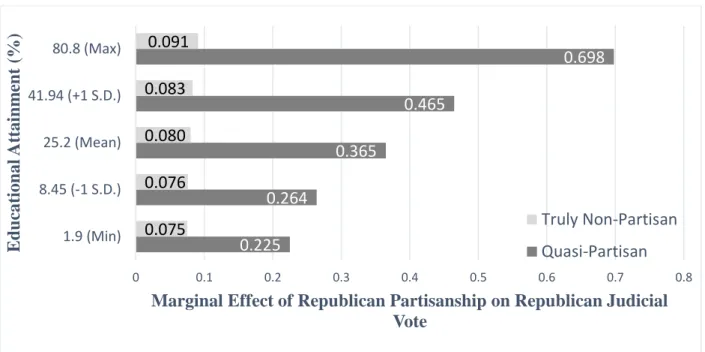
LIST OF FIGURES Figure 4.1: Effect of GOP Partisanship on GOP Judicial Vote,
1
Chapter One: Introduction to Voter Behavior in Elections without Party Labels
Walker (1966) noted that the most important aspect of the classical theory of democracy was the existence of “…an active, informed, democratic citizenry…” (p. 285). Many citizens, then and now, do not vote, and most are politically uninformed (see Campbell et al, 1960; Converse, 1964; Somin, 2004). Still, V.O. Key was right when in 1966 he declared that voters are not fools. Ignorance is not the same thing as foolishness. The standards set by classical democratic theorists were simply too high (see Dahl, 1949; Lippmann, 1922). Democracy still seems to function. Most Americans, at least in Presidential elections, even vote correctly (Lau and Redlawsk, 1997). How are voters able to cast ballots in a reasonable fashion? To many scholars, the answer to this puzzle is heuristics. So long as citizens utilize a reasonable decision rule, they do not need to be fully or even well informed on every candidate/issue (see Druckman, 2001; Gerber and Lupia, 1999; Lupia, 1994; Page and Shapiro, 1992; Popkin, 1991; Collier et al, 1989; McKelvey and Ordeshook, 1986). The most notable of these decisions rules, or heuristics, is the party heuristic. DeSart (1995) and Huckfeldt et al (1999) found that the party heuristic is easily understood by most voters, and thus has a major effect on candidate evaluation and vote choice. In short, party is the most important heuristic available to voters.
2
in partisan elections (DeSart, 1995; Huckfeldt et al, 1999). It is also clear that party labels can act as informational shortcuts. Citizens do not need to be fully or even well informed on every candidate/issue so long as they utilize an informational shortcut that maps reasonably well with their likely preferences on those candidates and issues (see Druckman, 2001; Gerber and Lupia, 1999; Lupia, 1994; Page and Shapiro, 1992; Popkin, 1991; Collier et al, 1989; McKelvey and Ordeshook, 1986). This dissertation is concerned primarily with party, and how party influences the decisions made by voters. Perhaps paradoxically, answering these questions requires scholars to examine elections without party labels (EWPLs). By examining EWPLs, we gain leverage on questions about the role of party in American democracy. These questions are difficult if not impossible to answer if one examines only elections where there is a meaningful party label on the ballot.
By EWPL, I mean both formally non-partisan elections and elections where the party label is technically on the ballot, but provides no meaningful information to voters. Primaries are an example of the latter category; strictly speaking party labels are present on the ballot, but they convey no meaningful information to voters (Lau and Redlawsk, 2001; Key, 1949). The same can be said of run-off elections, if both candidates in the second round belong to the same party.
1.2 The Importance of EWPLs
non-3
partisan elections.1 These officials do vital work, running the services that people rely upon on a day-to-day basis, or interpreting the state constitution.
Party primaries are, perhaps counter-intuitively, essentially non-partisan elections (Key, 1949). Voters in a general election can reasonably infer that a Republican is more conservative than a Democrat. It is more difficult to tell which Republican hopeful in a primary field is more or less conservative than the rest. Thus, even in races for partisan offices, it is important to remember that the election is really a two-stage process, and that the first stage lacks meaningful party labels.
1.3 EWPLs as Leverage
The study has EWPLs has mostly been confined to scholars of urban politics and the judiciary. This is unfortunate because, in addition to being important in their own right, EWPLs give scholars leverage to answer questions we care about regarding the role of party. It is difficult to answer questions about the role of party if every observation you have comes from a partisan election. This dissertation examines EWPLs because they are important in and of themselves, and because doing so can help answer fundamental questions about the role of party in voter behavior.
Chapter one examines one such question. There is considerable debate over the meaning of party to American voters. Some scholars argue that party is a psychological and/or social tie to voters that is very difficult to change, and that party acts as a perceptual filter (see Bartels, 2002; Miller and Shanks, 1996; Campbell et al, 1960). Conversely, argue that party identity is formed through a Bayesian updating process and is relatively malleable (Achen, 1992; Fiorina, 1991). In this conception, party does not really serve as an identity, but rather as a running tally performance evaluation of the parties. Still others have argued that voters use party as a more-or-less reliable guide to the ideology and policy positions of candidates (Abramowitz and Saunders, 1998). I argue
4
that in reality there are at least two kinds of party identifiers: those for whom party is a strong psychological attachment (psychological partisans), and those for whom it is not (objective partisans). To see the ways different types of partisans behave, it is necessary to have a baseline of comparison. I establish that baseline by analyzing how partisans behave in the absence of party labels. In this chapter, I examine the results of a unique survey experiment given to a large sample of American adults via Qualtrics. This survey experiment presents mock campaign material that described candidates running in a judicial election. Whether or not a party label is present is manipulated. Furthermore, the survey introduces cross-pressure, such that a partisan respondent will always be given a scenario in which their co-partisan is also the less qualified candidate. The results suggest that different types of partisans do behave differently in the presence of pressure. Namely, psychological partisans are much less likely to defect in the presence of cross-pressure.
5
A major question in the discipline is who benefits most from the use of the party heuristic, high sophisticates or low sophisticates? Some scholars have argued that since cognitive heuristics enable citizens to make decisions without having a great deal of information, they are most important for the uninformed (Popkin, 1991; Collier et al, 1989; McKelvey and Ordeshook, 1986). Others have argued that one has to be somewhat well informed a priori to understand what a heuristic means. Therefore it is the better informed, rather than the less informed, who benefit the most from heuristics (Lau and Redlawsk, 1997; Sniderman et al, 1991). To find out who benefits most from party however, one cannot look just at partisan elections. The best way to answer this question is to see what happens when the party label is taken away, and see how well different types of citizens perform.
In Chapter two, I examine the effects of education and candidate behavior on participation in EWPLs. I argue that the better educated should be better able to navigate the low-information environment of EWPLs, and thus should have higher rates of participation than the less educated. I also argue that when candidates in non-partisan elections run blatantly partisan campaigns (quasi-partisan campaigns) participation will increase across all levels of education, but particularly among the better educated. I test these hypotheses by examining ballot roll-off in a sample of precinct-level non-partisan judicial election returns and a sample non-gubernatorial executive branch primary election results from 2008. The results indicate that, contrary to expectations, participation in EWPLs decreases as education increases. This counter-intuitive result has been found elsewhere, however (Streb et al, 2009; Nichols and Strizek, 1994).
6
7
BIBLIOGRAPHY
Abramowitz, Alan and Saunders, Kyle (1998). “Ideological Realignment in the U.S. Electorate.” Journal of Politics. 60(3) pp. 634-52.
Achen, Christopher (1992). “Social Psychology, Demographic Variables, and Linear Regression: Breaking the Iron Triangle in Voting Research.” Political Behavior. 14(3) pp. 195-211 Bartels, Larry (2001). “Beyond the Running Tally: Partisan Bias in Political Perceptions.” Political
Behavior. 24(2) pp. 117-50
Bonneau, Chris and Cann, Damon (2013). “Party Identification and Vote Choice in Partisan and Nonpartisan Elections.” Political Behavior. 37(1) pp. 43-66
Campbell, Angus; Converse, Philip; Miller, Warren; and Stokes, Donald (1960). The American Voter. Chicago: Chicago University Press
Carsey, Thomas and Layman, Geoffrey (2006). “Changing Sides or Changing Minds? Party Identification and Policy Preferences in the American Electorate?” American Journal of Political Science. 50(2) pp. 464-77
Collier, Kenneth; Ordeshook, Peter; and Williams, Kenneth (1989). “The Rationally Uninformed Electorate: Some Experimental Evidence.” Public Choice. 60(1) pp. 3-29.
Converse, Philip (1964). The Nature of Belief Systems in Mass Publics. Dahl, Robert (1949). Who Governs. New Haven: Yale University Press
Dahl, Robert (1989). Democracy and Its Critics. New Haven: Yale University Press
DeSart, Jay (1995). “Information Processing and Partisan Neutrality: A Reexamination of the Party Decline Thesis.” The Journal of Politics. 57(3) pp.. 776-95.
Druckman, James (2001). “The Implications of Framing Effects for Citizen Competence.” Political Behavior. 23(3) pp. 225-56.
Dubois, Philip (1980). From Ballot to the Bench: Judicial Elections and the Quest for
Accountability. Austin: University of Texas Press
Gerber, E. R., and Lupia, A. (1999). Voter competence in direct legislation elections. In Citizen competence and democratic institutions, (Elkin, Stephen and Soltan, Karol, eds.) 147-160. University Park: Pennsylvania State University Press.
8
Key, V.O. (1949). Southern Politics in State and Nation. New York: Alfred Knopf.
Key, V. O., Jr., and Milton C. Cummings (1966). The Responsible Electorate: Rationality in
Presidential Voting. Cambridge, MA: Belknap Press.
Lau, Richard and Redlawsk, David (1997). “Voting Correctly.” American Political Science
Review. 91(3). Pp. 585-98.
Lau, Richard and Redlawsk, David (2001). “Advantages and Disadvantages of Cognitive Heuristics in Political Decision Making.” American Journal of Political Science. 45(4): pp. 951-71
Lippmann, Walter (1922). Public Opinion. New York: Macmillan.
Lupia, Arthur (1994). “Shortcuts versus Encyclopedias: Information and Voting Behavior in California Insurance Reform Elections.” American Political Science Review. 88(1) MacManus, Susan and Bullock, Charles (2003). “The Form, Structure, and Composition of
America’s Municipalities in the New Millennium.” Municipal Yearbook, 2003.
Miller, Warren and Shanks, J. Merrill (1996). The New American Voter. Cambridge, MA: Harvard University Press.
McKelvey, Richard, and Ordeshook, Peter (1986). “Information, Electoral Equilibria, and the Democratic Ideal.” Journal of Politics. 48(4) pp. 909-37.
Nichols, Christopher, and Strizek, Gregory (1995). “Electronic Voting-Machines and Ballot Roll-Off.” American Politics Research. 23(3) pp. 300-318
Page, Benjamin and Shapiro, Robert (1992). The Rational Public. Chicago: Chicago University Press
Popkin, Samuel (1991). The Reasoning Voter: Communication and Persuasion in Presidential
Campaigns. Chicago: University of Chicago Press.
Sniderman, Paul; Brody, Richard; and Tetlock, Philip (1991). Reasoning and Choice:
Explorations in Political Psychology. New York: Cambridge University Press
Somin, Ilya (2004). "When Ignorance Isn't Bliss." Policy Analysis. No. 525, pp. 2-27
Squire, Peveril and Smith, Eric (1988). “The Effects of Partisan Information on Voters in Nonpartisan Elections.” Journal of Politics. 50(1) pp. 168-79
Streb, Matthew; Frederick, Brian; and LaFrance, Casey (2009). “Voter Roll-Off in a Low-Information Context: Evidence from Intermediate Appellate Court Elections.” American
9
Walker, Jack (1966). “A Critique of the Elitist Theory of Democracy.” American Political Science
10
Chapter Two: Basis of Party Identification and Voter Behavior in the Presence of Cross-Pressure
John P. Lappie2
Abstract The study of party identification has mostly focused on monocausal theories of behavior. In this study I argue that for some party identifiers party is a strong psychological or social attachment, while others use party as a guide, and lack a psychological attachment. I refer to the former as psychological partisans and the latter as objective partisans. I argue that in the presence of cross-pressure, objective partisans are likelier to defect and vote for the opposition party than psychological partisans. I examine this argument via a survey given to a large sample of American adults. The results suggest that objective partisans are likelier to defect in the presence of cross-pressure than psychological partisans.
Acknowledgements I am indebted to the following persons for the assistance they have generously provided to me over the course of this project: Thomas Carsey, Virginia Gray, Michael MacKuen, Isaac Unah, Chris Clark, John Curiel, and Rahim Mohamed of the University of North Carolina at Chapel Hill; Kevin Banda of the University of Nevada at Reno; and Andrea Arbon and Greg Horne of Qualtrics. This survey was made possible by a generous grant from the Thomas Uhlman Graduate Fund.
Author Biography John Lappie is a Ph.D. Candidate at the University of North Carolina at Chapel Hill, with a major in American Politics and a minor in Public Policy.
2John P. Lappie. Department of Political Science, Ph.D. Candidate, University of North Carolina at Chapel Hill.
11 2.1Introduction
If there is consensus on anything in Political Science, it is that partisanship matters in vote choice. Numerous scholars of partisan elections have identified partisanship as the most important factor in voter behavior (Huckfeldt et al., 1999; DeSart, 1992). Scholars have also found evidence that, to a lesser extent, partisanship shapes the behavior of voters in non-partisan elections (Bonneau and Cann, 2013; Lappie, N.D.). That party is important to voters is beyond dispute; why party is important to voters is not. Some scholars argue that party identification is a strong psychological (see Carsey and Layman, 2006; Campbell et al., 1960) and/or social identity (Greene, 2004; Green et al., 2002) for voters. Other scholars argue that party is not a psychological tie. To Fiorina (1981) and Achen (1992), party identification represents a running tally of citizen evaluations of events, performance, and policy positions. Somewhat differently, scholar such as Levendusky (2010) and Abramowitz and Saunders (1998) have argued that voters use party as a more-or-less reliable guide to ideology and issue positions.
12
Similarly, in this paper I argue that there is not one kind of partisan, but at least two different types of partisans. To some citizens party is a psychological or social attachment, while for others party is a running tally or a policy/ideological guide. For simplicity’s sake I refer to the former as psychological partisans, and the latter as objective partisans. I discuss these two types of partisans more thoroughly in a later section. In this study I develop a theory of how different types of partisans would respond to being cross-pressured regarding the partisanship of two candidates compared to their objective qualifications for holding office, using the example of judicial elections.
The findings of this study indicate that scholars should pay more attention to how different types of partisans behave. Scholars have by and large focused on what causes party affiliation on average, assuming that party identifiers are more or less homogenous. If this is not true then models which claim to explain behavior of all (or nearly all) identifiers in fact only explain the behavior of some identifiers. The more complicated reality of party identification has been missed.
2.2Theory
2.2.1 Party as a Psychological or Social Attachment
13
Valentino and Sears, 1998, 1997). Just as children are socialized into certain religions by their parents and other close individuals, children are socialized into political parties. These childhood partisan attachments tend to be enduring (see Jennings et al., 2009; Valentino and Sears, 1998, 1997), just like other group attachments such as religious affiliation (Hunsberger and Brown, 1984). Most young adults who identify as members of a political party identify with the same party as their parents (Jennings and Niemi, 1991).
Most scholars following the Michigan school argue that, because party is a deep seated psychological attachment, it acts a perceptual filter for citizens, influencing how individuals perceive other political objects (Bartels, 2002; Miller and Shanks, 1996; Campbell et al., 1960). If an official at a sporting event were to make a questionable call, one can easily imagine fans of the penalized team calling foul while fans of the beneficiaries argue that the call was correct. The psychological attachment of these people to their teams colors their perception of reality. Similarly, to the Michigan school party identity colors how individuals perceive and relate to the political world. It shapes how they view political candidates, policy proposals, and even objective features of the political landscape such as the performance of the economy.
cross-14
pressured partisans; for instance, to simply accept that they are a Democrat and are pro-life. To do so would be to live with cognitive dissonance, holding two contradictory identifications (see Festinger and Carlsmith, 1959), which very few individuals will accept.
2.2.2 Rational Theories of Party Identity
Other scholars have challenged the Michigan and social identity schools. Their theories do have serious disagreements, but do possess at least one commonality: that partisanship is not a strong psychological or social attachment to voters. Following in the tradition of Downs (1957) and Key (1966), these scholars argue that voters are on the whole rational (see Achen, 1992). Furthermore, unlike the Michigan school these scholars argue that party identity is in fact moveable.
Fiorina (1981) and Achen (1992) for instance argue that partisanship is a running-tally (Achen calls this Bayesian updating), influenced by citizens perceptions of events, policy positions, and other political objects. If for example the economy was bad at a time when the Democrats held the governorship, citizens would consider that a negative in their running-tally evaluation of the Democratic Party. As these evaluations build, rational citizens can end up changing their party identification. Other scholars argue that party is used by citizens as a more-or-less reliable guide to candidate ideology and policy positions (Levendusky, 2010; Abramowitz and Saunders, 1998). Abramowitz and Saunders (1998) argue that the public has become increasing ideological, and that citizens now identify with parties in order to achieve their ideological and policy goals.
15
decision. Objective partisans will not reinterpret these political objects, lowering their likelihood of making a partisan political decision. I utilize the example of judicial elections and candidate quality to illustrate this.
2.2.3 Basis of Partisanship and Cross-Pressure
Most of the debate on party identification in the United States has revolved around whether party identity is a psychological attachment (Campbell et al, 1960), a social attachment (Green et al., 2002), or an information shortcut that is devoid of social .or psychological attachment (Achen, 1992; Fiorina, 1981). What these theories tend to have in common is monocausality. That is, they implicitly assume that a single theory applies on average across the entire population. Every scholar of course recognizes that no single theory applies equally well to every individual. The implication of these studies is that the best strategy moving forward is to find the single theory that best fits the entire population.
However I argue, similar to Brandenburg (2011), Kropko (2012), and Banda and Kropko (N.D.) that there are different kinds of partisans, and that each type of partisan occurs in sufficient numbers to make monocausal theories of party identification misleading. For some voters party is a deep-seated psychological attachment, as predicted by the Michigan School; or it is a deep-seated social identity, as Green et al. (2002) argue. For the sake of convenience, I refer to this group as psychological partisans. Conversely, there are other partisans who have no particular attachment
to being a Republican or Democrat. To them, party is a useful cue, either evaluative (Fiorina, 1981)
16
For objective partisans, party identity and presumably party-line voting are a means to an end. These voters want to elect candidates that will further their ideological agendas (Abramowitz and Saunders, 1998), or to reward/punish the party currently managing public affairs (Achen, 1992; Fiorina, 1981). This differs radically from psychological partisans, for whom electing members of their group to office is the end. The goal is to elect a member of their group to office. This should have major effects on the behavior of psychological partisans as opposed to objective partisans.
While voters, for any number of reasons, care about candidate partisanship (see Huckfeldt et al., 1999; DeSart, 1995), it is not the only factor that voters consider important. Voters care about the demographics of candidates (McDermott, 1997), the personality traits of candidates (see Glasgow and Alvarez, 2000), and the quality of the candidates (Carson et al., 2007; Dubois, 1984, 1980; Goldstein, 1979), among other factors. If citizens care about both party and other factors, then it is possible for an individual to be cross-pressured; one or more factors that they care about may be in conflict. In this study I focus on individuals being cross-pressured by candidate quality and candidate partisanship, and how these may influence voter decision making.
17
if a citizen values both electing co-partisans and electing better qualified individuals, then an unqualified Republican running against a qualified Democrat would introduce cognitive dissonance for Republican Party identifiers.
Psychological partisans have an attachment to being Republicans or Democrats, either because it is a psychological attachment (Campbell et al., 1960) or a social attachment (Green et al., 2002). Whatever the basis of their attachment, for psychological partisans supporting a political party is not a means to an end but the end itself. Their goal is to elect other members of their group to office. Furthermore, for these citizens party acts as a perceptual filter, coloring how they perceive other political objects (Bartels, 2002; Miller and Shanks, 1996; Campbell et al., 1960). This means that in the presence of cross-pressure, or cognitive-dissonance, psychological partisans are particularly unlikely to just accept that there is a mismatch between different values, such as electing a Democrat and electing the better qualified candidate. Rather, since party acts as a perceptual filter, these partisans should in engage in motivated reasoning to overcome the dissonance. Motivated reasoning is the process by which individuals seek and process information in such a way as to support a preselected conclusion (Redlawsk, 2002). Motivated reasoners often discount, ignore, or counter-argue dissonant information (Redlawsk, 2002). For instance, imagine a psychological Democrat who also cares about electing more qualified candidates to public office. When faced with a less qualified Democrat running against a more qualified Republican, a psychological Democrat may counter-argue that in fact the Democrat is more qualified.
18
lead to cross-pressure. Objective Democrats for instance would not counter-argue that the objectively less qualified Democratic candidate is actually more qualified than the Republican.
This has several implications for the behavior of psychological and objective partisans when cross-pressured. Since psychological partisans will engage in motivated reasoning, they are effectively able to eliminate the cross-pressure. A Democratic voter who has decided that his or her party’s nominee is also better qualified for office (say) has given his or herself no reason to defect and support the opposition party’s candidate. However, objective partisans do not have this perceptual filter, and are unable to rationalize the cross-pressure away. Objective partisans must make a choice between supporting a co-partisan and some other factor that they care about, such as candidate quality. Objective partisans then have reasons that they might defect and support the opposition party’s candidate.
2.2.4 Candidate Quality, Non-Partisan Elections, and Judicial Elections
In this study I examine cross-pressure between party identity and candidate quality. Voters do care about candidate quality in both the partisan and non-partisan context. A common phrase in American politics is “vote for the person, not the party.” This value hearkens back to the days of the Progressive Era reformers who disliked political parties and felt that candidate quality should be the most important factor in vote choice (see Williams and Adrian, 1959; Adrian, 1952). Quality challengers are in fact far more successful than less qualified challengers in US House (see Carson et al., 2002) and US Senate (see Squire, 1992) elections.
19
formally non-partisan, and only seven states have formally partisan judges.3 Americans are taught that judges are fair, impartial figures who make decisions strictly on the basis of law, and who are above the fray of everyday politics (see Jaros and Roper, 1980). This is the so-called Cult of the Robe (see Frank, 1949), which save the courts from the unpopularity the more blatantly political branches must endure (see Hibbing and Theiss-Morse, 1995). Therefore, candidate quality should have more resonance in the judicial context, since citizens tend to view the judiciary as apolitical.
Judicial elections however do not eliminate the desire of citizens to support their co-partisans. Scholars have consistently found that citizens will support their co-partisans when they are able to do so. Dubois (1980) found that if a former high-level partisan politician runs for a non-partisan judicial office, their co-non-partisans tend to support them while the opposition party’s identifiers tend not to. Squire and Smith (1988), using a unique poll, found that Californians reported partisan voting intentions for a non-partisan judicial retention election if they were informed whether Jerry Brown or Ronald Reagan had appointed the judge in question. Republicans indicated that they would vote to retain Reagan’s nominees and against retaining Brown’s nominees, and vice versa. More recently Bonneau and Cann (2013) found that partisanship influences voter behavior even in non-partisan elections, with citizens sometimes able to infer party from seemingly apolitical statements by the candidates. Relatedly, Lappie (n.d.) found that voter behavior becomes predictably partisan, at least among better educated voters, if candidates run quasi-partisan campaigns. By quasi-partisan campaigns, Lappie means explicitly partisan and/or ideological campaigns in formally non-partisan elections.
3Three of these states (Pennsylvania, Illinois, and New Mexico) use partisan elections only to fill vacancies on the
20
In both partisan and non-partisan judicial elections, voters care about candidate quality. Due to the public’s belief that judges are, or at least should be, above politics, candidate quality is likely considered a more important factor than in the non-judicial context. Still, voters do care about party even in non-partisan judicial elections, and they would certainly care in the partisan context. This makes judicial elections a strong test of the theory and hypotheses developed in this paper.
2.2.5 Types of Partisanship, Candidate Quality, Judicial Elections, and Cross-Pressure
In a non-partisan judicial election, it does not matter whether or not a partisan individual is a psychological or objective partisan. The party label is not available to them, so even in a real election it would be very difficult to cast a partisan ballot, no matter how much the citizen wanted to do so. The experiment conducted as part of this survey does not include what Lappie termed quasi-partisan campaigns. That is to say, the candidates do not make explicitly partisan or ideological statements. By construction, then in this study it should not be possible to infer partisanship in a non-partisan election (see the data and methods section).
In the absence of a party label, both psychological and objective partisans should tend to support the more qualified candidate. If there is no party label, there is no cross-pressure because the individuals simply do not know the parties of the candidates. Therefore, in the non-partisan context both objective and psychological partisans should rely upon the most relevant cue still available to them, candidate quality.
Hypothesis 1: In the non-partisan context, voters of both parties should be more likely to
21
Hypothesis 2: The probability of a partisan respondent voting for the objectively more
qualified candidate (Gordon) will decrease if that candidate is labelled as a member of the
opposition party
However, in a partisan election a partisan individual can be cross-pressured if their party’s candidate happens to be less qualified than the opposition party’s candidate. The party cue is in conflict with the candidate quality cue. The question then is how different sorts of partisans resolve this cross-pressure.
For psychological partisans, party acts as a perceptual filter, coloring their perception of other political objects, such as candidate quality. Psychological partisans, then, would tend to reassess candidate quality in light of partisan information. They would engage in motivated reasoning, counter-arguing the idea that the opposition party candidate is really better qualified. In short, psychological partisans would rationalize that their party’s candidate is actually better qualified, even if in the absence of party labels they would label that candidate as less qualified. Objective partisans would tend not to engage in motivated reasoning to resolve this cross-pressure. Their partisanship is caused by political objects, so it should not color their perception of candidate quality. If their co-partisan is in fact the less qualified candidate, objective partisans would recognize it and admit it. Note however that this study has no a priori measure of psychological versus objective attachments to political parties. Psychological partisanship is measured by whether or not a partisan respondent assessed the objectively less qualified candidate as being more experienced in a partisan election (see experimental design).
Hypothesis 3: The probability that a partisan individual will correctly identify the
objectively more qualified candidate as more qualified will decrease if that candidate is
22
If psychological partisans engage in motivated reasoning about candidate quality, they have relieved themselves of any cross-pressure. They have rationalized that their party’s nominee is better qualified, even if this is objectively untrue. Therefore, they have given themselves no reason to vote for the opposition party’s candidate. Objective partisans have not relieved the cross-pressure at all; they recognize the opposition party’s candidate as more qualified. Objective partisans are faced with a choice between electing a less qualified co-partisan or a more qualified candidate from the other party. This should lead as least some objective partisans to defect from their party’s candidate and cast a ballot for the more qualified opponent. Therefore, while support for more qualified candidates should decline across the board if that candidate is labeled as a member of the opposition party, this should be especially true of psychological partisans.
Hypothesis 4: The probability of voting for a less qualified co-partisan candidate will be
greater for a psychological partisan than for an objective partisan
2.3 Data and Methods 2.3.1 Experimental Design
23
treatment, Gordon is always described as having served as a judge for twenty-one years, including twelve years on the state’s second highest court. Respondents were also told that Gordon “Has received a rating of ‘Excellent’ from the Minnesota State Bar Association every year he has served as a judge.” Conversely, Anderson is described as having much less experience. For the sake of realism Anderson is described as a successful attorney, but the prompt always notes that Anderson “has never served as a Judge at any level.”
Respondents were asked to give their party identification in the pre-test. Respondents were given the option of identifying themselves as Republicans, Democrats, independents, or “other” using the same wording as in the American National Election Survey. Respondents identifying themselves as Republicans or Democrats were then asked if they viewed themselves as strong or not so strong partisans. Respondents calling themselves independents were asked if they were closer to one party or the other. For purposes of treatment assignment and analysis, these leaners were treated as Republicans or Democrats. The partisanship of the respondent determined which treatment they were assigned to. Independent respondents could be assigned to any treatment, but were analyzed separately from the partisan respondents. The results for independents are not theoretically interesting, and are included in the appendix.
The survey had three treatment conditions relevant to this paper.4 Respondents were only exposed to a single treatment condition. There is a non-partisan treatment, wherein neither Gordon nor Anderson is given a party label. Both Republicans and Democrats could be assigned to this condition. There were two variants of a partisan treatment. In one variant, Gordon is labeled as the Democratic candidate, while Anderson is labeled as a Republican. Republicans could be assigned
4There were four additional treatments given to respondents that are not relevant to this study. These four treatments
24
to this treatment, but not Democrats. In another variant of the partisan treatment, Gordon is identified as a Republican and Anderson as a Democrat. Democrats could be assigned to this treatment, but not Republicans. Therefore the partisan cue, where present, is always in conflict with the candidate quality cue.
In addition to candidate experience and the candidates’ pictures, respondents were also given background on the personal life and education of the candidates, and told about their judicial philosophies. The personal life and educations of the candidates are designed to be very similar, but with enough differences to appear genuine. Each candidate is always born and raised in Minnesota (but different parts of the state), is married, and has multiple children. Gordon is described as having one son and one daughter, while Anderson is described as having one son and two daughters. Both candidates are described as having earned his Bachelors’ degrees from private colleges in Minnesota that the vast majority of respondents have likely never heard of,5 and each candidate received his law degree from the University of Minnesota. The philosophical statements of the candidates are designed to be similar without making respondents question their genuineness. In other words, respondents were not supposed to be able to infer anything about the candidates’ partisanship from their philosophical statements.
Philosophy#1:
“[JUDGE GORDON/TOM] believes that judges must perform their duties in a fair and
impartial fashion, and must uphold the rule of law, recognizing the limited but important
role the people have assigned to our court system. [JUDGE GORDON/TOM], after visiting
with Minnesotans of all walks of life, believes that these principles, which are the
5There is at least one exception: one respondent who supported Anderson said that his or her support was based on
25
foundational blocks for our democracy, are widely shared.” -from
[ELECTEDJUDGEGORDON.COM/ANDERSONFORJUSTICE.COM]
Philosophy#2:
“[JUDGE GORDON/TOM] believes that judges should faithfully interpret and apply the
laws of our state, not follow their own political leanings or personal preferences. [JUDGE
GORDON/TOM] also believes that judges should treat each other, and all participants in
our legal system with dignity and respect. [JUDGE GORDON’S/TOM’S] philosophy will
result in unbiased, even-handed justice for all.” -from
[ELECTJUDGEGORDON.COM/ANDERSONFORJUSTCE.COM]
Each treatment in the survey had two variants. In one variant, Gordon would use philosophy #1 while Anderson’s would use philosophy #2. In the other variant of the condition, Gordon would use philosophy #2 while Anderson used philosophy #1. This helps to control for the potential independent effects of these philosophies on individual responses, in case these philosophies were more meaningful to respondents than intended.
2.3.2 Statistical Model
26
assigned to treatments that are not theoretically relevant to this study. Four-hundred and three partisan respondents were assigned to treatments whose results are reported in-text.
2.4 Models and Results
2.4.1 Support for Gordon Across Treatments
Model 1 tests hypotheses 1 and 2; that partisan respondents will tend to support Gordon in the non-partisan context, but be less likely to support Gordon in the partisan context. The dependent variable in this model is whether or not the respondent indicated that he or she would support Gordon: 1 if yes, 0 if no. At the bottom of the screen containing descriptions and pictures of both candidates, respondents were asked who they would vote for if they were Minnesota voters. Gordon and Anderson’s names appeared in the same order in the question that they did on the page, which itself was randomized. After answering this question, respondents were also asked why they cast their vote for either Gordon or Anderson. This response was open-ended, and respondents were not required to answer. The key independent variable is the condition to which the respondent was assigned. The coefficient on these variables demonstrate whether respondents in the partisan treatment behaved differently than those in the non-partisan treatment. If respondents are less likely to vote for the qualified candidate (Gordon) when there is a partisan cue, it is evidence in favor of hypotheses 1 and 2.
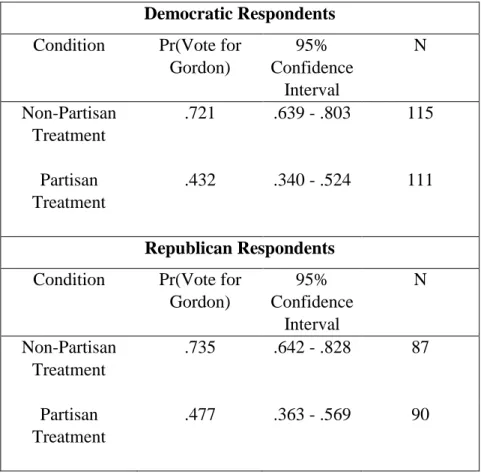
Table 2.1: Model 1, Probability of Vote for Gordon among partisan respondents, by treatment
Condition Pr(Vote for Gordon) 95% Confidence Interval
N
Non-Partisan Treatment .727 .666 - .789 202
27
Table 2.1 shows the predicted probabilities generated from model 1, among partisan respondents. The left hand column shows the treatment to which the respondent was assigned. The Pr(Vote for Gordon) column shows the predicted probability6 of a vote for Gordon from
respondents assigned to the treatment in the far left column. Thus, partisan respondents assigned to the non-partisan treatment have a .727 probability of voting for Gordon. The third column from the left shows the 95% confidence interval for the predicted probability reported in that row. The rightmost column shows the number of partisan respondents assigned to that treatment.
As predicted, in the non-partisan control condition partisan respondents are overwhelmingly likely to support Gordon, who by construction is the objectively more qualified candidate. Partisan respondents have .727 probability of voting for Gordon in the non-partisan treatment. However this probability falls to .447 in the partisan treatment, where Gordon is explicitly labeled as a member of the opposition party. These differences are both substantively and statistically significantly different from each other. This provides clear evidence in favor of hypotheses 1 and 2.7
2.4.2 Party and Assessment of Candidate Quality
Model 2 tests hypothesis 3, whether or not the probability of incorrectly identifying Anderson as the more qualified candidate increases in the partisan context. The dependent variable in this model is whether or not the respondent identified Gordon as the more experienced candidate, 1 if yes, and 0 if no. This question was asked of respondents immediately after they cast
6All predicted probabilities reported in this paper were generated using the Margins command in Stata. Dofile
available upon request.
7A preliminary analysis of the open-ended responses suggests that most respondents in the non-partisan treatment
28
their vote, though on a separate webpage. The key independent variable is what condition the respondent was assigned to. If partisan respondents are less likely to identify Gordon as the more qualified candidate in the partisan than non-partisan treatment, it is evidence in favor of hypothesis 3.
Table 2.2: Model 2, probability of evaluating Gordon as more qualified, by treatment. Partisan respondents.
Treatment Condition Pr(Gordon is Experienced)
95% Confidence Interval
N of Respondents
Non-Partisan Treatment .846 .796 - .896 202
Partisan Treatment .716 .654 - .778 201
Table 2.2 shows the predicted probabilities generated from model 2 among partisan respondents. The left hand column shows the treatment to which they were assigned. The column second from the left shows the predicted probability of the respondent assessing Gordon as the more experienced candidate. Thus, a partisan respondent assigned to the non-partisan treatment has a .846 probability of assessing Gordon as the more experienced candidate. The third column from the left indicates the 95% confidence interval around the predicted probability in that row. The far-right column indicates the number of partisan respondents assigned to that treatment.
29
substantively or significantly as one moves from the non-partisan to the partisan treatment. The results of this model therefore provide support for hypothesis 3. Partisans do seem to be less likely to assess Gordon as more qualified when he is identified as a member of the opposition party. The results also indicate that the survey successfully constructed Gordon as the objectively more qualified candidates. Partisans assigned to the non-partisan treatment were very likely to assess Gordon as more qualified.8
2.4.3 Basis of Partisanship and Support for Gordon
Model 3 tests hypothesis 4, that psychological partisans will be likelier than objective partisans to support a less qualified co-partisan candidate. The dependent variable in this model is whether or not the respondent voted for the objectively more qualified candidate, Gordon. This variable is labeled 1 if yes, 0 if no. The key independent variable in this model is the respondent’s evaluation of candidate experience. This is coded 1 if the respondent believes Gordon is more experienced, 0 if they believe Anderson is more experienced. Conceptually, respondents in the partisan treatment who believe Anderson is more qualified are psychological partisans, while those who believe Gordon is more qualified are objective partisans.
This model is tested only on respondents assigned to the partisan treatment. Running this model on respondents assigned to the non-partisan treatment would yield no theoretically interesting information. Furthermore, the number of respondents assigned to the non-partisan treatment who believe Anderson is more qualified is so low that it would make interpreting the results hazardous.
8Independents assigned to the non-partisan and partisan treatment were equally likely to assess Gordon as the more
30
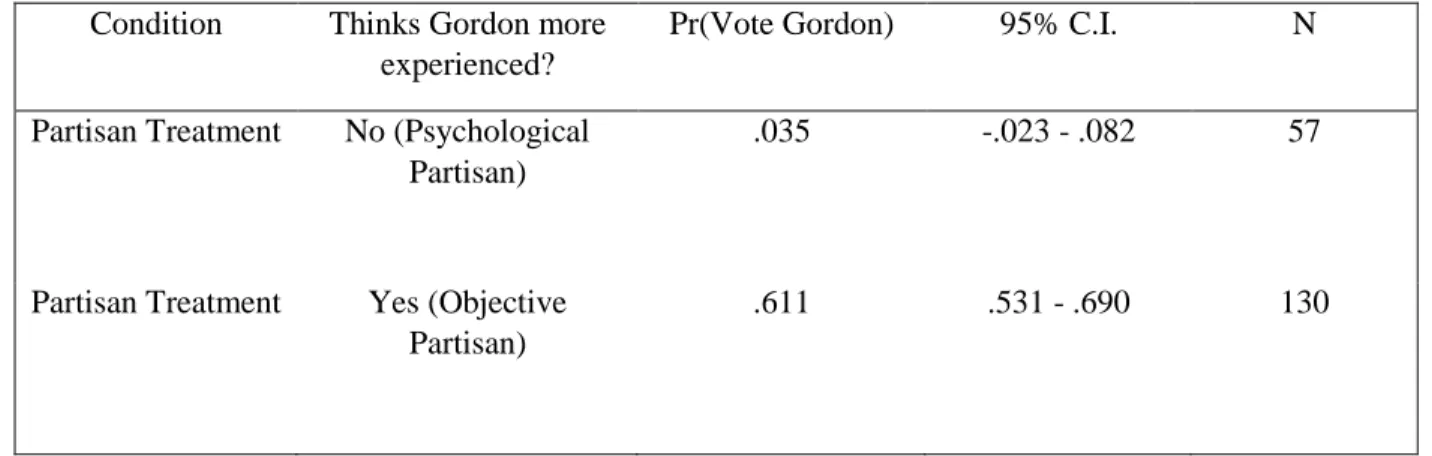
Table 2.3: Probability of Voting for Gordon by Psychological and Objective Partisanship
Condition Thinks Gordon more experienced?
Pr(Vote Gordon) 95% C.I. N
Partisan Treatment No (Psychological Partisan)
.035 -.023 - .082 57
Partisan Treatment Yes (Objective Partisan)
.611 .531 - .690 130
Table 2.3 presents the results from model 3. Note that all respondents in this model were assigned to the partisan treatment. The second column from the left indicates whether the respondents are psychological or objective partisans. The middle column shows the predicted probability of that type of partisan voting for Gordon. Therefore, a psychological partisan has a .035 probability of voting for Gordon. The second column from the right shows the 95% confidence interval around the predicted probability in that row. The far-right column shows the number of psychological and objective partisans in the sample.
Objective partisans have a .611 probability of voting for Gordon. These are respondents who see Gordon as more qualified than Anderson but who share the same party identification as Anderson. These voters are cross-pressured as a result because they could justify supporting Gordon based on qualifications or supporting Anderson based on shared partisanship. In this case, a modest majority chose Gordon over Anderson, suggesting that qualification trumped partisanship for a majority of objective partisans.
31
that Anderson is more qualified, despite objective information to the contrary. Because in their minds both partisanship and qualifications of the candidates point in the same direction, they vote overwhelmingly for Anderson. The difference between the behavior of psychological and objective partisans is statistically and substantively different. Objective partisans are still more likely than not to vote for Gordon, while psychological partisans have virtually no probability of voting for Gordon. This provides support for hypothesis 4: psychological partisans are much less likely to support the objectively more qualified candidate (Gordon) than are objective partisans. This is because objective partisans are cross-pressured while psychological partisans resolve that potential tension by simply concluding that the candidate who shares their partisanship is also the more qualified candidate.9
A potential objection to these findings is that the terminology “objective partisan” and “psychological partisan” may simply be proxies for “weak partisan/leaner” and “strong partisan.” The logic of such a complaint is simple: psychological partisans should be more committed to their political affiliation since it is a deep-seated attachment. Objective partisans, for whom party is not a psychological attachment, would have weaker ties. After all, objective partisans would treat party as a standing decision, subject to change in light of events. If the identity of objective partisans is subject to change more easily than a psychological partisan, then their attachments must be weaker.
However, this would be an erroneous conclusion. It is true that an objective partisan would have little if any affect towards the terms “Democrat” or “Republican”. It is also true that the partisanship of psychological partisans should be harder to change over time than that of an
9I also ran this model on separate samples utilizing only Republican, or only Democratic, voters. The results are
32
objective partisan. That does not mean, however, that objective partisans are, at any given point in time, less committed to the election of their party’s candidates than a psychological partisan.
Imagine two hypothetical Democratic voters. One is a psychological partisan, who supports the Democrats because she was socialized into the party at a young age. Being a Democrat is important to this person’s identity, and it will likely not change in the future regardless of events. Conversely, the other Democratic voter is an objective partisan. He has no psychological or social attachment to the term Democrat. He supports the party because he is very much choice, pro-same-sex marriage, pro-gun control, for a more progressive tax structure, etc. It is true that if the Democrats and Republicans happened to switch positions on these issues in the future, he would likely switch parties. However, in the context of 2015, there is no reason to believe that this objective partisan would be any less committed to the election of Democratic officials than the psychological partisan.
33 Table 2.4: Diagnostic Regression
PID Strength Pr(Gordon is Experienced)
95% C.I. N
Leaner .755 .629 - .881 45
Weak .779 .680 - .877 68
Strong .647 .547 - .747 88
Strength of party identity does not seem to predict whether or not respondents in the partisan treatment assess Gordon as the more qualified candidate. While strong identifiers are less likely than weak identifiers and leaners to correctly identify Gordon as the more experienced candidate, the difference does not even approach statistical significance.10 In short, there is no evidence that strength of party identification is related to an individual being an objective or psychological partisan.
2.5 Discussion and Conclusion
This study has identified two different types of partisans: psychological partisans and objective partisans. Psychological partisans are deeply attached to their party affiliation, while for objective partisans party is just a useful heuristic. For objective partisans, party is a means to an end, while for psychological partisans supporting their party is the end. Psychological partisans are not necessarily stronger partisans than objective partisans. In any given year there is little
10This is true both according to the 95% confidence intervals and to the regression results used to generate this
34
reason to believe that an objective Republican would be less committed to the election of Republican candidates than a psychological Republican.
Nonetheless, this study has identified an important way in which psychological partisans differ from objective partisans. Specifically, they differ in how they evaluate objective information about candidates and how they use that information to render their vote choice. For psychological partisans, party acts as a perceptual filter, causing them to reassess objective information about the political world in order to justify a partisan decision. This means that in the presence of cross-pressure they can eliminate the cognitive dissonance by rationalizing the cross-pressuring factor away. In this case, a cross-pressured psychological partisan would rationalize that the objectively less qualified co-partisan is actually more qualified.
Conversely, party does not act as a perceptual filter for objective partisans. Therefore, they do not reassess political objects in light of their party affiliation. When cross-pressured between party and some other factor, they do not rationalize the cross-pressuring factor away. They have to live with the dissonance and make a choice between two factors they care about – party and whatever else (candidate quality in this case). As expected, this study finds that objective partisans are therefore more likely to defect from their party on a given vote than a psychological partisan is. In effect, objective partisans can be persuaded by other factors to support the opposition party’s candidate, unlike psychological partisans.
35
partisan treatment is .128. This could be viewed as the lower-bound of the proportion of partisans who are psychological partisans. However, the results may be underestimating the presence of psychological partisans. For one, some proportion of partisans who think Anderson is more qualified in the non-partisan treatment are presumably psychological partisans. For another, the survey experiment used here is a hard test of the hypotheses presented earlier. There is a widespread notion in the United States that judges are apolitical figures (Jaros and Roper, 1980; Frank, 1949), giving candidate quality cues more resonance than in other types of elections. Candidate quality is in fact the most important predictor of vote choice in non-partisan judicial elections (Dubois, 1980; Goldstein, 1979).
The judiciary is also a hierarchical institution. As chief judge of the state’s second highest court, Gordon would occupy a superior rank to anyone other than an incumbent running for state supreme court. Anderson is described as a successful attorney, plainly much lower down the judicial hierarchy; but if Anderson had been described as a county magistrate he would still have held an obviously inferior position to Gordon. In the non-judicial context it is not always so clear cut. In a gubernatorial election, for example, a mayor is not obviously better qualified than a state senator or even a business owner. The use of judicial elections in the experiment might have limited the effects of motivated reasoning, leading to an underestimation of the proportion of partisans who are psychological partisans.
36
partisanship influences voter behavior may be too simplified, assuming that all partisans behave the same. Doing so, however, means that there may be systematic overestimation or underestimation of the effects of partisanship. More attention needs to be paid to how different kinds of partisans make political decisions. For example, table 2.1 shows that in the partisan treatments, both Democrats and Republicans are slightly less likely to support Gordon than to support Anderson. However, to leave that as the conclusion would have been misleading. Objective partisans (see table 2.3) are more likely than not to support Gordon in the partisan treatment, while psychological partisans have essentially no probability of supporting Gordon.
37
BIBLIOGRAPHY
Abramowitz, Alan and Saunders, Kyle (1998). “Ideological Realignment in the U.S. Electorate.” Journal of Politics. 60(3), pp. 634-52
Achen, Christopher (1992). “Social Psychology, Demographic Variables, and Linear Regression: Breaking the Iron Triangle in Voting Research.” Political Behavior. 14(3), pp. 195-211 Achen, Christopher (2002). “Parental Socialization and Rational Party Identification.” Political
Behavior 24(2), pp. 151-70
Adrian, Charles (1952). “Some General Characteristics of Nonpartisan Elections.” American
Political Science Review. 46(3), pp. 766-76
Adrian, Charles (1959). “A Typology for Nonpartisan Elections.” Political Research Quarterly. 12(2), p. 449-58
Banda, Kevin and Kropko, Jonathan (N.D.). “Information Cues, Candidate Positioning, and Vote Choice.” Unpublished Manuscript.
Bartels, Larry (2002). “Beyond the Running Tally: Partisan Bias in Political Perceptions.” Political
Behavior. 24(2), pp. 117-50
Bonneau, Chris and Cann, Damon (2013). “Party Identification and Vote Choice in Partisan and Nonpartisan Elections.” Political Behavior. 37(1), pp. 43-66
Bowler, Shaun; Donovan, Todd; and Happ, Trudi. “Ballot Propositions and Information Costs: Direct Democracy and the Fatigued Voter.” The Western Political Quarterly. 45(2), pp. 559-68
Brandenburg, Heinz (2011). “The Two Faces of Party Identification: Distinguishing Remnants of Tribe Loyalty from Conditional Support.” Presented at Elections, Public Opinion, and Parties Conference 2011, Exeter, United Kingdom
Campbell, Angus; Converse, Philip; Miller, Warren; and Stokes, Donald (1960). The American
Voter. Chicago: Chicago University Press.
Carsey, Thomas (2000). Campaign Dynamics: the Race for Governor. Ann Arbor: University of Michigan Press
Carsey, Thomas and Layman, Geoffrey (2006). “Changing Sides or Changing Minds? Party Identification and Policy Preferences in the American Electorate?” American Journal of Political Science. 50(2), pp. 464-77
38
DeSart, Jay (1995). “Information Processing and Partisan Neutrality: A Reexamination of the Party Decline Thesis.” The Journal of Politics. 57(3), pp. 776-95
Downs, Anthony (1957). An Economic Theory of Democracy. New York: Harper and Row. Dubois, Philip (1980). From Ballot to the Bench: Judicial Elections and the Quest for
Accountability. Austin: University of Texas Press
Dubois, Philip (1984). “Voting Cues in Nonpartisan Trial Court Elections: A Multivariate Assessment.” Law and Society Review. 18(3), pp. 395-436
Festinger, Leon and Carlsmith, James (1959). “Cognitive Consequences of Forced Compliance.”
Journal of Abnormal and Social Psychology. 58(2), pp. 203-10
Fiorina, Morris (1981). Retrospective Voting in American Elections. New Haven: Yale University Press
Frank, Jerome (1949). Courts on Trial: Myth and Reality in American Justice. Princeton: Princeton University Press.
Glasgow, Garrett and Alvarez, R. Michael (2000). “Uncertainty and Candidate Personality Traits.”
American Politics Research. 28(1), pp. 26-49
Goldstein, Joel (1979). “Bar Poll Ratings as the Leading Influence on a Non-Partisan Judicial Election.” Judicature no. 63, pp. 377
Green, Donald; Palmquist, Bradley; and Schickler, Eric (2002). Partisan Hearts and Minds. New Haven: Yale University Press.
Greene, Steven (2004). "Social Identity Theory and Party Identification." Social Science
Quarterly 85(1), pp. 136-53
Hibbing, John and Theiss-Morse, Elizabeth (1995). Congress as Public Enemy: Public Attitudes
towards American Political Instituitons. Cambridge, MA: Cambridge University Press.
Huckfeldt, Robert; Mondak, Jeffrey; Craw, Michael; and Mendez, Jeanette (2005). “Making Sense of candidates: Partisanship, Ideology, and Issues as Guides to Judgment.” Cognitive Brain
Research. 23(1), pp. 11-23
Huckfeldt, Robert; Levine, Jeffrey; Morgan, William; and Sprague, John (1999). “Accessibility and the Political Utility of Partisan and Ideological Orientations.” American Journal of Political Science. 43(3), pp. 888-911