RESEARCH
Professional Organizations for Pharmacy Students on Satellite Campuses
Mollie Ashe Scott, PharmD,a,bJacqueline McLaughlin, PhD, MS,c Greene Shepherd, PharmD,aCharlene Williams, PharmD,aJackie Zeeman, PharmD,a,c Pamela Joyner, EdD, MS Pharmc
a
University of North Carolina Eshelman School of Pharmacy, Asheville, North Carolina bUniversity of North Carolina School of Medicine, Asheville, North Carolina
c
University of North Carolina Eshelman School of Pharmacy, Chapel Hill, North Carolina
Submitted April 14, 2015; accepted July 25, 2015; published June 25, 2016.
Objective.To evaluate the structure and impact of student organizations on pharmacy school satellite campuses.
Methods. Primary administrators from satellite campuses received a 20-question electronic survey. Quantitative data analysis was conducted on survey responses.
Results.The most common student organizations on satellite campuses were the American Pharma-cists Association (APhA) (93.1%), American Society of Health-System PharmaPharma-cists (ASHP) (89.7%), Christian Pharmacists Fellowship International (CPFI) (60.0%), state organizations (51.7%), and local organizations (58.6%). Perceived benefits of satellite campus organizations included opportunities for professional development, student engagement, and service. Barriers to success included small enroll-ment, communication between campuses, finances, and travel.
Conclusion. Student organizations were an important component of the educational experience on pharmacy satellite campuses and allowed students to develop professionally and engage with commu-nities. Challenges included campus size, distance between campuses, and communication.
Keywords:student organizations, professionalism, satellite campuses, leadership
INTRODUCTION
The number of colleges and schools of pharmacy with multiple, geographically dispersed campuses has steadily increased during the past decade. As of August 2014, 30 schools of pharmacy had established satellite campuses1 compared to 20 in 2009.2 Primary reasons for this growth is the need to increase student enrollment, expand access to experiential education resources, and improve recruitment and retention of pharmacists in par-ticular areas, such as rural communities.2Medical schools have also expanded regional medical campuses. Accord-ing to the American Association of Medical Schools, there were 48 regional medical school campuses in 2014.3Leaders in medicine have projected a shortage of 52 000 primary care physicians between 2010 and 2025, prompting medical schools to increase enrollment or to create 2-year or 4-year regional campuses to increase the number of graduates.4 The increased need for primary care physicians is a result of population growth, an aging population, and increased health insurance availability.4
Satellite campuses in medicine may have different mis-sions from the main campus, including an emphasis on rural and community medicine.5
Although schools of pharmacy with satellite campuses have successfully expanded enrollment and enhanced use of clinical training sites,2there have been challenges asso-ciated with developing distance campuses.2,6 Providing an equal educational experience for a student body spread across campuses can be challenging, especially when con-sidering effective strategies to develop pharmacy student organizations.2Since cocurricular and extracurricular ac-tivities such as participation in student organizations play an important role in the student experience,7-9it is impor-tant to address the challenges that schools face when de-veloping student organizations on satellite campuses. Schools with multiple campuses must demonstrate equiv-alence of curriculum, faculty members, and student sup-port at distant campuses in order to meet Accreditation Council for Pharmaceutical Education (ACPE) Stan-dards.10The 2016 ACPE Standards include requirements related to cocurricular experiences that emphasize the importance personal and professional development.10
A review of the literature yielded a paucity of data related to pharmacy student organizations on satellite
campuses. The purpose of this study was to evaluate the structure of pharmacy student professional organizations on satellite campuses including student leadership oppor-tunities, types of student organizations offered, and the perceived benefits of student organizations for students on a distant campus.
METHODS
The ACPE website was evaluated to identify schools of pharmacy that included a main campus with one or more satellite campuses.1 At the time of this study, 30 schools of pharmacy had a main campus with at least one satellite campus, and seven schools had multiple dis-tance campuses. A list of schools with satellite campuses in 2013 can be found in Appendix 1. A total of 40 satellite campuses were identified for the 30 schools of pharmacy. Since the time of the research project, some schools’ names have changed, and some satellite campuses have been added whereas others have closed. At the time of the proj-ect, the research team identified the primary administrator at each satellite campus by e-mailing and/or calling the satellite campus. Participation in the survey was voluntary and no incentives were provided. Consent to participate was implied by completion of the survey. This study was reviewed and exempted by the Institutional Review Board at the University of North Carolina at Chapel Hill.
A 20-question survey was developed by the research team based on previous research related to student orga-nizations on satellite campuses, with significant input from a faculty member skilled in educational research and survey design. The survey was created using Qual-trics survey software (QualQual-trics, Provo, UT), and a link to the survey was e-mailed to the previously identified primary administrators from each satellite campus. Questions included demographic information about the location, enrollment, structure, and leadership of the sat-ellite campus, followed by questions about student orga-nizations on the satellite campus. The survey ended with two open-text boxes asking about the perceived benefits of professional organizations and the barriers to develop-ment of successful student organizations on the satellite campus. The survey was launched in fall 2013 and remained open for eight weeks, and a survey reminder was sent two weeks after the initial e-mail. To improve the initial response rate, those who hadn’t completed the survey the first time were contacted individually and in-vited to complete it after the first 8-week window. Loca-tion and enrollment data was verified for accuracy via online search or phone follow up. All quantitative data analysis was conducted with Qualtrics. Continuous data are presented as mean (SD).
RESULTS
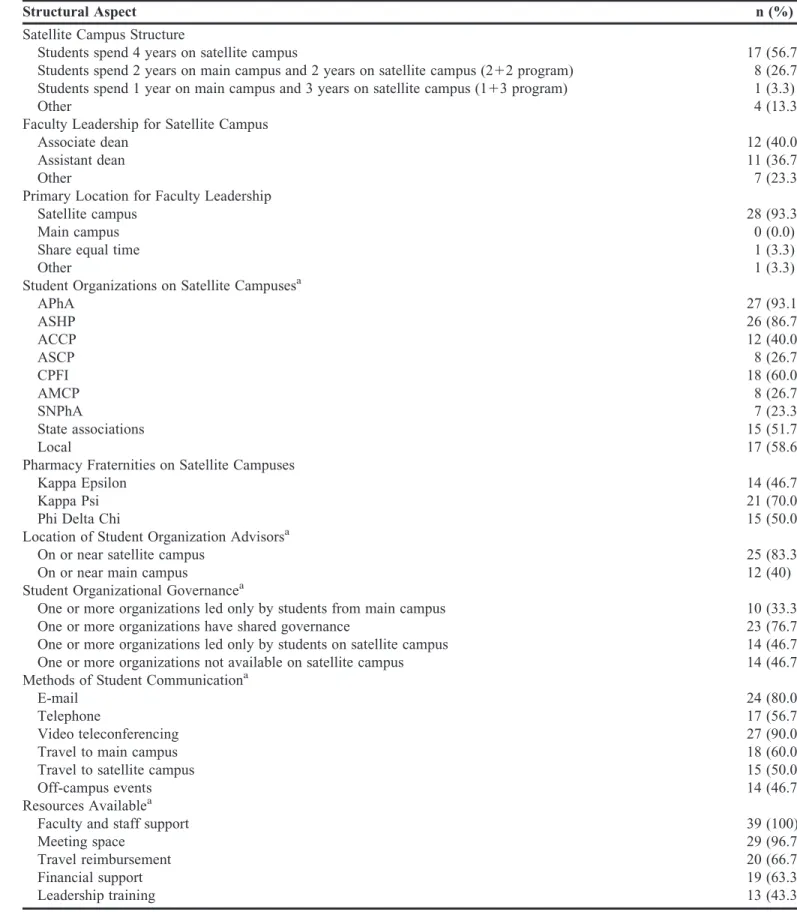
Twenty-five of the 30 schools of pharmacy with sat-ellite campuses responded to the survey (83.3% response rate). Thirty satellite campuses out of 40 responded to the survey (75% response rate). Results presented are based on a denominator of 40 satellite campuses and are sum-marized in Table 1.
Seventeen (56.7%) satellite campuses delivered all four years of education on the satellite campus (parallel program), whereas eight (26.7%) campuses described themselves as a 212 program or sequential campus (two years on the main campus followed by two years on the satellite campus). The structure of one school (3.3%) included one year on the main campus followed by three years on the satellite campus.
The mean number of students per class on satellite campuses was 48.4 (33) (range 11-150 students). Satellite campuses were located a mean of 240 (287) miles away from their main campus (range 44 – 1186 miles), and approximately half were within 100 miles of the main campus. Twenty-four satellite campuses (75%) were established after 2000, one was established in the 1990s (3.5%), and two satellite campuses were developed in the 1970s (7.0%). The most common title for the satellite campus leader was associate dean (40.0%) or assistant dean (36.7%). Twenty-six of the satellite campus leaders worked primarily on the distance campus (93.3%) (Table 1). The structure of student organizations on satellite campuses is described in Table 1. The most frequently mentioned student organizations included APhA (27 sat-ellite campuses, 93.1%), ASHP (26 satsat-ellite campuses, 89.7%), CPFI (18 satellite campuses, 60.0%), local orga-nizations (17 satellite campuses, 58.6%), and the Ameri-can College of Clinical Pharmacy (ACCP) (12 satellite campuses, 40.0%). The Student National Pharmaceutical Association (SNPhA) and the American Society of Con-sultant Pharmacists (ASCP) were available at fewer campuses (23.3% and 26.7%, respectively). Professional fraternities on satellite campuses included Kappa Psi (70.0%), Kappa Epsilon (46.7%), and Phi Delta Chi (50.0%). Students communicated across campuses about student organizations through video-teleconferencing (90.0%), e-mail (80.0%), telephone (56.7%), and travel to the main campus (60.0%).
Table 1. Structure of Satellite Campuses and Student Organizations (n530 satellite campuses)
Structural Aspect n (%)
Satellite Campus Structure
Students spend 4 years on satellite campus 17 (56.7)
Students spend 2 years on main campus and 2 years on satellite campus (212 program) 8 (26.7) Students spend 1 year on main campus and 3 years on satellite campus (113 program) 1 (3.3)
Other 4 (13.3)
Faculty Leadership for Satellite Campus
Associate dean 12 (40.0)
Assistant dean 11 (36.7)
Other 7 (23.3)
Primary Location for Faculty Leadership
Satellite campus 28 (93.3)
Main campus 0 (0.0)
Share equal time 1 (3.3)
Other 1 (3.3)
Student Organizations on Satellite Campusesa
APhA 27 (93.1)
ASHP 26 (86.7)
ACCP 12 (40.0)
ASCP 8 (26.7)
CPFI 18 (60.0)
AMCP 8 (26.7)
SNPhA 7 (23.3)
State associations 15 (51.7)
Local 17 (58.6)
Pharmacy Fraternities on Satellite Campuses
Kappa Epsilon 14 (46.7)
Kappa Psi 21 (70.0)
Phi Delta Chi 15 (50.0)
Location of Student Organization Advisorsa
On or near satellite campus 25 (83.3)
On or near main campus 12 (40)
Student Organizational Governancea
One or more organizations led only by students from main campus 10 (33.3)
One or more organizations have shared governance 23 (76.7)
One or more organizations led only by students on satellite campus 14 (46.7) One or more organizations not available on satellite campus 14 (46.7) Methods of Student Communicationa
E-mail 24 (80.0)
Telephone 17 (56.7)
Video teleconferencing 27 (90.0)
Travel to main campus 18 (60.0)
Travel to satellite campus 15 (50.0)
Off-campus events 14 (46.7)
Resources Availablea
Faculty and staff support 39 (100)
Meeting space 29 (96.7)
Travel reimbursement 20 (66.7)
Financial support 19 (63.3)
Leadership training 13 (43.3)
a
of pharmacy offered student organizations on the main campus, which were not offered on the satellite campus.
All satellite campuses offered faculty and staff sup-port for student organizations. Advisors for student orga-nizations were located on or near the satellite campus (83.3%), or on or near the main campus (40.0%). Travel reimbursement and financial support of organizations were offered to students by 66.7% and 63.3% of satellite campuses, respectively. Eighty-nine percent of satellite campuses reported that their student organizations pro-vided service projects for the community, and 50% of campuses continued to offer students leadership opportu-nities in student organizations during advanced pharmacy practice experiences (APPEs). Forty-three percent of satellite campuses offered leadership training for student leaders.
Because perceived benefits and challenges associ-ated with student organizations were assessed using open-ended questions, it was not possible to fully quantify the responses. However, general themes associated with perceived benefits of student organizations on satellite campuses included opportunities for networking and pro-fessional development, promotion of service and commu-nity engagement, development of professionalism, and the chance to connect with students residing on the main campus. Forty percent of respondents cited leadership development as the most important benefit of student organizations. (Table 2). Two respondents noted that smaller enrollment on satellite campuses resulted in more leadership opportunities for students. General themes as-sociated with perceived barriers to success of student or-ganizations on satellite campuses included the need for a critical mass of students to operationalize an organiza-tion, lack of communication with students on other cam-puses, managing funds and making purchases, and the need for travel and housing for events across campuses. Thirty percent of respondents to the open-ended question about challenges of student organizations on satellite campuses noted smaller enrollment numbers and the need for technology as challenges. Moreover, 22% of respon-dents commented that sturespon-dents on satellite campuses may feel disconnected from organizational events happening on the main campus (Table 2).
DISCUSSION
Cocurricular activities for doctor of pharmacy students are an important component of the student experience and help foster professionalism and rela-tionship-building.7,8Moreover, student organizations are an important component of the student experience, according to the ACPE Standards.10Specifically, Standard
4 focuses on personal and professional development with emphasis on four key elements: self-awareness, leadership, innovation and entrepreneurship, and pro-fessionalism.10Pharmacy student organizations create opportunities for students to engage with communities through service projects and volunteerism and to en-hance professional development through patient care projects, clinical competitions, and seminars. For ex-ample, APhA sponsors national patient care projects for student pharmacists such as Operation Diabetes and professional development programs including the Na-tional Patient Counseling Competition. The ASHP has a Pharmacy Student Forum, and also hosts the annual Clinical Skills Competition. In this survey, APhA and ASHP were the most common student organizations on satellite campuses and were available to students on the vast majority of satellite campuses. Almost 90% of sat-ellite campuses completed service projects, indicating that student pharmacists on distant campuses were en-gaging with their local communities.
Our survey indicated that faculty members on sat-ellite campuses perceive that student organizations promote professionalism and leadership development. Several respondents noted that students on satellite campuses have significant opportunities to lead be-cause of the smaller numbers of students available to serve in such roles. Poirier and Gupchup used a profes-sionalism instrument developed by Chisholm to eval-uate changes in professionalism across the curriculum among pharmacy students in different classes.7First-year, second-year, and fourth-year responded to the instrument, which measured overall professionalism scores as well as subscales in excellence, respect for others, altruism, duty, accountability, and honor/integrity. Professionalism Table 2. Qualitative Perceived Benefits and Challenges Associated with Student Organizations on Satellite Campuses Benefits Networking
Professional development
Community service and engagement Personal satisfaction
Leadership opportunities Student engagement Peer mentorship
Giving back to the profession Challenges Technology
Space
Communication Distance
scores increased and demonstrated that curricular and co-curricular activities in the school of pharmacy contributed to the development of professionalism.7Specifically, sub-scales in altruism, accountability, and honor/integrity in-creased after participation in service learning and student organizational events.7Kiersma et al surveyed 514 stu-dents at Purdue University about their perceptions of the value of student organizations for their professional de-velopment.8Students indicated that extracurricular activ-ities improved their personal skill development including their abilities to take personal responsibility, help others, get along well with others, organize work and projects, and understand others’ point of view, but were less likely to help them with budgeting, policy development, or writ-ten communication.8This body of literature indicates the important role that professional organizations play in the development of professionalism and leadership skills.
Our project indicated that satellite campus students were frequently involved in local organizations that were unique to their particular campus, which supports Congdon et al’s findings from the University of Maryland that described the development of student organizations on their satellite campus.11 They reported that 33% of stu-dents in the inaugural class on their distance campus par-ticipated in at least one organization on the main campus, whereas 97% of satellite students joined a locally devel-oped organization called the DC Metro Student Pharma-cist Association.11 This organization was developed by satellite students in order to create opportunities for pro-fessional development on a local level.11The University of Missouri-Kansas City published a descriptive report about their experiences with student organizations on their satellite campus. When their satellite campus was opened in 2005, APhA was the first organization offered to satellite students and originated from the main campus. Authors noted that students on the satellite campus were not participating in events and postulated that student organizations based only on the main campus served as a barrier. Once an APhA student chapter with leadership positions was developed on the distance campus, student satisfaction with leadership, social, and volunteer oppor-tunities increased.9Thus, students on satellite campuses may be more likely to engage in student organizations that include activities that are locally focused.
Adams et al evaluated the student organizational experience from four schools with satellite campuses.12 Each school offered parallel campuses, meaning that all four years of study occurred on the main campus or the satellite campus. Thirty-one percent of the 1013 students who were surveyed responded. Ninety-three percent of students on the main campus participated in student organizations, and 92% of satellite campus
students participated. However, only 80% of students on satellite campuses were satisfied with access to faculty advisors for student organizations compared to 93% satis-faction among main campus students. Fewer students on satellite campuses than on main campuses felt that it was easy to communicate between campuses (37% vs 49%), or felt a sense of belonging with their classmates on the other campus (47% vs 58%).12Despite the fact that the survey indicated most faculty advisors were located on or near the satellite campus, students at the satellite campus may not have perceived adequate support from advisors.
student experience and contribute to the development of professional behaviors,7 a culture of support for student organizations and advisor engagement should be a corner-stone of satellite campus life; (2) Because a critical mass of students is necessary to operationalize student organi-zations on a satellite campus, it is important to focus on excellence within individual organizations as opposed to creating a multitude of organizations that might not suc-ceed; (3) To promote unity within the entire student body while also making an impact on individual campus com-munities, schools should provide a mixture of student organizations that collaborate across campuses and initia-tives that focus on the unique needs of each campus com-munity;9,11 (4) Leadership training and advisor support that emphasizes effective communication and relation-ship building at one school of pharmacy on multiple cam-puses is important.
There are several limitations to this study. We did not compare differences in student organizations on satellite campuses with a small student body with those of a larger student body. We were not able to determine the critical mass of students necessary to build a successful student organization; however, Kappa Epsilon’s bylaws require a minimum of 10 students to begin a colony. Finally, it is not known which benefits and challenges of student orga-nizations are most important and which ones matter least to students. Future studies focused on student organiza-tions on satellite campuses should examine these issues in more detail.
CONCLUSION
A growing number of schools of pharmacy have sat-ellite campuses, most being established in the last 15 years. Because satellite campuses tend to have smaller numbers of students and are located away from the main campus, development of student organizations is associ-ated with unique challenges. Despite this, satellite cam-puses had student organizations in place and almost all campuses provided service projects within their commu-nities. Resources were available on satellite campuses to support student organizations including advisors, space, travel reimbursement, and financial support. Most student organizations were governed on the satellite campus or across campuses. Although communication among stu-dents on different campuses frequently utilized video-technology, visits to other campuses were also frequent. Primary administrators on satellite campuses recognized
the benefit student organizations play in the professional development of students. Students on satellite campuses appear to have significant opportunities for leadership development.
ACKNOWLEDGMENTS
The authors would like to acknowledge the assistance of Laura Bratsch and Jennifer Marvin for their assistance with the manuscript.
REFERENCES
1. Accreditation Council for Pharmacy Education. Preaccredited and accredited professional programs of colleges and schools of pharmacy. https://www.acpe-accredit.org/shared_info/programsSecure.asp. Accessed August 29, 2014.
2. Harrison LC, Congdon HB, DiPiro JT. The status of US multi-campus colleges and schools of pharmacy.Am J Pharm Educ. 2010; 74(7):Article 124.
3. American Association of Medical Schools. Group on Regional Medical Campuses. https://www.aamc.org/members/grmc/. Accessed 7/1/2015.
4. Petterson SM, Liaw WR, Phillips RL, Rabin DL, Meyers DS, Bazemore AW. Projecting primary care physician workforce needs: 2010-2025.Ann Fam Med. 2012;10(6):503-509.
5. Cheifetz CE, McOwen KS, Gagne P, Wong JL. Regional medical campuses: a new classification system.Acad Med. 2014;89(8):1140-1143.
6. Fox BI, McDonough SL, McConatha BJ, Marlowe KF. Establishing and maintaining a satellite campus connected by synchronous video conferencing.Am J Pharm Educ. 2011;75(5): Article 91.
7. Poirier TI, Gupchup GV. Assessment of pharmacy student professionalism across a curriculum.Am J Pharm Educ. 2010;74(4): Article 62.
8. Kiersma ME, Plake KS, Mason HL. Relationship between admission data and pharmacy student involvement in extracurricular activities.Am J Pharm Educ. 2011;75(8):Article 155.
9. Vyas D, Stinner N, Lindsey C. Promoting the professional development of students through the creation of a student
organization on a satellite campus.J Am Pharm Assoc. 2009;49(5): 580.
10. Accreditation Council for Pharmacy Education. Accreditation standards and key elements for the professional program in pharmacy leading to the doctor of pharmacy degree. https://www.acpe-accredit. org/pdf/Standards2016FINAL.pdf. Accessed July 1, 2015.
11. Congdon HB, Nutter DA, Charneski L, Butko P. Impact of hybrid delivery of education on student academic performance and the student experience.Am J Pharm Educ. 2009;73(7): Article 121.
Appendix 1. Schools of Pharmacy with Satellite Campuses in 2013
Albany College of Pharmacy and Health Sciences Auburn University
Ferris State
Florida Agriculture and Mechanical University
Lake Erie College of Osteopathic Medicine School of Pharmacy Massachusetts College of Pharmacy and Health Sciences Nova Southeastern
Oregon State University Roseman School of Pharmacy Shenandoah University South University Texas Tech
University of Arkansas University of Florida University of Georgia University of Idaho
University of Illinois, Chicago University of Kansas
University of Maryland University of Minnesota University of Mississippi
University of Missouri, Kansas City
University of North Carolina Eshelman School of Pharmacy University of Oklahoma
University of South Dakota University of Tennessee University of Texas-Austin