J. Chem. Phys. 112, 1096 (2000); https://doi.org/10.1063/1.480664 112, 1096 © 2000 American Institute of Physics.
Quantized field description of rotor
frequency-driven dipolar recoupling
Cite as: J. Chem. Phys. 112, 1096 (2000); https://doi.org/10.1063/1.480664
Submitted: 25 August 1999 . Accepted: 22 October 1999 . Published Online: 06 January 2000
G. J. Boender, S. Vega, and H. J. M. de Groot
ARTICLES YOU MAY BE INTERESTED IN
Chemical shift correlation spectroscopy in rotating solids: Radio frequency-driven dipolar recoupling and longitudinal exchange
The Journal of Chemical Physics 96, 8624 (1992); https://doi.org/10.1063/1.462267 Homonuclear radio frequency-driven recoupling in rotating solids
The Journal of Chemical Physics 108, 9463 (1998); https://doi.org/10.1063/1.476420 dipolar recoupling under very fast magic angle spinning in solid-state nuclear
magnetic resonance: Applications to distance measurements, spectral assignments, and high-throughput secondary-structure determination
Quantized field description of rotor frequency-driven dipolar recoupling
G. J. Boendera)
Leiden Institute of Chemistry, Leiden University 2300 RA Leiden, The Netherlands
and Department of Chemical Physics, Weizmann Institute of Science, 76100 Rehovot, Israel
S. Vega
Department of Chemical Physics, Weizmann Institute of Science, 76100 Rehovot, Israel
H. J. M. de Groot
Leiden Institute of Chemistry, Leiden University 2300 RA Leiden, The Netherlands
共Received 25 August 1999; accepted 22 October 1999兲
A formalized many-particle nonrelativistic classical quantized field interpretation of magic angle spinning 共MAS兲 nuclear magnetic resonance 共NMR兲 radio frequency-driven dipolar recoupling 共RFDR兲is presented. A distinction is made between the MAS spin Hamiltonian and the associated quantized field Hamiltonian. The interactions for a multispin system under MAS conditions are described in the rotor angle frame using quantum rotor dynamics. In this quasiclassical theoretical framework, the chemical shift, the dipolar interaction, and radio frequency terms of the Hamiltonian are derived. The effect of a generalized RFDR train of pulses on a coupled spin system is evaluated by creating a quantized field average dipolar-Hamiltonian formalism in the interaction frame of the chemical shift and the sample spinning. This derivation shows the analogy between the Hamiltonian in the quantized field and the normal rotating frame representation. The magnitude of this Hamiltonian peaks around the rotational resonance conditions and has a width depending on the number of rotor periods between thepulses. Its interaction strength can be very significant at the
n⫽0 condition, when the chemical shift anisotropies of the interacting spins are of the order of their isotropic chemical shift differences. © 2000 American Institute of Physics.
关S0021-9606共00兲03203-7兴
I. INTRODUCTION
Magic angle spinning 共MAS兲 nuclear magnetic reso-nance 共NMR兲 correlation spectroscopy in conjunction with multispin isotope enrichment has been established recently as a novel concept for refinement of electronic and spatial structure in solids.1,2This development was triggered by the discovery of broadbanded pulse sequences for homonuclear dipolar recoupling.3–11 In principle, MAS averages dipolar interactions.12,13Using dipolar recoupling techniques, homo-nuclear and heterohomo-nuclear dipolar correlation spectroscopy can be performed and the NMR response of moderately sized multispin clusters can be assigned.14,15In addition, since the dipolar interaction is strongly distance dependent, dipolar correlation spectroscopy can be used for de novo structure determination on an atomic scale of multispin labeled systems.1,2In this article we present a formal quantized field interpretation of the seminal radio frequency driven dipolar recoupling 共RFDR兲. The technique was originally proposed for one refocusing-pulse per single rotor period.5RFDR is straightforward to implement and robust, and can be applied readily in high and ultra high fields. It has already been uti-lized for assignment and structure refinement of moderately sized uniformly labeled biological aggregates.16
It has been shown that the effect of MAS on a nuclear spin system in a solid can be described in terms of a quan-tized rotor field, leading to a physical interpretation of the
Floquet description of MAS.17,18 This makes it possible to disentangle the influence of the radiation field and the MAS rotation, leading to the construction of a Floquet Hamiltonian for the MAS NMR from first principles. Here it will be shown that the quantized field description can be combined with the average Hamiltonian approach in order to provide us with a quasiclassical description of RFDR experiments with a variable number of rotor periods between the
-pulses.19
The formal description of the RFDR experiment starts with a brief summary of the quantum rotor dynamics in the next section. The interaction of the quantized rotor field with the nuclear spin is discussed in Sec. III. The chemical shield-ing of the magnetic field is calculated in this section and the term in the quantized field Hamiltonian describing the dipo-lar interaction is put forward. In Sec. IV, the RF pulse is included in the quantized field framework. Using the meth-odology discussed in Secs. II–IV, we analyze in Sec. V a generalized RFDR sequence. In Sec. VI the polarization transfer driven by the dipolar recoupling sequence is dis-cussed and in Sec. VII the main conclusions are given. In the appendix the transformation properties for the quantized field operators constituting the spin-pair dipolar term in the multi-spin Hamiltonian are evaluated.
II. QUANTUM ROTOR DYNAMICS
MAS NMR spectroscopy is generally described with the help of a spin Hamiltonian, in which the effect of the sample
a兲Present address: ID-DLO, P.O. Box 65, 8200 AB Lelystad, The
Nether-lands.
1096
rotations on the nuclear spins is taken into account by a set of periodically time dependent coefficients. The spin Hamil-tonian of a single crystallite in the rotating frame can there-fore be expanded in a Fourier series according to20
Hˆ
S共t兲⫽HˆS0⫹
兺
p⫽12 Hˆ
S pexp共i p共0⫹rt兲兲⫹HˆS p
†
⫻exp共⫺i p共0⫹rt兲兲, 共1兲
in whichris the spinning speed andHˆS pthe Fourier
com-ponents of the Hamiltonian. These comcom-ponents differ from crystallite to crystallite in the sample, while0 is a constant initial phase that may vary between experiments.
In the quantized field description the concept of a nuclear spin Hamiltonian is extended with quantum rotor dynamics.17 The interaction of the spins with the environ-ment due to the MAS rotation is included in the Hamiltonian, by using a set of quantum rotor dynamics operators Lˆz⬘, Fˆp,
and Fˆp†, to replace the phenomenological time-dependent phase of the rotation 0⫹rt in Eq.共1兲.
Recently, it was shown that rotor field quantization of-fers a self-consistent framework to describe the evolution of the spin system with conservation of energy.17The total or-bital angular momentum l of a forced rotation of a rotor with eigenstates兩lm
典
in the quasiclassical limit defined by l→⬁ and l⫽m, corresponds with the number of bosonquasipar-ticles. The associated rotor field is a vector field that can be constructed using boson annihilation and creation operators
aˆ兩l
典
⫽l1/2兩l⫺1典
,共2兲
aˆ†兩l
典
⫽共l⫹1兲1/2兩l⫹1典
, whereLˆz⬘⫽aˆ†aˆ 共3兲
measures the orbital angular momentum. The energy of the rotor is rl, which is very large on the energy scale of the
nuclear spin system.
It was shown that a complete description of the MAS for a nuclear magnetic moment in a solid can be obtained within a single set of reduced angular momentum states 兩n
典
. By taking l⫽¯n⫹n, with n the variation of the angularmomen-tum around a large average value n¯ , the orbital angular
mo-mentum states can be renumbered according to17
兩¯n⫹n
典
→兩n典
. 共4兲To provide a description of the quasiclassical limit, a phase operatorˆ
⬘
is introduced that represents a continuous coor-dinate⬘
withexp共iˆ
⬘
兲⫽ aˆ†
冑
¯n. 共5兲The relation between the phase operator and the angular mo-mentum operator Lˆz⬘, is the canonical commutation relation
according to
关ˆ
⬘
,Lˆz⬘兴⫽i, 共6兲and the z axis is the axis of rotation.
MAS is a rotation with a single normal frequency mode
r. The interaction between the spin system and the sample
rotation can be interpreted in terms of p-quantum interac-tions with the single mode rotor field with a frequencyr.
For a p-quantum transition, a Fourier operator is defined by
Fˆp⫽exp共i pˆ
⬘
兲. 共7兲 According to Eq.共5兲the Fpoperators are multiquantumlad-der operators with Fˆp兩n
典
⫽兩n⫹p典
and they can beinter-preted as a repeated application of single quantum raising
and lowering operators, since Fˆp⫹q⫽FˆpFˆq.
17 The commutator关Lˆz⬘,Fˆp兴⫽pFˆp implies that
exp共irtLˆz⬘兲Fˆpexp共⫺irtLˆz⬘兲
⫽1ˆ⫹irt关Lˆz⬘,Fˆp兴⫹ 共irt兲2
2! 关Lˆz⬘,关Lˆz⬘,F
ˆ
p兴兴⫹¯
⫽exp共i prt兲Fˆp. 共8兲
In the quasiclassical limit, quantization of the rotor field is therefore equivalent with the introduction of a phase operator
ˆ
⬘
in the rotor angle frame according to Eq.共5兲. A quantized field extension of the spin Hamiltonian in Eq. 共1兲is thenHˆ
Q共t兲⫽HˆS0⫹
兺
p⫽12 Hˆ
S pexp共i p共ˆ
⬘
⫹rt兲兲⫹HˆS p†
⫻exp共⫺i p共ˆ
⬘
⫹rt兲兲. 共9兲 It includes two independent degrees of freedom, ˆ⬘
and t, which contrasts with the single time degree of freedom that is used to generate the time-dependence in the spin Hamil-tonian HˆS(t) in Eq. 共1兲.17 The ˆ⬘
degree of freedom ises-sential, to account for the infinitesimal phase variations due to the quantum rotor dynamics, in which the rotor is de-scribed as a two dimensional harmonic oscillator or a rigid rotor.21,22
Using the relations共7兲and共8兲, it is possible to rewrite the Eq.共9兲, yielding
Hˆ
Q共t兲⫽exp共irtLˆz⬘兲
冉
HˆS0⫹兺
p⫽12 Hˆ
S pFˆp⫹HˆS p
† F
p
†
冊
⫻exp共⫺irtLˆz⬘兲. 共10兲
A time-independent Hamiltonian HˆQ can be obtained by a
transformation to the spatial rotating frame, defined by exp(⫺irtLˆz⬘):
17
Hˆ
Q⫽Hˆn⫹Hˆi⫹Hˆr 共11兲
consisting of a term associated with the sample rotation
Hˆ
r⫽rLˆz⬘, 共12兲
a pure nuclear spin Hamiltonian term independent of Fp
Hˆ
n⫽HˆS0, 共13兲
and an interaction term depending on Fp and Fp
†
Hˆ i⫽
兺
p⫽1 2
Hˆ
S pFˆp⫹HˆS p
†
which describes the effect of the rotor dynamics on the spin interactions. SinceHˆQis time independent its unitary evolu-tion operator is
Uˆ共t兲⫽exp共⫺iHˆQt兲. 共15兲
The effect of the phenomenological time dependence on the spins is included by means of the time-independent or-bital angular momentum ladder operators Fˆp,Fˆp
†. These have a physical basis and have been identified as the Fourier operators in the Floquet description of MAS NMR.17 The Hˆ
Q Hamiltonian operates in the product space spanned by
the spin states and the 共reduced兲angular momentum states. The commutation relation between the Fourier operators and the orbital angular momentum operator 关Lˆz⬘,Fˆp兴⫽pFˆp
al-lows for energy exchange between the rotor and the spin system. In addition, it provides a route to coherent superpo-sitions of states involving the quantum rotor dynamics, since in general关Hˆr,Hˆi兴⫽0.
III. THE INTERACTION HAMILTONIAN
The Fourier components of the spin Hamiltonian 共1兲, containing chemical shift and dipolar interactions, can be expressed in terms of contractions between Aˆk, the
irreduc-ible tensor operators of rank k in real space, and Tˆk, the
irreducible tensor operators of rank k in spin space.23,24In the spin rotating frame only the part of the interactions that com-mute with the Zeeman Hamiltonian have to be taken into account. An interaction term of the spin-Hamiltonian in the spin rotating frame can therefore be written as
Hˆ
S共t兲⫽
兺
kAk0共t兲Tˆk0. 共16兲
The time dependent spatial part can be expanded in a Fourier series according to17
Ak0共t兲⫽
兺
p⫽⫺kk
exp共i p共rt⫹0兲兲Vp0 k
, 共17兲
with
Vp0k ⫽
兺
s⫽⫺kk
兺
r⫽⫺kk
Akr
Drsk共␣c,c,␥c兲Ds p k 共␣r,r,␥r兲
⫻Dp0k
冉
0,m, 4
冊
. 共18兲The Akr
coefficients are the elements of the spatial tensor describing the coefficients of the interaction in the principal axis system共PAS兲. In Eq.共18兲three sets of Euler angles of the Wigner coefficients Di jk(␣,,␥) describe the transforma-tion from the PAS to a crystal frame (␣c,c,␥c), from thiscrystal frame to the rotor angle frame (␣r,r,␥r), and
fi-nally from the rotor angle frame to the laboratory frame (0,m,/4).
23
The tensor operators in spin space can be written as
Tˆk0⫽W00
k Iˆ
0 共19兲
in which W00k are some coefficients and Iˆ0 spin operators commuting with Iˆz. The quantized field Hamiltonian
be-comes then
Hˆ
Q共t兲⫽Z00
kIˆ0⫹
兺
p⫽1k
Zp0k Iˆ0exp共i p共ˆ
⬘
⫹rt兲⫹Zp0k*Iˆ0exp共⫺i p共ˆ
⬘
⫹rt兲 共20兲 withZkp0⫽Vp0k W00k 共21兲
and the fact that the Hamiltonian is Hermitian requires that
Z⫺p0⫽Zp0* . After the transformation to the spatial rotating frame the interaction Hamiltonian in Eq.共14兲yields
Hi⫽
兺
p⫽1k
共Zp0k Fˆp⫹Zp0 k*Fˆ
p
†兲
Iˆ0. 共22兲
Here we have used again the Fourier operators to include the quantum rotor dynamics, according to Eq.共7兲.
For a dipolar coupled spin system of like spins under MAS, the Hamiltonian consists of a chemical shift term and a dipolar term. Thus the nuclear spin Hamiltonian and the interaction Hamiltonian can be written as
Hˆ n⫽Hˆn
CS⫹Hˆ
n
D ,
共23兲 Hˆ
i⫽Hˆi
CS⫹Hˆ i
D.
With the external magnetic field along the z axis, the spin tensor operators in the truncated isotropic chemical shift (k⫽0) and chemical shift anisotropy共CSA兲 (k⫽2) Hamil-tonian in Eq. 共16兲are for a spin i23
Tˆ00i ⫽⫺ 1
冑
3 ␥H0Iˆzi
,
共24兲
Tˆ20i ⫽
冑
23␥H0Iˆz i
.
The spatial isotropic chemical shift tensor is of rank 0 with a single element A00
⫽A¯i. The CSA interaction is a real sym-metric tensor interaction of rank 2 and the three elements that characterize this tensor in its principal axis system are for a spin iA20
⫽冑
32␦
i,
共25兲
A2
⫾2⫽12 ␦
i,
with A¯i⫽¯i⫽
冑
1/3( xx i ⫹y y i ⫹
zz i
) the isotropic and ␦i ⫽1/3(zzi ⫺¯i) the anisotropy parameter and i⫽(
y y i
⫺xx i
Vp02i⫽dp02 共m兲exp共i␥rp兲
兺
s⫽⫺22
共ds p2 共r兲exp共i共␣r⫹␥ci兲s兲
⫻共d0s 2 共
c i兲
冑
32␦
i⫹兵exp共i2␣ c i兲
d2s 2 共
c i兲
⫹exp共⫺i2␣ci兲d2⫺2s共ci兲其1 2
i␦i兲兲 共26兲
with V002i⫽0, since for MAS d002(m)⫽0.
Using Eqs.共19兲and共22兲, the chemical shift contribution to the interaction Hamiltonian can be constructed and yields
Hˆ i
CS⫽
兺
i⫽1
N
兺
p⫽12
共ZpiFˆp⫹Zp i*F
p
†兲Iˆ
z
i, 共27兲
with Zip⫽(Zp02 )iand
Zip⫽
冑
23␥H0Vp0
2i . 共28兲
The isotropic part is not affected by the spinning and yields a contribution to the pure nuclear spin term
Hˆ n
CS⫽
兺
i⫽1N
⌬¯iIˆzi, 共29兲
with⌬¯i⫽⫺␥H01/3(xx i ⫹
y y i ⫹
zz i
).
The spin space tensor operator for the dipolar interaction between a pair of spins (i, j) is
Tˆ20i j⫽⫺
冑
162␥ 2ប共2Iˆ
z i
Iˆzj⫺12共Iˆ⫹
i
Iˆ⫺j ⫹Iˆ⫹i Iˆ⫺j 兲兲. 共30兲
The components of the spatial tensor Vp02i j for the spin pair interaction can be obtained from Eq.共26兲with␦isubstituted by
␦i j⫽⫺0
2
␥2ប
ri j3 ,
and i substituted by i j⫽0. Thus the dipolar term in the interaction Hamiltonian is a quantized field contribution that is bilinear in the spin operators,
Hˆ i
D⫽
兺
i⬍j p
兺
⫽1 2共Zpi jFˆp⫹Zpi j*Fˆp†兲共2IˆziIˆzj⫺1 2共Iˆ⫹
i Iˆ
⫺j⫹Iˆ⫹i Iˆ⫺j 兲兲 共31兲 with the summation over all spin pairs i⬍j .
Here, with Zp i j⫽
(Zp0
2 )i j,
Zi jp⫽⫺Cp i j
ri j
3 共32兲
and
Cpi j⫽0
4 ␥ 2បd
p0
2
共m兲exp共i␥rp兲
兺
s⫽⫺22
ds p2 共r兲
⫻exp共i共␣r⫹␥c i j兲
s兲d0s2共ci j兲 共33兲 withci j and␥ci j the polar angles of the dipolar vector in the crystal frame.
Since the dipolar interaction is traceless, the contribution to the pure nuclear term due to the dipolar interaction is
Hˆ n
D⫽0. According to Eq. 共11兲 the time independent quan-tized field MAS HamiltonianHˆQof the coupled spin system
is the sum of Eqs.共27兲,共29兲,共31兲, and共12兲.
IV. RADIO FREQUENCY PULSES
An on-resonance RF field contributes to the spatial ro-tating frame Hamiltonian a nuclear spin Hamiltonian term of the form:
HˆRF⫽
1共Iˆxcos⫹Iˆysin兲. 共34兲
The 1 is the nutation frequency and is the RF phase in the rotating frame.23 TheHˆRFoperates only on the spin part of the spin system and is independent of the sample spinning. If the intensity of a short RF pulse is sufficiently strong then it is possible to neglect all the other terms in the Hamiltonian containing spin operators. During a pulse the effect of the rotor should be considered to account for refocusing errors and to achieve stable effective dipolar recoupling.26 The re-maining terms in the quantized field Hamiltonian are then
Hˆ Q
RF⫽HˆRF⫹Hˆ
r. 共35兲
The HˆQ
RF
is time-independent and its evolution operator at the end of a pulse of length p becomes
Uˆ共p兲⫽exp共⫺i共HˆRF⫹Hˆr兲p兲. 共36兲
However, in the limit of an extremely short pulse p→0,
while⫽1pis kept constant, also the rotor dynamics
dur-ing the pulse can be neglected and a pulse evolution operator can be defined as
Pˆ共兲⫽exp
冉
⫺i兺
i⫽1N
共Iˆxicos⫹Iˆyisin兲
冊
, 共37兲 affecting only the spin-operational part of the spin system.27,28During an interval of length m between such pulses, Pˆm⫺1 and Pˆm, in a multi-pulse experiment the spin system
is governed by the time independent quantized field Hamil-tonianHˆQand the evolution of the spin system in this period
is described by the evolution operator Uˆ (m)⫽exp
(⫺iHˆQm). The overall evolution operator for a pulse
se-quence of M equally spaced pulses during a time of c is
UC共c兲⫽
兿
m⫽1M
PˆmUˆ共m兲, 共38兲
with
c⬅
兺
m⫽1M
m. 共39兲
Schematic representations of such pulse sequences are shown in Fig. 1.
A product of unitary transformations is again a unitary transformation and it should be possible to express the entire sequence in terms of an average quantized field Hamiltonian H¯
ˆ
Qaccording to
as for spin-Hamiltonians.29 The evaluation of this average Hamiltonian must be accomplished by using average Hamil-tonian theory in the quantized field representation. This is discussed in the following section.
V. ROTOR FREQUENCY-DRIVEN DIPOLAR RECOUPLING
The RFDR sequence was analyzed previously using av-erage Hamiltonian theory and Floquet theory.5,30,31It utilizes a train of rotor-synchronized -pulses to invoke the dipolar recoupling. In the original version one pulse per rotor period is used, with a time window between the pulsesw⫽r, with
r the length of one rotor period. Here a generalization of
RFDR is discussed that was first introduced in Ref. 19. A fixed number of rotor periods per pulse nw is used and w
⫽nwr is the time window between the pulses.19,26In this
paper we restrict ourselves to even nwvalues and one RFDR
cycle contains two pulses 关1
2w⫺Pˆ1()⫺w⫺Pˆ2() ⫺1
2w兴in a cycle time ofc⫽2w. The sequence allows for
narrow band RFDR and its frequency selectivity has been discussed recently in Ref. 26. When the pulses are cyclic in the sense ⌸mp⫽1Pˆ1Pˆ2⫽1ˆ, the expression for the averaged quantized field Hamiltonian can be found by transforming Hˆ
Q to the ‘‘toggling frame,’’ were the RF pulses are
eliminated.27,28This implies that the evolution operator in the spatial rotating frame and the toggling frame are the same at the end of each RFDR cycle.
The basis RFDR pulse cycle can be divided into three periods 0⭐t⭐12w,
1 2w⭐t⭐
3
2w, and
3
2w⭐t⭐2w. The
effect of such a cycle on an ensemble of N dipolar coupled like spins can be evaluated using the quantized field formal-ism in the toggling interaction frame of the chemical shift and the sample spinning. If the HˆQ is divided according to
Hˆ
Q⫽Hˆ0⫹Hˆ1, with Hˆ
0⫽Hˆn
CS⫹Hˆ
i
CS⫹Hˆ
r,
共41兲 Hˆ
1⫽Hˆi
D,
the toggling frame Hamiltonian becomes
H˜ˆ0⫽
再
Hˆ n
CS⫹Hˆ
i
CS⫹Hˆ
r, 0⬍t⬍12w,
⫺Hˆ n
CS⫺Hˆ
i
CS⫹Hˆ
r, 12w⬍t⬍
3 2w,
Hˆ n
CS⫹Hˆ
i
CS⫹Hˆ
r, 32w⬍t⬍2w,
共42兲 H˜
ˆ1⫽Hˆ i
D
where we assumed infinitely short -pulses.
The evolution operator can be written in the toggling
frame as Uˆ˜(t)⫽Uˆ˜0(t)Uˆ˜1(t), with Uˆ˜1(t) governed by the equation of motion
dU˜ˆ1共t兲
dt ⫹iH ˜ ˆ
int共t兲Uˆ˜1共t兲⫽0, 共43兲 with
U0共t兲⫽exp共⫺iH˜
ˆ
0t兲 共44兲
and
H˜ ˆ
int共t兲⫽U˜
ˆ
0 ⫺1共t兲Hˆ˜
1U˜
ˆ
0共t兲, 共45兲
the Hamiltonian in the interaction frame of Hˆ˜0.25
The evolution operator Uˆ˜1(t) in this interaction frame at
t⫽2w becomes equal to the toggling frame U˜ ˆ
(2w) when
U˜ ˆ
0(2w)⫽1ˆ. This equality can easily be shown by the
fol-lowing calculation and implies that the spin evolution in the original spatial rotating frame is governed by Uˆ (2w)
⫽ˆU˜1(2w). The HamiltonianˆH˜0 in Eq. 共42兲contains three terms. The isotropic chemical shift term, proportional toHnCS in Eq. 共29兲, the CSA interaction terms, equal to ⫾HˆiCS de-fined in Eq.共27兲, and the rotor termHr. The first term
com-mutes with the additional terms and its evolution operator is one at 2w. Thus the evolution operator in Eq. 共44兲 only
depends on the two remaining and noncommuting terms:
U˜ ˆ
0共2w兲⫽exp共⫺i/2共Hˆi
CS⫹Hˆ
r兲w兲exp共⫺i共⫺Hˆi
CS
⫹Hˆ
r兲w兲exp共⫺i/2共Hˆi
CS⫹Hˆ
r兲w兲. 共46兲
To show that this operator equals one we use the following diagonalization conditions:
Hˆ i
CS⫹Hˆ
r⫽Dˆ⫺1HˆrDˆ ,
共47兲 ⫺Hˆ
i
CS⫹Hˆ
r⫽DˆHˆrDˆ⫺1
which are derived in Appendix A. Insertion of these equa-tions into Eq.共46兲and using that exp(iHˆrw)⫽1ˆ results in a
periodic U˜ˆ0(t) operator with
U˜ ˆ
0共2w兲⫽Dˆ exp共⫺i/2Hˆrw兲Dˆ⫺1Dˆ⫺1
⫻exp共⫺iHˆrw兲Dˆ Dˆ exp共⫺i/2Hˆrw兲Dˆ⫺1⫽1ˆ . 共48兲 Thus the CSA interaction is refocused at the end of a RFDR cycle, as is well known for two -pulses that are separated by an integer multiple of rotor periods w⫽nwc.
It is now possible to use the interaction Hamiltonian in Eq. 共45兲 for the evaluation of the average RFDR Hamil-tonian. The quantized interaction Hamiltonian is time depen-dent and is not anymore defined in the spatial rotating frame.
This is due to the fact that the transformation operator Uˆ˜0(t) contains the rotor Hamiltonian term Hˆr. However, because
we are only interested in the spin response at the end of the
RFDR cycles and U˜ˆ0(t) is periodic, the time independent average Hamiltonian can be considered as being defined in the spatial rotating frame. We will restrict ourselves to the calculation of the zero order average Hamiltonian assuming
that 2w储H˜ ˆ
int储Ⰶ1.
VI. THE ZERO ORDER AVERAGE RFDR HAMILTONIAN
The zero order average RFDR Hamiltonian of a homo-nuclear spin pair (i, j ), evolving with the isotropic and an-isotropic chemical shift interactions of both spins defined in Eqs. 共27兲and共29兲, equals
H¯ ˆ
Q⫽
1
2w
冕
0 2wH˜ ˆ
intdt⫽ 1
2w
冕
0 2wU˜ ˆ
0 ⫺1共
t兲Hˆ˜1U˜
ˆ
0共t兲dt 共49兲 with the two-spin dipolar interaction Hamiltonian in Eq. 共31兲. Simplifying the expressions by defining the operators,
Uˆr共t兲⫽exp共⫺iHˆrt兲,
共50兲
UˆnCS共t兲⫽exp
冉
⫺i兺
i⫽1 2⌬¯iIˆzit
冊
and using the diagonalization operators Dˆ⫽DˆiDˆjof the two spins, the integral of the average Hamiltonian can be written as
H¯ ˆ
Q⫽
1
2w
冕
⫺1/2w 1/2wdt UˆnCS⫺1共t兲
⫻兵Dˆ Uˆr共t兲Dˆ⫺1其Hˆ1兵Dˆ Uˆr⫺
1共t兲Dˆ⫺1其Uˆ n
CS共t兲 ⫹UˆnCS共t兲兵Dˆ⫺1Uˆ
r共t兲Dˆ其Hˆ1
⫻兵D⫺1Uˆr⫺1共t兲Dˆ其U0⫺1共t兲. 共51兲 Here we used the fact that during the three time intervals of the RDFR cycle the Hamiltonians are time independent. In the appendix the integral in Eq.共51兲is calculated by expand-ing the diagonalization operator. The result yields an
expres-sion for Hˆ¯Q of the form:
H¯ ˆ
Q⫽⫺
兺
i⬍j冉
di j0⫹
兺
k⫽1⬁
di jkFˆk⫹di j k*Fˆ
k
†
冊
1 2共Iˆ⫹i
Iˆ⫺j ⫹Iˆ⫺i Iˆ⫹j 兲
⫽⫺
兺
i⬍j
冉
di j0⫹
兺
k⫽1⬁
di jkFˆk⫹di j k*Fˆ
k
†
冊
共IˆxiIˆxj⫹IˆiyIˆyj兲, 共52兲
with
di j k⫽1
ri j3 n⫽⫺
兺
⬁⬁
Mkn i j
sinc
冉
2nw共⌬¯i⫺⌬¯j⫺n r兲 r
冊
共53兲 and
Mkni j⫽⫺
兺
p⫽⫺22
Cpi j共Kni j⫹kKni j⫹*p⫹Kni j⫺*kKni j⫺p兲 共54兲 with
Kmi j⫽
兺
k⫽⫺⬁⬁
Jk
冉
⫺兩Z2i⫺Z2j兩 r
冊
Jm⫺2k
冉
⫺2兩Z1i⫺Z1j兩 r
冊
⫻exp共i共m⫺2k兲i j1⫹ik2i j兲, 共55兲 where Cpi j is given by Eq. 共33兲 and Zpi j in Eq.共32兲. In Eq. 共52兲 a summation over all spin pairs in a coupled homo-nuclear spin system is added. The HCQ can induce
polariza-tion transfer between the nuclei.5 The rate of transfer strongly depends on the internuclear distance di jk⬀1/ri j3, ac-cording to Eq. 共53兲. This provides the selectivity necessary for correlation spectroscopy in isotope enriched solids.
Introducing the deviation from the rotational resonance condition by the off-rotational resonance value ␦¯i jn⫽(⌬¯i
⫺⌬¯j⫺nr), we see that the sinc-function in Eq.共53兲has a maximum at every rotational resonance condition ␦¯i j
n⫽
0, including the n⫽0 rotational resonance condition. For␦¯i jn ⫽0 the sinc-function decreases and can become zero for a certain value. If we define the bandwidth of the RFDR as the difference between the two zero points around the maximum value, the bandwidth is19
Bw⫽ r nw
. 共56兲
This implies that the bandwidth can be narrowed by increas-ing the number of rotor periods per pulse. In the limit of large windows between the pulses (nw→⬁) this bandwidth
goes to zero. In this case only at the rotational resonance condition the zero order average Hamiltonian recovers the dipolar interaction. With adding -pulses according to the extended RFDR scheme, the rotational resonance condition becomes broader and spectral selectivity can be considered. In this way, the rotor frequency drives the transfer in RFDR and not the radio frequency.
In Eq. 共53兲 also the n⫽0 rotational resonance is in-cluded. This implies that also for small isotropic shift differ-ences the dipolar interaction can be recovered. In the early treatment of the RFDR, this possibility for efficient transfer with small isotropic shift differences has been overlooked, since the shift anisotropy was generally excluded from the earlier analytical treatments. In contrast, in our quantized field analysis the chemical shift anisotropy is included and is embedded in the Kmi j in Eq.共55兲. This theoretical outcome is experimentally confirmed, because efficient transfer around
n⫽0 has been observed in chlorophylls.14,16It can be con-cluded that RFDR is considerably more broadband than originally thought.
VI. POLARIZATION TRANSFER
In Eq. 共52兲 the quantized field average Hamiltonian is given for the RFDR cycle. This Hamiltonian can be used to describe the evolution of the spin system after nmcycles via
UC共m兲⫽关exp共⫺i2HCQw兲兴nm⫽exp共⫺iHC
Qm兲, 共57兲
with m⫽2nmw. This propagator promotes polarization
transfer from nucleus i to nucleus j. Within the multi-spin formalism presented here, multiple pathways are implicitly covered, since the polarization transfer can be direct
i→ HCQ
j,
or can be relayed, e.g.,
i→ HCQ
k→ HCQ
j .
The discrimination between direct and relayed transfer has attracted considerable attention in recent years.32In a general treatment, the evolution of the spin system and the transfer of polarization can be described in terms of the evolution of the density operator
ˆ共m兲⫽UC共m兲ˆ共0兲UC⫺1共m兲. 共58兲
The density operator in the quantized field representation describes the combination of rotor and spin system. This approach is very demanding, because the total process of creation and annihilation of particles via the Fourier opera-tors in combination with the multiple spin processes has to be taken into account. Therefore, to simplify matters we project the quantized Hamiltonian onto an average spin Hamiltonian HCS via a ‘‘dequantization’’ of the phase: Fˆk
⫽exp(ikˆ
⬘
)→exp(ik0). This is justified in the simple case we intend to consider, provided we are in the limit of a large number of rotor quanta. The average Hamiltonian in Eq.共52兲 becomes thenHCS⫽⫺
兺
i⬍jd ¯
i j共Iˆx iIˆ
x j⫹Iˆ
y iIˆ
y
j兲, 共59兲
with
d ¯
i j⫽
冉
di j0⫹
兺
k⫽1
⬁
di jk exp共ik0兲⫹di j
k*exp共⫺ik
0兲
冊
. 共60兲 If we restrict ourselves to a two spin system then we avoid relayed polarization transfer. A convenient way of describing a two-spin system is using the single-transition operators33,34Iz23⫽12共Iˆz
1⫺
Iˆz2兲,
Ix23⫽共Iˆx1Iˆx2⫹Iˆy1Iˆy2兲, 共62兲
Iy23⫽共Iˆ1yIˆ2x⫺Iˆx1Iˆy2兲.
The average Hamiltonian in Eq. 共59兲 can be expressed in those operators, according to
HCS⫽⫺
兺
i⬍jd ¯
i jIˆx
23
. 共63兲
If the spin density operator at the beginning of the RFDR period is
ˆ共0兲⫽共Iˆz1⫺Iˆz2兲⫽2Iz23, 共64兲
the average Hamiltonian will lead to rotation in the zy plane around the x axis of this space of single-transition operators, according to
ˆ共m兲⫽共2Iˆz23cos共¯d12m兲⫹2Iˆy
23
sin共¯d12m兲 共65兲
which is consistent with earlier findings.5,31 However, in d¯i j
also the CSA and the narrow band RFDR sequence are taken into account. This implies that by measuring d¯i jas a function of the nw in principle not only information can be deduced about the internuclear distance, but also about the relative orientation of the CSA tensors of the two sites.35
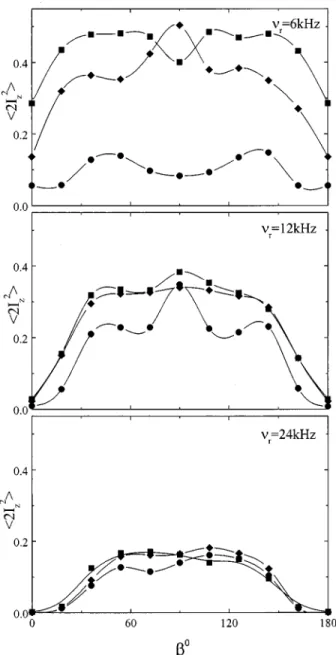
This is illustrated in Fig. 2 with simulations of a RFDR experiment on two 13C spins resonating with a Larmor fre-quency of 125.7 MHz and separated by⬃1.4 Å with a small isotropic shift difference of 14 ppm, corresponding with 1.76 kHz. The orientation of the PAS of the CSA for the second spin is defined with respect to the PAS of the CSA of the first spin and changed by varying the Euler angle 0⭐⭐180. For
⫽0 the two tensors are aligned and the dipolar vector is along the axis corresponding with the largest principle com-ponent of the spin 1. The points are evaluated at three dif-ferent spinning speedsr⫽r/2 assuming an initial
condi-tion for the density matrix
具
2Iˆz1典
and calculating the具
2Iˆz2典
after a constant mixing timem⫽2.66 ms.At a low speedr⫽6 kHz we calculate efficient transfer
for nw⫽1 with
具
2Iˆz2
典
approaching the maximum of ⬃0.5 over a broad range and it depends on the value of . The transfer efficiency drops for nw⫽2 and the angular
depen-dence is enhanced. The narrow band character of the RFDR is nicely illustrated for nw⫽4. Here the bandwidth is Bw/2⫽1.5 kHz, less than the isotropic shift difference
(⌬¯1⫺⌬¯2)/2⫽1.76 kHz and the
具
2Iˆz2典
⬃0.1, much less than for the nw⫽1 and nw⫽2 at the same spinning speed.This reflects the decrease of the bandwidth for increasing
nw.
With a spinning speed of 12 kHz, we calculate again a considerable dependence of the transfer efficiency on the angle , which is most pronounced around ⫽30° and
⫽150°. The
具
2Iˆz2典
goes through a maximum around⫽90°. The relative variation of the transfer withis stron-gest for nw⫽4. The
具
2Iˆz2
典
peaks around⫽90° and it almost vanishes for ⫽0° or ⫽180°. These calculations suggest new and interesting possibilities for collecting angular infor-mation by measuring the transfer rate for different nw, using
the generalized RFDR treatment discussed here for the analysis. At 24 kHz, the transfer characteristics change again. At the high speed of 24 kHz also for the nw⫽4 the Bw/2⫽6 kHz is sufficient to cover the isotropic shift dif-ference of 1.76 kHz. In addition, the spinning speed of 24 kHz is sufficient to attenuate the CSA’s, since ␦1/2 ⫽⫺11.3 kHz and␦2/2⫽⫺11.7 kHz. The Mkn
i j
in Eq.共54兲 depend on the spinning speed. They vanish in the limit of
r→⬁. Therefore the transfer is less efficient at high speed,
with
具
2Iˆz2典
below 0.2 for vr⫽24 kHz. This illustrates thatVII. CONCLUDING REMARKS
We have shown that the quantized field description can be used to analyze pulse sequences including MAS on a multiple spin system. It is demonstrated that the quantized
field approach, from which the Floquet approach can be de-rived, can be combined with average Hamiltonian theory. In the earlier Floquet treatment of the RFDR, an effective Hamiltonian was formulated, with the pulses included in the sequence.30In the quantized field formalism the effect of the MAS rotation and the rotation itself are disentangled and the resulting time-independent Hamiltonian can be treated in an average Hamiltonian formalism by adding the pulses after-wards. In this way average Hamiltonian theory and Floquet theory are fully compatible, since average Hamiltonian theory can be applied to the time dependent quantized field Hamiltonian in the toggling frame.
The HCQ in Eq. 共52兲 induces polarization transfer
be-tween nuclei in a multiple spin system.5 The probability of transfer strongly depends on the internuclear distance ␦i jk ⬀1/r3 and this makes correlation spectroscopy in isotope en-riched solids possible. The probability of polarization trans-fer has a maximum at every rotational resonance condition
¯i⫺¯j⫽n
r. Since the CSA is embedded in the Km i j also
the n⫽0 rotational resonance condition is included. According to our treatment, the driving force in both RFDR and rotational resonance is the rotor frequency and not the radio frequency. This suggests that a physically more appropriate expansion of the RFDR abbreviation would be ‘‘rotor frequency-driven dipolar recoupling.’’ The RFDR bandwidth can be changed by changing the window between the -pulses. This additional variable can be used to obtain information about relative orientation of the CSA tensors.
ACKNOWLEDGMENTS
This research was supported by the foundation of Life sciences 共ALW兲, financed by the Netherlands Organization for Scientific Research共NWO兲and part of this research was supported by The Israel Science Foundation. G.J.B. and H.J.M.dG are recipients of NWO TALENT and PIONIER awards, respectively.
APPENDIX
In this appendix the expression for the zero order aver-age Hamiltonian in Eq. 共52兲 is derived. To do so the inter-action Hamiltonian of a two-spin system must be calculated by applying the transformation of Eq.共45兲:
H˜ ˆ
int共t兲⫽Uˆ˜0⫺ 1共t兲Hˆ˜
1Uˆ˜0共t兲. 共A1兲
The transformation operator is defined by the sum of the isotropic chemical shift Hamiltonians
H˜ˆ n
CS共
t兲
⫽
再
1/2共⌬¯i⫺⌬¯j兲共Izi⫺Izj兲, 0⬍t⬍1/2w,
⫺1/2共⌬¯i⫺⌬j兲共Izi⫺Izj兲, 1/2w⬍t⬍3/2w, 1/2共⌬¯i⫺⌬¯j兲共Izi⫺Izj兲, 3/2w⬍t⬍2w,
共A2兲 and the CSA interaction term plus the rotor Hamiltonian FIG. 2. Examples of magnetization transfer within a dipolar coupled spin
pair. The calculations are performed for two spins separated by 14 ppm and resonating at 125.7 MHz. A set of parameters was used that correspond to the CSA’s that can be observed, e.g., aromatic or ethylenic carbons: for the first spin an anisotropy␦1⫽⫺90 ppm was used with an asymmetry
param-eter⫽0.41, while␦2⫽⫺93 ppm with ⫽0.73. In the evaluation of the
signals0⫽0 and 300 orientations are taken for each point. The relative
orientation of the tensors is defined by the Euler angles for the second spin (␣c
2
,c
2
,␥c
2
), following Eq. 共26兲. In this calculation ␣c
2
⫽␥c
2
⫽0 and c
2
⫽0is varied. The Euler angles for the transformation of the PAS of the
first spin and for the transformation of the dipolar frame to the crystal frame according to Eq.共33兲are taken zero. This corresponds with an orientation of the dipolar vector parallel to the most shielded direction of the first spin Iz
1
. The powder integration is performed over (␣r,r,␥r). The points are evaluated after mix⫽2.66 msec by assuming an initial condition for the
density matrix 2Iz
1 and following the magnitude of具2I
z
2典. The maximum
value we can expect is具2Iz
2典⬃
0.5 in a powder. XY 8 phase cycling was used for the full RFDR共nw⫽1, squares兲, XY 4 for nw⫽2共diamonds兲, and XX¯ for
H˜ ˆ i
CS共
t兲⫹Hˆr
⫽
冦
兺
k⫽i, j p兺
⫽12
共ZpkFˆp⫹Zp k*Fˆ
p
†兲I
z k⫹Hˆ
r, 0⬍t⬍1/2w,
⫺
兺
k⫽i, j p
兺
⫽1 2共Zp k
Fˆp⫹Zp k*Fˆ
p
†兲
Iz i⫹Hˆ
r,
1/2w⬍t⬍3/2w,
兺
k⫽i, jp兺
⫽12
共ZpkFˆp⫹Zp k*Fˆ
p
†兲
Izi⫹Hˆr, 3/2w⬍t⬍2w,
共A3兲 as
U˜ ˆ
0共t兲⫽Uˆn
CS共t兲Uˆ i
CS共t兲, 共A4兲
with
UˆnCS共t兲⫽exp
冉
⫺i冕
0
t
H˜ ˆ n
CS共兲d
冊
,共A5兲
UˆiCS共t兲⫽exp
冉
⫺i冕
0
t 共Hˆ˜
i
CS 共兲⫹Hˆ
r兲d
冊
.The dipolar interaction Hamiltonian from Eq. 共31兲 has the form
H˜ ˆ
i⫽共Zp i j
Fˆp⫹Zp i j*Fˆ
p
†兲共 2Iˆz
i Iˆz
j⫺
1/2共Iˆi⫹Iˆ⫺j ⫹Iˆi⫺Iˆ⫹j 兲兲. 共A6兲
The HamiltoniansHˆ˜nCS(t) andˆH˜iCS(t)⫹Hˆr commute and so
do UˆnCS(t) and UˆiCS(t). In addition, theˆH˜iCS(t)⫹Hˆris block
diagonal and can be diagonalized according to Refs. 33 and 36 with (k⫽i, j ),
兺
p⫽12
共ZkpFˆp⫹Zp k*Fˆ
p
†兲
Iˆzk⫹Hˆr⫽DˆkHˆrDˆk⫺
1 ,
共A7兲
兺
p⫽12
⫺共ZpkFˆp⫹Zp k*Fˆ
p
†兲
Iˆzk⫹Hˆr⫽Dˆk⫺
1Hˆ
rDˆk
with
Dˆk⫽exp
再
⫺兺
p⫽12
冉
Zpk prFˆp⫺ Zpk* pr
Fˆ†p
冊
Iˆzk冎
. 共A8兲 Insertion of these results into Eq. 共A1兲, defining Dˆ⫽DˆiDˆjwith关Dˆi,Dˆj兴⫽0 and using关Uˆn
CS
(t),UˆiCS(t)兴⫽0 we get
H˜ ˆ
int共t兲⫽
再
Uˆn
CS共
t兲Dˆ Uˆr共t兲Dˆ⫺1Hˆ1Dˆ Uˆr⫺
1共
t兲Dˆ⫺1Uˆn
CS⫺1共
t兲,
UˆnCS⫺1共t⫺w兲Dˆ⫺1Uˆr共t⫺w兲DˆHˆ1Dˆ⫺1Uˆr⫺
1共
t⫺w兲Dˆ Uˆn
CS共
t⫺w兲, UˆnCS共t⫺2w兲Dˆ Uˆr共t⫺2w兲Dˆ⫺1Hˆ1Dˆ Uˆr⫺
1共t⫺2
w兲Dˆ⫺1Uˆn
CS共t⫺2
w兲,
共A9兲
respectively, for the three time intervals, where we assumed that nw is even inw⫽nwr, and Uˆr(1/2w)⫽1ˆ. When we
change the variables of integration and take into account that the Hamiltonians are constant during each time interval, the average Hamiltonian can be rewritten as
H¯ ˆ
Q⫽
1
2w
冕
⫺1/2w 1/2w兵UˆnCS共t兲Dˆ Uˆr共t兲Dˆ⫺1Hˆ1Dˆ Uˆr⫺
1 共t兲
⫻Dˆ⫺1UˆCSn ⫺1共t兲⫹UˆnCS⫺1共t兲Dˆ⫺1Uˆr共t兲
⫻DˆHˆ1Dˆ⫺1Uˆ
r
⫺1共t兲Dˆ Uˆ
n
CS共t兲其dt. 共A10兲
To evaluate this integral we must consider the following computational steps: 共a兲 calculation of Aˆ⫽Dˆ⫺1Hˆ1Dˆ and
Aˆ
⬘
⫽DˆHˆ1Dˆ⫺1 by expanding the diagonalization operators; 共b兲 application of the rotor operator Aˆ (t)⫽Uˆr(t)Aˆ Uˆr⫺1 and
Aˆ
⬘
(t)⫽Uˆr(t)Aˆ⬘
Uˆr⫺1
(t); 共c兲 transformation of Aˆ (t) and
Aˆ
⬘
(t) to Bˆ (t)⫽Dˆ Aˆ(t)Dˆ⫺1 and Bˆ⬘
(t)⫽Dˆ⫺1Aˆ⬘
(t)Dˆ ; 共d兲 and application of the isotropic chemical shift operatorCˆ (t)⫽UˆnCS(t)Bˆ (t)UˆnCS⫺1 and Cˆ
⬘
(t)⫽UˆnCS⫺1Bˆ⬘
(t)UˆnCS(t). To perform the first step we calculate the D-transformations of the terms of Hˆ1:Dˆ FˆpIˆz iIˆ
z
jDˆ⫺1⫽Fˆ pIˆz
iIˆ z j,
Dˆ⫺1FˆpIˆz iIˆ
z jDˆ⫽Fˆ
pIˆz iIˆ
z
j, 共A11兲
Dˆ FˆpIˆ⫹ i
Iˆ⫺j Dˆ⫺1⫽⌬ˆi jFˆpIˆ⫹ i
Iˆ⫺j ,
Dˆ⫺1FˆpIˆ⫹ i
IˆjDˆ⫽⌬ˆi j⫺1FˆpIˆ⫹ i
Iˆ⫺j
with
⌬i j⫽exp
再
⫺兺
p⫽12
冉
Zpi⫺Zpj pr⫺ Zp i*⫺Z
p j*
pr
冊
冎
共A12兲
and ⌬ˆi j⫽⌬ˆji⫺1 and⌬ˆi j⫹⫽⌬ˆi j⫺1. This exponent can be ex-panded in a Fourier series using Zpi⫺Zpj⫽兩Zip
⫺Zpj兩exp(ipij):
⌬ˆi j⫽
兿
p⫽12
兺
m⫽0⬁
兺
n⫽0⬁
1
n!
冉
⫺ Zpi⫺Zpjpr F ˆ
p
冊
n1
m!
⫻
冉
⫺Zp i*⫺Zp j*
pr
Fˆ⫺p
冊
m⫽
兿
p⫽1 2
兺
m⫽0⬁
兺
l⫽⫺m⬁ 1
m!
1 共m⫹l兲!
⫻
冉
⫺Zp i⫺Zp j
pr
冊
m⫹l冉
Zip*⫺Zpj* pr冊
m
Fˆl p
⫽
兿
p⫽1 2
兺
m⫽0⬁
兺
l⫽⫺⬁⬁ 1
m!
⫻
冉
⫺兩Zp i⫺Zp j兩
pr
冊
2m⫹l
exp共ilpi j兲Fˆl p
⫽
兺
k⫽⫺⬁
⬁
兺
l⫽⫺⬁⬁
Jk
冉
⫺2兩Z2i⫺Z2j兩
2r
冊
Jl⫻
冉
⫺2兩Zli⫺ Zlj兩 r
冊
exp共il1i j⫹ik2i j兲Fˆl⫹2k
⫽
兺
m⫽⫺⬁
⬁
Kmi jFˆm 共A13兲
with
Kmi j⫽
兺
k⫽⫺⬁⬁
Jk
冉
⫺兩Z2i⫺Z2j兩 r
冊
Jm⫺2k
冉
⫺2兩Z1i⫺Z1j兩 r
冊
⫻exp共i共m⫺2k兲1i j⫹ik2i j兲 共A14兲
and Jk(x) the kth order Bessel function of x. Thus in step共a兲
the transformation results in
Aˆ⫽
兺
p⫽12
再
2共Zpi jFp⫹Zp i j*Fp
†兲
IziIzj⫺1/2
⫻
兺
m⫽⫺⬁
⬁
共共Zp i j
Km i j
Fm⫹p⫹Zp i j*K
m i j
Fm⫺p兲Ii⫹I⫺j
⫹共Zpi jKi j⫺*mFm⫹p⫹Zi jp*K⫺i j*mFm⫺p兲Ii⫺Ij⫹兲
冎
,共A15兲
Aˆ
⬘
⫽兺
p⫽12
再
2共Zp i jFp⫹Zp i j*F
p
†兲
Iz i Iz
j⫺
1/2
⫻
兺
m⫽⫺⬁
⬁
共共Zpi jKi j⫺*mFm⫹p⫹Zpi j*K⫺i j*mFm⫺p兲Ii⫹Ij⫺
⫹共Zi jpKmi jFm⫹p⫹Zp i j*K
m i jF
m⫺p兲Ii⫺I⫹j 兲
冎
.In the next step共b兲we use the fact that
Ur共t兲FpUr⫺1共t兲⫽Fpexp共⫺i prt兲,
共A16兲
Ur⫺1共t兲FpUr共t兲⫽Fpexp共i prt兲
and replace all Fp in Eq. 共A15兲 by Fpexp(⫺ipr) and Fpexp(ipr) to obtain A(t) and A
⬘
(t), respectively. In step 共c兲 an additional D-transformation must be performed. The results for B(t) and B⬘
(t), obtained again by using Eqs. 共11兲–共13兲, are cumbersome and are therefore not shown here. Their coefficients of IziIzj and I⫾i I⫾j contain multiples of the K-parameters. In the last step the isotropic chemical shift Hamiltonian is applied to the bilinear spin operatorsUnCS⫾1共t兲IziIzjUnCS⫿1⫽IziIzj,
UnCS⫾1共t兲Ii⫹I⫺jUnCS⫿1⫽I⫹i I⫺j exp共⫿共⌬i⫺⌬j兲t兲, 共A17兲
UnCS⫾1共t兲I⫺i I⫹jUnCS⫿1⫽I⫺i I⫹j exp共⫾共⌬i⫺⌬j兲t兲
in order to obtain expressions for C(t) and C
⬘
(t) from B(t) and B⬘
(t). Insertion of the results of these calculations in Eq. 共A10兲yields for the zero order average Hamiltonian the fol-lowing:H¯ ˆ
Q⫽⫺
1
4w
兺
i⬍j p兺
⫽⫺2 2Zpi j
兺
k,n⫽⫺⬁⬁
冉
Kki jKni j⫹*pFˆk⫺nIˆ⫹i Iˆ⫺j⫻
冕
⫺12w1
2w exp共i共⌬¯i⫺⌬¯j⫺n r兲t兲dt
⫹K⫺i j*kKni j⫺pFˆk⫹nIˆ⫹j Iˆ⫺i
冕
⫺12w1
2w exp共i共⌬¯j⫺⌬¯i
⫹nr兲t兲dt⫹K⫺k i j*K
n⫺p i j Fˆ
k⫹nIˆ⫹i Iˆ⫺j
冕
⫺12w1
2w exp共i共⌬¯j
⫺⌬¯i⫹nr兲t兲dt⫹Kki jKni j⫹*pFˆk⫺nIˆ⫹j Iˆ⫺i
冕
⫺21w1 2w
⫻exp共i共⌬¯i⫺⌬¯j⫺nr兲t兲dt
冊
共A18兲and the actual integration gives Eqs. 共52兲 and 共53兲. This Hamiltonian has only a (IxiIxj⫹IyiIyj)⫽1/2(I⫹i I⫺j ⫹I⫺i I⫹j) term, since the integral of the IziIzj coefficient, containing only terms of exponents exp(⫾iprt) is zero when w is a multiple of the rotor periodr.
1B. J. van Rossum et al., Spectrochim. Acta A 54, 1167共1998兲. 2B. J. van Rossum, S. Prytulla, H. Oschkinat, and H. J. M. de Groot,
Proceedings of the Joint 29th AMPERE—13th ISMAR International Con-ference, Berlin, Vol. 1, p. 38, 1998.
3R. Tycko and G. Dabbagh, Chem. Phys. Lett. 173, 461共1990兲. 4R. G. Griffin, Nat. Struct. Biol. 5, 508共1998兲.
5A. E. Bennet, J. H. Ok, R. G. Griffin, and S. Vega, J. Chem. Phys. 96,
8624共1992兲.
6
M. Baldus, M. Tomaselli, B. H. Meier, and R. R. Ernst, Chem. Phys. Lett.
230, 329共1994兲.
7J. M. Joers, R. Rosanske, T. Gullion, and J. R. Garbow, J. Magn. Reson.
106, 123共1994兲.
8
B. Q. Sun et al., J. Chem. Phys. 102, 702共1995兲.
9Y. K. Lee et al., Chem. Phys. Lett. 242, 304共1995兲.
10D. M. Gregory, D. J. Mitchell, and G. P. Drobny, Chem. Phys. Lett. 246,
654共1995兲.
11R. Verel, M. Baldus, M. Ernst, and B. H. Meier, Chem. Phys. Lett. 287,
421共1998兲.
12I. J. Lowe, Phys. Rev. Lett. 2, 285共1959兲.
13E. R. Andrew, A. O. Bradbury, and R. G. Eades, Nature共London兲182,
1659共1958兲.
14
G. J. Boender et al., Chem. Phys. Lett. 237, 502共1995兲.
15
B. J. van Rossum, H. Fo¨rster, and H. J. M. de Groot, J. Magn. Reson. 124, 516共1997兲.
16T. S. Balaban et al., Biochemistry 34, 15259共1995兲.
17G. J. Boender, S. Vega, and H. J. M. de Groot, Mol. Phys. 95, 921共1998兲. 18
J. H. Shirley, Phys. Rev. 138, 979共1965兲.
19G. J. Boender, thesis, Leiden University, 1996.
20M. M. Maricq and J. S. Waugh, J. Chem. Phys. 70, 3300共1979兲. 21C. Cohen Tannoudji, B. Diu, and F. Laloe, Quantum Mechanics 共
Her-mann, Paris, 1977兲.
22
Quantum Mechanics, 3rd ed., Course of Theoretical Physics, edited by L.
D. Landau and E. M. Lifshitz共Oxford, Pergamon, New York, 1981兲.
23M. Mehring, Principles of High Resolution NMR Spectroscopy in Solids
共Springer-Verlag, Berlin, 1983兲, 2nd Ed.
24
G. Racah, Phys. Rev. 62, 438共1942兲.
25U. Haeberlen, High Resolution NMR in Solids: Selective Averaging,
26A. E. Bennett et al., J. Chem. Phys. 108, 9463共1998兲.
27J. S. Waugh, L. M. Huber, and U. Haeberlen, Phys. Rev. Lett. 20, 180
共1968兲.
28
J. S. Waugh, C. H. Wang, L. M. Huber, and R. L. Vold, J. Chem. Phys.
48, 662共1968兲.
29R. R. Ernst, G. Bodenhausen, and A. Wokaun, Principles of Nuclear
Magnetic Resonance in One and Two Dimensions 共Clarendon, Oxford, 1987兲.
30
O. Weintraub, S. Vega, Ch. Hoelger, and H. H. Limbach, J. Magn. Reson.,
Ser. A 109, 14共1994兲.
31D. K. Sodikson, M. H. Levitt, S. Vega, and R. G. Griffin, J. Chem. Phys.
98, 6742共1993兲.
32
B. Q. Sun et al., J. Chem. Phys. 102, 702共1995兲.
33S. Vega, J. Chem. Phys. 68, 5518共1978兲.
34A. Wokaun and R. R. Ernst, J. Chem. Phys. 67, 1752共1977兲. 35G. Goobes, G. J. Boender, and S. Vega共in preparation兲.
36D. B. Zax, G. Goelman, D. Abromovich, and S. Vega, Adv. Magn. Reson.