Transactions Among Early Reading Development and Individual and Environmental Conditions: A Case Study
By Marnie Ginsberg
A dissertation submitted to the faculty of the University of North Carolina at Chapel Hill in partial fulfillment of the requirements for the degree of Doctor of Philosophy in the School of Education.
Chapel Hill 2007
iii ABSTRACT
Transactions Among Early Reading Development and Individual and Environmental Conditions: A Case Study
(Under the direction of Jill Fitzgerald)
The purpose of this study is to examine the transactions among a first-grade struggling reader’s reading abilities, reading-related cognitions, reading motivation, classroom behavior, and her individual and classroom reading instruction. In addition, I examined whether the transactions vary over time within the context of the Rural Early Literacy Initiative. Using a case study methodology, I analyzed observations of individual and classroom instruction, interviews of the teacher and student, assessments of the student’s reading abilities, and teacher questionnaires.
This study provides early evidence of the complex, reciprocal relationships that exist across multiple child and instructional domains related to reading. Within the child’s system, I observed transactions among reading instructional level, all reading sub-processes, reading motivation (particularly reading self-efficacy and reading involvement), and classroom behavior (particularly distractibility, independence, and task orientation) for one first-grade African-American girl. Most striking, her reading instructional level, reading sub-processes, and reading motivation reciprocally interrelated to one another, as mediated by reading practice. I also observed the ways in which her reading abilities and motivation affected her classroom behavior and witnessed suggestive evidence that this relationship was
iv
Individual reading instruction that was matched to the student’s instructional needs displayed clear transactions across the child system. To a less observable degree, I also saw ways in which classroom instruction transacted with individual instruction as well as the child system. The most notable instructional influence, the teacher-student relationship, exerted a strong reciprocal influence on reading sub-processes and instructional level,
reading motivation, classroom behavior, and individual and classroom instruction, mainly via the dramatic increase in positive instructional and emotional exchanges between the student and teacher.
v
ACKNOWLEDGEMENTS
I praise God for what I have learned and experienced through this process and that this work is nearly accomplished! Indeed, all good things come from you (NIV; James 1:17).
To my committee, I am grateful for your shepherding me through this stage of my education. To Jill Fitzgerald, my advisor, I am most thankful for your patient tutoring of me through my ideas, variations, and revisions. You have pushed me and I have learned much. To Lynne Vernon-Feagans, I am very appreciative of the opportunity to work on the Rural Early Literacy Initiative and for your wise counsel when the going got tough. To Dixie Lee Spiegel, I am thankful to have learned from and worked with a consummate teacher-educator. To Gloria Harbin, I am grateful to have had you as a teacher and a career counselor; you have listened and understood my research passions. To Leigh Hall, I am thankful to have had your careful feedback and your last-minute support for data analysis.
vi
TABLE OF CONTENTS
LIST OF TABLES... ix
LIST OF FIGURES ... x
I INTRODUCTION AND RATIONALE 1 Rationale ... 1
Transactional Model of Early Reading Development ... 3
Significance... 10
Definition of Constructs... 11
Reading ... 11
Reading-Related Cognitions ... 12
Reading Motivation ... 12
Classroom Behavior... 13
Reading Instruction... 13
Teacher-Student Relationship... 14
Struggling First-Grade Reader... 15
II CRITIQUE OF RELEVANT LITERATURE 16 The Transactional View of Learning Development... 16
Transactional Model of Early Reading Development ... 19
The Multiple Transactions Integrate Multiple Theories ... 20
The Self-Teaching Hypothesis... 20
The Matthew Effect ... 24
vii
Classroom Behavior... 26
The Teacher-Student Relationship... 28
Instantiating the Implications of a Transactional Model of Early Reading Development ... 32
III METHODOLOGY 34 Design ... 34
Participants and Setting... 42
Rural Early Literacy Initiative ... 42
Mrs. McBride, Cierra, and Eastwood Elementary... 44
Researcher’s Perspective ... 47
Data Sources, Variables, and Reliabilities... 50
Instruments... 51
Interviews... 59
Observations ... 59
Data Collection Schedule... 60
Data Analysis ... 61
IV RESULTS 68 An Initial Profile of Cierra as a Reader and a First-Grade Student ... 68
A Tale of Two Classrooms ... 75
Transactions Within the Child System ... 78
Transactions Across the Child System and the Instructional System... 103
Summary of Findings of the Transactions Among the Variables in the Two Systems ... 113
Variations Over Time ... 114
Summarization ... 116
viii
Transactions Within the Child System ... 119
Transactions Across the Child and Instructional Systems... 124
Variations in Transactions Over Time... 128
Implications for Practice ... 131
Implications for Research ... 132
Limitations ... 133
APPENDICES Phonics Knowledge Tests... 135
Conversational Interviews with Student—Possible Questions for Selection 139 Conversational Interviews with Teacher—Possible Questions for Selection140 Example Coding of First TRI Session ... 141
ix
LIST OF TABLES
Table Page
x
LIST OF FIGURES
Figure Page
1. Transactional Model of Early Reading Development………..….…… 4
2. Transactional Model of Early Reading Development – Expanded.………..…...…. 5
3. Reading and Motivation Sub-System.……….…….….. 81
4. DIBELS Assessment Data……….…….… 82
5. Phonics Knowledge……….………... 83
6. First Hundred Sight Words……….……….... 84
7. Words Studied per TRI Session………. 86
8. Accuracy Rate during TRI Sessions ...……….…….. 87
9. Oral Reading Fluency (DIBELS) …………..………..…... 90
CHAPTER 1
INTRODUCTION AND RATIONALE
The purpose of this study is to examine the transactions among a first-grade struggling reader’s reading abilities, reading-related cognitions, reading motivation, classroom behavior, and her individual and classroom reading instruction. In addition, I examine whether the transactions vary over time within the context of the Rural Early Literacy Initiative. The research questions are: 1) For a struggling first-grade reader, what are the transactions: a) among selected student characteristics—reading instructional level, selected reading sub-processes, selected reading-related cognitions, reading motivation, and classroom behavior; and b) among selected student characteristics (those just named) and individual and classroom reading instruction? And 2) Do the transactions vary over time within the context of the Rural Early Literacy Initiative? In the following section I will discuss the rationale for this study and define key constructs.
Rationale
[R]eading disability may be approached from the perspective of the
neurophysiologist interested in brain processes; from the perspective of the cognitive psychologist interested in isolating information-processing functions that explain reading ability; and from the perspective of the social-constructivist theorist
interested in how social structures define, support, and suppress certain literacy acts based on the social value assigned to various activities. The issue of contention is whether the views deriving from the different perspectives can be integrated (Stanovich, 1999, pp. vii-viii).
2
teachers do can influence students’ reading growth. For instance, explicit instruction in the code improves word recognition ability (NICHD, 2000; Snow, Burns & Griffith, 1998). Similarly, instruction in vocabulary improves students’ comprehension (Beck, Perfetti, & McKeown, 1982), as does comprehension strategies instruction (NICHD, 2000). Effective instruction has also been shown to help struggling readers, in particular, improve their
reading achievement (Torgesen et al., 2001; Vellutino, Scanlon, Sipay, Small, & et al., 1996). We also know that what the student brings to the reading task, such as cognition, motivation, and behavior, also relates to reading growth. A child’s phonological awareness strengths, for example, support early word recognition learning (Blachman, 2000). Early vocabulary knowledge ability also correlates with later reading achievement (Share, Jorm, Maclean, & Matthews, 1984). In the motivation realm, strong self-efficacy is linked with intrinsic motivation for reading, which is related to increased reading practice and reading achievement (Guthrie & Wigfield, 1999). Student behavior, too, has been found to be predictive of future reading difficulties (Nelson, Benner, & Gonzalez, 2003).
3
scientist to “see together” that which is often inappropriately isolated or separated (Dewey & Bentley, 1949). A transactional perspective acknowledges the need to understand the
dynamic relationships among factors internal and external to the child. It also might help researchers and practitioners “move away from ‘the search for pathology’ (Sarason & Doris, 1979) and toward the specification of the conditions under which a student can and will learn” (Wixson & Lipson, 1994, p. 561).
Transactional Model of Early Reading Development
The study employs a Transactional Model of Early Reading Development (Figures 1 and 2) that I developed. It has its roots in the child development literature (see Bronfenbrenner's ecological model, 1979; developmental systems theory, Pianta, 2005; and Sameroff & Fiese's transactional model, 2000) and in a model of reading as a socio-cultural process (Ruddell & Unrau, 2004). It describes the transactions among a) the child’s reading instructional level and reading sub-processes, reading-related cognitions, reading motivation, and classroom behavior and b) individual and classroom reading instruction for a struggling first-grade reader. While Ruddell and Unrau (2004) adopt the term, “interactive,” for their model of reading, I have opted for the word, “transactional,” to evoke the connotations of
Figure 1
Transactional Model of Early Reading Development
Figure 2
Transactional Model of Early Reading Development – Expanded
6
similarly, instruction influences reading level and several child factors (see Spear-Swerling & Sternberg, 1996; Wixson & Lipson, 1994). The hypothesized transactional relationships among child and instructional factors are expected to modulate with one another inextricably, although some factors may exert a stronger influence at certain times.
For more detail on the transactional perspective, consider each of the model’s domains and how they influence one another (Figures 1 and 2). First, a child’s specific cognitive skills impact the development of her reading abilities. Most notably, early preschool success in phonological processing, vocabulary knowledge, and language comprehension frequently presages future strong reading achievement (Blachman, 2000; Scarborough, 1998). Reading achievement, in turn, has a reciprocal relationship with phonological processing (Ehri, 1992), vocabulary knowledge and language comprehension (A. E. Cunningham & Stanovich, 1998). For example, a child’s ability to identify initial phonemes may facilitate early grapheme-phoneme relationships and word learning. As the child’s knowledge of grapheme-phoneme relationships and sight words deepens, she reciprocally develops greater phonemic awareness sensitivity because of her attention to specific orthographic patterns and their connection to phonological information.
7
with high self-efficacy believe they can conquer challenging tasks, such as recognizing new words, and are willing to persist in behaviors that result in success. On the other hand, children with low self-efficacy may be more likely to give up in the face of similar
challenges because of an assumption that they cannot be successful at the task. A person’s self-efficacy in a particular domain, however, is not a constant, so repeated success or failure has the potential to engender either high or low self-efficacy for the given task.
The classic “Matthew effects” study by Stanovich (1986) is an excellent example of how success in reading words and particular beliefs and behaviors transact over time, yielding vastly different reading achievement levels. He describes the all-too-typical
scenario where children’s poor entering aptitude and knowledge of early reading skills causes initial frustration with learning to read. These early failures bring about low self-efficacy in reading, which, in turn, leads to less exposure to print. The results of these transactions are even less ability to read words, and over time, significantly diminished vocabulary
knowledge, interest in reading, written language comprehension, and background knowledge. In this scenario, we see self-efficacy and other beliefs of the child reciprocally influencing cognitive characteristics and environmental conditions, such as exposure to print.
Finally, forces external to the child, especially teacher instruction, play a dramatic role in shaping reading level, and, as hypothesized by the Transactional Model, by indirectly influencing the child’s cognitive, motivational, and behavioral development. For example, early preschool instruction can prepare children for the concept of the alphabetic principle, in part, through phonological awareness games and activities. Even before encountering
8
(Blachman, 2000). If phonological awareness is highly teachable, experiential influences are likely to be important in its development over the course of a young child’s life. Consider how individual or classroom instruction in phonological awareness can stimulate this ability in the child (cognitive ability), thereby laying the ground work for the child to have an easier transition in learning to recognize words in context (reading instructional level), which may kindle the child’s positive motivational and behavioral choices. A child’s reading
achievement and classroom behavior may also positively impact the teacher’s perception of the child, which may result in differential instruction and grouping practices and in an improved teacher-student relationship. Therefore, it is incomplete to study phonological awareness outside of the external forces that help it developand that react to its
sophistication, or lack thereof.
The relationship of a child’s cognitive, motivational, and behavioral characteristics on a teacher’s instruction is less well-studied in reading research although some evidence does exist. For example, researchers from a socio-cultural perspective have suggested that children’s social and behavioral traits do affect teachers’ organization and instructional decisions (Rist, 1973; cited in Coles, 1987; Vernon-Feagans, 1996). In a study of children in a poor, minority school from kindergarten to second grade, Rist observed that the
9
Presumably, within the context of school, the children’s traits influenced the teacher’s evaluations of them, which, in turn, guided her classroom exchanges with the children and influenced some of their cognitive abilities and eventually later achievement.
A hypothetical example of the transactions between child and instruction may help instantiate the concepts represented in the Transactional Model of Early Reading
Development (Figures 1 and 2). Consider a child with intrinsically low-average phonological processing abilities. Her kindergarten teacher happens to spend little
instructional time targeting phonological awareness whereas her first-grade teacher relies on phonics instruction without much phonemic support for her reading instruction. Therefore, much of the phonics may be useless to the girl because she lacks the phonological “ear” through which to make sense of the phonics information. By second grade, the girl is struggling with the code and with school in general, but her struggle is not “caused” just by her cognitive abilities—it developed through the dynamic interplay of her cognitive abilities, motivation, behavior, and instruction. However, her poor early elementary outcomes may be improved if she has developed particular motivational and/or behavioral attributes, such as persistence (Spear-Swerling & Sternberg, 1996).
10
reinforcing the upward spiral of positive transactions among the child and instructional factors.
Significance
To my knowledge, other researchers have not examined the complex transactions among child and instructional factors in the context of reading instruction and how they vary over time. If the Transactional Model of Early Reading Development is validated for a struggling first-grade reader, early elementary teachers may have a better understanding of how their instructional and emotional supports for a struggling reader can impact the child’s reading level, cognition, motivation and behavior. Rich descriptions of such transactions may yield vivid images in teachers’ minds of the cascading effects between the child and teacher in the midst of reading instruction.
I also expect that reading researchers may benefit from a preliminary validation of a model that expands contemporary theories. In particular, reading researchers who attempt to predict which children will have reading difficulties as well as those who attempt to
11
Definition of Constructs
Reading
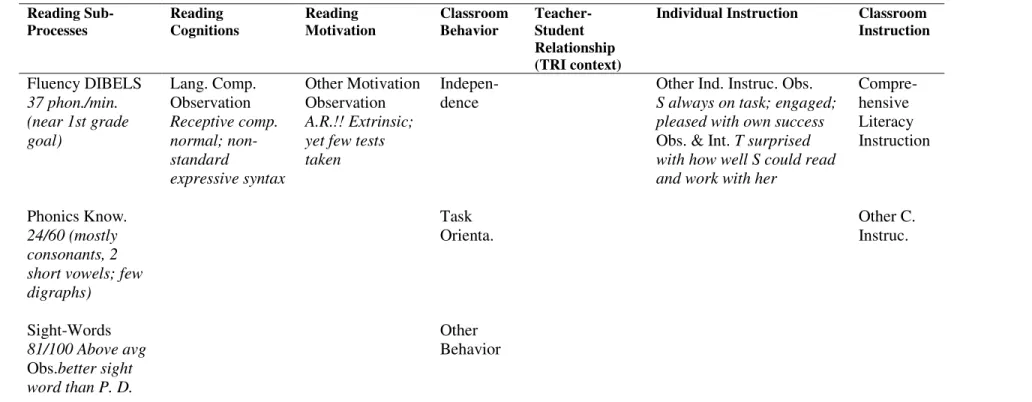
Reading instructional levelis the level of reading material at which a student can look at and pronounce words and understand the content. The selectedreading sub-processesare phonologicalandorthographic development, phoneme segmentation, phonological decoding, fluency, phonics knowledge, and sight-word reading. Phonologicalandorthographic
developmentrepresents changes in the sophistication and accuracy of spellings of isolated words. Spellings are considered more sophisticated and accurate when they demonstrate more advanced phonological (sound-based) representations or orthographic (spelling-based) representations, or both (Bourassa & Treiman, 2003; Treiman & Bourassa, 2000). Phoneme segmentationis the ability to separate the phonemes (sounds) in a word (Wagner &
12
from memory. Identifying words from memory excludes the use of a strategy, such as decoding or analogizing (Ehri, 2005).
Reading-Related Cognitions
Cognitionrefers to the mental “processes or faculties by which knowledge is acquired and manipulated” (Bjorklund, 2000, p. 3). For this study, three cognitions highly related to reading—phonological processing, vocabulary knowledge,andlanguage comprehension (Scarborough, 2001)—are what I examine. Phonological processingrefers to the aural awareness, acquisition, and retrieval of the phonological (sound-based) properties of our language (Wagner & Torgesen, 1987). It is described as consisting of three constructs: phonological awareness, phonological memory,andrapid naming. Phonological awareness and rapid naming are the two constructs that I focus on. Phonological awarenessis
attunement (awareness) and access to units of sounds in words and to individual sounds (Wagner & Torgesen, 1987). “Rapid namingof objects, colors, digits or letters requires efficient retrieval of phonological information from long-term or permanent memory” (Wagner, Torgesen, & Rashotte, 1999, p. 6). Vocabulary knowledgeis the understanding of the meanings and uses of specific words. Language comprehensionis the ability to receive and express thought in words, and it relies on background knowledge (including vocabulary knowledge), language structures, verbal reasoning, and written language knowledge
(Scarborough, 2001). Reading Motivation
13
and reading importance. Reading involvementis the “child’s enjoyment of immersion or absorption in a text. This is often referred to as ‘getting lost in a book’” (Guthrie & Wigfield, 2000, p. 407). Reading self-efficacyrefers to a child’s expectancies for accomplishing
various reading tasks (Guthrie & Wigfield, 2000). Reading importanceis the value that the young child places on reading and on learning to read.
Classroom Behavior
Five aspects of a child’sclassroom behaviorat school are considered: distractibility, hostility, independence, considerateness,andtask orientation. Distractibilityis the ease with which the student remains focused on a given task and screens out extraneous stimuli.
Hostilityis the anger and aggression the child exhibits to other children in the classroom. Independenceis the ability of the child to engage in classroom activities with little additional support from the teacher. Consideratenessis the extent to which the child puts the needs of others ahead of her own. Task orientationis the degree to which the child completes a given task, despite interference.
Reading Instruction
14
struggling readers. Theindividual reading instructionvariable incorporatesinstructional match,instructional supportandemotional support. Instructional matchoccurs when the task size, nature, and level of difficulty allows the student to be successful with the teacher’s help. Instructional supportincludes instructional match, as well as other aspects of good instruction, such as scaffolding, instructive feedback, and coaching for independence. Emotional supportrefers to sensitive and positive feedback and responsiveness (Hamre & Pianta, 2005).
Classroom reading instructionrefers to the daily whole group and small group reading instruction that the entire class received from the classroom teacher and/or her teaching assistant. Theclassroom reading instructionvariable also includesinstructional matchandinstructionalandemotional supportas described above. In the context of this study, as I observed classroom reading instruction, I watched primarily for these support mechanisms for the case study student. Additionally,comprehensive literacy instructionis another variable that I expect will relate to the other child and instructional conditions. For the purposes of this study, comprehensive literacy instruction refers to evidence-based instruction in reading and writing that includes explicit instruction in word recognition, fluency, comprehension strategies, vocabulary, and process writing with frequent exposure to a variety of texts (NICHD, 2000; Snow, Burns, & Griffin, 1998).
Teacher-Student Relationship
15
conceive of the teacher-student relationship as being influenced by the instructional and emotional support the student receives from the teacher (Hamre & Pianta, 2005). Struggling First-Grade Reader
CHAPTER 2
CRITIQUE OF RELEVANT LITERATURE
In this study, I have drawn upon theories and research of learning and reading development that suggest that the study’s multiple variables would, indeed, be expected to transact with one another. With the present critique, I will delineate those theories and research that have shaped the creation of the Transactional Model of Early Reading Development. First, with a wide angle, I will describe the theory and research behind the transactional view of learning development in general. Then I will narrow my focus to review the research that lends support to the conception that the particular variables in the child system (reading-related cognitions, reading sub-processes, reading instruction, reading motivation, and classroom behavior) would reciprocally interrelate with one another and with the variables in the instructional system (individual and classroom instruction).
The Transactional View of Learning Development
Three-year old Kyra, with pen and pad of paper in hand, proudly asserts to her sister, “I’m working on my dissertation” (Observation, 2006).
…I argue that the roles of the individual and the social world are mutual and not separable, as humans by nature engage in social activity with their contemporaries and learn from their predecessors….[O]ur cultural stress on the individual must be balanced with recognition of the interdependence of children and their social partners in cultural contexts, in order to understand the processes and goal of cognitive
development (Rogoff, 1990, pp. viii, ix).
As Rogoff implies, human learning is a contextual process. Changes within the mind of a child or an adult learner are not separable from the environment in which they
17
environment. Rather, both learner and environment mutually influence one another in an ongoing process. Neither are unchanged after having encountered one another.
Dewey and Bentley (1949) popularized the importance of thetransactional perspective, “in which is asserted the right to see together, extensionally and durationally, much that is talked about conventionally as if it were composed of irreconcilable separates” (p. 120). Their scope was wide, defining procedures for encompassing all of human learning. They were passionate about not shattering “the subjectmatter into fragments in advance of inquiry and thus destroy[ing] instead of furthering comprehensive observation of it” (p. 120). For example, when we isolate three reading-related cognitions and use them to explain reading achievement, we fragment the inquiry and disallow a complex lens of study on reading achievement that would include cognitions and many other aspects of the interconnected puzzle.
18
mother has a baby born under difficult circumstances. The stress of the event and her
interpretation of the event cause her to handle her baby anxiously. The underweight baby, in turn, develops sleeping and eating habits that are difficult to manage. The parents conclude that the child has a difficult temperament, and the mother avoids interacting with the child. The child may later exhibit poor language abilities. So, was the child’s low verbal abilities the direct result of a difficult birth? Or, was this poor outcome the result of the transactions among child, mother, family, and culture over several years? Both Sameroff and Chandler (1975) and Sameroff and Fiese (2000) conclude that the latter is a better frame for
considering the development of the child. Other writers have similarly theorized of child development as occurring via nested systems of interaction, including the biological, psychological, cognitive, and environmental systems (see Bronfenbrenner’s ecological model, 1979; Pianta’s developmental systems, 2005).
19
Transactional Model of Early Reading Development
I adopt the transactional perspective for the creation of a Transactional Model of Early Reading Development (Figures 1 and 2). The model interprets a young child’s reading level as the developing product of the dynamic interplay between internal (child) and
external (teacher instruction) factors. Based on theory and research, I selected for the model the child and teacher factors most expected to influence reading level in the first-grade year. Specifically, it describes the transactions among a) the child’s reading instructional level and reading sub-processes, reading-related cognitions, reading motivation, and classroom
behavior, and b) individual and classroom reading instruction for a struggling first-grade reader. In the following sections, I will elaborate on the theory and research that validate the expected transactions between these particular child and instructional variables.
The Transactional Model of Early Reading Development springboards from the model of reading as a sociocognitive interactive process by Ruddell and Unrau (2004). They describe the reading process at the juncture of the reader, the text and the classroom, and the teacher. In the midst of the reading process, “these three components are in a state of dynamic change and interchange while meaning negotiation and meaning construction take place” (p. 1464). According to Ruddell and Unrau, the teacher and reader’s cognitive and affective conditions and their use and control of knowledge are all bi-directionally
20
model does not elaborate on the uniqueness of the word identification acquisition process or include contemporary research of word acquisition. As a child learns to identify words, she faces unique challenges that more advanced or adult readers do not face, so the Transactional Model of Early Reading Development integrates contemporary theories and research of early reading processes and development.
The Multiple Transactions Integrate Multiple Theories
In keeping with Dewey and Bentley’s (1949) admonition to “see together” things and events, I will integrate four research-based reading theories that usually skim past one
another to describe how child and instructional factors would be expected to transact with one another. Using the theoretical lenses of Share’s self-teaching hypothesis (1995), Stanovich’s Matthew effects explanation for developmental differences in reading (1986), the model of reading as engagement (Guthrie & Anderson, 1999), and early literacy
development in the context of the teacher-child relationship (Pianta, 2006), I will attempt to depict a comprehensive picture of early literacy development embracing reading and its sub-processes, cognition, motivation, behavior, instruction, and teacher-student relationships. The Self-Teaching Hypothesis
21
reader to deduce the novel word. Each word-learning opportunity provides her with another chance to learn slightly more about both the phonological and orthographic properties of the word and of letter combinations typical to English words, in general. The more successful the reading practice, the more likely the student will absorb more information about the “inside parts” of words.
What explains the variation in students’ facility to absorb this orthographic information is still in debate. One perspective favors rapid naming, as measured with a Rapid Automatized Naming (RAN) task, as the best explanation for a secondary causal factor in explaining reading acquisition differences. Rapid naming is a complex
22
Dykman, 1993; Blachman, 1984; Wolf, 1991; Wolf & Bowers, 1999; Wolf, Bowers, & Biddle, 2000).
Wolf and colleagues (Wolf, 1991; Wolf & Bowers, 1999; Wolf, Bowers, & Biddle, 2000) presume a psycholinguistic model of reading to explain the sub-processes involved in the act of naming in hopes of elucidating a possible theory of how this construct relates to reading. When presented with the RAN task, a child first must attend to the page, visually scan the symbol, and integrate it with stored mental representations, both orthographic and phonological. Then this integrated representation calls up phonological labels, incorporating semantic information. Finally, these sub-processes allow the articulation of the symbol. Although these processes were described in a linear fashion, instead, a better
conceptualization would depict the simultaneous activation of these sub-processes. Wolf and colleagues emphasize that the very complexity of the task described above suggests that naming speed entails much more than just phonological processing. Theoretically, naming speed describes the integration of other cognitive processes that further explain individual differences in reading achievement, beyond phonological processing alone.
However, the other perspective puts forward orthographic knowledge, as measured with orthographic learning tasks, as a better conceptualization of another cognitive ability that supports word learning (A. E. Cunningham, 2006; A. E. Cunningham, Perry, &
23
agree that both phonological and orthographic processing are interrelated, yet separate, core cognitive agents in word acquisition.
24
prospects for more carefully discriminating among slight variations of both phonological and orthographic information. With repeated exposure to print, she builds a more and more sophisticated word bank. Thus, phonemic awareness, phonological decoding, sight-word reading, and reading practice are reciprocally interrelated.
The Matthew Effect
Second, although phonological awareness is a prime causal agent explaining
cognitive variation in early reading acquisition, it does not, of course, explain all sources of cognitive variation. Researchers have also shown that general language comprehension and vocabulary knowledge correlate consistently with literacy development (Chall, Jacobs, & Baldwin, 1990; A. E. Cunningham & Stanovich, 1997; Feagans & Short, 1984; Hart & Risley, 1995; Scarborough, 2001). Stanovich’s oft-cited Matthew effects theory of reciprocal influences over the course of reading development explains individual differences in several cognitive domains (1986). The term “Matthew effects” comes from Jesus’ parable in the gospel of Matthew, “For everyone who has will be given more, and he will have an
abundance. Whoever does not have, even what he has will be taken from him” (NIV; 25:29). The analogy popularized by Stanovich is that those children who enter school well-equipped to learn to read will continue to gain in achievement while those ill-equipped will only grow in their frustration. In addition to elaborating on the significant, bi-directional relationships between phonemic sensitivity and early word recognition development, Stanovich explains how early reading success often spurs extensive reading practice, which, in turn, results in enriched vocabularies and general language use.
25
achievement predict vocabulary development and reading comprehension in early elementary (Hart & Risley, 1995; Scarborough, 2001). Later reading practice predicts vocabulary and comprehension, as well, even after partialing out cognitive ability (West & Stanovich, 1991). Given that reading achievement is associated with reading practice (Anderson, Wilson, & Fielding, 1988; A. E. Cunningham & Stanovich, 1997; McBride-Chang, Manis, Seidenberg, Custodio, & et al., 1993), these relationships do, indeed, suggest another reciprocal causation mechanism as Stanovich purports—this time between vocabulary and reading achievement. Reading As Engagement
Other non-cognitive outcomes are also implicated by the Matthew effects proposal. Stanovich writes, “the initial specific problem may evolve into a more generalized deficit due to the behavioral/cognitive/motivational spinoffs from failure at such a crucial educational task as reading” (1986, p. 393). It is at this juncture of cognition, motivation, and behavior that I invoke the engagement model of reading (Guthrie & Anderson, 1999) in order to integrate these three domains. Stanovich and Share both hint at the motivational necessities for a learner to have ample exposure to print but do not expand on the theory and research that explain why a child might elect to read. Guthrie and Anderson explain how an engagement theory of reading fills this void:
Reading traditionally has been defined as a set of skills or competencies (Anderson, Hiebert, Scott, &Wilkinson, 1985; Huey, 1908; Ruddell, Ruddell, & Singer,
1994)….We believe this achievement-oriented view of reading is accurate but incomplete. In our view, reading should be conceptualized as an
26
early reader, Guthrie and Anderson highlight motivation as a mediating, bi-directional factor in children’s reading experiences. “As motivation increases, engagement increases. When students are intrinsically motivated, they learn to use cognitive strategies for reading…As students gain conceptual understanding, their sense of self-efficacy grows and their motivations for reading increase…” (1999, p. 20).
Numerous aspects of reading motivation have been described and researched (e.g., Baker & Wigfield, 1999; Wigfield & Guthrie, 1997). Two intrinsically-related aspects of motivation, self-efficacy and involvement, have been found to correlate strongly with exposure to print (Wigfield & Guthrie, 1997)—the variable hypothesized by Share (1995) and Stanovich (1986) to be a powerful mediator of reading achievement. Self-efficacy is “people’s judgments of their capabilities to organize and execute courses of action required to attain designated types of performance” (Bandura, 1986; quoted in Guthrie & Wigfield, 2000). The self-efficacious reader elects to read more, which, by virtue of the importance of reading practice, often leads to greater reading achievement. The involved reader enjoys “the experience of ‘getting lost’ in a book” (Guthrie & Anderson, 1997; p. 21) and is more likely to search out more opportunities to read. Aspects of intrinsic motivation, such as self-efficacy and involvement, predict exposure to print (Wigfield & Guthrie, 1997), and we know that exposure to print predicts reading achievement (Anderson et al., 1988; A. E. Cunningham & Stanovich, 1997; McBride-Chang et al., 1993). Thus, motivation may mediate the reciprocal relationship between reading-related cognitions and reading achievement, via the importance of reading practice.
27
In addition to motivation, Stanovich predicted another “spinoff” from an early failure to learn to read: problem behavior. A student’s difficulty with the prime task of his school day, reading, may cause an increase in his disengagement with reading and possibly with school in general. Or, perhaps underlying characteristics of the child develop into both difficulties with reading and problem behaviors. In an influential review (1992), Hinshaw explains that inattention and externalizing behaviors (e.g., defiance, disruptiveness,
aggression or hyperactivity) both correlate with early academic difficulties, and these connections grow stronger as students move through primary, middle, and high school (see also S. B. Miles & Stipek, 2006). The early co-occurrence is suggestive of an underlying causal connection, and the strengthening of the relationship is suggestive of a feedback loop. Hinshaw found that externalizing behaviors commonly have their routes in low
socioeconomic status, subaverage IQ, language deficits, and neurodevelopmental delay, so their effects are expected to be diverse and not overlap completely with reading or academic difficulties. Indeed, he writes, “[g]iven the interactions and transactions among social, familial, linguistic, and neurobehavioral variables that may culminate in the overlap between underachievement and externalizing behavior, teasing apart the effects of any single
background factor is likely to be quite difficult or even misguided” (1992, p. 151).
28
(phonological decoding and fluency) rose, externalizing behaviors in the classroom and playground diminished. The authors concluded that “for some first-grade children, secondary interventions targeting academic skills resulted in positive collateral effects on behavior” (Lane, O'Shaughnessy, Lambros, Gresham, & Beebe-Frankenberger, 2001, p. 1071). Similarly, another experiment tested the effects of reading tutoring for 10
kindergarten through second-grade children whose teachers identified them as low in academic skills and high in aggression. Most of the tutored students improved in their reading abilities and their classroom time-on-task, but only a small minority of non-tutored students made gains. The greater the gain in reading abilities, the greater the gain in time-on-task (Gest & Gest, 2005). Gest and Gest conclude, “[t]he most parsimonious explanation is that promoting reading skill development provides children with the prerequisite skills to engage in classroom tasks that require some form or reading” (2005, p. 41).
The conclusion of Gest and Gest leads us full-circle back to the first variables described in the child domain of the Transactional Model of Early Reading Development. Cognitive, motivational, and behavioral traits of children relate to early reading development, and they transact dynamically over the first years of school (Snow et al., 1998; Stanovich, 1986). Cracking the code is a necessary, but not sufficient, component of reading
29
For most children, the teacher stands at the nexus of the child’s incipient reading system. The extent to which a teacher is able to provide the student what she needs instructionally and emotionally will likely account for much of the student’s success or difficulty. Pianta (2006) conceives of the successful literacy system developing within a teacher-student relationship that provides sufficient instructional and emotional support. Reading researchers are accustomed to considering the powerful influences of teachers’ instructional actions on students’ reading achievement. For example, researchers have shown the difference that storybook reading has on language and reading achievement (Bus & et al., 1995; Dickinson & Smith, 1994), the impact of phonological awareness instruction on future reading achievement (Ball & Blachman, 1991; Blachman, 2000; NICHD, 2000), the significance of fluency instruction (NICHD, 2000; Rasinski, 1990; Rasinski & et al., 1994), the benefits of vocabulary teaching for vocabulary and comprehension (Beck et al., 1982; NICHD, 2000), and the effectiveness of teaching comprehension structures and strategies on reading comprehension (Fitzgerald & Spiegel, 1983; Gersten, Fuchs, Williams, & Baker, 2001; NICHD, 2000; Spiegel & Fitzgerald, 1986).
Not only is the content of instruction important, but the form or organization of instruction has been shown to have significant predictive ability on students’ achievement (Connor, Morrison, & Petrella, 2004; Connor, Morrison, & Slominski, 2006; Pressley, Gaskins, Solic, & Collins, 2006; Taylor, Pearson, Clark, & Walpole, 2000;
Wharton-McDonald, Pressley, & Hampston, 1998). For instance, researchers have studied the ways in which schools in high-poverty areas “beat the odds” by demonstrating greater student
30
reading instruction and encouraging feedback, these researchers highlight the importance of instructional conversations and instructional density; high-quality teachers have students with higher achievement and often provide more literacy instruction to their students. Instead of relying solely on whole-class instruction, high-quality teachers more often teach in small groups and their students more often read independently.
Besides the importance of instructional support via effective content and
organization, the teacher-student relationship also depends on emotional support, which is less often considered by reading researchers. However, scientists are more recently showing interest in emotional support as a critical variable explaining reading achievement. For example, in an analysis of 787 first-grade students from the NICHD Study of Early Child Care and Youth Development, Connor and colleagues (2005) found that students with classroom teachers who were rated as emotionally responsive and who offered more
31
Interestingly, some studies have also found a bi-directional relationship between students’ characteristics and teachers’ behaviors (Klem & Connell, 2004; Skinner & Belmont, 1993; Thijs, Koomen, & van der Leij, 2006). In a description reminiscent of Stanovich’s Matthew effects (1986), Skinner and Belmont found strong support
for reciprocal effects that are magnificatory, in which positive student engagement elicits positive teacher behaviors. Teachers respond to children who have initially high behavioral engagement with more involvement, more autonomy support, and even to a degree, more contingency and consistency, and they respond to children who are more passive with correspondingly more neglect, coercion, and even inconsistency. Because these supports have an impact on children’s subsequent engagement, this means that children who have high behavioral engagement are treated in a way that is likely to increase their active participation in class, whereas teachers deal with children who have lower behavioral engagement in a way that will exacerbate their initial passivity and withdrawal from learning activities (1993, p. 578).
Thus, instructional and emotional support impacts the teacher, who in turn is influenced by student characteristics and behaviors.
Unfortunately, scientists have uncovered ways in which teacher assumptions and organization also appear to bias their treatment of children with differing economic, cultural, and racial backgrounds (R. Rist, 1970; R. C. Rist, 1973; cited in Coles, 1987; Vernon-Feagans, 1996). Both Rist and Vernon-Feagans found that early elementary teachers grouped their low socioeconomic students into low ability groups, with no regard for the children’s true abilities. Low ability groups also received poorer instructional support and challenge. Rist (1973; cited in Coles, 1987) found these differential treatments also related to diminished academic outcomes by second grade.
32
the student may influence how she responds to a child. A lowered expectation of a child’s potential may limit the challenge that a teacher sets before the child and may limit the extent to which she pursues acceleration of the student’s achievement. Given the powerful impact of a teacher, these lowered expectations and challenges could cause weakened student outcomes. In sum, quality of instruction and related achievement is somewhat influenced by reciprocal relationships between child traits and abilities and teacher beliefs and practices.
Instantiating the Implications of a Transactional Model of Early Reading Development
Given the complexity of the theoretical argument that reading develops
transactionally across multiple child and instructional factors, a hypothetical example may help instantiate the potential relationships. Consider a boy from a low-income household entering kindergarten. He has average general language abilities and has occasionally been read to by his single mom, but he has not yet shown an interest in print, and he has little phoneme awareness. He knows how to spell and recognize his name but has no other sight word knowledge. He also knows the names of several letters but only three letter-sounds.
33
form, her response to his struggles, and his moderately immature attentional and self-regulation systems.
With few interactions with her, over time he loses some of his intrinsic motivation to complete handwriting and letter name worksheets, and occasionally he gets in trouble after wandering off-task. The teacher perceives him to be “a slow learner” who is also not trying his best. She determines that he cannot be expected to understand some of the more complex discussions she has with the “top students,” and she does not encourage him to look at or read books on his own. As he leaves kindergarten “behind in reading,” with attenuated motivation and a slight history of behavior problems, his position at the bottom of the educational hierarchy may already be fixed, unless a caring, knowledgeable teacher, or several such teachers or family members interject an unusually intense amount of instructional and emotional support. Thus, his potential to succeed is inextricably intertwined with his environment’s potential to succeed with all children.
In summary, this hypothetical example displays the transactional network of relationships between child and instructional systems and emerges from contemporary theories and research. The child’s cognitive, motivational, and behavioral characteristics reciprocally interact with one another, in addition to reciprocally interacting with his
relationship with the teacher, who provides instructional and emotional support. The child’s developing reading abilities, then, are the continuously adapting product of child and
CHAPTER 3 METHODOLOGY
In this section I will detail the methodology for the case study. First, I will provide an overview of the study design. I then describe the participants and setting of the study,
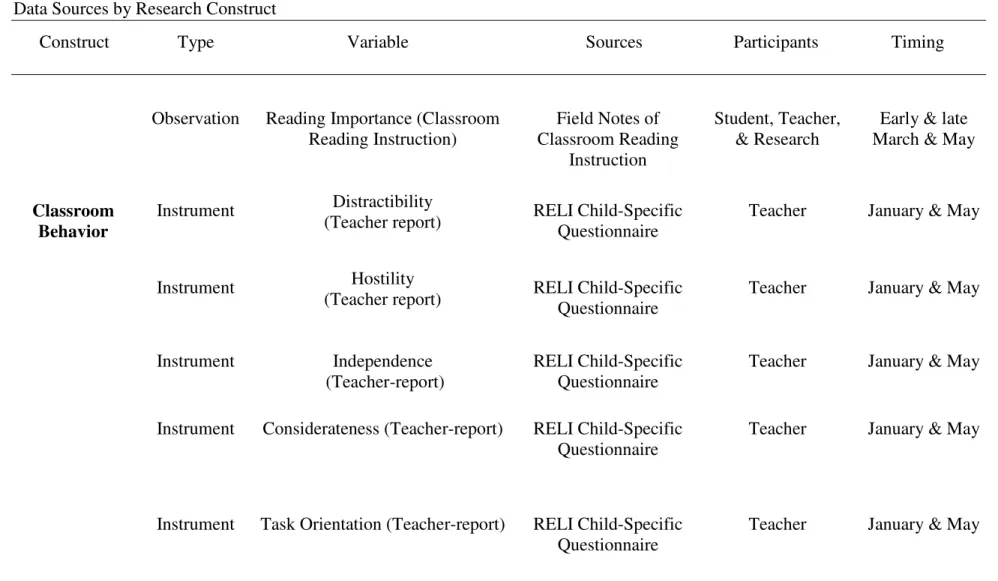
including the context of the broader study, the Rural Early Literacy Initiative (RELI). I also explain my own researcher background and perspective as a key context for the study. Next, the data collection section describes each data source, including instruments, observations, and interviews. This section is followed by the data collection schedule. Tables 1 and 2 in the appendices are helpful overviews of the data sources, variables, and timing. I end the methodology section with my data analysis plan.
Design
For this case study (Yin, 2003), I selected one first-grade teacher and one struggling first-grade reader in her class from the RELI experimental school. I utilized RELI data sources of the child’s reading instructional level, phonological processing, and vocabulary knowledge collected in December 2005, and of reported child behavior and teacher-student relationship collected in January 2005. I began collecting additional child
assessments, teacher and student interviews, and observations of both individual and
35
Table 1
Data Sources by Research Construct
Construct Type Variable Sources Participants Timing
Reading Instructional
Level
Instrument Reading Instructional
Level Qualitative Reading Inventory-3 (QRI-3;Leslie & Caldwell, 2001) Student March, April, &December, May
Reading Sub-Processes
Instrument Phonological and Orthographic Development
Treiman-Bourasso Early Spelling Test (T-BEST; Treiman & Bourasso, 2000)
Student March & May
Instrument Phoneme Segmentation
Phonemic Segmentation Fluency--Dynamic Indicators of Basic Early Literacy
Skills 6thEdition (DIBELS; Good, Kaminski & Smith, 2002)
Student March and weekly thereafter
Instrument Phonological
Decoding Indicators of Basic Early Literacy Skills 6Nonsense Word Fluency--Dynamic th Edition (DIBELS; Good, Kaminski &
Smith, 2002)
36
Table 1 – Continued
Data Sources by Research Construct
Construct Type Variable Sources Participants Timing
Instrument Fluency DIBELS Oral Reading Fluency--Dynamic Indicators of Basic Early Literacy Skills 6th Edition (DIBELS; Good, Kaminski & Smith,
2002)
Student March and weekly thereafter
Instrument Phonics Knowledge
Researcher-made assessment Student Early & late March & May
Instrument Sight-Word
Reading Researcher-made assessment, using list by Fry etal., 1993 Student March & MayEarly & late
Reading-Related Cognitions
Instrument Vocabulary Knowledge
Peabody Picture Vocabulary Test-Third Edition (PPVT-III; Dunn & Dunn, 1997)
Student December & May
Instrument Phonological Awareness
Comprehensive Test of Phonological Processing
37
Table 1 – Continued
Data Sources by Research Construct
Construct Type Variable Sources Participants Timing
Instrument Rapid Naming Comprehensive Test of Phonological Processing (CTOPP; Wagner,
Torgesen & Rashotte, 1999)
Student December & May
Observation Language Comprehension (Individual Reading
Instruction)
Transcription & Field Notes of Individual Reading Instruction
Student, Teacher, & Researcher
Twice a week
Observation Language Comprehension (Classroom Reading
Instruction)
Field Notes of Classroom Reading Instruction
Student, Teacher, & Researcher
Early & late March & May
Reading Motivation
Interview Reading Involvement Conversational Interviews with Student
Student & Researcher
Early & late March & May
Interview Reading Self-Efficacy Conversational Interviews with Student
Student & Researcher
Early & late March & May
Interview Reading Importance Conversational Interviews with
38
Table 1 – Continued
Data Sources by Research Construct
Construct Type Variable Sources Participants Timing
Observation Reading Involvement (Individual Reading
Instruction)
Transcription & Field Notes of
Individual Reading Instruction
Student Twice a week
Observation Reading Involvement (Classroom Reading
Instruction)
Field Notes of Classroom Reading
Instruction
Student, Teacher, & Research
Early & late March & May
Observation Reading Self-Efficacy (Individual Reading
Instruction)
Transcription & Field Notes of
Individual Reading Instruction
Student Twice a week
Observation Reading Self-Efficacy (Classroom Reading
Instruction)
Field Notes of Classroom Reading
Instruction
Student, Teacher, & Research
Early & late March & May
Observation Reading Importance (Individual Reading
Instruction)
Transcription & Field Notes of
Individual Reading Instruction
39
Table 1 – Continued
Data Sources by Research Construct
Construct Type Variable Sources Participants Timing
Observation Reading Importance (Classroom Reading Instruction)
Field Notes of Classroom Reading
Instruction
Student, Teacher, & Research
Early & late March & May
Classroom Behavior
Instrument Distractibility
(Teacher report) RELI Child-SpecificQuestionnaire Teacher January & May
Instrument Hostility
(Teacher report) RELI Child-SpecificQuestionnaire Teacher January & May
Instrument Independence
(Teacher-report) RELI Child-SpecificQuestionnaire Teacher January & May
Instrument Considerateness (Teacher-report) RELI Child-Specific Questionnaire
Teacher January & May
Instrument Task Orientation (Teacher-report) RELI Child-Specific
40
Table 1 – Continued
Data Sources by Research Construct
Construct Type Variable Sources Participants Timing
Observation Student Behaviors (Observed During Individual Reading
Instruction)
Transcription & Field Notes of
Individual Reading Instruction Student, Teacher, & Researcher Twice a week
Observation Student Behaviors (Observed During Classroom Reading
Instruction)
Field Notes of Classroom Reading Instruction Student, Teacher, & Researcher
Early & late March
Individual Reading Instruction (Instructional Match, Instructional
Support, & Emotional Support)
Observation Reading Instruction (Individual Reading
Instruction)
Transcription & Field Notes of
Individual Reading Instruction Teacher & Child Twice a week Observation Teacher-Student Relationship (Individual Reading Instruction) Transcription & Field Notes of
41
Table 1 – Continued
Data Sources by Research Construct
Construct Type Variable Sources Participants Timing
Classroom Reading Instruction (Instructional Match, Instructional
Support, Emotional Support, & Comprehensive Literacy Instruction)
Observation Reading Instruction (Classroom Reading
Instruction)
Field Notes of Classroom
Reading Instruction
Teacher &
Classroom late MarchEarly & & May
Observation Teacher-Student Relationship (Classroom Reading
Instruction)
Field Notes of Classroom
Reading Instruction
Teacher &
Classroom late MarchEarly & & May Instrument Teacher-Student Relationship (Teacher Report) RELI Child-Specific Questionnaire
42
about once a month (see Table 2). I used two dominant modes of analysis:time series analysisandexplanation building(Yin, 2003, p. 109).
Participants and Setting
Rural Early Literacy Initiative
This study takes place in a school that is part of the Rural Early Literacy Initiative (RELI) study of the effectiveness of a professional development intervention in rural schools targeting literacy, teacher-student relationships and struggling learners. Eight kindergarten and first-grade teachers at one southeastern, rural school, which I will call Eastwood
Elementary, received coaching in strategies for struggling learners from myself and another university-based, literacy specialist. During the first year of the RELI (2005-2006)
intervention, three schools in one county in North Carolina were participating; one school was experimental and two were control schools. Eastwood Elementary was 72 percent black, 23 percent white, and 4 percent Hispanic, and 96 percent of the students were eligible for free or reduced-price lunch. The kindergarten and first-grade teachers and teaching assistants at Eastwood participated in a two-day professional development summer institute (August, 2005) and will be receiving ongoing professional development support from a RELI consultant across two years (2005-2007).
43
Table 2
Data Collection Timeline
December 2005
January 2006
3/10/06 3/14 3/17 3/24 3/27 4/4 4/11 5/13 5/9
RELI assessor administers QRI-3; PPVT-III; CTOPP RELI Child-Specific Question . Current study begins. RELI assess. admin.: QRI-3; PPVT-III; CTOPP; RELI Question QRI-3 QRI-3 T-BEST T-BEST
DIBELS DIBELS DIBELS DIBELS DIBELS DIBELS
Phonics & Sight-word Reading Phonics & Sight-word Reading Phonics & Sight-word Reading Student Intervie w Student
Interview StudentInter.
Class.
Observ. Class.Observ. Class.Observ.
44
across the two-year period, the teachers are receiving consultation in how to implement the TRI.
The suggested TRI 15-minute lesson framework includes Re-Reading for Fluency (2 minutes), Word Work (6 minutes), and Guided Oral Reading (7 minutes). In the Re-Reading for Fluency lesson, the teacher asks the student to re-read a selection that he/she read at least once the previous day, and the teacher times and charts the student’s reading speed. The Word Work lessons include multi-sensory strategies for manipulating, saying, and writing words and individual graphemes. These lessons are designed to: demonstrate the nature of the code (the alphabetic principle); to help students learn sound-symbol (phoneme-grapheme) relationships; to develop students’ segmenting and blending abilities (phonemic awareness tasks); and to help students learn to recognize sight words. The Guided Oral Reading lesson involves the student reading aloud a text at her instructional reading level with the teacher providing comprehension strategies and word recognition support. Ongoing, daily diagnosis of a student’s strengths and needs is a key aspect of the TRI implementation.
For the 2005-2006 school year, I served as the RELI First-Grade Literacy Consultant and was charged with collaborating with the first-grade teachers to develop their teaching knowledge and abilities in literacy and teacher-student relationships, especially those related to struggling learners.
Eastwood Elementary, Mrs. McBride and Cierra
I purposively selected one first-grade teacher, who I will call Mrs. McBride, at
Eastwood Elementary because she more consistently worked with her students using the TRI, and she was also willing to participate in the additional case study. I also purposively
45
participating in the broader RELI intervention. Her instructional reading level was determined to be pre-primer, based on Mrs. McBride’s assessment of her instructional reading level, using the North Carolina K-2 Literacy Assessment.
Eastwood Elementary. Looking back across the year as a literacy consultant and researcher working in Eastwood Elementary, I summarize it as a year of crisis for many of the staff. It was their third year in a row with a new principal and the newest one
immediately clashed with the teachers. Several teachers either resigned or retired over the course of the year, attributing their decisions to their difficulties in working with the
principal. In addition, the status of a small town school in a county that has been persistently poor for thirty years created an unusual burden for the teachers to overcome. Indeed,
demographically-speaking, Eastwood Elementary would be expected to struggle as 96 percent of students received free or reduced-price lunch. Most of the teachers I worked with, other than Mrs. McBride, considered their students’ educational destinies as outside of their control. Rather, they identified the parents as the source of their students’ problems (Knotek & Gallagher, 2006). All but one of the teachers were raised and educated in the surrounding rural communities and most had worked in the system for over 25 years.
Mrs. McBride. Mrs. McBride is a thirty-something, enthusiastic teacher of European-American descent with 10 years of elementary teaching experience. She had spent most of her career teaching older elementary students at a school with a history of strong leadership and school-wide student success relative to the broader school system. After taking a short leave of absence for family reasons, she returned to the classroom in January 2005 at
46
good teacher but that she was challenged by the newness of first grade in particular, and by the students’ behavior, which she perceived to be much more difficult to manage as
compared to her prior students. Previous professional development targeting her fourth-grade instruction had prepared her well to guide students to enhance their comprehension. She had confidently run a readers’ workshop and coached students in comprehension strategies. However, she said she felt ill-equipped to teach beginning reading, particularly word identification. She also wondered how to manage and organized the classroom to support students’ early reading growth, especially in light of their “difficult behavior.” The other first-grade teachers did not regularly use the reading basal, yet the only other
organizing framework they drew from was the district’s skills-based pacing guide, which emphasized grammar, punctuation, and sight words, and teacher guides for making words (Cunningham & Hall, 1994) and sight word mini-books. As a literacy coach, it appeared to me that Mrs. McBride’s limited professional development for teaching first-grade
specifically, coupled with the un-comprehensive nature of the school and district materials, prepared an unstable foundation for Mrs. McBride’s foray into first-grade reading
instruction.
47
adopting the TRI with another student in February 2005. In March 2005 she began working with Cierra, and I was there from the beginning to observe many of their one-on-one
instructional sessions.
Cierra. Cierra is a high-energy, bubbly seven-year old of African-American descent who repeatedly demonstrated her eagerness to work with Mrs. McBride by bounding over to us, looking up and saying, “Am I gonna work with you today?” Cierra was always carefully dressed with hair bows and styles that changed daily to match her clothes. She was rarely still; even when she was focused on her classroom assignment, Cierra might be
simultaneously standing, swaying, and writing. On several occasions I observed her jumping rapidly from filling out a response on her paper to talk to a friend, to provoke another child, or to fiddle with her clothes or something in her desk. This hyperactivity was balanced, however, in many instances by her prompt return to her work. She lives with a younger brother and her mom, who completed the tenth grade. In a neighboring town live her father, who completed high school, and her older siblings.
Just the day before this case study began, Cierra had been sent home by the principal for attacking another girl in her class, pinning her on the ground and scratching the other child’s face considerably, so that Mrs. McBride expressed shock to me that such a young child would react that way. Despite this inauspicious beginning to the study, on my many visits to Mrs. McBride’s classroom I observed Cierra respond with more
typically-developing self-restraint and an eagerness to please. It was my privilege to observe her and talk with her individually.
48
I bring to this study a particular vantage point that is most influenced by my experiences and choices as a former classroom teacher, private reading tutor, teacher educator, teaching assistant in a master’s program for reading education, and graduate student of literacy studies. During my years teaching language arts in middle schools, I began to develop a passion for guiding struggling readers to enjoyment and success in reading. Later, regularly putting on my problem-solving hat proved very gratifying to me as private reading tutor where I had the luxury of time to teach diagnostically. As a graduate student and teaching assistant in literacy, I gained a wider knowledge of contemporary theories, methods, and research in the field of reading.
From these experiences with people and texts, I have developed assumptions about literacy and literacy acquisition on which this study is based. The written word is largely a code for oral language. This suggests three things to me. First, learning language well from birth onward will facilitate acquisition of literacy, which is the emergent literacy perspective (Teale & Sulzby, 1986). Rich experiences with talk and texts will enhance a person’s knowledge of the world, receptive and expressive vocabulary, reading comprehension and interest in reading. Reading instruction that capitalizes on the synergistic effects of read alouds and discussions of excellent literature will show stronger effects in students’ world knowledge, literacy knowledge, and engagement.
49
identification skills and strategies in the context of meaningful literacy experiences to the greatest extent possible.
Third, English letters and letter patterns represent sounds, or phonemes, in words, so phonetically-driven word identification instruction tied to the spoken word will be more efficient than typical reading instruction which often arranges the code around visual
patterns. “[L]earning to read written words is parasitic on spoken words already represented in memory. Creating precise representations of spoken words in memory close in time to teaching the phonological decoding process from the written word may enhance the probability that the connections between the spoken and written version of a word are computed” (Berninger, 2000, p. 180) .
Finally, I believe reading is a highly enjoyable activity that is also a learned love. Learning to love to read is usually contingent on environmental conditions that foster both reading achievement and reading enjoyment. When a child dislikes reading, I suspect he may lack either a strong ability in reading or positive experiences with reading for personal enjoyment and learning, or both. As difficulties with early reading achievement all too often derail a child’s future academic abilities and expectations (Juel, 1988; Stanovich, 1986), I attempt to prioritize both reading achievement and enjoyment when I work with students in classrooms or as a tutor or when I coach teachers. Looking simultaneously to achievement and enjoyment is consistent with the engagement model of reading (Guthrie & Anderson, 1999). The engagement model includes strategies, conceptual understanding, social interactions, and motivations as interactive domains that influence a student’s level of
50
one-on-one instruction is often the best means for propelling both reading achievement and enjoyment, as the teacher is usually able to more precisely individualize and personalize lessons, activities, and texts.
These assumptions about best practices for literacy learning not only influence how I view a student’s reading achievement and a teacher’s instruction; they also impact this study through my other role as a consultant of the Rural Early Literacy Initiative (RELI)
intervention within which this study is situated. I served first-grade teachers for professional development in literacy, teacher-student relationships and struggling learners at a RELI experimental school, which is a high-poverty, rural school in the southeast. Thus, as a facilitator I offered coaching and support to the first-grade teacher in this study, and as a researcher, I assessed, interviewed, and observed relevant participants. My “embedded-ness,” then, in the lives of the teacher and student, in particular, is an important context and a potential influence on the transactions in the proposed study.
Data Sources, Variables, and Reliabilities
I collected most of the data myself with the support of a RELI assessor who administered some reading-related measures and collected the RELI Child-Specific
Questionnaire from the classroom teacher. The RELI assessor is a former classroom teacher with a master’s in education and was the lead trainer for all RELI assessors. Table 1