Conditional cash transfers improve retention in PMTCT services
by mitigating the negative effect of not having money to come to
the clinic
Marcel Yotebieng1,2, Kathryn E. Moracco3, Harsha Thirumurthy4, Andrew Edmonds2,
Martine Tabala5, Bienvenu Kawende5, Landry Kipula Wenzi5, Emile W. Okitolonda5, and
Frieda Behets2,6
1 The Ohio State University, College of Public Health, Division of Epidemiology, Columbus, OH
2 The University of North Carolina at Chapel Hill, Department of Epidemiology, Chapel Hill, NC
3 The University of North Carolina at Chapel Hill, Department of Health Behavior, Chapel Hill, NC
4 The University of North Carolina at Chapel Hill, Department of Health Policy and Management, Chapel Hill, NC
5 The University of Kinshasa, School of Public Health, Kinshasa, Democratic Republic of Congo
6 The University of North Carolina at Chapel Hill, Department of Social Medicine, Chapel Hill, NC
Abstract
Objective—To elucidate the mechanisms by which a cash incentive intervention increases
retention in prevention of mother-to-child transmission (PMTCT) services.
Methods—We used data from a randomized controlled trial in Kinshasa, Democratic Republic of
Congo. Perceptual factors associated with loss-to-follow-up (LTFU) through six weeks postpartum were first identified. Then, binomial models were used to assess interactions between LTFU and identified factors, and the cash incentive intervention.
Results—Participants were less likely to be LTFU if they perceived HIV as a “very serious”
health problem for their baby vs. not (risk difference [RD], −0.13; 95% confidence interval [CI], −0.30, 0.04), if they believed it would be “very likely” to pass HIV on to their baby if they did not take any HIV drug vs. not (RD, −0.15; 95% CI, −0.32, 0.02), and if they anticipated that not having money would make it difficult for them to come to clinic vs. not (RD, 0.12; 95% CI, −0.07, 0.30). The effect of each of the three factors on LTFU was antagonistic to that of receiving the cash incentive intervention. The excess risk due to interaction between the cash incentive
Corresponding Author: Marcel Yotebieng, MD, PhD, MPH, Assistant Professor, College of Public Health Division of Epidemiology, 304 Cunz Hall, 1841 Neil Avenue, Columbus, OH 43210-1351, Office 614-688-2133 /Mobile 614-632-2629 /Fax 614-688-3533, [email protected]; [email protected].
Meetings: the abstract for this article has been submitted for the upcoming AIDS 2016 conference in Durban, South Africa.
CONFLICTS OF INTEREST
The authors declare no conflicts of interest.
HHS Public Access
Author manuscript
J Acquir Immune Defic Syndr
. Author manuscript; available in PMC 2018 February 01.Published in final edited form as:
J Acquir Immune Defic Syndr. 2017 February 01; 74(2): 150–157. doi:10.1097/QAI.0000000000001219.
A
uthor Man
uscr
ipt
A
uthor Man
uscr
ipt
A
uthor Man
uscr
ipt
A
uthor Man
uscr
intervention and the anticipated difficulty of “not having money” to come to clinic was exactly equal to the effect of removing this perceived barrier (excess risk due to interaction, −0.12; 95% CI, −0.35, 0.10).
Conclusions—Our analyses show that cash transfers improve retention in PMTCT services
mainly by mitigating the negative effect of not having money to come to the clinic.
Keywords
Conditional cash transfers; PMTCT; retention in care; mechanism; DR Congo
INTRODUCTION
At the end of 2014, 77% of HIV-infected pregnant women in the 21 Global Plan priority countries in sub-Saharan Africa were receiving antiretrovirals for their own health or for the prevention of mother-to-child transmission (PMTCT).1 Moreover, there has been a rapid shift to the 2013 WHO recommendations of lifelong antiretroviral therapy (ART) for all HIV-infected pregnant and breastfeeding women regardless of their clinical or immune status (Option B+) 2. If implemented optimally, these guidelines could lead to mother-to-child transmission (MTCT) rates below 5% in a breastfeeding population and below 2% in a non-breastfeeding population 3. Recent data from the Promise Study showed that with Option B+, a transmission rate as low as 0.5-0.6% can be achieved by age 14 days 4.
To ensure maximum benefit from ART for themselves and for PMTCT, HIV-infected pregnant women have to adhere to a continuum of services often referred to as the “PMTCT cascade” 5. The cascade includes attendance of regular clinic visits (at a minimum for ART refills), delivery in a health facility, and testing of the HIV-exposed infant (HEI) at six weeks, at nine months, and at the end of breastfeeding (between 18-24 months). Yet, data from early implementation of Option B+ in Malawi showed that about one in six pregnant women initiated on ART at antenatal care (ANC) registration do not return to the clinic after their initial visit 6. In addition, a recent meta-analysis of women lost to follow-up (LTFU) across the “PMTCT cascade” found that 49% of HIV-infected pregnant women are LTFU between ANC registration and delivery, and 34% of mother-infant pairs are LTFU within three months of delivery 7. Although the MTCT rate was 5% at six weeks in the 21 priority countries in sub-Saharan Africa in 2014, as a result of high rate of LTFU, it rose to 14% by the end of breastfeeding when many of the mothers are no longer on ART 8.
Identification of effective and scalable strategies to improve retention along the PMTCT cascade and improve uptake of HIV services is at the forefront of PMTCT optimization efforts. In a recent randomized controlled trial, we found that providing newly-diagnosed HIV-infected women with small and increasing cash incentives, on the condition that they attended scheduled clinic visits and received available PMTCT services, significantly increased the proportion of women who were retained in care and received available PMTCT services through six weeks postpartum 9,10. The intervention choice was informed by an important finding in the behavioral economics literature that many individuals have present-biased preferences, whereby they place disproportionate weight on present costs and benefits relative to those in the future.11 Thus, consistent with the Health Belief Model's12
A
uthor Man
uscr
ipt
A
uthor Man
uscr
ipt
A
uthor Man
uscr
ipt
A
uthor Man
uscr
elements of “perceived risk,” “perceived benefit,” and “perceived barriers,” it was
hypothesized that though there may be strong health incentives (e.g., desire to ovoid MTCT) for HIV-infected pregnant women to engage in HIV care and treatment, women may place substantial weight on the immediate costs of PMTCT, which include the financial and opportunity costs of attending regular clinic visits, and heavily discount the delayed benefits.13,14 Verification of the mechanisms by which cash incentive interventions increase desired PMTCT outcomes would 1) enhance our understanding of how these interventions work and 2) improve our ability to design and scale up similar interventions for PMTCT and other health and social issues.
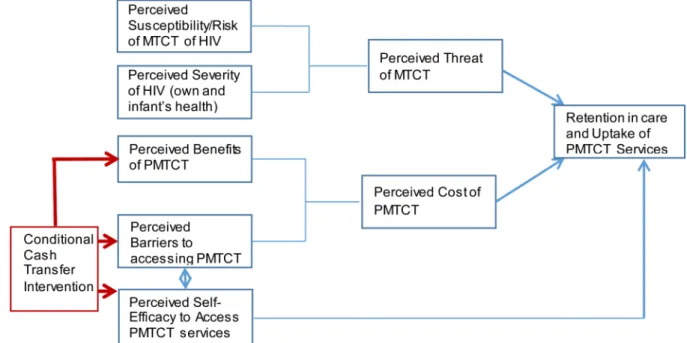
To elucidate the mechanisms by which a cash incentive intervention increases desired PMTCT outcomes using a modified Health Belief Model as conceptual framework (Figure 1), we examined the associations between perceptual factors (perceived severity of HIV, perceived MTCT susceptibility/risk, perceived PMTCT benefit, perceived barriers and self-efficacy to access and use PMTCT services) and retention in care. We also assessed the potential interactions between 1) perceptual factors found to be associated with retention in care and 2) the effect of a conditional cash incentive intervention on the same outcome.
METHODS
Study design and study population
This is an analysis of data from a randomized controlled trial that was conducted in
Kinshasa, the Democratic Republic of Congo (DRC). Between April 2013 and August 2014, 433 newly-diagnosed HIV-infected women, ≤32 weeks pregnant, registering for ANC at one of 89 clinics during the enrollment period were recruited and randomized to receive either the standard of care or the standard of care plus small and increasing cash payments. These payments started at $5 and increased by $1 each month on the condition that the woman attended scheduled clinic visits and provided a blood sample for a CD4 count, accepted referral for ART if referred, delivered in a health facility, and at six weeks postpartum provided a blood sample for early infant HIV diagnosis. A detailed description of the intervention, and results of the analysis of primary outcomes showing that the intervention resulted in significantly higher retention along the PMTCT cascade and better uptake of available services, have been reported.
Perceptual factors and measurements
At enrollment into the study, which occurred between two to four weeks after registration for ANC and HIV diagnosis, participants were interviewed using a structured questionnaire to collect information on perceived HIV severity, perceived MTCT susceptibility/risk, perceived PMTCT benefits, perceived difficulties and barriers accessing PMTCT services, and perceived self-efficacy to access and adhere to clinic visits and PMTCT services (see Figure 1 for the conceptual model). All survey questions for the perceived factors had Likert-style scale response options (e.g., “very likely,” “somewhat likely,” “somewhat unlikely,” “very unlikely,” “don't know,” and “refuse to answer”). The questions, response options and the final coding of those responses are summarized in Table 1.
A
uthor Man
uscr
ipt
A
uthor Man
uscr
ipt
A
uthor Man
uscr
ipt
A
uthor Man
uscr
Outcome variables
The main outcome considered in this analysis was LTFU – not in care at six weeks postpartum with unknown whereabouts (participants who were dead, or who did not return to the clinic because they experienced a poor pregnancy outcome but could still be reached, were classified as not in care but not as LTFU).
Statistical analysis
Identification of perceptual factors associated with LTFU—Using data from
participants randomized to the control group (to avoid any mixing of effect), we examined the associations of the measured perceptual factors with LTFU by comparing the proportion of participants LTFU by six weeks postpartum across categories of perceptual variables. Multivariate logistic regression models including all of the perceptual factors were used to identify factors that were independently predictive of LTFU and to estimate odds ratios (OR) and 95% confidence intervals (CI) assessing the strength of their associations with the outcome. Perceptual variables found to be significantly associated (alpha=0.20) with LTFU after adjustment for all other factors considered as well as wealth index were retained for the evaluation of interaction with the cash incentive intervention. Wealth index was included in the model because sub-group analysis of the primary trial outcomes showed that the effect of the cash intervention was particularly strong for poorer women.9 Wealth index was
determined using principal component analysis. The model for this factor analysis included years of education, average number of household members per room (an indication of crowding), number of sleeping beds in the household, types of household water source (communal or private pipe), cooking fuel type (electrical stove, or wood/charcoal), and ownership status for several durable assets. The first component explained 27% of the variability in the data. The factor score was categorized into upper (two richest quintiles), middle (third quintile), and lower (two poorest quintiles) categories.
Modification of the effects of identified perceptual factors on LTFU by the
cash incentive intervention—To assess potential synergism or antagonism between
perceptual factors found to be significantly and independently associated with LTFU and the cash incentive intervention, log-linear risk models were used to estimate the risk difference (RD) measuring the individual and joint effects of the conditional cash incentive intervention and the perceptual factor on the outcome. The likelihood ratio test was used to assess RD modification, and excess risk due to interaction (interaction contrast [IC] and 95% CI) was used to assess for synergism or antagonism. IC is the difference between the observed RD comparing the doubly-exposed category with the doubly-unexposed category, and the expected RD comparing the same two groups assuming additivity (without the interaction term) should be equal to zero in the absence of RD modification. All analyses were
completed using SAS 9.3 (SAS Institute Inc., Cary, NC). All tests were two-sided and used a 0.20 significance level unless otherwise indicated.
The study is approved by the Institutional Review Board of the Ohio State University and the Ethical Committee of the Kinshasa School of Public Health. This parent trial is registered at ClinicalTrials.gov, number NCT01838005.
A
uthor Man
uscr
ipt
A
uthor Man
uscr
ipt
A
uthor Man
uscr
ipt
A
uthor Man
uscr
RESULTS
Perceptual factors
Overall, most participants perceived HIV as a “very serious” health problem for themselves (78.5%, 340/433) and for their infants (84.3%, 365/433) (Table 2). The perception of MTCT susceptibility/risk was also high; 83.6% (362/433) of participants responded that it was “very likely” they will pass HIV on to their baby if they did not take any HIV drug.
Similarly, the perceived benefit of PMTCT medication was also very high; 84.8% (367/433) of participants believed it would be “very unlikely” that they will pass HIV on to their baby if they take all their HIV drugs. Over 90% (391/433) of participants stated they were “very confident” to be able to come to clinic every month to collect their HIV drugs and get checked; accordingly, 83.8% (363/433) anticipated that it would be “very easy/not at all difficult” for them to come to clinic. The anticipated difficulties included “transportation” for 15.9% (69/433) and “not having money” for 11.6% (50/433) of respondents. Virtually all participants, 98.4% (426/433), stated that it was “very likely” they would take all of their medication every day without missing any doses.
Association between perceptual factors and LTFU
In bivariate analysis, perceived MTCT susceptibility/risk was the strongest predictor of LTFU; participants who perceived passing HIV on to their baby was “very likely” if they did not take their HIV drugs were strongly and statistically less likely to be LTFU at six weeks postpartum compared to those who did not perceive the risk of transmission as “very likely” (OR= 0.44; 95% CI, 0.19, 0.99) (Table 3). Participants who perceived HIV to be a serious health problem for their infants (OR, 0.50; 95% CI, 0.21, 1.14) were also less likely to be LTFU at six weeks postpartum compared to women who did not perceive HIV as a serious health problem. On the other hand, compared to participants who responded “nothing” to the question “what makes it difficult for you to come to the clinic to receive your treatment?” those who responded “not having money” were about twice as likely to be LTFU (OR, 1.90; 95% CI 0.75, 4.84).
In a multivariate logistic model, women who perceived it as “very likely” that they will transmit HIV to their baby if they did not take any HIV drug remained statistically less likely to be LTFU (adjusted OR [aOR], 0.39; 95% CI, 0.14, 1.08). Though not statistically significant, HIV-infected women who perceived HIV to be a serious health problem for their baby were also less likely to be LTFU at six weeks postpartum (aOR, 0.55; 95% CI, 0.18, 1.65). Accordingly, perceived lack of benefit of PMTCT medication was associated with LTFU. Women who responded that it was “very unlikely” that they will pass HIV to their baby if they take all their HIV drugs were twice as likely to be LTFU (aOR, 2.01 95% CI, 0.64, 6.30). Believing that “not having money” will make it difficult to come to the clinic was the only anticipated barrier associated with an increased tendency of LTFU (aOR, 1.83; 95% CI 0.67, 5.02).
Modification of the effects of identified perceptual factors on LTFU by the
cash incentive intervention—Table 4 presents the RDs and 95% CIs for LTFU for each
exposure (perceptual factors and cash incentives) individually and jointly, as well as the
A
uthor Man
uscr
ipt
A
uthor Man
uscr
ipt
A
uthor Man
uscr
ipt
A
uthor Man
uscr
excess RDs due to interaction (IC) and their 95% CIs. Perceiving HIV as a “very serious” health problem for their baby vs. not was associated with a 13% decrease in the proportion of women LTFU by six weeks postpartum (RD, −0.13; 95% CI, −0.30, 0.04) among women who did not receive the cash incentive intervention. Among women who did not perceive HIV as a “very serious” health problem for their baby, receiving the cash incentive was associated with a 23% (RD, −0.23; 95% CI, −0.41, −0.04) reduction in the proportion of participants LTFU. The effects of the two exposures were not additive for participants who perceived HIV as a “very serious” health problem and received the cash incentive (RD, −0.20; 95% CI, −0.37, −0.03). The antagonistic excess RD due to interaction (IC, 0.16; 95% CI, −0.04, 0.35). Similar antagonism was observed for the perception that it will be “very likely” to pass HIV on to the baby if one did not take any HIV drug.
Anticipating that “not having money” will make it difficult to come to clinic to receive treatment, though not statistically significant, was associated with a 12% (95% CI, −7%, 30%) increase in the proportion LTFU at six weeks postpartum among participants who did not receive the cash incentive (compared to participants who reported “nothing” when asked about barriers to clinic attendance). Providing women in this group with a cash incentive perfectly antagonized the negative effect of “not having money” on LTFU (IC, −0.12; 95% CI, −0.35, 0.10).
DISCUSSION
If ART is started at an early stage of pregnancy and continued uninterrupted throughout breastfeeding, the risk of HIV transmission from mother to child decreases to almost zero.4 But without novel strategies to increase retention in and adherence to PMTCT services, the goal of an AIDS-free generation is unlikely to be achieved. In this study, we examined the mechanisms through which a cash incentive intervention recently tested by our group in a randomized controlled study increases retention in care.
As hypothesized during design of the study, our analysis showed that HIV-infected pregnant women who perceived HIV as a “very serious” health problem for their baby (perceived severity of HIV), and perceived that they will “very likely” pass HIV on to their baby if they did not take their drugs (perceived benefit of PMTCT), were more likely be have been retained in care through six weeks postpartum. Our results are in agreement with previous studies showing that better PMTCT knowledge15 as well as greater understanding and belief in the effectiveness of ART16 are positively associated with higher adherence to PMTCT services. Interestingly, the observed antagonism between the cash incentive intervention and 1) the perception of HIV as a very serious health problem for the baby and 2) believing that it will be very likely that HIV will be transmitted to the baby if one does not take any HIV drugs suggests a competitive mechanism of action as represented in the conceptual framework. Consistent with the Prospect Theory,17 this observation suggests that
interventions which combine 1) relatively short-term cash incentives to keep asymptomatic pregnant women who are likely to be LTFU and 2) an effective education program to improve women's understanding of HIV risk for themselves and for the baby may achieve meaningful and sustained retention.
A
uthor Man
uscr
ipt
A
uthor Man
uscr
ipt
A
uthor Man
uscr
ipt
A
uthor Man
uscr
Lack of financial support is a known risk factor for poor ART adherence among HIV-infected women 18. Our finding that provision of a small cash incentive to those women completely reverses the negative effect of “not having money” on LTFU is a confirmation that there are real financial barriers to accessing HIV care, at least in maternal and child health clinics where PMTCT programs are implemented despite HIV care itself being provided free of charge. In fact, in most countries in sub-Sahara Africa, hospitals and clinics are funded on a fee-per-service basis, and HIV-infected women have to be able to pay for their antenatal visits registration and delivery costs, as well as register for the well-baby clinic visit in the postpartum period to be able to continue to have access to the clinic at each of those steps.19 The magnitude and structure of those fees varies by clinic and might explain why some women switch clinics during and after pregnancy.9
The observation of a negative effect of “not having money” on retention also has
implications for determination of the magnitude of the cash incentive. It has been suggested that incentive magnitude be dependent on the opportunity cost incurred by the behavior change. A systematic review of the use of financial incentives in treatments for obese and overweight persons found evidence of very weak trends in favor of using amounts greater than 1.2% of personal disposable income.20 However, while the optimal size and structure of incentive payments remain important questions to be addressed empirically, this finding suggests that in areas where fee for service is in place, they must be taken into account when determining the opportunity costs of attending clinic visits.
This is the first study to examine the mechanisms by which a cash incentive intervention achieves the desired outcomes of retention in care among newly-diagnosed HIV-infected pregnant women. The study used data from a randomized controlled trial to test hypotheses that informed the design of the intervention. Despite the potential risk of misreporting the perceptual factors considered in this analysis, the fact that interviews were conducted before participants were assigned to randomization groups eliminates any potential for differential misreporting by study group or outcome level. However, because the study was not powered for this specific analysis, some estimates are unstable with wide confidence intervals.
In conclusion, our analyses show that cash transfers improve retention in PMTCT services mainly by mitigating the negative effect of not having money to come to the clinic. In designing financial incentive interventions to improve retention in PMTC services, the minimum amount proposed should be at least equal to the cost of attending clinic visits.
ACKNOWLEDGEMENTS
We are grateful for the participation and time of the mothers and infants in the study, the time and efforts of the personnel of the participating clinics, the technical support of Dr. Landry Kiketa and Mrs. Martine Tabala, the data collection and data entry contributions of Josée Nlandu Babela, Valerie B. Chalachala, Fanny Matadi, Espérance Mindia, and Georges Kihuma Nganguli, and the support of the administrative teams of the Ohio State University, the University of North Carolina at Chapel Hill, and the Kinshasa School of Public Health. Marcel Yotebieng is partially supported by NIAID U01AI096299
Sources of support: This study was supported by a grant from the President's Emergency Plan for AIDS Relief
(PEPFAR) and the National Institute of Health and Child Development: NIHCD 1R01 HD075171. The sponsors of the study had no role in study design, data collection, data analysis, data interpretation, writing of the report, or the decision to submit the paper for publication.
A
uthor Man
uscr
ipt
A
uthor Man
uscr
ipt
A
uthor Man
uscr
ipt
A
uthor Man
uscr
REFERENCES
1. UNAIDS. 2014 progress report on the global plan towards the elimination of new HIV infections among children by 2015 and keeping their mothers alive. 2014.
2. World Health Organization. Consolidated guidelines on the use of antiretroviral drugs for treating and preventing HIV infection: recommendations for a public health approach. World Health Organization; 2013.
3. Ciaranello AL, Perez F, Keatinge J, et al. What Will It Take to Eliminate Pediatric HIV? Reaching WHO Target Rates of Mother-to-Child HIV Transmission in Zimbabwe: A Model-Based Analysis. PLoS Med. 2012; 9(1):e1001156. [PubMed: 22253579]
4. Fowler, MG., Qin, M., Shapiro, D., et al. PROMISE: Efficacy and Safety of 2 Strategies to Prevent Perinatal HIV Transmission.. Conference on Retroviruses and Opportunistic Infections (CROI); Seattle, Washington. February 23 - 26, 2015; 2015.
5. Stringer EM, Chi BH, Chintu N, et al. Monitoring effectiveness of programmes to prevent mother-to-child HIV transmission in lower-income countries. Bull World Health Organ. 2008; 86(1):57–62. [PubMed: 18235891]
6. Tenthani L, Haas AD, Tweya H, et al. Retention in care under universal antiretroviral therapy for HIV-infected pregnant and breastfeeding women (‘Option B+’) in Malawi. AIDS (London, England). 2014; 28(4):589–598.
7. Sibanda E, Weller I, Hakim J, Cowan F. The magnitude of loss to follow-up of HIV-exposed infants along the prevention of mother-to-child HIV transmission continuum of care: a systematic review and meta-analysis. AIDS (London, England). 2013; 27(17):2787–2797.
8. UNAIDS. 2015 progress report on the global plan towards the elimination of new HIV infections among children and keeping their mothers alive. UNAIDS; 2015.
9. Yotebieng M, Thirumurthy H, Moracco KE, et al. Conditional cash transfers and uptake of and retention in prevention of mother-to-child HIV transmission care: a randomised controlled trial. The Lancet HIV. 2016; 3(2):e85–e93. [PubMed: 26847230]
10. Yotebieng M, Thirumurthy H, Moracco KE, et al. Conditional Cash Transfers to Increase Retention in PMTCT Care, Antiretroviral Adherence, and Postpartum Virological Suppression: A
Randomized Controlled Trial. Journal of acquired immune deficiency syndromes (1999). 2016; 72(Suppl 2):S124–129. [PubMed: 27355499]
11. Laibson D. Golden Eggs and Hyperbolic Discounting. The Quarterly Journal of Economics. 1997; 112(2):443–478.
12. Rosentock, IM. The Health Belief Model: Explaining health behavior through expectancies.. In: Glanz, KL., F.M. Rimmer, BK., editors. Health Behavior and Health Education. Jossey-Bass; San Francisco, CA, USA: 2002. p. 39-62.
13. Shafir, E. Decision Biases, Cognitive Psychology of.. In: Neil, JS., Paul, BB., editors. International Encyclopedia of the Social and Behavioral Sciences. Pergamon; Oxford: 2001. p. 3296-3300. 14. Green L, Fry AF, Myerson J. Discounting of Delayed Rewards: A Life-Span Comparison.
Psychological Science. 1994; 5(1):33–36.
15. Mirkuzie AH, Hinderaker SG, Sisay MM, Moland KM, Morkve O. Current status of medication adherence and infant follow up in the prevention of mother to child HIV transmission programme in Addis Ababa: a cohort study. Journal of the International AIDS Society. 2011; 14:50. [PubMed: 22017821]
16. Durante AJ, Bova CA, Fennie KP, et al. Home-based study of anti-HIV drug regimen adherence among HIV-infected women: feasibility and preliminary results. AIDS Care. 2003; 15(1):103–115. [PubMed: 12655838]
17. Kahneman D, Tversky A. Prospect Theory: An Analysis of Decision under Risk. Econometrica. 1979; 47(2):263–291.
18. El-Khatib Z, Ekstrom A, Coovadia A, et al. Adherence and virologic suppression during the first 24 weeks on antiretroviral therapy among women in Johannesburg, South Africa - a prospective cohort study. BMC public health. 2011; 11(1):1–13. [PubMed: 21199570]
19. Manthalu G, Yi D, Farrar S, Nkhoma D. The effect of user fee exemption on the utilization of maternal health care at mission health facilities in Malawi. Health Policy and Planning. 2016
A
uthor Man
uscr
ipt
A
uthor Man
uscr
ipt
A
uthor Man
uscr
ipt
A
uthor Man
uscr
20. Paul-Ebhohimhen V, Avenell A. Systematic review of the use of financial incentives in treatments for obesity and overweight. Obesity Reviews. 2008; 9(4):355–367. [PubMed: 17956546]
A
uthor Man
uscr
ipt
A
uthor Man
uscr
ipt
A
uthor Man
uscr
ipt
A
uthor Man
uscr
Figure 1. Conceptual model for conditional cash transfer intervention for retention in care and uptake of prevention of mother-to-child prevention services
The model is based on Health Belief Model 11; MTCT = mother-to-child transmission of HIV, PMTCT = prevention of mother-to-child transmission of HIV
A
uthor Man
uscr
ipt
A
uthor Man
uscr
ipt
A
uthor Man
uscr
ipt
A
uthor Man
uscr
A
uthor Man
uscr
ipt
A
uthor Man
uscr
ipt
A
uthor Man
uscr
ipt
A
uthor Man
uscr
ipt
Table 1Perceptual factors considered, questions used to measure perceptual factors, and final variable coding
Perceptual factors Question Response coding
Perceived Severity of HIV How serious a health problem is HIV for you personally? Would you say that it is:
Very serious 1 index
Somewhat serious Not very serious Not at all serious Don't Know Refuse to answer
0 referent
Now think about your baby. How serious a health problem would it be if your baby had HIV? Would you say it would be:
Very serious 1 index
Somewhat serious Not very serious Not at all serious Don't Know Refuse to answer
0 referent
Perceived MTCT susceptibility/risk How likely or unlikely do you think it is that you will pass HIV on to your baby if you do not take any HIV drug? Would you say it is:
Very likely 1 index
Somewhat likely Somewhat unlikely Very unlikely Don't Know Refuse to answer
0 referent
Perceived PMTCT benefits How likely or unlikely do you think it is that you will pass HIV on to your baby if you do take all your HIV drugs as indicated by the nurse? Would you say it is:
Very likely 1 index
Somewhat likely Somewhat unlikely Very unlikely? Don't Know Refuse to 0 referent
Perceived difficulties to accessing PMTCT services
How difficult or easy will it be for you to come to the clinic to collect your HIV drugs and get check? Would it be:
Not at all difficult/very easy
1 index
A little difficult, or Somewhat difficult Very difficult Don't Know Refuse to answer
0 referent
Perceived barriers to accessing PMTCT services
What makes it difficult for you to come to the clinic to receive your treatment? (check all that apply) Transportation Nothing (referent) Transportation Not having money Other No Childcare
Takes too much time Husband/partner won't allow
Other_________
Perceived self-efficacy to adhere to PMTCT medicines
How confident are you that you will be able to come to the clinic every month to collect your HIV drug? Would you say you are:
Very confident 1 index
Somewhat confident A little confident, or Not at all confident Don't Know Refuse to answer
0 referent
How confident are you that you will be able to continue to come to this clinic to receive your HIV drugs after given birth? Would you say you are:
Very confident 1 index
Somewhat confident A little confident, or Not at all confident Don't Know Refuse to answer
0 referent
How likely is it that you will take your medication everyday without missing any doses? Is it:
Very likely 1 index
Somewhat likely Somewhat unlikely Very unlikely? Don't Know
A
uthor Man
uscr
ipt
A
uthor Man
uscr
ipt
A
uthor Man
uscr
ipt
A
uthor Man
uscr
ipt
Perceptual factors Question Response coding
Refuse to answer
Anticipated regret if baby infected Imagine that your baby contracted HIV during pregnancy or birth, and that you did not receive HIV treatment, which could have prevented your baby from contracting HIV. How much would you regret that you did not get HIV drug? Would you:
Regret it a great deal 1 index
Regret it a moderate amount
Regret it a little, or Not regret it all?
Don't Know Refuse to answer
A
uthor Man
uscr
ipt
A
uthor Man
uscr
ipt
A
uthor Man
uscr
ipt
A
uthor Man
uscr
ipt
Table 2
Perceptions of HIV and mother-to-child transmission risk among 433 newly-identified HIV-infected women in Kinshasa, Democratic Republic of Congo
N (%) How serious a health problem is HIV for you personally?
Very serious 340 (78.5)
Other 93 (21.5)
Now think about your baby. How serious a health problem would it be if your baby had HIV?
Very serious 365 (84.3)
Other 68 (15.7)
How likely or unlikely do you think it is that you will pass HIV on to your baby if you do not take any HIV drug?
Very likely 362 (83.6)
Other 71 (16.4)
How likely or unlikely do you think it is that you will pass HIV on to your baby if you do take all your HIV drugs as indicated by the nurse?
Very unlikely 367 (84.8)
Other 66 (15.2)
How difficult or easy will it be for you to come to the clinic to collect your HIV drugs and get checked?
Not at all difficult/very easy 363 (83.8)
Other 70 (16.2)
How confident are you that you will be able to come to the clinic every month to collect your HIV drugs?
Very confident 391 (90.3)
Other 42 (9.7)
How likely is it that you will take your medication every day without missing any doses?
Very likely 426 (98.4)
Other 7 (1.6)
Imagine that your baby contracted HIV during pregnancy or birth, and that you did not receive HIV treatment, which could have prevented your baby from contracting HIV. How much would you regret that you did not get HIV drugs?
Regret it a great deal 409 (94.5)
Other 24 (5.5)
What makes it difficult for you to come to the clinic to receive your treatment?
Nothing 274 (63.3)
Transportation 69 (15.9)
Not having money 50 (11.6)
A
uthor Man
uscr
ipt
A
uthor Man
uscr
ipt
A
uthor Man
uscr
ipt
A
uthor Man
uscr
ipt
T ab le 3Association of perceptual v
ariables and loss to follo
w-up among a cohort of 217 ne
wly-identif
ied HIV
-infected pre
gnant w
omen in Kinshasa, Democratic
Republic of Congo (control group w
omen only)
Loss to f
ollo
w-up
OR (95%CI)

Y
es: n (%)
No: n (%)
Crude
Adjusted
Ho
w serious a health pr
oblem is HIV f
or y ou personally? V ery serious 32 (18.7) 139 (81.3)
0.65 (0.30, 1.40)
0.95 (0.34, 2.64)
Other
12 (26.1)
34 (73.9)
No
w think about y
our baby
. Ho
w serious a health pr
oblem w
ould it be if y
our baby had HIV?
V
ery serious
34 (18.4)
151 (81.6)
0.50 (0.21, 1.14)
*
0.55 (0.18, 1.65)
Other
10 (31.3)
22 (68.7)
Ho
w lik
ely or unlik
ely do y
ou think it is that y
ou will pass HIV on to y
our baby if y
ou do not tak
e any HIV drugs?
V
ery lik
ely
33 (17.9)
151 (82.1)
0.44 (0.19, 0.99)
*
0.39 (0.14, 1.08)
* Other 11 (33.3) 22 (66.7) Ho w lik
ely or unlik
ely do y
ou think it is that y
ou will pass HIV on to y
our baby if y
ou do tak
e all y
our HIV drugs as
indicated by the nurse? Very lik
ely
37 (20.6)
143 (79.4)
1.11 (0.45, 2.72)
2.01 (0.64, 6.30)
Other
7 (18.9)
30 (81.1)
Ho
w diff
icult or easy will it be f
or y
ou to come to the clinic to collect y
our HIV drugs and get check
ed?
Not at all dif
ficult/v
ery easy
35 (19.4)
145 (80.6)
0.75 (0.33, 1.73)
0.87 (0.33, 2.28)
Other 9 (24.3) 28 (75.7) Ho w conf ident ar e y
ou that y
ou will be able to come to the clinic e
v
ery month to collect y
our HIV drug?
V
ery conf
ident
39 (19.9)
1.57 (80.1)
0.79 (0.27, 2.30)
0.78 (0.23, 2.66)
Other
5 (23.8)
16 (76.2)
What mak
es it diff
icult f
or y
ou to come to the clinic to r
ecei v e y our tr eatment? Nothing 25 (18.1) 113 (81.9) T ransportation 6 (18.8) 26 (81.2)
1.04 (0.39, 2.80)
0.95 (0.34, 2.68)
Not ha
ving mone
y
8 (29.6)
19 (70.4)
1.90 (0.75, 4.84)
*
1.83 (0.67, 5.02)
Other
5 (25.0)
15 (75.0)
1.51 (0.50, 4.53)
1.07 (0.33, 3.51)
W
A
uthor Man
uscr
ipt
A
uthor Man
uscr
ipt
A
uthor Man
uscr
ipt
A
uthor Man
uscr
ipt
Loss to f
ollo
w-up
OR (95%CI)

Y
es: n (%)
No: n (%)
Crude
Adjusted
Upper
27 (15.3)
149 (84.7)
Middle
13 (14.9)
74 (85.1)
0.66 (0.24, 1.80)
0.72 (0.25, 2.03)
Lo
wer
27 (15.88)
143 (84.12)
1.04 (0.51, 2.14)
0.91 (0.42, 1.99)
* signif
icant at alpha = 0.20; OR = odds ratio, CI = conf
idence interv
al
¶ adjusted for all the v
A
uthor Man
uscr
ipt
A
uthor Man
uscr
ipt
A
uthor Man
uscr
ipt
A
uthor Man
uscr
ipt
T ab le 4 Risk differences of the conditional cash incenti
v
e interv
ention, percei
v
ed HIV se
v
erity
, and pre
v
ention of mother
-to-child HIV transmission benef
it on
loss to follo
w-up, and interaction contrasts, among 433 ne
wly-identif
ied HIV
-infected pre
gnant w
omen in Kinshasa, Democratic Republic of Congo.

Loss to f
ollo w-up Inter v ention gr oup Contr ol gr oup
RD (95% CI)
RD (95% CI)
IC (95% CI)
No
w think about y
our baby
. Ho
w serious a health pr
oblem w
ould it be if y
our baby had HIV?
V
ery serious
−0.20 (−0.37, −0.03)
*
−0.13 (−0.30, 0.04)
*
0.16 (−0.04, 0.35)
*
Other
−0.23 (−0.41, −0.04)
*
1
Ho
w lik
ely or unlik
ely do y
ou think it is that y
ou will pass HIV on to y
our baby if y
ou do not tak
e any HIV drugs?
V
ery lik
ely
−0.22 (−0.39, −0.05)
*
−0.15 (−0.32, 0.02)
*
0.19 (−0.01, 0.38)
*
Other
−0.25 (−0.44, −0.07)
*
1
What mak
es it diff
icult f
or y
ou to come to the clinic to r
ecei v e y our tr eatment? T ransportation
0.04 (−0.11, 0.18)
0.01 (−0.14, 0.16)
0.11 (−0.09, 0.32)
Not ha
ving mone
y
−0.09 (−0.23, 0.04)
0.12 (−0.07, 0.30)
−0.12 (−0.35, 0.10)
Other
−0.18 (−0.62, 0.16)
0.07 (−0.13, 0.27)
−0.16 (−0.65, 0.32)
Nothing
−0.09 (−0.17 −0.00)
*
1
¶ Stratif
ied risk dif
ferences (RD), interaction contrasts (IC) and 95% conf
idence interv
als (CI) were obtained using log-linear risk models. Only perceptual f
actors that were statistically associated with each
outcome were considered for interaction assessment. * signif