O R I G I N A L R E S E A R C H
Facing exclusion and smiling through the pain:
positive emotion expression during interpersonal
ostracism
This article was published in the following Dove Press journal: Psychology Research and Behavior Management
Elena Svetieva1 Lisa Zadro2 Daejoong Kim3 Carolyn M Hurley4 Rani Goodacre2
1Department of Communication,
University of Colorado, Colorado Springs, CO, USA;2School of Psychology, University of Sydney, Sydney, NSW, Australia;3Department of Media & Communication, Dong-A University, Busan, South Korea;4Department of Communication Studies and Theatre, Northern Virginia Community College, Sterling, VA, USA
Background:The present research compares smiling and emotion expression generally to
other indicators of negative intra- and interpersonal reactions to ostracism, and in particular negative reactions towards the ostracizers.
Methods:A total of N=143 participants (n=55 in Experiment 1 and n=88 in Experiment 2)
were ostracized from a web-conference by two other individuals. Facial expressions of participants during the exclusion period were coded using EMFACS and compared to self-reported reactions to ostracism and the sources of the ostracism.
Results:Ostracized individuals showed significant levels of both Duchenne (genuine) and
non-Duchenne (social) smiling, despite finding ostracism highly aversive, reporting more negative attitudes towards the ostracizing confederates, and (in Experiment 2) higher levels of negative affect. Experiment 2 showed evidence of a self-regulation and display manage-ment function of smiling during ostracism in that participants who exhibited more Duchenne smiling during their exclusion also reported higher levels of positive emotion after the ostracism, and were also rated by a group of judges as experiencing more amusement at their exclusion.
Conclusion: The web conferencing paradigm used in this study provides an ecologically
valid method to study the management of expressive behavior during aversive interpersonal experiences, adding to the existing evidence of facial display management during other types of distressing experience.
Keywords:ostracism, facial expressions, self-regulation, emotion, display rules
Introduction
Multiple models of emotion highlight the importance of facial expression as an integral component of emotion experience whose function is to communicate an
individual’s reactions to the situation and his/her behavioral intent.1,2While facial
expressions of emotion can provide a dynamic and unobtrusive indicator of
affec-tive change,3they are also sensitive to the social and cultural context in which they
occur. Concerns for self-presentation moderate much of what and how we
communicate,4and the same is true of affect displays. In a number of situations,
individuals are suppressing negative emotion that they feel or expressing positive emotion they do not.
Display rules refer to our implicit understanding that we need to manage and
conceal emotion in certain situations.5The smile, for example, is a socially pleasant
display that is often recruited in situations where individuals are not necessarily
Correspondence: Daejoong Kim Department of Media & Communication, Dong-A University, 225 Gudeok-ro, Seo-gu, Busan 49236, South Korea
Tel +82 108 597 8624 Email [email protected]
Psychology Research and Behavior Management
Dove
press
open access to scientific and medical research
Open Access Full Text Article
Psychology Research and Behavior Management downloaded from https://www.dovepress.com/ by 118.70.13.36 on 26-Aug-2020
feeling positive affect, such as smiling at an unfunny joke
or smiling during embarrassment.6Smiling during distress
is often linked to the culturally mandated need to manage
expressions in front of other people,7 but evidence
sug-gests that facial expressions of positive emotion may even serve a spontaneous self-regulatory function, where
smil-ing can serve as an intrapersonal copsmil-ing mechanism.8
Smiling during distressing experiences can boost the levels of positive affect felt after the experience, and thus
lessen subjective distress,6,9 and can also decrease
objec-tive stress markers such as heart rate.10Additionally, some
studies have established that not all smiling during distress is equivalent, but that Duchenne smiling, the type of smiling that is a true indicator of enjoyment (involving both the zygomatic major and the orbicularis oculi), is
particularly important to consider.8,11 Duchenne smiling
is also distinguishable from smiles that are displayed
dur-ing embarrassment or nervousness.12Although some have
questioned the predictive utility of Duchenne smiles as
indicators of enjoyment,13 Duchenne smiles are thought
to have distinct behavioral markers, neural correlates and
social perception outcomes.14,15
The majority of studies on this effect have used experi-mental paradigms in which emotion states are induced
with media,8,9or other distressing autobiographical
mono-logues (eg, postbereavement). The present study seeks to expand on this research by examining smiling during an experimentally controlled, negative interpersonal
experi-ence of ostracism. Ostracism is the specific experience of
being excluded or ignored by another person or group of people, and is in general an experience that individuals
find to be highly aversive.16
Humans are social animals that experience an adaptive
and fundamental need to belong.17 Experiences of social
rejection and exclusion threaten this need, decreasing an
individual’s sense of belonging, control, self-esteem, and
meaningful existence.18 Negative affective reactions play
a large role in this process –an immediate experience of
negative arousal signals to the individual that he or she is
being rejected,19,20and the more elaborate emotional
reac-tions to being ostracized (typically sadness, anger, and hurt feelings) act as moderators and motivators for subsequent
behavior.21,22Behavioral outcomes can be antisocial
beha-vior but also reparative in nature.23
Despite ample evidence of negative self-reported affec-tive reactions to ostracism, surprisingly little is known about the nature and function of emotion expression in ostracized individuals, especially in a social/interpersonal
setting. Real world interviews with targets of ostracism
point to individuals’concerted efforts to manage and
con-trol behavior during these periods and abstain from
show-ing distress.24However, there is currently no experimental
evidence to support this observation. The few studies that have experimentally examined facial expressions in ostra-cism have utilized computer-simulations of ostraostra-cism that only nominally represent a social situation, have been limited to clinical comparisons of individuals with
border-line personality disorders and healthy controls,25and have
measured nonspecific negative affect in targeted facial
regions.26 For example, when participants were excluded
from a decision-making task, they displayed fewer expres-sions of joy, and more of sadness, suggesting that the experience of exclusion does modulate facial behavior
just as it affects internal affective reactions.27
Overview of the research
This research utilizes a paradigm that enables facial expressions of emotion to be measured during an ecologi-cally valid, face-to-face interpersonal experience of
ostra-cism. In contrast to previous studies,27 individuals
experience and react to their overt exclusion while still in a social situation and when they believe to be observa-ble by their excluders.
The present research compares smiling and emotion expression generally to other indicators of negative intra-and interpersonal reactions as a result of ostracism, intra-and in particular negative reactions towards the ostracizers. Based on the existing evidence, in Experiment 1 we test the hypothesis that ostracized participants will exhibit marked negative psychological reactions to their cism, including more negative attitudes toward their ostra-cizers. The main research question in Experiment 1 focuses on how both Duchenne and non-Duchenne smiling will be modulated by the experience of exclusion, and the second, related research question is how facial expres-sions of both positive and negative emotion relate to
negative reactions to ostracism.28
In Experiment 2, our aim was to confirm and extend
the findings of Experiment 1 by further exploring the
function of smiling during exclusion. Smiling during
dis-tress can reflect self-presentation concerns, as well as
adherence to display rules as to the appropriate
expres-sions during a negative interaction,29but it can also be part
of an emotion regulation strategy, designed to down-regulate the aversiveness of the ostracism, increase felt
positive affect, and minimize negative affect.9Therefore,
Psychology Research and Behavior Management downloaded from https://www.dovepress.com/ by 118.70.13.36 on 26-Aug-2020
in Experiment 2 we coded facial expressions of emotion in addition to assessing self-reported emotion immediately after the experimental period. This approach allowed us to assess whether smiling during an aversive period of exclusion is related to subsequent subjective levels of positive emotion. Additionally, Experiment 2 featured a group of external judges that thin-slice coded the visual behavior of ostracized participants on a number of
affec-tive dimensions.30 These were then compared for
conver-gent validity to both expressive behavior during the
interaction and the ostracized participants’ levels of
self-reported emotion. Experiment 2 also tested the robustness
of the initialfindings byfilming a different set of
confed-erates. Further, given that in both O-Cam and Cyberball participants always seemingly interact with students from another university, there remained the untested possibility of confounds due to outgroup effects. We tested this pos-sibility by randomly assigning some participants to be to excluded by a salient outgroup of confederates of Indian ethnicity. The ingroup vs outgroup manipulation had no main or interaction effects on feelings of being excluded (manipulation check), primary needs, or negative and
anti-social revenge attitudes. We conclude that exclusionfi
nd-ings using O-Cam and similar paradigms are unlikely to be
affected by participants’perceptions of being excluded by
an outgroup, and limit the findings to the main effects of
exclusion experience.
Methods
We conducted two experiments: Experiment 1 was designed to examine how ostracism affects emotion expression in a social setting, and Experiment 2 was designed to replicate the results of Experiment 1 with a particular focus on smiling, and with self-reported emo-tion at the end of the exclusion period. This study applied the same procedure of O-Cam to both experiments but with the different participants and measures.
O-Cam procedure
O-Cam31extends existing ostracism paradigms, where
parti-cipants engage in an online ball-tossing game with two students from another university, into a more interpersonal and yet experimentally controlled experience of ostracism.
Although the paradigm has the appearance of a real web-based interaction, the other students are actually actors whose actions have been pretaped. Confederates give their accounts sequentially such that in all conditions, the two confederates speak for approximately 90 s each, and the participant gives
his or her account last. Participants in the inclusion condition
are“attended to” by the confederates (ie, the confederates
smile and appear to look at the participant) for the duration of their speech. In contrast, participants in the ostracism
condi-tion are“attended to”for approximately 15 s, at which point
the confederates begin to speak to each other and completely ignore the participant for the remainder of their talk time, approximately 75 s (see Figure 1 for a depiction of the O-Cam set up).
Ethics statement
All stages of this research were carried out in accordance with the Declaration of Helsinki concerning the protection of human subjects and the ethical conduct of human sub-jects research. All research participants provided their written-informed consent to participate in the research, and for their data to be used in the reporting of the results. This research was approved by the University of Sydney Human Research Ethics Committee.
Experiment procedure
Participants were informed that they would be trialing
a new web-conference program called UniLink
Conferencing with two students from a local university. The experimenter explained that in this conference, each student would give a short, prepared speech about his/her
choice of degree,field of study, and subsequent career path.
After consenting to take part in the study and to have their session video-recorded via webcam, participants received a series of questions to assist them in preparing
Figure 1The experimenter (right) introducing the participant (left) to two female students (prerecorded confederates) at the beginning of the experimental interaction.
Psychology Research and Behavior Management downloaded from https://www.dovepress.com/ by 118.70.13.36 on 26-Aug-2020
their speech (eg, “what subjects are you taking?”). They then practiced their speech with the experimenter both to reduce their nervousness and to ensure that participants in the inclusion condition would talk for the full duration of
the O-Camfilm, approximately 1 min and 30 s.
Once the participant’s speech was prepared, the
experi-menter started the appropriate conference tape and then left the laboratory, allowing the participant to continue the web-conference alone. Conference discussion time lasted for approximately 6 mins. When the conference connec-tion was terminated, participants completed the post experimental measures, which included a manipulation check, followed by negative attitudes toward ostracism sources in Experiment 1, and self-experienced emotion in Experiment 2. Participants were then fully debriefed and thanked for their involvement.
Participants
Experiment 1Fifty-fivefirst-year psychology students (45% male;Mage
=20.07, SD=3.39) at a large Australian university parti-cipated in return for course credit and were randomly assigned by a computer to be either ostracized or included by two same-sex individuals.
Experiment 2
Eighty-eight introductory psychology students (33%
male, Mage=21.83, SD=6.16) participated in the study in
exchange for course credit. As in Experiment 1, partici-pants were randomly assigned to the ostracism or inclusion condition.
Measurement
Experiment 1Negative attitudes:A 24-item self-report questionnaire based
on the categories proposed by Yoshimura,32assessed
partici-pants’ negative attitudes towards the ostracism sources. To
increase the believability of the paradigm, participants answered each item for both confederates, and the average score was used. All items were assessed on a 5-point Likert scale (in which 1= strongly agree and 5= strongly disagree) and
were scored such that higher scores signified higher levels of
retaliation. These items were then averaged to give an overall
retaliatory attitude score (overall scale M=2.52, SD=0.52,
Chronbach’sα= 0.95). The questionnaire consisted of three
sub-dimensions: active distancing, reputation defamation, and direct aggressiveness.
Active distancing refers to withdrawal of one’s availability
to another–essentially, the desire to ostracize the other
stu-dents. Participants were asked two questions: “I would be
willing to take part in another discussion with the two students
from today’s conference” (reverse-coded) and “I would be
willing to participate in another discussion, but only if it were
with a different group of students”. A mean score is calculated
by taking the average of the two items, M=2.47, SD=0.85,
α=0.68.
For the measurement of reputation defamation, 16 items measured the extent to which participant attempted to reduce the positive public image of the students in the O-Cam conference by presenting them in a negative light to the experimenter. Participants were asked to rate four positive (eg, friendly, attractive; reverse-coded) and four negative (eg, ugly, cold) adjectives as accurate descriptions of the other students. Participants were also asked to rate whether they believed the other students would be likely to engage in eight
activities–four positive (eg, do volunteer community work;
reverse-coded) and four negative (eg, lie, steal), M=2.59,
SD=0.56,α=0.95.
For the measurement of direct aggressiveness, six items assessed attempts to cause physical discomfort, emo-tional distress, or pain. Participants were asked to rate the extent to which they wished to nominate the students (confederates) from the conference to participate in six experiments which involved exposure to three positive experiences (eg, an experiment looking at increasing self-esteem through positive feedback) and three negative experiences (eg, an experiment looking at sleep depriva-tion or whether unavoidable electric shocks affects their fear response). Positive experience items were reverse scored such that greater values indicate more direct
aggressiveness,M=2.33, SD=0.67,α=0.88.
Facial expression coding:Of the sample, 46 participants’ webcam recordings (23 included and 23 ostracized) were selected for coding. Some video footage was not available or selected due to technical error and unavoidable issues (eg, participants leaning so far to one side that less than 50% of their face was within the frame of the webcam). The pattern of results as to the dependent variables (feelings of exclusion and negative and antisocial attitudes) was the same regardless of whether the full or coded sample subset was used. Videos were coded using the Emotion Facial Action Coding System
(EMFACS),33an abbreviated system of facial coding based
on the comprehensive Facial Action Coding System (FACS),34
that only deals with facial action units involved in the produc-tion of discrete emoproduc-tion.
Psychology Research and Behavior Management downloaded from https://www.dovepress.com/ by 118.70.13.36 on 26-Aug-2020
A coder notes expression events using a set of 33 action units empirically shown to be associated with the
set of seven universal emotion expressions.35 Both in
FACS and EMFACS, the focus is on describing the anato-mical movement observed in the face, without interpreting the actual emotion. The facial behavior was coded by two
FACS-certified coders. A sample of the videos (10%) was
coded by both and inter-coder reliability for the action units was calculated by doubling the number of action units on which the two coders agreed and calculating this number as a proportion of the total number of action units coded by both coders, with a mean agreement of 0.72.
In order to obtain emotion judgments, the EMFACS codes were compared against a software-based emotion
dictionary,36 which categorizes action unit combinations
on the likelihood that they reflect a particular emotion. For
the purposes of the study, the focus was on smiling (as measured by both Duchenne and non-Duchenne smiling), but we also examined relevant negative emotion expres-sions to ostracism: namely anger and sadness.
Experiment 2
Self-reported emotion: Participants completed an 8-item emotion inventory on a 5-point Likert scale (eg, While I was watching the web conference I felt: relaxed, tense, angry, happy, sad, energetic, lively, active) where 1= not at all and 5= very much.
Facial expression coding: Facial expressions were
coded using the same FACS-certified coders and procedure
as Experiment 1. We compared ostracized participants who were in the coded subsample vs those who were not, as well as included participants in each subsample,
and confirmed that there were no differences in feelings of
inclusion, primary need threat, or negative and antisocial
attitudes, all P-values > 0.2.
Thin-slice coding: Video recordings of the ostracized participants (n=26) were coded by a group of 21 under-graduate students who served as judges and were not acquainted with the participants or the experimental design. The responses of three judges were excluded because they
self-reported an autistic-spectrum diagnosis. Thefinal judge
sample was therefore of 18 judges (6 males and 12 females).
The final 30 s of each recorded ostracism experimental
period (the experimenter ended the interaction after 1 min
30 s) was edited and converted to sound-lessfilm clip.
After watching each video clip, judges rated the partici-pant on several characteristics and then made a set of
judg-ments, based on the categories by Mason et al.37 Using
a 0–10 slider scale, with 1-point increments, where 0=
none/not at all, and 10= extremely/the most possible, judges rated the individual in each clip on the following statements: How well is this person coping with being excluded?; How well is this person able to control his or her emotions?; How much stress is this person experiencing?; How much is this person experiencing angry thoughts about being excluded?; How much amusement is this person experiencing during this time?; and How much sadness is this person experien-cing?. The statements were presented in random order for each video, and the presentation order of the clips was counterbalanced. The average measure of intraclass correla-tion (18 raters, 156 items) was 0.90.
Results
Experiment 1
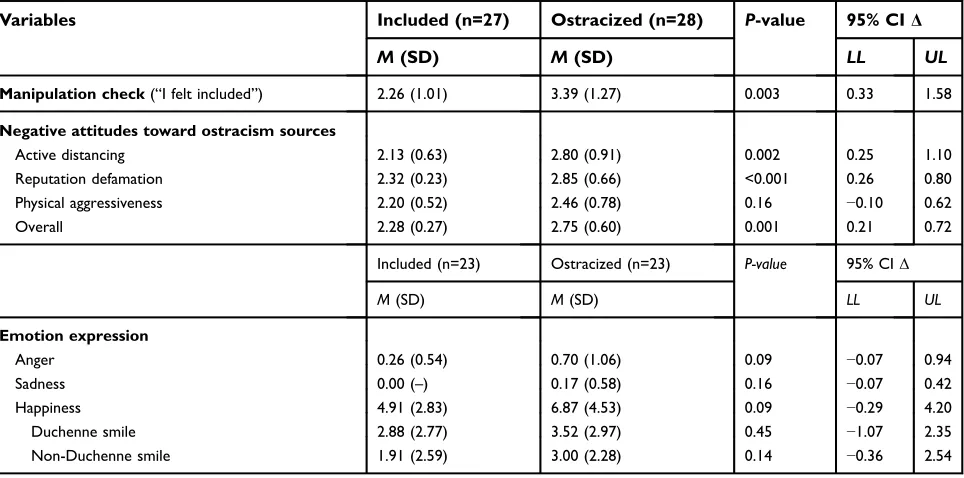
Manipulation checkA manipulation check determined the effectiveness of the O-Cam ostracism manipulation. Ostracized participants
reported feeling significantly more ignored (M=3.21,
SD=1.29) as compared to included participants (M=2.26,
SD=0.98;t[53]=−3.08,P<0.05), confirming the success of
the experimentally induced ostracism experience.
Negative attitudes
ANOVA examined the effect of being ostracized on active distancing, reputation defamation and direct aggressiveness separately, as well as the overall negative attitude score. Being ostracized was associated with more negative
atti-tudes towards ostracism sources,F(1, 53)=13.47, P=0.001,
ηp2=0.20; specifically, significantly greater active distancing
F(1, 53)=10.19,P=0.002,ηp2=0.16; and reputation
defama-tion,F(1, 53)=15.65,P<0.001,ηp2=0.23, though not direct
aggression (Table 2).
Emotion expression
We used a multivariate ANOVA that compared ostracized and included participants on each of the emotion expression frequencies during the experimental interaction. Given that the paradigm experimentally controls the time in each con-dition, we retained our main dependent variable as fre-quency of expression. The overall model was not
significantF(3, 42)=2.42,P=0.097 (see also Table 2).
When looking at the emotion expression variables individually, ostracized participants exhibited equivalent frequency of smiling during the experimental phase
(there was in fact a statistically nonsignificant tendency
for ostracized individual to display more smiles during the
Psychology Research and Behavior Management downloaded from https://www.dovepress.com/ by 118.70.13.36 on 26-Aug-2020
experimental phase, P=0.09). Similarly, aside from
a nonsignificant tendency for ostracized participants to
display slightly more anger expressions (P=0.09), there
was no evidence that ostracized individuals displayed more negative expressions of emotion during the
experi-mental interaction. Ostracized participants’ facial
expres-sions, therefore, were not generally more negative than their included counterparts. Therefore, there was no evi-dence that facial expressions during ostracism relate to the negative attitudes that participants form toward the sources of their ostracism.
A caveat of the above findings is that both anger and
sadness expressions showed typically very low frequen-cies. This result has two implications. Firstly, it compro-mises the validity of statistical analyses through the
restriction of variance. At a theoretical level, however, it highlights the strong display rules that govern interactions with strangers, even when those interactions are aversive.
Experiment 2
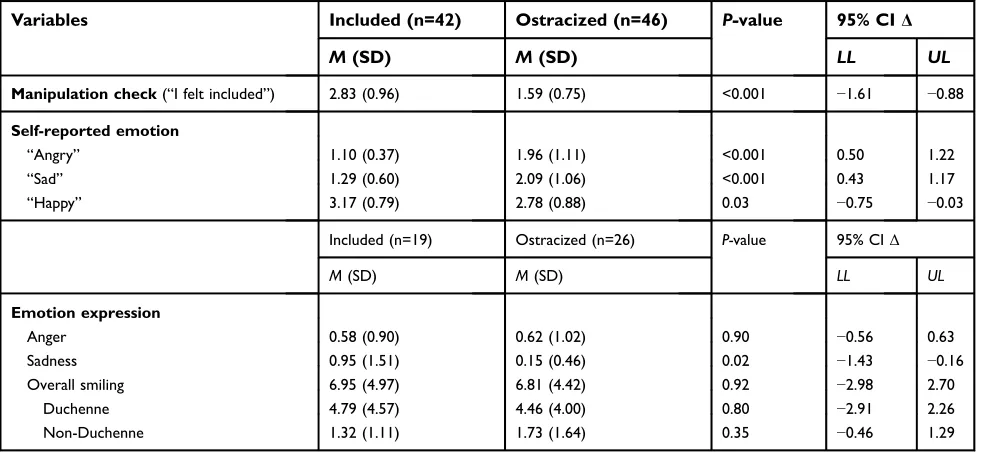
Manipulation checkAs in Experiment 1, ostracized participants felt signifi
-cantly less “included” (M=.54, SD=0.72) than included
participants (M=2.83, SD=0.96, t[86]=6.82, P<0.001)
(Table 3).
Self-reported emotion
Ostracized participants reported significantly lower levels
of happiness,F(1, 85)=2.16,P=0.03,ηp2=0.05 subsequent
to the experimental period, as well as significantly higher
Table 1Age and gender distribution of included vs ostracized participants
Experiment Variables Included Ostracized Significant difference
Experiment 1 Age (M) 20.26 19.89 t53<1;P>0.6
Gender Male =12
Female =15
Male =13 Female =15
χ2=0.02,P>0.8
Experiment 2 Age (M) 22.03 21.03 t68<1;P>0.5
Gender Male =13
Female =29
Male =16 Female =30
χ2
=0.15,P>0.8
Table 2Experiment 1 included vs ostracized participants on negative attitudes and emotion expressions during the interaction
Variables Included (n=27) Ostracized (n=28) P-value 95% CIΔ
M(SD) M(SD) LL UL
Manipulation check(“I felt included”) 2.26 (1.01) 3.39 (1.27) 0.003 0.33 1.58
Negative attitudes toward ostracism sources
Active distancing 2.13 (0.63) 2.80 (0.91) 0.002 0.25 1.10
Reputation defamation 2.32 (0.23) 2.85 (0.66) <0.001 0.26 0.80
Physical aggressiveness 2.20 (0.52) 2.46 (0.78) 0.16 −0.10 0.62
Overall 2.28 (0.27) 2.75 (0.60) 0.001 0.21 0.72
Included (n=23) Ostracized (n=23) P-value 95% CIΔ
M(SD) M(SD) LL UL
Emotion expression
Anger 0.26 (0.54) 0.70 (1.06) 0.09 −0.07 0.94
Sadness 0.00 (–) 0.17 (0.58) 0.16 −0.07 0.42
Happiness 4.91 (2.83) 6.87 (4.53) 0.09 −0.29 4.20
Duchenne smile 2.88 (2.77) 3.52 (2.97) 0.45 −1.07 2.35
Non-Duchenne smile 1.91 (2.59) 3.00 (2.28) 0.14 −0.36 2.54
Notes:N=55, except for emotion expression where N=46. The pattern of results for the manipulation check and retaliatory attitudes are the same regardless of whether the full sample is analyzed or the subset for which emotion expressions were coded.
Psychology Research and Behavior Management downloaded from https://www.dovepress.com/ by 118.70.13.36 on 26-Aug-2020
levels of anger, F(1, 85)=22.96, P<0.001, ηp
2
=0.21, and
sadness,F(1, 85)=−4.31,P<0.001,ηp2=0.18, compared to
included participants (Table 2).
Subsequent analyses focused on the experience of ostracized participants, and the relationships between levels of smiling, both Duchenne and non-Duchenne, dur-ing the experimental period, and self-reported happiness at the conclusion of the experimental interaction. The fre-quency of Duchenne smiling during exclusion was posi-tively related to postexclusion self-reported happiness,
r=0.45,P=0.023, n=26, 95% CI (0.08, 0.71). The
relation-ship between non-Duchenne smiling and postexclusion self-reported happiness, on the other hand, was both
nega-tive and nonsignificant,r=−0.21,P=0.298, 95% CI (−0.55,
0.19). These findings support existing research on the
positive intrapersonal functions of Duchenne smiling
specifically.8 There were no other relations observed
between self-reported postostracism affect and expressed affect.
Emotion expression
A multivariate ANOVA tested the effect of being ostracized on the frequency of smiling (Duchenne and non-Duchenne) , anger, and sadness. The overall multivariate model was
again, not significant, F(4, 40)=1.86, P=0.14. Ostracized
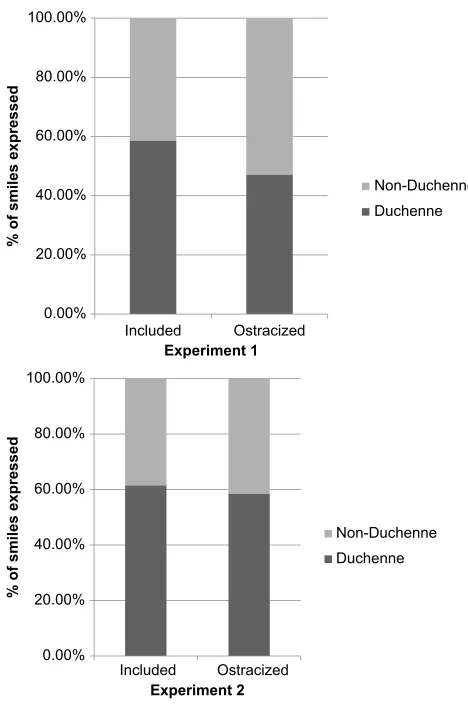
participants, therefore, exhibited levels of smiling, both Duchenne and non-Duchenne, that were statistically equivalent to their included counterparts (see Figure 2 for
a comparison of the proportion of Duchenne vs non-Duchenne smiling in both Experiment 1 and Experiment 2). In Experiment 2, there was no evidence of greater frequencies of negative emotion expressions, and though
there was a significant univariate difference in sadness
expression, ostracized participants actually expressed less
sadness than included participants, F(1, 43)=2.53,
P=0.015,ηp2=0.13 (see Table 4 for a complete report of
all the coded emotion frequencies for both Experiment 1 and Experiment 2).
Thin slice coding
Thin slice coding was performed on ostracized participants only, in order to examine whether the relation of the thin slice coded categories with both emotion expression during ostra-cism, and self-reported emotion postostracism. In general, individuals who expressed more EMFACS-coded sadness and anger during ostracism were also judged as coping less
well with their exclusion; sadnessr=−0.41,P=0.039, 95% CI
(−0.69,−0.02), anger r=−0.42, P=0.032, 95% CI: (−0.70,
−0.04) (n=26 for all the correlations reported). Individuals
who expressed more anger were judged as less able to control
their emotions;r=−0.40,P=0.041, 95% CI (−0.68,−0.02),
and individuals who expressed more sadness were also
judged as experiencing more sadnessr=0.41,P=0.036 95%
CI (0.03, 0.69). Interestingly, ostracized participants who expressed more Duchenne smiling were also judged as
experiencing more amusement, r=0.60, P=0.001, 95% CI
Table 3Experiment 2 included vs ostracized participants on self-reported emotion and emotion expressions during the interaction
Variables Included (n=42) Ostracized (n=46) P-value 95% CIΔ
M(SD) M(SD) LL UL
Manipulation check(“I felt included”) 2.83 (0.96) 1.59 (0.75) <0.001 −1.61 −0.88 Self-reported emotion
“Angry” 1.10 (0.37) 1.96 (1.11) <0.001 0.50 1.22
“Sad” 1.29 (0.60) 2.09 (1.06) <0.001 0.43 1.17
“Happy” 3.17 (0.79) 2.78 (0.88) 0.03 −0.75 −0.03
Included (n=19) Ostracized (n=26) P-value 95% CIΔ
M(SD) M(SD) LL UL
Emotion expression
Anger 0.58 (0.90) 0.62 (1.02) 0.90 −0.56 0.63
Sadness 0.95 (1.51) 0.15 (0.46) 0.02 −1.43 −0.16
Overall smiling 6.95 (4.97) 6.81 (4.42) 0.92 −2.98 2.70
Duchenne 4.79 (4.57) 4.46 (4.00) 0.80 −2.91 2.26
Non-Duchenne 1.32 (1.11) 1.73 (1.64) 0.35 −0.46 1.29
Notes:N=88, except for emotion expression where N=45. The patterns of results for the manipulation check are the same regardless of whether the full sample is analyzed or the subset for which emotion expressions were coded.
Psychology Research and Behavior Management downloaded from https://www.dovepress.com/ by 118.70.13.36 on 26-Aug-2020
(0.28, 0.80), but the same relation did not hold for
non-Duchenne smiling r=−0.01,P>0.96. These results indicate
significant congruence between the expressive behavior as
coded both objectively and using thin-slice impression coding.
The relationship between the observer-coded category
of “amusement” and participant self-reported happiness
was r=0.34, P=0.093. While non-significant, this
correla-tion was not significantly different to that obtained
between Duchenne smiling and self-reported happiness,
z=−0.46,P=0.647, using Fisher’srtoztransformation.
Experiment 2 showed evidence of a self-regulation and display management function of smiling during ostracism in that participants who exhibited more Duchenne smiling during their exclusion also reported higher levels of posi-tive emotion after the ostracism, and were also rated by a group of judges as experiencing more amusement at their exclusion.
Discussion
The present set of experiments adds to the existing evi-dence of positive emotion displays during negative and
aversive interpersonal experiences.9,38 Not only did
excluded participants smile just as much (if not slightly more) than their included counterparts, they also exhibited comparable levels of Duchenne smiling. Moreover, the analyses suggest little to no expression of negative emo-tion by excluded participants, despite the fact they report negative reactions to being excluded, including negative attitudes towards the sources of their exclusion. In
Experiment 2, we were also able to confirm that ostracized
participants smile and manage their facial display despite
the fact they report experiencing significantly higher levels
of negative affect. In sum, facial expressions of emotion in
0.00% 20.00% 40.00% 60.00% 80.00% 100.00%
Included Ostracized
% of smiles expressed
% of smiles expressed
Experiment 1
Non-Duchenne Duchenne
0.00% 20.00% 40.00% 60.00% 80.00% 100.00%
Included Ostracized
Experiment 2
Non-Duchenne Duchenne
Figure 2A comparison of the proportion of Duchenne vs non-Duchenne smile expressions during the experimental interaction for included vs ostracized partici-pants for both Experiment 1 and Experiment 2.
Table 4Experiment 1 and Experiment 2 means across all codable emotion expression types
Emotion expression (as proportion of codable expressions)
Experiment 1 Mean (n=46)
Experiment 2 Mean (n=45)
Significant
differencea
Included Ostracized Included Ostracized
Anger 0.0213 0.0470 0.0391 0.0428
Contempt 0.0839 0.1009 0.1034 0.0487
Disgust 0.0570 0.0357 0.0885 0.0654
Fear 0.0683 0.0074 0.0897 0.0158 1, 2
Happiness 0.6874 0.7074 0.5935 0.7440
Duchenne (felt) happiness 0.4313 0.3409 0.4144 0.4704
Non-Duchenne (unfelt) happiness 0.2561 0.3313 0.1276 0.2300
Sadness 0.0000 0.0204 0.0593 0.0208 2
Positive emotion overall 0.6874 0.7074 0.5935 0.7440
Negative emotion overall 0.2326 0.2096 0.3800 0.1892 2
Notes:Means represent frequency of each emotion expression frequency as a proportion of the number of codable expressions. Codable expressions reflect combinations of key facial actions that are associated with an emotion state coded as an“event”within EMFACS.33 aIndicates in which study (1 and/or 2) the means between included and ostracized participants were significantly different from each other at theα=0.05 level.
Psychology Research and Behavior Management downloaded from https://www.dovepress.com/ by 118.70.13.36 on 26-Aug-2020
ostracized individuals do not betray their exclusion, or the negative attitudes they hold towards the sources of their ostracism.
The results of both experiments indicate that, despite being ignored for the duration of the interaction, ostracized participants continue to show facial expressivity. These results highlight the strong display rules that govern interac-tions with strangers, particularly when those interacinterac-tions are negative and involve exclusion. This research establishes experimental evidence that mirrors the observations from interviews with real-world targets of ostracism who often state that they make attempts to hide their distress and behave
normally, expressing their distress only when alone.39
The current research also found that facial expression in this context was not predictive of the negative reactions that ostracized participants exhibited towards the sources of their exclusion. While there is some evidence that facial expression can provide a guide to subsequent antisocial or
cooperative behavior in children,40regulatory control and
display rule adherence in adults means that facial expres-sion of emotion is not necessarily diagnostic of an
indivi-dual’s social experience or their subsequent behavior.
Thefindings of the present set of studies were obtained
using a novel paradigm that is able to examine expressive
behavior during a finite period of social exclusion. Our
analysis of facial expression in the context of ostracism also offers a different and complementary perspective to the considerable research on the impacts of exclusion on cognition, emotion, and behavior. These studies demon-strate that ostracized participants manage their facial expressions of emotion to a level that is statistically indis-tinguishable from their included counterparts.
Although Duchenne smiling can occur in
non-enjoyment situations, the results of these experiments pro-vide support to the hypothesis that such displays, aside from conforming to display norms, can serve an emotion regula-tion funcregula-tion. The presence of Duchenne smiling in both studies optimistically suggests that ostracized individuals do spontaneously regulate their emotion experience during this time, which in Experiment 2 was also linked to higher levels of postexperimental self-reported happiness. If emo-tion regulaemo-tion is comprised of the relatively maladaptive strategy of suppressing the emotion vs the adaptive strategy of reappraising a situation in order to feel a more positive
emotion,41 individuals that expressed greater levels of
Duchenne smiling may be reappraising the situation,finding
amusement in the experience, and increasing the positive outcomes of an otherwise aversive experience.
Limitations
Thefindings of the present set of studies were obtained using
a novel paradigm that is able to examine expressive behavior
during afinite period of social exclusion. A limitation of this
research is that the significant coding demands tend to limit
the sample size of such studies. Thin-slice coding may pro-vide a viable alternative, in addition to advancements in technological capacities, such as the automated coding of
facial expressions,27and other nonverbal indicators such as
eye movements, all which will greatly enable future research to examine the multitude of information provided by
indivi-duals’nonverbal behavior during ostracism.
The present experimental paradigm also measures facial expressions during a limited time period, which may limit the variability and extent of emotion expression change. It may well be the case that facial expressions of emotion show markedly different patterns when measured in different settings, such as when an ostracized individual recalls the experience of being excluded, or across time, such as when an individual experiences chronic and repeated instances of exclusion (eg, a student who is repeatedly excluded in his or her school and classroom). In instances where individuals are more subtly excluded or where their exclusion is made less conspicuous, more
negative expressions of emotion may emerge.27
Similarly, there is no research to date that examines how facial expressions might also be modulated by the
pre-sence of others, ie, the prepre-sence of ostracism“witnesses”
in addition to the ostracism sources, a situation where the
desire to manage one’s reactions may be even stronger,
and yet the ability to do so more difficult.
Conclusion and future research
Given that ostracism is an aversive experience that
indivi-duals must often “suffer through” in social settings, the
O-Cam paradigm provides an ecologically valid method to study the management of expressive behavior during aver-sive interpersonal experiences, adding to the existing evi-dence of facial display management during other types of
distressing experience.8,38Both experiments reported here
show consistent evidence that ostracized individuals man-age their facial expressions of emotion through what they report to be a highly negative and unpleasant experience,
through the use of significant levels of smiling, and
mini-mal expression of negative emotion.
To the extent that self-regulation is afinite intrapersonal
resource,42 facial display management in the context of
Psychology Research and Behavior Management downloaded from https://www.dovepress.com/ by 118.70.13.36 on 26-Aug-2020
ostracism, such as suppressing or masking negative
emo-tion, may deplete self-regulatory capacity.43Future research
will be able to investigate this possibility, and examine self-regulation failures that are the result of facial display man-agement, such as self-defeating behavior, and less regulated behavior in other tasks or domains (such as resisting
unhealthy food or reduced perseverance in a task).17
Our experiments also show that certain individuals are able to up-regulate positive affect during an aversive experience, which could be observed both in their expres-sive behavior and their emotion self-reports. Future
research will benefit from directly inquiring with targets
of ostracism as to their emotion regulation strategies, which will, in turn, inform any attempt to build resilience to ostracism in vulnerable populations such as children and adolescents. The key to understanding how we can reduce and prevent the negative effects of ostracism in young adults may very well lie in identifying the cogni-tive and regulatory strategies that these ostracized parti-cipants used, and how these strategies may be trained, developed and implemented more broadly.
Acknowledgment
Funded by an ARC Discovery Project Grant DP0666929 to L Zadro (co-investigator M Moulds) as well as Dong-A University Research Fund awarded to D Kim.
Disclosure
Dr Lisa Zadro reports grants from Australian Research Council during the conduct of the study. The other authors
report no conflicts of interest in this work.
References
1. Frijda NH. The Emotions. New York (NY): Cambridge University Press; 1986.
2. Scherer KR. On the nature and function of emotion: a component process approach. In: Scherer KR, Ekman P, editors.Approaches to Emotion. Hillsdale (NJ): Erlbaum; 1984:293–317.
3. Matsumoto D, Keltner D, Shiota MN, O’Sullivan M, Frank MG. Facial expression of emotion. In: Lewis M, Haviland-Jones JM, Feldman Barrett L, editors. Handbook of Emotions. 3rd ed. New York: Guildford Press; 2008:211–234.
4. Goffman E. The Presentation of Self in Everyday Life. Oxford (England): Doubleday; 1959.
5. Ekman P, Friesen WV.Unmasking the Face. Englewood Cliffs (NJ): Prentice Hall; 1975.
6. Keltner D. Evidence for the distinctness of embarrassment, shame, and guilt: a study of recalled antecedents and facial expressions of emotion. Cogn Emot. 1995;10(2):155–172. doi:10.1080/026999396380312 7. Matsumoto D. Cultural influences on facial expressions of emotion.South
Commun J. 1991;56(2):128–137. doi:10.1080/10417949109372824
8. Papa A, Bonnano GA. Smiling in the face of adversity: the inter-personal and intrainter-personal functions of smiling. Emotion. 2008;8 (1):1–12. doi:10.1037/1528-3542.8.1.1
9. Ansfield ME. Smiling when distressed: when a smile is a frown turned upside down. Pers Soc Psychol Bull. 2007;33(6):763–775. doi:10.1177/0146167206297398
10. Kraft TL, Pressman SD. Grin and bear it the influence of manipulated facial expression on the stress response. Psychol Sci. 2012;23 (11):1372–1378. doi:10.1177/0956797612445312
11. Frank MG, Ekman P, Friesen WV. Behavioral markers and recogniz-ability of the smile of enjoyment. J Pers Soc Psychol. 1993;64 (1):83–93. doi:10.1037/0022-3514.64.1.83
12. Ambadar Z, Cohn JF, Reed LI. All smiles are not created equal: morphology and timing of smiles perceived as amused, polite, and embarrassed/nervous. J Nonverbal Behav. 2009;33(1):17–34. doi:10.1007/s10919-008-0059-5
13. Krumhuber EG, Manstead ASR. Can Duchenne smiles be feigned? New evidence on felt and false smiles.Emotion. 2009;9(6):807–820. doi:10.1037/a0017844
14. Gunnery SD, Reuben MA. Perceptions of Duchenne and
non-Duchenne smiles: a meta-analysis. Cogn Emot. 2016;30
(3):501–515. doi:10.1080/02699931.2015.1018817
15. Lustgraaf CJN, Sacco DF, Young SG. Smiling and social perception: evolutionary, neuroscientific, and social cognitive considerations. In: Freitas-Magalhães A, editor.Emotional Expression: The Brain and the Face. Vol. 6. Porto (Portugal): University Fernando Pessoa Press; 2015:115–147.
16. Williams KD, Cheung KT, Choi W. Cyberostracism: effects of being ignored over the internet.J Pers Soc Psychol. 2000;79(5):748–762. doi:10.1037/0022-3514.79.5.748
17. Baumeister RF, DeWall CN, Ciarocco NJ, Twenge JM. Social exclu-sion impairs self-regulation. J Pers Soc Psychol. 2005;88 (4):589–604. doi:10.1037/0022-3514.88.3.421
18. Williams KD.The Power of Silence. New York (NY): Guilford Press; 2001.
19. Blackhart GC, Eckel LA, Tice DM. Salivary cortisol in response to acute social rejection and acceptance by peers.Biol Psychol. 2007;75 (3):267–276. doi:10.1016/j.biopsycho.2007.03.005
20. Eisenberger NA, Leiberman MD, Williams KD. Does rejection hurt?
An fMRI study of social exclusion. Science. 2003;302
(5643):290–292. doi:10.1126/science.1089134
21. Gerber J, Wheeler L. On being rejected: a meta-analysis of experi-mental research on rejection. Perspect Psychol Sci. 2009;4 (5):468–488. doi:10.1111/j.1745-6924.2009.01158.x
22. Smart Richman L, Leary MR. Reactions to discrimination, stigmatization, ostracism, and other forms of interpersonal rejection: a multimotive model.Psychol Rev. 2009;116(2):365–383. doi:10.1037/a0015250 23. Leary MR, Koch EJ, Hechenbleikner NR. Emotional responses to
interpersonal rejection. In: Leary MR, editor.Interpersonal Rejection. New York: Oxford University Press; 2001:145–166.
24. Zadro L. Silent rage: when being excluded and ignored leads to acts of aggression, vengeance, and/or self–harm. In: Forgas JP, Kruglanski A, Williams KD, editors. Social Conflict and Aggression. New York (NY): Psychology Press; 2011:201–216. 25. Staebler K, Renneberg B, Stopsack M, Fiedler P, Weiler M,
Roepke S. Facial emotional expression in reaction to social exclusion in borderline personality disorder. Psychol Med. 2011;41 (9):1929–1938. doi:10.1017/S0033291711000080
26. Kawamoto T, Nittono H, Ura M. Cognitive, affective, and motiva-tional changes during ostracism: an ERP, EMG, and EEG study using a computerized cyberball task. Neurosci J. 2013;304674. doi:10.1155/2013/304674
27. Schaafsma SM, Pfaff DW, Spunt RP, Adolphs R. Deconstructing and reconstructing theory of mind.Trends Cogn Sci. 2015;19(2):65–72. doi:10.1016/j.tics.2014.11.007
Psychology Research and Behavior Management downloaded from https://www.dovepress.com/ by 118.70.13.36 on 26-Aug-2020
28. Chow RM, Tiedens LZ, Govan C. Excluded emotions: the role of anger in antisocial responses to ostracism. J Exp Soc Psychol. 2008;44(3):896–903. doi:10.1016/j.jesp.2007.09.004
29. Ekman P, Friesen WV. Detecting deception from body or face.J Pers Soc Psychol. 1974;29(3):288–298. doi:10.1037/h0036006
30. Murphy N. Using thin slices for behavioral coding. J Nonverbal Behav. 2005;29:235–246. doi:10.1007/s10919-005-7722-x
31. Goodacre R, Zadro L. O-Cam: a new paradigm for investigating the effects of ostracism. Behav Res Methods. 2010;42(3):768–774. doi:10.3758/BRM.42.3.768
32. Yoshimura S. Goals and emotional outcomes of revenge activities in interpersonal relationships. J Soc Pers Relat. 2007;24(1):87–98. doi:10.1177/0265407507072592
33. Ekman P, Irwin W, Rosenberg E. Emotional Facial Action Coding System (EMFACS-8) [Unpublished manuscript]. San Diego (CA): University of California at San Diego; 1994.
34. Ekman P, Friesen WV. The Facial Action Coding System (FACS). A Technique for the Measurement of Facial Action. Palo Alto (CA): Consulting Psychologists Press; 1978.
35. Ekman P, Matsumoto D, Friesen W. Facial expression in affective disorders. In: Ekman P, Rosenberg E, editors.What the Face Reveals: Basic and Applied Studies of Spontaneous Expression Using the Facial Action Coding System (FACS). New York: Oxford University Press; 2005:429–440.
36. Levenson RW FACS/EMFACS emotion predictions [Unpublished computer program]. Berkeley: University of California; 2005. 37. Mason AE, Sbarra DA, Mehl MR. Thin-slicing divorce: thirty seconds of
information predict changes in psychological adjustment over 90 days. Psychological Science. 2010;21:1420–1422. doi:10.1177/ 0956797610381507
38. Keltner D, Bonanno GA. A study of laughter and dissociation: distinct correlates of laughter and smiling during bereavement.J Pers Soc Psycho. 1997;73(4):687–702. doi:10.1037/0022-3514.73.4.687 39. Zadro LOstracism: Empirical studies inspired by real-world
experi-ences of silence and exclusion [dissertation]. Sydney (Australia): University of New South Wales; 2004.
40. Matsumoto D, Haan N, Gary Y, Theodorou P, Cooke-Carney C. Preschoolers’ moral actions and emotions in Prisoner’s Dilemma. Dev Sci. 1986;22(5):663–670.
41. Gross JJ, John OP. Individual differences in two emotion regulation processes: implications for affect, relationships, and well-being.J Pers Soc Psychol. 2003;85(2):348–362. doi:10.1037/0022-3514.85.2.348 42. Muraven M, Baumeister RF. Self-regulation and depletion of
limited resources: does self–control resemble a muscle?Psychol Bull. 2000;126(2):247–259. doi:10.1037/0033-2909.126.2.247 43. Richards JM, Gross JJ. Composure at any cost? The cognitive
con-sequences of emotion suppression.Pers Soc Psychol Bull. 1999;25 (8):1033–1044. doi:10.1177/01461672992511010
Psychology Research and Behavior Management
Dove
press
Publish your work in this journal
Psychology Research and Behavior Management is an international, peer-reviewed, open access journal focusing on the science of psychol-ogy and its application in behavior management to develop improved outcomes in the clinical, educational, sports and business arenas. Specific topics covered in the journal include: Neuroscience, memory and deci-sion making; Behavior modification and management; Clinical
applications; Business and sports performance management; Social and developmental studies; Animal studies. The manuscript manage-ment system is completely online and includes a very quick and fair peer-review system, which is all easy to use. Visit http://www. dovepress.com/testimonials.php to read real quotes from published authors.
Submit your manuscript here:https://www.dovepress.com/psychology-research-and-behavior-management-journal
Psychology Research and Behavior Management downloaded from https://www.dovepress.com/ by 118.70.13.36 on 26-Aug-2020