Don‘t Dis Our Abilities
Nell Tabor Hartley, Robert Morris University, USAJanette Sutphin, Robert Morris University, USA
ABSTRACT
No one questions the need to provide equal employment opportunities for people. Yet, often out of ignorance, employers and co-workers create a discouraging if not hostile environment for people with disabilities. Those who prepare students to enter positions in Human Resources are in positions to make a difference, The authors offer statistics, suggestions and encouragement for the creation of an even playing people for all people who wish to pursue employment opportunities and self sufficiency. We challenge those who teach to continue their leadership in creating attitudinal and behavioral changes.
Keywords: Employment; disabled; leadership; activism
INTRODUCTION
nd, we do have lots of abilities! ―We want to work and pay taxes.‖ (Bender, 2010) The purpose of this presentation and paper is to inform and guide individuals in educational and leadership positions whose daily tasks are to lead and affect organizational change through education, employment practices and policies. Disabilities may be visible or invisible to the naked eye. The co-authors of this paper fall into both categories. Less than one in five people with disabilities (19.2 percent) have been able to secure employment. (Belser, 2010) No one questions the need to provide equal employment opportunities. The reality is that people perceive opportunities differently. People have different personalities, capabilities, thoughts, feelings, needs, and desires. The challenge is to communicate information to audiences who are in positions to enhance opportunities both perceived and real. At stake are issues of self-efficacy and acceptance by others. To quote one researcher: ―Sensitizing employees to the capabilities of people with disabilities and the issues they face is critical.‖(Cole, 2010)
BACKGROUND
Our society was founded upon a belief in personal freedom. All of us have the right to make our own life choices about education, work, religion, relationships, and so forth. Pursuant to this is the fact that a person must be given opportunities to succeed to the extent of his or her abilities and desires. People with disabilities have long been denied the rights of personal freedom and opportunity. Current legislation is changing that. This country has Americans with Disabilities Act of 1990 (ADA), Workforce Investment Act (WIA), Ticket to Work and Work Incentives Act. These pieces of legislation, as well as government agencies, (Equal Employment Opportunity Commission (EEOC) and the U.S. Department of Labor), insist that every employer adheres to the constitutional guarantee that every citizen is entitled to the pursuit of happiness.
Happiness is equated by many to be independence and the realization of potential and acceptance. There is no room in the definition for pity, condescension or limitation of those who by some standards may seem disabled. A famous quote from Beatrice Wright explains this, "A shameful fact cannot be accepted as long as it remains shameful.‖ (Wright, 1960) Unfortunately, many disabled presently have limited opportunities in the workforce. Wilton and Schuer (2006) convey a stark reality for the disabled employee. Programs focused on employment transition typically assume there are sufficient numbers of jobs/employers out there for disabled people wishing to move into paid employment, and that these opportunities provide livable wages, secure employment relations and the necessary ‗flexibility‘ to accommodate workers. Critical scholarship has cautioned that for many workers the contemporary economy produced by ‗globalization, transnational ownership and disinvestments has decreased the opportunities or entry-level employees. Furthermore, the astonishing rise of low-paid unskilled service employment‘ (McDowell 2004, 150; also Dyck and Jongbloed 2000; Cranford et al. 2003) has further frustrated the disabled in
their search for ‗flexible‘ alternatives.
Business leaders like Greg Bebe, CEO of Bayer, have a more enlightened view. In a recent address Bebe, asserted, ―Social Responsibility is big business…Fostering workplace diversity is not only the right thing to do…It‘s also good business. Enterprises that are all-inclusive are the ones where the best talent rises to the top.‖ (Bebe, 2005)
WHO ARE THE DISABLED?
Disability statistics list as many as 43 million people in the United States as being disabled. That‘s about 17% of 250 million; almost 1 out of 5 persons has some form of disability. Easily one third of that number have disabilities related to their being over the age of 65. Fewer than 15 percent have a congenital disability. Motivational speakers insist that we, “Remember that persons with disabilities are persons first and disabled individuals secondly.‖(Buscaglia, 1983, p. 18)
COMPARISONS OF THE DISABLED
People respond to physical, intellectual and emotional shortcomings differently. Often those who know only the ―equipment‖ with which they were born, the negative responses are minimal. For those who develop or experience a disability during or after childhood, the adjustment processes differ. Many people experience, to varying degrees, feelings of denial, mourning, depression, and anger before reaching acceptance of their disabilities. (Dembo et al., 1975)
One way to understand these differences is to review the literature on the complex relationship between personalities and cognition. There are suggestions as to why people adopt different strategies for their social interactions both social and professional. Communication scholar, Donald Smith suggests that employees may be defensive because of something the employer has said or not said. ( Smith, 2008) By way of example, Hartley and Sutphin suggest four categories of strategies people employ to interact with others. The first is risk avoidance – risk acceptance in making decisions about personal interactions. How concerned is a person about the responses of others to his/her unusual appearance or different abilities? Is risk of rejection outweighed by the rewards of inclusion?
Second is ―causal attribution.‖ Does fault exist? Depressed and/or discouraged people systematically ascribe their failure to themselves and success to external factors, like luck. Happy and self-confident people, on the contrary, ascribe success to themselves and failure to external adversities. People respond to the same ―challenges‖ differently. Inherent in the ―pursuit of happiness‖ is our right to self-actualize at our own rate, in our own way, and by means of our own tools. To quote Buscaglia: ―It is incumbent on individuals not to suffer the idea of nonbeing and to find their 'selves.'‖ (Buscaglia, 1983, p. 18)
Third is the axis of assertiveness—passivity. Assertive behavior may be perceived as interpersonal responses involving direct, honest and appropriate verbal and non-verbal expressions of thoughts, feelings and beliefs in ways that do not violate other persons' rights. (Lange, & Jakubowski, 1976). Locus of control, self-confidence, personal adjustment, anxiety, appropriate expression of anger, and acceptance of disability appear to be related to assertiveness. Research by Percell, Berwick and Beigel (1974) indicates that as individuals become more assertive, manifest anxiety decreases, while self-confidence, personal adjustment (Galassi & Galassi, 1974), appropriate expression of anger (Doyle & Briggio, 1981), and acceptance of disability (Morgan & Leung, 1980) increase. Lange and Jakubowski found in their research that those who believe themselves to be accepted are more prone to communication with others that is assertive, direct, and honest. 11 (Lange & Jakubowski, 1976)
1
Pivotal to the issue of assertiveness and societal acceptance of disabilities is the degree to which individuals accept their own disabilities. Acceptance of disability was conceptualized as acceptance of loss (Dembo, Leviton, & Wright, 1975), and a person's acceptance of disability is likely to be associated with better adjustment to disability. According to Dembo et al., acceptance of loss is a process of value changes. The extent of acceptance of disability is associated with the degree that a person (a) recognizes values other than those that are in direct conflict with the disability; (b) deemphasizes those aspects of physical ability and appearance that contradict his or her disabling condition; (c) does not extend his or her handicap beyond actual physical impairment to other aspects of the functioning self; and (d) does not compare himself or herself to others in the areas of limitations but instead emphasizes his or her own more.
The Fourth and final personality characteristic for this discussion is optimism – pessimism. Membership in ―Club Neg‖ (Negativity) is perhaps the major ―deal breaker or maker‖ in our responses to our own differences. Those with lifetime memberships in ―Club Neg‖ spontaneously focus on negative aspects of a situation or scenario or on possible dangers, vs. people who focus on the positive aspects or opportunities. Participants in the Special Olympics earn the admiration of everyone for their optimism.
THE IMPACT OF THE SELF-FULFILLING PROPHECY
The theory of Self-Fulfilling prophecy enhances understanding of the development of risk taking, assertiveness, causal attribution, and optimism. This concept, also known as the Pygmalion Effect, explains that if Person A thinks that Person B is capable of doing something, A will treat B accordingly. If B is treated as though he is incapable, B seems to become incapacitated. In that scenario, the self-fulfilling prophecy has come to pass for Person B. A powerful scene in the movie ―Best Years of Our Lives,‖ shows a very competent war veteran, Homer, dropping a glass after others treat him in the living room as being ―defective.‖
Unwittingly, people create self-fulfilling prophecies for themselves. Success breeds success. Consider what is known about the creation of self-esteem and self-confidence. Developing independence is a natural rite of passage from youth to adulthood. However, independence does not develop in a vacuum. People cannot make reasonable decisions without experience in decision-making, without testing themselves in the world, trying and failing, and trying and succeeding. (Corbett, Froschl, Bregante & Levy, 1983) Stanley Smits, a rehabilitation psychologist and business professor was one of the first to call attention to the need for providing an environment in which there exists a level playing field for people of all abilities. (Smits, 2004)
SUGGESTIONS FOR CREATION OF POSITIVE OUTCOMES
Fairly simple and straightforward: Give Acceptance “as is.” The way that a person perceives his disability is key to the rational acceptance of the fact of disability. Positive acceptance has traditionally been described as a crucial variable in the rehabilitation process because it enables individuals to accept the realities of their disabilities, reorder their values and priorities and continue productive lives. (Dembo, Leviton & Wright, 1975) The acceptance of disabilities of others is the realization of the potential difficulty of a disabling conditions, while at the same time stressing the intrinsic value and ability of the individuals. A strategy to accomplish this is relatively simple: Look beneath the surface. Get to know people and allow honest dialogue. Heinmann and Shontz (1984) and Patrick (1984) emphasize the importance of disability acceptance and appropriate verbal and non-verbal expressions of thoughts, feelings and beliefs in ways that do not violate the other persons' rights. (Lange, & Jakubowski, 1976)
Watch what you say: No labeling, sympathizing condescension or talking in 3rd person about the disabled. Also, a
straightforward observation is that personal questions are often inappropriate. Most women know not to ask a man how he deals with his bulky genitals.
Respect the need people have for independence. Research by Percell, Berwick and Beigel (1974) indicates that as
individuals become more assertive; manifest anxiety decreases, while self-sufficiency increases.
accessible workforce development system for job seekers with disabilities. These nontraditional leaders emerged to create consensus, build local communities, and foster sustainable change. Their vision, perseverance, and direction mobilized groups, spearheaded initiatives, and in some cases, transformed systems.‖ (Hamner, 2008)
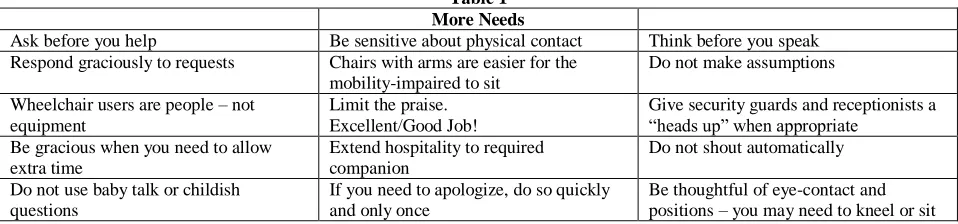
In the spirit of assisting more people to gain bridge-building skills, the authors interviewed seventy-five citizens who are statistically classified as being disabled. Scholars suggest the need for the disability community to help in the identification and communication of ―best practices.‖ (Smits, 2004) Table 1 is a list of the most frequently offered suggestions and observations.
Table 1 More Needs
Ask before you help Be sensitive about physical contact Think before you speak Respond graciously to requests Chairs with arms are easier for the
mobility-impaired to sit
Do not make assumptions
Wheelchair users are people – not equipment
Limit the praise. Excellent/Good Job!
Give security guards and receptionists a ―heads up‖ when appropriate
Be gracious when you need to allow extra time
Extend hospitality to required companion
Do not shout automatically
Do not use baby talk or childish questions
If you need to apologize, do so quickly and only once
Be thoughtful of eye-contact and positions – you may need to kneel or sit
Times are changing, and through education, legislation, and structural accommodations human rights advocates are gaining momentum. A transformation has begun occur in the workplace for disabled persons. Many in the U.S. have been demanding it. An analogous example is the repeal of ―Don‘t Ask, Don‘t Tell,‖ legislation. ―The aim of the Disability Discrimination Act 1995 is to ensure that people with a disability are able to undertake and remain in employment without hindrance and with a little help, if not from their friends then from their employer.‖ (Goldman, 2009) Smits concludes, ―In brief, ‗best practices‘ happen in the disability-employment area when (a) service providers and persons with disabilities have employment as a convergent priority; (b) investments in public awareness create a climate of collaboration and systems integration; and (c) when employers are brought on-board and get involved at a personal level.‖ (Smits, 2004)
Once users become more familiar with the technology, they become more likely to adopt the technology. Similarly, working with disabled individuals should become easier, more familiar, and akin to second nature for people as more disabled enter all levels of the workforce and are accepted co-workers. The time has past for the indulgence of social emotions, of guilt, embarrassment, pride, indignation, sense of justice, envy or shame, that often come unannounced from within our intuitive response system.
We must work together for a cultural tsunami of change in our values, perceptions and ill-conceived notions about the disabled. There must be an end to the attitudinal barriers that exclude the disabled from pursuing the American Dream. This paper is a clarion call for everyone to be supportive of one another; to consider the depth and variety of our abilities. It is time for society to recognize their obligation to welcome disabled workers into mainstream society, as well as, in the employment arena. We have abilities to offer!
AUTHOR INFORMATION
Nell Tabor Hartley, Ph.D. is Professor of Management at Robert Morris University in Pittsburgh, Pa. Her degrees are from Agnes Scott College, University of Illinois and Vanderbilt University. Ectodactylism is a congenital deformity that has the potential of hiding her abilities. She currently serves as an elected board member of the international Organizational Behavior Teaching Society and holds membership in several other professional and civic organizations.
Assistant) internship at the RMU School of Business. Currently, Janette is a graduate representative for the COIE (Council on Institutional Equity). They are charged with examining ways that RMU can be a more inclusive atmosphere for all, in many areas; gender, disabilities, employment, race, religion, contracts, student demographics, curriculum, Veteran's affairs, and sexual orientation. Also, she is affiliated with the Crohn‘s & Colitis Foundation of America and SERVPA.
REFERENCES
1. Bebe, G., President, CEO Bayer Material Science LLC, (2005). Remarks. US Business Leadership Network Annual Conference.
2. Belser, A. (2010, September 19). Challenges met: For Americans with disabilities, finding jobs in a tough economy can be especially difficult. The Pittsburgh Post Gazette, pp. D-1, D-4.
3. Bender, J. (2010) ―Commentary‖ Special Section: ―Diversity Maters‖ p.8 Pittsburgh Post Gazette‖ October
2010
4. Buscaglia,L.F. (1983). The disabled and their parents. New York: Holt, Rinehart and Winston. 5. Cole, Yoji (2010) The Best 4 Ways to Recruit Employees with Disabilities. Annual Editions Human
Resources 09/10. McGraw Hill 27-30.
6. Corbett, K., & Froschl, M., with Bregante, J.L., & Levy, L. (1983). Access to the future: Serving disabled young women. In S. Davidson (Ed.), The second mile: Contemporary approaches in counseling young women. Tucson, AZ: New Directions for Young Women, Inc.
7. Cranford, C., Vosko, L., & Zukewich, N. (2003). The Gender of Precarious Employment in Canada.
Relations Industrielles / Industrial Relations, 58(3), 454-482. Retrieved from Business Source Premier database.
8. Dembo, T., Leviton, G.L. & Wright, B.A. (1975). Adjustment to misfortune: A problem of social-psychological rehabilitation. Rehabilitation Psychology, 22(1), 1-100.
9. Doyle, M.A. & Biaggio, M.K. (1981). Expression of anger as a function of assertiveness and sex. Journal of Clinical Psychology, 37(1), 154-157.
10. Dyck, I. and Jongbloed, L. (2000) Women with Multiple Sclerosis and employment issues: A focus on social and institutional environments. Canadian Journal of Occupational Therapy 67, 337-346. 11. Galassi, J.P. & Galassi, M.D. (1974). Validity of a measure of assertiveness. Journal of Counseling
Psychology, 21, 248-250.
12. Goldman, L., & Lewis, J. (2009). The same, but different?. Occupational Health, 61(4), 12-13. Retrieved from Academic Search Premier database.
13. Hamner, D., Hall, A., Timmons, J., Boeltzig, H., & Fesko, S. (2008). Agents of change in the disability field: bridge-builders who make a difference. Journal of Organizational Change Management, 21(2), 161-173. doi:10.110810953481017.
14. Heinmann, A.W. & Shontz F.C. (1984). Adjustment following disability: Representative case studies,
Rehabilitation Counseling Bulletin, 28(1), 3-13.
15. Lange, A. & Jakubowski, P. (1976). Responsible assertive behavior. Champagne, Illinois: Research Press. 16. McDowell, L. (2004). Work, workfare, work/life balance and an ethic of care. Progress in Human
Geography, 28(2), 145-163. doi:10.1191/0309132504ph478oa.
17. Morgan, B. & Leung, P. (1980). Effects of assertion training on acceptance of disability by physically disabled university students. Journal of Counseling Psychology, 27(2), 209-212.
18. Patrick, G.D. (1984). Comparison of novice and veteran wheelchair athletes‘ self-concept and acceptance of disability, Rehabilitation Counseling Bulletin 27(3) 186-188.
19. Percell, L., Berwick, O. & Biegel, A. (1974). The effects of assertive training on self-concept and anxiety.
Archives of General Psychiatry, 31, 502-504.
20. Smith, D. (2008) Teaching Managers to Relate: Using Feedback To Bolster Commitment and Morale. Journal of Diversity Management, 3(3) 7-12.
21. Smits, S. (2004). Disability and Employment in the USA: the quest for best practices. Disability &
Society,19(6), 647-662. doi:101080/0968759042000252551.
22. Wilton, R., & Schuer, S. (2006). Towards socio-spatial inclusion? Disabled people, neoliberalism and the contemporary labour market. Area, 38(2), 186-195. doi:10.1111/j.1475-4762.2006.00668.x.