STUDY OF A REAL TIME AIRCRAFT LANDING SCHEDULE
WITH AN ATTEMPT TO OPTIMIZE THE SAME USING NON
TRADITIONAL ALGORTHIMS
1C.NITHYANANDAM, 2Dr.G. MOHANKUMAR
1Associate Professor, Hindusthan College of Engineering and Technology,
Coimbatore, Tamilnadu
2Professor and Principal, Park College of Engineering and Technology,
Coimbatore, Tamilnadu
E-mail: 1[email protected]
ABSTRACT
In this percent decade’s, airport scheduling operation are most essential for aircraft landing and takeoff. The radar range control systems act as the brain for the aircraft scheduling operations. Arrival runways are a critical resource in the air traffic system. Arrival delays have a great impact on airline operations and cost. Radar system is to communicate with all the aircrafts within the 200 nautical miles (370 km). In this paper the technique describes the execution time and penalty cost of the each aircrafts. Throughout, we discuss how our formulations can be utilized to model a number of issues (aircraft selection, precedence restrictions, restricting the number of landings and takeoffs in a given time period, runway workload balancing) commonly encountered in practice. Existing techniques does not considered the timing factor, so based on the time factor penalty cost is very high. Many of the techniques are used to reducing the penalty cost whenever possible to landing and takeoff operations are done for the emergency flights. These experiment shows whenever flights landing on the runway at that time no congestion on that particular path, if it’s occur then its seems to be problem. In order to eradicate these problem, neural network and Genetic Algorithms are utilized to eradicate the congestion occur in the runway and also our proposed technique reduced the penalty cost to be charged.
Keywords: Artificial Neural Network, aircraft selection, runway selection, Scheduling, Genetic algorithm
1. INTRODUCTION
Nowadays, airlines play an important role in the transportation, and a major volume of transportation is carried by aircrafts. Typically, the cost of air transportation is much higher than other transportations means [1]. Directed by air traffic controllers, an aircraft must go through an approach stage. The aircraft’s flight number, altitude and speed are transmitted to controllers within the air traffic control tower, when entering the airport radar range [2]. To arrange the safe and effective landings of a continuous flow of aircrafts onto the assigned runway is the ultimate goal of these instructions [3]. Airlines, the users of airports, play a very important role in airport pricing policy in reality because the structure of landing fees impacts airlines operational and management decisions. Practical scheduling constraints and influence on their competitive situations makes airport congestion management policy difficult to implement. [4]From the target time (both earliness
and tardiness), it is to minimize the total deviation of landing time. This problem is recognized to be NP-hard. Therefore, to solve large-scale instances in a reasonable amount of time is not possible [5].
minimum separation between landing aircraft is
required. This separation depends on the weight categories of the aircraft [9].
For incoming aircraft, in the single runway situation the landing sequence implemented is often decided in a first-come first-served manner. The first-come first-served manner is also often used such that aircraft land on their allocated runway, in the same order they appeared in the radar range, when multiple runways are present. [10]. A problem involving a mix of takeoffs and landings are on the same (or on different) runways. In addition, in this paper, we are concerned with the static case of scheduling aircraft landings. [11] Statistical analysis of aircraft arrivals at several major airports in the United States has shown that the distribution of times between estimated arrival times of successive aircraft (estimated when the aircraft are100 miles from their final destinations) is nearly-exponential in character. [12]
Though, frequently in applications the operational environment changes, usually as time passes new information makes it necessary to review the preceding decisions that have been made. As the operational environment changes, such situations are dynamic in the sense that planned decisions repeatedly have to be reconsidered. [13]. It is hard to find the optimal solution to the problem in most cases, due to its complexity. Therefore, it draws important attention from different scientific communities with numerous research studies carried out on modelling and developing algorithms to increase capacity at an airport. [14]
Rest of this paper is organized as follows: the second section presents literature review based on existing works on aircraft scheduling problems. In the third section methodology is described based on artificial neural network and genetic algorithm for the selecting runway of the aircrafts. Fourth section presents results and analysed regarding the proposed technique of the aircraft scheduling. We improve the Genetic algorithm by neural network optimization presented in Section III.
2. LITERATURE REVIEW BASED ON
EXISTING WORK
In 2008, StefaniaGualdiet al. [15] have discussed about the application of multidisciplinary multi body modeling to the analysis of a specific aircraft landing gear-induced unpredictability, known as “gear walk”. Due to the coupling of the LG deflection with the brake anti-skid control system
characteristics, the proposed low frequency fore-and-aft oscillation of the landing gear (LG) was primarily considered. Together with a simple anti-skid model, to predict the onset of the instability, a comprehensive multi body model of an aircraft with a tripod main LG is developed and used. The components used in the multi body model are thoroughly explained and the numerical results obtained are presented and discussed.
In 2008,Jih-GauJuanget al.[16] have presented an intelligent aircraft automatic landing controller that uses recurrent neural networks (RNN) with genetic algorithms (GAs) to progress the performance of conventional automatic landing system (ALS) and monitor the aircraft to a safe landing. To train the RNN that uses gradient-descent of the error function with respect to the weights to perform the weights updates, real-time recurrent learning (RTRL) was applied. Convergence analysis of system error was provided. The control scheme utilizes five crossover methods of GAs to examine optimal control parameters. A simulation shows that, than the conventional controller the proposed intelligent controller has better performance.
In 2012,Reza Tavakkoli-Moghaddam et al. [17] have examined the ways of landing aircraft with the least waiting time in time windows under serious conditions, such as the closest time of landing to the target times for each aircraft or the minimum time of landing the planes. Therefore, minimizing the total cost of the deviation from the target times and minimizing the completion time of the landing sequence are the two conflict objectives that are faced by it. They use a fuzzy programming approach and an estimator for landing the sequence of planes to solve such a problem. With actual landings, the results are compared.
landing attitude when the carrier-based aircraft was
landing on the dynamic deck.
By most of the control towers scheduling aircraft landing is a complex task encountered. In this paper, we study the aircraft landing problem (ALP) in the multiple runway case. In 2011, Ghizlane Bencheikh et al. [19] presented a mathematical formulation of the problem with a linear and nonlinear objective function. In the second part, they consider the static case of the problem where all data are known in advance and they presented a proposed heuristic for scheduling aircraft landing on a single runway, the proposed heuristic was integrated into an ant colony algorithm to resolve the multiple runway case.
During the aircraft landings and take-offs on the airport, the ground staff workload was very large. In this paper we study a landing time in the ACT. In 2011, Nils Boysen et al [20] the support of this decision problem with suited optimization approaches had a long lasting tradition in operations research. For the aircraft landing problem the paper on hand presents three novel objectives, which target at levelling the workload of ground staff by evenly spreading: number of landed passengers, landings per airline, and number of landed passengers per airline over the planning horizon. Mathematical models along with difficulty results were developed and precise and heuristic solution procedures are presented.
In 2011, Chaug-Ing Hsu et al. [21] have developed a stochastic dynamic programming model. This model is developed to optimize airline decisions regarding purchasing, leasing, or disposing of aircraft over time. To forecast passenger traffic and capture the randomness of the demand, Grey topological models with Markov-chain were employed. Rather than to purchase its aircrafts, the results shows that severe demand fluctuations would drive the airline to lease. Our proposed technique would allow better flexibility in fleet management and allows for matching short-term variations in the demand. The proposed technique was provide a useful reference for airlines in their replacement decision making procedure by taking into consideration the fluctuations in the market demand and the status of the aircraft.
In 2011, Qing Liu et al. [22] have presented technique to decrease the flight delays and ease the airport congestion, a space-time network taxi scheduling model integrates the three types of conflicts was used. The aircraft taxiing schedule
problem was transformed to multi-commodity network model, and the Genetic-annealing algorithm was designed to solve the problem in the model. The simulation case showed that optimized schedule results significantly reduced the total taxiing time by 586 seconds of 17 flights compared with FCFS strategy and avoided the potential flight conflicts, which greatly improved airport operational efficiency. Additionally, genetic-annealing algorithm weight out the standard genetic algorithm in convergence rate and solution efficiency.
3. METHODOLOGY STEM WITH
ARTIFICIAL NEURAL NETWORK AND GENETIC ALGORITHM
3.1 Flow Chart
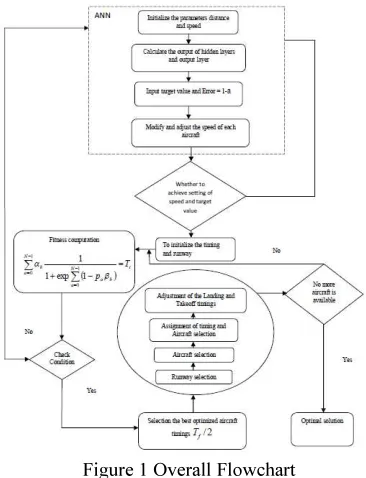
[image:3.595.312.495.410.649.2]According to this technique our goal is to reduce the penalty cost of aircrafts. So I utilize the neural network and Genetic Algorithm. Here we utilize Artificial Neural Network for finding the optimized set of timings and Genetic Algorithm for optimized point in the runway for aircraft.
Figure 1 Overall Flowchart
3.2 Timing Analysis Stem With Neural Network
the neuron can be trained to fire (or not), for
particular input patterns. In the testing mode, when a taught input pattern is detected at the input, its associated output becomes the current output. Here, output is produced by utilizing the parameters such as speed and distance; this is applied to the neural network.
Figure 2 Artificial Neural Network
(
)
∑
= a ab
b P W
R .
) 1 (
(
b b)
th
b F R t
Q = +
(2) a
b ab
ab W LRe P
W = * + . .
(3)
(
b)(
b b)
b
j Q Q d Q
e = .1− . −
(4)
(
−)
∑
(
)
= b b c bc
b Q Q e W
e 1 . .
(5)
( )
(
* **)
* 1 . . .
ab ab b b ab
ab W M LRe P MW W
W = + − + −
(6) Where
a
,b
- each of inputs and layers respectivelya
P
-a
thinput of networkab
W
- established weightb
R
- Internal value of the operationb
t
- established threshold valueb
Q
- Resulting outputth
F
- Activation functionLR
- Learning Rangeb
e
- ErrorM
- Momentum factorIn our technique distance and speed are variability and to find the time of the aircraft travelling on the runways. First of all, initialize all the variable parameters like distance and speed. Calculate the hidden layer weight value of the each input and output layers. Most of the closed loop systems are having the error value that will affect the output of the system. In order to provide the desired output these kinds of procedures are to be follow on. Then modify and adjustment to the
distance and speed values for the desired timings. If the variable values are very high compared to threshold value then the process moved to again input to calculate the hidden layers, if low that value is moved to the Genetic Algorithm input. It is optimized solution of the Artificial Neural Network output. This optimized set of timings is fed to the Genetic algorithm.
3.3 Optimization Process With The Aid Of Genetic Algorithm
Generation of Chromosome
Generation of chromosomes is the function of the randomly generated set of chromosomes (set of genes). Our proposed technology helps to collect all the scheduling time from the Artificial Neural Network output for allocating the separate runway for each aircraft landing and takeoff operation.
Fitness Computation
Fitness computation is best way for finding the optimization solution on the chromosomes. Our proposed technology is required to apply all the timing to the fitness computation, in this value should mainly based on the weight factor of the all chromosome timings.
(
)
T
t N a b a N a b p = − +
∑
∑
− = − = 1 0 10 1 exp 1
1 β α ) 7 (
T
p
T
s N a b n i a t N a bn
= − − +∑
∑
∑
− = − = − = 1 0 1 0 1 0 )) ( ( 1 exp 1 1 β α ) 8 ( bα
, bβ
-- weightsT
t= Total time taken for the flight to reach thedestination point
T
s=Signal Time, when the waiting flight gets thesignal.
p
a= Input time parameters
Selection of best chromosomes
All the chromosomes are producing different fitness value. We have to select the minimum value of the fitness value chromosomes. They are called parent chromosomes. In our proposed technology to utilized the best timing chromosome. We have to select only the minimum fitness value for each aircrafts both operations.
Select the optimized scheduling time = Tf/ 2
Tf --- Number of population
Crossover
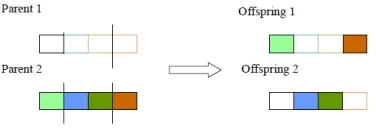
In reproduction contains the crossover and mutation operation. The crossover operation is having many methods to produce the offspring. They are one point, two point, uniform, and arithmetic crossover.
Two point Crossover
[image:5.595.312.510.331.743.2]A crossover operates by randomly selecting a crossover point within a chromosome then interchanges the two parent chromosomes between these points to produce two new offspring. When recombined the chromosomes it avoids genes at the head and genes at the tail of a chromosome are always split
Figure 3 Two point crossover
Mutation
Mutation is the function of the generating new offspring from the single parent and maintained the diversity of the each chromosome. There is a chance to get a gene of a child to change randomly. This gene performance is better than the old parents. Mutation having two methods they are random and alternate method.
Figure 4 Mutation
Here I used the two point crossover for further operation. In our technique this crossover and
mutation operation having the runway selection, aircraft selection, assigned and modifying the aircraft timings and aircraft selection. Runway selection is the important operation of the airport radar control system that it provides the information for each aircrafts. In this radar system it usually covers about 300 km range that is analysed whenever one aircraft is within the range so that it can communicate to the aircraft system. If the speed of the aircrafts is slow the aircraft control system checks if any aircrafts are detected within the radar range then assigns the timing and runway for that aircraft. Assign and adjustment of the timings happens under the crossover and mutation area. If no more aircrafts are available in this area, there will not be any problem to occur.
3.4 Objective Function
s a
a
a A L a P
E ≤ ≤ ∀ ∈ (10)
(
L S E)
d abS A A ba b ab a ab a
b≥ + − + − × ∀ , (11)
s a
a
a
T
A
a
P
e
≥
−
∀
∈
s a
a
a
T
E
a
P
e
≤
−
∀
∈
≤
0
z s a aa
A
T
a
P
l
≥
−
∀
∈
s a
a
a
L
T
a
P
l
≤
−
∀
∈
≤
0
s a a aa T e l a P
A = − + ∀ ∈
(12)
b a b a d d ba
ab+ =1 ∀ , ≠ (13)
a
s
d
bbaa
,
=
0
∀
0
≥
aA
andd
ab∈
{ }
0
,
1
s a
a
a
e
l
a
P
A
,
,
≥
0
∀
∈
max
minZ=C
(14)
s a
a
a
A
L
a
P
E
≤
≤
∀
∈
(
L
S
E
)
d
a
b
S
A
A
ba b ab a ab ab
≥
+
−
+
−
×
∀
,
a
S
A
C
ab
a
+
∀
≥
maxb
a
b
a
d
d
baab
+
=
1
∀
,
≠
a
s
d
bb
aa
,
=
0
∀
0
≥
a [image:5.595.95.283.435.499.2]
a
A
- Landing time for aircraft a a(
a
∈
P
)
a
e
- How soon aircraft a lands before aT
(
a
∈
P
)
a
l
- How late aircraft a lands after aT
(
a
∈
P
)
a
g
- Unit costs for aircraft a landing earlier thanthe target time
a
h
- Unit costs for aircraft a landing later than thetarget time
ab
S
- Separation time between aircraft a and b,where a lands before b
a
T
- Target time for aircraft aa
E
- Earliest possible time of landing aircraft a aL
- Latest possible time of landing aircraft aotherwise
before
lands
aircraft
if
d
ab
=
,
0
,
1
maxC
- Completion time[
a
E
,L
b] predetermined landing time window for aircraft a.Select Optimized Timings
(
)
T
( ) opt t N a b a N a b p = − +∑
∑
− = − = 1 0 10 1 exp 1
1
β
α (15)
( )
T
p
T
opt s N a b n i a t N a bn
= − − +∑
∑
∑
− = − = − = 1 0 1 0 10 1 exp 1 ( ( ))
1 β α ) 16 ( ( )
T
t opt - optimized total time taken for the flightto reach the destination point
( )
T
s opt - optimized signal time, when the waitingflight gets the signal
In this section, each aircraft operation was computed by its optimized timings. This is the optimized solution for our proposed technique. Based on optimized timings, the penalty cost has been evaluated. This is clearly explained in the upcoming section.
3.5 Computing Penalty cost
Penalty cost depends on the timings (delay and past landing flight timings). The main reason for collecting the cost is unnecessary usage of fuel. Even a single unit is reduced in timing factor that is also useful for reducing penalty cost.
Delay time = Scheduled time – flight arriving time (17) (18)
= Money charged 1 Unit = 20 seconds
1 unit charge = 40 $ (~ 2180)
4. RESULTS AND DISCUSSION
This section discussed the experimental results of our proposed method for reducing penalty cost using Genetic Algorithm.
Table I Output Timings And Cost For Each Aircrafts.
Distance Speed Time Penalty
cost 1
Optimal point
Time Conserved
Penalty cost 2
Proposed P.C
3.5
135 942.4804 1884.961 3.4125 117.8103 235.6205 1649.341 130 942.5024 1885.005 3.0625 353.4524 706.9047 1178.1 125 944.4554 1888.911 2.8875 473.2154 946.4308 942.4802
4
125 941.0439 1882.088 3.2 528.7089 1057.418 824.67
120 940.7168 1881.434 3.7 234.3148 468.6297 1412.804
115 994.1699 1988.34 3.1 640.7399 1281.48 706.86
4.2
135 942.5045 1885.009 4.095 117.8282 235.6564 1649.353 130 944.0367 1888.073 3.885 237.0767 474.1535 1413.92 120 939.8455 1879.691 3.675 350.7954 701.5909 1178.1
5.2
135 936.6971 1873.394 4.55 347.6471 695.2943 1178.1
130 941.2509 1882.502 4.68 293.506 587.0119 1295.49
125 940.8345 1881.669 4.94 175.7331 351.4661 1530.203
Normal scheduling process
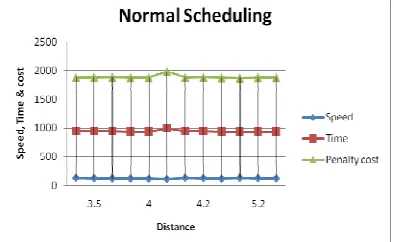
[image:7.595.92.289.390.511.2]This graph expressed as the normal timings of the each aircraft to landings on the particular runway.
Figure 5: Normal Scheduling Process
In afore showed graph, X-axis comprise of distance and Y-axis has speed, time and cost. The combination of these three clearly shows that the speed, time and penalty cost is incorporated with each other and their relation also clearly defined in the above graph.
Peak point optimization
This graph explains the optimized point based speed, time and cost Optimization.
Figure 6: Optimized Point Based Speed, Time And Cost Optimization
In this optimized solution graph, we consider the optimized pick point distance in x- axis and speed, time and penalty costs are in y-axis. This graph explains the variation of penalty cost on various optimized pick point. Amid all the optimized point first and seventh point gets lower penalty cost. While the sixth getting higher penalty cost. Then by analysing this graph we conclude that the penalty cost purely depends on time. So, that the conserved time will certainly reduce the penalty cost.
[image:7.595.309.507.611.734.2]Penalty Cost
In this penalty cost estimation graph, the normal computation of penalty cost is compared with the proposed optimal point detection estimated graph; this shows that our proposed technique is better than the normal free running penalty cost computing. This penalty cost graph is plotted for runway distance and penalty cost. In the above graph blue colour marked line shows the penalty cost for free running aircraft, and the red colour shows that the penalty cost computed for optimal point detection. This graph clearly shows that our proposed technique is betted and it reduces the penalty cost.
5. CONCLUSION
The existing technique normally viewed on the aircraft landings and flight delay timings this delay and landing time information has not be said in the existing technique. So, the proposed technique provides the solution for landing timings of the aircraft along with the midpoint selection. Here we utilize Artificial Neural Network for generating data set and Genetic Algorithms for optimization. In our proposed work, the ultimate aim is to eradicate the congestion occurred between the emergency and normal landing. Conflict occur when emergency occur on the other landing time, in this case penalty cost charged for emergency flight. In order to minimize the penalty cost our proposed technique is more efficient to minimize the penalty cost.
REFERENCE
[1] Amir Salehipour, Mohammad Modarres and Leila Moslemi Naeni,"An efficient hybrid meta-heuristic for aircraft landing problem”,
Computers & Operations Research, pp.1-7, 2012
[2] H. Pinol and J.E. Beasley,"Scatter Search and Bionomic Algorithms for the aircraft landing problem”, European Journal of Operational Research, Vol.171, pp.439-462, 2006
[3] Sheng-Peng Yu, Xian-Bin Cao and Jun Zhang,"A real-time schedule method for Aircraft Landing Scheduling problem based on Cellular Automation”, Applied Soft Computing, Vol.11, pp.3485-3493, 2011
[4] Wenbin Wei,"Impact of landing fees on airlines’ choice of aircraft size and service frequency in duopoly markets”, Journal of Air Transport Management, Vol.12, pp.288-292, 2006
[5] Amir Salehipour, MohammadModarres and LeilaMoslemiNaeni, “An efficient hybrid meta-heuristic for aircraft landing problem”,
Computers & Operations Research
[6] Anne Mercier, Jean-Fran.cois Cordeaub and Fran.cois Soumis,"A computational study of Benders decomposition for the integrated aircraft routing and crew scheduling problem”,
Computers & Operations Research, Vol.32, pp.1451-1476, 2005
[7] Anne Mercier and François Soumis,"An integrated aircraft routing, crew scheduling and flight retiming model".Computers & Operations Research,Vol.34,pp.2251-2265,2007
[8] M.J. Soomer and G.M. Koole,"Fairness in the Aircraft Landing Problem", pp.1-19, 2008 [9] M.J. Soomer and G.J. Franx, “Scheduling
aircraft landings using airlines’ preferences”,
European Journal of Operational Research, Vol. 190, pp. 277–291, 2008
[10] H. Pinol and J.E. Beasley, “Scatter Search and Bionomic Algorithms for the aircraft landing problem”, European Journal of Operational Research, Vol. 171, No. 1, pp. 439–462, 2006 [11] Andreas T. Ernst, Mohan Krishnamoorthy and
Robert H. Storer,"Heuristic and Exact Algorithms for Scheduling Aircraft Landings", pp.229-241, 1999
[12] Hamsa Balakrishnan and Bala Chandran,"Scheduling Aircraft Landings under Constrained Position Shifting"pp.1-23, 2006 [13] JE Beasley, M Krishnamoorthy, YM Sharaiha1
and D Abramson,"Displacement problem and dynamically scheduling aircraft landings",Journal of the Operational Research Society,Vol.55,pp.54-64, 2004
[14] Mohammad Mesgarpour,Chris N. Potts and Julia A. Bennell,"Models for Aircraft Landing Optimization",pp.1-4
[15] Stefania Gualdi, Marco Morandini and Gian Luca Ghiringhelli, "Anti-skid induced aircraft landing gear instability”, Aerospace Science and Technology, Vol.12, pp.627-637, 2008
[16] Jih-Gau Juang , Hou-Kai Chiou and Li-Hsiang Chien,"Analysis and comparison of aircraft landing control using recurrent neuralnetworks
and genetic algorithms
approaches",Vol.71,pp.3224-3238,2008
[17] Reza Tavakkoli-Moghaddam, Mojtaba
Yaghoubi-Panah and Farzad
[18] Zhang Wen, Zhang Zhi, Zhu Qidan and Xu Shiyue,"Dynamics Model of Carrier-based Aircraft Landing Gears Landed on Dynamic Deck ",Chinese Journal of Aeronautics,Vol.22,pp.371-379,2009
[19] Ghizlane Bencheikh, Jaouad Boukachour and Ahmed EL Hilali Alaoui,"Improved Ant Colony Algorithm to Solve the Aircraft Landing Problem”, International Journal of Computer Theory and Engineering, Vol.3, No.2, pp.224-233, 2011
[20] Nils Boysen, Malte Fliedner, “Scheduling aircraft landings to balance workload of ground staff”, Computers & Industrial Engineering,
Vol. 60, pp. 206–217, 2011
[21] Chaug-Ing Hsu, Hui-Chieh Li, Su-Miao Liu and Ching-Cheng Chao, “Aircraft replacement scheduling: A dynamic programming approach”, Transportation Research, Vol. E, No.47, pp. 41 – 60, 2011
[22] Qing Liu a Tongshui Wu a, b Xianfei Luo, “A space-time network model based on improved genetic algorithm for airport taxiing scheduling problems”, Procedia Engineering, Vol. 15, pp. 1082 – 1087, 2011