R E S E A R C H A R T I C L E
Open Access
Predictive validity of a new integrated selection
process for medical school admission
Paul L Simpson
1, Helen A Scicluna
1, Philip D Jones
1, Andrew MD Cole
2, Anthony J O
’
Sullivan
1, Peter G Harris
1,
Gary Velan
3and H Patrick McNeil
4,5*Abstract
Background:This paper is an evaluation of an integrated selection process utilising previous academic achievement [Universities Admission Index (UAI)], a skills test [Undergraduate Medicine and Health Sciences Admission Test (UMAT)], and a structured interview, introduced (in its entirety) in 2004 as part of curriculum reform of the undergraduate Medicine Program at the University of New South Wales (UNSW), Australia. Demographic measures of gender, country of birth, educational background and rurality are considered.
Method:Admission scores and program outcomes of 318 students enrolled in 2004 and 2005 were studied. Regression analyses were undertaken to determine whether selection scores predicted overall, knowledge-based and clinical-based learning outcomes after controlling for demographics.
Results:UAI attained the highest values in predicting overall and knowledge-based outcomes. The communication dimension of the interview achieved similar predictive values as UAI for clinical-based outcomes, although predictive values were relatively low. The UMAT did not predict any performance outcome. Female gender, European/
European-derived country of birth and non-rurality were significant predictors independent of UAI scores. Conclusion:Results indicate promising validity for an integrated selection process introduced for the Medicine Program at UNSW, with UAI and interview predictive of learning outcomes. Although not predictive, UMAT may have other useful roles in an integrated selection process. Further longitudinal research is proposed to monitor and improve the validity of the integrated student selection process.
Keywords:Student selection, Predictive validity, Predicting, Performance, Demographics
Background
Coinciding with a significant rise in demand for medical education has been increasing scholarly and public inter-est about how to binter-est select medical students. The trad-itional use of prior academic achievement for medical student selection has been challenged in recent decades on the basis that it unfairly advantaged students from higher socio-economic backgrounds and excluded many students who would likely become exceptional medical practitioners [1,2]. Since the late 1990s the use of three selec-tion tools has become common practice among Australian medical schools to address such concerns [1,3]. These
tools assess prior academic achievement, cognitive skills and personal characteristics as measured through second-ary school academic ranking, Undergraduate Medicine and Health Sciences Admissions Test (UMAT) and a structured interview, respectively.
A critical issue noted in the literature is establishing the validity of the UMAT and interview [1,4-6]. Prior academic achievement is the strongest predictor of aca-demic performance at university for a range of disci-plines including medicine [7-10]. Studies have shown mixed results regarding the ability of prior academic achievement to predict performance in the later years of medicine [5,10-12].
The UMAT is a test to measure cognitive skills and an understanding of people. UMAT annual reports in-dicate good internal reliability and validity (Australian Council for Educational Research - ACER, 2011), and
* Correspondence:[email protected] 4
South Western Sydney Clinical School, Faculty of Medicine, University of New South Wales, Sydney, Australia
5
Department of Rheumatology, Liverpool Hospital, Locked Bag 7103, Liverpool BC NSW 1871, Australia
Full list of author information is available at the end of the article
while good construct validity has been reported for the UMAT, sections measuring cognitive abilities [13] and its predictive validity have been disappointing [5,14]. However, some assert that UMAT’s value lies more in predicting medical internship and practice performance, thus more longitudinal studies are called for [14].
Studies looking at interview validity have shown mixed results: one study reported low predictive validity yet interview scores predicted Year 4 clinical-based outcomes better than prior academic achievement [14], whilst an-other found the communication skills dimension pre-dicted performance in the later years of the program specifically clinical skills [5]. Recent studies looking at interview validity have largely focused on the Multiple Mini-Interview (MMI), which has been found to predict clinical skills in later years of the program [15]. Due to resource costs and mixed validity results, the interview remains a controversial method [6]. While some Schools in Australia, like the University of Queensland have aban-doned its use [16], others claim such a move is premature [1,17]. Some scholars argue that non-cognitive assess-ments such as the interview add value to academic criteria thus justifying its use as part of the selection process [3,5,18], while others have reported its value in introdu-cing changes relating to student demographics in terms of gender balance and ethnicity [19].
A lot of the focus on UMAT and the selection interview is, understandably, framed by efforts to achieve high pre-dictive validity. However, efforts to improve predictions of student performance may meet with various degrees of success as a function of the original purpose of the pre-dictive variable of interest [11].
The UMAT and interview were originally included in UNSW’s selection process to serve as tools to distinguish between applicants who meet the criteria of a high UAI, to differentiate students with variable motivations to study medicine (e.g. expose those motivations that stem from social pressures, family expectations), to include assessment of non-academic capabilities, and to enhance and preserve student diversity. Thus, an important ori-ginal reason for employment of the UMAT and interview at UNSW was based on the rationality of differentiation, rather than predicting specific program outcomes, whilst recognising that validity would be examined at a later stage when data and resources permitted. As a conse-quence, this original function is likely to impact on pre-dictive relationship values. Small sample sizes and range restriction of predictor and criterion variables may also affect the ability to achieve high validity coefficients [20].
Student demographics should also be considered to de-termine their role in predicting selection tool performance and Medical Program outcomes [21]. Accounting for the effects of demographics on performance outcomes has
largely been confined to measurements of ethnicity [11,22-24]. This study examined country of birth, gender and socio-economic measures relating to educational background and rurality.
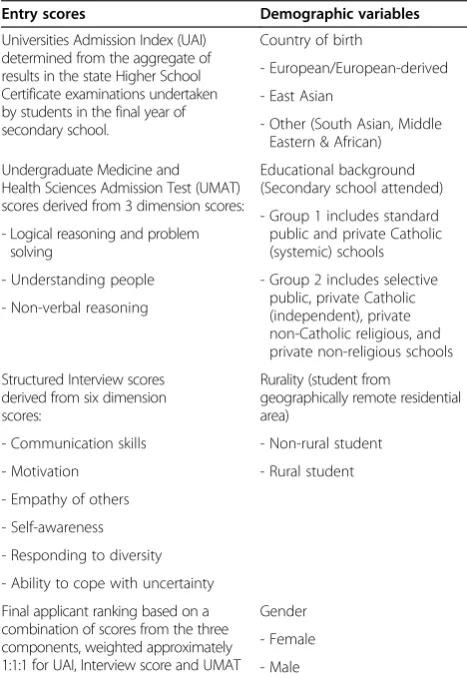
At UNSW, an integrated multi-dimensional selection system has been adopted in which performance of appli-cants in each of the three components of UAI, UMAT and interview, are equally weighted in the calculation of a final ranking (see Table 1). During the year prior to entry, applicants submit an application form and struc-tured curriculum vitae, which asks applicants to respond preliminarily to material that would be explored in greater detail at interview, and which requires the appli-cant’s school to provide a predicted UAI. Interviews are offered based on the applicants’known UMAT and pre-dicted UAI outcomes. A second round of interviews is held for applicants whose actual UAI outcomes were much better than predicted by their school. Once all in-terviews are completed, scores for all three variables (actual UAI, UMAT and interview) are standardised and combined to determine a ranked order of offer for places in the UNSW program.
Table 1 Predictor variables examined in the study
Entry scores Demographic variables
Universities Admission Index (UAI) determined from the aggregate of results in the state Higher School Certificate examinations undertaken by students in the final year of secondary school.
Country of birth
- European/European-derived
- East Asian
- Other (South Asian, Middle Eastern & African)
Undergraduate Medicine and Health Sciences Admission Test (UMAT) scores derived from 3 dimension scores:
Educational background (Secondary school attended)
- Group 1 includes standard public and private Catholic (systemic) schools - Logical reasoning and problem
solving
- Understanding people - Group 2 includes selective public, private Catholic (independent), private non-Catholic religious, and private non-religious schools - Non-verbal reasoning
Structured Interview scores derived from six dimension scores:
Rurality (student from
geographically remote residential area)
- Communication skills - Non-rural student
- Motivation - Rural student
- Empathy of others
- Self-awareness
- Responding to diversity
- Ability to cope with uncertainty
Final applicant ranking based on a combination of scores from the three components, weighted approximately 1:1:1 for UAI, Interview score and UMAT
Gender
- Female
The interview instrument developed at UNSW is de-signed around a biographical assessment of the appli-cant’s life context and experiences which had led to a desire to pursue a medical career, and the motivation for this. Interviewers score an applicant in a range of dimen-sions, including for example empathy towards others, communication skills, and coping with uncertainty. An identical process is utilised to select students who meet criteria for entry as ‘rural entry’, although these cants compete for dedicated places reserved for appli-cants with a rural origin.
This study aimed to evaluate the integrated selection process for medicine introduced at UNSW in 2003 by determining the predictive validity of prior academic performance UAI, UMAT and interview, controlling for student gender, country of birth, educational background and rurality.
Methods
Participants
The first two student cohorts assessed using the new se-lection process and who were successful in entering the new outcomes-based UNSW Medicine Program in 2004 and 2005 [25], were included in the study. Student pro-gram outcomes were tracked over six years of study. International and Indigenous students admitted via a dif-ferent entry pathway were excluded from analyses. Ac-cordingly, data on 318 students (149 from the 2004 cohort and 169 from the 2005 cohort) were analysed. Where students repeated an assessment, their first out-come was used for analysis.
Demographic, UAI, and educational outcome data were also available from 304 students who studied the previous discipline-based medicine program in 2002 and 2003. The 2002 cohort (145 students) were selected through a rank-ing based on UAI scores alone, whereas the 2003 cohort (159 students) were selected using the new selection process. Analyses of these two cohorts provide some insight into effects of different selection processes for stu-dents undertaking the same discipline-based program.
Predictor variables
Predictor variables included admission scores and demo-graphic variables. The six interview and three UMAT di-mension scores were included in the regression model. Dimensions were used because total scores are constituted by different (though probably overlapping) constructs. Interview dimensions include communication skills, mo-tivation, empathy of others, self-awareness, responding to diversity, and ability to cope with uncertainty. UMAT di-mensions are verbal reasoning, understanding of people, and non-verbal reasoning.
Table 1 outlines the demographic variables and their categorisations considered for analysis. Demographic
variables include: gender; country of birth (COB); educa-tional background; and rurality. COB was firstly cate-gorised into five groups informed by the Australian Standard Classification of Cultural and Ethnic Groups [26]. Due to small numbers of students in some of these groups, groups were collapsed into three broad groups: (i) European (including European colonial-derived countries of Australia, New Zealand and USA); (ii) East Asian; and (iii) Other. The term “European” was used rather than “Caucasian”. This is because Caucasian “white” people are a heterogeneous grouping who, and/or whose par-ents, may come from such diverse areas as Europe, North Africa, the Middle East and East Asia. Given this, the authors consider that the term“Caucasian”as a classi-fication is better replaced with identiclassi-fications based on geographic origin and migration history [27].
Educational background derives from the following Australian secondary schools students attended: selective or standard public school (a selective school is a school that admits students on the basis of an academic selec-tion criteria, whereas a standard school has no selecselec-tion criteria except residential proximity of the student to the school); private systemic or independent Catholic school (systemic referring to a number of schools belonging to a system, whereas independent schools are not part of a system); private Protestant school; private non-Christian religious school and; private non-religious school. These schools were categorised into two ordinal groups reflect-ing levels of educational advantage as perceived by the wider community [28]. Group 1 consisted of standard public and private Catholic (systemic) schools. Group 2 comprised private Protestant, private Catholic (independ-ent), private non-Christian, private non-religious schools, and public selective schools.
Rurality considers the geographical remoteness of the student’s primary and secondary schools and residential address. Accordingly, students were categorised as either ‘rural students’or‘non-rural students’.
Performance outcomes
derive from written examinations. Outcome scores were percentile-based rather than grade-based. For the 2002 and 2003 cohorts, performance outcomes examined were average marks at end of years 2, 4 and 6.
Statistical analysis
To address range restriction and different score vari-ances across 2004–5 cohorts, standardised scores were calculated for UAI, interview and UMAT total scores using standard competition ranking andZ-score conver-sion. In standard competition ranking scores of equal value receive the same ranking number, and then a gap is left in the ranking numbers (e.g. 1, 2, 2, and 4). Data were analysed using SPSS (version 22). Demographic and admission data were compared between 2004 and 2005 cohorts using one-way ANOVA and chi-squared analysis.
Pearson correlation coefficients were calculated for ad-mission (total) scores by performance outcomes, as well as for UAI and selected yearly average scores across 2002 and 2003 cohorts who entered the old Medicine Program. Hierarchical multiple regression analyses were performed with interview dimensions scores, UMAT di-mension scores, UAI and demographics as predictors. WAM (phase 1 and program final), clinical skills (phase 1 and 3) and knowledge examinations (phase 1 and 3) scores were used as six separate criterion. Data assump-tions relating to normality, linearity, homoscedasticity and tolerance were satisfactorily met before running re-gression analyses. Pearson correlation coefficients were also calculated for UAI by UMAT and interview total and dimension-item subtotal scores in order to examine divergent validity.
Ethics approval from the UNSW Human Research Ethics Committee (reference No. 2011-7-27) was obtained.
Results
Student characteristics
For the 2004 and 2005 cohorts, the mean age was 18.5 years and ranged from 16 to 31 years; 54% were fe-male, 46% male. Most were born in countries that were European/European-derived (64%) followed by East Asian (22.6%) and other countries (i.e. South Asian, Middle Eastern or African (13.4%). Forty three per cent attended a public selective high school, 31% private non-Catholic, 13% standard public, 7% private independent Catholic, 6% private systemic Catholic and 1% went to private non-Christian or non-religious schools. In terms of school categories: 81% attended Group 2 schools and 19% went to Group 1 schools. Over three quarters (78%) were non-rural students. No significant differences were found between 2004 and 2005 cohorts for age, gender, COB and rurality numbers. No significant differences in
UAI, UMAT and interview total scores were found be-tween 2004 and 2005 cohorts.
Comparison of the first cohort admitted using the new integrated selection process (2003) with those previously admitted using the UAI alone (2002) showed no statisti-cally different changes in socio-demographic characteris-tics. The mean ages were 18.24 and 17.97 years for the 2002 and 2003 cohorts respectively. Females comprised 56% of accepted students in 2003, compared to 57.3% for 2002 entry. In 2003, 59% were of European descent, 34.5% were of East Asian descent, and 6.5% were born in other countries compared with 53%, 43.2% and 4.0% respectively in 2000–2002. Whereas all students admitted in 2002 achieved a UAI≥99.75, only 42.6% of students ad-mitted in 2003 were above this cut off. The median UAI of the 2003 admitted cohort was 99.65. Thus, the new in-tegrated selection system opened up more than half of the previous places offered on the basis of UAI alone to appli-cants with a broader range of capabilities, attributes, and abilities, without major changes to socio-demographic characteristics. Furthermore, students admitted under the new integrated process appeared more motivated to pursue medicine as evidenced by a much lower year 1 discontinuation rate of <2% for the 2003–2005 cohorts compared to 6-10% for cohorts admitted in the years up to 2002 selected on UAI only.
Divergent validity
Total and dimension-item subtotal scores were analysed for divergent validity as evidenced through low and/or inverse Pearson correlation coefficients. For interview, UMAT and UAI total scores, Pearson correlation coeffi-cient was −0.17. For UAI, interview dimension-items and UMAT dimension-items, the correlation coefficient was 0.30. The higher correlation coefficients for the UAI, interview items and UMAT dimension-items stem from higher inter-item correlations between UAI and the UMAT dimension-items ‘Reasoning Skills’ and ‘Non-verbal Reasoning Skills’. These latter inter-correlations while significant (r= 0.32,p< 0.001;r= 0.31, p< 0.001), were regarded as unlikely to influence regres-sion analysis.
Correlation coefficients
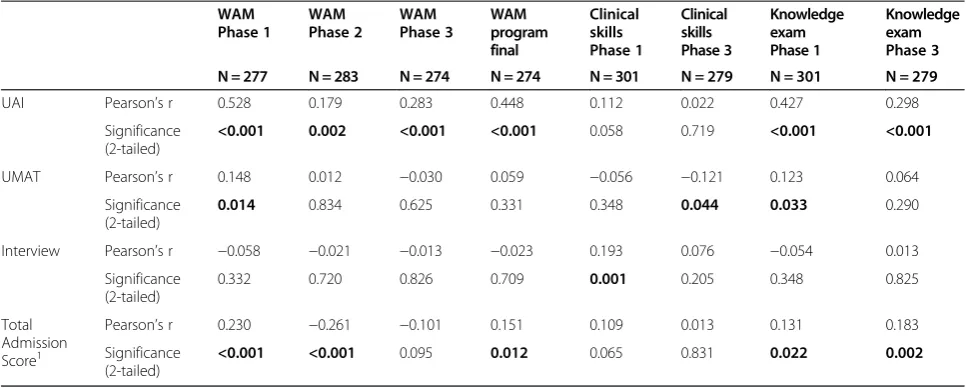
examination phase 1 (0.12,p< 0.05) scores. The interview significantly correlated with clinical skills for phase 1 only (0.19, p < 0.01). Total admission scores correlated with WAM phase 1 (0.23,p <0.01), WAM program final (0.15, p< 0.05) and knowledge examination scores phase 1 and 3 (0.13,p <0.01 and 0.18,p <0.01).
Correlation coefficients for old selection process and new selection process with UAI
Students admitted in 2002 based on UAI alone com-prised a cohort with a very narrow UAI range of 0.25 (99.75 to 100). Thus, correlations between entry criteria and educational outcomes were not considered valid. The 2003 cohort admitted under the integrated process had a UAI range of 5 (95 to 100). For this cohort, signifi-cant correlations (p< 0.01) were evident between UAI and year 2 average (r = 0.37), year 4 average (r = 0.52), year 6 average (r = 0.38) and overall program average (r = 0.52).
Regression analysis
WAM
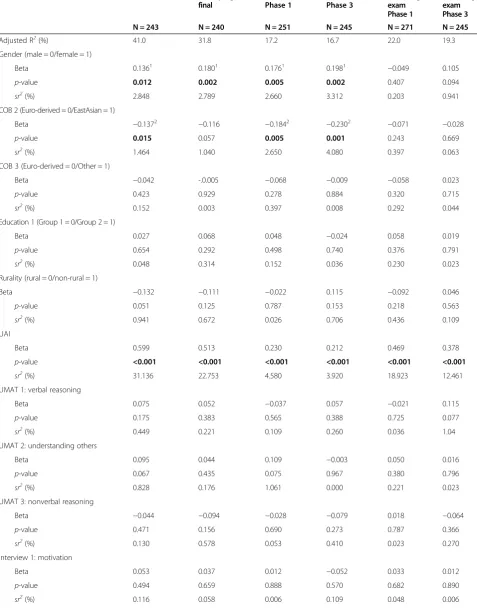
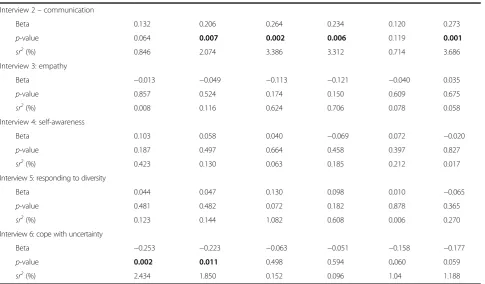
The amount of variance in WAM phase 1 accounted for by predictors (adjusted R2) was 41.0% and decreased to 31.8% by the end of the program (see Table 3). Signifi-cant predictors for both WAM phase 1 and WAM pro-gram final scores were UAI (p <0.001) and the interview dimension ‘cope with uncertainty’ (p <0.01, phase 1; p <0.05, program final). The ‘cope with uncertainty’ interview dimension showed a negative prediction for WAM phase 1 and WAM program final scores. The inter-view communication skills dimension was a significant predictor of WAM program final only (p <0.01). Gender (p <0.05, female) and COB (p <0.05, European descent)
were also significant predictors for WAM phase 1, with only gender (p <0.01, female) maintaining statistical sig-nificance for WAM program final. The ‘cope with un-certainty’ dimension decreased its unique contribution to WAM variance (sr2
) from phase 1 to program final [2.4% to 1.9% unique variance] and gender maintained its unique variance [2.8%].
Clinical skills
The amount of variance in clinical skills phase 1 accounted for by predictors (adjusted R2) was 17.2% and decreased by phase 3 to 16.7% (see Table 3). Significant predictors for both clinical skills phase 1 and 3 scores were UAI (p <0.01) and the communication skills dimension (p <0.01). Gender (female, p <0.01) and COB (p <0.01, European descent) also significantly predicted clinical skills for phase 1 and 3. UAI scores and the communication skills dimension accounted for the highest unique variances (sr2
) towards clinical skills phase 1 at 4.6% and 3.4%, decreasing to 3.9% and 3.3% by phase 3. Gender (female) and COB (European descent) both accounted for 2.7%% variance in phase 1 in-creasing to 3.3% and 4.1%, respectively.
Knowledge examinations
The amount of variance in knowledge examination scores phase 1 accounted for by predictors (adjusted R2) was 22.0% and decreased to 19.3% by phase 3 (see Table 3). UAI was a significant predictor for both phase 1 and 3 (p <0.01). The communication skills dimension (p <0.01) significantly predicted phase 3 scores. UAI accounted for the highest unique variance (sr2) (18.9% for phase 1, de-creasing to 12.5% by phase 3). The communication skills dimension accounted for 3.7% unique variance of phase 3.
Table 2 Pearson correlation coefficients for total admission scores and performance scores
WAM WAM WAM WAM
program final
Clinical skills
Clinical skills Phase 3
Knowledge exam Phase 1
Knowledge exam Phase 1 Phase 2 Phase 3
Phase 1 Phase 3
N = 277 N = 283 N = 274 N = 274 N = 301 N = 279 N = 301 N = 279
UAI Pearson’s r 0.528 0.179 0.283 0.448 0.112 0.022 0.427 0.298
Significance (2-tailed)
<0.001 0.002 <0.001 <0.001 0.058 0.719 <0.001 <0.001
UMAT Pearson’s r 0.148 0.012 −0.030 0.059 −0.056 −0.121 0.123 0.064
Significance (2-tailed)
0.014 0.834 0.625 0.331 0.348 0.044 0.033 0.290
Interview Pearson’s r −0.058 −0.021 −0.013 −0.023 0.193 0.076 −0.054 0.013
Significance (2-tailed)
0.332 0.720 0.826 0.709 0.001 0.205 0.348 0.825
Total Admission Score1
Pearson’s r 0.230 −0.261 −0.101 0.151 0.109 0.013 0.131 0.183
Significance (2-tailed)
<0.001 <0.001 0.095 0.012 0.065 0.831 0.022 0.002
1
Table 3 Regression models of the relationship between admission scores (dimensions), demographic variables and performance scores
WAM Phase 1 WAM program final
Clinical skills Phase 1
Clinical skills Phase 3
Knowledge exam Phase 1
Knowledge exam Phase 3
N = 243 N = 240 N = 251 N = 245 N = 271 N = 245
Adjusted R2(%) 41.0 31.8 17.2 16.7 22.0 19.3
Gender (male = 0/female = 1)
Beta 0.1361 0.1801 0.1761 0.1981 −0.049 0.105
р-value 0.012 0.002 0.005 0.002 0.407 0.094
sr2(%) 2.848 2.789 2.660 3.312 0.203 0.941
COB 2 (Euro-derived = 0/EastAsian = 1)
Beta −0.1372 −0.116 −0.1842 −0.2302 −0.071 −0.028
р-value 0.015 0.057 0.005 0.001 0.243 0.669
sr2(%) 1.464 1.040 2.650 4.080 0.397 0.063
COB 3 (Euro-derived = 0/Other = 1)
Beta −0.042 -.0.005 −0.068 −0.009 −0.058 0.023
р-value 0.423 0.929 0.278 0.884 0.320 0.715
sr2(%) 0.152 0.003 0.397 0.008 0.292 0.044
Education 1 (Group 1 = 0/Group 2 = 1)
Beta 0.027 0.068 0.048 −0.024 0.058 0.019
р-value 0.654 0.292 0.498 0.740 0.376 0.791
sr2(%) 0.048 0.314 0.152 0.036 0.230 0.023
Rurality (rural = 0/non-rural = 1)
Beta −0.132 −0.111 −0.022 0.115 −0.092 0.046
р-value 0.051 0.125 0.787 0.153 0.218 0.563
sr2(%) 0.941 0.672 0.026 0.706 0.436 0.109
UAI
Beta 0.599 0.513 0.230 0.212 0.469 0.378
р-value <0.001 <0.001 <0.001 <0.001 <0.001 <0.001
sr2(%) 31.136 22.753 4.580 3.920 18.923 12.461
UMAT 1: verbal reasoning
Beta 0.075 0.052 −0.037 0.057 −0.021 0.115
р-value 0.175 0.383 0.565 0.388 0.725 0.077
sr2(%) 0.449 0.221 0.109 0.260 0.036 1.04
UMAT 2: understanding others
Beta 0.095 0.044 0.109 −0.003 0.050 0.016
р-value 0.067 0.435 0.075 0.967 0.380 0.796
sr2(%) 0.828 0.176 1.061 0.000 0.221 0.023
UMAT 3: nonverbal reasoning
Beta −0.044 −0.094 −0.028 −0.079 0.018 −0.064
р-value 0.471 0.156 0.690 0.273 0.787 0.366
sr2(%) 0.130 0.578 0.053 0.410 0.023 0.270
Interview 1: motivation
Beta 0.053 0.037 0.012 −0.052 0.033 0.012
р-value 0.494 0.659 0.888 0.570 0.682 0.890
Effect of rural-entry students
When regression analyses were performed excluding students admitted under the rural entry scheme, there were no significant changes in any statistical outcomes reported compared to analyses of all local-entry students (data not shown).
Discussion
This study aimed to evaluate an integrated selection process for the Medicine Program introduced at UNSW by determining the predictive validity of the three selec-tion methods; UAI, UMAT and structured interview, controlling for student gender, COB, educational back-ground and rurality. Divergent validity was also exam-ined and results indicate acceptable levels of divergence between UAI, UMAT and the interview.
Predictive validity findings reported were mixed; UAI was the strongest predictor of WAM and knowledge-based outcomes. Although demonstrating a small pre-dictive value, the communication skills dimension was statistically significant in predicting clinical capability, as well as final WAM outcomes, and combined knowledge outcomes for the final two years of study. An unexpected finding was that the ‘cope with uncertainty’ dimension scored during interview had negative predictive value
for WAM outcomes. The UMAT was not a significant predictor of any outcome. Female gender and European or European-derived COB presented somewhat consist-ently as statistically significant predictors of WAM and clinical competency despite having relatively small pre-dictive values.
Prior academic achievement
Consistent with previous findings, prior academic achieve-ment was the strongest predictor of overall program and knowledge-based outcomes [5,9,10,16,29]. This finding re-inforces the use of academic performance as a robust and valuable component of the selection process. Prior aca-demic achievement also demonstrated small yet signifi-cant predictive values for clinical skills.
UMAT
Consistent with previous studies, the UMAT and its dimen-sions showed poor prediction of outcomes [5,14]. Never-theless, as discussed below the UMAT may serve an important function to help differentiate amongst a large number of applicants with high academic performance. Evaluating the validity of this process was not possible in this study and requires further research.
Table 3 Regression models of the relationship between admission scores (dimensions), demographic variables and performance scores(Continued)
Interview 2–communication
Beta 0.132 0.206 0.264 0.234 0.120 0.273
р-value 0.064 0.007 0.002 0.006 0.119 0.001
sr2(%) 0.846 2.074 3.386 3.312 0.714 3.686
Interview 3: empathy
Beta −0.013 −0.049 −0.113 −0.121 −0.040 0.035
р-value 0.857 0.524 0.174 0.150 0.609 0.675
sr2(%) 0.008 0.116 0.624 0.706 0.078 0.058
Interview 4: self-awareness
Beta 0.103 0.058 0.040 −0.069 0.072 −0.020
р-value 0.187 0.497 0.664 0.458 0.397 0.827
sr2(%) 0.423 0.130 0.063 0.185 0.212 0.017
Interview 5: responding to diversity
Beta 0.044 0.047 0.130 0.098 0.010 −0.065
р-value 0.481 0.482 0.072 0.182 0.878 0.365
sr2(%) 0.123 0.144 1.082 0.608 0.006 0.270
Interview 6: cope with uncertainty
Beta −0.253 −0.223 −0.063 −0.051 −0.158 −0.177
р-value 0.002 0.011 0.498 0.594 0.060 0.059
sr2(%) 2.434 1.850 0.152 0.096 1.04 1.188
1
Students categorised as female result in criterion increase.
2
Interview
Of the selection methods, the communication skills di-mension emerged as one of the strongest predictors of clinical outcomes, but on the other hand its predictive and unique variance values were relatively small. The communication dimension predicted final WAM out-comes and combined knowledge outout-comes for the final two years, albeit also with small predictive values. On the surface these two seemingly contrasting statements point to respective ‘for’and ‘against’arguments relating to the use of the interview. Yet given the reported issues that the achievement of high predictive values may be thwarted [19], as well as the socially informed policy fac-tors, it is reasonable to suggest that removing the use of the interview based solely on the predictive validity find-ings of this study is likely to be a hasty decision. The lower year 1 discontinuation (drop-out) rates for the in-tegrated process that includes the interview suggests its value in differentiating between applicants with variable motivations to pursue a medical career. Additionally, the communication dimension predicted final WAM out-comes and combined knowledge outout-comes for the final two years, albeit with small predictive values as well.
The assessment of whether a student has developed clinical capability, while fundamental to the Medicine Pro-gram, represents a complex and fluctuating endeavour when compared to developing knowledge-based skills. This is because clinical capability is likely to be a multidi-mensional construct compared to specific scientific know-ledge [30]. Such construct complexity arguably has an unstable effect on the validity of ‘clinical skills’as a criter-ion, potentially compromising its relationship to predic-tors. Furthermore, the relationship between the original differentiating function of the interview and UMAT and pursuing high degrees of predictive validity deserves con-sideration. That is, given the UMAT and interview were originally designed to assist in distinguishing students with very similar high UAI scores, and not for predicting spe-cific or overall program outcomes, placing sole onus on such selection methods to deliver high predictive values alone may be tenuous.
Demographics
Literature examining demographic effects on outcomes has been largely confined to measures of ethnicity [23], with some recent studies reporting on gender effects [5,11]. This study demonstrated small yet statistically significant effects for gender, and country of birth. Simi-lar to other studies, females outperformed their male counterparts in overall program and clinical skills out-comes [5,31]. Further, consistent with comparable re-search [22,23], students who were born in European/ European-derived countries outperformed students born in East Asia in clinical skills outcomes and overall
program outcomes for the first two years of study. Eth-nic differences in medical school performance have been found to be a consistent feature in the UK and such findings should not be considered atypical or as a local problem [23]. It is likely these differences relate to wider structural and social class inequalities that to various degrees permeate local level institutions and practices [32,33].
Although measures of educational background and rur-ality are commonly unexamined within selection method evaluation studies, this study found no effect of these demographics. One interpretation of this finding is that the university environment provides students with uni-form learning opportunities that rescind any disadvantage that may come from living in a remote location, as well as educational advantage that may come from secondary school attended. However, there is no evidence that the authors are aware of to support this interpretation. Rather, studies looking at the relationships between secondary school and university performance have suggested to the contrary [34,35]. However, these studies have only exam-ined first year university performance. Another interpret-ation could be that our methods of school categorisinterpret-ation may have blunted any observable effects. The lack of effect of rural status on outcomes is encouraging and requires replication in future studies to assure this lack of effect.
Conclusion
This study evaluated the new selection process introduced at UNSW and confirms the importance of prior academic achievement in predicting student performance. Small yet statistically significant effects relating to gender and COB were also found. This demonstrates that demographic variables, including those typically unexamined in medical education research, should be considered and further researched.
Predictive validity findings for the communication di-mension of the interview also demonstrated statistically significant effects. Although on the surface, the smaller effect of interview compared to academic performance may lend support for abandoning the use of the inter-view, we must also consider other factors located both internally and externally to evaluation discourses premised on predictive validity. When these factors are considered, findings suggest the assessment of communication skills through the interview combined with prior academic achievement are valuable components within an inte-grated student selection process.
Competing interests
The authors declare that they have no competing interests.
Authors’contributions
PLS drafted the manuscript, participated in the design of the study, and performed the statistical analysis. HAS participated in the design, coordination and helped to draft the manuscript. PDJ conceived of the study and participated in its design. AMDC participated in its design and helped to draft the manuscript. AJO helped to draft the manuscript. PGH helped to draft the manuscript. GMV helped to draft the manuscript. HPM conceived of the study, participated in its design and edited the manuscript. All authors read and approved the final manuscript.
Authors’information
Paul L. Simpson, BSc (Psych), PhD is a Research Officer, Faculty of Medicine, University of New South Wales, Sydney, Australia.
Helen A. Scicluna MEd, PhD (Medicine) is a Senior Lecturer, Faculty of Medicine, University of New South Wales, Sydney, Australia.
Philip D. Jones MBBS, MHEd, PhD is the Associate Dean (Education) Faculty of Medicine, University of New South Wales, Sydney, Australia.
Andrew M.D. Cole BSc (Hons), MBBS (Hons) is a Conjoint Associate Professor, School of Public Health and Community Medicine, Faculty of Medicine, University of New South Wales, Sydney, Australia.
Anthony J. O’Sullivan MBBS, MD, MHPEd is an Associate Professor in Medicine, Faculty of Medicine, University of New South Wales, Sydney, Australia. Peter G. Harris MBBS is a Senior Lecturer, Faculty of Medicine, University of New South Wales, Sydney, Australia.
Gary M. Velan MBBS, Grad Dip HEd, PhD is an Associate Professor in Pathology, School of Medical Sciences, Faculty of Medicine, University of New South Wales, Sydney, Australia.
H. Patrick McNeil MBBS, PhD, Grad Dip HEd is a Professor of Rheumatology, South Western Sydney Clinical School, Faculty of Medicine, University of New South Wales, Sydney, Australia.
Acknowledgements
We are grateful to Gordon Rees for his help in gathering the data.
Author details
1Faculty of Medicine, University of New South Wales, Sydney, Australia. 2
School of Public Health & Community Medicine, Faculty of Medicine, University of New South Wales, Sydney, Australia.3School of Medical
Sciences, Faculty of Medicine, University of New South Wales, Sydney, Australia.4South Western Sydney Clinical School, Faculty of Medicine,
University of New South Wales, Sydney, Australia.5Department of
Rheumatology, Liverpool Hospital, Locked Bag 7103, Liverpool BC NSW 1871, Australia.
Received: 16 December 2013 Accepted: 9 April 2014 Published: 23 April 2014
References
1. Powis D:Selecting medical students.Med J Aust2008, 188(6):323–324.
2. O'Neill L, Vonsild MC, Wallstedt B, Dornan T:Admission criteria and diversity in medical school.Med Educ2013,47(6):557–561.
3. Mercer A:Who gets in and who doesn’t? Selecting medical students: an Australian case study.Educ Res Perspect2009,36(1):i.
4. McManus IC, Ferguson E, Wakeford R, Powis D, James D:Predictive validity of the Biomedical Admissions Test: an evaluation and case study.
Med Teach2011,33(1):53–57.
5. Mercer A, Puddey IB:Admission selection criteria as predictors of outcomes in an undergraduate medical course: a prospective study.
Med Teach2011,33(12):997–1004.
6. Salvatori P:Reliability and validity of admissions tools used to select students for the health professions.Adv Health Sci Educ Theory Pract2001, 6(2):159–175.
7. Cooney G:The Tertiary Entrance Rank: An endangered species?In Bringing Assessment and Curriculum Issues Together.Sydney; 2001. 8. Wilkinson D, Zhang J, Byrne GJ, Luke H, Ozolins IZ, Parker MH, Peterson RF:
Medical school selection criteria and the prediction of academic performance.Med J Aust2008,188(6):349–354.
9. Wright SR, Bradley PM:Has the UK Clinical Aptitude Test improved medical student selection?Med Educ2010,44(11):1069–1076.
10. Shulruf B, Poole P, Wang GY, Rudland J, Wilkinson T:How well do selection tools predict performance later in a medical programme?Adv Health Sci Educ Theory Pract2012,17(5):615–626.
11. Ferguson RL, Brennan RL:Some issues of predictive validity related to college admission testing programs.InAnnual meeting of the National Council on Measurement in Education.San Francisco: ERIC, ED 171800; 1979. 12. Roberts WL, Pugliano G, Langenau E, Boulet JR:Modeling relationships
between traditional preadmission measures and clinical skills performance on a medical licensure examination.Adv Health Sci Educ Theory Pract2012,17(3):403–417.
13. Griffin B, Carless S, Wilson I:The Undergraduate Medical and Health Sciences Admissions Test: what is it measuring?Med Teach2013, 35(9):727–730.
14. Wilkinson D, Zhang J, Parker M:Predictive validity of the undergraduate medicine and health sciences admission test for medical students’ academic performance.Med J Aust2011,194(7):341–344. 15. Eva KW, Reiter HI, Trinh K, Wasi P, Rosenfeld J, Norman GR:Predictive
validity of the multiple mini-interview for selecting medical trainees.
Med Educ2009,43(8):767–775.
16. Wilkinson D, Zhang J, Byrne G, Luke H, Ozolins I, Parker M, Peterson R: Medical school selection criteria and the prediction of academic performance: evidence leading to change in policy and practice at the University of Queensland.Med Educ2008,188(6):349–354.
17. Harding D, Wilson I:Medical school selection criteria and the prediction of academic performance.Med J Aust2008,189(4):234–235.
18. Pesken C, Detsky A, Shandling M:Effectiveness of medical school admissions criteria in predicting residency ranking four years later.
Med Educ2007,41(1):57–64.
19. Puddey I, Mercer A, Carr S, Louden W:Potential influence of selection criteria on the demographic composition of students in an Australian medical school.BMC Med Educ2011,11(1):97.
20. Griffin B:Predictive validity of the UMAT for medical students’academic performance.Med J Aust2011,195(2):102.
21. Puddey I, Mercer A:Socio-economic predictors of performance in the Undergraduate Medicine and Health Sciences Admission Test (UMAT).
BMC Med Educ2013,13(1):155.
23. Woolf K, Potts HWW, McManus IC:Ethnicity and academic performance in UK trained doctors and medical students: systematic review and meta-analysis.BMJ2011,342:d901.
24. Utzman RR, Riddle DL, Jewell DV:Use of demographic and quantitative admissions data to predict performance on the national physical therapy examination.Phys Ther2007,87(9):1181–1193.
25. McNeil HP, Hughes CS, Toohey SM, Dowton SB:An innovative outcomes-based medical education program built on adult learning principles.Med Teach 2006,28(6):527–534.
26. ABS:Australian Standard Classification of Cultural and Ethnic Groups.In Canberra: Australian Bureau of Statistics.2nd edition. 2011.
27. Bhopal R, Donaldson L:White, European, Western, Caucasian, or what? Inappropriate labeling in research on race, ethnicity, and health.Am J Public Health1998,88(9):1303–1307.
28. Public or Private:Where’s the Evidence?2004. http://www.acer.edu.au/enews/ 2004/08/public-or-private-wheres-the-evidence.
29. Hughes P:Can we improve on how we select medical students?J R Soc Med2002,95(1):18–22.
30. Mercer A:Selecting Medical Students: An Australian Case Study [PhD thesis]. Murdoch University; 2007.
31. Ferguson E, James D, Madeley L:Factors associated with success in medical school: systematic review of the literature.BMJ2002, 324(7343):952–957.
32. Bedi R, Gilthorpe MS:Social background of minority ethnic applicants to medicine and dentistry.Br Dent J2000,189(3):152–154.
33. Woolf K, Cave J, Greenhalgh T, Dacre J:Ethnic stereotypes and the underachievement of UK medical students from ethnic minorities: qualitative study.BMJ2008,337:a1220.
34. Win R, Miller P:The effects of individual and school factors on university students’academic performance.AUSER2005,38(1):1–18.
35. Dodson IR, Skuja E:Secondary schooling: tertiary entry ranks and university performance.People Place2005,13(1):53–62. 36. Edwards D, Friedman T, Pearce J:Same admissions tools, different
outcomes: a critical perspective on predictive validity in three undergraduate medical schools.BMC Med Educ2013,13(1):173.
doi:10.1186/1472-6920-14-86
Cite this article as:Simpsonet al.:Predictive validity of a new integrated
selection process for medical school admission.BMC Medical Education
201414:86.
Submit your next manuscript to BioMed Central and take full advantage of:
• Convenient online submission
• Thorough peer review
• No space constraints or color figure charges
• Immediate publication on acceptance
• Inclusion in PubMed, CAS, Scopus and Google Scholar
• Research which is freely available for redistribution